To W.C.W. M.D.

It’s now 1916—well not really—but allow me immediate mode for the time being. Some early 20th Century Modernist characters we’ve already met are about to collaborate in New York City with a largely forgotten figure whose words we’ll meet today.

The Provincetown Playhouse, that CBGB’s of Modernist American theater, has moved its organization from the remote Cape Cod artist’s colony to New York’s Greenwich village, and they’re still looking for new types of plays by new playwrights. How about drama using Modernist poetry?

Verse drama, despite continuing productions of Shakespeare, is a thing that often generates rumors of revival while never really reviving. In 1916, the Provincetown group was open to trying this. Which poets can come up with something?

Alfred Kreymborg could. Kreymborg was a leading networker or influencer in the New York area for Modernist poetry. Ezra Pound, and then Amy Lowell, would publish anthology books of Imagist Poets. Harriet Monroe out of Chicago was also gathering new Modernist work for Poetry  magazine. In 1916 Kreymborg would do the same in New York, with a magazine and anthology book series called “Others.”  Kreymborg had also been writing poetry, short poems mostly, all of them free verse. Now a play.

Others group

The “Others” group: L to R in back: Jean Crotti, Marcel Duchamp, Walter Arensberg, Man Ray, R. A. Sanborn, Maxwell Bodenheim. In front: Alison Hartpence, Alfred Kreymborg (bowtie daddie), William Carlos Williams (w/ Internet click-bait cat) and Skip Cannell


The play he wrote is an odd thing to describe. Titled “Lima Beans,”  it’s a two-character play about a couple. The husband loves lima beans, the wife decides he might also like string beans and surprises him with the new beans—but no, he loves lima beans. He stalks off, angry. She scrambles and gets some lima beans. He realizes he loves his wife, returns and she’s got lima beans for him. Kiss. Curtain.

I guess this could be a Seinfeld  episode plot decades later, but that’s not how Kreymborg uses it. He writes his play with litanies of repeated words, hocketing between the two voices. After reading the play this month, I’m guessing a performance might sound like a cross between Dr. Suess’ Green Eggs and Ham  and a late 20th Century Minimalist musical work by someone like Phillip Glass or Meredith Monk. Or as Preston Sturges’ Sullivan would have it, Waiting for Godot  plus vegetables—but with a little sex in it. That musical comparison is particularly apt, because even though the play did not use musical accompaniment, Kreymborg saw it as a musical structure.

So here in 1916 we have the Provincetown group, putting on a play that pioneered a performance aesthetic that still seems audacious 50 or 60 years later. Who are you going to get as actors to realize this—words and a presentation of thought conveyed musically, without actual music?

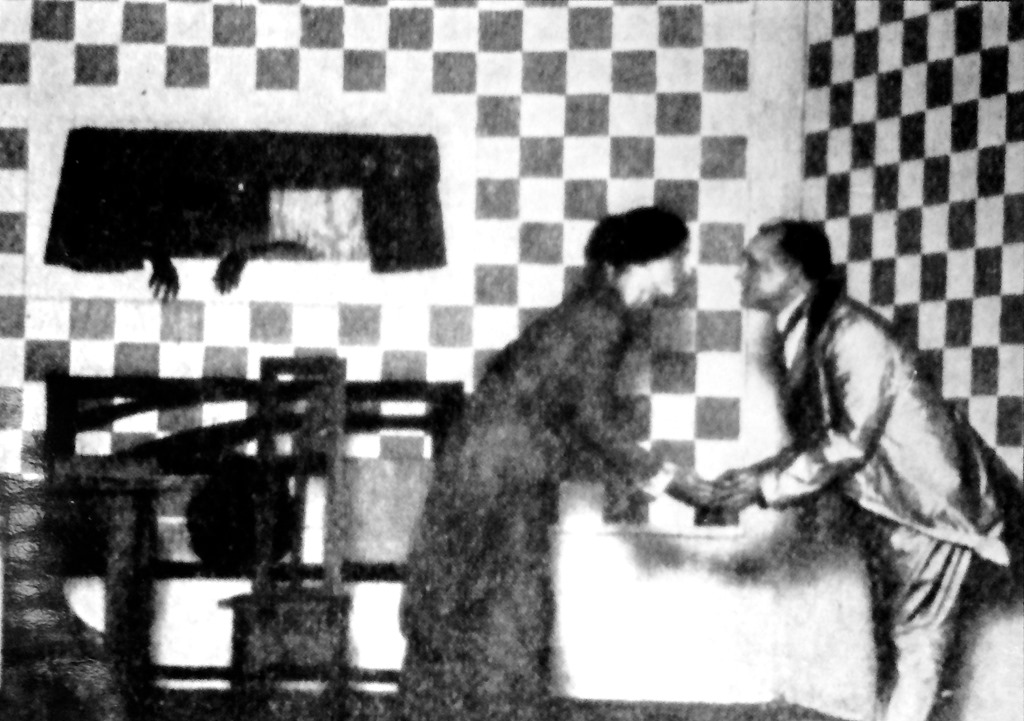
Poets.  In the role of the husband, William Carlos Williams. In the role of the wife, Mina Loy, who had just arrived in New York after getting away from those Italian Futurists. Neither poet had acted before, but Kreymborg rehearsed the two poets until they could present his free-verse vision.

Loy and Williams in Lima Beans

Mina Loy and William Carlos Williams in Lima Beans. The set for the proudly independent Provincetown Playhouse production cost $2.50, and its set designer, William Zorach,  also played the 3rd character whose hands are hanging, Soupy Sales-like, out the window.


I toyed with the idea of trying to realize Lima Beans  here, although with music this time. But it really needs two voices, and I wasn’t sure that a short section could do justice to the structure of the piece.

In it’s place, I looked for a short poem of Kreymborg’s to use instead. This proved more difficult than I thought it would be. I read his two poetry collections from this era, but no poem grabbed my attention. As in the play, he’s looking for a new poetic language in these poems, but it’s hard to grab the emotional center of many of them for performance.

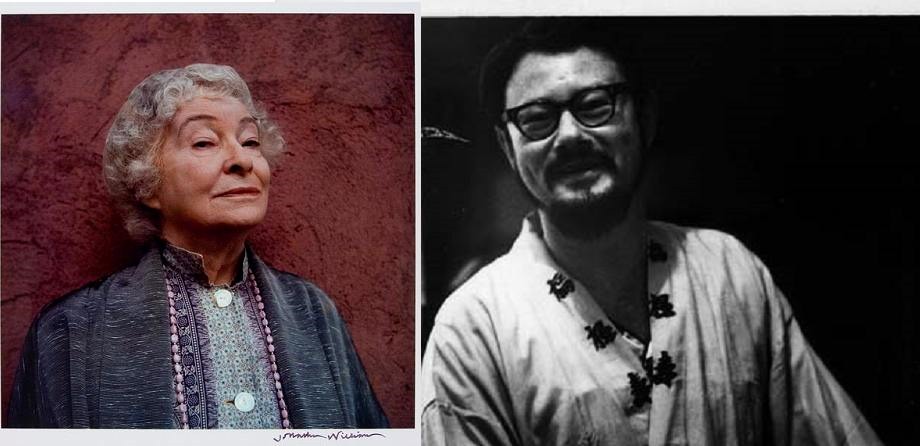
In the end I chose today’s piece: “To W.C.W. M.D.”  It’s dedicated to William Carlos Williams. This might be more of Kreymborg’s log-rolling networking skills on display, but its subject also answered a desire I have to do a piece remembering my late wife Renee Robbins in some way today. As best as I can penetrate the emotional core of this poem, it speaks of the need to separate and not separate from those that have died.

Musically, the piece is based on one stacked chord, E minor7/11, but the notes are spread out between the instruments. Besides drums there are two bass guitars, piano, two viola parts, a violin part, and a clarinet in this. To hear it, use the player below.


The Fisherman

Complaints about the size of the audience for poetry are far from new. So too, complaints about the quality of its audience. Throughout the course of the 20th Century, one increasingly common theory was to assume that a quality audience for poetry is likely incompatible with a quantity audience for the art.

We’ve just about used up two decades of our century, and that theory is still around. This quantity/quality audience-linkage belief is not always stated plainly, but it’s not hard to see its presence. Poets that rise to modest or surprising audience size will sometimes face some degree of backlash from critics. It may naturally be so that their poetry is less worthy by some criteria. This could be coincidental, honest criticism. It may be that it’s hard to find an audience for poetry criticism, as it is for poetry, so writing about better-known practitioners who have failed in some way helps grow the audience for the critic.

Another way to hold to this theory is to limit what poetry is allowed to do, to narrow its practice or even its definition. Spoken word or slam poetry? Not really poetry, or it encourages a poor selection of poetry’s virtues. Song lyrics? Self-evidently a different art, though given that the consensus canon of poetry is so different among itself, surely difference alone cannot be the criteria. Mix those two as rap or hip-hop and risk both  explanations of why it’s not poetry. Short, aphoristic poems? Too insubstantial. Long poetic forms once much in evidence, like the poetic epic or verse drama? No longer living forms of the art for the most part, if for no other reason than the type of poetic techniques the modern academic poet often uses can wear out an audience in a matter of minutes.

Myself, I don’t disagree or agree with those judgements in particular cases, and they could even be theoretically correct, I just viscerally dislike the idea that this thing poetry is so small and limited, that it’s a desert island disc for a few scattered islands, deeply loved by solitary coconut eaters with a very constricted shoreline.

When I break out of those narrow roles and rules for poetry, I will fail, and I do get discouraged. My limitations are bothering me two years into this project; and now 240 published audio pieces later, I may be running out of rules to break and the motivating pleasures of audacity.

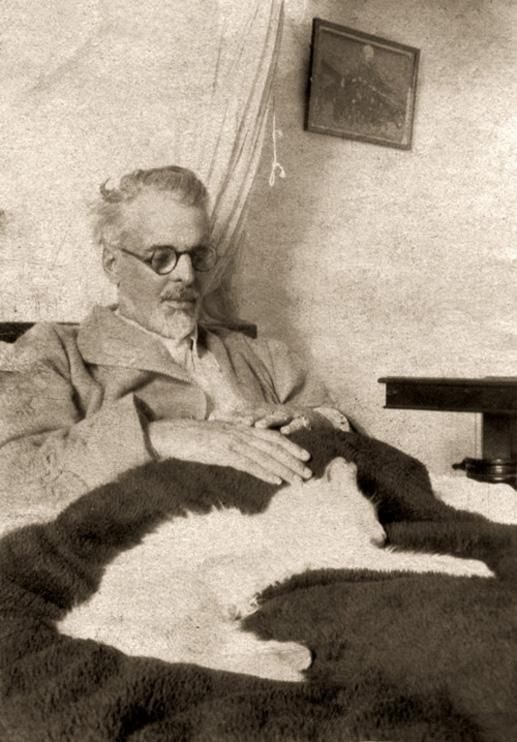
William Butler Yeats with cat

Also dreaming of catching fish. Are cat pictures the secret to gathering an Internet audience for poetry?


Here’s a piece today using a poem by someone who somewhat agrees with me: William Butler Yeats. In one way it’s specific to him, and his time. I’ve recently honored two working-class sport fishermen in one of my favorite pieces so far this year, but the fisherman in Yeats’ title, the simple man working his craft on nature to help feed himself rather than for hobbyist enjoyment—well, he, even in a much poorer Ireland of 1916, is admitted as imaginary.

Otherwise, how about those folks listed in the middle section of today’s piece that are harshing Yeats’ mellow? How little imagination is needed to see them today?

I admire Yeats in this poem, embracing his failure, even though he brought immense poetic talents to his work, so much so that I should be embarrassed to admit to that admiration. In one way, the fisherman here is Yeats, casting with deft wrist or verse, but not in the course of the poem catching anything. There’s a saying with the fishermen in my family, “It’s called fishing, not catching.”

But the imagined fisherman is also that audience Yeats seeks. Maybe once, Yeats says at the end, maybe once,  he can please an audience correctly, with a single valid poem and valiant audience—even if he can only see that audience in his imagination. I surely hope (and Yeats’ life helps me here) that the singular fisherman is an image for a possible greater audience, and not a headcount. After all, to write for something as large as “his race” (by which he means Ireland), is too small a target to hit, while that tweedy imagined fly-fisher inside his jacket might possibly expand to more countries, more times, more genders. In Yeats’ case, as with all artists, he failed; but he failed reaching for a larger audience with a larger poetry, a poetry which he risked allying with other arts. Many of us will not be able to accomplish that failure, but I’m glad Yeats tried.

You can hear my try to alloy William Butler Yeats “The Fisherman”  with a rock band by using the gadget below.


Ample make this Bed

I’ve been unable to do as much as usual with this project for the past month for several reasons. One of those reasons was a trip to Massachusetts, which if this was a normal blog would have already generated posts of the travelogue sort. However, this project is about two palpable things, music and words (mostly poetry), that can’t handily be walked along, though you can tour their containers and neighborhoods. Perhaps that trip, in an indirect way, will generate pieces yet this summer.

I was finally able to visit Amherst and the house where Emily Dickinson lived nearly her entire life—and today’s piece uses words from one of Dickinson’s poems—but long-time listeners will know that Emily Dickinson is already a favorite source for words here.

No house, no state, not even any time or country can explain the genius of Emily Dickinson. For reasons of brevity, I’ll try to summarize by saying that she created and entirely new form of poetry, powerfully compressed, elusive and still approachable, and wholly without precedent. The things scholars can trace as influences can be found in her poetry, but no one else made Emily Dickinson poems out of that same stuff. And her poetry has largely not become obsolete. Over 150 years after it was written it still seems modern, maybe even more modern today than it seemed to the early 20th Century Modernists 100 years ago.

Dickinson Bedroom 3

Ample? The specific standing for eternity. Emily Dickinson’s restored bedroom in Amherst

I’m attracted to shorter poems that unpack into larger things, and “Ample make this Bed”  is that. It’s short even by Dickinson standards, eight lines, 34 words. If one pauses to puzzle at this meaning, the imagery of the grave is what comes to many reader’s mind. It can be read as a shorter companion to one of Dickinson’s most famous poems “Because I could not stop for Death,”  but with a bed replacing the longer poem’s subterranean dwelling. However, besides its greater concision, “Ample make this Bed”  is using another poetic form, one different from her longer poem.

“Ample make this Bed”  is an aubade.

An aubade is a poem where two lovers wish for the morning to never arrive. Since it is, in fact, arriving, they will deny it, wishing for their night together to remain forever. By using this traditional poetic trope, Dickinson has thrown a rich ambiguity into her 34 words. Although Christian religious belief has its variations, the traditional judgement day is the day of eternal salvation and the universe’s perfection. “Ample make this Bed”  compares the morning of divine perfection to the morning that separates the lovers in an aubade.

Is this a statement that the sensuousness of human love can be judged greater than eternal salvation? Or is it a puritan statement that any such love will face its final end and judgement? Could it even be both, balanced on a knife’s edge?

Look too at two of those 34 words describing possibilities of this bed. Its Mattress, where the body rests, may be straight. The body has a straightaway lifetime. The Pillow, where the mind inside the braincase rests, may be round, a circular line that doesn’t end.

Dickinson puts her poetic thumb on the scale with the most beautiful line in the poem: “Let no Sunrise’ yellow noise.” The poem has been puritan with its rhymes until this line, although elusive near-rhymes are present in the first stanza. Now it lets in richness, a rhyme internal to the line, before proceeding to the final perfect rhyme in the last line. Besides the line’s sound, the dawn of eternal judgement is— what?—so much noise. If Keats’ second inversion is so, then beauty is truth—and Dickinson may be indicating her thoughts on the matter.

Musically, I performed this in waltz time and I repeated the first stanza to add some sense of the eternal.  Most of you can hear the performance with the player gadget below, but some ways of reading this blog won’t show it. In those cases, use this highlighted hyperlink instead.

Beloved

Here’s a short piece I wrote about the intimacy of sound. Part of the idea I used for this came from a remark Bobby McFerrin made about music: that we hear it because waves of sound touch a sensitive membrane inside our ear. How intimate is that!

McFerrin and Ear Drum

Talking. Drum. Musician Bobby McFerrin and that tiny ear drum membrane that sound touches

Anatomically speaking, there is an accuracy there, but some would clarify, speaking strictly, that the brain is what gives us the sound we perceive, just as it does the seeing and so forth. Philosophers would also tell us that this distinction is important. They have made their case elsewhere, and I will not reiterate that here now.

There is a view that poetry too is about mental images. No doubt this is so. Language is full of strange ways of meaning to be understood. But all these exact pieces of information shouldn’t lead us to forget McFarrin’s point: when spoken, it’s still a sensual act. We hear poetry as information to some degree, but we hear it also as a musical sensation.

Our world is filled with information. We can sort it forever for meaning. But the feeling of our beloved’s voice on our ear is more than information or imagery. So is music. So is poetry.

Posts may be somewhat farther apart this month, but I remind you that we have well over 200 audio pieces available in our archives over on the right, where they are waiting for further listening.

St. Francis Einstein of the Daffodils

Metaphor, that stuff that helps make the music of thought in poetry, is the linking or liking of things. This is like that. This stands for that. The sensation of this is like the sensation of that. This reminds us of something else. The way I say this recalls the way one says that. Metaphor recombines the stuff of our world even though it’s a combination that only exists in the imagination.

Metaphor can make something clearer to an audience. It’s so useful in that way that one can barely explain anything challenging to an audience, even in the most prosaic day-to-day business world, without falling into metaphor. In poetry however, the bounds of increased clarity can be stretched, broken, and abandoned. Depending on one’s mood as a reader, this can be frustrating or a pleasing play of the mind. With the Parlando Project we perform the poems with music. One hope from this is that you can relax and let the beauty or strangeness of the words carry you over gaps in meaning. Sometimes you can enjoy a poem before you understand it.

William Carlos Williams who wrote the words in today’s piece, gives us Spring weather with Spring flowers and fruit blossoms, gardens and orchards, and all under a title that combines a famous saint with his era’s most famous scientist. He gives us almost no help in combining that title with the poem, other than yoking them together. The linkage of metaphor is much strained here, even when he further explains his title by adding a sub-title: “On the first visit of Professor Einstein to the United States in the spring of 1921.”

How are we to make the connection that will construct the metaphor?

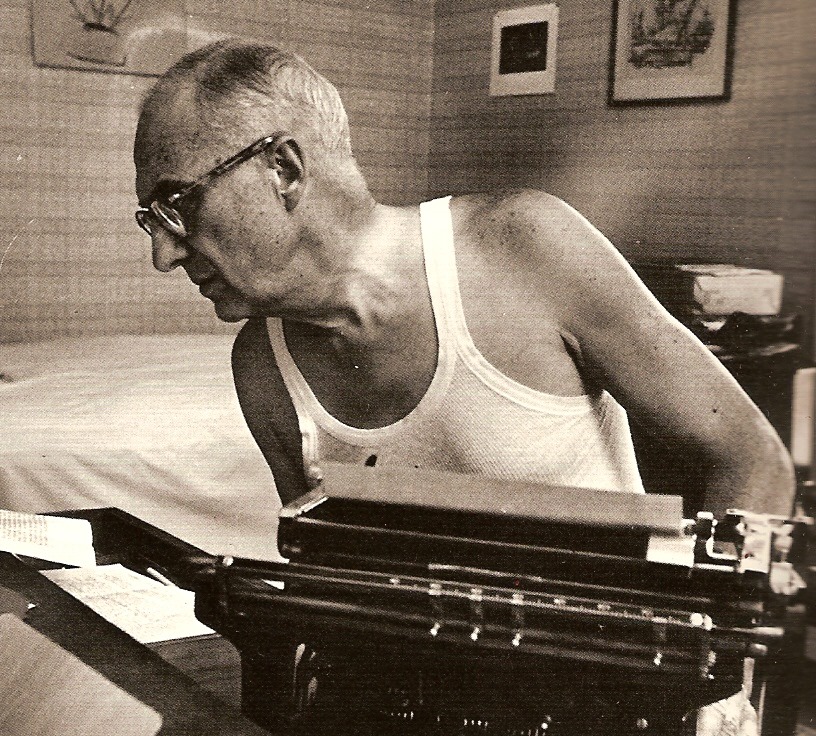
William Carlos Williams with typewriter

Just another hipster with his typewriter. William Carlos Williams throws off his covers.


My best understanding so far is that the connection is wonder and change. Recall our last post, where in his “Queen Mab”  Percy Bysshe Shelley, the Romantic early-19th Century poet, gave us a vision of the wonder of an immense cosmos, which Shelley’s own notes tell us he could also sense through the poetic/mathematical meter of the speed of light. The theoretical scientist and the visionary poet each seek to grasp some new metaphor of the world. Einstein was changing physics in the time that Williams and his fellow Modernists were seeking to change the apparatus of art. Williams elaborates on this theme mostly by vivid descriptions of the change of Spring. In the only mention of Einstein in the body of the poem, Einstein is “tall as a violet.” He is the Spring’s new growth.

There are a couple of obscure literary references in one section, the sort of thing T. S. Eliot or his imitators would have used. Who is “Samos, dead and buried?” I’m not sure, but my guess is that it’s Pythagoras of Samos, the famous classical Greek philosopher for whom science and the arts were one. And Lesbia? Catullus’ Roman poetic beloved, who we’ve met here in Elizabethan guise. It may be enough that they have ancient sounding names, and of such ancient classical modes, Williams, who is in some ways the Anti-T. S. Eliot, says “Sing of it no longer.” He moves right back into a present day of Spring. Pythagoras is dead, Catullus’ Lesbia is dead, and so is a black cat buried in a newly planted garden. Awhile later in the poem we may get one more connection to that cat part of this buried trio. A chicken-raising man who puts out poisoned fish-heads to keep the cats from his chickens. That man becomes like the Modernists, needing to kill the ancients to protect the new flock he’s raising.

As a side note, this poem’s chicken farmer, the white-haired negro, was quite likely the man whose rain-glistened red wheelbarrow sat next to the white chickens in William’s famous poem of admiration.

The poem closes with a sensuous image of Spring change, a night that grows warm as an orchard owner opens his windows and throws off the covers that were needed in the cold. In an earlier version of the poem, Williams had woven Einstein by name in and out of those Spring images explicitly, including this last one where Einstein was named as that man with the blossoming orchard, another grower of renewed things. In this later version, all these stated links to Einstein are removed (save for that one Einstein as a violet).

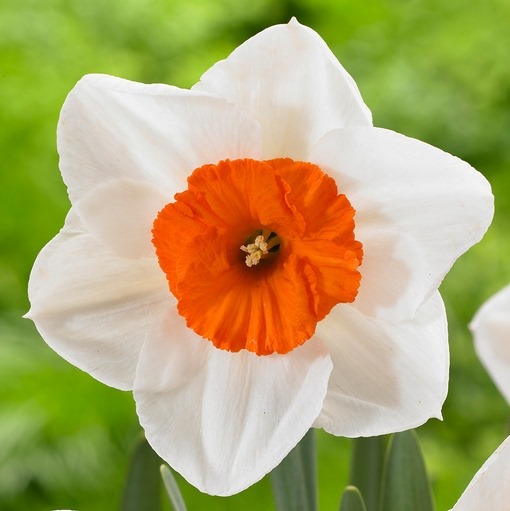
Professor Einstein Narcissus

Not a violet, but the “Professor Einstein Narcissus.” Has “great curb appeal” and “deer won’t eat” says this garden center.


Was that a right choice? The resulting poem is shorter and more mysterious, but it also doesn’t make it easy to see what Williams is getting at. He’s using metaphor, but he’s removed all the connections. I decided to perform the later version. I think it performs slightly better, and perhaps the music makes the obscurities less taunting.

A simple musical arrangement this time, just acoustic guitar and subdued electric bass. To hear my performance of William Carlos Williams’ “St. Francis Einstein of the Daffodils,”  use the player below.


From Queen Mab Canto II

It’s not often that we think of English Romantic poets along with science. We tend to think of them as pure examples, an engraved picture of an enraptured youth subject to the throws of inspiration, to be found next to the words “poet” or “fool” in a dictionary.

Percy Bysshe Shelley is no exception to this. In my mid-20th Century American school-days he was seated with the Romantics, and biographically some mention would be made of his notoriety during his lifetime, the matter of which would be ascribed with a summary of libertine sexual behavior in the Byron and Shelley households. I suspect many of those descriptions, brief and bloodless as they might have been, were attempts to woo additional interest in poetry from otherwise little-interested adolescents.

Part of the joy of this project is finding surprising things in poetry among the accidents and intents of looking for material. At the end of last week, I read of the memorial service held for physicist Stephen Hawking at Westminster Abbey.

Vangelis is going to stream a musical piece with Hawking’s famously synthesized voice out to the galaxies! Somewhere out there, the odds say, a curious alien will detect this light-years from now; though probabilities also say they will have likely forgotten to bring earbuds along on their saucer-ride.

And there were celebrities! Elgar, Stravinsky and Holst got played! The ticket application form allowed future birthdates, in case time-travelers wanted to apply to attend!

But reading on I find that astronaut Tim Peake read a bit of, what, Shelley. From “Queen Mab”  accounts said.

I find a copy of “Queen Mab.”  Turns out it’s another kind of Shelley from the school-book aesthete. “Queen Mab”  is a fairly long blank-verse epic, but I didn’t have to read far to find the parts you’d want to read for a cosmological tie-in. Right there in Canto II, Mab, the queen of the fairies, has Uber’ed up a human soul to her palace, which is more or less an atheist’s heaven, which is to say a philosophical location above the cosmos—and there, the human soul gets to observe the wonder of this perspective. Mind-blowingness ensues.

This is the kind of thing which visionary poets and scientists share, and that thing is wonder. Stacks of SciFi books would lift one nearly that high; but why couldn’t poetry, the literary artform best-suited to grasp tiny pieces of the un-graspable do that too?

percy_shelley

What if instead of sitting at a cave entrance, I was at a place of immense gravity, where even light falls into it? If I ever go back to England that’ll make a good bedtime story for little Ada, who’s always too busy using her wooden blocks to solve equations.


Here’s something else I found remarkable, a series of notes on the issues in the poem, written by Shelly, a young man of 18 in the early 19th Century. Here’s a portion of the first one:

Light consists either of vibrations propagated through a subtle medium, or of numerous minute particles repelled in all directions from the luminous body. Its velocity greatly exceeds that of any substance with which we are acquainted: observations on the eclipses of Jupiter’s satellites have demonstrated that light takes up no more than 8′ 7″ in passing from the sun to the earth, a distance of 95,000,000 miles.—Some idea may be gained of the immense distance of the fixed stars when it is computed that many years would elapse before light could reach this earth from the nearest of them; yet in one year light travels 5,422,400,000,000 miles, which is a distance 5,707,600 times greater than that of the sun from the earth.

I was an English major, I had to look this up. Shelley, or early 19th century science, was off several billion miles on the length of a light-year, and a couple of million miles off on earth-sun distance—hey, I knew that last measurement, though from an early-childhood advertising jingle. However, ask yourself, how likely would it be that the most facile poet in any first-year college creative-writing class be conversant in those measurements, and how they are empirically proved?

So, thanks Stephen Hawking, Tim Peake, and whoever planned that part of the Westminster Abbey internment service. I now think of Percy Bysshe Shelly differently.

Musically, I started by noting in Shelley’s poem the description of deep-space orbs “in mazy motion.” I thought immediately of Mazzy Star, that late 20th Century indie band. Does mazzy/mazy go back that far? Turns out that the word mazy was something of a English Romantic poet favorite. Wordsworth, Southey, and Keats all used the word. Coleridge used it in “Kubla Kahn.”  Mazzy Star is a band with a predominate sound, and though they have some great cuts with wild electric guitar, there’s more often a strummed acoustic guitar, a droning organ, and some occasional violin, all the songs are taken at a slow tempo and modest volume. The band’s lead singer,  Hope Sandoval, has a style that superficially sounds easy to do, but in practice isn’t, and so my singing skills deferred trying.

So, it’s spoken word, not sung, but here are those words of Shelley’s used this month to memorialize Stephen Hawking. Use the player below to hear it.


Plum Tree Blossoms on 40th Street

Today I step aside from our usual practice here, and present words I wrote. With opportunity, next week I should be able to return to “Other People’s Stories.”

“Plum Tree Blossoms on 40th Street”  was written recently, and includes elements of observations I made during a bike ride to school with my son in early May. In the course of writing the poem and revising it, I modified the events of that day. This is not unusual. The events of one’s own life have a fractal branching of meaningfulness that frustrate encapsulation. It may be useful to use those endless edges as perforations to tear away from all things remembered the shape of a poem.

I tested the revision before this one with a group of poet friends, and alas, it didn’t seem to work well for them. They were slightly puzzled why the speaker in the poem didn’t ask the child to stop and smell the blossoms, but altogether bewildered by the question (or the way I presented it) when the speaker asks near the end of the poem about memory being able to remember the smell of something overlooked in one’s past. That was useful information. They also made a very specific suggestion. Originally the blossoms had been tree blossoms, and though they were extravagantly fragrant on the morning that inspired the poem, I did not know in fact what kind of tree was bearing them. No matter, they suggested, it works better if you make them a specific tree.

Blossoming Plum Tree

OK, it was some kind of fruit tree blossoming, let’s make it a plum.


I read something once particularly wise regarding such honest critiques about one’s writing. It may have been from Kurt Vonnegut, or it may have been someone else, but the gist of it was that if good, honest, readers find a problem in a piece they are almost always right, even if they are often wrong about how to fix it. The suggestion to name the type of tree was simply right I thought, but how to deal with what they saw as the troublesome puzzle about memory?

What I was trying to suggest in my poem’s story was that we can indeed remember things retroactively. Things that were not noted at the time consciously, that were not filled out as if a contemporaneous diary as experienced, can still be recalled when we later find them important or precious. We do this partially from our subconscious, perhaps even from what the Transcendentalists would call the over-soul, but mostly this is augmented because our minds are great pattern makers, able to fill in gaps with all the other things we recall.

The readers who noted this as a problem were smart, perceptive people. They likely knew of this, but I still had perplexed them.

I could not remove this, for me it was the point of the poem. Sometimes, what folks most object to in a poem (or other art) is, paradoxically, why it needs to exist.

I made some slight changes in a couple of lines around that concluding question, hoping in this version to make this natural phenomenon of memory clearer, without hindering the “music of thought” as well as “music of words” that I think poetry should have. Maybe it works better now.

To hear my performance of “Plum Tree Blossoms on 40th Street”  use the player below.


The Hunter

A couple of mornings ago, I awoke after a night’s sleep, and as I took my bicycle out to the alley to ride off for breakfast, I was surprised to see the road dusted in torn blossoms and several small tree branches cast about on the wet ground.

While I had been still and sleeping, a storm must have come up.

That contrast, the stillness and the broken change is at the heart of today’s poem by William Carlos Williams, “The Hunter.”   Williams opens his poem with an allusive image. “In the flashes and black shadows of July.” Is this the lightning of a summer storm? I thought so at first. But it might be just what one sees lying on summer grass and looking up through the boughs of a tree. The whims of a breeze or the caprices of squirrels and birds on the thin branches will flutter the leaves’ fan of shade revealing the sun in a flash.

Yet, summer “seems still.” The animals of summer appear “at ease.” But what if there is danger in the world, as in the unmet character in the poem’s title, the hunter?

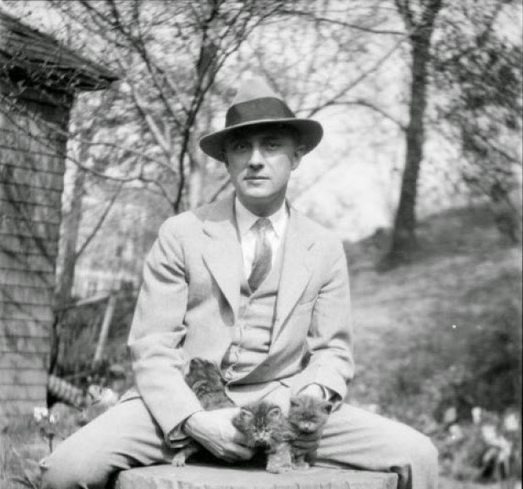
William Carlos Williams with Kittens2

In a last-ditch attempt to increase readership of his poetry, William Carlos Williams decided to try that Internet staple: cute kittens.


In Williams’ poem, the hunter does not appear, ready to shoot the game. The hunter is invisible, as the hunter is time, the hunter is change.

For today’s music I combined an orchestral ensemble and electric guitar with an appearance of a harpsichord.  The player gadget to hear my performance of “The Hunter”  is at the bottom of this post.

I’ve noted that there has been a steady listenership for the other William Carlos Williams poems posted in the archives lately, and that helped inspire me to look for more of his work to present. As we move into summer, I remind visitors that there are over 220 pieces available here. Use the search box or just wander through the monthly links on the right.


Parlando Spring 2018 Top 10-Part Three

We now come to the top half of our count-down of the most listened to and liked pieces during the past three months. But what if you’re new here, and you wonder what this Parlando Project does?

In short, we take various words, mostly poetry, combine them with original music, and perform them. My intent at the start was not to do this the same way each time, to vary our approach as much as we could. We’ve been doing this for a couple of years, and there are now over 220 Parlando Project pieces available here if you search through our archives. From time to time, as I look at what we’ve done, I seem to notice a “style” developing, and while I have no objection to that arising organically from my predilections and limitations as a musician, performer or composer, when I hear that I usually ask myself “What can I try that’s different?”

The poems are not always the famous ones, I like to mix in some “deep cuts,” but it just so happens that these three recently popular ones are all pretty well-known, but maybe we can bring something new to them?

In position number four we have Emily Dickinson’s “We Grow Accustomed to the Dark.”  Last time I talked about how I’m finding that Modernist poetry in English moved from a recognizable natural landscape freshly observed in it’s early poems to a more interior landscape, another darker country where new dialects of language and syntax seemed the natural tongue of that region. It may well be that WWI, with its unstoppable socially-accepted murders, was a cause for this change. The rise of Freud contributed too. But more than half-a-century before WWI, and decades before Freud published, Emily Dickinson, spurred by American Transcendentalism and her own individual genius, was exploring some of those same places.

When Dickinson gets furthest inside her own head and tries to use her mutation of mid-19th century language to describe it there, she can be inscrutable; but when she’s half-way there like in this little masterpiece, she’s exploring poetic areas that won’t be visited again until the 20th Century.

This is another of the pieces where I think my music works particularly well. Perhaps you’ll agree. Player below:


Funny how these count-downs seem to form a sequence. From Dickinson’s dark we move to the  third place piece, by that little-known poet William Shakespeare, with one of his sonnets about The Dark Lady, “My Mistress’ Eyes are Nothing Like the Sun.”  When we wasn’t supplying titles for late 20th Century Sting CDs, or writing a play here and there, Shakespeare wrote a collection of sonnets that are full of ideas woven of memorable phrases.

Emilia Lanier Nothing Like the Sun

Emilia Lanier, musician, poet and possibly Shakespeare’s Dark Lady.


I’ve always loved the sonnet, even shared a few of mine here. It just seems the perfect length for a lyric poem, long enough to develop two or three ideas costumed as images, but not so long that one will find them frayed and soiled at the cuffs before it’s done.

Hear my performance of Shakespeare’s Sonnet 130, “My Mistress’ Eyes are Nothing Like the Sun”  with the player gadget below.


And now we’re up to the second-most popular piece this past quarter, Marianne Moore’s “Poetry.”  Shakespeare’s poem in slot number three declares his love by saying the things his beloved isn’t. Poet Moore’s poem about poetry starts off famously by saying she “too dislikes it,” and goes on to tell us what she feels works an doesn’t work as poetry, including the poem’s other famous line about poetry’s goal, to show “imaginary gardens with real toads in them.” I think here again of those early Imagist poems, with their unromantic and ordinary things made into central images: T. E. Hulme’s red-faced farmer standing for the moon or Aldington’s poplar tree as a young woman or F. S. Flint finding the moon taking on the terror of a WWI Zeppelin raid. Toads all, ordinary nature, not the battalions of classical gods or the obligations of sentiment.

This piece’s popularity on Spotify continues steadily, as with “Sky”  from earlier in the count-down, I wonder if it’s the short, somewhat generic title that brings in curious listeners there.

My initial idea of the Parlando Project did not have my voice as the only reader, and the first voice you hear in this version of “Poetry”  is Dave Moore who’s been the voice in a number of pieces over the past two years. The other voices in this performance are two fine poets who’ve spent a lifetime raising toads to see what works in their gardens: Kevin FitzPatrick and Ethna McKiernan. Hear them read Marianne Moore’s “Poetry”  with the gadget below.


That leaves us only the number one to count-down, the most popular piece this past spring. It’s not a well-known poem, and it’s not by a well-known poet. See you back here soon for that.

Parlando Spring 2018 Top 10-Part Two

Continuing on with our count-down of the most listened to and liked audio pieces from the Parlando Project during the past quarter, we’ve now come to numbers seven through five.

At number seven this time is an example of how the Spotify listeners differ from the blog listeners. This piece received only a handful of listens on the blog this past spring, which isn’t unusual, as “Sky”  was posted there last summer, and blog users tend to listen to the latest posts unless brought here by a search engine. On Spotify though, “Sky”  has seen steady action, and enough plays there to make it one of the most listened to this spring..

I like the idea and outcome of looking at the Midwestern sky that multimedia artist Laurie Anderson explained in an interview that I quoted to make the words for this piece, but I’m not sure what attracted all the action on Spotify for it. Is it the short, somewhat generic, title perhaps? As we’ll see later this month in the countdown, another of the Parlando pieces with a one word title was very popular on Spotify in the past few months.

Well, no matter blog readers, here’s “Sky” brought to your attention by the listeners on Spotify.


One of the Parlando Project principles is “Other People’s Stories.” There are a good number of Internet locations where people post their own poems, and blogging in particular is often autobiographical. I could do the same, but I have a contrarian streak, and I find responding to other people’s words and figuring out how to perform them interesting.

I don’t dislike autobiographical blogs, I subscribe and happily read a handful of them myself. If prodded, I can go on way too long about myself, just as I have a tendency to do on any subject, and having had my first poem published almost 50 years ago, I’m certainly not against revealing my own poetry. “Other people’s stories” is a choice I find helpful, that’s all.

I will use my own poetry/lyrics in the audio pieces here from time to time, though I like it when they are my words about other people, such as the number six most popular piece last spring, “Anglers.”  This is the story of my father and his youngest brother’s sport fishing, something they spent many pleasant days doing before my father became too old and frail for his beloved outdoors. Those days seemed timeless even as they were occurring decades ago, and those lakes have become mysteriously reflective in memory now. So, in writing of them I added notes about passing between dimensions.

I’m proud of how this came out, and glad so many have taken the time to listen.


These Top Ten lists often include well-known poems by well-remembered poets, but that contrarian streak in me likes to look at those less remembered and see what might be of interest there. Richard Aldington is one such case, a writer who was active in the pre-WW1 London circle that created Modernist poetry in English. Coming in at number five on this spring’s list is this charming poem of his “The Poplar.”

David Todd asks Athen GA artists to sketch eclipse

62 years before REM was formed in that town, astronomer David Todd asks artists in Athens Georgia to sketch the June 8th 1918 total solar eclipse. Note the ads pitching goods to WWI soldiers. “Delmer’s Lunch – Run by Americans”


Since it is easiest for me to use poems here that are in the public domain, the newest ones are often from that Modernist revolution that occurred in the first two decades or so of the 20th Century. There are weeks when I think I must be living 100 years ago more than in 2018, as I look for and read poetry from that era. Do I find this a refuge from 2018? No. The horrors of WWI (which impacted Aldington, who served, significantly), the realities of racial, class and gender attitudes then, mean this was no golden age. But what does surprise me reliving the genesis of English Modernist verse as I read their work now, is how they employed broadly accessible images in their Imagist poetry.

The post-1920 High Modernism that was largely used to represent the Modernist movement when I first encountered it is full of obscure references, exotic words and locations, events so far into the imagination and the special dialects the poet chose to reflect those inward locations, that a reader is confronted by a world they can’t comprehend the landscape of, much less the meaning of what occurs there. There can be beauty and insight in this, but it’s a world that assumes one will come prepared, well-equipped with poetry expedition gear and maps.

But before all this, as Modernism was forming itself, the poems are still in a world much like the one inhabited by the general reader, like this graceful and musical one. Give a listen to Richard Aldington’s “The Poplar”  below.


Other peoples stories. How can I connect sky-watcher and eclipse sketch promoter David Todd to poetry? Todd was a pioneer of “eclipse chasing” as well as a theorist of life on Mars. His wife, who documented his trips to view eclipses was Mabel Loomis Todd. Back in the 1880s Mabel had a scandalous long-running affair with Emily Dickinson’s brother, who lived next door to Emily. After Emily’s death, Mabel Loomis Todd was the person who saw to the publication of Emily Dickinson’s poetry. And when we return soon to continue our count-down, we’ll have a poem from Emily Dickinson.