Here we go with our quarterly run down of the most liked and listened to audio pieces over the past season. We’ll be counting up to the most listened to piece over the next few days as we approach winter solstice. Who’ll chart? The most famous poets with their best-loved words? The literary poets’ poets? The poems of the now largely forgotten figures I like to dig up sometimes?
10. “Seventeen Almost to Ohio,” words by Paul Blackburn arranged by me. Where does Paul Blackburn fit now? Probably in the poets’ poet bin, though he’s also verging on forgotten. He doesn’t seem to have benefited from connections to a poetic movement, though he had them in overplus. He’s sometimes associated with the Black Mountain School, though he himself says he wasn’t really. He visited Ezra Pound and shared Pound’s interest in imaginative translation and the old French Provencal poets, and he is there connected to the original English language Modernist movement. He was based in New York coincident with the New York School of poets though he’s never mentioned as one in any summary roundup I’ve read. The Beats touched edges with the New York School—and with Blackburn, and again there are similarities in their approaches. Perhaps the most significant connection is that Blackburn was a leading NYC-based encourager of spoken and recorded poetry, including being the original organizer of the St. Marks poetry readings, a spoken word radio host, and a recordist of many other poets reading.
“Seventeen Almost to Ohio” comes from an aside Blackburn made while recording Mina Loy in 1960, where he (apparently) spontaneously recalls an event from his own youth while asking Loy about hers at the dawn of Modernism. I lightly edited and arranged his anecdote and then composed the music.
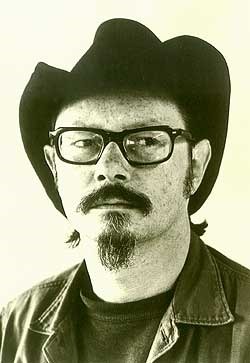
Paul “Does Jeff Tweedy look like me when he looks in the mirror” Blackburn
9. “Fog”, words by Carl Sandburg. Early Modernists were fascinated by extreme compression and very short poems, and anthologists since then so often include Pound’s “A Station in the Metro,” Williams’ “The Red Wheelbarrow,” and this 21-word Sandburg poem. And because it so baldly displays its central metaphor of fog and cat, the poem is often used to introduce grade-school children to metaphor.
In writing about “Fog” this fall I wondered if there’s anything we’ve overlooked for over a century in this short poem, and came up with this question: Might it matter what kind of cat it is?
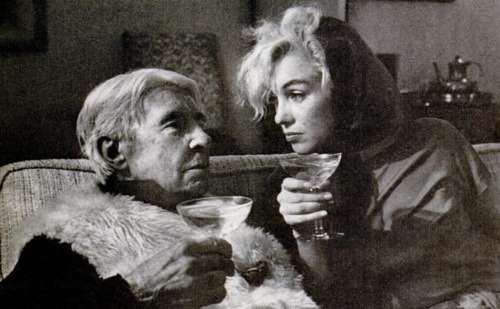
Marilyn: Carl, Carl, you simply must tell me what kind of cat it was!
Carl: In good time, my dear—but first I need to finish inspiring Sonny Bono’s Sixties look.
8. “The Temple of Summer,” words by Frank Hudson. Well, I’m almost as short-winded as the Sandburg of “Fog” in this 31-word Mellotron drenched goodbye to summer. Longtime readers here will already know of my devotion to the sound of this primitive attempt at a sampling instrument used memorably in many late 60s and 70s British Prog-Rock recordings. The real thing is finicky, bulky, and hard-to-find and maintain, but the Mellotron’s sampling of real instruments to strips of recording tapes, whose notes can then be played by a keyboard press, is an easy trick for the computer-hosted Virtual Instruments that the Mellotron inspired and I use.
Robert Fripp, on the right with King Crimson, declared after dealing with voltage issues on tour: “Tuning a Mellotron, doesn’t”
I can’t say what day this happened, but it was sometime in 1916 in Davenport Iowa. A well-off, Harvard-educated man in his mid-thirties named Witter Bynner was visiting a former Harvard classmate Arthur Davison Ficke in the latter’s elegant home. Besides family wealth, both men shared an interest in the arts, and both were published poets and art critics. A variety of fine-arts could have been discussed by these highly educated men, more so than any yet-to-be-invented concerns that random recently-young men might discuss today. Bynner later recalled the high-spirited discussion got raucous enough that Ficke’s wife asked the men to take it outside.
What the F.T.D! Nijinsky as the spirit of the rose
We know where the conversation started: Bynner had recently seen a new modern ballet, The Spectre de la Rose based on a poem by Théophile Gautier with music orchestrated by Hector Berlioz from a piano piece by Carl Maria von Weber. I don’t know who the dancers were in the performance Bynner had seen, but the titular role of the spirit of the flower was first danced by Nijinsky, and the piece’s choreography ended with the extravagant gesture of Nijinsky leaping out of a stage-set window and disappearing as if he had flown off into the ether of the rose’s wafted scent.
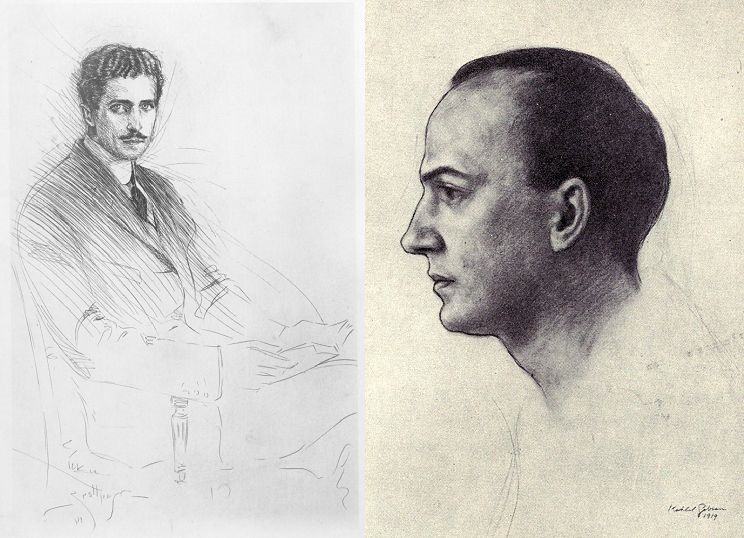
Arthur Davison Ficke and Witter Bynner. Bynner’s portrait is by Kahlil Gibran.
The two men retired to a cross-town hotel room with a bottle of whisky. Bynner had had an idea while watching that ballet. The romantic artistic styles of his birth century were now being challenged by new 20th Century modes. The kind of poetry that the pair wrote: carefully crafted metrical, rhymed verse was being challenged by new verse. It too had extravagant expression, but not only did the new free verse not care about symmetrical forms, it didn’t seem to care about extracting from its expression sense or meaning—things didn’t mean, they were, in these new poems. And some of the new poets were so deadly serious about how important this was! They wrote manifestos about how poetry should work without the old frameworks, yet they didn’t seem to care about how meaning worked!
The levels of the whiskey in the bottle lowered quietly as the levels of whisky in the two loud poets increased. Here was the plan: Oh, this was so good! They would write a bunch of these new poems, just whip them out while they were good and drunk and no longer bound by anything other than sounding like these new Imagist, Vorticist, Futurist poets. Great fun! So much so that nine more sessions and nine more bottles followed in close succession.
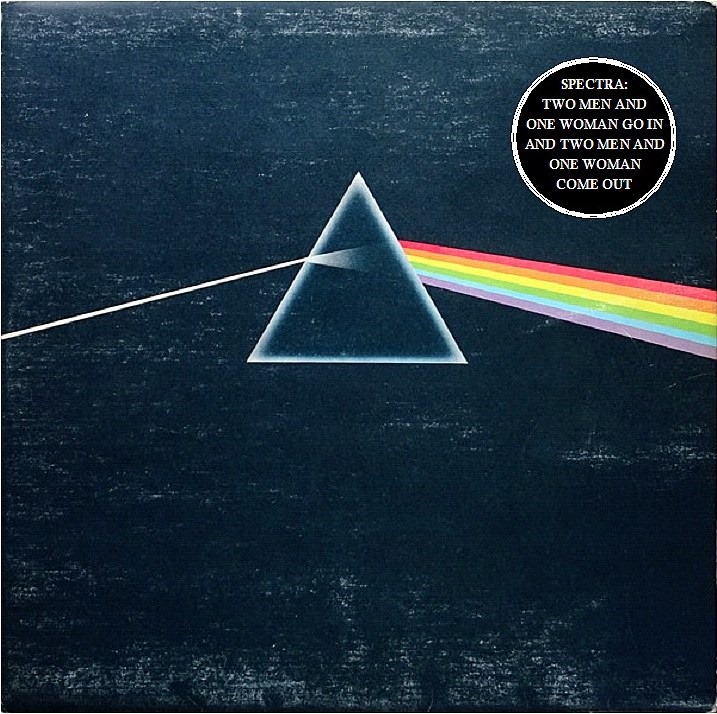
Intoxication didn’t stop these two educated, upper-class men from some structure and planning. They’d publish the poems under assumed identities. Bynner, a gay man, was to be Emanuel Morgan, a painter/poet who had dallied in Europe and dug the French poetic influences. Ficke, the straight, goyim man with day job as a lawyer, was to be an exotic eastern-European Jewish poetess Anne Knish. Later that year they roped in another well-off child of local Midwestern privilege, Marjorie Allen Seiffert, whose contributions would be signed as Elijah Hay*, who would be (like Ficke) a cisgender lawyer/poet. Ficke was drafted to write the new movement’s manifesto**, and Bynner supplied the name, taken from the ballet: “Spectrism.” Prophetically anticipating the birth a dozen years later of Andy Warhol there, these Spectra poets were said to be living in the Pittsburg area. Well, maybe it wasn’t Warhol. Maybe Pittsburg was chosen because it was half-way between the East Coast-based Bynner and the Midwestern Ficke, or perhaps they shrewdly judged it as sufficiently nowhere to evade detection.
They submitted Spectrist poems to magazines and some were published. They submitted a manuscript of the drunken hotel room poems to their own publisher and had a good laugh when it was accepted (they did tell the publisher about the hoax after the acceptance however). Perhaps the strangest publication was a “theme issue” of Alfred Kreymborg’sOthers magazine. Others: A Magazine of the New Verse was the publication of the Modernist Avant Garde in America, promoting William Carlos Williams, Carl Sandburg, Marianne Moore, Fenton Johnson, Mina Loy, Man Ray, H. D. and Wallace Stevens. If it was “free” or “new” or “modern,” Others was associated with it. It seemed particularly open to redefining sexual and gender roles. Recent “theme issues” before the Others’ Spectra issue for January 1917 had focused on Spanish-American poets and “A Woman’s Number” (which included work by Seiffert).
Mysteries of the Spectrism. The 1916 published collection and the 1917 special issue of Others.
What would happen if the Spectra hoax occurred this year? I’m certain there’d be considerable criticism of the perpetrators. Other than the inherent dishonesty the goes into a hoax (though “honesty” is always ambiguous in art) the audacious usurping of the Anne Knish persona by a WASP scion of wealth would draw additional condemnation for sure. Rich white men tweaking the always struggling to stay in business little magazine Others seems particularly cruel on the face of it.
You’d also expect pieces to be written about how the hoax “proves” that Modernist poetry is, consciously or unconsciously, a hoax itself; that Spectrist poetry had shown that if the right signals are made, any word-jumble will pass as art. And yes, that happened after Bynner revealed the hoax in 1918, just as it would likely happen now.
Interestingly, at least in my limited research into this, the 1918 response did not seem to include much if any anger toward the perpetrators though. Class, ethnic and gender privilege might have shielded them. Perhaps even those who might have standing to complain were cowed by the perpetrators prestige and power, or maybe they hadn’t developed an analysis of “cultural appropriation” yet. AFAIK, Ficke, Bynner, and Seiffert never suffered “you’ll never work in this town again” repercussions.
Those fooled by the hoax generally followed a line that the Spectrist poems, regardless of the author’s intent, had some vitality as Modernist expression anyway.*** As the 20th century progressed, automatic writing, cut-up, exquisite corpse, chance and computer-generated composition, found poetry, psychedelic poetry composed while intoxicated, and more would be tested as tactics. Spectra might have started in Davenport Iowa not at the Cabaret Voltaire in Switzerland, but does Dada require intent to be Dada? Can one draw a line from the Ficke’s Spectrist manifesto to the First Surrealist Manifesto?
For myself, more than the philosophical and aesthetic questions, I wonder at the personal impact, and not just on the hoaxed. Modernism had not yet triumphed in its campaign to take over poetry in the 1916-1918 era, but all three of the Spectra hoaxers began to agree with the hoaxed that when they freed themselves from their birth personas and the formal rules of poetry and meaning, that something else emerged that their poetry hadn’t seen before they put on the mask. All three later wrote some free verse as their careers continued and Modernism won the post-WWI war for literary respectability.
On the other side, I’d suppose that the Spectra hoax may have helped give impetus to New Criticism and it’s move to establish objective criteria for what makes a poem good, even if it’s Modernist in language, structure and word-music.
What of the poems themselves? I read the original Spectra book and found it disappointingly forgettable. There are some good lines, but fewer than pure what-the-hell wild improvisation should have engendered. You can laugh at the unhidden humor present in some of the poems, and I can recognize and smile at some of the references to common early Modernist tropes that they are parodying. I was drawn more to Ficke/Knish than Bynner/Morgan, and couldn’t help but think that Ficke, part-way down that bottle of whisky, might have found his invented exotic anima therapeutic.
Therefore, I’ve chosen to perform one of Ficke’s Spectra poems today, “Opus 131.” I think Ficke—a son who grew up in a house wealth-filled with his father’s world-spanning art collection and who had followed his father into the practice of law—may have needed something more, may have wanted something that Millay or Kreymborg or Mina Loy had, even in their not-having. He may have wanted to leap out of that hotel room window, like Nijinsky in that ballet, and never come down.
Here’s my performance of Ficke/Knish’s Spectra poem:
*Although it’s usually not filed under “hoax” there’s a fairly long tradition of women writing under masculine pen names, from the three Bell/Bronte sisters onward. Davenport itself was home to Octave Thanet, a successful popular writer born Alice French.
**Sample lines from the manifesto: “The theme of a poem is to be regarded as a prism, upon which the colorless white light of infinite existence falls and is broken up into glowing, beautiful, and intelligible hues… Just as the colors of the rainbow recombine into a white light,— just as the reflex of the eye’s picture vividly haunts sleep,— just as the ghosts which surround reality are the vital part of that existence,—so may the Spectric vision, if successful, synthesize, prolong, and at the same time multiply the emotional images of the reader.” I can only think of the cover of Pink Floyd’s Dark Side of the Moon.
***However, the funniest critical quote from before the hoax was revealed was William Carlos Williams remark that he preferred the Elijah Hay’s Spectrist poems to Anne Knish’s because the “Woman as usual gets all the theory and—as usual—takes it seriously whereas the male knows it’s only a joke.” Mirror upon mirror in that quote.
Those new here may not know that the Parlando Project intentionally varies the words and writers whose work we present, and the types of music that we combine with them. We tend to use poetry as our word source, because compression and musical expression is baked in, but we don’t always use the most famous poets or poems (though I do enjoy trying to find something new in a well-known poem too)*.
Because obtaining rights to present poetry has difficulties, most of what you find here is from before 1923, but that doesn’t mean we won’t surprise or puzzle you with our authors. Today’s piece was written by Muriel Strode, who is an extreme case of biographical and critical obscurity. Almost nothing is known about her, and rather than Wikipedia, or one of the online poetry-promoting orgs or education sites, what info I could gather about Strode is largely from a single blog post.
As it often is with me, finding out a few things about someone opens up further questions. The bare bones reported in Terri Guillements’ blog post, partially informed by surviving relatives, is that Strode was born in 1875 in a rural township in Illinois, south of Galesburg where Carl Sandburg and Don Marquis spent their youth at nearly the same time. Her father was a “naturalist, teacher, and physician” and her grandparents were pioneer farmers and settlers according to Guillements. Her mother died when she was around 13 and her father remarried. At around the same time as her father’s remarriage, it’s said that she left home at age 15 (1890) to attend a business school, and a year later she started work in Long Beach California as a “stenographer and typist.” No context is given on this, but the remarriage and move far away from her childhood home happening at near the same time does lead one to suppose some friction.
The next markers in her life come in 1906, 15 years later. Guillements’ says Strode was able to buy two parcels of land in the Signal Hill area of Long Beach and the same year move to New York City. Also in 1906, Strode published her first book My Little Book of Prayer with Open Court Publishing out of Chicago. Open Court was the closely held venture of a German immigrant who had made it big in the zinc business, Edward Hegeler. Hegeler was a believer in something he called “the religion of science,” discussed briefly and tantalizingly in his Wikipedia entry, and Open Court worked to promote those ideas.
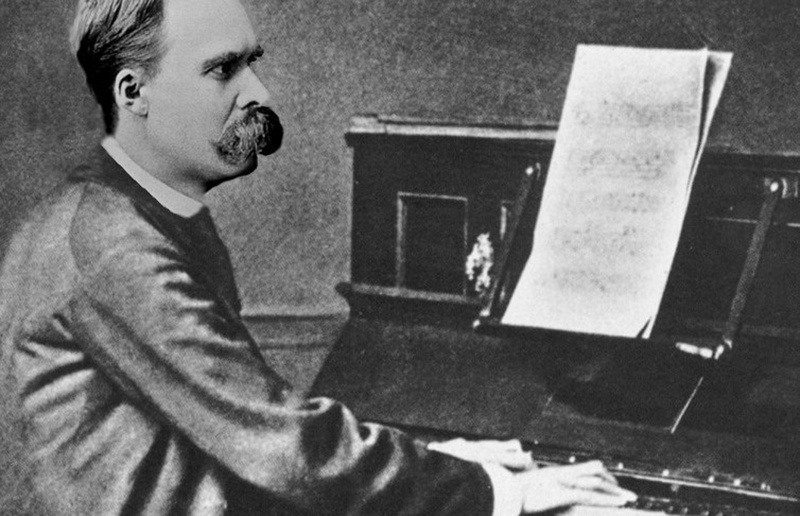
My Little Book of Prayer might seem puzzling without those connections. It’s not a prayer book in the usual American Christian sense. God, even implied, is not present in most of its entries, nor are any conventional religious texts or figures present to an appreciable degree. The entries are short, aphoristic, and poetic enough that one might consider it an early book-length work of American free verse. On the other hand, they don’t exactly seem to want to work as poetry as Pound or the English and European Modernists were re-casting it. My Little Book of Prayer reads more like a self-help book expressed in strongly worded and rhapsodic affirmations. The general attitude is the that with the too-rarely understood right goals and attitudes, human potential is unlimited. You start out thinking this is Stuart Smalley in 1906 guise, then wonder if you aren’t reading a follower of Ralph Waldo Emerson, and finally end up considering if you are reading a very concise American and female Friedrich Nietzsche.
For today’s audio piece we feature Fred “Sonic” Nietzsche on the keys. Makes me think of the Bonzo’s “The Intro & the Outro”—which is a very good thing!
None-the-less at the beginning of The American Century as education, industrialization, science, and an expanded political franchise were in motion, the book seems to have struck some sky’s-the-limit chords. The St Louis Globe-Democrat published this breathless notice:
If you want to know the greatness of a soul and the true mastery of life, apply to the Open Court Publishing Company for a slip of a book by Muriel Strode, entitled simply ‘My Little Book of Prayer.’ The modern progress of sovereign mind and inner divinity from the narrow cell of the ascetic to the open heaven of man made in God’s own image, is triumphantly shown in it, yet a self-abnegation and sacrifice beyond anything that a St. Francis or a Thomas a Kempis ever dreamed of, glorifies the path. To attempt to tell what a treasure-trove for the struggling soul is in this little volume would be impossible without giving it complete, for every paragraph marks a milestone on the higher way.”
How Strode hooked up with Open Court and its philosophy is one mystery. Even Strode’s southern Illinois childhood is not in Chicago’s orbit, and we know too little about her parents’ social class or connections. One theory that occurs to me is that somewhere in that Stenographer/Typist job title was an intelligent and ambitious woman who made social, commercial and philosophical connections with entrepreneurs and businessmen in those 15 “lost years” that may have been in California.
One piece of evidence for that: two years later she married Samuel Lieberman, “the president of an iron and steel firm in Chicago where Muriel had worked.”
Today’s piece, taken from her later work, 1921’sA Soul’s Faring. Instead of Open Court, this one was published by Boni & Liveright, a New York-based imprint much associated with literary Modernism.** By this point someone had dubbed Strode as “The female Walt Whitman,” and her free verse is, if anything, more unabashed and heroic*** than Whitman, which takes some doing. One has to be of the right mind to read much of it—it’s so over the top. The same Nietzschean philosophical concerns remain from her Open Court books, and the individual, roman-numerated, sections are barely longer at times than her earlier aphoristic “prayers.” There may be a growing mysticism entering into the work as well as elements that at times echo deep-ecology thinking about nature.
After reading three of her books, doing this research, and working on incorporating something I took from the XXXV section of her “Songs of the Strong” inside A Soul’s Faring, I still don’t quite know what to make of Muriel Strode. The gushing visionary true-believer attitude, even for a reader such as myself who enjoyed William Blake as a young man and who also appreciates Whitman is just so strong, and some underlying “Like attracts like” Law of Attraction elements seem unavoidable.**** So, I can’t say I’ve become a fan, as much as I must acknowledge her audacity and extremity of expression. Perhaps she’s best taken in small doses, in disconnected aphorisms?
In seeking to maximize that element in Strode’s poetry, I’ve adapted her poem, trimming even this already short work back even more, and turning one of its lines into a refrain. And for music? Well, I told you at the start we like to mix things up. Our last piece was orchestral, featuring strings and English horn, but today’s piece, which I call “I Am the Clod that has Taken Wing” in my adaptation—it’s metal, and of the sludgy type. Maybe in honor of Open Court and the Gilded Age Mr. Hegeler (who must be a Galvanized Age figure), it’s “Heavy Zinc?” Metal is a type of musical expression where you can say anything, no matter how outrageous, and get away with it; so maybe that fits in an odd way, which is what we do here at the Parlando Project. Here’s the player to hear it.
*If you’re not in the mood to adventure into this unusual story of a small town girl who makes her way in the world and some transitory literary notice, our archives here have lots of better-known poets from this same era and before.
**You, and the world, may have forgotten Muriel Strode, but Boni & Liveright were the first American publisher of William Faulkner, Ernest Hemmingway, E. E. Cummings, Jean Toomer, and Hart Crane and the US publisher of T. S. Eliot’s “The Wasteland.” So, between the boards, Strode was in high-lit company.
***There’s also an erotic element in A Soul’s Faring that might remind one of Whitman.
****What we know of Muriel Strode’s life story reads like a romance novel, doesn’t it? Here’s one more novelistic touch, and if you’re a skeptic about the “Law of Attraction,” you’d best ascribe it to a failure of authorship: those two parcels of land Strode bought before leaving California? Turns out about the time A Soul’s Faring was published, they found oil under them. Lots of oil. If you listen to today’s audio piece over and over, and perhaps play it backwards, who knows what riches will come to you.
I spend an invisible part of the iceberg in this project looking around for material that I think might work combined with music. One thing invariably happens when you look broadly at something: you find connections that you didn’t expect you’d find.
Here’s something I’ve noticed this fall: around 1875 or so, in a small, little-thought-of area of the U.S., a bunch of people were born who went on to leave a mark on our nation’s culture, even if only one of them retains any fame now in the 21st Century (and even that exception is undervalued in my estimation).
Geographically the area I speak of is the region where the Mississippi and Rock rivers meet in the Midwest, which had transitioned from what had been an important point for the Native-American tribes at the beginning of the 19th century and before, to an area that supported settler towns which grew up around river-based commerce and industry. “Transitioned” of course is a passive word for a slow-motion invasion and conquest by the European Immigrant-Americans, which included the short Black Hawk war of 1832 that left a great many Native-American names, but fewer Native-Americans, in the area. Eventually states were created here bearing those native names: Iowa and Illinois.
Who’s in the cohort from this area and time?
My relative*, Susan Glaspell, born in Davenport Iowa in 1876. Glaspell and her husband (George Cram Cooke, also born in Davenport, 1873) eventually midwifed the birth of Modernist American drama in Provincetown Massachusetts and New York City.
Carl Sandburg was born 1878 in Galesburg Illinois. Sandburg was a big noise in the first half of the 20th Century, and I maintain he is now the forgotten Modernist, and a man who strived to weave several important American threads.
Arthur Davison Ficke (born 1883 in Davenport) a now lesser-known, but fascinating figure that I’ve yet to grapple with. Like Ezra Pound, he was drawn to Japanese art, and like his post WWI hot-crush, Edna St. Vincent Millay, he attempted to utilize older forms such as the sonnet in an increasingly Modernist age. As part of this friction, he and his friends Witter Bynner and Marjorie Allen Seiffert (born 1885 in Moline across the river from Davenport) concocted the Spectrist movement, parodying the -ics and-ists schools that were forming in Modernism. Oddly, the parodist seems to have been captured by his game, and Ficke later reconsidered Modernist poetic tactics.
Muriel Strode born 1875 in rural Bernadotte Township Illinois. I haven’t quite gotten a grip on her yet (though she was sometimes styled as “The Female Walt Whitman”), but she wrote a number of books early in the 20th Century combining a sort-of-Kahlil-Gibran-like popular non-denominational spirituality with Nietzschean self-improvement. She’s the most little-known here by far. So little is known about her that one can’t really use biography to help sort out what she’s getting at.
There was even a younger generation that called Davenport it’s hometown. Floyd Dell (born 1887) the editor of The Masses which in the early 20th century linked Modernism with left-wing politics until the red scare of 1917 closed it down, and Bix Beiderbecke (born 1903), the live-fast-die-young jazz composer and cornetist.
They’d make one hell of a roundtable. From the upper left: Susan Glaspell, Carl Sandburg, Arthur Davison Ficke, Floyd Dell, Muriel Strode, and Bix Beiderbecke.
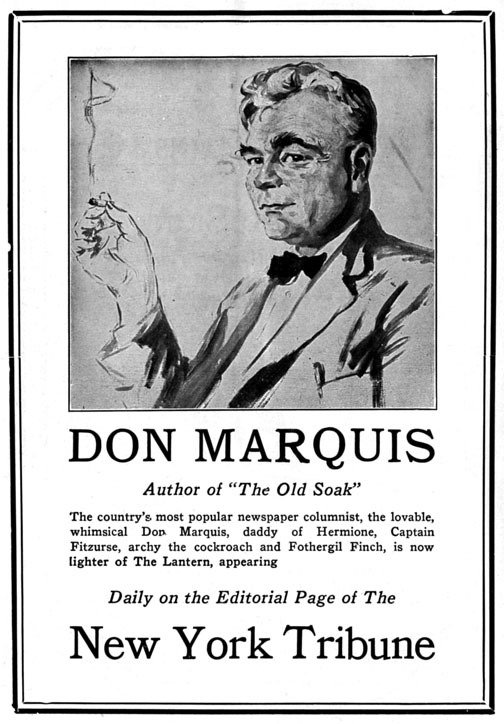
But since we last time touched on Dorothy Parker, let’s present a piece I slightly modified from a poem by Don Marquis, born 1878 in the tiny settlement of Walnut Illinois, but educated in Galesburg. Don Marquis is usually filed (like Parker) as a humorist, but like Parker he worked in various genres including collaboration with the Krazy Kat cartoonist George Herriman. Unlike some of the others here, it appears that Don Marquis’ most consistent connection to Modernism was to satirize it. Today’s audio piece, which I call “The Young Intellectual**” pricked the romantic presumptions the young Modern of his time might suffer from. I updated part of one verse (the original next to last line was “I’ll start a Pale Brown Magazine”) when I performed it, an update I choose just so we can more easily feel offended or amused by his humor now. The player to hear the LYL Band performing this is below.
*My Great-grandfather lived on the Iowa side of these river-towns and worked in war-industry factories there. My father’s mother and her sister also grew up in the Davenport area. Alas, many of them died before I was old enough to ask questions, and one thing I regret about my youth is that I didn’t query those that were around.
**I’m not sure I qualify as an intellectual, but I’m sure I’m not young—so, Marquis can’t be talking about me now, can he. Like Ficke, Marquis also parodied Modernist verse, rather broadly from the examples I’ve read in his Hermione and Her Little Group of Thinkers from 1916. Marquis’ greatest success was a series of later newspaper columns that became a series of books about “archy and mehitabel” ostensibly created and typed by a cockroach hopping on the typewriter keys in Marquis’ office. Archy, the cockroach/author, is also something of a free-verse poet, and Archy’s poems are a much subtler expression.
Marq Daddy? He looks like an urban swell here, but the country he comes from they call the Midwest
The year 2018 marches on, as we pass onward past Thanksgiving toward December. I’m quite thankful for the opportunity to continue this project. Time-consuming though it is to do these pieces, it also continues to fascinate me and (one hopes) it also continues to surprise and entertain you. For me there’s considerable enjoyment in trying out or finding out something new, thinking about something, or playing something, different.
Though they may no longer be as well-known, some of McGeehan’s list you and I might recognize: W. E. B. Du Bois, Jane Adams. Others, such as women’s suffrage activist Anna Kelton Wiley and bra designer Mary Phelps Jacob were unknown to me. Three writers get a nod, all three wrote poetry: Amy Lowell, William Carlos Williams and Dorothy Parker.
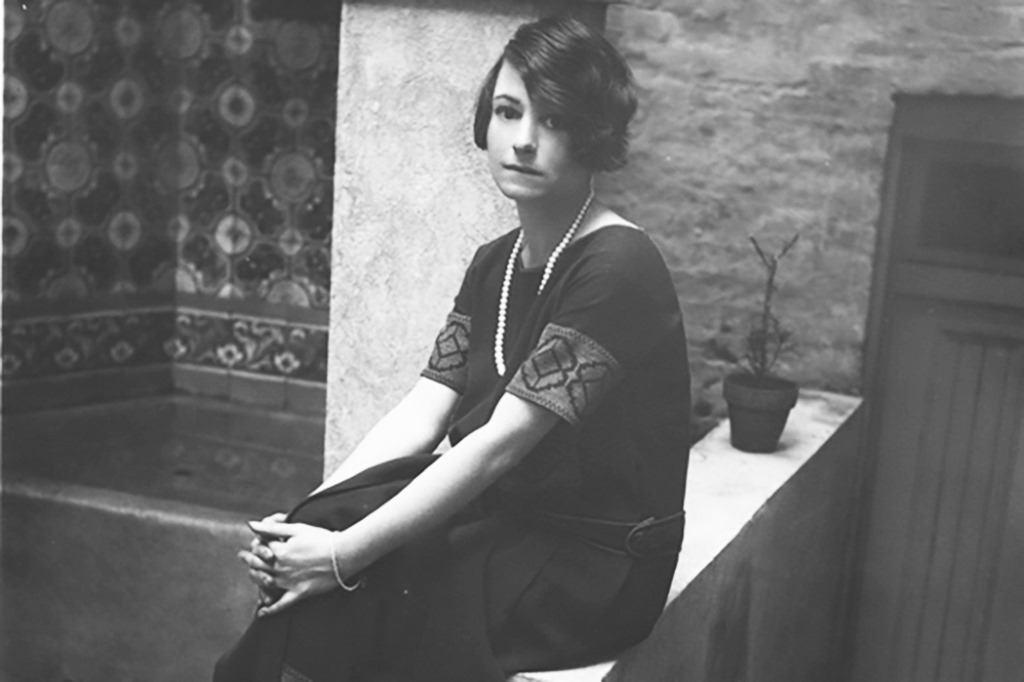
That plant looks like it could use a little water. Dorothy Parker at home in 1924.
Amy Lowell is a literary force I need to address sometime in my own project, though I’ve yet to absorb anything of her poetry. Though I overlooked Williams in my youth, he’s grown on me throughout this project as his public domain, pre-1923, work explores the lyric impulse with eyes whose perspective has been expanded by the Modernist explosion. The third, Parker, is a double surprise. I can see where My Year in 1918’s McGeehan will encounter her, as Parker was writing for magazines (one of My Year in 1918’s chief sources of material), but she’s not some inescapable pantheon writer. And though later in life she became a committed social activist, particularly in regard to African-American civil rights, her WWI self had yet to develop in this regard. But she’s a, a—oh, the never-immortal shame, the art that dare not speak its name—a humorist.
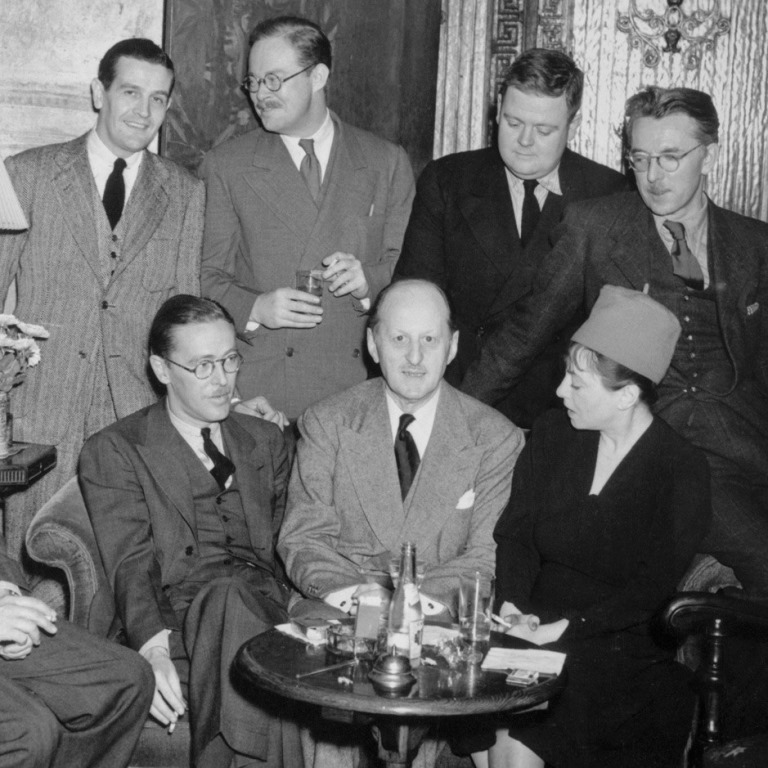
Parker with the Algonquin Round Table group of wits. We don’t know if they’re having lunch with those drinks, but it’s something of a sausage fest anyway. I haven’t seen a caption naming those present, proof that humorists don’t make the pantheon. Besides Parker on the lower right, I think it’s Alexander Woollcott 2nd from left in the upper row, but I’m drawing a blank on the rest.
Humorists, whatever their skill and craft, tend to damage their reputations as literary figures. We like our literary titans dour and serious for the most part. They can scatter a little wit around for decoration or as weaponry, but to be celebrated for their merit—even if that’s all we end up really noting about them, their worthy merit—you need to rise above that. The assumption seems to be: if the point is to make you laugh, the point is ephemeral.
We think too little of humorists as agents of social change, or as participants in the Modernist artistic revolution of the early 20th Century. We do this even after Dada, even after Mark Twain’s now-recognized status as another American who broke Modernist ground before the 20th century.
To take Dorothy Parker seriously (not solemnly) you need to start by acknowledging that she’s fighting with two hands tied behind her back: she’s a woman before women were considered capable of human complexity, and she wants you to laugh at our folly. Parker survives at times wielding dark, survivors’ humor, the sensibility that remembers her poem “Resumé,” a meme in verse about suicide. She might step on a few toes while doing that, and she’ll laugh about it.
Alternate voice here, Dave Moore, has appreciated Dorothy Parker for some time. Several years back the LYL Band covered Alan Moore’s “Me and Dorothy Parker,” and here today is the LYL Band doing a Dave Moore original that expands on Parker’s observations on suicide in his own words.
Parker ended “Resumé” with the punch-line “You might as well live.” I’d add, you might as well create art. After all, even in the worst-case, you’re only burning part of your life-time while struggling with joy and it’s opposite. If there’s no hope, you might as well hope.
Thanks again for reading and listening. Thanks to spreading the word about the Parlando Project. In the Internet world of millions of likes and shares, we’re a small thing, but I’m grateful for you helping keep this little thing going. The player for the LYL Band’s performance of Dave Moore’s “Looking for a Way to Go” is below.
Last time I talked about how hard it is to be sure how Emily Dickinson meant her poems to be read. Some poems seem gentle, some fierce. She sent some to her more conventional friends enclosed in letters or gifts—but some she never shared, and puzzle even hard-core literary critics to this day. When is she applying a clarifying simplicity to complex or profound subjects and when is she undermining simple statements or homey images with subtle side-glances? She’s a small-town 19th Century person, a stalwart reader of the book of nature—and yet she sometimes reminds me of later 20th century urban wits, like Frank O’Hara or even Dorothy Parker as much as she reminds me of Ralph Waldo Emerson. Am I reading this into Dickinson, or is it already there?
Well, I take today’s Dickinson piece pretty much as it seems, a humorous conspiracy with someone, perhaps the reader, wherein lack of credentials or claims to the podium/lily pad are brushed aside. This is a good place to begin observation and then art, or the circle back from art to observation of it, perhaps the best place.
So here’s Emily Dickinson’s “I’m Nobody Who Are You?” as I performed it, available through the player below. And not to shout from the lily pad, but the only reward I get for the time and effort of doing this is you, the audience who listens to these various words from past nobodies who want to talk to us. Thanks for doing so, and if you find something here you like, please let others know about it.
What was Emily Dickinson’s personality like? Biographers have tried to line that question out from the available evidence filled in with supposition; but then none of us present exactly the same face, the same sensibility to all people and at all times. And any of us who are writers may also know that what we write and how we live can differ, even if only in expression.
This is partly why we have so many Emily Dickinsons, not just over time since her emergence on the page in 1890, but now in the present days, depending on reader’s framing. Today’s piece, “Tell All the Truth, but Tell it Slant” can be read as a playful and humorous observation, as a serious artistic credo, as a secret diary of non-conformity, or as a dark observation of human fearfulness. How many Emily Dickinsons had how many intents as she worked out this little poem?
Her dark materials. A silhouette of the teenaged Emily Dickinson.
As I often do with Dickinson performances, I leaned a bit more to a serious mode of expression, which doesn’t preclude the thought that Dickinson would be internally chuckling. I tell myself I’m just trying to channel something I feel as I experience the poem, but I may be also trying to overcompensate for the Dickinson widely assessed in my youth as an eccentric dealer in homilies, a naïve artist without the depth of metaphysical thought that mid-20th Century High Modernism adored. It seemed then to have been an unspoken assumption that Emily suffered from “lady brain,” that imagined biologically-stunted inferior organ with sentiment where exploratory thought would be. Sure, her syntax and imagery had some originality, so we’ll allow her into the anthologies with the serious poets.
My model of humanity is more androgynous than most, but let us allow female associated elements in her artistry, just as we should be sure that there are experiences from gender and class roles in her time and place. But let’s not overdetermine what she did, what she can still do, when we read, perform or listen to her poetry.
As I said, “Tell All the Truth but Tell it Slant” can be read as a light-hearted jape. I even remembered the first line taken for the title on publication as “Tell the truth but tell it slant,” forgetting the “all.” Is that “all” there just for metrical reasons? Because, if that “all” is meant, it changes things doesn’t it. It goes from a reading of “Well, it’s not polite or advisable to go around spouting the whole truth at every occasion” to a more general statement, that the truth is never told directly. And then the second line and its “lies”—surely one of the most punned-on words in English. It that just an easy rhyme? The next line, “Too bright for our infirm Delight” could have been in a William Blake poem.
The second stanza* starts with some inverted order poetic diction, but it may be forgiven, as we finally get to a physical image: lightning and frightened children. Dickinson appears to be siding with the filters, the myths, the accepted consolations of fibs and filigree we buffer the truth with. And perhaps she is. It may come down to how much or how often Dickinson, or you yourself, look away from the truth, how often the wisdom of your fears can help you survive.
In the end in this performance, I thought it might be key to consider who is charged with—or to—“Tell all the truth but tell it slant.” Is it society, or those who speechify to us as if we’re frightened children, who slant the truth? Or is it us, who should tell all the truth, even if we need to put it indirectly so that our audience can discover it, as the world gradually discovered further Emily Dickinsons, for ourselves, in our own time?
Musically, I return to my weird folk-rock sound and I choose to make Dickinson’s first line into a refrain to stress its ambiguity and centralness to the poem. Hear it with the player below.
*One joy of the poem comes in the end of this stanza’s third line: “dazzle gradually” where the meter and consonance of the chiming d and l sounds enchants.
As we celebrate the 100th anniversary of the armistice ending World War One, let’s bring in a writer not primarily known as a “war poet,” Thomas Hardy. Hardy is one of those bridge-poets between the era of the romantic and sometimes sentimental Victorian poets and the Modernists. Though I’m told Hardy never felt at ease in London artistic circles (he was country-born, son of a stone-mason and largely educated through apprenticeships as an architect) his poetry was admired by some of the Modernists. Why might that be? While his language can sometimes seem antique to modern ears, it was his language, the language of a rural 19th century working class Englishman. And while he will write about sentimental subjects, he’ll balance that with a cold eye.
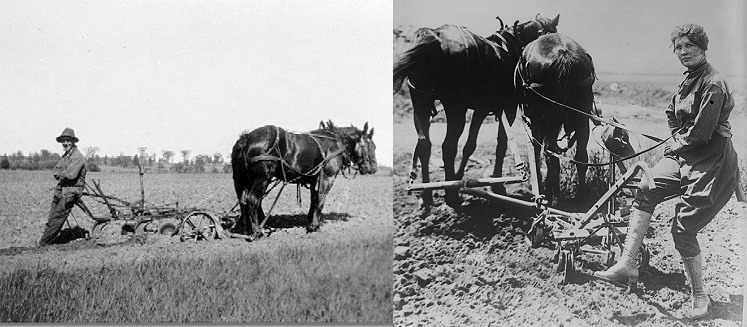
The horse-drawn harrowing time of the Breaking of Nations. But what’s that woman doing behind the horse?
Hardy grew up in a rural, farming district, as I did, and it may have been natural for him to relate the violence of the Great War to that setting. And I love how he does it here with three spare quatrains: the boustrophedon horse-drawn disk or rake plow that is literally breaking the earth*, in contrast with the prophetic “Breaking of Nations” warning from Jeremiah used for the title. Then there’s smoke rising, not a razed town after an army has swept through it, “only” the burning of invasive weeds. And finally, a mysterious third stanza with a mysterious word: wight.
It’s an old word, one of those that came to English with the German Saxons centuries ago. Chaucer knew it, used it in The Canterbury Tales, and as best as I can tell it meant a sort of unimposing person or creature. Sometime later, perhaps after Hardy learned the usage of the word and after this poem was written in 1915**, it’s taken on a supernatural connotation. It’s fairly easy to trace that back to J. R. R. Tolkien’s use of the word in The Fellowship of the Ring written decades after Hardy’s poem. Tolkien was a scholar of the ancestor languages of modern English. Did he know of other usages of the word, or did he simply take a very old word and choose to use it for an undead-spirit slain in battle?
So, in this last stanza, what does Hardy mean by his whispering maid and “her wight.” A flirting young couple? Are they whispering merely to shield their romantic bantering from others? Or is it something weirder? Is this a young woman whose man is off to battle, or even one of the battle-dead? Or, as part of Hardy’s theme are they both immortal ever-returning spirits, whispering because you only barely sense them in our time-bound world?
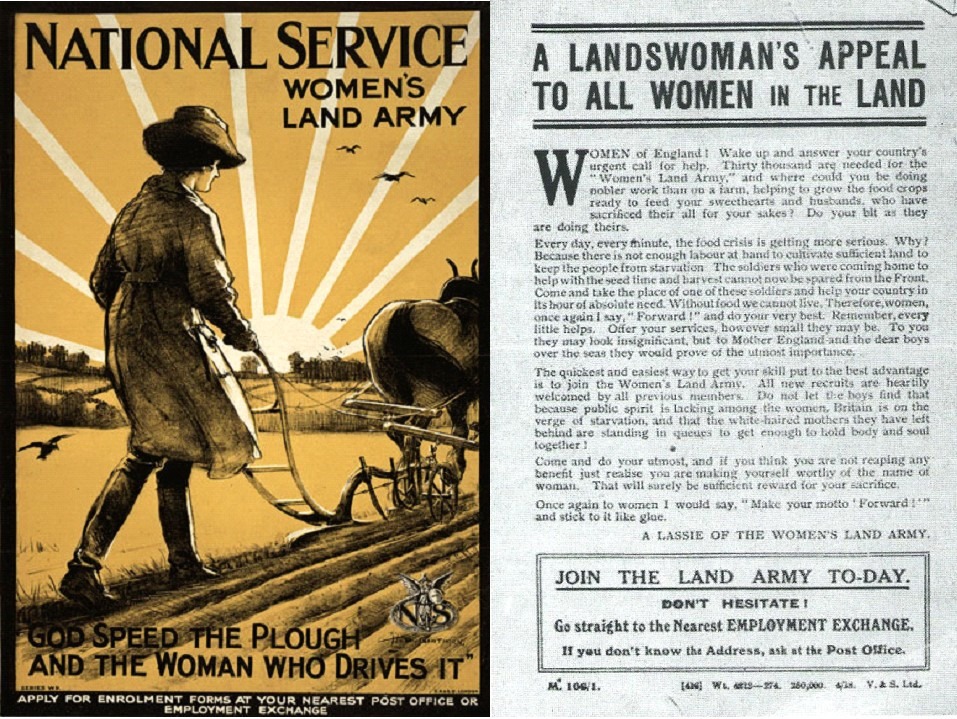
I don’t have the detailed historical knowledge to know how depopulated the farming areas of England were by the need for soldiers during WWI. From Edward Thomas’ poem from last month, “Gone, Gone Again” I get the idea that the absence of farming men was noticeable. And it was at least enough of an issue that England formalized an effort to recruit and train women as replacement farm labor.
Not just whispering to her boyfriend. “There’s not enough labour at hand to cultivate sufficient land to keep people from starvation.” Recruitment ads for the Women’s Land Army in England during World War I.
Well, I just like it that this is blurred. Do the final two lines give us any clues? Why does Hardy say that “War’s annals will cloud into night?” In early drafts, Hardy wrote “fade,” and “cloud” seems a more peculiar choice. In the context of the 2nd stanza weed-burning, I’m thinking he’s saying they will disappear in a cloud of smoke. Also in context of the 2nd stanza, this would make such war records in some future as valueless as weeds, but smoke/cloud again reiterates that there’s something unsubstantial about the couple.
“In the Time of the Breaking of Nations” demonstrates a lot of what I like about short lyric poetry. T. S. Eliot could write a Modernist masterpiece like “The Wasteland” extending to the farthest lengths of lyric expression, 15,000 words—but a poem like this can touch a lot in its 63 words.
It may not be apparent due to the instrumentation used, but I might have been subconsciously inspired by Bob Dylan’s repeating chord progression used for his masterful three-short-stanza song “All Along the Watchtower,” which is very much in the same mode as Hardy’s poem.
Here is my performance of Hardy’s poem. Use the player below.
*Note too, Hardy’s pun on “harrowing.” For another discussion of boustrophedon plowing and time, see this earlier post. Near the end of his life, while visiting a farming museum, my father wanted me and his grandson to know that he’d walked behind a horse-drawn plow.
I’ve spent a lot of words this month talking about the history of poet and songwriter Dave Moore, who’s been the alternate voice here since we kicked things off more than two years ago. Today I’m going to end the history and get back to the present, shut up a bit, and let Dave’s words and performance tell its own story. Here’s a recent Dave Moore piece performed with the LYL Band this fall.
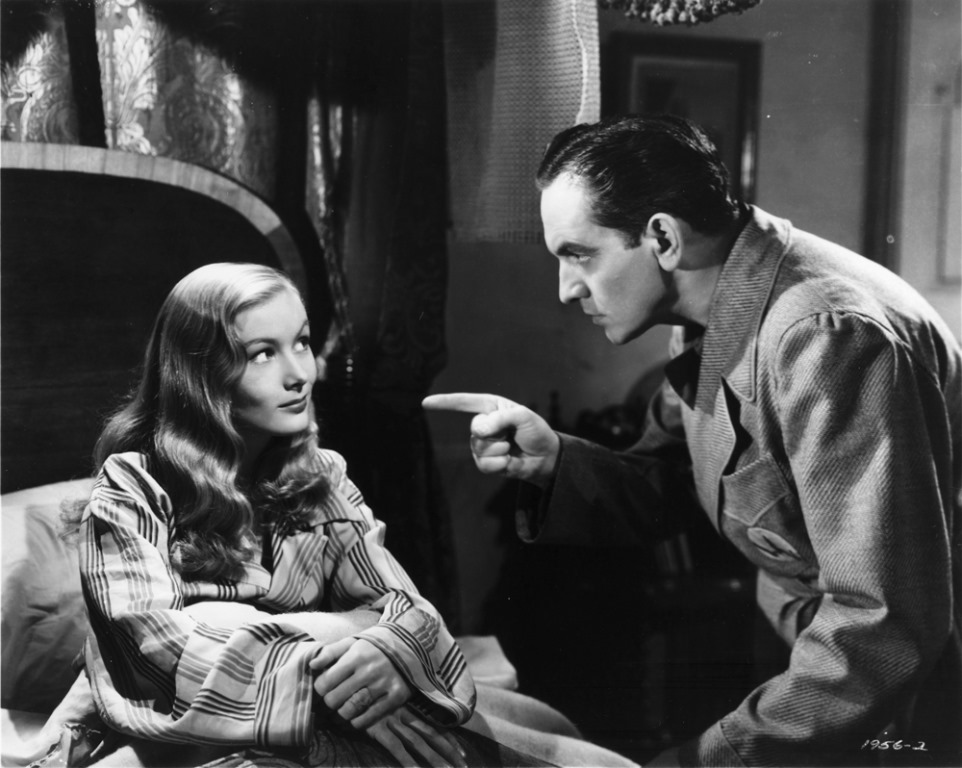
Little to do with Dave’s song, but I can’t resist including a still from René Clair’s “I Married a Witch”
Is this a Halloween song? A political commentary? An investigation of something that precedes and supersedes civilized politics? An excuse for me to fire up my Mellotron virtual instrument again? I could talk. You could listen. Today let’s choose the later. The player gadget is below.
Don’t worry, we’re only taking a break from our regularly scheduled mix of various words (mostly poetry) with original music to tell the history of the Parlando Project’s alternate voice Dave Moore. So far in our story, he’s gone from poet to pioneering Twin Cities indie band lyricist to full-fledged songwriter to singer-songwriter-keyboardist for a two-person band of poets with instruments in about two years. If you’ve been following along, I’m the other poet.
How did this turn out?
Returning to 1980 after the release of the Lose Your Lunch Band’s Driving the Porcelain Bus recording, the two-man-poet-band thing seemed to be a problem. Around this time a handful of Twin Cities indie rock bands had eked out a local circuit of venues that would book them. This was all very tentative, and only sufficient to give bands the initial toe-hold on a career, and it wasn’t really open to something as sparse and loose as we were. Could we possibly have tried to push that square peg, a “hardly rock band,” into that circuit?
Perhaps. We started looking to fill out the band, with the drummer being the biggest problem. I had started to dabble with electric bass, and Dave’s Farfisa combo organ had left-hand gray keys which could be dedicated to keyboard bass duties in the Ray Manzarek mode. The first third was Jonathan Tesdell, a guitarist who had a set of congas, and who was drafted out of a commune down the street. Jonathan practiced and played with us for a few gigs on electric guitar, but I can’t recall us ever even trying the congas as a replacement for a more rockist drum set live. But after a few months, Jonathan left town, traveling light. I once heard that his Gibson Firebird electric guitar that he sold before packing for travel was bought by The Replacements’ Bob Stinson.
Next up was a very talented guy who I believe was working then in the live comedy and theater scene,* Dean Seal. Dave somehow recruited him**, and Dean played drums and bass. Of course, not at the same time, a limitation we overlooked because he was willing to play with us. Dean could write great songs as idiosyncratic as Dave’s, and he had a good singing voice (later recordings with Mr. Elk and Mr. Seal demonstrate his cabaret-ready performance chops***). Dean later went on to a long and unique career, leading the Minnesota Fringe Festival for several years, and in this century becoming a UCC minister who combined his theater and comedy experience with religion.****
Performing “Magnetized,” the rarely seen, full LYL Band live in the ‘80s. L to R: unknown drummer (see below) Dean Seal, Dave Moore, and Frank Hudson
Alas, Dave and I had sort of lost the fire to play out around the time Dean joined up. I’m not even sure if Dean could have been the singing drummer (harder than it looks) and songwriting voice that could have given Dave a rock-club ready band. With us, Dean played mostly electric bass, and he took a liking to a cheap Japanese copy of a Gibson EB0 bass that I had found in a second-hand store. We traded basses, mine for his similarly low-quality Made In Japan bad-translation-of-a-Fender bass. That instrument sits next to me as I type this, and I still play it often on pieces you hear here. Somewhere in the later ‘80s the LYL Band went, as press-releases still say these days, “on hiatus.”
Why? When I asked Dave today he said he hadn’t thought of that, but as we chewed it over I think it was the matter of both of us, in committed relationships and needing to pay the rent and bills at the lower edges of the economy, gradually converting the concept of the public band to a private joy.
But as that was, almost imperceptibly to us, happening, Dave’s songwriting took one more turn. The goth and gothic Fine Art lyrics and the agitprop and Dada characters of the early LYL songs were joined by unconventional and sincere love songs.
It’s more than 30 years ago, but I can still remember the first time I heard Dave sing this song, as I have heard Dave sing many songs before or since, stone cold fresh. We didn’t often discuss songs before playing them. Unless specifically working out a live set, we didn’t work out arrangements, run through the changes or discuss accompaniment. We just let it happen for fun or failure.
So, there we are in the 1980s. Dave’s standing at the Montgomery Wards electric piano, I’m no doubt sitting with my Cortez 12-string acoustic guitar with a DeArmond soundhole pickup. I’ve programmed a simple three-drum beat on a Mattel Synsonics electronic drums toy. I hit record on the cassette recorder. Dave hammers out some chords and I figure out the key and some kind of pattern as quick as I can. He begins to sing—and I suddenly realize this is, surprisingly, a love song, a damn fine love song, though still uniquely Dave. What do I think next? Well, that I had better not screw this up. Playing lead/melody lines on a 12-string has a catch: the two highest string courses are tuned in unison, but move to the G string and lower, and they jump up to courses tuned an octave apart. Listening to this now, I can still feel how I kept that in mind as I played. If music be the food of love, don’t lose your lunch.
I have some later, better-recorded versions of “(I Think I’ve Lost My) Total Recall.” The lyrics Dave wrote as a younger 30-something were good then, but when I perform or listen to this song now, thoughts of memory loss mixing with love are real as well as art representing the impact of love. As songs occasionally do, it’s gone from heartfelt to heartbreaking—but this is the moment I first heard it, and so, excuse the archival audio quality and listen.
As a bonus, although also low-fi, here’s what a putative ‘80s LYL Band as a fully realized rock band would sound like. We’d planned this gig at a Native American center with Dean Seal playing drums or bass on alternate numbers. We’d setup and sound-checked ourselves, and then left our instruments sitting on stands at the end of the building’s gym. As we left for the rest of the event before we played, four guys, unknown to us, went over to our instruments, and began to play them. They were pretty good as I recall, sort of blues-rock. We figured there was no reason to stop the better, volunteer musicians. They played a short set, maybe two or three songs or so. Later that night, the drummer asked if he could sit in for our set on Dean’s drums. Trusting in chance, that’s what happened. The song “Magnetized” is a Dave Moore lyric, another love song, but I think I wrote the music and sang it here. Once more it’s a cassette recording, taken from the vocal PA that night. You can hear me slightly off-mic trying to let the band know when I’m going to the bridge and walking over to let the rhythm section know that it’s time to end the tune.
*Someone should write a book on that circa ‘80s Twin Cities comedy scene, and yet oddly enough no one has. Louie Anderson, Liz Winstead, Joel Hodgson, Kevin Kling, Jeff Cesario—and I could go on—were all starting out in the Twin Cities in this era.
**Dave remembers he was working as a record store clerk for a time at the Wax Museum on Lake Street, and his manager there, knew Dean, and probably introduced them. Dave doesn’t recall knowing anything about Dean’s theater and comedy work then, only that he played bass.
***One story is that when Mr. Elk and Mr. Seal recorded an album at Prince’s Paisley Park they did it so quickly that it was the least expensive recording ever made there. Here’s some of their work.
****Here’s an article that touches on Dean’s 21st century take on Christianity.