Cobwebs, Steel, and Moonshine

This is the weekend that ends in American Labor Day, and I’m going to see if I can put up at least a couple of pieces celebrating that.

The relationship between poetry and labor is complicated. On one hand, unlike entertainers, popular prose writers, or some other fields in the arts, almost no poet earns enough solely from poetry to escape a complete lifetime of some other everyday work. This could lead to the world of work and the concerns of those that do it being widely incorporated into poetry, but in my observation that’s not so. Why should that be? Well, as much or more than any other art, poetry, in self-image or in public image, sets itself apart from ordinary work.

Poets are seen as dallying with the muses, observing unsullied nature, being drawn to erotic passion, explaining the godhead and the nearly unreal, or engaging in an endless spree of derangement of the senses. None of this seems related to the world of work. Things like that may be a way to spend the weekend or a holiday, and so poetry may be attractive to those seeking to temporarily escape their workdays — but then not an art used to understand them, or to interrogate them.

Two Poetry Collections about Work

Thinking about poets who did write about work today. “Down on the Corner,”  Kevin FitzPatrick’s early career collection (cover pictured on the left) is still available.

.

American Modernist poet Carl Sandburg conspicuously didn’t avoid work and workers as a subject. Some elements of Modernism liked to write about the products of early 20th Century industry — odes to locomotives and airplanes could stand in for birdsong or daffodils just fine for the make-it-new crowd — but the systems that built them and the human effort involved were largely not viewed as fit subjects. Satires of the management classes could be undertaken, and by damning their mundane concerns, the world of work could be dismissed as a fallen human state.

In variety and extent of opportunities to observe work the poet Sandburg may have had an advantage, and he didn’t squander it. Itinerant laborer, municipal government functionary, labor-union agitator, journalist, small-time farmer — Sandburg certainly had his perch to observe work. He wrote about all of those trades from inside and beside. Today’s piece is taken from the very last section of the long title poem in his 1920 poetry collection “Smoke and Steel.”   In the poem Sandburg concentrates on that backbone of American industry in his time, the smelting of iron ore into steel, and he does so by focusing on the laborers in that system. While he’s in a long-winded Whitmanesque mode, he brings to this task the miniatures of Imagism, and in this final section, if separated out as I did here, he presents an Imagist poem. Earlier in his poem we meet a lot of people and their tasks involved in the manual labor of steel making; and now in this Imagist ending we’re left with three or four objects. Once he violates the unity of the charged moment, but otherwise it follows Imagism’s rules. Here’s a link to “Smoke and Steel”,  and the section I adapted and used today is at the end of the opening poem.

We first meet cobwebs, called “pearly” to indicate a beauty in them, and they’ve caught and held raindrops. Just a “flicker” of wind tears them away from the scene. Moonshine, golden and so also portrayed as beautiful, perhaps in a pool of rainwater, is likewise shivered and dispersed by the wind. Finally, a bar of steel is presented, and there’s contrast. It’s not so transient. Violating the unity of the moment, the poem says it’ll last a million years, even if nature will coat it with a “coat of rust, a “vest of moths” and “a shirt” of earth, images that seem to me to connotate the grave when we are also told the steel bar will “sleep.”

I’ll admit that while I could visualize the cobwebs with pearly rain drops and the moonshine rippling in short-lived puddles, just exactly what the steel bar was as an image to be visualized was puzzling to me. A railroad track? We don’t usually call rail tracks bars. A fence, or even a jail cell (“steel bars” as shorthand for jail)? Nothing earlier in the poem prepares us for that reading in this section. Some steel ingot stockpiled and stored outside? But destined to be forgotten and left for a million years? Other than that “million years” permanence we’re told only one other thing about the steel bar: that it looks “slant-eyed” on the cobwebs and pools of moonshine. I understood this as “side-eye” and that reading seems pretty solid to me. The steel bar knows it’s going to be there longer than the cobwebs and moonshine, so it can dismiss them as ephemeral.

Then looking to confirm if a slant-eye look would have been understood to Sandburg as side-eye, I could only run into the use of, and disparagement toward “slant-eye” as an ethnic slur. Though that slur wasn’t news to me, it hadn’t occurred to me as I don’t think it’s what Sandburg intends.* Realizing this after I’d completed recording today’s performance, I considered that it might harm the ability of some listeners to receive the poem’s intention, and if I was to perform the poem again, I might take my privilege with a work in the Public Domain and sing it as “side-eye.”

Coming as it does at the conclusion of Sandburg’s longer poem “Smoke and Steel”  what do I think the cobwebs, steel and moonshine mean as they are met by the wind of time and change? We may abide by the convention that poetry and work are separate things, but as Sandburg has just written a long poem about work, we know he wants these things to be combined. The things we do everyday for pay, the work we do in arts like poetry — are the later the cobwebs and moonshine, beautiful, transitory, little noticed; and the former the steel, the solid, useful things that will last? Or is the steel the “real” that is buried, and the cobwebs and moonshine it distains the eternal now that returns fresh?

And then, can either be both?

The player gadget to hear my performance of an excerpt from Sandburg’s longer poem that I’ve titled “Cobwebs, Steel, and Moonshine”  will appear below for many of you. Don’t see a player? Then this highlighted hyperlink is another way to play it.

.

*Sandburg is too comfortable with ethnic slurs for many modern tastes in his poetry, and “Smoke and Steel”  contains a handful of them earlier in the poem. The unabashed way he uses them in his way argues against this ethnic-Asian slur being a 1920’s dog-whistle.
E Flat

As promised, here’s the very next piece Dave and I tracked last July after our take on Bob Dylan’s “Went to See the Gypsy”  which eventually broke out into a full orchestrated arrangement. It’s one of Dave’s songs, his words and music, a piece he wrote a couple of years ago called “E Flat.”

Dave says he wrote it after reading a report that planet Earth’s fundamental vibration was determined to be at the pitch of E♭, though this pitch was at an octave range much lower than human instruments or hearing go. I did a little searching today to see if I could re-find that report, and I’ve come up blank — though the concept of our planet having a frequency has been trotted out, often with a dose of cosmic woo-woo. The most popular Earth frequency I found was “Schumann’s Resonance” discovered in 1952 by a German electro-physicist Winfried Otto Schumann.*  Schumann’s observations were made of electrical wave activity between the earth and the ionosphere, and were calculated to be on a fundamental frequency of 7.83 Hz. What pitch is that? Well, it depends, and if you follow some esoterica, that’s an important depends. Most musical stuff these days is set so that 440 Hz is an A note, but that was not historically the only way the pitch we call A was defined; and there’s a belief that one such past standard, 432 Hz, is better. Some of this belief is buttressed with “hear me out, this is very scientific, an objective fact” talk about powerful natural vibrations that have perfect ratio relations to a 432 Hz A.

So, I found that — but at A=432 Hz, 7.83 Hz is closest to a C note. At A=440, 7.83 Hz is closest to a B. So, no E♭ either way.

As of today, I can’t relocate the report Dave read, but that doesn’t mean his song isn’t close enough for rock’n’roll. When we performed it this summer, I set out a time-keeping drum beat, and while Dave sang I played a free-form guitar track swinging close to the amp speaker for feedback sustain. Some days after the live tracking I fancied up the drum track, added electric bass, and played the electric guitar chordal part that dominates the final track you can hear below. When Dave and I play we decide things very fast, and I didn’t do a great deal of thinking or composing for what I added later either. Working on this song was like painting with wet oil paints.

W O Schumann and Patti Smith

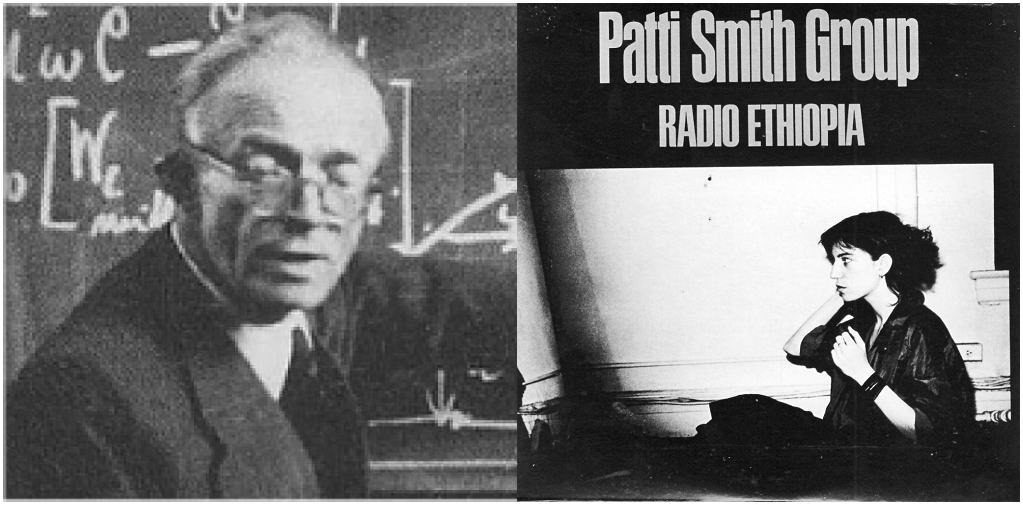
W. O. Schumann at the chalk-board and Patti Smith looking to run her nails on it.

.

By the time I was throwing on the last guitar track I was verging on consciously aiming for the sound of the Patti Smith Group’s “Radio Ethiopia,”  the title track to Smith’s second LP. Not a very famous or prestigious record. Why’s that? Here’s the punk-rock-speed history.

A significant group of people (though not top-the-American-charts-sized then, or modern Internet multi-million-follower sized now) had taken Patti Smith’s first album, Horses  to their hearts. I was one of that group. The chanted and declaimed poetry, the open references to rock’n’roll — that record’s sound was balanced between passion, looseness, and intent, unembarrassed in its declaration and performance. I also believe that impact was intensified because it was fronted by a young woman who acted unencumbered by gender roles.**

But that’s the first LP. I spoke above about the second LP, one that got tagged with the “difficult second record” label. “Difficult second record” syndrome is usually explained by a band having had a reasonable period to develop a range of material for their debut album, material that they have confidence in while still retaining a sense of freshness in their own experience of it. The second record now has expectations that have to be dealt with, expectations to either be mostly “the same, but better” or if not that, “different, but every bit as good.” But there’s less time to develop that second record while they tour to exploit the interest from the first.***  What was it they did right to make a splash with the first? Does a band have time to figure that out? What to keep, what to add?

Radio Ethiopia,  the album, kept an element from the tracks that are often less remembered from Horses:  the first record’s more conventional rock songs as opposed to the longer, idiosyncratic spoken word mixed with rock-references tracks — but in place of Horses  longer pieces like “Gloria,” “Birdland,”  and “Land,”  we got a different style on Radio Ethiopia  in songs like “Poppies”  and particularly and problematically on the 10-minute title track. Smith’s vocals were mixed lower in these new long-form songs, at times down to a subliminal level, and the chordal guitar work got denser. Few liked it. Not “few” as in dedicated, knowledgeable fans — “few” as in not-very-many.

I liked it.

E Flat

Here’s the lyric sheet Dave was singing from. Yes, the song’s in E♭

.

Will you like what I did to Dave’s song here then? Who can tell? It sure is musically different than the piece we performed just before it this summer, and the final resulting pieces you can hear here, even more different. I like different. If you don’t care for it, I’ll say that my aesthetic here is like Minnesota weather: don’t like it, or like it, today? It can, and will, be different tomorrow. Some will see a player gadget to play it below, but if you don’t here’s a highlighted hyperlink that will open a new tab window and play it.

.

*It would be so resonant if he was related to the composer Robert Schumann, but I’ve found no cite claiming that.

**One could, and likely someones have, written a treatise on Patti Smith’s relationship to gender, which is complex. Those hadn’t been written in 1975, which didn’t mean it didn’t have impact then. What some felt, got, resonated at pitch, would be emotions recollected in intellectuality later.

***Radio Ethiopia  came out just 10 months after Horses.

Went to See the Gypsy

In discussing last May how much fun it is to perform Bob Dylan songs I mentioned that when Dave Moore and I get together to play we often throw in a Bob Dylan song along with our own music. Last month* we finally got together after a long break due to Covid-19 and other infirmities, and as per that tradition the next to last song we played was a Dylan number.

Dave has been extraordinarily prolific with songs over the past few years, so it’s most often I who bring the Dylan to the table. Hipster-wannabe that I am, I often like to cast a wide net for the less-covered or celebrated Dylan songs. This time it was “Went to See the Gypsy”  off of Dylan’s little-remembered New Morning  LP of 1970.

At the time it came out New Morning  seemed important, as Dylan had stumbled badly with his previous record Self-Portrait.  Self-Portrait  seemed to many a lackadaisical record about being lackadaisical, and those many weren’t having that in the turbulent and searching summer of 1970. Think about this: that LP was released almost exactly a month after nine college students were shot and four died on a Midwest college campus. Of those four dead, two were protesting what seemed a widening war in Southeast Asia and two were somewhat distant onlookers between classes. A few days later two more students were killed at Jackson State in the South. The average youthful Dylan fan was less likely to be interested in tunes about all the tired horses in the sun at that moment.

So, less than six months later this other Dylan album, New Morning,  came out. In retrospect it wasn’t really a return of the fiery prophet of Sixties Dylan, but a lot of rock critics had made their bones considering that earlier Dylan style and made the best of what they had in it. One song, and one song only, could be parsed as if it was in that style “Day of the Locusts,”  a protest tune about getting an (honorary) degree from an Ivy League university while that year’s crop of “17 Year Cicadas” chirped their Dada chorus. Maybe some college students dug that one.

With the passage of time, New Morning’s necessity to rehabilitate the great songwriter’s reputation has lost its utility. Dylan has had at least two greater “return to greatness” moments since then, easily supplanting the importance of New Morning.  And of course the measure of the artist over such a long and important career makes bumps in the road disappear in the trailing dust. Though little thought of now, New Morning  is what it may have been intended to be, a much better record of relaxing with the mundane and interrogating it.

“Went to See the Gypsy”  is about nothing happening, a topic that many of the fraught students of 1970 would eventually need to come to grips with, and maybe it fits this second summer of Covid-19 too. The singer goes to meet the undefined titular “gypsy,” who maybe only figuratively that (the word derives from a now considered pejorative term for the Romany ethnic group). I think that character title is used to convey someone exotic and transitory. There may also be a suggestion that the gypsy could be a fortune teller, as many songs that Dylan would have known would have made explicit. The meeting is a big nothing. The two have a nighttime greeting in a hotel room (transitory housing), and then the singer has to go to the hotel’s lobby to make a call. Modern people, sit down in a circle around the fire, and let the old ones speak of this: in those days you couldn’t text anyone if you were running late or you had to get some info or agreement, you were required to go to a place where there where iron-clad telephones chained to a wall that took coins to accomplish that.

In the lobby an attractive girl (“dancing,” intimation of transient movement) begins to do a hype man spiel about the gypsy. How much time passes? We don’t know. Does the singer try to make time with the girl or vice-versa? The song doesn’t say. It only says that dawn is approaching (often the signal to end a song or poem) and the singer returns to the gypsy’s door, which is open and the “gypsy is gone.” The door being open is a telling detail, as it indicates that this wasn’t some planned leaving. The gypsy rushed out or was rushed out by someone. The singer returns to the lobby, the dancing girl is gone. Was she part of some planned distraction? We don’t know. The song ends with the singer instead “watching that sun come rising from that little Minnesota town.”

Now this song all could have happened in a little Minnesota town. One thing that many non-Minnesotans think about Dylan’s home in the Iron Range was that it must’ve been some ethnic Northern European monoculture, which it wasn’t in the least. Personally, I’ve always thought this final scene is a poetic jump cut, and that Dylan’s final sunrise is times and miles away from the events before in the song, but that’s just me.

In summary, a song about things just happening that keep things from happening. Your fortune won’t get told, nor will the mysterious guru tell you what to do, you won’t get to go through the mirror, and a pretty girl may have her own agenda.

Here’s today cover version of Bob Dylan’s “Went to See the Gypsy” Alas, there’s a couple of typos in the captions that flash by. I blame working too late.

.

Musically this is me on electric guitar with Dave playing some soft reed organ sounds at first. After those tracks were laid down live, I decided it’d been too long since I had done a full orchestral arrangement, and so after the fact I did just that and had the orchestra instruments come in partway in the song to represent the potential big something that hovers out of reach over this non-event story. I know dawns in little Midwestern towns, far from the chance of Las Vegas, gurus, or those who can tell one’s fortune. There you make your songs and self, yourself.

I should be back shortly with the song we did right after this one, a Dave Moore original.

.

*This same session produced The Poem, ‘The Wild Iris,”The Dragonfly,”  and I Am Laughing in the Dark Underground  that have already been presented here.

To Poets Not Dying Young

Poems and songs about those artists who die young are easy to find.*  Why should that be? Well, tragic aspects there are plain to see and it’s easy to note the lost potential in an early exit. I think there’s a further factor too: we are much in love with the trope of young artists whose work is caught in a rising arc before falling with melted wings. It’s extraordinarily difficult for an artist to continue to impress or delightfully surprise over a long career. We artists repeat ourselves and are judged to have become stale — or we change and produce work that isn’t judged correct to be coming from us. Perhaps this is inevitable. Or maybe in part it’s us as readers, listeners, audience, who contribute some faults to this by always seeking new faces — or the practical use of any failures as telling markers to drop attention.

I’ve made no secret here that I’m old. I missed out on being a has-been and I’m not anyone’s coming thing in the arts. In a strange way I find that frees me from those burdens, and I only need to carry my age and infirmities while producing new work. This summer as the blog and listenership has its seasonal drop off, I’ve indulged myself and your attention with more work with texts written by Dave or myself. I do notice that the poetry I’m presenting here of mine is overwhelmingly focused on loss, something Dave usually avoids. Young poets, young musicians, often add gravitas with similar emphasis — and I should note, young artists can and do directly experience those things outside of the world of imagining. Experienced artists may more likely realize this is a choice, one that we are free to question and doubt. But, speaking for myself and my summer it’s been more at reporting. The everlasting crisis of the wider world continues — unjust losses there are still noted — but each day I think of the closer infirmities of those I know: small losses for me beating in resonance to their greater losses, and less specific worries and predictions for myself standing before me as I look through them to assay these others unavoidably present and particular ones. This is likely the selfish and self-contained man’s version of empathy.

.

To Poets Not Dying Young

I enjoyed some dissonant chord colors and an “Is it in major or minor?” rub in this one’s music.

.

Today’s piece uses a text of mine I call “To Poets Not Dying Young.”   The effect I’m trying to convey is the wearing of life on the body and soul of older poets who persist in their observation and writing, and it’s written in the hope that we, as audience, retain our ability to read and hear them. I do worry that the images are too enigmatic in this one, but maybe the connotations or some incantatory power will carry the effect through to you. Even to myself, their author, some of the images reflect more than one thing, and I’m not sure if that’s good or bad.

The Parlando Project plans to restore our usual service in presenting texts by other writers in upcoming pieces you’ll see here soon, but to hear this one you can use a player gadget below if you see it, or this highlighted hyperlink which will open a new tab window with an audio player.

.

*Here’s a post and a short and graceful poem linking several “died young” poets by American poet Anne Spencer.  And here’s a real-life ghost story post that has as its musical bit a poem by Carl Sandburg about another poet who died young.

And here are three to argue from the other side for older artists persisting. An aged Longfellow calls on the spirits of other older artists to make his case.  And his contemporary in Britain, Tennyson famously hymned a possibly deluded old Ulysses asking for one more voyage. And here’s another one of mine, in full rock fury recalling a young man who was once thought a coming man in his field and who persisted in making art past fame. If you didn’t like today’s musical piece, these five pieces will give you a wider sample of what we do here.

Love and Sleep — or I re-examine Swinburne, with a little sex in it

I have to hand it to the Victorians — when it came to the names of some of their poets, they seemed to know how to roll right through the evocative, and tumble ass over teakettle into camp.*  This project has touched on the Pre-Raphaelites, those 19th century hipsters with their love for the middle-parts of the Middle Ages, and one of their leading lights Dante Gabriel Rossetti had a moniker that seemed to mix angels and demons with some flowery notes. Or then there’s the pioneering Canadian poet who decided to flesh out Sappho’s fragments with his own poetry: Bliss Carmen. But let’s suppose you’re writing a comic novel set then. You want a character name that’s really, really over the top. If so, you might then independently invent the name Algernon Charles Swinburne.

Sorry, already taken.

I can remember first running into the name in a poetry anthology while a teenager. I laughed out loud at its outrageousness. Algernon had been dead for a bit more than 50 years, but as we shall see, I doubt he minded my noting that. Honestly, I laughed for myself, but of course as a teenager who liked poetry I may have needed to laugh at that name out loud too. Young men in my place and time weren’t much for poetry, but I could suppose a name like John Keats could slip under the radar. Algernon Charles Swinburne, on the other hand, could have written poetry like Robert W. Service and he’d still have such a foppish name.

I went to read his poems anyway. Or I tried to. They didn’t seem outrageous to me — their effect was more at ornate, over-decorated boredom. And his poetry seemed to have nothing to say other than its fancy dress. In the years since, I’ve occasionally looked at a few Swinburne poems, and nothing has changed that opinion.

Algernon_Charles_Swinburne,_1862

Portrait of Swinburne by Dante Gabriel Rossetti. Let’s forget poetry for a moment, what product does he use for that much body?

.

This year while reading some accounts and memoirs of early poetic Modernists I did notice something odd. More than a few of them went through a Swinburne phase.**  I had known that the Pre-Raphaelites (Swinburne knew and was associated with them) and their “Forward Into the Past” revivalism of earlier literary and visual styles was an influence on some Modernists, but the things they sought to revive tended to be simpler than the mainstream Victorian style: old ballads, flatter painting, hand-hewn furniture, that sort of thing. Swinburne just seemed rococo through and through.

But there was another element that may have attracted them. Swinburne’s poetry was considered in the late 19th century to be, well, hot stuff, erotic, even transgressive. Swinburne’s contemporaries thought that Swinburne if anything reveled in those characterizations. Oscar Wilde (here we go again with the Victorian names) might be thought as someone comfortable with this, but more than one article I’ve read notes that Wilde said of Swinburne “A braggart in matters of vice, who had done everything he could to convince his fellow citizens of his homosexuality and bestiality without being in the slightest degree a homosexual or a bestialiser.”

School poetry anthologies skipped over that part, but Swinburne’s indirection in his poetic diction isn’t going to cause me to create a “radio edit” of today’s piece, his love sonnet “Love and Sleep.***”

So, what’s going on in this poem? S-E-X of some kind, though the down and dirty details are hard to suss out. A lot of what you may “see” in it is portrayed by implication and connotation. The “nudge, nudge, wink, wink” elements of the famous Monty Python sketch can be invoked in close readings here. I don’t want to play the Eric Idle character from that sketch for you, but I must risk being a mixture of risqué and ridiculous if I’m going to talk about what the poem does with language and imagery. Here’s a link to the complete text of Swinburne’s poem that I used for today so you can follow along as I go through the sonnet line by line.

  1. Classic mechanical clocks of that era might strike to mark the hours of nighttime. They don’t stroke. Make of this what you will.
  2. The lover, or perhaps some dream, imagining, or otherwise non-corporeal manifestation of them arrives at the poet’s bed.
  3. Flowers are invoked. Georgia O’Keefe, Judy Chicago, and Cardi B have yet to be born. Details in Swinburne’s imagery sometimes seem contradictory in a way I find hard to read. Something “pale as the duskiest lilly’s leaf” is hermetic. Is what is being viewed pale or dark?
  4. Erotic nibbling, or call for Van Helsing? You decide.
  5. Skin. Bare skin. Victorians are getting hot and bothered now. A lot of care in trying to describe the skin’s tone that just confused me. Wan (pale again) yet…
  6. “Without white or red.” Is Swinburne color blind? Is this night-vision gray? Even readers who are POC are getting confused here. One reading informed by those bestiality rumors: cephalopods. Students who find this post later: don’t put this in your essay, it will not help your grade.
  7. Well, the lover appears to be female, and she’s going to be allowed to speak. Thanks patriarchy!
  8. She speaks like a veddy veddy proper lady too — but apparently interested in “Delight.” Is that what the kids are calling it now?
  9. “Her face” is honey. Good, let’s keep this PG.
  10. Her body is “pasture” which borders on Surrealist de-humanizing imagery, though by implication this may be portraying the poet as a horny ruminant — so equality! If then: several stomachs. He can go all night.
  11. English poets love the word lithe. I’m not sure why, other than to prove they can enunciate without lisping. I don’t think Victorian English winter heating systems were well-ranked, and even in modern Minnesota we have our own personal erotic frissons with hands far from warm. Anyway, in Swinburne’s poem, the hands are “hotter than fire.” Let’s hope the beloved wasn’t chopping jalapenos in the kitchen before coming to bed.
  12. “Quivering flanks.” Good, someone’s having fun. “Hair smelling of the south.” In the mid-19th century Swinburne was living with William Morris and Dante Gabriel Rossetti in a house in Chelsea just north of the Thames. Luckily for poetic romance, this was a few years after this smell that would have come from the south.
  13. Feet. Thighs. More skin. Swinburne may have had trouble describing it, but he knows it’s sexy.
  14. “Glittering eyelids of my soul’s desire.” The arrival of Mark Bolan is prophesized by Mr. Swinburne. Get it on! Bang a gong. Get it on!

The poem’s title may be an indication this is a dream or imagining. Those on the material plane could suggest it’s a report of the great lover Swinburne, post quivering flanks.

Now, can singing help this text out? That’s plausible, as song lyrics can escape close examination and play to Swinburne’s strengths in meter and rhyme.**** And absurdity and mutual laughter are not enemies of eroticism. I give you a testimonial, available with a player gadget below for some of you, or where that’s not seen, this highlighted hyperlink which will open a player in a new tab window so you can hear my performance of “Love and Sleep.”  A couple rough spots for the acoustic guitar track I had to throw down quickly, but I love the C# minor11 chord I throw in at the end, even if I don’t know what color its skin is.

.

*By the 20th century Americans were much more straightforward with their name-branding. “Robert Frost” is the best name for that poet of New England’s cool stoicism. Ironic, what with the Anti-Semitism, but then what’s a better name for the poetic force that sought to revive the freshness of poetry’s texts, carefully weighing his words, than Ezra Pound. And for someone who would grow up to like the most honest poetry of the New York School, I can thank my family for Frank Hudson.

**As late as The Sixties, the anarchist and sex-very-positive  musical group The Fugs would perform a Swinburne poem just as they would perform Ginsberg and Charles Olson. Not suitable for the easily, or even not so easily, offended, The Fugs usually skipped the euphemism in their name, and as far as looseness in performance and vocal perfection they could make The Replacements sound like The Captain and Tennille. Don’t blame them, but they were a big influence on Dave and myself forming a band.

***Once again, I have to thank the Fourteen Lines blog for bringing this poem to my attention. This summer he’s had me look again at Joyce Kilmer, and now Swinburne. Well worth reading and following if you are interested in shorter poetry forms and expression. Like this project, Fourteen Lines doesn’t limit what they present to the poets they like the most.

****After all, pace Mr. Bolan: what the heck is “I’m just a Jeepster for your love” mean anyway? Did it seem exotic Americana to Marc? Just easier to scan than “I’m a Humbler Super Snipe for your love?” Perhaps, just as Paul  Éluard would have it, the beloved makes you “Speak without having a thing to say.”

Silent Steps

Rabindranath Tagore is surely one of the most remarkable writers ever to win the Nobel Prize for Literature. If you’re a veteran of this project you might recall that a few years back when Bob Dylan won the same Nobel there were objections from poets and novelists that song-writing wasn’t literature, and that giving such a Nobel to Dylan was unprecedented and wrong.

While “Wrong” is a debate, unprecedented was an error on the part of the objectors, even though they often stated their objections from a stance of knowledge, craft, and learning. I was explaining this to someone earlier this summer, who had innocently asked your hosting windbag here if songwriters hadn’t taken over some of the place that poets occupied a century or more ago. The concise person would have just agreed with a “Yes,” but I wanted to tell him the story of the 1.5 songwriters who like Bob Dylan had already won a Nobel Prize for Literature.

The .5 songwriter in my tale was William Butler Yeats, a great poet who once decided that if the ancient bards presented their poems with music, that he should revive that practice. He went so far as to commission the building of instruments to accompany his poems and setup a tour from a professional performer* to realize this aim. “Yeats, The Musical” was not a success, and when Yeats won his Nobel it was largely for his poetry printed on paper.

Tagore was a much more significant songwriter than Yeats’ case, though Tagore wasn’t just a songwriter. He made other 20th century polymaths like Albert Schweitzer look like pikers, with copious literature in all forms, political activism, painting, teaching in several areas, social reform work, and more. But for those who spoke his native language, Bengali, he was a very well known and liked songwriter. Nor was he just a poet with a sideline as a lyricist. Tagore the composer had his hand in not one, not two, but three South Asian national anthems.

When Tagore won his Nobel for literature, there was one book most Westerners could read of his: Gitanjali,  a work he had translated himself into English. That title references songs, and from what I’ve read it consisted of Tagore’s prose-poem-ish adaptations of his song lyrics. Yeats himself knew this, remarking in an introduction in the 1912 English edition of the book that because Tagore was a songwriter all strata of his society knew his work intimately.

Today’s song is my adaptation of the 45th piece in that 1912 collection, using my own music. “Silent Steps”  may seem familiar even if you are not familiar with Tagore or his beliefs. I hear echoes of Hebrew psalms and prayers, and the other Middle-Eastern-origin religions such as Islam and Christianity too. Are you instead secular? I’ll come back to you.

I lightly adapted Tagore’s phraseology for much of this piece to make it more singable in English, because one of Gitanjali’s  chief issues is that it often doesn’t sing in our tongue. I departed more widely for the final verse. Tagore’s image there is hard for me to follow, and even if I haven’t clarified it much, I was moved to modify the image.

Tagore originally wrote this in English as the final stanza:

In sorrow after sorrow it is his steps that press upon my heart,
and it is the golden touch of his feet that makes my joy to shine.

See what I mean about hard to sing? But let’s get to the overall issue. What are, or whose are, the poem’s titular “silent steps?” To those familiar with Tagore’s beliefs, it’s the godhead, manifesting itself through nature and human consciousness attuned to it. Tagore is saying that human awareness that the godhead is present and manifest in its creation is consolation in times of sorrow. His “press upon my heart” is perhaps more at “seal,” as in the Hebrew Song of Songs  “Set me as seal upon thine heart, as a seal upon thine arm.” And the touch of the feet more at something like the Christian “If I could touch the hem of His garment, I know I would be made whole” line that has been used in many Christian song-settings.

Silent Steps

The text of my adaptation used for today’s song-setting of Tagore.

.

To be audaciously critical of the great man Tagore, his concluding stanza lacks visceral power. I thrashed around a bit to come up with a different image that may be adjacent to Tagore’s. My last stanza says in effect: as we walk in the footsteps of our life, trying to follow our precepts and finding in that journey the inescapable sorrows of infirmities and imperfection, we feel not only our own lowly footsteps on the path, but the pressures of (unrealized) perfection and completeness pressing on ourselves. All of our footsteps polish the surfaces of the paths we trod — and that the higher consciousness (the godhead consciousness for believers) does the same to us. We try to make life shine in our footsteps — and the limits of trials, troubles, and tribulations that press down upon us in turn polish us. Our joy shines because of those pressures, those rubs.

I said I would get back to the secular among this readership, because I don’t think the poem requires agreement with Tagore’s beliefs, or any adjacent religious beliefs either, to retain power. The godhead manifesting in a chariot would please the Biblical prophet Ezekiel, or 20th century Midwestern Afro-American Fenton Johnson, and so too the onrushing, unstoppable “time’s winged chariot” of 17th century English poet Andrew Marvell, who recasts that cosmic sound as a booty call. In American sports idiom, “hearing footsteps” is when a player senses a play-ending tackle is forthcoming. The successful player knows that, just as the unsuccessful one does — but the successful ones are able to continue to complete their task despite that knowledge.

For all I know, the heaven of death and reunion with the godhead and the heaven of oblivion may be two neighborhoods of the same city.

The small graphical player will appear below for some of you to hear my adaptation and performance of Rabindranath Tagore’s “Silent Steps.”   If you are reading this where that player doesn’t appear, this highlighted hyperlink will also open a new tab window to play it.  Thanks for reading and listening!

.

*From accounts Yeats was (like myself) somewhat pitch-challenged as a singer. And he didn’t exactly want his poems sung, thinking that a complex melody might detract from the words. Yeats instead choose some kind of middle-ground for the vocalist of which we have no extant recordings to demonstrate. From some research I did a few years back, the closest we may have to understanding what he was proposing was his “Song of the Wandering Aengus”  which Burl Ives and Dave Van Ronk and then Judy Collins performed back during the midcentury “Folk Scare.” Van Ronk said in performance that he learned it from an actor Will Holt who was also a folk singer, and it’s speculated that Ives and/or Holt may have learned the melody he used from another actor (Sara Allgood) with connections to the Abbey Theater, where Yeats was a foundational force. Here’s how I recounted that story a few years ago back here.

Answer July

It’s time once more to perform the brilliance of Emily Dickinson. Today’s text, “Answer July”  is Dickinson in her seeming simple mode. Read quickly, it might strike one as almost a nursery rhyme or maybe as one of those playful listing or counting folk songs. Here’s a link to the full text of the poem.

But when I looked again, “Answer July”  appears to be a debate or interrogation between nature’s seasons and the consciousness of souls, a rather strange thing to put into such a brief and unfancy piece of poetry. Emily Dickinson loves strange, and if you’re a reader or listener who’s stuck around here, you’re comfortable with it too. What’s being debated here?

It starts with the poem’s speaker — let’s call them Dickinson, though obviously, it’s a creation of Emily Dickinson, and as its creator she knows more than this character — demands of nature’s mid-summer month of July just where certain summer things are. July, like a party in a legal dispute or sidestepping debater replies that the things that would allow it to produce those summer things are not in its control. There could be a supply chain issue, and maybe the real problem is with its supplier: the spring month of May.

Bee in Flower by Heidi Randen

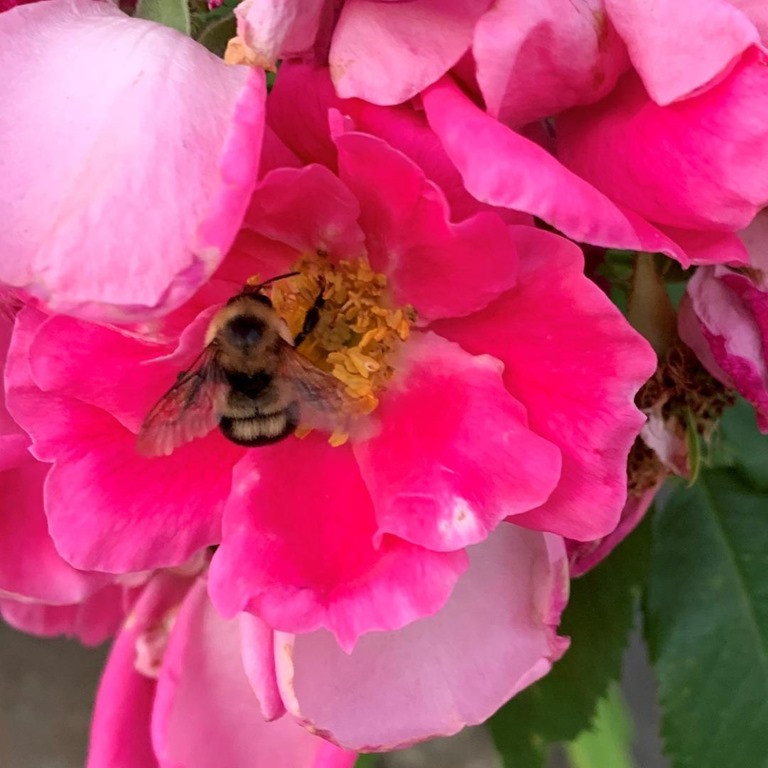
Where is the Bee — Where is the Blush? Got it right here Emily.

.

May is called in. “Nay,” says May. Tell me about supply chain issues! I’ve got suppliers too, like winter. Subpoena the jay, a winter bird.

The jay is sworn in. Look I need food in the winter they testify. Where’s the leftover autumn corn, the periods of hazy-thaw less-severe cold, and those burred seeds still in their protective casing? The implication here is that we could next look to question fall, though by now we suspect fall will blame summer. And round and round we would go.*

Dickinson gives us two lines that may be a break in the circle. When July, the first month/season to be questioned ends their reply, I think July suggests that May/spring is not a calendar month, but instead a creature of the questioner in the poem. The syntax is broken and unclear here, so who speaks each word is uncertain — but at the time I performed it, I went with this understanding (in paraphrase): July replies (answering to Dickinson’s opening line of questioning) “You’ve called on me to answer. Well, I’ve got one for you, ‘Where is May?’ Come on, you (thee) answer! Because I know what you should answer when asked about where things spring from: ‘It’s me.” That is, Dickinson, July questioner, is responsible.

I could be wrong on that somewhat convoluted reading. It could also be July saying “If May was here, they could answer your question for you (thee) and for me too.”

And then again, as the poem ends, the jay has a cryptic answer to where it can find its winter sustenance: “Here — said the Year.” Unlike summer, winter seems like a time of scarcity, but nature provides the jay what they need. There the implication is that Dickinson’s original complaint to July about where are the summer things she wants is being answered by the jay saying that nature will provide, if your soul seeks for things rather than asking for it to be summer ample and at every hand. This reading of the last line is what drew me to my more complicated reading of the earlier “Answer Thee — Me —” line. The poet Dickinson is telling the character of the questioner in her poem that it’s not the seasons that provide, it is the soul that seeks that finds. She is her own spring, summer, harvest and survival.

Musically I had some fun with this one. On one hand the harmony is simple, a I V progression, but I used some less-common voicings for the Ab (it’s an AbMaj13) and Db (a DbMaj7) and I played sitar.**  Why not! Emily loved strange, and if you’ve stuck around here this summer, you have to have some tolerance for that. The player gadget will appear below for some of you, but don’t ask July where it is if you don’t see the player. Instead, click this highlighted hyperlink, which will open an new tab-window and play my musical performance of “Answer July.”


.

*Once again, I’m working on my theory that Emily Dickinson’s sharp intelligence was surrounded by a family that worked as lawyers, and that may have provided a frame for some of her poetry. As I write this there happen to be many supply chain issues ascribed to the impact of the Covid-19 pandemic and other causes, but neither legal precedents nor logistical savvy is the real subject for this poem, rather it’s about a Transcendentalist understanding of how the soul must partner with nature.

Emily Dickinson herself was also a gardener and the Dickinson household raised a wide variety of food and feed crops. Any farmer or gardener knows that it’s not just the calendar page that brings in food and crops, but effort and seeking.

**Well, not exactly. I’ve never owned a real sitar. I have owned an electric sitar with a plastic rounded bridge that sought to emulate their buzzy sound. I’ve used MIDI “virtual instruments” that allow a guitar or keyboard to play sitar notes with attempts at following sitar articulations. Today’s piece uses a Line6 Variax guitar that has a sitar sound setting, and it tracks guitar string vibrato precisely, a necessity for this piece’s main sitar line motifs.

The Dragonfly

This summer, amid the seasonal lower traffic volumes for The Parlando Project, I’ve been featuring some uncharacteristic pieces where Dave Moore or I have written the words as well as the music. But today we’ll return to the proper mix, using a text by English Victorian poet, Alfred Lord Tennyson.

I saw today’s text first over at Kenne Turner’s blog, where it was included as a short stand-alone lyric poem entitled “The Dragonfly”  in the midst of a series of excellent  photos of varieties of this creature.  Here’s a link to that post which will also let you read the text I used. Other blogs have published the same text under this title, and I assumed it was a uncharacteristic very short nature poem by Tennyson. Let me thank Kenne for bringing this poem to my attention.

Long-time readers here will know I like concise poetry, and this one, so concentrated in its charged notice of this strange yet charismatic insect in a moment of transition captured my interest immediately. Earlier this month I performed “The Dragonfly”  along with Dave playing keyboards, and you’ll be able to hear how it came out below. Sure, it is a Victorian poem, though not excessively so. Just a few words might need 21st century explanation. That “sapphire mail” is the insect’s chitin exoskeleton portrayed as if armor, not a blue envelope delivered by some postman. “Crofts” is something of a Britishism and means a humble field. The moment Tennyson seems to be describing is the ending of the years-long nymph stage of the dragonfly, as the mature winged insect splits open its old hard exoskeleton emerging a moist new winged creature. In checking on the zoology of this, I read that dragonflies spend the majority of their life as immature, wingless, nymphs before becoming the strange fascination that we see, and only then think: dragonfly.

I’ve mentioned infirmities and transformations a good deal this summer, and I thought this transformation more clearly ecstatic in nature, and that it would be a good break from the more gothic material I’ve been working on recently.

So there I was, I had this text, cloaked in language and poetic diction that said “Victorian,” but also prophetically Imagist in its concise approach. I had music to perform it with, and then a decent recording that brought it into existence.

Dragon at the Door 1080

Summer, time to fly thro crofts wet with dew, and not just more screen time.

.

Then today, I decided to see what else I could say about this poem when I present it here. It was then that I found that it may never have been intended as a short poem, but was instead part of a long, very philosophic poem by Alfred Tennyson called “The Two Voices.”   Here’s a link to that text. When I say philosophic, that might sound a bit bloodless, but Tennyson’s own working title was “The Thoughts of a Suicide”  — and no, that’s not a literary plot, like “The Lady of Shalott.”   It appears* that “The Two Voices”  is something of a less-favored and less fully-achieved early attempt at the matter that produced what is thought of as Tennyson’s masterpiece “In Memoriam AHH.”   So, “The Dragonfly”  a simple nature poem? No, nature isn’t simple, even if beautiful. The matter Tennyson was grappling with was the unexpected death of his friend, supporter, and literary compatriot, Arthur Hallam, at the age of 22.

It would be appropriate to insert your favored curse word here. I’m an old man. The death of folks I know, then knew, is a commonplace of age, and painful, though touched too by a strange partnering with an idea that death is closer to me — if only demographically at this moment. But young, brilliant, helpful, a man with whom, it is recalled, would fall and roll down in the grass with the similarly young Tennyson, overcome by paroxysms of laughter at some bit of passing humor — how can one express that kind of loss?

Imagism says that you can enclose that unexpected death of a vibrant and cherished youth inside a short poem, made up of a moment of exacting and clarifying observation; a poem that is furthermore modest in its emotional expression and that doesn’t say what something like that event feels — showing instead what one examines with our two, small, dark eyes, our meager allotment compared to the giant multitudes of eyes that make up most of the dragonflies’ head.

Can it do that? I don’t know. Interesting to try. I sensed only this mysterious/glorious transformation when I first read “The Dragonfly”  excerpted from it’s longer setting in “The Two Voices.”   I really did intend for it to be a bit of a break here, but I’m left with informing you of my honest experience of this poem as I do regularly in this Project.

For some, the player gadget will appear below to hear The LYL Band perform Tennyson’s “The Dragonfly.”  Don’t see a player? Turns out a lot of ways to read this blog won’t show that, so I provide this highlighted hyperlink to open a new tab window and play it as well.

.

*Given that I’ve only seen Tennyson’s “The Two Voices”  in its entirety this afternoon, I’m not able to tell you more about it other than what I’ve quickly gathered. Victorian poetry doesn’t generally attract my attention, even if most of the Modernists that do attract me grew up during the Victorian era, and, even in rebellion, would be impacted by it.

The Final Minute

Patience appreciated reader. You know we sometimes start one place here and then teleport to somewhere else near the end.

The NBA finals concluded last night, settling for this year the championship of the world’s premier basketball league. Best as I can tell, there’s not a lot of sports-fan overlap here, and to be honest my sports interests atrophied by the time I reached middle age to the point that it’s mostly a skimming of the sports news.

Still while researching something else last night I noticed a live-updating article on a news site for the finals game in its last quarter. I opened a tab in my browser, and in between reading other links germane to my research, checked back on how it was going.

A tied and then two-point, one-possession game eventually entered its final minute, and around there the Milwaukee team, possession by possession, started to assure its win. Even though it is a business, and even though the losers will get paid too, these moments in sports still build into an Aristotelian Poetics agony. One side is partly hoping no one screws up the increasing likelihood; the other side increasingly knows hopelessness. Compounding this, the obligatory strategies of the game mean the endgame is prolonged with timeouts for court position and play caretaking, and desperate, clock-stopping intentional fouls.

Fireworks spent

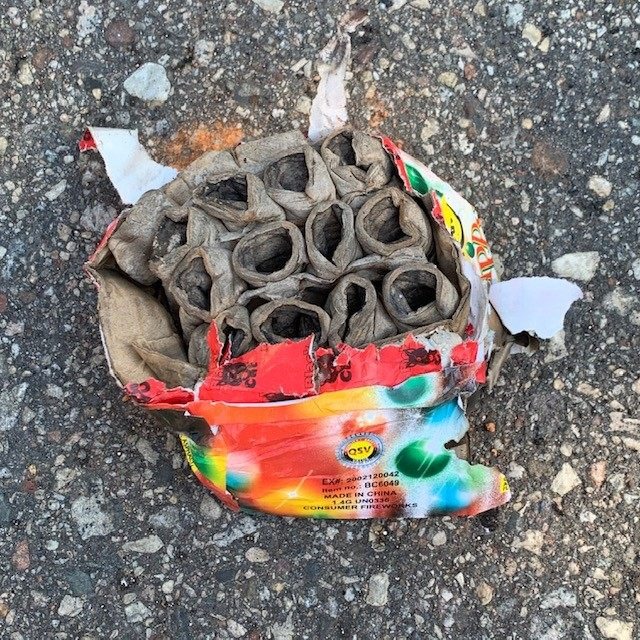
July remains of bang, light, spent.

.

And so, patient reader, it was then, as we continue our summer death, infirmities, and transformation tour here at the Parlando Project, that I thought of this song by Dave Moore that we had performed over a decade ago. Things sticking in memory is one test of artistic validity, and out of hundreds of different songs that Dave and I have performed since then, to recall this one seemed meaningful.

When I dug it out and listened to it this morning, I heard its infirmities: a simple rhythm-machine beat, Dave misses some intended notes in the vocal, my guitar part is not much. The combo organ sound that Dave uses is not hip or fashionable. But still, I think the piece did more than charm my memory. Near the end, Dave lets out a quatrain that still says something about our lives, about infirmities and death:

“You can’t make this up.
It makes up itself.
You can’t make it be
more than anything else.”

We all have our lies, our lives, our arts. We strive, and then someday, strived, to make them. Two out of the three are artificial, and yet from that we still try to discover truth. In the end, death makes up itself. Funny game.

A player gadget will appear for some of you to play this performance of Dave Moore’s “The Final Minute.”   If you don’t see it, this highlighted hyperlink is another way to hear it.

They’re Not the Grateful Dead

Is it time to take a break from our sometimes intense presentations of poetry combined in some way with music? Well, here’s a little ditty about the lighter side of death, or rather the worship of dead rock stars.

My observation is that though there are still the occasional premature music casualties in the current environment, that the worship of “The Greats are Taken from Us Too Soon” variety is reduced among young people today. Perhaps that’s a healthy sign, or it could be secondary to the casualties not having the right mix of fame to burn brighter at the graveside. And in the past, the other half of this project’s concern, poetry, has not been immune to the praise of dead talent, particularly dead, young talent, either.

Sure, it can be a honorable thing to give respect to those who’ve gone, to carry their artistic flag further when they can’t, but there is another side, the romantic admiration for the risks and the access to excess that often precedes the early death of musicians, writers, and other artists. The first duty of an artist is to survive. Society is not generally on the artist’s side until they become successful commercially, and even when it grants them that success, it can withdraw it and their support quickly too. To add to that burden with one’s own self-medication and distractions seems like a compensation to that state, but it doesn’t always work that way.

Poet, songwriter, alternate voice, and frequent keyboard player here Dave Moore wrote a short poem about how an older person might view with a strange kind of envy the tentative fame and unbounded experiences that others in our musical/generational cohort enjoyed. Sex, drugs and Rock’n’Roll once seemed to be jobs on offer in the want ads in our youth, even if it turned out the positions were already filled and the items already sold. I adapted Dave’s words, added a verse of my own, and wrote music for my performance of “They’re Not the Grateful Dead”  some years back and thought you might enjoy it here. Oh, that “Grateful Dead” in the title? Translated folkie Jerry Garcia knew that this was a trad folk song trope where the dead magically and musically express some gratitude.

They're Not the Grateful Dead

Who’s who for any crate digger obsessives: Hopkins, Hendrix, Moon, Jaco, Saxon, and Thaxton are hereby linked.

.

One thing I like about Dave’s lyric is that, outside of Jimi Hendrix he doesn’t pull in the big names, the Boomer rock’n’roll Shelleys and Byrons, the ones that are still featured faces in the rear-view mirrors looking at the music and times. Starting right off with Nicky Hopkins* is a bold move, but then Dave is  a keyboard player.

The song’s conclusion has a little fun with the sentimental “If there’s a rock’n’roll heaven, you know they’ve got a hell of a band” thing. Keats’ unheard music may be sweet, but it’s still hard to hear.

My performance of this has a few flubs, but it’s hard for me to get more recording in right now, so we’ll make do with this older recording as is. The player gadget is below for many of you, but if you don’t see it, this highlighted hyperlink will also play my performance of “They’re Not the Grateful Dead.”

.


*Huh. Who? Those who didn’t ruin their eyesight fantasizing about debauched after-parties but by reading all the liner notes on every LP will know who Nicky Hopkins is.