Palingenesis — three anniversaries noted

Today’s post is part of observing three anniversaries this week: this blog’s launch six years ago, Atomic Bomb Day (noting the anniversaries of the bombing of Hiroshima and Nagasaki), and my late wife’s death in 2001. An odd combination? Well, yes, but they coincide.

Odd? Personal loss has an odd size. If one holds one’s hand in front of one’s eyes it can block out the entire sun. How close grief is to one, has a similar effect. When the 9/11 plane crash attacks occurred a month after my wife’s death, it was objectively a sad, horrible, thing. To some small and nearby degree it impacted the place I worked. There were employees traveling, in the air as the attacks became known. We had at that time a floor of offices in a tall local building in St. Paul, over a thousand miles away from the attacks, but a tower named at that moment ominously “The World Trade Center.” And the radio network I worked for had a large news component. Everyone and I did what we needed to do in the wake of the attacks. It was not that I did not care or have consideration then — but the sharp pain of that public grief could not be felt to the same degree in my self still encased in loss.

So too the atomic bomb attacks on the two Japanese cities must have been in 1945 to many Americans. Some had lost loved ones in that war, some feared for losses to come. Some were waiting for what, how many, conventional deaths before the war’s end, and wondering if one of them would be their own.

Those nearby close things can blot out an atomic bomb. Ethical philosophers try to make true weights and perspectives, poets on the other hand talk instead of how it feels to think of these things.

Henry Wadsworth Longfellow, an American poet whose importance is now obscured by judgements of excessive conventionality against the bright lights of Dickinson and Whitman’s new approaches, wrote the poem which I’ll perform in part today. Written and published in 1864 during the American Civil War, it’s author certainly knew of the generalized grief and loss of that war and the human slavery it was fought over* — but he also had closer griefs. His wife had not only died in 1861, she died in his arms, her body on fire from a household accident as he himself was burn-scarred trying to extinguish the blaze. And then his teenaged son was serving in the Civil War and was grievously wounded in 1863.

Longfellow-bomb-Renee

Three anniversaries remembered. There’s no way to picture this blog in a single picture, so we’ll show Longfellow.

.

The opening section** of “Palingenesis”  considers memories and grief, considers the imperfection of the rebirth that the obscure word used as the poem’s title offers. If the eternal noises of the sea and ghostly apparitions in the mist may strike us as all-too-tired poetic tropes to our 21st century judgement, the image at the end of the segment I perform, the ashes from which some fabled alchemist might be able to reconstruct a burnt rose still has power for me. This “rebirth” without scent, and without the ability to change and bloom, is not a true rebirth, it does not repair the loss.

My life path after my wife’s death is a complicated story including joy and gratitude. Are those considerable things big enough to obscure the loss — in reverse, a planet bigger than a hand? I cannot honestly weigh that, other than to live in the scent of life and to bloom. Starting this project, even if over a decade after my wife’s death, was one way to return to poetry what my young poet-wife would have given.

I have at least one other planned part to this anniversary post, one other musical performance that doesn’t yet exist. I don’t know if I’ll be able to find time to do that, but this part that I did complete is available below. You can play the performance with the graphical gadget below where you see it — and where you don’t, you can use this highlighted link.

.

*A close friend, a U. S. Senator, was beaten unconscious and seriously injured on the floor of the Capitol over an anti-slavery speech which was deemed insulting for inferring the same crimes of sexual slavery Longfellow wrote about in a poem.

**The rest of Longfellow’s “Palingenesis”  concludes with the realization that a forward-looking new birth, not an attempt at exact repair and reincarnation, is the better answer. Not only would the entire poem produce a piece longer than I prefer to present here, I think the poem’s older poetic language might wear down many current listener’s interest. Here’s a link to the complete version.
From Cocoon forth a Butterfly – Emily Dickinson’s summer consideration

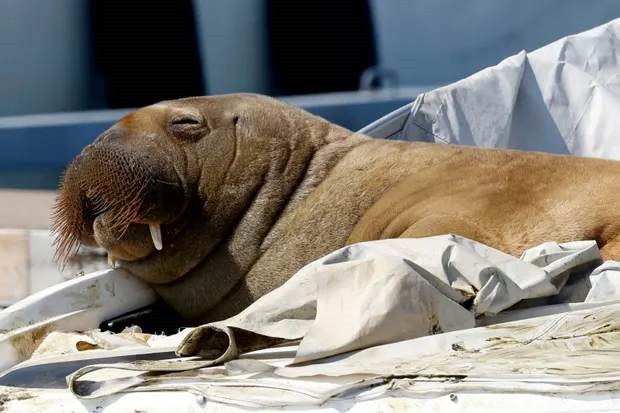
I shared with my wife, who has many concerns bearing down on her this summer, recent video clips of Freya, a celebrity lady walrus who’s lately been hanging out in Oslo Norway’s harbor. Freya is a young 1300-pound mermaid who spends around 20 hours a day sleeping while carelessly lounging on marina boats, sinking a few with her what-the-hell-I’m-wiggling-aboard anyways. During the other four hours Freya chases ducks and swans. The marina also has kayakers and paddleboard riders which she also likes chasing. Recent videos have caught her eating one of the swans,*  but perhaps thinking of her beach-body figure, she’s skipped eating the humans so far.

“Twenty hours of sleep…” my wife responded. “goals!”

Freya

Hot Girl Summer: Freya, in her liminal state between 20 hours of rest, bird and clam eating, boat wrecking, and being adored by her Norwegian fans.

.

Now as far as I know the great American poet Emily Dickinson never got to observe a walrus. On one hand, Emily did have a privileged life as the child of a successful lawyer, but then it was the 19th century and they had fewer smartphones, washing machines, lawn tractors, induction stovetops, and air conditioners. At least in her youth her parents believed strongly in self-reliance and careful household finances, and so distained servants, since after all they had a pair of daughters who could do that work. If we think of the later-life Emily Dickinson as the housebound hermit, you may not know that the younger Emily Dickinson divvied up the household work so that she had more outdoor chores compared to her sister.

One of the things I learned when I visited the Emily Dickinson house a few years back was that across the main road in front of the Dickinson house the family also had a field they farmed. And then on the house’s main lot there was an orchard and food garden which were largely the creature of Emily and her mother. Harvesting hay from the field was probably men’s work, but I was told that Emily would be tasked with bringing the harvesters water and food during their work. All that came back to me as I read this charming poem of Dickinson’s that is generally known by it’s first line: “From Cocoon forth a Butterfly.”  Here’s the full text of the poem if you’d like to follow along.

There are three or four characters in this little poetic drama. There’s our Butterfly (joined by others of her kind later), a “notwithstanding bee” who is proverbially occupied pollinating and presumably making honey, and the harvesting men. The fourth character is animated by the poet herself, a flower which despite being a plant is described as “zealous,” waving in a summer breeze for an afternoon.

Our main character, the Butterfly is described as if she’s an idle lady. She seems to have no task, something she flaunts in the poem. The field workers, the men, have obvious tasks. That hay won’t harvest itself. The bee, a cliché of purpose. The flower is a bit more ambiguous. If we assume Dickinson chose zealous carefully, the flower may be ardently worshiping the summer day or perhaps it’s divine author, shuckling in vegetative prayer.

Which character does Dickinson identify with? Maybe a little with all of them, if not entirely with one. If one has farm tasks (or for that matter the artistic tasks of a poet) the idle lady making a show of her leisure isn’t your model, even if you may feel a bit of envy — and yet poetry can be charged as like a butterfly, a piece of beauty that seems to do nothing. The men are doing useful work (see Robert Frost on mowing in this poem) but though Dickinson tends a garden this haying is not her work. Same for the bee. Dickinson no doubt knows the bee’s work, appreciates it too, but it’s not her work. We know Dickinson is highly knowledgeable about flowers, and often makes them the subject of her poems, but this zealot flower? If she’s serious about that characterization, she stands outside that level of belief.

The closing stanza, like her more famous “I’ll Tell You How the Sun Rose”  poem resolves this separation from her, the observer of it all — Vanity of Vanities, all is Vanity — and so the purposeful actors and the purposeless Butterfly will all be gone by end of day. Emily the poet remains, as does her poem if we take the time to observe with her again, many days and decades later.

Before I leave you with an opportunity to hear my performance of Dickinson’s “From Cocoon forth a Butterfly” I want to put in a note here about the lack of activity here this summer. I share some of the concerns of my spouse, and I am also trying to reevaluate this Project to see if I can make what I do here more useful, or beautiful, or something. Traffic and listenership always drops off in the summer, so a good time to reevaluate, and you may see fewer new pieces until autumn.

To hear my performance with original music you can use a player gadget many will see below. Don’t see any gadget?  This highlighted link is here as a backup for you.

.

*Showing a connoisseur’s appreciation for the swan greater than William Butler Yeats’ I’d say. Yeats only looks at his swans, and yet the great poet distains at putting his tusks into one like Freya. Walruses also eat clams, which as far as I know have never moved Yeats to poetic transport. Apparently, Norway has a problem with lots of invasive clams, which may be why Freya has been hanging out in Oslo.

Yellow Air (Heat)

Are you new here? If so, this is what the Parlando Project does: we take words (other people’s, mostly poetry) and combine them with a variety of music we compose, create, and perform. I find this fun, and I also find that even more than reading another person’s poem — even reading it aloud — performing it illuminates corners inside the text that I might otherwise overlook, so I write here about that experience. Then when you listen to the pieces you get to hear the poem in this new context to freshen your appreciation of poems you know, or to allow you an entry into a poem previously unknown to you.

Most of the time I’m faithful to the texts I use to create these pieces. Oh, I might take a part of a poem and make it a refrain/chorus, or I may select some tasty phrases from a prose paragraph so that expresses something more sharply, as if it was a poem — but my usual idea here is to honor some poet or their poem no matter how famous or little-known it is.

John Gould Fletcher is shelved in that little-known section these days, even though he was associated with writers and movements that are still studied, still read (at least by those interested in early 20th century American Modernist poetry.) I wanted to look at some of his work because I read that one of those associations was with those pioneering Modernists who took to calling themselves Imagists. Imagism was often that 2:40 punk-rock single of a hundred years ago. Instead of spendthrift merely decorative language, rhyme, and imagery, the Imagist poem wanted to get right down to it: direct treatment of something observable, not some ideal distilled from abstract thoughts imagined or philosophically proposed. No extra points would be scored for extra words. Rhyme, while not forbidden, was also not the main point. If rhyme led to extra words, those unneeded ones, it was worth discarding.

The musicality of poetry wasn’t thrown out, but like Modernist music, Modernist verse wasn’t interested in the old formal beats so much.

Best as I can tell from my early readings, Fletcher’s personal interpretation of Modernism and Imagism was not the same as others. He didn’t write much in hyper-short forms, while many of his fellow Modernists published whole collections, or sections in collections, made of sub-20-line poems. At least at first glance, Fletcher cared more for sound and less for freshness and concreteness in his imagery than others.

This Project likes shorter pieces, even more so now because my time and opportunities to compose and record are less than in the Project’s early years. In reading through a couple of Fletcher’s collections from a hundred years ago, I did come upon this short poem that was part of one of those roman-numeral separated sequences like other Modernists used. “Heat”  seemed an attempt at the short Imagist poem to me. Here’s how “Heat”  goes:

As if the sun had trodden down the sky,
Until no more it holds living air, but only humid vapour.
Heat pressing upon earth with irresistible langour.
Turns all the solid forest into half-liquid smudge.

The heavy clouds like cargo-boats strain slowly against its current;
And the flickering of the haze is like the thunder of ten thousand paddles
Against the heavy wall of the horizon, pale-blue and utterly windless.
Whereon the sun hangs motionless, a brassy disc of flame.

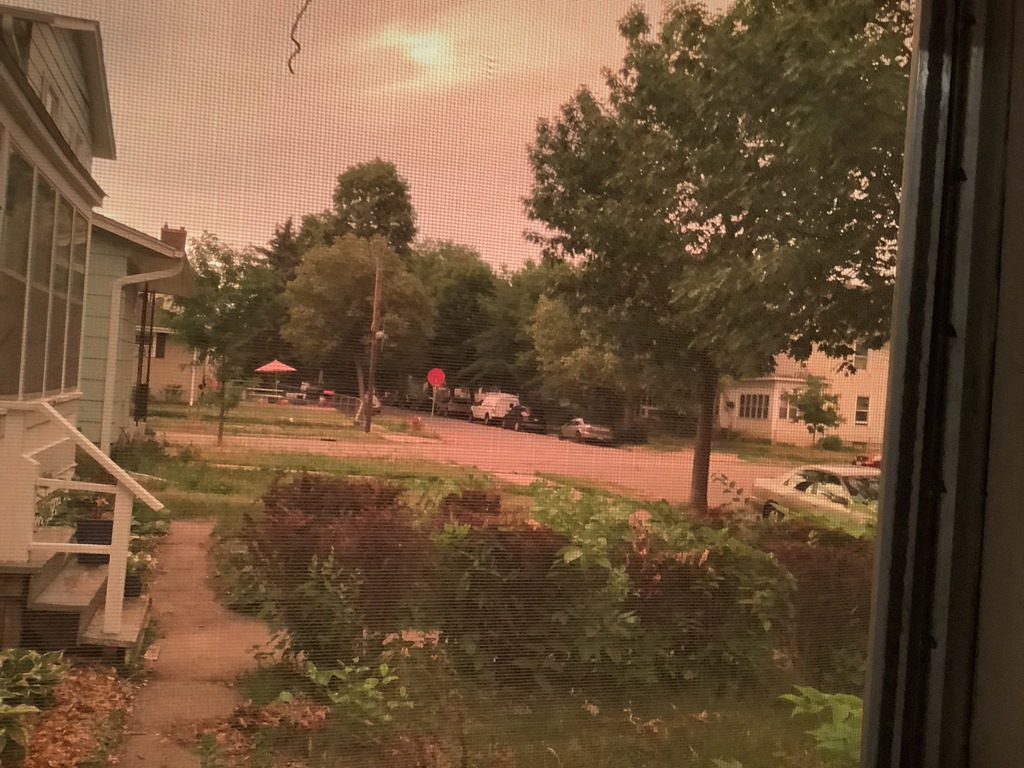
Short as it is, it’s a little wordy and formal in its manner of speech compared to other Imagists, but a palpable feeling is evoked in the description. I could have performed “Heat”  as it is above — but then a week ago tonight, I was sitting on my front porch after a summer thunderstorm when the entire outdoors started to take on an intense yellow cast.*

Yellow Sky the Picture 2

It was hard to get a modern digital picture of last Tuesday evening’s sky with a phone. The smartphone kept correcting the heavy yellow and darkening cast to that sky, and as I looked at the photo preview on the phone I wondered why my phone wouldn’t believe me as it showed things brighter and blue. I resorted to using a much less smart device with a lesser digital camera to get this.

.

I decided then and there to use Fletcher’s poem to remark on that experience. This recasting went through a few drafts and produced this reuse of some of Fletcher’s words in a different poem:

Yellow Air song PRINT VERSION

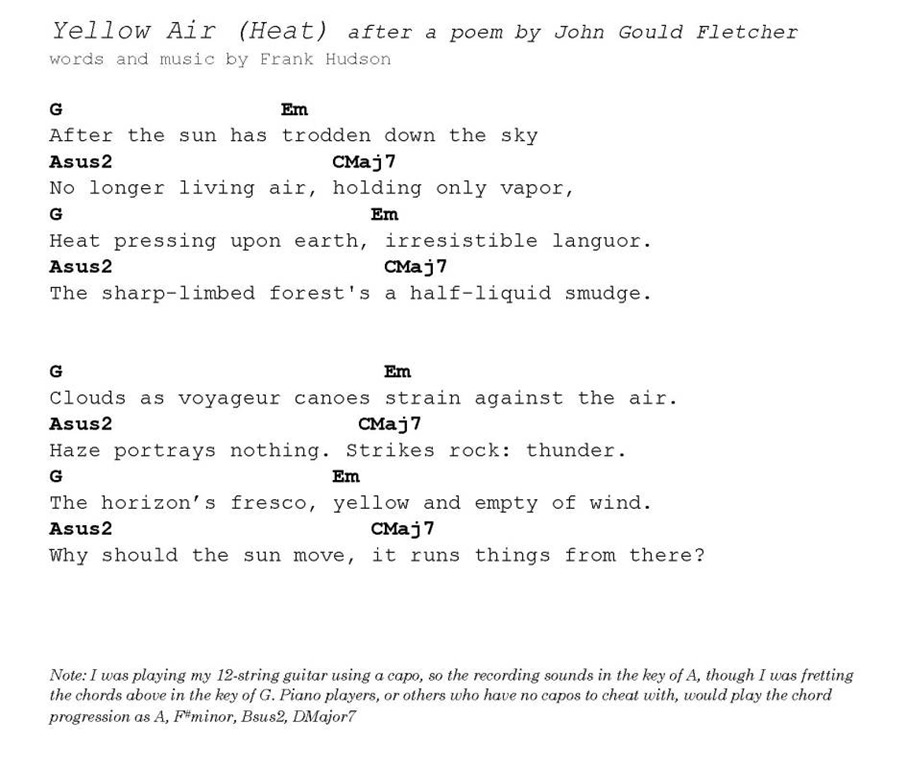
Here’s “Yellow Air” with chords in case you want to sing it yourself.

.

What did I change? I wanted my own yellow air in a hot, humid summer experience to be portrayed. Though I retained many of Fletcher’s original words and phrases, my variation is present tense and uses a much less literary/formal sentence structure. Mine’s 61 words — Fletchers, 80. The clouds as ships image is borderline cliché and Fletcher’s “cargo-boats” wasn’t specific enough to fight that, so I substituted my own upper-Midwest image: the 18th century indigenous cargo-boats of our region, the voyageur canoe — still reflected even today by those who use their modern canoes to carry themselves and gear into the Boundary Waters for camping. I wanted a more definitive ending too, and so ended my “After…” poem with the sun portrayed as a ruling strong-man who doesn’t care that the sky is yellow and the heat and humidity oppressive.

What I kept, or even tried to bring out was Fletcher’s word-music. Rhymes near and perfect were increased in number and paused on, and I tried to make this variation more easily singable than Fletcher’s more prolix lines.

You can hear the resulting song with the player gadget below, or if that won’t show up in your way of viewing this blog, with this backup highlighted link.

.

*The Twin Cities Weather Service explained last week’s yellow sky cast this way: “Behind thunderstorms in the evening, high clouds remain. The setting sun emits light that is bent with longer wavelengths. While the blue (shorter) wavelengths are scattered out, the yellow-orange-red part of the spectrum remain, thus producing the sky we’re seeing tonight.”

The Dick & the Dame, or Dave Moore goes Pulp Noir

This project spends a lot of time in the first quarter of the 20th century where the public domain diamonds are scattered free for recutting and reuse — but If I was able to expand this, I’d probably skip the Thirties and delve into the 1940-1965 mid-century quarter, the era I personally remember through youthful-eyed memory. What were those adults up to then, what were they thinking?

We can never answer that fully. Even through that time’s poetry and other art we can only get shadows and dappled sunlight. The high-level summary is “The Greatest Generation” with its dedication to institutions and its obverse face of turned-away conformity. One way the dark leaked out from this gloss color print with scattered blood stains was through paid-by-the-word hard-boiled detective fiction and the run-fast through the projector snap-traps of film-noir. This stuff was white-male written, and mostly for male audiences too. Misogynistic? Well, yes — and in its defense it’d plead misanthropic. That first quarter of the 20th century had its Lost Generation, but this quadrant had exiles. The former wandered off in search of something and doesn’t know where home is anymore. The latter was sent away from home and was pretty sure it couldn’t go back.

The misogyny can bother me when I read or view it, but the magnetic soundtrack of caustic oppositional views attracts me too. And then the outmoded slang involved can seem almost Shakespearian now, the anarchic becaming archaic.

Pulp Detectives 600

“The underwires on this dress are killing me, so don’t think for a moment I won’t use this piece.” Dames on the covers, dicks on the bylines.

.

When Dave Moore and I got back together to set down some live “in-the-moment” tracks this spring, Dave brought two outstanding longer pieces he’d written since we last worked together. The first, already presented here was “The Wall Around Heaven,”  a satire which is set in our present day. If you haven’t heard it, you should. Here’s a link to it.  I can’t praise it enough. The second I present today is a re-weaving of pulp detective and film noir tropes, told though. as Dave turns the pages, with his own poetic verve. Language of course was the chief freedom of the grayscale Abelards & Heloises in those stories, and Dave makes the most of that argot. In a note on the copy of the text we performed this spring, Dave wrote that “The Dick & the Dame”  was “inspired by Robert Coover’s Noir.”   Dave marked a handful of lines as “taken or shaped by Coover.”

The music here is Dave’s too, though some of the decoration is mine. There’d be a temptation to dress this set in mid-century Jazz sounds, which I didn’t do here. Afterall, Elvis Costello’s “Watching the Detectives”  went with the end of the mid-century era with its reggae and Secret Agent Man guitar twang. I went with funky electric guitar neck wringing and whammy bar abuse which would scorch the manners of the Jazz cigarette world. The result is longer than our usual pieces, and neither Dave nor I are well-known poets who’ve written well-known poems, so this breaks from our “Poetry’s Greatest Hits” format. I figure: by this point summer is breaking out and there are fewer listeners and readers of this project until fall anyway. Might as well turn it up and go loose today.

Warning: in this crescendo of innuendo, bad words and flawed people show up.  You can hear that and it with the player gadget below, or where that doesn’t show, with this highlighted hyperlink.

.

.

William Blake’s “The Tyger”

It seemed a long time since I last had a new performance to share. I checked, and found it’d only been a week, but since then the moon has had a red eclipse, and in my country there’s been a couple of mass shootings motivated by ignorant ethnic hatreds. Willful ignorance combined with violence is particularly ugly, and presently a state-leader with missiles and bigger guns wants to kill to impress too.

I’ve completed no new pieces. I tried to start two, but so far nothing is developing. So today I thought I’d present this new-to-you performance of William Blake’s “The Tyger,”  mostly because it’s pretty good and I don’t have anything else ready. I made that decision this morning, and then I suddenly realized that “The Tyger,”  a poem first published in 1794 by a mystical Englishman, has turned just about right for this ominous spring and our current year.

Over 40 years ago, I was in bed and my partner asked me how I could account for the presence in the world of evil.*   Strange place and time for that question — for in that moment I was more impressed with beauty and joy. I stumbled for my answer: good was always present in the universe, and always powerful enough to overcome evil — but not always both at the same point. Alas, “not always” is more painful than it sounds to nakedly say.

Visionary poet William Blake asked that question too. Blake was born into a family of religious dissenters and progressed to rebel even further from Christian dogma. He intuited a moral universe where evil was caused by over-justified powers of the creator. Interesting thought that. In “The Tyger”  poet Blake asks a manifestation of terrible predatory power a series of rhetorical questions, meaning to direct our thoughts in the direction of his conclusion.

Now, to get to my performance of Blake’s poem, we need to make a jump cut. Ready?

Year of the Tyger

Year of the Tyger, three times.

.

In what’s usually called the Chinese zodiac, years go through a 12 year cycle. I wrote this musical setting for a video of an event in 2010 tied to the Chinese Year of the Tiger. In order to extend the length of performance to the length needed for the video, I refrained Blake’s “Tyger Tyger burning bright” stanza after every verse, a tactic which makes it longer than I’d like it to be today. As it turned out, the video ran longer than planned, and I needed to cross-fade even my lengthened “Tyger”  with another piece then for the final cut of the video. Given how long ago the recording was done, I only have that completed mix from the video’s soundtrack, so “The Tyger”  I present today ends on the start of that cross-fade.

The “Chinese Zodiac” progresses, and as it goes we’ve once again come to the Year of the Tiger in 2022. I think this performance from the previous Year of the Tiger retains its power and so I present it to you now.** There’s an audio player gadget below that will play it for many of you, and where that’s absent, here’s a highlighted link that’s an alternative way to play it.

.

*This all seems way too Leonard Cohen doesn’t it? No, it actually happened like that.

**I often find I have one more question as I think I’ve finished a post. This time, I asked myself, what year in the Zodiac cycle was Blake’s 1794? Why, another Year of the Tiger of course.

Edward Thomas’ “Cock-Crow” cleaves the wood of thoughts that grows by night

A lot of these performances begin somewhat randomly. Oh, Edward Thomas isn’t random, I’ve enjoyed exploring this British writer with you since I first ran into his connection with Robert Frost in the years just before WWI. Was I looking for a poem considering a particular subject or event? One could see today’s piece, “Cock-Crow”  as a spring poem. Well, spring is  random, the current one where I live more so than most. but I wasn’t looking for a spring poem so much as I wanted to find someone else to present from the early 20th century.

I picked up a poetry anthology from 1929. It’s titled 20th Century Poetry,  which would be audacious for a book published a little more than a quarter of the way in, but the editors were aware of that and they rightly note that their century milepost had marked a noticeable change in poetic expression.*

It starts with selections from 50 British Isles poets. Names you might expect are there: Yeats, Hardy, Houseman, De La Mare, Masefield, and so on. A couple of distinctive British women poets you may recall from posts here too: Charlotte Mew, Frances Cornford.

It’s to be expected, given that 1929-to-now allows plenty of shelf-life for poet’s readership and notice to expire, and because Britain and the United States do not share a completely unified poetic canon, that there are a good number of “Who?” names there too: Edmund Gosse, William Watson, Henry Newbolt, Clifford Bax, and Edward Shanks.

It may have been my mood, but though I would have loved to find a little-known poem I thought would be interesting to perform there, much of it was quite dreary as I skimmed through it. The copy I was reading was a library scan, and these books sometimes have interesting marginalia. In my boredom, I examined the library stamp:

Fort Huachuca stamp

.

I wondered where Fort Huachuca was, and what would be going on there between the World Wars? Turns out it’s near the Mexican border in Arizona. It was a military facility since Western Frontier times, and it was the base for a “Buffalo Soldiers” Afro-American Calvary Regiment. Just before America’s entry into WWI, the base commander was Charles Young, the Black officer that was the subject of this poetic tribute by Countee Cullen that I presented here last year. So, as I wandered off from the poems themselves, an interesting place for this poetry anthology to reside — even more so when I glanced at the Wikipedia list of the notable people who had been there over the years. That list includes Jayne Cortez a Black Arts Movement poet and (out)spoken-word performer who was born while her father was stationed there. She’d have been too young when she left Fort Huachuca to have read this anthology, but the momentary thought that perhaps her parents had read this volume I was scanning was more intriguing than many of the British poems — or at least it seemed to me reading through it in the middle of a 21st century night.

The editor** is faint-praise in his introductory note to Edward Thomas in his anthology, calling him accurately (but misleadingly) a “commencing poet” and saying that Thomas’ poetry “comes from a very shy and personal mood that sometimes seems to lack variety if we bear it company for long at a time.” He oddly concludes Thomas’ “Invention made no parade of vigour, but he borrowed hints from no one.” Gee, Johnny Editor, it’s the middle of my American night and a lot of the early 20th century British poets you’re presenting are boring me to the point I can’t get to sleep with their all-too-unoriginal “vigour” — an odd effect which I attribute to my hopefulness of discovery — but I’ll take Thomas’ originality thank you.

“Cock-Crow”  is a little 8-line poem describing awakening from disturbing or unresolved dream-sleep, or lack of it, to a set of chickens — not hanging out round a New Jersey wheelbarrow, but amusing Thomas with the bird-pair’s face-to-face rural dramatization of a veddy British heraldic motif. Is Thomas simply smiling at that coat-of-arms likeness, or is there a resonance toward Britain’s more overt class structure?

Heralds of Spendor

“Heralds of splendour’ he says of us! That’s about right. Lions’ll  go and eat you, and unicorns don’t even bother existing.”

.

The charm of this poem is that Thomas acknowledges the unsettling “wood of thoughts that grows by night”*** yet allows them to be chopped down by bird-song — and transcendental bird song is ever-present in Thomas’ poetry. And what revelation does that song bring? Farm workers putting their boots on and getting to work. So. Much. Depends. Upon. Putting your boots on and getting to work. Want to read the text while listening? Here’s a link.

Musically I started with a simple folk-guitar accompaniment, though I tried to be settled and unsettled with the harmonic cadence in this one. I ended it with a minute-long coda where I used a vocal chorus to spread out across the English countryside like all the birds of spring. Why do I do these audio pieces? Because I want to hear them —  and you can to. You can use the player that appears below, or this highlighted link in the player’s absence.

.

*We’re approaching a similar milepost in the 21st century. Can we say that English-language poetry has significantly changed since 2001? You might say “We’ll know later what we can’t see now in the midst of things.” But the editors of this book were in the midst, and yet thought they could see something distinct in their new quarter-century.

**John Drinkwater for the anthology’s British half.

***Whose woods these are, I think he knows. Thomas led a troubled life. Every peaceful British rural scene in a Thomas poem is set next to that dark woods of thought that grows by night.

“Oh Me! Oh Life!” Walt Whitman’s de profundis poem performed

I saw this Whitman poem from the 1867 version of Leaves of Grass  during National Poetry Month but was unable to find the time to compose the music and arrange a performance during that busy month. Still, I was so stunned by its expression that I made a note to myself to get to it after April.

This week I did just that.

The de profundis poem is a fairly common poetic trope, up there with the aubade and the elegy in examples. It takes its name from the opening words of the Latin version of the Hebrew psalm 130, but it’s not a mode we often associate with Whitman. Whitman, with all his talk of containing multitudes and nonchalantly harboring his contradictions has a personal poetic voice associated with an unashamed and near-boasting manner, a self-portrayal as an example of an unafraid and unbounded life-force.

Why would he write such a poem then? Well, he did want to portray everything human, which would include doubt and failure, it could just be that. But let’s consider something else about Whitman. When this poem was written he’d been working for more than a decade on creating a poetry that was unprecedented: not just free in its subject matter, but “free verse” without fixed meter and rhyme. There were next-to-no models for that form then. Yet, if one was to go this week to a good bookstore, move to its poetry section, and then open any volume of contemporary poetry to a random page, the odds are you’ll find an unrhymed poem, rhythmic perhaps, but not likely in strict meter with unvarying beat-count line-lengths. That poem may not sound like Whitman, but the path to make its own sound can be traced to him.

Back in the middle of the 19th century, in an America which was just getting its poetic feet planted, and still in the process of proving it could write as well as the Europeans in the way the European’s wrote, there wasn’t any call for this. Isn’t it remarkable then, that this carpenter’s son and peripatetic journalist in a place so far off the cultural centers of the western world went and did this!

When Whitman wrote this poem America had just emerged from a great civil war. I’ve said here that WWI, a similar trauma for Britain and Europe, made from its breaking of nations a plausible opening for Modernist poetry. But in post-Civil War America, Whitman’s break didn’t quite take, even though Whitman would include free-verse poems about that war in this edition of Leaves of Grass.

Ah, but there was one Civil War poem in Whitman’s 1867 edition that, for the first time caught the public’s fancy: “My Captain, Oh My Captain,”  an elegy for the assassinated President Lincoln all strictly rhymed up and in regular meter. Oh me! Oh life!

No matter, eventually Whitman got his due. We no longer even need to particularly like his poetry (though I suspect many here do), so significant is his prime-mover role.


I’d forgotten that an abridged version of this poem appeared in the movie “Dead Poets Society.” A photo of Whitman is in front of the classroom, but most recall the “My Captain, Oh My Captain” scene over the one above.


.

The things that stand out for me in “Oh Me! Oh Life!”  are Whitman’s acknowledgement that the failures of those around him, which drive him to despair, are a way in which he is like and “intertwined” to those “cities fill’d with the foolish” and “sordid crowds,” and then the answer he says he receives from out of the depths: the answer that we live to experience that connection, however sorrowful as well as comforting — and that each of us, in our own wisdom, paths, failure, and imperfections contains a self-consciousness, an individual identity, the lifely miracle that we experience life through our own minds creating themselves.

In working on how to perform “Oh Me! Oh Life!”  I considered spoken word (a choice I often make here) — but I soon decided that I needed to sing it in an open and emotive style. Whitman was a fan of opera (a more popular form in his time), and his poem here is something of an aria. This decision seemed right, but it presented a problem: I’m not that good a singer. I pressed ahead anyway, as I think imperfection in the service of required expression was the better choice. My version of “Oh Me! Oh Life!”  isn’t opera — I kept the accompaniment spare for my setting perhaps in the hope that the simplicity of the music will match the limited nature of my voice. I think that did work somewhat. The irregular nature of Whitman’s line-lengths also presented some challenges, and I “solved” them in my performance by elaborating and repeating some of his phrases.

You can hear my Whitman performance two ways. There’s a player gadget below for many, but some can’t see that, and so I also provide this highlighted link to play it.

.

See Emily (Dickinson) Play — I recast her poem “May-Flower” for National Poetry Month

Yesterday I said poetry isn’t just beauty and wonder. Well, sometimes it is. Like this recasting of an Emily Dickinson poem into outright 1960’s wonderment.

I carried around a copy of the original text of “May-Flower”  today for Poem in Your Pocket Day, but alas I wasn’t assertive about it. Should I have been?

The staff at the café I biked to were maybe my best chance, but I was still waking up. Then at the bank, my own variation on Miss Stillwagon had needed to take several helpful minutes to go over questions from an African immigrant accented small businessman before I stepped up to her window, and I didn’t know if she wanted to know about Dickinson’s spring flower just then. Instead, we exchanged the brief small talk about how cold this April has been.

Then at the grocery store I always take the human checkout line, thinking that that supports someone’s job in this scanned beep and bloop age. The cashier in the lane I picked must have hit her off-switch for the Lane 8 sign simultaneously as I plopped the first bag of cherries I’ve seen this season on the belt.

“Didn’t you see my light was off?” Which I hadn’t, probably looking down in my cart for the next item to unload. “Well, that’s OK” she said as she efficiently rung up my small batch of items in a dozen seconds. Still, she didn’t seem all that open to Emily Dickinson’s offering of the aspects of a flower. Out in the parking lot, as I packed up the groceries, a pickup truck pulled in and had, I noticed, a “Media is the virus” Alex Jones bumper sticker. I was putting my N95 mask back in the envelope I pocket it in. I didn’t think it worth putting the mask back on to ask him about “May-Flower.”

So, you are left to hear it.

I sometimes sense when reading a certain kind of Emily Dickinson poem that she’s in a visionary or unusual state of perception. The various theories about her mysterious illness including vision symptoms are one level of explanation, but then I also suspect her cast of intellect and a dose of Transcendentalism could explain some of it. So it is with “May-Flower,”  which is ostensibly a riddle for which the reader is to guess the particular type of flower. That may be her intent, but the scattered aspects of the flower she reveals, and her trademark specific originality of word choices*  are as full of swirling fluorescents as any psychedelic poster or LP cover.

Was it the pinkness of the flower that made me think of Syd Barrett era Pink Floyd?

.

In this classic performance from our archives, I decided to further unravel the poem she wrote — and then re-weave the words in a variety of orders and alignments while playing electric guitars, bass, and combo organ in my best rock ballroom approximation of Sixties’ amazement. The 1960s — not Dickinson’s 1860s.

You can hear it three ways. There’s a player gadget below, but some won’t see that and can then use this highlighted link instead. And as we’ve done for almost every post this National Poetry Month, there’s a fresh lyric video above too.

.

*I recently read a short piece on Dickinson by Alexandra Socarides. In it she reveals a poetic mentor, Carolyn Williams, had taught her an interesting way to appreciate Dickinson’s originality. She calls the exercise “Dickinson Mad-libs.” Here’s how she describes the exercise best done with lesser-known Dickinson poems: “I choose a line, a stanza, or a whole poem, and I take out some of its words (usually nouns and adjectives, but sometimes verbs as well), and I simply leave blanks where those words were. Then I ask the students to fill in the blanks. I tend to switch up which poems I use, even though I know several that work particularly well. I’ll never forget the time I used “Grief is a ________.”

If you don’t know “May-Flower” and haven’t listened to today’s piece, or if you want to try this exercise with another poet, here’s the Mad-Libs game for the poem’s first stanza:

May-Flower

Pink, small, and [ADJECTIVE].
Aromatic, low,
[ADJECTIVE] in April,
[ADJECTIVE] in May,

Give anyone, even a poet, guesses — a dozen or a hundred — to what Dickinson would use in those three blanks, and what would be their batting average? And here’s the even better trick: because of the sound of those words, I don’t have any sense that their author is over-trying to be “original.” The sound attracts you to them, however rarely you’d expect them.

Emily Dickinson’s “Ample make this Bed”

Today’s piece for National Poetry Month is another Emily Dickinson: her gothic aubade “Ample make this Bed.”   Word-music is subjective, but I find this one of the most poignant and lovely of her poems.

As with many Dickinson poems the meaning tantalizes, at once clear on the surface and tangled beneath. The trope it’s using, the aubade, is highly common in love poems. In the aubade, the lovers are faced with the dawn and do not want to leave their night. The poem’s loveliest line “Let no sunrise’ yellow noise” is as good as a line as ever graced this poetic form. Yet, Dickinson’s stance has a twist in that there’s an implication just below the surface* that the “bed” is instead a buried coffin, which the voice of the poem declares will not be occupied for a lover’s single night, but until the Last Judgement at the end of time (as per some Christian doctrine).  Stop though, and consider — which is the metaphor and which the actual moment being portrayed? Is the bed our life, or our time after life?

Here’s today’s lyric video. I found the picture of the note at the end of the video in a post by Martha Ackmann of New England Public Media.

.

I think this is another example of a gestalt drawing as a poem. We’re to behold either and both.

The classic gestalt face/vase drawing asks us to alternate “figure” and “ground.”

.

The paired bedding metaphors of the first two lines of the second stanza may be overlooked on one’s first or second, or even further readings, so audacious is that overall bed/coffin in the grave pairing. So, let’s examine them for a moment. How often have we tossed and turned in a restless night? Nothing is right. The mattress is too firm, or swayed and too soft. The gentle corners of the pillow jab us, and it’s neither high or low enough. The mattress/pillow lines remind us that contentment is like unto the grave.

Can we make the bed of our lives ample — or the sum of our lives totaled at final judgement? Are the lovers ever fully ample when judged at end? Oh but it is beautiful and poignant to think they might be, and honorable to try.

As National Poetry Month continues for this week, we have three ways again to enjoy this re-release of one of my favorite audio pieces from the six-year history of the Parlando Project. There’s our graphic player gadget below in many cases, but I’ve provided this highlighted link as an alternative since some ways you can view this blog won’t show the player. And there’s our poetry month bonus: the lyric video above.’

.

*As usual, pun intended.

H. D.’s “The Pool” for National Poetry Month

Ever wanted to visit an old school flame? Maybe not even for romance, just to catch up on what they’re doing, or to let them know what you’ve been up to? Well, in 1911 24-year-old Hilda Doolittle visited London to meet up with Ezra Pound who she knew from the University of Pennsylvania.

Pound was up to something alright. Along with a small group of men including F. S. Flint and T. E. Hulme, he was planning to tear down and repave English language poetry. No more stentorian Victorian third-generation copies of Romantic verse. No. No extra words. No dusty ornaments. Metaphors as decoration? No. Instead: direct treatment of the thing! Incongruous emotional language in tired verse? No. Strict rhythms and forced rhymes? No.

The group were poets, not just theorists, and they were trying to create yes poems to those no ideals.

Hilda showed Ezra some poems and asked what he thought of them. Pound was cat on mouse with that sort of offer, because there was no larger reserve of literary opinions in London at that time than Pounds’.

He liked them. He said Doolittle was already doing what they were formulating. And then with his characteristic audacity, he took his blue pencil to the bottom of Doolittle’s poems and wrote “HD, Imagiste.”

Branding!

Oh, and Pound was the overseas conduit for new poetry to Harriet Monroe’s Chicago-based Poetry magazine. Off he sent some of Doolittle’s poems with her new pen name applied.

Doolittle never liked her family name anyway. She kept the shortened name but dropped the French addition.

“The Pool”  is one of the most anthologized of H. D.’s early short Imagist poems. One can think of it as a just as short, just as spare, contrast to William Carlos Williams’* “The Red Wheelbarrow.”  “The Red Wheelbarrow”  wants us to clearly see something mundane as meaningful, as beautiful. “The Pool”  wants us to impressionistically see something mysterious obscured by water, never framed sharply. WCW seems comforted by and comfortable with the wheelbarrow and chickens. H.D. seems at least a little taken aback by what she sees in the pool, as does what she sees there (it “trembles.”) That it’s the subject of a poem tells us she’s fascinated by it, but we’re not sure she likes what she’s seeing. WCW’s rainwater on the wheelbarrow seems like magnifying-glass raindrops. H.D.’s pool water applies an obscuring filter.


What’s in the pool? Is it some alien-looking sea creature? See below for another possibility. And here’s a third.

.

Is this poem a riddle to be solved? If you like, it can be. One reading has it that what she sees is her own reflection, and the strings of the net she dips into the reflection make it “banded.” She can’t catch her reflection or fully understand herself, so the ending without naming the thing in the pool “reflects” that.

We’re still celebrating National Poetry Month, so three ways again to hear my musical setting and performance of H. D.’s “The Pool”  today. There’s a graphical player below for some, and a brand-new lyric video above. Just want the audio, but don’t see a player?  This highlighted link will open a new tab with its own audio player.

.

*It just so happens that there was a young medical student at that university too: William Carlos Williams. Yes, they all knew each other in college. And they continued to spar with each other afterward.