The experience of the fourth performance in this July series was unlike the previous three. Those reading along may recall that each of the first three I’ve written about this month left me with its own distinct feeling of disconnect, of ways that I had not been able to reach an audience. I could’ve taken the performer’s side in this failure to connect — there is a long and necessary tradition of confounding audience expectations after all — but emotionally I couldn’t live with that unreservedly. Given that the core of the LYL Band was a band of poets not reliable professional musicians, and those poets were reflexive non-conformists singing songs that held up to examination or ridicule civic and cultural matters, I should have expected that outcome.* Intellectually, I understood this, but emotionally, it bothered me, particularly after the U of M concert I wrote of last time.
Society picks a few non-conformists, perhaps ones bound with redeeming qualities or compelling evolutionary necessities, and is fine dispensing with the rest.** If it didn’t do this mostly, well, the non-conformists wouldn’t be non-conformists would they? The LYL Band in this metaphor is the platypus.
But as I said, today’s performance is different. Somewhere in the mid-1980s a couple of nurses at the hospital I worked at had an idea: they wanted to put on a Prom to remediate memories of less-than-accepting Proms from their high-school years. What a great idea! They set a date and went about decorating a house’s basement with festooned crepe paper and colored light bulbs, plastic flowers, and some cardboard gilding, just as small school gyms had been transformed in teenage midcentury America. One of the nurses knew I had a band, would we be the rockin’ dance combo for this event?*** Sure, we’d do it — if we could find a drummer.
If nothing else, the perceived (by me) failure of the U of M concert from last time cemented in my mind that playing electric instruments without a backbeat couldn’t sustain the illusion that we were a Rock band. Someone knew a drummer. He agreed. We rehearsed with him a single time, and Dave and I selected from our repertoire songs that might be fit for dancers.
When the night of the Alternative Prom arrived, we set up in the house’s basement. We had no PA as such for vocals at this time, so I used a small Radio Shack mixer connected to my home stereo for the vocals, with no provision for monitors. I even set up one mic for any members of the audience that wanted to sing backing vocals.
The Prom attendees arrived. Some had scrounged old formal wear from second-hand stores, and even accessorized with corsages, while others were in come-as-you-are casual dress. Some came with their we’ve-achieved-adulthood-now partners, others just themselves. Given the nurse-origin of the event, women were in the majority. How many in the audience? Again, memory can’t count, but the basement was soon quite full, just enough room to dance, maybe 30-35 people? I really can’t be sure. I think there was some food and drink, but I don’t recall the particulars as my mind was keyed up for the performance.
Our little trio began to play about 10 p.m., myself with my electric guitar, Dave with his Farfisa combo organ with grey bass-register left-hand keys, and our for-the-night-drummer at his kit.
Dancing broke out, and continued through our roughly 60 minute set which concluded with a cover of Wilson Pickett’s garage-rock classic “In the Midnight Hour.” I don’t know what experiences any of my readers who play instruments have had, but let me say that if you ever get a chance to play for a dancing audience, I highly recommend it. I believe that music (and to a degree, its sibling art poetry too) are meant to move bodies. While I have never been a very good “rhythm guitarist,” here in a trio I had to fill that space however shambolically I could. It helped that the drummer was good, and fully-invested in “more cowbell,” and Dave’s left hand on the organ grey keys filled in well for no bass player.
I’d considered what should be our encore if the performance worked, and my idea was to lean on my still patent Patti-Smith-inspired vocal improvisation skills. The planned framework would be the ultimate chestnut of its era “Louie Louie,” a three-chord song that I would connect with whatever songs came into my head by converting them to fit “Louie Louie’s” three-chord-trick cadence.
Dave started the encore, his voice hoarse from singing without the benefit of vocal monitors that night. “Louie Louie” soon slid into Dave’s song “Sugar Rush.” As the guitar breaks and audience sing-alongs carried us forward toward midnight, I merged in other songs: “Like a Rolling Stone.” “La Bomba.” “The Star-Spangled Banner.” “Fortunate Son,” and finally, tiny snippets of the Velvet Underground’s “Pale Blue Eyes” and “Sweet Jane.”
The performance was over. Art is hard to measure, harder yet when it’s rough-edged, imperfect, and improbable; but it may have been the single best LYL Band performance, despite (or because) of its unconcern for sophistication. The recording is crude too, and the vocals suffer from the lack of monitors and strained voices. The funk of the sweaty basement, the joy of the dancers remediating their teen-age years, the surrounds of dance steps and emotions: none-of-than can make it directly onto audio tape. But Rock’n’Roll isn’t a juried competition. On any one night, with any one audience, it’s a shared mood of ecstatic feelings, and no level of skill and fidelity sans those feelings can’t maintain it.
I can’t find any pictures from the Alternative Prom, but for visuals I put in a bunch of LYL ‘80s posters and pictures from other gigs, including the U of M concert I wrote about last time. One level of our non-conformity: we tried and succeeded in not dressing for the part of a punk band.
.
*If only in a footnote, I feel a need to note the death of Tom Lehrer this week. He really made an impression on me, and Lehrer’s presentation was, like the early LYL band, centered on the idea of gleefully rubbishing many cultural standards and pieties. I even tried to work in a punked-up version of his “We’ll All Go Together When We Go,” as our answer to “99 Luftballons.”.
If the Fugs, that other band of poets, were arguably the first punk rock group, I suspect any acerbic singer-songwriter from my generation had listened to Lehrer’s LPs. Here’s one odd thing I noted in the reaction to his death, and the inevitable short pieces on his career: I have yet to see a conservative weigh in with their view. No tut-tutting from the religious cultural nationalists on Lehrer’s satire tearing down the church and militaristic state. No remarks on his musical asides to sexual laissez faire oppressing or not-oppressing in the proper ways. No public-health consequences drawn from his 1953 ode to “The Old Dope Peddler” recorded when Lou Reed hadn’t turned 12 years old. Somewhere there may have been some “he’d be cancelled today” edge-lord free-to-be-fascist Lehrer elegy, but the respectable conservatives are leaving the field to the crickets. My theory: there’s an audience result that isn’t “enemy list” notoriety, but is more at “never heard of him” where Lehrer resided for 75 years or so.
**Frank Zappa, who understood a scientist’s cool examination of such things, had this quote: “Without deviation from the norm, progress is not possible.”
***Let me do a capsule American Rock history lesson here. During the 1960s and into the early ‘70s the nation was full of small musical combos made up of young semi-professional musicians. They had different models: some wanted to be the Ventures, or Booker T and the MGs, others The Beatles, or Animals, The Young Rascals, The Rolling Stones, Paul Revere and the Raiders, Mitch Ryder and the Detroit Wheels, or the Yardbirds. By later in this era many of these combos took on psychedelic trappings and had converted to ballroom and movie-house stage ambitions, but for a few years before, these “garage rock” band’s gigs would be bars, under-21 not-bars or teen-clubs, and youthful social functions such as high-school dances and proms.
Attention is an investment. Today’s piece combines two poets that had my attention this Spring. Regarding one poet, this expenditure was long-standing, for the other, the attention is more short-lived, conditional. My attention requests yours, so let me get on with this as I try to be brief while providing context.
Fifty years ago I had just bought a cheap nylon-string guitar from the unsold Christmas stock at a local J. C. Penny’s store. I was learning to play it because I, a poet, wanted to write songs. I can’t say much for how substantially I’ve mastered guitar playing, but I have learned how to make songs.
I had models in early 1975 for what I was trying to do. My internal list of influences was shorter than it would be now, but it wasn’t just one or two. Certainly one was a young woman roughly my age who I’d read was performing her poetry with an electric guitar player and who had written a few literary pieces I’d seen published.* In the Fall of 1975 she released her first record album. I bought that LP the week it was released, likely at the sprawling Lloyds store on the edge of town.
The Seventies were a heyday for recording. The record business had recently become bigger economically and Rock music was huge culturally. Oddly, at the same time of this growth there was a falling off of the visionary and exploratory stuff that had attracted me as a teenager. Key artists of the previous decade had died or been diminished. Commercial filters along with endemic chemical narcissism and dependency reduced the force of many of those still recording. That debut record I eagerly bought — Horses, by the Patti Smith Group — was nothing like those compromises, and it retains considerable uniqueness to this day. It’s a poetry record as much as it’s a Rock music record. Large portions are chanted rather than sung. Smith’s words, however delivered, demanded a listen from the heart and the pelvis before taking the long-way around to the brain. What Smith was doing wasn’t unprecedented for a woman (or a man for that matter), but it was rare then, and still is. But I don’t want to diminish the music on the record either, the band, the Patti Smith Group, were also doing things underrepresented in 1975, despite their irregular formation. Writer Lenny Kaye had been the electric guitarist backing Smith at those NYC poetry readings earlier in the decade, and now he had another guitarist, Czech refugee Ivan Kral, to expand the sound, along with a rhapsodic keyboardist Richard “DNV” Sohl, and a drummer, Jay Dee Daugherty, who had joined the group just before going into the studio. They were fellow explorers to Smith, willing to go places they didn’t have charts or established trading routes for.
Horses gathered some attention. It was the spearhead of a musical revitalization movement that soon got a reductionist name: “Punk Rock.” Released on a major record label in this era meant that it had to be reviewed. While Horses is now recognized as a landmark, a signpost to new paths, the reviews then were mixed, though usually respecting its ambition. It was not a commercial blockbuster, sales were modest, but that was OK then as first albums were allowed mere “worthy of attention” response. My own reaction wasn’t as a critic or chart watcher — I needed inspiration, and I overwhelmingly welcomed it.
To get to today’s Parlando piece we need to move on to the PSG’s meeting up with the problematic-second-album syndrome. That album, Radio Ethiopia, sold even less than the first, and the Rock critics were even more mixed in opinions. It was a shot-by-both-sides response. These contradictory judgments were issued: it was even less commercial than Horses, it was trying to be a mainstream Rock record and so wasn’t Punk; it indulged too much in Smith’s self-mythologizing (evidence: she, a woman without credentials, played naïve guitar on the LP’s longest jam), it was too much a band-record featuring the Group instead of Smith.
I liked Radio Ethiopia. More inspiration as far as I was (and still am) concerned. A song from that doomed follow up has remained in Smith’s repertoire for the rest of her career: the breakup song “Pissing in a River.” In this linked 20 minute 21st century account of Radio Ethiopia and that song, Smith herself movingly describes her state of mind while making that expression. She was so full of doubts that the wholly committed vocals that mesh with Ivan Kral’s compelling four-chord cycle in “Pissing in a River” are credited by Smith to her brother, who came to the studio just to stand next to her, silently, at the mic. Last time here I spoke of how our relationships with others broaden what we see and report as artists. I teared up listening to Smith’s account this week, another testimony.
The version I used for performance is roughly half the length of the original poem.
.
This Spring, as I made tentative plans for National Poetry Month pieces here, I made a note next to a poem “Lilacs” by pioneering early 20th century Modernist poet Amy Lowell: “Long. Maybe do it Patti Smith style?”
I have not played much attention to Lowell, though one musical performance of a poem of hers is a personal favorite of mine. In the landmark era when English-language Modernist poetry emerged, she was a controversial figure — those mixed reviews again. It’s undeniable that she helped popularize the new free-verse style as a poet, anthologist, critic, and promoter — but otherwise these were arrayed against her: she was a woman, not gender-conforming, overweight, and suspected of being a wealthy bougie poetic interloper on the bohemian Modernists. I’ll add my own personal count against Lowell: a lot of her poetry doesn’t consistently reward my interest. My current theory is that she’s something like Wordsworth, a poet whose best work may be diminished by a mass of undistinguished work, and great lines sit next to meh ones. But also like Wordsworth, her value in theorizing and promoting a new prosody must be acknowledged.**
“Lilacs,” the poem that gathered some of my attention, is an example of the good and bad as I see things with Lowell. There’s immediacy in the poem that attracts me for performance (Lowell was an enthusiastic public reader). “Lilac’s” theme, remembering her New England ancestry,*** would befit her cousinoid Robert Lowell later in the 20th century, and I loved lines that sounded like Allen Ginsberg (“Clerks….reading ‘Song of Solomon’ at night, so many verses before bed-time, because it was in the Bible”) and Frank O’Hara (“Parks where everyone walks and nobody is home.”) ****
So, I did one of my “use what fits me best” editing jobs on Lowell’s original text, excerpting what I thought of as the most vital images in the poem, reshaping some of the lines, and following through on my first-thought of performing it in the manner of the Patti Smith Group.
That incantatory “Pissing in a River” chord cycle was a good match. I needed to rotate myself into each player’s role to create the ensemble, getting the rhythmic core down with a drum program, adding a bass line, and then performing each channel of the song’s double-tracked rhythm guitar bedrock. I used a sophisticated arpeggiator to create a right-hand piano part, but on evaluation I was so proud that I could get the just-little-different precision of the doubled guitar parts that I removed the piano.*****
Now it was time for the vocal recording pass. I made an unusual choice to try to improve what I fear is the least successful part of my recordings: as my expedient to Patti Smith’s brother undergirding her resolve, and only as preparation for the take using Amy Lowell’s words, I recorded an entire “scratch take” performance of “Pissing in a River,”
My four-chord riff cycle isn’t played exactly as the PSG recorded it, but the last part of my recording was an even larger departure from my inspiration. As a musician I’m a full-idiot/half-way savant. The part I’m most comfortable in is lead guitar playing, so my version isn’t a copy of theirs, I looked to another mode, their adventuresome NYC scene-mate guitarists: Tom Verlaine, Richard Lloyd, Ivan Julian, and Robert Quine. The performance in my recording of “Lilacs (version)” includes what some (many?) would consider overplaying. As I (too?) often do, I continue to play during the vocal passages. I know this is incorrect — but more than correctness, I worry that it might detract from the song. Asking myself why I do this, my answer is that because my voice can’t provide the melodic elaboration I’d offer if I was a more skilled singer; and as a poet, I think the words can be (are?) powerful enough to compete with wailing electric guitar.
I leave that last thought with this restatement: as a writer, it’s OK to whisper — understatement has its power — but even if you read unaccompanied, or write for the silent but companiable page, consider if your chosen words are committed so they could go toe-to-toe with a cranked guitar. Sometimes you might want that.
You can hear my performance melding impressions of the 1970s Patti Smith Group with parts of the 1920s Amy Lowell poem “Lilacs” using the audio player below. No player? It hasn’t been dropped by the record company man — it’s un-displayed by some ways of reading this blog. This highlighted link is an alternative way to rock it, as it will open a new tab with its own audio player.
**As I mentioned recently, the issue of being too prolix and prolific with putting out work is something I worry about with the Project and myself.
***Like fellow New Englanders Cummings and Millay (and the British Housman) already performed this National Poetry Month here, Amy Lowell is presenting Spring as a memory of the quill-written past wafting through graveyards unkempt by their Modern age.
****As with a lot of early 20th century female Modernists, Amy Lowell dropped off the canonical map in mid-century as High Modernism and the New Critics came to the fore. Lowell’s popularizing efforts gained little credit as poetry sought a refuge in elite understandings and “serious subject” male-centric viewpoints. Our current century is re-evaluating that.
*****As a naïve keyboard player, arpeggiators are a crutch I often lean on. Give them a chord and their rule-based fingers will present a more sophisticated output. I border on shame when using them, though similar tactics are all over modern music. I’ve tried to bargain with my guilt by referring to my favorite arpeggiator as “DNV” — the nickname Lenny Kaye gave to Richard Sohl who was a vital elaborator of the earliest PSG records. “DNV” stood for “Death in Venice” because Kaye thought Sohl looked like an actor from the movie version of Thomas Mann’s story.
OK, it’s time for my Frank Zappa story. I’ve told this story a few times, but it’s appropriate that I tell it here as part of this series where I discuss the ways the Parlando Project’s meshing of poetry and music became an idea, and an idea I could implement. This post will be exactly as short as I can make it in order to move the story from Francis Poulenc to Frank Zappa.
Last time in this series you met Dave Moore and Jim Scanlon. During the year the three of us were all at this small college south of Des Moines in Iowa, we worked on an “underground newspaper” called The Gadfly that Dave and his partner ran. The content consisted of a mix of things, often with a strong satirical streak, commenting on politics, culture, and music. The capsule overview younger people of later generations get of The Sixties* is that every white young American was a hippie, everyone had long hair, and we all lived in bohemian haze coincidentally stoned and angry at political situations and injustices. The reality, as I saw it in Iowa then, was that 1968 was not that different from 1961. One common complaint reflected in The Gadfly was that the problem wasn’t just The Establishment, it was also our own cohort (at least the ones we were living among) who seemed mired in apathy. We thought new ideas and some ridicule of the old order might change that. Were we, and others like us elsewhere, slowly changing things? Observations differ.
Then came the spring of 1970, when for a brief moment the political activism spirit seemed to change in the matter of a couple of days.
My friends Dave Moore and Jim Scanlon had left for another college in the fall of 1969, Beloit in Wisconsin, where they hoped they would get a better education and find a more responsive group of students. I remained at the small college in Iowa where I had become the editor of the official school newspaper at a premature age. Over the school year, that responsibility slowly spiraled out of my control. I had no idea how to lead a group of people (still don’t). My working theory was to let them exercise their talents and see what happens.
Here’s what often happens under that scheme: many people will valorize what they think is their talent, then not actually exercise it. What will some conclude from that? That they must be restricted yet, somehow — that the actuality that they can’t deliver must be due to outside forces. For those, any extra degree of freedom doesn’t free them, it exposes them.
If you’re considering that carefully, you may wonder, is that what I was suffering from as well? I’d been given this opportunity/responsibility after all. Was I ducking it? Was I not taking advantage of it? I will say this: I wasn’t blaming outside forces, I was blaming myself. The romantic me wanted to see others blossom. The romantic me thought that blossoming was a natural process. Like an inconstant gardener, I was looking at a lot of failed plantings.
Then the spring of 1970 arrived, and with it the shootings at Kent State University, shortly followed by further deaths at Jackson State in the context of the now official expansion** of the Vietnam war into neighboring countries. This led to an extraordinary expansion of activism on college campuses around the country. I was frankly surprised at the speed and the rapid spread of the college student response, even after the shootings. There had been for at least a couple of years an eminent fear among the young men regarding the draft risk, which while it had helped fuel the anti-Vietnam War efforts, it hadn’t engendered this level of response. Tens of thousands of Americans, our generational contemporaries, had died in the combat, and that’s just considering “our side.” Activists being shot or killed wasn’t new either. Activists knew all this. I knew this. What had I discounted was that the Kent State shootings were at a very ordinary midwestern university, that dead included non-activists who just happened to be between classes, and that the dead included women.*** Across the country hundreds of colleges were shut down by a fast-rising wave of student activism, including my little Iowa college.
As quickly as the tide of activism rose up, the wave subsided. Our college-based headquarters and its plans for increasing political pressure to end the war depopulated as students returned to home or summer jobs. Eventually it was a few people in an apartment on the town square, lieutenants without any troops.**** I left for New York in an adventure I don’t have time to recount today.
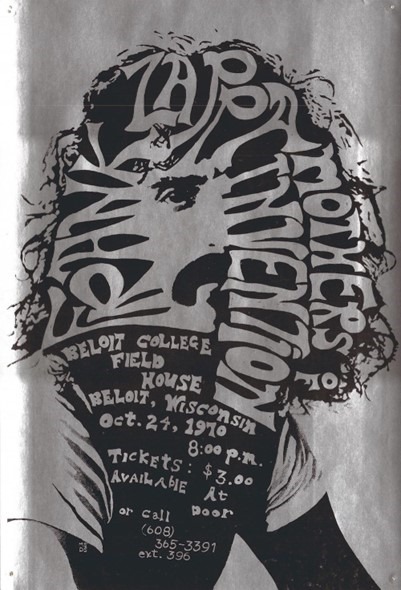
Returning that fall, I was living in a sort-of-commune in the college town, without any funds to attend college, trying to figure out what I should do. Not only didn’t I know that, I didn’t have any idea how I would know that. That’s when I heard that Frank Zappa was going to play at Beloit, at the college my friends had left for over a year before.
I probably heard this news by reading it in a letter. Yes, younger readers today, there was no other way. There was no Internet. There wasn’t even timely press coverage of national tour dates, everything being done through local promoters and short-lived rock concert halls. Phone calls beyond your city were “long distance,” charged by the minute and too costly to use for entertainment gossip. I found out in 1970 the same way as someone would have exchanged this information in 1870.
My interest in Zappa had grown over the two years since I’d first heard Zappa’s Mothers of Invention on recordings. I didn’t realize it fully, but wider music listening and observing Don Williams’ ability to construct music on the fly was mixed with another rare thing my small college supplied me. This little college 20 miles south of Des Moines, with enrollment of barely a thousand students, had a burgeoning opera program. Opera of course is — what does it say up at the top of this blog? — a place where music and words meet. The opera curriculum would grow over the years, but at this time the program was still emerging. The theater used for performances (also the site of some of my classes) was a small old building, with seating for a few hundred. I’ll summarize one part of my experience in this: to see opera sung in a grand opera hall, with elaborate sets and pricey tickets, with a complete orchestra, is a very, well, operatic way to view the realization of that art. All art is artifice, sure, but the human connection to me in those situations is stilted. Not so, opera sitting a few yards away from another person singing it, perhaps even a person your own young age who you might see in your classes or on campus. That’s another experience, far rarer.
You have not likely seen that impact reflected on my adult life, or on the Parlando Project that you know here. For one thing, my voice is not operatic, it’s barely a singing voice. Yet I can write this today, that I remember seeing for one exact example, a performance of Poulenc’s Dialogues of the Carmelites, and being carried away about what performed music, voice, and words could do in that small space. It may have helped that this opera makes an extensive use of recitative.
Listening to Rock music in my daily life then in The Sixties, it occurred to me, who in Rock could bring something to opera? Besides the differences in the use of the voice, or the nature of projecting character as opposed to ones seemingly authentic personal voice, there was the problem of extending the instrumental colors. My thought-answers then? Jim Morrison, who had performed a bit of Brecht/Weill on the first Doors album, and Frank Zappa, who claimed the ability to be “a composer,” and was even allowed to demonstrate that he could compose for larger ensembles including orchestral instruments.*****
That I could consider that was consistent with Zappa’s brand then. In those early, heady days of Rock Criticism, it was a given that Zappa was a genius. He wasn’t the sort of musical act that many people listened to with addictive, ear-worm pleasure, sure, but still a genius. Well, there were those smutty lyrics, and an assumed swimming pool of contributory drugs, but still a genius. It was The Sixties, we assumed impossible things could happen, but we still felt genius was rare and worthy of note.
So, a chance to see this genius in a live concert, this artist whose recordings had opened up other considerations for me, couldn’t be missed. I drove there, 300 miles, with other share-the-gas people in a Fiat 1100D.
Cost of the concert? $3. An amount similar to my portion of the share-the-gas cost too.
.
The concert? Not life-changing. The acoustics in the fieldhouse hall were atrocious, and our seats were in the galleries far from the stage. The music was good, but with the sound bouncing around and the typical poor vocal PA of the time, the result was a mixed pleasure.
We got back in the little car to head back to Iowa. Finding our way through the unfamiliar streets we saw another car occupied with hair as long as ours inside. That car contained some young women. For some reason they wanted to share with the fellow freaky-looking folks that they knew the hotel where Frank Zappa was staying and that they’d been invited to visit him.
Of course we believed them. Of course we followed them. What did we assume was to happen there? Some sex, drugs, and rock’n’roll orgy? I’d just turned 20. I didn’t know what I was going to do with my life, or how I’d figure that out. So, why would I worry about might happen for the rest of some single night in October?
When we arrived, the bunch of us from the two cars, maybe 8 or 9 people, spread out around the non-descript motel room. A couple members of the band were checking in with Zappa. There was a short discussion at the doorway between Zappa and George Duke about what Duke had played at the concert, which got approval from Zappa. The band that night, though billed as the Mothers, was new, containing vocalists who had once been part of the pop band The Turtles, now billed as “Flo and Eddie.” One of the young women from the other car bounced on one of the beds. Most of us seemed like me, passive, waiting for something to happen. Zappa turned his attention to us, asked us what we’d thought about the concert. There was some short discussion. I think I may have mentioned that a lot of the material seemed new. Best as I can remember, that was accurate. Zappa replied that they were doing some of the old stuff too. Memories fail, but I believe “Concentration Moon” was replied as one of the veteran numbers. The male part of the room had some hard-core Zappa fans, who started to geekout on questions about the band’s history. I recall one asking about Doug Moon who had played with early versions of Captain Beefheart’s Magic Band. Were they trying to impress the genius with their knowledge, even in the midwest, of the places Zappa had come from? Zappa replied Doug was some guy who’d worked at a gas station. Zappa was patient about the questions, however trivial. At one point he took out a movie camera and filmed us in the room. I remember he moved in close to my face as I was missing one bow on my eyeglasses after that part had broken, and I had no funds to fix or replace the frames yet.
Here’s a few things Zappa conveyed to us in the roughly hour that I, and maybe others in the room, didn’t know before meeting him.
When asked about his doo-wop music parodies, including the Cruising with Rueben and the Jets LP, he corrected us that he liked that music. He spoke about Fifties R&B records he was inspired by. Since the lyrics in those songs were satiric, I’d assumed the music was also something he held in contempt. Far from it, he lit up talking about this. In The Sixties there was a widespread critical assumption that good music was “progressive,” meaning that we were to drive our plows over the bones of the dead, so this was news to us.
He nonchalantly corrected any impression that he was inspired by drugs. How he did this without sounding like a “Listen kids…” PSA I can’t exactly recall.
He seemed genuinely interested in us, and what we thought about the music — though at times, such as when he wielded the camera, the idea that we were natives and Zappa was an anthropologist occurred.
For me, the important thing happened near the end of our time in the room with this “…But, a genius” guy. I asked him how much of the show was improvised and how much was composed. He went over to the side of the room and picked up an oversized portfolio. Opening it, he showed it to me. Multiple staves of music, a rather full score as I recall. Dialogue written out, seemingly informal and back and forth, as if the band members were speaking off the cuff. In retrospect, I believe I was looking at scores for 200 Motels which would be filmed a few months later with a full orchestra. As he showed me this, he talked briefly about the effort he put into it, which the score showed. I was immediately impressed with the formality of the effort to achieve what seemed like chance informality. There must have been some serious seat-time in getting that done. The intent of it!
Imagine instead if I had somehow visited the hotel room of Jim Morrison in 1970. Perhaps my romantic notions of the creation of art would have gathered more poète maudit forces. Did something in my subconscious connect what Frank Zappa conveyed that night with William Blake, who when not out talking with the visions of angels, was innovating printmaking techniques and making books with his own skills?
After that significant side-trip, we left the room and returned to Iowa. If you’d asked me that day, I still didn’t know what I wanted to do with my life — not a whit more — but what I did have was a piece of information, and an outlook. From that night I could remember that doing was a large part of doing something with your life.
This is already a double-length post, so enough for today. To tip my hat to Mr. Zappa, here’s the LYL Band roughly approximating one of his later tunes in a we’ll-give-it-a-go live performance.
We flattened Zappa’s music and arrangement here, but as the video points out, if Zappa were performing this song today he’d be sure to include more screens than just TV.
.
*This oversimplification is more accurate about youth in The Seventies than the Sixties, even the final three years of The Sixties. In terms of clothes and hair, look at a range of contemporary photographs and film from the actual Sixties. Beards and long hair will be sparse on the young men, not movie wardrobe department common. Yes, use of marijuana and other drugs increased during the last half of The Sixties from a very in-group secrecy thing to a sizable minority, but in doing so it lost a bit of its bohemian rhapsodic connotations and became just another illegal high like drinking alcohol before the age of 21 had previously been. Real “counter-culture” bohemianism in an artistic sense had grown from the beatnik Fifties — maybe even doubled or tripled — but was still something a single digit percentage of people engaged in with any seriousness.
**In reality, this regional expansion of the conflict had been going on by proxy and by secrecy for a long time — but in the run up to the Kent State shootings it had become stated policy, driving hard-to-escape fears that there were now going to be additional para-Vietnam Wars.
***This is a complex point, one I need to leave off too briefly. Women of course were involved in anti-war activity before Kent State, but it occurs to me that this small factor may have been more important than recognized in adding to the explosion of activism in the spring of 1970. In case you’re wondering: yes, the anti-Vietnam war organizations, like the counter-culture, weren’t significantly less patriarchal than the rest of Sixties society — and though it may rankle some, I’ll add this as well: the victims at Kent State were also white.
****Any reading this who participated in Occupy Wall Street or the Black Lives Matter activism of this century may have a moment of recognition here. The emotional high of sensing that something is finally being said loud enough, that mass pressure is finally being brought by an unprecedented number of people is shared from this time. The emotions following, when such movements crest and seem to dissipate, need to be considered too. Here’s one piece of wisdom from someone else from this time worth listening to.
*****Will some Classic Rock oldster reading this think “Well, Rock Opera, what about the Who’s Tommy?” Tommy had yet to be released.
Life events are conspiring again to keep me out of my studio space to record new pieces — but it just so happens that I have this rocking Blues recorded back in 2007 with the LYL Band that’ll contrast with our pensive Frost meditation on work from last time. Today’s audio piece was made from Frost’s short poem titled “Fragmentary Blue,” now recast as “Fragmentary Blues.”
Unlike Carl Sandburg or Langston Hughes, I have no idea if the 1914 vintage Robert Frost had any experience or appreciation of this Afro-American musical form. A quick search found nothing, even though Frost’s lifetime overrode The Jazz Age, The Swing Era, and even early rock’n’roll.
But as poet Langston Hughes soon discovered, the lyrical expression of the Blues was a vital format worth picking up. A first draft of this post included a long aside about the importance of this Afro-American Modernist form, but on second thought I’m going to take less of our time today so that we can focus on how Frost’s poem can be expressed through that form.
JFK: When you wrote “Come on mama, to the edge of town/I know where there’s a bird nest, built down on the ground” were you talking about what I think you were talking about? (wink wink). Frost: No, you’ve got me confused with another bucolic poet, that’s Charlie Patton — but I believe that’s a philosophic statement about how erotic desire is both natural and elusive. Patton was tuned in open Spanish for that one.”
Blues lyrics often used a stanza format of three lines: one a statement, the second a restatement that may be the same, nearly the same, or subtly varied while still gathering intensity via repetition; and then a third line which can go in any direction the writer/poet/singer wants to take it, though it usually rhymes with the ending of the first two lines. It’s a variation of that ancient and simple poetic scheme the rhyming couplet, but with that repetition allowing for something extra in the balance. And there’s often an element of call and response in the lines: that choral rock, and roll back that Sophocles, Skip James, and Pops Staples could share.
So, let’s go back to our 1914 Robert Frost poem “Fragmentary Blue.”
Why make so much of fragmentary blue
In here and there a bird, or butterfly,
Or flower, or wearing-stone, or open eye,
When heaven presents in sheets the solid hue?
Since earth is earth, perhaps, not heaven (as yet) —
Though some savants make earth include the sky;
And blue so far above us comes so high,
It only gives our wish for blue a whet.
Not in Blues stanza form. Instead, ABBA, and I don’t mean the Swedish pop group.* But Frost has made the center two lines in each stanza a sort of parenthetical, so that lines one and four are natural couplets and the middle two lines are already couplets that can stand by themselves. This means it was easy to turn “Fragmentary Blue” into “Fragmentary Blues.”
Why make so much of those fragmentary blues?
Why make so much of those fragmentary blues —
When heaven presents us sheets of a solid hue.
Here and there a bird, or a butterfly.
Here and there’s a bird, or a butterfly,
Or a flower, or a wearing stone, or an open eye.
There’s some savants say the earth includes the sky.
Some say, some say, that the earth includes the sky —
And the blues so far above us, it comes on so high.
Since earth is earth, it isn’t heaven yet.
Earth is earth. It ain’t heaven yet.
It only gives a wish for blues a whet.
So there you go, via show not tell, we rock up Robert Frost in the Blues form. If you read the two sets of words closely, you’ll see something has changed. Frost’s “blue” on first reading seems a stand-in for beauty, while the Blues treats its namesake emotional dissatisfaction as something less than beauty. But, consider again. Frost’s poem says we miss the immensity of natural beauty in our all too earthward human act of trying to possess its emulations. That difference, that dissatisfaction — that’s the Blues. My adaptation only brings out that subtext more overtly. You can hear the LYL Band express Frost most blues-wailingly with the player gadget below, or with this highlighted hyperlink that will play the performance. Most of the better guitar notes here were played by Andy Schultz who played with the LYL Band for a few times, and Dave Moore will once more hear himself back when he could pound and roll on the (plastic) ivories.
.
*Is it too late in their career to suggest that they produce a trans-Atlantic Carl Sandburg tribute record? I’m available, and you need my audience of dozens to hundreds of listeners.
I was long-winded last time, so let me try to minimize the gab today. I went to sleep last night wondering if I’ve ever done anything for an Indigenous Peoples’ Day. Though I’m going to keep my own comments brief, I can hear over the Internet a few groans. “Indigenous Peoples’ Day? Isn’t that one of those woke-ish things with a work-ish name meant to single out some small subsection of Americans?” Well, objects in my mirror are closer than they may appear to you.
The Twin Cities is home to a lot of what used to be called Urban Indians. “Indians” of course being part of Columbus’ “My dog ate my GPS” report back to the royals in Spain, where he imagined he had found a route to the frontiers of South Asia. My part of the Twin Cities has a lot of Mexican and Central American immigrants — immigrants that have DNA that says they were in the Americas before my ancestors were. We’ve got folks around here from India too — makes things confusing.
But for any complaints about special holidays implying special pleading, this day is still widely known as “Columbus Day,” which with footnotes and explications, can be said to mark the start of European colonization of the Americas. But it’s widely known that the day became a holiday through the desires of Americans with Italian heritage wanting a day to celebrate that. I’m fine with that too, it’s just that where I live in our big and diverse country I’m more likely to be around folks who think of themselves as Native or Indigenous Americans.
So, here’s what I did today to hurry up and figuratively meet the Spanish boats with an Italian commander, and to celebrate Americans discovering them. Yes, what happened as a result is a complicated story, and I said I’ll be brief.
I recalled that the LYL Band had once covered a couple of songs on one past version of this holiday. One was Patti Smith’s “Amerigo” from her under-rated Banga record. I listened to it, and it’s kind of long and languid, and I’m not in that mood today. Then I listened to the other, a cover of a song from the Nazz.* Now that was more like it, though my mix of the rough and ready performance from six years ago was not very good. So, I took some time to remix it today, not so that’s it’s sophisticated or genteel. No, it’s still LYL in its immediate punk mode. No acoustic guitar or my approaches to Jazz-my-way. This is turn it up and roar music. Also, some notes escaped being hit in the mayhem. Sorry about that, but in the right punk mode you may be able to deal with it.
You may want to turn it up loud.
.
*The Nazz were a group from the late Sixties that never got as much traction as their records deserved. Think of an American band that sounded like Laura Nyro or Loving Spoonful-era John Sebastian writing songs for The Who or The Yardbirds. Connoisseurs know The Nazz as the band Todd Rundgren emerged from. Todd’s talents as a producer and musician made sure their recordings sounded a lot more polished than our cover, but maybe he’d like our energy? After all, he did get the job producing the first New York Dolls LP (and the Patti Smith Group’s Wave too). I think I even casually assumed “Christopher Columbus” was a Rundgren song, but it seems that it was written by the band’s bass player Carson Van Osten. Van Osten went on to have a considerable career behind the scenes at, of all things, Disney.
As promised, here’s the very next piece Dave and I tracked last July after our take on Bob Dylan’s “Went to See the Gypsy” which eventually broke out into a full orchestrated arrangement. It’s one of Dave’s songs, his words and music, a piece he wrote a couple of years ago called “E Flat.”
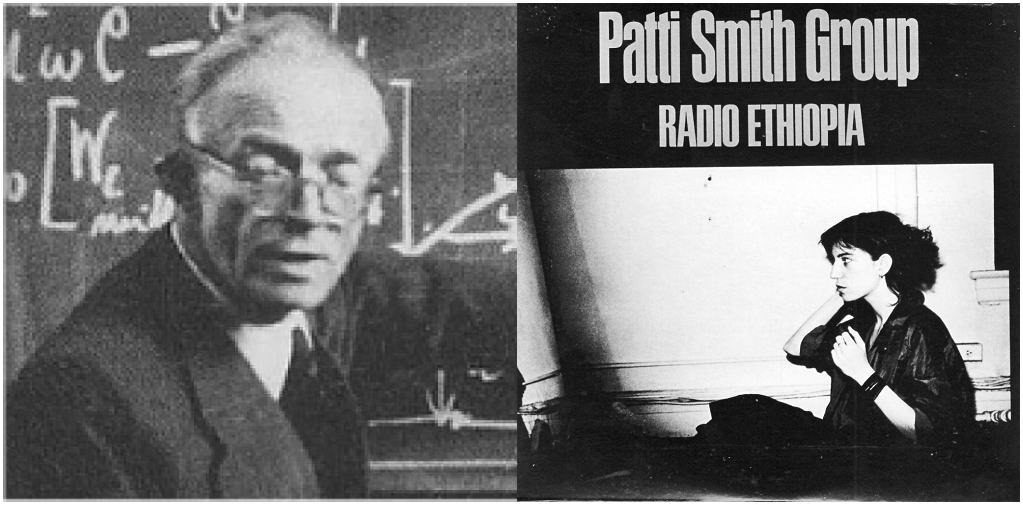
Dave says he wrote it after reading a report that planet Earth’s fundamental vibration was determined to be at the pitch of E♭, though this pitch was at an octave range much lower than human instruments or hearing go. I did a little searching today to see if I could re-find that report, and I’ve come up blank — though the concept of our planet having a frequency has been trotted out, often with a dose of cosmic woo-woo. The most popular Earth frequency I found was “Schumann’s Resonance” discovered in 1952 by a German electro-physicist Winfried Otto Schumann.* Schumann’s observations were made of electrical wave activity between the earth and the ionosphere, and were calculated to be on a fundamental frequency of 7.83 Hz. What pitch is that? Well, it depends, and if you follow some esoterica, that’s an important depends. Most musical stuff these days is set so that 440 Hz is an A note, but that was not historically the only way the pitch we call A was defined; and there’s a belief that one such past standard, 432 Hz, is better. Some of this belief is buttressed with “hear me out, this is very scientific, an objective fact” talk about powerful natural vibrations that have perfect ratio relations to a 432 Hz A.
So, I found that — but at A=432 Hz, 7.83 Hz is closest to a C note. At A=440, 7.83 Hz is closest to a B. So, no E♭ either way.
As of today, I can’t relocate the report Dave read, but that doesn’t mean his song isn’t close enough for rock’n’roll. When we performed it this summer, I set out a time-keeping drum beat, and while Dave sang I played a free-form guitar track swinging close to the amp speaker for feedback sustain. Some days after the live tracking I fancied up the drum track, added electric bass, and played the electric guitar chordal part that dominates the final track you can hear below. When Dave and I play we decide things very fast, and I didn’t do a great deal of thinking or composing for what I added later either. Working on this song was like painting with wet oil paints.
W. O. Schumann at the chalk-board and Patti Smith looking to run her nails on it.
.
By the time I was throwing on the last guitar track I was verging on consciously aiming for the sound of the Patti Smith Group’s “Radio Ethiopia,” the title track to Smith’s second LP. Not a very famous or prestigious record. Why’s that? Here’s the punk-rock-speed history.
A significant group of people (though not top-the-American-charts-sized then, or modern Internet multi-million-follower sized now) had taken Patti Smith’s first album, Horses to their hearts. I was one of that group. The chanted and declaimed poetry, the open references to rock’n’roll — that record’s sound was balanced between passion, looseness, and intent, unembarrassed in its declaration and performance. I also believe that impact was intensified because it was fronted by a young woman who acted unencumbered by gender roles.**
But that’s the first LP. I spoke above about the second LP, one that got tagged with the “difficult second record” label. “Difficult second record” syndrome is usually explained by a band having had a reasonable period to develop a range of material for their debut album, material that they have confidence in while still retaining a sense of freshness in their own experience of it. The second record now has expectations that have to be dealt with, expectations to either be mostly “the same, but better” or if not that, “different, but every bit as good.” But there’s less time to develop that second record while they tour to exploit the interest from the first.*** What was it they did right to make a splash with the first? Does a band have time to figure that out? What to keep, what to add?
Radio Ethiopia, the album, kept an element from the tracks that are often less remembered from Horses: the first record’s more conventional rock songs as opposed to the longer, idiosyncratic spoken word mixed with rock-references tracks — but in place of Horses longer pieces like “Gloria,” “Birdland,” and “Land,” we got a different style on Radio Ethiopia in songs like “Poppies” and particularly and problematically on the 10-minute title track. Smith’s vocals were mixed lower in these new long-form songs, at times down to a subliminal level, and the chordal guitar work got denser. Few liked it. Not “few” as in dedicated, knowledgeable fans — “few” as in not-very-many.
I liked it.
Here’s the lyric sheet Dave was singing from. Yes, the song’s in E♭
.
Will you like what I did to Dave’s song here then? Who can tell? It sure is musically different than the piece we performed just before it this summer, and the final resulting pieces you can hear here, even more different. I like different. If you don’t care for it, I’ll say that my aesthetic here is like Minnesota weather: don’t like it, or like it, today? It can, and will, be different tomorrow. Some will see a player gadget to play it below, but if you don’t here’s a highlighted hyperlink that will open a new tab window and play it.
.
*It would be so resonant if he was related to the composer Robert Schumann, but I’ve found no cite claiming that.
**One could, and likely someones have, written a treatise on Patti Smith’s relationship to gender, which is complex. Those hadn’t been written in 1975, which didn’t mean it didn’t have impact then. What some felt, got, resonated at pitch, would be emotions recollected in intellectuality later.
***Radio Ethiopia came out just 10 months after Horses.
Is it time to take a break from our sometimes intense presentations of poetry combined in some way with music? Well, here’s a little ditty about the lighter side of death, or rather the worship of dead rock stars.
Sure, it can be a honorable thing to give respect to those who’ve gone, to carry their artistic flag further when they can’t, but there is another side, the romantic admiration for the risks and the access to excess that often precedes the early death of musicians, writers, and other artists. The first duty of an artist is to survive. Society is not generally on the artist’s side until they become successful commercially, and even when it grants them that success, it can withdraw it and their support quickly too. To add to that burden with one’s own self-medication and distractions seems like a compensation to that state, but it doesn’t always work that way.
Poet, songwriter, alternate voice, and frequent keyboard player here Dave Moore wrote a short poem about how an older person might view with a strange kind of envy the tentative fame and unbounded experiences that others in our musical/generational cohort enjoyed. Sex, drugs and Rock’n’Roll once seemed to be jobs on offer in the want ads in our youth, even if it turned out the positions were already filled and the items already sold. I adapted Dave’s words, added a verse of my own, and wrote music for my performance of “They’re Not the Grateful Dead” some years back and thought you might enjoy it here. Oh, that “Grateful Dead” in the title? Translated folkie Jerry Garcia knew that this was a trad folk song trope where the dead magically and musically express some gratitude.
One thing I like about Dave’s lyric is that, outside of Jimi Hendrix he doesn’t pull in the big names, the Boomer rock’n’roll Shelleys and Byrons, the ones that are still featured faces in the rear-view mirrors looking at the music and times. Starting right off with Nicky Hopkins* is a bold move, but then Dave is a keyboard player.
My performance of this has a few flubs, but it’s hard for me to get more recording in right now, so we’ll make do with this older recording as is. The player gadget is below for many of you, but if you don’t see it, this highlighted hyperlink will also play my performance of “They’re Not the Grateful Dead.”
.
*Huh. Who? Those who didn’t ruin their eyesight fantasizing about debauched after-parties but by reading all the liner notes on every LP will know who Nicky Hopkins is.
During this project’s first April #NationalPoetryMonth back in 2017 I started what has become a 5-year serialized performance of the entirety of T. S. Eliot’s “The Waste Land.” And here we are today, finally completing that portion of our Parlando Project.
Why “The Waste Land?” for this lengthy each-April presentation?Several reasons.
Like a number of literary cultural artifacts, the single thing widely known and carried forth from it is only a single line. A certain significant ratio of us knows “The best of times, the worst of times,” or “Do not go gentle into that good night,” or “To be or not to be” — and so you may know “The Waste Land” from its opening line: “April is the cruelest month.” That small keepsake of a long poem is much brought forward for anything that occurs in any April, and as much or more than Chaucer’s April preface to his Canterbury Tales, it’s likely the reason April is National Poetry Month. As an opening line it’s not misleading. Much cruelty happens in Eliot’s poem. Is it cruel to be kind as Shakespeare and Nick Lowe might put it? Is it just cruelty for shock effect — or can it cure, however partially? Our long serialization explores that, covering all those parts that you may have forgotten even as you remember and repeat the first line only.
“The Waste Land” is also a landmark, a milepost, a line in the sand for a certain kind of Modernist English language poetry. While this project is not entirely about the rise of Modernism, the current rules of public domain make work from the first quarter of the 20th century the latest I can surely use for my project’s purposes without complications. If time permits me, I may follow up today’s post with a later one about what I’ve learned about Modernist poetry before and after “The Waste Land” while working on this project; but when I first encountered the unescapable “The Waste Land” in a schoolbook and classroom as a teenager one thing that I understood about it (perhaps the only thing I understood about it) was that it’s quite musical in most all of it’s movements.
“The Waste Land” is not, at least in America, a beloved poem from what I can tell. Even among college-education-exposed Americans it’s not commonly memorized, kept in a commonplace way, used for occasions, or re-read for pleasure or new insights. Consistent with that, for the most part, these every-April “Waste Land” segments have not been among the most popular here.* Even among poetry lovers there are some that actively dislike it, find it a pretentious mishmash overrated by those afraid to speak plainly. Eliot himself seemed to avoid speaking about it or reading sections of it at later public readings. He may have thought his later poetry more accomplished, but I also wonder if he didn’t care to revisit the more unbounded elements of his life reflected in The Waste Land.
Which brings me to the main reason you’re about to get a chance to hear this performance today: The Waste Land is not just one thing by design or execution, but it is significantly about someone in the throes of depression. Indeed, much of this year’s final section, “What the Thunder Said,” was first drafted while Eliot was hospitalized for this. This section is not “The Waste Land” of scholarly footnotes, bank officer work, gender blurring and questioning, or the knowledge of a night-class schoolteacher for working class women, or the lament of a man who has a personal sense of the intimate losses of a great war. This is the howl of personal despair of a consciousness who can portray those things — and it’s the howl of someone seeking to explode and break out of that state.
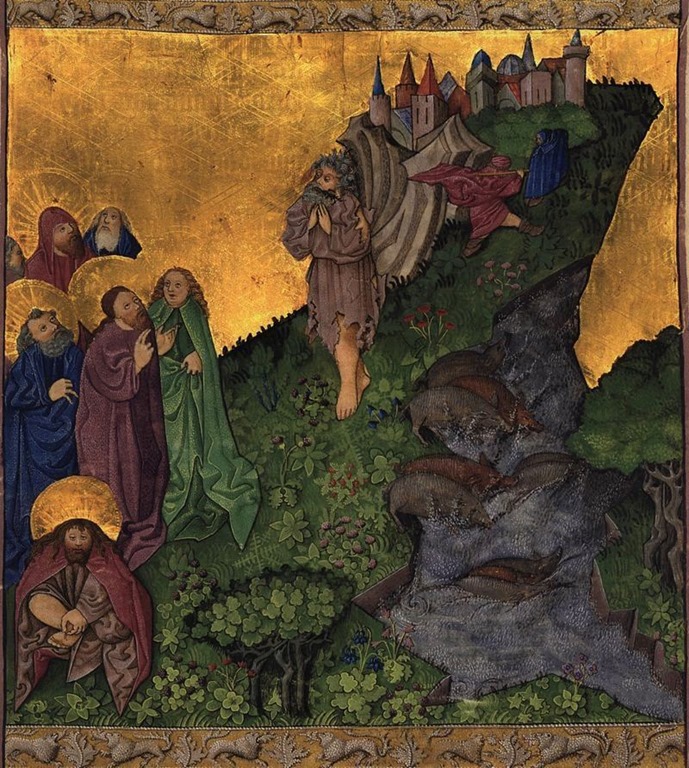
The LYL Band performance you’ll hear if you click on the player at the bottom of this post is a live performance from more than a decade ago, long predating the other sections I’ve presented here of “The Waste Land” over the past 5 years. At the time of that performance I myself was emerging then from an episode of depression, one of two I believe I have gone through in my life. Depression has a variety of feelings and absence of feelings, and if one reads good writers describing their own depression experience you may well get a sense of the blind men’s elephant of fable, but my own feelings on the day and hour this was recorded were largely feeling sick and tired of those depression feelings. At some level I felt this section of Eliot’s poem was similar to what I was seeking, feeling, finding: an expression of an expiation of that, of demons transferred into mad pigs being cast into the sea. This coincidence of my life, a performance, and the poem would make it dear to me.
As I said, this is a recording of a live performance. Besides my voice and electric guitar playing, you’ll also hear Dave Moore’s voice spontaneously following along as I unfurled mine. I was cold-reading Eliot’s text here, I had not rehearsed or prepared for this performance, other than printing out the text. Embarrassingly, as I reached many of the foreign words in the text and fully in high transport of the moment, I mangled their pronunciation or dropped them from the reading. I used a handful of short samples you’ll hear mixed in the background to restore some of the dropped text.
In later, calmer reflection I continue to think this element of expiation is part of Eliot’s design here. A line I recall feeling strongly and intimately as I came upon it in my reading and performance that day is:
We think of the key, each in his prison
Thinking of the key, each confirms a prison.”
Whatever part of the elephant of despair or depression you might jiggle, touch, or be crushed by, we think of the key. Can we also think, hope to think, expect to think, of the prison as invalidated, destroyed, or obsolete?
What you’ll hear if you click on the player or hyperlink is rough, it has some mistakes, and being recorded live there is little I can do to fix them — and by intent it’s not a very genteel and formal presentation of Eliot’s poem. If that was my intent on that day over a decade ago, I today renew that intent by concluding our long, serialized The Waste Land with this performance that predates all the other segments. In one of Eliot’s later poems (“The Little Gidding”) that he may have uprated over his 1922 landmark, he wrote:
We shall not cease from exploration
And the end of all our exploring
Will be to arrive where we started
And know the place for the first time.”
And so it is here too: every episode for this serialized presentation of “The Waste Land” has been informed by that beginning, performed and recorded long before, that is now being used at it’s conclusion.
American poet Wallace Stevens constantly spoke in his poetry about the creation of art. This sort of “art looking at itself” move has a danger of being too self-referential and one might fear that it would sit with the reader as unresolved as being between two mirrors. I think today’s subtle poem works, despite those risks, and we’ll see if my performance of it brings out something that you may not have noticed in it.
Stevens, though wordier than Emily Dickinson*, often has his poetry seem like a riddle or puzzle, and though his poems have a surface beauty one can see right off, they also sometimes work like a lawyerly contract with the reader, full of obscure words and fine-print sub-clauses that you may not fully understand.
Let’s listen to Stevens read his poem himself.
One can hear background noises outside the room in this recording, so Stevens’ voice is heard here “Out of all the indifferences.”
.
He’s not a bad reader, he does an acceptable job of bringing out the structure and word-music of this poem—but it’s emotionally flat, a default setting for many poet-readers. I think the theory is: if his words are good, well selected and ordered they should be able to convey all. If I listen carefully, I hear just a tiny touch of ruefulness in his voice as his poem nears its end, but it’s just a touch.
There’s an overall image in this poem laid out in the somewhat fussy title: that thing that causes us to create art—in Stevens’ case, poetry—is like a paramour. That is, it’s like a desired lover (and “paramour,” that somewhat unusual word he chooses, has strong associations with an illicit or secret lover). But wait, it’s an “Interior Paramour.” It’s something within ourselves. That internal duality will be dealt with in his poem.
At times he seems confident in speaking of this cause to create art, but look closely at the shading, the little codicils in his statements. “For small reason” we think our imagination is good. We are “poor,” not particularly perceptive or wise, we only choose out of the richness of all things some single thing that we’ll prize over all those things we are indifferent to. We do this to impose or create this intimacy we feel with our art, this imagined, chosen, second self, this internal paramour his title speaks of.
But, but…“God and the imagination are one!” Surely, this is praise.
Look carefully, “We say,” Stevens says: it’s but our claim. A God in actuality is some higher candle. What we feel we have, in our separate imaginations selected into art, that art that may cohere out of shared human centrality—is a smaller, lower light, shedding on a smaller circle: us perhaps and our work in the moment of imagination choosing creation, or that resulting work and a reader or listener.
That’s the internal paramour, the shame-feared, secret love inside us when we create. It’s a small lit space we make in darkness, where occasional readers or listeners see something like what we saw. Being together with little creation is enough. Being together with some audience out of all the indifferences is enough.
Today’s music is based obliquely on the Velvet Underground, a pioneering indie rock group that explored areas that later groups also chose to explore. On one level they seemed to be like unto a rock band: two guitars, drums, and a further musician who might play keyboards, electric bass or bowed strings–but their genius was to put those things together differently, to use those voices in uncharacteristic ways. How will listeners react when you do that? Well, for a lot of them it will be to reject it as worthwhile music, though some may see a new possibility. Some art comforts. Some art unsettles. Being together with some audience out of all the indifferences is enough.
I should note that I was reminded of this poem when the Fourteen Lines blog included it last month. I immediately thought I’d like to perform it, but it sounded like it was later Wallace Stevens. I did a quick web search to see when it was first published and the return said in Harmonium, Stevens’ first book-length collection which is in the public domain. I let out a shout and began work on the composition and performance I present today. It was only this morning as I started writing this post that I found that it was, just as I suspected from the title, from late in Stevens’ career when he was as old as I am now, and is therefore likely to still be in copyright, even though Stevens himself has been dead for 65 years. I feel conflicted about going ahead and presenting what I worked on and came up with, but have decided to take this route: if whoever holds the rights to Stevens work objects to this non-commercial use, let me know, I’ll gladly remove it.
My performance of “Final Soliloquy of the Interior Paramour” seeks to be unsettling. The two guitars don’t work like rock band guitars are supposed to work. The drums and their beat are strange, not tying things down as the instrument’s rhythms slide instead of lock. The organ plays low, driving somewhere you can’t see. And I chant Stevens’ words as if I know where they’re going, and yet I can’t yet say where that is yet. That’s what I feel when I create music or poetry. The player to hear it is below. Like some early Velvet Underground tunes, it may sound better around the third time you listen to it. But if you don’t like it, remember I promise various words and various music here, there are other selections available in our archives.
Thanks for sharing this little light by reading or listening tonight.
.
*Stevens was an actual lawyer. Dickinson came from a family of lawyers and I suspect either absorbed this manner of written discourse or may have inherited it along with her mental firmware.
It’s always the late empire period for old folks. When 1920 Claude McKay prophesied last time of granite wonders sinking in the sand at the end of his America poem, he was a self-proclaimed vital young man. He’s likely visualizing some hazy prophetic event with a undefined date as recorded by an even more distant future, and not the current toppling of certain bronze statues.*
McKay was 29.
To some old folks such as myself, fallen empires and overturned practices are not prophecy, we’ve seen them fall over as presently as gravity after their props and pedestals disappear, and so for the thoughtful among us, the conceivability that we might be living at the end of an American empire is not so strange, and even for the less-considered among us, we know our personal remaining time has shorter numbers.
This summer I showed a 15-year-old a YouTube recording of a live reading by Allen Ginsberg of his poem also called “America.” They’d showed me YouTube videos of earnest anarchists explaining the essential evils of money controlling government, after which they ask me if I’ve read Kropotkin. They live in a world were schoolyard bullying is considered actionable, not character building, and where the ideograms of gender-queer nearly exceed the Phoenician alphabet. Marijuana is about as novel and exotic as some parent’s veneer liquor cabinet.
They also live in a world where the man with a gun is found in the right if he’s afraid, doubly so if he’s a government agent. Economically we have endured a second Gilded Age where we have the Internet instead of railroads. For this generation, their first memory of a President was a competent and graceful Black man. Their second memory of a president, is not.
I haven’t mentioned environmental danger, Covid-19, or spoken of that tiger’s tooth that sank into the throat of George Floyd in our shared city. My catalog will be too long or too incomplete. There’s no other choice.
Here, I said, “This is anarchism!” and I launched the video. A static picture of a 1960’s Ginsberg stayed stationary on the screen and the soundtrack played. Ginsberg wrote this when he too was 29, just as McKay had been, though decades later in the American experiment. There was another red scare going on. Likely it was not much safer to be Black (or Jewish), Left, poor, or Gay and expect legal respect between 1920 and the January 1956 Ginsberg aurally date stamps his poem with.
Ginsberg reading the entirety of his “America.” Warning to tender ears: his performance, like mine below, includes one F-bomb.
In maybe a minute, 2020 made their judgement: “This is bad. It’s terribly recorded.”
I think its faults to this young audience were more at this was old, and this is not new. They had not lived in 1956, the supposed happy, carefree “The Fifties” of which “The Sixties” were in betrayal of. More than merely novel then for Ginsberg to stand up in public and say the unholy word about the holy bomb; for him to speak frankly about not being neurotypical, gender conforming, and accepting of the post WWII social order; to not only oppose, but to make fun of racism and red-baiting, and to say all of this as if it could and should be said in poetry. This was no longer revolutionary to this teenage 2020 set of experience. There’s now a mix tape every day saying the same.
Revolutionary? I’m presenting this series for American Independence Day. “America” is Allen Ginsberg’s declaration of independence. Like the later parochial details in the July 4th document that no one now remembers, parts may have dated. And it’s no longer novel to say all men are created equal either. I wouldn’t want it any other way.
“America” is Allen Ginsberg’s declaration of independence.
So, I’m grateful for Ginsberg. I listened to that recording of his “America” several times in the tumult of this year. Some things he speaks about are not, alas, mooted points. My young viewer may at times overestimate our current state of accomplishment, just as I’m intimately aware of how far we’ve come from then.
I saw Ginsberg read a couple of times, but never this poem. However, I have an aged memory of it being read, not by him but by an Iowa rock band called the Emergency Broadcasting System in the late Sixties. They would open up their first set with the lead singer speaking sections of this poem while the band riffed behind him. I liked the combining of rock band energy with this then only teenaged poem, and maybe that’s part of why this project exists.
I’ll note that the sections I quote from “America” in today’s piece may be long enough that I could be breaching copyright on Ginsberg’s work here. Rights holders, if that’s the case, I won’t debate your point.
The player gadget for my performance of sections from Allen Ginsberg’s “America” is below. Is there more to say and perform as I look to poetry’s statements on July 4th? I plan at least one more as we approach Independence Day—one from yet another American time, and with another outlook different from McKay and Ginsberg.
*It’s only in this century that I became aware that a large percentage of the Confederate Civil War statues date from the early 20th century period, not to the years right after the war. There were no monuments being erected then to the enslaved people whose bondage was material to making that genteel and romanticized world of noble warriors however. Must have been an oversight.
McKay did have one example of revolutionary change in his experience-bank: the 1917 Russian Revolution. Like many of his era’s leftists he was hopeful, even inspired, by it for some time. Yes, he reevaluated that eventually. Revolutionary ideals do not equal the regimes that follow.



 Frank Hudson