A friend of the blog noticed today I used a particular phrase when I wrote about late-night work on the musical piece you can hear below. I’ll try not to take too much of your time, but I thought I’d expand on my explanation to him, and at the bottom you’ll be able to hear a 2-minute song made from a poem by Alfred Kreymborg.
The early years of the Parlando Project benefited from several things that are not in as great a supply now: I had multiple days in each week when I could work on finding and making these musical pieces. I worked regular workday hours on this, beginning after my morning bicycle ride for breakfast. I was eight years younger then, and those days were filled with rewarding creative work as I learned more about musical composition and recording technology. Shortly after the public launch of the Parlando Project, we had a consequential election in America,* but that (if anything) increased the energy I found most weeks.
Those who happen upon early posts here might notice a tone that isn’t as common in recent years. Without announcement, I was writing back then with my child in mind as an audience. They were going to be entering the 6th grade, and I vividly recall from my own youth how a great vista of complex, connective, and evaluative thought opens up around that age. I wasn’t going to make it a point to them to read this — adolescents aren’t looking for that sort of thing from parents — but rather more, I thought others in their peer group might come upon this Project and find some interest in my promotion of discovery and enjoyment. Working from that aim, as my child grew, I gradually changed the age group I was aiming the blog writing here at — though I don’t know if I ever achieved an adolescent audience.
Then a few years ago my family went through a series of crises, and it was only after a period of distress that the wise and resourceful members of my little family met those issues and managed them. I tried to be supportive — I probably was, to my imperfect degree — but that work was largely their doing. I’ll say that in that year or so of the greatest distress, my time spent here was a tonic for me from the stress and worry. How much of that was (in the modern terminology) “self-care,” and how much was temporary flight from responsibility? I can’t say, my perspective is too close-in.
But now in the past year or so, the time I can devote to this Parlando Project is constrained by external and internal factors. By choices outside my control, days go by when I’m restricted from recording, and even the blocks of assured time to compose or research are harder to come by. At the same time my energy endurance is lower as I age. As grateful as I remain to have the opportunity to do this Project, I guilt and grumble as an old codger when an opportunity comes — time when I can play or record — and at that moment my body is saying: take a nap instead. If I could schedule creative time, if I was to ask for concessions to schedule it, I’d probably face complex outcomes and reactions when my old body can’t be assured the energy levels and ready fingers like my 70-something self could.
Let me be complexly-clear about that though: that frustration doesn’t outweigh the gratitude. To have the opportunity and resources to do this Project remains a blessing! I just have to work with this, that’s all.
Here’s one “how” of that: after everyone in the house has gone to sleep early, or is at work on an evening shift outside our home — I can do my work, as long as it’s in silence. Knowing this, I often get a “second-wind” after 8 or 9 PM or so. I might spend this time researching or writing early or final drafts of these posts. There’s even limited music-making that can be done without making noise. I can go over the things I have been able to record, evaluate if they are worth using, perhaps adding additional parts silently using my little plastic keyboard, and mix the results into something suitable for releasing to the public. So: the hours between 9 PM and 1 AM have increasingly become working hours for the Parlando Project.
I’ve come to call that time “burning the midnight lamp.” As I told my online friend this morning, that phrase is taken from two particular sources — ones you might not guess could be combined.
“Burning the Midnight Lamp” is a song, a lesser-known “deep cut,” by Jimi Hendrix. The song had a long gestation, Hendrix struggled to complete it. It was written early in his Jimi Hendrix Experience career, while living in London. Hendrix was a young man who previously had been in the care of a succession of childhood relatives, foster homes, and then a short Army barracks stint followed by couch-surfing until this point. For the first time he had his own place, shared with a woman in what sounds like an equality of love.** That Hendrix London flat has been restored to appear as it did then, and when I visited it some years back I thought of what a special place it must have seemed to him. I imagine his thoughts: my own place, paid for with my own money, living on my own recognition, work done under my own name. In anyone’s life (not just a “rock star”) the time when one has achieved that — that’s something.
Here’s an odd connection: when you visit the site it’s a joint institution. Hendrix’s apartment is upstairs, but the main floor is laid out to reflect another emigrant musician of another era: this address was also George Frideric Handel’s London home.
When Hendrix was searching for the extra sound needed to complete his “Burning the Midnight Lamp,” he found the recording studio he was in had an odd instrument present: a harpsichord. Comparing Hendrix’s guitarist skills to my own would be laughable, but things even out in naivete when at the musical keyboard. Today’s song uses piano, but I had to play separate right and left hand tracks to realize the simple part. Likewise, Hendrix hacked out a little harpsichord part for his song. Was Hendrix tipping his hat to his downstairs ghost with that harpsichord?
Why did Hendrix write his tune about working late within the endemic uncertainty of creatives using the image of a lamp? No guess. But another lamp, elsewhere, in another visit: something I recall when visiting Emily Dickinson’s bedroom was the little table that was her writing desk. On the small top of the table was a whale oil lamp. Dickinson, living with her family in a household, with household tasks and human needs that would take the daylight hours, had this little mid-19th Century, middle-class luxury of a warm effective light to work by after the busier-with-others’ hours.
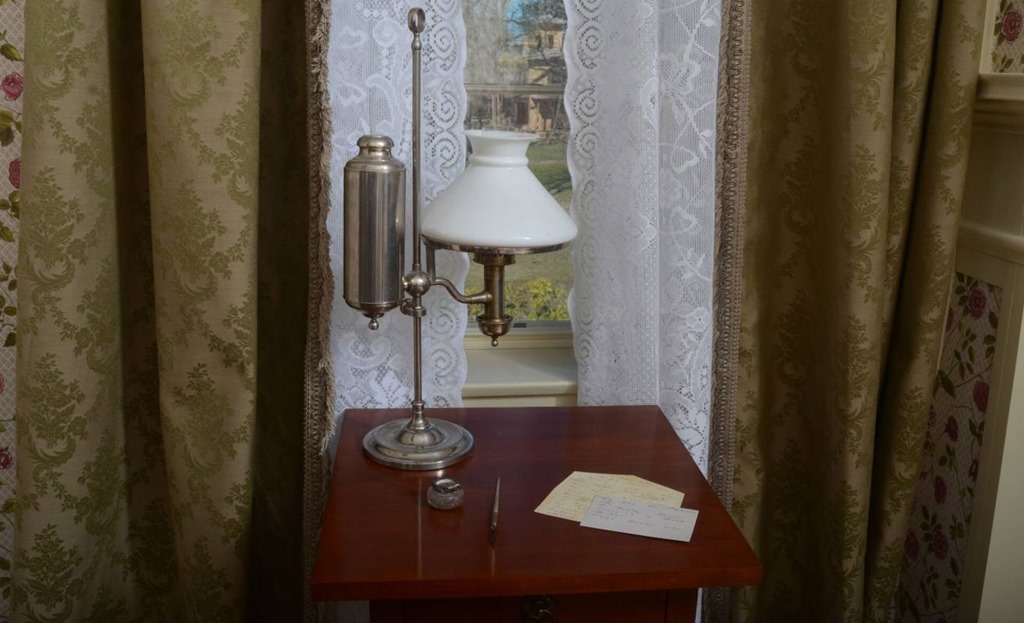
“Ready for the same old explosion/Going through my mind…” A small writing table and lamp in Emily Dickinson’s bedroom (photo from the Emily Dickinson museum)
.
Looking at Dickinson’s lamp, I thought of the whole system that represented: the swimming mammals of the dark, cold sea, the diverse Moby Dick industry which captured, killed and deconstructed those massive bodies — and so, extra hours glowing with North Atlantic juice opened for a woman to scribble and sew little booklets. If I’d try to tell these thoughts and feelings when looking at the lamp to the average person, they’d sense a disproportion. Someone might even harrumph to me “It’s just a lamp — an unexceptional, domestic thing.” Readers here? You’re not that sort of person — and on her part, Dickinson too, she had further thoughts.
And so I continue, to burn the midnight lamp. Alone.
Today’s results came after a week of disappointing myself as I looked for some words to express what I was feeling, words that would ask me to sing them out even with my inexact and unprofessional voice. I was seeking words that would add something hopeful in a time of extraordinarily slipshod callousness carried out with motives of punishment as a virtue. It was this short poem by early American Modernist poet, editor, and publisher Alfred Kreymborg that captured me.
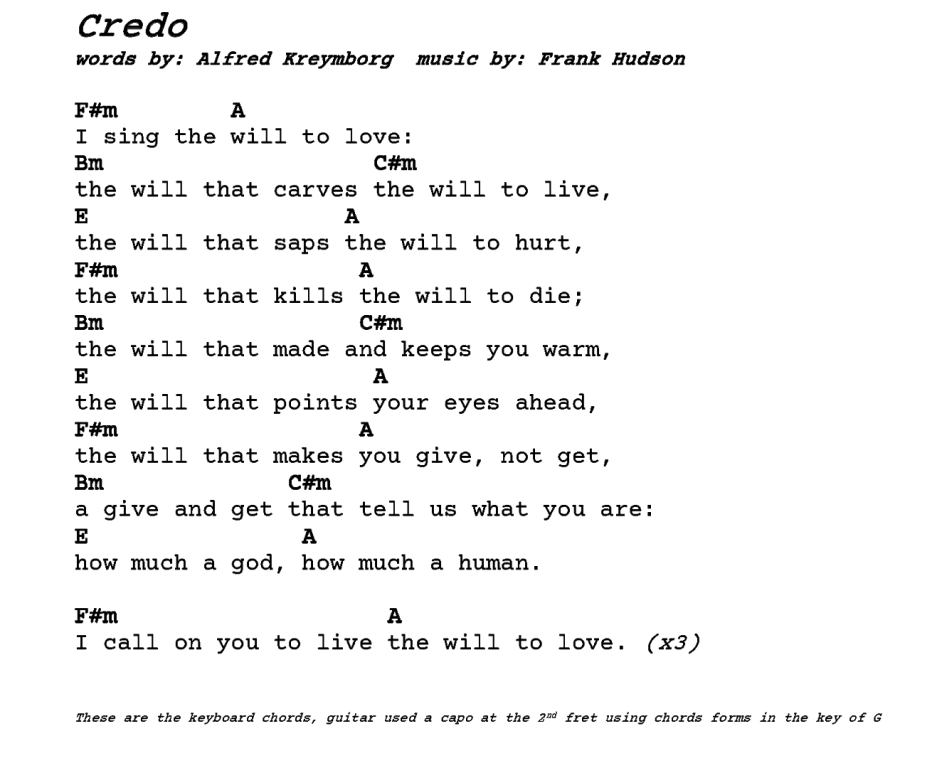
As I often say here under these chord sheets: someone out there can likely sing this song better than I can.
.
Last post here was a series of inspirational maxims carried by a Jazz musician. Maybe Kreymborg’s “Credo” seems a little too hopeful, too earnest for some of you. It’s probably not the sort of poem you’d first think of as an early text of American Modernist poetry from a colleague of William Carlos Williams, Man Ray, and Mina Loy. Little matter, I felt I needed to sing it. That’s enough for now.
You can hear my performance of “Credo” with the graphical audio player gadget below. No gadget? It’s not that you didn’t keep your lamplight trimmed and burning, it’s just that some ways of reading this suppress showing the player gadget. This highlighted link will open a new tab with its own audio player.
.
*Decades before, longtime Parlando contributor Dave Moore and I started the LYL Band just before Ronald Reagan’s election. Then too something that wasn’t very good for the country paradoxically encouraged creativity as contrast.
**This short video shows the flat decorated to look just as it was in the mid-Sixties, and features Hendrix’s then-partner, Kathy Etchingham, speaking briefly about their time together. Hendrix, like other struggling musicians, lived before largely at the behest of his hosts. From accounts, the two lovers seemed to be in a somewhat equitable partnership (within the expectations of the time). Etchingham worked as a DJ in London clubs and had a resident’s knowledge and straight-white-British appearance to bring to the arrangement. Hendrix’s fame was still somewhat localized, and his uprising career had offered him a semblance of a regular income.



 Frank Hudson