from “A Letter to Robert Frost”

Last time in our National Poetry Month series of musical settings of poems and poets included in Louis Untermeyer’s Modern American Poetry  we heard from the poems of a leading practitioner of light verse, Ogden Nash. Today’s piece was made using some brief quotes from a much longer poem that fancies itself a step up from light verse.

In 1937 Robert Hillyer was a fresh winner of the Pulitzer Prize for poetry, and he had a professed friendship with the GOAT of all poetry Pulitzer winners, Robert Frost. That year he published a long poem in rhyming couplets, a format that in his day might make a cultured reader think of Alexander Pope – though a 21st century ear might hear in that rhyming form the philippics of Pulitzer winner Kendric Lamar. Couched as a letter to Frost, it’s a wry survey of the between-world-wars state of poetry. As an active professor of literature at Harvard, Hillyer’s in a good position to comment on and even change the nature of The Canon – that agreed upon pantheon of great poets to be taught and kept alive, even if as only as cadavers for academic dissection.

His poem from the start wants to make a point that The Canon is mutable – unlike arguments that it’s revealed truth only disputed by ignorant academic Visigoths with sub-rosa agendas. So, from the start (and the parts I chose to quote for today’s musical piece are all from the beginning of the poem) Hillyer uses himself and Frost (and meta-event! also the very anthology and anthologist that I’m drawing from for this month’s #NPM2026 series) to point out that we can change our mind and experience of poets, even long-dead ones.

His first case in point concerns Emily Dickinson. Let me do a quick attempt to summarize how that great poet – dead 50 years when Hillyer tells his tale – came to be vetted for a position in The Canon. Most of Dickinson’s best-considered work was written in the 1860s, and when she died in 1886 that work was almost entirely unknown, save for those poems she included in letters or otherwise distributed to intimates. None-the-less, in one of the cultural miracles of the ages, a large cache of hand-written fair copies of her poems were located after her death, and her surviving sister Lavinia Dickinson sought to publish them. More coincidence comes into play: Emily had corresponded with Thomas Higginson, a smart and well-connected Boston cultural figure, and two other culturally ambitious local women were willing to assist in editing these manuscripts: Emily’s sister-in-law (and now commonly assumed lover) Susan Gilbert Dickinson, and Mabel Loomis Todd, wife of a local astronomer and mistress of Emily Dickinson’s brother, the husband of Susan. No, this isn’t a season arc of Real Housewives of Amherst, that’s the mishigas/miracle that gives us one of America’s greatest poets.

Susan got first at bat with the surviving poems. She had grand plans for them, perhaps too grand. Lavinia grabbed the rights back and handed them to Mabel. Mabel Loomis Todd and Thomas Higginson were expeditious: they turned in a publishable manuscript quickly, doing what any responsible professional editor would do with this batch of handwritten “amateur” poems: cleaning up punctuation, spelling, grammar, etc., ordering their choice of best poems in a sequence, and adding helpful-to-the-casual-reader poem titles and subject-matter sub-sections.*

Still, the posthumous publication of a dead loved one’s poems generally produces about as much reaction as an engraved epigraph on a cemetery rock: a loving gesture with a small audience. Yet, surprisingly the Poems of Emily Dickinson sold very well, needing additional print runs only weeks after it was released. Two subsequent volumes containing more cleaned up and regularized poems quickly followed. So, at the turn of the 20th century, shortly before Modernism breaks out, this mid-19th century poet arrived.

When Untermeyer presents Emily Dickinson in his Modern American Poetry, it’s only her and Walt Whitman who are from the mid-19th century – the pair considered suitable to be considered “moderns” – but he points out that with the rise of High Modernism in the late 1920s, Dickinson’s poetry had taken a hit in critical assessment: she didn’t seem “serious” enough, and even with the Higginson-Todd edits, her prosody seemed sloppy. Untermeyer notes that the myth and mystery aspect of Dickinson’s biography, as understood then, was in danger of taking over from the verse: why did she withdraw socially, and was that part of some doomed romance?

That was still the Emily Dickinson that I read and heard about in school in the mid-20th century: a curious eccentric with a cozy-gothic-romance backstory to go with those poems of strangely polite funeral carriages. Real poets, like Frost, Stevens, and Eliot had no backstory, just texts that could support impersonal New Criticism exegesis.

But Emily Dickinson’s poetry was still to be written – or rather, printed. It was only in my lifetime that accurate and complete editions of her poetry were released. Shorn of half-measures, her language when faithfully conveyed, unleashed from conventional rules, now seemed less careless and more passionate and incisive. New readers started to see a Shakespearean width to Dickinson’s concerns, partly I suspect because there were smart women now with academic rhetorical skills who didn’t put blinders on when reading Dickinson, poems now sharper with the varnish taken off.

I took you on that little side-trip for two reasons. First, I wanted to be fair to Robert Hillyer as he recounts his and Frost reactions to Dickinson in the between-world-wars era. In the first blush of Modernism before the end of WWI, Dickinson (even if still regularized) seemed contemporary, because those early American Modernists prized concise directness and freedom from tired metaphorical tropes in poetry. Sandburg wrote a poem calling Dickinson an Imagist, the name taken for that early 20th century vanguard. And so it is too, that the young Hillyer recalls his original fondness for Dickinson, but then Hillyer’s journey as a poet and academic** taught him to value exactness in prosody: perfect rhymes, precise metrics, correct grammar arrayed in longer poems with grand themes. And what of his reporting of Frost reply to his youthful Dickinson enthusiasm: “Perhaps a genius, but mad?” Hillyer heard that judgement when Frost was teaching in Dickinson’s home town, people there still lived that knew the living Emily Dickinson, town eccentric.

I think it’s fine to (I quickly did this myself) ascribe the incident I extracted from Hillyer’s much longer poem to so much patriarchal prejudice – but the judgement of The Canon as its caissons go rolling along was for us to forget Hillyer’s verse and study Dickinson’s. The second reason I told Dickinson’s story, the greater point, and the reason I perform these few lines from Hillyer’s poem now, is to show that The Canon isn’t static, that it changes, or rather that we change it by our attention, what we find, what we take into ourselves. Because Hillyer’s long 1937 poem is likely still in copyright, I’m not able to provide a link to the full text on the Internet and I’ve chosen not to print the quotes I excerpted from it for educational purposes this National Poetry Month.
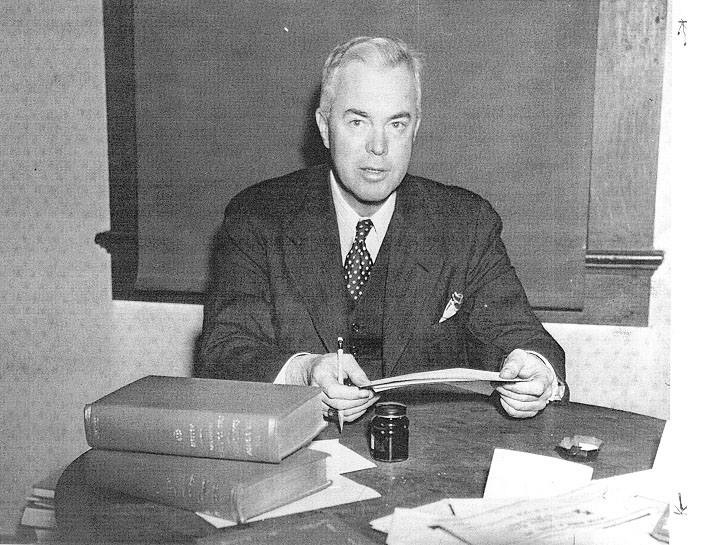
Robert Hillyer

Robert Hillyer. I don’t know if he ever got to revise his learned opinion of Emily Dickinson’s poetry once again.

.


I also present this piece as evidence of the music in differing styles precept of this Project.*** I am a naïve composer with limited musician skills. I suspect nearly all composers compose on an instrument, and that most inform their trial-and-error exploration with more adequate skills on an instrument buttressed with more knowledge of musical theory that I have. My mitigations, which I hope to hide from listeners partway, it to use anything I can do  with my instruments and voice in my compositions, and avoid those things I can’t. If I learn some new musical theory or tactic, I’ll turn it into a composition while remaining ignorant of the panorama of musical structural theory – and when I work with orchestral instruments, as I do today, I’m closer to the Lego school of musical construction, using arpeggiators, MIDI editing, and lots of trial and error to make something that may be worthwhile. Today’s piece is therefore limited – from its composition through to its recording you can hear below – by the composer/performer’s limits to realize it. I believe that it will still work for some listeners – perhaps you. The audio player to hear this short piece with quotes from Robert Hillyer’s “A Letter to Robert Frost”  is below. No player seen? Some ways of viewing this blog won’t let audio player gadgets into the canon, but I offer this highlighted link that will open a new tab with its own audio player.


.


*Modern critics and scholars generally decry their work. Todd in particular is often taken to task today for suppressing anything in the poems related to Susan Gilbert Dickinson, and both are accused of making the genius of Emily Dickinson all too conventional with their edits. But, if they had not done their work, not gotten Emily published, not done the commercial “clean-up” that made her immediately approachable to general readers in print, we likely wouldn’t have an Emily Dickinson to be concerned with.

**Hillyer seems more remembered today as an important teacher at Harvard than as a poet.

***Beside my own listening to orchestral music and art song (amidst a broad palette of other musical expressions) two pieces by trained composers likely influenced this work. Many years ago I was able to hear a locally-based composer, Dominick Argento’s Letters from Composers  performed, and much more recently I was delighted to hear the premier performance of young composer Patricia Wallinga’s The Sisters,  a one-act opera featuring singers portraying Sappho, Emily Dickinson, Elizabeth Barrett Browning, and Amy Lowell together on stage singing about their poetic careers. I’d almost consider my little work today to be a modest response to The Sisters  from the male side, as three of Wallinga’s quartet of women poets are observed in the Hillyer excerpt I performed. Where’s Amy Lowell? “Our friend at Sevenells” mentioned in Hillyer’s poetic letter to Frost is a reference to Amy Lowell’s home. Wallinga’s less-than-an-hour opera performance is available to be seen and heard at that hyperlink on YouTube.

You might notice that those composer/performer particulars I mention above limit the sophistication of my two-minute piece compared to these of course, my saving grace is the hope that my piece retains some value. I’ve taken to calling my efforts in this vein “punk orchestral” to make my case.
Meeting Music and Words; a personal history. Chapter 4 “Dialogues of the Zappalites”

OK, it’s time for my Frank Zappa story. I’ve told this story a few times, but it’s appropriate that I tell it here as part of this series where I discuss the ways the Parlando Project’s meshing of poetry and music became an idea, and  an idea I could implement. This post will be exactly as short as I can make it in order to move the story from Francis Poulenc to Frank Zappa.

Last time in this series you met Dave Moore and Jim Scanlon. During the year the three of us were all at this small college south of Des Moines in Iowa, we worked on an “underground newspaper” called The Gadfly that Dave and his partner ran. The content consisted of a mix of things, often with a strong satirical streak, commenting on politics, culture, and music. The capsule overview younger people of later generations get of The Sixties* is that every white young American was a hippie, everyone had long hair, and we all lived in bohemian haze coincidentally stoned and angry at political situations and injustices. The reality, as I saw it in Iowa then, was that 1968 was not that different from 1961. One common complaint reflected in The Gadfly  was that the problem wasn’t just The Establishment, it was also our own cohort (at least the ones we were living among) who seemed mired in apathy. We thought new ideas and some ridicule of the old order might change that. Were we, and others like us elsewhere, slowly changing things? Observations differ.

Then came the spring of 1970, when for a brief moment the political activism spirit seemed to change in the matter of a couple of days.

My friends Dave Moore and Jim Scanlon had left for another college in the fall of 1969, Beloit in Wisconsin, where they hoped they would get a better education and find a more responsive group of students. I remained at the small college in Iowa where I had become the editor of the official school newspaper at a premature age. Over the school year, that responsibility slowly spiraled out of my control. I had no idea how to lead a group of people (still don’t). My working theory was to let them exercise their talents and see what happens.

Here’s what often happens under that scheme: many people will valorize what they think is their talent, then not actually exercise it. What will some conclude from that? That they must be restricted yet, somehow — that the actuality that they can’t deliver must be due to outside forces. For those, any extra degree of freedom doesn’t free them, it exposes them.

If you’re considering that carefully, you may wonder, is that what I was suffering from as well? I’d been given this opportunity/responsibility after all. Was I ducking it? Was I not taking advantage of it? I will say this: I wasn’t blaming outside forces, I was blaming myself. The romantic me wanted to see others blossom. The romantic me thought that blossoming was a natural process. Like an inconstant gardener, I was looking at a lot of failed plantings.

Then the spring of 1970 arrived, and with it the shootings at Kent State University, shortly followed by further deaths at Jackson State in the context of the now official expansion**  of the Vietnam war into neighboring countries. This led to an extraordinary expansion of activism on college campuses around the country. I was frankly surprised at the speed and the rapid spread of the college student response, even after the shootings. There had been for at least a couple of years an eminent fear among the young men regarding the draft risk, which while it had helped fuel the anti-Vietnam War efforts, it hadn’t engendered this level of response. Tens of thousands of Americans, our generational contemporaries, had died in the combat, and that’s just considering “our side.”  Activists being shot or killed wasn’t new either. Activists knew all this. I knew this. What had I discounted was that the Kent State shootings were at a very ordinary midwestern university, that dead included non-activists who just happened to be between classes, and that the dead included women.***  Across the country hundreds of colleges were shut down by a fast-rising wave of student activism, including my little Iowa college.

As quickly as the tide of activism rose up, the wave subsided. Our college-based headquarters and its plans for increasing political pressure to end the war depopulated as students returned to home or summer jobs. Eventually it was a few people in an apartment on the town square, lieutenants without any troops.**** I left for New York in an adventure I don’t have time to recount today.

Returning that fall, I was living in a sort-of-commune in the college town, without any funds to attend college, trying to figure out what I should do. Not only didn’t I know that, I didn’t have any idea how I would know that. That’s when I heard that Frank Zappa was going to play at Beloit, at the college my friends had left for over a year before.

I probably heard this news by reading it in a letter. Yes, younger readers today, there was no other way. There was no Internet. There wasn’t even timely press coverage of national tour dates, everything being done through local promoters and short-lived rock concert halls. Phone calls beyond your city were “long distance,” charged by the minute and too costly to use for entertainment gossip. I found out in 1970 the same way as someone would have exchanged this information in 1870.

My interest in Zappa had grown over the two years since I’d first heard Zappa’s Mothers of Invention on recordings. I didn’t realize it fully, but wider music listening and observing Don Williams’ ability to construct music on the fly was mixed with another rare thing my small college supplied me. This little college 20 miles south of Des Moines, with enrollment of barely a thousand students, had a burgeoning opera program. Opera of course is — what does it say up at the top of this blog? — a place where music and words meet. The opera curriculum would grow over the years, but at this time the program was still emerging. The theater used for performances (also the site of some of my classes) was a small old building, with seating for a few hundred. I’ll summarize one part of my experience in this: to see opera sung in a grand opera hall, with elaborate sets and pricey tickets, with a complete orchestra, is a very, well, operatic  way to view the realization of that art. All art is artifice, sure, but the human connection to me in those situations is stilted. Not so, opera sitting a few yards away from another person singing it, perhaps even a person your own young age who you might see in your classes or on campus. That’s another experience, far rarer.

You have not likely seen that impact reflected on my adult life, or on the Parlando Project that you know here. For one thing, my voice is not operatic, it’s barely a singing voice. Yet I can write this today, that I remember seeing for one exact example, a performance of Poulenc’s Dialogues of the Carmelites,  and being carried away about what performed music, voice, and words could do in that small space. It may have helped that this opera makes an extensive use of recitative.

Listening to Rock music in my daily life then in The Sixties, it occurred to me, who in Rock could bring something to opera? Besides the differences in the use of the voice, or the nature of projecting character as opposed to ones seemingly authentic personal voice, there was the problem of extending the instrumental colors. My thought-answers then? Jim Morrison, who had performed a bit of Brecht/Weill on the first Doors album, and Frank Zappa, who claimed the ability to be “a composer,” and was even allowed to demonstrate that he could compose for larger ensembles including orchestral instruments.*****

That I could consider that was consistent with Zappa’s brand then. In those early, heady days of Rock Criticism, it was a given that Zappa was a genius. He wasn’t the sort of musical act that many people listened to with addictive, ear-worm pleasure, sure, but still a genius. Well, there were those smutty lyrics, and an assumed swimming pool of contributory drugs, but still a genius. It was The Sixties, we assumed impossible things could happen, but we still felt genius was rare and worthy of note.

So, a chance to see this genius in a live concert, this artist whose recordings had opened up other considerations for me, couldn’t be missed. I drove there, 300 miles, with other share-the-gas people in a Fiat 1100D.

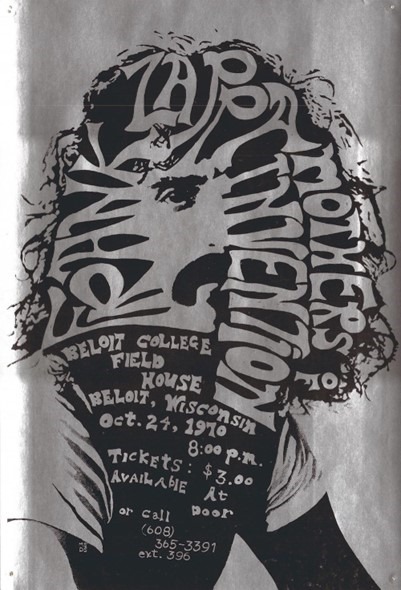
Zappa at Beloit concert poster

Cost of the concert? $3. An amount similar to my portion of the share-the-gas cost too.

.

The concert? Not life-changing. The acoustics in the fieldhouse hall were atrocious, and our seats were in the galleries far from the stage. The music was good, but with the sound bouncing around and the typical poor vocal PA of the time, the result was a mixed pleasure.

We got back in the little car to head back to Iowa. Finding our way through the unfamiliar streets we saw another car occupied with hair as long as ours inside. That car contained some young women. For some reason they wanted to share with the fellow freaky-looking folks that they knew the hotel where Frank Zappa was staying and that they’d been invited to visit him.

Of course we believed them. Of course we followed them. What did we assume was to happen there? Some sex, drugs, and rock’n’roll orgy? I’d just turned 20. I didn’t know what I was going to do with my life, or how I’d figure that out. So, why would I worry about might happen for the rest of some single night in October?

When we arrived, the bunch of us from the two cars, maybe 8 or 9 people, spread out around the non-descript motel room. A couple members of the band were checking in with Zappa. There was a short discussion at the doorway between Zappa and George Duke about what Duke had played at the concert, which got approval from Zappa. The band that night, though billed as the Mothers, was new, containing vocalists who had once been part of the pop band The Turtles, now billed as “Flo and Eddie.”  One of the young women from the other car bounced on one of the beds. Most of us seemed like me, passive, waiting for something to happen. Zappa turned his attention to us, asked us what we’d thought about the concert. There was some short discussion. I think I may have mentioned that a lot of the material seemed new. Best as I can remember, that was accurate. Zappa replied that they were doing some of the old stuff too. Memories fail, but I believe “Concentration Moon”  was replied as one of the veteran numbers. The male part of the room had some hard-core Zappa fans, who started to geekout on questions about the band’s history. I recall one asking about Doug Moon who had played with early versions of Captain Beefheart’s Magic Band. Were they trying to impress the genius with their knowledge, even in the midwest, of the places Zappa had come from? Zappa replied Doug was some guy who’d worked at a gas station. Zappa was patient about the questions, however trivial. At one point he took out a movie camera and filmed us in the room. I remember he moved in close to my face as I was missing one bow on my eyeglasses after that part had broken, and I had no funds to fix or replace the frames yet.

Here’s a few things Zappa conveyed to us in the roughly hour that I, and maybe others in the room, didn’t know before meeting him.

When asked about his doo-wop music parodies, including the Cruising with Rueben and the Jets  LP,  he corrected us that he liked that music. He spoke about Fifties R&B records he was inspired by. Since the lyrics in those songs were satiric, I’d assumed the music was also something he held in contempt. Far from it, he lit up talking about this. In The Sixties there was a widespread critical assumption that good music was “progressive,” meaning that we were to drive our plows over the bones of the dead, so this was news to us.

He nonchalantly corrected any impression that he was inspired by drugs. How he did this without sounding like a “Listen kids…” PSA I can’t exactly recall.

He seemed genuinely interested in us, and what we thought about the music — though at times, such as when he wielded the camera, the idea that we were natives and Zappa was an anthropologist occurred.

For me, the important thing happened near the end of our time in the room with this “…But, a genius” guy. I asked him how much of the show was improvised and how much was composed. He went over to the side of the room and picked up an oversized portfolio. Opening it, he showed it to me. Multiple staves of music, a rather full score as I recall. Dialogue written out, seemingly informal and back and forth, as if the band members were speaking off the cuff. In retrospect, I believe I was looking at scores for 200 Motels which would be filmed a few months later with a full orchestra. As he showed me this, he talked briefly about the effort he put into it, which the score showed. I was immediately impressed with the formality of the effort to achieve what seemed like chance informality. There must have been some serious seat-time in getting that done. The intent of it!

Imagine instead if I had somehow visited the hotel room of Jim Morrison in 1970. Perhaps my romantic notions of the creation of art would have gathered more poète maudit forces. Did something in my subconscious connect what Frank Zappa conveyed that night with William Blake, who when not out talking with the visions of angels, was innovating printmaking techniques and making books with his own skills?

After that significant side-trip, we left the room and returned to Iowa. If you’d asked me that day, I still didn’t know what I wanted to do with my life — not a whit more — but what I did have was a piece of information, and an outlook. From that night I could remember that doing  was a large part of doing something with your life.

This is already a double-length post, so enough for today. To tip my hat to Mr. Zappa, here’s the LYL Band roughly approximating one of his later tunes in a we’ll-give-it-a-go live performance.

We flattened Zappa’s music and arrangement here, but as the video points out, if Zappa were performing this song today he’d be sure to include more screens than just TV.

.

*This oversimplification is more accurate about youth in The Seventies than the Sixties, even the final three years of The Sixties. In terms of clothes and hair, look at a range of contemporary photographs and film from the actual Sixties. Beards and long hair will be sparse on the young men, not movie wardrobe department common. Yes, use of marijuana and other drugs increased during the last half of The Sixties from a very in-group secrecy thing to a sizable minority, but in doing so it lost a bit of its bohemian rhapsodic connotations and became just another illegal high like drinking alcohol before the age of 21 had previously been. Real “counter-culture” bohemianism in an artistic sense had grown from the beatnik Fifties — maybe even doubled or tripled — but was still something a single digit percentage of people engaged in with any seriousness.

**In reality, this regional expansion of the conflict had been going on by proxy and by secrecy for a long time — but in the run up to the Kent State shootings it had become stated policy, driving hard-to-escape fears that there were now going to be additional para-Vietnam Wars.

***This is a complex point, one I need to leave off too briefly. Women of course were involved in anti-war activity before Kent State, but it occurs to me that this small factor may have been more important than recognized in adding to the explosion of activism in the spring of 1970. In case you’re wondering: yes, the anti-Vietnam war organizations, like the counter-culture, weren’t significantly less patriarchal than the rest of Sixties society — and though it may rankle some, I’ll add this as well: the victims at Kent State were also white.

****Any reading this who participated in Occupy Wall Street or the Black Lives Matter activism of this century may have a moment of recognition here. The emotional high of sensing that something is finally being said loud enough, that mass pressure is finally being brought by an unprecedented number of people is shared from this time. The emotions following, when such movements crest and seem to dissipate, need to be considered too. Here’s one piece of wisdom from someone else from this time worth listening to.

*****Will some Classic Rock oldster reading this think “Well, Rock Opera, what about the Who’s Tommy?” Tommy had yet to be released.