Summer Is Icumen In

I sometimes like to ask musicians who sing folk songs “What is the oldest song you play?” As a person attracted to traditional English folk music at an early age, I often marveled at the gloriously old traditional ballads collected by Thomas Percy and Francis Child. There’s something interesting to me about singing not only “other people’s stories,” but very old stories at that.

Turns out that they are likely not all that  old. Most of them are no older than Shakespeare, and despite many antique words and usages, they are in more or less modern English. That’s old, but it’s not old like Homer, Sappho, some of the Chinese poems I’ve set to music here. Today’s piece, “Summer Is Icumen In”  was nearly as old to the typical Child ballad author as Shakespeare is to us.  You can say it’s words are written in English, but that’s only English within the broadest of meanings, as the words are even farther removed from the language we speak than Chaucer’s.
 
Unlike the now lost ancient Greeks’ music to accompany poetry, we even have the 13th Century music and a notated arrangement to present it sung as a canon or round.

Summer Canon [Reading Rota] - caption: ''Sumer is icumen in''

Old joke. Q: how do you make a guitarist turn down? A: put sheet music in front of him
New joke: Q: how do you make a lead singer ask for less in the mix? A: put old English lyrics in front of him

One tradition in folk music is to not be overly traditional in re-using it, and I’ve done so here. My melody is only tenuously related to that old one. The original music is minor and mine is major key, and I don’t do it as round. Furthermore, I’ve taken liberties with the various modern English translations of the words. I have replaced a phrase with one that I like better, completely blowing a raspberry toward those who translate uerteþ in the original text as “fart”.

I’ve fattened up the arrangement with a goodly helping of a traditional English instrument of the antique 20th Century, the Mellotron. I told Dave Moore after I completed the mix with the new Mellotron parts that the singing wasn’t good enough for it to sound like the Beatles, and it wasn’t stately enough to remind anyone of King Crimson, and it didn’t have any undeniable pop music dynamics like the Moody Blues either—but what I may have gotten too was something in the 2000 light-years neighborhood of the Rolling Stones’ Their Satanic Majesties Request—which I will confess was one of the first trio of records I bought back when the Beatles “Sgt. Pepper”  was threatening to reshape all pop music (a threat that was not carried forward for both good an ill).

Stones Album cover

Don’t adjust your monitor, the original LP’s 3D cover is really that blurry.
Also, any mention this Stones album’s name must now be done in Dana Carvey’s Church Lady voice.

Anyway, I’m using digital replicas of the original Mellotron’s cranky tapes in “Summer is Icumen In,”  but even in that remove they add a certain character to the string parts. Dave’s original organ part, mixed in the right channel, now seems like a top line to the Mellotron parts, but it’s a good part, so listen for it. To hear the LYL Band’s performing this old English lyric in a non-traditional way, use the traditional player that appears below.
I Know a Place Where Summer Strives

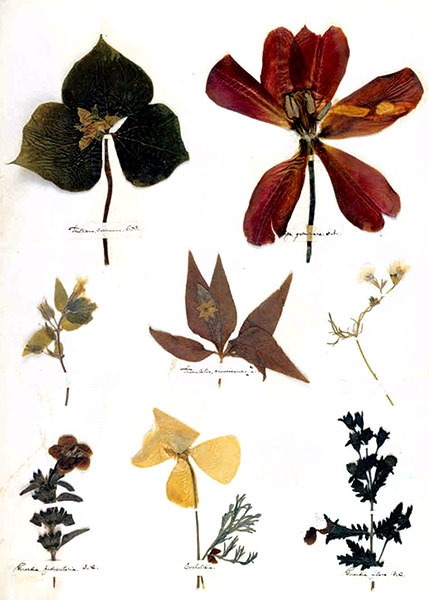
It would seem odd to us now, but when Emily Dickinson died, her most noted accomplishment was not her poems, but her plants. She was a serious gardener, known to her family, neighbors, and town for cultivating her plants even at night (which was also her customary writing time).

Emily Dickinson Herbarium page

Emily Dickinson created a 66 page herbarium with pressed flowers,
and often included flowers with her letters and privately distributed poems

There’s a lot of comparisons to be made there, that her poems are like flowers, pretty at first sight, but with their own alien structures, but I’ll leave that for now so that I can move on to today’s piece “I Know a Place Where Summer Strives.”

This is a poem that fits well with the Parlando Project’s tactics of combining poems with music, because it’s a poem that uses puzzles to tell its story. When you combine a puzzling lyric with music you can let those words ride along without requiring them to be immediately meaningful, as otherwise poems that go out of their way to be puzzling can frustrate readers not in the mood for non-straightforward speech.

I enjoyed “I Know a Place Where Summer Strives”  before I had solved its puzzles. As usual, Dickinson doesn’t belabor her subject, just three stanzas and 12 lines, a nice dosage for puzzlement. The poem’s internal music flows nicely, and Dickinson’s use of unusual word choices in the final stanza adds decoration to the mysteries. After reading it a few times, writing the music for it, performing it with the LYL Band, and then mixing the recording available below,  I have finally gotten around to trying to solve the riddles.
 
The first verse/riddle is a particularly cold spring, with “practiced frost” taking casualties among early blooming flowers. The second verse/riddle is a description of a building storm, which turns out not to be destructive, it brings “soft (ref)rains.” The third verse/riddle is more obscure yet, but the rain falls onto the hardened, adamant, ground. The last two lines of this verse are lovely to read and hear, but I couldn’t make any sense from them. At first thought I, like blogger Susan Kornfeld, wondered if this was a late-fall time image, and the quartz was ice forming on amber leaves—but then I noticed that the third verse clearly appears to be carrying forward the sentence and thought from the second verse, so it can’t be winter’s arrival: south wind, rain—that doesn’t sound like winter arriving.

Blogger Linda Sue Grimes suggests a solution, that the amber is mud on the shoe. This makes sense, and it could logically follow the rain on adamant hard ground, which could even be light yellowish, amber-colored, clay and not good dark garden soil, but I still am puzzled by the quartz. The line here is especially lovely: “That stiffens quietly to quartz” resonating with the “qu” “zee” and at “t” sounds, but I don’t think Dickinson cheated just to get the sound. Quartz can be brown like mud, though that’s not how I think of it, but its name and the modifier “stiffens” indicates this is something crystalline—not gooey, caked mud.

In performance I decided, intuitively, to repeat the first verse; and in so doing, I bring back the cyclical end of summer to close things.

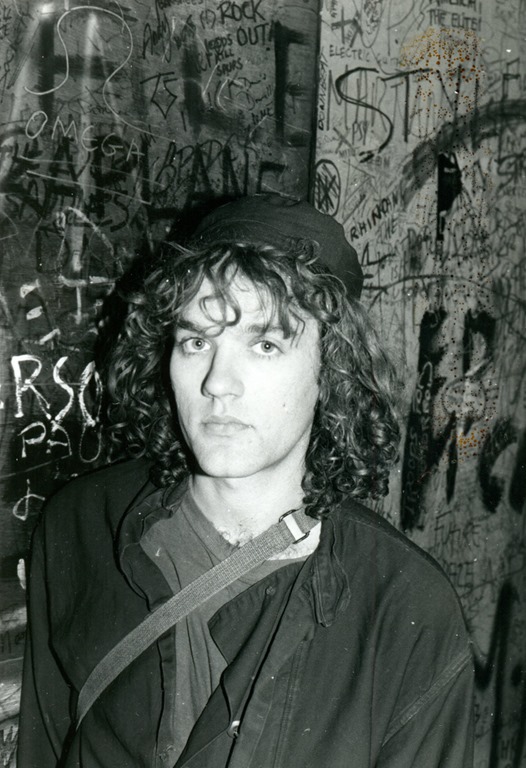
young Stipe

Michael Stipe when he was Gardening at Night.
Coincidentally, both he and the Parlando Project are in some part inspired by Patti Smith

When I read that Dickinson’s gardening extended even to nighttime work, I recalled the song from R.E.M.’s first EP, “Gardening at Night.”  Michael Stipe’s early lyrics, are far more abstract than riddles, reading to me like abbreviated captions to blurry photos. A set of lines like:

We ankled up the garbage sound,
but they were busy in the rows.
We fell up not to see the sun,
gardening at night just didn’t grow.

Are as obscure as any poem, but I could, and still can, enjoy R.E.M. songs like that one. Stipe sincerely sang his own meanings, and he had a great band around him that supplied the music that lets the meaning ride.

To hear the LYL Band performance of “I Know a Place Where Summer Strives”  you can use  the player that appears below. Musically, you might find it to be vaguely R.E.M.-like too.
Frutiger

Here at the Parlando project we say we’re where music and words meet.  Sometimes words sing without overt musical notation. Sometimes music speaks to you without speech. And since Dave and myself also play the music heard here, it gets to speak for us, we get to say this music. Every musician, whatever their level of talent, skill, and knowledge gets to experience this.

Today’s piece, “Frutiger”  is an elegy for an artist, Adrian Frutiger, a typographer who created typefaces, the shapes of letters we might use to spell out words. Typography is an unusual art in that we may invest in words a great deal of meaning but the actual ink-shapes that present them on a sign or a page may seem immaterial to that process. Like the music we sometime forget to hear in words, those little carved paintings of letters may disappear below our attention, but their legibility, and even their subtle pointilliste shadings in blocks of text, are still part of our experience of printed words.

Frutiger’s most widely used typeface design bears his own name, and it often chosen for signs because its letter forms excel in legibility during inclement weather or from a distance. For example, one of the Frutiger typeface’s  distinguishing features is use of square dot on top of the lower case i, which gives it a tiny advantage in the necessary discernable gap between the letter and the dot. In the words of the “Frutiger”  piece, I call that out as if the square dot was a diamond rotated (“diamond” just brings in more meaning) and lets me vaguely pun on the Eye of Providence.

Frutiger Sample

A line from today’s piece “Frutiger” in the like-named typeface

Three minutes in, and this little elegy’s words are over, but I start a guitar solo. At two minutes in length, that solo will be shorter than the spoken word part, and it was only indirectly called forth by those words.

That solo says what? Loss? Anger? An urgent and puzzled prayer? A man using his limited musical skills? A patient LYL Band allowing it to occur?

All I can say is that says what I was feeling that day, and today.

To hear today’s audio piece “Frutiger,”  use the player that appears below.


Love and Money

Poetry turn-offs? There are lot of them. There’s the fatiguing stretching of language that can wear one out. There can be an air of paradoxical “Let me tell you what I think/you wouldn’t understand” attitude. While modernism has greatly reduced this, there remains an expectation of grand subjects treated solemnly—but then the modernism that gives us a wider choice of diction and subjects, also may hand us a confounding abstraction of words that refuse to work the way we’re accustomed to having words work.

Every one of these things has kept me from enjoying poems, and yet I’ve committed every one of these annoyances myself with my own writing. But what if we could relax, what if we could be told right at the outset that you won’t be tested on the meaning of the poem?

As it turns out, our culture has done that. We call this experience of poetry, without any need to immediately stand and deliver meaning, song lyrics.

With the Parlando Project we often test this theory by applying music to some well-known poetry meant for the page. This pulls the poetry off its silent ink and puts a human voice in it, letting you hear the sound and tenor of the words—but the music adds something else we’ve been culturally trained to do by decades of modern songwriting: it lets us experience the meaning of phrases within the song lyric in a subconscious, non-linear way. As listeners to songs, we sometimes grab the chorus or “the hook” first, and only later begin to appreciate how the verses are shading the experience of the refrain, and in-between times, the music lets us unselfconsciously tap our foot or shake a tail-feather.

Slave freedom paper2

Find the cost of freedom. In this case, a bit less than $172.

I hear alternative Parlando voice, Dave Moore’s “Love and Money”  less as a page poem and more as a song. Over various listens, I think I have drawn some tentative meaning from it. When I first heard the opening lines, I thought I was hearing part of an Afro-American slavery story, where freed slaves sometimes found themselves obligated to buy the rest of their family, because in that outrageous framework, property rights were the only rights that might be honored. As the song progresses, it’s jumps elsewhere, including a verse clearly set in this century. I hear the concluding verse as back in times of slavery, or some equivalent evil time, but the journey from beginning to end exists with a refrain that “our only chance comes down to love and money” and a wicked interlocking riff between Dave Moore’s electric clavinet part and my own Telecaster guitar.

So go ahead and listen to Dave Moore’s “Love and Money”  by using the player below. You won’t be asked to write an essay on it or anything.

Grass

In the last post, I presented Ezra Pound’s rant about the society that lead so many to their deaths in WWI, deaths that included several of his own modernist artistic circle. Taking it personally, Pound exclaims that their “fortitude as never before” for change and their “frankness as never before,” lead only to equally great “disillusions”. He sees lies and liars leading others into the war and their sacrifices, and only liars as triumphing.

Speaking repeatedly about liars and lies and illusions, Pound’s “These Fought” would not be a very popular choice for a Memorial Day speech then, just as it probably would not be one now. If you agreed with him, you might enjoy his precise inventory of folly. If you didn’t, you’d say he was unappreciative of his friends (and so many others) sacrifice, and that his disbelief in the stated high motives for the war could be mere cynicism. I can hear what some voices must have said then (and would say now): “You can complain about what is imperfect, perhaps even foolish, but what’s your solution, other than to stand to the side and write poems?”

Alas for Pound, he did propose a solution. It was a solution chosen by many others disappointed after WWI, a fresh modernist conflation of race hate, nationalism, technology and authoritarianism, the fascism that lead to WWII.

Commonwealth-war-graves-WWI-cemetery-Belgium

What place is this? Where are we know?

Today’s episode: “Grass”  by Carl Sandburg is just as pure a modernist, imagist poem as any by Pound, but it’s statement about the sacrifices of war is more indirect.

Sandburg has a reputation as a clear-spoken poet who makes his points straightforwardly, as if plain words mean simple thought. I believe this is mistaken. Sandburg’s mind was not a simple, unicameral mind.  Sandburg was leading multiple lives at once during the WWI era. He was writing, sometimes under a pseudonym, for radical leftist/labor IWW publications, while writing for the mainstream Chicago dailies, while writing modernist poems. When Sandburg was protesting the jailing of IWW antiwar activists, and writing today’s compressed, Imagist, “Grass,”  Sandburg had also published a long, Whitmanesque populist and blood-thirsty poem “Four Brothers” lauding the urge of Americans to go overseas and put the German Kaiser’s head on a pike. “Grass”  too has its echoes of Whitman—not the martial revolutionary Whitman, but the Whitman who wrote of grass as “the beautiful, uncut hair of graves.”

So, this is a complicated and perhaps self-conflicted man who is writing this, and when we move in “Grass”  from the catalog of history’s deadly battles, ending with two great battles of WWI, Sandburg’s poem takes a turn.

In two years or ten years, what is this sacrifice? In“Grass”  the places of these battles become nowhere. Is this a hopeful statement, that after this “War to End All Wars,” we will now be able to forget war? Is this an anti-war statement that would say, as the radical Sandburg or Ezra Pound would have said: that after all such strife, the liars and those that run things will continue to run things anyway, as if the war settled nothing? Is it a statement of reconciliation to come, when elderly soldiers from opposing sides meet and speak of their common experience and equally lost comrades? Is this a statement of the democratic socialist Sandburg, that the forces of inevitable Marxist proletarian revolution will come and obsolete all that was before? Or is it a cool and detached statement that all human efforts are transient?

I don’t think it’s an accident that this divided man wrote a poem about the sacrifice of war that lets it be all those things.

To hear the LYL Band present Carl Sandburg’s “Grass,”  use the player below.


These Fought

The lives, outside of art, of artists bear only a mysterious resemblance to their work. The concentration of time that must be brought to creating work drains many a writer’s life of incident. And so, an artist like Emily Dickinson can lead an outwardly constrained life while creating an inward empire. Or the man who would eventually be charged with the establishment of the first modern democratic republic could be, as a teenage poet, a love-struck supplicant. Nor does general good character align with artistic success—saints can write bad poetry and flawed people may write good poetry.
 
Today’s post features the words from an American who as much as any single person launched Modernist poetry in English. His associates and admirers, added to his detractors and opponents, make up an encyclopedia of 20th Century English literature. In the first part of the 20th Century, some of them would be profoundly influenced by his artistic ideas, and some would even be directly edited or personally mentored by him. One hundred years ago, in 1917, Carl Sandburg would say of him:

“All talk on modern poetry, by people who know, ends up with dragging in Ezra Pound somewhere. He may be named only to be cursed as wanton and mocker, poseur, trifler and vagrant. Or he may be classed as filling a niche today like that of Keats in a preceding epoch. The point is, he will be mentioned.”

Pound would live more than another half a century after this, his literary revolution flowing outward until few could see back to its instigator. And there’d be reasons his influence would be discounted: by the end of WWII, when Modernism, no longer insurgent, was about to become the established artistic order, Ezra Pound was a 60-year-old man confined in an outdoor steel cage open to the elements, awaiting to be charged as a war traitor with a likely sentence of execution.

Ezra Pound Booked for Treason

This guy is most responsible for English literary modernism, but that’s not what got him arrested.


The customary quiet and inward life of a writer, even an unnoticed one, looks good in comparison.

Though this treatment was inhumane, and the charge not without controversy, it was not unsubstantiated. Pound had spent the years leading up to WWII making common cause with the European Fascists that the United States eventually fought in that war, and when that war was being fought, he broadcast eccentric propaganda in his native English in service of his adopted country of Italy and Mussolini. Furthermore, his attraction to the Fascist cause was not an accident, a casual side-effect of his adopted country of residence. Pound wholehearted seemed to believe in the crackpot and yet deadly racist theories bolstering Fascism.
 
Remember earlier this month when we talked about the popular folk song celebrating Jesse James, versus the reality of James’ life as a racist terrorist?  Pound lacked the actual bloody hands of a Jesse James, but not the thought behind them.

So much more could be said on this, but that would take more room that we have today, and besides your thoughts and judgements on matters like this, as I said when talking about Jesse James, are more important than mine. Not only are they more numerous, but you are likely younger than me, and will get to use those judgements on things like this to guide your life.

Today’s audio piece, “These Fought,”  was written by Pound at the height of his fame and good influence—not after WWII, after WWI. Unlike some younger Modernists, Pound did not actually fight in WWI, but situated in England during that war, he saw the patriotic recruitment and the creation of cases for the war, a war that soon became mechanized slaughter beyond all previous imaginings, and he lost friends in that staggering slaughter. So, in “These Fought”  Pound caustically calls out the cases for the slaughter, and leads us to note that bravery in fighting WWI, or fortitude in opposing it, were in some sense equal in valor and, alas, equal in success.

To hear the LYL Band perform this, use the player below.

I Was Reading About Jesse James

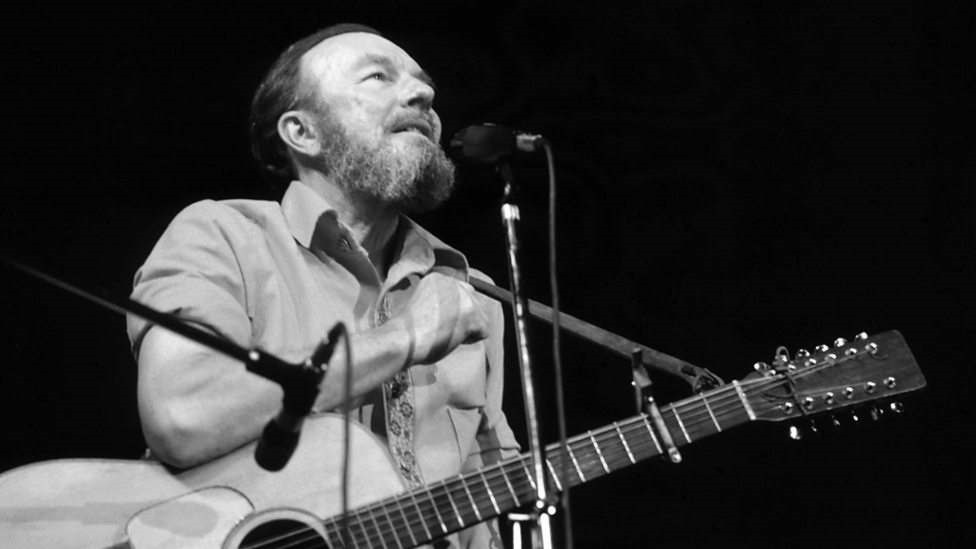
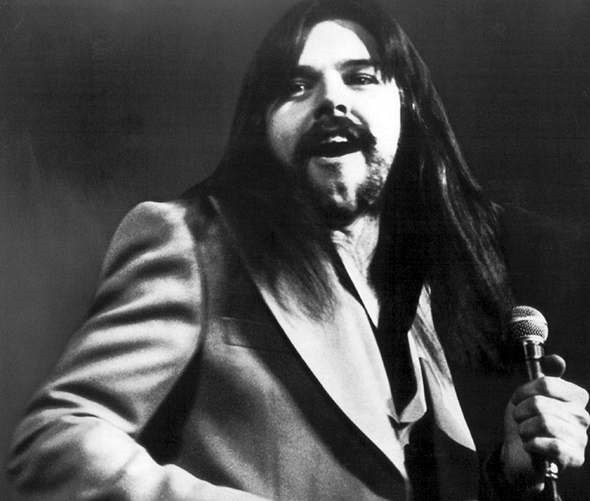
When I was growing up and learning songs from Jerry Silverman’s folk songbooks, there was song called “Jesse James”  included in many collections and sung by a wide variety of singers—and any song that has been sung by the Kingston Trio and Nick Cave, by Van Morrison and the Pogues, by yes, by both Peter Seeger and Bob Seger, has to be the very definition of a “folk song.”

Pete SeegerBob Seger

Both these guys have sung thoughtful songs, but sometimes you need to think beyond the song yourself


Though “Jesse James”  takes some of its spirit from older English ballads celebrating legendary medieval populist outlaw Robin Hood, this American song is more about betrayal (James was killed by a gang associate in his own living room) and about telling us what an all-around bad-ass James was. We’re told he “killed many a man” (never why or how, though bravery is claimed) and that he robbed banks and railroads (but he “gave to the poor” and would “never rob a mother or a child”).

You can see how this sort of thing has a wide appeal. A tale of revenge on the rich and the powerful appeals to many, and banks and railroads were particular targets of late 19th and early 20th century rural populism, but the emotional core of the folk song “Jesse James”  is the betrayal and assassination.  No matter what the variation in the lyrics, there’s lots of mention of James’ cowardly assassin Robert Ford betraying the man who trusted him, shooting him in the back.

Woody Guthrie took “Jesse James’”  structure and melody and produced an incisive, though less popular, version of his own called “Jesus Christ”  which cast Jesus as a rebellious populist betrayed by a disciple—though it had to do without the “killed many a man” factor. So popular is the original “Jesse James”  ballad, that Guthrie likely knew that Jesse James’ action-hero rep would rub-off on his populist Jesus.

So, it was with interest that I followed up on the reality of Jesse James. One can assume that most heroes have feet of clay, portions of their behavior that show faults or inconsistency, but it turns out Jesse James doesn’t have feet of clay—the whole man is made of half-baked clay mixed with ample fresh dung as filler.
 
He’s a nasty piece of work. True, his character shows audacity, but that’s not the same thing as bravery. There’s no evidence I’m aware of that he ever killed an armed man who was opposing him, but lots of connections to killings of prisoners and bystanders. It was somewhat true that seeking cash through his robberies was a side-point to him, but his main motivation was to extend, defend, or to restore human slavery, or to take broad revenge on those who sought to end his career seeking those aims.

If there’s a defense for his actions, it would be some listing of the bad things done by his opponents, but then monsters often breed monstrous actions against them. It’s an argument against monsters, not a defense of the actions themselves.

Today’s piece “I Was Reading About Jesse James”  starts by asking you to think about this. I thought about trimming the piece’s instrumental coda shorter, but I have left it in. Consider the last half to be time for you to begin to ask those questions yourself. To hear the LYL Band ask those questions to music, use the player below.


Wisconsin

One thing I like about the Parlando Project is how things we present end up reflecting on each other. Some of that I plan, but some of it just comes up.

Today’s piece “Wisconsin”  completes our series of pieces by songwriters who have won the Nobel Prize for literature, starting with Bengali Rabindranath Tagore who wrote thousands of songs, many of which are still sung today; then moving on to William Butler Yeats, who believed his poetry should be chanted to music and commissioned an instrument and a touring performer, Florence Farr, to realize his conception; and now today, Bob Dylan, the Midwestern American who has written hundreds of songs and whose birthday we’ll celebrate this month.

But “Wisconsin”  and Bob Dylan continues another topic, one from the last post, where I introduce the thoughts that enjoyment of a type of music is subjective, that the experience of the same music is subject to strange mutations of context in the passage of time, and that the judgement of merit and pleasure from music are two different things.

wagner opera costumes

A jam band looking to tune their banjo in the hills and feast on milk and cream


Like the lengthy operas of Richard Wagner or the exploratory playing of jam bands, Bob Dylan has never been universally appreciated. There’s evidence from his earliest years as a performer that this was intentional on Dylan’s part: to accept the freedom to perform in ways that caused part of an audience to reject his approach. Doing this in order to endear himself to another audience that would be attracted by this difference, this freedom, and yes—to a degree—to the power of the exclusion of that other audience.

This is not an unusual artistic stance. The artist who claims that audiences of Philistines cannot understand their work—and who may also aim steadfastly to make that claim true—is common enough to have been a comic stereotype from classical times. But Dylan distinguishes himself from that not only by becoming hugely influential, changing and expanding how songs will be written in English in a matter of a few years, but also because he was willing to change the nature of what audience he was repelling and attracting regularly, almost as if he had an over-arching artistic goal to say that this repel/attract response to art was a thing that we should examine with skepticism.

So one moment you are supposed to love or hate him because he’s an earnest politically-engaged folkie rejecting pop music and hedonism; and then you are supposed to love or hate him because he’s a loud rock’n’roll hip cynic deep into drugs and pop culture; and then you are supposed to love or hate him because he’s a Nashville country-music-factory family man embracing simple truths—but wait, now he’s not only that, he’s what, a Christian!? And then he’s someone adrift, trying to make records every wrong way in an era when everyone is making bales of money making records. Then he unplugs and makes two fine acoustic guitar records in his garage with not one self-written song, which only a handful notice; and then he makes five records in the last two decades that are either embraced or rejected as he writes songs full of richly imperfect characters and anti-heroes defiant and defeated. And now he has the nerve to ask us to listen to him singing songs Frank Sinatra would have sung. And all these twists and turns leave out three wonderful records that don’t fit these scenarios: “Blood on the Tracks”, “Desire”,  and “The Basement Tapes”— any one of which could be the masterpiece of most other songwriters’ careers.

Despite all this change, and more than 50 years as a notable performer, there are those who consistently don’t like his singing, don’t think much of his musicianship, who feel that the historic influence of his writing is somehow an embarrassing overachievement. Some of those people are musicians as well, some of them are smart and perceptive people, some of them hold to the duality of Bill Nye’s great sentence, who feel that like Richard Wagner’s, “Dylan’s music is better than it sounds.” How many of these people are sincere, how many are more at envious? How many are just smarter than I am, with better or different musical taste? How many can’t absorb Bob Dylan for the same mysterious reasons some can’t digest milk or gluten? Some of each.

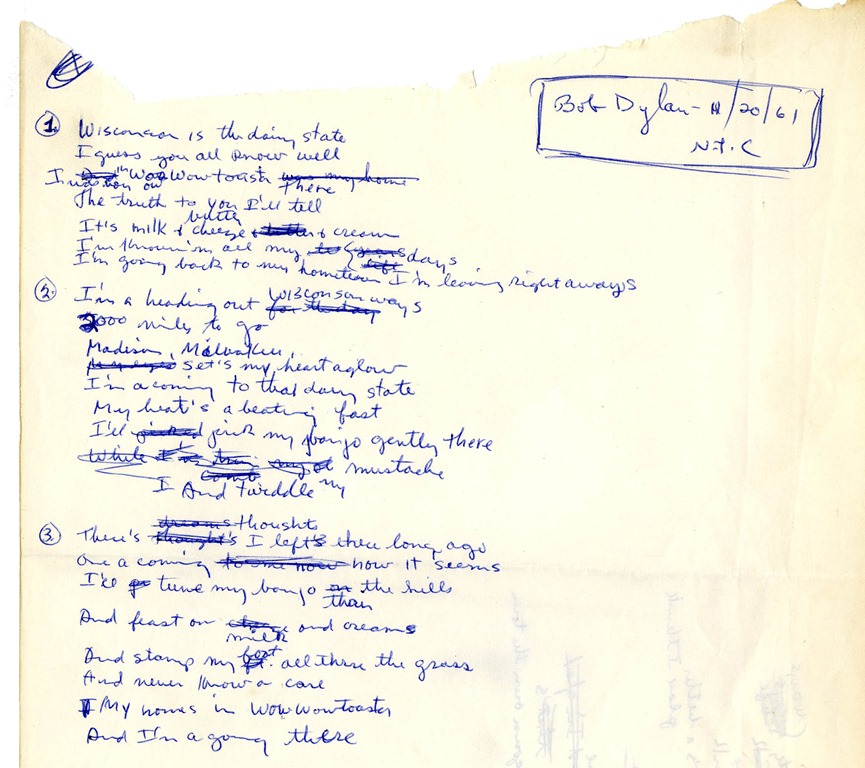
Now let’s take today’s Bob Dylan episode. “Wisconsin”  is a set of words, never used by Dylan, written when he was around 20. A handwritten manuscript was put up for auction last month with a minimum bid of $30,000, and I don’t think it made that minimum. Notices about the auction liked to poke fun at the unimportance and artlessness of the lyrics, particularly in the context of that songwriter getting a Nobel. Well, the Parlando Project is the place “Where Music and Words Meet,” and in this case the words are waiting for music and performance to animate them. On the scribbled page they are puppets without hands in them, so the LYL Band put their hands in.

dylan_wis_song

The Nobel is a long way off, but even the 20-year-old Dylan is revising what seems like off-the-cuff stuff

It turns out that the formula of nonsense and normality, commonplace and commotion, when animated with who-the-hell cares energy makes a fine rock’n’roll song. And you don’t need $30,000 to have that, you can get it here for nothing. Just click on the player below.

Up-Hill

Last post I compared late 19th Century cultural hipsters with early 21st Century urban cultural revivalists.  Did modern natural-fiber clad, skin-inked and perforated young people study up on William Morris’ Arts & Crafts movement and visit museums to absorb the Pre-Raphaelites? Some perhaps, not all. And the same can be said for what is carried onward from punks, hip-hop kids, hippies, beatniks, and so on. I’m too old, and too little a sociologist to answer this definitively.

I can say that when I tried to discover what kind of music I wanted to make in the 1970s I copied imperfectly many musicians from the previous decades as well as my contemporaries working down the river in New York City. And those NYC contemporaries? They too were looking backward to move forward. What had been overlooked? What had gone out of fashion for no good reason? What had been uncompleted? So, in listening to them, I was listening to their understanding and misunderstandings of the past too.
 
One of our principles with the Parlando Project is “Other People’s Stories.” Part of the above is “my story”—but my musical story is really made up of other people’s stories.
 
Tracing the path of influence is often hard to do. Today’s piece Up-Hill  is an example. The words were written by Christina Rossetti, that sister of the Pre-Raphaelite Brotherhood. Obviously, she’s familiar with the Pre-Raphaelites and their circle—but she’s also deeply interested in a Christian religious revival, and that too gets reflected in “Up-Hill.”  Would she have known Anna Coghill’s poem that was set as the hymn Work for the Night is Coming?”  That’s unknown to me, but “Up-Hill”  and “Work for the Night is Coming”  are both poems understood in context as being Christian devotional, while containing not a single specific utterance about a deity, salvation, or an afterlife. With revivals, context changes things.

Christina Rossetti

Christina Rossetti thinking about an up-hill journey?


And here’s another way that influence is hard to trace: it becomes unconscious. As I was writing the music for “Up-Hill”  I was mostly interested in varying my customary harmonic cadences while keeping it to just two or three chords, a short number that often works best for performance with the LYL Band. And “Up-Hill”  is, after all, a work of beautiful simplicity, saying something profound without pretentious elaboration.  I settled on a simple I V IV I progression, and tried it with the band last month, but my vocal wasn’t working. Trying again this month, the unconscious struck.

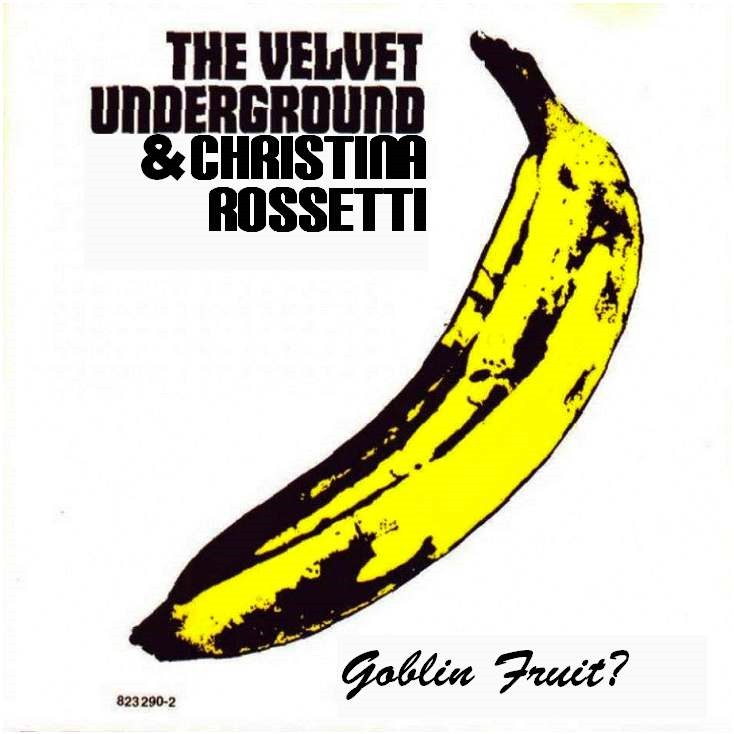
VU - Shall I Meet Other Wayfarers At Night

“Shall I meet other Wayfarers at night?” The Velvet Underground  certainly think so.


I didn’t realize until I was working out the rhythm track that I was falling into a Velvet Underground groove, like the one they used in I’m Waiting for my Man,”  a tune that is also understood as devotional in context—though to drugs, not a deity. Both songs feature a journey to a destination (up-hill or up-town), both engage in conversation along the way. Was this subconscious choice a sly comment on Christina’s brother Dante Rossetti’s addictions? A comparison of recovery to salvation, or of addiction to salvation?  No, the groove was just working, and it helped me get a better vocal down. If I understood anything about what I was choosing while doing, it was that I was linking sub-cultures and following the near invisible web connecting Other People’s Stories.

Velvet Underground and Christina Rossetti Cover

So what would that sound like? Use the player below to find out.


Same as always, the player should appear below.to hear the performance of “Up-Hill.”  And keep sharing the links, subscribing, and telling folks about the Parlando Project.

Love Is Enough

I drove to Des Moines Iowa this past weekend for a wedding of a niece. The reception was in a tap room attached to a small indie brewery. My 12-year-old son asked “Why is it in a brewery?”

I asked my son if he knew what a hipster was. “Yes, it’s someone who always needs to have the latest iPhone the day it is released.” My son likes to remind me that he is not  a millennial, and that he will have no truck with their ways.

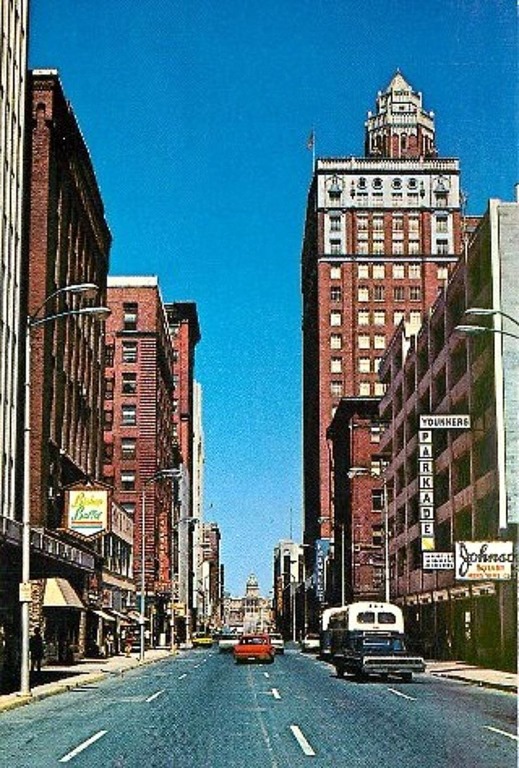
I laughed and said that it’s more than that though. I tried my best to explain, doing badly, as I usually do when speaking. What I was aiming to say was that hipsters are interested in things that are different and off-beat, that in doing so they often revive things from the past and redo them in the now different context of the present. This kind of rebellion against the too-ordinary incumbent culture eventually changes the culture, remaking cities and what they offer. “When I was a kid and went to Des Moines, there were no small breweries serving their own beer, or restaurants that serve those Asian noodles like you like. Instead I’d get to go to Bishop’s Cafeteria.”

“What did you like about Bishop’s?” my wife asked.

“I liked that you could choose your own desert. Usually something with whipped cream on top.”

Des Moines Early 60s

News from Nowhere: Des Moines dreams of hipsters to come. Shop at Younkers, eat at Bishop’s.

Now that isn’t a complete explanation of what a hipster is either. Nor does it tell how hipsters are seen and labeled by others, or that to call someone a hipster generally has a negative connotation. If you want a hyper-precise definition with lots of reasons to be wary of being called a hipster you can read one here.

Every cultural change movement like this gets made fun of, and provides lots of rich examples of foolishness. And unlike frankly political change movements which often generate mutual veneration between generations, many cultural rebels see the next generation of young novelty seekers as a bad, devolved outcome; while the young often find and fix their cultural novelty in rejecting the enthusiasms of their immediate predecessors. Can anyone be sure that hipsters are any more or less authentic than punks, hippies, beatniks, or swing era hepcats and so on? I can’t. Is some rampant cultural appropriation going on? Yes, and that has its foolish and even harmful side-effects for all these cultural movements—but are their benefits as well? I believe there are, and anyway, rigidly contained cultural silos seem stifling.

This rejection of immediate predecessors, doesn’t mean an inevitable total rejection of the past. Small breweries were common in America a century ago. Beards, mustaches, fedoras—the clichéd markers of the male hipster, all are revivals of past fashions.

Remember with the Christina Rossetti poem last month. I mentioned her brother Dante Gabriel Rossetti’s boys club “The Pre-Raphaelite Brotherhood?” Formed by art students, they signed their paintings with a “PRB” as secret tag for their movement. They hated the classical art and design standards of their day, and even though they were living in the original Steam Punk era, instead of fetishizing brass, well-oiled gear trains, and leather, they propagated their love for Medieval art and hand-made crafts.

Dante Gabriel Rossetti - Ford Madox Brown 1867

Dante Gabriel Rossetti. Can he interest you in some beard oil?

Sound familiar? The Pre-Raphaelites seem to me to be late 19th Century versions of early 21st Century hipsters. If they were ironically enjoying Midwest beer in a can, would they have signed their paintings “PBR”?

Today’s audio piece is William Morris’ “Love Is Enough.”  Morris was intimately connected with the Pre-Raphaelites. Like them, he was fascinated with Medieval art and culture, but he was a man with many interests—many more than I can touch on this time—including writing influential fantasy and speculative fiction. In that vein, we’re going to time-travel the Englishman William Morris like we did with Americans Walt Whitman and Emily Dickinson, so that this 19th century poet can sing a nugget of garage band blues with the LYL Band.

Watts painting of William Morris

William Morris fading into the wallpaper. He did just about everything but start a brew pub.

This one is a good song for a wedding and for lovers. To hear “Love Is Enough”  use the player gadget below.