Since I’ve been keeping track, one thing has been consistent with the most popular piece each season: it’s been by a poet not widely known or read in the United States. So previously we’ve seen on top after a season of your listening: my translation of Dada principal Tristan Tzara’s “The Death of Apollinaire,” the better-known-in-the UK Edward Thomas’ “Adlestrop,” the too-often overlooked Chicago Modernist Fenton Johnson’s “The Banjo Player,” and “Frances,” the teenage love poem by George Washington, whose career as a poet never really took off.
This has happened even though I’ve featured (multiple times) most of the popular canon of pre-1923 English-language poets touched by the Modernist movement of the 20th Century: Frost, Yeats, Sandburg, Millay, Pound, Williams and Eliot.
Pat yourself on the back: the listeners here are open to a variety of writing, and they don’t necessarily need to have a name they already know attached to the words.
Still, it’s surprising that it’s surprising that we have Emily Dickinson coming in at the top spot this past summer.
Dickinson (along with Frost and Yeats) seem to be special cases with The Canon, in that all three have retained some level of popular readership and presence in that still-existing oral-tradition of memorization, even into our current century, without being denigrated into the bin of “not-great poetry.”
Our Summer 2018 most liked and listened to audio piece is “Ample Make this Bed.” Like many Dickinson poems it’s extraordinarily compressed, just eight lines—and like so many of her poems it invites us in and then mystifies us. Most of us have made a bed, and some of us have even been instructed in how to complete that task correctly. Here, with “Ample Make this Bed,” we may get six lines into the eight and we haven’t left domestic normality other than the ironic satisfaction with a job, that if done excellently, will stand forever. Ah, if only any domestic housekeeping task can stand ‘till judgement day, rather than the few hours until it needs to be done again!
The poem’s final two lines are so modestly telling and beautiful. Until them, no rhyme—and then internal rhyme and end-rhyme rush in! And the synesthesia of “yellow noise,” an image which could have been informed by Dickinson’s mysterious medical syndrome which included photophobia, but needs no biographic detective work to strike us boldly.
Is “Ample Make this Bed” about death, domestic drudgery, love, or the unstoppable passage of time? Emily Dickinson seemed to have taken care with her poetry, to make it ample and arranged to last until judgment day, so it’s likely intentionally undetermined—or mystically, exactly, all of those things united.
Musically, I’m quite proud of my music and performance of all the various parts with this one. If you missed it last July, why not go ahead and listen to it now. And if you like it, please let others know about what we do here.
Here’s one more musical piece from the anthology of ancient Chinese poetry collected by Confucius and his school and known as the Confucian Odes or The Book of Songs.
This one may be my favorite, though my performance of it dates to a time before I could find literal translations to check against the extant English ones. Perhaps even more so than our last piece, “Wild Plums,” this presents itself as an expression of lover’s desire. You might find it similar to the Bible’s Song of Songs in that regard.
When I was young and looked at commentary on the Song of Songs, I was surprised to find that some scholars believed it to be a spiritual metaphor rather than some too-hot-for-school love poetry. My take then: those scholars must be prudes.
With the Confucian Odes, remember that the Confucians thought their collection of folk-poetry was not just a piece of cultural curation, but required reading for advanced participation in society—not just for poets or humanities majors, but also for politicians and bureaucrats, a class the Chinese Empire needed a great many of. There is commentary on “Cold Is the North Wind” that says then that this song expresses a hardship or grievance experienced by some province or another, or that the lover’s desire is a metaphor for political concern. After you listen to “Cold Is the North Wind” you may think that must be willfully obtuse. “What part of the ‘I’m lonely, it’s cold in this bed alone, and I want you right here, don’t they get?” you might be thinking.
In both cases, the Song of Songs and “Cold Is the North Wind,” I’ve come to a slightly different view. Poetry, sometimes when it’s at its best, binds the image and what it’s representing in a way that doesn’t privilege one over the other. William Carlos Williams’ “Red Wheelbarrow” isn’t some symbol which we need to decode as a handy emoji for the usefulness of tools in ordinary work, and “Aha! We’ve solved the poetry puzzle for today!” it’s also a freaking red wheelbarrow in a chickenyard and it’s wet with rain in a way we can feel and see if we allow that. Separated lovers are separated lovers, and their ache we can feel, but that ache specific to that need and pleasure is something we can feel again in other intensities. And that act of listening to these words (or listening to them on the page) binds us to the poem in the way the poet binds the image to the things the image is like.
There’s something there for future bureaucrats and politicians.
There was a time, also in my youth, when we thought songs might be able to do that. Someone who listened to Bob Dylan, Aretha Franklin, John Coltrane, Patti Smith, or other Smiths and Jones would be changed not necessarily into record store clerks or musicians but into more empathetic people whose imaginations would be wider than the immediate space around them. To what degree were we wrong? One provisional answer: “not entirely.”
“So, I’m writing this tweet. What makes the best metaphor: low IQ, sick, ugly, dumb, dog, failing or FAKE? I’m a genius myself, but poetry is an elite WITCH HUNT, and I could use a little help casting this spell. What, you can use poetry to listen, not just to speak good?”
If there was a modern Confucian school sitting somewhere in the English-speaking world, what would they collect to instruct future government members and business functionaries?
The player to listen to my performance of “Cold Is the North Wind” is below. If you’ve been checking out the archives of over 250 other combinations of various words and original music on the right, you might notice that “Cold Is the North Wind” appeared here several years back, before the official launch of this blog. With today’s post, it will now be available to those that follow the audio pieces via Apple Podcasts, or through other podcast services.
Is love enough in dealing with matters of translation? I want to talk a bit about some issues with this, and while it may start out sounding esoteric, stay with me, I’ll end up as immediate as anything.
I’ve presented Chinese poetry here before. Collected classical Chinese poetry goes back to around the 10th Century BC, materials gathered from an oral tradition around 700 BC and written down by Confucius or his school, and also a later golden age in the 8th Century AD for literary Chinese poetry. In Western terms, that’s from the time of the Bronze Age Trojan War to the time of Homer to the European Dark Ages.
If you enjoy thinking about large amounts of time, consider those dates again, that’s 1,800 years between the time of the oldest Confucian Odes (or the Book of Songs as it is often called), and the time of Du Fu and Li Bai, and then over 1,200 years until now, a total of 3,000 years—enough time to get through that bookshelf of books I’ve put off reading to do this project. Or if you’re a listener and want to relate this to the oral culture of the Modern or the Bronze ages, in that 3,000 years span you could listen to every one of the 20 million tracks on Spotify 26 times each and still have time to go for a night walk in the country while trying and failing to count the stars.
Let us contemplate the differences inherent in that much time. How different was the culture of Du Fu’s time or his anonymous predecessors who sang the Book of Songs before it was a book? I can’t even begin to compress those differences into a short post.
We sometimes speak about unchanging “human nature” when talking about such a great divide of time and place—and yet, then we turn the page (or flip to a new browser tab) and read about how technology and social changes may have significantly altered how humanity works in a decade or two. How much differently did a poet or a listener/reader evaluate, create, and experience poems then, compared to now?
Both of those conclusions could be true (essential, retained, human nature elements and change that is not slowing in velocity), each moving from opposite edges of the human experience in proportions hard to measure objectively from inside it.
Into this gap steps the translator (and in our case here, also the performer) who seeks to render the written record of these poems from a place so far away in time that great geographical distances seem minor. The task of translating a hundred-year-old poem from French to English is difficult enough—but this?
Should there be any surprise that many of these translations will seem inaccurate and differ significantly between themselves in their approximations, or that areas that would be understood by the poet or their more contemporary readers remain mysterious?
Greater scholarship and cultural knowledge than mine may help in these approximate efforts at translation and performance, but even then, one should understand the difficulties and likelihood of success. And yet I do it. I want to try to grasp this, however imperfectly, not because I am Du Fu, or his nearest like extant, but because his story is different.
I promised I’d eventually get immediate. Here’s the first level of the now: think of the occurrences in our times where a choice to use, perform, or even experience cultural expressions of our contemporaries will draw condemnation on the grounds of cultural appropriation, non-identical background tone-deafness, or of just plain laughable or painful ignorance on the part of the artist (that last often two sides of the same flaw).
Some of these are very practical objections. In financial (as opposed to artistic realms) cultural appropriation impacts people’s livelihoods. Yet there’s no Du Fu or other 8th Century Chinese man to perform his work with a closer understanding today. And Du Fu himself, as a neo-Confucian, probably realized that his appropriation of Confucius’ literary appropriation of the oral tradition Book of Songs material would be different and inexact in his own way.
Even if we’re necessarily failing, creating in our errors a cultural “telephone game,*” if we do this humbly and with respect for our forebearers, ancient or contemporary, I believe it’s honorable work.
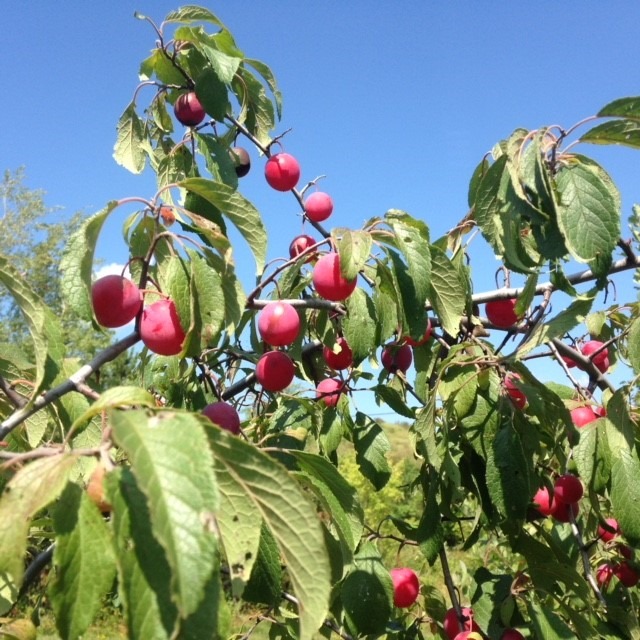
Wild plums my wife found along the Mesabi Trail, leading me to today’s piece
Here’s a second here and now: I mentioned I was re-reading some translations of the Confucian Odes because my wife sent me a copy of one of those poems in translation, the one I’ve reworked into today’s piece which I call “Wild Plums.” This was a gift of love I received in gratitude—even if the composer/performer-with-a-pedantic-streak part of me wanted to know who translated it, and if I could find a literal raw translation for another perspective on the work.** And here I found this, which indicates that it was not intended originally in Chinese in the way the translation presents it in English. My guess is that the translator loved the word music they found in it, that repetition of the line “the plums are falling ,” and this lured them away from the original meaning.
As best the literal translation I linked above can transfer an original meaning to me, the woman who speaks in it is either claiming that she has so many suitors that a successful one will need to up his game to make the cut (a Bronze Age “No Scrubs”) or it’s a portrayal of an eligible woman who is being too picky about a husband and has driven suitable mates off.
So, the poem that my wife sent me is probably not accurately translated, and yet it expresses something that was engendered in the translator by it, and by the caroms of life that bounced off my wife and to me. And that poem’s yearning, and the music of it in English has its own beauty, like the love that brought it to me.
And so that is what I adapted and performed. I’ve even added some additional refrains to further emphasize the musicality of the piece. To listen to the LYL Band’s musical version of this very old poem in it’s more romantic guise, use the player below.
*Also called “Chinese whispers,” unintentionally helping me make my point.
**That my wife is willing to tolerate this dreadful mix of traits is one of her charms, she even found and sent the less romantic literal translation as well.
Today we return to the early 20th Century Modernists with a piece using words by Mina Loy. Last post we had a poet taking a political stand: Longfellow aligning himself with the movement to abolish slavery. Decades later, the Modernists joined political movements too.
One might suppose that since Modernism sought to overthrow the old cultural order and revolutionize artistic expression that many Modernists would be attracted to political radicalism—and to a large degree that’s so.
You might also assume that these artistic radicals would be leftists, aligned with the growing Socialist movements in England and the United States, or attracted after 1917 to the as then untested promise of the new Communist government in Russia. Or perhaps they’d make common cause with anarchism. Or maybe they’d create their own playlist mixing all of the above.
And yes, you can find that. Carl Sandburg in the U. S. Midwest, most of the Surrealists, bohemians in New York’s Greenwich Village, Herbert Read and some other British Modernists.
However, one can also find Modernists who aligned with the right wing in this era—and not only garden-variety Tories, or even those who allied themselves with the “respectable” racist strains of U. S. politics. Even in the years before WWI, the social theories that would coalesce into Fascism found adherents in the new literary avant garde. As to Americans, the most famous case is the indispensable Modernist poet, editor and promotor, Ezra Pound, eventually charged with treason at the end of WWII.
Modernists seemed something like stem cells as their artistic revolution kicked off—they could develop into followers of any kind of political radicalism. At a time when political engagement for artists was common, there must have been a feeling in the air that a side must be chosen if one was to be a thorough-going cultural Modernist.
So, much as the French Surrealists once sought to make Communism a dictate for membership in the Surrealist movement, the slightly earlier Italian Futurists eventually made Fascism a core value of their artistic circle.
It’s now we get to Mina Loy. No, not the delightful Hollywood actress—that’s Myrna Loy (Myrna Loy was the stage name for the woman born Myrna Williams, and it’s just possible that Loy could have been chosen to refer to Mina).
It’s 1905. Modernism is kicking off first in the visual art world, followed just behind by the poets. Loy, in her 20s, has already done the visual art thing in London and Paris, but her marriage is failing, and she’s just had an infant child die. To change her life, she moves to Italy. She befriends Futurist artist Carlo Carra, and if you follow along on your Futurist score-card she had love-affairs there with two principals of Italian Futurism: F. T. Marinetti and Giovanni Papini.
Let’s re-set our scene. Here’s a young woman in a foreign country going through life stress events. The art-world is shifting under everyone’s feet. As a movement that will eventually fancy itself outright as the cultural well-spring of Italian Fascism, the circle she’s fallen in with isn’t just about making it new, it’s militaristic, paternalistic, nationalistic, and it worships violence. That isn’t what jealous opponents say about Futurism, it’s what its own manifestos brag about.
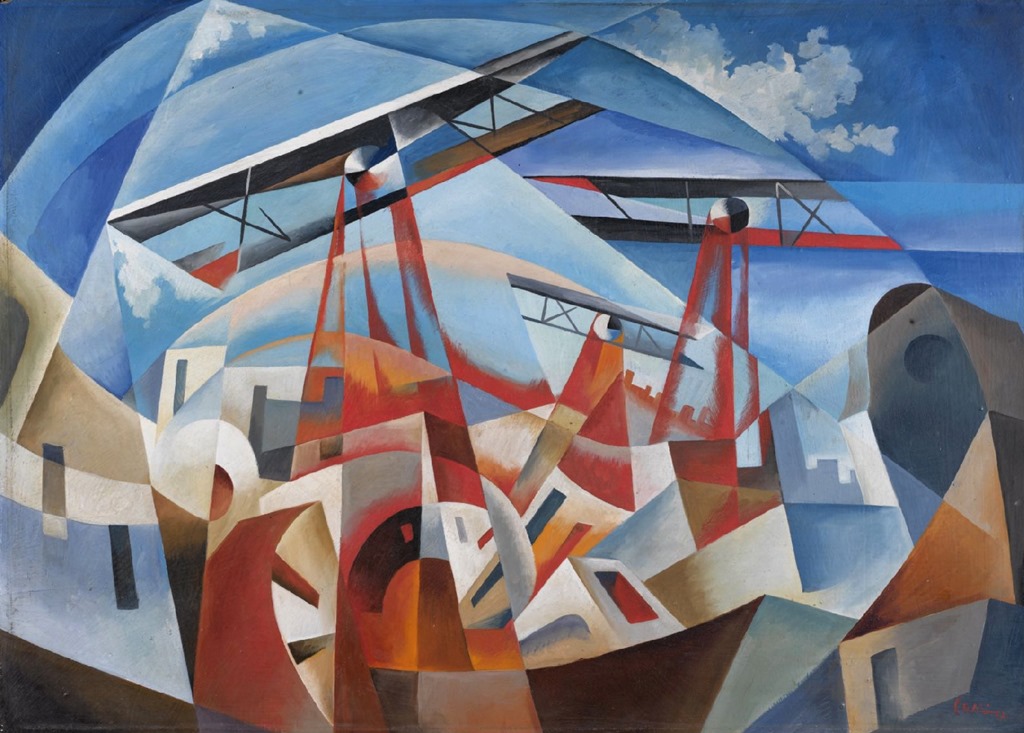
Futurist war painting. Compare its outlook to Guernica or Flint’s poem “Zeppelins.” Marinetti’s Futurist Manifesto declared “We will glorify war—the world’s only hygiene”
.
As preparing actors say, all that would be part of the work to figure out what Mina Loy is experiencing. Here’s another bit of business you might grab onto: young, ambitious, male artists. I doubt some not-uncommon tropes have changed in that field.
What happens?
Mina becomes a poet. A fierce poet. Artistically she uses some of the new ideas that the Futurists are thinking about. Her poetry moves between time and tenses, voices and outlooks, in machine gun bursts. Conventional expression and sentiment? Blow them up, run them over with a locomotive. Sixty years later Harlan Ellison would write “Love is just sex misspelled” and be thought provocative. Mina had already been there in the horse-and-buggy era. How can a woman keep her selfhood (or for that matter, how can any human being do so) in the minefield of desire and relationships? What is deep and inherent in motherhood that society will not express openly?
Though she used some of the artistic ideas of Futurism as effectively as any writer, Loy seemed to resist most of its political ideas and she satirized the pretentions of the “Flabergasts” while writing about her Italian time as being in the “Lion’s Jaws.” Leaving Italy, she next moved to New York, where she joined the Greenwich Village circle.
Today’s piece uses selections I took from a 34-poem sequence called “Songs to Johannes,” inspired by the relationship with Giovanni Papini (Johannes and Giovanni are variations of the same root name). Loy published these in 1914, near the end of her Italian time. Within the little-magazine world of Modernism she made an immediate impact. Eliot, Pound, William Carlos Williams, and Gertrude Stein said good things about her work. Legendary founder of Poetry magazine Harriet Monroe seems to have been scared by Loy’s frankness. Amy Lowell, poet and influential anthologist, was so put off she is supposed to have said that she would not publish in any magazine that printed Loy.
If the patriarchy may have lost the battle with Mina Loy, for a long time they seem to have won the peace. It was only in the last few years of the 20th Century that Loy’s poems of the first part of that century began to be looked at again. Now, Loy has become a key poetic Modernist for literary scholars tired of the usual sausage-fest, but that opens up the danger that work like “Songs to Johannes” may be introduced, academically, like this: “Loy in effect diagnoses an end to love poetry in the light of historical circumstance, anticipating that poststructuralist line of inquiry which urges a rereading of ‘lyric’ as a culturally responsive construct. Instead, her poetry constitutes a critique of the very demand that lyric expression be viewed apart from the social world.”
There’s nothing wrong with that view, but I find Loy’s pre-WWI writing here a lot more immediate assuming one has some applicable life experience to bring to it. Her diction sometimes reminds me of Emily Dickinson, and like Dickinson figuring out what is ironic, and what is earnest, and what is both, can sometimes be a challenge. In performance, any of those three choices seem to work for most phrases here. The greatest error would be to make them all of the same tenor. Also, like Dickinson, Loy will move from speaking concise abstraction to vivid metaphor using very few words. Thus, the high minded and the sensual nitty-gritty are juxtaposed.
My appreciation for this sequence grew tremendously as I constructed this performance. There are strong images, richly ambiguous expressions, and yes, lines that one could deconstruct at thesis length. I didn’t even have room to include the phrase from “Songs to Johannes” that I’ve chosen to title today’s selection, but I can never look at a plump rococo cherub again without recalling it. But the real gift I got, the unique gift of art, is that I could experience some of Loy’s moments in the hot-house nexus of Fascism and Modernism. “Pig Cupid” would probably be more authentic if this was performed in a woman’s voice, but alas my voice is what I have available today. To hear my performance, you use the player below if your reader displays it, or this highlighted hyperlink will also play it.
I’ve been unable to do as much as usual with this project for the past month for several reasons. One of those reasons was a trip to Massachusetts, which if this was a normal blog would have already generated posts of the travelogue sort. However, this project is about two palpable things, music and words (mostly poetry), that can’t handily be walked along, though you can tour their containers and neighborhoods. Perhaps that trip, in an indirect way, will generate pieces yet this summer.
I was finally able to visit Amherst and the house where Emily Dickinson lived nearly her entire life—and today’s piece uses words from one of Dickinson’s poems—but long-time listeners will know that Emily Dickinson is already a favorite source for words here.
No house, no state, not even any time or country can explain the genius of Emily Dickinson. For reasons of brevity, I’ll try to summarize by saying that she created and entirely new form of poetry, powerfully compressed, elusive and still approachable, and wholly without precedent. The things scholars can trace as influences can be found in her poetry, but no one else made Emily Dickinson poems out of that same stuff. And her poetry has largely not become obsolete. Over 150 years after it was written it still seems modern, maybe even more modern today than it seemed to the early 20th Century Modernists 100 years ago.
Ample? The specific standing for eternity. Emily Dickinson’s restored bedroom in Amherst
I’m attracted to shorter poems that unpack into larger things, and “Ample make this Bed” is that. It’s short even by Dickinson standards, eight lines, 34 words. If one pauses to puzzle at this meaning, the imagery of the grave is what comes to many reader’s mind. It can be read as a shorter companion to one of Dickinson’s most famous poems “Because I could not stop for Death,” but with a bed replacing the longer poem’s subterranean dwelling. However, besides its greater concision, “Ample make this Bed” is using another poetic form, one different from her longer poem.
An aubade is a poem where two lovers wish for the morning to never arrive. Since it is, in fact, arriving, they will deny it, wishing for their night together to remain forever. By using this traditional poetic trope, Dickinson has thrown a rich ambiguity into her 34 words. Although Christian religious belief has its variations, the traditional judgement day is the day of eternal salvation and the universe’s perfection. “Ample make this Bed” compares the morning of divine perfection to the morning that separates the lovers in an aubade.
Is this a statement that the sensuousness of human love can be judged greater than eternal salvation? Or is it a puritan statement that any such love will face its final end and judgement? Could it even be both, balanced on a knife’s edge?
Look too at two of those 34 words describing possibilities of this bed. Its Mattress, where the body rests, may be straight. The body has a straightaway lifetime. The Pillow, where the mind inside the braincase rests, may be round, a circular line that doesn’t end.
Dickinson puts her poetic thumb on the scale with the most beautiful line in the poem: “Let no Sunrise’ yellow noise.” The poem has been puritan with its rhymes until this line, although elusive near-rhymes are present in the first stanza. Now it lets in richness, a rhyme internal to the line, before proceeding to the final perfect rhyme in the last line. Besides the line’s sound, the dawn of eternal judgement is— what?—so much noise. If Keats’ second inversion is so, then beauty is truth—and Dickinson may be indicating her thoughts on the matter.
Musically, I performed this in waltz time and I repeated the first stanza to add some sense of the eternal. Most of you can hear the performance with the player gadget below, but some ways of reading this blog won’t show it. In those cases, use this highlighted hyperlink instead.
Our last poet, Margaret Widdemer seems to have done most of her adventuring in fantasy, but today’s poet, Elinor Wylie—well, she caused quite a scandal in the pre-WWI years. Widdemer may have dreamed of cavaliers and wearing leather in a traveling Romany wagon; but for Wylie, there’s biography! Elinor Wylie grew up in Washington D. C. the daughter of Theodore Roosevelt’s Solicitor General and infatuated with the poetry of Percy Bysshe Shelley, which, as we’ll see, could be a bit of a leading indicator. Elinor Wylie started right off by eloping with another would-be poet, Phillip Hichborn, shortly after high school. They had a child, but the match was not good, and the brief accounts I’ve read report the husband as “unstable” and “abusive.” Next, her story gets weirder. An older millionaire lawyer Horace Wylie, also married, began to, as Wikipedia puts it, stalk her. Again, I lack details, but he apparently followed her about, taking care to show up often wherever she was. I’m not familiar with dating etiquette for married people in the pre-WWI era, but this sort of thing began to attract notice.
Bad marriage. Stalker. What to do, Elinor? She ditched her husband and fled to England with the stalker. Now we have full-fledged scandal. They hid out in jolly old for a while under assumed names. President Taft reportedly made efforts to bring her back. Eventually Horace Wiley got a divorce, Elinor’s first husband Phillip committed suicide, and WWI broke out in Europe. The run-away couple returned to the US, got married, and settled in New England where according to one biographer “Shopkeepers boycotted her, and she could buy no food. People began to turn away from her in the street. [The Wylies] were ignored in the worst way possible.”
Back in the US, the marriage to Horace Wylie soured too. She was to have one more marriage, this time to Stephen Vincent Benet’s brother William Rose Benet. They eventually separated, but Benet continued to promote her literary efforts, until in 1928 at the age of 43, the writer, still writing under the name of Elinor Wylie, died instantly of a stroke at Benet’s home while looking over pre-publication galleys of her last poetry collection with him.
Elinor Wylie, clean bones crying in the flesh
All that folly of love in one short life! Did she manage to produce any poetry worth noting? From a look at her first collection, written largely while she was still married to Horace, I found her poetry more immediately attractive when read in the present day than Widdemer’s work. It’s very concise, and often considerably musical. You can see the influence of Shelley in the intense feelings and in some of the elaborate word choices. During her lifetime, the musicality of her verse (like Teasdale, like Millay) was noticed and admired, but like all three of these skilled singers on the page, High Modernism eventually discounted that element of poetry and looked for grander, more elaborately worked-out themes. And, to be frank, it also seemed to be looking for men. Mid-Century Modernism was a boys club.
Unlike Shelley, when time and death wore out the notoriety, the poet was more or less forgotten.
“Full Moon” shows Wylie’s concise intensity well, and it shows a flair for visceral imagery too. In search of music or from love of obscure words, Wylie crafts lines that sound great even if one must keep a dictionary window open to grasp their gist. The poem as vocabulary test, a bit Wallace Stevens-like. Lines such as “My bands of silk and miniver momentarily grew heavier” and “Harlequin in lozenges” start the first two stanzas. Miniver? I think only of a Greer Garson movie. It’s a fur coat lining. Harlequin, a stock pantomime clown/fool character sure, but what’s with the lozenges, is the harlequin mute because of a sore throat? Nope, lozenges also means diamond shaped, the traditional harlequin costume has a diamond pattern.
Harmoniums without Wallace Stevens: Nico and Elinor Wylie
What’s it all mean? It’s not hard for me to see Wylie’s biography in this, the experience of being seen as the bad woman, shunned and condemned. I made a mistake in performing this, singing “carnal mask” instead of the more perfect rhyme Wylie wrote: “carnal mesh.” I noted it right off and tried to sing the verse again, correctly, but I ended up liking the mistake and left it in. Musically, a Nico solo record from the mid-20th Century vibe came out, as I could hear Nico singing something like “harlequin in lozenges” and getting away with it a half-century after Wylie. To hear my performance of Elinor Wylie’s “New Moon” use the player below.
When I look at a more well-known poet or poem, I often find someone else less well-remembered connected with them. This sort of thing naturally intrigues me. Are we overlooking something of interest? Does this lesser-known person change our understanding of the more well-known poet?
I’ve noted earlier this month that Carl Sandburg won the Pulitzer Prize for his 1918 collection Cornhuskers—but that’s not the full story. For some reason, they decided to give out two awards for poetry that year, and another poet’s 1918 work was the co-recipient: Margaret Widdemer’s Old Road to Paradise.
Huh? Who?
I don’t aim this project to literary scholars, who likely know more than I do about the poets whose words I use, but there are indications that Widdemer’s name would stump them too, even those whose field includes the Modernist era. From a look through Widdemer’s Old Road to Paradise this can be partly ascribed to Widdemer not writing in the Modernist style that triumphed as the century continued. Furthermore, Widdemer’s outlook, though feminist, is middle-class and lacks the bohemian allure of Millay or even Sara Teasdale (the poetry winner the previous year). As time passes, rebels and poètes maudite often retain their outsider excitement while losing their air of present danger, and Widdemer offers none of that. And while I’m hesitant to judge from a skim through one book, a further issue is that she may not be very good.
Widdemer also had a successful career as a popular novelist between the wars.
Particularly for me, and for the Parlando Project, Millay and Teasdale’s words just want to sing off the page. Widdemer’s, though rhymed and following metrical schemes, generally don’t. There is a flatness to subject matter and a conventionality of imagery that fails to grab me as well. I would have loved to have picked up Old Road to Paradise and found something as interesting as Fenton Johnson, Edward Thomas, or Anne Spencer; but not this time.
Margaret Widdemer
That doesn’t mean there’s nothing there. Widdemer seems a level-headed person, and she is writing from a woman’s point of view that has fewer representations in the literary cannon of her era. What little I know of her biography says she worked to advance poetry and literary efforts. Could I find something to use? As I paged through Old Road to Paradise I marked “When I Was a Young Girl” as a possibility.
Why did this one stand out? It seems based on a folk song, but while it takes lines and tropes from folk songs, it presents an alternative viewpoint to the songs it borrows from. Since the post-WWII folk song revival, folk song has been even further associated with bohemianism and adventuresome living, even though the traditional texts used most often tell of sad ends.
From its title and often refrained first line, the folk song we can most easily connect with Widdemer’s poem is the female version of “The Unfortunate Rake” a 17th Century song with dozens of popular folk song variations, including the American cowboy song “The Streets of Laredo.” With the “When I Was a Young Girl” title it’s been sung by Feist and Marlon Williams, and back in the 20th Century by Julie Driscoll and Nina Simone. The general plot of these variations is that a young person is dying after a short, intense life of drink and venereal disease. The too short life of pleasure is valorized even if the song’s singer often remarks that they know they are doomed to hell. No wonder this song has remained popular—both sinners and saints, and listeners on a journey from either pole to the other, can find something in the tale!
Widdemer starts as some of these folk songs do, by telling of the excitement of their youth before the song’s present moment, though in her more circumspect telling, the young girl’s adventures are in daydreams and fantasies, including (in another folk song reference), a longing to run off with the “raggle-taggle gypsies.”
I used a minor key melody for this, not unlike that used in the folk song. I won’t spoil the ending Widdemer puts on her version of this story by foretelling it here, but it’s not where that folk song and its variations take you. To hear it, use the player below.
Last month when I dropped Sara Teasdale’s “I Shall Not Care” hurriedly, I promised I’d return to Teasdale and say a bit more about her.
I’m not sure where Teasdale is in “The Canon” of modern verse now, but back when I was in college, she was even more left-out than Edna St. Vincent Millay, and for similar reasons. Teasdale and Millay were both contemporaries of the pioneering early 20th Century Modernists, both were published in their little magazines, received prestigious literary awards, and achieved a considerable readership in an era when page poetry had a more general readership.
But such status didn’t hold. As the 20th Century wore on, and High Modernism and academic-informed writing became the predominant style, Teasdale, like Millay didn’t seem to have the gravitas High Modernism required—after all, both wrote often about love and desire, a subject that if treated directly wasn’t thought serious enough. You know, “women’s stuff.”
If you’re getting the idea that by mid-century, Modernism was a bit of a boy’s club—well, yes, it was.
Teasdale had all of Millay’s problems with the curators of Modernism, and then some. Millay could write in the more modern style as well as engaging in somewhat old-fashioned-sounding sonnets. Teasdale was more adamantly a writer of metrical, rhymed lyrics that increasingly didn’t sound modern enough. Millay herself was a fiercely modern woman whose persona contrasted against any Victorian trappings in her poetic music, while Teasdale seemed less sure of herself. A typical no-win-situation for female poets by mid-century: assertiveness or originality couldn’t overcome the patriarchal attitudes—while submissiveness and reticence guaranteed its victory.
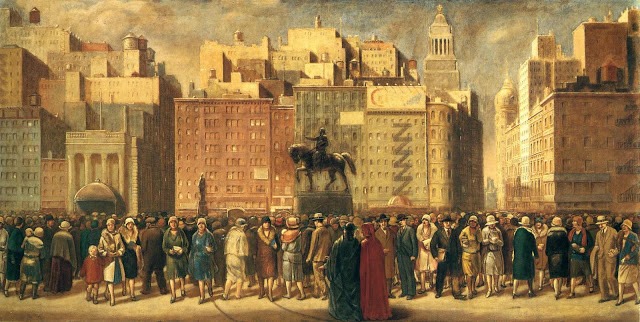
We’re decades past all that now, and we have a new century well underway. Today, it may seem like less of a crime for Teasdale to use the poetic music of 1875 instead of 1925 in this poem written around 1911. Publishing a poem like “Union Square” would have not caused Millay any second thoughts, but Teasdale went back and forth on that. In a fascinating run-down of Teasdale’s own doubts about the poem, Melissa Girard recounts early readers giving feedback like “Perhaps it is better, after all, to pursue the lovelier side of existence, and only give expression to what is unmarred in the realm of beauty.” And bizarrely, even after publishing it, Teasdale suggested “If the idea at the end of ‘Union Square’ had not been an accident suggested by rhyme, I should never have said what I said.” Say what? One of the beneficial side-effects of rhyme is that the search for it can work like Surrealist and automatic-writing techniques to jolt the mind’s search for language in directions it might not otherwise go—but none of the lines in “Union Square” where the poem’s speaker compares herself to the streetwalking prostitutes are rhyming lines.
I found it impossible not to sing this poem when presenting it, the poetry just demands it, even if the poem’s persona is expressing constraint. I think that contrast is what makes this poem, and Teasdale, worth considering. To hear my performance of Sara Teasdale’s “Union Square,” use the player gadget below.
Metaphors, implied or direct, are a form of an equation. If E=mc2 or 2+2=4 then should fog=little cats feet? Well, not exactly. But for some poems the metaphor, the image and “what it means,” is surprisingly equal at each side of the equals sign.
Here’s a poem that Ezra Pound included in the first Imagist anthology in 1914, written by someone we don’t normally think of as an Imagist, or even as a poet: James Joyce. While Joyce didn’t consider himself a member of the Imagist movement, his fellow Modernist Pound considered this work consistent with its principles.
Oddly, the case for Joyce as poet instead of the instigator of the modern literary short story form and the creator of increasingly avant-garde novels has been largely carried forward by folks (like me) who wish to combine words with music. The James Joyce poem I first knew, “Golden Hair,” came to me from Pink Floyd founder Syd Barrett’slovely setting written in the 1960s and used beautifully a decade or so ago to begin Tom Stoppard’s play “Rock’n’Roll.” Today’s words from Joyce, “I Hear an Army” was set to a complex piano accompaniment by famed 20th Century composer Samuel Barber along with two other Joyce poems as his 1939 “Three Songs” (Op. 10).”
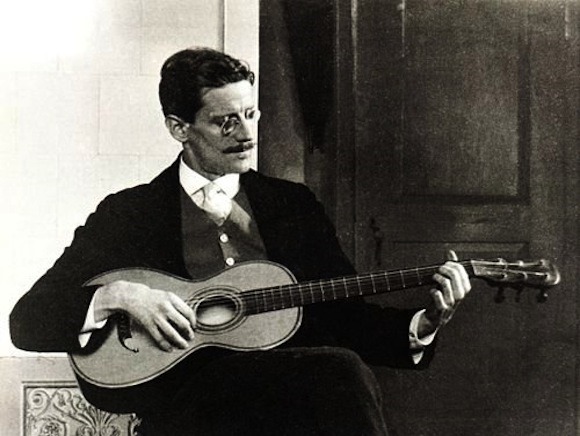
James “Blind Boy”Joyce kicks out the jams
As words, “I Hear an Army” is very musical (the consonance of “whirling laughter” alone is exquisite!), but that element wasn’t rated as highly by mid-20th Century critics who redefined poetry as a literature of complex and hermetic language. Still, its central image shows a bilateralism that I’d like to point out. I think most will see this first as a love song with a strong and strange metaphor of loneliness and separation from one’s beloved as feeling like the invasion of a grotesque and threatening army. Loneliness=as oppressive and overwhelming as an invading army.
But what if we reverse the equation? Is an invading army, this oncoming hoard, this force of arrogance, also like the absence of love, the sundered heart and the steeled will? Invasion, war=separation from love and our beloved—separation for not only the invaded but the invaders.
When an image can sustain this kind of bilateralism, it gains tremendous power. Maybe not mass times the speed of light squared, the force that hung over my youth, cleaving dreams, and whose blinding flame is seeking to haunt us again, but power none-the-less.
Vase or faces? Bilateralism in imagery.
Not to dis Barber, a giant, but I think there’s room for a different way to present “I Hear an Army” combined with music. If you use the player below, you’ll hear my original music for this, not Barber’s. Some take the Barber at rapid tempo, horses at full gallop. I don’t have a score to say what guidance Barber gave for that, but there’s a power in slowing dread—after all it’s a cinematic cliché to show an onrushing threat in slow-motion.
My predominant accompaniment for “I Hear an Army” is a vocal chorus using different vocal timbres, including a low part using Himalayan Tuvan throat singing where two pitches are sung simultaneously. Other than the two short rock band interludes, the only “instrument” used is electric bass.
Last time we made some fun of Shakespeare’s honest love poem, his Sonnet 130, “My Mistress’ Eyes are Nothing Like the Sun.” Well today, let’s give it it’s due.
The fun was that if was a poem meant to attract or hold a lover, it’s, well, not complementary—but there’s no evidence internal to the poem or external to what little we know about its writing, that says that was its intent. It’s one of Shakespeare’s sonnets that was written to “the Dark Lady.” Great title that. We may feel put off if the meaning of a poem isn’t clear to us right away, but in love and biography, most of us love a mystery. Let’s examine that mystery a bit.
First bit of mystery: it’s not clear exactly how autobiographical the typical Elizabethan poet, such as Shakespeare, intended their poetry to be. The idea of art as a mode of direct self-expression has become increasingly more common in the past 200 years, but it wasn’t necessarily the mode of the 16th Century poet. Showing off one’s language skills and elaborate allegorical metaphors while speaking of popular and entertaining subjects scored points in the game then, and it was less about biography that rhymed.
Poets of that era liked to revisit the same subject over and over, because playing on the same topical court let them measure themselves against each other. And so it was when writing a series of sonnets about love troubles.
But no author can avoid the personal entirely. This has lead to the detective game to identify the “Dark Lady.”
A leading solution is Emilia Bassano Lanier. Like a lot of Elizabethans, a fascinating character of which only scattered but intriguing facts are known. She may have been Jewish, North African, or Italian. Family described as “black” in Elizabethan times. Had connections to the same theater and artistic world that Shakespeare did in London. Musical family. Her father helped Queen Elizabeth with her lute when she was a young girl. Emilia wrote the first book of poetry published by an Englishwoman, and she seems remarkably independent and kick-ass. She even makes it onto the lists of the people who “really wrote Shakespeare.”
This may be a portrait of Emilia Bassano Lanier
Shakespeare wouldn’t be the first writer to use a person they knew as a model for a literary character as an in-joke that his crowd would get, or just as a handy way to gather a matrix of characteristics. And yes, Shakespeare and Lanier might have been a thing.
It’s fairly clear that Sonnet 130 is another answer record/dis cut like our dueling shepherd poems from the same era. However biographical or invented, the poet is telling us that as far as his love is concerned, all the bullcrack about white skin, golden hair, and rosey cheeks doesn’t get his motor running. There is that breath “reeks” thing in his poem, but I’m not sure it was automatically funky in Shakespeare’s time. The word comes from the Middle English word for smoke or steam—so not necessarily stinky breath, just not literally like perfume.
Elsewhere in the “Dark Lady” sonnets Shakespeare praises “black beauty.” Was the Dark Lady Black in the modern sense of the term? I don’t know if we can say for sure. Sub-Saharan Africans were in England in those times, including a trumpeter who was part of Elizabeth’s father’s court.
Birth of the Crewel? Henry VIII and the king of France take in a WWF tag team match.
In the upper left of this tapestry, on trumpet, is John Blanke, also spelled Blak
Was Shakespeare “answering” one particular poem? One doesn’t have to look far for targets, but some point to a poem set to music by William Byrd “Of Gold All Burnished:”
Of gold all burnished, brighter than sunbeams, Were those curled locks upon her noble head Whose deep conceits my true deserving fled. Wherefore mine eyes such store of tears outstreams. Her eyes, fair stars ; her red, like damask rose ; White, silver shine of moon on crystal stream ; Her beauty perfect, whereon fancies dream. Her lips are rubies ; teeth, of pearls two rows. Her breath more sweet than perfect amber is ; Her years in prime ; and nothing doth she want That might draw gods from heaven to further bliss. Of all things perfect this I most complain, Her heart is rock, made all of adamant. Gifts all delight, this last doth only pain.
The poem’s 9th line might be a mondegreen, as it makes sense if the last words aren’t “amber is,” but the perfume “ambergris.” Who wrote the words? That’s not stated in the book which published Byrd’s piece in 1589, but a modern musician and relative of Emilia has put forth the idea it’s a poem by Emilia Bassano Lanier, though I can’t access any cite for his evidence.
Maybe I should have tried to make a lute sound here for the music, but it’s 12-string guitar, bass, a small string section and just a bit of recorder back in the mix for Sonnet 130. To hear it, use the player.







 Frank Hudson