I found this strange and deadly little poem in a collection of Walter de la Mare’s children’s poetry. It’s a literary ballad – a poem referencing that style of folk and popular song while not being explicitly designed to be sung. The subject matter of a doomed voyage was a common one in British folk song,* but de la Mare gives this trope his own touch.
You see, in the field of horror and fantasy literature, de la Mare often elided what was most horrible or fantastic. His best-known poem, “The Listeners” has nothing but hoofbeats on gravel and a portentous silence to elicit shudders. “The Silver Penny” is remarkably compressed. A comparable folk song dealing with doomed seafarers might well have a dozen verses, a tolling refrain, and a catalog of detail of the fateful voyage – de la Mare makes do with five stanzas. We know nothing of why the singer and his sister must hire a boat, we only sense their urgency. We know nothing of the man who agrees to take them on his boat, but we sense his motives could be nefarious. The storm that sinks their boat is sketched – though almost lingered over compared to the human characters and their motives – but the usually graceful versifier de la Mare chooses (I think it must be a choice) an uncharacteristically awkward turn of phrase “back to the shore again, sailing they will not.” My guess is that as one reads or listens to this, we are to think for a moment they’ve turned back to dry land at the onset of the storm. The refusal of even a half-rhyme between “boat” and “not” adds more to this sour prosody.**
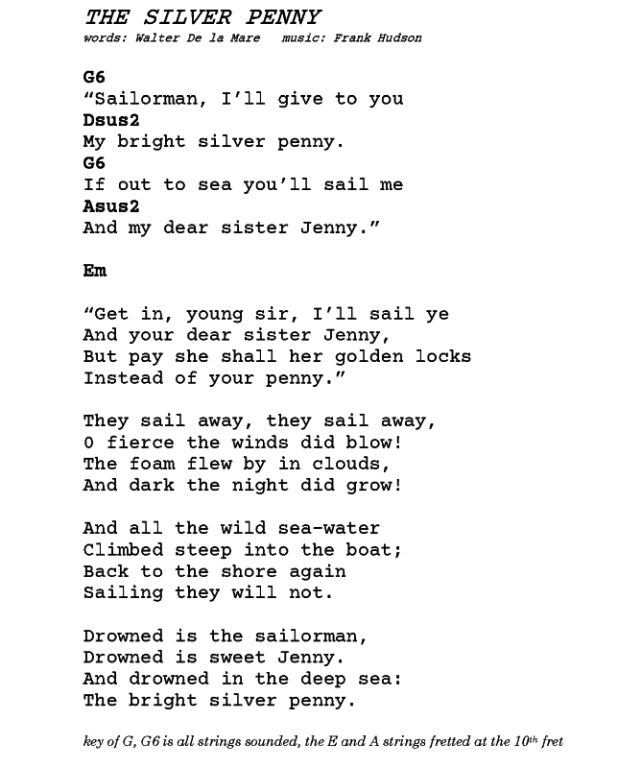
Discovering that open string G6 chord form was the genesis for the music I composed to de la Mare’s poem today.
.
The other unusual thing about the poem for modern readers, is that it was, in its time, intended for kids. Of course, the old fairy tales had many a horror and sudden death, but these were ofttimes in service of an easily discerned moral lesson or social shibboleth. Is the lesson here that children shouldn’t hire a boatman without proper vetting and assured possession of a current weather forecast? De la Mare is as subtle about any such didacticism as he is about delineating the horror. My guess is that the poem’s voice is that of the brother of sister Jenny, the owner of the silver penny, and if there’s a lesson he draws from the shipwreck, it’s more at the observation that death and fate laugh at our concerns about what precious thing to offer up to it for safe passage – certainly a dark message for children, but one old people may recognize.
I worry a little recently that I’m doing too many pieces based around acoustic guitar. The composer in me thinks that even though it’s “my instrument” and all that, I still want to include other sonic colors. A peculiar thing about all this acoustic guitar this year is that it has become the most difficult instrument for me to find opportunities to record with, and so when such an opportunity comes about I feel I must take it. I used an old and worn little 00 sized guitar to record my song using de la Mare’s words. At least for this player, when recording a piece that calls for ringing open low strings, the more common larger-bodied acoustic guitars can sound too unbalanced. The audio player to hear the recording is below. What? Do you think the player’s not there because you lack a penny? No, it’s just some ways of reading this blog suppress showing the player gadget, and for you then there’s this highlighted link that will open a new browser tab with its own audio player.
.
*One of my favorites in that folk-song genre is the song “The House Carpenter,” also known as “The Daemon Lover,” where a runaway wife takes off on a doomed ship only to find that the captain is evil and the ship will sink to a watery Hell. Patriarchy much? Well, in the best performances, the doomed wife’s tale can at least rise to a Faustian tragedy.
**I considered that there could be a long O regional pronunciation that is sort of “boo-t” and “Noo-t” which I could sing to make the rhyme, but my own difficulties with dialect pronunciation and the effect of the non-rhyme along with the awkward word order signaling the disaster won out.

