At the New Year

I’ve long been fond of the poetry of Kenneth Patchen — but even though an old edition of his Collected Poems has followed me about over the years, it was only today that I appreciated this poem of his. He wrote it sometime in the 1930s, but reading it this morning I felt he was speaking my thoughts as I look back from the ending of our year 2024.

Patchen’s poetic sensibility was essentially an exercise in Keats’ Negative Capability. Patchen admired human love and wrote reverently about nature and joy, but he was also disappointed and in opposition to a world manipulated by selfish and thoughtless power. He wrote some poems so sweet you might select them for a child’s bedroom wall, and others bitter in the taste of his analysis — but his life wasn’t a trajectory between those poles. Some of Patchen’s most politically radical and downbeat poems were written in his youth and some of the most hopeful pieces of bonhomie came from late in his life. And this was so despite never achieving crowning literary success, and after suffering chronic and painful health setbacks. He seems to have liked today’s poem, as it stuck with him. Looking briefly at its history tonight I see he had sent it out to be set for a choral musical performance in the 1940s,* and he printed a broadside of a slightly revised version in 1967, shortly before his death. So whatever specifics he was thinking of when he first set it down, the man himself thought it more universal. Here’s a link to the version of “At the New Year”   I found on my bookshelf.
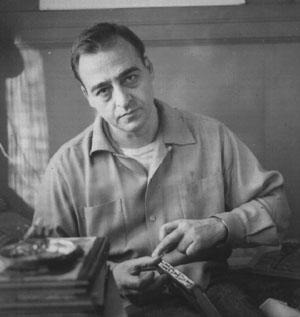
Patchen photo

Kenneth Patchen. He wrote of his times and is timeless.

.

Today I read it as if it was expressing my own thoughts this year, about this  year — not some year in the 30s, 40s, or 60s. Most any decade has wars, but the cruelty of current wars and new refugees cuts freshly. And then, my country’s last national election was heartbreaking for me. I have long held faith with Lincoln’s democratic analysis of how long how many can be fooled, but at my old age I don’t know if I will be there awaiting the arc of the universe when it bends toward justice. As Patchen moves into the second half of his poem he writes of the brave talk and the mean talk, he takes in this world as full of the good and the lovely, but also a measure of the sham and hatred. When he says as the New Year’s bells are to be rung that there are other bells that he, that I, that you and I too perhaps, would ring — well I got a little misty singing those words this afternoon.**

I had to proceed rapidly to create a realized singable version of Patchen’s poem before New Year’s Eve, and so I quickly set up a broadly repeating musical cycle for the accompaniment: VI, V, i changes in musician’s shorthand, but the VI and V sometimes go minor in the quick and dirty rush to make the cycle. Since the passage of years is cyclical and won’t wait, perhaps this accidentally makes for a fitting setting. I was lucky to get accommodation this afternoon so I could open a microphone, and I ripped through the vocal you can hear below while that musical cycle did its thing.

The audio player is below for my performance of Kenneth Patchen’s “At the New Year.”   What, has the ball dropped, the bells have rung, and there’s no player gadget on your screen? No need to stop time, just use this highlighted link.  That’ll open a new tab with its own audio player.

.

*I make a quick search to see if I could find this once-planned 1940s choral setting, but came up empty,

**The bells motif at the end of Patchen’s poem recalls Henry Wadsworth Longfellow’s holiday poem “I Heard the Bells on Christmas Day”  that I wrote about and performed a few years back. Long after Longfellow, and some years after the death of Patchen, Leonard Cohen did his own New Year’s “Anthem”  with bells that contains one of that poet’s more remembered passages: “Ring the bells that still can ring,/forget your perfect offering,/there is a crack in everything/that’s how the light gets in.” Cohen’s poem echoes Patchen’s sentiments, and Cohen’s poem and song may have been in conversation with those earlier poets’ work.

Instructions for Angels

What I’ll write about today’s piece might be needlessly complex. I’ll try not to take too much of your time so you can get to the simple performance of the poem below and you can decide.

The usual job of a critical essay on a poem or other work of art is to explain how something works and doesn’t work, usually making use of, or in the context of, criteria for artistic value. Within these efforts, the spread of essays praising or condemning a poet, poem, or poems is maintained. There’s no contradiction here. How can there be good art if we don’t have bad art? Judgments, pointing out good and bad, are equally creative, just as when we are writing and revising ourselves.

Is this a critical essay? I’m not sure it is. Instead, I think of these pieces of prose as short notes about my experiences with the texts, nearly always literary poems, as I combine them with music and perform them. And in the case of today’s audio piece using Kenneth Patchen’s “Instructions for Angels”  my experience so contradicts what criteria I believe I have that it calls into question that I have them or really believe in them.

What do I think are the things I look for in a successful poem? First, I think poetry is musical speech. “Instructions for Angels”  is free verse, something formalists take as problematic. I doubt I’m a formalist. I admit the effects of rhyme and meter, but my musical sense admits also that the amount of symmetry and regularity can and should vary. There’s some underlying da DUM da DUM iambic back-beat feel here in Patchen’s poem, that King James version 17th century English thing that can itself now feel overused or overfamiliar. But familiarity is not always bad, no more than regularity in structure. “Instructions for Angels”  does clearly use one musical feature: the refrain. Perhaps this is what drew me to it when skimming through a book-length selected poems looking for what would be good to set with music. I’m not alone in choosing this poem. I’ve found several other musical settings online.

instructions for angels

Today’s piece is easy enough to play on guitar, so guitarists have at it.

.

I do think we too often confuse imagery with poetry’s essence, praising coded word-play rather than word-music. But imagery is a more abstract version of word music isn’t it? That this-is-like-that, or things arrayed in an as-above-so-below manner is an intellectual harmony. The intervals and combinations are pleasing as audible music is. “Instructions for Angels”  is plainsong in this regard. Yes, I suppose angels and God have a certain majesty, but as a recent coronation reminds us, tired pomp can bore quickly. The rest of the poem is full of threadbare, generalized counters isn’t it? “pretty girl,” “red mouth,” “baby,” “beautiful,” “rain,” “snow,” “flowers,” “trees,” “winds,” and “fields.” If one looks for fresh and arresting imagery this poem doesn’t seem to have it. If I was revising this poem or it was being workshopped, it would be easy to imagine changing a few of those general terms to more specific ones. I can see someone asking “But Ken, what flower exactly do you like? Give us the name so we can see it.”

How about a poem’s message? Shouldn’t that count for something? Yes, I think it should, yet over the ages critics can worry that worthy messages are too common, too cheap — or that art for art’s sake has judged any meaning as secondary. Writing in the 1930s Patchen was often reacting to a Modernism that was too inhuman, too concerned with form, and too unconcerned with the fates of its readers. I sense the present pendulum has once more swung and we are now again asking poems to tell us worthy things, and for the poets to be worthy people. I should be happy, yet I’m not always happy with poems on the right side of the issues. I wouldn’t like it if that was all the poetry I read and sing. Am I just cursed with contrariness? Should I note here that Patchen’s pacifism continued throughout WWII? That was a contrary position and not helpful to his poetic career at the time.

If a poem’s message is important, shouldn’t it be as clear as prose about saying it? How obscure can or should poetry be? Again, poems and critics differ on this, but there’s a consensus that a poem shouldn’t be harder to understand than it has to be.

That “has to be” is a broad thing however. Proponents of exciting and fresh images and language will say beauty and skill allows indirection, ambiguity is true to life, a little, even a lot, of mystery can compel, and that irony combats blandness and tiresome cliché. The greatest benefit of workshopping poems, or at least second readers, is for a poet to find out they are sometimes unintentionally obscure.

One could say that “Instructions for Angels”  is clear. But on first and later readings, even into my performance, there was one small thing that was less than clear and more at odd. We don’t have to wait long for it: the first sentence says “Take the usual events/For your tall.” “The usual events” is clear, it’s a statement of purpose for the everyday and common that Patchen will praise as the poem continues. But “tall?” It looks like a typo.* I could make more immediate sense if it was “tale,” “tail,” “toll” or “tell.” Is Patchen saying “Angels pass this info up (way up,  like to heaven) the chain?” A phrase soon to come, “Blue weather,” is fine, and there is some nice ambiguity there: blues or blue skies? Patchen returns and expands that image with “The weather in the highest soul” indicating he intends that ambiguity.

So where does that leave me, all this applying of what I think and have been taught to understand might constitute a “good poem?” In my present, poems have two states: ones that interest me, often because I can see performing them; and then, the ones I skip over. It may not be the fault of the poet or their poem that I skip them — that poem just doesn’t exist with me in my moment. I’m not totally without criteria, some things I can predict, but this poem is an example of a poem that met me emotionally in my moment, the place where some poems live while others are undressed tombstones. Is Patchen’s poem technically perfect? Unlikely, but there’s a ruined recording take were I just started crying a bit as I tried to sing.

I don’t believe every poem needs to do that. Pleasure in the words, images, and music of some other poems will make them live for me. Amazement at virtuosities can compel at times. If every poem in the world was like “Instructions for Angels,”  I’d be a rebel angel, and crawl into a John Ashbery volume and never come out. As it is, I’d instruct the angels to not poop on my head and to pass it up the line that I’m grateful for Kenneth Patchen.

You can hear my performance of “Instructions for Angels”  with the graphical player below. No player? This highlighted link will open a new tab with one.

.

*I have a scanned pdf of the published collection presumably OK’d by Patchen, but the typo theory remains possible. Patchen was recorded reading some of his poems, sometimes with music. That would answer this doubt, but as far as search goes I haven’t found him reading this  poem.

The Origin of Baseball

Let’s hope I don’t overextend my love for American poet Kenneth Patchen with yet another example of his work today, which happens to be the opening day for baseball in my city. Patchen wasn’t quite the modern day spoken word poet, but even 80 years ago he was writing in a form that works in that presentation — though more here in a mode where the listener is immediately attracted by references to our common life and speaking idiom, and then finds the poem going off somewhere else between its lines before it ends.

Many poets are indifferent readers of their own work, but Patchen is usually quite good. I actually muffed one line in his text today, but Patchen has modified several lines, either from the variations of performance, or in the case of the lips of the “girls of heaven” he seems to choose a gentler metaphor here.

.

Baseball used to brand itself as “America’s Pastime,” and this poem makes something of that with its intimations that like love’s fancy and poetry it fills time and makes a joke of watches and schedules. I note too, that Patchen, the pacifist whose world was at war when he wrote this, knows that concerted effort is not always noble, and that the blessing of wasted time is better than time wasting from want or wasting one’s fellow humans.

Oh yes, the prophets among us can see clearly that professional baseball is a business enterprise, full of the commercial slight-of-hand that parodies patriotism and oh-so-righteous conflict. I myself remarked last year as I was reading the newspaper, that I had finished the section dealing with the businessmen who wear uniforms and was now moving on to the — why-is-it-separate?  — sports section. But then, oh prophets, who really can find any remedial pleasure in cheering on a grocery chain or brokerage firm?

As I write this, over at the baseball field the home team has just answered the visitors’ one run with four runs in the bottom of the 3rd and now a light rain says we stop and wait for rainbows — or if the game is called, it will all go away as if it had never happened. Time knows it’s real. Everything else is illusions.

Here’s a link to the full text of this poem in case you want to read as well as hear it. The player for my performance of Kenneth Patchen’s “The Origin of Baseball”  is below. Don’t see the player gadget? This highlighted hyperlink will also play it.

.

Winter ‘20-‘21 Parlando Project Top Ten, numbers 4-2

Today’s report on the most listened to and liked pieces featured here over the past quarter will show three experiences of the mystery of winter. So, let’s return to our countdown:

4 Twilight Fallen White and Cold  by Joseph Campbell.  I seem to have become something of a promotor of this little-known in the United States Irish-born poet who I still know little about. He published a series of poetry collections before the end of WWI, and then his poetic output dropped off, for reasons I’m not yet clear on, though the politics of his country’s decolonization struggle may have contributed. This piece using his words that a lot of you liked and listened to may be the most mysterious of today’s trio.

Best as I can figure it, this winter nature landscape poem may be an expression of his nation’s detracted state and situation, particularly in the invocation of ancient earthworks (raths) and burial mounds — but I cannot plumb the entirety of the refraining line of “wounds of Eliom/weep on me” that I feature in my setting of Campbell’s poem. Eliom is a plural word for gods, sometimes used for polytheistic gods, sometimes used for the singular monotheistic diety, and as it may be here, used for angels. If that’s so, then the starry constellations, the winged vampires, the curlew birds, the floating mists, the carrying sound of the ocean are all the Eliom, the angels in this changed winter nighttime vision.

To hear my setting of Campbell’s poem, you can use this highlighted hyperlink which may open a new window with a player, or in many cases, you’ll see a player gadget below to directly play it.

.

What the Story Tells Itself by Kenneth Patchen

It’s been too long since I’ve said this: thank you for coming to read or listen here.  It’s become harder for me to respond to comments or properly promote this project, but I appreciate so much those who come here, listen, and let others know what the Parlando Project does.

..


3 The Snow is Deep on the Ground  by Kenneth Patchen.  Lawrence Ferlinghetti, whose words we met earlier in this countdown, would sometimes remind folks that he wasn’t really part of the Beat Generation, even if he was associated with others who might have been so thought. Patchen is a similar case, or perhaps more so, in that his poetry career started in the 1930s,

As with many of the best Patchen poems, even the political ones, this is a love poem, delicately poised between the enchantment of love and the world that allows the shattering of it. If one can fully absorb the illumination of this poem, as with some of the best of Patchen, you would cry tears of joy and sadness at the same time.

You can hear my performance of Patchen’s “The Snow is Deep on the Ground”  with this highlighted hyperlink, or if you see it, with a player gadget below.

.

2 The Sky is low  by Emily Dickinson.  Some years back in this project I once compared Emily Dickinson to one of those unexploded, yet potential, bombs that are still unearthed in Britain or Europe from the World Wars. Originally she was found as the creator of curious little poems from an eccentric woman, then as a prescient 20th century Imagist, and now in our deconstructed age we can stare at one of her tiny poems, and like one trying to follow the decent of a single flake of snow in a flurry, fall as far as one can follow.

You can read, or listen to my performance, of “The Sky is low”  and find a whimsical nursery rhyme, and find enough enjoyment in that — but let it stick in your memory or repeated ear and a little dialog about predestination, first causes and fate is discernible. To listen, use this hyperlink, or you may see a player gadget to directly play it below.

.

One more post in the Top Ten countdown to go, and then we can move on from the mysteries of winter to the mysteries of spring.

The Snow Is Deep on the Ground

Today’s piece is a winter poem for troubled lovers, but in the wandering tradition of this project, we’re going to go somewhere else on our way there.

Next week there is to be an inauguration of a new American President. It’ll be the 13th new President in my lifetime. Though I remember witnessing all these inaugurations in part through news reports, photographs and recorded footage; to the best of my recall, I have only watched two as they happened. Which ones? Most recently, I watched Barack Obama’s first inauguration in 2009 while working in a place with a newsroom; and then, before that, as a schoolchild I watched John Kennedy’s inauguration.

I believe this is so because in our democracy we have a tradition of our Presidential terms ending and beginning uneventfully and with a comforting regularity. It’s not that we citizens ignore that there’s a new President, but the event itself happening is largely unremarkable.

Kennedy’s inauguration in 1961 was contemporaneously recognized as a post-WWII milepost, the Presidency passing to a young former enlisted man in that war, moving us beyond a country ruled before by 19th century men. As I said, I was a schoolchild. My class watched it on a single gray TV set placed up high in front of our schoolroom instead of our usual lessons. I don’t think I was alone in the audience for that event in thinking it was important to pay attention to what was said, watching for news of a new era we knew was new.

Obama’s election and inauguration said something about America recognizing it had changed its evaluation of people of color.*  It’s become a mark of sophistication and analysis to say that was an illusion, disproven by everything wronged people and close examination brought forward then, and since then. I thought, and think, we’re in the midst of things. If more know that now, the marker post of Obama can still tell us where we’ve come from and where we can go.

Is it a coincidence that both of those Presidential Inaugurations had a poet read a poem as part of the ceremony? That’s not a common choice: Kennedy was the first President to ever do so, and only one other President, Clinton, did so besides Obama.

Now, as it happens, I hope to watch the Inauguration next Wednesday, because this one seems more precious to me, more extraordinary, something not to be taken for granted. I will not watch it expecting or requiring great words — no need anyway, because the event alone now has a greatness thrust upon it. Yet coincidence or not, there will be a poet, a particularly young one, reading next week: Amanda Gorman, all of 22 years old.

There are several videos of Gorman reading on the web, but I wanted to bring forward what she says here about her poem for Independence Day, which starts with Phillis Wheatley and mentions that she’s speaking in the Washington-Longfellow house that day. It occurs to me that Gorman seems to be essaying a kind of civic American poetry that Longfellow might recognize.

.

So, now I’m ready to return to today’s piece, one using the words of American poet Kenneth Patchen’s poem “The Snow Is Deep on the Ground.”   If you’d like to follow along with the text, here’s a link to the poem. “The Snow is Deep on the Ground”  seems to fit my times, and perhaps it fits yours too, and so we may think of it as my unofficial poem for this January’s Presidential Inauguration.

What did Patchen intend with the repeated image here of deep snow? As a northerner I know one thing it portends, a restriction of movement, and it’s often too a trope of accumulated time. I read something now in the image that Patchen may not have intended, restricted as I am in movement by our current epidemic and having just endured a cloddish act of insurrection deep in whiteness. It seems, or we hope it is, that that “war has failed.”

Patchen says the snow is beautiful though — but specifically it’s beautiful in a fallen state,  something meteorologically and theologically true in Patchen’s poem.

The poem’s third stanza has muffled terrors. What a strange and yet strong line “Only a few go mad” is! And the whiteness “like the withered hand of an old king” undercuts any sense of simple winter landscape beauty. To say twice “God shall not forget us” implies this is in question, doesn’t it?

The poem has it what we know more than we know by faith: our love, our lovers. How beautiful it is to be loved, to love. And to know that after talking of politics in a world where lies and flags are used as shields and lances to beat each other with!

My performance of “The Snow Is Deep on the Ground”  can be heard with the player below, or if you don’t see that, with this highlighted hyperlink. The musical core today is my naïve piano playing, over some drums and small percussion instruments. To add some character to the string bass part I doubled it with a synth-bass. Thanks for reading and listening, particularly as my ability to produce new pieces is reduced right now.

.

*There was something else about that Presidency. I’ve lived a long life, and yet in all those years Barack Obama is the only President I’ve ever had who was younger than me.

Winter 2020 Parlando Top Ten, numbers 7-5

Back now to our recounting of the pieces that you, our readers and listeners, most liked and listened to this past winter. Let’s jump back in as we count them down.

7. “We Wear the Mask”  by Paul Laurence Dunbar.  This one is remarkable in that it was released on February 24th, very late in the winter season, yet it still racked up a lot of listens to go with the number of likes here on the blog, outstripping the other well-known Dunbar poem I performed and released three days earlier: “Sympathy (I Know Why the Caged Bird Sings.)”

These two poems are the best known works of this early 20th century Afro-American poet directly addressing racial issues, and given the seriousness of racism and the quality of “We Wear the Mask”  as word-music, it’s well earned its current position as a much anthologized poem.

Why did it edge out “Sympathy?”  Who can really say? I liked both performances I did of the Dunbar poems myself. “Sympathy”  has the more complex arrangement, but simplicity that works has its appeal. Or was it something random—did Dunbar’s title put it in search queues connected to world-wide Covid-19 concerns?


6. “Do the Dead Know What Time It Is”  by Kenneth Patchen.  I was completely enraptured by this poem of Patchen’s because of its complicated paralleled half-conversations. In the previous Top Ten post this week I remarked about how Marianne Moore’s poetic expression seemed to echo the actual syntactic twists of transcribed common speech, even at the cost of being harder to follow on the silent page. In Patchen’s poem, we have the more common “naturalistic dialog” where syntax is complete, where sentence structure is plausible, not the fractured and disagreeing actuality of literal transcribed speech. But Patchen has two speakers totally focused on non-answering halves of a conversation: the old guy at the bar who wants to tell the poem’s persona of a second-hand encounter with the God-head, and the poem’s persona, a quasi-homeless swain in conversation with an unheard and somewhat mysterious woman* at the same bar.

The chemical reaction of these two side-by-side half-conversations builds until one phrase appears to link the two—two loves linked somewhere between desperation and desire.

Patchen All at Once is What Enternity Is

And all our count-downs are happening over and over. Patchen as painter.


5. “The Little Ghost”  by Edna St. Vincent Millay.  So, a comforting God-head appears off-stage in Patchen’s poem. Hugo Ball’s ghost in our last Top Ten post seemed of the malevolent poltergeist type. Now here Millay’s is a much more benign spirit who seems to signify being there after being there.

Regarding the music for this one: like a number of my generation, I encountered Ravi Shankar LP records and performances in the Sixties. For a moment some borrowed sense of South Asian music permeated the culture of popular music groups and their audience. Why did that happen? Has anyone asked, much less answered, that question? Yes, I assume the drug and social stress induced search for mysticism was a factor. Maybe George Harrison and his access to the culture through The Beatles alone was enough. But I can speak for myself: some musical qualities easily discerned in this music grabbed me then as they still do now. The musical structures related to steps in various orders away from and returning to a home drone pitch. The opulence of microtones beyond the conventional 12 notes. The singing rhythms.

In the Seventies, that decade that everyone forgets, I spent nights working in a busy Emergency Room, often with an Indian-born surgeon, who as the evening would wear us on, would suture while hum-singing tunes of his homeland. Every so often, even these decades later, I sometimes find myself singing unremembered vaguely South-Asian melodies when working late on some task.

Evidence of some ghost? I doubt it myself. Not reincarnation—resonance.


We’re more than halfway down the countdown. The next three coming up here soon.


*Is she a down-and-outer like the poem’s persona just looking for some kind of human connection? A prostitute seeking money? An analog to the God-head, or is the poem’s persona that? By not clearly defining this, the poem gains mysterious power I think.

Do the Dead Know What Time It Is?

Here’s a poem by 20th Century American poet and artist Kenneth Patchen performed with music which manually realizes some ideas often produced by machinery.

Patchen is one of the original poetry accompanied by jazz guys, an idea that is one of the tributaries to the Parlando Project, but the poem of his I use today isn’t one that sings off the page when you first look at it. The speech in it seems casual, as if one is overhearing someone talking.

“Do the Dead Know What Time It Is?”  has a very unusual structure. It’s one part a Robert-Browning-like dramatic monolog and another part seeming snippets of a bar-room conversation. But Patchen doesn’t separate these out into differentiated sections of a multipart poem, rather the two modes seem to be occurring at once, the louder monolog spoken by “the old guy” to the younger man and then the often whispered and interrupted conversation between the younger man and a woman who is trying to pick him up.

Here’s Patchen reading this poem with a jazz combo. I also just discovered that The Blue Aeroplanes did a version of it with a rock band decades ago.


I first thought: oh, what a great thing for a recording! I’ll put one in one stereo channel and the other on the other side—but then I thought better. The claustrophobic nature of these two conversations is part of the effect Patchen has designed.

As barroom stories go, the old guy’s story is a good one, even if the younger man is only half-listening—but the second, whispered one, is all about what isn’t exactly said. I could go on at length about how the two stories connect, what they say to each other in the structure of the poem Patchen made, even though the two conversations in the bar never actually join each other. I found the poem quite moving, but I’ll leave it to you to connect them.

Instead, let me dance about the architecture of the music today. I’ve been on a loud electric guitar kick lately, which may frustrate those of you that prefer the acoustic music, which will return in good time. Music structured like this piece is often constructed by loops stored and manipulated by computer software or by small solid-state devices that can capture a phrase and repeat it. Similarly, the original rappers’ DJs used turntable manipulation to repeat a section of a grooved record, a task that can now also be emulated digitally at the press of a button. There’s nothing wrong with these methods or machines.

Still, I most often try to play the repetitive parts you hear here. It’s not something I’m naturally good at, and I allow some imperfections to occur. Perhaps I do this because I became enamored of the hand-played repetitions that made up the composed music emerging in New York near the time I left for the Midwest—but it’s not Steve Reich or Phillip Glass* that today’s piece sounds most like. The proximal influence is a record album that came out in the early 1970’s called No Pussyfooting  by Eno and Robert Fripp. That record’s guitar textures were produced by mechanical means too, two tape recorders set several feet apart from each other so that the “looping” was really a long loop of tape between them that allowed measures played by the guitar to repeat and get gradually added to in approximately real time. This seemed magical then, but a tidy little box that sits on the floor and costs about $100 can do all that these days.

No Pussyfooting

It was hard to find a barber shop with a fresh tarot deck in the ‘70s


There are two guitars in my music here, but the one that sounds throughout most of the piece I’m playing with loud sustaining notes that I (unconsciously) made sound as if they are a repeating loop with variations even though it’s real-time, straight through playing emulating Robert Fripp’s sound on that record which made such an impression on me at the time. One never knows what ghosts will visit when I plug in a guitar.

You can hear that music combined with Patchen’s words with the player below. The full text of “Do the Dead Know What Time It Is?”  is available here.


*Reich did use tape loops as well as live through-played instruments. Seeing the small ensemble Phillip Glass toured with in the ‘70s: electric combo organs that sounded like “96 Tears”  and “Light My Fire”  along with a handful of wind instruments was amazing in a small space.

Parlando Project Summer 2019 Top Ten part 2

Continuing the countdown of the audio pieces with the most listens and likes over the past summer, we’ve reached numbers 7, 6, and 5.

7. O My Darling Troubles Heaven by Kenneth Patchen. I do wish I had more pieces with Dave Moore in them this summer. My summer schedule, my studio re-org, and various unscheduled things have conspired against us, and Rudy Giuliani has either not had anything to do with this—or has of course been involved. *

Still, it’s nice to see this piece getting a good number of listens. Patchen helped found the mid-century school of poetry read to Jazz backing, something now considered quaint, but at the time it was being done it was considered impossibly pretentious or inconsequential or narcissistically individualist by many.

Well, either judgement means you shouldn’t be listening to this, but some of you are anyway.

Another good reason to be glad for Dave presenting this is that it’s a further corrective to the Modernist Gloomy Gus tendency. Patchen’s critique of mid-20th century culture was plenty down-beat, and his personal life had enough depressing challenges to reinforce that. But! But! But! His statements of love, the necessity of resistance, and of the joy of art superseding some dreary cultural cod-liver oil pitches for it were about overcoming that—or at least fighting it to a draw.

Musically, this is an older recording where the LYL Band plays in its almost-Jazz mode, which fits Dave’s vocal where he told us last June that he was intentionally trying to recall Patchen’s own phrasing from when Patchen read his work in the post WWII era.


Floating Man-Patchen

“If you see no hope at all, isn’t it sort of, well, a lie—all your talk about how human beings must love one another?” Painting by Kenneth Patchen


6. Grace Before Song by Ezra Pound. I presented three series this past summer where multiple posts presented different aspects of something. This charming poem was from the series I called “Before They Were Modernists” where I looked at work Modernists wrote before they found their place in the 20th century revolution in art.

Pound of course was the indispensable fomenter, editor, and promotor of literary Modernism in English, known for both his generosity and dismissive opinions.**  But this early poem of his is a prayer written in metrical and rhymed verse, and it’s soaked with poetic diction and antique words. Still sounds fine when sung, and if sincere, the poem’s sentiment is admirable however expressed.

If you haven’t listened to it, go ahead and see if you agree.


5. Memory of June by Claude McKay. Speaking of graceful rhymed and metrical lyrics, this one by Claude McKay is full-throated and sounds great. In my post on it in June I wondered if the tantalizing line “for one night only we were wed” might have been an encoded cry of a gay black man who knew full well that marriage was out of the question. In each of these countdown posts, I start the listing with a hyperlink to the original post if you would like to read more about what I said about my encounter with the text at the time.

That’s still an interesting question, but no answer to it is required to appreciate the poem. As with so many compositions this summer I was meshing acoustic guitar with bowed strings and some of my sparse naïve piano.


*I probably should refrain from introducing the impossible to determine quantum state of an American political figure to this cultural discussion, as many of the readers here won’t even know who I’m talking about.

**and eventually, his active participation in Italian Fascism. If one decodes their way through all the masks, certain ugly prejudices and nutball ideals are present in the man’s art—and also beautiful distillations and perceptions that I can sit behind his eyes and share with him. This sort of thing is why I’m sometimes glad that I’m constrained to present here the work of the long dead. If Pound was alive, you and I might well feel it our duty to oppose him in total. As best as I can tell, Pound seems of little use to current English-language Fascists.

In the arts, Pound’s early 20th century Modernist opinions made him the Marie Kondo of poetry. “If it doesn’t spark joy, throw it out” was not one of the famous Imagist rules, but it could have been.

O My Darling Troubles Heaven

When we last left-off Kenneth Patchen he was beginning his career as a proletarian poet in the 1930s, writing a strikingly prophetic (in both senses of the word) poem about what the middle of the 20th century was holding in store. I’ll leave it to you to decide if that poem also speaks of our 21st century’s future.

Kenneth_Patchen_1952

I didn’t have time to discuss that Patchen’s 1952 Wikipedia picture looks like Thurston Howell from Gilligan’s Island.


Patchen never left his concerns with society’s dangers and constraints, it remained part of his poetry throughout his career until his death in 1972, but that’s not all or even much of what he became known for. Here are some of those things:

He was a significant influence on the post-WWII independent, largely non-academic Beat explosion. The bohemian aspects of his life and outlook, as well as the ways his writing expressed itself was a key living American model for the Beats.

And speaking of the Beats, he and his friend and fellow Kenneth, Kenneth Rexroth, were enthusiastic pioneers in the tradition of performing their poetry with musical accompaniment. Though many Beat Generation poems still live on the page, I’m not alone in hearing many of them, even when read in silence, as spoken voices, a jazz group cooling it behind. Patchen was more committed to this combination than most he influenced, touring his “Poetry-Jazz” in the late ‘50s.

Obviously, that style is part of what’s led to the Parlando Project, though I wish to expand on it. Patchen too seemed open to other musical genres with his writing: for example, a longer piece for radio performance with a musique concrete score by John Cage, “The City Wears a Slouch Hat.”

American bohemian arts flowed out from the Beat era, and Beat’s immediate predecessors like Patchen, in a series of connections and mutations. Diverted poet Jim Morrison used his psychedelic ballroom singer money to help Patchen publish one of his final books. And a figure as singular-seeming as Leonard Cohen has links in his expression that seem to connect closely with some of Patchen.*

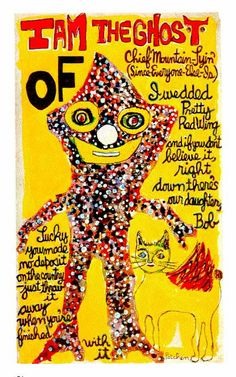
It wasn’t just music that Patchen combined his poetry with, but visual art—drawing and painting pages that were as much pictures as poems. While this has precedent in medieval illuminated manuscripts, the painter/poet/engraver William Blake, and some of Dada’s work, Patchen’s style of combining his own naïve art with epigrammatic text connects with some of the poster art of the Sixties.

I Am the Ghost art by Kenneth Patchen

Closer to Pedro Bell than William Blake? Art by Kenneth Patchen.


One of the reasons I so like presenting figures like Patchen or Blake is their “get in the van” indie spirit. Art does not need to ask permission, it perpetrates itself anyway, figuring out a way to use the resources it can scrounge together.

And lastly, another thing Patchen became known for, even if it wasn’t as widely imitated in the Beat era, was his love poetry. It would be restrictive to think of him as just a love poet, but it was a substantial part of his writing and audience. As the billboards changed from “The Beat Generation” to “The Love Generation,” Patchen was already there with his poetry. A case in point, today’s poem “O My Darling Troubles Heaven”  performed here by Dave Moore and the LYL Band.

So, enough talking without a band. Go ahead and click on the player below to hear Dave’s performance of Patchen’s poem.


*Like what? The love poetry combined with the prophetic social dread is a recognizable Patchen trope. The combinations of art and writing, such as in Cohen’s Book of Longing  can be similar. And while Cohen’s typical poetry plus music style isn’t often reminiscent of Patchen’s, the two obviously didn’t mind mixing those arts.

A Letter to Those Who are About to Die

Certainly not the most self-love inspiring/invest me with hope/promise to give me beauty title for a poem. Mid-century American poet Kenneth Patchen could supply those sorts of things, but in his first book, Before the Brave  published in 1936, he was looking around him, and the things he saw and felt were ominous.

In that collection and this poem, Patchen seems militant and politically committed in tone, though the poems seem too immediate to the times for me to fully decode his advocacy. “A Letter to Those Who are About to Die”  indicates something’s coming, but it doesn’t simply say what. Violent revolt or revolution? Another World War? State-run oppression? Radical social change? If we study history, we know that it turned out to be some all of that. By the time Patchen was writing “A Letter to Those Who are About to Die,”  the Italian invasion of Ethiopia, the Spanish Civil War and the Japanese invasion of China were at hand or a few months away. Hitler was firmly in power in Germany. America was in economic crisis—and if you were poor, black or another ethnic minority perhaps only a generation away from another country that might be equally troubled, your life was now doubly challenged.

Kenneth Patchen 1939

A photo of the young Kenneth Patchen in the 1930s


I know the later Patchen, the pacifist, the poet of love, the painter of illuminated outsider pages, but this was an angrier voice, more desperate than I expected. He was all of 24 and he’d just found the love of his life—but this wasn’t a newlywed world of hope. Could we look back from our perch informed by 20th century history and say he was wrong, that he was over-reacting? No. The ovens, the bombs, the death marches, the battle beaches, the truncheons, the gulags, the lynchings, the public gunshots.

Someone called Patchen’s mid-century cohorts The Greatest Generation. They fought for and against these things, perhaps in roughly equal numbers, and there are claims in all alignments that some of the above list of horrors were necessary to defeat some others also of the above. Objective history can tell us this all happened, even if it can’t speak with one voice on which horrors were justified. As far as I know, Patchen was against all of those horrors, which made him an outsider in his generation. Idealist? Naïve? An individual who opted out from being blamed for history?

I’ve been taken this spring by a song of Andrew Bird’s “Bloodless.”  Bird’s an artist that I’ve previously admired more than I’ve wanted to listen too, but this song has a laid-back Curtis Mayfield/Marvin Gaye groove and heart that I can’t deny, with lyrics about the poets exploding like bombs “And it feels like 1936 in Catalonia.” That feels, in my present, like today’s Patchen poem.


Andrew Bird’s “Bloodless” official video.


So, even with that title that refuses to be attractive, I’m willing to give Kenneth Patchen a read and a performance, and you may be willing to give it a listen.*

Musically, my band and voice aren’t going to be keeping Andrew Bird awake on those nights when it’s music and not the parallels of the Spanish Civil war that interrupts his sleep. However, Patchen is one of those pioneers in combining spoken/chanted poetry with jazz-influenced American music, including collaborations with John Cage and Charles Mingus and a series of LPs with other musicians issued in the ‘50s. I do not expect or wish to frighten the ghosts of Cage and Mingus, only to honor their, and Patchen’s, independent spirit. The player gadget to hear my performance is below. There is no easy place to read the text of this poem on the Internet, but this link may work for those that want to read along.


*By coincidence, the Poem-a-Day from poets.org today is by Fatimah Asghar titled I Don’t Know What Will Kill Us First: The Race War or What we’ve Done to the Earth,”  which title probably equals Kenneth Patchen’s in click-through rate, even though the poem itself might ask us to read the title after the poem rather than before. I sat in a bakery this week and overheard two older white guys, looked my age or a bit younger, discussing the ridiculousness of fears like unto Bird’s and Fatimah Asghar’s these days in America. I wonder what Kenneth Patchen would say if he were to stop by?