I ask AI to write a protest song, and…

A funny thing happened on my way to winding-up my Summer diversion series of thoughts on Artificial Intelligence. I’d concluded last time: since current AI was capable of producing musical pieces in popular styles that could pass for human works in casual listening – or plausibly even more exacting listening – those who’d prefer music expressed by humans might need to change the things they look for and value in music. What kind of things? Accept more imperfections in the music, cultivate an appreciation for the humanness inherent in live performance, and increase their consideration of the intent and motivations of the musical organizations they support.

That last point, about more significantly honoring intent, had hardly inscribed itself as a blog post here when a mischievous thought came over me: while AI is created by businesses with commercial intent, human-made music doesn’t have to be. As difficult as it is to refine authentic intent from music made by strangers distributed in a marketplace, could we be fooled about intent by entirely software-generated music? So, what if I asked AI music generating software to produce a protest song? What if I went further and presented it in a misleading context?

Disregarding my environmental footprint for the duration of the experiment, I created a free account on an AI music generating site, and I set about creating a new protest song. Out of the many outrages of 2025 so far, I picked the authoritarian assaults on academic independence which have sought fines/bribes/tribute from some of the U.S.’s most prestigious universities (known in America as “the Ivy League”) while demanding oversight into their operations and academic programs on flimsy pretexts.

Like a lot of AI, the one I used for this works on a “freemium” structure, with limited features for non-paying users. To make a song I only needed to enter in a text prompt (length-limited for free users) describing it. I asked another AI engine to suggest a prompt and asked it to create lyrics for a song (though the song-creating AI site would be glad to generate its own lyrics). The more general AI answer-bot suggested including artists whose style the music generating AI site should seek to emulate. I picked Phil Ochs and the Fugs. I wanted something with real anger and satiric bite.*

I created around six songs. None of them gave me that, even when I tweaked my prompt. What came out was sweet-voiced singers with an attitude of pop-music yearning, or acceptably sorrowful disappointment in their delivery. The AI lyrics did come up with a few phrases that had some charge to them, but the lyrics generally suffered from what I personally call “Horse With No Name” defects.** My prompt specified “gruff,” “angry,” rough” or even “sloppy” to describe the vocal delivery I was looking for, and out came the singers with an air of polished regret, and lyrics that groaned under their attempt at machine-constructed sincerity. The best I could say for the lyrics on the songs? They might pass as modern recording-production-style versions of the parodies created for the Spinal Tap acting company’s folk-music parody It’s a Mighty Wind.***

These results fed into the context I chose to present them in. I wrote a script for a podcast, supposedly devoted to American folk and Americana music. I decided the podcast presenter would be earnest, but a bit removed from the less-commercial segments of American folk music, and so I made her British. She would be portrayed by the machine speech that I use on my writing computer as a proofreading aid.**** As the token human in this enterprise, I’d appear as a hype-man for the Parlando Project.***** Over the next day I wrote the podcast script and recorded it folding in sections of the machine-generated protest songs. I slightly degraded the audio quality for the British host’s dialog, though after I finished I now think I should have done that for my own dialog instead, as I’d be more likely the guest relying on a remote overseas link for the imaginary podcast.

I had fun doing this, trying to gauge how many tells that this wasn’t on the up-and-up I should drop before revealing the near total AI nature of the content in the last minute. For the names of the Americana acts that were purported to be performing the AI songs, I decided to burlesque the names of U.S. 19th century Fireside Poets. I think “Greenleaf-Whittier” is a great name for a band in that genre – failing that, Jeff Tweedy if you’re reading here, you’re welcome to it for the next Wilco album title.

Greenleaf Whittier

Featuring the exciting new song “University Surrender” you heard on the “Kit That Sounds So Real” podcast.

.

The audio player below will let you hear the 18-minute program. The program opens with a snippet of an AI generated folk instrumental whose prompt I supplied was its title: “Obey in Advance.”   Though only a small selection, I think it demonstrates that AI generated music without vocals is particularly “real” sounding. The program continues with parts of three versions of a song called “University Surrender”  where the AI program supplied the words, music, and fully produced recording in three slightly different Americana styles it thought appropriate. The three versions resulted as I tried tweaking my text prompt – and while distinct, on repeated listening they seem somewhat “samey” to me. More smooth than I was asking for, “Ralph Waldo Bryant’s” version rising to falsetto delivery almost works for the material despite the pitch control artifacts I can detect in the computer-generated performance – but remember, as I said earlier in this series, the same artifacts are now common with recorded human vocalists in current pop. “Greenleaf-Whittier’s” cover did add one, nice, out-of-leftfield, touch: the flagrantly computer-voiced autotuned opening refrain of the title before continuing into its bouncy two-step country groove. And then there’s “Oliver and the Rolling Homes’” version of “University Surrender”  whose arrangement serves up a country-music playlist/station format sound. I was laughing hard as I heard the small-town-worshiping-my truck-my girl -I may get a little drunk sometimes-but I’m a hardworkin’ man-like my daddy sonic approach, but this time holding forth on tenure and syllabus issues. And then there’s “Ivy Towers Bow”  that is said to be written and performed by “J. R. Lowell.” The lyrics here were written by an AI chatbot and then those lyrics were given to the AI music generating program to make this song. Musically this one doesn’t give me anything – so generic. I almost didn’t include it, but I decided it was an example that a generate-songs-AI was on par with a text-focused AI when writing lyrics. The final song on the fake podcast might be the one of the group that does the best emulation. If I was listening casually and “E. E. Peterbuilt and the International Harvesters ““The Emperor’s New Chains”  came on, I’d think it better than many songs in its style. Oddly enough, the AI program produced it when I goofed and clicked generate when I’d only partly written the prompt “Folk or Americana protest song, gruff voice…” and by not having to lyrically add the academic details that made Oliver and the Rolling Homes version of “University Surrender”  so unintentionally hilarious, its Horse-with-No-Name lyric faults are not as exposed. If I wanted to pick one AI song from the ones I generated to fool a careful listener, I’d pick this one. You know you’re in the Uncanny Valley when the guitars have faded out and the robot vocalist gives us a little aside into the still open mic. Spooky.

If you don’t see the audio player gadget to play this imaginary podcast, this highlighted link was human supplied to let you hear it, and will open a new tab with its own audio player.

If my courage and energy hold out, I still want to write one more post about what I call “the guild issues” that concern some artists engendered by plausible AI results.

.

*The AI program didn’t object to those two 20th century folk-rock artists of outrage and cutting satire being supplied for models – but it completely ignored trying to emulate them. When I tried “Bob Dylan” – suggested by the separate AI that’d given me a prompt I could use elsewhere – the song AI immediately refused to do so, presumably due to a specific concern about IP.

**”A Horse With No Name” was a 1971 song, recorded in England by a band led by expatriate Americans. The recording, done by humans, not AI, sounded like someone had anachronistically entered our future and asked AI to “Create a song that sounds exactly like a Neil Young record.” The lyrics went forth despite including some awkward lines like “There were plants and birds and rocks and things,” “the heat was hot,” “’Cause there ain’t no one for to give you pain,” and “Under the cities lies a heart made of ground, but the humans will give no love.” To spare us from more lyrical howlers, the song also featured a lot of repeated “la la la’s” in its chorus, well-performed in a CSN&Y style of harmony.

The song was a substantial hit in both the U.S. and Britain, indicating that it worked as a song for its audience none-the-less.

***Hey, I’m a fan of Spinal Tap. Everyone is! And rating art is a fool’s game – but “It’s a Mighty Wind” is every bit as good, maybe better.

****The “read aloud” feature in the current versions of Microsoft Word is a huge aid to my self-proofreading. With my neuro-wiring, it lets me catch a great many errors I’d otherwise miss, and using the female British voice enhances the “hearing this anew, as if I didn’t write it” factor that makes it so effective.

*****The stuff I say in the middle of the satiric podcast concerning the Parlando Project is how I actually feel about the nine-plus years of stuff I’ve put out here.

Two men walk into a hotel room, and…

I can’t say what day this happened, but it was sometime in 1916 in Davenport Iowa. A well-off, Harvard-educated man in his mid-thirties named Witter Bynner was visiting a former Harvard classmate Arthur Davison Ficke in the latter’s elegant home. Besides family wealth, both men shared an interest in the arts, and both were published poets and art critics. A variety of fine-arts could have been discussed by these highly educated men, more so than any yet-to-be-invented concerns that random recently-young men might discuss today. Bynner later recalled the high-spirited discussion got raucous enough that Ficke’s wife asked the men to take it outside.

Nijinsky Le Spectre de la Rose crop

What the F.T.D! Nijinsky as the spirit of the rose


We know where the conversation started: Bynner had recently seen a new modern ballet, The Spectre de la Rose  based on a poem by Théophile Gautier with music orchestrated by Hector Berlioz from a piano piece by Carl Maria von Weber. I don’t know who the dancers were in the performance Bynner had seen, but the titular role of the spirit of the flower was first danced by Nijinsky, and the piece’s choreography ended with the extravagant gesture of Nijinsky leaping out of a stage-set window and disappearing as if he had flown off into the ether of the rose’s wafted scent.

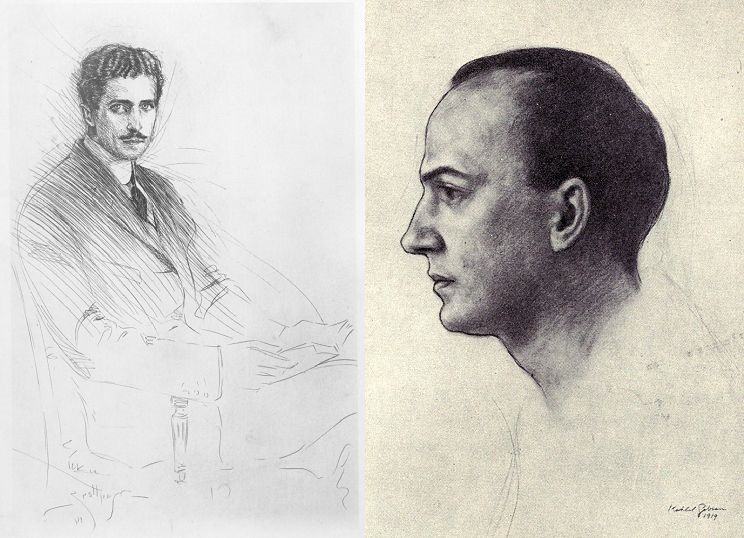
Ficke and Bynner drawings

Arthur Davison Ficke and Witter Bynner. Bynner’s portrait is by Kahlil Gibran.


The two men retired to a cross-town hotel room with a bottle of whisky. Bynner had had an idea while watching that ballet. The romantic artistic styles of his birth century were now being challenged by new 20th Century modes. The kind of poetry that the pair wrote: carefully crafted metrical, rhymed verse was being challenged by new verse. It too had extravagant expression, but not only did the new free verse not care about symmetrical forms, it didn’t seem to care about extracting from its expression sense or meaning—things didn’t mean, they were, in these new poems. And some of the new poets were so deadly serious about how important this was! They wrote manifestos about how poetry should work without the old frameworks, yet they didn’t seem to care about how meaning worked!

The levels of the whiskey in the bottle lowered quietly as the levels of whisky in the two loud poets increased. Here was the plan: Oh, this was so good! They would write a bunch of these new poems, just whip them out while they were good and drunk and no longer bound by anything other than sounding like these new Imagist, Vorticist, Futurist poets. Great fun! So much so that nine more sessions and nine more bottles followed in close succession.

Intoxication didn’t stop these two educated, upper-class men from some structure and planning. They’d publish the poems under assumed identities. Bynner, a gay man, was to be Emanuel Morgan, a painter/poet who had dallied in Europe and dug the French poetic influences. Ficke, the straight, goyim man with day job as a lawyer, was to be an exotic eastern-European Jewish poetess Anne Knish. Later that year they roped in another well-off child of local Midwestern privilege, Marjorie Allen Seiffert, whose contributions would be signed as Elijah Hay*, who would be (like Ficke) a cisgender lawyer/poet. Ficke was drafted to write the new movement’s manifesto**, and Bynner supplied the name, taken from the ballet: “Spectrism.” Prophetically anticipating the birth a dozen years later of Andy Warhol there, these Spectra poets were said to be living in the Pittsburg area. Well, maybe it wasn’t Warhol. Maybe Pittsburg was chosen because it was half-way between the East Coast-based Bynner and the Midwestern Ficke, or perhaps they shrewdly judged it as sufficiently nowhere to evade detection.

They submitted Spectrist poems to magazines and some were published. They submitted a manuscript of the drunken hotel room poems to their own publisher and had a good laugh when it was accepted (they did tell the publisher about the hoax after the acceptance however). Perhaps the strangest publication was a “theme issue” of Alfred Kreymborg’s Others  magazine. Others: A Magazine of the New Verse  was the  publication of the Modernist Avant Garde in America, promoting William Carlos Williams, Carl Sandburg, Marianne Moore, Fenton Johnson, Mina Loy, Man Ray, H. D. and Wallace Stevens. If it was “free” or “new” or “modern,” Others was associated with it. It seemed particularly open to redefining sexual and gender roles. Recent “theme issues” before the Others’  Spectra issue for January 1917 had focused on Spanish-American poets and “A Woman’s Number” (which included work by Seiffert).

Spectra Covers

Mysteries of the Spectrism. The 1916 published collection and the 1917 special issue of Others.


What would happen if the Spectra hoax occurred this year? I’m certain there’d be considerable criticism of the perpetrators. Other than the inherent dishonesty the goes into a hoax (though “honesty” is always ambiguous in art) the audacious usurping of the Anne Knish persona by a WASP scion of wealth would draw additional condemnation for sure. Rich white men tweaking the always struggling to stay in business little magazine Others seems particularly cruel on the face of it.

You’d also expect pieces to be written about how the hoax “proves” that Modernist poetry is, consciously or unconsciously, a hoax itself; that Spectrist poetry had shown that if the right signals are made, any word-jumble will pass as art. And yes, that happened after Bynner revealed the hoax in 1918, just as it would likely happen now.

Interestingly, at least in my limited research into this, the 1918 response did not seem to include much if any anger toward the perpetrators though. Class, ethnic and gender privilege might have shielded them. Perhaps even those who might have standing to complain were cowed by the perpetrators prestige and power, or maybe they hadn’t developed an analysis of “cultural appropriation” yet. AFAIK, Ficke, Bynner, and Seiffert never suffered “you’ll never work in this town again” repercussions.

Those fooled by the hoax generally followed a line that the Spectrist poems, regardless of the author’s intent, had some vitality as Modernist expression anyway.*** As the 20th century progressed, automatic writing, cut-up, exquisite corpse, chance and computer-generated composition, found poetry, psychedelic poetry composed while intoxicated, and more would be tested as tactics. Spectra might have started in Davenport Iowa not at the Cabaret Voltaire in Switzerland, but does Dada require intent to be Dada? Can one draw a line from the Ficke’s Spectrist manifesto to the First Surrealist Manifesto?

For myself, more than the philosophical and aesthetic questions, I wonder at the personal impact, and not just on the hoaxed. Modernism had not yet triumphed in its campaign to take over poetry in the 1916-1918 era, but all three of the Spectra hoaxers began to agree with the hoaxed that when they freed themselves from their birth personas and the formal rules of poetry and meaning, that something else emerged that their poetry hadn’t seen before they put on the mask. All three later wrote some free verse as their careers continued and Modernism won the post-WWI war for literary respectability.

On the other side, I’d suppose that the Spectra hoax may have helped give impetus to New Criticism and it’s move to establish objective criteria for what makes a poem good, even if it’s Modernist in language, structure and word-music.

What of the poems themselves? I read the original Spectra book and found it disappointingly forgettable. There are some good lines, but fewer than pure what-the-hell wild improvisation should have engendered. You can laugh at the unhidden humor present in some of the poems, and I can recognize and smile at some of the references to common early Modernist tropes that they are parodying. I was drawn more to Ficke/Knish than Bynner/Morgan, and couldn’t help but think that Ficke, part-way down that bottle of whisky, might have found his invented exotic anima therapeutic.

Therefore, I’ve chosen to perform one of Ficke’s Spectra poems today, “Opus 131.”  I think Ficke—a son who grew up in a house wealth-filled with his father’s world-spanning art collection and who had followed his father into the practice of law—may have needed something more, may have wanted something that Millay or Kreymborg or Mina Loy had, even in their not-having. He may have wanted to leap out of that hotel room window, like Nijinsky in that ballet, and never come down.

Here’s my performance of Ficke/Knish’s Spectra poem:


*Although it’s usually not filed under “hoax” there’s a fairly long tradition of women writing under masculine pen names, from the three Bell/Bronte sisters onward. Davenport itself was home to Octave Thanet, a successful popular writer born Alice French.

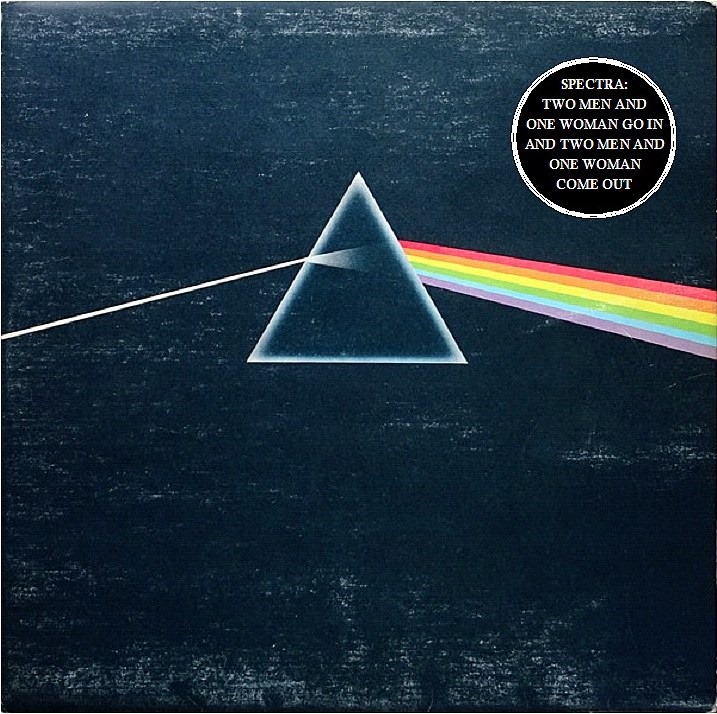
**Sample lines from the manifesto: “The theme of a poem is to be regarded as a prism, upon which the colorless white light of infinite existence falls and is broken up into glowing, beautiful, and intelligible hues… Just as the colors of the rainbow recombine into a white light,— just as the reflex of the eye’s picture vividly haunts sleep,— just as the ghosts which surround reality are the vital part of that existence,—so may the Spectric vision, if successful, synthesize, prolong, and at the same time multiply the emotional images of the reader.” I can only think of the cover of Pink Floyd’s Dark Side of the Moon.

Spectra Poets Dark Side of the Moon LP Cover


***However, the funniest critical quote from before the hoax was revealed was William Carlos Williams remark that he preferred the Elijah Hay’s Spectrist poems to Anne Knish’s because the “Woman as usual gets all the theory and—as usual—takes it seriously whereas the male knows it’s only a joke.” Mirror upon mirror in that quote.