Wanderers Nightsong II

Despite my inveterate bicycling and my wife’s love of nature walks, I’ve never been much of a hiker, and I’m very much not so in my old age. None-the-less I was charmed this winter when I saw this short poem because it appealed to my mental wandering. Walk with me: it’s not all that long a hike to a short audio piece.

When I saw today’s poem, I immediately noted that its translator from Goethe’s original German was the American poet Henry Wadsworth Longfellow. Let me reassure the poetry hardcore who might be reading this post that Longfellow was far from my interests when I started this project. While 19th century worthies Whitman and Dickinson remain staples of American poetry, Longfellow was to me only a schoolchild’s memory — and at that, not even a literary anthology schoolbook memory. My Midcentury-Modern anthologies of poetry in English didn’t concern themselves much with him, so I recalled only the Longfellow of illustrated poems for children that predated Dr. Seuss’ ascendency, Midnight rides, patriots at the bridge, culturally appropriated native Americans epics in stalwart meters. Longfellow’s Wikipedia page, reflecting critical consensus, still makes the case to downgrade him — and that’s hard to do, to downgrade someone who is now largely overlooked. The judgement handed down can be summarized: you don’t know him, and it’s probably best to keep it that way.

How did Longfellow come to me then? Part way into this Project I visited Massachusetts, planning to see the historic sites in Boston. While in Boston I decided to add a visit to the Washington/Longfellow house in Cambridge. This was a toss-in, yet it was while I was there that I heard about Longfellow’s life and I started to pay a bit more attention to the range of poetry he wrote.

While on that tour, our group was walked through Longfellow’s study where he wrote. I noticed right away that he had something that 21st century Americans would recognize immediately as a modern adaptation for intellectual work: a standing desk. If you must be deskbound, current theories hold, it’s best for your body to spend some of it on your feet during its mental wanderings.

The other thing that stood out was a statue on the desk. It’s not a small little desktop trinket that some of us keep on our own desks,* but something you could easily see across the room from behind the tour ropes. “Who’s the statue on the desk of?” I asked our guide.

“Goethe.” They replied.

If Longfellow has some incontrovertible objective value remaining, it’s that he established the idea of a preeminent American national poet. Those children’s books were thinly veiled citizenship lessons, direct appeals to America’s nationhood after all. So, what’s up with this German poet?

Longfellow, born of a generation where many living adults knew the American Revolution firsthand, was tasking himself with finding what could be an American poetry. What materials did he gather for this?

It’s likely he knew British literature of his time well, but he was officially a professor of Modern European Languages, and while still a young man he taught himself French, Spanish, Italian, Portuguese and German. He read literature in those languages, translated works from them into English. Whitman and Dickinson largely looked inward (within national and mental borders) for their remarkable American poetry, Longfellow was (as far as influences) a proper internationalist.

He could have decorated his desk with former householder: George Washington I suppose, or that other Washington who was a pioneering American literary figure, Washington Irving. Nope. The man he wanted staring at him when he stood and wrote was this formidable German poet and polymath.

Longfellows Desk 1080

Longfellow’s desk, and Goethe is right up in his grill when he wrote there.

.

Johann Wolfgang von Goethe was not a model for a faint-hearted writer, but perhaps one of the things from Goethe’s overstuffed portfolio might have interested Longfellow: Volkspoesie, “Folk poetry.” The idea here was that shared history, mythic tales, and interests of ordinary people experiencing their landscape was a nation-forming cultural foundation. Here’s a connection Longfellow might have felt: France, England, Spain, and Portugal had been nations for centuries by Goethe and Longfellow’s time: but Germany was not yet a nation in the modern sense, and Longfellow’s United States was only freshly one.**

“Wanderers Nightsong”  is not a grand, nation-building poem however. It’s a tiny little lyric, really only concerned with an internationally-known experience of being outside under one’s own power, perhaps by choice recreationally, perhaps in some outside-directed travel or need to escape, but anyway alone enough in one’s landscape that all things are silent. You can hear your own breath, feel your own accumulation of footsteps, and the landscape says: rest with us.

This means that Longfellow has a delicate task. The thoughts contained in Goethe’s German are not unique — indeed, they wish to speak of a shared experience. Nor are there striking images or clever language effects in the poem. No strange worlds or visions are portrayed. The song-sense here, even on the silent page, is the poem’s substance. Like Hank Williams’ American country song standard “I’m so Lonesome I Could Cry,”   the point here is not that the singer has seen something you haven’t seen, the point is that he sees what you’ve seen, felt what you’ve felt, and you, even reading silently, can sing it with them. Therefore, Longfellow chose to keep Goethe’s German rhyme scheme in his translation to English so that it continues to sing on the page in its new language.

wanderers nightsong

Schubert fans will tell you, I’m a follower not a lieder.

.

Longfellow’s choice here is the right one, and I’ve honored it while slightly modifying his syntax and usage. You can read Longfellow’s original text and Goethe’s German at this link. Coincidentally, the poem’s original germ was written on a wall, a fact shared by “Smells Like Teen Spirit”  and this poem presented here a few years back. My performance is not complicated — it’s folk-song like — though the chord structure uses some less-common chord extensions. I do use one of my standbys, the simple sustain-pedal piano notes which testify to my absolute non-mastery of that instrument while wanting to make use of its sonorities. Like some other poems I’ve presented here, an accomplished composer has set this before me. You can hear my simple version with English lyrics using the audio player gadget you should see below. No gadget?  This highlighted link is an alternative way that will open a new tab with its own audio player.

.

*I used to keep a sentimental ceramic rabbit that was a gift from my late wife on my writing desk. More recently, a Lego figure of Shakespeare my child assembled and gave to me.

**Yes, nationalism, and in particular German or American nationalism, has its downsides — but the case that it’s foundational to establishing a civic bond can be mooted without denying it’s plausible faults. I should also note for students: my knowledge of German literature is scant, despite my mother having been bilingual in her childhood, and her grandparents speaking German in their home and church. This is a blog written by a “layman” explorer of poetry and music, my scholarship is spotty, though my interests are broad.

The Poet’s Afterthought

Does any poet know if their work is any good? Some perhaps have that conviction, but at least during substantial moments I think the majority of poets have doubts. This drives some poets to ever tinker with and improve their writing, and causes others to abandon the idea of poetic writing as a useless pretention. Some even numb themselves to the question — yet anything that numbs doubts can overshoot and numb creativity too.

Do bus drivers and child-care workers have these doubts about their work? Do politicians or generals? Is a poet’s lack of confidence in their work generally less than other artists? Let me only take the last question. I do think more poets have more doubt, because their audience is usually small, and that audiences’ response is so muted. Actors, musicians, or other performers can expect immediate audience response, it’s in the nature of their work that it exists only in front of others. Poets, even successful ones, read publicly much less often than they write. The attempts at bringing performance to poetry, with slam and other spoken word variations are seen by many literary poets as corrupting the complex and more contemplative aspects of their art. Novelists, screenwriters, the authors of non-fiction and memoir, can lucidly dream of paydays that would be fantastical for poets, and it’s not unusual for poets to step aside from their poetry to those other writing fields seeking something they can touch and deposit on account from their work. Visual artists are as abstracted from their audiences while doing their work as poets, but we have no auctions of living artists poetry that bring bidders to the alexandrine numbers.

So, in such solitude, such silence, or even within the quiet, diffuse reverence of award-winning poets, there is most often doubt. What would it be like if poetry was on most everyone’s mind, if living poets were giants in our culture?

Since I started this project I’ve sometimes thought of Longfellow, an American poet who reached that level of achievement. The American culture of Longfellow’s era wasn’t more educated or entitled to access to high culture that we are today. Yet, I grew up in a town, and live in a city now, which from that time created streets and spots, and named them for him like we would for Presidents or Generals. My father and his father would know, would memorize his work. We do not need to travel back to Classical Greece or the Confucian Odes to imagine that level of poetry in our culture.

And yet. Longfellow has disappeared, and as far as those that do care about poetry this is regarded as neither mistake nor injustice. This isn’t due to scandal. AFAIK, Longfellow lived a praiseworthy life. He must have said or written some things we could condemn, but on the big issue of his age, slavery, he was on the side of the angels. He was a nationalist, but an internationalist too. He may have appropriated First Nations names and legends with insufficient grounding, but he did it to ennoble not dehumanize them. No, the main reason we have dumped Longfellow off the bookshelves of our culture is that he doesn’t excite or move us in the least. His poetry seems like old civic statuary covered in pigeon dung, not worth noticing, and not worth any effort to replace.

American poetry is a different country now, and Longfellow is exiled from it.

Inside poetry, in its provinces, and within old classics where we might still retain interest, there’s current discussion about Emily Wilson and her fresh translation of Homer’s Iliad.  Wilson has been clear in discussing her practice of translation. She assumes or assays that there must be something there in the archaic Greek. Her task, she writes, isn’t to make a work that sounds like the original text, or to bring us its most exacting word-for-word translation, but to make a new poem that works like the original must have worked for it to have had the impact it had — a version which we can by extension expect to be something like the authors best intentions. We believe this is what Homer deserves, regardless of if our tactics vary from or agree with Wilson’s.

We do this for Dante. We do this for Du Fu. We even do this to some degree with Shakespeare’s plays. We don’t do it with Longfellow. Why not?

We may think there’s nothing much there. We may think that Longfellow’s English is close enough to our modern English that to do so would be presumptuous or dishonest to the work. This last objection is a funny combination with the first. If there’s nothing worthwhile there, who cares what we do with it?

For a recent live in the studio LYL Band recording I decided to “translate” — or more exactly, extract and arrange for greater direct effect to the modern ear, a portion of a lesser-known Longfellow poem, one he titled “Epimetheus, or the Poet’s Afterthought.”  Epimetheus, for those not up on your Greek mythology is Prometheus’s contrasting brother. If Prometheus is a hero, however tragic his fate, Epimetheus is the “Oops! I did that?” guy, a total fool. Prometheus is the I’ll give humans fire and suffer the eagle eating my liver forever hero. Epimetheus is the ”What’s in that cool box, Pandora. Let me have a look” disaster.

In my version I left Epimetheus out of it. Pandora too. Longfellow’s poem is a Friday-the-13th thirteen stanzas long and would require more melody and virtuosity than I can muster to capture a modern listener’s attention. I cut it to three stanzas, modified a couple of pieces of archaic word-order, killed one perfect rhyme for a near one. I did this because I think there’s a core in the piece that might speak to me or you without delay or overly baroque elaboration — and that’s the intent I found in Longfellow’s subtitle. If you write, particularly if you write poetry, you likely know the feeling: that joy and initial appreciation of the inspiration that carries you into the first draft, only to be followed by the problems of realizing the best poem that escapes us. And the completed poem? It travels out to a place where there are only wanderers like us.

Poets Afterthought

Here’s my much shorter adaptation of Longfellow. The full poem as originally published is linked here.

.

You can find that performance of my revised version of Longfellow with the audio player many will see below. Don’t see any audio player?  This highlighted link will open a new browser tab that will have such a player.

.

Abbreviated Summer 2022 Parlando Top Ten

There were fewer audio pieces presented this past summer, so I’m going to abbreviate our traditional Top Ten review of the past season to reflect that — but I still kind of like this part of the Project, as I get to see what pieces got the most response. Like the Parlando Project in general, the most popular pieces tend to be quite various, and it’s often the pieces I’d least expect that bubble to the top. As a proper Top Ten, we’ll look at them as a countdown, starting with the 10th most liked and listened to one and ending with the most. The bold headings are links to the original posts in case you’re new here and would like to read what we said then.

Very briefly here are the pieces that make up numbers 10 through 6.

10. Arthur Hoehn by Frank Hudson. In the summer doldrums I felt free to include more of my own words. This is a short elegy for a classical music DJ who worked the overnight hours. I’m quite proud of the final lines of this one.

.

9. Staying the Night at a Mountain Temple by Li Bai. Another of my loose translations of a Tang Dynasty classical Chinese poem. I based my translation on my understanding of Li Bai’s (his name is also rendered as Li Po) general outlook. An example here of how I work with orchestral instruments.

.

8. Stratocaster by Frank Hudson. Really, this project is usually concerned with other people’s words, but this sideways ode to an ingenious radio repairman whose swoopy electric guitar design was enshrined in the Museum of Modern Art got a good amount of response.

.

7. The Dick and the Dame by Dave Moore. Alternate voice and keyboard player here Dave Moore says some of this is adapted from Robert Coover, but this really holds together as a poetic liturgy for pulp noir. Also I got to wail on guitar.

.

6. Let us be Midwives by Sadako Kurihara (translated by Richard Minear). This was my piece for past August’s Hiroshima Day, a short tale of the huddled human aftermath of the first atomic bombing. Is there a word for sad/hopeful? If so, that’s this poem.

.

don't underestimate 800

Getting ready to lock up my bike late this summer, and my attention is drawn to a message on top of the post.

.

Now let’s move on to the top 5 and say just a bit more about each of them.

5. From Cocoon forth a Butterfly by Emily Dickinson. We’ve done lots of Dickinson poems here over the years. Though we did this one in summer, it talks about harvest time. While poetically condensed, Dickinson observes harvest workers and the proverbially productive bee and contrasts them with a no doubt lovely, but also somewhat unoccupied butterfly. Is Dickinson, the poet, the butterfly? I’m not so sure. My understanding is that Dickinson’s domestic duties in her mid-19th century household, while less than those of poorer families, were also not insignificant. Is the butterfly then poetry, or the poem she’s written, or a fancied life of a full-time artist which she wasn’t? Dickinson ends with this point: at the end of it all, however joyful or laborious, is the Sundown, which is Extinguished. Like the Preacher in Ecclesiastes, I’m thinking she sees vanity in the whole scene.

.

4. To Whom It May Concern (Carry Them Away) by Kevin FitzPatrick. Dave and I both admired Kevin’s poetry and outlook, even if neither of us wrote like him — but then as I said elsewhere here this summer, too few poets write like Kevin. Here’s a short poem written entirely in another’s voice, whose words Kevin the poet recognizes deserve repeating, deserve attention, deserve concern. If I don’t write like Kevin, that essence, that principle, is part of what I do here with the Parlando Project.

.

3. Palingenesis by Henry Wadsworth Longfellow. Poets today read Dickinson (should) and Whitman (must), but few literary poets will admit to reading Longfellow now. Dickinson and Whitman are great rebels, geniuses of make it new. Longfellow worked in traditions, replanting them in America. If you want to rebel with your attention and consider Longfellow, I’d suggest the shorter lyrics. Was this lyric referencing Longfellow’s wife who died too young in his arms? I can’t say for sure, but I used it to reference my late wife who also died too young more than 20 years ago.

.

2. Generations by Frank Hudson. This is a tiny poem in a tidy setting. I’ve been noting recently the lack of perspective in many older persons’ views of the young. Old people are supposed to supply that perspective, to know from intimately observing things over longer time that stuff thought new is just a variation or a carrying forward of the flow of society. Instead, I see all too many who want to proclaim some past got it right and the present is a decadent signal of end times. So, in this short piece I cast myself as the sage of advice to the young, but with a twist.

.

What was the most popular piece this summer? Come back tomorrow for the answer.

Palingenesis — three anniversaries noted

Today’s post is part of observing three anniversaries this week: this blog’s launch six years ago, Atomic Bomb Day (noting the anniversaries of the bombing of Hiroshima and Nagasaki), and my late wife’s death in 2001. An odd combination? Well, yes, but they coincide.

Odd? Personal loss has an odd size. If one holds one’s hand in front of one’s eyes it can block out the entire sun. How close grief is to one, has a similar effect. When the 9/11 plane crash attacks occurred a month after my wife’s death, it was objectively a sad, horrible, thing. To some small and nearby degree it impacted the place I worked. There were employees traveling, in the air as the attacks became known. We had at that time a floor of offices in a tall local building in St. Paul, over a thousand miles away from the attacks, but a tower named at that moment ominously “The World Trade Center.” And the radio network I worked for had a large news component. Everyone and I did what we needed to do in the wake of the attacks. It was not that I did not care or have consideration then — but the sharp pain of that public grief could not be felt to the same degree in my self still encased in loss.

So too the atomic bomb attacks on the two Japanese cities must have been in 1945 to many Americans. Some had lost loved ones in that war, some feared for losses to come. Some were waiting for what, how many, conventional deaths before the war’s end, and wondering if one of them would be their own.

Those nearby close things can blot out an atomic bomb. Ethical philosophers try to make true weights and perspectives, poets on the other hand talk instead of how it feels to think of these things.

Henry Wadsworth Longfellow, an American poet whose importance is now obscured by judgements of excessive conventionality against the bright lights of Dickinson and Whitman’s new approaches, wrote the poem which I’ll perform in part today. Written and published in 1864 during the American Civil War, it’s author certainly knew of the generalized grief and loss of that war and the human slavery it was fought over* — but he also had closer griefs. His wife had not only died in 1861, she died in his arms, her body on fire from a household accident as he himself was burn-scarred trying to extinguish the blaze. And then his teenaged son was serving in the Civil War and was grievously wounded in 1863.

Longfellow-bomb-Renee

Three anniversaries remembered. There’s no way to picture this blog in a single picture, so we’ll show Longfellow.

.

The opening section** of “Palingenesis”  considers memories and grief, considers the imperfection of the rebirth that the obscure word used as the poem’s title offers. If the eternal noises of the sea and ghostly apparitions in the mist may strike us as all-too-tired poetic tropes to our 21st century judgement, the image at the end of the segment I perform, the ashes from which some fabled alchemist might be able to reconstruct a burnt rose still has power for me. This “rebirth” without scent, and without the ability to change and bloom, is not a true rebirth, it does not repair the loss.

My life path after my wife’s death is a complicated story including joy and gratitude. Are those considerable things big enough to obscure the loss — in reverse, a planet bigger than a hand? I cannot honestly weigh that, other than to live in the scent of life and to bloom. Starting this project, even if over a decade after my wife’s death, was one way to return to poetry what my young poet-wife would have given.

I have at least one other planned part to this anniversary post, one other musical performance that doesn’t yet exist. I don’t know if I’ll be able to find time to do that, but this part that I did complete is available below. You can play the performance with the graphical gadget below where you see it — and where you don’t, you can use this highlighted link.

.

*A close friend, a U. S. Senator, was beaten unconscious and seriously injured on the floor of the Capitol over an anti-slavery speech which was deemed insulting for inferring the same crimes of sexual slavery Longfellow wrote about in a poem.

**The rest of Longfellow’s “Palingenesis”  concludes with the realization that a forward-looking new birth, not an attempt at exact repair and reincarnation, is the better answer. Not only would the entire poem produce a piece longer than I prefer to present here, I think the poem’s older poetic language might wear down many current listener’s interest. Here’s a link to the complete version.

Eliot’s Oak

The river of history runs only in one direction.*  And so on our river journey, the Modernist poetic landmark “The Waste Land”  will arrive, and stopping and resting on the landing there will mark us as well past the headwaters, and our memories will diminish of the headwaters, even if the very water that carries our boats flows from there. T. S. Eliot wrote many letters and critical essays, he must have written somewhere about his American poetic forbearers — but if so, the spotty scholar writing this is so far unaware of what he said.

If one searches on that subject, one will see many mentions of Eliot’s Modernism supplanting the American 19th century New England worthies headed up by one Henry Wadsworth Longfellow. And then something else might turn up, like this deserves-to-be-better-known sonnet of Longfellow’s titled “Eliot’s Oak.”   Here’s a link to the text if you’d like to follow along.

If we largely forget Longfellow these days, we tend to forget Longfellow the writer of short lyric poems to an even greater extent. If this sonnet had been attributed to Keats or Shelley, it would be no less antique in some of its usage, but I suspect it would be better remembered and rated for achievement. Besides the “speakest,” “days remote,” “eventide,” and “hath” language, its chief crust of old-fashionedness is its use of the pathetic fallacy, where a tree is addressed and converses in the poem. We’d forgive Keats and Shelly for this, where we likely won’t forgive Longfellow. If we allow that bald-faced metaphor to pass, we might notice that the imagery in the poem develops in an admirably subtle way. In the sound of the tree’s leaves the poem hears a variety of sounds whose meaning is just out of reach, and masterfully Longfellow transitions to say that different people will hear different nearly intelligible languages in this sound. Am I stretching this conceit’s move too much to say that this 1876 poem has just sought to impress upon us a key tenet of cultural Modernism?

As Longfellow’s sonnet reaches its turn for a final six lines, we are forced, as much as we might be in parts of “The Waste Land,”  to seek out what is being referred to. With “The Waste Land,”  it wouldn’t be extraordinary to believe that some of the readers of this blog would have some knowledge of Richard Wagner, Jacobean drama, Metaphysical poets, or Ovid; and it’s even more likely today that some here would have some understanding of Hindu religious thought and writings, which will get called out in the upcoming concluding sections. But, do any of you know of the “Apostle of the Indians, Eliot…” Longfellow speaks of, what this story means, and how dark it is? I didn’t.

Eliot Oak before 1936

The Eliot Oak still stood in Longfellow’s time, and long enough for a trolley line to run past it.

.

In the 17th century, the Puritans who founded the European colonization of Massachusetts included this stalwart preacher John Eliot who came to believe that he was called to preach to the indigenous Algonquin tribes there. The Puritans had a strong streak of religious zealotry, and given that and the commercial interests of colonization, many regarded the natives of their new colony has the devil’s savage minions. John Eliot believed them to be merely unconverted fellow humans.**  As Longfellow’s poem indicates in his Biblical allusion in lines 10-11, Eliot views the indigenous as fellow members of the Abrahamic family, potential “people of the book.” At first, all this was only a philosophical/theological debate. Eliot was allowed to learn their language, preach Christianity to them, and form somewhat autonomous villages of “praying Indians.” In an act of superhuman intellectual and literary effort he managed to translate the entire Christian Bible into their native language. Just this massive translation alone would be remarkable, but these tribes had no written language, so he had to devise a way to use the western alphabet to depict it. Nor was it an easy job to then print the resulting Bible: the press had to be imported, and the work of setting the type and printing was not trivial either. Eliot headed this project, but it should also be noted that the first nations people who worked with him were indispensable.

The resulting book, in a first edition of 1000, Mamusse Wunneetupanatamwe Up-Biblum God, wasn’t just the first time anyone had created a new written language to publish a Bible, it was the first  Bible to be printed in what would later become the United States.

Now of course the whole issue of evangelical Christianity and native cultures is a complex subject. Even those of you who do not know John Eliot’s particular story will include some who know some of the harmful incidents in such matters. Yes, this story gets dark, but there’s also a strange redeeming element in the end too.

In 1675 some of the Algonquins began a three-year uprising against the colonialists, leading to what was called King Phillips’ War. It makes no difference that Eliot’s converts are co-religionists of the colonialists or if they have any allegiance to the rebels. The very fact that many of them are now fluent in the native languages and English makes any of them prime suspects as spies and informants by both sides. Some of Eliot’s converts are killed, and the rest are shipped off to a concentration camp where many starve, despite Eliot’s efforts. Oh, and most copies of the Eliot bible are deliberately destroyed. Those theological debates have become warfare.

I promised there would be a ray of light in this. I’m not sure this had happened yet when Longfellow wrote his poem — and if so, he prophecies it in the poem’s last line — but in the ensuing colonial disaster inflicted on the native peoples, their language was wiped out. People still existed who were descendants of this Algonquin tribe, but they could not speak it’s Wampanoag language. Surviving copies of Eliot’s Bible become the Rosetta Stone that allows the language to be revived.

John Eliot Memorial Newton Mass

The same year Longfellow wrote his poem a memorial on a spot where Eliot preached to the Algonquin was built. I wondered through Google Streetview to find it still stands, though it looks ignored.

.

In summary, as you listen to today’s audio piece, it may just seem like a facile little ditty about a talking tree and this, whatever Eliot,*** who isn’t even T. S. Eliot. Understand what its images and references point to, and it’s a memento of one of the least-known and most-impressive American literary achievements and a link to the complex tragedy of some who hoped to turn in some way from genocide. Perhaps it’s the romantic in me, but consider some of the lost or just unheard stories of the land we live on during this #NationalPoetryMonth, the lips that spoke them, the hearts that heard them. The river of history may run in one direction — but go ahead, make a fool of yourself, and listen to the trees. Or listen first or second to my performance of Longfellow’s “Eliot’s Oak.”  You can use the player gadget if you see it below, or this highlighted hyperlink will open a new tab or window to play it too.

.

*Except in Chicago. See this.

**Here’s a short, two-page summary of John Eliot’s efforts in PDF format written for a local church that bears his name.

***So, is John Eliot related to T. S. Eliot? I don’t have a family tree or other such documentation, but it’s highly likely. Eliot’s family was known to descend from early Puritan colonists.

Some past Parlando Project pieces relating to Black History Month

This project has gone on so long and produced so many pieces, so before February ends I thought I’d highlight five of the most popular pieces we’ve presented in past years that deal with Afro-American experience or history. The bold-faced start of each listing is a link to take you to the original Parlando Project post that presented this poem if you want to read my first reactions to it back then.

Lines to a Nasturtium by Anne Spencer. Another Afro-American poet who published before 1925’s The New Negro  anthology, but who was not published much during the later half of her life. This poem may be her extant masterpiece. It still defeats me from extracting a simple prose “meaning” from it, but it’s just breath-takingly gorgeous in sound and a diffuse emotional impact remains even in its mystery.

.

The Witnesses by Henry Wadsworth Longfellow. What, a poem by a white guy? Well, white supremacy is — what, how does that term start? — a white problem. Here’s a 1841 poem about the notorious Middle Passage of African captives taken across the Atlantic written within the lifetime of those that would have chartered, manned, and benefited from that trade.

.

The Banjo Player by Fenton Johnson. Like Anne Spencer, Johnson published before 1925 and sometimes gets linked with the Harlem Renaissance — which is spiritually correct, but geographically misleading. He’s from, and spent a good deal of his life, in Chicago. He predates Langston Hughes in wanting to present ordinary Afro-Americans in the whole of their expression and experience without so much emphasis on the Talented Tenth. He’s also sometimes presented as an Afro-American radical-poet predating McKay and Hughes, though I still don’t know much about his actual political beliefs. This poem brings some humor to Black History Month, while coincidentally linking us to an historical reminder: the banjo is an Afro-American instrument first constructed by people that remembered African home fires and instruments.

.

Zalka Peetruza by Ray G. Dandridge. Another Midwesterner, this time from Cleveland Ohio, but as far as I’ve seen he’s not linked often to the Harlem Renaissance. If fact this piece is one of the Parlando Project pieces that has garnered outsized listenership without being a well-known poem or being written by a well-known poet. Perhaps folks liked the music I wrote for it, or maybe they just recognized it as a fine short poem that implies some good questions within its short character study. In my original write-up I thought it might stand being as well-known and discussed as Paul Lawrence Dunbar’s We Wear the Mask.”

.

Jean Toomer by Winold Reiss from The New Negro

Portrait of Jean Toomer included in the 1925 “The New Negro” anthology that launched the Harlem Renaissance.

.

Her Lips Are Copper Wire by Jean Toomer. I’ll maintain this is one of the best short poems of love and desire ever written in English, and it would stand well with anything written in any other language too. Yes, I love me some Paul Eluard. Folks have rushed to read my pair of translations and accompanying thoughts on the young Pablo Neruda’s Twenty Love Poems.  Kenneth Patchen can paint love in an unseeing world and break my heart. Yet. Yet. Toomer’s poem is as effective a surrealist work as any of that. It’s beautiful, mysterious, and charged — everything poetry should be.

.

Just want to play the audio pieces for these poem. but don’t see the player gadget with your blog reader app that you’d see in a full web-browser. Well, here are highlighted hyper-links to Her Lips are Copper WireZalka PeetruzaThe Banjo Player, The Witnesses, and Lines to a Nasturtium.

.

The Three Kings

Here’s a piece that will seem appropriate for Christmas, but to be exact, it’s actually early  and only due by January 6th. Yes, even though your standard-issue Christmas decoration depicts a stable with baby Jesus, his parents, livestock, shepherds, a hanging heavenly star, and that exotic trio: the Three Kings, the Three Wise men, the Magi, the reviewers who will give King Herod a scathing no-star* Yelp review—never mind that creche, the traditional story has it that the three kings arrive later.

the-adoration-of-the-magi by Rubens 1

In this painting by Rubens it looks like the Magi have  roadies, a security detail, and an all-access pass

.

There’s even a church holiday associated with this January date: Epiphany. And that date, the visit of the Magi, was also the endpoint of the English 12 Days of Christmas, something best remembered here in the U. S. via that crowded, livestock enriched, counting song.

But never you mind. On Christmas, angels appear on high, animals can talk, and Christians celebrate the coming of the Godhead as a small human baby. Let’s not sweat the small stuff.

I found this late Henry Wadsworth Longfellow poem, “The Three Kings,”  this week, and set about quickly seeing if I could turn it into a Parlando Project piece in time for Christmas. Turns out I can. And as a result, you all get a new Christmas carol today.

The Three Kings

You don’t need a word-a-day calendar when you have poetry. “Kine” is an archaic word for cattle. As to the breath of cattle, well, carbon-neutral poetic license there. “Paraclete” is the consoling aspect of the Holy Spirit.

.

The full original text is longer than what I’ll perform. Here’s a link to the full poem in case you want to see what I started with. Figuring that performing the whole thing would run long (I like to keep Parlando Project pieces under 5 minutes) I looked to see if I could excerpt a scene from it, and rather quickly I found what I think is the heart of the piece. Even though the Three Kings are the title characters, and lots of detail on their story is included in Longfellow’s original, the real central character is Mary, the mother of Jesus.

So, I open with the Kings arriving and finding the incongruous royal, holy, baby in the stable. I love the stanza where Longfellow so touchingly, and humanly, recounts something many first-time parents will relate to: Mary with joy and worry watching the fragile miracle of her newborn’s breathing.

And then he follows that with the exact details of the gifts that the Magi are offering, efficiently detailing what they symbolize, ending with the myrrh and the note that it is for burial of the body. Which, as one might expect, is not what worried Mary wants to hear.

I close on Longfellow’s next-to-last stanza, where Mary comforts herself with the annunciation message she had heard from an angel before Jesus’ birth, which didn’t include the fine print of her baby’s eventual suffering, torture and execution.

Longfellow may have a reduced reputation as an effective poet, but particularly when I zoom in on the heart of this piece, I don’t think he comes off badly. I believe also that the aged Longfellow has his own life to draw on here, not just as a parent, but as someone who lost his first beloved wife in childbirth and his second beloved wife to a fire that he himself tried to smother out on her body.

Longfellow himself says the moment of his poem mixes the joy of life with the terror of death—yet oh my, I’ve gone and mixed Christmas joy with sorrowful things, but I will not remove the above, nor decorate it with some statement that sorrow is what makes joy more intense, or that neither is everlasting, or some elaborate reminder that this happy holiday has been set so near our Northern hemisphere’s shortest day and longest night to set it off with hope. As I say from time to time here, it’s not what I believe that is important—it’s what you  believe.

Thank you for reading and listening. A player gadget should appear below to hear my performance of my selection from Longfellow’s “The Three Kings”  using my own music. If you don’t see the player, this highlighted hyperlink will also open a player in a new window so that you can hear it.

.

*Astrologers giving out a no-star review is the ultimate burn for those guys. See also haruspex dishing on bad chicken take-out, palm readers who really don’t want you to give them a hand, and numerologists who’ll correct your bad arithmetic.

Longfellow’s Harvest Moon

What value is mystery and strangeness to gratitude, to a sense of thanks? Let me try an experiment with you here.

American Thanksgiving still retains a degree of its nature as a harvest festival, and so when looking for a text to use today I came upon this one by highly unfashionable poet Henry Wadsworth Longfellow. Looking at the poem on the page one can see why modern poetic esteem may have passed Mr. Longfellow by. It’s a sonnet, intricately rhymed (ABBAABBA CDECDE), an antique skill that we no longer appreciate as much. Its imagery is both pat and removed from most of our daily lives, a rural landscape at night before the coming of electric lights, where moonlight can illuminate reflective objects and cast discernable if low-contrast shadows. Harvest signs include loaded wagons (“wains” is the charming old word for wagons chosen perhaps for rhyming needs), bundled sheaves of grain after reaping by hand, the changing of the bird population, falling leaves. In summary, we have imagery that is largely meaningless or lacking impact to us today in our modern America. It looks like stuff that is, and justly is, filed away in dusty poetry collections.

Harvest Moon

An illustration for “The Harvest Moon” from an 1880 edition of Longfellow poems

.

But what if we were to experiment a bit with Longfellow, and make him stranger and more mysterious? After all, this past rural world is now alien to most of us as some far-off land. And Longfellow, who we mistake as a rote poet here, has a subtle point to make, one that cultured British people might excavate and polish if this were a poem by Shelley or Keats, but which Americans may be too willing to overlook due to the old modes of Longfellow’s poetry.

In today’s performance of Longfellow’s “The Harvest Moon”  I attempt that act of mysteriousation. It started with breaking up the lines and underemphasizing the end-rhyme. This lets it act as an occult undercurrent, rather than a regular chime we know is coming. I sing the words as if this is new and not fully understood to the singer or listener. And as I often do here, I make the music I wrote and performed carry a lot of the load. The main harmony is carried by a 12-string acoustic guitar, which is playing primarily suspended chords, chords that remove the 3rd of the scale that makes a chord major or minor, and replaces that significant note instead with a not fully discordant but unexpected 2nd or 4th. The bass plays a busy but similarly unsettled melody line under this. And as a final signal that we are to regard this old American landscape with a time-tourists’ eye, and not as an old poem full of discarded conventions, I play a higher melody line and drone on a sitar,*  an instrument from another continent.

All that distancing effect is to force the listener to hear this poem as if it may have some meaning other than a decorative picture of a quaint and therefore meaningless scene. Longfellow outright begs us to do this in the text when he writes “All things are symbols.” This poem is late Longfellow, he’s nearly 70 when he wrote this, his America has passed through a horrible civil war, his life has passed through multiple family sorrows, and he is now an old man. The songbirds gone here are but counters perhaps, but his life of poetry is nearing its close. He’s spent his life helping establish that there can and should be an American poetry, that there can be American poets. We are them. Our grandparents and great-grandparents are the children asleep in those strange and now far-off curtained rooms. We are the piping quails, grounded birds gorging on the grain-seeds fallen to the under-shadows of the harvested sheaves.

Let us be grateful, let us be thankful, for those before us. Wrong and right they labored for us. Enslaved and wrongful masters they planted and harvested on lands that cannot forget the exiled feet of those before us. How strange, that it was exiles and the tempest-tossed that appropriated this place. Exiles creating exiles. There is a mystery in that.

The player gadget for my performance of “The Harvest Moon”  should be below. If you don’t see the player gadget, you can try to use this highlighted hyperlink to hear it instead.

.

*If you visualize me sitting cross-legged on a damask pillow with incense wafting in paisley curlicues while plucking on that elaborate musical device, it may be good for the effect of the piece—but in the spirit of full disclosure I’m playing a MIDI guitar here which allows my plucking to be translated into the notes and sounds of that difficult to maintain and master South Asian instrument.

As we wait….

A momentous week in the United States as election results are counted, and I’m frankly distracted from my normal creative routine. But as we wait, I can offer this piece by Henry Wadsworth Longfellow that I presented as part of a celebration of American Independence Day last July.

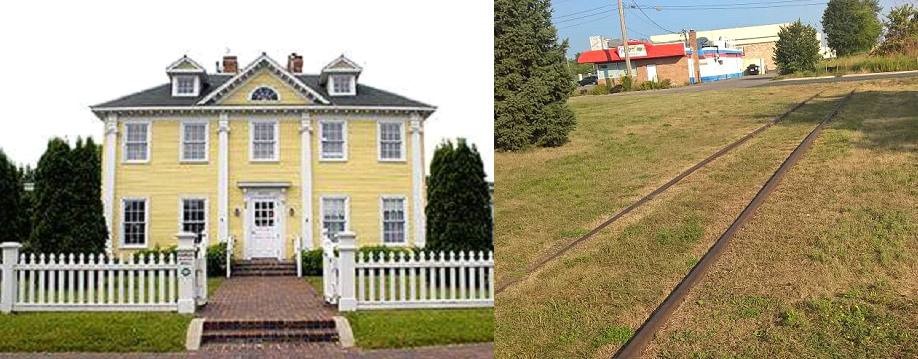
Longfellow House and remains of trolley tracks

Mixed metaphors: ships and trains. Minneapolis has a replica of Longfellow’s famous house, if you look closely outside it, you can find remnants of trolley tracks that now start and finish under the earth.

.

As we noted back then,  Longfellow’s 19th century American poem was sent by Franklin Roosevelt to Winston Churchill during the darkened days of WWII in the middle of the 20th. Maybe it speaks to Longfellow’s country here in our 21st century. The player to hear my performance of Longfellow’s “Sail On, Oh Ship of State”   is below.

.

.

Sail on, Oh Ship of State!

Claude McKay led an outsiders’ life, Allen Ginsberg became a near celebrity bohemian whose outsider status changed over his life. The author of today’s poem in our Independence Day series was more well-known than Ginsberg in his day, and he was as far from being an outsider as any American poet could be. At one time, as many knew and read his poems as Edgar Guest’s, and he was a much better versifier.

So, do you know today’s poem from the above title, or from the name of the longer work from which it’s excerpted, “The Building of the Ship?”   It’s highly unlikely that you would. The American writer Henry Wadsworth Longfellow went from being the stuffy square’s square, the kind of writer that Modernists didn’t want to be, to a forgotten man, the writer that no one remembers even to reject. He was a civic poet, a poet’s role that no longer exists in white America. Along with a handful of other men, most of whom he knew, he sought to create an American poetry in the first half of the 19th century when the American experiment was still new. After all, when he was born in 1817, many who celebrated July 4th were around for the July 4th!   And for much of his life Longfellow lived in a house that George Washington had lived in while commanding the American Revolutionary War troops.

Longfellow_National_Historic_Site,_Cambridge,_Massachusetts

George Washington lived here, and later so did Henry Wadsworth Longfellow. And a child named Darby Vassall. Haven’t heard of that last one? Read on.


In 1855, an elderly man visited that house where he had been born in 1769, meeting with Longfellow there. The man’s name was Darby Vassall, and this was the nature of his birth: he was born to enslaved Afro-Americans owned by the owners of that big house, which made him a slave by law from birth. When the Revolution came, his masters sided with the British, and so after the Battle of Bunker Hill, the owners skedaddled off to safer British-controlled territory. This left the house available for the new Revolutionary Army’s commander, General Washington, as spoils of war. Washington left his short-term smaller quarters and went to the big house to move in.

And here’s the story Darby Vassall liked to tell about meeting The Father of Our Country. There he was, six years old, and the revolution had by accident empirically freed him. He was swinging on the gate of the very house Longfellow now lived in, a time-honored childhood pastime then and now (see also sutures and Colles’ fracture.) General Washington, impressively tall for his time, and like the house’s absent owners, a rich slaveholder who traveled with an enslaved manservant, asked the boy if he would like to work for the new occupant, this man who’d become so honored and famous that people even now buy his portrait for something between 25 cents and a dollar.

Darby kept swinging, sizing up the tall white man, and then asked “How much are you paying?” Darby says Washington kind of lost interest in the conversation at that point—because, you know, slavery. He looked like a gentleman Darby later recounted, but “He was no gentleman.” Now that’s an Independence Day story!

We don’t know all Vassall told Longfellow about the house Longfellow now lived in, but the stories must have been interesting. The best-selling author blew off a meeting with his publisher to hear them all.

Have I forgotten to talk about Longfellow’s poem? No, this is another poem for our July 4th series. It comes at the end of a much longer poem Longfellow published in 1850, one that less than nobody reads today. The entire “The Building of the Ship”  is an allegorical story of a venerable ship builder* who with the help of a crew including a younger apprentice builds a ship for a merchant, more magnificent than any the builder has ever built. While building the ship, the apprentice and the master ship builder’s daughter fall in love, and the old master promises that on the day the ship launches his daughter and the apprentice will be wed. After many supple verse lines detailing the construction of this ship,** it’s complete and it launches with a epithalamium in which the new and lovely ship is embraced as a bride by the timeless, older, gray sea.

If the poem ended there it’d remain a curio of interest to scholars today, a romance in a European style adapted with distinctive American details and accomplished in English verse with a difficult rhyming scheme that never grates or seems fake, the sort of thing that is easier to do in French or Italian.***  But Longfellow had an envoi of sorts. The ship, as all man-made things do, would eventually wear out and come to a wrecked end. A downbeat, look-at-oneself-through-the-grave warning that would also not be out of place in romanticism.

This whole poem, along with that ending was sent to the publishers.

Then Longfellow called it back. He had a revision, with an entirely new ending. You can read the old ending and the story of the last-minute revision here. Not only is the new ending upbeat, it seemed to retroactively change the poem that proceeded it. That boat-like-a-bride thing was still there, but the ship was named “The Union,” and in those manifests of the things that made the ship, the entire young country seems to be the source. The Union becomes not just a marital union, it becomes the United States.

Here’s where that civic poet role comes into play. In the dozen years leading up to the Civil War, the delicate balance of slavery’s evil in a democratic country was becoming harder and harder to keep from spilling, the compromises seeking to keep the country in existence more and more difficult to negotiate. Longfellow’s new envoi, the one that I perform today, may seem anodyne if considered as an abstract statement of patriotism, but in 1850 it was a considered second-draft meant to say that ideals of the American experiment should continue, needed to continue, because those ideals, those plans, however imperfectly applied are contagious (in a good non-Covid-19 way). Enough for a small 6-year-old to stand up to Washington for example.

Now if we are to consider inspirational Afro-American patriotism, the best story that is likely not true is that Winston Churchill once quoted in a public speech Claude McKay’s “If We Must Die,”  a Black man’s valiant ode to self-defense written after the deadly “Red Summer” of 1919, but then applied during the darkest days of Great Britain standing against Nazi-occupied Europe. No one has such a transcript or recording. But there is  a recording of Churchill reading a section of the abolitionist**** Longfellow’s envoi during that time in a speech of endurance in 1940.


Maybe the strangest thing about this ship and it’s sailing on, even as the maker of the poem has slipped away from public consciousness, was “Sail on, O Ship of State”  being quoted in Leonard Cohen’s “Democracy,”  his excellent ode to the need to continue the American experiment, however flawed, because it’s flawed.

The player gadget to hear my performance of Longfellow’s “Sail On, Oh Ship of State”  is below. I’ll note that my performance has some flaws that I’m accepting for now in order to get this out in a timely manner, but the spirit is there. Happy 4th of July though it be just one date. May freedom and independence come to all of us. The revolution is plural.


*Though Longfellow lived and wrote much of his work in Cambridge Massachusetts, he was born and educated in Maine, and even at this late hour he probably vies with Stephen King and Edna St. Vincent Millay for the title of most well-known writer from Maine. Maine was a shipbuilding center in the 19th century and so the poems extended allegory of shipmaking was local color to Longfellow.

**I’m no expert here, but those who know about early 19th century American shipbuilding seem to feel that Longfellow got the details of ship design choices and construction right.

***Many prosody theorists think that rhyming English poetry is a mistake, as we have many fewer rhyming word-endings than other European languages. Longfellow’s poetry may not be to modern tastes, but one thing he did have was a non-forced and impressive “flow” in the hip-hop/rap sense.

****Among the favorable reviews from abolitionists: Thomas Wentworth Higginson said of “The Building of the Ship”  “The most complete and artistic which he ever wrote.” Lincoln was said to have quoted the envoi lines in private to his secretary as the Civil War broke out—and broke down in tears before he could finish them.