In Just Spring

It’s the first day of Spring.

This E. E. Cummings poem is often read as delightful. And it is. It’s also a poem some encounter in childhood. At least in my youth, it was an anthology favorite that vied with Carl Sandburg’s “Fog”  as an introductory example of free verse. And no verse is ever more free than this: the letters smattered like mudprints all over the page, capital letters not yet grown, stuff smushed together. No colonnaded sonnet, no astringent exhale of meditative breath like a haiku. On your poetic menu, this is a mudpie for Spring.

Is it just this?

I set it to music. That’s what this Project does in Spring, and Fall, and Winter too. Every chord in the music I made today is a minor chord. Is this a sad poem, did I want to force it to be one? Not that simple. Just lowering the 3rd note in a scale a half-step to form a chord from it, is that really determinative? These are just sounds playing together.

But this is a considered song about Spring and the distance in half-steps from childhood, not just some neutral exhalation of it. The poem itself grew up, or blew up, over a few years. It was first submitted for a class assignment by a Harvard college student in 1916, and that version, while free verse, lined up this way.

In Just Spring 1916

I found this excerpt of the original version of the poem in a section on Cummings written by Michael Webster included in A Companion to Modernist Poetry published in 2014.

.

That college student would soon go overseas into a world war as an ambulance driver, and Cummings and his cohorts there took exception to simplistic war piety. I’d guess the logistics of suffering didn’t firm up the young man’s patriotism. In something I see echoed in this week’s American news, his talk was deemed an imprisonable thing to say, and Cummings was imprisoned in France. It’s one thing to write free verse, it’s another to convert the currency of one’s free thought into loss of freedom. I wonder if at this point the blood-soaked mud of WWI’s trenches were known to the young man. Anything but mud-luscious.

Cummings had enough luck or privilege to be released. In 1920 The Dial  publishes a new version of that college poem. In a few years more this magazine would publish an expatriate American’s poem that indicted Spring, starting “April is the cruelest month…” But this is Cummings’ poem, and this is how it looked on The Dial’s  pages.

in Just-spring dial 1920

On first publication it’s largely the poem we now know, but it doesn’t have a title. And curiously, the second instance of balloonman is “balloonMan.” Did a proofreader just get exhausted editing Cumming’s manuscript?

.

In 1923 Cummings published a poetry collection, Tulips and Chimneys. He put the still untitled poem in a section “Chansons Innocentes” (Innocent Songs). By innocent did he mean from childhood’s sensibility, or a plea of not guilty? And this is how that version went.

In Just Spring Tulips and Chimneys 1923

Nope, the balloonman to balloonMan thing must have been Cumming’s intent.

.

We’re near the final version, but at some later date (I’d assume a selected or collected poems publication) it converted its first line (strictly constructed) into a title with some typographical marks to make it look like Cummings was establishing Bon Iver’s song titling methods a few decades before the bard of Eau Claire. In the end, the poem that a lot of folks informally recall as “In Just Spring”  is [in Just-].   I can’t help but read that title as a pun.
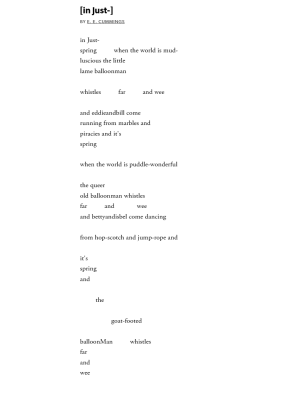
In Just Spring final 400

Here’s how the poem in it’s final form appears collected on the PoetryFoundation.org web site. “Just” is the only capitalization and man stays lowercase.

.

And now decades have past — and I, an old man, have gone to perform this poem for this year’s Spring, and I pick minor chords. Much has past us, dancing toward or running from: another world war, and current cruel wars happening somewhere further than the far distance whistle of the balloonman. Cummings’ childhood was close enough to me that I can actually recall playing marbles in the dry dirt finger-writ circle of a schoolhouse playground.*  I know how a hopscotch chalk field is laid out. Do children still jump rope with rapping rhymes, and if not, what has poetry and hip-hop lost? If there’s a balloonman, his creatures are mylar and determinedly decorated no doubt. All this 20th century stuff is now as archaic as the arcadian goatfoot-god Pan who whistles like escaping air. I, and once-girls with names like Betty and Isbel, know this. Now, as I experience the poem this year there’s more distance there than there was for a twenty-something poet who wrote it. I put a distance far and wee in the music — for Cummings was of an age that he knew he was to be an adult now, while still young enough in years to know within his body’s memory the lost experience of the playing children delighted at the balloons. Balloons that would either fly away or deflate — escape/ascent vs. air loss or a pop as sharp as a bullet.

It’s the first day of spring. My chords have a third a half-step deflated. Disordered self-important dolts are running things, and I think better to have an old halt body with a bouquet of floating hearts. If the world can still seem puddle-wonderful — to be aghast is not to wonder. So, I must recall how to wonder, far and wee.

You can hear my performance of E. E. Cummings “In [Just] spring”  with the graphical audio player below. Did someone let go of the string and a player is blown away? Don’t whistle, just use this highlighted link alternative that will open a new tab with its own audio player.

.

*And playing pirates without extra-faceted dice, is a lost quattro too — but I wonder if Cummings was thinking of Barrie’s Peter Pan  in choosing that manner of play. I’ve just finished watching an absorbing 2022 TV documentary series called Wonderland on BBC Select that often asks over its episodes how much childhood trauma, WWI, and social injustice informed English children’s literature a hundred years ago.

Two Aunties: Fenton Johnson’s transition to Modernist free verse

There’s a great deal that remains unknown about the poet I’ve been featuring here this month: Fenton Johnson — but then again, there are some things that I’ve been able to learn about him since I first began performing his poetry as part of this Parlando Project in 2018. Today’s piece, though late in my month-long series on this pioneer American Black poet, comes around to where I first encountered Johnson: as a Modernist, free-verse poet.

The previous posts this month are from two book-length collections Johnson published in 1913 and 1915. While it’s only speculation, it’s not uncommon for poets to collect work done over a few years, particularly for a first book. Accounts I’ve read say Johnson wrote poetry (and at least one locally produced play) while a student, so it’s plausible that some of the poems included in his poetry books could have been written even earlier in the century. English-language Modernist poetry started to be published around 1909. Within the next decade we see new forms begin to spread out based on concision, fresh imagery, unusual or prismatic scene-focus, and freer and non-regular rhyme and meter. Americans are conspicuous in this new movement. In 1912 Ezra Pound published his famous ultra-short poem “In a Station of the Metro.”   Living overseas, Pound starts promoting the new style as the foreign editor for the new Poetry  magazine, and he submits to them short poems by Hilda Doolittle (freshly renamed as H. D.)  In 1913 Pound and F. S. Flint compile “A Few Don’ts by an Imagiste”  which was published as a manifesto of the new style in Poetry. The next year Midwesterners Carl Sandburg started publishing the new free-verse style in Chicago and Edgar Lee Masters placed his initial Spoon River epitaph poems in Reedy’s Mirror out of St. Louis. In 1915, T. S. Eliot, another American ex-pat, publishes Prufock, and in New York a young poet Alfred Kreymborg gathers his friends to start a small literary magazine explicitly dedicated to the new forms. He titles it, in honor of the insurgent outsiders, “Others.” These others included William Carlos Williams, Wallace Stevens, Marianne Moore, Man Ray, Mina Loy, Orrick Johns, and Lola Ridge, all of whom were U.S. East Coast based. Also in Others:  Pound, Sandburg, and Eliot — and eventually, our Black man from Chicago, Fenton Johnson.

If Fenton Johnson is lesser-known, it’s possible he’d be on an even greater level of historical obscurity if he hadn’t been published in Others.  Sitting here in 2024, I can retroactively maintain that some poems from Johnson’s books of 1913 and 1915 are proto-Modernist through using Afro-American oral and musical forms, even though the bulk of his books are like the poems I shared early this month: poems in 19th century forms.* From what I can see, Johnson’s work came to the attention of New York based Afro-American focused cultural critics and anthologists not because of those two book collections, but because of how strikingly different this 1919 free-verse little-magazine published poetry was, and the visibility of the cutting-edge Others  to NYC-based critics. When James Weldon Johnson created his first-of-its-kind collection The Book Of American Negro Poetry  in 1922 he included several poems by Fenton Johnson — but instead of the paragraph or two praising their strengths offered for many of the poets in his introduction, he says only this: “Fenton Johnson is a young poet of the ultra-modern school who gives promise of greater work than he has yet done.**” I read that hands-off briefness as meaning “Well, he’s doing something different, some are noting that, so I include him.” Despite that lack of enthusiasm by this early Black anthologist, one of the included poems, “Tired,”  has become Fenton Johnson’s most anthologized poem — the one that to this day is included in many Afro-American poetry anthologies. Besides being an early Afro-American to write in free verse, “Tired’s” prominence and Johnson’s mysteriousness has also given Johnson the air of a fierce political radical. In the next post in this series, I’ll tell you what I’ve found out about that.

Since it’s such a striking poem, and because “Tired’s”  free verse has become the predominant literary poetic style as the century progressed, that mode of Johnson’s poetry remains fixed in cultural memory to represent him. You can view a “lyric video” of my musical performance of “Tired”  at this link.  All of Johnson’s 1919 Others  poems (eight in total) are also in free verse, and today I’ll present two of them combined in one performance: short poetic portraits of a pair of older Black women that would be invisible to the society and the culture. “Others” indeed.

Fenton Johnson Two Aunties

Here’s how the two poems appeared in the February 1919 issue of Others

.

This time my accompanying ensemble is a rock quintet. You can hear it with the audio player gadget likely available below. No player? This highlighted link is a backup, and if you click it, it will open a new tab with its own audio player.

.

*Other Afro-American poets retained traditional metrical-syllabic and rhyming prosody used by Johnson’s original model Paul Laurence Dunbar. Jamaican Claude McKay who moved to the US after WWI published excellent formal verse, as did the younger poet Countee Cullen. Other less-remembered Black poets of this WWI through the 1920’s era worked largely in the older, established prosody. Just as Fenton Johnson was early in adapting Afro-American preaching and musical styles into his poetry, his early use of free verse predates the Harlem Renaissance.

**In a later 1931 edition there are apparently more extensive remarks by Johnson on Johnson, but I have yet to find anything other than excerpted quotes — but from those excerpts it seems James Weldon Johnson was troubled by what he saw as radicalism and despair in Fenton Johnson’s poetry.

Branches

This project’s subtitle Where Music and Words Meet  portrays its interest in the ways words, mostly poetry, might interact with music. How that works varies. I use different kinds of poetry, and different ways to combine those words with the music written for this project.

Song lyric writers, who intend their words to be sung from the git-go usually rhyme their lines, and most song lyrics are at least roughly metrical. That practice has continued even as free-verse without regular rhyme and strict rhythm became a substantial portion of literary poetry written for the page.

None-the-less, I find it’s often easier than you might think to sing free-verse. Here’s the text of today’s piece for our celebration of #NationalPoetryMonth: “Branches,”  by one of this project’s favorites, Carl Sandburg:

The long beautiful night of the wind and rain in April,
The long night hanging down from the drooping branches of the top of a birch tree,
Swinging, swaying, to the wind for a partner, to the rain for a partner.
What is the humming, swishing thing they sing in the morning now?
The rain, the wind, the swishing whispers of the long slim curve so little and so dark on the western morning sky … these dancing girls here on an April early morning …
They have had a long cool beautiful night of it with their partners learning this year’s song of April.

One thing I notice right away that lets this take to singing: it’s ecstatic. Some of the sections of what has been our April National Poetry Month staple for the past few years, Eliot’s “The Waste Land,”  are hard to cast into singing — even though that poem as a whole is very musical with its repetition and its outright references to musical pieces. Parts of “The Waste Land”  use mundane dialog purposefully, and it’s difficult to sing that sort of thing without transforming its nature. “Branches” too uses repetition, along with sound-tricks like words that sound like what they are describing (swishing sounds like the word “swishing” for example). Repetition can stand-in for rhyme to some degree. Free-verse irregularity of lines is less of a problem than it might seem. Music is fully capable of filling in spaces where syllables aren’t, and it can be made comfortable too with melodic lines of various lengths.

Carl Sandburg himself is an interesting combination of words and music. Besides his early and vital contributions to American Modernist poetry, he was also an important collector and popularizer of American folk song both by playing and singing those songs himself, and by the 1927 publication of his significant early anthology of them The American Songbag.  I haven’t quite nailed down just how important he was in those matters, but I think it’s possible that without Carl Sandburg there’d be no Woody Guthrie as he was, and going forward from that, no Bob Dylan as he was and is.

Sandburg_with_guitar

When performing them, Sandburg accompanied those folk songs himself with guitar

.

I’m not alone in liking to set Sandburg to music, though I’m not aware that Sandburg himself ever did, oddly enough. I perform his “Branches”  today with just acoustic guitar, nothing fancy, just as Sandburg himself could have. The player gadget to hear me perform it is below, or if you don’t see that, this highlighted hyperlink will play it too.

.

Song of Myself (I Contain Multitudes)

Is he joining me in celebrating National Poetry Month? Last week Bob Dylan released a new song called “I Contain Multitudes.” It’s pretty good, mixing the elegiac mood and the bittersweet blues. Like Dylan’s other new release, “Murder Most Foul”  from earlier in the month, folks quickly swept through the lyrics to collect and note the allusions. They found that “I Contain Multitudes”  has literary references mixed in with the musician and cultural touchstones. Poets William Blake and Edgar Allan Poe get name-checked.

But for some reason, the main poetic link Dylan seems to intend was missed in most of the early write-ups I read. The song’s refrain, which also supplies the title, is a line from Walt Whitman’s “Song of Myself.”  We’re going to fix that today.

Over the years of this project I probably haven’t presented enough Whitman. He’s the indispensable ice-breaker of poetic Modernism, even for those that didn’t attempt to closely follow his style. By writing in free verse with no set line length, irregular meter, and no need to make the rhyming word, he freed poetry to be infinitely expansive and did for poetic music what Ornette Coleman and John Coltrane did for instrumental music. Once this idea of freedom was demonstrated, any number of other Modernist approaches eventually developed, some of which don’t directly bring Whitman to mind as a model, though that doesn’t mean that they didn’t benefit from his revolution.*  And some subsequent writers did  show the influence of Whitman’s characteristic word-music: Carl Sandburg, John Steinbeck, Woody Guthrie, Allen Ginsburg. Stop for a minute: all three of those writers—all examples where one can trace the lineage of Whitman easily—are influences on the language and expression of Bob Dylan. Whitman, like Dylan, loves the wide-ranging catalog, the linking of things plain and exotic, the workman’s comment and the sage’s koan.

So maybe it was time for Bob to give a nod to Walt—and for me to do so too.

I’ve chosen today to present the last two numbered poems in Whitman’s “Song of Myself.”  Besides the “I contain multitudes” line, this selection also includes some other of Whitman’s most famous proclamations: “Do I contradict myself? Very well, then I contradict myself,” “I sound my barbaric yawp over the roofs of the world,” and “Look for me under your boot-soles.”

Walt and Iggy

Barbaric Yawp in action: “Every atom belonging to me as good belongs to you.” Well, maybe if you take off the hat and remove your shirt Walt.


Although I approach Dylan’s age, yet somewhat in arrears, I’m not going for the old-man lope of Dylan’s recent songs today.** No. It’s time to rawk!   My personal index-thought as I composed, arranged, and started to perform this was “Whitman as if done by Iggy*** and the Stooges.” As with many of my index-thoughts in this project, I missed the mark, but that’s OK, maybe I came close to the bulls-eye of another target nearby. Since I long for the sound of a loose and loud rock band in these days of social distance, I tried to make one myself for this piece, even attempting to duplicate the kind of thing my LYL Band partner Dave Moore might have played on piano when that was possible. My shelter in place partner Heidi Randen kicked in some backing vocals on the chorus. It took me to this morning to get a time when I could crank a guitar amp to get the feedback and speaker interaction for the Ron Ashton-style guitar solo, which I scheduled between my high-schooler’s interactive telelearning sessions.

As always, the next audio piece will likely be different than this one, so check back (or hit “follow”) to see what the Parlando Project does next during National Poetry Month.

The full text of the long poetic series “Song of Myself”  is available here, the sections I perform are the last two, numbered 51 and 52. The player gadget to hear the performance is below. Turn it up!


*I believe that even poets who chose to write in rhymed and metrical forms after Whitman can benefit from his break. Formalism became a choice not an obligation.

**I do that in other pieces here anyway.

***I note that secret reader Iggy is taking part in an all-star group performance of “The Rime of the Ancient Mariner”  this month. You can check out the readings as they are posted starting at the beginning here.

Self-Pity

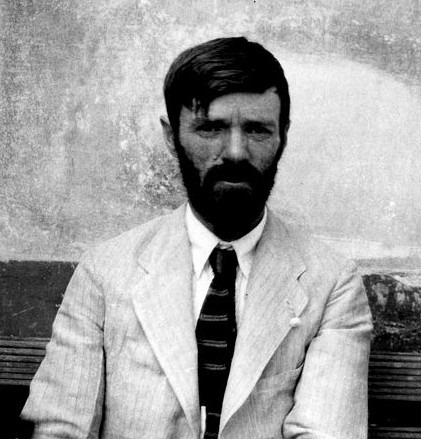
Like Thomas Hardy or James Joyce, D. H. Lawrence is another writer remembered more as a novelist than a poet, though he published multiple books of poetry in a variety of forms in the early 20th Century.

He’s hard to place in the various “schools” of poetry of his time. He was published in Imagist anthologies, but he is also sometimes grouped with the Georgian Poets who eschewed free verse, though he often wrote free verse. He sometimes wrote compressed epigrams like the one I present today. “Self-Pity”  looks like a Modernist short poem on the page, but it doesn’t aim to work like most of those poems on the reader or listener.

DH Lawrence  by Bynner

1923 photo of D. H. Lawrence by Witter Bynner


Oh “Self-Pity”  uses all the devices of poetry, save for rhyme. It’s loosely iambic with anapestic moments in meter, though the line lengths are uneven. This is consistent with much free verse, which still wants the beats of the words to be felt, without lock-step marching drills. It has a vivid image (the frozen, falling bird). It has a repetition (“sorry for itself”).

Why then does it seem different from other Modernist poems? Contrast Lawrence’s “Self-Pity”  to two other contemporary-to-it very short poems: William Carlos Williams’ The Red Wheelbarrow  and Carl Sandburg’s Fog”.  “The Red Wheelbarrow”  puzzles readers to this day about its message, other than it wants the wheelbarrow to be clearly real. I think it’s about the beauty and dignity of work and its tools, but perhaps I’m wrong. You may not draw any meaning at all when you first hear or read “The Red Wheelbarrow.” “Fog”  attracts immediately with its metaphor of silent fog and haunches-poised cat. It may seem to you at first a show of how metaphor cleverly works. “Wow, fog and a cat, I never thought of them together. Cool.” It’s only if you hold the poem longer in your mind and heart that you may ask why the fog/cat is at the harbor, that it’s not a pampered pet, but a feral or work animal.

“Self-pity”  is more directive. Many who hear or read it will get the point the first time. Yes, that frozen dropping bird is a vivid image, but it doesn’t lead off the poem, it comes after half-way, and it’s meant to work not as something the poet saw, but as an imagined image to illustrate his point.

Which way is the right way to go about it? That’s for you the reader/listener/writer/performer to decide. The Internet tells us some folks find the direct and pointed message of “Self-Pity”  helpful to them. I myself could stand to be reminded of it sometimes. Literary poetry of the 20th Century gradually made the decision to go with the non-directive imagery way, not with the more frankly didactic aims of Lawrence’s poem. Current writers and readers will get to re-decide this issue for our maturing, teen-aged, century.

“Self-Pity” was used in a Hollywood depiction of military training.  I imagine a Pythonesque skit where John Cleese or Graham Chapman submits other poetry to raw recruits. “I saw the best minds of my generation destroyed by madness, starving hysterical naked!” “Suppose an opponent comes at you armed with plums. So sweet. So cold. What would you do?” or “You are a pair of ragged claws scuttling across the floors of silent seas.”


What do I think? After all, this is the Internet. I must  have an opinion!

I’m eclectic. I don’t want poetry, or any art, to always work in the same way, to stop surprising me. If I could send myself back and offer advice to Lawrence on his poem, I’d tell him to spend more time on that bird before he tells us what the bird means. By not giving me the sense that a real human stood cold or bundled up or on the warm side of a window and watched that instant, that small bird, ruffling their feathers to hold what warmth was still there before the perch became its last, the poem loses potential power for me.

Thomas Hardy may have imagined his winter darkling thrush entirely as a useful image, but I feel that encounter with his bird. I’m convinced Rilke actually looked at an amputated and archaic torso of Apollo and wanted to see its present state fully before he delivered his reaction. I think Lawrence wanted to make a point, and that bird was a useful slide in his deck.

But that may be sentimentality on my part, and too much of that can be stifling and predictable. And perhaps the poem would loose some of it’s epigrammatic power. How often we see by opposition.

Musically, I spent a good deal of time on the drums/percussion for this track, trying to pull out the vibe of “Self-Pity’s”  meter. With the rest of the music I tried to balance my reaction to Lawrence’s resolution while transmitting the assertion of the epigram itself. To hear it, use the player below.


I Am the Clod that has Taken Wing

Those new here may not know that the Parlando Project intentionally varies the words and writers whose work we present, and the types of music that we combine with them. We tend to use poetry as our word source, because compression and musical expression is baked in, but we don’t always use the most famous poets or poems (though I do enjoy trying to find something new in a well-known poem too)*.

Because obtaining rights to present poetry has difficulties, most of what you find here is from before 1923, but that doesn’t mean we won’t surprise or puzzle you with our authors. Today’s piece was written by Muriel Strode, who is an extreme case of biographical and critical obscurity. Almost nothing is known about her, and rather than Wikipedia, or one of the online poetry-promoting orgs or education sites, what info I could gather about Strode is largely from a single blog post.

As it often is with me, finding out a few things about someone opens up further questions. The bare bones reported in Terri Guillements’ blog post, partially informed by surviving relatives, is that Strode was born in 1875 in a rural township in Illinois, south of Galesburg where Carl Sandburg and Don Marquis spent their youth at nearly the same time. Her father was a “naturalist, teacher, and physician” and her grandparents were pioneer farmers and settlers according to Guillements. Her mother died when she was around 13 and her father remarried. At around the same time as her father’s remarriage, it’s said that she left home at age 15 (1890) to attend a business school, and a year later she started work in Long Beach California as a “stenographer and typist.” No context is given on this, but the remarriage and move far away from her childhood home happening at near the same time does lead one to suppose some friction.

The next markers in her life come in 1906, 15 years later. Guillements’ says Strode was able to buy two parcels of land in the Signal Hill area of Long Beach and the same year move to New York City. Also in 1906, Strode published her first book My Little Book of Prayer with Open Court Publishing out of Chicago. Open Court was the closely held venture of a German immigrant who had made it big in the zinc business, Edward Hegeler. Hegeler was a believer in something he called “the religion of science,” discussed briefly and tantalizingly in his Wikipedia entry, and Open Court worked to promote those ideas.

My Little Book of Prayer  might seem puzzling without those connections. It’s not a prayer book in the usual American Christian sense. God, even implied, is not present in most of its entries, nor are any conventional religious texts or figures present to an appreciable degree. The entries are short, aphoristic, and poetic enough that one might consider it an early book-length work of American free verse. On the other hand, they don’t exactly seem to want to work as poetry as Pound or the English and European Modernists were re-casting it. My Little Book of Prayer reads more like a self-help book expressed in strongly worded and rhapsodic affirmations. The general attitude is the that with the too-rarely understood right goals and attitudes, human potential is unlimited. You start out thinking this is Stuart Smalley in 1906 guise, then wonder if you aren’t reading a follower of Ralph Waldo Emerson, and finally end up considering if you are reading a very concise American and female Friedrich Nietzsche.

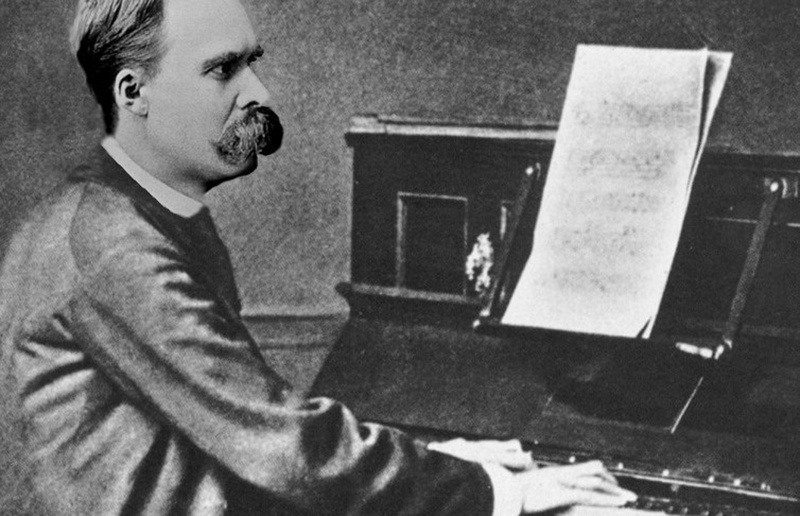
Nietzsche-piano

For today’s audio piece we feature Fred “Sonic” Nietzsche on the keys. Makes me think of the Bonzo’s “The Intro & the Outro”—which is a very good thing!


None-the-less at the beginning of The American Century as education, industrialization, science, and an expanded political franchise were in motion, the book seems to have struck some sky’s-the-limit chords. The St Louis Globe-Democrat published this breathless notice:

If you want to know the greatness of a soul and the true mastery of life, apply to the Open Court Publishing Company for a slip of a book by Muriel Strode, entitled simply ‘My Little Book of Prayer.’ The modern progress of sovereign mind and inner divinity from the narrow cell of the ascetic to the open heaven of man made in God’s own image, is triumphantly shown in it, yet a self-abnegation and sacrifice beyond anything that a St. Francis or a Thomas a Kempis ever dreamed of, glorifies the path. To attempt to tell what a treasure-trove for the struggling soul is in this little volume would be impossible without giving it complete, for every paragraph marks a milestone on the higher way.”

How Strode hooked up with Open Court and its philosophy is one mystery. Even Strode’s southern Illinois childhood is not in Chicago’s orbit, and we know too little about her parents’ social class or connections. One theory that occurs to me is that somewhere in that Stenographer/Typist job title was an intelligent and ambitious woman who made social, commercial and philosophical connections with entrepreneurs and businessmen in those 15 “lost years” that may have been in California.

One piece of evidence for that: two years later she married Samuel Lieberman, “the president of an iron and steel firm in Chicago where Muriel had worked.”

Today’s piece, taken from her later work, 1921’s A Soul’s Faring Instead of Open Court, this one was published by Boni & Liveright, a New York-based imprint much associated with literary Modernism.**  By this point someone had dubbed Strode as “The female Walt Whitman,” and her free verse is, if anything, more unabashed and heroic*** than Whitman, which takes some doing. One has to be of the right mind to read much of it—it’s so over the top. The same Nietzschean philosophical concerns remain from her Open Court books, and the individual, roman-numerated, sections are barely longer at times than her earlier aphoristic “prayers.” There may be a growing mysticism entering into the work as well as elements that at times echo deep-ecology thinking about nature.

After reading three of her books, doing this research, and working on incorporating something I took from the XXXV section of her “Songs of the Strong”  inside A Soul’s Faring, I still don’t quite know what to make of Muriel Strode. The gushing visionary true-believer attitude, even for a reader such as myself who enjoyed William Blake as a young man and who also appreciates Whitman is just so strong, and some underlying “Like attracts like” Law of Attraction elements seem unavoidable.****  So, I can’t say I’ve become a fan, as much as I must acknowledge her audacity and extremity of expression. Perhaps she’s best taken in small doses, in disconnected aphorisms?

In seeking to maximize that element in Strode’s poetry, I’ve adapted her poem, trimming even this already short work back even more, and turning one of its lines into a refrain. And for music? Well, I told you at the start we like to mix things up. Our last piece was orchestral, featuring strings and English horn, but today’s piece, which I call “I Am the Clod that has Taken Wing”  in my adaptation—it’s metal, and of the sludgy type. Maybe in honor of Open Court and the Gilded Age Mr. Hegeler (who must be a Galvanized Age figure), it’s “Heavy Zinc?” Metal is a type of musical expression where you can say anything, no matter how outrageous, and get away with it; so maybe that fits in an odd way, which is what we do here at the Parlando Project. Here’s the player to hear it.


*If you’re not in the mood to adventure into this unusual story of a small town girl who makes her way in the world and some transitory literary notice, our archives here have lots of  better-known poets from this same era and before.

**You, and the world, may have forgotten Muriel Strode, but Boni & Liveright were the first American publisher of William Faulkner, Ernest Hemmingway, E. E. Cummings, Jean Toomer, and Hart Crane and the US publisher of T. S. Eliot’s “The Wasteland.”  So, between the boards, Strode was in high-lit company.

***There’s also an erotic element in A Soul’s Faring  that might remind one of Whitman.

****What we know of Muriel Strode’s life story reads like a romance novel, doesn’t it? Here’s one more novelistic touch, and if you’re a skeptic about the “Law of Attraction,” you’d best ascribe it to a failure of authorship: those two parcels of land Strode bought before leaving California? Turns out about the time A Soul’s Faring  was published, they found oil under them. Lots of oil. If you listen to today’s audio piece over and over, and perhaps play it backwards, who knows what riches will come to you.

The Black Riders XXXIX

In my episodic way here, I’ve touched on the rise of Free Verse in Modernist poetry. Free Verse poetry may still be rhythmic and musical, but it follows no strict meter, nor does it use any rhyme scheme. Now an established tradition, it came to poetry written in English in a non-straightforward way.

I think we can largely assign this happening to Walt Whitman, the American who was writing verse with eccentric line lengths and no rhymes by the middle of the 19th Century. Whitman did not immediately gain imitators in English, but French poets like Jules Laforgue took up the cause of Vers Libre later in the century. In Laforgue we can see a direct link from Whitman through his pioneering French translations of the American’s work.

The main thread of the Free Verse revolution for poetry in English then jumps to England, where before WWI Britons F. S. Flint and T. E. Hulme made common cause with American ex-patriot Ezra Pound. Pound must have certainly been aware of Whitman (more on this later) and though I’m unsure if Flint or Hulme knew of the American poet, all three shared an interest in Modernist French poetry.

I can only surmise, but in starting their Free Verse revolution, it may have been advantageous for this small group to present this as a French idea rather than as an American one. At the beginning of the 20th Century, France was an established cultural force, a place from where new intellectual and artistic ideas were expected to emerge—and in painting and music Frenchmen were the leading edge of artistic Modernism then in a way that Americans were not yet.

This strange path, from America to Paris to London misses one poet, a too often forgotten writer of Free Verse before the 20th Century, Stephen Crane. As a young man in his early 20s he was introduced to the just-published first collection of Emily Dickinson (1890), and mixing his take on Dickinson’s compressed musings on the infinite with the just-died Whitman’s Biblical cadences and love of parallelism, Crane in 1895 published a collection of short Free Verse poetry “The Black Riders.”  Today’s piece uses the words of one of those short, untitled poems from Crane’s book.

Stephen Crane

Stephen Crane:. He’d written Free Verse when Ezra Pound was still weighing in with sestinas

If, a couple decades later, one of the short poems in “The Black Riders” was to appear in an Imagist anthology, on a quick glance or reading it wouldn’t look or sound out of place, but the pieces in Crane’s collection are not really Imagist poems, not even in the same way that sections of Whitman or Dickinson are. Crane’s “Black Riders”  pieces are too full of abstract concepts and romantic notions—and even though Crane is questioning or mocking these concepts, he’s not presenting the issues through concrete new images as the Imagists would.

It’s interesting to wonder how Crane might have developed if he’d lived a full life, rather than dying at age 28 at the end of the 19th Century. Still and all, here was an American, in America, writing Modernist verse with Modernist attitudes while still a young man and with the 20th Century still on the horizon.

Musically, today marks a return of new pieces recorded with the LYL Band and Dave Moore. The music I compose and play myself can be created over a varied length of time, and in whole or in part, reconsidered and redone. The LYL Band on the other hand, just goes.  When we did some recording this week, Dave told me he was waiting for another instance of us starting off something with no more than my announcing  “G Minor.” Today’s Crane piece “The Black Riders XXXIX”  is not particularly complex or unpredictable musically, but we needed to knock off the rust. To hear it, use the player below.