Let Us Live and Love

A while back here there were several episodes where we discussed songwriters as literary figures, using the springboard of Bob Dylan getting the Nobel Prize for Literature. Dylan was the third songwriter to receive this award, preceded by William Butler Yeats and Rabindranath Tagore. But the Nobel prize is not really all that old, and the idea of the singer-songwriter is older. We know little about how the ancient Greeks performed their poetry, but accounts consistently say that it was accompanied by music, and in the case of at least Sappho of Lesbos, it’s specified that the lyricist played the lyre as well. Similarly in ancient Hebrew, David and his harp, or the west African griots and their Koras, and so on.

So, despite the idea that lyrics sung to music mark an inferior art, or that performing poetry to music is an affectation hardly to be endured, history says this was not always so. Of course, the way it’s done can please or not please, and it’s still possible that such performances are an obsolete form that we’ve now superseded with hugely popular and culturally significant poetry chapbooks and small press poetry collections—I kid! I kid!

Today’s piece is by just such a singer-songwriter, an Englishman born in 1567, Thomas Campion. He wrote his lyrics, wrote music for them, and was an accomplished lutenist, so the chances are that he was discovered by John Hammond and played the authentic Elizabethan blues music he misheard from 78 r.p.m. discs of Catullus. Well no, doubting Thomas, once more I Kyd.
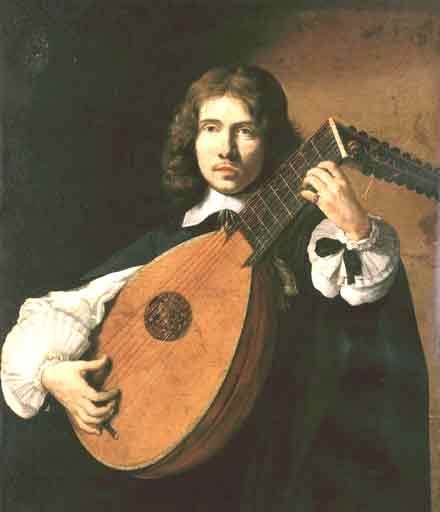
Thomas Campion with Lute

Poetic Campions compose. Thomas Campion with his lute.
If he looks glum it’s because it’s two centuries until Martin Guitars is established, and 350 years until the Telecaster.

He did write lovely songs, in a style I can’t come up with a way to present. “Let Us Live and Love”  was one. You can hear it sung beautifully to his tune here. So instead of exploring my counter-tenor range, I’m going to go with a sort of loose skiffley blues in my performance.

I’m going to lean on my blues audacity hard here, because the poem is addressed to the singer’s lover, Lesbia. Beavis and Butthead style giggles are breaking out in the back, I can hear you.  Turns out Campion took the lover’s name and the idea for his first verse of his lyric from a Latin poem by classic Roman poet Catullus, before taking off on his own thoughts on the matter. Classics scholars explain this by saying the Sappho of Lesbos’ association in classical times was more at a widely experienced lover, not necessarily a lesbian one.

Catullus Comforting Lesbia over the Death of Her Pet Sparrow and Writing an Ode

OK, OK, forget the one about you might as well have sex with me.
How about this, we’re all going to die, just like that bird, and…


Another category “Let Me Live and Love”  could be put in would be a “Carpe Diem” poem, which is not the Department of Natural Resources limit on the number of bullheads you can catch, but is more Latin meaning: “seize the day,” which in the case of poems usually doesn’t mean seize the day for fishing. Instead, Carpe Diem poems usually offer this proposition: “We’re all going to die, so you might as well have sex with me.” Seriously. Poets have actually made that seem like a smooth line.

The twist Campion puts on Carpe Diem is to bend it around a bit. His song has it that you already love me, and that makes the idea that we’re all going to die bearable. That’s at least a little more flattering.

To hear my performance of Campion’s “Let Us Live and Love”  use the player below.
 

Trenches St Eloi

I was talking with my wife this weekend. She’s reading a memoir about current military deployments (and redeployments) and she said a Wilfred Owen poem was mentioned in it.

“Well, World War I was the last war to be covered by poets.” I replied. Which is not strictly true of course. World War II generated a number of poems I’d love to share here, but I have no time to try to track down the rights issues to use words that still may be under copyright. And I suspect other wars have generated other poems since then, even if I don’t know many of them. But that’s not what I meant.

World War I was the last war to be covered by poets.

What I meant was that WWI was the last war in which a considerable portion of the English-speaking public looked to poetry for meaning and consolation regarding the battles and their losses. I’m not sure if they looked to poetry more than journalism or political oratory, but I believe that poetry then still operated somewhat in the same theater as these other words when addressing current events. Longer forms of literature, such as novels, tend to lag events substantially, changing or fixing our view of things afterwards, instead of framing it while the picture is still moving. I think of two epithets, for journalism and then for poetry: “The first draft of history” and “The news that stays news.”

I think of two epithets, for journalism and then for poetry: “The first draft of history” and “The news that stays news.”

This morning, my son wanted to show me this brilliantly parsed cartoon summary of the Iliad. The narrator there has a lot of fun with the meandering and seemingly arbitrary plot of that Greek epic poem, but it struck me that it’s possible that the ur-version of the Iliad might have been written contemporaneously to the events, only to be shaped afterward like a collection of old news dispatches repurposed for later use.
 
So, this is a long tradition in Europe from Homer to the war poets of WWI, for the battles and the experience of the battles being reported in poetry.

Why has this use of poetry, to report current and crucial events, fallen away? The first explanation that occurs to me is we have other media to do this now. Film, radio, video, and now cellphones capture the moment without pretending to rely on subjective art. The Imagists who forged their poetic theory in the years around WWI, would seem to have lost their territory as their theory won the war. A cellphone or nose-cam video of the bomb exploding follows two out of the three famous Imagist rules: The “thing” is treated directly, there are no unnecessarily words (indeed there may be no discernable words at all), while more or less ignoring the less-noticed third rule (the one we at the Parlando Project keep pointing to and speaking about), the one that asks for musical phrasing.

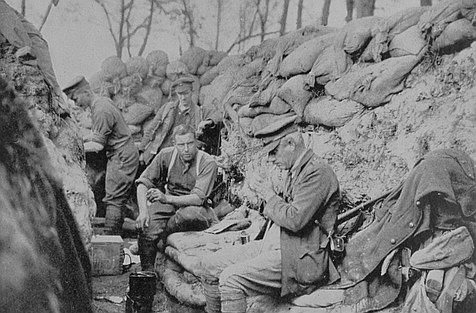
Hulme's company in the trenches at St Eloi
This photo shows men in T. E. Hulme’s Artillery company at St. Eloi in 1915

  
Poetry, like painting, is no longer necessary for reportage. Modernists often chose to respond to this by a movement into abstraction, conveying thoughts in motion and novel conceptions, seeking to demonstrate what can be meaningful without meaning.

Today’s piece “Trenches: St. Eloi”  is attributed to T. E. Hulme, a man who helped form this Modernist revolution and died before he could live in it. I say “attributed” because, like Homer, he did not write it down. The exact attribution is “Abbreviated from the Conversation of Mr TEH” when it was published by Ezra Pound, and it may have been Pound who chose what to transcribe or how to lay out the transcription. My guess is that some of the language sounds like Hulme (the unusual, but so perfect word choice of “pottering,” the homey image of trench soldiers strolling compared to the shoppers on the busy London street of Piccadilly), but the overall arrangement sounds like Pound to me.
 
We know pretty much the where and when that is being talked about, more than we know of the actual history of Troy. Hulme got a chance to relate these details while in an English hospital after being wounded in the spring of 1915 in trench warfare in St. Eloi. He recovered, returned to the war, and to his eventual meeting with a German artillery shell that ended his life.

T. E. Hulme may have said it, Ezra Pound may have edited it and written it down, but to hear me perform it with my musical accompaniment, use the player below.

Two Views of a Lunar Eclipse

We seem to be in a month of sky omens in the Midwest, with the Perseids meteor shower and a solar eclipse following one after the other. Perhaps because solar eclipses are rare, poems about them are rare too. I’m going to cheat then, and present two pieces about lunar  eclipses, a slightly more common event that occurs when the Earth comes between the Moon and the Sun, blocking the moon‘s reflected shine.

I’ll lead off with one written sometime in the 19th Century: Thomas Hardy’s sonnet “At the Lunar Eclipse.”   I remember the moon-trip photos, taken near the middle of the 20th Century, looking back at Earth, where for the first time, we could see our planet whole. Hardy reminds us, a hundred years before that, that we could see our whole Earth in a shadow play during the lunar eclipse.

Whole Earth Catalog

For the first time we could see the big blue marble
…also, composting toilets!

 
Optimists at the end of the 1960s thought these whole Earth pictures would help us understand our solitary yet majestic unity and common cause. Hardy, though he had only the Earth’s shadow during an eclipse to work with, is not so sure.

The LYL Band’s performance of this Hardy poem is a live recording from a few years back and it strains to reach “bootleg tape” recording quality, but still I hope it retains some vitality.  And since this Hardy poem is referenced in the next piece, I’m going to give this rougher recording an airing.
 
Though neither I or the Parlando Project had anything to do with it, if you’d like to hear a restrained and lovely simple solo voice and piano sung setting of the same Hardy poem, you can view it here. To hear the LYL Band performing our louder version of Hardy’s “At the Lunar Eclipse” use the player just below this.

My own lunar eclipse piece is set in our century, and in my Midwestern place. I start off by musing on the same planetary shadow play that Hardy wrote of, but wondering if we were our planet, might we make sport of our standing between the sun and moon, as we did as children when the film strip broke in class, or the slide tray of vacation photos needed to be changed, by making hand shadow puppets in the light. Then, as the blood moon eclipse neared totality, and the dark was dark, save for the streetlight at the end of the block and a houselight here and there left on, every hand up and down the street raised itself to the heavens, holding their lit smartphones, as they took pictures of the moon blocked by ourselves on our planet.

2015 Blood Moon Eclipse

A blood moon eclipse. “Can immense mortality but throw so small a shade?”

Unlike our last pairing, the perennial face off between Marlowe’s Shepherd and Raleigh’s Nymph’s reply, my poem “Lunar Eclipse – The Earth in Transit between the Moon and Sun”  isn’t really an “answer song” or a diss on Hardy. In a lot of ways I wanted more to simply update the scenery of Hardy’s poem. Oh, and that title is awkward, but enough listeners didn’t know the mechanics of a lunar eclipse, that we are in the middle on the earth blocking the Moon from the Sun.

What did I mean by the last line? Well, as I sometimes do, I wanted to mean several things. I wanted to say we thought we could capture this cosmic event that had stopped our routine in with the birthday pictures on our smartphone camera roll. I wanted to say, as Hardy did, that we are seeing the whole of our planet, the lives of all our neighborhoods, yet it is only one disk in the wide sky. I wanted to say that our present, particular lives: all our details, our family, our neighborhoods, our homes—though they are the way we experience living—are but one transit of life. Maybe I wanted to say something else that even I wasn’t sure how to say? If so, I wouldn’t know. Sometimes that happens in poems.

Again, we have the LYL Band performing this piece, but it has better recording quality. To hear it, use this player just below.

The Nymph’s Reply to the Shepherd

There’s a long tradition of “the answer record” in pop music, where another artist responds to a hit record with an opposing viewpoint. Christopher Marlowe’s 1593 “The Passionate Shepherd to His Love”  (our last post) received a similar diss from Sir Walter Raleigh with his “The Nymph’s Reply to the Shepherd,”  which is today’s. Who will folk-rock the mic harder? Feel free to re-listen to Marlowe’s inning before considering Raleigh’s reply, Marlowe’s player is just below:

As I mentioned last time, these poems with their shepherds and lovers, called Pastorals, were proudly artificial, and set in a completely stylized and relaxed world of affection and sufficiency. You may find any desire to dwell in this unreal world strange and old-fashioned, but perhaps we imagine now another kind of locus amoenus/“pleasant place” to dream of going to, to escape the world.

Christian_Wilhelm_Ernst_Dietrich_-_A_pastoral_landscape_with_Diana_and_her_Nymphs,_1754

“Then he was all about rural handicrafts all of sudden. Was he even interested in me?”
“Well, it’s not like taking care of sheep is that hard. A child with a tambourine can do it!”

 
Raleigh’s “The Lie”  has already demonstrated here that Raleigh had no patience with romanticism. So, he’s primed to take on “The Passionate Shepherd,”  but he also notices another weakness in Marlowe’s argument: the Shepherd promises pleasures, presumably mutual pleasures to his lover, but he isn’t stopping there. He’s going to demonstrate his commitment by throwing an entire Etsy shop at her: beds of roses, caps, vests and belts made from woven wildflowers, wool dresses and wool lined slippers. And bling! Gold buckles, coral and amber buttons.

So, Raleigh composing the nymph’s reply has three arguments to make. All those hand-made crafts on offer? Doesn’t move me Shep. Outdoor animal husbandry? Not as romantic as you make it out to be in May, and those wool slippers better be warm if I’m going to be traipsing after some sheep come January. Lastly Shep, you’re all hot and bothered about me now, but just how lasting is all that? I appreciate the offer, but let’s just say I’m keeping the wool lined slippers and you can go try your line on some other nymph?

Wool Lined Slipper

I’m not even sure what a kirtle is, but I understand cold feet at night

Musically, this is another piece inspired by a 1960s folk-rock sound. I was thinking specifically about the musical style of Fred Neil’s Capitol records as I arranged this. I used a minor key chord progression somewhat related to the major key one I used for “The Passionate Shepherd,” and once again I sung this one. Raleigh, if downbeat, is just as lyrical as Marlowe in his answer. Marlowe has pretty lines like “By shallow rivers to whose falls/Melodious birds sing madrigals,” but Raleigh has “The flowers do fade, and wanton fields/To wayward winter reckoning yields.” So, use the player just below to hear Sir Walter Raleigh’s response in song.

The Passionate Shepherd to His Love

Let us leave the Modernists for a moment, for a trip to an imaginary land, a locus amoenus, a pleasant place, within whose bounds certain things hold true: love brings simple riches and complex pleasures ignorant of inconstant affection, and where the cares and complexities of cosmopolitan life, brutal prejudice, and other social constructions fade away.

Such a place can have many names. To the Surrealists it was the unfettered confusion of certain dreams. To the west coast optimists of the Sixties and their cross-Atlantic vibrationalists, it was a new Eden of decorated affection and open-mindedness. To a resident of fetid Elizabethan London, it was the pastoral, a demi-countryside where love was free and the rent non-existent. Shepherds, Pan and Panopticon, willed willing partners to their bowers. It seems like a nice place to visit—and in the mind, even more so.

Christopher Marlowe must have written this pastoral love poem sometime before he died in 1593 (baring any occult forces of the Twilight variety, or the posthumous inspirations that allow Oxfordians to confound Shakespeare’s later plays) but it wasn’t published until a few years after his death. It’s a full-throated exhortation in the pastoral style—with a slippery set of gold-buckled feet at the bottom of its argument as we’ll soon see, though that may not matter. Not only is it lovely sounding, even read flat on the page, the whole point of the imaginary pastoral world and the locus amoenus is that it isn’t real, that it’s the place we want to lie in and be lied to sweetly, within.

Marlowe and Peel

“And we will all the pleasures prove.”  The 19 year old Marlowe and the 29 year old Peel.


In the spirit of all this, today’s audio piece is one of the few Parlando Project selections where I sing, as you can’t really declaim “The Passionate Shepherd to His Love.”   Musically, I chose to use some of the production techniques popular among dreaming optimists in the Sixties, where John Peel’s Perfumed Garden  would be another locus amoenus, another imaginary place, where, in fetid times, we might want to go. This week, 50 years ago, John Peel performed his final  broadcast of that accidental and influential radio show.

To hear Marlowe’s“The Passionate Shepherd to His Love”  performed as if it was a cut being played on the Perfumed Garden, use the player that should appear below.


Strange Meeting

Here is one more war poem from WWI, this one by another soldier poet, Wilfred Owen.

Beside living with the trauma of his war service, Owen was another poet caught in the revolution as English poetry moved from old modes to newer modernist verse. Like his friend Siegfried Sassoon, he was a decorated soldier who came to broadly distrust the case for war. Unlike Sassoon, Owen did not take the risky public stand against the war while it was being fought; but also unlike Sassoon, his fate was to die at the front of the war. Owen’s war poetry was largely published after his death, with Sassoon’s assistance and promotion.

wilfred-owen

Wilfred Owen: poet, soldier, witness to warfare

If WWI was billed as the war to end all wars, the anti-war poetry Owen and Sassoon wrote also spoke to universal themes. At least to what I’ve read, their poetry is not an argument against specific issues of their war, rather it’s an angry argument against war itself, and the associated patriotic justifications for sacrifice. Owen and Sassoon both wanted to rub their readers faces in the bloodied mud of the trenches.
 
It’s sometimes said that artists, if only they would happen to suffer the real struggles of non-artistic life, would see that art is only a trivial sideshow, inessential entertainment and decoration. Men like Owen are an example of how this is not necessarily so.

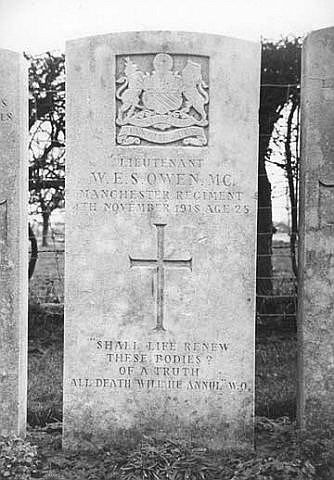
WilfredOwensGrave

Wilfred Owen’s gravestone

Today’s episode, “Strange Meeting,”  shows Owen’s anger, but because he’s a poet not yet fully in the 20th Century style, he expresses it sounding like a 19th Century poet, more like a Keats or early Yeats. As I came to grips with this piece, I felt the thought and subject matter was sometimes obscured by its march of rhymes and occasional poetic diction—and though a poem’s music is subjective, “Strange Meeting”  doesn’t consistently sing to me like Yeats does, but then Yeats is a very high standard to meet, and Yeats never lived the brutal fighting the war poets like Owen went through.

Speaking of music, I’m finding myself repeating ideas (or finding a style?) with the settings lately. “Strange Meeting”  starts with sustained piano chords, unsteady strings, and a plaintive wind instrument (in this case, an English horn). But I felt that carrying that all the way through would work against the grit and bitterness of the story here, just as Owen’s poetic diction does, so for much of the middle section I break it down to just drums and bass.

I hope I’m not overwhelming regular listeners with the war poetry from WWI this month. Perhaps I can find a change of pace soon, and some new variations in my musical arrangements too.

To hear my performance of Wilfred Owen’s WWI ghost story “Strange Meeting,”  use the player below.

Summer Is Icumen In

I sometimes like to ask musicians who sing folk songs “What is the oldest song you play?” As a person attracted to traditional English folk music at an early age, I often marveled at the gloriously old traditional ballads collected by Thomas Percy and Francis Child. There’s something interesting to me about singing not only “other people’s stories,” but very old stories at that.

Turns out that they are likely not all that  old. Most of them are no older than Shakespeare, and despite many antique words and usages, they are in more or less modern English. That’s old, but it’s not old like Homer, Sappho, some of the Chinese poems I’ve set to music here. Today’s piece, “Summer Is Icumen In”  was nearly as old to the typical Child ballad author as Shakespeare is to us.  You can say it’s words are written in English, but that’s only English within the broadest of meanings, as the words are even farther removed from the language we speak than Chaucer’s.
 
Unlike the now lost ancient Greeks’ music to accompany poetry, we even have the 13th Century music and a notated arrangement to present it sung as a canon or round.

Summer Canon [Reading Rota] - caption: ''Sumer is icumen in''

Old joke. Q: how do you make a guitarist turn down? A: put sheet music in front of him
New joke: Q: how do you make a lead singer ask for less in the mix? A: put old English lyrics in front of him

One tradition in folk music is to not be overly traditional in re-using it, and I’ve done so here. My melody is only tenuously related to that old one. The original music is minor and mine is major key, and I don’t do it as round. Furthermore, I’ve taken liberties with the various modern English translations of the words. I have replaced a phrase with one that I like better, completely blowing a raspberry toward those who translate uerteþ in the original text as “fart”.

I’ve fattened up the arrangement with a goodly helping of a traditional English instrument of the antique 20th Century, the Mellotron. I told Dave Moore after I completed the mix with the new Mellotron parts that the singing wasn’t good enough for it to sound like the Beatles, and it wasn’t stately enough to remind anyone of King Crimson, and it didn’t have any undeniable pop music dynamics like the Moody Blues either—but what I may have gotten too was something in the 2000 light-years neighborhood of the Rolling Stones’ Their Satanic Majesties Request—which I will confess was one of the first trio of records I bought back when the Beatles “Sgt. Pepper”  was threatening to reshape all pop music (a threat that was not carried forward for both good an ill).

Stones Album cover

Don’t adjust your monitor, the original LP’s 3D cover is really that blurry.
Also, any mention this Stones album’s name must now be done in Dana Carvey’s Church Lady voice.

Anyway, I’m using digital replicas of the original Mellotron’s cranky tapes in “Summer is Icumen In,”  but even in that remove they add a certain character to the string parts. Dave’s original organ part, mixed in the right channel, now seems like a top line to the Mellotron parts, but it’s a good part, so listen for it. To hear the LYL Band’s performing this old English lyric in a non-traditional way, use the traditional player that appears below.

Up-Hill

Last post I compared late 19th Century cultural hipsters with early 21st Century urban cultural revivalists.  Did modern natural-fiber clad, skin-inked and perforated young people study up on William Morris’ Arts & Crafts movement and visit museums to absorb the Pre-Raphaelites? Some perhaps, not all. And the same can be said for what is carried onward from punks, hip-hop kids, hippies, beatniks, and so on. I’m too old, and too little a sociologist to answer this definitively.

I can say that when I tried to discover what kind of music I wanted to make in the 1970s I copied imperfectly many musicians from the previous decades as well as my contemporaries working down the river in New York City. And those NYC contemporaries? They too were looking backward to move forward. What had been overlooked? What had gone out of fashion for no good reason? What had been uncompleted? So, in listening to them, I was listening to their understanding and misunderstandings of the past too.
 
One of our principles with the Parlando Project is “Other People’s Stories.” Part of the above is “my story”—but my musical story is really made up of other people’s stories.
 
Tracing the path of influence is often hard to do. Today’s piece Up-Hill  is an example. The words were written by Christina Rossetti, that sister of the Pre-Raphaelite Brotherhood. Obviously, she’s familiar with the Pre-Raphaelites and their circle—but she’s also deeply interested in a Christian religious revival, and that too gets reflected in “Up-Hill.”  Would she have known Anna Coghill’s poem that was set as the hymn Work for the Night is Coming?”  That’s unknown to me, but “Up-Hill”  and “Work for the Night is Coming”  are both poems understood in context as being Christian devotional, while containing not a single specific utterance about a deity, salvation, or an afterlife. With revivals, context changes things.

Christina Rossetti

Christina Rossetti thinking about an up-hill journey?


And here’s another way that influence is hard to trace: it becomes unconscious. As I was writing the music for “Up-Hill”  I was mostly interested in varying my customary harmonic cadences while keeping it to just two or three chords, a short number that often works best for performance with the LYL Band. And “Up-Hill”  is, after all, a work of beautiful simplicity, saying something profound without pretentious elaboration.  I settled on a simple I V IV I progression, and tried it with the band last month, but my vocal wasn’t working. Trying again this month, the unconscious struck.

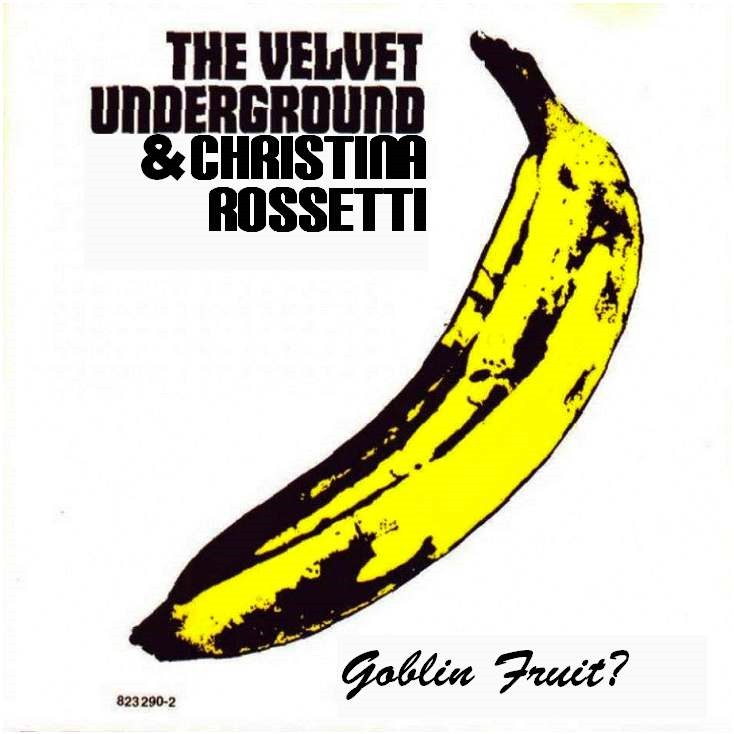
VU - Shall I Meet Other Wayfarers At Night

“Shall I meet other Wayfarers at night?” The Velvet Underground  certainly think so.


I didn’t realize until I was working out the rhythm track that I was falling into a Velvet Underground groove, like the one they used in I’m Waiting for my Man,”  a tune that is also understood as devotional in context—though to drugs, not a deity. Both songs feature a journey to a destination (up-hill or up-town), both engage in conversation along the way. Was this subconscious choice a sly comment on Christina’s brother Dante Rossetti’s addictions? A comparison of recovery to salvation, or of addiction to salvation?  No, the groove was just working, and it helped me get a better vocal down. If I understood anything about what I was choosing while doing, it was that I was linking sub-cultures and following the near invisible web connecting Other People’s Stories.

Velvet Underground and Christina Rossetti Cover

So what would that sound like? Use the player below to find out.


Same as always, the player should appear below.to hear the performance of “Up-Hill.”  And keep sharing the links, subscribing, and telling folks about the Parlando Project.

Love Is Enough

I drove to Des Moines Iowa this past weekend for a wedding of a niece. The reception was in a tap room attached to a small indie brewery. My 12-year-old son asked “Why is it in a brewery?”

I asked my son if he knew what a hipster was. “Yes, it’s someone who always needs to have the latest iPhone the day it is released.” My son likes to remind me that he is not  a millennial, and that he will have no truck with their ways.

I laughed and said that it’s more than that though. I tried my best to explain, doing badly, as I usually do when speaking. What I was aiming to say was that hipsters are interested in things that are different and off-beat, that in doing so they often revive things from the past and redo them in the now different context of the present. This kind of rebellion against the too-ordinary incumbent culture eventually changes the culture, remaking cities and what they offer. “When I was a kid and went to Des Moines, there were no small breweries serving their own beer, or restaurants that serve those Asian noodles like you like. Instead I’d get to go to Bishop’s Cafeteria.”

“What did you like about Bishop’s?” my wife asked.

“I liked that you could choose your own desert. Usually something with whipped cream on top.”

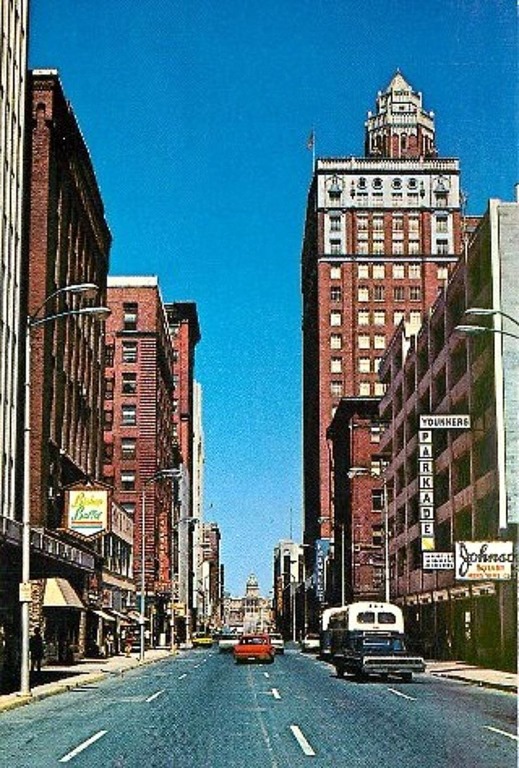
Des Moines Early 60s

News from Nowhere: Des Moines dreams of hipsters to come. Shop at Younkers, eat at Bishop’s.

Now that isn’t a complete explanation of what a hipster is either. Nor does it tell how hipsters are seen and labeled by others, or that to call someone a hipster generally has a negative connotation. If you want a hyper-precise definition with lots of reasons to be wary of being called a hipster you can read one here.

Every cultural change movement like this gets made fun of, and provides lots of rich examples of foolishness. And unlike frankly political change movements which often generate mutual veneration between generations, many cultural rebels see the next generation of young novelty seekers as a bad, devolved outcome; while the young often find and fix their cultural novelty in rejecting the enthusiasms of their immediate predecessors. Can anyone be sure that hipsters are any more or less authentic than punks, hippies, beatniks, or swing era hepcats and so on? I can’t. Is some rampant cultural appropriation going on? Yes, and that has its foolish and even harmful side-effects for all these cultural movements—but are their benefits as well? I believe there are, and anyway, rigidly contained cultural silos seem stifling.

This rejection of immediate predecessors, doesn’t mean an inevitable total rejection of the past. Small breweries were common in America a century ago. Beards, mustaches, fedoras—the clichéd markers of the male hipster, all are revivals of past fashions.

Remember with the Christina Rossetti poem last month. I mentioned her brother Dante Gabriel Rossetti’s boys club “The Pre-Raphaelite Brotherhood?” Formed by art students, they signed their paintings with a “PRB” as secret tag for their movement. They hated the classical art and design standards of their day, and even though they were living in the original Steam Punk era, instead of fetishizing brass, well-oiled gear trains, and leather, they propagated their love for Medieval art and hand-made crafts.

Dante Gabriel Rossetti - Ford Madox Brown 1867

Dante Gabriel Rossetti. Can he interest you in some beard oil?

Sound familiar? The Pre-Raphaelites seem to me to be late 19th Century versions of early 21st Century hipsters. If they were ironically enjoying Midwest beer in a can, would they have signed their paintings “PBR”?

Today’s audio piece is William Morris’ “Love Is Enough.”  Morris was intimately connected with the Pre-Raphaelites. Like them, he was fascinated with Medieval art and culture, but he was a man with many interests—many more than I can touch on this time—including writing influential fantasy and speculative fiction. In that vein, we’re going to time-travel the Englishman William Morris like we did with Americans Walt Whitman and Emily Dickinson, so that this 19th century poet can sing a nugget of garage band blues with the LYL Band.

Watts painting of William Morris

William Morris fading into the wallpaper. He did just about everything but start a brew pub.

This one is a good song for a wedding and for lovers. To hear “Love Is Enough”  use the player gadget below.

In The Drear-Nighted December

200 years ago this month a 21 year old surgical resident decided to give up his studies to become a doctor and to instead concentrate on the writing of poetry. An interesting decision. He had already rolled up a considerable education debt, and while it’s possible that poetry’s earnings potential might have been greater in 1816 than today, greater than zero is not a high bar.

So how prudent was our young not-to-be surgeon? He had tried his hand at poetry and had published a couple of poems in magazines before his decision. Hmm. Not a great prospectus you might think. In a rough translation for our time, it’s as if the young student had ditched his studies and loan debt for a shot at touring as an indie-rocker, even though he’s only played in his dorm room and doesn’t have a band.

His friends thought he had promise. In the forthcoming year, and with their help, he would find a publisher for his first volume of poems, but his work was mostly unnoticed, and where noticed, the reviews were at best mixed. One reviewer had rich fun with this impudence:

“The spectacle of an able mind reduced to a state of insanity…. It is a better and easier thing to be a starved apothecary than a starved poet; go back to the shop, Mr. John, back to `plasters, pills and ointment boxes.'”

Another reviewer offered this judgement

“We regret that a young man of vivid imagination and fine talents should have fallen into so bad hands as to have been flattered into the resolution to publish verses, of which a few years hence he will be glad to escape from the remembrance.”

We know how this turns out, more times than not: the young fool will be unable to sustain a long career in the arts—and yes, that was the case here. The young surgeon turned poet was to have a career of less than 5 years—but that was because of his early death at age 25. Yup, he dies two years too young to make the 27 club. Our surgeon turned poet was John Keats.

Besides talent, and desire that was the equivalent of foolishness, Keats worked very hard reading poetry, thinking about it, and writing it in those less than five years, producing some of the best lyric poetry in English.

In my own twenties, this encouraged and discouraged me. On one hand, it said I could write and read fearlessly as a young poet in the first half of my twenties; and on the other, as I measured what I had accomplished, I often admonished myself: John Keats died at 25.

Almost exactly one year after he broke from medicine for poetry, John Keats wrote the words for this piece In the Drear-Nighted December. He wrote it after struggling for much of the year to write his first long piece, Endymion, a neo-classical epic in heroic couplets that he never thought he got right.

This is something many writers experience. You struggle mightily to create something. Something big, something impressive. You bring all your craft to it, but it doesn’t quite work. You finish it, or otherwise set it aside, and in the aftermath out pops another smaller-seeming thing that is much more perfect. It’s like the muse says to you “You don’t control me and direct this, and here’s the proof.”

What has Keats done here? First off, those words cannot be read and not sung. This kind of silent melody is not easy to do in English, yet here is the young Keats doing it brilliantly. His images? I’m deep in a minus 17 degree F. Minnesota afternoon as I write this this. His trees with their “sleety whistle,” those branches glued with ice, once flowing water frozen like mineral crystals—I know these things, but Keats has said them well to remind me that we both know.

Keatslifemask

John Keats encased in Carbonite by Jabba the Bad Reviews

And then his sublime last verse, so beautiful I could not help but repeat it. In two verses Keats has setup an nice lyric that doesn’t stray far from convention. To paraphrase: “Hey, look at nature in winter. Doesn’t look like it does in spring or summer at all. Even though we conscious beings know (more than dumb water and trees) that these trees will bud and the brook water will flow again, nature doesn’t care.” Now the third verse: “How smart are we compared to non-conscious nature? We will ‘writhe’ in pain as things are taken from us (and though unspoken: since the image has been of a repeating natural cycle, this will happen again and again). This is not a poem that says “Suffering? Don’t worry, spring will come again.” This is poem that says suffering will come again, as surely as winter. “The feel and not to feel it, when there is none to heal it.” What a line: “The feel and not to feel it!”

A good song for winter solstice, so to hear the LYL Band perform In the Drear-Nighted December, click the play button the player gadget that will appear below.