To not be scared of death that doesn’t understand us

I’m going to start off the new year 2024 with something I do less often, presenting a new piece that uses my own words. I give myself permission in part because it was engendered by thoughts of another poet, Robert Okaji, who I’ve considered as something of a kindred spirit to my efforts here since this Project began 8 years ago. Like most every blogger I can’t help but talk about myself, but when I do that I fear I become a spendthrift of boredom, so one of this Project’s mottos has been “Other Peoples’ Stories.” Yet, for all that, this isn’t Robert Okaji’s story in any summary — he’s his own poet, his own writer. I’m presumptuous, but I won’t go there. I don’t know him, though I’ve read his blog, his poetry, seen him read online once. Is that like knowing him in some way?

Many of us poets could admit that we see ourselves in a timeless guild. Homer, Sappho, Shakespeare, Emily Dickinson, Du Fu, Yeats — they’re our co-workers. We flatter ourselves at times that we now occupy their offices. By the same conceit, I could think of Okaji as a compatriot. We live in the same country at the same time, we’ve exchanged the customary short notes over the Internet. At least once before today, something he wrote caused me to write something myself. I think I started writing translations/adaptations of classic Chinese poetry before reading his, but his approach (we both need to start from literal English glosses) ratified mine in effect.

So we poets, at the moments our heads swell up so that poetry can burst forth,* may think it’s as if we know each other, because we think we know each other in poetry. To say then that it’s like companionship, that it’s as if, is to do that thing that’s called in poetry a simile.

Every simile when examined harshly knows it’s pathetic. Every poem is not the thing it represents — even the great poems that change how we look at the thing they represent. Let all in the poetry guild admit this to each other within the walls of the guild hall.

I started writing today’s words on one of my more-or-less daily bicycle rides. In spring there may be many kinds of birdsong in my well-forested city, but in winter it may be only crows — which, as the poem describes, are quite vocal about a solitary early morning bicyclist in their midst.

Crows, ravens, big dark birds, are a death symbol of long repute. And it struck me that while we might chide ourselves for not having sufficient knowledge or understanding about death, we could just as well say that death doesn’t understand us. Living in our consciousness as if the present continues indefinitely, we don’t understand death, but death doesn’t understand that moment either. And then, we poets think we can capture the flow of consciousness and preserve it in poems. Today’s poem carries on in a series of similes and then makes a final summation of the series.

Okaji has written a group of poems over the years featuring the character of a scarecrow. Perhaps he too is riffing on crows as the death symbol, but his scarecrow is at times a comic figure too. A scarecrow is just another simile, a sort of, an as if symbol for us — and so I speak of Okaji’s scarecrow in my poem.

Scarecrow takes a winter bike ride

Scarecrow rides a bicycle in early winter mornings, and the crows object. (a note: I begat these AI illustrations with Adobe Firefly, which claims it doesn’t use uncompensated artists’ work to train itself)

.

I said my poem isn’t Okaji’s story — it’s more mine partway — but if you’re like me in some ways, particularly if you want to consider those of us aged to where a compatriot’s death seems next door, then it might be as if it’s partway yours too. The admonition in the poem’s title is therefore not addressed impertinently to Robert, but to myself and perhaps others who might read or listen to this.

Woody Allen wrote a great line: “I don’t want to be immortal from my work. I want to be immortal by not dying.” We write poems, we make those “like a” statements by writing poetry. As if: in our minds we walk into those poetic offices, write our metaphors, our similes. And some day, we must clean out our offices, leaving on our desks a few sheets of paper, maybe enough to stuff a scarecrow.

Today’s performance started with two electric guitar lines I recorded early on New Year’s Day, following the tradition of trying to do things on that day that one would like to continue to do regularly the rest of the year. The two somewhat irregular riffs were spontaneous,** thinking that promise to myself required doing  as much as planning. The bass line was laid down almost a day later to try to hold things together, and the decoration of the keyboard parts arpeggiating the spontaneous chord changes which had started things off, were the final tracks. Those things done, I had my rock band to declaim my sonnet “To not be scared of death that doesn’t understand us” over.

You can hear that with the audio player you should see below. No player?  This highlighted link is a back-up method, as it will open a new tab with its own audio player.

.

*A metaphor that sounds more like a sneeze than Athena’s birth when I re-read this.

**I fancy the right channel line played on my Telecaster has some crow-call-like moments.

Since There Is No Escape: Thanatopsis-Turvy.

Here’s another piece that has been in process for nearly a month. It’s also another that I’ve held back because I feared it would be either disturbing or unattractive. It should be apparent by now that this Project doesn’t exactly pander to an audience — what with its inconsistency and stubborn variety — but I do sincerely appreciate those who take some of their time to read or listen to it. So let me explain.

Sara Teasdale’s “Since There Is No Escape”  is a piece of gothic romanticism. Since my tastes are wide-ranging, it’s not the first time I’ve touched on that strain of expression — “The Dark Cavalier”  from earlier this month would be another example. These are pieces with a kind of dark beauty to them, and therein is the danger. For, at least to some, there’s a simplifying morbid pull to that kind of thing.

Do gothic pieces impel that kind of response? They have a defense. I wrote that “The Dark Cavalier”  implies skeptical elements while expressing the dank promises of death. “Since There Is No Escape”  might be said to go further, presenting itself as a memento mori exercise, a way of praising life by starkly expressing the inevitability of death. As an old person I’ll frankly acknowledge that the ending of any expectation of unlimited numbers of years ahead of me motivates me in getting on with what I do. At my age, my cohort of fellow art-workers near and far from me are dying off. Yes, that’s inevitable, but I’m not going to put on a big black-crepe production about it either. Let it get me off my butt and onto my work — but beyond that, those concerns could just get in the way and constrict my vision.

Teasdale means to say nearly the same thing, but with poetry it isn’t so much about what is said (unlike a book or essay) but more about what it feels like to say it. The emotional moment in this poem is stuck a bit — and it’s a short poem which contains only a moment — in the contemplation of death and the romanticism of life and song against it. If “The Dark Cavalier”  sees death as a lover who promises to be faithful, a quality many lovers promise with crossed finger bones, the “Since There Is No Escape’s”  singer sees death as a chief magnifier of the author’s art.

Maybe that’s so. Maybe there’s no escape from that: that we value the transience of life, love, and art because it’s transient. Memento mori is a motivator, as I acknowledge, but it can get in the way of living, which has a right to the flavor of the inconsequential and the illusionary non-obsolescence of the present.

Teasdale not having it

An oft used picture of Sara Teasdale. I’m struck by the enigmatic expression.

.

All this sounds like I’m dragging on Teasdale, whose word-music pulls me in, and whose poetry is worthy of greater attention. It’s not that simple. The poète maudit stance can be overvalued as the only true outlook — it’s not the only way to frame life and living — but poetry and song that expresses those emotions allows us to examine those feelings in ourselves, in others. That then is my explanation: those who believe life is richer and stranger can find value in examining and acknowledging that gothic outlook.

A few words on the music for today’s audio piece. I’d like to give a romantic explanation for the elaborate ensemble you’ll hear when you listen to it: three (count’em) three pianos, two Mellotron parts, organ, upright bass, drums, and a large mixed chorus of voices. I could write about the music trying to express the richness of life that Teasdale says she’ll miss, or that those are the choral voices of sweet and solemn death angels singing above us temporary earth dwellers.

Don’t let anyone else know, but that fair field full of folk set of sounds is due to my setting up a new more powerful audio production computer because I’ve finally started to run into issues with larger numbers of more demanding virtual instruments in some of my arrangements. This music was motivated by me layering in a bunch of those VIs to see that I’d successfully reauthorized them, and to test that the upgraded computer was able to run them at low latency settings without glitching. Perhaps this is a parable: that you can find substance while you are only concerned with the mundane, since it was freeing to play the various lines on these instruments on my plastic piano keyboard unconcerned with their lasting success.

To hear my performance of Sara Teasdale’s “Since There Is No Escape”  you can use a graphical player you should see below. No player? There’s still a way, this highlighted link will open a new tab with its own audio player. Those wanting to follow along with the text of the poem can find it at this link.

The Dark Cavalier

Long time readers here will know I’ve referred several times to an observation by former US Poet Laureate Donald Hall that I’ve called Donald Hall’s Law. Here’s how I’ve recorded what Hall wrote:

The majority of poets who receive prizes, notice and ample publication in their time, will be unread 20 years after their death.

If they are unread at 20 years post-mortem, their fate beyond that rarely changes, save by scattered efforts like this weird Project and its versatile readers and listeners. So, today’s piece is by one such awarded and forgotten poet, Margaret Widdemer. I can’t really claim that Widdemer is a great talent awaiting rediscovery. I fear some antiquated elements in her poetry make reading her in large doses more of an academic exercise. As an indifferent scholar with many other tasks in this project, I can only say I’ve skimmed her work. Yet, per Hall’s Law, she was a prolific oft-published prize winner. Widdemer was first published as a novelist in 1915, and in the silent film era several of her novels were adapted into movies. Her poetry has several modes and subjects, and she wrote selections dealing with social issues, including child labor and women’s suffrage. Perhaps the height of her prize-winning resume came fairly early, when she tied Carl Sandburg in the voting for the 1919 Pulitzer Prize for poetry, becoming the co-winner that year. Anyone who knows me knows I maintain that Sandburg is due for a reappraisal — but if Sandburg’s undervalued, he at least has a current value. If Widdemer was his peer in 1919, her stock has long ago dropped off the literary stock exchange.

Widdemer’s Pulitzer Prize winning poetry collection was The Old Road to Paradise,  and it contained a representative mix of what I’ve seen while skimming her poetry. She writes rhymed verse, and her poems often seem to have music implied in their structure and prosody — you could class many of them as literary ballads or songs. Despite this structure, I’m unaware that she’s been commonly set to music by composers.*

At least to me, the most interesting of Widdemer’s work combines that “just asking for a musical setting” structure with strong fantasy elements.**  Given that fantasy literature retains cultural interest in the present day, these Widdemer poems are the ones that might have revival interest. Today’s selection “The Dark Cavalier,”  included in her Pulitzer book, is one such poem. Furthermore, if it was written more recently and set to music, we’d easily see it genre-wise as Goth. It certainly risks being disturbing, the poem being spoken by a seductive Death who wishes to lure the weary or troubled listener to settle for his stable and grave-set romance. The poem’s outlook is such that one could feel that reprints should have footnotes about the 988 number established for those dealing with suicidal thoughts. Yet it seems to be one of the relatively-known of her nearly-unknown works, and it was selected in 1958 as the title for a late selected poems collection.

Dark Cavalier

I didn’t know Widdemer married a cellist when I composed this, but this setting is acoustic guitar with a simple string quartet accompaniment.

.

In musical performance I tried to undercut the poem’s speaker’s luring spiel, to bring out a little of the subsumed caddishness in a suitor who offers an everlasting relationship, when we know, that even for prize-winning poets, their attention will quickly fade.

You can hear my performance of the musical setting I did for Margaret Widdemer’s “The Dark Cavalier”  with the audio player gadget you may see below. No player to be seen? Some ways of reading this blog will suppress that player, so I offer this highlighted link that will open a new tab with its own audio player.

.

*Widdemer married the year she received the Pulitzer. Her husband was also a prolific author, but it’s also said he was a proficient cellist who wrote book-length biographies of composers.

**One recent reader noted that she wrote a poem about a “Gray Magician” in “Middle Earth” before Tolkien, which indicates that Widdemer may have had some knowledge like JRRT did of Old English. I also suspect that she must have been aware of the revival of interest in older British Isles folk-music by Cecil Sharp, Francis James Child, et al.

Does your garden have ghosts, part 2: Hardy’s “The Shadow on the Stone”

Yesterday in our Halloween Series I mused on the appearance of ghosts in a garden with Millay’s blithe apparition. As I present today’s musical piece adapted from literary poetry, Thomas Hardy’s “The Shadow on the Stone,”  let me start by asking questions. Many others will follow.

Do you want to see a ghost? Is that wanting part of what makes it appear?

Hardy’s poem is poised in that first question. As I have performed it as a song with music that I wrote for it, I should wonder if the words are clear enough in themselves to tell us what the situation is. Looking at the text of Hardy’s poem, I think it’s mostly self-sufficient in that regard, though some mystery (possibly useful mystery) remains if nothing else is explained.

When I first presented this in 2021, I went into the biographical specifics that engendered this poem, but for today let me just say that the “she” that the ghost is supposed to be is Hardy’s dead wife who was completely estranged from him before her death.  Nothing in the poem spells that out, nothing tells us that when living she had grown to find Hardy completely unsuitable. Well nothing, save for a line that we can hear as modern idiom that Hardy may have intended only as a brief metaphor: “Her behind me throwing her shade.”

The Shadow on the Stone illustration 1024

Ghost from a machine: illustration from Adobe Firefly, the AI engine that proclaims it doesn’t use uncompensated artists work.

.

Such a complex ghost, or a wish for a ghost, this is!

Does Hardy want to see the ghost? Does Hardy fear to see the ghost? Can either of them speak? Are either of them changed from what they once were? Is he haunted by her, or haunted from her? All the answers are all the answers here. The curly shape of the question mark the shifting curve of an ghost manifesting.

Spontaneously when doing the vocals for this piece I decided to throw in some more answers at the end of my song in the form of “inline epigraphs” that Hardy didn’t include with his poem, but this performer did.

You can hear my performance of Thomas Hardy’s “The Shadow on the Stone”  with the audio player gadget below. You don’t see a player?  This highlighted link will make one appear in a new tab.

.

Warm Summer Sun, the 700th Parlando Project piece

This is a modest little piece — a small number of words, a simple musical setting — so it may seem odd to choose it as the 700th audio piece from this Parlando Project. Well, this whole project is odd, isn’t it? You, for reading this and listening to the audio pieces are unusual. I’d say I’m odd too for taking the uncounted hours this Project has taken: looking for available words that strike me as worthwhile for performance, composing the music, performing most of the instruments, recording them, and figuring out what to briefly say about my experience of these words.

I plan to say more about reaching this milestone in a follow-up post, but I will put that off so that we can get to American author Mark Twain’s words without overwhelming them with my particulars.

I came upon this as if it was a poem written by the famous novelist, something I took immediate note of. Poets who publish novels at least once or twice aren’t extraordinarily rare. Established novelists who take to writing poetry may be slightly more unusual, but there are examples. The two arts are unlike enough that the list of those whose expression in both fields remain worth considering exists, but that list isn’t likely to take more than one page. But Twain’s poem was specifically unexpected. If you have followed this Project completely for a while you will have encountered most of what might be considered poetry by the great novelist Twain. One was a little monolog that performs easily.*  That piece is a still-acute skewering of poète maudit literary stances. Twain’s other poem used here was a satire produced by a character in a novel who wrote rafts of terrible elegies, a poetic form that Twain’s era loved more than any other: Tennyson’s book-length, multi-part, In Memoriam  elegy was a Victorian best-seller. Twain’s USP while he worked in the book trade was instead books full of life and absurdity written in garrulous American vernacular. Yet, here’s a poem by Twain that is:

Heartrendingly sincere
An elegy
Short enough to be engraved on a headstone

Where did this come from? It has both a biographical and literary inheritance. The biographic one: the headstone it was engraved on was for Twain’s beloved eldest daughter, a talented young woman who died at age 24. If you’ve got a few minutes, click this link and read her Wikipedia entry, so that you can mourn along with Twain. The literary antecedent, who Twain credited on the headstone as the author, was a contemporary poem written by an Australian expat-to-Scotland named Robert Richardson. Richardson is next to unknown and I’ve only glanced at the collection in which his poem titled“Annette”  appears. He was a newspaper and periodical poet who wrote (as did Twain) for popular audiences — but unlike the Twain we best remember today, he is (at first glance) conventional in his literary diction and full of the usual Victorian sentiments. Richardson’s “Annette”  takes up three pages and many stanzas, and Twain’s adaptation uses only the final stanza. Twain’s poem is 27 words long. Only 20 of those words come from Richardson’s stanza.

Here’s Richardson’s stanza followed by Twain’s poem as it appears on the headstone:

Warm summer sun, shine friendly here;
Warm western wind, blow kindly here;
Green sod above, rest light, rest light,
Good-night, Annette!
Sweetheart, good-night!

Warm Summer Sun Twain headstone

Here’s a link to a page where I found this picture of Olivia Susan Clemens’ headstone in Elmira New York. The link also includes the full text of Richardson’s Annette.

.

What are the alterations, which I’ll presume to be Twain’s, and which I assume are changes, not Twain using a different version than I found in an 1893 Richardson poetry collection?

“Friendly” is dropped from the description of the sun. “Kindly” is moved to the sun in Twain. “Softly,” a more objective adverb is used for the wind by Twain. Imagists (who’ll arrive only a decade after Twain’s poem) would have preferred kindly to be dropped entirely for an objective word, but on balance Twain is just slightly more modern. “Southern wind” not western may be localizing weather patterns between Richardson and Twain’s locales, but making this change shows a careful choice is being made.

Both Richardson and Twain make the choice to move from the above world of the living to the below ground world of the buried in their stanzas. Richardson has the sod “resting,” personifying in Victorian fustian. Twain has the weightier and more objective “lie.” Small difference, but I hold with Twain’s choice.

“Dear heart” for “Annette” removes the inapplicable specific from Richardson. In the final phrase Twain again adds power in my judgement by refraining “good night” rather than using the specific Victorian term “sweetheart.” Although Twain intended his poem as an inscription, the refrain adds to the effect when sung in performance.

Tiny poem, tiny changes, but of course the greatest difference, one made by a novelist (of all trades) was to presume that these spare 27 words from the end of Richardson’s longish poem make an apt summary of the situation: a beloved, talented daughter struck down by illness in her youth. This may have been a practical choice: carving it on a headstone (though larger headstones with longer inscriptions are found in Victorian graveyards). Intent and practicalities aside, I was moved.

You can hear my performance of Twain’s epitaph/elegy with the following audio player. No player? This is a backup link that will open a new tab with it’s own audio player. As I said, simple music today. Just me playing a nylon string “classical” guitar, the kind of instrument that I first played when I started out.

.

* Besides being credited by Hemingway as the progenitor of “All modern American literature,” Twain pioneered what today we’d call standup comedy.

Lightly, from Aldus Huxley’s novel “Island”

Death is a funny thing, mainly because dying is treated so damn serious. Have you ever asked yourself this: are you afraid of death or are you afraid of dying? If you answer, “Well I’m afraid of death.” I ask you to further question yourself. Non-existence is easy, a gimmie, a non-task. Dying on the other hand? You can fear pain, suffering. You can fear what is left unremedied, unfinished, left undone. One can fear you will not do it well. That you will show too much or not enough emotion. You can fear you will do it too slow and draw out suffering — or have it happen too fast before one can set an agenda for the occasion.

This weekend is the anniversary of the official launch of the Parlando Project in 2016. This weekend is also the anniversary of my late wife’s death decades ago. Last weekend I learned that a poet/blogger who I’ve followed through much of the seven years of working on the Parlando Project has received one of those months-to-live diagnoses.*

In-between those weekends, someone posted the text I’m going to present today by Aldous Huxley. Here’s a link to where I saw it. The poster knew it as if it was a poem titled “Island.”   Instead, it’s a passage from Huxley’s last book, a novel called Island.  In using this as text I decided to call this short excerpt after a repeated invocation in the passage: “Lightly.”

I’m not very well-read when it comes to novels, but as a teenager I read Huxley’s best-known book Brave New World.  I loved the SF world-building of it even if I likely missed good portions of the satire at that young age. After that I tackled Island  as well, promoted on the paperback cover as an updated companion to Brave New World.  I don’t recall much about Island,  certainly not this passage. What could I remember? That Island  had a bunch of ideas to present, but since I read it so long ago and so young, I retained nothing else. Looking at synopsis’s online this week, it appears that Huxley was trying to synthesize a long fascination with Asian spirituality and philosophy and apply that to his contemporary mid-20th century Western world.

Island cover

I think this is the edition I read as a teenager

.

Today I was able to look at a copy of Huxley’s novel, and the passage, presented as I first saw it in broken lines as if it was free verse, is indeed a block of prose within it. I said Island  was Huxley’s last novel. He died of cancer a year after it was published.**   I don’t know if Huxley had received one of those “months left” estimates as he worked on Island,  but the passage spoken by a character in his final book could be the author speaking from, or to, himself —  a reminder of how he felt he should approach dying.

In the book it’s spoken to a woman who is dying, attended by her husband and family. As I read the larger section the excerpt was from, I thought of being beside my late wife as she was dying. Yes, in essence, the teenage me with my youthful experience, could not have read the same book.

I was only able to do that reading for context this afternoon, a day after I had already completed the new audio piece. Maybe that’s of little matter. After all, even shorn of context as I saw it online, it immediately resonated this week with my thoughts for my distant faintly-colleague. Perhaps you will find resonance as you hear it too.***

I made a couple small alterations to the excerpt to generalize it. Then I composed the music for it on acoustic guitar, playing that instrument in a somewhat pianistic style,**** and then combined the two in the performance you can hear using the graphical audio player below. No visible player? This highlighted link will open a new tab with its own audio player.

.

*This poet and blogger, Robert Okaji, has been mentioned elsewhere here in the Parlando Project blog. Besides being a fine poet in general, Okaji helped me by example and brief comment to continue developing my penchant for freely translating classical Chinese poetry, something he also did. Sometimes we would adapt the same poems from the same literal glosses, producing two facets, two impressions, of the Tang Dynasty masters. I never met Okaji, though I’m glad I got to see him read his work online once during the pandemic.

Here’s a link to his graceful announcement of his diagnosis.  Wishing you the best living Robert: lightly.

**A darkly comic touch to Huxley’s death. His fame from Brave New World  was still considerable in the Sixties. After all, in many ways, his book was more relevant to the US/British culture in that era than its quasi-competitor 1984.  Another late work of his, The Doors of Perception about the benefits of psychedelic drugs (also a subplot in Island)  was a pioneering examination of that idea — and the source for a Californian rock band’s name a few years later. But instead of Huxley getting the few days of reassessment that would normally have attended his death, he got bupkis. You see, he died on November 22nd, 1963, the day the American President was assassinated. The world’s news-hole was filled with non-literary matters.

***As it turns out, this excerpt has been shared numerous times that I found when I searched for information about the words this week. Sometimes the passage retains its prose layout, other times it’s presented as if it is a poem. A small point, but most of the online quotes have slight wording differences from what I saw in a 1975 edition of the book I looked at today.

****By using the whole neck of the guitar and alternate tunings, one can expand the pitch and timbral range of the acoustic guitar beyond that of the more folk-song style pieces I present here otherwise.

The Dying Bed

I said I’d return to our encounter with the 1926 Harlem Renaissance issue of Fire!!  magazine — and here we are with another poem that was printed there. If you’ll remember from earlier this Black History Month, Fire!!  was largely organized, written, and edited by young people under the age of 25, and as such it wanted to represent a generational change from the curators of anthologies like James Weldon Johnson’s 1922 The Book of American Negro Poetry or Alain Locke’s The New Negro  of 1925. There’s more emphasis on free verse in the poetry section for example, and throughout the issue there’s less attention to propriety. Though only a year separates Fire!!  from The New Negro,  long-time readers here may recall that Locke’s book included an essay on Black music casting a suspicious eye on what the essayist cast as frivolous Jazz music — and Blues, as a vocal music depicting a lot of disreputable situations, wasn’t considered an art at all.

The cohort of Fire!!  didn’t share that outlook. If anything, they wanted to make sure they touched on unconventional thoughts and affinities. And here’s something we now think we know about the young writers in Fire!! — a substantial portion were gay or bisexual. Afro-Americans in the 1920s were coming out as full-fledged contributors to all the public arts — would that other status, fully-illegal and disrespected, muddy the waters of “racial uplift?”

Today’s piece uses a poem by a lesser-known contributor in this issue of Fire!!,  Waring Cuney. Like Helene Johnson, who you may have been introduced to earlier this February, Cuney deserves to be better-known. While not directly part of the Harlem scene, Cuney was friends with Langston Hughes, one of the chief instigators of Fire!!,  and like Hughes he was a young man who was comfortable with the language and outlook of the Blues.

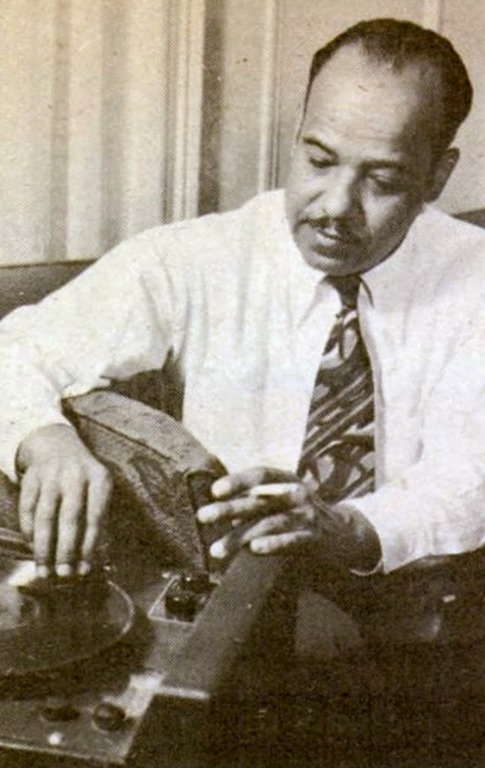
William Waring Cuney

I can’t seem to find a picture of the young William Waring Cuney, but here he is later in life modeling modern vinyl hipsterism.

.

Today’s set of words, Cuney’s poem “The Death Bed”  doesn’t use Blues forms directly, but I’ve already been working with some other Cuney poems that do for possible performance, so I decided that I could include some of that today. “The Death Bed”  is a poem about a dying man who doesn’t seem very interested in his family’s consolations of religion. While getting religion as death approaches is a common trope, our dying man quickly tells his relatives there’s no need for prayer. The relatives leave for another room, and instead of the purposeful theology of public prayer, our protagonist listens to the enigmatic wind. For one moment he tries to join the windsong with his own song, but finds he can find no words. If windsong is nature (likely) or the paraclete (possible), our dying man cannot form his response.

The poem ends with the dying man concerned with what the relatives in the other room are praying. Are they seeking to intercede for the non-believer? Or might they think he needs to be cleansed of some evil — maybe they are even praying to be protected from the sins this sinner personifies?

The Death Bed

Cuney’s poem as it appeared in Fire!!

.

In my performance I sought to open-up intimations of another possibility via music. The Godhead or the universe may not require intercession or last-minute prayers. I made a rare choice to use a conventional musical sample* for this performance. The slide guitar you hear in the main body of “The Death Bed”   is taken from a 1927 recording “Jesus Make Up my Dying Bed”  by gospel/blues guitarist and singer Blind Willie Johnson. While many guitarists think Johnson’s sound and distinctive slide-vibrato is unmatchable, one could suppose I could have tried  to approximate it. However, I was taken with the romantic notion of combining this 1926 poem with a slice of music recorded around the same time. I then included a short coda with a sung variation of this song.** The rest of the music was made with percussion and the sound of bowed cymbals. You can play this performance of Waring Cuney’s “The Death Bed”  with a graphical player below. No player to see?  This highlighted link is a backup method to play it.

.

*Portions of modern popular and art music intentionally use collaged and looped sections of existing recordings. I tend to avoid that for whatever reason, generally choosing to play or electronically “score” my instruments.

**The performers in that short coda are Fred and Annie McDowell. Fred McDowell is another master of the bottleneck slide guitar.

It’s been hard to complete new work recently, so “Anglers” for Minnesota’s Sport Fishing Opener day.

The world of this poem is scribed with the understanding that when you’re on a lake’s surface you are at the boundary level of two worlds. Like unto angels in Medieval drawings, those fishing are pulling the fish from the aqueous world into the sky world, and I often felt I could sense the hooked fish’s wonder and distress. “Who are these scale-less giants unconcerned by gaseous air?” This poem is called “Anglers.”

Meanwhile, back in Chicago, the Yip Abides blog and rmichaelroman caught this wall painting in 2009. Whimsey aside, the very fish the anglers are seeking to catch in Minnesota today are spending their day trying to catch other fish.

.

It’s unsaid in the poem, but I was in the boat described. I didn’t put myself there because I wanted to focus the reader’s attention on the two brothers and yes, on the fish. There are other undercurrents that I think I kept out of the poem, and someday should make at least one other fishing boat poem. If any in this blogs’ diverse readership reads this before or after getting in a boat and wetting a line, net, or spear, the poem asks you to consider this if you like to think on the water and not just chum with talk: you are frighteningly miraculous.*  Don’t let it give you a big head or anything. There are angler forces without skin on another level above our surface.

My grandfather’s actual Johnson Seahorse outboard motor mentioned in the poem

.

I recall that the more published and noticed members of my little writer’s group Kevin FitzPatrick and Ethna McKiernan were not particularly satisfied as readers/listeners of this poem in an earlier version, and I may have made a couple of changes based on that in the version you can hear today. I think they may have been puzzled or unimpressed** by the pun at the heart of the title: that on the flat surface of the lake, the “anglers” are the highest upward length of a right-angle to the water surface, the sharpest break vertical the fish would ever experience. And then there’s the even more obscure eye-rhyme-ish pun of anglers and angels. Neither of them cared much for puns, while Dave Moore and I indulged generously, enough to wrinkle the other half of the group’s noses.

Now Kevin and Ethna have been, like the fish, also pulled through the surface, and today there’s a church-based memorial service for Ethna which I don’t think I will be attending, though I’m glad to have attended a poetry-centered one for her earlier this year, and I’m planning to attend the poet-focused one for Kevin later this May.  In lieu of today’s service attendance, and out of guilt from my absence, I’ll say that if their skin-less existence is in wonder and distress, that my thoughts go with them, and in my dim watery existence here I ask us on all our levels to turn our circle-eyes toward wonder.

And I know too there are practical voices in the fishing opener today. “That’s what I get for getting into a fishing boat with a poet. Such high-flown thoughts! Damnit. I’m trying to get a worm on this rig’s hook. We feed worms to fish, and then well, we feed worms.”

If you’d like to hear my performance of my own poem “Anglers”  there’s an audio player gadget below this for many of you, and for those who can’t see that, this highlighted link  will open an audio player  for it in a new tab. My music for this uses what I often call my “punk rock orchestration.” I use very simple orchestral instrument colors both because I lack the knowledge/skill to do more complex ones and because I think there’s a direct charm remaining and being featured by stripping that sound down.

.

*Ah, footnotes, the sinker-weighed lures bobbling along near the bottom! No, I’m not out fishing today, or most any days in this part of my life, though I think about my hours of fishing as a young person. I always considered the fish though, a little to a lot. One thing’s simple though: every poet wants to be miraculous.

**When a poem or poet doesn’t “hook” us, these two feelings can be cause and effect in either order.

Emily Dickinson’s “Ample make this Bed”

Today’s piece for National Poetry Month is another Emily Dickinson: her gothic aubade “Ample make this Bed.”   Word-music is subjective, but I find this one of the most poignant and lovely of her poems.

As with many Dickinson poems the meaning tantalizes, at once clear on the surface and tangled beneath. The trope it’s using, the aubade, is highly common in love poems. In the aubade, the lovers are faced with the dawn and do not want to leave their night. The poem’s loveliest line “Let no sunrise’ yellow noise” is as good as a line as ever graced this poetic form. Yet, Dickinson’s stance has a twist in that there’s an implication just below the surface* that the “bed” is instead a buried coffin, which the voice of the poem declares will not be occupied for a lover’s single night, but until the Last Judgement at the end of time (as per some Christian doctrine).  Stop though, and consider — which is the metaphor and which the actual moment being portrayed? Is the bed our life, or our time after life?

Here’s today’s lyric video. I found the picture of the note at the end of the video in a post by Martha Ackmann of New England Public Media.

.

I think this is another example of a gestalt drawing as a poem. We’re to behold either and both.

The classic gestalt face/vase drawing asks us to alternate “figure” and “ground.”

.

The paired bedding metaphors of the first two lines of the second stanza may be overlooked on one’s first or second, or even further readings, so audacious is that overall bed/coffin in the grave pairing. So, let’s examine them for a moment. How often have we tossed and turned in a restless night? Nothing is right. The mattress is too firm, or swayed and too soft. The gentle corners of the pillow jab us, and it’s neither high or low enough. The mattress/pillow lines remind us that contentment is like unto the grave.

Can we make the bed of our lives ample — or the sum of our lives totaled at final judgement? Are the lovers ever fully ample when judged at end? Oh but it is beautiful and poignant to think they might be, and honorable to try.

As National Poetry Month continues for this week, we have three ways again to enjoy this re-release of one of my favorite audio pieces from the six-year history of the Parlando Project. There’s our graphic player gadget below in many cases, but I’ve provided this highlighted link as an alternative since some ways you can view this blog won’t show the player. And there’s our poetry month bonus: the lyric video above.’

.

*As usual, pun intended.

Honoring Ethna event scheduled for Sunday March 6th

This winter readers of this blog got to follow my own celebration of the work of Irish-American poet Ethna McKiernan. That was my memorial to her fine work, by which some of you now can know her. I realize that the Parlando Project has a world-wide readership, but for those of you that are in the Minneapolis-St. Paul area there’ll be a live event to celebrate her and her work featuring a number of her Twin Cities area poetic peers.

Here’s a link to the event listing.

This will be a bittersweet occasion for me and some others, as Ethna and Kevin FitzPatrick used to do a poetry reading around every St. Patrick’s Day in March, and now of course both of them have died., turning them into memories and their words.

I assume McKiernan’s selected poems collection Light Rolling Slowly Backwards will be available at the event. If you’re not local, here’s the publisher’s listing.

.

Here’s one of those pieces I did this winter with Ethna’s words and my music. Player gadget below for some ways you may be reading this, or this alternative highlighted hyperlink if you don’t see that graphical player.

.