I hope some of you enjoyed this Black History Month look at the premier 1926 issue of Fire!! Devoted to Younger Negro Artists. This landmark of the Harlem Renaissance announced a new generation of young Black writers, many just out their teens — artists who not only filled its pages, but organized and edited the publication. Today I’m going to tie up some loose ends and tuck in the laces on the Fire!! story and give you a few links in case you want to do your own exploring.
The quiz says I’m Gwendolyn Bennett. My wife’s results: Richard Bruce (Nugent). Richard Bruce too for longtime keyboard playing and alternate voice contributor to this Project Dave Moore. Dave’s artist partner joined me in the Gwendolyn Bennett result.
So, we looked at the first issue of Fire!! this month. What about the next issue, other issues? There wasn’t one. The magazine, founded by young artists, was not well funded, and selling and distributing didn’t go well. The gatekeepers were at least privately aghast at some of the content, so their advice and word of mouth was to disparage and discourage this effort. I’ve already mentioned when presenting two of the four poets I selected for musical performance that publication in Fire!! did not guarantee lasting readership or note for these young people. So, Fire!! folded, and in a lead-eared note of irony, the mostly unsold print run was destroyed in a storeroom fire. John Keats epitaph says his name was writ in water. Fire!! and some of its writer’s names were writ in fire, and it all died down.
I often suspect many folks who find these blog posts are looking for homework help or teaching resources. To what I (an old person) can understand, being a teacher or a student covers wider territories than in my days, but there are still skirmishes at the borders and difficult areas under the control of different warlords. Fire!! magazine sought to cross those borders then — and if one is to study it and its contributors in any depth, it still does. Not only did Fire!! bring forward new young writers — many committed to Modernist art and radical politics — it purposefully sought to express elements of life that the older generation of gatekeepers wanted to suppress or keep only within the tribe. One of those things was sexuality. So teachers and students, here we have a group of young creators in 1926 writing on race, injustice, and sexual expression that isn’t in committed relationships or straight. On what authority did these audacious writers take to break through those barriers? Not only were the instigators and contributors of Fire!! young, gifted and Black, they also were often somewhere on the spectrum we could label today as queer.*
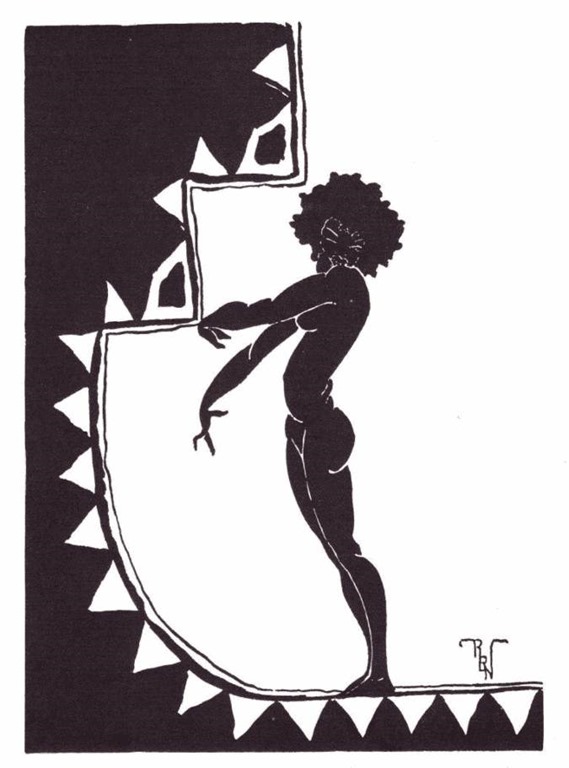
A drawing by Richard Bruce Nugent from Fire!!
.
So, to teach or discuss Fire!! and its creators beyond a surface is to go to places where teaching and learning is still constrained. I’d say to learners (a class that includes nearly all teachers) you may choose to go there even if traveling alone. Literature, music, the arts are the forged identity papers that let you cross borders. Though the writers of Fire!! are all dead, they won’t mind speaking with you.
In the spirit of gratitude to Afro-Americans and their vital contribution to American culture let me repost my Buzzfeed Fire!! contributor-like Gwendolyn Bennett’s summary in poetic “Song.” Graphical player below, or a backup player will open in a new tab link here.
.
*Here’s one web post by someone who taught school, doing a better job than I can today of discussing the queer aspects woven into the Harlem Renaissance. There is also this low-budget indie movie Brother to Brother made nearly a decade ago centering on Richard Bruce Nugent, Wallace Thurman, and the non-straight circle that organized Fire!! The film has some PG13 level sex scenes and self-violence. I found it available for rental from the usual online sources like Apple TV or Amazon Prime.
Returning to the poems published in the 1926 issue of Fire!! magazine which proclaimed it was “Devoted to Younger Negro Artists,” we get this simple seeming, yet mysterious poem by one of Fire’s most famous contributors and organizers: the then 25-year-old Langston Hughes.
“Railroad Avenue” looks like a simple free-verse street-scene vignette. Here’s a link to the text of the poem if you’d like to follow along. Yet the more I looked to understand it, the deeper the mystery of it became.
Here are a few things that seem quite clear: it’s evening. There’s a street, likely named by the poem’s title. A few things are seen or heard: lights in two businesses, a boxcar, a record player, a player piano, a boy and a girl, laughter. Largely unremarkable things, so there’s some specific character given to them.
The record player is a Victrola, a short-lived brand from the early 20th century — for example, the ones with the big conical horn as in the original RCA Victor logo. The businesses are a pool hall and a restaurant serving fish. The boy is at leisure, comfortable. The girl has a dark face that is powdered.* In what may be internal monologue the poem’s narrator gives us the winning number in the day’s policy game.**
So, are we clearly visualizing the place being described? At first I thought I could. I figured without evidence that this was a crowded urban nightlife street, the two other people only examples of many, the sounds and things part of what could have been a larger catalog. Is that reading possible? Two things mentioned that are likely heard not seen: the player piano (reasonably loud) and the Victrola, which would not be. Victrolas were not electric record players. The records turned via clockwork, the sound was produced acoustically from the grooves in the records. So, it’s not blaring out a window over robust street sounds. If the statement on the winning daily number 942 is audible rather than the interior thoughts of our narrator, it too would likely be at a conversational level (given no indication that the speaker/thinker won).
And then there’s that boxcar. Mentioned twice, Hughes really wants us to see that there’s this boxcar there, yet says nothing about it other than also saying twice that it’s forgotten. What’s that mean? A boxcar is a freight train car. This is not an urban light rail or passenger train line being invoked. Who forgets a boxcar? Is it just one piece of rolling stock left off somewhere as a spare or scrap? While the poem doesn’t say this, I began seeing it as part of a train on a grade-level street crossing, with the boxcar’s location blocking the road, a location so that it has to be mentioned, can’t be ignored. Did Hughes see this clearly in his mind and forgot to make it plain in his poem, or am I imagining things?
This vision invoked in me of a small town to small city location where the freight train line runs on grade-level, not on bridges over the roads or in tunnels under them, let me begin to see this as a much sleepier street. This isn’t the busy streetlight and neon Harlem of Hughes’ Harlem Renaissance. The dusk is “dark,” the street quiet enough to hear things distinctly as the evening begins. As the poem reaches a crescendo portion, it’s laughter we hear. It’s “sudden,” indicating that it startles the relative quiet and is not muffled by it. Hughes metaphorically amplifies that laughter with repetition — stating that this laughter with its transport from the ordinary and unenergetic street is able to shake the shop lights and move billiard balls.
This is a poem published by a 25-year-old, but I get a sense this may well be a memory of an even more youthful time with daylight ending, with sounds and a scattered glow from remembered lit windows. Dusk is a marking time for many young people, between the era when it says “time to go home” spanning to the age of “time to first go out and explore your nighttime world of romance and adult recreation.” I wondered, would the poem have more context if I knew where the poem’s titular Railroad Avenue is? America has lots of Railroad Avenues and streets, so the name alone tells us little, other than this isn’t a boxcar dropped off miles from a rail line.
A Google Streetview showing the intersection of a main Joplin MO street now renamed for Langston Hughes with Railroad Ave. Google’s camera vehicles didn’t drive & record down the gravel path that is Railroad Avenue right beside the train tracks.
.
I spent half a day trying to figure out where such a street might be in the places the young Hughes was known to have lived. I’ll summarize the candidates as briefly as I can. He was born in Joplin Missouri, and there’s a very good Railroad Avenue there, with everything you might want for this less-populated scene — though the Afro-American population at the time Hughes’ family lived there was low. But Hughes and his parents left Joplin when Hughes was around 1-2 years old, and there’s nothing I could find saying anyone went back. And was Joplin even big enough and ethnic enough for a numbers game? Hughes spent his grade-school years in Lawrence Kansas being raised by his grandmother. Yes, there were some Black neighborhoods,*** but no likely Railroad Avenue. He spent time at Howard University in Washington D. C. There’s a Railroad Avenue in that city, but it’s far from Howard, and seems to be (and likely was) a non-descript industrial area. Afro-American Howard students might spend evenings on U street circa 1920, but like Harlem in that era, it’d be lit and busy, and no likely boxcars there. Hughes attended Lincoln University in Pennsylvania, and once more I thought I might have a chance. Not as urban circa 1920 — but then no Railroad Avenue, not even a railroad line for more than 15 miles that I could find. And even if he’s a famous figure from the Harlem Renaissance, Hughes’ Harlem is as unlikely for a sleepy dark dusk with a grade-level railroad line as Washington D. C.
Is Railroad Avenue just something Hughes made up? Is it someone else’s story, something he absorbed from a friend, or his mother or grandmother? Did he go back and visit his birthplace Joplin before 1926 and observe a relaxed scene somewhere on that gravel-surface Railroad Avenue? I’ll probably never know.
But what’s up with that boxcar? Why is it so important, and so specifically forgotten? As a short, Modernist free verse poem, we can think: “So much depends/upon/the boxcar/serenaded by a/Victrola/beside a purple/powdered girl.” One theory: the boxcar is a plausible hobo-ride escape out of the town, but our narrator either doesn’t want to leave, or doesn’t know if the train-car is soon going his way. Within a year Hughes published another poem “Homesick Blues” written more in Southern Black dialect about someone looking to hobo back south.**** Another theory? If, as I imagined without direct evidence, the train has stopped and the boxcar is blocking the road, it’s a symbol of systematic blockage of the people in the scene. Whoever owns/controls the boxcar doesn’t even need to care about this (it’s “forgotten”) — and meanwhile the laughter of the folks in the scene mitigates their lives as they deal with this unfair, indifferent, hindrance.
I’ll conclude by admitting I composed the music and performed Langston Hughes’ “Railroad Avenue” without knowing exactly what the poem was about. I did have my supposed internal vision while doing so: it’s a small non-urban place, like some in Hughes’ youth. A boy or young man is watching the grownups, thinking without even thinking much, about where he might go, what he might do as he grows up. He knows somehow this, and he, will go away — but this evening he’s there. That personal, practical, vision of mine is, as Hughes has it, “Neither truth nor lie.”
*This line is the only one that specifically calls out the racial caste situation in the poem. Powders to lighten the skin tone of darker skinned Afro-Americans were a common cosmetic in Hughes’ time.
**Number or Policy lottery games were present in cities by the time of this poem. The illegal gambling game was usually a daily low-cost bet, winners determined by some coincidental trio of numbers that could be found published daily in newspapers. While associated with Afro-Americans, it was played by other ethnicities too. I don’t know much about its plausible presence in smaller cities and towns before 1926, though Wikipedia says such games go back to Civil War times.
***During the mid-19th century violence of the “Bloody Kansas” struggle to decide if Kansas would be admitted to the union as a slave or free state the pro-slavery forces sacked and destroyed Lawrence more than once. John Brown became a leader of guerilla anti-slavery forces in Kansas, and Hughes’ grandmother, who largely raised him, had a first husband who was killed with Brown at Harper’s Ferry.
****Example that Hughes was comfortable writing either as a collective noun or in the voices of personas.
It’s one of those things that is hard to do well but is none-the-less important to do anyway. Why is it hard? Why is its realization often imperfect? What might one do or aim for when attempting to read one’s own poetry for the public? Well, before I write down some responses to those challenges, let me say that these are not the opinions of an expert or the summary judgements of some important critic, but only observations of someone who attends readings and occasionally reads my own verse aloud before a live audience.
Why is it hard? Perhaps I’d rather say it this way: there’s no good reason it should be easy. The writing of poetry, emphasis on the second word in that sentence, is not a public act. For many of us it takes extraordinary private concentration to create our poetry — and too, we often put in it things we would otherwise never share face-to-face. As a result, a great deal of poetry, particularly our present age’s poetry, derives its power from whispers to ourselves in the dark. Why should the same person who does that writing be any good at reading it aloud?
I attend at least one poetry reading every month and I’ve seen over a hundred poets read. Let me be honest about myself: I’m not a very good listener. I have a racing mind, and any spark that a reader’s words set off, has a tendency to cause my mind to follow it off into my own bonfires. And if the reader’s own tinder is damp, I as a poet myself will spend internal time noting how poorly the campfire chances are progressing. How much better (or worse?) is the average poetry reading audience member in listening? I can’t say, but I fear I’m a bit worse than the average audience member, but that doesn’t mean I don’t notice some ways poets reading may fail more than others.
I’ll summarize one class of failure with a general statement of an issue: not convincing me that the words the reader is sharing are important to be shared. Yes, yes, I know this is hard. Most poets don’t have the audience or objective awards and rewards to be reinforced that their stuff is any good. And those that do (or those that inflate what small elements of that they’ve received) can forget that there may be audience members who still need to be convinced. If you make that case in your manner of presentation and in any introductory speaking you do before and between poems, you’ve improved the chance of the audience paying attention.
Oddly, general posture and “stage presence” doesn’t seem to have as much effect as I might guess it would. Readers who make extensive eye contact vs. those whose heads are downcast to the page on the podium — is the former better than the latter? Probably, but I’ve seen success and failure with both. I’ve seen a few poetry readers with more extensive motion moving around the stage or reading area. This has been rare, and I’ve seen it work (for me as audience member). If I’m not otherwise compelled, it might seem off-putting or artificial. Literary poetry readings do not seem the same as general public speaking or stage performance in expectations or needs in this regard.
Taking steps to earn the audience’s attention can pay off.
.
Pacing, setting audience expectations, and “set-list structure” does seem important. Don’t read too fast or too slow. Help the audience understand what you’re going to do (even mundane things like “I’m going to read six poems today” or “This is the last poem I’m going to read tonight”). Musicians most often work out the order of pieces they will present with some thought. It may help the performer (and therefore the audience) if you start with a “greatest pop hit” that you know how to consistently perform without making any extraordinary demands on either audience or reader. Place your most emotionally or intellectually demanding piece at the end, or next-to-last.*
Because we have to get over two obstacles when reading our own poetry, I’ve suggested to poets that they consider splitting their task into two parts. First, practice by reading other poets’ work aloud, even with no audience. Pick poets whose work is meaningful or influential to your own writing style, and figure out how to make them sound their best and most compelling in your voice.** Then, move on to your own poetry, and read it in the same voice and manner, as if it was as important and “certified” as your poetic models. The self-doubt, the “who am I to…?” factor can possibly be tricked with this path. However, what should you do if, when you get to the second task, you choke at how it sounds? It’s possible that your models, your influences, may need to be expanded. I myself started loving romantic era 19th century poetry for example, but later wanted to develop a more conversational style in my own writing. I could try reading Keats or Blake as if they were talking to me, or I could try reading aloud some Frank O’Hara instead.
How do you know how you sound when reading other poets or your own work. You need to record yourself. Your basic smartphone or laptop will do well enough. In the Parlando Project I make efforts to make my recorded voice sound better on recordings, but that’s not important in this effort. Will you feel self-conscious listening to your own voice? Almost certainly. Get over that it won’t sound right — it will sound more like what the audience hears. Do you feel your reading voice has a weird or unappealing timbre? That’s likely of less importance, so get over it.
It’s a good idea to practice your “set” before a public reading. Highly experienced readers can skip this step,*** but inexperienced readers should not.
In summary then, most readers of their own poetry are not great readers, even those who’ve widely published or won awards — so congratulations, it’s OK to be an imperfect reader, most of us are! Yet it’s still worthwhile becoming a better public reader.
A week ago I decided to read a love poem at a rare open mic session for a longstanding local reading series. I picked a slightly revised version of a poem I presented here a few years ago “The Phones in Our Hands (are so Magical).” The organizers’ instructions said that we should read only a single poem of our own and keep it under four minutes. I prepared for the reading by informally recording myself reading my poem about three times, to get a quick sense of if I had it down as to its presentation. On the night of the reading, I was able to present it at about 75% of what my third and best practice reading was. Where was the fall off? I read it just a bit too fast (nervousness) and I probably was less than optimum in handling some of the phrasing. I’ll give myself a middle grade in my overall presentation. I did try to set the expectations in introducing the poem, but in the end, the overall effect was less effective than it could have been for two reasons. I didn’t properly setup or convey the tonal shift in the poem, so the surprise when the poem shifts from the mysterious/playful to the experience of the separation of death from one’s partner confounded the audience. The difference between pleasurable surprise and confusion is subtle to describe, yet critical in effect. The other issue was “set-list” related. Most of the readers disregarded the one poem request and read 2-3, and as a Valentine’s Day themed reading, many of the poems were light-hearted and playful. My single poem was a “downer” and a “thinker” poem. I had considered doing two poems (still well within the four minutes) and would have led off with the Valentine’s poem I presented here last time, which is a more informal and joyous poem, even if it addresses the same issues of old love and eventual widowhood. In retrospect, that would have improved my “set” considerably. The bottom line I’ll convey from my most recent public reading: accepting imperfection is an important skill, ever more so if you are trying to do things well, and I enjoyed taking my swing at sharing my poem.
Today’s audio piece is the third take of my practice run-through of “The Phones in our Hands (are so Magical)” with an impromptu two-handed improv over a synth pad, one track a soft grand piano and the other a more plaintive high-in-its-range violin. Apropos to the above discussion of recording your own voice, the poem coincidently mentions how odd our recorded voice seems to most of us. You can hear it with the player below or this alternative highlighted link.
.
*If next-to-last, your last poem can then be another “greatest pop hit,” a poem of clarity that seeks to leave the audience energized and feeling they’ve comprehended what you’ve presented, rather than drained or perplexed.
**Does this sound like the Parlando Project, where 90% of the time we present performances of other poet’s words? I guess it does, but the main reason that I do the Project is that spending extended time with those words and integrating them with music tricks me into listening to them in a deeper way. It gets me past those issues I have being distracted while listening to another reader. In melding their poem with my breath and music, I’m forced to inhabit it.
***A great many (not all) musicians go through an intense practice regimen while developing their skills on their instrument, but a more relaxed and informal one later. Someone who’s gigging and playing regularly (using their bank of skills deposited from their own-room practice) is often able to maintain or even sharpen those skills without the need for as much solo practice. Similarly, if you are regularly reading, there’s much less need to practice your set.
As we continue our 2023 Black History Month encounter with the young Harlem New York based writers in the 1926 issue of Fire!! we reach a much less familiar name: Helene Johnson. Our lead-off poet Countee Cullen was a mere 3 years older than the 20-year-old Johnson when Fire!! was published, but Cullen had already published two books and had two more in the works. Johnson had published mostly though successful writing contest entries. In the upcoming year she’d publish a poem in Vanity Fair. And then? Well, not much.
None-the-less, her poem in Fire!! “A Southern Road” is as strong as any included. I’m going to try to be brief in discussing the poem’s craft — though the poem exhibits those skills — because discussions of meter and imagery against the poem’s subject seem disproportionate to my heart’s response. And let me be clear at the start of this discussion: “A Southern Road” is a lynching poem, and in the last decade called The Twenties most Black American poets assayed a poem on the terroristic acts against Afro-Americans that were then an occurrence as common as mass shootings or questionable police killings are today.* And like those things we experience today, lynchings and other acts of anti-Black violence were both a cause for political organizing and an ongoing hurt that the country seemed incapable of correcting. Let that sink in for cause of sorrow and information: around 100 years ago, in the lifetime of people in our lifetimes, it was considered an insolvable problem that American communities would torture, mutilate, and summarily execute fellow citizens as a public display of their power and the executed’s lack of it. Read that sentence again. Read it once more after that. This level of savagery was thought something that couldn’t be stopped, something inevitable.
Can I appropriately introduce an odd sort of hope into this horrendous history? Yes, the heart and head may be confused on that. Still, people, Black and white Americans, dealing with a nation that collectively thought this just had to continue, eventually made lynchings rare. There’s a long and likely necessary analysis on why this happened that would include how the same hatefulness mutates into new forms, I won’t get to that here. I’ll just say to our current, crucial, Greatest Generation (because, like the last given that name, they’ll have to be great) that pervasive “This can’t be changed. Any solution would be ineffective and worse than the disease” statements about present horrors can be reflexes not reflective of history.
As the poem appeared in Fire!! The Internet has some mistranscriptions likely due to OCR errors.
.
Did Johnson’s poem make this change come about? No, it’s not even well-known as a poem— not even well-known as an African-American Harlem Renaissance poem — but poetry works in each reader and listener, one-by-one. A little over a decade later Abel Meeropol’s song “Strange Fruit” was powerfully realized by Billie Holiday, but Johnson’s earlier work was similarly skillful in giving us a portrait of evil. Even more than “Strange Fruit,” “A Southern Road” is cast as a cold pastoral. “A Southern Road” opens with a somewhat specific yet mysterious image: a dry yellow tongue. A metaphoric rural clay road? A parched leaf? From the poem’s generalized title we don’t know. I think the following “little tune” image developed over the next few lines is birdsong, and our dry forest pastoral ends unexpectedly with a line “Pregnant with tears.”
Johnson’s next sentence spread over four lines is part of why I think the tune, a melody that is a “streaming line of beauty” is birdsong, as there’s a nest that’s been flung down by some indifferent god/fate, before the Sabbath. We are to worship that god? We are to puzzle at a beautiful song despite loss?
The poem’s final five lines have us reassessing the poem’s portion before them. Several antique words are used here, perhaps a conscious choice to make this horror that was contemporary to her time in a way more timeless and generalized. A tree is described as a “predella,” the platform of an alter. We can next tell that the metaphoric altarpiece in this case depicts a crucifixion of a kind, a lynched person. “Sacrificial dower to raff” is near-Chaucerian in language. “Dower” is the inheritance of a dead person, raff is Middle English for rubbish, akin to the slightly less out-dated term “riff-raff.” The sacrificed body does not seem like much of an inheritance, any more that Christ on the cross seems much like a godhead, but I think Johnson is using raff/riff-raff in this line also to refer to the lynchers and their hate’s inheritance.
The poem ends with the tortured body suspended in the air, which I believe the poem compares to a plausible reader’s opinion on this matter: suspended?
There, I said I would keep my account of how we might encounter and understand this poem’s craft brief. I’ve compared “A Southern Road” above to “Strange Fruit,” and so I took it as my job to give Helene Johnson’s poem some further equivalence, albeit with what I could create for music and with a less masterful singer. I needed to put the music together fairly quickly again, but despite having three guitars and an electric piano over the bass and drums it worked spontaneously, as it needed to. You can hear it with the player you may see below, or with this alternative highlighted link.
.
*There’s a figure easily found in web searches that more than a thousand lynchings occurred between 1900 and 1914. The later year 1919 (not included in that selection of years) was notorious for white riots and other forms of violence. US population at the time of today’s poem was roughly 1/3 of what it is today if you’d like to adjust figures. It’s plausible that numbers were not easily gathered for other years — after all, in our century there were no figures on the number of people killed in police encounters until recently. And anyway, technical arguments about collection and accuracy of numbers, like metrical scans of this poem’s lines don’t get at the overall effect of this: that people are going to terrorize and kill you and not enough are going to care about it.
Let us return to the genius of Emily Dickinson, as we have regularly here at this Project. As I look to her work over the years, I find that Dickinson has several modes. In one mode, her approach is charming, a just-between-slightly-weird-friends sharing of concrete observations of people and the physical world. Even when that Emily speaks of death and eternity, it takes as its conveyance and destination a horse-drawn fate and a well-made bed/grave. Another mode, not as well represented in her “greatest hits,” can be puzzlingly condensed and abstract, as if shorthand notes taken from her own mind of states of thought or insight that come upon her.
One aspect of genius is that it can get away with things that us more craft-assigned poets cannot. To be abstract and nearly impenetrable at any length tires out readers even as her other poems draw us in. If one reads Dickinson as an entire collection, these modes are interspersed. We might think, “Oh, there’s our friend Emily in one of her private moments we cannot join — moments we accept with partial-at-best understanding because we’ve come to love the other parts of her poetry.”
Today’s short Emily Dickinson poem bridges those two modes. It opens as arrestingly as any poem could with the striking statement “I am afraid to own a body.” As I did with our last Dickinson performance here, I wonder at that line and immediately relate it to body dysphoria, something that portions of our current society experiences and is more free to express.
The poem then moves on to an allied and contrasting statement nearly as striking: “I am afraid to own a soul.” The soul is by definition incorporeal, but by linking it with the body in the first line we may palpate it none-the-less. As the quatrain finishes these two connected things, body and soul, are described as valuable, and despite our fears, inescapably present. The poem might be too short if it ended there, but I’d recognize it as a complete koan of enlightenment — but it doesn’t end.
1st stanza draws us in. 2nd one confounds. You & I may not be able to get away with such writing, but let us trust in the genius of Emily Dickinson.
.
In the second quatrain we are off in the abstract Emily. I often seek to remind readers here that Emily lived in a house devoted to law with a father, grandfather, and brother who practiced law.* I think there’s passion and emotion in this second and final stanza, but if we are to follow it we must think as if we’re reading a contract or one of those user agreements we so often click “accept” on without reading. This stanza as saying that both body and soul are willed to us, like a “conditions attached” bequest in a will — and then after the stanza’s second em-dash, what? Who’s the “Duke?” Since rural mid-19th century Massachusetts was not supplied with titled nobility, I suspect this is connected to something Dickinson read. I’m going to take a flying leap of wild assumption here, one that you shouldn’t “take to the bank” any more than my “what if?” wondering that the mouldering man who died for truth in this other Dickinson poem could be John Brown, and a link much less certain than the idea that the kept in quotes “hope” bird was a reference to Emily Brontë. Could this poem’s Duke be Robert Browning’s monologuing one who speaks of “My Last Duchess?” I know Dickinson read Elizabeth Barrett Browning, so it’s not an impossible leap to think she read EBB’s spouse too.
If our Duke is exhibiting his deathless painting of his now dead (likely on his own orders) “last Duchess,” Dickinson is perhaps (in a very obscure and condensed way) mentioning drawbacks to our existence as a body** and as a questing soul.*** What then to make of the final line? I’m not sure. Is God the bequeather of the soul and body in the bargain our speaker is afraid of? Is God as cruel and exacting as Browning’s Duke? What’s the closing “Frontier?” The course of our lifetimes not yet mapped out? A “light out for the territory” escape? I’m not sure.
I’ll be honest, I recorded my performance of this second stanza not having figured out even these potentially wrong readings of it. What did I rely on then? There is some worthwhile word-music — and poetry using that tactic can give pleasure and connection before understanding. I trusted the mystery of the words might convey some mystery to the listener even if I had not opened the packet containing their meaning. My hope: that I could be, however imperfect and limited, one who carries Emily Dickinson’s genius to you.
You can hear my performance of Emily Dickinson’s “I Am Afraid to Own a Body” with the player gadget below. If you don’t see the player, there’s this highlighted link that will play it too. Speaking of links, there are other hyperlinks in the post above to some other Parlando Project Dickinson pieces that you might want to read.
.
*Have other better-known and credentialed scholars made much of Emily Dickinson’s connection to the law? I think the last time I searched I didn’t find much of anything. There’s a thesis topic for some young reincarnation of Wallace Stevens.
**Not much of a leap to a feminist reading of a female body here.
***One of my observations on reading my first full-length biography of Dickinson many decades ago was how remarkably determined she was to resist the pull of declaring herself as “saved” during her time and place’s Christian religious revival. Schoolmates, family, and community all declared, and she steadfastly refused.
A person I know as a poet told me at a reading that he was playing with his Jazz combo on Sunday, assuming (rightly) that there would be some interest on my part. I told him I wasn’t sure if I could attend, since I live in a household with two distressed persons. They nodded as if they understood.
If you’ve noticed that this Project has been more intermittent, that’s much of the reason. The typical post here starts with looking for interesting texts, researching a bit about their context, composing, playing and recording the music, and then finally these blog entries about my encounters with the poems and the process of presenting them. The order of these events isn’t set in stone, occasionally there are gaps between steps, but it’s also common for each step to take an open-ended block of concentration. My desires to support those I love, their needs for quiet, and frankly, my unease held in common with theirs, has made that kind of focus rare for several months, wearing down what storehouse of steps I have for new pieces of work.
In place of that, I’ve taken up two things that more easily fill the odd-lots moments of time that come to me. I’ve increased Twitter promotion of the over 650 pieces in our Parlando Project archives found here.* I’m doing that enough that I’m probably seen by some as an ignorable nag by now, and the results so far in drawing traffic are only slightly better than my attempts on Twitter made during last National Poetry Month. Still this substitute effort to promote the various ways that music and words can combine makes me feel like I’m not abandoning this Project’s goals.
The other activity is reading, which of course has always been part of the Project, but I speak of reading that isn’t directly tied to finding a new piece or understanding its contexts. I’m mostly reading books about musicians, music, or poets for pleasure and as a reset from life stress.
But enough about me and troubles that aren’t yours. This post is getting tardy in getting to today’s work by William Butler Yeats. His “A Fairy Song” comes from a fairy story told in a verse play from early in Yeats career. Most recently we’ve presented a later Yeats poem “A Coat”in which Yeats is looking askance at this sort of earlier work and at those who chose to copy his early style. “A Fairy Song” is very pretty, and you could enjoy it just as fantasy word-music — decoration not declaration or anything much. I enjoyed the poem from first reading on that basis. In times of trouble, why not some dancing fantasy?
Easy chords & simple arrangement, and like many of my Parlando Project pieces, offered here in case other singers want to sing it.
.
However, after waking in the middle of the night last night I read the play The Land of Hearts Desire that this poem appears in twice, introduced inside the play by a fairy child. Let me quickly summarize the plot: a young bride is beguiled to take in a beautiful child who comes upon their rural poor Irish cottage at night. She gives the child food and warmth, and in return the child reminds her that her loving marriage means bondage to grinding tasks of life and family duties that will have no release until death — but if the young bride comes away with the beautiful child to the otherland of the faery, they will have nothing but carefree joy.
It’s a commonplace that fairy stories have psychological depth, and so to my mind in the middle of my night, I was ready to take this one in beyond idle fantasy. I hold for the loving marriage. I hold for duty. Ever the freedom and fate for breakage, ever the poverty or wealth of what we can give and bring — beside and knowing that — I’m for that above music and magic. And readers, I love music and poetry a great deal.
That poet who plays saxophone in his jazz combo? I waited until an hour before the show started, things were clear, I went off and saw them play. I was worried: jazz plus poetry is a formula that might each reduce the additive audience, but an appreciative 50 or so showed up scattered about the theater. A stranger a couple of seats over thought the keyboard player sang like Chet Baker — and yes he did. The playing was fine, and at my age I might have danced, but the fixed theater seat aisles would have kept a dancing ring from forming.
The next day I had what turned out to be a bit over an hour to find music from “The wind that blows out the gates of the day.”** I did so and quickly recorded this simple setting with acoustic guitar of Yeats’ “A Fairy Song.” You can hear it with the player gadget below. No gadget seen? This highlighted link will play it too.
.
*If you’re following the Elon-Musk-takes-Twitter farce of Internet doors opening and closing amid much bumbling, you may be curious about my take on this. No time today. There are some interesting people there, including a small poetry community — that size like all poetry communities. Twitter’s design, which long predates Musk, is conducive to folks like me with unknown blocks of time from a few minutes to sleepless doomscrolling hours. I personally find it impossible to keep up with WordPress on my phone, even though I treasure the blogs I follow when I can find time at a larger computer screen.
**If you’re interested in a deep dive into the Irish faery mythology that Yeats was using in his play and poem, this web page will give you quite a bit to go on.
Monday is Martin Luther King Day in the United States, which I take as an occasion to honor the man but also to honor the American promise that changes for the better can be achieved, albeit via earnest efforts and personal costs.
At my age King and the mid-century struggle for what was then called “Civil Rights” were not history — they were current events. I can tell you that despite the somewhat anodyne holiday we celebrate this year, these things were in King’s time as fractious and deadly as any issues today. Some of the immediate issues in the struggle were things we might now assume are self-evident, equivalent civic rights for Black Americans: the rights to vote, to travel, to sit in a restaurant, to speak for change. I assure you these things were controversial, and that it was easy to find short and long arguments as to why they were impossible or contraindicated by the inherent and/or empirical nature of Black or white America. Those things, or so it was widely said, were impossible, impractical, ill advised, a poor use of resources, against human nature.
Are any of my readers thinking that the consideration of history including so many instances of injustices is depressing? Or what of the fears that this will cause inordinate shame? Let me then point out on this holiday: societies can advance, costs borne in the struggle for those advances will be honored. On July 4th we celebrate the improbable founding of our country as “A republic if we can keep it.” On Memorial Day we celebrate great losses to preserve that country. On your choice of Labor’s Day we say our nation takes broad-based work. On Martin Luther King Day we can see all those things too. while being reminded that King was not a President or General, but a man who represented and gained his power from us, American citizens, asking adamant with the effectiveness of soul-force, for our country to stop doing what harms us, to start doing better. Isn’t that a fine thing to celebrate?
The 56-foot-tall Birmingham Vulcan exhibited before installation overlooking the city. How the iron man looked around the time MLK was in Birmingham. How it looks today atop it’s base and observation tower. African ancestor: Ptah. The MLK memorial statue.
.
The Song
Are any readers still reading who feel what I wrote above is jejune? If you’re still here, thank you for your patience, but I’m about to try your patience some more. “The Birmingham Vulcan (for MLK)” has never found an audience, and there are times when I can see why. I have an unreasonable love for unusual connections — things that in my mind connect but to most seem trivial. You’d think poetry might allow some license in such things, but that’s not so. When I showed this to my former group of poets when we were all alive together a few years ago, this piece was to them confusing and without a shred of emotional connection. My takeaway? I had portrayed nothing of the wide-ranging connections to them then. It’s gone through a couple of revisions since, likely improving things, but the core problem is that this piece requires a somewhat unique combination of knowledge to make sense.
So, let me take the usually foolish step of providing a brief decoder ring to the mythological story “The Birmingham Vulcan” tells. Poets and songwriters: you should know this is a bad idea. “The Waste Land” and “American Pie*” aside, few readers like the impression that the poem knows something they don’t.
My poet group first-readers stopped right off at the second word. “Who’s this Solon?” Short answer, he’s a big macher for classical Greek Athens and it’s system of government. “What’s he doing in Africa?” Plato told a story in one of his Symposiums that Solon went to Egypt, and the learned priests there told him that he had no idea about the history of his region. Now this is an interesting story choice in that the Greeks were famous for thinking they were exceptional, and here are these foreign Africans telling them they knew more about history than they did.
“OK, so who’s this iron man?” He’s Hephaestus to the Greeks, but to the Egyptians he was Ptah,** and to the Romans he was Vulcan. All three of these ancient gods were makers and metalworkers. Hephaestus has some additional particulars: he was segregated from the other Olympians, was described as deformed or ugly, and in a connection that will come up later, he was also the patron of weavers.
Did the statue’s maker make him clearly Afro-American? Nope, I don’t think the city fathers*** would have paid for any such depiction of Vulcan. But sometime between the World Wars they painted this iron statue brown, either to hide the corrosion or to make the connection to iron more plain.
Third stanza: segregation and regulation to lower paid jobs. One of the “Well, you don’t understand, it just works better that way” situations that King went to Birmingham to oppose.
Fourth stanza: King arrives. King’s “Letter from Birmingham Jail” is as wide-ranging as an Emerson essay in terms of references, but I loved this little noted connection: King was in a city of foundries and chose as an example of soul-force civil disobedience the men from the biblical book of Daniel thrown into a fiery furnace for disobeying the ruler.
Fifth stanza: “Letter from Birmingham Jail” is not written to dispute overt racists or the segregationists. Rather it was addressed to ostensible supporters who raised objections to getting on with stopping what was hurting the country and offending justice. The non-segregationist position was to object on a wide range of fronts to that civil rights movement — some with practical, strategic or logistical concerns, some seeking to assuage those whose “culture” and “traditions” might be offended. And of course, many too were silent on those issues out of fear, ignorance, or distaste for struggle. King spoke to those too in his letter.
The original version of this piece was called “The Cord of Life,” a phrase mysteriously used in King’s letter, and one I loved for its connection to Hephaestus, and so it remains in this stanza.
I trimmed some stanzas as the poem went through revision that directly referred to the infamous Birmingham Sunday terrorist bombing of a church during the civil rights struggle in Birmingham. A great many poems and songs have already sung of this and of the four schoolchildren killed going to Sunday School, so I hope it’s still remembered. That act was so offensive that the terrible sacrifice helped move public opinion. The sixth stanza is all that remains of that matter, and I still feel the song is a bit long, but I left this one in so that there’s some motivation for the Vulcan statue to magically speak in the concluding stanza.
The last stanza as the silent statue finally speaks has been worked over several times. I still hope it has some power on this day. You can hear my sung version of “The Birmingham Vulcan (for MLK)” with the player below, or for those who don’t see the player, with this highlighted link.
.
*I admire the former and am generally uninterested in the latter. So even for the exceptions this doesn’t always work.
**Ptah, venerated particularly in Memphis. As in the delightful Talking Heads lyric “Cities” got away with it: “Memphis, home of Elvis and the Ancient Greeks.” That song, like mine, is briefly referring to the “African origin” theory/myth that assuming that Western culture started with the Greeks ignores that African cultures may have informed the Greeks.
***The writer’s group, poets of good taste, disliked my play on words “foundering men.”
It’s been sometime since I’ve posted here. Having fewer blocks of uninterrupted time to compose and record the audio pieces for this Project, I’ve spent time instead with that proudly designed to be a time-waster Twitter in the past week or so. Twitter* has its own news stories this week — but that’s not my subject today.
I have a tiny number of followers there, and what I tend to talk about on Twitter is poetry, and then less-popular types of music. Really, not unlike what I do here on this blog, but more cut-up and off-the-cuff — and with more typos from typing on a small tablet screen and screen-keyboard. While working with poetry and music might cross-train you to fit things into constrained spaces, the Twitter short post-length limits challenge even this fan of compressed verse and sub-1000-word essays.
I came upon this Tweet this morning though that brought to mind something I’ve not revisited here on the blog for a while. One of the regular Twitter poetry-posters put up the devastating Wilfred Owen poem “Dulce et Decorum Est,” and I once more thought of how powerfully the soldier-poets of World War I wrote about their war from the front lines — how to this day England recalls what they said combined with their presence as example casualties from that war, and in the sum, the tragedy all that entails. Long-time readers of this blog will know how thoroughly I’ve extracted poetry from WWI for presentation here.
Here’s a picture of a specific memorial to WWI poets in the Poet’s Corner of Britain’s Westminster Abbey
.
Perhaps it’s the Public Domain limitations of what can be freely reused in a Project like this, which puts my attention on pre-1927 work — but I was caused again to wonder, why don’t we have dozens of effective poems about WWII, many of which will be commonly anthologized and recalled by the general audience poetry retains? If called to find examples I might start (as would many others) with Auden’s “September 1, 1939” — but this isn’t a first-person “report from the front lines” poem like Owen, Sassoon, or T. E. Hulme presented back then. It’s not even as close to harms way as the incisive poems of Edward Thomas who wrote about his approach to volunteering for the British Army that led to his death in the conflict, or Apollinaire’s equivalent to Auden’s poem about the outbreak of WWI, “The Little Car.” It’s not that poets or writers didn’t serve, and a great many novelists who served had a war book in them it seems.** So, we can easily think of the novels about WWII written from frontline experience. But poems?
Was WWI poetic and WWII novelistic? I can’t make that case. Maybe you can. Is it down to the changes in the literary marketplace? Plausible, though within poetry’s more limited audience in the second half of the 20th century you think there’d be room for poetry as vivid as those of the WWI soldier-poets. Here’s a short list of a few of the notable American poets who did serve in WWII: James Dickey (Air Corps airborne navigator, though some reports say fighter pilot), Richard Wilbur (Army Signal Corps in Europe), Frank O’Hara (sailor on a destroyer in the Pacific), Richard Eberhart (gunnery trainer), Lawrence Ferlinghetti (Captain of a submarine chaser), Karl Shapiro (medical corps clerk in the Pacific theater), Kenneth Koch (infantryman in the Philippines), Randall Jarrell (“Celestial navigation tower operator,” which he claimed was the most poetic job in the Air Force).***
What happened? Why didn’t more of these poets write more about the details and moments of their service? My general observation is that instead they wrote consciously and unconsciously about how the war changed their outlook on the world. David Haven Blake wrote a short journal article on Wilbur’s World War II poetry, but instead makes the case more for this theory. He quotes Wilbur as saying “The war challenged me to organize a disordered sense of things, and so prepared me to write a poetry of maximum awareness and acknowledgement.” I’ve seen another quote from Wilbur circling the same thought “One does not use poetry for its major purposes, as a means to organize oneself and the world, until one’s world somehow gets out of hand.”
This non-scholar will now generalize wildly, but the WWI war poets used poetry, often structured metrical/rhyming poetry, to demonstrate the world out of joint, a genteel form container for barbarity and chaos. The WWII poets muted all that as unspeakable (or even over-spoken?) and sought to portray in poetry (that wasn’t always as formal) the values and observations of a peacetime more precious, however ambivalent and imperfect, from the militarized brutality of combat.
Let me dedicate this little essay to Robert Tallant Laudon. Laudon sought out the Lake Street Writers Group early this century as an 80-something veteran who had served in a logistical role in England during WWII. Though he became a music professor after the war, he seemed not completely sure of his skills as a poet, but he wanted to use poetry to portray something of his experiences during the war. By the time he was 86 he published a small chapbook “Among the Displaced — World War II” with the resulting poems. I now view the younger me who heard him workshopping drafts of these poems as a much younger man than I thought I was then. Such is the progression of age! His poetry, like much good poetry, was written in an immediate present while depicting the 1940s, and I’ll always treasure that experience.
I mentioned at the start no new music, but here’s a piece, a “found poem” I created out of a recorded interview with another music professor, Weston Noble, who had served in WWII and which I set to my own music early in this Project. The voice you’ll hear in this must-listen-to piece is Noble’s. He commanded a tank in Europe during that war. In other parts of that interview, he recalled that when under fire, another member of his crew would ask him to sing. Inside that steel turtle shell the war outside existed mostly audibly, and the fate of those vibrating inside was unsure. The voice of Noble somehow calmed his crew. And this person now, here, who writes this? I’m still afraid to sing, worried that the unpleasant sounds that I too-often utter will embarrass me and displease any listeners. When I hear this man, now far in age from the war he fought in, decades from the interior of that tank, speak to the recorder of “The Garden of Trust” claiming that it can be found in music, I invariably start to mist up.
Listen to this two-minute audio piece with the player below — or if you don’t see it, with this highlighted link provided as a backup.
.
*A new sole-proprietor owner has led many — who have through long activity and posting on this online service built up it’s usefulness for themselves and others — to worry about its continued existence.
**Kurt Vonnegut did two WWII novels . One, Slaughterhouse Five, is one of the last first-person-experience-informed WWII novels, and another, Mother Night, is a personal favorite, and includes this WWII poem that this Project performed.
***I was able to start this list from an article on the Poetry Foundation’s web site linked here.
Is it even possible to mention Stonehenge without risking the unbidden memories of the feet-to-inches comic debacle from Spinal Tap? Well, that’s one reason I’m a little hesitant to introduce today’s piece in our Halloween Series this year.
But still, I’ve been talking and singing about ghosts, ancestors, spirits, and their home fires a good deal, and I remembered this performance by the LYL Band of this song I wrote after visiting an altogether homier set of Neolithic English standing stones at Avebury several years back. I understand Stonehenge is fenced off, and that enforced distance probably does little to staunch the tales of quasi-Medieval druids with magical rites floating stones in the air. Avebury’s large henge basically had a country hamlet grow up inside it, there’s even a pub in the midst of the circle. You can walk right up to the stones, feel these cool earth-aerials, measure them against one’s own height and age. A walk around the Avebury henge is a good walk, and one may also look over the equally amazing earthen ditch-works that are part of the site. As you stroll a flock of official government sheep wander the grassy meadow keeping overgrowth at bay without internal combustion clatter. So at Avebury, as I was walking around all this, I did not think of druids. I thought of men and women who dug and moved that earth, dug and moved those stones, erected them watching over each other.
There are several rings in the henge at Avebury, and the stones are individual in shape and size, furthering the thoughts I had while visiting the site.
.
Did they have some chieftain or matriarch who planned and ordered its construction? Perhaps. What belief was being expressed in large rocks? Some likely, at least to the level that metaphor asks of us. But as I said, I thought of who did the work — the sweaty, hard-breathing, hand-callousing work. They worked stones with stones, dug with pickaxes made of antlers. At night in what huts did they sleep, on dried grass beds perhaps? And in that night they no doubt slept hard after their day of work, dreamt dreams harder than those of old poets who need only to move words around. If the energy of the earth and sky was transmitted up and down those big stone antennas, so too must the energy of their dreams be drawn in there. And I was there where they must have slept, dreaming under night breaths, their aches soothed by the rest. Dreaming of what? Children, parents, lovers, siblings, colleagues, whole days of rest, the mighty thing they would construct, a story, a prayer, a melody, the little joys of a meal or exactly good weather?
Not druid magic in my thoughts at Avebury, but I felt those dreams might be — no must be — harder than the dulling mutes of time. They sparked around in their heads, and when their heads became skulls and then dust, where is that spark, and can we read it still, tune it in? A belief, at least to the level of metaphor, felt we could. That’s the song.
Here’s the songsheet. If you ask for scenery to back your performance of this, get the measurements right.
The player many will see below will play “Avebury Song #2,” and if you don’t see it, you can use this alternative highlighted link. I hope to complete at least one more new Halloween piece to present here yet this month, though the moving pieces of my life doesn’t make that sure.
English poet Walter de la Mare does a very particular kind of fantasy or horror poem. If one is looking for body horror or jump-scare monsters, de la Mare is not your guy. His spooks and slitherers are usually off-camera — instead, he describes discretely the atmosphere and effect of a haunting, visitation, or some binding spell. As our Halloween series continues, I have a performance today of a de la Mare poem called “Song of Shadows.” It starts out commanding a musician, so it’s a natural for the Parlando Project, but besides the ghost story, I think it invokes something else I considered this week.
Here’s a link to the poem as de la Mare wrote it. I made a slight change to the concluding line of each stanza as I like how that change works in performance.
I learned a weird fact about de la Mare this month: as a writer he struggled for income, but for reasons I don’t yet know he was given a bequest in golden-boy and WWI casualty Rupert Brooke’s will that provided for his career.
.
“Song of Shadows” is not definitely set, though some elements of the scene indicate it might be somewhere antique. Fires and tapered candles wouldn’t be totally obsolete to a 19th century-born man like de la Mare, but the opening command to a musician sounds like a court or titled lord of the manor kind of thing to me. And the poems report of an extant — not necessarily metaphorical — hourglass with sinking sands really sets this outside of the early 20th century when it was written.
One could stretch and draw a class-conscious reading between the commander of the poem, the musician, and the eventual appearance of some ghosts or spirits. Who are the ghosts to the commander? To the musician? De la Mare leaves that open, but the different roles of those three characters offer an opportunity for speculation. To the commander: old friends, old enemies, subjects, servants, or serfs rebellious? And within the range of feelings the spirits may carry, we may note the poem’s commander asks to risk summoning them.
But I mentioned the poem set off another line of thought beyond its subtle fantasy intent. The poem concludes the shadows have been summoned by the musician’s song, “Dreaming, home once more.” So rather than thinking of the commander or the ghosts, I thought of the musician. While I operate musical instruments to realize the Parlando compositions, I’m likely more competent as a poet than as a musician, but singer is often an honorary title for any poet. For those who read this who are poets: is this not a part of our job?
The thought intensified when I read a string of Twitter posts by Lao poet Brian Thao Worra this week. Thao Worra was taking stock of his career in that post, and throughout it he seemed charged with a mission toward the Laotian diaspora as a Laotian-born poet and artist living in America. I’m no expert on Laos (nor anything else really, but less so on Laos), but it struck me that so many poets I read and resonate with are part of, and speak of, large diasporas: Irish poets, Afro-American poets, Jewish poets. Even the echt classical Chinese poets Du Fu and Li Bai were banished to far provinces of China. Why do I resonate to these poetries? It then occurred to me: many, perhaps most, poets are in some kind of diaspora, be it geographic or otherwise. We have emigrated from the country of Poetry, or we have been exiled or taken away from there. And there we are, like the musician who sweeps faint strings in de la Mare’s poem — singing, waiting for countrymen* to hear our song. Will they hear, and if so, will it be in the plane of dreaming, in the plane of ghosts and spirits — and so then will it be that we are all, home, once more?
I didn’t sweep the strings of an old, cheap 12-string guitar very faintly for this performance of Walter de la Mare’s “Song of Shadows.” And I kind of hollered the vocals. Ghosts, make of that what you want. You can hear it with an audio player gadget below, but if you don’t see that player, this highlighted link is an alternative that will open a player gadget.
.
*I can’t think of a gender-neutral word that has the same flavor and power to me as that word “countrymen.” Why that is must be complex, or just some failure on my part, but I just wanted to say I used it because I couldn’t do better.


 Frank Hudson