“Sweet Thames” from Eliot’s “The Waste Land” for National Poetry Month

Today we’re going to commemorate something we did to celebrate National Poetry Month during the earlier years of this Project. In a series of posts and performances each April over five years we serially presented the entire “The Waste Land”  here.

Eliot’s Modernist masterpiece famously begins “April is the cruelest month…” — a line that is endlessly quoted during NPM and otherwise to make it as famous a line of poetry as any. Yet the extraordinary collage of words that follows may have frustrated or just turned-off as many poetry readers as it has attracted. To counter that, as I presented this poem over the years, I tried to make these points about it:

  • It’s abundantly musical. It’s possible to enjoy it while understanding little about what it’s trying to mean, as if it were a cousin of “Jabberwocky.”
  • For such a complex and multi-layered poem, it makes more sense more quickly spoken than on the page. “He do the police in different voices” was the working title for it. Vocalizing the various characters was assumed in its vision.
  • It’s a poem written by a depressive about their experience of depression. That might sound like a recipe for needless wallowing. Yet “Depressing English Majors is Like Shooting Fish in a Barrel” is not  a suitable blurb for “The Waste Land.”   It ends in uplift and a rage against self-pity.
  • Generalizing wildly: English poets sing melancholy songs, American ones sing the Blues. The Blues is analytical about sadness, tells sorrow it knows its game. Eliot, the America-to-England emigree, is somewhere in the middle, and then he draws on Buddha the bluesman.
  • The poem has a thread that examines sexual roles (summary: it excoriates them) and even indulges in some gender dimorphism. The theory that there’s a gay subtext hangs together pretty well — but objective correlative and all, the ghastly, haunting, lost, and unclaimed corpse of Jean Verdenal, and all the WWI dead, suffuses the poem. Alas, we’re now in another cruel spring of warfare this year.

But still and all, what’s the deal with a poem that has footnotes,* and seems to require them? Even my high school English teacher who did so much to introduce poetry to me thought that a little embarrassing back in the Sixties. Can we understand the wide range of quotes, parodies, references, allusions, and just plain collage better as Modernism has permeated our culture even more by our 21st century? Can we now see “The Waste Land”  as a big mix tape, full of samples being dropped? Can one dig the groove and general effect without needing to know where the sample was taken from, or what in-joke M. C. Eliot was putting down?

With a T and an S and L I @ / here to rock this mic with my river rats. / Think you’re a sick rhymer with a mad dose? / I’ve been to a Swiss asylum and been diagnosed,./ Dis my soft Thames flow while I’m singing my song,. / you might end up drowned like that Phoenician! /Peace (that passeth all understanding) out!

.

The section I decided to use to represent the entire serialized performance was this one, the start of the poem’s “The Fire Sermon”  section. In this part that I titled “Sweet Thames,”  we begin with a decidedly not-so-sweet urban river, a polluted river being actively polluted, an adjoining gashouse is visited (a hideously smelly polluter), and finally we get the corpse of Jean Verdenal, lost in the sea/sand verge of the disastrous WWI Gallipoli landing being sung to and fro to a bawdy hymn about a madam and her girls who euphemistically are washing their “feet” in water.

Two ways to hear it, one way to see and hear it. There’s player gadget below for some ways this blog is read. This highlighted link is here for those that don’t see the player.  And as we’ve been doing so far this April, there’s a lyric video too, linked here.

.

*Eliot later apologized for the footnotes.

Letters to Dead Imagists and A Pact for National Poetry Month

Within the limited time I can find for it, I’ve been informally surveying what others online are doing for National Poetry Month. I’ll make one casual observation, unbacked by rigor or focused study: a great deal I’ve seen this April is aimed solely at the supply side for poetry.

I’ve got nothing against urging more folks to write poetry. How could I? I’ve contributed additional verses to the Olympus of written —and albeit years ago — to the avalanche of published poetry. I’ve even advocated here for more poetry that isn’t judged as “great poetry,” or even intended as such, because I don’t believe in a poetic Gresham’s Law. Two others in my house have even started the “write a poem-a-day” challenge. If urging more poetry to be written is a crime, I’m part of a criminal syndicate.

But I find some things lacking. Some things that should be as large or larger but seem (on first glance at least) to be noticeably smaller this month: a profound and compelling case for the poetry already in existence, statements of its impact on us as poets or just people. I’d welcome testimony that folks are reading a poem a day on average, as a challenge if it must be, as a pleasure if possible.

Committed poets, like committed musicians, often talk freely about influences, while beginning or occassional poets seem to shrink from this. Are they afraid their individual expression will be blunted by reading others? Or that they will only find other poems lacking the particular thing they seek to write? I think most poets start by being compelled to write poetry. Should there be a time shortly after that when they see a need, as most musicians quickly find, to consider themselves as part of a continuum of poets?


In one moment in the video I Ken Burnsed it into trying to make it seem that Pound and Whitman were having a glare-off between each other.

.

Today’s piece, re-released from the archives of our first two years of the Parlando Project with a new lyric video, is an example written long before the first National Poetry Month of two crucial poets speaking to influences. First off, one of my own influences, Carl Sandburg, speaks of how Emily Dickinson’s view of transcendental nature illuminated him. I should note, Sandburg was writing this only 25 years after the world first saw Emily Dickinson’s poetry and long before her stature had risen to current levels. Note too that few would think of Sandburg as a nature poet. This old guy reminds himself, that in his time Dickinson was fresher than “classic rock” to Sandburg. The next influence Sandburg testifies to might be more at a “guilty pleasure.” Stephen Crane’s The Black Riderswas a book of gnomic free verse that was directly influenced by Crane being given a freshly published copy of Emily Dickinson’s first collection. Caught between creative monuments like Dickinson and Whitman, Crane’s contribution to poetry seems slight to most then or now, but Sandburg says that he picked up imagistic honesty from it.

Ezra Pound, an indispensable promoter* of the Modernist English-language poetry revolution as well as a poet, gives us a more ambiguous note of influence. His “A Pact”   is an example of just how useful it may be to read poetry that you don’t care for, or that just misses the mark, as a way to find out what it is that you do care for.

By doing what the Parlando Project is doing, today and for six years, we’re trying to add to the demand side of the poetry table. Constrained by practicalities of copyright and respect for living writers, we use mostly older poems, but they are part of our continuum. You can hear my performance combining Carl Sandburg’s “Letters to Dead Imagists”  with Ezra Pound’s “A Pact”  three ways. There’s a player gadget below to hear it for most of you, a video picture link above for those who’d like to watch the new lyric video, and then this highlighted link as an alternative way to hear the performance.

.

*Sandburg, who probably even then was politically at separate poles from Pound, said as much. See this 1916 piece where Sandburg sings Pound’s praises.

Zeppelins for National Poetry Month

Here’s another piece from the early days of the Parlando Project that we’re re-releasing for this year’s National Poetry Month. This is the place where I’d often encourage you to listen to the musical performance made from this poem, but I also could see why you might want to skip it and wait for tomorrow’s.

The poem “Zeppelins”  is by F. S. Flint, a too-little-known man who rose from poverty to help launch English language Modernism early in the 20th century as one of the original Imagists who shucked off the expectations of overused poetic tactics and filigree for what he called “unrhymed cadences.”  As a piece of poetry, I think it still sounds modern, still hits this listener with an impact you can feel.

And there’s the rub regarding this poem. It intends to be disturbing, to communicate an intimate dread and revulsion. Not everyone respects Williams’ “Red Wheelbarrow”  celebration of utilitarian beauty for its insistence on simplicity. There are probably even some who won’t “get” Frost’s exuberant ode to the shaping of nature’s gusts to singing words. But neither of those poems will disturb you, and our lives may have enough disturbance that I can see one not wanting to seek out a poem that gives us more of that. Flint’s poem is the story of one of the first aerial bombing raids on a city, an attack in May of 1915 on London that caused around 100 casualties, including children.*

Furthermore, this poem from 1915 is disturbing for another reason: it’s still topical. It was so when I first posted it in 2017 — cities and towns were being bombed and civilians killed then. So it is today. As another bombing witness was wont to say: “So it goes.”

Imagism in action. Note how Flint intimately invokes confusion, dread, and fear directly in this rapidly accelerating narrative poem

.

So skip today’s poem if you don’t want to be subjected to that, if your life is already strafed. I’ll understand. Poetry like “Zeppelins”  can serve as a powerful witness, we should respect that, but I can see why we may ask poetry for something else too.

The performance is available three ways. You’ve seen the picture of the lyrics video above, you may see a graphical player below to play the audio of the performance, and then there’s this highlighted link to also play it.

.

*I felt obligated to put an advisory on the video, not because I desire a world of poetry that cannot frighten or offend, but because such a piece may be too much for children who may be introduced to poetry during National Poetry Month.

Coyotes

Today let’s examine the place of hands and humor in poetry and music. Let’s start with hands, before we turn to the subject of humor and a poem about farming.*

You just heard alternate Parlando Project voice Dave Moore last time here, but besides letting you get a break from my vocals, Dave has played keyboards with me since the late 1970s as the core of The LYL Band. That’s a long piece of work, particularly in that I’ve needed him more than he’s needed me with this. Here are the basics of that: I’m a poor rhythm guitarist. I like to add color and decoration whether the song is fast and loud or quiet and moody. Groove, beat, a solid march of chords to carry you along? Not in my wheelhouse. The LYL Band has had other guitarists over the years to handle some of that, but most of the time it’s been down to Dave for the chords and groove. Back in the earliest days of recording us, when four tracks were a fresh luxury, I’d put Dave’s keys on the same track as a drum machine, sure that he’d be solid as the machine.

Now we’ve both got some mileage on our hands, and Dave has encountered some issues with both of his arms and hands. He tells me that the fingers just won’t do what he asks them to do some of the time. He’s become more like me now as a musician: able to do some things, some days, within limits. My own hands have had problems too, which currently are no worse, and many days a little better. Oddly, writing and composing can let my hands weaken. To wrangle a guitar as I often like to takes not just flexibility but also finger strength which is best approached by regular use with a gentle uptake, not a two-hour live session where I need them to work right off after weeks of musing on poetry and tapping out a sonnet. I’ve been trying to carve out more time to “just play” in order to keep my digits loose and strong.

So, when Dave and I got together this month to honor our friends who’ve recently died, I assessed that my hands were ready to rumble by current standards; but Dave, while game, wasn’t sure. During the session, he did all right, even if he wasn’t nearly as strong as he was in our little band for years.

Now on to humor. Kevin FitzPatrick was a poet we got together to honor. We both knew him for decades, and Kevin even played a little blues harmonica with us a few times in the early days. One thing that Kevin’s poetry often used was his dry sense of humor. If his poems “had other people in them” the interaction between those characters was often humorous. Humor is like that, isn’t it? With poetry one can easily fill a chapbook with solitary musings, singing philosophies, and hermit’s prayers, but humor generally requires other people, our rubs, our missed and kissed connections.

Kevin’s final collection Still Living in Town  has several characters, but the central ones were his own persona, a city-living office employee and his life partner, Tina, a woman who had decided she wanted the rural life — and not a Walden cabin in the woods, but a farm growing a variety of produce and sheep.**  Kevin was in his 60s, but he was a big fit guy (he boxed and taught martial arts in his youth) and however urban his life had been, his character pitched in with the farm labor.

Kevin’s farm poems are and aren’t like Robert Frost’s to compare them to a famous example. That Kevin could approach a blank verse feel in some poems would connect them — but Frost, urban-born and professionally an itinerant teacher, liked to cast his persona in his farming poems as knowledgeable and in place with farming, while Kevin portrayed himself with beginner’s mind on the farm. Given that fewer living readers have any connection with farm work, Still Living in Town  invites us into that milieu wonderfully.

The poem of Kevin’s I used for today’s piece is looser metrically, but while it’s set in like weather to this current March (wheeling rain and snow and thaw) it most wants us to hear a little story about the two characters, the labor of farming, and yes, the humor in hands and their stubbornness.

Jazzmasters!

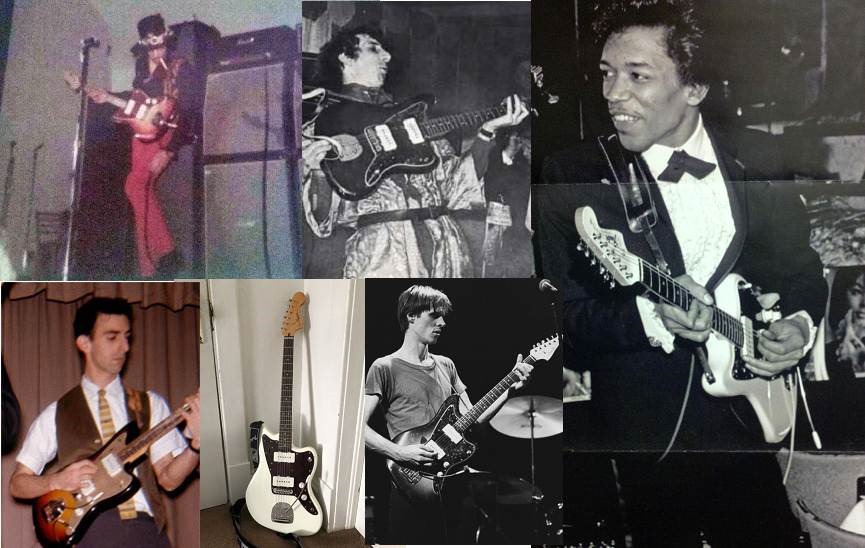
Jazzmasters! From the upper left: Jimi Hendrix without a Strat; Pete Townsend about to decrease the supply of used guitars; some guy named Jimmy James (wonder what became of him?); Frank Zappa, who didn’t say “The Jazzmaster isn’t dead, it just smells funny;” my Jazzmaster painted the homeopathic color Sonic Blue; Tom Verlaine, vanguard of the alternative nation which latched onto the bargain unwanted Jazzmaster in the 1970s.

.

A few notes on the music. I sometimes create the drum tracks for my compositions before the live session begins. And since I’m usually needed in the guitarist role, I sometimes lay down the bass parts with those tracks ahead of time too. That’s how this piece was. On the day of the session, I sang and played the wailing lead guitar*** and recorded the reading of Kevin’s words live with Dave playing a baaing/buzzing synth part live. Dave’s part, subject to his current hands, didn’t fulfill all the groove chop I thought the piece needed. So I added a second guitar part doing my best at rhythm guitar on my Telecaster, but a lot of the final groove you hear is an electric piano part that I laid down trying to imitate my friend and partner Dave’s playing as I recall it from the past.

By now I hope you’re ready to hear the musical story of Kevin FitzPatrick’s farm poem “Coyotes.”   The player gadget is below for many of you. Don’t see that? This highlighted link is provided as an alternative so you can hear it that way too.

.

*I have to repeat this one, which I read in a comment thread this month regarding the upcoming Hollywood Oscar awards event: “The only Oscars I care about are Peterson and Wilde.” In the context of Dave Moore, even the young Dave wasn’t likely to stand toe to toe (finger to finger?) with Oscar Peterson on piano. On the other hand, I’ll hop on top of Oscar Wilde’s tea table in my slush-muddy Minnesota shoes and declare Dave’s poetic wit with Wilde’s.

**Other reoccurring characters weave in and out in the farm poems too — and while four-legged, the couple’s farm dog, the incongruous poodle named Katie, makes a cameo appearance in this one and others.

***The lead guitar part is played on a Jazzmaster, a famous failure in Fender’s otherwise wildly successful line of mid-century electric guitars. A couple of decades into its Edsel-hood of “what were they thinking” failure, unwanted used Jazzmasters became an affordable choice pragmatically chosen by some punk and alternative musicians. Even so, few think of a Jazzmaster for this kind of wailing lead guitar with a bit of funk flavor. As long as one is able to address the Jazzmaster’s bridge design issues, it can  do that sort of thing.

Bicycle Spring

Let’s celebrate our arrived spring with this LYL Band performance of another Kevin FitzPatrick poem. Here’s a link to the full text of Kevin’s poem that we used — a link which also serves as a reminder that Garrison Keillor’s old Writer’s Almanac program used this poem once too.

Green vs Snow - photo by Heidi Randen

Not a satellite image of Antarctica, but a representation of how ice is fading and green emerging in Minnesota.

.

Like most all of Kevin’s poems this one yields a straightforward meaning to many readers or listeners without need of study or re-reading. As I mentioned last time, that was one of Kevin’s aims. You may also notice the care he takes with the word-music in this piece. In our little poet’s group, Kevin’s suggestions would often be metrical improvements, and isn’t the sound of this poem’s opening line: “Windy, sunny, and Sunday” a fine springboard into this spring poem!

If one expects, requires, or prefers a more allusive and elusive poetry, you could shrug at this poem on the page. The poem’s overall metaphor — that learning to ride a bicycle in childhood is representative of a parent and child’s task of independence and departure — is likely apparent before you complete the poem. Myself? I found the poem charming. I can come to like a poem that doesn’t charm me at first — but how many poems survive to be understood when we initially stand coldly next to them? Oh, some poems taunt you with mystery. Some ask you to be impressed with verbal richness. Some present unknown worlds you may choose to explore. “Bicycle Spring”  seems simple. So, is it less good, or good only for lesser pleasures and less respect?

I’ve been writing, reading, and performing poetry for decades. I suppose I should have a valuable opinion on that matter. Sorry to disappoint, but I do not. Readers often tell me that my own poems and lyrics are too obscure and mannered. I personally prize originality in outlook and images highly, even at the risk of asking my readers/listeners to drop expectations and habitual/familiar ways of understanding a piece. Is that the best way, or do I even execute that way very well?

Way back in the 20th century I was taking a seminar class with poet Michael Dennis Browne, and in talking to the group he suggested that most of us students were writing poems that were more obscure than the ones he was writing. He asked, or at least strongly implied, that we should ask if that obscurity was necessary. I now ask you — as I continue to ask myself — to ask that. One thing should be key to your analysis: obscurity may be a way to cover up bad writing, insufficient intention, and fear — yes fear — of being understood.

Kevin FitzPatrick’s poetry was one poet’s answer to those questions. He truly wanted to speak to a broad audience, and yet at his death had achieved only a small (if appreciative) one. Dave and I are trying to enlarge that audience a little bit with this series,* as well as to memorialize our feelings after the death of our colleague.

Before I leave you with Dave Moore’s performance of Kevin FitzPatrick’s poem “Bicycle Spring,”  let me point out that there are often little figures on the horizon or in the background that can add depth to the first hearing or reading of one of Kevin’s poems. In our first example this month “Blackberries,”  I should have given you a link to the Seamus Heaney poem “Blackberry Picking”  that serves as the distant core of FitzPatrick’s poem.  FitzPatrick’s “Blackberries”  is homey, humorous, even practical. Heaney’s “Blackberry Picking”  is fatalistic, mildly tragic, haunted by waste. Kevin admired one poem, wrote another, and says so in “Blackberries.”   To know the tragic and to choose the comic is a complex choice isn’t it? And in “Bicycle Spring”  the background is there too, those concluding “blocks where he/has forbidden you to walk.” The father’s job is in part to help himself disappear.

The graphical player to hear the LYL Band’s performance of FitzPatrick’s “Bicycle Spring”  is below for many. If you don’t see that, here’s a highlighted hyperlink to hear it too.

.

*Kevin’s poetry collections were published by Midwest Villages & Voices, and are not available through easily linked online booksellers or AFAIK, even directly from the publisher. “Bicycle Spring”  is in his 1987 collection Down on the Corner  which is ISBN 978-0935697025 and this information may help you get a copy via your library or local bookseller.

UPDATE: Kevin’s literary executors have now made his work more easily available for those who need to order it online. See this link to order his books that way.

Blackberries

Here’s a performance of a poem in time for St. Patrick’s Day to start Dave and my celebration of the poetry of Kevin FitzPatrick. Longtime readers here may remember me speaking of Kevin late last year when he became seriously ill and then died. I even published a post then that discussed some things that FitzPatrick’s poetry did that my own poetry, or much other contemporary poetry, didn’t make enough use off. Despite that earlier post, I’m going to say a few more words about the value of his poetry you may not hear at first — even though most of his poems are clear, plain spoken, and easy enough to understand for most readers.

Right there is a first potential problem. Some readers have an “Is that all there is?” response to many of Kevin’s poems. To the degree that I knew Kevin’s internal processes I don’t think he was troubled with that “problem.” He wanted his poetry to communicate to audiences not inured to modern poetry which might communicate in a non-linear way or with great reliance on esoteric imagery. But just because FitzPatrick doesn’t “come in hot” with arresting first lines, occult mysteries, and outlandish similes or settings, doesn’t mean it can’t have some other values. In the series this post initiates, I hope to show some of those strengths.

This is the picture that seems most “Like Kevin” to me.

.

Today’s piece uses the poem that led off FitzPatrick’s final collection, Still Living In Town.  And for St. Patrick’s Day? Besides Kevin’s own Irish heritage, this one is about taking a fresh look at Ireland’s Nobel Prize winning poet Seamus Heaney. Like Heaney, FitzPatrick liked to take a sly look at his subjects.

There’s a player below to hear The LYL Band’s performance of this poem by our friend and fellow poet. In our celebration of Kevin earlier this month we performed all the pieces live, one after the other, without rehearsals or preliminary run-throughs. This leaves some rough spots, sure, but perhaps we can take them as evidence of life for us left to sing against the taking from us?

There’s a fairly long intro before the words begin today, which documents how our recording session began: with Dave coming from the stairs into the studio as I am already commencing my musical part. He then needs to start almost without thought.

Oh, what if you don’t see the graphical player below?  This highlighted hyperlink is another way to hear that same performance.

.

The Taking and the Singing Back

I started this inconstant month calling it “Unrequited March”  — and I had this desire: to pay a more complete tribute to a recently departed poet I knew: Kevin FitzPatrick. In that task I wanted to see if I could rejoin with another voice and poet you’ve heard here: my friend Dave Moore.

Dave’s had some reduction in his ability to play keyboards, and he wasn’t sure how well his voice would hold up, but he was able to join me late last week as we took our usual “live in the studio” approach to doing some new pieces together, including a number of ones using FitzPatrick’s words. This requitement was doubly appropriate because Dave knew Kevin even longer than I did. Dave and I managed fine, and had a good time.

In the normal course of things those pieces would get worked on in the following week, but life has interrupted our singing back at death.

Ice Toad - monocrhome

We are all racing forward and melting.

.

How? Even if one of this Project’s mottos is “Other People’s Stories,” I have qualms about telling other living persons’ events, so I don’t feel right discussing more details here today, but there have been hospitals involved, and some pretty long hours in the last two days in those places.

The outlook, best as I can predict it now, is that beyond my concerns with these other matters, my ability to work on audio pieces will be restricted for a while. If time allows, you might still hear some of the Kevin FitzPatrick related stuff yet this week.

Does it seem odd to work on art and our experience of it, even when other things must take precedence? That occurred to me too. Well, when I visited our newly hospitalized patient, they had two needs: music and Jacques Derrida. Go figure.

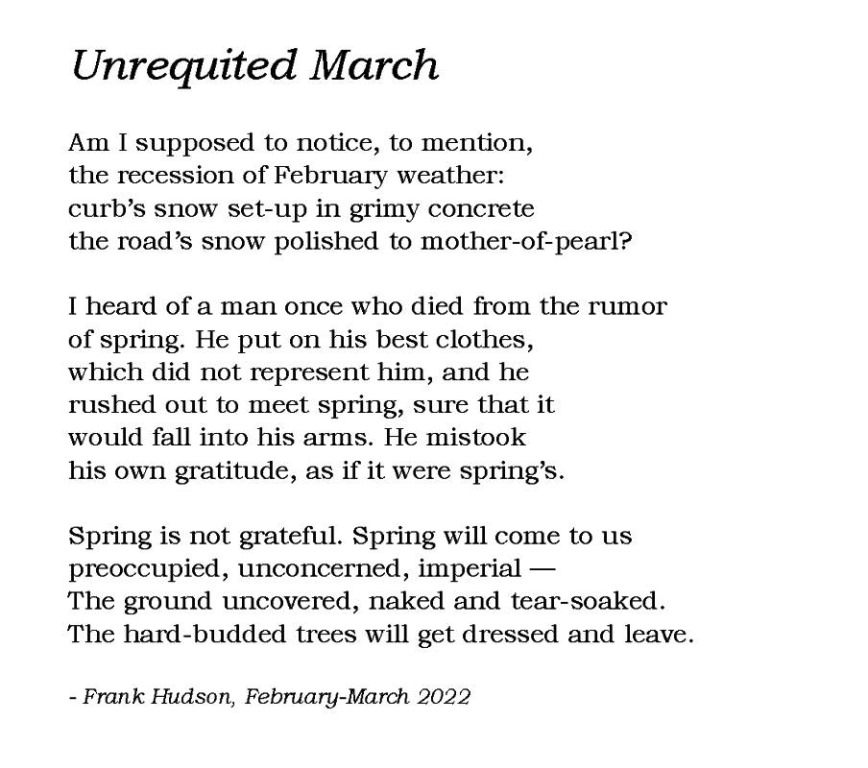
Unrequited March

Here’s a sonnet of my own about the oncoming spring. I live in Minnesota, and here that season’s arrival is something of a lottery ticket. Oh, it’s likely that by sometime in February a Minnesotan is tired of winter, and we know that somewhere around May Day we’ll not have snow or cold to deal with for a few months, but when today’s high got to 40 F, we know no more than that. When I moved here, I was told that on days like today we might see folks wearing T-shirts outside — and yes that’s so. We are so in a hurry for spring that what would be a 5-degree Celsius winter day in more temperate regions seems time to ditch the jacket. Yet we are still likely to have more cold, and even more likely to get substantial snowfall, particularly in March.

So it is, from late February to late April is a two-month season of “what d’ya got” in our state. That’s what my poem performed today deals with.

Things are still snow-covered around here, but it’s not fluffy, Christmas-card snow— more at rugged crusts. I still ride a bicycle nearly every day year-round, and so winter means that I pay special attention to the surface conditions of the side-streets that I most often ride. You know the old factoid that Inuit peoples have a multitude of words for snow in their vocabulary? A day or two after a snow what’s often found is compressed and polished snow with some patches of white glaze where tires’ friction has buffed a gloss.*  A few days later there will be areas where that surface further abrades and patches of dull-brown porridge-like snow aggregates are scattered on the roadway. I call the later “brown-sugar,” and the earlier hard white surface looks to me like the smooth inside of a shell.

Spring-time bike rides in Minnesota aren’t necessarily what you think.

.

Low-pressure studded bike tires work pretty well on the hard shiny stuff, and large knobby treads are the thing for the loose brown sugar. My deep-winter bike’s tires are a pair of Venn diagram hoops circling both.

That’s a poet’s bike ride for you: metaphors per hour.

Unrequited March

The meter’s a bit loose, yet not loose enough to cry “Kings X — Free Verse!” either.

.

Does any of this help “translate” my poem for those without my climate? That’s my hope anyway. Though the title of my poem is “Unrequited March,”  my wish for you, curious or stalwart reader/listener, is that spring will love you back this year. The player gadget to hear about the uncertainty of that is below for many readers, and for those whose way of reading this blog won’t show that graphical player, this highlighted hyperlink will open a new tab to play the performance just as well.

.

*The large, knobby, low-pressure tires are also capable of riding on fresh snow before cars get to it. Un-rutted light and granular cold-weather snow is kind of fun to ride in. The wetter and clumpy snow that will likely come in any heavy storms for the rest of the season is much less joyful. That stuff is like riding in deep mud. The tires’ knobs will get traction — it’s not the tires, it’s an old out-of-shape guy like myself who’ll get tired quick riding through that.

Langston Hughes’ Poem

Today’s piece, “Poem”  from Langston Hughes 1926 poetry collection, The Weary Blues, is one of the shortest poems in that book. Here’s a link to the text, all of it, if you’d like to read along. Those who’ve followed this Project as it has looked at early English language Modernist verse may recall that very short poems, even poems that seem bereft of obvious metaphor, were something that many of those early Modernists liked to present. Such tiny poems are pointed darts at the pomposity and long-windedness of the poetry they were seeking to replace.

The sense I get from today’s example is that by using the generic if exalted name of “Poem”  as the title, when what follows is so spare and simply stated, is meant to draw attention to the provocation that this is worth consideration as a complete lyric.

It may be me and my current situation, but when I read “Poem”  I immediately thought it was a memorial poem, a five-line-with-one-refrained-line statement of the essence of loss intended to put itself up against something like the book-length “In Memoriam A.H.H.”  by Alfred Tennyson. I still find nothing in the text that forbids that reading.

But death isn’t the only loss in life. Some, particularly those looking for obscured clues to Langston Hughes’ erotic orientation see this a coded statement of a romantic or erotic breakup with a “He.” Like Shakespeare’s sonnet sequence and Tennyson’s long poem, the poem has a dedication to a set of initials: “F. S.” in “Poem’s”  case. Some articles one can find in a web search identify this dedicatee as Ferdinand Smith, who was in the merchant marine — as was young Hughes before he published The Weary Blues.  Hughes did know Smith, but I haven’t seen a full explanation of how this putative identification was made. Oddly, if this poem of complete separation was written about Smith, Hughes and Smith kept in touch until Smith’s death in 1961. In Real Life there was no utter break between the two — but that’s biographical information, nothing in the text forbids the abandoned love reading either.

Frederick Smith

Frederick Smith, who’s been identified by some as the  mysterious F.S.

.

And then too the poet Hughes of The Weary Blues  and elsewhere is very broad in his use of the pronoun I. Not only does Hughes not identify F. S. and what exactly was the nature of the love relationship, Hughes is fully capable of using “I” as a collective or representational singular. Think of Hughes most famous early poem The Negro Speaks of Rivers”  — its litany of I’s is not a Quantum Leap  confession that this certain 20th century poet worked on the Pyramids or rafted the Mississippi with Abe Lincoln.

But “Poem”  does feel like a personal expression, even if Hughes may frustrate us if we prefer poems as memoir filled with explicit self-expression. Yet maybe this is of little importance to the essence the poem wants to express. Grief from loss of a lover who leaves and lives, or loss of a friend who has died — does the heart assay any difference?

Musically today I demonstrated fidelity of a different kind, playing a cheap 40-year-old 12-string guitar that I bought shortly after coming to Minnesota, and a bass that once belonged to Dean Seal, who played in the LYL Band in the early 80s. I have newer better* instruments, but it seemed like a good way to reset and get back to making some new Parlando Project musical pieces after February presented other matters that needed to be done.

You can hear my performance of Langston Hughes’ “Poem”  with the player gadget below — or if you don’t see that, with this highlighted link.

.

*My newer guitars are better in that they don’t have parts that won’t exactly work anymore or intonation issues I need to work around, but besides old-times-sake I think there’s some character remaining in these funky instruments sound.

Song to the Dark Virgin

I’ll promise you a love song at the end of this, but let’s look briefly at some other stuff that surrounds that song.

As I look in the Langston Hughes poetry collection I’m featuring this Black History Month for a Valentine’s Day piece, there is less to pick from than one might imagine. Even though his The Weary Blues  is a first book by a young man, and it includes some of the Afro-American poet’s best-known poems — poems of love or passionate desire are conspicuous in their absence.

Even for 1926, the year The Weary Blues  was published, this is somewhat unusual. You might think roughly a century ago the down and dirty lunge of love might be automatically missing, and to some degrees of physical explicitness you’d be correct, but poems on the emotional variety of love and desire were if anything the very fashion for the last decade called The Twenties. Popular and esteemed poets of that era Edna St. Vincent Millay, Sara Teasdale, and others were quite ready to talk frankly about desire. Nor were Afro-Americans silent on this subject. Jean Toomer wrote what I think is flat-out one of the best surrealist love poems of all time. Claude McKay wrote beautiful and passionate love sonnets, and the Blues singers performing and recording then were quite willing to serve in the lust and fond department of art.*

We’ve already said that Hughes was a pioneer in valuing those very Blues and Jazz singers. Early this month we performed Hughes’ “To Midnight Nan at Leroy’s,”   a Blues poem presenting just such a singer and a condensed late-night view of a hook up. Was the man in this poem Hughes himself? Possible, but I think the preponderance of the evidence says not. I think he’s an observer of the tryst, and even given the value he puts on short poems in his collection, he somewhat stints on the details.

No, Langston Hughes, for all his night-life settings and ash-can-school observations in The Weary Blues is almost prudish about sex and love. If he feels desire himself, he’s loath to talk about it — while all around him poets and singers were talking and talking about that.

I’m not a scholar, just a person who actively seeks out poetry encounters and then gathers some information that helps me grasp what the poem may be on about. Hughes was guarded about his sexuality. I gather this was true for his entire life. Some believe he was gay or bi, but then other poets of his time were and that didn’t stop them from writing about desire even if their readers didn’t necessarily understand the gender object of their affections.**   I read at least one piece that concluded Hughes was asexual. Frankly no one seems to know, and if you’re looking to date Langston Hughes, he’s dead, so it may not matter.

Today’s piece uses Hughes’ “Song to the Dark Virgin.”   It does show passion, and if not as Surrealist as Toomer’s great poem, it dips into almost a Robert Herrick style 17th century set of conceits***  Hughes’ use of the archaic pronoun “Thou” and a few other less current words in common speech show him code-switching to something a bit like the Bible’s “Song of Songs”  in the King James translation.

And speaking of “Song of Songs,”  it’s not even clear if this love poem is to some anonymous person or if in some sense it’s to Black people in general, just as “Song of Songs”  melds what seem like individual lovers into Judaism. If you read this poem as Black is Beautiful breaking out 40 years before it’s more publicized instances, you could make a good case.**** The Weary Blues  includes poems set in the various ports Hughes landed at around the world during his stint as a merchant sailor before assembling the book, and his father was living in Mexico. From this I wondered if the ”Dark Virgin” is a reference to the Black Madonna paintings and figures he might have encountered overseas. A possible clue to this not just being a young person’s love poem is that it’s titled “to the  Dark Virgin” not “to a.”

Mother of God of Andronicus

A Greek Orthodox icon, one of the examples of the Black Madonna found in Eurasia and Latin America.

.

But Valentines Day is here, so let’s perform this as a romantic love song. In Robert Herrick style, just calling out a love object as a virgin isn’t unusual. In such a reading or performance this is how the poem may be described: the poem opens with the idea of being a scattered and shattered love offering to the beloved in Part I. Part II gets a little more intimate: the speaker wants to be the layer of clothes next to the beloved skin. Kinky, but Herrick and for that matter “If I Was Your Girlfriend”  Prince would approve. Part III gets closer to consummation of desire as in the trope of consummation as consumed by fire. Yes, it’s a little bit of archaic dress up, but who knows, maybe a love whisper of “I want to annihilate your body” is still a working bedroom line?

Song to the Dark Virgin

The above are guitar chords as I fingered them, but the recording uses a capo on the 3rd fret, so it’s heard in the key of Bb today. Interesting progression, there’s no V chord in it!

.

If you follow the progress of the imagery Part I starts out with shining light, then the more obscured light inside folds of clothing, and finally in Part III it’s out in blazes of leaping flame.

I ardently performed this one today with guitar, chorused fretless bass, and a warped low string section. I let those bowed strings play what an electric bass would play so that the actual electric bass could do other things. Many of you can hear it with a graphical player below, but those whose way of reading this won’t show the player can use this highlighted link to play it.

.

*She’s not Black, but Genevieve Taggart wrote one of the most pointed and poignant of love poems about love on the poor side of town during the last Twenties too.

**Today’s poem never uses a gendered pronoun or name.

***No, not meaning he’s vain — it’s a poetic term for a metaphor that’s not afraid to be elaborately weird or fanciful.

****Back to “Song of Songs,”  get to the 5th verse and you get “I am black, but comely” in the KJV. Or as “Ecclesiastics”  had it: “Nothing new under the sun.”