Artificial Intelligence in Music: the last wall of the castle

Just a note to readers coming here for the experience of literary poetry combined with the original music stuff we do – I’m still doing some “summer vacation” writing that breaks from that form this month. This post does deal with music – if from another angle – and I expect to fully return to our traditional presentations this Fall.

So, I’m at my frequent breakfast place on a fine August morning that has not yet reached the AQI-alert level of smoke. In an unplanned coincidence, Glenn walks in. We’d talked last week about, of all things, Herb Alpert, and his early 1960’s instrumental hits, particularly “A Taste of Honey”  which was a chart topper in our youth.*

Glenn has some Herb Alpert and the Tijuana Brass CDs, but like many he’s as likely to have a CD player as he is to have a way to play 78 rpm shellac records. He’s been trying to get their music onto his new Mac Mini, but his old USB Apple Super Drive won’t recognize a music disk.**  Somehow (likely my current preoccupation with finally writing about it) we got to talking about AI. I mentioned that I’ve been struggling to use my collection of Virtual Instruments (VIs) to realize recordings with brass instruments that capture the full level of articulation the real thing can produce.

We talked a little bit about the various ways these instruments can be controlled: little plastic keyboards, various guitar pickup schemes, even wind controllers. Glenn has a bit of engineering background – this had (I hoped) some mutual interest.

I have little or no guilt in using VIs here for the Parlando Project. Not only is a VI grand piano highly affordable, it takes up no space, requires no fancy mic’ing, and produces a pleasing sound. Given my musical eclecticism, I think of how much more cluttered my studio space would be if I continued to collect odd instruments that I would experiment with to add unusual colors to pieces. And though I can’t actually play a real cello or violin, I can use a MIDI guitar controller to add those sounds. I’m grateful for those options for realizing my music.

Then I told Glenn about the Mellotron – a pioneering virtual instrument before such a thing had a name and acronym. Rather than hard drive files containing databases of digital recordings of actual instruments playing a range of notes in different articulations like one of my computer VIs, this primitive mid-20th century machine used strips of analog tape recordings of an instrument playing a single note for each tape strip. When professional musicians (among them: The Beatles, the Moody Blues, King Crimson, The Zombies) started to use the Mellotron, some objected: could the Mellotron put real musicians out of work? When the Beatles and their producer George Martin wanted a high trumpet part on “Penny Lane,”  a real musician was contracted for and played that difficult and memorable part. But flip the “Penny Lane” 45 RPM record over and on “Strawberry Fields Forever”  Paul McCartney pressed a Mellotron’s keys to produce an eerie flute sound. Listening closely, it wasn’t quite like a real musician blowing into a real flute. It was maybe 80% there – but if it sounded a little fake to a discerning ear, one might think it was still an interesting sound, whatever its level of verisimilitude. But imagine you’re a flutist in 1967 – the Beatles could certainly afford to pay for your services. Though bands moved on to use more complex synthesizers and other devices, real instruments still retained a level of preference when their fully-authentic sound was called for.

Could I pay or otherwise record real musicians instead of using my computer VIs? It’s hard for me to imagine a cello or violin player that would accept my chaotic and self-imposed quick-turnaround schedule, naïve/inconsistent musicianship, my shifting moods, and my no-revenue-project budget.

In my defense, this human being may well be playing the instruments,  just as I play guitar: this note, here, this loud, this long. Other times I’m scoring the music the VIs play, writing or modifying the MIDI event data rather than on a music-staff leger.

Still, there are some gray (or even darker) areas. For me, that started with using arpeggiators: ways to tell a computer you want it to take a chord and play the notes within it in a rhythmic series. I can tell it what note-length to use, something about the order of the notes, but the precision is then all the computer’s – and arpeggiators will have presets to suggest, and I might agree to one. Numerically quantifying the level of plausibility of my own work is problematic, but VI technology is such that even with my limited musical-instrument-operator skills, I may approach 90% there – but my musicianship, with its intents, and also it’s limits, is still involved. I can’t help but think my brass VIs sound badly because they are so far from the families of instruments I have played in “the real world.”

But a greater temptation arrives: more sophisticated computer “players” that take a chord sequence and duration I supply – from composition or by my playing something – and augment them by playing those cadences musically in a style it supplies and I consent to. These “players” have multiple adjustments, I can (and often do) modify what they supply as defaults, but this further development bothers me. Am I still the composer? In a human-musician world the answer would be clear by well-established tradition: yes, they’d say, I’m still the composer. Professional musicians, working before computer algorithms, have long supplied “feels,” timbres, expression, and entire decorative lines. They might even revoice the chords or play extended harmonies. They will do all that (or more, or better) than my computer does for me. So why do I feel bad when I ask my computer to do this? Well, there’s the impersonality to it. I’ve worked with others who’ve made important musical contributions to work I’ve originated, and that doesn’t feel the same. While I think I would be problematic to impose this on human musicians for the rewards I can offer, there’s more to it than not offering them that opportunity. I can’t help but think I’m cheating, that these realizations are fraudulent.

Yet guilt hasn’t stopped me from using these computer functions, and you’ve heard some of the parts they’ve played sometimes in Parlando Project recordings. The term artificial intelligence is elastic, it’s become a marketing buzz-word, but these enhanced arpeggiators and play-with-this-feel-or-articulation variations could fairly be called AI – even when the same musical piece has my vocals of I-hope-for subjective-quality or my it’s-supposed-to-sound-like-that guitar playing.

That said, over breakfast, I tell Glenn about how far AI music generation has come in the past few months. Just by entering a prompt or making a menu selection, often made up of generalized summary words for genre or playing style, one can create an entire song including vocals and all the musical accompaniment. Earlier in this decade the results would’ve been overly simple or subject to embarrassing defects. Now, the results easily pass the “Turing Test” for casual listeners. If the Mellotron flute is 80% there, and my best VI violin might be 90% there, these entirely machine-generated songs are about 95% there in verisimilitude. Sure, human musicians, real composers, even avid music listeners, are forever aiming for that extra 5% of skill, originality, and listener appeal; but when I listen to these productions which can be produced endlessly in minutes of hands-off computation time, the “tells” are the thoroughly AI songs meh obsequiousness to genre musical tropes and the slight artificiality of the machine-made vocalists. And that’s a problem. Centuries of musical theorists from the days of music theory treatises written with a quill, and onward to the accretion of hardened commercial songwriting craft, have supplied all the steps in ink-stained longhand to create a coherent musical structure with predictable effects. The computer coders only have to apply a light dressing of adaptation to transfer this consensus for robotic mass-duplication. The singers would still have remained a challenge – except by a fateful choice: popular music has increasingly prized machine-aided polishing of human voices to remove the inexactness they are prone too. Ironically, what could have been the last rampart to be surmounted by AI was dismantled by meticulous vocal production and ubiquitous auto-tune before the tech-bro Visigoths arrived.

I said to Glenn over breakfast in the café “Here we are talking about a popular song released 60 years ago, one we both still remember. ‘A Taste of Honey’  didn’t have any vocals, and now AI could easily produce an entire album of other instrumental songs to surround it – and even listening carefully, I’m not sure we could tell AI from human-written and realized musical pieces.”

This is not a theoretical exercise. Streaming platforms and playlists care even less than casual music listeners about AI content standing in for human work. In some genres, the algorithm that supplies your next song playing may already be a robot suggesting robots playing robot-composed imitations of human music. The only thing holding off an overwhelming onslaught of AI slop is that we, the audience, are still invested in the erotic worship of flesh-and-blood young performers and some residual romantic veneration of the human artist. Those things may be illusionary, but even if so, those things may be our defense. Do I have any other hope to offer? Yes, there’s something else, that comes next post.

This is the author of the play “A Taste of Honey” for which
the tune was composed. Her play frankly portrays a whole range of working-class situations in ‘50’s Britain. A teenager when she wrote her play, she was 21-years-old when this cheeky interviewer interrogated her. What admireable self-confidence!

.

*As vividly as I remembered the song, I knew nothing about its origin – and while I could distinctly recall the musical sound of Alpert’s recording in my head (trumpet, trombone, and that beating drum) I also heard in my mind vocals and a crooner singing. I tried to find the version with the sung lyrics I was remembering. I likely had heard the (somewhat unlikely) version of “A Taste of Honey”  done on the Beatles’ earliest LP, but I don’t think it was that one I was hearing in head.

**If you still own that ancient Apple artifact, the external Super Drive CD/DVD drive, you should know that it won’t work unless connected directly to one of your Mac’s USB ports. Even deluxe powered USB hubs or docks won’t work–  the drive will seem completely dead when connected through them.

May Music Find a Way. Spring 2022 Parlando Top Ten numbers 7-5

Tonight is Jazz Night here at the Parlando Project Top 10 countdown. I’m going to ask the folks who come here for the talk about words to murmur down quietly today as I speak about the music.

Funny how these quarterly counts sometimes become nice little “sets.” Both today and tomorrow’s segments as we countdown to the most popular piece this past spring are as good as any planned ones I could have devised. So, let’s get the musicians on stage!

7. Sonny Rollins, the Bridge, 1959 by Frank Hudson.  Remember that the bold-face headings at the start of each entry in this countdown are links to the original post presenting them, where you can read what I had to say about it then. I had a lot to say about this one back in January, and so even though this is a piece where I wrote both the words and music, today I’m going to talk about how this (and many of our Parlando Project musical pieces) was realized.

With significant accuracy I hesitate to call myself a musician. My home instrument is the guitar, but even there my knowledge is not something to brag about, my skillset a bit unusual, but limited, and my consistency not up to a professional (or even many dedicated amateurs’) level. But I have a secret weapon: I can choose to compose or improvise (spontaneous composition) the things I present here. My Jazz guitar chops are not strong, but the chordal part was something I was able to execute. Listening back today to the second guitar part I improvised for this I think it was a good day with the wind at my back for me.

In another world I’d more often use other musicians who could add their skills to this enterprise, but logistically and financially the one-man-band approach is what makes it possible for me to express the variety of different musical ideas that I present.

To hear this or the other musical pieces here, use the player that may appear below, or this highlighted link.

.

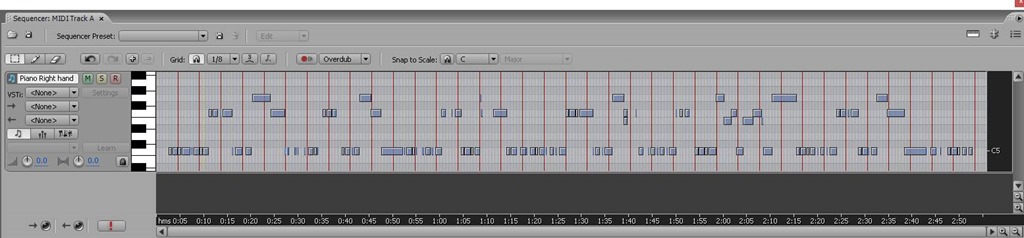
6. Lenox Ave Midnight, an Extension by Langston Hughes.  Another little miracle pulled from my limited, if a bit unusual, skill set? On a good day I can do a passible impression of a guitarist, but my keyboard playing is always naïve. The advantage I can find? Modern MIDI lets me use my mind where my fingers don’t know what to do. In a piece like this I figure out some kind of harmonic flavor by trial and error and my sketchy knowledge of music theory. I played that part and then improvised a right-hand part, editing on a MIDI “piano roll” to correct bad dynamics or altering notes I didn’t like. To an actual pianist this could be called “cheating.” To a composer, it’s called “composing.” You see, I use the term composer protectively, because I really do feel ashamed sometimes that I couldn’t play in real time with two hands the keyboard parts that to casual listeners make a sound like I could. And I think: to a real pianist realizing this simple composition would be a trifle. To me: achievement!

Near the end of this piece, to open up its musical world before I speak the two lines I added to Langston Hughes poem (the reason I call this piece “an extension”) I did something I rarely do here, which I personally try to avoid, because it really does feel like cheating to me. I used a couple of small loops of recorded melodic material from Apple Logic’s free-to-use loop library. My composer’s need here was that my simple and not very convincing saxophone part, that I did play on MIDI guitar, needed something to camouflage those issues.

Why does this bother me to do? After all sampled loops have been part of popular music since the hip-hop DJ’s started dropping riffs from vinyl records. Because I use “composer” as my excuse, my get-out-of-pretender-jail free card, I believe I (or at least some human present in the room with me in the creation process) should have played or scored the notes. I think the two short horn section loops used here sound fine, helped make this piece successful for listeners — but that’s why I feel guilty for using that tactic. Whoever played them, devised those short motifs, didn’t know what I was doing, wasn’t working in concert with my aims.

Now look, I don’t generally mind when other artists do this. Returning to words briefly now: I spent many an April here performing the words of Eliot’s “The Waste Land”  which includes — even more than I imagined — squadrons of quotations and paraphrases from pre-existing works. Selection, curation, recombination, and recontextualization are easily defined as creative acts. Maybe my qualms and self-imposed rules in this have a most self-interested reason: I worry that the casual listener here will think I’m just reading poems over pre-recorded music, when I’m proud that I had to write and play and record the majority of the music on this Project, one track at a time.

Player below, or link.

.

Sonny Rollins, inspiring to me, yet my distance from that discipline shames me

.

5. Autumn Movement by Carl Sandburg.  I stopped writing this post here yesterday, because what I had written so far seemed embarrassingly solipsistic, pretentious, and uninteresting to my audience, and yet also because some of the things I’m feeling as I write about my musical work are hard to condense into a reasonable length post — to be better, it would be even more. And so here we are at this, my presentation of a short nature poem by one of my heroes Carl Sandburg, illuminated by lovely music I made for it. How am I to feel about it tonight? Amazed that I, a non-musician, was able to make it? Or something that feels almost like shame or embarrassment that I present it publicly, when there are days I can’t play anything of any value? Knowing enough to know that what I know as a composer (little) and what I can bring to the composer as a player (limited). Knowing that at my age (old) there isn’t much lifetime to remedy those things.

This, though I cannot say I have sufficient understanding or skills, is where Jazz comforts me as no other art does. Jazz is always confronting the empty sky. Always a critique of silence — and able to the fears inside silence, now, not later, and with surprise and failure. There can be no surprise without failure. I’m a small man, it’s a big sky and a big silence. There are better musicians, better composers, but it’s a big sky and a big silence. This the musician’s and composer’s prayer: may music find a way.

Player below, or link.

.

An exchange from the Prologue to Kora In Hell

William Carlos Williams Kora in Hell  is an unusual book. Its subtitle: Improvisations  promised me more than it delivered. Improvised or semi-improvised poetry, that true Jazz poetry where the author composes on the spot from themes or from spontaneous inspiration is something I admired and—to a degree—practiced in my youth. The improvisations of Williams’ book are usually classed as prose poems, but I don’t find much music in them nor a sense of surprise or discovery. They do reflect the influence of Dada and Cubism, and if I could hold my attention on them longer, they might still bring some pleasure and illumination to me—but so far I haven’t been able to do that. But nearly half the book as published is prologue and that was more rewarding to read.

One can get a real sense in the prologue to Kora in Hell  of where Williams found himself a century ago when it was written. There’s a lot of self-assertion, a lot of names dropped, a lot of debates on poetry and art where Williams as the author of the piece gets to be not just a debate participant, but the moderator, editor, and director of the debate. Poets Ezra Pound, Mina Loy, Wallace Stevens, Marianne Moore, T. S. Eliot, H. D. and Alfred Kreymborg make their appearance. In visual arts Duchamp, Man Ray, and Charles Demuth are referenced. Earlier this year I also noted that a forgotten Modernist poet and editor Orrick Johns has one of his poems quoted in the prologue without attribution.*

The point Williams seems to be making over and over again in the prologue is that he is just as important, connected, valid and artistically insightful as any of these. One can easily view this assertion in a multi-valent way. Williams could easily have felt isolated and left out, now resident in New Jersey and earning his living with a bourgeois job** as a physician. And however genteelly it’s couched, most artists must engage in self-promotion—it’s unlikely that any ego-less man or woman ever set out to write a poem or paint a picture. And the point he’s making, that he, Williams, has something worth considering has  since been validated by the canon-setters.

In the case of two poets, Pound and H.D., Williams has a personal history, having known them in his college years. And it’s an exchange of letters with H.D. excerpted by Williams in the prologue to Kora in Hell  that I used for today’s audio piece. In her letter H.D. is offering gentle advice regarding something Williams has written. She’s noticed some stuff that seems derivative and that she feels doesn’t represent Williams’ individual inspiration. She sets that observation in the context of a writer’s calling and the sacredness (in her view) of the artistic enterprise.

HD and WCW

Two initial American Modernist poets: H.D. and W.C.W.


Williams, the home team here, gets to respond in the bottom of the inning and he shrugs briefly before thundering. He doesn’t really address the substance of H. D.’s feedback so much as he jumps on the “sacred” sentiment it’s couched in. Sacred in Williams’ mind is associated with singular artistic criteria, the kind of thing that Eliot and the New Critics of High Modernism are starting to create in a revised standard version—and he’s again’ it. When Williams says “There is nothing sacred about literature, it is damned from one end to the other” it sounds as a ringing iconoclastic statement, but what does he mean? Is he saying “There’s so much crap around that folks think is great art, so who should care what little mistakes us Modernist innovators make.” Or is it something else? Is he perhaps saying something akin to a maxim I repeat here often, that “All artists fail.” Is Williams claiming that to attempt some impossible sacredness, forgetting that the artist will fail, will harm the work from that intention?

There is nothing sacred about literature, it is damned from one end to the other.

He then closes, in a sentence as musical as anything in the prose poems that follow, with a Dada litany. A half a century later, another Dada-influenced artist who influenced me, Frank Zappa, would phrase the same principles when he said his artistic rule was AAAFNRA, “Anything, anytime, anywhere for no reason at all.”

I’ll have more to say on this in a follow-up post, but this is long enough for one sitting and it’ll give me a little space to talk about the music in today’s piece. I got to use two new components in composing this. The opening section features a fine pipe organ virtual instrument from Garritan. In a vary real sense, the pipe organ was the first, wholly mechanical, embodiment of the synthesizer, and I personally can’t play or compose for it without thinking of Michael Barone and his long-running radio show “Pipe Dreams” featuring that instrument. The orchestra sounds are from Sonuscore’s The Orchestra which is a novel approach to orchestral virtual instruments. My initial encounter with using The Orchestra mirrors most other reviewers: it makes adding orchestra colors simpler than most while giving indications that it can be used deeply if one gets under the hood of the default ensembles.

This may be a good time to explain how I use virtual instruments here, and particularly orchestral instruments. I’m thinking that many of our casual listeners when they hear Dave or myself chanting or singing away with everything from a string trio to larger ensembles that I’m just dropping in some loops or samples from a recording. There’s a good deal of that done on the Internet with poetry and I won’t knock it.*** After all, I subscribe to the maxim of Duke Ellington’s that Peter Schickele sustained “If it sounds good, it is good.” However, because I consider myself, despite my limitations, a quasi-musician and an intentional composer, I choose not to do that. Those string and orchestra parts are played,  on little plastic keyboards or with a guitar MIDI interface. Sophisticated musicians probably already know that because even while using orchestral instruments my harmonic framework is either based on rock’n’roll/blues and their common “three-chord trick” or on older drone/modal folk music traditions.

So the opening H.D. section of today’s piece is a three-chord trick, something that any garage band or punk musician would understand. And the William Carlos Williams part that follows is simpler yet harmonically, based on just C to D major chords, though the color notes of the electric guitar solo extend that slightly. When someone asks what kind of music I write I’m at a loss for useful words. I’ve said extended folk music and I’ve said punk orchestral.

To hear me present the epistolary dialog between H. D. and W.C.W, use the player below.


*As I said when presenting John’s “Blue Undershirts,” it’s possible that Williams, who praised the lines he quoted and used a similar though extended expression in his anthology staple “The Red Wheelbarrow,” might have thought that Kreymborg wrote them, since he quotes them while praising Kreymborg.

**I have no idea of Williams’ intent in that “day job” choice—or even how good or bad he was as a physician—but given the latency and indirectness of writers and artists impact on their fellow human beings, such work may be a useful adjunct to the writing life. I myself spent nearly 20 years of my working life in the lower levels of nursing. As I told my wife recently in a moment of clarity, I figured that if I couldn’t help myself at least I could be some help to others. Young artists: consider this.

***I must also mention modern hip-hop production which has developed a class of composers who are very adept in using samples, bits of recordings, and timbral eclecticism in a way that if someone had described it in the mid-20th century it would have seemed the very essence of an elite and esoteric avant garde, and thanks to a blessed (as in The Beatitudes) audience, and a good dose of the ever-popular folk music elements: intoxicants, sex and violence, they’ve made widely-heard popular music with it. This strikes me, along with Bob Dylan completing the Modernist revolution in poetry, as the most significant and surprising artistic events of my cultural lifetime.

Leonard Bernstein’s 100th

Just a few words here to note this. I am not a studied musician or composer, and I’m not even passionately drawn to Bernstein’s own work in these areas. Why I pause to mention him has more to do with the particular role he took in introducing composition to young people of my generation.

He did this both with live events (most of which were in cities far from my little rural farm town) and with broadcast shows. He’s the first person who presented himself in greys between rolling bar-lines on my rounded TV screen telling me that actual human beings created these imposing orchestra pieces, and not only that, there were human beings from my own country who did that, and even more strangely, living people who still did this.

Why should this have been news? I don’t know for sure. And is that still news, information not yet widely known? I can’t say. But Leonard Bernstein did let me know that, sitting on the the floor of my mid-century childhood’s home. I can still recall him introducing American Modernist Charles Ives’ music to me, so many years ago.

Here’s an hour-long TV broadcast from over 50 years ago with Bernstein presenting Ives and his music.

I believe this is the program where I first heard Ives


If you’d like just a taste on how Bernstein introduced Ives, here’s a slightly later talk that is only a couple of minutes long


Bernstein links Ives words and music together in his explanation.

Conlon Nancarrow

A great deal of what you hear me play here is made possible by a 1983 invention, MIDI (Musical Instrument Digital Interface), a standard for communicating musical commands. MIDI lets me create piano parts I can’t play with my non-pianist fingers. I tell MIDI what to play, and MIDI then instantly responds by playing those notes on an instrument so I can see if they fit.

Given MIDI, I as the composer can have the equivalent of a pair or more of pianists willing to play as simply or complexly as I want them to, and not only are my MIDI pianists totally compliant, they can be preternaturally skilled as well, willing to play odd rhythmic displacements or impossible fingerings.

In the years between WWI and WWII, a young musician of no great wealth or social background was studying composition in Boston. He was said to have crossed paths with some of the giants of 20th Century music there, including Walter Piston, whose Harmony  book I once started many decades ago, and Nicolas Slonimsky whose book on scales later became a huge influence on John Coltrane and Frank Zappa.

However, the titanic forces of world events would soon sweep him away from all this. In the 1930s he joined the Abraham Lincoln Brigade, Americans who volunteered to fight the Fascist forces seeking to overthrow a republic in Spain during a war that served as a beta-test for World War II. This was a complex event, but all we need to know for our young man is that the anti-Fascist coalition was defeated, and the survivors who had fought for the Spanish Republic ended up as men without a country.

Earlier this year I was reading some 1939 writing by Herbert Read where he was appealing for support for a plan to transport these Spanish war survivors from French refugee camps to Latin America. Our young man, who’d hobnobbed with key musical theorists before becoming a “premature anti-Fascist,” soon found himself in Mexico City, perhaps as a result of this plan.

It was there our exiled young man took a technological step as a composer. He chose to write his music using “player pianos.” Player pianos, also called “reproducing pianos,” were a home entertainment fad from the era before better quality electronic recordings. An elaborate clockwork rolled a scroll of punched paper across mechanical sensors inside the piano which then drove the hammers to strike the piano strings. Scrolls of piano music, some recorded and played by the famous performers of the early 20th Century could be purchased, and when inserted into the home player piano, and played back with musical fidelity.

Our young man’s name was Conlon Nancarrow. Over the next few decades he exploited the player piano, not for parlor entertainment, but to create striking Modernist music of otherwise unplayable complexity. He was hip to new varieties of rhythm and harmony not only from other 20th Century “serious composers,” but from Jazz too—and the mathematical structures of Bach-like cannons were well suited to the looping scrolls he would punch himself. He wasn’t reproducing music someone played, he was producing music he conceived and punched into the controlling scrolls.

In the first few decades of his work Nancarrow had no funds, no grants, no copyist/assistants, no local orchestral resources to realize his musical ideas; but this one artist, a player piano, and his own score-roll punching could produce work needing only himself and his ideas to sound inside his small Mexican apartment.

Except for it’s painstaking, mechanical, cuckoo-clock handwork, what Nancarrow did is schematically like how one can use MIDI today. In a tip to this heritage, MIDI scores are still shown on the lit-up computer screen like player piano scrolls.

Nancarrow Piano Part MIDI score

“Stuck in holes which once were dots”
One of the piano parts for today’s piece shown in MIDI “piano roll” notation


In 1969, using the high-fidelity home entertainment media of its age, an LP record of Nancarrow’s works was issued on a major, well-distributed record label (Columbia, the record company of Miles Davis, Bob Dylan, and Gary Puckett and the Union Gap). That’s when I first heard him. Acclaim in avant-garde music circles, and some grants and touring followed until his death in 1997.

In some ways the typical Nancarrow piece sounds like an artist who when finding out the vast capabilities of his new technology decides to use all of them. At once. A lot. Typical tempos sound like someone playing a recording at the wrong speed—and backwards. The number of simultaneous notes can be overwhelming, the intervals jarring, the rhythms insane. It’s challenging you to understand it, and it’s not a matter if you want to, you likely cannot. As with some avant-garde music, repeated listening (if one allows it) can increase comprehension of the ideas, but Nancarrow is never going to be shoving Billy Joel off the piano bench in popularity.


“Punched polyphony in a row” A Nancarrow scroll plays.


No, the reason I wrote this to celebrate Nancarrow isn’t because I think you’ll like his music, or even because he’d figure in any Desert Island Discs episode in my future (though through castaway days one might find the time to try to untie all the knotted ideas in a Nancarrow piece). No, it’s because I admire that kind of audacity and perseverance.

I originally wrote music of an acoustic guitar “folk song” sort, even though the poem sought to make use of eccentric meters and a tricky rhyme scheme to reference some of Nancarrow’s ideas. Today’s version has new music I wrote which fits the words better. Using MIDI-controlled pianos, it’s sort of “Nancarrow-lite” musically. To hear my audio piece for “Conlon Nancarrow,”  use the player below.