Mistah Witch: Pioneering Blues Poetry

Enjoy the Valentine’s candy if you have it, but this is a longer post, and we’re going to get into some uncomfortable stuff with this one. Yes racism, but then I’ll deal today with musicology and Modernist poetry too. The first is deadly in spirit and body, but then the latter two may often bring on the little death of boredom and indifference. This is why I respect you as an audience: poetry is a minority interest, mixing in the variety of musical styles I use here to the best of my subjective abilities will confound some of that audience, and then to discuss oppression — even the resistance to oppression which should be heartening — well, welcome rare, broad, and appreciated readers and listeners. Let us continue.

I said earlier in this year’s Black History Month series where I’m examining the early work of Chicago poet Fenton Johnson, that it may help us to orient ourselves into the time in which this young Black man in his twenties started writing and publishing. If we look at poetry and music, three big things are happening. They’re going to change how the 20th century, and even our own current century, approaches things.

The Fenton Johnson poetry I’ve presented so far this February has been in the 19th century tradition. It’s a style of poetry his school teachers would have taught him,* and like his chief model Paul Laurence Dunbar, he can speak for and about his fellow Afro-Americans using that mode of poetry. However, at this time something new is brewing in poetry. Over in England a small group of ex-pat Americans are joining forces with a couple of British poets/critics and a man from Belfast to create the first Modernist English poetry.** Few are noticing this yet, it takes a couple of years for it to get a foothold, but in 1909 the first poem in a style that would soon take to calling itself “Imagist” was published: “Autumn”  by British writer T. E. Hulme.

What makes that poem and the Imagist poems that follow Modernist? First off, it’s concise, it gets to the point. The language may combine things in unexpected ways, but it uses much more ordinary and day-to-day language to do it. Indeed, it revels in that — part of its freshness is that it wants to render sublime moments in the same way of speaking that something utterly mundane might be expressed. Its commitment to this is so strong that those mundane moments, the “unpoetic” ones, can be charged with a power. It doesn’t care to have the people in its poetry seem high-flown, they don’t have to be different more “poetic” creatures. Yet these same poems often have an important core of distrust for common or worn-out appreciations of reality. Emotions may be stated, yes, but many of the most vivid poems portray the landscape and the palpable things surrounding an emotion rather than hang signposts or explanatory placards of their feelings. Rhyme and meter could be used, but they aren’t the main point if they lead the poet to ignore these new things to emphasize.

While this is going on, Black Americans are forging a couple of new musical forms that are going to overthrow their nation’s music — and from there, impact the world’s. Because this happened before the full emergence of commercial music recording, some of this is literally un-recorded. Buddy Bolden and his like are playing instrumental music largely sounded on brass-band instruments along with pianos, where access to those instruments is available. Eventually that will be called Jazz. Many mark the first Jazz record as being issued in 1917, though Jazz existed before the recording.

At roughly the same time various strains of music with lyrics made by Afro-Americans are being extracted and refined from the ore of American folk music. I would maintain that the lyrical part of this sung music can be viewed as Afro-American Modernism. The songs love to get to the point of things, stripping away hypocrisy and pretense. They deal with disappointment and sadness, yes, but they most often deal with it in resiliency and wry resistance. Taking from the preexisting tactics of folk musics, they will borrow and reference each other’s individual songs — and like Modernism will soon take to doing, they will collage together unlike things and verses to jump from incident to incident. That sung music will eventually be called Blues, and because it’s a sung music, any instrument can be used for accompaniment, including cheap and portable ones. No Blues? No rock’n’roll, no country music as we came to know it, no rap.*** The first Blues recordings were done in the 1920s, but the first sheet music which might be classed as Blues dates to 1912, though again we know it existed unrecorded and off the books before this.

So, three things — all big, culture shaping stuff. In 1900 there’s no general cultural knowledge that these three things exist: English-language Literary Modernism, Jazz, and Blues. By the 1920s they all become part of the mainstream culture, however misinterpreted and misrepresented they may be. Modernist poetry might be thought of as self-consciously crude esoteric nonsense sticking its thumb into the eye of real poetic verse, while Jazz was thought of as hopped-up fast-tempo music to deaden the mind as rapidly as cheap liquor might, and Blues? That’s merely sad and sentimental music of resignation to fate.

This is Fenton Johnson’s world as a young man. The Harlem Renaissance writers that would come a decade or so later would still be dealing with this world. As we’ve seen in previous Black History Month series here, the Black cultural leaders of the first part of the 20th century were not yet fully on-board with Jazz or Blues, which they often felt reflected badly on their race. They did briefly note Fenton Johnson as a Black Modernist free-verse poet, but this happened in the Twenties as Johnson was withdrawing from writing new verse.

I was thinking of this as I read Johnson’s first collection of poems, no doubt written in the years before the book’s publication in 1913, and I come upon this short poem, “Mistah Witch”  printed in the phonetic dialect meant to represent unlettered Afro-American speech.

Mistah Witch as it appeared in A Little Dreaming

Here’s how it appeared published in Fenton Johnson’s “A Little Dreaming” in 1913

.

What matter of word music is this? I used my musicological knowledge along with literary thoughts as I examined it. It could be a folk-origin nursery rhyme or play song.***  It could just be a short supernatural poem, for we’ve seen last time that fantasy poems were a genre Johnson touched on in his more conventional verse. It may just be me, but I couldn’t help but read it as Blues Poetry — and a very early example of it too.

No, as printed it doesn’t use the Blues’ 12-bar structure or the three-line (two refrained or near refrained lines, and a response in the third line) stanza. Blues has never been purist about that, and early Blues often didn’t fit into regular musical forms. But I got a Blues sensibility from it. Mistah Witch may be mythologically, potentially, or actually, frightening, but the poem’s speaker seems to know Mistah Witch’s game, how he operates. I thought the poem’s sharpest line was (translated from the phonetic dialect) “Ain’t you tired of scaring me?” That implies Mistah Witch’s “magic” terror is weakening out of boredom and the rote nature of it for the speaker!

If Blues, like other Modernist poetry, likes to get to the point of things, it can also enjoy encoding its statements. The tactic is often: I’m going to speak something publicly, and part of the audience (the ones I want to let know we share an outlook) will get what I’m saying — while at the same time those that might not approve of my statement will be in the dark about what I’m talking about. The latter will just be puzzled or indifferent to what they don’t understand.

What could be encoded in “Mistah Witch?”

In plain talk: from the days of Fenton Johnson’s youth, through the years he began publishing his poetry, and continuing after his poetic work faded away, there was beside the slow incremental wear-and-tear of stereotypes and “civilized” discrimination an active and brutal threat of terroristic violence against Black Americans. Threats, attacks, lynching and (white) race riots are a part of American history that wasn’t talked about broadly out of a mixture of shame and “politeness.” *****   Blues doesn’t play that game, but a Blues singer (or a poet looking to find a broader audience) might encode a protest against that terror metaphorically. I did note that the poem concludes with telling us that Mistah Witch (“Mistah” signifying the frightener is someone the singer feels they must make a show of social respect to) has eyes like the sea — the bluest eye perhaps.

I’m not certain if that’s what Fenton Johnson is doing in “Mistah Witch,”  perhaps even unconsciously. I am planning to try to include some information that I have recently learned about Johnson’s political views later in this series. Musically I took Johnson’s original poem, and for this performance turned it more toward an irregular folk-Blues structure to reflect the Blues sensibility I saw in the poem.

And for those who want a little time-machine technical magic to travel back to those early Blues recordings often pressed cheaply for the “race records” market and worn with dust and the needles of heavy-armed Victrolas, I’ve included a Bonus Track today: a simulation of how the recording would sound in that context.

Here’s my rough’n’ready musical performance of Fenton Johnson’s “Mistah Witch” recorded with inexpensive modern equipment.

.

Here’s the simulated worn 78 RPM shellac record version.

.

*Johnson, unlike most Americans and even more so, most non-white Americans, had a first-rate college education, attending Northwestern and the University of Chicago.

**This group coalescing before the start of WWI included T. E. Hulme, from the less fashionable north of England who’d been expelled from Cambridge, F. S. Flint a self-made man of letters who risen from Victorian poverty, the Americans T. S. Eliot, Ezra Pound, and Pound’s former college sweetheart Hilda Doolittle, as well as Robert Frost, and the somewhat forgotten man from Belfast was Joseph Campbell. I count Frost as a Modernist, as I see his poetry aligning in its outlook with Hulme’s theories, differences in prosody aside. Remaining in America, William Carlos Williams, Carl Sandburg, and Edgar Lee Masters would also be early Modernists.

***Jazz musicians will often maintain that the Blues is essential to Jazz as well. In that sense, my reading is that they aren’t just talking about Blues musical structures and vocal inflections portrayed by instruments, but the Blues sensibility.

****Blues could and did use lines shared with those folk music forms.

*****In 1919 Johnson’s Chicago suffered a mass racially motivated riot. In 1909 downstate Illinois had a similar incident in Springfield. Smaller acts of terrorism against Afro-Americans were continuous in Johnson’s time. Black History Month isn’t just about that, history shouldn’t be a flat picture. That stuff is ugly — it was meant to be so — and that ugliness is part of the reason it was suppressed and untaught. But. But. But — you can’t fully comprehend the beauty of resistance to that without knowing the ugliness it opposed.

“Mistah Witch”  in my reading is racism, or white-supremacist terror in general, and it could be specifically referencing the original Klan terrorists who fancied themselves in their costumes as representing murderous ghosts and spirits.

Uncle Sam Says

Here’s another lyric of Waring Cuney’s used on Josh White’s 1941 record Southern Exposure.  Before I get on with presenting the song, let me briefly review who White and Cuney are.

Josh White was a Black American singer and guitarist who usually performed in the Afro-American Blues style. The Blues was a popular musical genre among Black Americans during the first half or so of the 20th century. During that century, some of the musical ideas and a great deal of the outlook and performance style of Blues were gradually absorbed into general American musical culture. As another Blues lyricist, Willie Dixon put it: “The Blues had a baby, and they called it Rock’n’Roll.” And so, when I was a young man, there were numerous young acts seeking to call attention to the centrality of Blues music to Rock music. However, most of these then young musical artists, like the majority of their audiences, were white. Unluckily, Josh White’s relationship to the Blues and it’s audiences was essentially premature — he was a man before his time.

Though White was a fine guitarist, singer, and performer who could have scuffled on the segregated Black performance circuit, for a complex set of reasons he became associated with the American political left and its largely white “Folk Music” performers. There’s a fascinating story on how that came to be that I can’t fit into a short blog post, but the shortest summary I can make of this is that equal rights for Afro-Americans was taken up as a left-wing cause, even more specifically as an American Communist cause, after the Lincoln-Grant Republican party became estranged from energetic advocacy for those rights. In the 1930s-50s era White performed for mixed, largely white audiences associated with the Left, while his contemporary Black Blues artists performed to overwhelmingly Black audiences. Want to know more? Here’s a link to an excellent blog post by Elijah Wald that explains how this premature Blues cross-over complicated White’s career. TL:DNR? Because he crossed-over before  the Sixties, he was somehow considered inauthentic.

Josh White Southern Exposure ri

A later re-issue of the White-Cuney Southern Exposure record

.

Waring Cuney, as this month’s readers of this blog know, was associated with other young artists of the “Harlem Renaissance” even though his name became lesser-known than his colleagues. Always musically interested, he lent his poetic skills to White’s 1941 Southern Exposure  album. Today’s selection, where I perform one of his lyrics from that with my own music, deals with a specific area of equal-rights advocacy for Afro-Americans: military service. In 1941, the American military was segregated, and like America in general in this era, the dictum “separate but equal” was largely an absurd charade, easily tied to pervasive white supremacy and ideas of Black inferiority. Ugly stuff — but in the era just before America entered into WWII, also stupid and counterproductive.

I’m going to oversimplify and compress again, but during the Civil War and in WWI segregated American Black soldier companies had proven their abilities as fighting units, but in the between-the-wars era the US Military had reduced itself to something reflective of the plantation South or the servant-class North. Roles for Afro-American military personnel were limited. Cuney’s “Uncle Sam Says”  is a prophetic smart missile aimed at that situation. How so?

It’s a four-verse song, but let’s get on to how Cuney is able to foresee or encourage three things that became current events in the months around when White recorded his singing version of Cuney’s words.

Verse one: Black folks can’t fly combat airplanes. That takes a skilled knight of the air in the mind of the prejudiced. In the same 1941, an Air Corps unit was formed that became known as the Tuskegee Airmen. Yes, it was a segregated all-Black unit, but by 1943 they started proving their mettle.

Verse two: this one is almost eerie. American involvement in WWII combat began with the attack on Pearl Harbor. Aboard the battleship West Virginia there was a messman’s mate named Doris Miller who just before the enemy warplanes arrived was serving breakfast — as Cuney’s lyric says “Keep your apron son.” Miller was a big guy, fullback on his Texas high school team. He was deputized to help carry wounded out of fire and to aid stations on the ship while it was under attack, which he did, including being called on to carry the dying commander of the battleship to treatment. In the midst of this someone directed him to an unmanned machine gun. Miller had no machine gun training — remember, subservient roles in this Jim Crow military — but he’d hunted squirrels, and taking charge of the gun it’s said that he downed between 2 and 6 of the attacking aircraft.

Verse three: while the US hadn’t entered WWII when Cuney wrote his lyrics or when White sang them, the lyric’s prophetic claim that “when the trouble starts, we’ll all be in that same big fight” isn’t as specific as the opening two verses’ charges. Still, it’s a good point. Also note: when blindered folks maintain that the struggle for Afro-American civic equality is all about “privileges,” that it has also historically been a struggle for access to civic responsibilities too.

The last verse issues the call to action and wraps up this effective “message song.” I performed it —that’s a regular part of my encounters with the words this project explores — but if you’d like to hear Josh White’s original version here’s the link to his. The player gadget for my version is below, and if you don’t see that, here’s a link to my version. I have one more example yet from the young Black poets who published Fire!! planned if situations allow me this month, so follow this blog or check back for that.

Southern Exposure, more Waring Cuney

Last time here, as we examined the young “Harlem Renaissance” writers who created the 1926 issue of Fire!!, we met one of its lesser-known contributors, Waring Cuney. Today I present an example of something that Cuney did later in his career. But let’s start by going backwards. Cuney was contributing to Fire!!  around the time he had won a poetry contest prize as a 19-year-old, but he was originally intending to become a musician. His Wikipedia entry says he changed his mind because he thought he had a poor singing voice.

Already you can see why I, with my inconstant voice and a project that uses the subtitle “The Place Where Music and Words Meet,” might take a liking to him. His family’s music and civil-rights connection may be deep and as strange as America could offer. While I can’t confirm this as I write today, he appears to have been the grandson or other descendant of Norris Wright Cuney (Waring’s father was named Norris Wright Cuney II) who was an important figure in Reconstruction era Texas politics and therefore also related to Norris’ daughter Maude Cuney Hare. Even a glance at the Wikipedia summaries for Norris Wright Cuney and Maude Cuney Hare might tell you how rich and fascinating American Black History can be.*

So, what strangeness made Cuney consider poetry? Here’s the story I found: one day Cuney was riding on a bus reading a newspaper when he saw in it a picture of another young black man his age who had just published a book of poetry. He looked up, and there was that same guy, riding on the same bus, Langston Hughes. The two became friends.

If Hughes’ poetry was early in concerning itself with Black musical expression, Cuney was alongside him with that same inclination. Later on, Hughes would occasionally read his poetry with jazz accompaniment. Cuney went Hughes one better, collaborating with Josh White on a remarkable dawn-of-WWII record of Blues songs about racial injustice called, like the lyric I perform today, “Southern Exposure.”

Southern Exposure album cover

The 1941 record where Cuney’s lyric was first performed

.

This song lyric is nothing fancy, but it’s a compressed portrait of the forces that led large numbers of southern Afro-Americans to move North. What moved them? In short: industrial or domestic/pink color work seemed preferable to the feudal system of southern agriculture enforced with outright de jure racial segregation and restrictions. I could step back a bit and say that like Joseph Campbell’s highly compressed portrait of Irish rural poverty and emigration, “Southern Exposure’s”  small cabinet of modest imagery is in the service of describing big things.

I didn’t use Josh White’s music or arrangement for my musical performance of Cuney’s “Southern Exposure,”  preferring to rig up my own. I’m singing with acoustic guitar, the adopted Blues instrument White used, but about halfway in the rustic guitar is joined by a cello, a concert-hall instrument. You can hear my rendering of “Southern Exposure”  with a graphic player if you see that, or with this backup highlighted link that will open a new tab with a music player.

.

*When I read the current controversies being utilized for political leverage regarding American Black History, may I introduce one point that I think gets missed as folks try to maximize white fears about this subject. Yes, horrible things occurred — and they weren’t accidents or fate, they were inflicted with intention. But strange and brave things occurred too. I’d argue that studying evils inflicted with intention is a vital subject for humanity — but also that the second, however bittersweet at times, is marvelous and intensely interesting.

The Dying Bed

I said I’d return to our encounter with the 1926 Harlem Renaissance issue of Fire!!  magazine — and here we are with another poem that was printed there. If you’ll remember from earlier this Black History Month, Fire!!  was largely organized, written, and edited by young people under the age of 25, and as such it wanted to represent a generational change from the curators of anthologies like James Weldon Johnson’s 1922 The Book of American Negro Poetry or Alain Locke’s The New Negro  of 1925. There’s more emphasis on free verse in the poetry section for example, and throughout the issue there’s less attention to propriety. Though only a year separates Fire!!  from The New Negro,  long-time readers here may recall that Locke’s book included an essay on Black music casting a suspicious eye on what the essayist cast as frivolous Jazz music — and Blues, as a vocal music depicting a lot of disreputable situations, wasn’t considered an art at all.

The cohort of Fire!!  didn’t share that outlook. If anything, they wanted to make sure they touched on unconventional thoughts and affinities. And here’s something we now think we know about the young writers in Fire!! — a substantial portion were gay or bisexual. Afro-Americans in the 1920s were coming out as full-fledged contributors to all the public arts — would that other status, fully-illegal and disrespected, muddy the waters of “racial uplift?”

Today’s piece uses a poem by a lesser-known contributor in this issue of Fire!!,  Waring Cuney. Like Helene Johnson, who you may have been introduced to earlier this February, Cuney deserves to be better-known. While not directly part of the Harlem scene, Cuney was friends with Langston Hughes, one of the chief instigators of Fire!!,  and like Hughes he was a young man who was comfortable with the language and outlook of the Blues.

William Waring Cuney

I can’t seem to find a picture of the young William Waring Cuney, but here he is later in life modeling modern vinyl hipsterism.

.

Today’s set of words, Cuney’s poem “The Death Bed”  doesn’t use Blues forms directly, but I’ve already been working with some other Cuney poems that do for possible performance, so I decided that I could include some of that today. “The Death Bed”  is a poem about a dying man who doesn’t seem very interested in his family’s consolations of religion. While getting religion as death approaches is a common trope, our dying man quickly tells his relatives there’s no need for prayer. The relatives leave for another room, and instead of the purposeful theology of public prayer, our protagonist listens to the enigmatic wind. For one moment he tries to join the windsong with his own song, but finds he can find no words. If windsong is nature (likely) or the paraclete (possible), our dying man cannot form his response.

The poem ends with the dying man concerned with what the relatives in the other room are praying. Are they seeking to intercede for the non-believer? Or might they think he needs to be cleansed of some evil — maybe they are even praying to be protected from the sins this sinner personifies?

The Death Bed

Cuney’s poem as it appeared in Fire!!

.

In my performance I sought to open-up intimations of another possibility via music. The Godhead or the universe may not require intercession or last-minute prayers. I made a rare choice to use a conventional musical sample* for this performance. The slide guitar you hear in the main body of “The Death Bed”   is taken from a 1927 recording “Jesus Make Up my Dying Bed”  by gospel/blues guitarist and singer Blind Willie Johnson. While many guitarists think Johnson’s sound and distinctive slide-vibrato is unmatchable, one could suppose I could have tried  to approximate it. However, I was taken with the romantic notion of combining this 1926 poem with a slice of music recorded around the same time. I then included a short coda with a sung variation of this song.** The rest of the music was made with percussion and the sound of bowed cymbals. You can play this performance of Waring Cuney’s “The Death Bed”  with a graphical player below. No player to see?  This highlighted link is a backup method to play it.

.

*Portions of modern popular and art music intentionally use collaged and looped sections of existing recordings. I tend to avoid that for whatever reason, generally choosing to play or electronically “score” my instruments.

**The performers in that short coda are Fred and Annie McDowell. Fred McDowell is another master of the bottleneck slide guitar.

I’m Gonna Make Love to My Widow ‘fore I’m Gone

I’m going to take a short break from our February celebration of 1926’s Fire!! Devoted to Younger Negro Artists*   to celebrate old people — really old people. The audio piece today is also not as solemn as some of the issues we’ve dealt with in other posts: it’s about love, desire, lust — and those feelings are represented as Shakespeare or many of the Afro-American Blues artists of our last decade to be called “The Twenties” might present it, as “country matters.”

There’s a long poetic lyrical tradition of mixing rural metaphors with desire. We’ve done more than one piece here over the years in the bucolic poetic tradition of lusty shepherds and comely rural maids, but it has occurred to me in my present old age that they are almost always young and single. I, on the other hand, am an old, long-married man. Not to put a damper on the prurience factor, but when I say old, I mean old enough to think about not being around to promise love forever. I’ll repeat what I’ve said here before: that at my age when offered a lifetime guarantee on a product, I’ll ask now if there’s a better deal. Yet, oddly enough, that for me makes the desire to connect with my beloved no less ardent. Carpe Diem is no longer just a trope to be trotted out.

Does today’s rambunctious piece do a good job of communicating that? I’m not sure. I presented an earlier draft of this a decade ago to a writer’s group I was participating in — and they, in the springtime of their mid-60s, thought it was a persona poem about someone wooing a rural widow, while I thought the inescapable ribald joke in the piece was that the singer wanted to, ahem, get down with it, before they died making their wife a widow. That group was often right about such lack of clarity, but I sometimes wonder if they were too young — and now that half that group has died, that they might have a different understanding of this lusty Blues poem. And it occurs to me that’s an additional joke! The audience for poetry may be small, but am I expecting the audience for this one to be made up of dead people?

Make Love to My Widow

Here’s my Blues-poem lyric. We’ll be back with other peoples’ words soon.

.

I don’t know, but I wish all of the readers and listeners here, of whatever age, a happy Valentine’s Day. We may not understand love — after all, we barely understand lust — but let us fumble toward that understanding with chocolates and flowers in a cold February. You can hear me perform this Blues-poem with bottleneck-slide guitar using the graphical player gadget below, or with this alternative highlighted link.

Are you looking to further connect Black History Month with love poetry? Patricia Smith is presenting new and existing Black love poems this February via a month of curating their Poem-a-Day feature.

.

*You might think, “1926, that’s old people!” but Fire!!  was organized, edited, and written by members of the famed Harlem Renaissance when they were barely out of their teens.

Her Lips are Copper Wire for National Poetry Month

Even with its most popular and well-known poems, poetry works, works its impact, one reader, one listener, at a time.

Doing this project leads me to read a lot of poems. I’ll go through whole collections, entire anthologies, looking for things that I suspect I can create music for. That sense, “This could work with music” is hard to quantify. I’ve noticed repetition and refrain will often cause a second look. Longer poems will need to presently suggest selections as I’m seeking sub-5-minute pieces. Yes, graceful lines that sing on the page for whatever reason will suggest music. An image or an incident vividly depicted that grabs me will ask me to stop and consider it. Oh, I don’t really know, can’t say for sure, how I select things for this. I’m happy with it being a mystery, and I hope you, reader/listener are too.

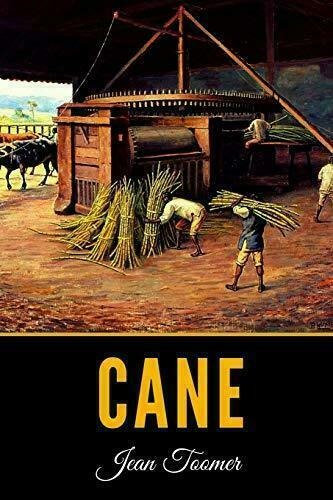
Sometimes that attraction is strong though. The moment I finished my first reading of Jean Toomer’s “Her Lips are Copper Wire”  I knew I had to write music for it and do my best to realize it in performance. Perhaps I can’t say why that is. Little matter. The pull, the attraction, was undeniable.

This Surrealist love poem, like E. E. Cummings poem from last time, was written before the first Surrealist Manifesto, and is proof Americans could use English in this mode early in the Modernist era. Long time readers here will know I sometimes like to mesh in Blues and Jazz flavors with my music,* but Toomer, an early Afro-American Modernist, seemed to have already suggested that with this poem, so that I didn’t have to underline the point. I suppose it just strongly communicated the wonder of desire to me.

Cane cover

This poem was placed into Toomer’s Modernist masterpiece, the book-length mixed-form “Cane.”

.

It’s National Poetry Month, the reason I’m going through early Parlando Project pieces to present a more rapid posting schedule here this April. NPM tries to increase interest in poetry, but it’s hard to get a read on how significantly it achieves that. Arrayed against it is every poem someone didn’t “get” for whatever reason. Every poem that says only “Care about what I’m saying, even though you won’t understand,” poems without the bridge to “Here’s how you connect to this.” Every poem that bores us keeps us from poetry, and we are so easily bored. How many poems does it take to put up a wall against poetry, and will putting a poster on that wall dissolve the wall?

Is this the fault of the poets, their poetry? Is that the fault of us, the readers/listeners? Are there social structures that surpass us in enforcing this distance from the art?  That’s a mystery. I don’t know the answer. But I know that once in awhile I come upon a poem like “Her Lips are Copper Wire,”  and like another Surrealist love poet Paul Éluard I’m left compelled “to speak without having anything to say” — anything to say other than the words of this poem. That limerent pleasure is likely why you’re here, reading this, and listening to the performance of Toomer’s poem. Thanks to that mystery and you.

No lyric video today, but you can hear my performance of Jean Toomer’s poem with a player gadget below. Don’t see that? Well, this highlighted link will also do the job.

.

*I’ll bring that musical influence to any text, breaking out Delta slide for T. S. Eliot, turning German Dada verse and Robert Frost into blues stanzas — and anachronistically seeing Emily Dickinson as a scratchy blues 78 record, or Henry Wadsworth Longfellow at a beatnik Jazz café.

Soul Selector Blues for National Poetry Month

Just suppose that back in the 1920s someone wanted to record a Blues song based on Emily Dickinson’s “A Soul selects her own Society,”  and so they waxed a 78 rpm platter at Paramount records “New York Recording Laboratories,” located back then in, well, Wisconsin.*

If they did, it might sound a little like this.

We offer this sort of nonsense as part of our celebration of National Poetry Month. Then again, maybe it’s not nonsense. Dickinson’s poem does fit into “Old Weird America” and its music shockingly well. Why’s that?

As best as can be determined, Dickinson wrote “A Soul selects her own Society”  during her highly-productive mid-19th century, but for a variety of reasons, this poem, like almost all the other poems that she wrote, wasn’t published until near the end of that century. Somewhat “regularized,” Dickinson’s poetry was bound then into book-length collections that sold well for poetry by an otherwise unknown author, partly due to the myth of her eccentric later-life used as hype for the verse, and because some of her poetry was disarmingly informal and approachable — at least on the surface.

Literary poetry gradually began to take notice of her. I presented Sandburg’s audacious mention of her in 1914 as an “Imagist” earlier this month, and over the course of the 20th century her work has eventually been judged as important as Whitman’s in presaging 20th century Modernism. Now, I daresay that if one was to survey living poets in 21st century America for what 19th century American poet they read, admire, and use as an influence, Dickinson would beat out Whitman — and those two would leave the rest of the field far arrears.

What else happened around the beginning of the 20th century, but took serious critics and culture a while to notice? Afro-American secular music — Blues and Jazz — which would come to significantly define American music internationally and become the dominant strain of our country’s music ever since. Americans were highly important in English language poetic Modernism.** Afro-Americans had their Modernist revolution to offer too, and a great deal was musical in this era.***

So, in another way, this unlikely pairing of Dickinson and Blues isn’t as odd as it seems.

Paramount’s “race records” ads scattered in this video, like other white-owned firms marketing to Black listeners, ran often in Black publications like the Chicago Defender. Outside of these ads, the Defender of the ‘20s largely ignored Blues as problematic. From examples I’ve seen the Paramount ads were less stereotyped than other “race records” companies’. Paramount did hire a Black consultant, Mayo Williams, who may be partly responsible for that.

.

Three ways to hear this performance of speculative fiction: a graphical player is below for a portion of you, but if your way of reading this blog doesn’t show that, this highlighted link will also do the job.  And the new lyric videos we’re doing this month is the third way to hear “Soul Selector Blues.”   Oh — it’s not your speakers or computer — it’s supposed to sound like a Paramount 78 RPM record!

.

*Port Washington Wisconsin to be exact. I’m not entirely sure why Paramount Records wanted to make it sound like it was in New York, perhaps for prestige, and despite the name they had no connection with the motion picture company Paramount either. What was a record company doing in Wisconsin anyway? Well, they made furniture (the upper Midwest was a timber source) and that led them to make cabinets for the new entertainment device, the phonograph. And if they made phonographs, why not seek another income stream from the “software,” the disks to be played on them?

If you choose to view today’s lyric video you’ll see a sampling of how they marketed to Black Americans variously (I can hear the meeting: “Who really knows what they like and will buy…”). High culture to gut-bucket, spirituals to sexual rebels (Ma Rainey’s “Prove It On Me” is about exactly what the illustration on its Paramount ad might lead you to think it was about). They had a pitch for your money and ears.

**Curiously, almost exactly 50 years before the “English Invasion” brought British rock’n’roll bands to the U.S., a small but influential group of Americans were over in England evangelizing poetic Modernism. Were The Beatles payback for Ezra Pound and T. S. Eliot?

***Even literary minded Afro-American writers, critics, and poets weren’t necessarily ahead of the curve in seeing Jazz music and Blues lyrics as an authentic Modernist revitalization of tired-out existing tropes at first. Langston Hughes and Carl Sandburg were exceptions a century ago in seeing this.

To Midnight Nan at Leroy’s

It’s Black History Month, and I’m planning on presenting a series focusing on Langston Hughes’ first poetry collection: The Weary Blues — but before we get to today’s new Hughes’ piece, let me briefly set down a few reasons for why Langston Hughes.

This project presents early Modernist poets most often. From the American predecessors of Modernism (Whitman, Dickinson) we often jump to those of the 1905-1926 era who sought in various ways to “make it new.” While I continue to read and have interest in post-1926 work, less of that can be reused freely for this project. This reduces the Afro-American sources free to use, as the beginnings of the Harlem Renaissance have moved into Public Domain slowly, year by year, since this project began in 2016. My earlier Hughes’ pieces, even if they were eventually included in The Weary Blues,  were published earlier and so had already moved into PD. It’s only on January 2022 that the whole book’s contents moved to public domain.

The Weary Blues cover 1024

Our February focus: Langston Hughes’ first book.

.

A second reason: look at the title of Hughes’ first book, it includes “Blues.”  As we celebrate Afro-American contributions and experience this month there’s an important parallel here. Americans, some of whom set up shop in England and France before WWI, are hugely important in establishing the Modernist break with the shopworn 19th century writing styles. At the same time, Afro-Americans were crucial in doing the same job for music. As I tried to briefly explain last Black History Month, a great deal of the American Black intelligentsia was caught flat-footed by this musical revolution happening around and by them.*

Let’s cut them some slack on that: cultural change is hard to understand while it’s happening, and the quick white adaptation of Afro-American musical ideas in The Jazz Age of the previous Twenties reflected back to the Black community some rough or even derogatory approximations of what was really going on.

Hughes was a young man when he wrote today’s poem. He’d crossed paths with Black intellectuals by then, but he wasn’t fully one of them. His father had cut a bargain for him to go to Columbia to become a professional. Langston skipped out, worked as a cook and at other restaurant jobs; and took to sea working on merchant ships. Hughes came quickly to an understanding of this new music, it’s complexities and its reflections.

Lastly, here’s one of the things I’ve come to understand about the beginning of Modernist poetry in English: there were substantial elements there that sought to strip back poetry, to simplify it to its essence, to make it immediate to an open heart and mind without pre-requisites. This mode was eventually superseded by a more academic and allusive poetry to the degree that some of the best of this early poetic Modernism was set aside or down-rated as simplistic and insufficient.

Over the years you’ve heard me sing the praises of Carl Sandburg, who seems to have been eventually excused away as cornball. But Sandburg was still vital to the young Langston Hughes in the 1920s, and Hughes took Sandburg’s Midwestern American Modernism and applied it to his own heritage and experience. The mainstream of Afro-American poetry retained more of the vitality and working-class connection that Sandburg expressed. Thank you, Afro-Americans.

Let’s move onto the poem I used as today’s text for the performance you’ll be able to hear below. “To Midnight Nan at Leroy’s”  is not one of Hughes’ best-known works, though it deserves more attention. Here’s a link to the text. You could skim through it on the page and see the Blues connection, even if it’s not a Blues stanza as printed — though it could be refitted as one — but more importantly, it’s got a Blues sensibility. My reading of the poem says there may be a little playing going on, a little con and double consciousness which the whole of the work will show up. This will let the hip listener say on hearing it “Yeah, you and I know what that’s like.” That’s Blues sensibility.

I think the poem is a dialog. Nan of the title is performing at a club, and she’s expressing some eroticism in her performance. I think the poem’s other voice is hitting on Nan. The opening stanza is that other voice, the un-named man, who’s starts out teasingly acknowledging that he’s getting what she’s putting down.

The second stanza could be either voice. I performed it neutral, even as if it might be a narrator, a third voice. Note the loaded word “jungle” in it, one of the “primitive” adjectives used to describe this new Afro-American art. Primitive isn’t totally a derogatory or diminutive to the Modernists, who remember wanted to remove the cruft of a worn-out culture and get back to an essence; but in the context of a white-supremacist-soaked society it could surely slide over to being that. Black artists with intact self-respect did use labels such as “Jungle” in the 1920s, so it’s not simply an external white appellation, but it sure sounds like they’re partially reflecting with the white culture when they do. Pause at the last line: I hear Hughes’ “And the moon was white” with intent.

The third stanza is the man cheering on the singer/performer Nan, and I think also he’s suggesting that if “lovin’” is her object, he’s ready.

Fourth? Yes, the two get together. I perform this as Nan’s voice. Note Nan’s use of the diminutive “boy” for the man in this part of our dialog. He may have been acting the player in his earlier stanzas, but I think this is an intentional reveal that the male character is less than a fully actualized man. The white moon image returns, and their moments of Black joy contrast against it. One could write a moving essay on this poems white moon image, but I’ve already gone long.**  You write it.

The poem concludes by refraining the entire first stanza. I perform in the man’s voice, now sour-grapes-ing the couples’ night. Who put one over on the other in this one-night? Maybe some of both, and maybe external social forces are part of the fate-mix too. Hughes chose to dedicate the poem to Nan, so I suspect his sympathies lie more with her. Another question: is Langston Hughes the unnamed male voice? Hughes’ sexuality is mysterious, and while that’s possible, my estimate is that he’s observing, not writing a poem as memoir here.

I performed “To Midnight Nan at Leroy’s”  with my own one-man-band providing the trio accompaniment, and I hope your speakers can handle the bass part. Some of you will see a graphical player gadget below, but other ways of reading this blog won’t show it, so here too is a highlighted hyperlink  to play it.

.

*Last years Black History Month book was 1925’s The New Negro , which included an essay worrying about the dilution of Black uplift and culture from the diversion of frivolous Jazz. Read my post on that essay here.

**As with Sandburg’s short poems, with Langston Hughes here it may help to imagine that you are translating this from Tang dynasty Chinese. The plain English words here could mislead us to think this a mere rote moon/June thing and that Hughes had nothing complex to say.

Fragmentary Blues

Life events are conspiring again to keep me out of my studio space to record new pieces — but it just so happens that I have this rocking Blues recorded back in 2007 with the LYL Band that’ll contrast with our pensive Frost meditation on work from last time. Today’s audio piece was made from Frost’s short poem titled “Fragmentary Blue,”  now recast as “Fragmentary Blues.”

Unlike Carl Sandburg or Langston Hughes, I have no idea if the 1914 vintage Robert Frost had any experience or appreciation of this Afro-American musical form. A quick search found nothing, even though Frost’s lifetime overrode The Jazz Age, The Swing Era, and even early rock’n’roll.

But as poet Langston Hughes soon discovered, the lyrical expression of the Blues was a vital format worth picking up. A first draft of this post included a long aside about the importance of this Afro-American Modernist form, but on second thought I’m going to take less of our time today so that we can focus on how Frost’s poem can be expressed through that form.

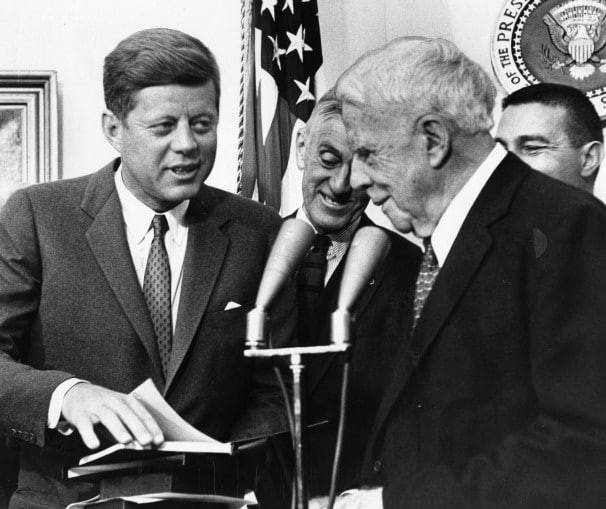
JFK and Frost

JFK: When you wrote “Come on mama, to the edge of town/I know where there’s a bird nest, built down on the ground” were you talking about what I think you were talking about? (wink wink).
Frost: No, you’ve got me confused with another bucolic poet, that’s Charlie Patton — but I believe that’s a philosophic statement about how erotic desire is both natural and elusive. Patton was tuned in open Spanish for that one.”

Blues lyrics often used a stanza format of three lines: one a statement, the second a restatement that may be the same, nearly the same, or subtly varied while still gathering intensity via repetition; and then a third line which can go in any direction the writer/poet/singer wants to take it, though it usually rhymes with the ending of the first two lines. It’s a variation of that ancient and simple poetic scheme the rhyming couplet, but with that repetition allowing for something extra in the balance. And there’s often an element of call and response in the lines: that choral rock, and roll back that Sophocles, Skip James, and Pops Staples could share.

So, let’s go back to our 1914 Robert Frost poem “Fragmentary Blue.”

Why make so much of fragmentary blue
In here and there a bird, or butterfly,
Or flower, or wearing-stone, or open eye,
When heaven presents in sheets the solid hue?

Since earth is earth, perhaps, not heaven (as yet) —
Though some savants make earth include the sky;
And blue so far above us comes so high,
It only gives our wish for blue a whet.

Not in Blues stanza form. Instead, ABBA, and I don’t mean the Swedish pop group.*  But Frost has made the center two lines in each stanza a sort of parenthetical, so that lines one and four are natural couplets and the middle two lines are already couplets that can stand by themselves. This means it was easy to turn “Fragmentary Blue”  into “Fragmentary Blues.”

Why make so much of those fragmentary blues?
Why make so much of those fragmentary blues —
When heaven presents us sheets of a solid hue.

Here and there a bird, or a butterfly.
Here and there’s a bird, or a butterfly,
Or a flower, or a wearing stone, or an open eye.

There’s some savants say the earth includes the sky.
Some say, some say, that the earth includes the sky —
And the blues so far above us, it comes on so high.

Since earth is earth, it isn’t heaven yet.
Earth is earth. It ain’t heaven yet.
It only gives a wish for blues a whet.

So there you go, via show not tell, we rock up Robert Frost in the Blues form. If you read the two sets of words closely, you’ll see something has changed. Frost’s “blue” on first reading seems a stand-in for beauty, while the Blues treats its namesake emotional dissatisfaction as something less than beauty. But, consider again. Frost’s poem says we miss the immensity of natural beauty in our all too earthward human act of trying to possess its emulations. That difference, that dissatisfaction — that’s the Blues. My adaptation only brings out that subtext more overtly. You can hear the LYL Band express Frost most blues-wailingly with the player gadget below, or with this highlighted hyperlink that will play the performance. Most of the better guitar notes here were played by Andy Schultz who played with the LYL Band for a few times, and Dave Moore will once more hear himself back when he could pound and roll on the (plastic) ivories.

.

*Is it too late in their career to suggest that they produce a trans-Atlantic Carl Sandburg tribute record? I’m available, and you need my audience of dozens to hundreds of listeners.

Jazz Fantasia, a pioneering work of Jazz Poetry

This Friday is International Jazz Day, and for a project that subtitles itself “Where Music and Words Meet,” it’s a little odd that I talk less about the musical half of what we do. My project assumes that poetry, even on the page, can be defined as words that want to sing. What manner of tune fulfills that desire? It varies.

Early in this project it became apparent that I was going to feature a lot of early 20th century verse as it was the newest poetry that was clearly available for reuse. This was the time when literary Modernism came to English language poetry, greatly expanding the tactics that could be applied to poetry, and it came in too with an idea that much of what had become expected of poetry was tired and worn out, inauthentic and false.

Almost simultaneously, a very similar movement was happening in music. Though largely segregated from European Modernist composers in person, Afro-Americans were developing at the turn of the century a twisted helix of musics that came to be called Blues and Jazz. Differentiating between those two things is a complex matter. Blues is a nearly inescapable element of Jazz, and Blues is more substantially a vocal music, and so Blues needed a poetry from the start. That means that Blues song lyrics are the Modernist revolution as originally expressed by American Black people, though because of their context and place in American culture this was not understood as such. Like Modernist poetry, Jazz and Blues too demonstrated freedom to use new tactics, and they too wanted to replace tired and false musical tropes.

Poets, even those who intend for their work to be published and read on the page, can’t help but be informed by the music they know and admire. Earlier this month I’ve speculated on Emily Dickinson’s use of 19th century hymn-song meter and a possible connection for her deviation from strict poetic forms informed by her own improvisations on piano. By 1920 we had a Modernist Jazz music coming to America’s attention, and literary Modernist verse, though not without its naysayers, had reached an American audience too. It’s like flame and gasoline, isn’t it? When are they going to meet?

I can’t say what the first Jazz Poem was, or who wrote it. If it was composed by an Afro-American it may have been unnoticed, unpublished, and unrecorded (save by the oral tradition and the folk process which didn’t keep their names). Some of the traditional folk-blues lyrics seem to date from the turn of the century, but they were not printed as poetry then — and even as vocal recordings, the oft-cited first blues record, Mamie Smith’s “Crazy Blues,”  dates from 1920.*  The recording history of Jazz predates that a bit, with the all-white but still claiming “Original” Dixieland Jass Band’s broadly comic “Livery Stable Blues”  coming out in 1917, and that’s sometimes cited as the earliest Jazz record. Two poems already featured here: Ray Dandridge’s “Zalka Peetruza”  and Fenton Johnson’s The Banjo Player”  were available in 1922 for James Weldon Johnson’s Book of American Negro Poetry.**   The former’s “tom tom” beat and the later’s Modernist free verse could make them Jazz Poetry. Some articles cite Langston Hughes’ “The Weary Blues”  of 1925 as the first Jazz Poem, and it is unquestionably a Jazz Poem, but even Langston Hughes had some issues to overcome with it. Back in our February focus on Locke’s The New Negro  anthology of 1925, recall that the elders mentoring and gatekeeping The Harlem Renaissance weren’t yet welcoming Jazz into high culture and were unsure of its effect on their project to elevate America’s appreciation of their race.


No, not that Prince’s band. A 1915 example of proto-Jazz and Blues being integrated into society dance music.

.

Which brings us to the underrated Modernist figure of Carl Sandburg,***  the white Midwesterner who had won the Pulitzer prize for his free-verse poetry in 1919 while being based in Chicago. In 1920 he publishes a follow-up collection, Smoke and Steel containing today’s poem called “Jazz Fantasia.”   This too is clearly Jazz Poetry. It appears to be portraying an instrumental performance, and while unlike Hughes’ poem it quotes no Blues lyrics, it’s clearly a Jazz performance with its imitation of horn sounds, the husha, husha, hush of brush work on the high hat, and their sandpaper swish on the snare, the tin can of cowbell, and the knocking pan-metal ring of stick hitting rim.

If not Blues form as such, two details from Sandburg’s 1920 words (here’s a link to the full text of the poem) stand out to me. Half-way in, there’s a car, a cop, and… “bang-bang!” Striking to hear a still modern pain in a 100-year-old poem isn’t it! And the poem’s conclusion makes a case for the breadth of Jazz expression infrequently made in the fad for Jazz during the Jazz Age: that it wasn’t only frantic music with comic musical effects suitable for careless youth further forgetting their cares, but that it could also portray some green night lanterns and the boats ceaselessly beating against the current.

It was imperative to me that today’s musical performance for International Jazz Day must use some approximation of Jazz. I play no brass instruments and I find them hard to approximate with virtual instruments articulated by keyboards, so you’ll hear an anachronistic, more modern, Jazz trio: drums as featured in Sandburg’s poem, guitar, and bass. The player gadget for this may appear below — and if it doesn’t, this highlighted hyperlink will also play my performance of Sandburg’s “Jazz Fantasia.”


.

*In 1903, Afro-American composer W. C. Handy encountered a Blues playing guitarist in Tutwiler Mississippi, noted he was singing a Blues song with recognizable Blues lyrics. He thought the music was “The weirdest thing he’d ever heard” but by smoothing it off and adopting it to the composed brass band and society dance music he was familiar with, he made use of those Blues elements.

**Other examples of Jazz Poetry influenced writers I’ve managed to sneak in here are Kenneth Patchen who read to Jazz music, Le Roi Jones/Amiri Baraka, a poet who also wrote widely about Jazz, and even words by Laurie Anderson who was influenced by fellow Chicagoan Ken Nordine who had released several LP records he called “Word Jazz.” The music on Laurie Anderson’s recordings doesn’t read as Jazz to most, but focus instead on her voice and you’ll hear that same ‘50s cool jazz phrasing.

***I often make the case here that Sandburg’s poetry contains some admirable examples of the compressed and spare Imagist aesthetic, but besides poetry he’s intimate with the rise of photography as an art via his wife’s brother Edward Steichen, he was reportedly the first daily newspaper cinema critic in Chicago, and he was an important popularizer of American folk music.

And speaking of Langston Hughes achievement, Hughes’ early poetry often sounds unmistakably to me like he had “heard” Sandburg and taken some of his riffs into his own heart to be further extended by Hughes’ personal familiarity with the Afro-American experience.