If I hold to my current plan, there are going to be several more posts this February as I tie up this series dealing with an Afro-American scrapbook found at the house I stayed at when I came to Minneapolis in the 1970s. Those missing the Parlando Project focus on literary poetry combined with original music here should eventually get a return to usual service before the start of U.S. National Poetry Month.
So, that scrapbook, the thing in the middle of this series — I talked to Dave Moore who bought an old South Minneapolis house in 1975, about its discovery this week. As we learned last post, 3132 Park Avenue was originally built as the sort of house for an early 20th century businessman or upper-middle-class family: four large bedrooms on the second floor, spacious rooms on the first floor (two of which could be joined by opening a pair of large pocket doors) and a separate interior set of stairs to an attic third floor which may have been designed as quarters for live-in help. I summarized the house’s history last time, including that from the 1940s on, the house had a succession of tenants after its long-time grain-trader owner died in 1939, eventually becoming a rooming house catering to Black residents. Shortly after moving in, Dave was on that third floor, and he noted a small, about 3×3 foot, access door on one wall where the slope of the roof descended to less than full height. Opening the door, he crawled inside. It’s been decades, but Dave is pretty sure that the scrapbook was found there. “Anything else in there?” I asked him. “I remember an old carpet sweeper.”
The house still had furniture when Dave decided to buy it. By the time he took ownership the real-estate firm had taken all of that out, emptied the house — so for the scrapbook to have survived, it was lucky to have been secreted in a crawl space. Did its owner or creator hide it there? Who could that person have been? Today I’ll give you my best guess, and in following days you’ll get to look inside the scrapbook to see the clues that led me to that guess. In looking at what the scrapbook includes, you’ll get to look inside a particular document of what had the attention of a 1940s American Black person.
My initial guess, back when Dave gave me the scrapbook in the ‘70s: I figured it was made by a fan of Jazz music, then the popular music of the 1940s. Noting the movie and performing stars pictures clipped from entertainment magazines and newspapers — and that it was after all a scrapbook — I thought the greater probability was that it was a woman. Scrapbooking is not something that many grown men engage in, and so I imagined a young woman entranced by performers.
Later as I found out more about the Jazz-vocal-quartet The Cats and the Fiddle who figure prominently in what was chosen for inclusion in the scrapbook, I changed my theory. I learned that a man named Lawrence Hazlett (who professionally went by the name Hank Hazlett, and whose last name has been misspelled as Haslett and Hazelett) had been, during the 1940s, a member of the Cats and the Fiddle. I’d overlooked personal items pasted in the scrapbook connected to Lawrence Hazlett that a mere music fan wouldn’t have: his 1944 pay stub from MGM, a Department of Labor ID card. Hazlett was born in 1911 in St. Louis according to Marv Goldberg’s info. He may have lived at times in Indianapolis, Chicago, Minneapolis, and Los Angeles.* I changed my mind. This was a musician who was scrapbooking his career, and Hank Hazlett was that musician. At the start of the month, that’s what I thought I’d attribute the “authorship” of the compiled material in the scrapbook to.
I’ve now changed my mind again, due to this month’s research and closer re-examination of particular items included in the scrapbook, and my plan is that you’ll be looking over my shoulder at items in the scrapbook as I examine them in the next posts. These items engendered feelings, hunches — my attempts, however imperfectly but empathically, to think of why certain things were chosen to be saved and pasted on pages.
My current theory is that the scrapbook was made by a wife of Hank Hazlett, likely a woman named Edith I. Hazlett, with his collaboration.** If, instead, it’s my previous working theory that it was Hank himself documenting his life, the choices made in collating the material in the scrapbook would make him even more fascinating to me. The author (or collaborating authors) are more deeply and widely concerned with Black artistic expression than I would think most musicians were in the 1940s. There’s an undercurrent of feminist thought that can be extracted from some items in the scrapbook,*** though that may be a reflection of the decade of the 1940s when so many men were mobilized and out of the country. And dare I say it, at times there’s the slightest hint of gender non-conformity there too.****
It looks like the maker of the scrapbook altered the brand name of the now tattered scrapbook to Hazlett. The TV Troubleshooter booklet won’t tell you how to block annoying YouTube ads, nor offer fool-proof password sharing schemes. The torn photo may be a South Minneapolis snapshot of Hank Hazlett. Someone has to take snapshots (no selfies then) so it could be a clue that Hank isn’t the sole creator of the scrapbook.
.
Guitarist and singer Lawrence “Hank” Hazlett lived in the South Minneapolis neighborhood that the scrapbook was found in from 1953 to at least 1963. He worked steadily there as a musician, leading his own Hank Hazlett Trio for most of that time, and at least occasionally playing with other groups. Minneapolis city directories and some online histories of the Minnesota music scene document this information. But there’s a strikingly absent bit of data there: he’s never shown as living at 3132 Park Ave where the scrapbook was found. Instead, he was consistently recorded in city directories as living six blocks away at 3648 Portland Ave. Starting in 1953 and 1955 Lawrence Hazlett is listed as a musician at that address, and his wife is named as Edith. In the 1957 directory Lawrence Hazlett is missing from the directory listing, but a Mrs, Marian M. Hazlett is listed as living at that address. This continues in 1958 with Lawrence listed as the head of household and Marian as his wife onward to the last Minneapolis city directory in the Minnesota Historical Society collection, Marian is also identified in one directory of this era as working at the Minneapolis Public Library. So somewhere in the mid-‘50s, it appears that Lawrence has a different wife. There are no firmly dateable items in the scrapbook that can be fixed after the middle-50s. There are a couple photographs that could be estimated (from woman’s clothing styles) as early 1960s, so I can’t eliminate Marian the Librarian as the collaborating collator, but the masses of things from Los Angeles including current events clippings from the ‘40s indicate the book may have started before Hazlett or his wife were known to be in Minneapolis. In my ranking, Marian would be third on the list after Edith and then Lawrence/Hank himself. In this theory, Edith may have stopped using Hazlett as her last name and ended up at the 3132 Park address in its Black rooming house phase, carrying with her the scrapbook of her days in Hollywood and the following years in the musical scene in Minneapolis with Lawrence/Hank.
In the next few posts we’re going to take a ride through the crumbling pages of this scrapbook in detail. The details will go a lot of places. If you haven’t figured this out about me yet, I love that about details.
.
*The scrapbook has material listing addresses in LA and the Portland Ave. address in Minneapolis, and no other cities are explicitly listed as residences for Hazlett there.
**One surmise: Lawrence/Hank had off-handily collected stuff during his career, and his wife, seeing the value of what her husband did, decided to use a scrapbook to organize and present it, melding him in with other national entertainers. This might explain why things like publicity photos for line-ups of the Cats and the Fiddle dating from before Hank Hazlett was a member of the group are in there. That could be read as expressing symbolically “Here’s my husband, he’s good enough that they asked him to join this nationally-touring Jazz vocal group.
***There are also elements of laddish/Benny Hill-type sexual stereotypes in some cartoons — items that led my switch of maker-attribution to Lawrence/Hank — but the history of the cartoons broadened my understanding of them.
****Better scholars than this amateur, Afro-Americans who know by living things I’m ignorant of, or anyone who may have known the now dead people in the scrapbook may know better. I’m just an open-hearted person looking at this stuff and writing of my experience of it. I’m going to share an opportunity for you to do the same as the series next continues.
One of the things about writing this series surrounding a scrapbook connected with a 1930-‘50s Afro-American Jazz combo is to observe the risk of writing here as an old white guy in the 21st century about a bunch of young Black Chicago musicians and what I might suppose about their lives. The Cats and the Fiddle in the scrapbook took their shot in the world of art and entertainment, but they’re not famous guys. They lived their lives, as I’ve lived mine, as you likely will live yours, with few persisting details or indelible marks. Perhaps I’m overly fixated with looking for those marks.
In today’s piece I’m going to look at the house where that scrapbook was found. It still exists: 3132 Park Ave South in Minneapolis. I’ve looked to see what I could find out about that inanimate place and the people who passed through it. I hoped any details might help me figure out who collated and left that scrapbook. I found what preceded the scrapbook’s discovery sustained my interest.
Back in the first part of the series I recounted that I lived there briefly in 1976 while helping a friend whose words, voice, and keyboard playing has appeared here over the years, Dave Moore. Dave and his then wife had purchased the somewhat rundown house at an attractive price for their planned little family and their small business. I helped a bit with their work in fixing it up and getting the business going.
The house had character, and this young couple, my friends, hoped to honor part of it by making it look a little more like it did in the house’s youthful years at the beginning of the century, looking for clues in old style books and in the “bones” of the house. Similarly, today’s post is going to start as far back as I can find information.
As Minneapolis started to grow as an upper-Midwest business hub, Park Avenue was a broad, tree-lined boulevard that ran north-south through the middle of the city from the southern neighborhoods to the rail depot and centers of government, business, and milling which were fast being established in Minneapolis’ downtown. Park Avenue became a prime site for the commerce titans to build their mansions. In the mid-70s you could still sort of squint and image that era: the trees were still there, elder elm branches arched much of the way over the wide street, and a handful of the mansions still remained.*
3132 was not one of the mansions. In 1902 it was built by an A. E. Rydlum (or Rydlun) who was a builder, and it was complete and offered for sale in the Spring of 1903 by Thorpe Brothers, who were an active real estate sales firm in this era of rapid growth and building of new housing in Minneapolis. Here’s how Thorpe listed it:
For Sale-Modern house, ten rooms, hardwood finish throughout; full basement, nickel open plumbing, hot water heating plant, sideboard, china closet, mantels, bookcase. Location 3132 Park Av; easy terms; will be sold soon.”
The next notice of the house I found was a birth announcement later that year. A Mr. and Mrs A. J. MacDougall were listed as living there in that announcement. Next year, 1903, they place an ad seeking “a nurse girl, 12 to 15 years old” for service at 3132. In 1904 they place another, similar, ad: “A nurse girl from 14 to 16 years old for 3-year-old boy.”
When I was working on the house, an attic servant’s quarters and separate stairway were part of the house. There was still a bell in the pantry off the kitchen that had a ringer button on the floor of the dining room. How many servants eventually lived there? How long did a 12 or 14 year old childcare worker likely stay an employee? The McDougall child had a theater birthday party at the downtown Orpheum Theater in 1908. The original Minneapolis Orpheum was a 1500 seat, ornate vaudeville house that had been built in 1904.
A recent Streetview picture of 3132 Park Ave S, servants quarters behind the three dormered windows at top.
.
I pictured a somewhat prosperous young family, that kind that the house seemed to be built for in this location. So, I thought Mr. MacDougall, the first owner of a fine large house with its attic servant’s quarters, was perhaps a middle-manager, a businessman, or the like. Then earlier this year I began to look at the city directories that are available from the Minnesota Historical Society. It might be helpful to my generation to say that these Directories were like the phone books of their time, a combination Yellow and White Pages of a city’s residents, businesses, and organizations — but younger readers will find that obsolete image useless. So let me reset: they were large books issued yearly, or near so, listing alphabetically by name the head of each household in a city, followed sometimes by the name of their spouse, sometimes by the name of their company or employer, and almost always by a general classification of their job.
No one is just their job, but as a shortcut to figuring out, however roughly, where someone and their family was in the class structure, city directories are a data source for everyday people in the past. Here’s what a series of annual Minneapolis city directories say about our MacDougall (whose first name was Allan or Allen — the first spelling used in earlier entries, and then the other):
1903 not in the directory. Likely the directory’s data predates his moving into 3132 Park
1904 he’s listed as “miller” living at our 3132 Park Ave. house
1905 his occupation is “lab,” short for laborer, living at 3132
1906 the “lab” adds that he works at “Washburn C” — Washburn Crosby was a large milling firm in Minneapolis that is now the corporation General Mills
1907 laborer again, no mention of what company, still living at 3132 Park
1908 job now changed to “foreman,” continues living at 3132 Park
1909 looks like he, still a foreman, (and likely his family, though none of these listings mentions his wife) now live at 3436 Columbus Ave, about three blocks away
This scant info tells me little and makes me wonder. Does a miller or an ordinary laborer afford this large new house — much less, live-in help, and theater birthday parties for his kid? Does the later classification as foreman tell us he wasn’t just a line worker? Was there a blip in the market that caused Thorpe to sell under normal market prices, or would they possibly rent an unsold house? Mortgage terms were shorter then, but moving a young family from a fine house in a great location after only 5 years could mean it turned out to be only aspirationally affordable to MacDougall.
The next residents appear in 1910 from the records I’ve found. A Mr. and Mrs. Peter W. Campbell — leaving a gap, 1909 is unaccounted for. The 1910 city directory lists him living at 3132 Park, and his daughter Elizabeth is married at the home that year. The newspaper account lists 25 guests at the wedding. The house I later knew had a big dining room and parlor joinable by opening a large set of pocket doors. I imagined that many guests, the bride and groom, the officiant. It’d be a cozy affair, but they’d probably all fit.
Peter Campbell is confirmed to be living at 3132 Park in the 1910 directory, but there’s no Peter Campbell in the 1911 Minneapolis directory at all, and he’s a boarder elsewhere in the city in 1912. These listings don’t list his job. This short-term occupancy for someone that doesn’t seem clearly homeowner class testifies against his ownership.
In 1910, during the same summer as the Campbell wedding, 3132 Park is listed for sale again: “”Elegant 8 room all modern home, fine lot, reduced price $6,250.” The house isn’t yet a decade old. It’s a fine upper middle class home in a desirable location in a growing city, and in this time servants-wanted ads were placed, and then placed again, curious residents arrive and leave. If this was a Stephen King novel, I could see the haunted story potential, but I don’t really know the story, just these little points.
I can’t say when the house sold but by 1913 we have yet another servants wanted ad, “girl for general housework.” This ad is likely announcing the family that would be the home’s longest occupants, The McLeods: husband John, wife Elizabeth. I note there have been three Scottish names in the house’s history: MacDougall, Campbell, McLeod. John McLeod was certainly Scottish, born on the Island of Lewis, a very northwestern part of the Outer Hebrides. McLeod was said to have built several grain elevators in North Dakota, but his job now in Minneapolis’ downtown was as an “independent grain trader.”** The McLeod’s were a middle-aged couple when they lived there, and Mrs. McLeod was an active clubwoman, holding regular meetings for the Columbian Club and her Presbyterian church at 3132. In 1921 the Columbian Club agenda was a talk on “Greece, the Reign of Pericles, the Glory of Phidias.” Rather than thinking of cursed winds crying “Heathcliff” around 3132 Park, the next 21 years record the kind of stable middle-class life the house’s builders might have expected.
In 1934 Mrs. McLeod dies. Then five years later, in April 1939. this headline appears in the local paper “Trader Collapses at Grain Exchange.” John McLeod was 77, still apparently working as a grain trader. He died the next day in an oxygen tent at the Swedish Hospital in South Minneapolis.
This more-or-less ends the upper middle-class phase of the fine house on 3132 Park. In May 1941 it’s listed for sale as a “very livable home” and “interior in excellent condition….must be sold to close an estate.” I think of all the hardwood trim, doors, built-ins — much of which Dave and I were chemically stripping of layers of paint in 1976. It was likely still pristine then, and still echoing with talk of Phidias and perhaps John McLeod’s mumbles about the Non-Partisan League’s pressures on his trading margins.
Two years past McLeod’s death to settle an estate? You got me on that, but there are indications that the Great Depression isn’t the best time to be selling a big house. The house is listed again in August and September of ’41, this time in the for rental ads. Rent? $50.
Yet in 1942 someone else is having social club meetings at 3132 Park: a Mrs. Jewell Bliss is holding a meeting there for the Juline Burr Tent, DUV to be followed by a social hour and cards. DUV is probably Daughters of Union Veterans and Mrs. Juline Gales Burr (who died in 1906) was a Minneapolis resident and the first state president of the Minnesota Grand Army of the Republic (another Union Civil War veterans organization). Also that year a luncheon for “past president of D. of H.” hosted by Jewell again. D of H is likely “Degree of Honor” a Catholic female fraternal benefit society.
Yet the house on 3132 remains in a murky state in 1942 as I look for mentions. I’ve found records for Jewell Bliss, who was married to a Norland (who went by Noel) Eldred Bliss. Since city directories are alphabetical by head of household (often husband) I looked for Noel Bliss. Throughout the entire US WWII years he lived on Penn Ave North, not Park Ave, and Jewell is listed as his wife, same address in 1942, ’44, and ’45 in the city directory. Noel’s occupation is listed as “beverages” and his business address seems to be 2501 Marshall in Minneapolis.*** Bliss was in the news in 1936 for being a liquor dealer indicted for perjury in Minneapolis. He pled not guilty — but alas, I have no more information on this case.
Noel Bliss: liquor dealer three years after the end of Prohibition, but facing charges.
.
But the situation at 3132 Park remains unclear. Jewell is holding meetings there, though she apparently doesn’t live there. In post-WWII years larger houses on Park Ave were used for offices of various organizations. Was 3132 Park being used at least temporarily in this way, or was Jewell an organizer using someone else’s home or apartment? Again, I think of the home’s two large main rooms, a good place to hold your social gathering.
1943, a short newspaper story about one of our house’s residents links to some fascinating details. A 14-year-old boy named Bruce Dybvig who lives at 3132 Park Ave stumbles on the shores of one of Minneapolis’ urban chain of lakes. He breaks his foot falling into Lake Nakomis where his injury inhibits his ability to swim. OK. I’m not trying to stress a 3132 Park Ave curse theme — and look, the newspaper story I found says a boy lifeguard, only 16 himself in these wartime years of military mobilization, pulls Dybvig out of the lake. Bruce is treated and released from a hospital, and surviving he soon goes on to become another teenage Jazz musician with a story comparable to our Cats and the Fiddle main thread this February.
A year after his accident, Dybvig takes up alto sax, and by 1946 he’s organizing Minneapolis high school students into a 16-piece Jazz orchestra to play the “books” of the hippest white Jazz big bands of that year: Stan Kenton and Woody Herman. What happens to Bruce and those kids? If I haven’t exhausted you with this thread about a house, you may be the kind to enjoy the Jazz-in-Minnesota side-trip to be found at this link.
Boy saved from drowning, the teenager then starts playing modern Big Band Jazz. Bruce Dybvig at the left of each picture. What’s with the Carnegie Hall sign behind him? I’ll tell you again, you might want to read that above link.
.
By 1953 the Park Avenue house is on the market listed again as “Lge. Inc. home, full basmt, gas heat, partly furnished, in excel repair, Ideal for rest home.” Two elderly men with different last names died in 1950 with 3132 Park as their address. This indicated to me that sometime in the early Fifties it may have become a “rest home,” a midcentury type nursing home/elder care facility.
In 1956 another for sale listing: “3132 Park Av S. See this lg, well kept home, 8 BRs, 2 1/2 baths, completely furnished for income, has gas HW heat, nice yard & gar.” It appears that sometime in the mid-50s the house’s rooms were subdivided or areas in attic and possibly the basement became living areas. In the mid ‘70s Dave was told the place had been a Black-owned rooming house.
In 1963 a teenager, Roosevelt Gains, likely a son living with his mother, a hotel maid, at 3132 Park, gets convicted of robbery.
In 1973 I found one more appearance of a 3132 Park resident in the newspapers, Bill Wilson, a house painter doing a little frozen lake winter fishing. In Minnesota this sometimes involves big trucks and semi-elaborate shacks pulled out on sledge runners, but Wilson is equipped with just regional hardiness and a hand-auger. Dave Moore, and then I, will be arriving soon to the Park Avenue house. The scrapbook that’s the idée fixe of this series will be uncovered there. Did 3132 Park Ave have a curse, or is the nature of the place simply the nature of the struggles and reprieves of life? I will be returning to the Black History focus of this series next, but leaving today’s stories of inconclusive fates and historical lacunae of largely white residents who lived at 3132 Park Ave, I’ll summarize. I don’t know even the names of everyone who lived in that house: those teenage servants advertised for (likely newly arrived European immigrants), other old people who may have lived in a midcentury rest home, the transient renters. I’ll leave you tonight as I go to sleep, saying these clippings of life collected here, outside the scrapbook that started things off, are exhibits of working class people in my South Minneapolis — Black, white, Asian, Latin and Native American — saying that our histories have commonalities of dreams (and yes, blunted dreams) passing under all our shades of eyelids, closed in our place across time.
Bill Wilson, one of the last tenants at 3132 Park Ave S. in its rooming house days.
.
If you want a short poem performed with original music after these decades, here’s the young Langston Hughes preparing to close his dark lids amidst his neighborhood in the last decade called the Twenties. Backup link in case you can’t see the audio player the rest of you will see below.
.
*Rather shortly after I arrived, nearly all of the remaining mansions were torn down, as they had no clear commercial or residential usage by then. We’ll discuss South Minneapolis in the later 20th century later in this series, but in 1976 as it is now, this Park Ave area is a series of varied working class to under and unemployed ethnic mix neighborhoods. Over in the other twin city in the 1960s and ‘70s, St. Paul’s similar Summit Ave, was preserving their grand pre-WWI houses which became once again homes to upper middle-class owners.
A surviving Park Avenue mansion is now the Swedish Institute. It was built by a Swedish immigrant businessman in 1908. It’s five blocks from where 3132 went up a few years earlier.
As to the tree canopy, most of the old trees were elms, and Dutch Elm disease wiped most of them out after I arrived. The city’s urban foresters have tried to replant, but it’s trees, and old trees take time.
**Noting McLeod’s North Dakota and Minneapolis connections, I think of the history of the successful organization of the Non-Partisan League in the Dakotas. Farmers there rankled at the low prices they got for their crops, and high markup profits by traders and middlemen who owned the grain elevators, the railroads, and the grain processing mills. Those latter folks often worked out of Minneapolis, but the eventual NPL elected governing majorities in state government, built their own elevators, and pressed with more leverage and bargaining power to improve the farmer’s lot.
***As late as 2022 Bliss’ old business address was the location of Betty Danger’s Country Club, a hip and eccentric restaurant. The owner listed it for sale that year, citing the reason for the sale in this report: her mental health. However many levels this is removed from 3132 Park, it’s another reason for Stephen King to contact me about that gothic novel.
Some of you made it through my summarization of the musical career of the Cats and the Fiddle Jazz combo this week, but even though I was writing about music, we didn’t add much poetry there. One little thing I found out since I wrote that summary: that eBay matchbook collector item should have tipped me off about the site of one of those young Chicago kids’ gigs — a way stop on a trip to Hollywood to try breaking into the movies. It wasn’t at the “Airplane Café Club” as Marv Goldberg had it from his research, but the “Aeroplane Café. I’ve found a postcard. Looks pretty swanky. I wonder how the Cats act went down there in 1936 — did the Denver white swing kids dig their act? Four or five years later I’d give our band of audacious teenagers better odds on that.
Well, however they were received, they were young, they had dreams of a career ahead of them.
Looking at what musical acts were playing Denver at this club and elsewhere during the ‘30s, it was mostly white bands for dancing. Black bands started appearing on the bills in the ‘40s. My research said the Aeroplane Cafe lasted until the ‘80s, hosting in its last years rockabilly bands.
.
So, let’s combine some literary poetry with music, Parlando style today. The words are by Langston Hughes, one of the first poets to recognize that Blues and Jazz were poetic, suitable for praise in poems, suitable to combine with Jazz words he’d contribute. When the young Hughes wrote today’s words for publication, he called the short poem “Dreams.” I heard it as a kind of Blues, a Blues with a sorrowful side, but with an admonishment to endure. If some reading this are having a February of backlash and disappointment tempting despair, this is after all Black History Month. Afro-American poet Hughes knew that dreams may well be knocked down, ignored, belittled. Yes, I know the word “woke” is a word in present contention. I find it odd it is used by those who smirk and dismiss the word as they speak it, aiming it toward those who know very well the reasons that dreams are extinguished.
Hold fast to dreams
For if dreams die
Life is a broken-winged bird
That cannot fly.
Hold fast to dreams
For when dreams go
Life is a barren field
Frozen with snow.
I’m looking at a bare and snowy landscape out my window this evening. I rode to breakfast in 10 degrees with a cold wind this morning. I read the newspaper when I got to the cafe, because I’m a man who still spills eggs and hot sauce on the news in the morning. None of the news was good.
I spent my last couple of days making the musical piece work as well as I could make it, tickling an old guitar that I played when I was young, playing piano the way I can: a finger or two on the keys, tracking the left and right hand parts separately to disguise my ham-handedness — because music may find a way. I sang Langston Hughes’ words quietly, mouth up near the microphone. I had to, it was near midnight when I sang them, and my family was asleep and I want them to keep their dreams.
I want you too to keep the sweeter of your dreams. Waking right now can script all the nightmares and anxiety dreams that need no help. When the best mysteries come under the eyelids, ones almost too good to remember, I want you to keep them, even just the sense of them.
The audio player to hear my adaptation of Hughes’ poem I call “Langston’s Blues” can be heard with the audio player gadget below. No gadget? It’s off dreaming, but you can also use this highlighted link which will open a new tab with its own audio player.
I’m planning to return in a few days with more on why I wanted to work at figuring out all I could about that young Jazz combo of the 1930s and ‘40s.
Time for me to lay out all I know of the story of a 1930s and ‘40s Black American Jazz vocal quartet: The Cats and the Fiddle. Last time in this February series, I reminded moderns that so much in my parent’s and grandparent’s time revolved around neighborhoods. That’s going to continue today as I tell about some kids who shared a location. Previously we’ve seen the Cats and the Fiddle appearing in small-time Hollywood pictures in the Thirties, which might give you the idea that they were a well-established band with hit records and thriving career. That’s not the case. They were young, from out of town — and though they did have a few years of performing under their belts, they were likely around 20 years old. How’d they get there? Where did they go?
The Cats and the Fiddle didn’t start in Southern California. The original quartet were classmates at Wendell Phillips High School, an important school in Chicago’s Black South Side. Last February here we featured Fenton Johnson, an ambitious Black poet who graduated from Phillips decades before the Cats’ founders attended, but some other folks could have passed the band members in the hallways in their day: Nat King Cole and just possibly singer Dinah Washington. Cole was likely the same age — Washington 5-6 years younger but there was a Junior High section at the school.* Oh, let’s not totally leave off poetry — poet Gwendolyn Brooks was the same age as Cats members, and Phillips High School was one of three Chicago area high schools she attended. The thought that these teenagers, poets, singers, musicians, and songwriters, might have taken inspiration from each other, or some other, lesser known commonalties is intriguing.
While in High School the future Cats were in two different bands, the Harlem Harmony Hounds and another group which was — at least at times — performing as Four Dark Flashes. No, the first band had nothing to do with Harlem, these were Chicago kids. There’s a round-up of Cats and the Fiddle history available online put together by Marv Goldberg. He’s found a reference to the Harlem Harmony Hounds as early as summer of 1932, which says they were appearing on radio station WCFL in Chicago.**
The Four Dark Flashes appeared to have traveled some. In October 1936 they were listed as playing the Casino Theater in Toronto Canada, a 1,200-seater which would have just opened earlier that year. If they were all Barksdale’s age, they’d be 16 or so, and traveling out of the country during the school year. This would indicate that some of the Cats-to-be had dropped out of school early to pursue music. ‘36 was likely the year the Four Dark Flashes group lost a fourth, their lead singer. Harmony Hound Austin Powell singer and guitarist was the handy neighborhood replacement to join Ernie Price (tenor guitar), James Henderson (tipple), and Chuck Barksdale (bass). The whole group sang, and beside Barksdale holding down the upright bass, the fretted stringed instrument combinations of 6-string guitar, tipple, and 4-string tenor guitar might shift from song to song.
In October 1937 we get the first mention of Cats and the Fiddle as an act that Goldberg has found. The famous Chicago Black newspaper The Defender wrote that “Four Cats and a Fiddle” were booked to play the Dome Club in Bismarck, North Dakota along with a Bessie Mitchell.
OK, who’s asking “What are a bunch of teenage hep-cat Black musicians doing in Bismarck ND in 1937?” I don’t know. I can find nothing about the Dome Club there, but chances are slim that there were enough Afro-Americans in Bismarck in 1937 to support a Black entertainment establishment. Another Afro-American vocal act with guitar accompaniment, the four Mills Brothers from Ohio, had gotten on nationwide radio, and though their hit records are a smoother sweeter sound and have none of the jive talk found in the early Cats’ lyrics, it’s possible that our group of teenagers had a set-list of tunes tailored for white audiences. The Chicago Defender, when announcing the act’s road gig on its pages says the Cats had “one of the greatest floorshow acts in the game.” Promotional hype supplied by the Cats themselves? Or had they already done some show-stopping appearances in Chicago? Were upper Midwesterners plausibly ready for something like that “Killin’ Jive” hard-swinging Jazz aimed for Black audiences?
Then on November 20th the Pittsburg Courier (another Black newspaper) says The Cats and the Fiddle, consisting of the quartet of guys and a Bessie Sutton are playing at the Airplane Club Café in Denver this week. Not sure why anyone is concerned about this in Pittsburg, unless that Bessie is from there. What kind of venue was the Airplane Club Café? The only thing I can find is this picture of a matchbook once offered for sale on eBay.
The young Jazz guitar & vocal combo was going places. Lenny Kravitz’ grandma not pictured. (just checking to see if you get to the footnotes)
.
That pair of odd Fall ’37 notices bill a Bessie Mitchell and a Bessie Sutton as being with the Cats. It’s unclear if they are one or two different people, and if they are full-fledged members of the band or a separate act that might use the Cats as road show accompanists.*** If neither Bismarck or Denver seem like a common tour stop for a locally-known Chicago Afro-American combo in 1936, swing Jazz had a generalized popularity that was testing racial barriers. It’s also possible that clubs expected the Mills Brothers and got something a bit wilder, or that Bessie or Bessies were the headliners.
Where can we put our Cats on the map next? On January 13th, as 1938 has begun, Goldberg finds them in another Black newspaper, the Los Angeles California Eagle. The paper names the original four schoolmates and a Willis Rogers as members and they go on to say the group will “go far in pictures.” Once more I provisionally assign PR from the group to that prediction. I wondered if the late ‘36 Bismarck and then Denver gigs were just part of a “play your way to pay your way” tour to get to the American west coast. I’m just enough of a trainspotter type to wonder about passenger train service from Chicago to Bismarck to Denver to LA.
Want to figure their transit route with me? Chicago to Bismarck to the Pacific Northwest coast. Sure, the North Coast Limited. A lower Midwest route from Chicago to Denver with connections to LA? Yes, those are options on the Union Pacific Overland Route. But Bismark to Denver? Your faithful researcher looked. You’d likely have to go back to Minneapolis from Bismarck, and then from Minneapolis to Denver before going on to Southern California from Denver. But what’s the alternative? They could have driven, though I know nothing about their family’s financial resources to buy a car, and there’s the season of that traveling: modern indie band road dogs would dread a late Fall tour itinerary from Chicago to North Dakota then off to Denver before a jaunt to LA, when if LA is your goal from Chicago, a southernly “Route 66” highway beckoned. So, if the three dates Goldberg lists are accurate, I think of these four or five ambitious young Midwestern musicians zig-zagging like water bugs on train routes aiming for Hollywood. Yes, I’m grasping here at details, hoping that like a detective they lead to solutions to greater mysteries. The mysteries remain.
You’ve seen the high points of that movie career in the earlier installments of this series. For Afro-Americans in the mid-1930s that would be low-budget all-Black cast and audience pictures, novelty appearances in B movies, and possible work as extras or as a musician for soundtracks. Seems pretty meager when I list those opportunities, but to look at it another way it wasn’t that far from what bigger Black musicians were getting in the movie industry then. Racism and segregation were still unavoidable, overt issues, but Jazz as a rising popular music was softening some barriers in that decade. And it was the Great Depression. Black unemployment was even higher than the general unemployment rate. Appearing as “native” extras on a studio backlot might be demeaning, but even that level of employment meant a paycheck.
Still, they were all about 20-years-old, and they didn’t even have a record contract— yet. And our intrepid group still seems to be traveling back to Chicago from Hollywood.
Lawrence Cohn, who wrote liner notes for a 1976 reissue of the Cats and the Fiddle recordings, tells that Cats were visiting outstanding guitarist Tampa Red’s apartment in Chicago in the spring of 1939 after their spate of 1938 movie appearances, when Red introduced them to Lester Melrose. Melrose was A&R for Bluebird, RCA Victor’s “race records” label for artists of color. In the 1930’s and ‘40s, Bluebird was making good money on a variety of Blues related vocal records, often featuring small combo accompaniment, catchy rhythms, and double-entendre lyrics. Melrose worked out of Chicago where he collected a lot of Black talent for the label.****
How well did the Cats records do? Middling at best. Their closest approach to a hit was a ballad recorded on their first studio session in the summer of ’39, “I Miss You So” — but as WWII was about to break out in Europe, no one knew yet how big the young Cats could be. Cohn compares them to the Ink Spots, a vocal combo who started having big hits on Columbia Records around this time. He tells us the Cats and the Fiddle were repped by William Morris (the same talent agency as the Ink Spots) who started booking them all around the country to see what kind of career they could have. The subsequent gigs Goldberg tracks are mostly at Black audience theaters, but they include the big ones, the ones the most successful Black stars would play.
In America, WWII was still two years away. Victor records recorded more than two-dozen songs as they toured. That maybe-kinda hit “I Miss You So” wasn’t issued until 1940, and it wasn’t representative of their typical fast-tempo jive-slang songs.
Then the war came, and the previously stable, self-contained quartet group of high-school-pals started to churn. Henderson (who wrote “I Miss You So”) died shortly after the record came out. The bass-fiddle guy Barksdale died in ‘47, but was in and out of the lineup from ’41 on. Henderson and Barksdale were replaced by ex-Harmony Hound members Herbie Miles and George Steinback. In the midst of this ’40s churn Tiny Grimes was in the group for a couple of years, even wrote a tune or two for them. Grimes would leave the Cats to play with Art Tatum and Charlie Parker, and along with Charlie Christian, he would help popularize instrumental bebop styles for the guitar. Grimes left our vocal act because by then it wasn’t paying much, and he didn’t think it was going anywhere. A musician’s recording strike and a shellac shortage greatly reduced the issuance of records during the ’40s, and the audience mix for live shows must have changed some due to the overseas war. Amidst all this, Austin Powell, the most prominent singer and songwriter in the Cats was drafted. Hank Hazlett, a guitarist originally from St. Louis, was brought in when Powell went into the armed forces. Hazlett would play with the Cats from ’43 until late 1945. Powell was de-mobbed in Spring ’46, and the somewhat tattered group was still recording and playing, but to smaller and smaller returns. In 1950 the Cats and the Fiddle disintegrated, though surviving individual ex-members continued to be involved in music.
Lawrence Cohn was a highly knowledgeable man about this era, and he worked on a number of important late 20th century reissues of classic Blues and Jazz recordings. When in 1976 RCA collected most of the Cats and the Fiddle’s recordings in a double LP, Cohn wrote the liner notes, yet he only rises to faint praise there. He thinks the songs sound too samey. He says their musicianship was mediocre at best. In the end he’s left with the idea that their humor might be viewed as a corrective to the (in his opinion) too serious and artsy Jazz around when he wrote the notes. This sour summation ends Cohn’s notes:
In general this kind of happy jazz and pop combination disappeared, along with most of the melodic kind of jazz, during the Fifties and Sixties when rock and roll replaced the earlier style of music, and when jazz became politicized. A lot of people stopped going out when this kind of music was not being presented. Perhaps this release may in some small way facilitate its return.”
So besides knocking the Cats, Cohn seems to want to take some shots at the Spiritual and Black Arts Jazz musicians contemporary with his notes. I apparently like those musicians more than he did, and I like the Cats and a Fiddle more too. As to the Cats’ musicianship, I’m of the school that says the essential is that the players did a good job putting their own songs over, and that’s what counts more than an academic skills comparison. Barksdale was good enough for Coleman Hawkins when playing outside of the Cats. Tiny Grimes could trade riffs with Charlie Parker. Austin Powell was still gigging and recording with Louis Jordan and his Tympani 5 until the end of the 1950s, apparently playing not only guitar, but sax and piano.
Decades after Cohn, Australian critic Bruce Elder got the job to write up the Cats and the Fiddle for the current music streaming service Apple Music. Writing there Elder says
If anything, the Cats & the Fiddle were ahead of their time, producing a bolder form of R&B than critics were prepared to accept at the time, such as ‘That’s All I Mean to You,’ which likely would have slotted in perfectly a decade later, but in 1940 just seemed like style-less noise with a swing beat.”
Being slammed as “Style-less noise, with a…beat.” Does that sound like a description of something else that would come around after the Cats broke up post-WWII? Self-contained combos who play their own instruments with guitars mixed to the foreground, brisk tempos, uninhibited stage performances, energetic, youthful, close-harmony singing, witty lyrics that might wink with some “the squares won’t know what we’re talking about” slang?
I’m leading you to say “Rock’n’Roll.” I suspect older readers will be the first to follow that lead with that response, as I find many listeners in middle-age (and younger) think of the later evolution of what gets called Rock — or now, Classic Rock — as a more overdriven electric guitar thing, backbeat drums with less swing laying down the beat, with lead singers often singing alone only with occasional backing vocals. I used to shake my head (and type someone’s-wrong-on-the-Internet posts) in my 20th century Usenet days when the admittedly problematic Rock’n’Roll Hall of Fame would select some (usually Black) harmony vocal group for enshrinement and posters would object that’s Do Wop, or Soul, or something, but not real Rock. I’d try to remind them that Rock’n’Roll originated as a diverse mongrel genre, and that groups who approached music with an outlook, energy, and vocal blend like the Cats, were all over the first decade or so of Rock’n’Roll. These Black high-school students from the South Side of Chicago had an idea and put some audacious energy into propagating it.
About thirty years after the Cats and the Fiddle took their warning-track fly ball swing for the fences, this group of plaid suited white rubes — who looked exactly like you’d expect to find them at the Dome club in Bismarck North Dakota — got to have their moment in a low budget Hollywood movie. This is how they looked and sounded:
On discovering this band in a rural roadhouse, the film’s hero enthusiastically shouts “It isn’t boogie. It isn’t jive. And it isn’t swing. It’s kind of all of them.”
.
*I’m basing age estimates for the original Cats members on a military draft registration record Marv Goldberg indicates he’s seen for original member bassist Charles Barksdale, documenting that he was born January 11th, 1918. Nat King Cole and the Cats were seen again in Hollywood, as Black extras playing South American natives in the Myrna Loy/Clark Gable romcom Too Hot to Handle. Dinah Washington was playing in Chicago with the Cats and the Fiddle as her backing band for the gig when the club owner dragged Lionel Hampton to hear her and nationwide fame for that great singer ensued.
**This radio show was said to be weekly, and other references led Goldberg to think the show lasted until January 1935. WCFL’s history is interesting. Nathan Goldfried’s book WCFL, Chicago’s Voice of Labor has it that it’s “the first and longest surviving labor radio station in the nation, beginning in 1926 as a listener-supported station owned and operated by the Chicago Federation of Labor…” and that ““The station emphasized popular entertainment and labor and public affairs programing, seeking during its earlier decades to help organize workers, increase public awareness and support for the union movement, and enhance public awareness and culture.”
***Entering into wild/just plausible territory: Bessie Mitchell was the birth name of actor Roxie Roker’s mother, musician Lenny Kravitz’ grandmother, and actor Zoe Kravitz’ great-grandmother. She would have been in her mid-20s in 1937, but I have no info that she was ever in entertainment at all, or connected with the Chicago scene.
****Bluebird recording artists included Memphis Minnie, Big Bill Broonzy, Jazz Gillum, Memphis Slim, Victoria Spivey, Arthur Crudup, and LeRoy Carr. Melrose reportedly passed on Muddy Waters — Waters said Melrose was looking for a sweeter style of music than he and his post WWII generation played. One thing I wonder regarding Melrose likely having some responsibility for how big a promotional “push” might be given the Cats. Members of the Cats and the Fiddle from the start wrote most of their own material. Melrose often engaged in the pernicious practice of taking co-writer’s credit on records by acts he shepherded, cutting himself in on that element of royalty monies. At least on the Victor reissue LP I have, Melrose is never listed as having a songwriting contribution.
We left off last time in my Black History Month series this year, with a crumbling scrapbook filled with mid-20th century things someone had gathered. The scrapbook compiler was concerned with entertainment, particularly Afro-American’s in that role, and the largest number of items they’d pasted in focused on a somewhat obscure musical act: The Cats and the Fiddle. Was the compiler a fan or a musician themselves? Woah, we get ahead of ourselves. Let’s stay with the musical evidence we have for a little while longer.
Once I get out of bed in the morning, I grab a newspaper from somewhere in the vicinity of my front door and read it. This is antiquated behavior. I often linger in bed before or after sleeping reading near-instant news on a large tablet connected to the Internet before I later get to the morning paper’s headlines that were written yesterday, yet still I take comfort or distress from reading them printed on paper. This is memory/habit working. I’ve read a newspaper in the morning since shortly after I learned to read. I even delivered them door to door as a youth in my little Iowa town, a place where and when the newspaper might be the only way you’d find out about some things in any detail.
Though I compose music and operate various musical instruments constantly as part of this Project, I’m somewhat removed from the general life of a musician today though I read accounts, I observe. But all of us listen to music, experience it some way. I know of no culture anywhere that for any appreciable span of time has been without music.
In the 1940s and ‘50s world the scrapbook photos, magazine clippings, and ephemera collected would have overlapped my childhood, would have been my parent’s adulthood. I experienced music some from records, some from television or movies, and largely from radio.* Music face to face? Church music once a week, and the school’s student marching brass band a few times a year. I enjoyed rock’n’roll cover bands just twice, at the Junior and Senior proms in my high school. Concerts? I once got to travel to the large auditorium at the state capitol to hear Handel’s Messiah oratorio. But that’s a rural, small-town story within a family that had no special connection to music, played no instruments.
For other white folks in cities, and in other areas, music could have been more central, more direct. Step back a generation to my grandparents’ youth? Recordings, perhaps some, radio not yet broadcasting, movies silent. Non-commercially, there was the parlor and folk music of those whose neighbors or families played. Music at events meant musicians playing, making the entirety of the noise right there and then. Let me repeat: that era’s connection to music was almost entirely performer in the room or performance space — and so where you lived or traveled to impacted your music heavily, and overwhelmingly your connection to your music was as fully dimensional, occupying the same space at the same time with you.
Some who read this may be two full generations younger than me. Your connection to music will likely be more removed: streaming playlists, the soundtrack to video games, concerts that could be large TV screens over a distant stage of dancers and miming singers with microphones in their hands. Or it could be a sweaty basement or a club with a small stage at one side, or something you try to record on the ubiquitous computers surrounding us, to hopefully exist elsewhere momentarily on phones, like a brief, wrong-number phone call that each connected party, embarrassed, occupies briefly, and leaves. You may think: I decide how I experience music, or how I make music! Yes, you do have choice, even if you may, out the other side of your mouth, decry that most all others are dictated by culture and capital. The in-between truth is that you, musician or listener, and the musical audience and musicians in general, are still living inside a present culture that changes things. The older ones living now still remember past cultural contexts, a diversity of time.
Because Afro-American representation lagged in mainstream American culture, representation of their music in mass media was filtered out, shown behind a screen for much of America. A Black American circa 1930-1960 is going to make and experience music because of their contemporary cultural particulars, their landscape in time. How long this post would be for me to try to even outline or list those things I think I have a smidgen of understanding of: the divide of parochial cultural ignorance from non-Black folks can fill volumes, Black History Month a pitcher of a lakeful. Demeaning white superiority, colonial European cultural hierarchies, and minstrel show comic-fool stereotypes are the proscenium for Afro-American performers. Sometimes violence lurks at the meeting edges. A well-meaning paragraph in a blog post staggers to carry that weight.
So then, if a Black American was going to use music to relax, or as a balm against the absurdities of your life and times, how much easier is it going to be to find that in Black entertainers, in Black saturated places among fellow Black audience members. But also consider: your experience of music is going to be that fully-dimensional one most often. In the room. In the same time. You can smell the music, which you can’t on Spotify.
Think back to that short movie clip from the previous post in this series,“The Harlem Yodel.” The Cats and the Fiddle and the Dandridge Sisters are dressed up for the Alps in the roomful of mirrors that we’re to know to be an indoor ski meet. It’s 1938. I notice as the Cats enter our frame at one minute into the video clip, they drop a short series of sour, single string plucks. Is that a musical Dada expression saying: we know this is ridiculous, but we’re getting to be in the MGM movies, even if it’s a B minus, undercard short-subject? One of the producers of the short, Jack Chertok, would work on more than 30 shorts in 1938. By the early 60s he’d be the producer of My Favorite Martian, a half-hour TV sitcom about an undocumented extraterrestrial alien living incognito on a grey-scale Earth — not exactly Ralph Ellison, but some of the strangeness is intentional. In the movie, the audience is white.
White folks on the right: “What, we can’t even have segregation at an indoor ski jump competition?”
.
In the second music clip, “Killin’ Jive,” the audience is black in the film and in the producer’s movie-house intent. It’s from one of a series of Westerns made for Black audiences, and the picture’s star (unseen in the clip) is the “Sensational Singing Cowboy” who was variously billed as Herb or Herbert Jeffries or Jeffrey. Wikipedia decided on Herb Jeffries, but I don’t know if the last name varied for carelessness or branding tweaks. His Wikipedia article goes on to write about the unsettled ethnic background of the man born Umberto Valentino, but he was clearly marketed at the time as an Afro-American. The band’s performance there is intense and uninhibited — can’t-top-this showmanship. This clip, and publicity photos, would mean that the Cats would need to do this live on club stages at some point in their sets. This song (like many in the Cat’s recorded repertoire) is by a member of the band, and “Killin’ Jive” is, full of insider Jazz/Black slang. Here’s a link to the lyrics.
Clearly, it’s a song about marijuana intoxication, and it’s performed in a let’s-get-high-and-party manner. The lyrics, which as I said are written by one of the group’s founders, Austin Powell, can be read as adding an undercurrent to that performance. A line is refrained in the song “He’s a sad man, not a bad man,” and I expect “bad man” in Thirties Jazz argot could carry the same “formidable and unrestrained” (in this case, when high) Afro-American slang meaning as well as the mainstream cultural meaning of he’s not evil, he’s just depressed. There are lines too about “darkest days” and “got no rent” (not transcribed correctly in the link) If this were a Brecht and Wiell song from say The Rise and Fall of the City of Mahagonny, we’d read these lines and expect Modernist irony. What do I expect? That Powell had a brain and a viewpoint and meant what he wrote.
CORRECTION: The “Killin Jive” song was actually performed in another Black-audience-targeting picture called The Duke is Tops. They did appear in Two Gun Man from Harlem too, I just trusted my memory more than double-checking my notes,
“All Star Negro Cast” in the film from which “Killin’ Jive” appears
.
In real life and not in front of Hollywood backlot cameras? I can’t say for sure what kind of places the Cats and the Fiddle played in, but as working musicians the places they performed in would surely be physical contexts in a segregated society. Los Angeles had its own Black musical scene and audience around the Central Avenue neighborhood, and they could have played there. In a following post in the series we’ll get into what I can figure out regarding their musical career and travels from supposition, elements in the scrapbook, and some new information I was able to gather this month. More to come here soon in this series.
For a musical note, here’s a Langston Hughes poem remembering time on the other side of the tracks. There should be an audio player gadget below, but if it’s been red-lined out for you, this highlighted link will open a new tab with its own audio player.
.
*Radio was more-or-less the streaming of my era, but it had the extra dimensions that you knew that others were listening to the same music you were listening to at the same time. When “your record,” the one you made, or simply the one you cared about as a listener, was played on the radio, you may have been alone in your room or your car, but you knew also you were one of some many in a simultaneous nexus. Music on television or in the movie house was most often a generation behind. I’m nowhere near a Jazz musician in skills, but I owe it to TV and movies of my youth that when I hear a Jazz take on a “Standard” I usually know the tune.
So, what’s in that scrapbook? There were a bunch of clippings from magazines or newspapers, sometimes pictures from them, sometimes articles, often about people in the entertainment business. A couple of letters. Ephemera from places, like business cards, tickets, a cocktail napkin. A few things related to Hollywood movies. A theater program. A restaurant menu. And photos, some posed “publicity shots” for musical combos or performers, some amateur snapshots. Even more than 40 years ago when I received the scrapbook, the pages these things were attached to were starting to fragment, and stuff that was likely attached to the dried-out paper was now loose inside the book, making it hard to leaf through. Alas, there were almost no captions or notations anywhere by the scrapbook’s maker. From clothing, cars, and dates on the clippings it was from the 1940s and 50s.
I think I tried when I received it in the 1980s to determine if it had a story, but I couldn’t really figure it out. Because a majority of faces in the scrapbook were Black, I thought it was safe to assume it was kept by someone who was also Black. On thinner grounds, I made another likelihood assumption: that it was made and kept by a woman. Somehow, it seemed feminine to me, and I could imagine someone fan-crazy about music collating this book. But there was a lot of miscellany to it too. One plurality thread seemed to be in the entertainers’ pictures and clips: a band that called itself The Cats and the Fiddle.
Stuff from the crumbling scrapbook that I’ll be examining this month.
.
I’d never heard of them, and back in the pre-Internet age it wasn’t easy to find out about them. In the pictures they were an all-Black group in sharp suits. The “fiddle” was the bass fiddle — a standup bass player* was in all the pictures of the band. The rest of the small combo were playing a range of fretted stringed instruments. I could see one of the guitars had just four strings, and I knew that was a tenor guitar, an instrument that otherwise looked like the acoustic guitar I was playing with Dave in our punk folk band then. I knew that it was developed to allow 4-string tenor banjo players to transition over to the guitar as the banjo faded out as a Jazz instrument. Another would hold a regular archtop hollow-body guitar. And there as an odd instrument I could make out in some pictures: smaller than a conventional guitar, with more than 6 strings. The Cats and the Fiddle looked pre-rock’n’roll, but it didn’t look particularly like the Chicago Blues bands I knew of then, nor was it a typical modern Jazz combo that I listened to. No keyboards, no drummer.
I somehow located an LP record, a reissue collection of some of their recordings. They played hot tempo, small combo, hard swinging Jazz backing accompanying their own tightly-grouped vocal blends. This was a genre I knew only a little about. It had largely faded out as popular music by the time I was aware of music, but I had encountered something like it in acts that were reviving 40s-era genres, nationally: The Pointer Sisters, Bette Midler, Dan Hicks and His Hot Licks, and locally a band called Rio Nido. As a guitarist The Cats and the Fiddle were easy for me to take a liking to. Though a vocal group, the energetic short solo breaks on the guitars still sounded fresh to me, a fellow stringed instrument plucker. I’m not sure if I stole any licks, but I would have liked to have.
What is this group doing in cold Minnesota? A movie clip shows they can take to the snow!
.
There was something else about the songs: many of them were lyrically about what might have been called the Jazz life: referencing the music itself, but also things connected with it: drinking, partying, hepcat slang, and those “Jazz cigarettes.” There were a handful of lovelorn ballads, but the approach more often was near-hypermania good times. No drummer, but the combo’s rhythm was solid, and that accompaniment was not mixed down low way behind the vocals.
Proof that Jimi Hendrix and Stevie Ray Vaughn didn’t invent the behind-the-back guitar strum
.
There were liner notes on the LP sleeve. Yes, they were a ‘40s group. I can’t recall if the notes mentioned where the musicians were from or what region the band worked out of, but I know I was looking for a tie to Minnesota where the scrapbook ended up, and didn’t find any. One thing the reissued LP did reveal: one of the members was Tiny Grimes. I’m not a hard-core Jazz historian, but I knew of Grimes — a contemporary, though longer-lived, of electric guitar pioneer Charlie Christian. Guitarist Grimes, like Christian, was present at the creation as Swing music morphed into Be-Bop.
I put that scrapbook away, and when I moved to my present home, it stayed on an upper shelf in my study where I work on the pieces you read here. Did I decide I had hit a dead end with the scrapbook, or was I just busy with my life then as sometime gigging member of a band? Probably a little of both. I’d sometimes look up at it, look at it looking down at me, and I’d think: I should get back to it sometime, see what more I can determine.
And this is the month I did that. More to come, as I examine the scrapbook again for Black History Month 2025.
.
*Well, not always an upright bass player, as you can see in the second video clip.
In the past few years I’ve enjoyed focusing here on Afro-American poets during the month of February. Last year, I dug in and did a bit more research on an understudied but fascinating Chicago poet Fenton Johnson, whose published work sits between the emergence and premature death of Paul Lawrence Dunbar and the Harlem Renaissance. Johnson became easily identifiable as a Modernist before his access to extant publications dried up in the 1920s, and I suggested last year that his poetry allows us to see —albeit silently on a page until I did some musical settings — into the formative years of Afro-American Gospel and Blues music before it made it onto recordings.
Here’s something I formulated for myself early in this Project as I found myself often looking at the rise of Modernism in the 20th century: a part of why Americans became highly significant innovators in Modernism has to do with Afro-Americans. Literary-only scholars might not focus on this inside their silo, but at the same time Pound, Eliot, Frost, Moore, Stevens, Millay, Williams, H.D., Sandburg, et al were reforming poetry, Afro-Americans were spearheading a revamped approach to music. Black poets like Johnson and Langston Hughes were hip to how those two things should be viewed together from the start, and after all, Modernism took root during the last decade called The Twenties under the banner of “The Jazz Age.”
That 2024 series on Fenton Johnson let me further express the musical part of the Parlando Project: “Where Music and Words Meet” — and it should also be obvious by now to regular readers that history is one of my interests. So, this February, like the Fenton Johnson series of last year, I’m going to get into the deep weeds a bit this on some lesser-known stuff.
I’m unable to schedule the Parlando Project work in a fully professional manner, so it’s likely you, if you follow along this month, will be going on a journey with me as I look into elements in real time. I may be revising myself before the finish, and if that gets awkward, let me say at the start that this isn’t some plotted-out documentary, I don’t know what all I’ll find. It’s likely going to be very first-drafty, so put on your reading sweater.
If this was an audio presentation, at this point there’d be one of those audio fades with reverb to suggest a passage of time now. From out of the echo my voice will be saying: “It all started in 1976 when I moved to Minnesota from New York…”
I was looking for a new start. It wasn’t entirely clear if I was going to continue intermittent attendance at college, which was both logistically and financially limited to me at the time. One advantage I had: doing nursing work in an Emergency Department was an easily transferable skill, I could go most anywhere that had a hospital, and maybe it would be good if where I moved also had a college. I settled on Minneapolis because I knew a couple living there from my Iowa college experience in The Sixties. One of that couple, Dave Moore has remained a friend (and contributor to the Parlando Project). Dave and his then wife had plotted out a plan for themselves. They were going to run a small mail-order used book business and needed a place to collect stock, store it, and run that business. They purchased (for an attractive low price) a large old house on Park Avenue in Minneapolis. Park Avenue was, in the last Gilded Age, a place where newly rich Minneapolitans built their mansions along a wide tree-lined street leading into the business center downtown. Now in 1976, this couple I knew were going in big on the sweat equity thing, rehabbing that house. The place, 3132 Park Avenue South, was built as a sort of a Junior-Grade Mansion. The 3rd floor, where the original owners had servant’s quarters would hold their stock of books which Dave was obtaining from aging bookstores that were beginning to close down or dump old stock. The other two floors would be their living space and nursery for the child they were planning to have. I could help a bit with the enterprise and rehab, and stay with them for a while.
It was a grand adventure. I had no builders skills, but mainly helped with the stripping of paint off the old woodwork and general lifting and toting. Work was already more than half done when I arrived. Dave told me that around mid-century the house had been turned into a set of small rentable spaces part-way between a rooming house and a set of apartments. Most of those changes had been removed already, and the book business part of things was more at my interests. For that, I’d go with Dave on trips to the basements of sole-proprietor bookstores, some closed, closing, or soon to close, to clean out old stock in their basements or back rooms. There was so much stuff from the 50s and the early 60s — before, you know, The Sixties. From ruined books I collected a small batch of lurid pulpy covers on these expeditions. The packrat in me wished I’d grabbed more.
This house on Park Avenue is just a location for the drama, a set for one of the acts I want to present haphazardly this month. The whole play is not extant. It exists only in fragments, a bad quattro. How do we raise the curtain?
Dave knew I had an interest in old Blues music, and somewhere in an interval after I was staying at 3132 Park Avenue and maybe as late as when I moved into the rented part of a duplex next door a few years later, he gave me a tattered scrapbook found when they were cleaning out those rooming house remnants. I’ve learned a lot since that scrapbook came into my possession. Let’s take a look inside as this series continues.
We’ve come to the end of our Black History Month series on early 20th Century Black Chicago poet Fenton Johnson. Let me try to wrap things up with a few summary points — which as I’ll warn again, are preliminary and include speculation on my part. Long post, so the headings may help you if parts of this are of more or less interest.
Was Fenton Johnson able to achieve his goals during his lifetime?
No. He seems to have had very high goals however. He wanted a general readership for his poetry across racial lines, he wanted to be part of the solution to “the racial problem” in America. For an Afro-American poet of his time being able to publish several book length collections, or to receive any notice for his poetry should mark him as achieving something. But those books were all self-published and likely had a small audience. It’s unlikely that he had anything like Paul Laurence Dunbar’s audience in the Black community, and his white cross-over audience was small. These are estimates: but it’s clear he didn’t “break-through” with either audience — and his political platform seems unremarkable and no more successful than early 20th Century America was in general when addressing racial discrimination and oft-times violent white supremacy.
Why did he fail in that?
Remember one of this Project’s mottos: “All Artists Fail?” Even the most successful will be misunderstood and will be downrated for cause by some, will have a limit to their reach even if popular or well-ranked. But even if we don’t rate him against a perfect score, he didn’t succeed to the level of Dunbar, and he was superseded by his successors in the Harlem Renaissance such as Langston Hughes in Black or white readership. My guess: he overrated the audience value of his verse and likely highly overrated the value of his prose/journalism. It’s easy to suppose that he was a bright young man seeing himself in the eyes of youth protected at least at first by the loving support his family was able to give him, but not necessarily with the eyes of a skilled careerist or marketer. His early poems have more value than his contemporaries judged, but some of that value was too deeply coded for some to appreciate in the pre-WWI era. Judging from the small portion of his journalist-writing I’ve read, his efforts there may have displaced his stronger talents. His later poems? James Weldon Johnson’s evaluation of Fenton Johnson in the 1931 version of The Book of American Negro Poetry points out that FJ was uniquely despairing for an Afro-American poet, and contrasts him with Claude McKay’s famous poem “If We Must Die” from the same era as “Tired,” discerning that McKay at least says we can, we should, fight back. One thing that is odd about Fenton Johnson, he’s unsparing about deprivations of rights and dignity for Black Americans in his poetry while maintaining this public face in his presentation of “we just need to listen to each other and work together.” Even onward into the era of Jim Crow and the Great Depression he might have been both too down-beat and too optimistic.
Further supposing on my part: Johnson seems to have been discouraged around 1920 by the evident failure of his audacious goals, and there’s a report that the self-funding from family sources had dried up. I don’t know how dire his life was after 1920, but his pre-WWI Black middle-class status might have changed in ways that refocused his life and added new obstacles. A lot of modern poets reach their heights in writing quality and audience in middle age, which was about the time Johnson’s poetry stops being published.
The Harlem Renaissance has been informally extended to include writers who weren’t NYC located in retrospect, but Frank Marshall Davis and Margaret Walker from between-the-wars Chicago indicated that patronage support and publishing contracts were not at New York levels in Chicago then. Yes, there was a Chicago Renaissance in Black writing, but that came after Johnson stopped publishing.
If Johnson’s early attitudes continued, he may have had a disconnect with some Black literary cultural outlooks that followed WWI. I’ve yet to find anything linking him directly to Temperance/Prohibition, but he writes often enough about alcohol as the marker of a fallen state. He seems to have retained a religious component until he stopped writing — and even the religious have been known to disdain those whose religion differs only slightly from their own, as much or more than non-believers. And lastly, Johnson is explicitly adamant that he’s against “the Bolsheviks,” and commented to friends that this was hurting him in literary circles.
If he’s just some poet who didn’t rise to an undeniable level of success, why read him?
I think there’s unqualified value in the best of Johnson’s poetry. Historically, reading even his lesser-known poems can tell us something about what a smart Black man in this “bridge era” was thinking and writing.
Johnson is precedent-setting in the use of Afro-American musical forms in poetry. This particularly endears him to me. This element alone is highly important culturally and should cause him to be more widely considered. He was active in an era when our resources for Afro-American speaking and musical expression are scarce, so there’s some musicological interest on top of literary value.
You were so down on his political essays. Would you rather he was some kind of radical who might have been tied to between wars dictators? Or hassled by the Red Squads?
No. They were just disappointing in their slack writing and surface allegiance to common political stances without any vivid insights. The man I see in his poems is much sharper than the essayist I’ve read so far. It’s possible that that writing was insincere, that he’s trying to market himself, probably to white audiences who might help fund him. Was he conscious of this split in himself? I can’t say. One may think of one of Dunbar’s best-known poems “We Wear the Mask.”
After he stopped publishing poetry, his friendships in Chicago included those who would be aligned with more leftist politics. As with his non-extant post-1920 poetry, his political analysis might have continued to evolve.
Even some relatively unsuccessful writers influence those who come later. Is Johnson one of those?
Incomplete, but there may be something there. Although his post-WWI poems are few, they were anthologized, and anthologies are still a place younger writers find ideas of the possibilities of their own poetic voice. This Project is an anthology of a kind, and I’ve tried to add that his “spirituals” are worthy of re-evaluation.
This month, I was able to read two accounts of the next generation of Black midwestern poets (Margaret Walker and Frank Marshall Davis) who lived in pre-WWII Chicago, knew Johnson, and mention Johnson’s connection with other writers in this period when Johnson was no longer publishing. Davis (who is himself a bridge between the pre-WWII Black poets and the post WWII Black Arts Movement) admired Johnson and found his work validating his own. Little that I know beyond that, but at least by association there’s a possibility that a later-in-life Fenton Johnson may have influenced these other writers first or second-hand, even after he ceased publishing himself.
AFAIK, this is the only known photo of Fenton Johnson, from when he was in his 20s. We have more photos of Emily Dickinson or Robert Johnson.
.
Summing Up, and A Musical Piece for Today
In closing, there’s still more for me to find out about Fenton Johnson, even if it’s likely that I (or any “we’s” reading this and sharing my curiosity) will never find out other details that would illuminate him. We have those final poems before he “went dark” as far as literature is concerned, and I’ll maintain that his earlier work has qualities worth re-assessing. Yes, he’s a case of someone who dreamed big, maybe spread himself too thin, maybe his self-regard was blind, maybe he underestimated the resources and skills needed — all that “reach exceeds his grasp” stuff. And he certainly had to deal with generalized and persisting cultural undervaluing of Afro-Americans — so this isn’t a simple case of hubris. His most famous poem, that despairing “Tired” remains on various printed pages silently waiting to be found — but there’s an unwritten poem that sums Fenton Johnson up for me: “Tried.”
His most famous poem, that despairing “Tired” remains on various printed pages silently waiting to be found — but there’s an unwritten poem that sums Fenton Johnson up for me: “Tried.”
For today’s musical piece I’ll give you something sung by Dave Moore. It’s called “When the Dream Outruns the Real.” Dave didn’t write it about Fenton Johnson, but it is about anyone who tries, dreams, and doesn’t make it. Here’s what I think is cool about what Dave wrote and sang: it’s not a rote put-down. Easy to laugh at the over-reachers, easy to mark it all down to vanity. The Qoheleth in Ecclesiastes preaches that “All is vanity.” Could that mean we laughers are vain too? You can hear The LYL Band perform this with the audio player below, or with this backup highlighted link.
.
Here’s my sketchy and incomplete timeline of what I know of Fenton Johnson’s career.
1888
Born in Chicago on May 7. An only child and his parents are middle-class. There seems to have been at least some modest wealth in other branches of his family. According to his later friend Arna Bontemps, he starts writing at age 9.
Circa 1905
At least one play was produced in Chicago while he’s a high school student. There are scattered other mentions of Johnson writing plays, but I’ve found nothing about what they were about or if there was much notice of them.
1906
His early model, Afro-American writer Paul Laurence Dunbar dies. Around the same time he graduates from Wendell Phillips High School in Chicago. Attends Northwestern University and the University of Chicago, does post-graduate work at Columbia University in NYC circa 1914.
1910
Briefly teaches at a HBCU, Simmons College in Kentucky, founded by the Baptist church.
1909
He submits a manuscript (handwritten on lined paper from the scanned copy I’ve seen) to Doubleday as a non-fiction diary, though it’s fiction. It survived, though unpublished. Titled a “A Wild Plaint,” the main character in the story commits suicide due to the stresses of his Afro-American life. I have not read this yet.
1913
Self-publishes his first book, a poetry collection A Little Dreaming which has a wide variety of poems in subject matter and styles reflecting mainstream 19th century poetry modes as well as dialect poetry. Dedicated to a relative who may have helped finance its printing.
1915
Returns to Chicago, presumably ending his education. Self-publishes his second book Visions of the Dusk. Dedicates it to Albert Shaw, a well-known white reviewer who had given a favorable review to his first book.
1916
Founds The Champion magazine in Chicago and is listed as its editor. It’s uncertain how many issues are published. One issue does exist as a scanned complete copy. I just found it online, though I haven’t read it yet. Also in 1916 comes a third volume of self-published poetry, Songs of the Soil, which concentrates on his dialect verse.
1918
Founds The Favorite Magazine. Again, it’s unsure how many issues there were, but it may have been as few as two. Published Three Negro Spirituals: “How Long, O Lord,” “Who is That A-Walking in the Corn,” and “The Lost Love” in the June issue of Chicago’s influential Poetry magazine.
1919
Publishes his best-known poem,“Tired,” in the January issue of The Others. The Others circulation is small, but it’s an influential landmark little magazine focusing on the new American avant-garde poetry
Publishes five poems in the February issue of The Others: “Aunt Hannah Jackson” “Aunt Jane Allen,” “The Gambler,” “The Barber,” “The Drunkard”
Publishes “The Artist” and “Dreams” in The Others April-May issue.
1920
Self-publishes two short books: For the Highest Good and Tales of Darkest America. The former is a reprint-collection of pieces from The Favorite Magazine and they are largely anodyne Republican party material. The latter is a short stories collection which sustains some interest while not demonstrating that Johnson is a great undiscovered short-fiction writer.
Around this year Johnson seems to have another ready manuscript of new poems, but is apparently unable to find a commercial publisher and family funds to self-publish another book are denied.
1921
Published Two Negro Spirituals: “A Dream” and “The Wonderful Morning” in the December issue of Poetry magazine.
1922
James Weldon Johnson publishes the first anthology of Afro-American poetry at the dawn of the Harlem Renaissance. He includes five of Fenton Johnson’s poems including “Tired,” marking down Fenton Johnson as someone to be remembered in future surveys of Black verse. JWJ says little about FJ in his preface, saying he “gives promise of greater work than he has yet done.” Fate laughs: FJ is no longer publishing poetry. Nearly a decade later JWL publishes a new edition of A Book of American Negro Poetry and has more to say about FJ then, notes his work is uniquely despairing.
1925
The Cabaret Girl, a play he wrote was staged at Chicago’s Shadow Theatre. I know nothing about the work, nor of any other public work by Fenton Johnson after this.
Works for the Federal Writers’ Project part of the WPA. Others recall he was also in the “South Side Writer’s Group” of Afro-American writers including Richard Wright, Arna Bontemps, Margaret Walker, Theodore Ward, and others. The young Gwendolyn Brooks may have been connected to this group’s later incarnations.
Margaret Walker says she worked with WPA/FWP in Chicago while a senior at Northwestern. She reports Nelson Algren, Jacob Scher, James Phelan, Sam Ross, Katherine Dunham, Willard Motley, Frank Yerby, Richard Wright, Arna Bontemps, Sterling A Brown, and Fenton Johnson were also in the Chicago WPA.
Personal note: my relative Susan Glaspell was also associated with the Chicago FWP during the Great Depression. I don’t know how officially or unofficially the FWP was racially segregated, so there’s no guarantee my relative and Johnson even knew of each other. I know of no work of interest ascribed to Fenton Johnson from the FWP, at least as yet.
1958
Fenton Johnson dies in Chicago on September 17. Some of his papers etc. reported destroyed in a basement flooding event. Arna Bontemps was his literary executor.
Given that there’s no full biography for Fenton Johnson, and that it would be difficult to produce one with reliable levels of detail at this late date, this post is going to resort to a measure of speculation. Reader beware: I’m not a fully engaged scholar, and my knowledge of American and Afro-American history for the early 20th century is only a little better than average. Still, I want to write this post during Black History Month to give a fuller picture of this interesting, if lesser-known, literary figure incorporating some additional information that has become available to me.
From my earliest encounters with Johnson’s work last decade, I’d read that he founded two magazines around 1920 that seemed to be concerned with political issues. What was he writing there? What were his political alliances, his political and social opinions? The possible range of positions here are wide — the early 20th century was a dynamic period, including one of the periodic “backlash” swings in American commitment to racial equality, while it was also an era where the “make it new” artistic movements included many in the arts who explicitly aligned themselves with radical political change. Just as to be a Modernist poet likely led them to make common cause with other Modernists in drama, painting, music, sculpture, etc, — the Modernists were often drawn to new, radical, political movements. A whole spectrum of such alignments were on offer: everything from revolutionary Communism spurred by the recent Soviet Russian Revolution, to Catholic Worker or Democratic Socialism, to anarchism, to various kinds of American Lost (Confederate) Cause racism, to the new violent reactionary nationalist cadres that came to be known as Fascism.
No matter what your personal political convictions are, looking into the alignments of Modernists in the first half of the 20th century is land-mine territory if you believe that the poets you read must have steadfastly maintained recognizably similar political beliefs to your own. Some of them even traced apostate paths making them bipolar pariahs!
For a moment let’s revisit Fenton Johnson’s most famous poem, “Tired.”
A little-appreciated aspect of Johnson’s most famous poem: it’s written in a persona. The speaker is clearly not Johnson himself.
.
Published in an avant-garde poetry magazine in 1919, it could have been written 50 years later, and it would have fit right in. Dashikis, big Afros, raised left fists, and conga drums would sit well in between this poem’s lines — and frankly, lines like “I’m tired of building up somebody else’s civilization” still sound a radical critique today. In Johnson’s biographic summary for the Chicago Literary Hall of Fame it’s said that Others editor/founder Kreymborg called Johnson “The first radical poet.” James Weldon Johnson* wrote slightly more specifically that Fenton Johnson was “One of the first Negro revolutionary poets” when he expanded his opinion of him in a revised 1931 edition of his landmark The Book of American Negro Poetry.
Oh, I thought, if I could only read Fenton Johnson in his short-lived The Favorite Magazine which was said to have included essays on his political and social opinions circa 1919 when he’s also publishing his revolutionary poetry in Others! I’m not sure how many issues there were of this magazine (it may have been a few as two), but as far as online materials there’s only a handful of lo-res scans showing clippings (not even entire pages) of The Favorite Magazine that I’ve found. What I did find was a good PDF scan of Johnson’s book For the Highest Good, from 1920 which seems to be his attempt to save and further distribute selections from that magazine.
Whatever my expectations might have been, the result was disappointing. The titular essay is the most informative. It’s a summary of his expressed credo that “Co-Operation Will Solve the Race Problem.” The rest of this very short book reads like hack-journalism in an obsequious mode. Politically it’s closely aligned with the Republican party.** Three essays in the short book are spent extolling the party, an obscure Republican politician/journalist, and the then current Republican mayor of Chicago, the famously corrupt William Hale Thompson.*** Johnson is adamant at declaiming his firm opposition to “Bolshevism.” His economic and labor platform seems to be (like his platform for racial and civil rights problems) mutual cooperation as well. Labor and Business need to work together he urges. One of the hard-to-read lo-res scanned clippings from the actual magazine praises Madame C. J. Walker for advancing the Afro-American cause through her business success.
If one was looking for an unsparing prose analysis that would seem to match the underlayment of his poetry, this isn’t that. If in his poetry he might aim to be, might be seen as, a Superman — as a Clark Kent he’s not only mild-mannered, he’s not even much of a reporter. I’m somewhat familiar with Republican party positions in this era, and this reads to me to be a restatement of their positions and political platform, with Johnson extending its labor/capital stance to the long-suffering crisis of Black second-class citizenship. The scanned copy that produced the PDF I read captures this piece of marginalia: an author’s dated, handwritten note to the new U. S. Vice President Calvin Coolidge dated Nov. 15, 1920. A stamp a couple of pages in, shows that if this was presented and was to be conveyed in some way to Coolidge, it was passed off to the Harvard University Library on November 27th, only a few days later. I was disappointed at the lack of substance in the book’s contents, but still a little sad to read that once again Johnson’s estimate of his salience was passed off.
Johnson’s handwritten note on the flyleaf of “For the Highest Good.”
.
My speculation, my judgement so far with gaps known and unknown: in his poetry Johnson remains the revolutionary he was made out to be. And I am not sure that his public political face represented his thoughts and emotions in totality. Was all this (to simply paraphrase) “I’m here to put my Black shoulder to the wheel to move forward mainstream (Republican) politics” persona just a way to get over, to cross-over, to get him a larger platform (or at least pay the rent?) Or where the more radical critiques portrayed in his poems “man on the street” personas — not representative of Johnson’s own sincere beliefs, but rather warnings of why a more moderate approach must actually produce change?
And there’s another possibility to speculate on: by the middle of the 1920s Johnson’s literary work seems to have gone dark. While there was another, 1920s, poetry collection planned by Johnson that likely extended the work that was printed in Others, it apparently found no publisher, and as of yet I know of no other writings that might show Johnson’s political analysis evolving or uncloaking. The 1930s produced another wave of political consciousness for writers. During that decade he apparently was employed with the New Deal WPA Writer’s project, but this could have been just a way to find a survival income during the Great Depression. Johnson lived past WWII and into the dawn of yet another wave of activism for Afro-American full citizenship. Some of the people who associated with him in the Chicago scene from the Thirties onward, and who were aware of his poetry, had less-accommodationist stances. I’ll plan to talk a little bit about them next time.
Instead of another selection from Fenton Johnson’s poetry, I’ll offer this work of another Afro-American 20th century poet today, one James Marshall Hendrix. Jimi Hendrix gets all his proper respect as a revolutionary of guitar, but way less than he deserves as a songwriter. In his “Up from the Skies” he gives us an Afro-Futurist (or is it Afro-Historicist) monolog about facing a world he’s both a foundational part of and estranged from.**** The LYL Band can’t hope to duplicate Hendrix’s performance, but with this variation we performed last fall on the anniversary of Hendrix’s passing-on, I tried to bring forward the SF story his lyric tells — a story that, as famous as Hendrix genius-electric-guitarist was, was maybe as under-read as Fenton Johnson.
.
*James Weldon Johnson was a polymath who among other things was a leading Black civil rights activist of his time, a literary figure himself, and an anthologist who helped make sure Fenton Johnson’s name was recorded as an Afro-American poet of note. Despite the shared last name, they are not related. As far as I know, neither JWJ nor Kreymborg ever met Fenton Johnson much less discussed politics or his poetic aesthetics with him.
I’ll mention here that there is a contemporary author also named Fenton Johnson. I reached out to him yesterday, and he’s aware of the coincidental name, and has even thought of writing a Fenton Johnson on Fenton Johnson piece.
**The early 20th century Republican party shares little but the name with the current political faction. On the matter of Afro-American civil rights it was, however faintly, still “The Party of Lincoln,” and many of the more ardent Black advocates were at least nominally Republicans. They were also the party more associated with business interests, government reform, moral probity and alcohol regulation. At least in his writing, Johnson seems earnestly on the side of moral probity.
One speculation, Johnson may have hoped for a political patronage job either in Chicago or in Washington. His early model, poet Paul Laurence Dunbar, had received such an appointment.
***Anyone who’s seen the play or movie The Front Page, the uproarious farce of Chicago newspapering in this era, may remember the inept and corrupt mayor who was worrying about the effect of his stances on the black vote. That’s Thompson in the eyes of Hecht and MacArthur.
****When the wry alien stranger monologist in Hendrix’s song says “I have been here before, in the days of ice,” I wonder if Hendrix, who was aware of his mother’s First Nation’s heritage, was accidently, subconsciously, or intentionally thinking of the ice-age nomads who crossed over into North America. It’s a common trope to wonder what Hendrix the guitar hero would have done if only he’d not suffered the accidental sleeping pill overdose in 1970. May I offer an alternative: what if he’d grown to more fully consider his Afro-American and Indigenous heritage as a writer and Science Fiction aficionado?
There’s a great deal that remains unknown about the poet I’ve been featuring here this month: Fenton Johnson — but then again, there are some things that I’ve been able to learn about him since I first began performing his poetry as part of this Parlando Project in 2018. Today’s piece, though late in my month-long series on this pioneer American Black poet, comes around to where I first encountered Johnson: as a Modernist, free-verse poet.
The previous posts this month are from two book-length collections Johnson published in 1913 and 1915. While it’s only speculation, it’s not uncommon for poets to collect work done over a few years, particularly for a first book. Accounts I’ve read say Johnson wrote poetry (and at least one locally produced play) while a student, so it’s plausible that some of the poems included in his poetry books could have been written even earlier in the century. English-language Modernist poetry started to be published around 1909. Within the next decade we see new forms begin to spread out based on concision, fresh imagery, unusual or prismatic scene-focus, and freer and non-regular rhyme and meter. Americans are conspicuous in this new movement. In 1912 Ezra Pound published his famous ultra-short poem “In a Station of the Metro.” Living overseas, Pound starts promoting the new style as the foreign editor for the new Poetry magazine, and he submits to them short poems by Hilda Doolittle (freshly renamed as H. D.) In 1913 Pound and F. S. Flint compile “A Few Don’ts by an Imagiste” which was published as a manifesto of the new style in Poetry. The next year Midwesterners Carl Sandburg started publishing the new free-verse style in Chicago and Edgar Lee Masters placed his initial Spoon River epitaph poems in Reedy’s Mirror out of St. Louis. In 1915, T. S. Eliot, another American ex-pat, publishes Prufock, and in New York a young poet Alfred Kreymborg gathers his friends to start a small literary magazine explicitly dedicated to the new forms. He titles it, in honor of the insurgent outsiders, “Others.” These others included William Carlos Williams, Wallace Stevens, Marianne Moore, Man Ray, Mina Loy, Orrick Johns, and Lola Ridge, all of whom were U.S. East Coast based. Also in Others: Pound, Sandburg, and Eliot — and eventually, our Black man from Chicago, Fenton Johnson.
If Fenton Johnson is lesser-known, it’s possible he’d be on an even greater level of historical obscurity if he hadn’t been published in Others. Sitting here in 2024, I can retroactively maintain that some poems from Johnson’s books of 1913 and 1915 are proto-Modernist through using Afro-American oral and musical forms, even though the bulk of his books are like the poems I shared early this month: poems in 19th century forms.* From what I can see, Johnson’s work came to the attention of New York based Afro-American focused cultural critics and anthologists not because of those two book collections, but because of how strikingly different this 1919 free-verse little-magazine published poetry was, and the visibility of the cutting-edge Others to NYC-based critics. When James Weldon Johnson created his first-of-its-kind collection The Book Of American Negro Poetry in 1922 he included several poems by Fenton Johnson — but instead of the paragraph or two praising their strengths offered for many of the poets in his introduction, he says only this: “Fenton Johnson is a young poet of the ultra-modern school who gives promise of greater work than he has yet done.**” I read that hands-off briefness as meaning “Well, he’s doing something different, some are noting that, so I include him.” Despite that lack of enthusiasm by this early Black anthologist, one of the included poems, “Tired,” has become Fenton Johnson’s most anthologized poem — the one that to this day is included in many Afro-American poetry anthologies. Besides being an early Afro-American to write in free verse, “Tired’s” prominence and Johnson’s mysteriousness has also given Johnson the air of a fierce political radical. In the next post in this series, I’ll tell you what I’ve found out about that.
Since it’s such a striking poem, and because “Tired’s” free verse has become the predominant literary poetic style as the century progressed, that mode of Johnson’s poetry remains fixed in cultural memory to represent him. You can view a “lyric video” of my musical performance of “Tired” at this link. All of Johnson’s 1919 Others poems (eight in total) are also in free verse, and today I’ll present two of them combined in one performance: short poetic portraits of a pair of older Black women that would be invisible to the society and the culture. “Others” indeed.
Here’s how the two poems appeared in the February 1919 issue of Others
.
This time my accompanying ensemble is a rock quintet. You can hear it with the audio player gadget likely available below. No player? This highlighted link is a backup, and if you click it, it will open a new tab with its own audio player.
.
*Other Afro-American poets retained traditional metrical-syllabic and rhyming prosody used by Johnson’s original model Paul Laurence Dunbar. Jamaican Claude McKay who moved to the US after WWI published excellent formal verse, as did the younger poet Countee Cullen. Other less-remembered Black poets of this WWI through the 1920’s era worked largely in the older, established prosody. Just as Fenton Johnson was early in adapting Afro-American preaching and musical styles into his poetry, his early use of free verse predates the Harlem Renaissance.
**In a later 1931 edition there are apparently more extensive remarks by Johnson on Johnson, but I have yet to find anything other than excerpted quotes — but from those excerpts it seems James Weldon Johnson was troubled by what he saw as radicalism and despair in Fenton Johnson’s poetry.


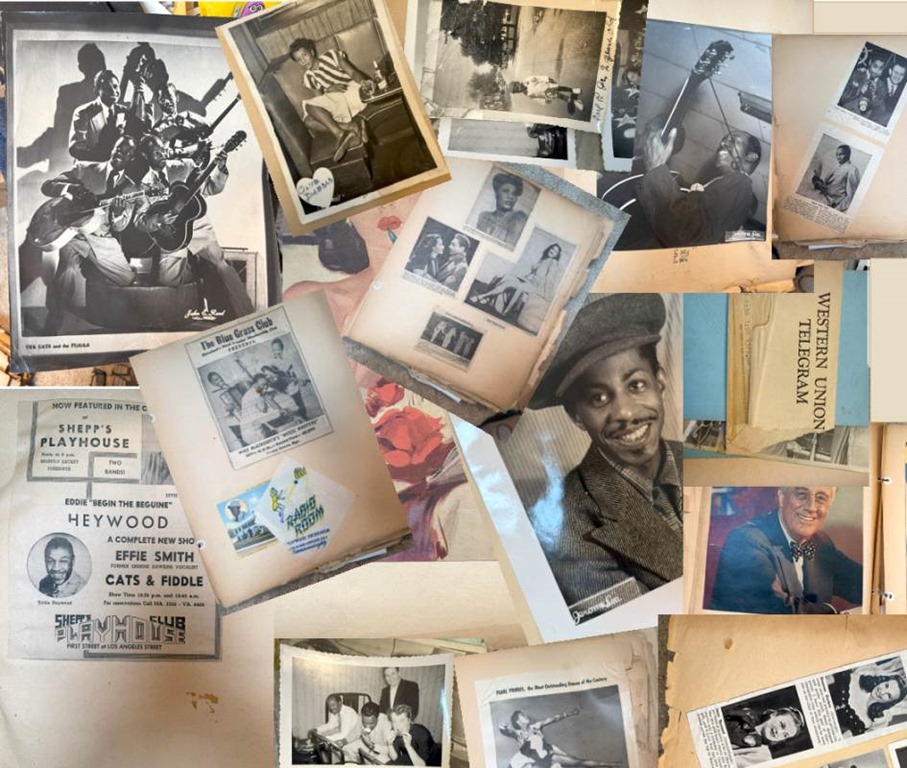


 Frank Hudson