Not to put the curse on things that fate might cast whenever you make plans, but I have a plan for February. I’ve been reading a bunch of Chicago-based early 20th century Afro-American poet Fenton Johnson’s poems this winter. Long time readers here may recall that I did a series on Johnson’s poetry in 2018, still early in this Project’s life.
Johnson is a bridge between Paul Laurence Dunbar, who died young after becoming the first Afro-American poet to pick up much notice, and the early poets of the Harlem Renaissance such as Langston Hughes who more fully brought Black American poetry into greater recognition.
One of Johnson’s poems, “Tired,” is still included in some anthologies of Black poets, perhaps because pioneering Afro-American poetry anthologist James Weldon Johnson (no relation) included it. In my 2018 series I tried to outline my estimate of how Johnson came to write such a despairing poem and to explore other modes of his verse. Since then more information on Johnson’s early years has become available to me, and I have a more complicated theory of his poetic progress that includes more data points.
I hesitate to lead off with “Tired” to represent him, though it’s a fine poem which James Weldon Johnson selected bringing notice to Fenton Johnson. See this post to see what James Weldon Johnson wrote about it.
.
One thing that attracts me to Fenton Johnson is that he (like Langston Hughes) wrote using his experience of Afro-American musical idioms. Regardless of current panics and nonsense expressed around the issue, Black history is American History—and oh my, is Black music American music! To keep’em separated would be so damaging to America’s culture. Oddly, believing that misapprehensions and ignorance must be behind such a self-defeating and self-denying idea, I continue to go forward trying to defeat that in my small way, despite realizing that there is much I don’t know and can’t portray as well as it might be portrayed.
Writing on and performing Fenton Johnson is a case in point. He seems to have too few considering him right now or bringing his story forward. I’d rather do the best I can illuminating his work with what skills and time I have, than to shrink from this out of deference or modesty.
Since today was Langston Hughes’ birthday, I’ll precede my Fenton Johnson February series with this piece of his that I performed previously for this Project. Hughes’ “Lenox Avenue: Midnight” is a beautiful expression of that complex thing: Black Joy. I was audacious enough to add a couplet at the end of Hughes’ poem/text that was my reaction to what Hughes portrayed in his poem, which is just about as presumptuous as my attempt to compose and play something that sounds like Jazz. You can hear my musical performance with the audio player below — or if no player, with this highlighted link.
I’ll admit I rushed to complete today’s audio piece because I wanted to make note of a birthday anniversary of an important contributor to the American wing of the Modernist movement of the early 20th century. I’m going to get to it in a roundabout way. Have patience, valued reader, I think this abbreviated story is worth your time if you care about the everyday accidents and personal connections that you might find scattered about behind what become large changes.
This story starts with two 19th century American immigrant families. I know a few details, and though I probably don’t know a lot more, but I think I know enough for a story. One family’s breadwinner was a laborer from Sweden. I read today he signed his name with an X, and he worked at various jobs including blacksmith’s assistant in Illinois after arriving. His wife was resourceful and was able to keep the underfunded household going. The other was described as a “peasant family” from the tiny country of Luxembourg. “Peasant” sounds so Bruegel, I don’t know if things were that feudal in Luxembourg in the middle of the 19th century, but that second family emigrated to the midwestern United States like the first one. The husband started out working in a mine until ill health forced him out. Luckily his wife found some income working as a milliner.
What’s important about these two families? Well, so far, nothing — though they raised families, that’s something. The second family already had kids when they arrived, the first one soon had seven kids. We’re going to concentrate on some of the kids. Our first family was the Sandburgs, the second the Steichens. One of the Sandburg children in Illinois called himself Charlie, and over at the Steichens in Wisconsin we had Edward and Lillian who were born in Luxembourg but were now growing up in the US. Charlie, the son of the man who signed his name with an X was passionate about writing. Edward, the son of the miner, was interested in art.
Charlie, our writer, had to leave school to help earn money for the struggling family at age 13. Eventually he volunteered for the army and served in the Spanish American War. Edward worked at the commercial end of art while having ambitions to move into the fine art world. Given those ambitions he took a wild chance by moving over to photography, which in the late 19th century wasn’t yet considered a fine art. How could that acceptance happen?
Edward started taking pictures and working on various ways the composition, lighting and film developing process could alter the images in artistic ways. One of his models for the photographs as he worked on his craft was his younger sister Lillian (see below).
Charlie got a break after the short-run war he was in. A local college gave him a scholarship* as a returning war veteran, and one of his sisters, Mary, was big on education and helped support him. Charlie rushed into doing everything writing he could do there — and while he didn’t graduate, when he left it was to pursue writing and to give talks on the midwestern Chautauqua circuit. Looking to network, he found himself in Wisconsin attending a Socialist party meeting.** It’s there that he met Lillian Steichen. Bam! Charlie fell hard and fast for Lillian. Lillian was perhaps a bit more careful. Charlie told her he was a poet, an artist, and he asked for her address (she was visiting her family, but was teaching in another state). She obliged. That was it, one accidental meeting.
For the next six months Charlie Sandburg wooed Lillian Steichen with letters. Lots of letters. Letters with poetry. Lillian’s letters easily showed her intelligence and wide interests, and she may have felt freer to discuss those things with native-born Charlie in writing because English was her second language and she may not have been as fluent in it speaking casually. And despite Charlie not being a good provider catch, the two fell deeply in sealed-with-a-kiss love. How much did Lillian rev Charlie Sandburg’s poetry engine? We’ll see at the end of this story today.
What about Lillian’s big brother Edward? His art photographs were getting some interest, and he had crossed paths with Alfred Stieglitz, another man who was interested in the Modernist movement to make photography into art. In 1905 the two go in to showing not just their fine art photographs but all kinds of Modernist art in New York City. Edward’s photographs filled Stieglitz’s journal Camera Work. A gallery they set up, the 291 Gallery, shows much new modern art work — not just photographs— and this work is often shown there publicly for the first time in America. How important and primary were Stieglitz and Edward Steichen in Modern art? Even a person who’s not primarily interested in visual arts like me has heard of the famous 1913 Armory Show in NYC, often considered the pioneering event in America’s exposure to Modernism. Well, Stieglitz and Steichen were showing that kind of work and laying the groundwork for that show for a decade before.
Back to Lillian Steichen and Charlie Sandburg. They married in 1908, job prospects for free-verse poets not overly concerning them. Charlie started to go by his birth name Carl, which he’d previously ditched because it seemed too ethnic. He worked for awhile as the PR/Press Secretary for the Socialist mayor of Milwaukee.*** And then he moves on to daily journalism as his day gig in Chicago. Carl, Lillian, and the brother-in-law exchange Modernisms. Carl’s poetry becomes more tightly visual, more show not tell. Later, if by extension photography can be an art, how about movies? Carl Sandburg’s daily journalism includes becoming an early movie critic.
Edward & Lillian Steichen. “My Younger Sister with a Rose Covered Hat.” Carl and Lillian Sandburg. “My Little Sister.” All photos by Edward Steichen. Check out the hats. Was it another happy accident that Steichen’s mom was a milliner?
On the anniversary of Edward Steichen’s birth, here’s one of Carl Sandburg’s poems wooing Lillian Steichen, “A Dream Girl,” performed as a song. You can think of it as Sandburg’s “Love Minus Zero/No Limit.” But knowing the art-photography Steichen side, consider the poems final line when you listen below, or read it here. I recorded the song quickly, with just my voice and an acoustic guitar, something that Carl Sandburg would have had handy to him, because Carl Sandburg was also a pioneering folksong revivalist, often dropping a set of acoustic guitar songs into his readings at a time when Pete Seeger wasn’t out of diapers. Oh, and Bob Dylan? Did you know that when Dylan’s poetic songwriting was just taking off that he took it upon himself to seek out Carl Sandburg? Oh, so many stories, let’s get onto the song. Graphical player below, and an alternative highlighted link for those that can’t see that player.
.
*Charlie, Mary, or someone must have talked Charlie up a bit. Colleges, even then, didn’t usually admit folks who hadn’t attended high school.
**By the turn of the century, democratic socialism was an emergent movement in the US. Despite its suppression in the WWI years there was some chance that it could have developed into a European style mass political party. Even with the Palmer raids and fears of a Soviet style revolution after WWI, US Socialists were able to win governorships, congressional seats, and mayoral races in places in the American Midwest in the first half of the 20th century.
****My own dedication: I found out about the 291 Gallery in a book Strange Bedfellows about the intertangled networks of American Modernism that was given to me by Dave Moore and Linnea Hadaway. Thanks!
Early this week, Poet Jose Hernandez Diaz on Twitter put out a call for people to respond with their go-to poets in our troubled times. I’m always uneasy when being put on the spot for short-lists, because I’m by nature a person of various moods and needs. The poet I need today is not always the one I need tomorrow. And then, it’s the same or even more so with music for me. Perhaps some of that comes through here in this project’s variety?
Two names surprised me* as I tapped in the poet names that came to my mind that day this month: Edward Thomas and Du Fu. We’ve dealt with Thomas here more recently, so today I’ll speak of Du Fu.**
Two things seem to connect me to this master of classical Chinese poetry: Du Fu wrote his best work as an old man (such as I am) — and that productive period coincided with a great governmental rebellion and crisis in China. When Du Fu writes a lovely nature passage, I always read it as the work of someone who is also seeing great destruction and violence in the human part of nature.
Du Fu, not an Asian-American, but his poetry sometimes speaks to my country none-the-less.
.
In this troubled week I went looking for a poem I could get close to and perform, and I found this one of Du Fu’s. For practical reasons, I need to make my own translations of Du Fu from English language glosses (such as the ones found at Chinese-poems.com) and the difficulties of making a graceful poem in English out of an 8th century Chinese poem would seem daunting, but they attract me all the more. Obviously, there are great risks that I will misunderstand what Du Fu is trying to say — but not only do I accept those risks, I’ve been tempted more than once to transform key images from Du Fu’s time and place to contemporary America. For these reasons most of my Du Fu pieces should be understood as adaptations, the kind of thing that I’ve decided are best labeled as “After a poem by….”***
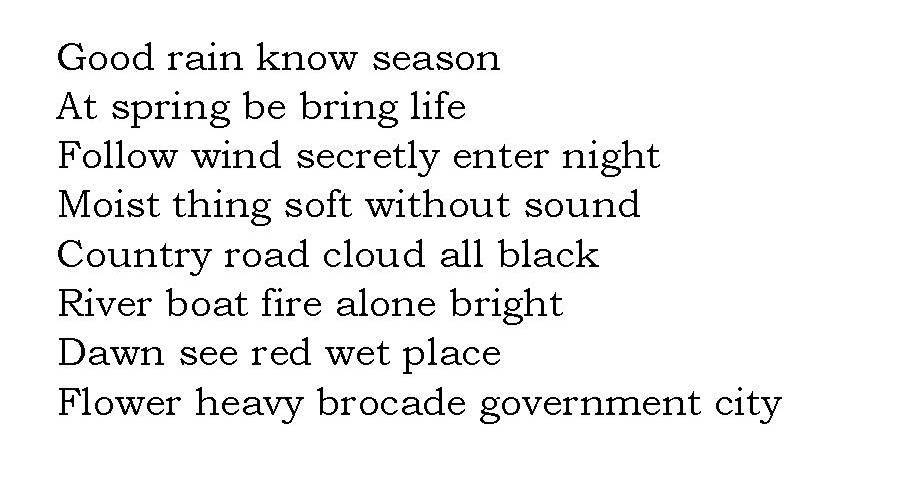
This is the gloss I worked from for today’s piece.
.
And here’s my “Rain on a Spring Night (after Du Fu)” version used for today’s performance:
I usually would work longer on one of these, but it’s been too long since I presented new work here.
I think of my opening section as a good faith attempt at an accurate translation into a working English poem. I used English syntax and conventions, added the poetic device of parallelism to substitute for the word-music losses inherent to translation, and tried, as I always do, to present vivid images.
The last section of Du Fu’s poem is where I likely diverge. I do sense a turn in the poem at this point, I think it’s possible Du Fu’s trying to contrast the peaceful rain following nature’s order in his opening. The (cooking? signal? lantern?) fire on the boat is the only human sign in the poem. Is that only coincidental decoration? The gloss’ final line is most difficult. A single image there comes through to me: that flowers, perhaps even fallen blossoms, are like the patterns on a brocade fabric. “Government city” puzzles. Like brocade on rich courtiers? Or is this spring morning near a capitol city?
So, my choice was to allude, somewhat obliquely as Du Fu seems to have done, and the final scene is designed to depict not peaceful spring and beneficent rain, but the aftermath of violence as we all to well know it now and here: the yellow crime scene tape, the flower memorials left. A rain of bullets is not a good rain.
My music and performance is very sparse for this, but I decided that’s starkness was effective. You can hear the performance with a player some will see below, or with this highlighted link.
.
*I wouldn’t even have known their names, much less their poetry or something of their lives before starting this Project six years ago.
**I have to note his name was often spelled in the western alphabet as Tu Fu. Du Fu is supposed to be the better approximation, even though there are as many or more references to him as Tu Fu online or in books.
Just suppose that back in the 1920s someone wanted to record a Blues song based on Emily Dickinson’s “A Soul selects her own Society,” and so they waxed a 78 rpm platter at Paramount records “New York Recording Laboratories,” located back then in, well, Wisconsin.*
If they did, it might sound a little like this.
We offer this sort of nonsense as part of our celebration of National Poetry Month. Then again, maybe it’s not nonsense. Dickinson’s poem does fit into “Old Weird America” and its music shockingly well. Why’s that?
As best as can be determined, Dickinson wrote “A Soul selects her own Society” during her highly-productive mid-19th century, but for a variety of reasons, this poem, like almost all the other poems that she wrote, wasn’t published until near the end of that century. Somewhat “regularized,” Dickinson’s poetry was bound then into book-length collections that sold well for poetry by an otherwise unknown author, partly due to the myth of her eccentric later-life used as hype for the verse, and because some of her poetry was disarmingly informal and approachable — at least on the surface.
Literary poetry gradually began to take notice of her. I presented Sandburg’s audacious mention of her in 1914 as an “Imagist” earlier this month, and over the course of the 20th century her work has eventually been judged as important as Whitman’s in presaging 20th century Modernism. Now, I daresay that if one was to survey living poets in 21st century America for what 19th century American poet they read, admire, and use as an influence, Dickinson would beat out Whitman — and those two would leave the rest of the field far arrears.
What else happened around the beginning of the 20th century, but took serious critics and culture a while to notice? Afro-American secular music — Blues and Jazz — which would come to significantly define American music internationally and become the dominant strain of our country’s music ever since. Americans were highly important in English language poetic Modernism.** Afro-Americans had their Modernist revolution to offer too, and a great deal was musical in this era.***
So, in another way, this unlikely pairing of Dickinson and Blues isn’t as odd as it seems.
Three ways to hear this performance of speculative fiction: a graphical player is below for a portion of you, but if your way of reading this blog doesn’t show that, this highlighted link will also do the job.And the new lyric videos we’re doing this month is the third way to hear “Soul Selector Blues.” Oh — it’s not your speakers or computer — it’s supposed to sound like a Paramount 78 RPM record!
.
*Port Washington Wisconsin to be exact. I’m not entirely sure why Paramount Records wanted to make it sound like it was in New York, perhaps for prestige, and despite the name they had no connection with the motion picture company Paramount either. What was a record company doing in Wisconsin anyway? Well, they made furniture (the upper Midwest was a timber source) and that led them to make cabinets for the new entertainment device, the phonograph. And if they made phonographs, why not seek another income stream from the “software,” the disks to be played on them?
If you choose to view today’s lyric video you’ll see a sampling of how they marketed to Black Americans variously (I can hear the meeting: “Who really knows what they like and will buy…”). High culture to gut-bucket, spirituals to sexual rebels (Ma Rainey’s “Prove It On Me” is about exactly what the illustration on its Paramount ad might lead you to think it was about). They had a pitch for your money and ears.
**Curiously, almost exactly 50 years before the “English Invasion” brought British rock’n’roll bands to the U.S., a small but influential group of Americans were over in England evangelizing poetic Modernism. Were The Beatles payback for Ezra Pound and T. S. Eliot?
***Even literary minded Afro-American writers, critics, and poets weren’t necessarily ahead of the curve in seeing Jazz music and Blues lyrics as an authentic Modernist revitalization of tired-out existing tropes at first. Langston Hughes and Carl Sandburg were exceptions a century ago in seeing this.
How has it been this far into National Poetry Month before featuring Emily Dickinson here? Well, no matter, time to get onto that today, as a number of our most popular pieces over the years have been related to Dickinson. Today’s piece is one of my personal favorites, our orchestral setting for her “We Grow Accustomed to the Dark.”
When I did this setting and then its subsequent performance back in 2017 I went intuitively with a contrary reading of this poem. Generally, Dickinson’s poem is read as saying that when we reach a point of uncertainty bordering on no knowledge whatsoever, we may still press ahead, and if we don’t exactly find our way, we may find a way.*
But that message is delivered in a vivid little parable whose details can undercut that “persevere” moral — and those images’ undercurrent, along with some American cultural dread from that time, led me to make it more dismaying. The sense I was communicating in my music and performance was more at that we may become accustomed to the dark, but that’s not a good thing.
The lyric video
.
If we view this as a poem of voyaging mysticism or stoic perseverance — or if we view it as us no longer noticing that we’ve left the comity of friends and turned our back on knowledge — the poems finest choice in imagery is both odd and comic. Emily Dickinson seems to be something of a Transcendentalist, the insurgent “New Thought” movement of her era, and one that held that the universe’s highest knowledge and truth were to be found in the book of nature. Dickinson’s poem does meet nature partway in: a tree. Such reverence for nature eventually birthed an epithet: “Tree Hugger.” Dickinson doesn’t go with that exactly. How then? You can find out three ways. There’s a graphical player below for some, but for those who don’t see it, this highlighted link will open a backup player in a new tab. And as we’ve been doing during this National Poetry Month, we have a lyric video with a thumbnail picture link to view the video above.
I’m posting a bit late in the day, but it’s International Women’s Day, and so today’s audio piece uses as a text a poem by a very international woman, Lola Ridge. Ridge’s poetry is perhaps best known for a fierce commitment to social justice and the situation of the poor in early 20th century America; but she was born in Ireland, left with her parents for New Zealand as a child, emigrated from there to Australia to attend college, and then to America, eventually New York City, where she mixed with most of the political and artistic radicals of the early Modernist era, including on the arts side: Marianne Moore, Edna St. Vincent Millay, Hart Crane, and William Carlos Williams and the rest of the circle around the NYC Modernist magazine The Others. Over at the Midwestern anchor of Modernist American poetry, it’s editor/founder Harriet Monroe was said to have called Ridge a genius, and she won awards and some favorable reviews in the years between the two World Wars.
Late in the 1930’s she apparently fell from the scene politically and artistically, and when she died in 1941 she was as poor as the people she wrote about, and then seemingly the subject of a rapid and rather complete forgetting for the rest of the 20th century.
Luckily our 21st century has become interested in reassessing the women who were on the scene a century ago along with the male Modernists, and there’s now a revival in considering her work.
Unlike some of Ridge’s poetry, today’s piece is not formally Modernist. It’s not only a sonnet, it attempts to present a passionate if conventional poetic argument regarding the abstract ideal of artistic beauty. Taken by itself it’s more Percy Bysshe Shelley than William Carlos Williams, but if we look just a little beyond its surface we can be reminded that Shelley was a thoroughgoing political and social radical as well as a Romantic era poet. Here’s a link to the text of Ridge’s “Sonnet to Beauty,” from a blog that does a great job of presenting sonnets and similar shorter poems, FourteenLines.blog.
Ridge’s poem starts by worshiping beauty almost as an awed acolyte unable to face the godhead. But in the midst of the poem, something strange starts to manifest itself: a buzzard (an ugly, carrion-eating bird) appears gussied up by “The wizardry of light” to appear “All but lovely as the swan.” I read this as Ridge saying that artists and society can fail, can deceive, can fake beauty.
A musical metaphor follows this that says despite the diversity of artistic endeavor — including false beauties or injustice like unto our buzzard — that beyond the dissonance and the harmonic stress of this dialectic, that the chords can resolve. The poem ends avowing that true beauty can still chime through ugliness, falsehood, and strife.
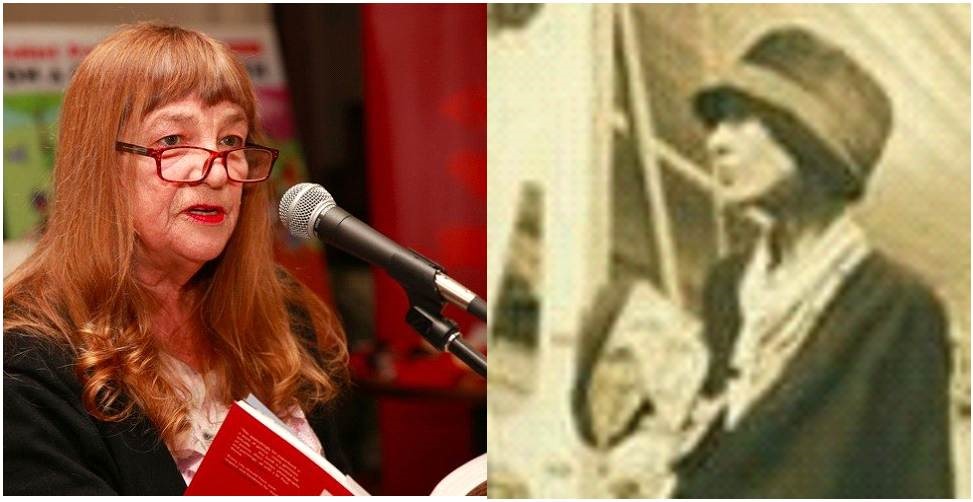
Beyond sonnets, I will now make a turn in this post before giving you a chance to hear my performance of Ridge’s poem. Let me quickly summarize the event I attended this past Sunday remembering Irish-American poet Ethna McKiernan. There may be more than coincidence that Lola Ridge started this off.
Ethna McKiernan reading, with lipstick, and Lola Ridge, I’m not sure.
.
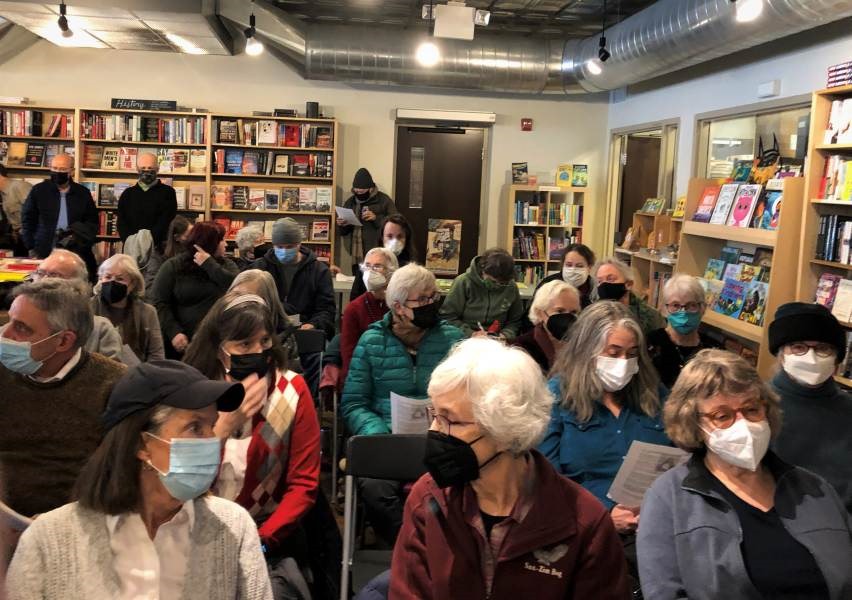
Minnesota weather and continued Covid-19 concerns might have conspired to reduce attendance, as the side streets were still full of sloppy snow from Saturday’s snowfall.* I arrived early and helped the bookstore staff setup chairs. They seemed to be expecting maybe a couple of dozen, which may be par for a Twin Cities local-writer poetry reading, but both the event organizer and myself the bystander suspected we’d need to maximize the amount of chairs the space could hold. I think we were able to get nearly 40 folding chairs into the designated space, but as the crowd started to assemble, extra chairs needed to be rounded up and put in the various aisles between the bookstore shelves to handle those that kept coming in, and we had a few standees who fit in where they could.
More than typical bookstore poetry readings, I suspect most of the crowd knew Ethna for a long time. And that may have given a boost to the eight poets who read poems of Ethna’s, a smattering of their own, and gave short thoughts about her as a writer and a person. So less a usual public reading where some poets might be nervously trying to consider how they would come off presenting their work to an audience which might not know it, and more like an experienced and informal poetry group of long-time colleagues.
Several of the readers were members of other periodically-meeting writer’s groups that included Ethna, like unto the Lake Street Writer’s group that Dave Moore, Kevin FitzPatrick, Ethna, and I were decades-long members of. I’m sure that if Kevin had lived, he would have been a valued part of this event, as Ethna often credited Kevin as an influence on her writing — but he died a few weeks ahead of Ethna. I tried to make myself useful by playing stagehand and raising and lowering the mic stand for the variety of readers.
Many of the readers spoke of Ethna’s work with homeless outreach, and read some of her poems that dealt with that work, something that echoes today’s poet Ridge. Though the audience was entirely masked, a few noted that Ethna was a stickler for always putting on lipstick when out in public. For all anyone knew, what with our Covid era masks, we all were wearing lipstick! Who could see — but I believe all of us were remembering Ethna.
Covid-era ambiguity: “Lipstick? We were supposed to wear lipstick?” A portion of the crowd at the “Remembering Ethna” event last Sunday.
.
So, as I speak of a woman who promoted culture, wrote beautiful poetry, and was committed to helping the economically desperate, I will now leave you with a piece using the words of another woman who a century before us did the same. You can hear Lola Ridge’s “Sonnet to Beauty” with a graphical player below if you see that, or if you don’t, with this highlighted link.
.
*My friend and participant here in the Parlando Project Dave Moore was unable to attend due to concerns with the street conditions. I’ve attended two other book-launch poetry readings given by Ethna herself, and this Sunday’s was the smallest crowd of the three. Consider though that most of those who knew Ethna are “senior citizens,” and some are frail as well.
Today I’m going to start a short series here celebrating Kurt Vonnegut, a writer generally filed under “novelist” on bookshelves.
Most of the words this project uses started out as poetry, and poetry is a form of literature. So, one might assume that I’ve read a lot of novels. I haven’t. I’ve set no ban against the form, and I’ll read one or two a year, but the ones I read aren’t usually considered great literature. Essays, poetry, poetry collections, biographies (and less commonly memoirs), non-fiction accounts long and short, historical and current — my reading dance-card is full, and at my age I’m not sure I’ll ever rebalance my reading investments.
As he aged, Vonnegut apparently fell out with the conventional ideal of the novel too. Even some of his earlier novels had elements in opposition to long fiction either literary or popular as generally considered, and so his reputation as a “great writer” or as a “best seller” were both constrained.
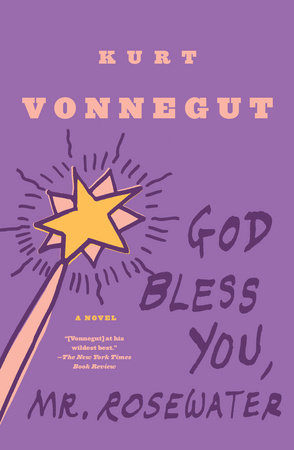
Luckily for this project, which likes to combine words with music in various ways, and prefers short, condensed forms of expression for that, Vonnegut is very quotable. Fictional characters who are quote collections and makers of short speeches are not the stuff of literary esteem, but then the results have other uses. Today’s piece is an infant-baptismal litany that a character in one of Vonnegut’s earlier novels* proposes to give, and it’s become one of Vonnegut’s most remembered and requoted passages.
The performance here, and probably the rest in the series to follow, was performed live in one-take by the LYL Band on April 15th 2007, the week that Vonnegut died, and these presentations are taking place in the week of the 99th anniversary of his birth. All these performances are imperfect in one way or another, but at least for me I still hear the emotions in-between the notes as Dave Moore and I made note of a departed writer’s spirit. Today’s piece was the first one we preformed that day.
*The Vonnegut novel this passage appears in is God Bless You, Mr. Rosewater, which I must confess I haven’t read. I say that just as a matter of honesty, not as a review or recommendation which I’m obviously not qualified to give. I suspect I’d like it when and if I get around to it. For counterpoint, here’s a review, contemporary with the novel’s publication, from the New York Times were the reviewer proves a maxim that I often repeat here: “All artists fail.”
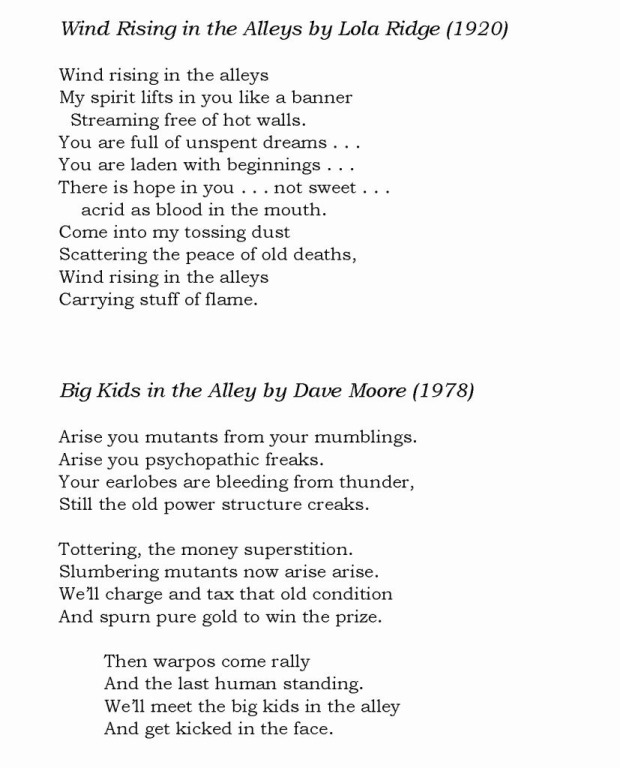
I thought I might get a second American Labor Day piece in from a few ideas I had last week, and this is the one that survived the cut. Well, maybe it’s more than one, as it’s a two-in-one, combining poems written 40 years apart: Lola Ridge’s “Wind Rising in the Alleys” and Dave Moore’s “Big Kids in the Alley.”
Ridge is a figure that could fascinate several different ways. She has a life story that would defy the most expansive novelist to invent. She was “on the scene” in both the literary avant garde of the NYC area of the first half of the 20th century and in touch with the political radicalism* of that era, and as woman who clearly saw the limitations of gender roles, she was allied with the wave of feminism arising then as well. A several-time immigrant herself,** she wrote with insight into the immigrant experience.
Having an interesting life isn’t the same as writing interesting poetry or poetry that compounds its interest over time, and I blow hot and cold myself as I once more start to read some of it. She has more than one style of poetic diction, occasionally sounding a little bit 19th century, and then sometimes flat and spare, to other times striking out with passionately with intense tropes of natural phenomena intending prophetic power. The first time I featured her work here I could easily see how that last kind of writing could link in with our era of Climate Change. In my second time into her work this summer I may be starting to “get” her, and Ridge may be one of those poets who one needs to get over the ways she seems “wrong” before understanding what she’s doing that’s uniquely “right.”
Accidents or coincidences, can sometimes help me do that. Reading her poem about a so red sky in contemporary times of widespread fire-smoke is one such connection. And my second time with Ridge happened when I saw this poem where nature in an urban alley is portrayed at a prophetic level. When I read this poem first published in 1920 I thought of a Dave Moore lyric used in the first Fine Art record in 1978. I made a note immediately to myself that they could be combined.
Are these Labor Day poems? Sandburg’s piece from “Smoke and Steel” I used last time is certainly one in the context of the larger poem it concludes. “Wind Rising in the Alleys” is the concluding poem in Ridge’s Sun Up, a collection of mostly short, sometimes Imagist style, poems and “Wind Rising in the Alleys” is the last one printed in the book’s final sub-section which also includes poem-portraits of famed Anarchists Emma Goldman and Alexander Berkman. The poem for which the section is named, “Reveille” starts “Come forth, you workers!” and ends “Let us meet the fire of their guns/With greater fire/Till the birds shall fly to the mountains/For one safe bough.” “Reveille’s” militant final lines compress parts of Ridge’s rhetoric: fervent radicalism combined with a “who would guess it would come next” poetic image.
As I mention here political beliefs and calls for direct action following from them, I’m thinking that some of you may not share those beliefs. So, let me stop for a moment and mention something important to poetry as an art. Poetry is not a very efficient method of communicating ideas, much less particulars of strategy and tactics. To say that it fails in these things (or to overstate what it may do in some part) is to find the obvious, for poetry fails as expository work or argument closer to the degree that music does. What poetry can do instead, is to tell you what having some idea or intent feels like. Do you recognize what it feels like the moment that someone you love or desire lets you know that they feel the same? That’s what poetry can do, and do intensely. Of course, it may happen that that lover turns out to be flawed, or an outright heal, just as much as they can turn out to be a partner for a lifetime and the treasured ancestor of ancestors.
That moment of love and connection is powerful to feel, and it’s not just romantic love poetry that can present that connection.
The optimistic winds in the alley Ridge speaks of have hope in them, hope for change. I can’t say exactly when it was written, but for publication in 1920 it may have been written in a time that was not at all hopeful for American labor and political radicalism. Berkman and Goldman were deported in 1919, and that year saw red-scare round ups and a particularly deadly year for anti-Black race riots. Whatever it is, “Wind Rising in the Alleys” is not a victory march.
I write about poetry and music on May Day or Labor Day, you can easily find others who will discuss political and economic matters. Let me just summarize a lot of complex history to say that workers and capital have both advanced their lot in the United States greatly since 1919. Hooray for Labor Day. Has justice advanced too? Yes, but the argument that that has been to a lesser and insufficient amount is strong. Hooray for Labor Day — and the days afterward.
Here are the texts of the two allied alleys that I’ve put together today.
.
Step forward to 1978. Dave Moore’s “Big Kids in the Alley” was written at the request from a rock band named Fine Art forming and making its debut album. I’ve written elsewhere a short history of that band, one of the earlier bands in the Twin Cities area to make and record original music in the Punk to New Wave transit station on the route-way of Indie music. Just as “Wind Rising in the Alleys” was the “album closer” for Ridge’s Sun Up,“Big Kids in the Alley” closed Fine Art’s record and was the encore or set closer for a lot of live sets I saw. At this time it remains one of two studio-recorded songs of theirs that can be found on the Internet, and it was even sampled and used in a hip hop record in our current century. Here’s the YouTube link to that cut from the vinyl record.
You may think that’s quite the intense showpiece. On stage it could be even more so, and it’s certainly not the kind of song you’d want to put in the middle of a set list with other songs immediately following. Rhythm guitarist Ken Carlson was always solid and tasty, and vocalist Terry Paul used a more aggressive style here than what was customary for her, but “Big Kids in the Alley” was also a feature for Fine Art’s lead guitarist Colin Mansfield. You can hear effects pedals sweep frequencies in the song, and Colin would usually play all or most of the parts using the edges of a Zippo lighter in his right hand as a string and pickup exciter as well as a pick. Colin had some understanding of avant garde and other orchestral instrument music under his belt before Fine Art, and while what he was doing here was unprecedented in punk and new wave bandstands in the Twin Cities in the 70s, unorthodox sound generation methods had some pedigrees there. Outside and Free Jazz players would also do similar things, though because those styles were usually wind instrument based, the precedents are less direct. A short-lived rock band movement in NYC at the same time (documented in the No New York LP also of 1978) used random noises and alternative guitar tunings often played by naïve players.*** Colin wasn’t a naïve player.
Lyrically, Dave Moore’s words for “Big Kids in the Alley” starts as a parody of “The Internationale” the 19th century labor anthem. If you read this Wikipedia article compiling the various versions of “The Internationale’s” lyrics over time and in many languages, you can see that they vary considerably, but the opening’s general thrust, retained with some intensifying language in Moore’s parody, is mostly honored. I sometimes wonder how many folks in pioneering venues that supported “punk” or “new-wave” bands in the Twin Cities 40 some years ago recognized the reference. You never ask such things when dancing.
The final chorus of Moore’s version adds an unexpected departure. This morning I realized I’d never asked Dave what his intent was in what he wrote there. I called him up, and he explained “That you’re going to have setbacks, that they are going to react violently. That you should realize that.” Note that the arrangement on Fine Art’s version ends on Dave’s final thought, which emphasizes its impact.
I didn’t use Fine Art’s music for this performance, and my musical setting is simpler while referencing a similar flavor. I did dig out an old Zippo lighter I keep in a drawer in my studio space, but I didn’t quite get Colin’s exact effect in my “get’er done” charge to record today’s piece.
You can hear this loud rock band combination of these two texts written 40 years apart with the player below, or if winds haven’t blown that up your alley, this highlighted hyperlink in an alternative way to play it.
.
*Early American Modernists, unlike an appreciable number of European or European-based Modernists, tended to be left-leaning, even radical. Many of the American publications that printed the work of Modernist poets or visual artists were equally if not more so concerned with social reform or outright restructuring.
**Though, I do not consider the elements in anyone’s background determinative, I enjoy on a superficial level the diversity of ethnic and regional variety in English language poetry. Ridge is a case where the hyphenation cannot cope. Born in Ireland, immigrated to New Zealand at 8, then to Australia where her career in the arts gained a foothold, then to the American West Coast were she at least touched bases with the contemporary arts there, and finally to New York City where she lived the majority of her life, including time in the teaming immigrant Lower East Side.
***A less-remembered pioneering American punk band Pere Ubu was working some of these ideas as early as 1975. Sonic Youth was connected to and arose after the NYC No-Wave scene was receding, becoming a successful band in the Indie Rock era. In the Twin Cities, The Wallets later presented a more song-oriented version of what some of the NYC No-Wave bands did.
Visits to this blog tend to go down on weekends, on holidays, and in the summer — so, congratulations if you’re reading this, you’ve managed to beat the crowds!
America is a young country, but after a bit of a slow start, we’ve been meeting our quota for poets, and by now the record shows a great variety and number of them. Who’s great? Who’s dispensable? Well, some days I wonder if any of that matters when poetry still has challenges getting traction on the slick surface of our nation. Still, one thing’s clear to me if I take stock of American poets, there’s no more American poet than Walt Whitman. That’s no accident: it was his life’s work to become the most American of poets. Few poets before and since have sincerely tried for that. Whitman did.
Whitman didn’t just want that personally. His poetry is full of invocations for other American bards to arise, with claims that the spirit of America would nurture and welcome them.
This Sunday is American Independence Day. Has he been right?
Our first piece today is one of Whitman’s best-known poems. In its litany of lines he shows us two things: that Americans love to sing and that America is the sum total of our varied labors.
Taking the last first. Whitman is going to concentrate on manual labor and trades in this poem. He could have written about other work and workers, even poets or professional musicians after all — but he says the songs he’s going to note are “those of the mechanics,” meaning the mechanical trades,* using the word in the same meaning that Shakespeare uses it when burlesquing the “rude mechanicals” and their ardently inept art in A Midsummer Night’s Dream. But Whitman is not making fun. He says nothing about the quality of their songs or singing, but the very length of his list indicates he values something in their number and variety. Overall (or overalls?) there’s celebration of masculine traits in the poem, though some work associated with women — and specific, specified work, not just sentimental “remember the ladies” stuff — is included in his list.
It’s fitting that in this summer month, as a holiday weekend approaches, that he ends his poem with a party, a get-together, but throughout “I Hear America Singing” songs continue in work, in comradeship, in love. I would wish you too just as happy a July 4th.
It’s complicated to judge if American poetry disproportionately influences the world in our time, but one doesn’t have to go hard to make the case that American music has done so in the time since Whitman’s death. Whitman speaks of poetry as a bardic art, and so he uses “song” and “poetry” interchangeably when he speaks of his art, even if later most have come to see these as separate arts and that it’s important to distinguish between them.
Whitman asked that — more than that, promised that — there’d be many significant American poets to come. He got musicians. Close enough Walt.
Checking on the predictions of two American poet-prophets: Walt Whitman and Langston Hughes
.
Some decades later, one of the poets that Whitman prophesied wrote an “answer record” poem to “I Hear America Singing.” In “I, Too” Langston Hughes, an Afro-American poet, decided to add one more labor example to Whitman’s litany. Hughes’ poem is sung from the position of a servant.** In Whitman’s 19th century time, many/most of the jobs that Whitman cataloged would have been self-employed, and it’s clear that Hughes’ worker isn’t. Furthermore, as an Afro-American his segregation from the “company” is double-more with his class status. Make the food, serve the food, wash the dishes — but you won’t eat in the room with the guests.
Hughes too is going to prophesize a future America then from his 1925 present. Don’t speak too soon, the wheel’s still in spin he says in effect about that stay-in-the-kitchen status. He’s going to spin that wheel.
Nearly a hundred years later*** how have things worked out with Hughes’ prophecy? Poets have written. Songs have been sung. Work from American political mechanicals has gotten us partway there to equality of opportunity, to recognized accomplishments, to appreciation of Black beauty.****
Is this an unpatriotic thing to say on this holiday, that our workmanship on some important civic matters is slipshod? I’m no prophet, but if I was one, I might say that some day we could build the temple in time where we can see beauty presently while being ashamed in the past tense, just as Hughes promises.
What Americans could build this temple? If not us, who else?
*I note that in his catalog Whitman mentions specifically house carpenters, the job his father held. He also mentions wood-cutters. Ezra Pound’s family had connections to the lumber industry, and in Pound’s poem “A Pact” about Whitman, Pound calls out Whitman as a wood-cutter while patting himself on the back as the more developed “carver” of wood, a job further down the supply chain and further up the artistic hierarchy. Sick burn Ezra.
**Details of this aren’t completely clear, perhaps intentionally. Hughes poem’s speaker could be enslaved, or he could be a paid domestic servant. He could even be a restaurant worker, a job that Hughes himself held for a short time. Early in his life, his poetry career got a boost when he left some poems at the table of diner Vachel Lindsay when that Illinois poet visited the establishment where Hughes worked. Lindsay read them, thought they had value, and touted Hughes as a result.
***When the country was younger, July 4th was a day for speeches on our history. Now, for me, so strange to be so old, and how disappointing how slow citizenship equity is. In my youth, it was common to speak of racial justice and full rights as being an American goal a hundred years old, using the end of slavery as the starting line. And now we near 100 years from Langston Hughes’ poem. The famous “arc of history” is such a long archway that one should wonder why it hasn’t collapsed in the middle.
****Speaking of I hear America singing: disproportionally the reason that strains of American music are known worldwide is due to Africans taken to these American shores. American singing, American music, has many tributaries, many are important, even the many-ness itself is important — but as I’ve said here before: I am an American musician. Most of the notes are black.
Let’s hope I don’t overextend my love for American poet Kenneth Patchen with yet another example of his work today, which happens to be the opening day for baseball in my city. Patchen wasn’t quite the modern day spoken word poet, but even 80 years ago he was writing in a form that works in that presentation — though more here in a mode where the listener is immediately attracted by references to our common life and speaking idiom, and then finds the poem going off somewhere else between its lines before it ends.
Many poets are indifferent readers of their own work, but Patchen is usually quite good. I actually muffed one line in his text today, but Patchen has modified several lines, either from the variations of performance, or in the case of the lips of the “girls of heaven” he seems to choose a gentler metaphor here.
.
Baseball used to brand itself as “America’s Pastime,” and this poem makes something of that with its intimations that like love’s fancy and poetry it fills time and makes a joke of watches and schedules. I note too, that Patchen, the pacifist whose world was at war when he wrote this, knows that concerted effort is not always noble, and that the blessing of wasted time is better than time wasting from want or wasting one’s fellow humans.
Oh yes, the prophets among us can see clearly that professional baseball is a business enterprise, full of the commercial slight-of-hand that parodies patriotism and oh-so-righteous conflict. I myself remarked last year as I was reading the newspaper, that I had finished the section dealing with the businessmen who wear uniforms and was now moving on to the — why-is-it-separate? — sports section. But then, oh prophets, who really can find any remedial pleasure in cheering on a grocery chain or brokerage firm?
As I write this, over at the baseball field the home team has just answered the visitors’ one run with four runs in the bottom of the 3rd and now a light rain says we stop and wait for rainbows — or if the game is called, it will all go away as if it had never happened. Time knows it’s real. Everything else is illusions.
Here’s a link to the full text of this poem in case you want to read as well as hear it. The player for my performance of Kenneth Patchen’s “The Origin of Baseball” is below. Don’t see the player gadget? This highlighted hyperlink will also play it.




 Frank Hudson