Giorgio De Chirico, but this is a poem

Returning now to my series presenting the early poems of French Surrealist Paul Éluard, you may recall that I was talking about the small contemporary presence early Surrealist poets like Éluard have in America compared to their contemporaries in Surrealism who were painters and visual artists. I wrote then about few reasons you may not have heard of, much less considered, Éluard’s poetry. Here’s another reason: we generally expect poetry to deliver a message to us, if not an explicit moral, memoir bit, or assayable philosophical, spiritual, or political point, then something that conveys a comprehensible, palpable, report of the experience of these things. Sure, poetry might be condensed and shorn of elaborate contextual frameworks – just as a text we might receive on our phones would seem vague to those not party to the conversation and the ongoing relationship of its writer and reader – but we fill in those things most of the time when we consider a poem worthwhile, while visual art is allowed a great deal more freedom. No one is required to hold forth on what water lilies or sunflowers mean in a painting, and melting clocks or obscuring apples may sport with our expectations, but still intrigue us.

So today’s Éluard poem is an appeal to readers to cut him some slack by presenting an ekphrastic poem, a poem implying a case that you could consider its set of words beyond finding its message, but to just enjoy it as a not-fully-decodable object in itself. If we don’t know what a Surrealist painting means, we might still have an experience with it, and one such experience is what Éluard’s “Giorgio De Chirico”  means to convey.

One side-effect of that open field we allow visual art is that we may have varied and dynamic experiences – derive entirely new and novel “frames” in our experience of it. As I wrote recently in my run-down of the most popular posts over the decade of this Project: the most popular post here was about how the Statue of Liberty, which is most often seen as a clear expression of freedom and welcome, has another context, partly intended by its creator, but unseen from our usual perspective, the metal giant’s feet have broken free from shackles and chains, and the small island its pedestal rests on once had a jail. Or let’s take the ubiquitous image of the Mona Lisa. What did Da Vinci intend? We don’t know, and we even like to think the enigmatic smile depicted intends for us to wonder. To its patron, the painting they commissioned might mean something about patriarchal ownership. Some surmise that the woman is pregnant and is musing on the child that is to be born. Others, pregnant themselves, could take that same framing and wonder if that face is attempting to misdirect its body from a bout of morning-sickness nausea.

So, as I translated “Giorgio De Chirico”  I could see things about De Chirico’s paintings that Éluard was experiencing and reporting on. I enjoyed finding singing English words to convey that from his French. I performed it, tracking just voice and solo acoustic guitar this time, during the same sessions where I was working on the other Éluard poems that I presented in August.
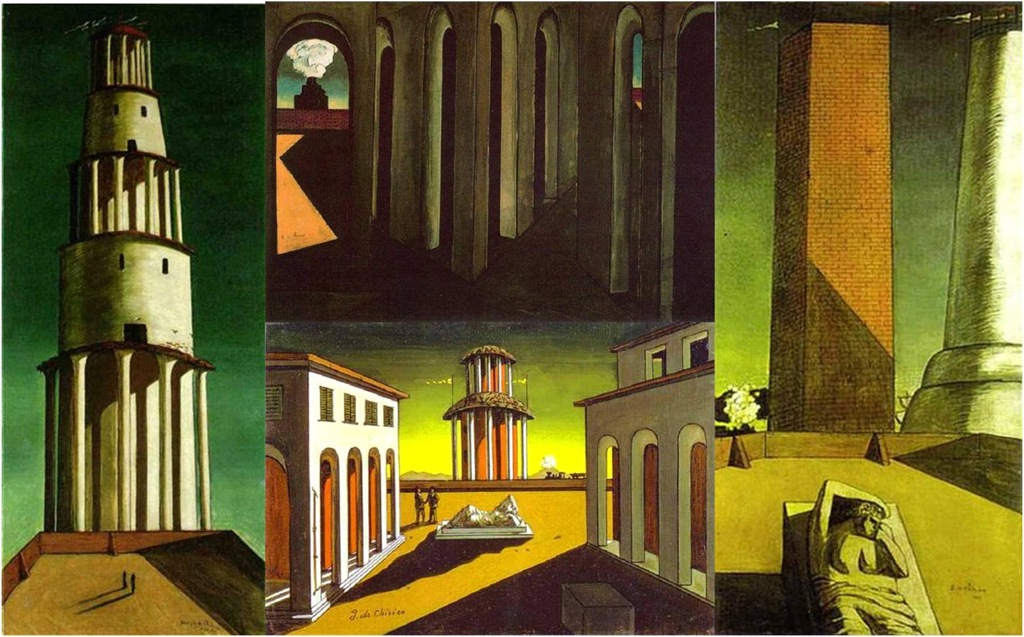
Four De Chirico paintings

Here are four representative De Chirico paintings. The sharp lines of shadows and bright light, the tiny people dwarfed by structures, all were motifs he commonly used.

.

Then yesterday, instead of buckling down and preparing a final mastered mix of the song I’d made, I watched a documentary about 9/11. The one I watched focused on the part not usually considered: the experience in the Pentagon, that giant military office building in Washington D. C. that also suffered a deadly hit by a hijacked airliner that day.

In it, one survivor told her tale of that day. She was a light colonel, working in an administrative desk job, in a building that (other than its massive size) is like a great many other office buildings many work at during any workday, and furthermore she was about to give a presentation on some matter in that common workday misery, a morning meeting in a small conference room there.

And then the speeding fuel-laden airliner slammed into the wall of her facet of the five-sided Pentagon. In darkness, thick smoke, and heat she led a small group trying to find an exit. She grabbed a damp sweater that she found by touch to try to stifle the smoke. She didn’t know the dampness was from jet fuel, not water. The building segment was already aflame, parts not yet immediately destroyed were collapsing in the heat. No one could see much of anything, they had to hold hands to stay together. Her small group made it to a window, a bit of light in the dark chaos. Like many modern office windows, it was not designed to be opened – more than that, it had recently been upgraded to be “blast proof” as protection from something like an outside truck-bomb attack. It was made so that it couldn’t even be broken! Someone in her party picked up that trouble-spot of many an office day, a heavy laser printer, and hurled it at the window. It bounced right back off the glass. Somehow in the dark and smoke, they found the printer again, and threw it again – and that time the blow started to uncase the window’s frame. They pried it out and leapt outside.

Now that’s more excitement than many poetry blogs will offer you most days. Watching this account, everything was intensified by the story’s setting, for I’ve worked in modern office buildings like this, I’ve had the boredom or anxiety of meetings, I’ve carried heavy laser printers and made them work again the second time – frames that make it easy to share that experience.

The documentary also had an account from a man standing outside who saw them pounding ineffectively on that window and who went into the burning building to try to see if he could lead them out, only to find the destruction and conditions inside made it impossible to find any way to them from that exit. It wasn’t until a decade later he found out those pounding at the window had escaped, but for ten years he thought he was the last one to see them alive.

And then, I expanded in my empathy as I watched these accounts, including those who didn’t escape. It called to mind that folks elsewhere in buildings or working boats struck, perhaps nowadays with un-maned mechanisms that don’t need suicidal fanatics inside them, but have up-the-chain commandants upwards to the Commander in Chief who’ve loosed them thinking they have good and sufficient reason to do so.

Now, I’ve ruined a perfectly good essay on art and poetry – and your expectations if you came here for that – but as I revisited this performance this morning to make a final mix you can hear below, those sudden and shuddering skies, the words I translated in August from French: denounced and spinning walls, daylight through leaves, and those who speak without knowing. Mysterious, enigmatic poems and songs can act like objects (as painting or sculpture) engender new feelings, new meanings.* Perhaps it takes a Surrealist, with a willingness to combine outlandish things without favoritism to sensible intent to portray some realities.
Giorgio de Chirico

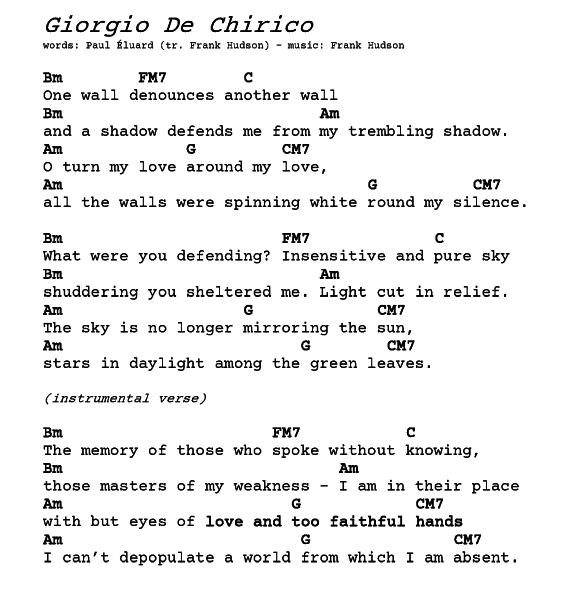
A chord sheet of the song I made from my translation of Éluard’s poem.

.

If you want to hear my performance of my own translation of Éluard’s “Giorgio De Chirico,” there’s the audio player below. If it’s not there, don’t throw a printer, there’s this highlighted link that will open a new browser tab with its own audio player.


.


*Regarding art and unintended re-framing due to the events of 9/11, I think of the breakthrough work by one of my acknowledged models for this Project, Laurie Anderson’s 1981 “O, Superman.”   What with it’s “Here come the planes. They’re American planes” and the spookiness of disembodied voices abstracted and preserved by machines, it can be, and has been, experienced differently post 9/11.

Song to the Siren

I’ve written briefly, here and there, about the time leading up to my late wife’s death, so let me write today about the days immediately afterward. Because this is a blog, and readers’ attentions are limited by that format’s expectations, it’s going to be brief again.

Most people have had experience with death before coming to the death of a spouse, but the qualities of that experience have their own specifics, felt by us one to another. My first feelings were of a very tangible physical absence. A skin-covered shape that was not there. The missing fingerprint sound of her voice. Isn’t that odd, I felt so intensely what I could not hear, could not feel. I was setting out into a life in silhouette.

Renée’s mother handled the funeral arrangements entirely, which was a blessing. That went by in a blurred quickly, and I remember little of it. I decided to go back to my demanding job right away. I thought it would be good to stay connected to those parts of my world that still existed, that carried on without – but I had a great deal of vacation time banked, and for a while set aside a day each week to do post-death tasks. Renée must have left me info on things like accounts, she was organized about such things, and I made a long list of the transitional stuff that needed to be done. I had a folder with lots of copies of her death certificate, and one-by-one I checked off the tasks. I think the very month she died was the last payment on our home’s mortgage, which I sent off thinking that she had just missed that milepost.

One of a couple who were in Renée’s large circle of friends started calling me, asking how I was, and listening to me express the little things, those grief specifics that flickered around me.*  They would invite me to get-togethers and events, keeping me engaged in society at large. I was numbed or preoccupied to think about this at the time, but I now suspect this was something Renée had asked them to do before she died, but whether they did this on their own or at a friend’s request, it was an extraordinary blessing. For a few months this couple (and my job) were my tugging connection to the ongoing world.

In a short interval after Renée’s death, I also began spending much time playing music, by myself or with two or three others. I spent time searching out low-priced but unusual guitars, a not all-together-admirable spate of “retail therapy.” I began to compose and record music I made with them. Here’s the odd part for those who’ve followed this now more than a decade old Parlando Project: it was predominantly music without words, the stuff that would be genre-categorized as “instrumental guitar music.” Here I was, this poet, who had married this young poet, who was missing her voice intimately, making music with no words in it.**

And then during the next year, I met and started going out with the woman who’d become my living wife. This was welcome and yet a little strange. Like many people with loved ones who’ve died, I would have intense dreams of the departed, and sometimes those sensations would slip over into waking hours where I’d have this palpable demi-sense that Renée was present. I can remember one such time when I was awaking in my empty bedroom and I had the strong sense – no apparition, but just as when your “object permanence” knows what’s behind you or beside your peripheral vision – and without hearing in a vibrating ear-drum way, I was hearing my dead wife’s voice. I was embarrassed, and I thought I should try to explain that I was seeing this other woman.

How did this conversation resolve? There were no actual words, no transcript that could be recorded on some spirit-device, no ghostly pronouncement. Just a sense that some sense of Renée (or my own sense of Renée) knew, and that we acknowledged this new thing together.

Returning now to this present August. Like a lot of folks this summer I saw the new movie of “The Odyssey.”   One controversial thing in this elaborate (and IMHO, successful) take on the old tale was Matt Damon’s performance of a haunted Odysseus. This is not everyone’s view of the character, and auteur-school critics tell us it’s a repeating trope in the director’s work. But what was resonating with me as I viewed the movie was that same flattened-and-its-opposite facets in Damon’s portrayal. And what an odd thing to see: a cost millions, makes millions, IMAX spectacular movie version of a poem. Makes the Parlando Project seem so modest in comparison.

During the movie, a song, a favorite of mine from The Sixties™, kept going through my mind: Tim Buckley and Larry Beckett’s “Song to the Siren.”***  I decided I wanted to record it.

One problem with setting off on that odyssey? It’s a song that’s been done by many much-more talented singers than I am, and it’s the sort of song that calls for a vocalist capable of a bigger more dramatic sound than my voice can manifest. I thought I’d try. And I did. I made multiple attempts to sing Beckett’s words even if I knew I couldn’t portray Buckley’s vocal melody. Take my word for it, they were all bad. Even trying to “comp” a best of the bits vocal track was a failed effort.

But I was left with this arrangement of “Song to the Siren”  that I still liked, subdued electric bass, sweetly keening fiddle, and the Guild 12-string acoustic guitar that I bought as Guild was closing it’s Rhode Island factory and the store where I bought it at a deep discount was going out of business. Today’s musical piece has become an instrumental, presented here in “The Place Where Music and Words Meet” – and the words are, this time, absent.

Since Larry Beckett’s words are so important to the resonance of “Song to the Siren” for me, this video displays them.


.


*One thing I can remember telling them about: every workday morning I would buy the daily papers at a convenience store near work. With the long-practiced eye of a veteran 20th century newspaper reader, I’d read them quickly in the early morning hours at my desk before the rest of the staff in my technology section would arrive, and then fold them and set them aside. At night I’d bring them home, and Renée would read them in the evening. In the first days after I’d returned to work I realized that there was no one at home to take the papers back to. This is the strange alternating contrast of grief: flattening at times and then at other times you can feel the textures of the smoothest surface, the tiniest detail.

Here’s a contrasting thing. One of the reasons I read the papers each morning, other than general habit, was that the radio network I worked for had a 24-hour news operation, with a large newsroom a couple of floors above me. Reading those papers was a way to keep appraised of what my coworkers there would be dealing with.

One morning, just over a month after my wife died, a tech coworker came back to the desk next to mine and said the newsroom was in an uproar, that a plane had flown into a skyscraper in New York. I told him (engage history-nerd tone) that this’d happened before: that an errant bomber had hit the Empire State Building in the Forties. “If you Google it, you can probably see photos of the aftermath.” “No, this is different.” my desk-neighbor said. I went up the newsroom. Yes, this was different: it was September 11th. That morning thousands of people died, and many more had risks and new realities to deal with. We had employees on airline flights in the air at that moment, the newsroom had an extraordinary news day, and we had offices in a nearby tower across the street a half-a-continent away – and the name of that tall Minnesota building was also “The World Trade Center.” I was heads-down in the technology logistics, my professional area. But here’s my specific thing: I felt no grief. Like a vaccine, I was inoculated, all my grief receptors were still occupied.

**I had one epiphany that helped me begin making music with words again. That benevolent couple who helped me bridge over my transition took me to a concert by Le Tigre at First Avenue. Le Tigre was a follow-up project led by the Bikini Kill principal Kathleen Hanna. They were non-virtuosic musically, and the lyrics were sharply funny/social analytical – and served as a punky early-21st-century reminder of the promise of bands like The Fugs or my own LYL Band work with Dave Moore.

***This song is one of several The Sixties™ musical efforts that refer to “The Odyssey.” Another fine song, “Tales of Brave Ulysses”  was inspired not just by Homer but by it’s lyricist listening to Leonard Cohen’s “Suzanne”  with its doomed sailors. A more oblique one: The Zombies magnificent final LP “Odessey and Oracle.”  No sailors, no sirens, in it – and the epic poem’s title is famously misspelled on the echt Sixties™ cover. I’m unfamiliar with how the title was chosen for this album recorded in another summer, the one in 1967 just before the group that made it broke up from lack of commercial viability, but it’s a suite of songs about loss and separation that ends in the celebratory song “Time of the Season.”   Remarkably, that final song became a hit nearly two years later, when there was no band remaining to tour behind the hit. The suitors at the banquet recruited some chancers from Texas to pretend to be this British group. That bogus bunch of Zombies included 2/3 of what would become ZZ Top.