Frances Cornford is a 20th century poet that is close to unknown in the United States, despite achieving some degree of success in Britain. She’s sometimes classed there as a “Georgian poet,”* a grouping that like the Imagists produced several contemporary anthologies in that century’s teens and twenties.
It’s not a term used much in America, even in literary circles, as the 20th century Modernist revolution and American hegemony in general brought so many American voices to the first rank of English language writing. The closest to an American “Georgian Poet” might be Robert Frost, whose first book length collection was published while he was living in England and building a close connection with British writer Edward Thomas who was labeled a Georgian poet.
Georgian poets are often set in opposition to the Imagists and the Modernist movement in general, even though they shared the same times, events, and places with each other, and even though occasional friendships and other affinities might cross between the groups. As Modernism “won” the war after WWI and the crises of the Thirties and Forties, Georgian poets were often seen as too tied to old poetic formalism and nostalgia—and even more damningly, to not fully appreciate the absurdities and dangerous forces of the modern world.
Labels are after all just sticky paper, but in reading poets like Frost and Thomas, I don’t see a pure division. Thomas and Frost’s outlook is just as Modernist as any, just as bleak and unsure of any easy consolation.** What they don’t share with many Modernists is a conviction that seemingly random assemblages of images with obscure rational connections are a useful and powerful tactic in expressing a reality.
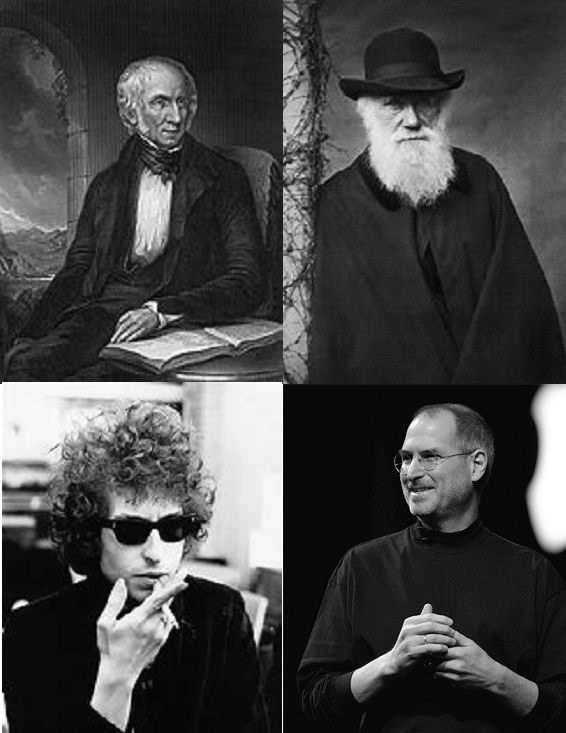
Frances Cornford has a singularly interesting back story, one that (so far) I only know the outlines of. On her father’s side she’s the granddaughter of Charles Darwin, one of the founders of modern science. On her mother’s side, she’s descended from William Wordsworth, a great reformer of verse in English at the turn of the 19th century. She seems to be whip smart, but her poetry may have a deceptive surface. Just to glance at it on the page or rattle it off the tongue, some of it looks and sounds like light verse, the kind of thing that might speak of little foibles and humorous misapprehensions. But then there comes a line that seems out of place, almost a mistake. When I first presented her earlier this month, the “sticks out” line in that poem was “O fat white woman who nobody loves.” Even if we may read that line differently than she intended, I think this smart writer intended for us to be surprised and arrested by it.
Frock coats to black turtlenecks. Frances Cornford: roughly like being a descendent of Dylan and Steve Jobs today.
Today’s Cornford piece, “Missing,” is even shorter. Two lines in (but ¼ of the way in this very compressed poem!) we might think we are about to get a piece of humorous verse musing about “just where did I put that.”
Wham! “Dead soldiers or unposted letters…”
If this was a Dada or Surrealist collage we might be forewarned by stylistic expectations, not just that a war casualty is about to drop into our short poem, but that it would be joined with something as mundane and as overlooked as an unsent letter. Like Cornford’s “Fat white woman” line it risks seeming like bad poetry or an example of egregious insensitivity.
But of course, this was a woman who lived through both World Wars. She named one of her sons after Rupert Brooke, the doomed Georgian poet whom she knew, and who would die in WWI. And that son then was killed fighting on the side of the republic in the Spanish Civil War.
Taken inside, as small, strange poems can be, Cornford’s “Missing” may make you see differently, think differently. Also, these poems have made me think again about the value of risking “bad poetry.”
To hear my performance of “Missing,” use the player below. I liked the simplicity of the music today, just strumming guitar and voice, as I worked on a more complicated piece that you might soon hear. Maybe you’ll like it too.
*In 1910 the British king Edward died and King George V was crowned. He lived until 1936, so his reign was a handy shorthand for a group of British poets whose careers emerged just before WWI.
**The group of American women poets, sometimes given the label “Songbird Poets” (Teasdale, Millay, Wylie, and to some degree Taggard and Bogan) who are favorites here have some of the same position and problems with “High Modernism”.
It should have been just a throw-away line in Modernist novelist Ernest Hemingway’s first novel. A character describes how he went bankrupt: “Two ways. Gradually and then suddenly.”
That line, or the concept of it: gradually, then all at once, has persisted because it encapsulates something that occurs more broadly than the accumulation of debt obligations. Economics, politics, artistic movements all work socially in ways that may be tied to some very deep concepts, deeper than mere humanity.
Earlier this winter I presented William Butler Yeats “The Stare’s Nest at my Window.” It’s Yeats musing on his country, which had so recently achieved colonial independence and yet had then fallen so soon into sectarian civil war. The “stare” is an archaic word for the common starling, and despite its presence in the title, this bird doesn’t really appear in the poem. Instead, Yeats’ poem is asking for honeybees, rather than starlings, to build in the nesting cracks in the deteriorating masonry of his home.
In talking about how I experienced the poem, I felt that Yeats may have been speaking to an understanding of starlings as a harmful, invasive species. European starlings are obnoxious, capable of displacing other birds, and they are artless, bereft of any sort of lovely birdsong or plumage. Their large flocks can damage crops, eating grain, fruit, young plants, and even the very seeds before the crops have become anything. Honeybees, as I read Yeats’ wish, are some better, more directly constructive creatures.
When a country is in turmoil, acting against its own as well as humanity’s best interests, doesn’t it seem as if such is evidence of base and selfish forces that are natural and therefore incapable of change? Evil, greed, and self-dealing seem ingrained, the result of some gradual deteriorating evolution toward greater and greater failures of heart and mind.
As it turns out, starlings, those deplorable birds, do have something marvelous that they can do. In flight, flying near to each other so as to seem to be grains in a sand painting or facets in a mosaic, by the hundreds and by the thousands, they can shift and change direction in such an amazing way—gradually, then suddenly.
Though this video has some cutesy elements, it’s one I could find that both shows the murmuration behavior and a theory of its mechanism.
These birds, certainly those individual birds in the flock, cannot know that this is beautiful, yet they do it anyway. Human observers may think they have seen a miracle, a sign of the divine, or at least some unprecedented event—but what they have really seen is just as ingrained in nature: a physics of change and of glorious new shapes.
In a comment on “The Stare’s Nest at My Window,” alternative voice here at the Parlando Project Dave Moore remembered that he too had done a starling piece, so we’re overdue to present it to you today. His song is called “Murmuration,” and it’s about this startling flight behavior of starlings. You can hear it performed by the LYL Band with the player below.
Continuing on with lyric poetry, that short form of compressed immediacy, here’s a poem that seems to be better known in Britain that it is here: Frances Cornford’s “To a Fat Lady Seen from the Train” first published in 1910.
I think it illustrates one of the things about good lyric poetry of the Imagist* type: it may be right or it may be wrong, but it’s always true. Almost immediately this poem was recognized as “wrong” by many (most?) readers. It could, and was, easily seen as unfeeling, or an expression of cruelty to the extent it has implied feeling. How the hell does the poet on the train know anything about that fat white lady in gloves? Early responses seemed to dislike the compression they read as glibness; more current readers see haughty fat-shaming.
Good lyric poetry of the Imagist type: it may be right or it may be wrong, but it’s always true.
I haven’t found anywhere where Cornford wrote about her intent with this poem. Given that she lived a long life and this poem became her best-known one, she must have said or written something, but lacking that I’m left to react to the text itself.
The objectionable is the poem’s third line. If the poem did not include it, I doubt any significant number of readers would dislike the poem. Let’s look again at that line: “O fat white woman whom nobody loves.”
If that was a social media post today, one can see the storm breaking rapidly. It sounds like it’s “kicking down” doesn’t it? Our graceless current President could easily tweet this line at someone who disapproved or challenged him, and regardless of one’s political stance, his demeaning meaning would be clear. But even in this short poem that stands alone with no testimony from its author, context may change how we read it.
What’s changed since 1910? “Fat” stands in a strange place in our culture currently. There are elements that regard it as somewhere between a sinful sign and a regrettable disease, but also strong elements that wish to make fat-shaming disreputable. Our general agreement, best as I can read it, is to allow “fat,” like curse words, as something we allow or forgive when we feel the subject it’s applied to has wronged us sufficiently, but not something we should throw around willy-nilly, particularly at strangers. But how damning and diminishing was “fat” in 1910?
Much less I think. First off, let’s look at the U.S. President in that year. A crude reading of the culture for sure, but William Howard Taft was, well, fat, and yet today few politicians are.** Female beauty standards too were curvier (though this was soon to change). Fat was, to the level of unexceptional cliché, associated then with wealth, and therefore wealth’s courtier, power. This once unquestioned association with wealth and power is partly responsible for how the fat person was treated comically, even later in the century. The lean, skinny person was the scrappy underdog, the fat person the one who ran things. Stan Laurel was put upon by the more officious Hardy. The Marxist critique of Margaret Dumont was to tear down the well-fed power structure of white women in gloves.
Moving on in Cornford’s problematic line: “white” is if anything more striking in its frank appearance in this short poem. Here I’m even more unsure of Cornford’s context and intent. “White” as a term for those not considered a person of color existed in 1910 certainly, and that’s how most of us will read Cornford’s line today. But a consciousness, without the context of other non-white people in the frame, of a white person calling out someone as “white” strikes me as so unusual in 1910*** that I wonder if we’re misreading her intent. Does she mean that she’s dressed in white? If she means, to us as we may experience the poem now, “a member of the favored and privileged racial caste,” we should take that into consideration regarding the effect of the poem more than most readers seem to. If she means “dressed in white,” which I think is more likely in the poem’s context, then she’s extending the “gloves” image as observing someone she imagines is not in touch with the earth. It’s probably taking too large a deterministic leap to think that she’s meaning to reference suffragettes with a singular woman in white. It’s a slightly lesser leap to consider dressed in white as a wedding gown undertone.****
And yes, let’s not miss the third word in this compound epithet: “woman.” Given that the author is a woman, and we presume the train-riding speaker of the poem looking out the window is a woman, we may have something like a peer to peer relationship between the observed subject and the observer.
In the few Frances Cornford poems I’ve read so far, there’s considerable female empathy exhibited. Why are we sure that the woman in the train is disgusted with or condemning the other woman? Does she feel superior or knowing in some way in the lyric moment (regardless if she’s right or wrong) that the white woman is missing something (love, an experience of nature)? Yes, I can see that. Is it a haughty superiority? I think that leans too much on the dismissive way we read “fat” and even “white.” As I read this poem over, I visualize looking out a train window, and the sense that comes to me is that one sees the woman outside through one’s own reflection in the glass we are looking through. I think, in the lyric moment, Cornford is imagining (and letting us know that it’s only that, imagining) a difference and a risk for herself, and for that other woman.
Dialectic: Frances Cornford at work. Frances Cornford without gloves.
There’s another mystery in the poem that I can’t decode completely: the gloves that refrain along with the absent loves. One reader jocularly suggested that the woman is hurrying on her way to a cricket match, and she’s wearing gloves because she’s a wicket keeper. Some, I think seriously, see gardening gloves. Others, formal-wear gloves. This is part of what I like about this poem: it’s plain-spoken, allusive, and elusive. That’s a hard combination to pull off. Along with its excellent musicality, that may be why it’s so well remembered in Britain—even by folks who are sure they dislike it.
Like Marlowe’s shepherd, this is a poem that calls out for an “answer record,” and humorist G. K. Chesterton’s retort “The Fat Lady Answers” is the most famous of several. I stand more with Cornford’s lyric than Chesterton’s busted triolet, but his point is worth remembering as we consider “other people’s stories.” And so I performed the two together today. At the time I recorded this performance I decided to read the female poet’s poem in a male voice and suggest a woman’s voice in the male Chesterton’s response. I was still buying into Chesterton’s objection more than I am now after living with the poem a bit longer.
Anyway, Cornford’s triolet is so damn catchy that I wanted to keep it to the hook today—mostly drums and bass for the music—but I added a little of my naïve electric piano working off an odd inverted-voicing CMaj13 chord. One of my shortest audio pieces gets this long post. Go figure.
*AFAIK, no one considers Cornford an Imagist, and this poem was written and published before other pioneering Imagist train poems like Pound’s “In a Station of the Metro” or Sandburg’s “Limited.” But in its straightforward immediate language, specific color imagery, compression, and avoidance of sentimental emotional language, it follows the intent of those later free-verse Imagist poems.
**King Edward the VII doesn’t look svelte either, nor Queen Victoria in her later years. Of course, “Who made you king of the Britons?” and all that, but this still speaks to how excess weight was viewed in 1910 as representative of wealth and power.
***I don’t know much about Cornford’s political and social beliefs. She had one son who was a dedicated Marxist of the Karl branch, but what she thought herself about racial questions, I don’t know.
****If it was explicitly a wedding gown, it’d be a different poem, but you can re-read or relisten to the poem and imagine that at your own option. Another possibility would be that the woman is white because she’s a ghost. Again, overdetermining the poem. I’d still like to know what Cornford’s intent was, but even if it was a bit of light verse that got away from her, one of the joys of lyric poetry is that undercurrents can be waiting for the next time you read, hear, speak, or perform it.
Here’s a follow-up note on another alternative reading of this poem. In the time since I wrote this post I sometimes wonder if the woman in white we ostensibly see through the train window is actually the poet, Cornford, looking at her own reflection in the glass which would then seem to be sweeping through the countryside. In photos I’ve seen, Cornford appears quite thin, and even given cultural differences in body image that I talk about above, I wonder (with no evidence) if Cornford may have suffered from anorexia.
The cosmos says we need to get a leap year, and extra day, and yet we put it in February. It was a dozen degrees Fahrenheit this morning, and my bike ride back from breakfast was into an insistent north wind that explains to me that we’re in Minnesota and we’ll probably have a snowstorm or two yet before we can see spring—a spring that sometimes seems too short to form memories.
So, before we leave this month and season, I thought it a good time for a short poem referencing a short month from American poet Sara Teasdale. Teasdale is like Edna St. Vincent Millay, a poet that 100 years ago was thought a leading voice in this country’s verse, after which we spent the rest of the century more or less forgetting or down-grading their place.
When such re-evaluations happen, it’s common to assign them to the refined judgement of posterity, the further assay that separates momentarily sparkly stuff from the for-all-time classics. How does that happen?
One could assign this downward path to Teasdale (like Millay) writing metrical and rhyming verse in their prize-winning years early in the 20th century. The evil Modernist free-verse hordes in this view laid waste to all who dare to rhyme or march to a one-shoe-off beat.
There’s a factor there, sure, but this story doesn’t account for two giants whose statues were not toppled: Frost and Yeats. Nor the monuments on many campuses to canon sitters like Auden and Wilbur et al who were not primarily free-verse poets.
No, I think there are more important factors in this determination, one that is currently under revision in our new century. First, both were essentially lyric poets. “Lyric” in this sense doesn’t mean that they wrote song lyrics. Though of course this project finds them sing-able and otherwise suited to presentation with music, “Lyric” in the literary sense means that their poems tend to be set in the impressions and immediacy of a moment, and their final and considered judgement of that moment is not necessarily explicit. Lyric poems don’t usually have great themes developed with long arguments in verse. Nor do they have narratives the way a novel or story does, were we turn the page to find out what happens next. What happens in a lyric poem—happens! Right then. Right now.
The pioneering Modernists in the years before the end of WWI, those that were or wrote like Imagists, were fine with that. Indeed, this was the point of Imagism. Teasdale wasn’t called an Imagist, but she could write like one, albeit with rhyme and meter. The Imagists didn’t call for the end of rhyme and meter, they called for an end of poems that existed to fill out those forms without the vividness of the lyric.
But post Eliot and the Pound of the Cantos, post the sheltering of poetry inside the academic monasteries which could too easily fall into a rout of poems to be taught rather than poems to be experienced, these poems could seem slight. The Imagists were a fine exercise to break from the past, but they were not, in this outlook, the way to write great poetry.
And here’s the other reason. Gender. The academics were overwhelmingly men and were steeped in the things men were thinking about. And the world of the middle of the 20th century had a lot of concerns that made the concerns of Teasdale and other women poets of the early part of the 20th century seem like the line in Casablanca uttered by Humphrey Bogart “The problems of three little people don’t amount to a hill of beans in this crazy world.”
For the first part of our double feature: 90 seconds of cinema that was an emotional touchstone to many. Also, mansplaining.
It took the culture until nearly the end of the 20th century to see that part of the world’s craziness was because men were still explaining how it worked to women.*
All that may be too much of a burden to bear for this short poem by Teasdale. But if “February Twilight” was signed Frost or Yeats, I suspect more attention might be paid to her poem. It doesn’t read much like Yeats, but it could pass for the shorter, lyric Frost.
The lyric impulse in poetry survived the mid-20th century when colored with Dada and Surrealism. “See, it’s not me! I’m a serious poet, but I just chanced into this charged moment.”
What does Teasdale experience in the charged moment of her lyric? That it seems like she’s the only one that views this star, a manifest untruth we could explain to her, but which I think she knows as the final line presents. She doesn’t explain this to us, but we can stand in the cold, snowy February and experience it with her.
I’m choosing tambura and acoustic guitar again for my performance today, this time with an organ keyboard part. Click on that player gadget below to hear it. “If you don’t, you’ll regret it. Maybe not today, and maybe not tomorrow, but soon, and for the rest of your life.”
*Which I’m doing here. Ha Ha! Here’s where one of the principles of the Parlando Project comes in: “Other People’s Stories.” I’m not claiming the exclusive right to mansplain mansplaining, but men speaking up about it has its place and value.
Oh, and explaining has value too. And I happen to like Casablanca as a movie. And defeating fascism might have a value greater than the optimum choice for a snuggle-bunny. And I had huevos rancheros for breakfast. A hill of beans would be meaningful and sustaining to me!
It’s leap year, and the last time there was one of those, Dave Moore wrote this song about the mysterious cosmologies and quantum physics of love.
We’ve already met Stephen Hawking here, though in a roundabout way, as the universe may be. When Hawking died a couple of years ago, at his public memorial an astronaut read a passage about the cosmos from a Percy Bysshe Shelley poem to eulogize the great cosmologist. Coincidence? Well I looked, and I was surprised to learn that Shelley, that early 19th century romantic poet, could write on the physics of light and calculate the speed of a light-year. Not quite quantum theory, but a better performance than many poets today might do. Romantic wonder and physics may be objects that are closer than they appear.
I suspect Sadie Hawkins is a more obscure star in our firmament these days than Stephen Hawking. Dave would know Sadie first-hand because he’s much more knowledgeable than I am about what once were comics and are now whatever they are fancied as an art form. Back when they were funny papers Sadie was created by cartoonist and satirist Al Capp.
Al Capp ran a comic book company too. In 1957 he published a comic book about the Montgomery Bus Boycott, which helped bring to the fore Martin Luther King. The story in Dave Moore’s family is that his mother typed MLK’s thesis in Boston. Like I said, objects are closer than they appear.
I can’t quite fathom how to condense Capp into a short blog post. I proudly thought I could come up with two or three sentences to sum up Capp’s career—but that’s impossible. His Wikipedia article covers the high points I guess. I will say that by the time I was reading comic strips the Al Capp mythos was probably past its prime and unappealing to me. But that didn’t mean that I didn’t know Sadie Hawkins. Schools still had annual “Sadie Hawkins dances” where young women were licensed to ask men to a date or dance, and all this (along with some legends about Irish Saint Brigid) got melded into a tradition that women could propose to men on Leap Year day.
That’s enough to get you into Dave’s song. As long as you’re willing to entertain a song about a once highly popular cartoon strip and theoretical physics, you’re the audience for this one. I don’t know if that’s enough to fill a Sadie Hawkins Dance floor, but the wallflowers are more interesting there I’d think.
How do quantum forces work? I doubt I know more than Percy Bysshe Shelley. I planned to present this piece for leap year day sometime back, but what did I think two years ago when I heard Shelley’s poem? That he had written of a mazzy heaven, and that flavorable word brought me to think then of Mazzy Star, an indie rock group that can trace its way back to Minnesota about the time Dave and I started to make music together. Now as I write this post this week, I read that the person whose particle path made that traverse, Mazzy Star principal David Roback, has just died.
The player gadget to hear the LYL Band perform Dave Moore’s “Sadie and Stephen Hawkings” is below.
Today I present the other widely anthologized Paul Laurence Dunbar poem: “We Wear the Mask.” I was going to put a “now” qualifier in front of “widely” above, but that made for an awkward sentence. I think it’s worth burning at least another sentence to note that.
In looking for some more Dunbar information, I found this story told by Professor Joanne Braxton. Braxton recounts that as recently as the 1980s when she was looking to teach Dunbar poems at her university, that Dunbar’s work was out of print and difficult to find. That’s not unusual. As Donald Hall fatalistically stated in one of his late essays: the majority of poets who receive prizes and ample publication in their time will be unread 20 years after their death. Braxton, who knew Dunbar’s poems from family and Afro-American tradition, eventually saw to publishing of the first collection of all of Dunbar’s verse.
I’m sure I have readers here for whom the 1980s is “a long time ago.” It’s all relative I suppose, but this change in availability speaks to the dynamism of “The Canon,” and which poets we’re exposed to in school or the culture at large. Braxton teaches by her example that we, each of us, shape The Canon,* particularly with poetry, which is in suspended animation on the page and lives only when we read aloud, chant, and sing it. It’s up to all of us to find those poets who split our skulls, open our caged chest bones, and let us animate the slumbering dreams.
No date is known for this poster, but Dunbar looks quite young here
Braxton** and others have written eloquently on the meaning of this Dunbar poem and about Dunbar’s pioneering code-switching project to write in dialect as well as mainstream 19th century poetic forms, so once more I’ll defer to others today in those matters.
On the poem itself, let me praise its word-music. There were occasional words that were hard for me to sing or set to music, but that’s likely my fault as a composer and certainly my fault as a singer. “We Wear the Mask” is almost too pretty for its subject, but then there’s a tradition (I associate it with Celtic folk musics) of setting the saddest stories to the most beautiful tunes. Last time, for Dunbar’s “Sympathy,” I followed that idea for my music and the fiddle melody. Now, for my explicit music today, I decided to go in a more martial cadence and ambience. Art song (that traditional method of setting poetry to music) usually avoids that mood; but one of my influences, the English language 20th century Folk Music Revival is perfectly fine with that.
Here’s the guitar chords. The piano and bass mostly just play the roots of the chords in today’s performance. That’s a nice thing about music: sometimes simple works just fine.
In the Broadside tradition, I’ve included my guitar chords with Dunbar’s lyrics for this one. I played it with a capo on the second fret, so the chords sound a full step higher than the chord forms indicated above. My performance can be heard with the player gadget that should appear below.
*This leads to complaints that change in The Canon is “watering down,” or subject to special pleading which somehow is self-evidently inferior to one or another objective aesthetic criterion. If there are indeed multiple criteria (objectively, that must be agreed to be so) how else must we decide among ourselves what has worth, but by a dynamic of discussion, debate, disagreement? And will such actions by human minds and hearts ever lead to a static situation? How can it, if for no other reason that we continue to create poetry, music and art. Hall says, correctly on the face of it, that most will be forgotten. But like those that charge, armed or not, against the redoubts, we must move forward even if only a few will reach and cross the wall.
**One fascinating bit in the link has Braxton sharing an account from Dunbar’s widow about a possible specific inspiration for Dunbar’s famous “Sympathy (I Know Why the Caged Bird Sings)” poem.
The last two times I presented poems by Paul Laurence Dunbar here I went out on a limb on subtexts that might be present in those poems. “October” is on the surface a harvest “Happy Autumn” poem, but there’s an element in it of the personified rich harvest’s carefree possession of wealth. Just a handy poetic metaphor? Perhaps. And then there was his valentine of a poem “Kidnapped” which could plausibly be connected to the Cupid and Psyche myth, but specifically deals with the narrator being captured and taken from its home. Just another recasting of a widely utilized myth? Could be.
But you see Paul Laurence Dunbar is the first successful Afro-American poet. A man whose parents had both been slaves, whose ancestors would have been very non-metaphorically kidnapped, and a man whose race in his 19th century were the harvesters who retained none of the wealth that accrued to the owners.
Today’s piece by Dunbar carries its subtext clearly—it’s hardly subtext at all! One cannot read or hear it and not see it as a statement about freedom denied. Partly because it can be applied so directly to Afro-American history, it’s become one of Dunbar’s best-known poems.
Dunbar with violinist. Seems like an idea….
I don’t need to add to Dunbar’s words today. But since my ego claims I should say something, I’ll note this: Dunbar chose to write his poem as a universalized statement. There’s no lack of Afro-American experiences of freedom limited, other-defined, and outright denied—but the poem he wrote speaks universally of that issue.* The specifics of racism and economic deprivation would be self-evident to his Afro-American readers anyway.
Was writing about denied freedom in metaphor a commercial choice, in accordance to the poetic style of his time, or an example of a largeness of his soul? Well, now his poem exists, and it speaks to freedom denied to anyone who encounters it.
I started thinking of wry captions for this. Nope, the picture doesn’t need’em.
Another setting from me using violin, cello, and acoustic guitar today. I went out last night after working much of the day on this audio piece and saw songwritersplaying acoustic guitar at a local venue. I enjoyed the concert, but also in the background I was thinking: alas, I can’t really play guitar or write songs like they do. I watched them changing chords rapidly compared to what I could do earlier in the day. That’s so useful I thought, recalling that I had had trouble rendering my leisurely cadence earlier.
I’m not sure why I thought that. I’ve been doing both of those “I can’t” things for over 40 years, despite limitations on my part that change over time. When I returned to the piece today my guitar part didn’t sound as wanting as I remembered, and the uncommon “i, III, VI, v, i” hopscotch chord progression of my composition seemed worthwhile to the morning’s ear. My violin line (played on guitar via MIDI) seemed better than I remembered too. I still wish I was a better singer, but I can express my own way with melody on an instrument even if my singing limits me. The piece seemed valid to me again.
What lesson to draw from that? Comparing your art to others can be fraught. Sometimes when you need to improve, observing others can show you the way. Sometimes when you’re different, it’s still good, and not a falling away.
To hear Dunbar’s “Sympathy” as I performed it, use the player below. The full text of the poem is here if you’d like to follow along.
*A good argument could be made that there is a specific to the Afro-American experience in Dunbar’s metaphor though: the caged bird’s song. American music, that stuff that we (and a great deal of the rest of the world) have come to hear as the strongest part of our American culture is disproportionally Afro-American music.
We are over half-way through Black History month and I’ve mostly spoken obliquely about it. I think that’s my nature. As poet I’m often doomed to reader response that they just don’t get it, and that bothers me, because in my mind I’m intending to link disparate things because I think that’s powerful. But in intending to do that, I make myself obscure—and painfully, some fine people who’ve heard or read my work think that’s my intent or my error.
So, when I speak about one of my discoveries, a law I think is strangely comforting: “All Artists Fail,” I’m speaking from personal experience. You may think, that’s not true about famous artist X or highly revered artist Y, but it is. Even those that are—for a time or for a long time—popular, many will not hear of them, many will not care for their work when exposed to it, and even those that are treasured and ranked highly, how many will understand what they are trying to do sufficiently? Some? Perhaps. Many? One hopes. All? Never. It’s good to aim for the some and honorable to hope for the many. Be prepared for the never-all however. Sequester or armor yourself against that or be prepared to take comfort in it.
That’s part of why this project has a principle of “Other People’s Stories.” More than 90% of the time the words I’m presenting and talking about here are not mine. Trying to encounter those words a couple times a week with an open heart and whatever limitations or strengths I have is the goal. I’ve done that here over the 420 audio pieces and the over 500 posts in the last few years.
The great majority of those that I present here are now dead, many long so. As my son points out to me, mostly white men too. One needs to interrogate the past to form the future. I have a culture I inherited. One that spoke English, was based in the middle of the U.S., and was as blinkered as any. Everyone inherits a culture. It’s inevitable, as inevitable as “All Artists Fail.” What do you draw from it for strength and inspiration, what do you oppose, what do you seek to add?
What can you find in what is not you? All those things. The future is not made of one heart alone, no matter how perfect, it’s made of many hearts. Good art can tear open our boney-caged chests and let us glimpse the beautiful glistening ooze within all of us: Chinese, African, Irish, English, indigenous, immigrant, and on and on. It’s right and wrong—yes, in some proportion, inside all of us—but it’s always beating as music and poetry does.
Long dead CIS white man Phillip Sidney wrote “Fool, said my Muse to me, ‘Look in thy heart, and write.” That can work. That can fail. My muse said, “Look in another’s heart, and no matter how dim your vision inside that swooshing pump, write there.”
More new audio pieces soon. But I was heartened today by a post over on the Yip Abides blog linking to a post from a couple of years ago here. Bob Roman has some very nice things to say about what’s attempted with the Parlando Project, things that reminded me why I do this. He also recomends that the archives here have a lot for those who’d like to find something different any day. The particular piece he linked to had Jimi Hendrix’s SciFi parable about an alien scout-ship dealing with observing life on the “Third Stone from the Sun.” The alien gets it wrong, or sees that we get it wrong: the prime Earth species is a bird, not us warm blooded mammals.
I neglected to plan ahead enough for today’s U. S. Presidents’ Day holiday. It’s an odd holiday anyway, of no great interest to the large number of readers/listeners this project has overseas. And for Americans, the title and avowed purpose of the holiday may be especially fraught in our present day.
Back when I was young, it was two holidays, celebrating two specific Presidents: George Washington’s Birthday and Abraham Lincoln’s Birthday. The first President, a leader of the American Revolution, had a cardinal virtue: he could have become the dictator of the newly independent country. That after all, is the result of many revolutions. He was one of the richest and most powerful men in the new country, full-fledged in the 1% for certain. Yes, part of his wealth consisted of enslaved men and women he owned, but these facts strangely testify to this one important fact in his character: he could have been that dictator. He could have run our country as a personal plantation. He would not.
Abraham Lincoln is another case entirely. I’m not au fait with the demographics of the early 19th century United States, but Lincoln’s family was undistinguished in wealth and fame then, and the circumstances of a rural frontier farming family in his time and place would rank his conditions with those of the world’s poorer regions today.
American poet Carl Sandburg was born less than 70 years after Lincoln, the son of a wealth-less immigrant in a rural America that was different from Lincoln’s, but much closer to Lincoln’s country life than we are today. When, in the last previous decade to be called “The Twenties,” Sandburg chose to write a biography of Abraham Lincoln, he could see those differences, smaller though they were to his eyes. And his eyes were an Imagist poet’s eyes.
This led to an unusual book,* one that was once central to Sandburg’s contemporary renown, but now is generally less well-regarded. Sandburg chose to tell the Lincoln story, as he might portray a scene in one of his poems, with a great deal of humble detail that at any moment could slip into a wider context unexpectedly. His palpable reverence for those humble details is unmistakable.
When Lincoln wrote and spoke the great American civic poem called “The Gettysburg Address” he famously began by noting our “fathers brought forth upon this continent.” Sandburg though, in telling Lincoln’s story was not exclusively beholden to the patriarchy. And so, however late for Presidents’ Day, here’s a piece more directly about the holiday’s forerunner: Lincoln’s Birthday, as portrayed in Sandburg’s book.
I could see Sandburg, being a poet, choosing poetic methods of refrain as he tells the story of Abe’s birth, and then but a few pages later the death of Lincoln’s mother Nancy Hanks Lincoln. Each event is set in humble rural isolation, with a central image of a bed of poles and animal hides, cleated to the wall in the corner of a hand-built, dirt-floor hut. This is where Nancy Hanks first presented us Lincoln’s birth day, and also where she died nine years later.
When Dell books got the paperback rights to Sandburg’s condensed version of his Lincoln book, they also made a 1956 comic book from it. The unknown artist didn’t follow Sandburg’s text accurately for the interior scenes however. The cabin drawing is based on a later reconstruction and the interior panel could be a 20th century home familiar to the 1950s reader.
Can we believe that’s an American story, much less the story of the birth of a President? It seems like a tale from somewhere else, particularly today. Oh, so much, particularly today. Like a grim fairy tale passed down from some old country. That the Lincolns’ nearest neighbors have the name “Sparrow” only adds to this effect. I decided that Sandburg’s Lincoln tale needed an invocation, a striking way to set us in readiness. My choice for that was to begin with a quote from Patti Smith’s “Birdland,” another place where music met words to tell the tale of a child who had lost a parent. In the little section I chose here Smith—like Sandburg will at times in his tale—steps outward from the particular in her poem to the promise of an ecstatic future.
The player to hear this performance should appear below. Because I was so late in getting this piece together, the main section retains a “scratch” rhythm section track I used while constructing the piece that I’d normally replace, but I doubt it detracts much from Sandburg’s story.
*The first book, published in two volumes, Abraham Lincoln: the Prairie Years was followed up several years later with Abraham Lincoln: the War Years published in four volumes. These books were in their time a success, and helped form the American cultural understanding of Lincoln in the 20th century. After another interval of years Sandburg created his own one volume condensation of these books, greatly shortening the original text. With my short deadline, it was from that later edition, the one I could get quick access to, that today’s text it extracted.
This week I met with a small group of poets that have been sharing their work with each other for a few decades. At the end of the night one of us said that, despite the date, that love poems had been rare.
I said that I do try to look for love poems to present here as part of this project, but when I do I’m often waylaid by something gloomier—“But then, love poems can be as complicated as any other, and there’s always Lorca where the poem is ‘I love and desire you even while we’re between one foot and our whole body and soul in the grave.”
Did I mention the group is all old poets? Young poets can choose to be poète maudit types, and to mine the tropes of love, separation from all, and death—but past a certain age, us old poets have an organic attachment to that role that we’d have to actively deny to escape.
So, for Valentine’s Day, here’s a free-verse sonnet of mine that speaks about a kind of love that old partners may have. I think some readers could miss that aspect in “These Phones in our Hands (are so Magical),” working as the poem does to contrast the little glowing palm-shrines that are now common to most of us with other kinds of connection.
Long time readers here know that we’ll be back soon with performances of poems I didn’t write.
The magical incident it describes, of a phone that can display a picture of a couple seven years in the future is not entirely fantasy. As the poem jokes, there are processes that can age a photo to show how a person might look at an older age. For someone older, the assurance that one might see proof that one will be around for seven more years is magical in a more above and below-ground earthy sense. Young lovers can wonder if their partner will stay partnered with them. Old lovers know that they will part.
The final couplet may be tricky. The empty hands are not just empty of their magical smart phones.
I almost presented this with just the drums, but in the past week or two I’ve spent composing time blowing on the guitar because my fingers have been up to it, and maybe I can recover a little of the few chops I once had. Yet, in the back of my mind I’ve reminded myself that it’s been awhile since I composed an orchestra piece for this project, and that led to the strings today. The player to hear it should be below. If you’re reading this in the WordPress reader on an iPad or iPhone the player gadget may be missing. Why? I don’t know, as the player shows up fine in Safari—but you can subscribe to the audio pieces by themselves in the Apple Podcast app or many other podcast places as “Parlando – Where Music and Words Meet.”


 Frank Hudson