When we last left-off Kenneth Patchen he was beginning his career as a proletarian poet in the 1930s, writing a strikingly prophetic (in both senses of the word) poem about what the middle of the 20th century was holding in store. I’ll leave it to you to decide if that poem also speaks of our 21st century’s future.
I didn’t have time to discuss that Patchen’s 1952 Wikipedia picture looks like Thurston Howell from Gilligan’s Island.
Patchen never left his concerns with society’s dangers and constraints, it remained part of his poetry throughout his career until his death in 1972, but that’s not all or even much of what he became known for. Here are some of those things:
He was a significant influence on the post-WWII independent, largely non-academic Beat explosion. The bohemian aspects of his life and outlook, as well as the ways his writing expressed itself was a key living American model for the Beats.
And speaking of the Beats, he and his friend and fellow Kenneth, Kenneth Rexroth, were enthusiastic pioneers in the tradition of performing their poetry with musical accompaniment. Though many Beat Generation poems still live on the page, I’m not alone in hearing many of them, even when read in silence, as spoken voices, a jazz group cooling it behind. Patchen was more committed to this combination than most he influenced, touring his “Poetry-Jazz” in the late ‘50s.
Obviously, that style is part of what’s led to the Parlando Project, though I wish to expand on it. Patchen too seemed open to other musical genres with his writing: for example, a longer piece for radio performance with a musique concretescore by John Cage, “The City Wears a Slouch Hat.”
American bohemian arts flowed out from the Beat era, and Beat’s immediate predecessors like Patchen, in a series of connections and mutations. Diverted poet Jim Morrison used his psychedelic ballroom singer money to help Patchen publish one of his final books. And a figure as singular-seeming as Leonard Cohen has links in his expression that seem to connect closely with some of Patchen.*
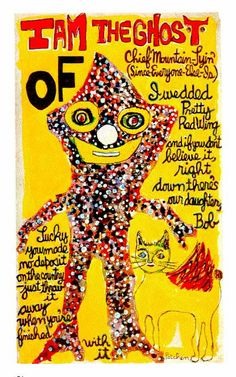
It wasn’t just music that Patchen combined his poetry with, but visual art—drawing and painting pages that were as much pictures as poems. While this has precedent in medieval illuminated manuscripts, the painter/poet/engraver William Blake, and some of Dada’s work, Patchen’s style of combining his own naïve art with epigrammatic text connects with some of the poster art of the Sixties.
Closer to Pedro Bell than William Blake? Art by Kenneth Patchen.
One of the reasons I so like presenting figures like Patchen or Blake is their “get in the van” indie spirit. Art does not need to ask permission, it perpetrates itself anyway, figuring out a way to use the resources it can scrounge together.
And lastly, another thing Patchen became known for, even if it wasn’t as widely imitated in the Beat era, was his love poetry. It would be restrictive to think of him as just a love poet, but it was a substantial part of his writing and audience. As the billboards changed from “The Beat Generation” to “The Love Generation,” Patchen was already there with his poetry. A case in point, today’s poem “O My Darling Troubles Heaven” performed here by Dave Moore and the LYL Band.
So, enough talking without a band. Go ahead and click on the player below to hear Dave’s performance of Patchen’s poem.
*Like what? The love poetry combined with the prophetic social dread is a recognizable Patchen trope. The combinations of art and writing, such as in Cohen’s Book of Longing can be similar. And while Cohen’s typical poetry plus music style isn’t often reminiscent of Patchen’s, the two obviously didn’t mind mixing those arts.
Just a couple of posts back I said that early Carl Sandburg poetry can be just as aligned with the ideals of the Imagist school as the Trans-Atlantic poets such as the then contemporary work of Ezra Pound, Amy Lowell, H.D., Richard Aldington, F. S. Flint, T. S. Eliot, William Carlos Williams, and T. E. Hulme was. Yet he’s rarely mentioned as such.* Why might that be?
My guess is that there’s an issue with Sandburg’s more expansive mode, present in some of his work, Whitmanesque in character and scope. The Pound and Eliot school of Imagism wasn’t much on Whitman, charging him with lack of craftsmanship and concision. And then there’s the issue of cultural affinity, which while outside the text, is important. Of the above, only Lowell was from a wealthy background** (and Flint’s childhood seems positively Dickensian) but they all saw themselves as culturally elite. Most were familiar with classical languages, some had Ivy League educations (though none were Oxbridge, save for Hulme who was thrown out after a bit more than a year for rowdy behavior), most had spent time in Europe , even Williams, the most American-focused of these.
Sandburg? Born working class to two immigrants in the Midwest***. Drops out of school at age 13 to go to work. The jobs he had in the first 40 years of his life were modest in prestige, but varied in location and nature. Coal-heaver, farm laborer, Army private, milk-truck driver, political organizer, bricklayer, “The Front Page” era urban journalist. What T. S. Eliot knew about the whole of literature, Sandburg knew about the whole of working-class work and life.
One could make one mistaken generalization from Sandburg’s biography, that like Whitman self-advertised himself, he’d be “one of the roughs,” a man whose art would be artless and as unconcerned with the niceties of aesthetics as the correct fork for which dinner course. But just like the lazy assumption that there’d be no poets in foxholes, the idea there are no aesthetes who punch a clock is bogus. Sandburg’s early work is as concerned with Modernist beauty and style as working-class dignity—and he is very concerned with working-class dignity!
Is today’s Sandburg piece, “Back Yard” an Imagist poem following the three Imagist rules? Let me paraphrase them:
Direct treatment of the thing: that is, the focus in the poem is on the image itself which will be described, instead of the image being a decoration and figure of speech within the body of a poem more concerned with its moral or message for which the image is only a “like” illustration. Conciseness: no extra words, and though not stated, it’s corollary is no less-apt words used only to make the rhyme. And freer rhythms: word-music, like sound-music, is not required to limit itself to only extraordinarily regular and repetitive rhythms.
Direct treatment? The outdoor, summer night scene is just that. One is hardly aware here that it’s an image, it seems like simple reportage. Is it merely the “hardly news” that on a summer night if one is outside, perhaps sitting on an open porch, you’ll hear and see other people outside too?
Concise? Pretty much. It’s not In A Station of the Metro, or The Pool, or The Red Wheelbarrow, there is some re-iteration in it, even a single line refrain, but even by the standards of lyric poetry, this is a short poem. The elements of the scene are evoked, but there’s little extravagant or showy description. One element that many Imagist poems share (though never a formal rule AFAIK) is that colors are used to simply describe objects, though since this is a moonlit night scene the colors are more monochromatic.
A follow up question: how minor and mundane is “Back Yard” really? I can’t claim it’s a poem of great originality—but that’s not the job of every poem, and this is more a poem of the continuity of change, a moment of shared perception, not a striking new vision.
I think its intent, in it’s just over 100 words, is for us to see a chain of life in a Chicago night early in the 20th century; and in its everyday exactness, state those things that might link to a night tonight where we live today. The silver moonlight in the scene seems almost a preservative, everything is frozen in that direct moment. In my night tonight it may not be an Italian boy with an accordion, but Mexican music from the back yard at the end of the block. The couple Sandburg says will marry next month, are now-dead grandparents of people as old as I am. An old man has fallen asleep in the late and waiting moment, his back-yard cherry tree’s fruits held in a moonlit unmoving until his eyes close. He will likely pass on sooner than the marrying couple, and his dreams and those long-ago cherries will be returned to the place that dreams, fruit, and poems go and come from.
The poem closes with a perennial thought delivered in the scene’s description. The clocks, the poet relates, say he too must go. The clocks say that to all of the characters in his poem, and by extension to us, his audience. Sandburg, the artist, the poet, has the job like the moon to fix this moment in silver. Was he thinking here of the silver of his brother-in-law Edward Steichen’s art photographs? What does he mean by the poem’s closing line? What are the “silver changes?” My best understanding is they are the endless succession of such fixed moments. There will be more and more silver changes, a great richness, even as we are entirely not there.
Fancier than my back yard: “Nocturne-Orangery Staircase” (1908). Sandburg occasionally collaborated with his brother-in-law and pioneer in fine art photography Edward Steichen.
For the performance of “Back Yard” I decided to intersperse some other night moments, sung as commentary on Sandburg’s poem. You can hear it with the player gadget below. Want to read along? Here’s the text of the poem. No audio player gadget? this highlighted link will make a new browser tab appear that carries with it its own audio player.
*Yes, Imagism is only a label, a piece of sticky paper put on some writers and writing. But because Imagism was so vital to the formation of English poetic Modernism, excluding Sandburg, “The Forgotten Imagist” from its usual ranks was part of how he was diminished in the late 20th century. The artistically-chosen stark simplicity of Imagism was admired, but similar directness in Sandburg was seen as populist simple-mindedness. For an example, here’s a long review of a late 20th century biography, where the dagger is that Sandburg’s poetry was “dumbed-down Whitman” and the charge seems to be that he was a pretentious yokel who was also a phony who pretended to be a yokel.
**I’m of the impression that Eliot and Pound’s family had at least upper-middle-class wealth too, but my informal memory is that some estrangement or streak of independence led them to live outside their families’ wealth.
Today is the summer solstice, and what better way to celebrate than a song from Shakespeare’s “A Midsummer Night’s Dream.”
The song “Over Hill, Over Dale” comes early in the play, as the audience is introduced to the fairies’ world. I’d like to point out, the un-named fairy who sings it might be particularly relatable to creative types. How so?
On our creative days we may like to think ourselves’ that play’s Puck, “that shrewd and knavish sprite” capable of all kinds of life-shaping mischief with our words and creations; the Puck who gets the play’s ending speech where he represents as all effortless, dreaming creators to our audiences.
But Puck doesn’t sing today’s song.
Nope. The singer is just a fairy no-name. And, to be frank, this fairy is kind of a drudge. The song, delightful as it is—and meant to generate with word-pictures a wonderous world of nature’s magic in the audience’s mind—does this by a description of no-name fairy keeping their fay nose to the pixie grindstone. Dutiful, and busy, busy, busy.
Shakespeare has set no-name fairy’s job to be an exposition-character. After today’s scene-setting song, their dramatic task is to introduce Puck, through no-name recognizing the much better-known sprite and speechifying as Puck’s hype-man. After that, no-name leaves the play speaking lines about not wanting to be noticed.
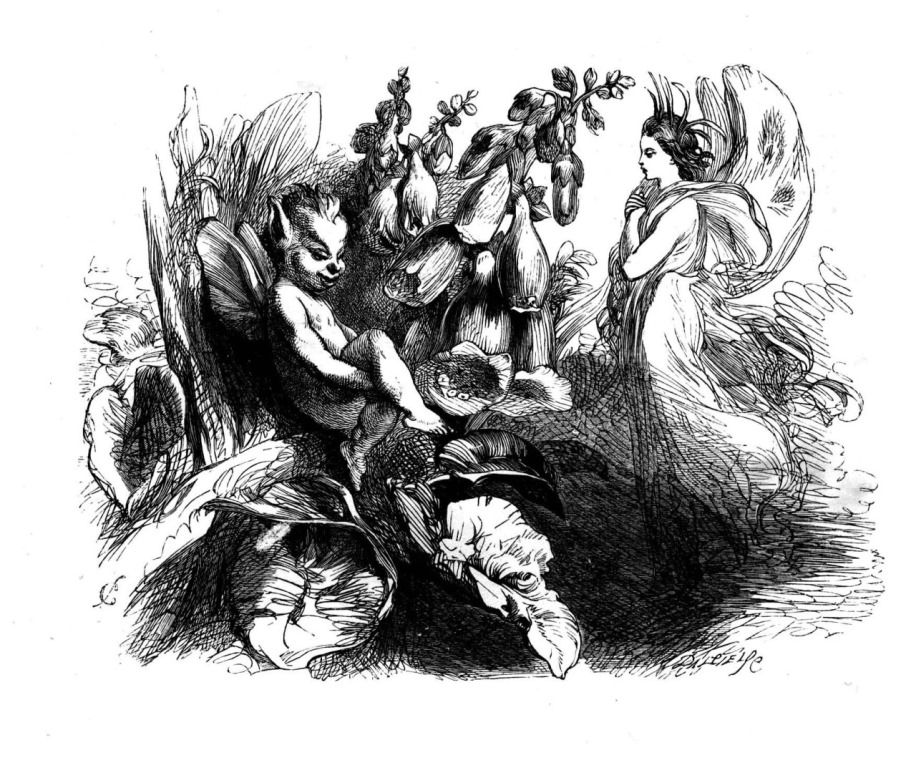
Consolations? This Victorian artist made our no-name fairy better-looking than Puck (on the left.)
OK, so what’s in this for creatives?
We’re not Puck, at least not most of us, mostly all the time, effortlessly casting our thrall. Magic and delight take a lot of grunt work. There’s always one more cowslip that’s missed its pearl-hanging, that’s a few rubies short of the categorical number.
And if we do our work well enough, it often seems like nature—you know, “You’re so creative. I could never come up with all your ideas!” Well, creative people aren’t the ones who come up with ideas (those are imaginative people, only some of which are creative)—creative people are the people who make things.
Musically, I get to work out my naïve piano playing while aiming for a funky feel on this one. I hear there’s a Midsummer party in the wood outside of Athens. What time? Oh, Elizabethan. The player gadget is below. If you want to read along, the song is at the start of Act 2, Scene 1, and you can read it here.
Here’s something I’ve noted in the years I’ve been doing this: these quarterly Top 10 lists advantage pieces posted earlier in the season since they have more weeks to accumulate listens and likes. So it was quite an achievement for D. H. Lawrence’s “A Winter’s Tale” posted near the end of February to make it to number 4 in our last-winter countdown, but it happens. After all, this time, “They Say Life is Precious” released in the middle of May this year, made it to that 4th position in our spring’s list.
Still, past the earliest days after posting there’s a predictable drop off slope. Listens are “front-loaded” as people notice it as a new post or podcast, and after that it’s mainly the explorers and those who find things from a web search. I am gratified that many of you check out our archives and listen to the nearly 350 audio pieces we’ve already presented, but the sheer number of pieces means that the long-tail listenership tends to be spread between those hundreds of pieces, making repeat appearances in the Top Ten rare—but we have one this time, one all the way at the top.
And it’s that D. H. Lawrence piece, “A Winter’s Tale.” I can see how: a large number of folks were still discovering and listening to it in March, and after the expected dip in April, more people actually listened to it in May than April. But I don’t really know the why.
D. H. Lawrence’s poetry* is not exactly forgotten, but he’s still better known as a novelist—but that could help if the interest in novelists is greater than that for poets.
Was it the music I wrote and played for it? My music for “A Winter’s Tale” was rather explicitly ‘80s related, what with the piece’s arpeggiating synths and big reverbed drums. I do rather like what I accomplished there, both the recording and the ideas of the musical arrangement still sound good to me, and so perhaps they did to you. One memory I have of doing the piece was wanting to remember to make use of silence. I always need to remind myself to do that, and too often I don’t obey. Listening to Mark Hollis’ music as I wrote and arranged this piece may have made that reminder stronger this time.
OK, some of you guys must have helped make this spring’s Number One.
Was it the title? Shakespeare** seems to be a reliable boost to interest over the years (sort of like putting Jimi Hendrix on the cover of a guitarist magazine), and Lawrence’s title is shared with a Shakespeare play. Was it Lawrence or Shakespeare drawing those later listens, or the combined power of both?
Like I said, I don’t know why, but thanks for listening and reading this spring! There’s still a fair amount of In Real Life and studio re-organization putting pressure on the amount of new music I can put together, but I still hope to be dropping new audio pieces this summer and writing about my experience with the words.
So here it is, as we approach summer, the enigmatic story of D. H. Lawrence’s “A Winter’s Tale” that’s just a click on the player below away.
*I’ve called Carl Sandburg “The Forgotten Imagist.” His early poetry uses the Imagist rules, but despite the way he wrote, Sandburg as a person doesn’t “read” as an Imagist: an immigrant’s child who wasn’t seen in Paris and London, and who wrote often about the world of work and those who sought and were bound to it, he doesn’t seem the aesthete (even though he was, in part, that). D. H. Lawrence too doesn’t inevitably get called an Imagist, even though his verse shared some Imagist characteristics and he was published in the movement’s anthologies. Lawrence was never viewed as a theoretician or leader in Imagism, and socially he mixed with poets like Edward Thomas and Witter Bynner who were outside the movement. Is he too a forgotten Imagist, or just “Imagist-Adjacent?”
**One measure of Shakespeare’s strength to draw listeners is a piece I did taken from Shakespeare’s play “Twelfth Night” which I still find embarrassing. After seeing what friend of the blog Weekesgaehl could do with her actual acting chops I figured I’d give it a go with a short scene from the play to frame a song found in it. The song turned out just OK, but my “acting” lead-in makes me cringe. Tragic fate and the draw of Shakespeare made sure a whole lot of people listened to that one—and continue to listen to that one—sustaining my embarrassment.
Now we’re nearing the topper-most of the top in our tip-top count-down of the most liked and listened to pieces this spring. Wait—did I just turn into a mid-20th century radio host? Out! Out! Commercial spirit! Timeless poetry knows no acne creams, Yardley scents, Thom McAn Beatle boots or white Levis. Well, maybe some of the music knows them—but honestly, it interrogates those pop intentions and asks us to re-evaluate that intent in the context of greater artistic accidents consciously or unconsciously evolved from the Modernist revolts of the last century.
No, no. Not that either. I mostly just want to make things that haven’t existed before, mix the known and the unknown, like and contrast the unlike, let poetry talk to music, and let music not shut up but talk back. As I do this, I look at things you and I and many others have looked at before and see if they’ve changed. And then sometimes I look at those poets whose names and poetry were writ in water.
It just so happens that our next three pieces in our count-down are from such writers, poets unknown to me, many literature students, and likely to you.
4. They Say Life is Precious. One of the principles of the Parlando Project is “Other Peoples’ Stories.” I don’t dislike memoir, self-narrative, words intended to establish or confess one’s selfhood. I couldn’t, or I’d have much less poetry to choose from to present here. But I feel that’s well served elsewhere, not just in literature but in blogs, podcasts, and social media. So, if and when we want that, we can find it. In the words of a wise boss I once had, it’s “ubiquitous everywhere.*”
What I do instead here is to encounter some other person’s words, see how they sound in my mouth, and ask myself what I hear, feel, and think when they are enthroned there.
I could suppose it’s a failure of a kind that a performance of one of my own poems is in this Spring Top Ten then. And indeed, I usually fall to using my own words when I find I’m behind in getting things posted because the research into the other writers adds to the tasks of writing, playing, and recording the music. “Well” I say to myself “At least I know that writer already.”
An unsafe assumption. We don’t really know ourselves effortlessly.
My favorite part of the music I did for this was the combination of bowed contra-bass with an upper register fretless electric bass part. What does that sound like? Listen below.
3. Everyday Alchemy. One of the things I love about this project is when I go crate-digging after poets I’ve never read and that I expect you haven’t either. Coming across this poem by Genevieve Taggard was one of those moments.
This is such a poem of sorrowful balance, yet it’s 11 lines contain a piercing analysis of society and its arrangements of obligations that are increasingly out of balance the farther down the chain one goes.
I’ve often spoken about the Confucian Odes here, designated by the Chinese sage and his school as required instructional material for government functionaries. The Odes are not, as educational poetry aids today might be, mnemonics of components, checklists or causes; but like “Everyday Alchemy” they are mostly accounts of daily life near the bottom on the pyramid, a pyramid where the giant blocks of limestone are not lifted by alien magic.
If I were Confucius again, I’d select this poem as required reading. Anthology editors now, or of the future: include this poem! And in the meantime, you can listen to my performance of it with the following gadget.
EX ARBOR, now dead with its ghost-pale sheets under a bookplate
2. Poppies on the Wheat.I reviewed the latest attempt at making Emily Dickinson cinematic this spring. TL;DNR: a mixed bag. The film had a consultant who’s a Dickinson scholar, something I’m not, and it’s likely they’ve read more and know more detail about Dickinson that I do. I wanted to cheer them on (forza Dickinson!) and there were moments in the film where I could. But there were also moments, some of the funnier moments viewed (as intended) as comic bits, that made me feel like they were leading the viewers to misunderstand some of the characters I’ve covered in “The Roots of Emily Dickinson.”
I imagine the film creator’s response: “It’s a movie! Dramatic license! Evenhandedness isn’t entertaining!” Yup. Still felt unfair. It’s only after the movie that I’ve read more about and from Thomas Wentworth Higginson, the literary-connected “Preceptor” sought out by Dickinson who is thought to have misunderstood and underappreciated her genius. He’s used in the movie as a comic personification of The Patriarchy and White Privilege. The author of the second most popular piece this Spring, Helen Hunt Jackson gets one scene in the movie, where she’s portrayed as a vapid sentimental sort who Higginson prefers to the artistic rebel Dickinson.
Yes, that’s one of the reasons we so admire Dickinson, who is never sentimental, even if the 19th century seems to want and need sentimentality so badly. But that charge, of sentimentality, was also a sledgehammer used against most women writers of the age. The same slack I’d expect the film-makers would ask for in presenting their matter in the way present-day movie audiences might absorb it, is what I’d ask them to apply to Helen Hunt Jackson negotiating with her audience in her time.
Jackson’s “Poppies on the Wheat” is a Wordsworthian sonnet whose argument in itself is a debate between practical commerce and the sentiments of memory and semi-wild beauty. Musically, it reflects a mood on my part this spring to put more focus on acoustic guitar. You can hear the result with the player below.
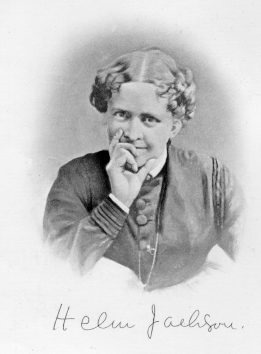
Hard to tell personality from a picture, but those eyes and the start of a smile make Jackson look like she’s about to dispute something or share a delicious secret.
That’s all but the most liked and listened to piece this spring, and I can tell you it was a run-away winner. Words from a famous poet or unknown one? Well, it’s sort of both. I’ll be back soon with that announcement.
*He laughed right after he said it, thinking it a fit pronouncement from the Department of Tautology Department.
Before we continue with our count-down of the most liked and listened to audio pieces this past spring, let me remind newcomers what the Parlando Project does. We take words (mostly other people’s, usually poetry) and perform them along with original music in various styles and sounds.
I really try to honor that intent for variety. My musical and singing limitations cannot be overcome just by intention—but the idea is to test limitations to see what will bend or break, not to treat them as barriers to be looked at from a safe distance off.
7. Water. One of our post series this spring I called “The Roots of Emily Dickinson.” I had the obligatory exposure to Dickinson during my education in the mid-20th century. My impression then was that she was treated as an approachable poet of the second rank. I think the shortness of her poems was part of that presumption of approachability, and that contributed to her subsidiary ranking too. And yes, the filter of gender stereotypes and prejudice had to be a factor. Common anthology poems like “Because I could not stop for death” added a little gothic touch to our genteel high-school textbooks, and in my college life she got a place in American lit, though much less in more general literature or poetry courses.
But when you dive into Dickinson deeply you may find that the modest surface level of a Dickinson poem, which seems a homey back-lot pond, is rather a deep and mysterious well, and that you’ll run out of breath long before you touch the bottom of some of her little poems. If you’re curious like me, you can’t help but wonder: “What did Emily Dickinson think she was doing?”
So, this spring I looked at some of her models, confidants, and influences, and chief among them must be Transcendentalism, the hard to pin down American movement centered in Dickinson’s own region and time whose instigator and leading prophet was Ralph Waldo Emerson. I had fun in my original post on “Emerson’s Water” by comparing Emerson’s fame and influence to Oprah Winfrey—but really, you’d have to add to Winfrey, Malcom Gladwell and the Dali Lama to get the range of Emerson’s influence.* I was going to add some Robert Bly in there too, but though Emerson wrote poetry and influenced poets up to and including Robert Frost and Wallace Stevens, Emerson’s own poetry was not even wholly esteemed by other Transcendentalists.
Emerson’s poem “Water” is still worth hearing, as many of you must have found here this spring. Back in The Sixties, when I first encountered the Transcendentalists’ story, I could see connections to the Hippie culture, and now in a generally more practical and materialist time I still see linkages. The Midwest had exceptionally widespread flooding issues this spring, and Emerson could have written “Water” this year to address that. What’s Emerson got to say about water? The player is below.
6. He Wishes for the Cloths of Heaven. William Butler Yeats is another familiar word-musician who supplies words to the Parlando Project. Perhaps I came closer to Yeats because I’ve ended up hanging around some Irish-American poets** once I moved to Minnesota, but if one is interested in musical sounding poetry in English, with things to consider beyond the inviting sound, eventually you’ll turn the corner and Yeats will be there.
The poem’s romantic closing lines are among several of Yeats’ that are well remembered by readers—memorability being one of the great tests of poetry. Hear those closing lines, for the first time or again, with the gadget below.
It was a classic battle of wills. The cat would not get up until Yeats agreed to get the cat food, and Yeats wouldn’t get the food until the cat got off his lap. Both were found and rescued in an emaciated state.***
5. May-Flower. From the roots present in Emerson, to the flower as expressed by Emily Dickinson herself, here’s the fifth most liked and listened to piece this spring.
Let’s return to the question of Dickinson’s intent. There some thought that this was written as merely a riddle-puzzle, that the reader was to guess the genus of the bloom from the clues in the poem. If that so, if that’s all, then it seems to me that Dickinson failed as a riddle-maker, as the clues don’t seem to determine the exact flower (and Dickinson, the avid botanist, would have had the knowledge to have done that). I decided to take her text and drill down to the mystical essentials she wrote of instead.
This is not the first time I’ve written of the psychedelic aspects of Dickinson. I can’t quite do the differential diagnosis on her eye problems (for which we know she needed medical attention) or decide on the theories that she may have had epilepsy or another disorder that could have caused auras and visual disturbances, but Dickinson often seems to be asking us to see differently, more intensely, as I believe she does here.
What kind of singular mind can toss this off as a riddle?
Hear my performance of “May-Flower” with the player.
*All of these pop-culture comparisons understate the influence Emerson seems to have had in American academic life, also largely centered in New England at the time, but I don’t think they understate that Emerson’s readership in America’s 19th century extended deeply into the general literate class.
**Perhaps the most directly connected to Irish culture of them would be Ethna McKiernan. A footnote is not an adequate way to draw attention to the news that she has a new book, but she does.
***This is a joke, and only this footnote is serious. And don’t link to yesterday’s post for your homework as a cite that Carl Sandburg taught O’Hara, Baraka, and Wilbur about the building trades.
It’s time for the seasonal tallying of the pieces presented here that received the most listens and likes from you during the past three months.
We presented 36 or 37 pieces in that time, including our increased posting activity during April’s National Poetry Month, but the most notable event for me during this interval was May, which became the most active month ever here for both blog visits and audio piece streams. I’m grateful that you’ve lent this effort some of your attention, and that goes double for any of you that helped spread the word about what we do here informally or through things like Facebook and Twitter.
As usual we’re going to follow the count-down format, moving from the 10th most popular piece as determined by your listens and likes and moving up to the most popular one.
10. Sweet Thames. It was a close finish with Charlotte Mew’s “The Trees are Down,” but one part of our ongoing annual April serial performance of “The Waste Land” made it into the Top Ten. “Sweet Thames,” the portion that kicks off that poem’s longest section “The Fire Sermon” was the part that made it, while the rest did not. Perhaps the listens/likes were lower because I warned our audience that “The Waste Land,” and particularly “The Fire Sermon” part of it, is not light entertainment, and things only got darker as “The Fire Sermon” continues after this. “Sweet Thames” may seem to have jaunty parts, particularly the catchy Mrs. Porter section near the end, but even that has dark undertones as it was sung by the ANZAC troops heading for the disastrous Gallipoli campaign in WWI.
I did like the music I composed and played for it though, mixing some buzzy synth lines with American delta-blues style slide guitar. Listen to it here:
You could think of Dr. Tearle’s 3 minutes of video here as the trailer if “The Waste Land” was a film. Definitely not a date movie then.
9. Smoke and Steel. Frequent visitors here know my love for Carl Sandburg, and the Sandburg piece that made our Spring Top 10 was a selection I took from the longer poem that is the title piece from his 1920 collection Smoke and Steel.
I found Sandburg’s extended metaphor of our working lives as smoke incredibly moving, something that a few of you must have agreed with. Musically, the toughest part was the piano part, the song’s musical hook. It’s not a complicated part, but I had to record it in two passes on my tiny plastic keyboard due to my naïve piano skills. Here’s the gadget to hear it.
Sandburg greets Richard Wilbur, Amiri Baraka, and Frank O’Hara at the start of a 20th century poetry symposium. “All poets must wear a hard hat and steel-toed boots before entering the typewriter area.”
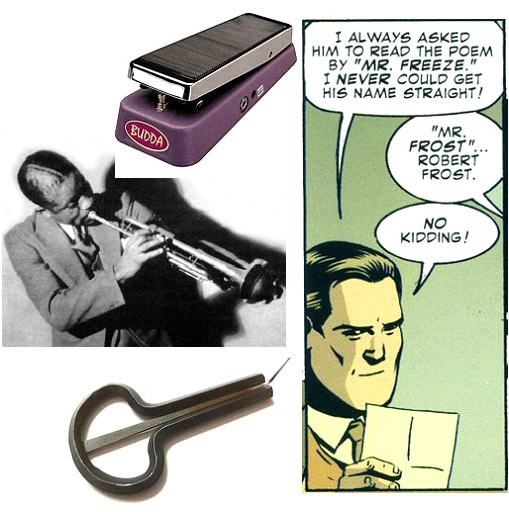
8. The Aim Was Song. Robert Frost’s ode to the genesis of poetry gave me an excuse to break out with an unapologetic electric lead-guitar song. The poem’s text talks about wind being shaped by the mouth, which may have clued me into using one of the oldest electric guitar effects devices: the wah-wah. The wah-wah is a foot-treadle pedal which when moved sweeps a frequency-band emphasis. The sweep of frequency seems to be changing the note as it sounds, like a jaw-harp or a horn plunger-mute. The player gadget for “The Aim Was Song” is below.
Wah-Wah Robert Frost
Next time we’ll continue the count-down with numbers 7 through 5.
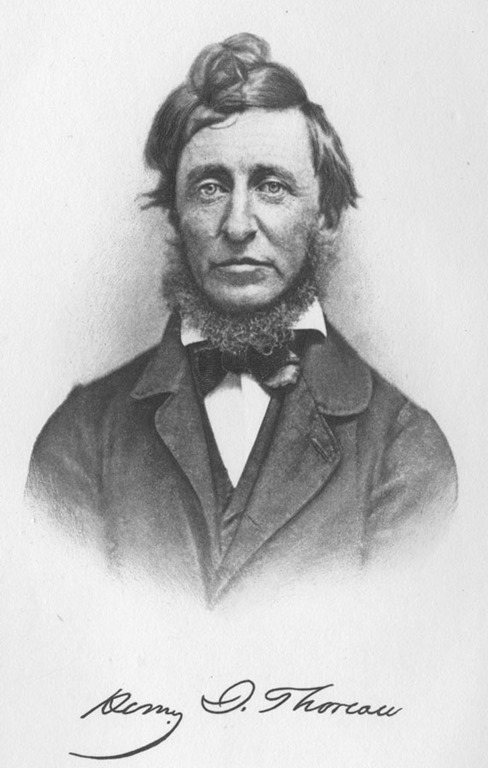
We’ve already heard from Claude McKay and Thomas Wentworth Higginson on the month of June, and now it’s time to turn to one of the foremost spirits of the mid-19th century American Transcendentalist movement, Henry David Thoreau.
Thoreau is well-known for being in the activist, live-the-ideals, wing of Transcendentalism, though readers here have been introduced to Thoreau’s contemporary Thomas Wentworth Higginson—more than a footnote in the Emily Dickinson story—who also spent considerable time living those ideals.
Collect the series: Unfortunate Hair Stylings of Important Personages
Thoreau and Transcendentalism’s major domo Ralph Waldo Emerson lived in the same town in Massachusetts, and one of the most striking things for me when I first visited that town, Concord, was to think that in a matter of a few blocks there lived Emerson, Thoreau, Hawthorne, Bronson and Louisa May Alcott—all in this place not that much larger than the small farming community I grew up in. What a town that must have been in those years!
Transcendentalism is a little hard to put a finger on exactly as a movement because it was interested in and had change-convictions about so many things. Higginson in his 1899 collection of memoir pieces Cheerful Yesterdays calls it “The Period of the Newness” and speaks of “The Sisterhood of Reforms.”
My current working-definition of Transcendentalism is it is the belief that there is a primary knowledge to be obtained from the deep study and meditation on the structures and methods of nature, as opposed to the accumulation of received and conventional truths about it. Thoreau the Transcendental activist helped to pioneer this, often writing about his direct experience of nature. His thought process also caused him to develop political ideals, including Civil Disobedience to unjust and violent government actions, famously inspiring Gandhi and Martin Luther King.
Thoreau didn’t just inspire Gandhi and King with his writing. The first story I ever heard of Thoreau recounted the tale of Ralph Waldo Emerson visiting Thoreau who had been jailed for refusing to pay taxes as a protest against the Mexican-American war and its support of slavery.
Henry, what are you doing in there?” Emerson asked across the jail door bars.
“Waldo, the question is, what are you doing out there?” Thoreau replied.
But here’s one lesser known thing about Thoreau, the deep naturalist, writer and political activist: he was also something of an engineer. Between writing and other activities, he was active in his father’s business, a small factory that made pencils. A chief problem at the time was the formulation of the graphite used in the “lead” for these indispensable writing instruments. Thoreau’s father’s pencils, like other American pencils at the time, used a too soft binder that led to a crumbling point and blurry line. Through study of European pencils (and one suspects a little lab time on his part) Henry David Thoreau, Transcendentalist writer, philosopher, and activist figured out a clay formulation to mix with the powdery graphite to produce a much better American pencil. Profits from the sale of these pencils and the underlying technology* were largely what supported Thoreau’s writing career.
Not to make too fine a point of it—and King and Gandhi might have found other inspiration, and Thoreau other funding—but the 20th century Afro-American civil rights movement and the independence of the Indian sub-continent owe something to a thing as prosaic as a better pencil design—monumental things that literally come from a feet of clay.
Today’s piece is a short meditation taken from an entry in Thoreau’s Journals for June 6th 1857. Adding to the above connection, when Thoreau was writing his nature observations in the field, he most likely was doing so using a pencil of his own design. Note too that at one point engineer-Thoreau talks of the revolution of thought connected to the revolution of the natural cycle of seasons as if they are the meshing of a gear train.
Handwriting as bad as mine! The page from Thoreau’s journal containing today’s text.
Written as prose, it has a flow that I could find to recite and accompany it with music. The piece’s chordal part I played on an electric 12-string guitar recorded in the manner Roger McGuinn and the engineers on The Byrds recordings devised in the Sixties. Instead of the John Coltrane-inspired lead 12-string melodic line of something like “Eight Miles High” I played an acoustic guitar with an E-Bow, a magnetic invention that drives a guitar string to vibrate and produce a flute-like sound. As I read a little about Thoreau this week, I came upon the information that he was also an avid flute player, so it seems appropriate.
The player gadget is below. My apologies for being away from this blog and blog activities so far in June—you know, life and things.
As promised, here’s a love poem, one written by Claude McKay the Jamaican-born poet and writer who worked for many years in the United States. McKay sort of bridges the gap between Paul Laurence Dunbar and the Harlem Renaissance for Afro-American poets.
Like Dunbar, Fenton Johnson and Anne Spencer, his poetry was written early enough to be included in James Weldon Johnson’s pioneering 1922 The Book of American Negro Poetry. Like Dunbar, McKay could write a smooth metrical/rhymed poem in the 19th century style, but like Fenton Johnson he often set his poems in distinctly urban settings: the northern U. S. cities that were the terminus of the Great Migration of southern Afro-Americans during the 20th century. Alas, also like Fenton Johnson and Anne Spencer, his published poetic work seems to have fallen off by the late 20s, though McKay’s prose career continued throughout the 30s.
Claude McKay
One of the poems James Weldon Johnson included in his anthology continues to be one of McKay’s best known, his sonnet “If We Must Die,” a passionate ode to desperate self-defense that doesn’t once specifically mention the white race-riots, lynching and other terrorism that was a cardinal problem for the civil rights movement between the abandonment of Reconstruction and the middle of the 20th century. I find this an interesting choice on McKay’s part. I’m certain many readers of “If We Must Die” understood in McKay’s time exactly what he was writing about, even to the specifics of it down to names, places and horrific details. But that’s not in the poem itself, unless you count the “O kinsman” address in the 9th line and the external knowledge of who that might be defined via McKay’s skin color. Is McKay’s choice intentional? By omitting his race and context, which his readership largely knew anyway, he’s saying self-defense isn’t a thing to be granted to or earned for Afro-Americans somehow, but a fundamental human right to be self-asserted. McKay had many other poems in which race is mentioned after all—makes it seem all the more to be a choice.
By choosing to state this universally, “If We Must Die” has even engendered an unverified factoid that Winston Churchill quoted this poem in a speech during the most desperate days of WWII—but all that is in war and ugly violence, and I promised you a love poem, and “Memory of June” is that—though it has one somewhat ambiguous phrase that might make it part of a struggle.
Here’s the text of McKay’s “Memory of June:”
Did you spot it? You should know I’m not about testing you; you are to only score yourself here. I didn’t see it the first time I read it either. Do you think it’s the phrase “your brown burning body” celebrating mutual Afro-American love and desire? Well this is poetry, a pleasure, not bomb-defusal, feel free to hold for that. It is a pretty poem, a romantic one, isn’t it?
The subtle, ambiguous line I eventually noticed is earlier: “For one night only we were wed.” McKay is now widely assumed to have been gay, though he never “came out” and nothing I’ve read so far tells me why this is now assumed as known.*
Let’s assume this is so. It is also safe to assume that few readers of the poem when it was first published in 1920 knew this, other than those in McKay’s intimate circle. Now the course of love is complex. Many nights of love are singular for many reasons. And Afro-American couples accrue special challenges. But McKay chose “wed,” the thing that gay couples were officially denied until late in my lifetime.
McKay might well be using the same tactical move as he used in “If We Must Die” in a different context, one where a then more secretive circle would read this poem differently from the common reader.
So here we are in June, a traditional month for weddings and also gay Pride month, and I present Claude McKay’s “Memory of June,” a love poem, not another poem about war or violence. Except love isn’t simple, and good love poems aren’t.
The player to hear my performance is below for many. Don’t see it? This highlighted hyperlink is an alternative way to play it.
*This sort of ex-post-facto outing without a diary, journal or other unpublished manuscript that would be easily cited if it existed often comes from gossip or oral history—two names for what is largely the same thing, but gay history has fewer paper records to rely on. So, evaluating that isn’t simple, and McKay isn’t notable enough for this to be something I can find quickly.
Here’s another post in our informal series “The Roots of Emily Dickinson.” Now a title like that may lead some to think I’m some sort of Dickinson scholar—which would be a fine thing to be, but I’m not. Frankly, when I started this project a few years back I assumed I’d present some Emily Dickinson poems. After all, not only do they famously fit well to music, but she was part of the poetry canon that I was raised on. Then something unexpected happened.
When I started to dig into Dickinson poems they grew mysterious, not just the elusive mystery of their intent or even their true subject, but the somewhat more external mystery of how they came to be written in the mid-19th century in a town in rural Massachusetts without any sure models for Dickinson’s new kind of poetry.
We know how many other writers assembled their machines and what fueled them. Shakespeare and Bob Dylan worked within successful entertainment enterprises, even if they were to reshape them. T. S. Eliot had a scholar’s interest in a wide range of art and spirituality across history, and after the trauma of WWI a significant part of the culture was waiting for someone to reassemble it however dolefully, even if it was in his Cubist collage. The Surrealists were crystal-clear about their influences and the impact of Freud and psychoanalysis. The G.I. Bill after WWII and the following post-war American prosperity introduced large numbers to colleges and college towns, including some who would likely not have attended before the war. This fueled not only the Beats, but the more academic-associated American poets of my youth. The 20th Century urban migration of Afro-Americans and the Talented Tenth tactics of the early 20th century U.S. Civil Rights movement encouraged the Harlem Renaissance and similar artists.
Emily Dickinson? It’s just not so clear to me. My best guess remains that she was a Transcendentalist of some sort in a household dominated by a father that wasn’t. Transcendentalism, staunchly individualist in it’s outlook has no mandatory dogma, but the sense that the intense, even visionary study of nature reveals the deepest spiritual truths seem to me to be its core. Received truths, any established customs and traditions, are to fall before this apprehension.
However individualist in philosophy, the Transcendentalists and the Boston publishing and cultural nexus were intimately connected socially in a way that Dickinson was not.
One incident, often judged as a quasi-accident* closed this circuit. In 1862 as the 31-year-old Dickinson had begun her extraordinary five years or so of white-hot poetic composition, she wrote Thomas Wentworth Higginson and enclosed a few of her poems. A string of correspondence ensues, and eventually the two met in person.
Dickinson’s letter is conventionally seen as a “cold call” prompted by Higginson writing a magazine article in The Atlantic “A Letter to a Young Contributor.” That article is largely unremarkable if sensible, the subject one that is covered over and over wherever there are editors who accept written submissions. Submit clean, legible copy. Re-writing is as important as writing. Remember your audience and take pity on them. Hey, the editor is on your side—they, like the writer, want to produce good work.
And here we come to the next beat in the story as it’s usually told. Higginson is often portrayed as something of a doofus, the archetypal mansplainer who can’t understand Dickinson’s greatness. He suggests Dickinson write more conventionally and doesn’t think her work is suitable for publication. Presented with one of the founding geniuses of Modern poetry, he’s blind and hesitant.
Is that so? Well, there’s a lot we don’t know. First, we only have letters from Dickinson’s side of the correspondence. I’ve delayed this post so that I could at least read some of Higginson’s writing on other contemporaries of his and Dickinson, and one thing stands out from his later 19th century accounts of his life and times: he’s the soul of discretion (obscuring names for embarrassing incidents), generous even to his opponents, and extraordinarily hesitant in claiming credit for any of the things he may have been instrumental in. As an editor and literary critic, he seems to have a fairly good and objective eye, and he does not shy from pointing out shortcomings in writers he admires. I read his essay on Emerson written shortly after Emerson’s death, and his admiration for the man and his intellect does not keep him from agreeing with judgements about the faults of Emerson’s poetry. It therefore seems likely he could have suggested changes to Dickinson in his correspondence.
How artistically wrong would those suggestions have been? How harmful might they have been to the isolated Dickinson? Even if he was “wrong” could he have been tactically right about what mid-19th century audiences would tolerate? Here we don’t know the devilish details, but we know some things otherwise: Dickinson wrote most of her nearly two thousand revolutionary highly condensed poems as this correspondence was initiated. If Higginson squelched her or convinced her to temper her individuality, he must have been bad at it. If, on the other hand, what he said encouraged and kept her going, that would be consistent with what occurred.
Here’s something else we know objectively: in 1890 he was instrumental in getting Dickinson’s posthumous-published-career off the ground.** He did not prevent and may have agreed with the conventionalizing of Dickinson’s punctuation, adding of titles to title-less poems, and so on—but historically those editions sold well right from the start and gained Dickinson a reading public. He added his prestige to the launch with the book’s introduction where he framed her (not yet knowing how well Dickinson would sell) as a sort of art brut phenomenon:
“In many cases these verses will seem to the reader like poetry torn up by the roots, with rain and dew and earth still clinging to them, giving a freshness and a fragrance not otherwise to be conveyed.”
This may be false, even if it’s an accurate advertisement for the impact reading Dickinson for the first time may have on a reader. Yes, Dickinson was likely a more conscious and careful artist than this impression leaves us with. But it worked! Remember, there was no Dickinson tradition to be misinterpreted when he did this. To a large degree, the reason we have an on-going debate about Dickinson that more than a handful of graduate students and eccentrics like me care about is because of his work in insuring that original edition.
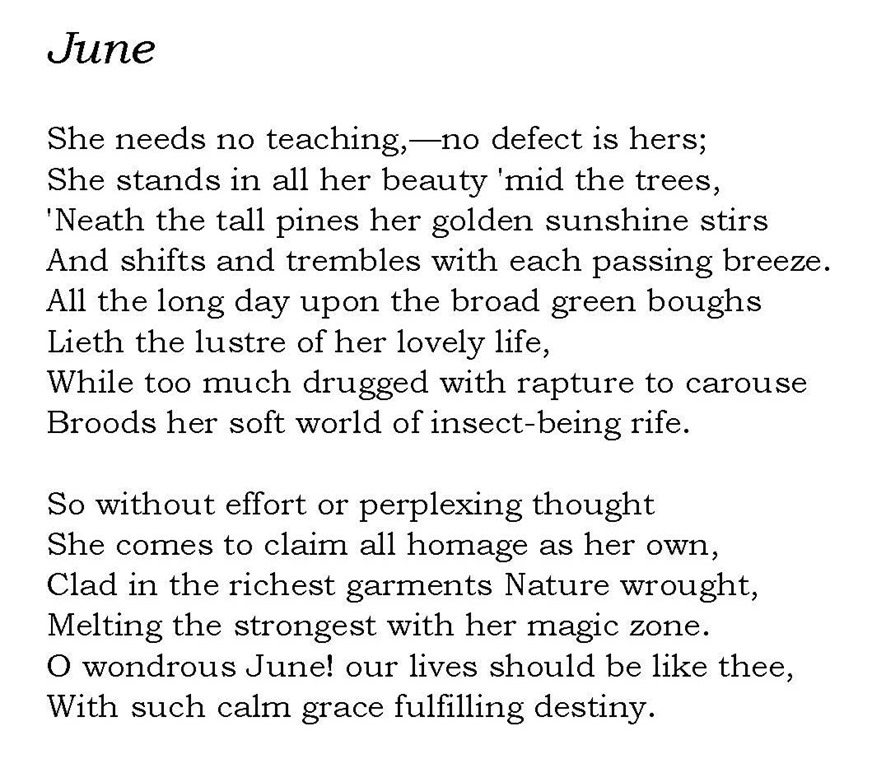
Now for a surprise. I did not know that Higginson had written poetry until I came upon this poem by accident while looking for June poems. I can find nothing about it, but in the absence of knowledge I’ll speculate it might be from Higginson’s college-age youth. Here it is:
I may be full of perplexing thought even if this June day isn’t
It’s a graceful sonnet. I’m not in love with the slightly over-egged consonance of the “Lieth the lustre of her lovely life” line, but I’d suspect other readers would point it out with appreciation. On the other hand, the vowels of the preceding line “All the long day upon the broad green boughs” are pleasing to me. And the poem’s fine opening line, referring to June’s summer overture, “She needs no teaching,—no defect is hers” is hard for me to not read, whenever it was written, as the proper way to approach Emily Dickinson’s genius. The ending of the octet “While too much drugged with rapture to carouse/Broods her soft world of insect-being rife” is a truly strange one, half awkward “poetic diction” perhaps necessary to make the rhyme, and half a striking William Burroughs a-century-too-early image of June on the narcotic nod as summer’s insect-being is partly suppressed for the moment.
The sestet is not as distinctive, and I wonder if “zone” was chosen for its rhyme rather than being the best word at the end of the 12th line, but overall more interesting than most 19th century American sonnets. In his “Young Contributor” article Higginson sagely notes that duality of the critic who’ll offer criticism when they themselves are not accomplished in the arts they criticize. “People criticize higher than they attain” he says.
After all that, here’s Thomas Wentworth Higginson’s sonnet “June” and my performance of it. The player gadget to hear it is below.
*The writer of the standard Dickinson biography Richard Sewell believed that regular Atlantic reader Emily Dickinson was attracted to Higginson’s nature articles which he’d published in The Atlantic prior to the “Young Contributor.” Early Dickinson biographer Genevieve Taggard speculates that George Gould (which she identifies as Dickinson’s ex-fiancé) may have suggested Dickinson write Higginson.
**I’m still underinformed on all the details of how we got to the 1890 publication of the first large batch of Dickinson poems. Originally, Dickinson’s sister looked to Sister-in-Law and intimate friend Susan Gilbert Dickinson to shepherd the publication. Susan Dickinson said (after the successful Higginson-introduced 1890 edition) that she had a big idea for presenting Dickinson in a fuller way from the start, but the project didn’t seem to get off the ground in the mind of Dickinson’s sister who was legally the rights holder. In an example of the multivalent family dynamics of the Dickinson family, the mistress of Susan Gilbert Dickinson’s husband (Emily’s brother, Austin) Mabel Todd Loomis, was then brought in as well as Higginson to edit and arrange for the first publication of Emily Dickinson’s work. Where Higginson comes in within this series of connections and who selected who, I don’t know, but seeing the book to completion and getting it published and launched with notice and eventual surprising sales has to be presumed to be largely Higginson’s work. He was the man with the connections, track record and prestige after all.