A Mien to Move a Queen

Ready to go on a roundabout trip with today’s blog post? Keep your hands inside the car, we’re going somewhere back to here on another wild-mouse ride.

A couple of things the foot-square vinyl LPs of my youth afforded us: liner notes to help guide us in appreciation of the grooves within, and more commonly as The Sixties progressed, lyric sheets.

Not every record had those lyric sheets. Some artists opposed them on principle—Bob Dylan was one—though to a large degree the reason we got them was due to that hold-out, Mr. Dylan. Dylan revolutionized song lyrics. Before Bob Dylan, no one wrote songs with lyrics like he did.*  After Dylan, a lot of everyones tried their hand at it. In the 21st century when we hear or see lyrics that use an accretion of rapidly changing metaphors and a kaleidoscope of dark-cylinder mental outlooks, we no longer notice that they are Dylanesque. It’s just a mode that songwriters can draw from the common.

Would that have happened if Dylan hadn’t happened? Possibly. And plausibly, only similarly, but distinctly different. Would Richard Farina (sans motorcycle accident) or Leonard Cohen have won a Nobel prize for reshaping a word form?

One argument that it would have still happened was the psychedelic phase of pop music that followed Dylan’s revolution. There, later in The Sixties, opaque and strange lyrics got another push, one that was largely ascribed to intoxicating chemicals which produced visual sequalae and baroque mental turns. Now of course the intoxicated or drug altered poet was already a thing in literary poetry, and the sober cold-water-army songwriter was likely a minority long before “The Sixties.” But Dylan had punctured the membrane that separated those two crowds, and so we got the Canyons of Your Mind school of songwriting too.

Cold Water Army

19th century straight-edge punks on dihydrogen monoxide, usually also anti-slavery and pro-women’s rights too. Comes with a lyric sheet!

Some of it was good, some of it bad—but then we might see lyric sheets to the wind like these:

Oh where are you now
Pussy willow that smiled on this leaf?
When I was alone
You promised the stone
From your heart….
Brandish her wand
With a feathery tongue

Or

A mien to move a queen
Half child—half heroine
An Orleans in the eye
That puts its manner by
For humbler company
When none are near
Even a tear
Its frequent visitor

Or

If you were a bird and lived very high
You leaned on the wind as the breeze came by
Say to the wind as it took you away
“That’s where I wanted to go today”

And

Bedouin tribes ascending
From the egg into the flower
Alpha information sending
States within the heaven shower
From disciples, the unending
Subtleties of river power

The chorus sings: “OK Boomer,” and you can ascribe all of these to chemical traces, wonder about their authors consequent mental damage, or coldly appreciate them as word music, but I’ll come at you from a minority report: the trip’s in your head, not in the drug. I gave up stuff you can smoke (mostly nicotine) around the time I passed the trustworthy border age of 30. I never spun the pill roulette wheel. Needles are for records or loose buttons.

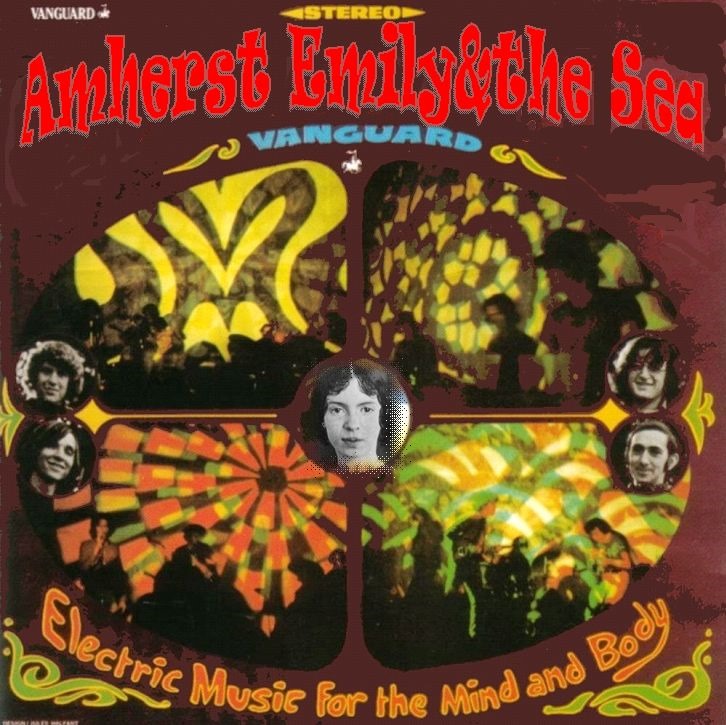
Next stop for the psychedelic bus is some credit for those lyrics above. The first is from Syd Barrett’s post-Pink Floyd song “Dark Globe.”  The second is the beginning of an arresting if mysterious poem by Emily Dickinson. The third is by children’s writer, humorist, and WWI vet A. A. Milne quoted by songwriter Paul Kantner to begin the Jefferson Airplane’s “Ballad of You and Me and Pooneil.”  And the fourth is the start of “Slip Inside this House”  from the 13th Floor Elevators’ Tommy Hall and Roky Erickson.

A little day glo paint or patchouli and Emily Dickinson fits right in when she writes in this mode I think, even if she’s a century too soon, “The Eighteen-The-Sixties.” When I ran into that first stanza of her 1861 poem known by it’s first line “A Mien to Move a Queen”  earlier this month, I was immediately captured by its strange mystery, so much so that I worked out the music you hear today without even knowing that the poem was longer than that one stanza, and I was so entranced by it that the piece you hear today uses only the first and last parts of her poem because I think the middle parts break the mood that first stanza gave me. Want to see the entire poem? The link is here.

The omitted middle section seems playful to me—even as the British would say, twee, but I am of course editing a genius here. I still like my selection as I hope it adds some weight to the whimsey. What was Dickinson on about in this poem? Even living with it for a few days, I’m not entirely sure. The opening stanza is often read as connecting to Joan of Arc. Some read the poem as Emily reflecting on herself and constructing her own persona, and the middle section I omitted gives some evidence of that. Beside it’s general mysteriousness, there are to my mind two pieces of particular heightened sensitivity or even hallucinogenic imagery: the “Orleans in the Eye” line and the sensuous and heard quiet of the “Like Let of Snow” image.

So, we started with musty cardboard squares and moved through two steps of an era of wilder and wilder metaphors sung to music, and finished with Emily Dickinson, sewing 1861 fascicles by whale oil light while listening to Syd Barrett or A. A. Milne feedback on her record player long into the night. In between songs, the needle stops shimmying and she can hear the sound of snow moving across snow outside, filling, and not, summer’s empty room.

The player to hear my musical performance of a selection from Emily Dickinson’s “A Mien to Move a Queen”  is below. Thanks for reading and listening!


*Yes there are examples that made it into popular or semi-popular music pre-Dylan. Modernist poetry had already done all of these things earlier in the century, and  in addition, a big part of what Dylan used in creating his work were the un-acknowledged Modernists who created the Afro-American blues. None of that disproves the point that Bob Dylan showed that you could do that sort of thing in a proximate way that led to a revolution in the possibilities of song lyrics.

The Workman’s Dream

Well, here’s an odd choice for a new Parlando Project audio piece: today’s song has lyrics from British-American poet Edgar Guest. It’s likely that you either know who Edgar Guest is, or you don’t. And if you do, you may be older than me, which is a rapidly declining Internet demographic, as most providers refuse to offer service across the river Lethe.*

Famous American wit Dorothy Parker wanted to help you remember—sort of—Wikipedia reminds us that she once poetically needled him: “I’d rather flunk my Wasserman test than read a poem by Edgar Guest.” But now, folks may not remember Wasserman tests either. Wit has a short shelf-life I guess.

Edgar Guest was a public poet in a way that is unimaginable today. He had a newspaper column, a nationwide radio show; and ordinary, non-academic folks clipped and memorized his poetry in the first half of the 20th century. What did academic folks think of his poetry? Well, Parker nailed it.

Edgar Guest rocks the mic

Radio. It was a kind of wireless podcasting useful before YouTube.


His poetry is often folk-humor related, and his style isn’t always very elegant: doggerel. But unlike poets whose work is always with humorous intent, some Guest poems, like today’s, are meant to make a serious point, often in a sentimental way. While there’s no common objective criteria for “good poetry” it’s still safe to say that almost anyone who would have some criteria to evaluate poetry would agree that Guest wrote bad poetry—or at best, not very good poetry.

So, what am I doing, following up some posts featuring a poet like Yeats, who has both a popular audience and a rightful place as one of the most graceful lyric poets in the English language, with Edgar Guest?   Well, it’s my opinion that “bad poetry” or poetry that has intents and methods that are not in alignment with academic critical modes, may still have some value, some reason to exist. I don’t think this is a common belief, which is somewhat odd. While there are elements of theoretical snobbery in other arts, fans of serious novels may still like a quick plebian mystery series, cinephiles may enjoy an occasional piece of mass entertainment, jazz purists or avant garde composers may have surprisingly impure playlists—but serious poetry authorities tend to view not-great poetry as a Gresham’s law issue for their endangered art form.

I went looking for a Father’s Day text in the public domain and came upon this one. What struck me about it? Well, you and I may agree it’s sentimental, but it wears its working-class heart on its blue-color sleeve. Better Modernist poems have been written on this poem’s subject (Hayden, “Those Winter Sundays”  for one)— but most of those are not available for my use today. And it’s not like poems about the world of work are all that common in Modernist lit. Instead, there are many poems about domestic life, lots about the human condition in general, erotic poems of love, visionary texts about the psychic borderlands, poems of scenic trips and museum pieces, poems about parenthood in its physical intimacy, and poems about economic and political injustice—but even the later are often absent the actual world and obligations of work.

Isn’t that odd? It’s as if poets are embarrassed to give evidence of their “day gigs.” Do we secretly expect that we are all still Lord Byron, with an inherited endowment? If we are any good should we be swinging from grant to grant, or have agents digging up the biggest returns as if we were rim protectors who can create our own shot while being a threat to sink the three from anywhere outside the arc? If we are serious, should we be beyond all that non-artistic, non-academic work?

Perhaps there are other reasons for this relative absence of the subject of ordinary work—and there are exceptions  in modern poetry—but even if we were to become one of those making a living with our pen or our mental flights alone, somewhere in our heritage we may have someone like the subject of Guest’s poem. I know I do. And from my age, from my era, I’ve even had the experience of being “the breadwinner” more than once in my life, the one working in a household and bringing in the outside income, while others do unpaid work.

This is no longer a gendered situation in our culture, but in my father’s generation this was the father’s prime job: the  job. Maybe for you this was another generation or even two generations back—we may have had forefathers. A lot of you had two parents doing “the job” (and yes, the unequal, unpaid woman’s work too) or one parent doing it all, or the most of the all.

That said, “It’s Father’s Day and everybody’s wounded.”**  This one goes out to those who didn’t get the service ribbons or the purple heart, who clocked in so we could write about time. In my case, they’re all gone now, but as Guest writes, I’ll sing “Out of this place of dirt and dust.”

The Workmans Dream

In the Broadside tradition, here are my chords for the song version I composed. I played it with a capo at the 1st fret, so the recording is in F minor. My piano, vibraphone and cello parts are simple: fifths, octaves and roots.

The player to hear my performance of the song is below.


*They say it has something to do with dog attacks on their installers, three-headed dogs at that.

**Leonard Cohen. For six minutes of REM performing “First We Take Manhattan”  see this link.

Government

Here’s the other pole of Carl Sandburg, a prose-poem about the nature of government. It seems so far from the tight compressed Imagism of “Gargoyle”  that one might wonder how it could be from the same poet. I may have a clue there, so read on, I’ll return to that thought.

But first let me note that Carl Sandburg had some unique experience to bring to this subject. This poem comes from his landmark Chicago Poems  published in 1916, a collection that both established his bonafides as a Modernist poet and as a foundational writer of American proletarian poetry. But before that he’d been a first generation immigrant,* a Spanish-American War soldier, a college dropout from a no-where college, and an itinerant worker. In the first decade of the century, as he turned 30, he was working as a daily paper journalist as he began a period of political activism in Wisconsin as a Socialist party organizer. In 1910, the city of Milwaukee elected a Socialist mayor, and Carl Sandburg took a position in his city administration. He was a self-proclaimed idealist as well as an aspiring poet. In his new job in government he was ready to—well, let me quote how he remembered itin an interview in 1953:

We were to build in Milwaukee the kind of planned city which existed in some places in Germany and in other European cities where socialism had taken hold….Then came the jarred awakening. Hordes of job-seeking Socialists descended on our office wanting the crumbs of victory. They behaved just like the Republicans and the Democrats on that day when they swept into power. This was not idealism; it was the old spoils game.”

In another account he said that his first official act in the new administration was to handle a citizen’s complaint about a dead dog in an alleyway.

Socialist Chickens!

Antifa infiltrator introduces Socialist chickens to Wauwatosa.  Sandburg admirer Bob Dylan was more of a milk and cheese man.


After two years in government, Sandburg kept with poetry but went back to Chicago and to getting his paycheck from the Fourth Estate. Thanks to Ben Hecht, a fellow Chicago newspaperman, we can sense what being a newspaper reporter in Sandburg’s Chicago era might have been like. Hecht’s play The Front Page  has been made into a movie three times, with most favoring the middle version, His Girl Friday,  as cinema, but the original 1931 version is most faithful to the original play and era.**

Sandburg’s “Government”  may not be one of his greatest poems, but I’ve maintained that poetry (like other arts) can serve us even when it’s not some sublime act. You’ve heard me maintain that Sandburg has poems that deserve to be considered in that sublime class, but this one shows us something too.

So now that we’ve detoured in the non-aesthetic realm of politics, let me come back to that thought, however unformed, that I have about the compressed Imagist Sandburg, the one we forget or underestimate, the poet who has poems that can stand with the other Modernists in concrete and incised compression. In “Government”  Sandburg, though in a prose-y and less concise manner than the Imagist Sandburg, shows government in its evil and corruption is us, human us.  It seems an institution as we speak of it in tired language that poets must avoid and repair, an external thing, like a building or statue put up long before our time—or if living, a monster from the other. However impure, however damaged, our republic is; however unclean our language is; however dull, ignorant, insufficient our thoughts are; we are the blunt weapon that damaged it, we are the only tool to repair it. Blunt tools break, sharp tools repair.

Here’s my performance of Carl Sandburg’s “Government”  available with a player gadget below.


*I grew up in a small Iowa farm town with substantial Swedish heritage. In my half of the 20th century I believe I may have underestimated the impact that Sandburg’s parents were immigrants, or that parts of WASP culture may have noticed this about Sandburg more than you or I might think. Last year when reading more about another under-considered Midwestern Modernist Edgar Lee Masters who crossed paths with Sandburg in Chicago, I was struck at how often Masters referred to Sandburg as a Swede/poet in a context that I believe was meant to be read as a natural incongruity, that such a coarse background could be associated with the athenaeum of poetry.

**Footnote fans, be prepared for a wild mouse of a ride in this one. In The Front Page  remember how the corrupt mayor is indebted to “the black vote.” In 1915, the black vote was largely Republican, and the Chicago mayor that year was William Hale Thompson, a character that could give our 21st century President a run for his money. He survived WWI politically despite being pro-German and reflexively anti-English, and with a drain-the-swamp campaign that was working to make sure the money sump-pump went toward his pockets. He was finally voted out of office by the campaign of Anton Cermak, the most important mayor in the history of Chicago. In that campaign, Wikipedia quotes Thompson as Tweeting (well, I guess not, it’s 1931 after all—but the flavor sure sounds reminiscent of our contemporary) “I won’t take a back seat to that bohunk, Chairmock, Chermack, or whatever his name is. Tony, Tony, where’s your pushcart at? Can you picture a World’s Fair mayor with a name like that?”

So, what’d Cermak do that was so important? In 1933 Cermak took a fatal assassin’s bullet that could have hit the U. S. President-elect Franklin Roosevelt standing next to him. Regardless of who took what bribe from who, or who did a better job of expired canine disposal, or even weighed against the epic odyssey of the Afro-American migration to urban centers, the death of Franklin Roosevelt in 1933 would have likely changed America and the world’s history immensely.

By way of footnote dénouement, I’ll note that Cermak’s son-in-law Otto Kerner chaired the commission that was charged with evaluating the urban riots of The Sixties. Read this linked article for a sense of what was said then, and then consider Sandburg’s words in his great poem I Am the People, the Mob:”  “When I, the People, learn to remember, when I, the People, use the lessons of yesterday and no longer forget who robbed me last year, who played me for a fool—then there will be no speaker in all the world say the name: ‘The People,’ with any fleck of a sneer in his voice or any far-off smile of derision.”

Gargoyle

I said last time that the Midwestern American poet Carl Sandburg is not often thought of as an Imagist when we recount the Modernist revolution in poetry. Indeed, I get the impression that his work as a whole is summarized as folksy/clumsy by academia, the efforts of a low-fi Modernist with middlebrow pretensions to real artistic innovation.

I wonder if some of this is an unexamined hold-over from the High Modernists who made a cult of academic culture and credentials in the mid-20th century. Sandburg certainly intended to be a Modernist and wrote thoroughgoing Imagist poems. And yes, he can present himself in a friendly, non-pretentious way in some of his poetry. T. S. Eliot or Ezra Pound rarely seem to welcome in the casual reader, Wallace Stevens or William Carlos Williams may puzzle us on first encounter. Amy Lowell will let us know this is salon-worthy art. E. E. Cummings may charm us in a playful way while still remaining elusive. Marianne Moore likes the seemingly earnest statement, but when I try to absorb an entire poem I’m often at sixes and sevens.

Sandburg can seem a bit too straightforward. Which he’s not, or at least not always. Williams can have his red wheelbarrows and plums, Pound his wet petal Metro pedestrians, and we understand this is willful simplicity in the context of their more elaborated work. Poor Sandburg. He’s misunderstood for being thought understood. Understood too quickly  perhaps.

Here’s an example of a poem that hardly seems like Sandburg at all. If I presented it, unattributed, as translated from the French it might seem Surrealist, but it was published in 1917 before Surrealism was a movement. Even at the time I was performing it, I had only been able to absorb it as a sensation, and I’m not sure yet if I could paraphrase it even now. Here’s the link to the poem’s text if you’d like to follow along. It seems to be a poem about violence and strife, about suffering and infliction of suffering. Is the poem’s gargoyle war, Moloch, capitalism, the demonized exploited, or the demon exploiter?

Is it possible that Sandburg intended this ambiguity? The sensation of this poem is so strong, yet it doesn’t seem easy to solve into a one-to-one allegory. One could use Orwell’s famous decades-later statement as a gloss on this poem:

If you want a vision of the future, imagine a boot stamping on a human face—forever.”

Two things ground this poem, and Imagism wanted to be grounded, not intellectually abstract. First is the gargoyle, which was a commonplace building ornament in Sandburg’s Chicago, secondary to the beau arts style popularized by the 1893 Worlds Fair there and to the widespread availability of immigrant stone carvers in the city. Gargoyles are ugly and often open-mouthed,* as this poem’s gargoyle is.

But Sandburg’s poem subject is metal, which is not impossible—there are cast metal gargoyles. I’m no expert on metalwork trades, but the actions described in the poem sound like hot metal riveting. Is the “gargoyle” some metal construction which is having red hot molten rivets being pounded into holes one after another?


A riveting video? Maybe not for everyone, but a few minutes of watching will show how a four-person team works together in hot metal riveting


Or is this poem’s subject a child’s nightmare? After all, twice Sandburg wants us to know a child could visualize this.

So, an elusive work, but the horror certainly comes through. My performance is straightforward, just acoustic guitar and bass. Sort of a folk song, if the kind of folks you hang around with like Michael Hurley. The player is below.


*They are sometimes functional downspouts, designed not just as ornament, but as a way to direct roof rain water away from the building and it’s foundation. Gargoyle as a word is derived from the French for gullet, or throat.

Emily Dickinson: Forever and Crumbling

Today Emily Dickinson is going to show us how not to write a poem—and how to make it work anyway.

This piece combines two different poems she wrote: “Forever—is composed of Nows”  and “Crumbling is not an instant’s Act”  in a way that I hope lets each poem reflect on each other. Both speak about time and the universe’s track along it, and that’s part of Dickinson’s substantial task as the poet here: these things are abstract. The Modernist experiment, which Dickinson in many ways presages, would generally try to represent even the most abstract, contradictory, and elusive things as images, palpable things. When that tactic works, it lets us find a shape, a sensual feeling, a weight and color to things we otherwise cannot behold.

Dickenson can  do that. Forgotten Imagist Carl Sandburg* even called her an Imagist, just as Imagism’s call to Modernism was emerging a few decades after Dickinson’s death and posthumous publication. But here, in these poems, she predominantly avoids that tactic.

I can think of a few reasons she might do what she does in these poems. If you’d like to follow along, here are links to the text of  “Forever..”  and to “Crumbling…”

First, she received a science education. This may seem odd, even though some time back we learned that Percy Bysshe Shelley, the uber-romantic poet knew how to calculate the distance between the Sun and the Earth, but Emily Dickinson was a woman as well as a poet in Shelley’s 19th century. Science? My 21st century child goes to a high school with a substantial STEM program. “It’s all guys, and they act like it too” is the report about the Engineering class here in 2020. But in Emily’s New England, science, the humble mechanics of the universe, was actually considered a safe subject for the hampered female brain. Politics, theology, fine arts would all be fields walled off from women anyway, but they were also considered inappropriate for the lady-brain.

The second is that she grew up in a household steeped in the legal profession. Her father, her grandfather, and her brother were all prominent lawyers. Though I’m not a full-fledged Dickinson scholar by a long-ways, I’m not aware that this substantial fact is much discussed as potentially formative in how Dickinson saw and thought about things. Yet, here by her poetry we can see that she was possessed of a mighty intellectual engine, one whose genetic blueprints and environment would be tailored to express things as lawyers might: in sharply defined abstract legalities.

Lastly, 19th century poetry was comfortable with abstraction of the sort she exhibits here, though few could match her compression of expression. We still use much abstract rhetoric in general discussion, but our poets generally recognize the danger of taking the specific vividness out of verse.

In the first piece of our dual Dickinson presentation today, she makes a statement about the nature of time: that it cannot be experienced relatively other than as an infinite series of nows. She cannot find a physical image for this, and so uses abstract scientific and legal language to describe this mystery: “Composed…Infiniteness…latitude…remove…dates…dissolve…exhale,” and the near-enough Latin of “Anno Dominies.” This, the language of a contract or scientific paper. That said, a phrase like “Years—exhale in Years” is palpable.

The second piece, “Crumbling is not an instant’s Act,”  could be read as a tiny summary lecture on entropy. In the middle stanza of this three-stanza poem (‘Tis first a Cobweb on the Soul…An Elemental Rust,”) Dickinson moves from abstract summary to imagery, but even here, her knowledge of botany, both empirical and academic, is deployed. “Cuticle” is not some chat over a manicure—it’s a distinct feature of plants. “Borers” and “rust” likewise would be familiar to Emily as the dedicated gardener of the Dickinson household.

Cucticle-Herbarium-Clausius

Emily Dickinson, science nerd:. Hosta’s cuticle protects it from dust, Dickinson’s self-made herbarium scientifically categorized a host of plants, and Rudolf Clausius considers entropy and whether to grow a mustache or not


The concept of entropy was only first posited in 1850, and I don’t know if Dickinson had any access to discussions of what would have been a fresh scientific concept. Some read “Crumbling is not an instant’s act”  as a reaction to medical or psychological issues Dickinson was personally facing rather than musings on the formal structure of ruin and the universe’s law of return to equilibrium. That reading works too. This old guy may not study thermodynamics, but I can personally recognize the states in this poem without measuring instruments or a blackboard of equations.

If you or I were to try to write either of these poems, we’d risk failure. Our abstractions might seem enervated, while the compressed energy of Emily Dickinson carries me through her argument, even where one cannot follow its intellectual thrust easily. In the middle of these abstract arguments, in the second stanza of each three-stanza poem, Dickinson lets in enough imagery to pull us in.

It may seem odd, now, in this month, as the nation stands at a crossroads to present these two poems today. Frankly, as I looked for any poem in the public domain that wouldn’t seem beside the point or merely pander to it, I failed.

Dickinson wrote in the midst of the greatest crisis, moral and physical, that our nation ever faced. In 1963, in a critical year of struggle against Afro-American civic oppression, John Coltrane released four records. In 1863, in the midst of the turning point year of the American Civil War, Emily Dickinson wrote 295 poems. Coltrane was a musician, not a poet or singer. I can’t fault him for not giving us words when he gave us “Alabama”  and “A Love Supreme.”  Emily Dickinson’s poet’s words don’t address the Civil War directly, we can even doubt that she understood the situation of Afro-Americans and slavery’s advocates significantly, however sharp and searching her mind was. So, check your privilege Emily? Sure. But her poetry is about—no not just about, is —freedom, a searching, seeing mind. Our caring hearts take us partway there. Our minds must journey too.

In combining these two poems I wanted to put them in a context that rings for me, in our present moment, however abstractly. We are in our forever nows, as we always are. Ruin is not a now, but a formal process, consecutive and slow.

Thank you for reading and listening. The player to hear my performance of two poems by Emily Dickinson should appear below.


*In looking for the next piece here I must have read or re-read over a hundred Carl Sandburg poems this past week. He’s often remembered as the 20th century’s first great inheritor of Walt Whitman, with great spanning catalogs of Americana in rambling free verse. But early Carl Sandburg is full of attempts and successes at concise Imagist poems that work like his contemporary pre-High Modernism Imagists’ poems did.

Reading Du Fu in the Ruins (with hope)

I’m still unable to think of completing new content here, but let me quickly follow up to say that we seem to have passed through the worst nights featuring the burn and bust cadres on Lake Street in Minneapolis. Which leaves only the sorrow and injustice, more than enough to tamp down my muses.

If plagues, oppression, and fires seem Biblical, then we get miracles too. Take the scene of the semi-truck coming down the freeway with thousands sitting on the pavement in focused protest just past a gentle curve. I have surely slighted the murmurations of crowds in a recent post, because they parted in an instant of flight seen in the video that looped over and over in coverage last week. Moses and Aaron never saw the like—not a single significant injury. Knowing America bristles with guns governmental and otherwise is not a comforting thought any night for me, but also the guns barking hardly at all* (so far) seems nearly as miraculous.


Plagues and miracles: additional phone video showed some of the first to the cab stopped retribution being taken on the driver. 


I continue to be amazed and gratified at the racial diversity of the protests here. That shouldn’t be a miracle, but it’s noticeably different than the earliest BLM protests. This may be a result of the clear casual atrocity of the George Floyd killing or some “Great Awokening” kind of evolution. Call them the Prince Rogers Nelson brigade. Afro-Americans seem to be leading the protests and observances now and focusing on the issues and pain. When people jumped on the still crawling forward semi-truck and yanked the driver from his controls in the furious moment when several tons had just missed killing and maiming hundreds, it was Afro-Americans in the crowd who stayed the blows.

There’s been much chatter in the neighborhoods/local social media and in some mainstream media articles about who the smash and burn cadres are, and if they are in some organized sense. From watching hour after hour of coverage and trying to use what rusty “radar” I have from old activist days, I suspect at least some small-group organization aided by modern cell-phone tech and automotive mobility is a factor. When I talked to alternate Parlando voice and keyboard mainstay Dave Moore last week I said “Give me 50 agile young people with some hand tools and fire accelerants and I could create all the significant destruction of the past week.” Five teams of ten, even if they aren’t together, would work just as well. Largely unconfirmed reports have these as anything from leftish anarchists, to younger right-wing militia types who hate the police too, to drug seeking gangs.**

Multi-racial neighborhood people seem to be on edge about this. It’s not just some rehash of the old “outside agitators stirring up our good local Negroes” trope. As the protests become more focused and organized, they also seem more effective at recognizing adventurist acting out and curbing it.

When I spoke recently about the Gloomy Gus progressives, the ones who will sagely tell us how nothing ever gets better, and how this or that supposed progressive advance was an illusion or failure, I perhaps should have made clear I was talking to an element in myself too. My nature and life says the human condition is limited, even though it can store immense amounts of hate and love, creativity and indifference.

What are those limits? What elements will be part of the solution or part of the precipitate? What I think about these things, what I can do about them, is less important that what you and you and you think and do.

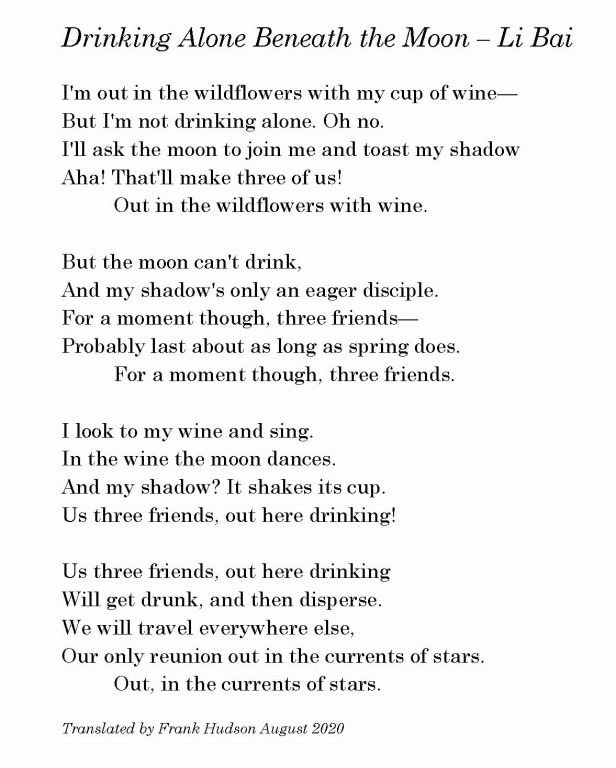
So, nothing new today, but here’s Dave Moore and I performing a poem written in a set of wet ruins by the supreme classical Chinese poet Du Fu centuries ago, and translated by myself. Was Du Fu a Gloomy Gus? Maybe, though like Robert Frost when he was lost or downhearted, he knew to press on anyway. Here’s the text if you’d like to read along, and the player gadget for the peformance is below unless you’re reading this with the WordPress IOS app (try using a browser instead to hear the audio piece in that case).

Jade Flower Palace – Du Fu trans. by Frank Hudson

The stream winds, the wind sighs.
Rats are running in the rafters.

The prince who owned this palace–
No one knows his name,
But it stands, abandoned beside these cliffs.

In dark rooms green ghost fires are shinning.
The streams now run over the boulevards.
From the trees I hear flutes? Voices?
Autumn leaves are wet with rain and rattle in the wind.

The young palace ladies,
Once painted on scrolls:
Now yellow dust buried in the earth.
What use now their robes,
their makeup and kohl?
And his gold chariots and the men who drove them?
There is only this carved stone horse.

I sit down on the grass and try to write of this,
But my ink is overcome by rain or tears
There are many paths away from here
How long are any of them?
None of them go on forever.


*One man reported shot and killed in what was sketchily reported as a looter/store-owner confrontation is all I know of. He seems forgotten in the surplus of events.

**One publicized arrest so far is a white guy (from, of all places, Galesburg Illinois, the hometown of Carl Sandburg) who live-streamed himself doing stunt arson and looting for a following that looks smaller than this poetry and music blog. The main argument for gangs is that far away from many of the crowds of protesters that unintentionally provided herd-cover in the early days of this, a large number of drug stores got broken into across the city.

The Stare’s Nest at My Window revisited

For Heidi

It’s been a rough series of days in the Twin Cities. Other than no great new loss of life (only fear of it) there’s not been much accomplished in my home or in my city.

I have a few new pieces in various stages of completion, and ordinarily I’d be working on additional ones for this project. This spring the pandemic quarantine measures have been bothersome, but so far Dave and my family have been coping and doing the best they can. Given the number of people sickened and killed by Covid-19, bothered and coping might as well count as “the best we can do.”

Then comes a public act of callous manslaughter. Worse for not being unprecedented. Worse for being tied to the sickness of racial oppression. We have a vaccine and a natural immunity for that: It’s empathy and love. Yet, many refuse to be vaccinated, or don’t have the vaccine available to them.

The phrase “the best we can do” has fallen into disrepute. Perhaps you’ve come upon this piece after reading or hearing someone else remarking on why this phrase is dispensed with, or should be dispensable.

For the last two nights the quarantine from the virus has been trumped by the fires and murmuring crowds. Crowds with the wisdom of crowds, which is to say, not much. Crowds work like a jangling overstimulated nervous system, tingling with pleasure and pain receptors, with a prejudice for why not.

My family, my friends, my artistic compatriots, my neighborhood are at the epicenter of this. Long time readers may know that alternate voice here Dave Moore was associated with a 20th century literary magazine that called itself “The Lake Street Review.”  Minneapolis’ Lake Street is (insert here the English verb that needs to be invented that stands for the balance of hope/fear/despair in our present moment poised in is/was/will be) a multi-ethnic, multiclass (if mostly working class) strip of enterprises where you can get diapers, groceries, your prescription filled, that part to keep your old car running, foods from fast to global, places where bands used to play before Covid-19, bookstores, libraries, arts labs, paper and toner for your printer, intoxicating beverages, hardware stores, your laundromat-load destination, where you go when your car needs gas and air for the leaky tire. It’s were the Latin Americans and African and Asian immigrants have their shops. Lake Street is an early 20th century construction. Apartments still over the retail ground-floors in older buildings, houses and apartments right next door behind the stores, closer than modern codes allow. Great portions of this are now gutted, looted; still smoldering from last night or cold ashes from the night before that.

I’m sure what we live  is a hugely interesting phenomenon for commentators, political philosophers, or folks just looking for a “news hook” to write or say something. Some will be civic sports-bar-tone arguments for who needs to be shot on sight for the sight of their targets, others will be earnest explainers about how rioting is the only effective language of the dispossessed, and that the wreckage of the places that a large percentage of those from the middle on down to the homeless frequent and depend on isn’t the disaster for them that it looks like to those less-evolved in their political consciousness.

As I’ve said already, I myself fear I’d dishonor this with my broken prose and dim eyes. And what old men think about this is less important than what those younger who may read this think, resolve, and do.

The Stare Nest at my Window text

Yeats poem written while sequestered in Ireland with his wife during a civil war. “Stare” is a old name for the starling, considered a nuisance bird.


Beneath the beach, more paving stones.

Friends of my family since both our children were born spent the hours around midnight wondering if the unchecked flames from a torched gas station would spread to the homes next door. My neighborhood post office (the same one where Lake Street Review  submissions used to come in) went up in big black smoke as it was deliberately broken into and set aflame. I’m not sure if anyone looted stamps.

My wife asked around midnight if we should flee.

“Where would we go?” I asked.

“Away from the flames.” She said.

All this is happening in a mix of memorializing assemblies at the site of the callous killing, protest marches with pointed aims, and then the looting and vandalism. I’ll offer one piece of observation that you may have not seen in the reports and thumb-sucking think-pieces: the memorializing, the protestors, and the vandals are an integrated lot. Skin tone and hair, those markers for ethnicities we use in our great cultural mythology of race, is My Rainbow Race in these events from the pious, to the protest, to the break and burn brigades. Watching cell-cam videos and media long-shots has impressed on me that the palette of the sufferers and perpetuators of these actions are not one shade. Racists are going to need to ignore these visuals as they form their illness’ distortions. The guy smashing the library window, setting fire to the auto parts store, or acting like a drunk frat boy he would never righteously be as he shoves the burning dumpster nearer to the building might well be white in these nights.*  And the “Nothing-ever-changes” cadre of gloomy-Gus activists** are likely too tired and weary to notice that the white, Asian, and Latin American participation has increased markedly in this time’s repetition of events sad, demanding, and chaotic.

I used gendered pronouns in moving to the vandal side of things, as that part does tend to become a sausage-fest. My wife is going off to join others this afternoon to sweep up broken glass. Not to get into gender stereotypes here, but how much do you want to bet that the gender mixture there will be distinctive too?

Tonight, I do not know what will happen. The memorializers will continue to do so, for George Floyd is still dead. The protestors will continue to protest, for it’s still wrong. And the vandals, not even interested in the materialist desire of the looter *** for a case of beer, a flat-screen TV, a book of Yeats collected poems or LeRoi Jones’ liner notes will continue to maintain that the best refutation of a failed “the best we can do” is: “the worst we can do.” The tao is too strange for me to know. Blessed be if they are right.

This is all the squishy thinking and writing I’ll be capable for a while. Tonight, I will probably not sleep, or fall asleep in imponderables. Will my wife be able to sleep the night before our anniversary? Will someone’s laddish fire, set with self-congratulating righteousness, find its equivalent of four Birmingham Sunday-school girls? When will America’s Valkyrie gunfire (I say with dread: remarkably rare so far) begin to sing? Will progressive change crest and recede? How happy is Donald Trump, our king of misrule, as his empire expands while progressives proclaim nothing ever changes as proof of their progressive acuity. Tell me, I want to believe, I need comfort: are you sure too it can’t get worse?

I now return you to our usual cultural activities. The most popular piece I’ve posted this year is by a cultural nationalist poet from another nation: Ireland’s William Butler Yeats. When I posted it at the end of January I wondered if I’d done well by it, but I now think I did, and listeners seem to agree. I’m also now sure my reading of this text is shared-heart-true. If you have time, and are interested in the exact background as Yeats wrote this, read the original post linked here.

This is a week where I have been in my own little run-down tower, seeing out my  window as Yeats showed me. Brothers and sisters, read the last stanza of Yeats poem in tears—even though they don’t put out fires directly.

Rather than a link to the text you’ll see it above in its entirety because I urge you to do that. If you’d like to hear my performance and music for this, the player gadget is below.


*Having tasted but not absorbed the fibrous materials of current cultural appropriation tropes, do any white anarchist allies as they smash the state at the library window, or get all dewy being a revolutionary fire-starter in a multi-ethnic neighborhood wonder if they are being authentically respectful of non-white culture from their skin privilege?

**I have long wondered at the futility of the salesman (as an agitator is, to a large degree) who paints their product as ineffective in use and their allies and audience as always deficient. I’m an old man. I understand being sick and tired. I’ll buy the “I can’t believe we’re still fighting these same old battles” T-shirt. But don’t tell me it itches, it’s guaranteed to fall apart, and isn’t available in my size.

***A few years back someone, who I cannot remember in order to credit, said that rioting with looting combines the two least attractive tendencies in American culture: shopping and violence.

from “John Coltrane Live at Birdland”

Continuing on from my post late last night, and the feelings of insufficiency we as artists may feel in the face of horrible things: cruelty, injustice, the taking of lives, the crippling of souls. As one of America’s sublimated poets put it, I think it all together fitting and proper that when we do this, that we feel this insufficiency. If something has risen to the level of being unspeakable, how can we speak it?

I’m still silent with answers tonight—and as with many things, my answers as an old man are less important than those you may find. So, let me instead give you a story and a testimonial.

The story may seem long ago to you, but it doesn’t to me. It happened in 1963, in my lifetime—not 1863 and the time of Lincoln, slavery, and Civil War.

It begins not with art but a group of domestic terrorists who were bombing and burning things in Birmingham Alabama. Terrorist is an ugly word, as it should be, but it’s likely that most terrorists think of themselves as partisans, as fighters against oppression, the necessary ones who will take the steps others shrink from.

Of course, I see these men as simple killers. I can suspect them of getting off on the clandestine evil of setting bombs and fires, of shooting into the night. And the “oppression” they are righteously bombing to oppose? They are more at the license to continue an oppression of others. On a Sunday morning, September 15th in 1963 they set off a bunch of dynamite at a church in their town. Just another bombing in a series.

This time they kill four little girls getting ready for sunday school.

Earlier that year, another of America’s displaced poets, Martin Luther King, had written his “Letter from Birmingham Jail”  in that town, that great document of the necessity of ending racial oppression, and now that year he would eulogize the four little girls. Eloquence was in town, continuing political pressure was in place, and the evil light of the terrorist bombing illuminated the words of those the bombers opposed. How sad and horrible it is to recount that.

That same year a jazz musician, John Coltrane was very busy earning a living with his art. When I say busy, I mean busy in a sense that boggles the mind. In that year alone he released four studio LPs while gigging constantly with his Quartet. Two weeks after he would have heard the news of the four little girls, he was due to play a New York City engagement at the Birdland club, which produced the live recording that gives its name to today’s post. Right after Coltrane finished the Birdland engagement, the group was off to Europe for a tour there. Four little girls dead, dynamited by their fellow human beings in furtherance of an evil idea. John Coltrane kept working.

Weeks then in Europe, and upon returning to the States the gigs and recordings continue. Somewhere between the day after the bombing in September and a one-day recording session on November 18th Coltrane came up with a musical piece that he called “Alabama.”

Then at the beginning of December when Coltrane’s tour was stopping in San Francisco he recorded a TV show. The format of the show was for the artist to play 3 or 4 songs and engage in a few minutes of interview with the host, but Coltrane begged off the interview. The host, Ralph J. Gleason, Mr. Rogers’ cardigan and all, subbed in a little explainer about the how jazz was like writing poetry in the middle of a supermarket. Cringe if you like at the metaphor and the white guy non-musician explaining it all to us,* but that’s what Coltrane and the Quartet then do. “Alabama”  is strictly-speaking wordless. The John Coltrane Quartet spoke with their instruments.

The TV show where “Alabama” premiered. At 7:40 Gleason gives his “poet in a supermarket” metaphor, and at 9:35 the Quartet starts “Alabama.”

The four little girls, so cruelly and unjustly dead that same fall. In the interim, a U. S. President has been killed too. Hot studio lights for the cameras, a cost-saving bare sound stage to film in. Those five minutes of “Alabama”  have been introduced to an audience for the first time.**

To my taste, Coltrane’s playing on the TV show performance of “Alabama”  is even richer than the recording made a couple of weeks earlier though the rest of this Quartet of great musicians were a bit sharper in the recording studio take—but in either case there are notes he plays in “Alabama”  that are quite possibly the saddest and most resolute notes ever to come out of a horn.

That winter “Coltrane Live at Birdland”  is issued as an LP record which includes the recording studio version of “Alabama.”  Another release in Coltrane’s furious pace of working and creating. The liner notes on the record were penned by the man who’d sign them then as LeRoi Jones.***

The art of the liner note is a dead art now, but today’s piece quotes a few lines from Jones’ piece of work (the entirety of which you can read here). Those that remember Jones’ notes often recall its opening line, which is also the first line I speak here today. If the job of a liner note writer was akin to writing advertising copy, to attract the consumer, that opening line is highly subversive of that intent:

One of the most baffling things about America is that despite its essentially vile profile, so much beauty continues to exist here.

Way to ship units LeRoi!

When it comes to writing about “Alabama,”  the song on the record where the Coltrane Quartet most directly speaks to that vileness, Jones writes:

I didn’t realize until now what a beautiful word Alabama is. That is one function of art, to reveal beauty, common or uncommon, uncommonly.

Jones knows what the tune’s about surely. I don’t know if I’ve fully absorbed that sentence yet, but if you are a person for whom 1963 might as well be 1915 or 1863, and you want to know what it felt like to know of such evil and endure it with an open heart, and to counter it with something that is beautiful (Oh! How can that be?), then you can find it in John Coltrane

Jones says John Coltrane’s art can change us, though neither he nor I will guarantee it. Can it? These are days that cause me to doubt. But if Coltrane doubted, he didn’t’ stop. I honor that belief. Perhaps art works in ways small but deep, and then only for some portion of us humans some of the time. If art like Coltrane’s carries me through sometimes, is that a reason I create art myself?

The player to hear me read a small section of LeRoi Jones’ liner notes to Coltrane live at Birdland is below. Don’t see the player? This highlighted hyperlink will also play it.  When I created this performance early this month I did not include any of the sections where Jones talks about the tune “Alabama,”  but I was trying to give some flavor of Jones parable about Coltrane’s power and conviction. Musically, my composition and performance is just a trio, there’s no saxophone.

*Yes, I cringe because I recognize myself there in a black&white mirror. Because I operate a musical instrument at times, I claim to be less guilty of the cringe factor. This likely convinces no one.

**Some have sought to document Coltrane’s gigs and recording sessions. There’s no account of “Alabama”  being played at any of the live gigs before this TV show. The version on “Coltrane live at Birdland”  is not live, but from that short studio session in mid-November.

***Later Amiri Baraka. A man who went through so many stances and positions in his life that it’s unlikely that any sane man can find agreement with all of them.

A poem about grief for American Memorial Day: June, 1915

This Monday is American Memorial Day, a day dedicated to remembering those that died in my country’s warfare. At its onset it was a solemn day for decorating graves, but over time it has lost some of that focus, with celebrations touching on generalized patriotism or military service. It’s also the calendar marker for the beginning of summer. In my youth it was celebrated on May 30th every year, but it’s now a Monday holiday that floats around a bit—but the reason it’s placed at the end of spring still goes back to the original purpose: it was set for a time of year when fresh flowers were in season across the United States, flowers for decorating those graves.

And so it is that this ambiguity makes it odd to wish someone rotely “Happy Memorial Day.”

The Parlando Project has marked Memorial Day with performances of poems over the years, but just as the reason for the holiday is somewhat problematic for mere celebration, it’s not easy to figure what poetry to mark it. Long time readers here will know that there is plenty of poetry that speaks honestly about the experience of warfare, and that WWI produced a great deal of it. But in its specific way, Memorial Day isn’t really about that. It’s about the mourners and their duty.

So, I cast about this week for a poem that spoke to that, and I found this poem by someone that this project has presented before: British poet Charlotte Mew. She was an unusual person when living, and the case of her poetic legacy is unusual too. Her poetry received some small amount of interest in the London scene around the time of WWI. Thomas Hardy, Walter de LaMare, Virginia Woolf, and even the American Ezra Pound recognized her work’s value, but this those-that-know praise never developed into any appreciable readership in her lifetime. Culture was still a bit of a boy’s club, and with the explosion of Modernism going on, you either planted the make-it-new bombs or faced being obliterated by them. Mew didn’t fit in any movement, and after her death, forgotten happened with efficiency.

Today a handful of scholars seek to make the case that she’s greatly underestimated and that her work needs to be reevaluated. They have a case which can be made with considered reading of her poetry. It doesn’t sound or work like anyone else’s.

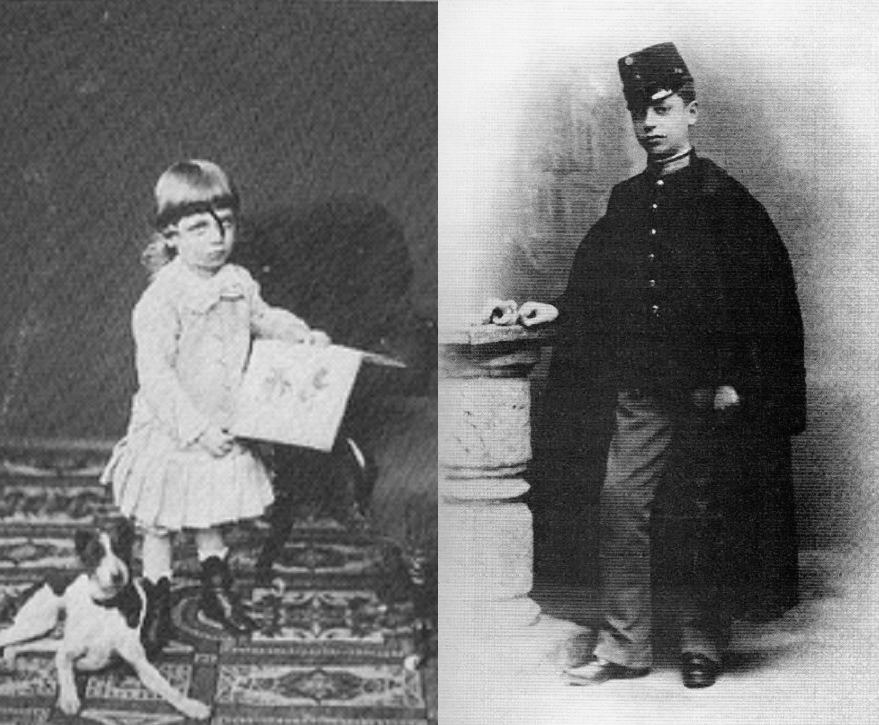
young Charlotte Mew

Mew wasn’t just strikingly original in her poetry. Most pictures show her presenting androgynously.


So, here is one of her poems about the experience of mourning during wartime, written, just as it says on the tin, in June 1915 as the massive extent of the casualties and stalemate in World War I was becoming inescapably apparent in Britain. Here’s a link to the text of this short poem.

Recent readers have seen that I’ve been writing recently on how poets who write short lyrics sometimes get underestimated. We readers might flow through the poems like we would paragraphs of prose, appreciating perhaps a bit of the poetic rudiments of rhyme or meter. This can go by so fast that there’s no time for more than surfaces, but great lyric poems can have depths that ask us not only to read them, or even to say them or sing them once, but to consider them for longer than the minute it may take to get through them a single time. A lyric is portable. Carry one around for a day or so, and it may enlarge.

A lyric is portable. Carry one around for a day or so, and it may enlarge.

Many Modernists sought to slow us down deliberately to oppose this one-and-done tendency. Obscure imagery, typographical variations, or syntactical sabotage are deployed for this. Mew goes in only for a light touch of the last here, with complex sentences that seem to end up somewhere else from where they begin. Her language here is quite plainspoken. There’s some interesting choices being made in the music of thought, with simple words being repeated to depict the stuck-ness of grief. I like the powerful simplicity of the repeated word “broken” here. Also notice the concise depiction of grief is externalized, depicted to a large degree by the seeming opposite in the child and the spring scene. Though not a recognized, full-fledged member of the 20th century Modernist flock, Mew’s poem of mourning and grief is not done in the Victorian manner. Even when she uses explicit emotional words, something done but twice, they are “the face of grief” and “the face  of dread.” She may have rightfully believed that a contemporary British reader would understand the wartime context of this poem, but in the Imagist manner, “June, 1915”  doesn’t say “war,” instead choosing to drill down into the charged immediate moments.

There’s no showy “stop and see how clever” imagery here either, though do not rush through consideration of the line contrasting the springtime child whose sunny lane is “as far away as are the fearless stars from these veiled lamps of town.” This line worked powerfully for me early in my appreciation of this poem, yanking the alienation between the child’s state and the mourners state a distance of light-years apart. I’ll note that a specific of Mew’s London times in the spring of 1915 has become obscure to us, but the “veiled lamps” aren’t just misty eyes, for on May 31st of that year nighttime Zeppelin bombing raids on London had commenced and blackout precautions were being practiced.

Mew could have chosen to make this poem itself as specific as its title. She didn’t. While I find it very appropriate for Memorial Day, the complex moment of this poem, so starkly told, is not even limited to the wartime dread and sorrow that engendered it.

How about the ending? I sensed an undercurrent, even an intent, the first time I read this that the child’s small eager hand isn’t just thinking of the first June rose, but is about to pick it, to turn if from a living, pollinating plant to decoration—that he innocently is aping the harvesting of souls in The Great War. If I may own the poem, I still want that there; but upon further review I don’t currently believe that was Mew’s intent.

Mourning. Grief. Dread. Part of the borderless human condition. Timeless because of its forever, returning briefness. To know this is a bare consolation, as memory is.

You can hear my performance of Charlotte Mew’s “June, 1915”  with the player gadget below.


Emerson’s Fable

Musically we ricochet again (as this project often does) from last-time’s acoustic South Asian ensemble to today’s rough’n’ready one-take rock band. For the words though, maybe not so great a jump, even though Ralph Waldo Emerson and Robert Frost are approximately a century apart.

Emerson is the prime American cultural instigator. Like many pioneers it’s easy to see where his maps may have been a bit off, his cultural borrowings misunderstood or missing sufficient attribution, but the route he set the American culture on, however paved, fueled, and electrified, is still one many travel on today. His conceptual school, Transcendentalism, whether acknowledged or not, can be found easily in 21st century America. It is impossible to think and write about ecology, perhaps even to use the word at all, without echoing Emerson. It’s difficult to examine mysticism or Asian religious traditions in America without going places that Emerson went before the Civil War, and if we do either of those things along with some practical sense that we’re using them to rebuild and reform our individualist understanding of the world, we’re doing as Emerson urged. It is both diminishing and praising of Emerson to say that he’s the first self-proclaimed “self-help” American authority.

If Emerson isn’t a great poet, America’s greatest poets often owe much to him. Whitman sought to use his concepts. Emily Dickinson clearly absorbed some of his then new thought. And so too Robert Frost, who is always examining nature and mankind and drawing hard lessons from the pairing of them. When Beat poet Michael McClure’s speaks as a bird or otter, and declaims public maxims,such eccentricities are Emersonian as much as they are from Emerson’s own small-town neighbor Thoreau.

So, today’s piece, which Emerson called simply “Fable,”  may not be a great poem if we have criteria to judge such things, but it has begotten great poems. The sage as small animal theme would please Dickinson. The flattening of greatness across multitudes of small things would be Whitmanesque. The cracker-barrel retort of the squirrel who knows, for all external mightiness and achievement, that his daily talent to be able to crack a nut is exquisitely necessary would fit Frost. The charge of change in attention, that the mountain is also just a squirrel-track, would serve Wallace Stevens well.

Returning to end, why the rock band today? The current Covid-19 situation has removed coincident live music—that joy of sounds and breaths in the same room—not only in public performance but in the kind of informal get-togethers that musicians of all skill levels and genres have enjoyed forever. I now miss even the difficulties and limitations of such things, finding it sad that I have no way of knowing when I’ll experience them again. “Fable”  today is an approximation of a  live band. I started with the drum pattern, added bass, the rhythm guitar, the piano track, a second “lead” guitar part, and declaimed Emerson’s words, doing each in one pass. There’s no composition process as a separate step, no great consideration on instrumentation. Even if it must be done sequentially: end, back to start, and track again, I wanted to approximate what playing live with others feels like.

In Emerson’s “Fable”  the mountain calls the squirrel a prig: a self-righteous, self-superior, self-satisfied prude or killjoy. That’s an odd accusation: a majestic mountain charging a little bottom-of-the-food-chain critter with unjustified audacity. Gee, Mountain, project  much? The squirrel is “self” indisputably—it cannot be otherwise—but that doesn’t mean it must also be any of the other things on the right-hand side of “prig’s” synonyms. Covid-19 is a mountain, large and natural, undeniable. My little squirrel track, my little path to crack the nut today, is not majestic nor considered in geologic time. What care I for the age and resolve of the mountain. The eagle, the owl, the car-tire have already said there’s no time to waste.

The player gadget to hear my performance of Emerson’s “Fable”  is below. If you’d like the text of the poem, here’s a link—and at that page there’s a link to someone else performing “Fable”  with music, music with it’s drone and percussion that sounds a little like last time’s “Nothing Gold Can Stay.”