Love and a Question

While looking for material to combine with music and perform for the Project this week I came upon a specific but little-known connection between two great early 20th century poets. I’ll go into the details of that in a bit, but before I write about that, let me set the scene by mentioning something about one of those poets, Robert Frost.

In the past mid-century, when I was growing up, Robert Frost was a poetic institution. He’d won four Pulitzer prizes, his work was as well known as any living American poet, ordinary readers might have familiarity with some of his best-known poems, and a few phrases from those poems had entered general usage. It was not uncommon for the schoolbook poetry anthologies that I’d encounter back then to end with Robert Frost. If he wasn’t the end of poetry, he was as good a symbol as any of the end of poetry as it was consumed up until that mid-century time, where literary poets wrote verse that was assumed to have a chance at general readership and could have evident value to them. He wasn’t Tennyson or Longfellow exactly (Frost’s sound was more like common American speech) but you could see him as a proprietor in the same trade as the 19th century giants.

He was enough of an institution that schoolboy-me was having as little to do with him as I could. Sure, he was living, but that was no help, because he was old.  Many dead poets left young corpses, paintings, engravings, or photographs of dashing writers, heads cocked with their thumbs and index fingers up against their visionary brains. Keats or William Blake, now there  were my comrades, not Frost. I plead youthful ignorance and concerns, and Frost’s poetry stuck around to eventually inform me in my foolishness.

So, it surprised me to eventually learn that for nearly half his life Robert Frost couldn’t get arrested as a poet in America, and he wasn’t doing all that well in finishing college or finding a steady day gig. Frost may have been trying, but he wasn’t trying very long in any one place — inevitably either they or he wasn’t for having him stick around. Nearing 40 years old, Robert Frost did something next in his unstable life: he went to England. What was this guy, that by my time was the quintessential American-scene poet, thinking?

I’m not enough of a scholar to know for sure, though reading a few Frost bios would probably inform me. One good theory: nature poetry and poetry about rural subjects was having something of a bloomlet in England. If England had led the way in industrialization and empire building, an in-reaction interest for literature about the countryside and country living was arising.

Within a couple of years of arrival Frost connected in England as he’d never been able to do in New  England. He published his first two collections of poetry. He formed a close friendship with British critic Edward Thomas (and in return convinced Thomas to write poetry). He ran into another American ex-pat, Ezra Pound, and the younger Pound trumpeted the now 40-year-old Frost’s poetry back to America as part of the coming new thing.
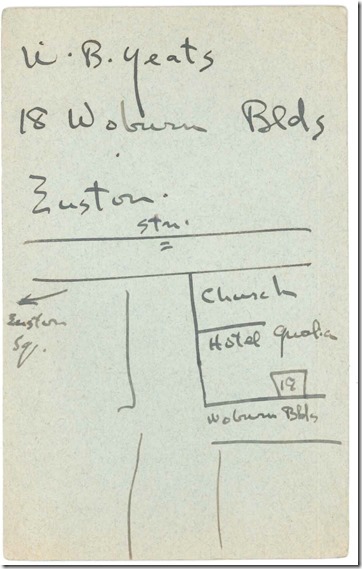
Imagism in action Ezra Pound, acting as a Georgian-era GPS, drew this map to show Frost how to get to Yeats place in London.

.

And there may have been another factor, a hoped-for connection with another poet: William Butler Yeats. Yeats wrote of the rural Irish  countryside of course, and I had never associated Frost with the Celtic revival at all. Just in preparing for this post today, I took note for the first time that Frost’s mother was a Scottish immigrant. Why did I start to look into that kind of connection?

I started re-reading Frosts first English-published collection, A Boy’s Will,  where I came upon this poem with a generalized title: “Love and a Question.”   That poem stood out at first glance because I could easily see how it could be fit to a folk-ballad style musical accompaniment. It even included a close variation of a floating verse line used in several folk songs “Her heart in a case of gold/and pinned with a silver pin.” But then there’s a second line too: the woman by a country hearth with thoughts of “the heart’s desire.” Here’s a link to the full text of Frost’s poem.

That second line would have been unremarkable except for the accident of performing a Yeats poem from an early verse play of his The Land of Heart’s Desire  this past winter. I link to my post on this if you are new or have forgotten, but this play sets up a nearly identical situation to Frost’s “Love and a Question.” A newly married couple are in a remote cottage on a stormy night. A knock at the door, and we are introduced to a stranger who asks for some comfort — but who is, it’s inferred, a fairy who wishes to enchant the new bride.

How well did Frost know this piece by Yeats? In research this week I found out that while in one of his short-lived teaching jobs before leaving for England he’d directed Yeats play with a company of his students. Cites I can find online mention him putting on this play,*  but nothing I found mentions that he also wrote this poem rather directly dealing with the play’s same story.

What does Frost bring to Yeats’ material? While his poem is understandably more condensed than even a one-act play, Frost obscured the situation considerably over Yeats well-told fantasy tale. The few attempts to write about Frost’s poem I found online catch nothing of the fantasy element because Frost makes that so unclear. Yeats’ stranger at the door is portrayed as odd and troubling soon after the character’s arrival, yet other than the continued borrowings from Yeats plot, the only thing in Frost’s text that suggests that the stranger is not a mortal is the peculiar detail of the stranger carrying a ”green-white stick” which if read in the context of Yeats’ tale may be interpreted as a wand or wizard’s staff. The stranger in Yeats is an active character, throwing themselves into the newlyweds’ relationship rapidly. Frost’s stranger is but spoken to and doesn’t act or speak other than the knocking entrance. The bride in Yeats has some action and agency in her own thoughts. The bride in Frost is a single tableau by the fire. The fears of the bridegroom are expressed in both the verse play and the poem, but in Frost’s poem he seems to be talking almost to himself. Endings? Spoiler alert: in Yeats’ play the bride dies, and it may be guessed that her soul-spirit has been taken by the fairy-stranger. Frost’s ending is vaguer. The bridegroom seems to say he understands the protocols of regular alms-seeking, but he can’t understand why someone would be so rude as to interrupt a new wedded couple on their honeymoon. Yeats’ bridegroom is anxious, but wary as he tries to win the occult battle, even though he fails. Frost’s bridegroom seems, well, puzzled.**  Is Frost satirizing Yeats tragic Irish tale, suggesting that a real rural bridegroom wouldn’t figure out what was going on? I might be missing something, but does the poem feel like a satire? For the bridegroom to be a fool wouldn’t surprise a Frost reader. Many kinds of human foolishness, misunderstandings and limitations are portrayed in Frost poems.

This brings up another factor. This early Frost poem isn’t very Frostian. The story, such as it is, isn’t clearly laid out, and the language and prosody — this seems impolite to say about this master — is awkward. I thought this poem would be easy to sing. It wasn’t, and I think that goes beyond my limitations and the brief time I could obtain to work on recording this. The poem strains natural, clear syntax and order at times to make the rhyme, and it doesn’t show well Frost’s famed use of metered verse that sounds like natural 20th century American speech. I don’t know if being so confusing adds to the weird tale, though as an aficionado of handed-down folk music there are times when the stuff that falls out through worm-holes or is forgotten in the folk process does add power by mystery. No one really knows for sure what “Smokestack lightning” is, or what it has to do with the rest of what Howlin’ Wolf sang about, and most don’t know what the hell a cambric shirt is either. We know only that something strange is going on. The listener here may be like Frost’s bridegroom: with some passion though puzzled.

So now you know that Robert Frost wrote a poem after a verse-play by Yeats, and you can hear me work to bring that Frost poem to music with the graphic player below. If that player doesn’t show up at your door, wave your magic pointer and strike this highlighted link to open an alternative audio player.

.

*Introduction to a Frost anthology The Road Not Taken by L. U. (I’m thinking, Louis Untermeyer), Yeats and American Poetry  by Terence Diggory, and Robert Frost: A Life  by Jay Parini. The latter quotes Frost writing that Yeats was able to “make the sense of beauty ache.”

**The ballad tradition includes tales of ordinary folks who by luck, pluck, or guile beat the occult challenger. I don’t know how well Frost knew his Child ballads, but he did know the golden heart box with a silver pin. Still, I can’t think of one offhand where the mortal wins just by being a bit dense about what is going on.
But These Things Too (Are Spring’s)

British poet Edward Thomas, who deserves to be better-known in the U. S., is one of the best nature poets I’m aware of. And today’s ode to the beginnings of spring shows one reason why. Like many a good nature poet, Thomas’ landscape, animals, and plants are infused not only with his region’s specifics, but with his own understanding of the order and significance of life. What takes his poetic observation to a next level? In this poem, it’s, well — bird poop.

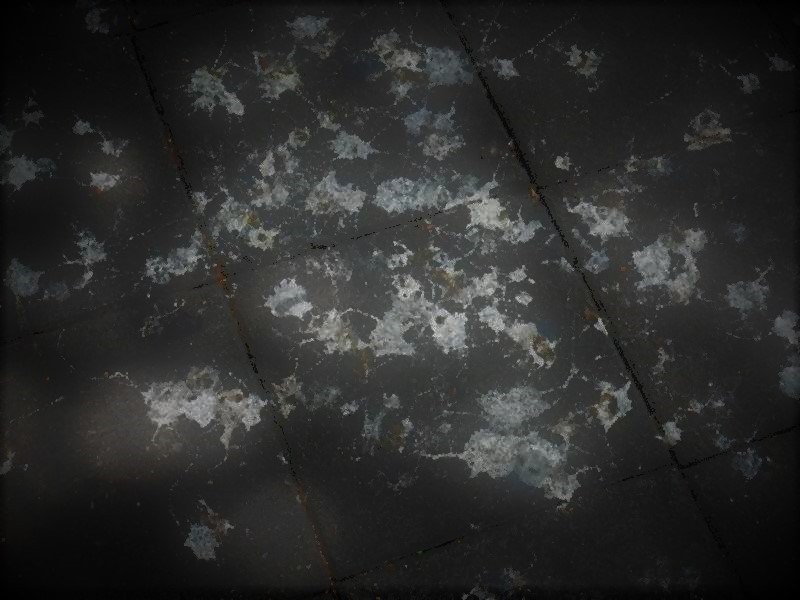
Here’s a link to the text of “But These Things Also.”   This is a grey poem about and often grey time, despite all the odes to the greenness and new-found warmth cataloged in other spring poems. In the reduced contrast of this poem’s palette, white splashes against grey make up its color field. Thomas (who didn’t make it past middle age,* but who could have been myopic) sees plausible flowers emerging. It’s not. It’s bird droppings. Here, nature instructs, changes his poem from an otherwise competent one to a better one. The later appearance of starlings, the British bird of indifferent song and nuisance potential, are foreshadowed (foreshite?) — and we might know (as Thomas certainly would have) that the starlings flocks are startling in their amazing patterned flights.  Life and spring may well get on with amazement after first meagre overtures.

The White Things A Man Mistakes

“In splashes of the purest white” vs. “Continuous as the stars that shine and twinkle on the milky way” Thomas vs. Wordsworth in a springtime faeces & flowers battle

.

You can hear my rock-band setting of Edward Thomas’ “But These Things Also”  below, but before I leave off writing about his poem, let me speak a bit about what I note about the poem’s use of rhyme. Like another great nature poet, Emily Dickinson, Thomas here is not over-determined by his need to make perfect rhymes, and the ABCB scheme starts right off with a sight rhyme of “grass” with “was.” Let’s not mark him down a grade, because the poem has a great deal of near rhyme, an effect that I find often more effective than ding-dong perfect rhymes. The pair of adjacent words “earliest” and “violets” are as strong to me as violet’s eventual end-rhyme with “debts.” And “debts” still hears the echo of the preceding “dung” and following “mist.” You may hear other consonance, assonance, and pararhymes in Thomas’ word choices.

It’s these sorts of things that make me resistant to some poetic formalists. While perfect regularity can reinforce a sense of fate (or to be honest about my own response, boredom) — irregular rhyme appearances, and variations to and from perfect rhyme, can evoke surprise and discovery.

OK, enough dancing about architecture. Let’s get onto the audio piece, the performance. Graphical player below for some of you, and if not, this highlighted link that’ll open an audio player. This is one of those pieces where I wish there was a better singer than myself handy, but it was still fun to move from chair to chair to create this one-man-band recording. I recorded this close enough together with our last piece, Anna Akhmatova’s “Like a White Stone,”  that I’m thinking if this was a polished prog-rock album that I’d fade the two pieces into a 7-minute medley.

.

*I decided to insert into Thomas’ ode my own aged vision issues, by making “man” in his text, “old man” in my performance.

Like a White Stone

Poetry, musical speech, is so associated with symbols that it may be impossible to imagine it without metaphor as a rhetorical device. This both bugs and pleases readers and listeners. Symbols can add richness, a sense of novel connections, or they may vex the reader, taunting them with needs for esoteric knowledge or psychic investigations of the author’s mind.

For me at least, poems can work when they are clear as any condensed speech would be on first reading — and  when they are nearly incomprehensible as anything other than collections of energetic words. So, along that continuum, a poem may succeed (or fail) — but it must compel. After all, we have so many other words that waft over us written, spoken, recorded, some enriched with music, video, some from those already near and dear to us. As a young person I was drawn more to the richness of images and cared less for the clarity of expression. Other poets tried to convince me that clarity showed respect for the readers busy lives, that incomprehensibility wasn’t a requirement for good poetry. I eventually listened to them and somewhat changed what I wrote and admired. In my newer but still ambiguous stance toward poetic obscurity, I believed that a poem needs to be no more complex that it has to be, and no fancier in its conceits than it needs to be to draw a reader’s or listener’s attention. I may have a bit more to say on these issues in another post, but let’s move on to a new musical piece today.

I’m largely unfamiliar with the poet whose words I’ll use for today’s audio piece, Anna Akhmatova.*  She became known to me several years back when the unique American roots singer-songwriter Iris DeMent recorded an album of heartfelt intuitive settings of Akhmatova’s poems, “The Trackless Woods.”   This record was released in 2015, around the time that I was formulating some ideas of how to do what became this Parlando Project. Many of my ideas were already set down, even some of the pieces you’ve heard here had already been recorded, but I felt then that DeMent’s record reinforced my intents to do this Project at a time of decision.

Now this month I saw Akhmatova’s poem “Like a White Stone”  featured in poets.org’s Poem A Day — and it did that “compel” thing with me as I read it in the middle of an otherwise occupied day. I eventually set upon creating a musical setting for it, one which you’ll be able to hear below.

Revisiting some interviews DeMent did around the release of her Akhmatova album I found out it was the same Akhmatova poem that compelled her. In a 2015 interview with the Poetry Foundation, she said:

This whole project is so mysterious to me…. It’s just this weird thing that happened instantaneously upon the first reading of the very first poem of hers I ever read which was “Like a White Stone”.  In that period of time, within an hour or so I’d set three or four of them to music.”

I also found out, after composing and recording my performance of “Like a White Stone,”  that Akhmatova was associated with a movement called Acmeism which reacted against the French Symbolists, a group of French poets that attracted me in my youth. The Symbolists were all about the effusive, exotic and elusive image. The Acmeists, in reaction, all about precision and clarity. The Symbolists were admired by Dada, Surrealism, and the hermetic strains of modern poetry in English. Acmeism could easily be related to other modern poets who want clarity and the power of easily discerned emotional messages.

Anna Akhmatova

“Someone looking closely into my eyes would see it” Anna Akhmatova

..

Knowing that, how does “Like a White Stone”  stack up on the continuum from clear and direct to wild and elusive? Here’s a link to the poem’s text. I’m working from this translation (by Babette Deutsch and Avaham Yarmolinsky) and I know, as one who’s translated poems myself, that there are risks that I may be grabbing onto details that are the translator’s solution not the author’s own design in the original language. My judgement overall is that this poem is in the middle somewhere, even if closer to the clear and direct pole. The opening image, the one that first grabs the reader, is both clear and elusive for me, a combination that often works to compel. A “white stone**” deep in a well, yet it’s also “hard and clear.” It somehow doesn’t put us off that this is contradictory. How much might we be able to see anything clearly, even a light-colored stone, deep in a well? Yet the poem says we know it’s there, we know its hardness sensuously — it’s not only some indistinct imagination. Is it likely we know the stone, its color, its feel in the hand, because we’ve tossed it there? And the poem then launches into an extended consideration of memory, its dichotomy, how it’s both present and by definition, absent. It’s easy to explicate this poem as something addressed to a false, absent, exiled, or discarded lover, yet it refuses to choose details or say that directly. In the poem’s conclusion, the white stone deep in the well is an image like unto a human turned into a rock or statue, unable to move from or toward exile, as permanent as ended — a memory.

Would this poem be more powerful if it just straightforwardly told us the details? Would it be more artful if it was more elaborate and fanciful in its images? Well, some poem otherwise might be — but this poem compelled both Iris DeMent and me, and maybe it’ll compel you to listen too.

My performance isn’t like DeMent’s at all. I hadn’t even recalled that this poem was one that she had performed when I worked on it this month. Although DeMent uses the same translation as I used, she phrases it differently, and while I’m no stranger to some American roots style musical flavors my choice today was more toward electronic synth sounds. Hers has a Protestant hymn flavor, mine aims at the surging dance of the floating memory mind. You can hear my performance of Anna Akhmatova’s “Like a White Stone”  with the player gadget below, or if you don’t see that player, with this alternative highlighted link.

.

*My ignorance isn’t Akhmatova’s fault. Although her work was suppressed by the Soviet Union’s cultural czars, and some of her associates killed, exiled, or imprisoned, she’s now generally recognized as an important 20th century Russian language poet.

**The white stone image, the specificity of which depends on translators’ choice, might possibly connect with another translator’s choice, in the Bible’s Revelations verse about a white stone. But remember, these are two translators, one going from Russian and the other from Greek to our English, each deciding exact words that we put in with our own connotations. Did this white stone have some connotation of translucency, perhaps even a diamond? Intuitively to me it’s a lover’s token, but I could be wrong.

Now that I’m in Madrid and I can think

Something in me says there should be more new pieces here since the last post, as I have several partially completed things, but the distress of folks around me pulls me several ways away from that. The distress hints that this music and poetry stuff should yield to more pressing problems, and then the unpredictability of the distress primes a sense of anxious alertness mixed with weariness. Though I’m at home, I feel like I’m in a medical waiting room, perhaps outside an Emergency Department, waiting for what it is that will be, in some not predictable soon, be said. As waiting people do, I read and do random things, anything having nothing to do with the matters at hand. Nothing too absorbing, for I don’t know when I will need to put it down.

But I’ll also say this, poetry has managed to stick itself into this state nonetheless. Poems can be as small as house mice, there’s always some place they can sift or scrunch their way in. And so it was early this morning when I saw this poem by Frank O’Hara “Now that I am in Madrid and I can think.”   I found it could be fit to an already composed musical piece I had done late last month, and so I put them together this afternoon. If you’d like to read the text of this poem, here’s a link to that.

This is a love poem, and more specifically a poem about separation from the beloved, and O’Hara’s language is as beautifully askew and full of charming scatteration as any of his more well-known poems. If I had time and an inclined mood, I could write at length about his musical language here and his turns of phrase: “The slender heart you are sharing my share of, “See (sea) a vast bridge stretching,” and “The lungs I have felt sonorously, subside, slowly.” There’s this intimacy interrupted, the separation of bodies and their encased lives. The title says the speaker in the poem can now think. Well, they have constructed a fine thing, something that takes some smarts, some wit, but what they have constructed is a set of feelings outweighing any thoughtful aesthetic pleasures of travel.

Madrid Iowa

The exciting places in Madrid Frank O’Hara is ignoring to think of his beloved. Oh— this is Madrid, Iowa! Iowans can tell out-of-staters by how they can’t get the French pronunciation of Des Moines right, and then they’ll see if they’ll correctly say this town’s name as “Mad-Rid.”

.

Perhaps this is why this poem snuck in between the trivia and my nervous time-passers. Here the illustrious culture of Spain is obscured by the distress and longing of separation. The poem finishes with one of O’Hara’s fine last lines. Do I want the empty world, the world without art? Yes, sometimes, but only by the choices of joined desire.

From the times I’ve listened to recordings of Frank O’Hara reading, I suspect he’d be more off-hand and playful in reading his poem than I was, but my reading reflects my current mood. The music for today’s performance is dense and urgent, I will not dance much about its architecture right now, but you can hear it with the player gadget below — or if that’s not visible as you read this, with this alternative highlighted link.

.

Winter Stars

Yesterday was some kind of day to celebrate Wales, and I asked the teenager in the house what they did to celebrate since they have an interest in languages and had recently been studying Welsh language online.

“You mean for St. David’s Day?” They replied. I was surprised they knew — but then they’re often surprising. “What are you supposed to do?”

“I dunno. Maybe make a point to use W as a vowel?”

What did I do? I worked, using some increasingly rare time recently, on a new piece here that you may see later this month with words by Welsh poet Edward Thomas. But that’s not today. Today is my catching up with a piece that has been in the works for a couple of weeks at least, remaining unfinished as other concerns remand me to only hot takes and short contributions on Twitter.

Late February

Those I follow in the British Isles are sharing pictures of buds and first wildflowers. Not here.

.

Is Sara Teasdale’s “Winter Stars”  late then? In my upper Midwest, absolutely not. Monday it snowed, my bicycle which I’ve ridden all winter, is behind a shed door whose jam is frozen completely shut by an icy enchantment after melt/refreeze — and 15 degrees F. this morning certainly won’t let it go. Yet, there’s one other time displacement to account for in this poem, for this is another of Teasdale’s poems about WWI. Particularly in Great Britain, when “War Poets” are mentioned, male citizen-soldiers are typically meant, and few now recall that American poet Teasdale wrote poems about the war. One of those poems is likely her best-known poem (or at least poem title, since Ray Bradbury borrowed it) “There Will Come Soft Rains.”   So lovely and complete is that dystopian vision within itself that I suspect it never occurs to readers today that she was writing it in the context of WWI.

“Winter Stars”  has the same strengths of not seeming to be stuck in time or current events. Indeed, folks have written about the poem and thought the blood flowing and wars mentioned within its lines are metaphoric tropes. Alas, as I considered this poem during this past February, the anniversary of the still ongoing invasion of Ukraine provided a corresponding all-too-actual simile. Here’s a link to the full text of Teasdale’s poem.

Teasdale’s night stars are then, like the sure-to-come soft rains of her other poem, a meditation on what endures when suffering, violence, and human vanity can change everything else. I was particularly taken with the next to last quatrain in Teasdale’s poem, remembering as I read it her guarded and constrained by illness childhood looking out a bedroom window at the immortal stars and the mighty Orion, the hunter, who could change and master things.

In the poem, it turns out that Orion doesn’t change things, rather that desire to change things is the constant. Teasdale would leave her sick-room childhood in St. Louis, find some brief success in New York. That older Teasdale is the writer of this lyric. Armies can march, hunting changeable borders to be drawn in blood. Teasdale seems to somehow fatalistically know that Orion and winter never leave, they only blink, they’re always there, the hunter and the prey.

The player gadget to hear my performance of Sara Teasdale’s “Winter Stars”  is below for many of you. No player to be found? This highlighted link will open a new tab window with a player so you can hear it too.

.

Railroad Avenue, Langston Hughes’ Locus Solus

Returning to the poems published in the 1926 issue of Fire!!  magazine which proclaimed it was “Devoted to Younger Negro Artists,” we get this simple seeming, yet mysterious poem by one of Fire’s  most famous contributors and organizers: the then 25-year-old Langston Hughes.

“Railroad Avenue”  looks like a simple free-verse street-scene vignette. Here’s a link to the text of the poem if you’d like to follow along.  Yet the more I looked to understand it, the deeper the mystery of it became.

Here are a few things that seem quite clear: it’s evening. There’s a street, likely named by the poem’s title. A few things are seen or heard: lights in two businesses, a boxcar, a record player, a player piano, a boy and a girl, laughter. Largely unremarkable things, so there’s some specific character given to them.

The record player is a Victrola, a short-lived brand from the early 20th century — for example, the ones with the big conical horn as in the original RCA Victor logo. The businesses are a pool hall and a restaurant serving fish. The boy is at leisure, comfortable. The girl has a dark face that is powdered.*  In what may be internal monologue the poem’s narrator gives us the winning number in the day’s policy game.**

So, are we clearly visualizing the place being described? At first I thought I could. I figured without evidence that this was a crowded urban nightlife street, the two other people only examples of many, the sounds and things part of what could have been a larger catalog. Is that reading possible? Two things mentioned that are likely heard not seen: the player piano (reasonably loud) and the Victrola, which would not be. Victrolas were not electric record players. The records turned via clockwork, the sound was produced acoustically from the grooves in the records. So, it’s not blaring out a window over robust street sounds. If the statement on the winning daily number 942 is audible rather than the interior thoughts of our narrator, it too would likely be at a conversational level (given no indication that the speaker/thinker won).

And then there’s that boxcar. Mentioned twice, Hughes really wants us to see that there’s this boxcar there, yet says nothing about it other than also saying twice that it’s forgotten.  What’s that mean? A boxcar is a freight train car. This is not an urban light rail or passenger train line being invoked. Who forgets a boxcar? Is it just one piece of rolling stock left off somewhere as a spare or scrap? While the poem doesn’t say this, I began seeing it as part of a train on a grade-level street crossing, with the boxcar’s location blocking the road, a location so that it has to be mentioned, can’t be ignored. Did Hughes see this clearly in his mind and forgot to make it plain in his poem, or am I imagining things?

This vision invoked in me of a small town to small city location where the freight train line runs on grade-level, not on bridges over the roads or in tunnels under them, let me begin to see this as a much sleepier street. This isn’t the busy streetlight and neon Harlem of Hughes’ Harlem Renaissance. The dusk is “dark,” the street quiet enough to hear things distinctly as the evening begins. As the poem reaches a crescendo portion, it’s laughter we hear. It’s “sudden,” indicating that it startles the relative quiet and is not muffled by it. Hughes metaphorically amplifies that laughter with repetition — stating that this laughter with its transport from the ordinary and unenergetic street is able to shake the shop lights and move billiard balls.

This is a poem published by a 25-year-old, but I get a sense this may well be a memory of an even more youthful time with daylight ending, with sounds and a scattered glow from remembered lit windows. Dusk is a marking time for many young people, between the era when it says “time to go home” spanning to the age of “time to first go out and explore your nighttime world of romance and adult recreation.” I wondered, would the poem have more context if I knew where the poem’s titular Railroad Avenue is? America has lots of Railroad Avenues and streets, so the name alone tells us little, other than this isn’t a boxcar dropped off miles from a rail line.

Broadway AKA Langston Hughes St and Railroad Ave in Joplin MO

A Google Streetview showing the intersection of a main Joplin MO street now renamed for Langston Hughes with Railroad Ave. Google’s camera vehicles didn’t drive & record down the gravel path that is Railroad Avenue right beside the train tracks.

.

I spent half a day trying to figure out where such a street might be in the places the young Hughes was known to have lived. I’ll summarize the candidates as briefly as I can. He was born in Joplin Missouri, and there’s a very good Railroad Avenue there, with everything you might want for this less-populated scene — though the Afro-American population at the time Hughes’ family lived there was low. But Hughes and his parents left Joplin when Hughes was around 1-2 years old, and there’s nothing I could find saying anyone went back. And was Joplin even big enough and ethnic enough for a numbers game? Hughes spent his grade-school years in Lawrence Kansas being raised by his grandmother. Yes, there were some Black neighborhoods,*** but no likely Railroad Avenue. He spent time at Howard University in Washington D. C. There’s a Railroad Avenue in that city, but it’s far from Howard, and seems to be (and likely was) a non-descript industrial area. Afro-American Howard students might spend evenings on U street circa 1920, but like Harlem in that era, it’d be lit and busy, and no likely boxcars there.  Hughes attended Lincoln University in Pennsylvania, and once more I thought I might have a chance. Not as urban circa 1920 — but then no Railroad Avenue, not even a railroad line for more than 15 miles that I could find. And even if he’s a famous figure from the Harlem Renaissance, Hughes’ Harlem is as unlikely for a sleepy dark dusk with a grade-level railroad line as Washington D. C.

Is Railroad Avenue just something Hughes made up? Is it someone else’s story, something he absorbed from a friend, or his mother or grandmother? Did he go back and visit his birthplace Joplin before 1926 and observe a relaxed scene somewhere on that gravel-surface Railroad Avenue? I’ll probably never know.

But what’s up with that boxcar? Why is it so important, and so specifically forgotten? As a short, Modernist free verse poem, we can think: “So much depends/upon/the boxcar/serenaded by a/Victrola/beside a purple/powdered girl.” One theory: the boxcar is a plausible hobo-ride escape out of the town, but our narrator either doesn’t want to leave, or doesn’t know if the train-car is soon going his way. Within a year Hughes published another poem “Homesick Blues”  written more in Southern Black dialect about someone looking to hobo back south.****  Another theory? If, as I imagined without direct evidence, the train has stopped and the boxcar is blocking the road, it’s a symbol of systematic blockage of the people in the scene. Whoever owns/controls the boxcar doesn’t even need to care about this (it’s “forgotten”) — and meanwhile the laughter of the folks in the scene mitigates their lives as they deal with this unfair, indifferent, hindrance.

I’ll conclude by admitting I composed the music and performed Langston Hughes’ “Railroad Avenue”  without knowing exactly what the poem was about. I did have my supposed internal vision while doing so: it’s a small non-urban place, like some in Hughes’ youth. A boy or young man is watching the grownups, thinking without even thinking much, about where he might go, what he might do as he grows up. He knows somehow this, and he, will go away — but this evening he’s there. That personal, practical, vision of mine is, as Hughes has it, “Neither truth nor lie.”

You can hear my performance with the player below, or lacking that, with this highlighted link.

.

*This line is the only one that specifically calls out the racial caste situation in the poem. Powders to lighten the skin tone of darker skinned Afro-Americans were a common cosmetic in Hughes’ time.

**Number or Policy lottery games were present in cities by the time of this poem. The illegal gambling game was usually a daily low-cost bet, winners determined by some coincidental trio of numbers that could be found published daily in newspapers. While associated with Afro-Americans, it was played by other ethnicities too. I don’t know much about its plausible presence in smaller cities and towns before 1926, though Wikipedia says such games go back to Civil War times.

***During the mid-19th century violence of the “Bloody Kansas” struggle to decide if Kansas would be admitted to the union as a slave or free state the pro-slavery forces sacked and destroyed Lawrence more than once. John Brown became a leader of guerilla anti-slavery forces in Kansas, and Hughes’ grandmother, who largely raised him, had a first husband who was killed with Brown at Harper’s Ferry.

****Example that Hughes was comfortable writing either as a collective noun or in the voices of personas.

Uncle Sam Says

Here’s another lyric of Waring Cuney’s used on Josh White’s 1941 record Southern Exposure.  Before I get on with presenting the song, let me briefly review who White and Cuney are.

Josh White was a Black American singer and guitarist who usually performed in the Afro-American Blues style. The Blues was a popular musical genre among Black Americans during the first half or so of the 20th century. During that century, some of the musical ideas and a great deal of the outlook and performance style of Blues were gradually absorbed into general American musical culture. As another Blues lyricist, Willie Dixon put it: “The Blues had a baby, and they called it Rock’n’Roll.” And so, when I was a young man, there were numerous young acts seeking to call attention to the centrality of Blues music to Rock music. However, most of these then young musical artists, like the majority of their audiences, were white. Unluckily, Josh White’s relationship to the Blues and it’s audiences was essentially premature — he was a man before his time.

Though White was a fine guitarist, singer, and performer who could have scuffled on the segregated Black performance circuit, for a complex set of reasons he became associated with the American political left and its largely white “Folk Music” performers. There’s a fascinating story on how that came to be that I can’t fit into a short blog post, but the shortest summary I can make of this is that equal rights for Afro-Americans was taken up as a left-wing cause, even more specifically as an American Communist cause, after the Lincoln-Grant Republican party became estranged from energetic advocacy for those rights. In the 1930s-50s era White performed for mixed, largely white audiences associated with the Left, while his contemporary Black Blues artists performed to overwhelmingly Black audiences. Want to know more? Here’s a link to an excellent blog post by Elijah Wald that explains how this premature Blues cross-over complicated White’s career. TL:DNR? Because he crossed-over before  the Sixties, he was somehow considered inauthentic.

Josh White Southern Exposure ri

A later re-issue of the White-Cuney Southern Exposure record

.

Waring Cuney, as this month’s readers of this blog know, was associated with other young artists of the “Harlem Renaissance” even though his name became lesser-known than his colleagues. Always musically interested, he lent his poetic skills to White’s 1941 Southern Exposure  album. Today’s selection, where I perform one of his lyrics from that with my own music, deals with a specific area of equal-rights advocacy for Afro-Americans: military service. In 1941, the American military was segregated, and like America in general in this era, the dictum “separate but equal” was largely an absurd charade, easily tied to pervasive white supremacy and ideas of Black inferiority. Ugly stuff — but in the era just before America entered into WWII, also stupid and counterproductive.

I’m going to oversimplify and compress again, but during the Civil War and in WWI segregated American Black soldier companies had proven their abilities as fighting units, but in the between-the-wars era the US Military had reduced itself to something reflective of the plantation South or the servant-class North. Roles for Afro-American military personnel were limited. Cuney’s “Uncle Sam Says”  is a prophetic smart missile aimed at that situation. How so?

It’s a four-verse song, but let’s get on to how Cuney is able to foresee or encourage three things that became current events in the months around when White recorded his singing version of Cuney’s words.

Verse one: Black folks can’t fly combat airplanes. That takes a skilled knight of the air in the mind of the prejudiced. In the same 1941, an Air Corps unit was formed that became known as the Tuskegee Airmen. Yes, it was a segregated all-Black unit, but by 1943 they started proving their mettle.

Verse two: this one is almost eerie. American involvement in WWII combat began with the attack on Pearl Harbor. Aboard the battleship West Virginia there was a messman’s mate named Doris Miller who just before the enemy warplanes arrived was serving breakfast — as Cuney’s lyric says “Keep your apron son.” Miller was a big guy, fullback on his Texas high school team. He was deputized to help carry wounded out of fire and to aid stations on the ship while it was under attack, which he did, including being called on to carry the dying commander of the battleship to treatment. In the midst of this someone directed him to an unmanned machine gun. Miller had no machine gun training — remember, subservient roles in this Jim Crow military — but he’d hunted squirrels, and taking charge of the gun it’s said that he downed between 2 and 6 of the attacking aircraft.

Verse three: while the US hadn’t entered WWII when Cuney wrote his lyrics or when White sang them, the lyric’s prophetic claim that “when the trouble starts, we’ll all be in that same big fight” isn’t as specific as the opening two verses’ charges. Still, it’s a good point. Also note: when blindered folks maintain that the struggle for Afro-American civic equality is all about “privileges,” that it has also historically been a struggle for access to civic responsibilities too.

The last verse issues the call to action and wraps up this effective “message song.” I performed it —that’s a regular part of my encounters with the words this project explores — but if you’d like to hear Josh White’s original version here’s the link to his. The player gadget for my version is below, and if you don’t see that, here’s a link to my version. I have one more example yet from the young Black poets who published Fire!! planned if situations allow me this month, so follow this blog or check back for that.

Southern Exposure, more Waring Cuney

Last time here, as we examined the young “Harlem Renaissance” writers who created the 1926 issue of Fire!!, we met one of its lesser-known contributors, Waring Cuney. Today I present an example of something that Cuney did later in his career. But let’s start by going backwards. Cuney was contributing to Fire!!  around the time he had won a poetry contest prize as a 19-year-old, but he was originally intending to become a musician. His Wikipedia entry says he changed his mind because he thought he had a poor singing voice.

Already you can see why I, with my inconstant voice and a project that uses the subtitle “The Place Where Music and Words Meet,” might take a liking to him. His family’s music and civil-rights connection may be deep and as strange as America could offer. While I can’t confirm this as I write today, he appears to have been the grandson or other descendant of Norris Wright Cuney (Waring’s father was named Norris Wright Cuney II) who was an important figure in Reconstruction era Texas politics and therefore also related to Norris’ daughter Maude Cuney Hare. Even a glance at the Wikipedia summaries for Norris Wright Cuney and Maude Cuney Hare might tell you how rich and fascinating American Black History can be.*

So, what strangeness made Cuney consider poetry? Here’s the story I found: one day Cuney was riding on a bus reading a newspaper when he saw in it a picture of another young black man his age who had just published a book of poetry. He looked up, and there was that same guy, riding on the same bus, Langston Hughes. The two became friends.

If Hughes’ poetry was early in concerning itself with Black musical expression, Cuney was alongside him with that same inclination. Later on, Hughes would occasionally read his poetry with jazz accompaniment. Cuney went Hughes one better, collaborating with Josh White on a remarkable dawn-of-WWII record of Blues songs about racial injustice called, like the lyric I perform today, “Southern Exposure.”

Southern Exposure album cover

The 1941 record where Cuney’s lyric was first performed

.

This song lyric is nothing fancy, but it’s a compressed portrait of the forces that led large numbers of southern Afro-Americans to move North. What moved them? In short: industrial or domestic/pink color work seemed preferable to the feudal system of southern agriculture enforced with outright de jure racial segregation and restrictions. I could step back a bit and say that like Joseph Campbell’s highly compressed portrait of Irish rural poverty and emigration, “Southern Exposure’s”  small cabinet of modest imagery is in the service of describing big things.

I didn’t use Josh White’s music or arrangement for my musical performance of Cuney’s “Southern Exposure,”  preferring to rig up my own. I’m singing with acoustic guitar, the adopted Blues instrument White used, but about halfway in the rustic guitar is joined by a cello, a concert-hall instrument. You can hear my rendering of “Southern Exposure”  with a graphic player if you see that, or with this backup highlighted link that will open a new tab with a music player.

.

*When I read the current controversies being utilized for political leverage regarding American Black History, may I introduce one point that I think gets missed as folks try to maximize white fears about this subject. Yes, horrible things occurred — and they weren’t accidents or fate, they were inflicted with intention. But strange and brave things occurred too. I’d argue that studying evils inflicted with intention is a vital subject for humanity — but also that the second, however bittersweet at times, is marvelous and intensely interesting.

The Dying Bed

I said I’d return to our encounter with the 1926 Harlem Renaissance issue of Fire!!  magazine — and here we are with another poem that was printed there. If you’ll remember from earlier this Black History Month, Fire!!  was largely organized, written, and edited by young people under the age of 25, and as such it wanted to represent a generational change from the curators of anthologies like James Weldon Johnson’s 1922 The Book of American Negro Poetry or Alain Locke’s The New Negro  of 1925. There’s more emphasis on free verse in the poetry section for example, and throughout the issue there’s less attention to propriety. Though only a year separates Fire!!  from The New Negro,  long-time readers here may recall that Locke’s book included an essay on Black music casting a suspicious eye on what the essayist cast as frivolous Jazz music — and Blues, as a vocal music depicting a lot of disreputable situations, wasn’t considered an art at all.

The cohort of Fire!!  didn’t share that outlook. If anything, they wanted to make sure they touched on unconventional thoughts and affinities. And here’s something we now think we know about the young writers in Fire!! — a substantial portion were gay or bisexual. Afro-Americans in the 1920s were coming out as full-fledged contributors to all the public arts — would that other status, fully-illegal and disrespected, muddy the waters of “racial uplift?”

Today’s piece uses a poem by a lesser-known contributor in this issue of Fire!!,  Waring Cuney. Like Helene Johnson, who you may have been introduced to earlier this February, Cuney deserves to be better-known. While not directly part of the Harlem scene, Cuney was friends with Langston Hughes, one of the chief instigators of Fire!!,  and like Hughes he was a young man who was comfortable with the language and outlook of the Blues.

William Waring Cuney

I can’t seem to find a picture of the young William Waring Cuney, but here he is later in life modeling modern vinyl hipsterism.

.

Today’s set of words, Cuney’s poem “The Death Bed”  doesn’t use Blues forms directly, but I’ve already been working with some other Cuney poems that do for possible performance, so I decided that I could include some of that today. “The Death Bed”  is a poem about a dying man who doesn’t seem very interested in his family’s consolations of religion. While getting religion as death approaches is a common trope, our dying man quickly tells his relatives there’s no need for prayer. The relatives leave for another room, and instead of the purposeful theology of public prayer, our protagonist listens to the enigmatic wind. For one moment he tries to join the windsong with his own song, but finds he can find no words. If windsong is nature (likely) or the paraclete (possible), our dying man cannot form his response.

The poem ends with the dying man concerned with what the relatives in the other room are praying. Are they seeking to intercede for the non-believer? Or might they think he needs to be cleansed of some evil — maybe they are even praying to be protected from the sins this sinner personifies?

The Death Bed

Cuney’s poem as it appeared in Fire!!

.

In my performance I sought to open-up intimations of another possibility via music. The Godhead or the universe may not require intercession or last-minute prayers. I made a rare choice to use a conventional musical sample* for this performance. The slide guitar you hear in the main body of “The Death Bed”   is taken from a 1927 recording “Jesus Make Up my Dying Bed”  by gospel/blues guitarist and singer Blind Willie Johnson. While many guitarists think Johnson’s sound and distinctive slide-vibrato is unmatchable, one could suppose I could have tried  to approximate it. However, I was taken with the romantic notion of combining this 1926 poem with a slice of music recorded around the same time. I then included a short coda with a sung variation of this song.** The rest of the music was made with percussion and the sound of bowed cymbals. You can play this performance of Waring Cuney’s “The Death Bed”  with a graphical player below. No player to see?  This highlighted link is a backup method to play it.

.

*Portions of modern popular and art music intentionally use collaged and looped sections of existing recordings. I tend to avoid that for whatever reason, generally choosing to play or electronically “score” my instruments.

**The performers in that short coda are Fred and Annie McDowell. Fred McDowell is another master of the bottleneck slide guitar.

Reading One’s Own Poetry in Public

It’s one of those things that is hard to do well but is none-the-less important to do anyway. Why is it hard? Why is its realization often imperfect? What might one do or aim for when attempting to read one’s own poetry for the public? Well, before I write down some responses to those challenges, let me say that these are not the opinions of an expert or the summary judgements of some important critic, but only observations of someone who attends readings and occasionally reads my own verse aloud before a live audience.

Why is it hard? Perhaps I’d rather say it this way: there’s no good reason it should be easy. The writing of poetry, emphasis on the second word in that sentence, is not a public act. For many of us it takes extraordinary private concentration to create our poetry — and too, we often put in it things we would otherwise never share face-to-face. As a result, a great deal of poetry, particularly our present age’s poetry, derives its power from whispers to ourselves in the dark. Why should the same person who does that writing be any good at reading it aloud?

I attend at least one poetry reading every month and I’ve seen over a hundred poets read. Let me be honest about myself: I’m not a very good listener. I have a racing mind, and any spark that a reader’s words set off, has a tendency to cause my mind to follow it off into my own bonfires. And if the reader’s own tinder is damp, I as a poet myself will spend internal time noting how poorly the campfire chances are progressing. How much better (or worse?) is the average poetry reading audience member in listening? I can’t say, but I fear I’m a bit worse than the average audience member, but that doesn’t mean I don’t notice some ways poets reading may fail more than others.

I’ll summarize one class of failure with a general statement of an issue: not convincing me that the words the reader is sharing are important to be shared. Yes, yes, I know this is hard. Most poets don’t have the audience or objective awards and rewards to be reinforced that their stuff is any good. And those that do (or those that inflate what small elements of that they’ve received) can forget that there may be audience members who still need to be convinced. If you make that case in your manner of presentation and in any introductory speaking you do before and between poems, you’ve improved the chance of the audience paying attention.

Oddly, general posture and “stage presence” doesn’t seem to have as much effect as I might guess it would. Readers who make extensive eye contact vs. those whose heads are downcast to the page on the podium — is the former better than the latter? Probably, but I’ve seen success and failure with both. I’ve seen a few poetry readers with more extensive motion moving around the stage or reading area. This has been rare, and I’ve seen it work (for me as audience member). If I’m not otherwise compelled, it might seem off-putting or artificial. Literary poetry readings do not seem the same as general public speaking or stage performance in expectations or needs in this regard.

Beatnik Crime

Taking steps to earn the audience’s attention can pay off.

.

Pacing, setting audience expectations, and “set-list structure” does seem important. Don’t read too fast or too slow. Help the audience understand what you’re going to do (even mundane things like “I’m going to read six poems today” or “This is the last poem I’m going to read tonight”). Musicians most often work out the order of pieces they will present with some thought. It may help the performer (and therefore the audience) if you start with a “greatest pop hit” that you know how to consistently perform without making any extraordinary demands on either audience or reader. Place your most emotionally or intellectually demanding piece at the end, or next-to-last.*

Because we have to get over two obstacles when reading our own poetry, I’ve suggested to poets that they consider splitting their task into two parts. First, practice by reading other poets’ work aloud, even with no audience. Pick poets whose work is meaningful or influential to your own writing style, and figure out how to make them sound their best and most compelling in your voice.**  Then, move on to your own poetry, and read it in the same voice and manner, as if it was as important and “certified” as your poetic models.  The self-doubt, the “who am I to…?” factor can possibly be tricked with this path. However, what should you do if, when you get to the second task, you choke at how it sounds? It’s possible that your models, your influences, may need to be expanded. I myself started loving romantic era 19th century poetry for example, but later wanted to develop a more conversational style in my own writing. I could try reading Keats or Blake as if they were talking to me, or I could try reading aloud some Frank O’Hara instead.

How do you know how you sound when reading other poets or your own work. You need to record yourself. Your basic smartphone or laptop will do well enough. In the Parlando Project I make efforts to make my recorded voice sound better on recordings, but that’s not important in this effort. Will you feel self-conscious listening to your own voice? Almost certainly. Get over that it won’t sound right — it will sound more like what the audience hears. Do you feel your reading voice has a weird or unappealing timbre? That’s likely of less importance, so get over it.

It’s a good idea to practice your “set” before a public reading. Highly experienced readers can skip this step,***  but inexperienced readers should not.

In summary then, most readers of their own poetry are not great readers, even those who’ve widely published or won awards — so congratulations, it’s OK to be an imperfect reader, most of us are! Yet it’s still worthwhile becoming a better public reader.

A week ago I decided to read a love poem at a rare open mic session for a longstanding local reading series. I picked a slightly revised version of a poem I presented here a few years ago “The Phones in Our Hands (are so Magical).”   The organizers’ instructions said that we should read only a single poem of our own and keep it under four minutes. I prepared for the reading by informally recording myself reading my poem about three times, to get a quick sense of if I had it down as to its presentation. On the night of the reading, I was able to present it at about 75% of what my third and best practice reading was. Where was the fall off? I read it just a bit too fast (nervousness) and I probably was less than optimum in handling some of the phrasing. I’ll give myself a middle grade in my overall presentation. I did try to set the expectations in introducing the poem, but in the end, the overall effect was less effective than it could have been for two reasons. I didn’t properly setup or convey the tonal shift in the poem, so the surprise when the poem shifts from the mysterious/playful to the experience of the separation of death from one’s partner confounded the audience. The difference between pleasurable surprise and confusion is subtle to describe, yet critical in effect. The other issue was “set-list” related. Most of the readers disregarded the one poem request and read 2-3, and as a Valentine’s Day themed reading, many of the poems were light-hearted and playful. My single poem was a “downer” and a “thinker” poem. I had considered doing two poems (still well within the four minutes) and would have led off with the Valentine’s poem I presented here last time, which is a more informal and joyous poem, even if it addresses the same issues of old love and eventual widowhood. In retrospect, that would have improved my “set” considerably. The bottom line I’ll convey from my most recent public reading: accepting imperfection is an important skill, ever more so if you are trying to do things well, and I enjoyed taking my swing at sharing my poem.

Today’s audio piece is the third take of my practice run-through of “The Phones in our Hands (are so Magical)”  with an impromptu two-handed improv over a synth pad, one track a soft grand piano and the other a more plaintive high-in-its-range violin. Apropos to the above discussion of recording your own voice, the poem coincidently mentions how odd our recorded voice seems to most of us. You can hear it with the player below or this alternative highlighted link.

.

*If next-to-last, your last poem can then be another “greatest pop hit,” a poem of clarity that seeks to leave the audience energized and feeling they’ve comprehended what you’ve presented, rather than drained or perplexed.

**Does this sound like the Parlando Project, where 90% of the time we present performances of other poet’s words? I guess it does, but the main reason that I do the Project is that spending extended time with those words and integrating them with music tricks me into listening to them in a deeper way. It gets me past those issues I have being distracted while listening to another reader. In melding their poem with my breath and music, I’m forced to inhabit it.

***A great many (not all) musicians go through an intense practice regimen while developing their skills on their instrument, but a more relaxed and informal one later. Someone who’s gigging and playing regularly (using their bank of skills deposited from their own-room practice) is often able to maintain or even sharpen those skills without the need for as much solo practice. Similarly, if you are regularly reading, there’s much less need to practice your set.