You might think we’d need do nothing but what we usually do — after all, we’re always celebrating poetry here. We have over 600 pieces you can find in our archives, performances that combine words (mostly poetry) with original music we compose and record ourselves. But here was my problem as April arrived: time to compose new pieces is inconsistently available.
So, I’m going to lean on that collection of pieces we’ve done and make this also a celebration of what the Parlando Project has done over this past 6 years. My plan is to regularly repost pieces from the first half of our history this April. For many of you who joined this Project already in progress these may well be pieces you haven’t heard, but an additional goal is to introduce new listeners to these audio performances.
Why do that? Readership of this blog, originally intended as brief “show notes” for the audio pieces, has grown tremendously over the past year, but the audience for the musical presentations has increased only by a small amount over the same time. I’m hoping to capture more ears for those performances and the poets whose work we interpret, sometimes in surprising ways.
To gather more ears I’m going to be making new low-budget YouTube videos for these classic pieces, mostly just “lyric videos” that display the poet’s words we are presenting. Most new people find us via search engines, and my wild guess is that putting things in front of YouTube searchers may bring more listeners and readers.
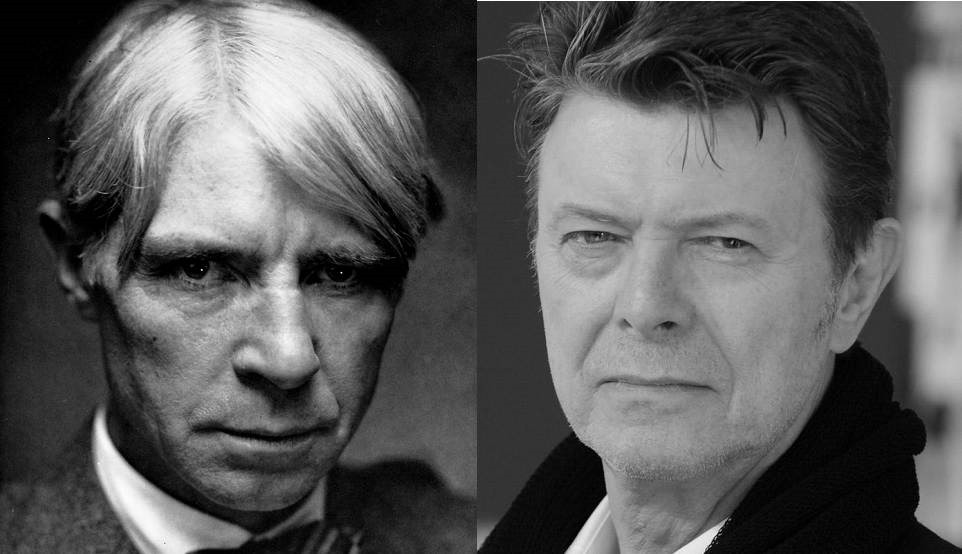
To begin this series? Why not use the first piece from this project’s official public launch in 2016: Carl Sandburg’s “Stars Songs Faces.” Speaking of strange, The LYL Band performed this on January 11th 2016, the day after David Bowie died. Carl Sandburg didn’t have the opportunity to prepare a eulogy for Bowie, since that American poet died in 1967, but back in 1920 he wrote this short evocative poem that we used for the words in this performance. Spookily, Sandburg’s poem presented this way makes it seem like he did write a eulogy for Bowie. And to eerily evoke that short time when both Sandburg and Bowie were extant, the music makes use of one of The Sixties most distinctive sounds: the wobbly Mellotron that could sound like a string section whose batteries were running down.
“What will I be believing, and who will connect me with love?” The young Swedish-American and the star with songs and faces.
This Friday is International Jazz Day, and for a project that subtitles itself “Where Music and Words Meet,” it’s a little odd that I talk less about the musical half of what we do. My project assumes that poetry, even on the page, can be defined as words that want to sing. What manner of tune fulfills that desire? It varies.
Early in this project it became apparent that I was going to feature a lot of early 20th century verse as it was the newest poetry that was clearly available for reuse. This was the time when literary Modernism came to English language poetry, greatly expanding the tactics that could be applied to poetry, and it came in too with an idea that much of what had become expected of poetry was tired and worn out, inauthentic and false.
Almost simultaneously, a very similar movement was happening in music. Though largely segregated from European Modernist composers in person, Afro-Americans were developing at the turn of the century a twisted helix of musics that came to be called Blues and Jazz. Differentiating between those two things is a complex matter. Blues is a nearly inescapable element of Jazz, and Blues is more substantially a vocal music, and so Blues needed a poetry from the start. That means that Blues song lyrics are the Modernist revolution as originally expressed by American Black people, though because of their context and place in American culture this was not understood as such. Like Modernist poetry, Jazz and Blues too demonstrated freedom to use new tactics, and they too wanted to replace tired and false musical tropes.
Poets, even those who intend for their work to be published and read on the page, can’t help but be informed by the music they know and admire. Earlier this month I’ve speculated on Emily Dickinson’s use of 19th century hymn-song meter and a possible connection for her deviation from strict poetic forms informed by her own improvisations on piano. By 1920 we had a Modernist Jazz music coming to America’s attention, and literary Modernist verse, though not without its naysayers, had reached an American audience too. It’s like flame and gasoline, isn’t it? When are they going to meet?
I can’t say what the first Jazz Poem was, or who wrote it. If it was composed by an Afro-American it may have been unnoticed, unpublished, and unrecorded (save by the oral tradition and the folk process which didn’t keep their names). Some of the traditional folk-blues lyrics seem to date from the turn of the century, but they were not printed as poetry then — and even as vocal recordings, the oft-cited first blues record, Mamie Smith’s “Crazy Blues,” dates from 1920.* The recording history of Jazz predates that a bit, with the all-white but still claiming “Original” Dixieland Jass Band’s broadly comic “Livery Stable Blues” coming out in 1917, and that’s sometimes cited as the earliest Jazz record. Two poems already featured here: Ray Dandridge’s “Zalka Peetruza” and Fenton Johnson’s“The Banjo Player”were available in 1922 for James Weldon Johnson’s Book of American Negro Poetry.** The former’s “tom tom” beat and the later’s Modernist free verse could make them Jazz Poetry. Some articles cite Langston Hughes’ “The Weary Blues” of 1925 as the first Jazz Poem, and it is unquestionably a Jazz Poem, but even Langston Hughes had some issues to overcome with it. Back in our February focus on Locke’s The New Negro anthology of 1925, recall that the elders mentoring and gatekeeping The Harlem Renaissance weren’t yet welcoming Jazz into high culture and were unsure of its effect on their project to elevate America’s appreciation of their race.
No, not that Prince’s band. A 1915 example of proto-Jazz and Blues being integrated into society dance music.
.
Which brings us to the underrated Modernist figure of Carl Sandburg,*** the white Midwesterner who had won the Pulitzer prize for his free-verse poetry in 1919 while being based in Chicago. In 1920 he publishes a follow-up collection, Smoke and Steel containing today’s poem called “Jazz Fantasia.” This too is clearly Jazz Poetry. It appears to be portraying an instrumental performance, and while unlike Hughes’ poem it quotes no Blues lyrics, it’s clearly a Jazz performance with its imitation of horn sounds, the husha, husha, hush of brush work on the high hat, and their sandpaper swish on the snare, the tin can of cowbell, and the knocking pan-metal ring of stick hitting rim.
If not Blues form as such, two details from Sandburg’s 1920 words (here’s a link to the full text of the poem) stand out to me. Half-way in, there’s a car, a cop, and… “bang-bang!” Striking to hear a still modern pain in a 100-year-old poem isn’t it! And the poem’s conclusion makes a case for the breadth of Jazz expression infrequently made in the fad for Jazz during the Jazz Age: that it wasn’t only frantic music with comic musical effects suitable for careless youth further forgetting their cares, but that it could also portray some green night lanterns and the boats ceaselessly beating against the current.
It was imperative to me that today’s musical performance for International Jazz Day must use some approximation of Jazz. I play no brass instruments and I find them hard to approximate with virtual instruments articulated by keyboards, so you’ll hear an anachronistic, more modern, Jazz trio: drums as featured in Sandburg’s poem, guitar, and bass. The player gadget for this may appear below — and if it doesn’t, this highlighted hyperlink will also play my performance of Sandburg’s “Jazz Fantasia.”
.
*In 1903, Afro-American composer W. C. Handy encountered a Blues playing guitarist in Tutwiler Mississippi, noted he was singing a Blues song with recognizable Blues lyrics. He thought the music was “The weirdest thing he’d ever heard” but by smoothing it off and adopting it to the composed brass band and society dance music he was familiar with, he made use of those Blues elements.
**Other examples of Jazz Poetry influenced writers I’ve managed to sneak in here are Kenneth Patchen who read to Jazz music, Le Roi Jones/Amiri Baraka, a poet who also wrote widely about Jazz, and even words by Laurie Anderson who was influenced by fellow Chicagoan Ken Nordine who had released several LP records he called “Word Jazz.” The music on Laurie Anderson’s recordings doesn’t read as Jazz to most, but focus instead on her voice and you’ll hear that same ‘50s cool jazz phrasing.
***I often make the case here that Sandburg’s poetry contains some admirable examples of the compressed and spare Imagist aesthetic, but besides poetry he’s intimate with the rise of photography as an art via his wife’s brother Edward Steichen, he was reportedly the first daily newspaper cinema critic in Chicago, and he was an important popularizer of American folk music.
And speaking of Langston Hughes achievement, Hughes’ early poetry often sounds unmistakably to me like he had “heard” Sandburg and taken some of his riffs into his own heart to be further extended by Hughes’ personal familiarity with the Afro-American experience.
As we continue our celebration of National Poetry Month, I remind us all that not everything in poetry needs to be heavy business. For example, here’s a poem by American writer Langston Hughes, a man known largely for his poetry that deals frankly with the Afro-American experience, and this poem of his was published in a magazine founded by W. E. B. Du Bois during the famed Harlem Renaissance.
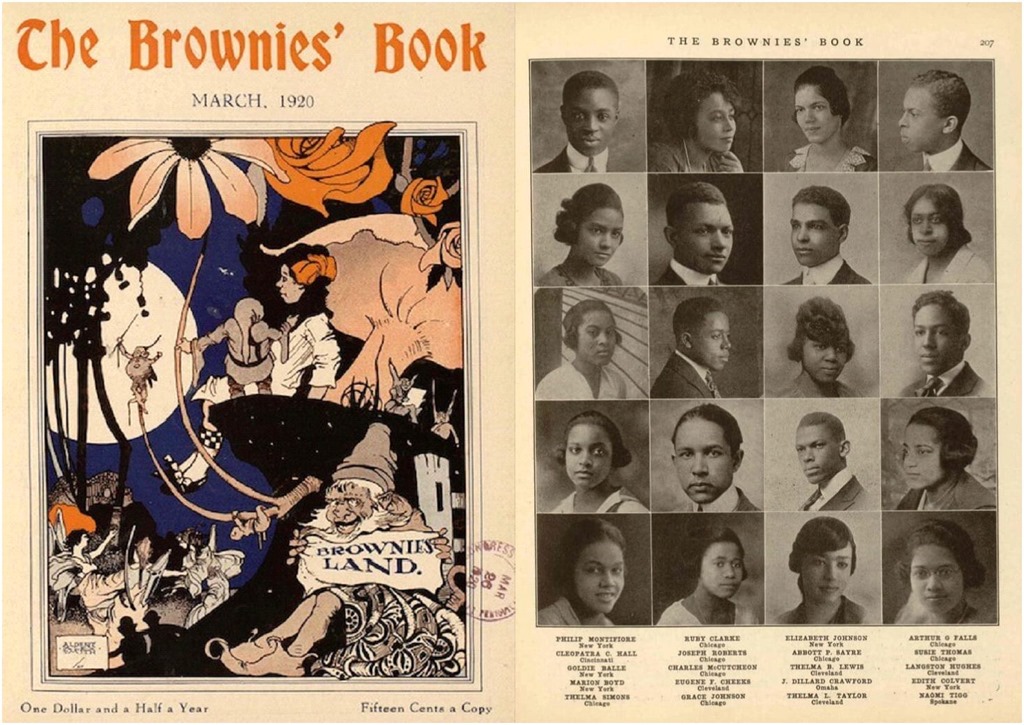
But wait, not only is this a poem about springtime, it’s a children’s poem written for Du Bois’ children’s magazine The Brownies’ Book. I first learned about this pioneering publication for Afro-American children at the My Life 100 Years Ago blog, which among other things often covers what was happening with magazines of that era.
Hughes himself wrote today’s poem when he was a teenager, and The Brownies’ Book was the first publication to publish his poetry. “April Rain Song” is a charming poem, and in rhythm and poetic tactics it reminds me of Carl Sandburg, a fellow Midwesterner whose writing influenced the young Hughes. Here’s a link to the text of Hughes’ poem if you want to follow along.
Check out the high school graduate in far right middle row. Yup, that’s Langston Hughes.
.
It’s been April rainy the past two days in my city, so working on making “April Rain Song” a Parlando Project piece had overcast and setting. Hughes here shows me a mode I sometimes aim for: it’s a nature poem, but specifically set in a city, not in some rural nature. The rain meets sidewalks and street-gutters, not some Eden.
Rain, specifically spring rain, has a strong memory element for me. Perhaps you share this? Outside in rain I’ll often recall other wet spring days, watching from the current distance my child-self walking beside miniature gutter rivers, observing for no particular reason their sweep around last years’ leaves and last winter’s final dusky ice clumps. Or perhaps you recall a particular roof on which fell our general rain? Was Langston Hughes too young yet to have that experience of memory when he wrote this poem? I cannot say, but I have that now, and so I add a bit of wistfulness to his words today.
The river of history runs only in one direction.* And so on our river journey, the Modernist poetic landmark “The Waste Land” will arrive, and stopping and resting on the landing there will mark us as well past the headwaters, and our memories will diminish of the headwaters, even if the very water that carries our boats flows from there. T. S. Eliot wrote many letters and critical essays, he must have written somewhere about his American poetic forbearers — but if so, the spotty scholar writing this is so far unaware of what he said.
If one searches on that subject, one will see many mentions of Eliot’s Modernism supplanting the American 19th century New England worthies headed up by one Henry Wadsworth Longfellow. And then something else might turn up, like this deserves-to-be-better-known sonnet of Longfellow’s titled “Eliot’s Oak.”Here’s a link to the text if you’d like to follow along.
If we largely forget Longfellow these days, we tend to forget Longfellow the writer of short lyric poems to an even greater extent. If this sonnet had been attributed to Keats or Shelley, it would be no less antique in some of its usage, but I suspect it would be better remembered and rated for achievement. Besides the “speakest,” “days remote,” “eventide,” and “hath” language, its chief crust of old-fashionedness is its use of the pathetic fallacy, where a tree is addressed and converses in the poem. We’d forgive Keats and Shelly for this, where we likely won’t forgive Longfellow. If we allow that bald-faced metaphor to pass, we might notice that the imagery in the poem develops in an admirably subtle way. In the sound of the tree’s leaves the poem hears a variety of sounds whose meaning is just out of reach, and masterfully Longfellow transitions to say that different people will hear different nearly intelligible languages in this sound. Am I stretching this conceit’s move too much to say that this 1876 poem has just sought to impress upon us a key tenet of cultural Modernism?
As Longfellow’s sonnet reaches its turn for a final six lines, we are forced, as much as we might be in parts of “The Waste Land,” to seek out what is being referred to. With “The Waste Land,” it wouldn’t be extraordinary to believe that some of the readers of this blog would have some knowledge of Richard Wagner, Jacobean drama, Metaphysical poets, or Ovid; and it’s even more likely today that some here would have some understanding of Hindu religious thought and writings, which will get called out in the upcoming concluding sections. But, do any of you know of the “Apostle of the Indians, Eliot…” Longfellow speaks of, what this story means, and how dark it is? I didn’t.
The Eliot Oak still stood in Longfellow’s time, and long enough for a trolley line to run past it.
.
In the 17th century, the Puritans who founded the European colonization of Massachusetts included this stalwart preacher John Eliot who came to believe that he was called to preach to the indigenous Algonquin tribes there. The Puritans had a strong streak of religious zealotry, and given that and the commercial interests of colonization, many regarded the natives of their new colony has the devil’s savage minions. John Eliot believed them to be merely unconverted fellow humans.** As Longfellow’s poem indicates in his Biblical allusion in lines 10-11, Eliot views the indigenous as fellow members of the Abrahamic family, potential “people of the book.” At first, all this was only a philosophical/theological debate. Eliot was allowed to learn their language, preach Christianity to them, and form somewhat autonomous villages of “praying Indians.” In an act of superhuman intellectual and literary effort he managed to translate the entire Christian Bible into their native language. Just this massive translation alone would be remarkable, but these tribes had no written language, so he had to devise a way to use the western alphabet to depict it. Nor was it an easy job to then print the resulting Bible: the press had to be imported, and the work of setting the type and printing was not trivial either. Eliot headed this project, but it should also be noted that the first nations people who worked with him were indispensable.
The resulting book, in a first edition of 1000, Mamusse Wunneetupanatamwe Up-Biblum God, wasn’t just the first time anyone had created a new written language to publish a Bible, it was the first Bible to be printed in what would later become the United States.
Now of course the whole issue of evangelical Christianity and native cultures is a complex subject. Even those of you who do not know John Eliot’s particular story will include some who know some of the harmful incidents in such matters. Yes, this story gets dark, but there’s also a strange redeeming element in the end too.
In 1675 some of the Algonquins began a three-year uprising against the colonialists, leading to what was called King Phillips’ War. It makes no difference that Eliot’s converts are co-religionists of the colonialists or if they have any allegiance to the rebels. The very fact that many of them are now fluent in the native languages and English makes any of them prime suspects as spies and informants by both sides. Some of Eliot’s converts are killed, and the rest are shipped off to a concentration camp where many starve, despite Eliot’s efforts. Oh, and most copies of the Eliot bible are deliberately destroyed. Those theological debates have become warfare.
I promised there would be a ray of light in this. I’m not sure this had happened yet when Longfellow wrote his poem — and if so, he prophecies it in the poem’s last line — but in the ensuing colonial disaster inflicted on the native peoples, their language was wiped out. People still existed who were descendants of this Algonquin tribe, but they could not speak it’s Wampanoag language. Surviving copies of Eliot’s Bible become the Rosetta Stone that allows the language to be revived.
The same year Longfellow wrote his poem a memorial on a spot where Eliot preached to the Algonquin was built. I wondered through Google Streetview to find it still stands, though it looks ignored.
.
In summary, as you listen to today’s audio piece, it may just seem like a facile little ditty about a talking tree and this, whatever Eliot,*** who isn’t even T. S. Eliot. Understand what its images and references point to, and it’s a memento of one of the least-known and most-impressive American literary achievements and a link to the complex tragedy of some who hoped to turn in some way from genocide. Perhaps it’s the romantic in me, but consider some of the lost or just unheard stories of the land we live on during this #NationalPoetryMonth, the lips that spoke them, the hearts that heard them. The river of history may run in one direction — but go ahead, make a fool of yourself, and listen to the trees. Or listen first or second to my performance of Longfellow’s “Eliot’s Oak.” You can use the player gadget if you see it below, or this highlighted hyperlink will open a new tab or window to play it too.
***So, is John Eliot related to T. S. Eliot? I don’t have a family tree or other such documentation, but it’s highly likely. Eliot’s family was known to descend from early Puritan colonists.
It’s time to wrap up our National Poetry Month celebration, and once more I’m going to present a piece where I wrote the words as well as the music, a piece in celebration of the unpredictability of poetic genius. In the “Song of Myself” section I presented a few days back, Whitman proclaims that America contains multitudes, plain and profound things, contradictions—and furthermore that everyone of us can contain all and each of that.
And by Whitman’s time we had Emily Dickinson, born a free white woman in a prosperous household, yes, but not yet in a time when those of her gender could hold for the power of her own mind. Her grandfather, her father, her brother all made and read the law, but she fully became Shelley’s unacknowledged legislator of the world.
In all the oppressions and focused indifference of America and the world, humankind still has these poets. Let us wonder and rejoice in them—and also those living now—who, whatever their given lot in life, open themselves to a blessed consciousness and find someway to convey it to us.
Speaking now of my poem that makes up today’s text: I think I called it a Confucian ode not only because I tried to use whatever understanding I have of how Li Bai and Du Fu expressed themselves in 8th century China, but in the sense that the much older odes collected by the school of Confucius were intended to instruct society as a whole, not just serve as an anthology for other poets.
Here the text of today’s piece. Classical Chinese poems don’t use punctuation either.
The process of explaining poems can suffer from the explaining the joke or speaking about music dangers. But since I have a passing acquaintance with this poem’s author, let me say a few words about my intent this time. In the first stanza, I note the priors from which our three poets came: William Blake’s father was a hozier, a maker of socks,* Emily Dickinson, as we’ve already discussed was the daughter of a lawyer, and Walt Whitman’s father was a house carpenter.
If poetic accomplishment was a matter of instruction, none of them would have stood a chance. Of course, there are other poets with fine educations, and poets whose households were steeped in literary culture and expectations; but in the area of poetry, they historically stand side by side with these of more modest backgrounds.
Pound has a point. I too think Whitman could have used a good editor, though perhaps then he wouldn’t be Whitman, so capable of maddening us to contradiction with his excess. In this year’s portion of “The Waste Land,” “Death by Water,” editor Pound took the exceedingly well-educated Eliot’s lengthy tale of a shipwreck and drowning and carved out the sharpened epitaph we now know, that I could present this month. So, in the second stanza I make my bow to craft, and to those of us who help preserve and present the work and souls of poets. I speak of this craft and preservation as a container, much as the poets are containers for the blessed consciousness they open themselves up to receive.
In the third stanza, I make a new connection to the first two stanzas. I speak of those wealthy in this world, with fine socks and gloves, lawyers to take care of their contracts, and builders to make their towers. If you are an American these days, you may think I refer to a particular someone who puts his name on lots of tall buildings—but that name is writ in water. By such actions and pride they are saying the buildings are not the point, they—their selves—are what is contained in them.
If we’re labeling things, the top on the other side should say “noggin.”
I end the poem with another stanza and a final couplet, continuing to tie the preceding in. This is my attempt at the “music of thought” I speak about often when I speak of poetry: a power that finds harmonies in thoughts, images—rhymes in things not only in words. Why must we say and share our poetry? Because it’s not ours. In acts like the Parlando Project and histories of much, much more, humanity preserves and presents it, and celebrates it in National Poetry Month.
Yes, if we wrote it, we stayed still to write it down, practiced the discipline to convey what blessed consciousness may have conveyed to us, removed the words and other personal cruft that obscured it, cut the cord and buried the now shabby afterbirth. We share it, not because it is ours, but because it has worth.
Thank you for reading and listening, thank you for the kind words. Thanks to Dave, Heidi and Bert for helping make this project happen. April is ending, but May can be filled with poetry too, so follow this and spread the word. The player to hear my performance of “Confucian Ode on Blake, Dickinson, and Whitman” is below.
*And so, by way of a footnote, our April-born William Shakespeare’s father made gloves.
Is he joining me in celebrating National Poetry Month? Last week Bob Dylan released a new song called “I Contain Multitudes.” It’s pretty good, mixing the elegiac mood and the bittersweet blues. Like Dylan’s other new release, “Murder Most Foul” from earlier in the month, folks quickly swept through the lyrics to collect and note the allusions. They found that “I Contain Multitudes” has literary references mixed in with the musician and cultural touchstones. Poets William Blake and Edgar Allan Poe get name-checked.
But for some reason, the main poetic link Dylan seems to intend was missed in most of the early write-ups I read. The song’s refrain, which also supplies the title, is a line from Walt Whitman’s “Song of Myself.” We’re going to fix that today.
Over the years of this project I probably haven’t presented enough Whitman. He’s the indispensable ice-breaker of poetic Modernism, even for those that didn’t attempt to closely follow his style. By writing in free verse with no set line length, irregular meter, and no need to make the rhyming word, he freed poetry to be infinitely expansive and did for poetic music what Ornette Coleman and John Coltrane did for instrumental music. Once this idea of freedom was demonstrated, any number of other Modernist approaches eventually developed, some of which don’t directly bring Whitman to mind as a model, though that doesn’t mean that they didn’t benefit from his revolution.* And some subsequent writers did show the influence of Whitman’s characteristic word-music: Carl Sandburg, John Steinbeck, Woody Guthrie, Allen Ginsburg. Stop for a minute: all three of those writers—all examples where one can trace the lineage of Whitman easily—are influences on the language and expression of Bob Dylan. Whitman, like Dylan, loves the wide-ranging catalog, the linking of things plain and exotic, the workman’s comment and the sage’s koan.
So maybe it was time for Bob to give a nod to Walt—and for me to do so too.
I’ve chosen today to present the last two numbered poems in Whitman’s “Song of Myself.” Besides the “I contain multitudes” line, this selection also includes some other of Whitman’s most famous proclamations: “Do I contradict myself? Very well, then I contradict myself,” “I sound my barbaric yawp over the roofs of the world,” and “Look for me under your boot-soles.”
Barbaric Yawp in action: “Every atom belonging to me as good belongs to you.” Well, maybe if you take off the hat and remove your shirt Walt.
Although I approach Dylan’s age, yet somewhat in arrears, I’m not going for the old-man lope of Dylan’s recent songs today.** No. It’s time to rawk! My personal index-thought as I composed, arranged, and started to perform this was “Whitman as if done by Iggy*** and the Stooges.” As with many of my index-thoughts in this project, I missed the mark, but that’s OK, maybe I came close to the bulls-eye of another target nearby. Since I long for the sound of a loose and loud rock band in these days of social distance, I tried to make one myself for this piece, even attempting to duplicate the kind of thing my LYL Band partner Dave Moore might have played on piano when that was possible. My shelter in place partner Heidi Randen kicked in some backing vocals on the chorus. It took me to this morning to get a time when I could crank a guitar amp to get the feedback and speaker interaction for the Ron Ashton-style guitar solo, which I scheduled between my high-schooler’s interactive telelearning sessions.
As always, the next audio piece will likely be different than this one, so check back (or hit “follow”) to see what the Parlando Project does next during National Poetry Month.
*I believe that even poets who chose to write in rhymed and metrical forms after Whitman can benefit from his break. Formalism became a choice not an obligation.
In a sharp turn-about that shocked many in our nation’s capitol, the President today declared that poetry is an essential service that must remain open during the current pandemic emergency.
“People tell me, that may surprise you, but they do, they say, you know Mr. President your speech is very poetic. I’m told I’ve been compared to the great French poet Ubu Roi, and you know that’ll surprise a lot of the so-called elites who look down on the way I talk straight in several directions. And I hear that Andre Breton had some very good things to say about my campaign. That Andre Breton is a smart guy, and I hear he’s a doctor too, so it’s especially good to hear that he supports me these days.
The President also demonstrated there are plenty of ventilators, tests kits, and protective masks and gowns available.
Now this is odd, because I’ve been involved in other things, but I think I could have been a poet if I’d wanted to. A great one. Maybe I didn’t because I don’t have a big ego like a lot of those poets do. Someone showed me some poetry today, and it didn’t seem to get to the most important things. It seemed to be mostly about the poet themselves. I don’t know if I could do that. But poetry seems to be like that, so maybe I could. I dunno—poets look to what I do, and do the opposite maybe.
Oh, some folks are telling me that I need to get back to the declaration. All right. As you know, our country is going through some tough times. Sometimes they are in little rooms, not fine rooms like this one here, or the ones that you could write in at my hotels or resorts by the way. Great rooms. Big ones, you could put a lot of poetry in there. Stuck at home, and I hear that some of them write and read poetry in those rooms. So, it’s an essential service to social distancing. Even in the earliest days of social distancing I’m told poets across the country were happy to comply with the earlier, looser crowd size regulations of 50 people—some of them even asked if the authorities could go further and require 50 people to attend their readings.
The declaration. It says here that:
Read poetry out loud, at full voice, often, until this emergency is over. It’s good for your lung function. Sad poems will tell you your sorrow is not all the sorrow in the world. Love poems will tell you there is an invisible web of desire as important as gravity. Poems of joy will make you leap like Carl Sandburg’s goats in pastures of plenty. Poems will turn your eyes inside out so you can see with another heart, and hear its strange burbling music.’
That’s the stuff here they want me to say, but I suggest you wait until after I’m done talking to start with the poetry. Oh, and this guy tells me it’s National Poetry Month. Yes, I think so. I hereby declare poetry an essential service today, and every April 1st.”
Reached for comment, Andre Breton suggested that he could not comment at this time, being dead and all. But he referred us to this section of his Surrealist Manifesto as performed in English by the Parlando Project. He further added “Vous pouvez cliquer sur le gadget du lecteur ci-dessous pour l’entendre.”
It’s been quite the April here as we ramped up activity to celebrate U. S. National Poetry Month. A lot of effort and time on my part, but since this project is based on the joy one finds in looking and listening to something and seeing what the encounter brings out, it’s been fun for me. I hope some of that always self-replenishing curiosity comes across to you as you read and listen here.
Here’s some of what happened this month.
Most blog posts here ever, nearly a daily schedule! There are blogs, ones that try to do different things than this one, that can carry on at that level for an extended period, but it took quite a lot of effort considering this project’s goals.
I completed a #npm2019 goal of performing all of T. S. Eliot’s longest section of “The Waste Land,” “The Fire Sermon,” this month. I warned readers here that “The Waste Land” isn’t poetry comfort food, but as I dived in, looking for things I could connect with in order to perform it, I found some unexpected things.
Before I started this serial performance, I thought I might struggle with misogynist/other portrayals of the women in Eliot’s masterpiece, but instead I found more empathetic depth there. Yes, it’s a bleak world for all in “The Waste Land,” but I also got to experience a surprising amount of gender-blurring in the voices of “The Fire Sermon.”
In researching it this year I finally grasped the level of extensive sampling tactics used, where nearly every line references some prior artistic creation. I love an in-joke, the pendant in me rejoices in odd connections, but even as I came to better understand the sources I’ve left much of that out of my writing about it, because I believe the poem still communicates its experience out of the sound of juxtapositions and the variety of voices without one needing to know who first wrote the words or sang the songs Eliot drops into his poem. Considering hearing it this way: “The Waste Land” is a collage—you don’t have to know where the picture was clipped from to sense that you’re being asked to see unlike things next to each other.
With a T and a S and L-I-@ / Here to rock this mic with my alley rats / Think you’re a sick rhymer with a mad dose / I’ve been to a Swiss asylum and been diagnosed / Dis a soft Thames flow while I sing my song / you might end up drowned like that Phoenician / Peace (that passeth all understanding) Out!
And lastly, I’m grateful for the broad music-ness of the poem that let me use what I think was a nice variety of musical styles along with Eliot’s words. Eliot wrote “You are the music while the music lasts” and Stevie Wonder wrote “Music is what gives us memories, and the longer a song has existed in our lives, the more memories we have of it.” Eliot’s immediate experience of music is all over the poem. My task was to take those memories of another poet’s mind and to make them sound again.
Besides presenting a couple of poems by Emily Dickinson, I also enjoyed my “Roots of Emily Dickinson” series this April. Comparing Emily’s Bronte and Dickinson on hope was a great “aha!” moment for me. And Helen Hunt Jackson, who got skewered with a single funny scene in the recent Wild Nights with Emily film, was a fascinating background character to run across, and Jackson’s “Poppies on the Wheat” has been one of the most popular pieces here so far this spring.
Would Emily Dickinson’s and family’s wild nights have been tamer if Gloria Bell was their chaperone? Discuss.
The blog audience has grown in response to this additional content, with April’s unique page views far exceeding any previous month. Listenership to the audio pieces were up too, and this April will likely set a record for the most listened to as well, though by a narrower margin than blog views.
As a practical matter, the amount of time and effort I put into things this National Poetry Month in April can’t be sustained. Unlike most blogs this is a two-pronged effort, with the production of the audio pieces coming first and then the blog post follows. I write almost all of the music for the audio pieces and I play and record the majority of the instrumental parts. But after that’s done, I’ve only started because then it’s time to write something interesting or illuminating about my encounter with the texts. Your readership tells me I’m succeeding sometimes.
This May I’m going to start some work on re-doing my main music production space. This is going to involve a lot of work, much of which I’ll need to do myself. My goal is to make it an even more streamlined, organized and functioning space. This will predictably reduce the amount of new audio pieces here for an interval, but afterward I hope it’ll make it possible to return to our normal 8-10 or so new pieces a month schedule.
However, because we’ve been at this a long time, there’s a lot of material in the archives, over 330 pieces, so there’s things here you may not have encountered yet. I try to mix the well-known with the nearly unknown. You can take a flyer on someone you’ve never heard, use the search function on the blog, or just try a random dive into the archives going back to 2016. Thanks for reading. Thanks for listening. Thanks for the likes, the follows, and particularly thanks for the shares and the links!
A recent comment here by Mr. Steele has reminded me of this sonnet I wrote several years back. Part of the idea for the poem came from reading some theories about the earliest humans and what may have been the beginnings of human speech and art.
No one can say exactly when recognizably human speech began, or how sophisticated it became how quickly, or even when it became anatomically possible. DNA evidence has told us a lot of things in the last decade or so, but it apparently can’t answer this question, and bone and fossil evidence is hampered by the largely soft-tissue aspects of our voice boxes. Work with apes and other animals has suggested that they can learn fairly complex symbolic communication even if they don’t have the vocal chord apparatus to speak in a conventional sense, and of course animals do communicate sonically otherwise, from birdsong to the elaborate EDM-like sounds of marine mammals. Human brains with symbolic thought preceding human voice boxes could have communicated in other ways too, ways that might sound musical. Steele’s comment includes lots of links.
These stenciled handprints have been dated to Neanderthal times
One thing we do know about paleolithic age humans: they had a thing for handprints. Any child who’s made a Thanksgiving turkey by tracing their fingers, or any parent who’s received it, knows something of that art-form. Stone age people used a stencil method. A hand would be placed on a rock wall and a mouth would be filled with some ochre pigment which would be blown over the hand, leaving a negative stencil. The colorful drawings of hunted animals on cave walls may be striking artistic creations, but these handprints of humans who lived tens of thousands of years ago touch one—yes, I use that word deliberately.
And later, the written word. Here’s the text of my sonnet.
The poem opens by assuming that Neanderthals, who may not have had the ability to articulate speech, and who likely didn’t have projectile weapons, could have used silent hand signals when hunting. The poem closes by referring to a find which was first interpreted as evidence of a Neanderthal ritualized burial: a stone-age body’s bones mixed with flower pollen covered by a rock. I bring that into our times by using an altered phrase from the hymn “Amazing Grace” and wondering who may see our bone fragments mixed with flowers in an unimaginable future time.
This poem has never impacted anyone I’ve performed it for as much as it does me. It could be that few are interested in these earliest humans and the nature of their lives so long ago, and so this is a poor choice for an image, or that could be from other faults in its writing—but I get misty every time I perform it. To consider that someone, a creature more or less like me—who has the knowledge that they will someday die, who perhaps has no other way to say they were here, once—made a stencil of their hand maybe 50,000 years ago is moving to me. If I were to stand beside them while they were doing this, it would be certain that neither of us would have spoken language to discuss this. But we could both point to that hand, stenciled on the rock. That’s art.
How is everyone finding the increased frequency of posts so far this April?
It’s been extra effort for me, but I’m enjoying what I’m finding out as I encounter these poems and poets. and I hope that comes across to you the listeners and readers.
I’ve got a lot more planned for National Poetry Month 2019. We’ll return to our serialized performance of T. S. Eliot’s “The Waste Land” soon, and I’ve got additional stuff in what’s turning out to be a “Roots of Emily Dickinson” series as we look at another poet who inspired this Founding Mother of modern American poetry.
Besides looking at Poetry’s Greatest Hits and poets like Eliot and Dickinson that are too large to ever get around, we’re also going to look at some more of the unusual, lesser-known, and should be better-known works again. If we have time, there may even be something new that Dave Moore or I wrote ourselves.
Scenes of winter past: what is that thing bleeding some vital fluid outside my window?
What else? Some things I don’t know yet. This project is about exploration, and when you find one thing it often leads to another surprise. But you don’t have to wait, as there’s probably something to surprise you in the over 300 pieces available in our archives.
I’ll leave you today with the most listened too and liked audio piece of 2018, Emily Dickinson’s “We Grow Accustomed to the Dark.” first released here last February.





 Frank Hudson