Beloved

Here’s a short piece I wrote about the intimacy of sound. Part of the idea I used for this came from a remark Bobby McFerrin made about music: that we hear it because waves of sound touch a sensitive membrane inside our ear. How intimate is that!

McFerrin and Ear Drum

Talking. Drum. Musician Bobby McFerrin and that tiny ear drum membrane that sound touches

Anatomically speaking, there is an accuracy there, but some would clarify, speaking strictly, that the brain is what gives us the sound we perceive, just as it does the seeing and so forth. Philosophers would also tell us that this distinction is important. They have made their case elsewhere, and I will not reiterate that here now.

There is a view that poetry too is about mental images. No doubt this is so. Language is full of strange ways of meaning to be understood. But all these exact pieces of information shouldn’t lead us to forget McFarrin’s point: when spoken, it’s still a sensual act. We hear poetry as information to some degree, but we hear it also as a musical sensation.

Our world is filled with information. We can sort it forever for meaning. But the feeling of our beloved’s voice on our ear is more than information or imagery. So is music. So is poetry.

Posts may be somewhat farther apart this month, but I remind you that we have well over 200 audio pieces available in our archives over on the right, where they are waiting for further listening.

A Small Puzzle in William Blake’s America, A Prophecy

I’m often fascinated by things that touch the material we use here. Where there’s William Blake, there’s often some mystery, and in reading Blake’s America, A Prophecy,  one small, seemingly mundane thing intrigued me. Several times, in parts of the poem I didn’t use in the selection the LYL Band performed for Independence Day, Blake names real, not spiritual, beings who he views as central figures in the American Revolution from his vantage point across the Atlantic.

Right near the start, in line 4 of his poem, he has it that “Washington, Franklin, Paine and Warren, Gates, Hancock, and Green meet on the coast glowing with blood…” and later “there stands Washington, and Paine, and Warren…” and finally “Washington, Franklin, Paine, and Warren, Allen, Gates and Lee…heard the voice of Albion’s Angel…” For some readers, this would just be a mundane list of names.

This article is for the other kind.

As a grade-school kid, even before I became enamored of poetry, I was a history buff. Washington and Franklin would easily have been known to those following the American Revolution, even across the sea. Paine, would be Tom Paine, who, while not a general or rebel government officer, was a chief propagandist/agitator who traveled to England and Europe to spread the new republican message. Political radicals like Blake would certainly have known of him, and the two writers shared London connections and may have even met. Lee, would be Henry “Light-Horse” Lee, who was both a cavalry officer in the Revolutionary army and an important politician in the American congress. Gates, was Horatio Gates, a General in the American forces. Green, is likely just a typo for Nathanael Greene, another important General on the American side. Allen, would be Ethan Allen, known as a resourceful commander for the colonists’ side in New England. Hancock, he of the big signature on the Declaration of Independence, was a leader in the colonial congress.

Nothing all that shocking in this list of American Revolutionary principals then, and it shows that Blake was at least following those American events, not just communing with his angel visions.

But, there’s one thing that bothered me, and I couldn’t let it go. Who was “Warren?”

If you search on Warren and American Revolution you’ll hit on a remarkable man who was not known to me before wondering about this: Joseph Warren. A Harvard educated physician, he was a leader in the leading rebel center of Boston Massachusetts. Poet Longfellow made Paul Revere and his ride before the dawn of the first battle of the Revolution famous, but it was Warren who sent him to warn Concord that the British were coming.

How did he know that the redcoats were going to make a secret move to round up the leaders of the opposition to British rule? He may have gleaned the info from the wife of the of British commander Thomas Gage. And if you want to follow another rumor, there may have been a little side-action going on between the handsome rebel leader and the British commander’s wife.

Warren fought in those first skirmishes, and when the first pitched battle in the Boston area was forming, Warren (who now had been newly commissioned as a General) deferred to other men in the rebel army who had military experience to lead in the upcoming battle of Bunker Hill. Instead, he asked to fight as a private in the forces. Serving as such, on the front line, he was killed at that battle at age 34. Some who knew him said, that had Joseph Warren lived,  he had the charisma and talents to have out-shown even George Washington.

What a story! And one unknown to me until I thought of looking into that bothersome name in William Blake’s poem.

But, he’s not the only candidate. Joseph Warren died early in the Revolution. He was well known to the British authorities in Boston, but I’m unsure how well known he was in England or to Blake’s radical circle in London. “Warren,” Joseph Warren, is listed as the author of the “Suffolk Resolves” a 1774 public repudiation and refusal to abide by the “Intolerable Acts” made by a Massachusetts organization resisting British rule, and this declaration did receive some notice in England.

There’s another candidate, with connection to Blake’s circle, even though Mercy Otis Warren is, if anything, more obscure than Joseph Warren. Apparently, these two Warren’s are not related, though both were living in colonial Massachusetts. Oh, and Mercy was a woman.

Two Warrens

Too-little-known patriots: Joseph Warren and Marcy Otis Warren


I’ve already mentioned that Massachusetts was a hot-bed of resistance to British rule. Mercy was also in the center of those efforts. If one thinks of current political efforts being organized via social media, the 18th Century colonists used good old postal letters to do the same thing, and Mercy Otis Warren was a leader in these Committees of Correspondence. As a woman in that time and place, there was no official position in the colonial government or military forces, but as a writer she was prolific in attacking the offenses of British rule, writing satiric plays, patriotic songs, and pamphlets extoling the cause. Mercy Otis Warren remained a staunch republican after the end of the Revolution, being one of the hard-liners who opposed adopting the Constitution without a Bill of Rights. In 1805, after Blake had published his America poem, Warren published one of the earliest substantial histories of the American Revolution where she warned against authoritarian elements in the Federalist party.

Noting that Blake always placed Warren next to Paine in his lists, I wondered if Mercy Otis Warren was his Warren, as the two were like as polemicists rather than government or military officers, and both wrote of a broad definition of the rights of man. Blake’s late 18th Century London radical circles included a writer and early British feminist Catharine Macaulay who was a friend of the American Mercy Otis Warren. That Blake seems to link women’s emancipation with an end to slavery and colonial oppression in America, A Prophecy  caused me to think that just maybe this woman was his Warren. I even found an article in the University of Bucharest Review from 2013 where its author Ruxandra Topor states that Blake’s Warren is Mercy. The author doesn’t say why they believe this, but so far that’s the single published identification of Blake’s Warren that I’ve found.

However, the vast majority of Mercy Otis Warren’s published revolutionary writing was done anonymously or under pseudonyms. Though she did publish one collection of writing under her own name in America two years before Blake engraved his book, it seems unlikely Blake would have known her name in 1793. Still, she may have been akin to Paine in her thoughts and actions, and like Paine, she had an ex-officio importance to the Revolution. Remarkably, she may have done all that, risking all for her country despite an 18th Century glass ceiling—and she’s someone else that I first heard about because of this list of names in Blake’s poem.

America, A Prophecy

July 4th is celebrated in the U. S. as Independence Day, the day that our congress signed a declaration of independence from the British Empire. I know this project has an international audience. So, why celebrate a provincial event here?

Because the American Revolution was not simply a patriotic event. Ralph Waldo Emerson said that its initial battle was “the shot heard round the world.” What was so singular about it? It was not merely an anti-colonialist act—after all empires have had rebellious provinces forever, and empires always fall—but it was also an act that founded the modern democratic republic. Overthrowing a colonial government, as the American patriots did, is not in itself a remarkable event. I don’t mean to denigrate the sacrifices, the risks, they took. I don’t mean to overlook the evils inherent in armed struggle. I won’t today seek to re-litigate the proximate issues of the Revolutionary War, with its details of commercial interests (including, yes, commercial interests in human properties) and debate the best tactics for redress of grievances. No, those are all important, but they are not what makes the American Revolution worth our unique attention today.

signing the declaration

Silent thoughts in the room: What a fine statement of the Rights of Man we sign today! I hope they wrap this up before traffic on the turnpike gets crazy. None of my slaves have learned to read, right? Why am I the only one wearing a hat? I can’t get tickets to Hamilton? I am Hamilton!  All middle-age white guys, when does the prog-rock concert start?


Americans did not replace a king with a president for life. They didn’t exchange one dictator for another. They were not, in the end, interested in only replacing a bad man with what seemed to be a good man, and job-done. They instead instituted an imperfect, constantly challenged and constantly changing structure based on human rights and rule by reason and popular consent. The struggles, the risks of the Revolutionary generation were indeed great, but they pale in contrast to the struggles and risks born by the successor generations who sought to maintain and improve those structures. So, this is not a holiday honoring a person, a generation, or a concluding event, but instead, it is one marking a beginning.

Today’s piece was not written by an American, but by an Englishman who followed those revolutionary 18th Century events, but dealt with them on a spiritual plane: William Blake. The words come from his self-created 1793 book America, A Prophecy,  which he wrote, lettered, illustrated, and printed himself. It’s not an account of the actual battles, and its characters are largely his own imaginary beings, but he never lets his visionary eye fall away from what he sees as the core struggle in the events. It’s spiritual—not in sense of its fantastic stage—but in the sense of its divining the essence of the battle: human beings being held back from their potential and dignity by corrupt structures.

America_a_Prophecy_copy_a_plate_08

A plate from William Blake presenting part of today’s song


In our worldly plane, the men who signed that declaration were all men, all white men, mostly men of property, and yes, we should remember that some of those men of property’s properties were indeed other men, women, and children. Blake explicitly understood that. In his prophecy, the essence that they are declaring for, the angelic forces that cry for freedom and dignity are for all nations, for all genders. If the American structure had to struggle for generations to refuse slavery and give full citizenship to women, Blake says that, in essence, and in the philosophy of their republican structures and statements, they have already declared those evils as tyranny, even if they don’t perceive that yet.

It’s almost a reverse Faustian bargain, isn’t it? Instead of the devil tricking them to eternal slavery, freedom’s angels have them agreeing to dissolve their allegiance to a bad king—but the codicils they have signed declare for more than that! They’ve put their lives on the line to declare that humans have inalienable rights and that governments must work with the consent of the governed. How entirely can they understand what that entails? July 4th 1776 is a Thursday. Some are no doubt thinking of Friday; the men of foresight, to the possible course of the rest of the war; the wisest, perhaps, are thinking, of what, a generation ahead?

The sections I use from William Blake’s America, A Prophecy  are spoken by an angelic character he calls Orc, who personifies the overturning of the old tyrannies. With the limits of our short-piece format I’ve tried to give some flavor of what Blake understood was being overturned by the American Revolution. Musically, it’s a simple structure, though not the most common of chord progressions.  I tried to chant Blake’s words with as much passion as I could in this one-take performance by the LYL Band. If you are in the U. S., enjoy your cylindrical explosives and tubular sausages, but do not mix the two things up. Their shapes are similar, but keep your mind on their essences. The performance of an excerpt from William Blake’s America, A Prophecy  can be played with the gadget below.


The Apotheosis of Harlan Ellison

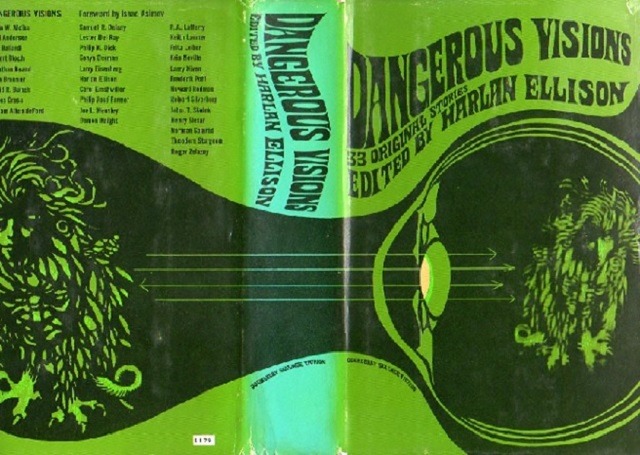
I’m not a fully-qualified Science/Speculative Fiction fan, though I did read it when I ran into it as a young man. Dave Moore, whose voice, songs and keyboard playing you’ll hear from time to time here, read more of it. I’m not sure if Dave introduced me to Harlan Ellison’s work, but my memory is that he did loan me a copy of Dangerous Visions  back in the Sixties. In that 1967 anthology, Ellison made the case that SF was the heir to a Modernist tradition of fiction using outrageous and unique situations—he was claiming SF could be more Kafka than L. Sprague de Camp.

It’s unlikely he was the only person thinking along those lines, but he certainly helped to popularize the idea at a time when an aging generation of SF writers, steeped in pulp magazines and cents-per-word paychecks were in danger of losing touch with the younger post-WWII generation who were more likely to be college educated and experienced in some chemically enhanced inner-space traveling.

Dangerous Visions cover

Used copies may have slight foxing (or are they cannabis stains?)


Ellison was an any-world-class curmudgeon. His non-fiction writing is full of enthusiasms and invective, with almost no middle ground. At times he reminds me of another late 20th Century artist/social critic: Frank Zappa. Both of them liked to remark that “The two most common elements in the universe are hydrogen and stupidity.” Over the course of his career Ellison seemed to transform from a US-born angry young man punching mostly up to a more generalized misanthropy, where at appearances he would sometimes riff like an insult comic. He once called my late wife who he had just met at an event, “Cathy Carbohydrate.”

These two things worked together. SF had always had a darker side, and the border between it and the gothic strain of fantasy or noir-ish mystery was crossed back and forth often. I believe a utopian, Transcendentalist wing of SF remains, but the terms SF and dystopia now seem to follow one another almost automatically.

Is this the artists’ fault or ours? A large question that.

Thursday night I read that Harlan Ellison had died. Friday I was booked to record with Dave. Friday morning, as I slept, I dreamed that Dave was showing me a binder full of typed manuscripts of stories he had written. As he flipped the pages I read parts of the stories. In style, they were the sort of thing a teenager just starting out would have written, so in the dream’s timeline they would have been written in the Sixties. In the dream, Dave, after learning of Ellison’s death, was telling me that Harlan Ellison had looked over these stories, and that Ellison didn’t like them very much, though he thought the last one had some promise. There was a short, encouraging note from Ellison scrawled in the margin on a page in the story. As I glanced up toward the middle of the page, I saw some dialog in which a character in the story was saying something. The character in this non-existent dream-story was named Octavia Butler.

Now I remind you: this is a dream. Dave never had Ellison critique any early stories he wrote. In the dream, these stories existed, in the waking world they don’t. But here’s the funny thing. I told you at the start that I’m not a fully-qualified SF fan. If you had mentioned Octavia Butler to me on Friday, the only impression I would have was that she was a writer. I wouldn’t have been able to name any of her work or have been able to place her in a genre. In the dream, I just thought it odd that Dave was using a writer’s name as a character in a story that the dream had had him writing 50 years ago. I was about to ask him why, when I woke up.

octavia-butler

Octavia Butler, before or after she was in my dream


I biked off for breakfast and hurriedly came back to write the piece you can listen to below.  Looking for info I might use in my song, I searched on Octavia Butler. In the Sixties, Butler was a young, unsure author, fearing that she was too “ugly and stupid, clumsy, and socially hopeless.” While she was still in school, Harlan Ellison, this man with a reputation as a scouring critic, had told her she had promise and should go to the Clarion Conference and present her work there, a suggestion that lead to her first publication in 1971.

Nothing there I could use in the song as it turns out, but strangely this was also nothing I knew when I had dreamed that dream early in the morning. I did use one bit I found in my searching: an interview with my former co-worker John Rabe that revealed that Ellison was still using a typewriter as his writing machine in the 21st Century. I thought of those older generation pulp writers and their per-word paychecks.

That afternoon, Dave and I recorded “The Apotheosis of Harlan Ellison.”  It turned out that in the waking world, Dave had not heard yet that Ellison had died. The player gadget below will let you hear it—though not on your typewriter.

The Poet to Death

Here’s a short piece using a poem by a person who started out as a poet but who spent the greater part of her life working for her country, India’s, independence: Sarojini Naidu.

Sarojini Naidu, like Edna St. Vincent Millay around the same time in the U. S., impressed people as a capable poet while still a teenager. Her talents lead to her being sent abroad to England for college, and eventually she connected with the Rhymer’s Club, the turn of the century London organization that was the last stop in the 19th Century for some of the poets who would launch the poetry of the 20th century.

Today’s piece, “The Poet to Death”  was first published in England as part of Naidu’s initial collection of poetry The Golden Threshold  in 1905. Fluent in several languages, the pieces in The Golden Threshold  are in Naidu’s own English. Some accounts say that the young Sarojini was modest about her poetry at the time, worried that her work was less-substantial because it is lyrical and song-like; and retroactively English-language Modernism did discount that sort of poetic gift. So, while her poetic work is still remembered in her homeland, where Wikipedia says she’s called the “Nightingale of India,” Sarojini Naidu will be a new name to most of our reader/listeners.

During the WWI years Naidu transferred her focus from poetry to working for Indian independence, a cause in which she became a principal, alongside Gandhi and the other independence leaders.

Did the world loose a poet for India to gain its independence? Perhaps. I do not know enough to say. In her English poetry, I can see the influence of the earlier 19th Century English romantics, but her language is less extravagant. She can remind me at times of Christina Rossetti (readers here will know I consider that a good thing), and “The Poet to Death”  is a concise version of a trope Keats used as well.

Sarojini Naidu Real Folk Blues

India gave us chess. Chicago gave us Muddy Waters on Chess records.


Today’s music employs a polyrhythmic blues. Perhaps I was subconsciously moved by the “till I am satisfied” line in Naidu’s poem to think of Muddy Waters and his “I can’t be satisfied,” though what I ended up playing has some elements of Skip James’ guitar style too. At a conscious level, I was working on this while thinking of poet Donald Hall, having read a review of his new collection of essays coming out this month, and then hearing later in the same day that he had died at age 89. In his last couple of decades, Hall has often written of what continues until it ends in the course of aging.

Donald Hall
Donald Hall. His book of essays “A Carnival of Losses: Notes Nearing Ninety” drops in July.


For some reason the version of the text I worked with did not have Naidu’s first stanza, which specifically speaks, as a younger poet, for death to stay his hand. In the remaining two stanzas, the age of the speaker is less determined, and so the situation is joined whether it is a young poet or old. The blossoms are always there a short time, at any age.

To hear my performance of Sarojini Naidu’s “The Poet to Death,”  use the player below.

A Visit from the Angels

Back more than 200 years ago, poet, painter, engraver and mystic William Blake was reported to be conversing with angels in English trees. Last episode we had William Carlos Williams celebrating celebrity scientist Einstein in a blooming New Jersey night early in the 20th Century. Today we have Dave Moore in his backyard garden in Minnesota in our present century.

Blake Angels on spiral

William Blake illustration of Dave’s Minneapolis garden night, sort of.

Is this poetry, song, or story-telling? It might be a little bit of all of them, but then labels are just sticky paper. Let me refrain this time from talking so much about the piece, but I encourage you to just listen to the LYL Band and Dave Moore tell the story. Use the player gadget below to hear it, or this highlighted hyperlink.

St. Francis Einstein of the Daffodils

Metaphor, that stuff that helps make the music of thought in poetry, is the linking or liking of things. This is like that. This stands for that. The sensation of this is like the sensation of that. This reminds us of something else. The way I say this recalls the way one says that. Metaphor recombines the stuff of our world even though it’s a combination that only exists in the imagination.

Metaphor can make something clearer to an audience. It’s so useful in that way that one can barely explain anything challenging to an audience, even in the most prosaic day-to-day business world, without falling into metaphor. In poetry however, the bounds of increased clarity can be stretched, broken, and abandoned. Depending on one’s mood as a reader, this can be frustrating or a pleasing play of the mind. With the Parlando Project we perform the poems with music. One hope from this is that you can relax and let the beauty or strangeness of the words carry you over gaps in meaning. Sometimes you can enjoy a poem before you understand it.

William Carlos Williams who wrote the words in today’s piece, gives us Spring weather with Spring flowers and fruit blossoms, gardens and orchards, and all under a title that combines a famous saint with his era’s most famous scientist. He gives us almost no help in combining that title with the poem, other than yoking them together. The linkage of metaphor is much strained here, even when he further explains his title by adding a sub-title: “On the first visit of Professor Einstein to the United States in the spring of 1921.”

How are we to make the connection that will construct the metaphor?

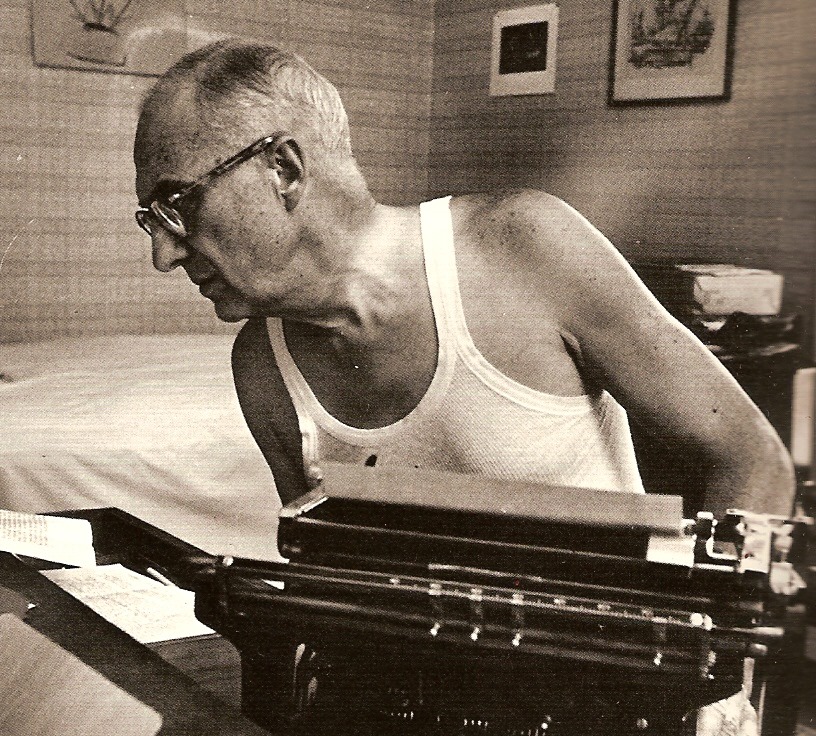
William Carlos Williams with typewriter

Just another hipster with his typewriter. William Carlos Williams throws off his covers.


My best understanding so far is that the connection is wonder and change. Recall our last post, where in his “Queen Mab”  Percy Bysshe Shelley, the Romantic early-19th Century poet, gave us a vision of the wonder of an immense cosmos, which Shelley’s own notes tell us he could also sense through the poetic/mathematical meter of the speed of light. The theoretical scientist and the visionary poet each seek to grasp some new metaphor of the world. Einstein was changing physics in the time that Williams and his fellow Modernists were seeking to change the apparatus of art. Williams elaborates on this theme mostly by vivid descriptions of the change of Spring. In the only mention of Einstein in the body of the poem, Einstein is “tall as a violet.” He is the Spring’s new growth.

There are a couple of obscure literary references in one section, the sort of thing T. S. Eliot or his imitators would have used. Who is “Samos, dead and buried?” I’m not sure, but my guess is that it’s Pythagoras of Samos, the famous classical Greek philosopher for whom science and the arts were one. And Lesbia? Catullus’ Roman poetic beloved, who we’ve met here in Elizabethan guise. It may be enough that they have ancient sounding names, and of such ancient classical modes, Williams, who is in some ways the Anti-T. S. Eliot, says “Sing of it no longer.” He moves right back into a present day of Spring. Pythagoras is dead, Catullus’ Lesbia is dead, and so is a black cat buried in a newly planted garden. Awhile later in the poem we may get one more connection to that cat part of this buried trio. A chicken-raising man who puts out poisoned fish-heads to keep the cats from his chickens. That man becomes like the Modernists, needing to kill the ancients to protect the new flock he’s raising.

As a side note, this poem’s chicken farmer, the white-haired negro, was quite likely the man whose rain-glistened red wheelbarrow sat next to the white chickens in William’s famous poem of admiration.

The poem closes with a sensuous image of Spring change, a night that grows warm as an orchard owner opens his windows and throws off the covers that were needed in the cold. In an earlier version of the poem, Williams had woven Einstein by name in and out of those Spring images explicitly, including this last one where Einstein was named as that man with the blossoming orchard, another grower of renewed things. In this later version, all these stated links to Einstein are removed (save for that one Einstein as a violet).

Professor Einstein Narcissus

Not a violet, but the “Professor Einstein Narcissus.” Has “great curb appeal” and “deer won’t eat” says this garden center.


Was that a right choice? The resulting poem is shorter and more mysterious, but it also doesn’t make it easy to see what Williams is getting at. He’s using metaphor, but he’s removed all the connections. I decided to perform the later version. I think it performs slightly better, and perhaps the music makes the obscurities less taunting.

A simple musical arrangement this time, just acoustic guitar and subdued electric bass. To hear my performance of William Carlos Williams’ “St. Francis Einstein of the Daffodils,”  use the player below.


From Queen Mab Canto II

It’s not often that we think of English Romantic poets along with science. We tend to think of them as pure examples, an engraved picture of an enraptured youth subject to the throws of inspiration, to be found next to the words “poet” or “fool” in a dictionary.

Percy Bysshe Shelley is no exception to this. In my mid-20th Century American school-days he was seated with the Romantics, and biographically some mention would be made of his notoriety during his lifetime, the matter of which would be ascribed with a summary of libertine sexual behavior in the Byron and Shelley households. I suspect many of those descriptions, brief and bloodless as they might have been, were attempts to woo additional interest in poetry from otherwise little-interested adolescents.

Part of the joy of this project is finding surprising things in poetry among the accidents and intents of looking for material. At the end of last week, I read of the memorial service held for physicist Stephen Hawking at Westminster Abbey.

Vangelis is going to stream a musical piece with Hawking’s famously synthesized voice out to the galaxies! Somewhere out there, the odds say, a curious alien will detect this light-years from now; though probabilities also say they will have likely forgotten to bring earbuds along on their saucer-ride.

And there were celebrities! Elgar, Stravinsky and Holst got played! The ticket application form allowed future birthdates, in case time-travelers wanted to apply to attend!

But reading on I find that astronaut Tim Peake read a bit of, what, Shelley. From “Queen Mab”  accounts said.

I find a copy of “Queen Mab.”  Turns out it’s another kind of Shelley from the school-book aesthete. “Queen Mab”  is a fairly long blank-verse epic, but I didn’t have to read far to find the parts you’d want to read for a cosmological tie-in. Right there in Canto II, Mab, the queen of the fairies, has Uber’ed up a human soul to her palace, which is more or less an atheist’s heaven, which is to say a philosophical location above the cosmos—and there, the human soul gets to observe the wonder of this perspective. Mind-blowingness ensues.

This is the kind of thing which visionary poets and scientists share, and that thing is wonder. Stacks of SciFi books would lift one nearly that high; but why couldn’t poetry, the literary artform best-suited to grasp tiny pieces of the un-graspable do that too?

percy_shelley

What if instead of sitting at a cave entrance, I was at a place of immense gravity, where even light falls into it? If I ever go back to England that’ll make a good bedtime story for little Ada, who’s always too busy using her wooden blocks to solve equations.


Here’s something else I found remarkable, a series of notes on the issues in the poem, written by Shelly, a young man of 18 in the early 19th Century. Here’s a portion of the first one:

Light consists either of vibrations propagated through a subtle medium, or of numerous minute particles repelled in all directions from the luminous body. Its velocity greatly exceeds that of any substance with which we are acquainted: observations on the eclipses of Jupiter’s satellites have demonstrated that light takes up no more than 8′ 7″ in passing from the sun to the earth, a distance of 95,000,000 miles.—Some idea may be gained of the immense distance of the fixed stars when it is computed that many years would elapse before light could reach this earth from the nearest of them; yet in one year light travels 5,422,400,000,000 miles, which is a distance 5,707,600 times greater than that of the sun from the earth.

I was an English major, I had to look this up. Shelley, or early 19th century science, was off several billion miles on the length of a light-year, and a couple of million miles off on earth-sun distance—hey, I knew that last measurement, though from an early-childhood advertising jingle. However, ask yourself, how likely would it be that the most facile poet in any first-year college creative-writing class be conversant in those measurements, and how they are empirically proved?

So, thanks Stephen Hawking, Tim Peake, and whoever planned that part of the Westminster Abbey internment service. I now think of Percy Bysshe Shelly differently.

Musically, I started by noting in Shelley’s poem the description of deep-space orbs “in mazy motion.” I thought immediately of Mazzy Star, that late 20th Century indie band. Does mazzy/mazy go back that far? Turns out that the word mazy was something of a English Romantic poet favorite. Wordsworth, Southey, and Keats all used the word. Coleridge used it in “Kubla Kahn.”  Mazzy Star is a band with a predominate sound, and though they have some great cuts with wild electric guitar, there’s more often a strummed acoustic guitar, a droning organ, and some occasional violin, all the songs are taken at a slow tempo and modest volume. The band’s lead singer,  Hope Sandoval, has a style that superficially sounds easy to do, but in practice isn’t, and so my singing skills deferred trying.

So, it’s spoken word, not sung, but here are those words of Shelley’s used this month to memorialize Stephen Hawking. Use the player below to hear it.


Plum Tree Blossoms on 40th Street

Today I step aside from our usual practice here, and present words I wrote. With opportunity, next week I should be able to return to “Other People’s Stories.”

“Plum Tree Blossoms on 40th Street”  was written recently, and includes elements of observations I made during a bike ride to school with my son in early May. In the course of writing the poem and revising it, I modified the events of that day. This is not unusual. The events of one’s own life have a fractal branching of meaningfulness that frustrate encapsulation. It may be useful to use those endless edges as perforations to tear away from all things remembered the shape of a poem.

I tested the revision before this one with a group of poet friends, and alas, it didn’t seem to work well for them. They were slightly puzzled why the speaker in the poem didn’t ask the child to stop and smell the blossoms, but altogether bewildered by the question (or the way I presented it) when the speaker asks near the end of the poem about memory being able to remember the smell of something overlooked in one’s past. That was useful information. They also made a very specific suggestion. Originally the blossoms had been tree blossoms, and though they were extravagantly fragrant on the morning that inspired the poem, I did not know in fact what kind of tree was bearing them. No matter, they suggested, it works better if you make them a specific tree.

Blossoming Plum Tree

OK, it was some kind of fruit tree blossoming, let’s make it a plum.


I read something once particularly wise regarding such honest critiques about one’s writing. It may have been from Kurt Vonnegut, or it may have been someone else, but the gist of it was that if good, honest, readers find a problem in a piece they are almost always right, even if they are often wrong about how to fix it. The suggestion to name the type of tree was simply right I thought, but how to deal with what they saw as the troublesome puzzle about memory?

What I was trying to suggest in my poem’s story was that we can indeed remember things retroactively. Things that were not noted at the time consciously, that were not filled out as if a contemporaneous diary as experienced, can still be recalled when we later find them important or precious. We do this partially from our subconscious, perhaps even from what the Transcendentalists would call the over-soul, but mostly this is augmented because our minds are great pattern makers, able to fill in gaps with all the other things we recall.

The readers who noted this as a problem were smart, perceptive people. They likely knew of this, but I still had perplexed them.

I could not remove this, for me it was the point of the poem. Sometimes, what folks most object to in a poem (or other art) is, paradoxically, why it needs to exist.

I made some slight changes in a couple of lines around that concluding question, hoping in this version to make this natural phenomenon of memory clearer, without hindering the “music of thought” as well as “music of words” that I think poetry should have. Maybe it works better now.

To hear my performance of “Plum Tree Blossoms on 40th Street”  use the player below.


The Hunter

A couple of mornings ago, I awoke after a night’s sleep, and as I took my bicycle out to the alley to ride off for breakfast, I was surprised to see the road dusted in torn blossoms and several small tree branches cast about on the wet ground.

While I had been still and sleeping, a storm must have come up.

That contrast, the stillness and the broken change is at the heart of today’s poem by William Carlos Williams, “The Hunter.”   Williams opens his poem with an allusive image. “In the flashes and black shadows of July.” Is this the lightning of a summer storm? I thought so at first. But it might be just what one sees lying on summer grass and looking up through the boughs of a tree. The whims of a breeze or the caprices of squirrels and birds on the thin branches will flutter the leaves’ fan of shade revealing the sun in a flash.

Yet, summer “seems still.” The animals of summer appear “at ease.” But what if there is danger in the world, as in the unmet character in the poem’s title, the hunter?

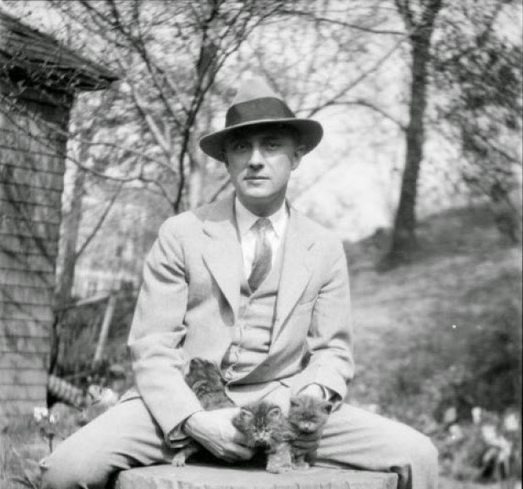
William Carlos Williams with Kittens2

In a last-ditch attempt to increase readership of his poetry, William Carlos Williams decided to try that Internet staple: cute kittens.


In Williams’ poem, the hunter does not appear, ready to shoot the game. The hunter is invisible, as the hunter is time, the hunter is change.

For today’s music I combined an orchestral ensemble and electric guitar with an appearance of a harpsichord.  The player gadget to hear my performance of “The Hunter”  is at the bottom of this post.

I’ve noted that there has been a steady listenership for the other William Carlos Williams poems posted in the archives lately, and that helped inspire me to look for more of his work to present. As we move into summer, I remind visitors that there are over 220 pieces available here. Use the search box or just wander through the monthly links on the right.