Blue Undershirts

Long time readers/listeners here know I like to look for the Modernist outliers and less-remembered poets, and today we have one of those: Orrick Johns. But as a bonus, today’s piece by Johns likely influenced one of the most famous American short modernist poems. So, we’re only one remove from “poetry’s greatest hits” with “Blue Undershirts.”

Orrick Johns has a Wikipedia page, but the project classifies it as “stub class,” and the article’s lead sentence claiming that Johns was part of “the literary group that included T. S. Eliot, F. Scott Fitzgerald, and Ernest Hemingway*” seems misleading to me from what little I know so far. If what the author of that meant was that Johns is a Modernist of the first generation, that would be correct, though he was not a novelist of note, nor a Lost Generation exile in Europe or (as far as I know) a close friend and artistic confidant of that trio.
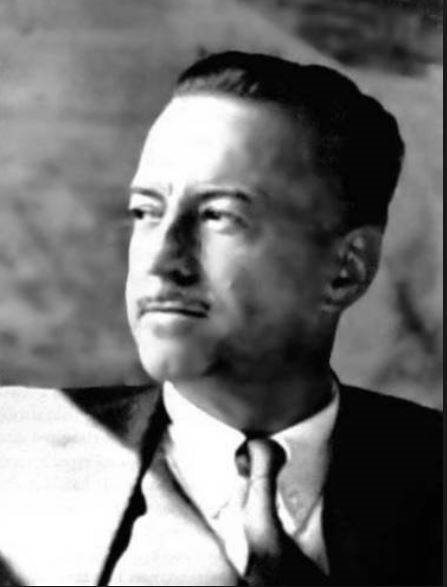
Orrick_Johns

The only picture I can find of Orrick Jones


Like Eliot, Johns was born in St. Louis, but I haven’t found any direct connection between them in my brief research. He did know St. Louis’ other most noteworthy poet of Eliot’s generation, Sara Teasdale though. If for no other reason that he was present in Greenwich Village in New York City during the early part of the 20th Century, he does turn and touch many other American Modernists. He eventually became a member of the American Communist Party later in the century, which no doubt connected him with others of that time who thought that a remedy for the crisis of capitalism, fascism and racism.

But for today, let’s look at how he and his little-known poem connects with William Carlos Williams. In 1915 Williams and Alfred Kreymborg were involved with Others: A Magazine of the New Verse,  a New Jersey headquartered, NYC-area journal that published many of the East Coast modernists. In its first year one of those published was Orrick Johns and a series of short poems in the then Modernist/Imagist style he called “Olives.”  Imagists were somewhat fond of small, mundane one-word objects as labels for poem series. Kreymborg called his own 1916 collection “Mushrooms,”  and so we know what the two of them would have ordered if they stopped off for pizza.**

There’s an element of provocation in “Olives,”  and though I don’t know John’s writing and outlook well, I can’t help but read a sense of humor in them. Some read as if they could be parodies of Imagist poems, even though Others,  being thoroughly Modernist, was in favor of Imagism.

Here’s the third poem in the “Olives”  sequence:

Oh, beautiful mind,

I lost it

In a lot of frying pans

And calendars and carpets

And beer bottles…

Oh, my beautiful mind!

That could be as serious as a modern Instagram poem, or it could be Don Marquis’ laughingstock fictional free-verse poet Fothergil Finch or Ficke, Seiffert and Bynner’s invented Spectrist characters’ work from 1916-17. Was there a meta/double-ness intended? In 1917 Others  published a “special issue” devoted to Ficke, Seiffert and Bynner’s Spectrist hoax “new poetic movement” poems. When the hoax was revealed, many Modernists like the Others group took the stance that these old-school poets had freed their minds when they wrote as invented authors with intent to mock the new styles.

Despite the caricatures of Modernist detractors, many early Modernists liked to make fun of themselves and recognized the outrageousness of what they were experimenting with. Was “Olives”  a Dada statement: “Look, this ephemera is as worthwhile as some long-winded, pro-forma imitation of Keats or Tennyson. At least it’s clearly of today, and doesn’t ask you to pretend to be some knight or medieval Latin scholar?” Or was Johns writing as best he could in the Imagist style, which valued stripping away fripperies and outdated metaphors, and presenting objects in a charged moment of time?

My best guess is both. And I could be wrong, even wrong twice.***

Here’s the piece I used today from “Olives,”  titled there “Blue Undershirts:”

Blue undershirts,

Upon a line,

It is not necessary to say to you

Anything about it—

What they do,

What they might do…blue undershirts

Does this sound like a famous William Carlos Williams poem?**** Did Amazon mess up your order for t-shirts, color: blue, sending you a red wheelbarrow instead—and what—there are white chickens in the box? I guess that’s what the air holes were for, even if they let some rain in when it was sitting on your doorstep.

Williams and Johns were both part of the Others circle, and there is the mysterious appearance of the first four lines of “Blue Undershirts”  quoted in Williams’ 1920 prologue to Kora in Hell  in the context of Williams claiming that Others  founder Alfred Kreymborg is superior to T. S. Eliot, because Williams observes that Eliot is too much recapitulating the past where Kreymborg and Williams believe:

“Nothing is good save the new. If a thing have novelty it stands intrinsically beside every other work of artistic excellence. If it have not that, no loveliness or heroic proportion or grand manner will save it. It will not be saved above all by an attenuated intellectuality.”

While writing this prologue, did Williams think that “Blue Undershirts”  was a Kreymborg poem? I can’t say, but that he prefers those lines of Johns to “Prufrock”  and Eliot says something by way of example.

So, in 1923 did William Carlos Williams have “Blue Undershirts”  in mind as he wrote “The Red Wheelbarrow?”  Again, I can’t say. Williams was already well versed in compressed Imagist writing and speaking in a plain American idiom, and the Others  circle was close enough that I’m sure all kinds of informal interchange occurred. From an abstract of his paper, it appears that Mark Hanna sees “Red Wheelbarrow”  as consciously seeking to be a version 2.0 improvement on Johns’ less graceful and vivid poem. That sounds plausible to me and detracts not at all from Williams’ achievement. Art isn’t a contest, and no amount of “Top 10 lists,” prizes, or “greatest” evaluations can make it so, but “The Red Wheelbarrow”  does give me subjectively more rewards than “Blue Undershirts.” Still, that doesn’t reduce the audacity of Orrick Johns doing “Blue Undershirts”  first.

When I performed “The Red Wheelbarrow”  I composed music using a 12-tone row based on one Modernist musical structure. In my performance of Orrick Johns’ “Blue Undershirts” I worked superficially with George Russell’s Lydian Chromatic Concept of Tonal Organization. Please know that you should stress the “superficially” in that sentence. Russell’s theory is substantial, and while I once had dreams of trying to study it, at my age I know What it does/What it might do…is, well, blue undershirts. The player is below.


*And I’m part of the musical cluster that included Prince, Bob Dylan, Garrison Keillor, Husker Du, Sharon Isbin and the Replacements. Technically true, but misleading as a claim of significance on my part.

**Ezra Pound published Canzoni  in 1911. He was paying tribute to medieval songs back then, but a careless listener could mistake that for Ezra’s own order at the pizza joint.

***Johns remained fond of the “Olives”  series, republishing a selection from the 1915 “Olives”  as “Tunings”  in his 1920 book Black Branches.

****The connection between the two poems was first pointed out by Mark Hanna in a scholarly paper in 2010. Alas, that paper doesn’t seem to be accessible to me, but Hanna has this poetry explorer’s admiration for making this connection. I can imagine him doing a Cortez in Darien leap when he found it.

They Say Life is Precious

Creativity is escape and sticking-with-it, avoidance and attention. Routine can take you to your place reserved for freedom, you may believe you’re going to the same place, and then something else happens.

Every so often I present a set of words I wrote here rather than following my usual practice of using other people’s words and “other people’s stories.” I didn’t plan to do a piece of mine here, though I did plan to revise this poem from 2016 yesterday. Sticking-with-it.

But first, I thought I should take the opportunity to play a little acoustic guitar in a quiet house on a cold grey day. Avoidance.

This is one of the good things about my multisided creative life. If I put off or am outright avoiding one side, for example, writing or rewriting my own poetry, I may flee to my music side, to the shear tactile pleasure of playing an instrument. Or to the poetry written by others and this project. Escape.

So there I was at the guitar. I tuned it to “double drop D,” and because the guitar that was at hand has too narrow a neck width at the nut to suit my less flexible older fingers, I capoed up to the second fret which gave me a little more room. From there, by ear I started to work on some chord forms that sounded interesting together in this alternate tuning. This is one of the virtues of altered tunings on the guitar. I have some understanding of the guitar’s conventional tuning, but an altered tuning requires new exploration.

None of the chords I ended up playing would have been difficult to find or fret in standard tuning, but the altered tuning I was using has three strings tuned to the same note (though one’s an octave lower than the other two) and that not only makes it easy to get a drone going while playing other notes on top, but that trio of strings resonates sympathetically.*

I was quite receptive to the sound that was developing, and next to me as I played was the manuscript of the poem I planned to revise. Could the resonating chords be fit to it? Yes, it looked like they could. Attention.

Performing a written piece can be an aid to revision. As I worked on the music I was cycling through sections of the poem, and some lines began to volunteer themselves for deletion. The poem lost five lines, and it was the better for it. The ending wasn’t strong enough, so I added a couple of sensuous verbs which I think made it better. The line deletions happened almost without attention. I was years separated from when I thought they were a good idea to be included, and the repetition while thinking mostly about the music and its flow simply made them seem unimportant. The revision of the ending was a more literary endeavor, but by that point the music was coming together, and I came up with choices sharply focused on getting that ending “fixed” so I could record a finished version.

That piece I ended up working on, today’s piece “They Say Life is Precious,”  was intended as a page poem, but the process I went through with it on Thursday made me think it works better as a performance piece—but even on the page I think it works better now because of the time I spent performing it as I composed and recorded the music.

They Say Life is Precious
We pay for life by filling it’s container, time, with attention. You can put money in there, but it can’t read what’s on the currency.


The acoustic guitar part didn’t turn out to be difficult. I recorded it and my vocal. The chords of the piece are E5, E minor 7, and two voicings of Bsus4.**  To fill out the sound I added Mellotron violins and flute, a simple contra-bass part, and an upper-register fretless electric bass line.

Escape and sticking-with-it, avoidance and attention. By avoiding the revision and choosing to play guitar first, I accomplished the revision—and when I thought I was just going to play guitar, my composition routine refused to relinquish itself and drew my attention.

To hear my piece “They Say Life is Precious”  use the player gadget below.


*Many musical cultures have instruments that use drones or sympathetic vibrations. South Asian music is full of them, but so to are Celtic pipes, Norwegian hardanger and any number of African stringed instruments. Even something as common as the piano when played undampened pulls up resonances.

**If there are any guitarists who want to try to play this, it’s a good introduction to altered tunes as the fingerings are easy. First drop your high and low E strings one whole step to D. To match the recording, capo the guitar at the second fret. The following fret-hand fingering positions are used: Chord E5 = 3rd string at 4th fret, 2nd string at 5th fret. Chord Em7 = 4th string at 5th fret, 3rd string at 4th fret and 2nd string at 3rd fret. The higher sounding Bsus4 = 4th string at 11th fret, 3rd string at 11th fret. The lower sounding Bsus4 = 4th string at 4th fret, 3rd string at 4th fret. Technically this Bsus4 also has the C# that makes it a Bsus2 as well.

A Letter to Those Who are About to Die

Certainly not the most self-love inspiring/invest me with hope/promise to give me beauty title for a poem. Mid-century American poet Kenneth Patchen could supply those sorts of things, but in his first book, Before the Brave  published in 1936, he was looking around him, and the things he saw and felt were ominous.

In that collection and this poem, Patchen seems militant and politically committed in tone, though the poems seem too immediate to the times for me to fully decode his advocacy. “A Letter to Those Who are About to Die”  indicates something’s coming, but it doesn’t simply say what. Violent revolt or revolution? Another World War? State-run oppression? Radical social change? If we study history, we know that it turned out to be some all of that. By the time Patchen was writing “A Letter to Those Who are About to Die,”  the Italian invasion of Ethiopia, the Spanish Civil War and the Japanese invasion of China were at hand or a few months away. Hitler was firmly in power in Germany. America was in economic crisis—and if you were poor, black or another ethnic minority perhaps only a generation away from another country that might be equally troubled, your life was now doubly challenged.

Kenneth Patchen 1939

A photo of the young Kenneth Patchen in the 1930s


I know the later Patchen, the pacifist, the poet of love, the painter of illuminated outsider pages, but this was an angrier voice, more desperate than I expected. He was all of 24 and he’d just found the love of his life—but this wasn’t a newlywed world of hope. Could we look back from our perch informed by 20th century history and say he was wrong, that he was over-reacting? No. The ovens, the bombs, the death marches, the battle beaches, the truncheons, the gulags, the lynchings, the public gunshots.

Someone called Patchen’s mid-century cohorts The Greatest Generation. They fought for and against these things, perhaps in roughly equal numbers, and there are claims in all alignments that some of the above list of horrors were necessary to defeat some others also of the above. Objective history can tell us this all happened, even if it can’t speak with one voice on which horrors were justified. As far as I know, Patchen was against all of those horrors, which made him an outsider in his generation. Idealist? Naïve? An individual who opted out from being blamed for history?

I’ve been taken this spring by a song of Andrew Bird’s “Bloodless.”  Bird’s an artist that I’ve previously admired more than I’ve wanted to listen too, but this song has a laid-back Curtis Mayfield/Marvin Gaye groove and heart that I can’t deny, with lyrics about the poets exploding like bombs “And it feels like 1936 in Catalonia.” That feels, in my present, like today’s Patchen poem.


Andrew Bird’s “Bloodless” official video.


So, even with that title that refuses to be attractive, I’m willing to give Kenneth Patchen a read and a performance, and you may be willing to give it a listen.*

Musically, my band and voice aren’t going to be keeping Andrew Bird awake on those nights when it’s music and not the parallels of the Spanish Civil war that interrupts his sleep. However, Patchen is one of those pioneers in combining spoken/chanted poetry with jazz-influenced American music, including collaborations with John Cage and Charles Mingus and a series of LPs with other musicians issued in the ‘50s. I do not expect or wish to frighten the ghosts of Cage and Mingus, only to honor their, and Patchen’s, independent spirit. The player gadget to hear my performance is below. There is no easy place to read the text of this poem on the Internet, but this link may work for those that want to read along.


*By coincidence, the Poem-a-Day from poets.org today is by Fatimah Asghar titled I Don’t Know What Will Kill Us First: The Race War or What we’ve Done to the Earth,”  which title probably equals Kenneth Patchen’s in click-through rate, even though the poem itself might ask us to read the title after the poem rather than before. I sat in a bakery this week and overheard two older white guys, looked my age or a bit younger, discussing the ridiculousness of fears like unto Bird’s and Fatimah Asghar’s these days in America. I wonder what Kenneth Patchen would say if he were to stop by?

See Emily Play: May-Flower

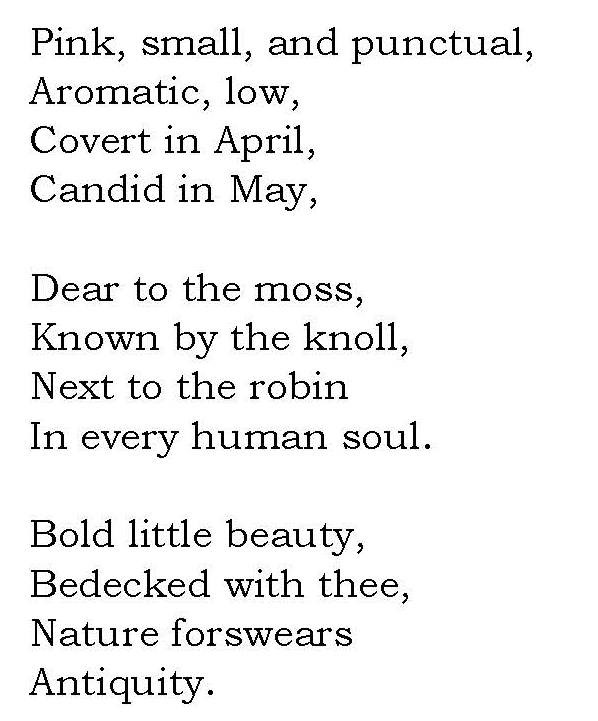
The great thing about Emily Dickinson and her around 2000 poems is that there’s always one you haven’t experienced yet—and just this week over at the Interesting Literature blog I saw this Dickinson spring poem. “May-Flower”  has Dickinson doing her most subtle music to accompany her most Blakean attention. Just like it says itself: it’s a “bold little beauty.”

It’s short and compressed, and if you read it quickly and silently it may seem slight and slide right by you. Spring, May, flowers, check. Robins. Yup, spring. Its abrupt ending might stop you for just a moment. It ends: “Nature forswears/Antiquity.”

Oh, I get it, the flowers in early May are new, there isn’t such a thing as antique flowers. Easy enough to see that—but the undercurrent is deeper, because this is another carpe diem poem, though this time without much bombast and no overt hey-baby-what-about… pickup lines. Yes, there are no old flowers, and so this flower will come and go with May.

Not many words in this poetry-machine, but without choosing any esoteric ones, Dickinson has made some choices that may arrest you the second time you read it. “Punctual,” the flowers know right when to be there. “Covert” those early signs of spring, like some advance spies. “Candid” for May, and spring fully here, no need to hide as a generic bud. Even “Dear” in “Dear to the moss” is a choice I wonder about. I’ve even read it incorrectly as “Near to the moss” once or twice, and sound-wise “near” works very well and is clear in meaning.  Does Dickinson want to pun on deer, another spring poem perennial? Does she want to pickup and connect that D sound from “Candid” in the line before it rather than predict the upcoming N sounds of “Known,” “knoll” and “Next?”

Which brings me to this: if you listen to the poem, or plant it in your own mouth, the sound is exquisite. Rhymes and near-rhymes abound without locking down to a scheme: “small/punctual/low/April/knoll/soul” and “every/beauty/thee/Antiquity,” and consonants and vowels are echoing each other too.

See Emily Play Games for May HD

Foreswears antiquity: I’m not sure if anyone who reads this will remember the poster I’m referencing here.


To perform “May-Flower”  I made some choices. First, to slow the listener down, and to give extra chances to hear that echoing sound-play, I repeated each line. And to emphasize the moment rather than its passing, I interleaved the first and second stanzas as responses to each other. In the last stanza, the responses are just additional echoes of that stanza’s lines.

For the music, I decided to refer to The Pink Floyd. No, not the auditorium and eventually stadium-filling rock band, but the original 1967 Syd Barrett-fronted line up, which was based more around the sound of that era’s electric organs with a taste of Barrett’s unique take on slide guitar. So, time to dabble and wobble organs and break out the Telecaster and a finger wrapped in a vase of glass.

Emily’s poetry-machine obliviates the need for dodgy recreational chemicals. Attention is the drug. This is not the first time I’ve referred to Emily Dickinson’s visionary side here. I see it coexisting with her skeptical wit. And this poem, for all it’s Blakean a heaven in a wild-flower aspect was also intended by the botanically knowledgeable Dickinson as a riddle, the correct answer is a particular New England wild-flower, the trailing arbutus.  See Emily play. There is no other day. Free games for May….

Here’s the text of Emily Dickinson’s May-Flower if you’d like to read along.

May-Flower text

This is the regularized version with conventional punctuation. Emily’s own was full of her dashes.

And here’s my performance of it with original music. Use the player below.


Smoke and Steel

Today is May Day, the international labor day, so I spent it working, looking through poetry books for something about our lives of work. There’s less there than there should be I think, the world of work somehow not seeming as poetic as human love and desire or as sublime as the observation of nature and things of the spirit without any human sweat in it.

This lack leads me to admire poets who address this imbalance. And the first one that came to my mind turned out to be the one I ended up using today: Carl Sandburg. That Sandburg might come to mind for others too as a poet of labor probably didn’t help his reputation at the start of our current century. He doesn’t come by that classification lightly, having had a career as an itinerate worker and labor organizer before he began as a poet, and even while he was publishing groundbreaking works of early American Modernist poetry like his Chicago Poems  in 1917, he had a second, less well-known life as a Socialist radical.

Carl Sandburg at work

Carl clocking in in his later years when his day job was goat farmer

Somehow Sandburg survived both the post WWI and post WWII red scares without great harm to his reputation, but by late in the 20th century there was less interest in Modernists who wanted to write about work and labor issues. The bohemian fringe more or less looked at straight work as an unfortunate event*, and the academic establishment was more interested in aesthetic rigor and the ability to carry lightly evidence of a full-fledged college education for its poets.

Proletarian writing had been done already. Time to move on.

As I keep reminding you and myself, our current century is now old enough to vote, it’s approaching adulthood. It might want to re-evaluate those judgements the old century made about its youthful innovators.

So, for today, May Day, I took the opening to Sandburg’s longer poem that gave its name to his 1920 collection Smoke and Steel and turned it into a labor hymn. “By this sign all smokes know each other.”

The player gadget to hear it is below. If you want to read the whole poem, or just read along to the opening section I used, the full text is here.  Don’t see the player gadget. No problem. This highlighted hyperlink will also play it.

.

*as leading beat-generation scholar and theorist, Maynard G. Krebs put it in his famous essay “On Work, An Existential Examination” “Work!?”

Wrapping Up National Poetry Month 2019

It’s been quite the April here as we ramped up activity to celebrate U. S. National Poetry Month. A lot of effort and time on my part, but since this project is based on the joy one finds in looking and listening to something and seeing what the encounter brings out, it’s been fun for me. I hope some of that always self-replenishing curiosity comes across to you as you read and listen here.

Here’s some of what happened this month.

Most blog posts here ever, nearly a daily schedule! There are blogs, ones that try to do different things than this one, that can carry on at that level for an extended period, but it took quite a lot of effort considering this project’s goals.

I completed a #npm2019 goal of performing all of T. S. Eliot’s longest section of “The Waste Land,” “The Fire Sermon,”  this month. I warned readers here that “The Waste Land”  isn’t poetry comfort food, but as I dived in, looking for things I could connect with in order to perform it, I found some unexpected things.

Before I started this serial performance, I thought I might struggle with misogynist/other portrayals of the women in Eliot’s masterpiece, but instead I found more empathetic depth there. Yes, it’s a bleak world for all in “The Waste Land,”  but I also got to experience a surprising amount of gender-blurring in the voices of “The Fire Sermon.”

In researching it this year I finally grasped the level of extensive sampling tactics used, where nearly every line references some prior artistic creation. I love an in-joke, the pendant in me rejoices in odd connections, but even as I came to better understand the sources I’ve left much of that out of my writing about it, because I believe the poem still communicates its experience out of the sound of juxtapositions and the variety of voices without one needing to know who first wrote the words or sang the songs Eliot drops into his poem. Considering hearing it this way: “The Waste Land” is a collage—you don’t have to know where the picture was clipped from to sense that you’re being asked to see unlike things next to each other.

t s eliot micophone

With a T and a S and L-I-@ / Here to rock this mic with my alley rats / Think you’re a sick rhymer with a mad dose / I’ve been to a Swiss asylum and been diagnosed / Dis a soft Thames flow while I sing my song / you might end up drowned like that Phoenician / Peace (that passeth all understanding) Out!


And lastly, I’m grateful for the broad music-ness of the poem that let me use what I think was a nice variety of musical styles along with Eliot’s words. Eliot wrote “You are the music while the music lasts”  and Stevie Wonder wrote “Music is what gives us memories, and the longer a song has existed in our lives, the more memories we have of it.” Eliot’s immediate experience of music is all over the poem. My task was to take those memories of another poet’s mind and to make them sound again.

Besides presenting a couple of poems by Emily Dickinson, I also enjoyed my “Roots of Emily Dickinson” series this April. Comparing Emily’s Bronte and Dickinson on hope was a great “aha!” moment for me. And Helen Hunt Jackson, who got skewered with a single funny scene in the recent Wild Nights with Emily  film, was a fascinating background character to run across, and Jackson’s “Poppies on the Wheat”  has been one of the most popular pieces here so far this spring.

Wild Nights with a chaperone 600

Would Emily Dickinson’s and family’s wild nights have been tamer if Gloria Bell was their chaperone? Discuss.


My own personal questions on what Emily Dickinson’s thoughts were about Afro-Americans and slavery, or even the bloody civil war that coincided with her most productive years as a poet, are still largely unanswered, but if I hadn’t gone looking for them I wouldn’t have run into the remarkable story of her Amherst contemporary Angeline Palmer and the bravery of three servants.

The blog audience has grown in response to this additional content, with April’s unique page views far exceeding any previous month. Listenership to the audio pieces were up too, and this April will likely set a record for the most listened to as well, though by a narrower margin than blog views.

As a practical matter, the amount of time and effort I put into things this National Poetry Month in April can’t be sustained. Unlike most blogs this is a two-pronged effort, with the production of the audio pieces coming first and then the blog post follows. I write almost all of the music for the audio pieces and I play and record the majority of the instrumental parts. But after that’s done, I’ve only started because then it’s time to write something interesting or illuminating about my encounter with the texts. Your readership tells me I’m succeeding sometimes.

This May I’m going to start some work on re-doing my main music production space. This is going to involve a lot of work, much of which I’ll need to do myself. My goal is to make it an even more streamlined, organized and functioning space. This will predictably reduce the amount of new audio pieces here for an interval, but afterward I hope it’ll make it possible to return to our normal 8-10 or so new pieces a month schedule.

However, because we’ve been at this a long time, there’s a lot of material in the archives, over 330 pieces, so there’s things here you may not have encountered yet. I try to mix the well-known with the nearly unknown. You can take a flyer on someone you’ve never heard, use the search function on the blog, or just try a random dive into the archives going back to 2016. Thanks for reading. Thanks for listening. Thanks for the likes, the follows, and particularly thanks for the shares and the links!

To Carthage then I Came

Here’s my performance of the concluding segment of “The Fire Sermon”  portion of “The Waste Land”  which I presented for this year’s National Poetry Month celebration. If you want to hear the earlier sections, they’re all here along with over 300 other audio pieces presenting a variety of poetry combined with original music.

The middle of the “The Fire Sermon”  is one of the few times in “The Waste Land”  when who’s speaking identifies themselves, and where they are allowed to speak more than a single line or so, but as “The Fire Sermon”  concludes here, it’s once again altogether confusing who’s talking. Eliot identifies who’s speaking in his footnotes for the poem as the three Rhinemaidens/river nymphs, who had been singing non-words in the previous section—but without the footnotes* I’d have never guessed that.

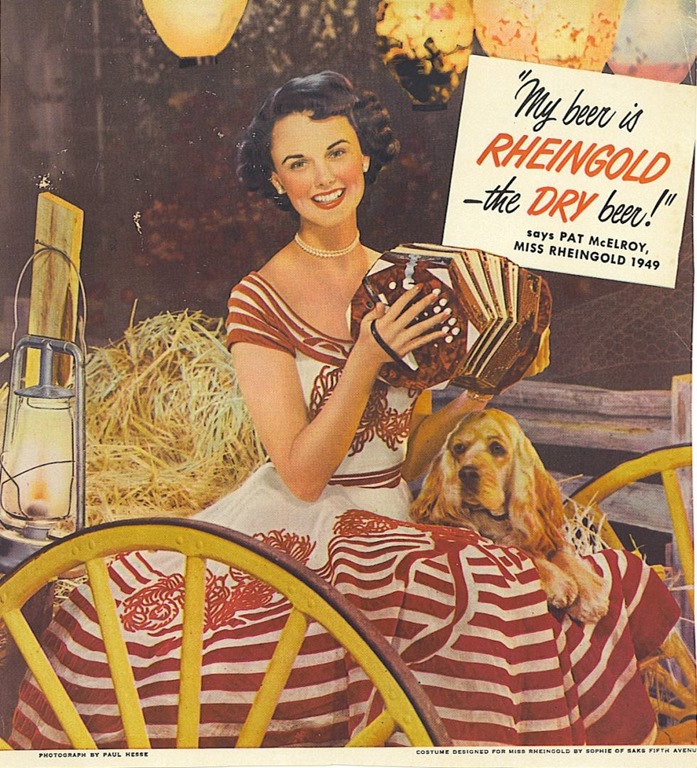
Miss_Rheingold_1949

The Rhinemaidens are from Wagner’s Das Rheingold. However, when I hear Rheingold, I think of the New York beer.

Even more so than the Typist/Man Carbuncular coupling or the subtle come on from Mr. Eumenides earlier in “The Fire Sermon,”  this is the dirty-book section of the poem. A speaker tells of having sex, flat on their back in a canoe** and furthermore (this may be another speaker/river nymph) tells of another sex act with their “heart under [their] feet.”***

This ends in tears and a question that many who’ve suffered from depression cannot answer from within their hall of dark mirrors: “What should I resent?”

If Eliot’s footnotes are saying it’s just the river nymphs talking, it soon gets specifically personal. The next stanza (“Margate Sands”) refers to the off-season resort where Eliot was taking one of those “rest cures” for his own depression. It wasn’t enough, he next went to a psychiatric hospital “By the waters of [lake] Leman.”

The final stanza (“To Carthage then I came”) is made up of quotes from St. Augustine, who as a teenager traveled to the famous African city to battle his own demons of human sexuality and spirituality, mixed with a refrain from the Buddha’s “Fire Sermon”  which says that all things are burning, consuming any constancy in desire and wanting. Joking doesn’t change what it’s about and what’s at stake: the wheel of suffering. But joking, if observed correctly, is also a demonstration of earthly things passing from significance.

John Fahey

John Fahey. Il miglior fabbro.

I performed this seriously as a solo acoustic guitar piece in Sebastopol tuning, using what I once absorbed from the playing of John Fahey, another man who had both demons and angels to laugh at. To hear it, use the player below. If you’d like to read along as I perform it, the whole poem, including this year’s part “The Fire Sermon”  is here.

*At last, I get to write a footnote on the footnotes! Oh, pedant’s delight! Eliot wrote extensive footnotes for the poem that appeared when an American publisher agreed to print a book containing the poem. These footnotes have always been controversial. Ezra Pound said they were only included to pad out the size of the book. Eliot himself said he originally wrote them to properly cite all the literature that he’d sampled in this extensively collaged work of text, and he sometimes expressed regrets at allowing the notes to be published with the poem, making “The Waste Land”  seem some scholarly treatise instead of an anguished cry.

**As the joke goes. “Q: Why is drinking American beer like having sex in a canoe? A: Because it’s f…ing close to water.” Note “The Waste Land”  was written by a serious poet, who was seriously depressed by the world and his life, and in this section he’s using sexual exploitation as image for that. How serious was he? Eliot took lay religious vows which included a vow of chastity just six years after this poem was published. This footnote is included for scholarly purposes only and you shouldn’t laugh at it.

***Class, if we turn to our Kama Sutras that’s page 112, where the person on the bottom is on their stomach and their legs are bent upward so that their feet are over their thorax. Also, there’s the connotation that one’s heart is being stomped on. More pedantic or podiatric joy: a foot note that’s a note on feet.

Wild Nights with Emily

I’ve been looking forward to this Emily Dickinson biopic since I first heard of it a few months back. I acknowledge the difficulty of making a film about writers, particularly if the film wants to give due weight to their writing, the least cinematic of art forms—but just because it’s difficult doesn’t mean it shouldn’t be tried.

From indications I was expecting Wild Nights with Emily to be irreverent, but I often like some irreverence, even about things I admire. The advance publicity used the hook that it was going to go strong on the theory that Emily Dickinson and Susan Gilbert were lovers. That’s a legitimate theory, with evidence to support it, but the trailer and the promo clip I saw indicated it was going to be one of those “Hey, famous artists go through all the wacky and awkward stuff we do, especially when they fall in love.”

Does that sort of thing diminish art or the people that make it? We should laugh at both devils and angels some of the time (just not all the time). For an example of literary irreverence that worked for me, I’ll point out Upstart Crow,  a series that turned Shakespeare into something between the Dick Van Dyke Show  and 30 Rock  using a passel of modern critical theories as comic premises.

Wild Night with Emily Poster

What’s with all the black. More Emily Dickinson goth moves?


As it turns out, Wild Nights with Emily  didn’t consistently work for me, though I’m glad I saw it and I admire the effort. It’s awkward in ways that alternately charm, puzzle, and just seem off. It tries for a complex structure that jumbles time-lines back and forth and the individual scenes seem very separate. There’s little character development, little sense of change or dynamics of Character A’s actions changing the course of Character B’s life outlook, even in the central love story. We see a scene or two of Susan and Emily falling in love as teenagers, but there’s no attempt to explain why Susan or Emily were attracted to each other instead of someone else, they just are. Nor is this attempted for any of the other relationships—some kind of lust/attraction spark occurs and bang they go off. It’s consistent enough that I think the writer/director Madeleine Olnek is making a point of this. Oddly, these connections go badly for the couples other than Susan and Emily. It’s kind of a bokeh effect thing: our lead couple just want each other, and that sort of works out, and everyone else is just mindlessly and brainlessly lusting.

Indeed, my impression was that the writer/director really was interested in making a point, or series of points. The film isn’t a biographical narrative* or love story or sex-positive comedy or an exploration of creativity, it’s more an illustrated lecture with actors given to illustrate those points. The disconnection of the scenes is just a new slide in the deck being shown. The points are all worthy ones, most of which I’d agree with. Dickinson was a mocker and questioner, not a conventional sentimentalist. No one understood how revolutionary her poetry was. Families are weird, and their secrets show that. The Patriarchy is blind to a whole lot of things.

Some of the scenes work well as illustrations for me. Some don’t. Your mileage may vary. Many scenes use humor to make their point. A couple of the scenes were Dada-weird (e.g. Lavinia and her fake cat). Others are very much “see the broadly underlined point.” Some are emotionally riveting in the same way that actors doing single scene can be as they instantly inhabit a character, but again, the film isn’t really a narrative. Nor does it go out of its way to say “I’m not a narrative” like other attempts to subvert the artist biopic genre like 32 Short Films about Glenn Gould  or  I’m Not There.  If you go to see it, go with that expectation and I think you’ll be more primed to absorb what it’s trying to do.

A couple of Olnek’s points I’m less sure of (she may be right, I’m no Dickinson scholar). She seems to be overcorrecting on the Dickinson was a hermit, always sequestered in her room thing. As far as her film shows it, it’s all a misunderstanding, and she just didn’t like Mabel Todd. The impression I get from my Dickinson biography research is that a much more sociable person did become increasingly withdrawn as she aged. And she seems to be saying that Dickinson directly sought publication, only to be rebuffed by the Philistines. Maybe there’s an earlier period I’m unaware of, but the testimony of among others, Susan Gilbert Dickenson herself included, was that the scattered publication of 11 or so poems in her lifetime was largely due to the efforts of others which Dickinson did not encourage.

A few times in the movie they use Dickinson’s poetry, spoken and with subtitles with scenes portraying something they relate to the poems. I’m favorable to that tactic—after all, the Parlando Project is doing that with music instead of film. I think that works in the film. The “Hope’ is a thing with feathers”  and “I died for beauty but was scarce”  examples were particularly memorable for me.

That’s my reaction to the film. I appreciate the effort that went into it, and the task it set out for itself isn’t easy.  Is it the best possible way to spread greater, deeper appreciation of Dickinson? Hell if I know. Worth a try.


*Maybe it’s just me, but has anyone done a straightforward Emily Dickinson timeline that says what Emily Dickinson was thought to be doing year to year? A good one would include links to the various theories regarding people that came and went in her life. I find some of this hard to keep straight and the non-linear choice of this movie obviously didn’t aim to help me. For example, the Mabel Todd/Austin Dickinson affair that started in 1882 happened very late in Emily’s life, more than a decade after she’s thought to have written the vast majority of her poems. And the first meeting with Thomas Wentworth Higginson in 1862 was when her amazing productivity was accelerating.

By the way the film’s bokeh effect makes Higginson and Helen Hunt Jackson look like comic idiots. Given the heroic things they tried to do in their time, I give them a little more credit than that.

The River Sweats

It seems like a long way back to the beginning of National Poetry Month this April. One long tradition I’ve followed here for Poetry Month is to perform parts of T. S. Eliot’s “The Waste Land”  accompanied by original music I write myself. I started doing this back in 2017, performing just two and a half minutes of the great poem’s “April is the cruelest month…” opening, and this year I’ve been tackling the poem’s longest section: “The Fire Sermon.”

Now April, cruel or not, is nearly over and we’re near the end of that section. “The Fire Sermon”  started by the side of a dirty urban river, London’s Thames, and the poet asked the river to flow softly until he’d finished his song. And so today we’re back where “The Fire Sermon”  started, with an unnamed narrator viewing the river. Even when “The Waste Land”  isn’t shifting voices or shapeshifting who the narrator is, it’s likely to be drawing from it’s great mixtape of references to just about anything, and that’s pretty much what happens in this section. The busy commercial Thames circa 1920 that opens the poem gives way to brief singing by river nymphs,* who we were told had departed when “The Fire Sermon”  opened—but they’re in earshot now, at least in the narrator’s imagination. And their singing gives way to—what!—Queen Elizabeth moving down the river on the royal barge.

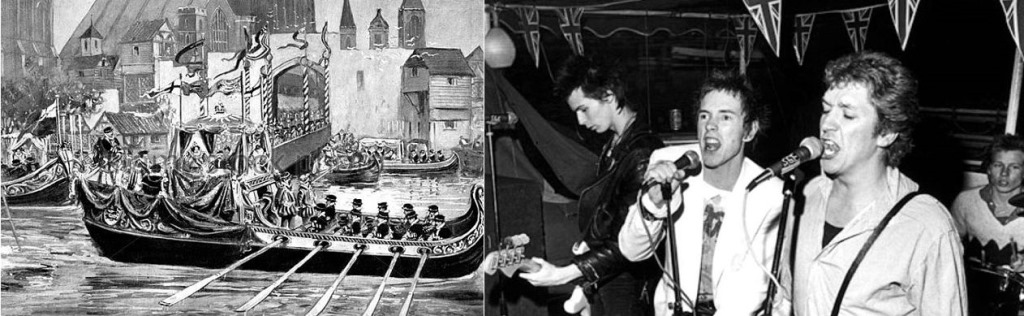
No, not that Queen Elizabeth, the other one, the one before Roman numerals were necessary—but if there’s to be a barge sailing down the Thames connected with some royal jubilee, I was hoping for the Sex Pistols in my small r republican heart.

Two Royal Barges

Either/Oars: the Elizabethan royal barge the first time. The Sex Pistols on their Thames barge trying to drown out Elizabeth “The Deuce’s” Diamond Jubilee with their river nymph song.


Elizabeth is with her most constant suitor on the gilded royal barge, the Earl of Leicester, but historically the “Virgin Queen” never married. Some point to this couple as a continuation of “The Fire Sermon’s”  main topic: the corruption and inconstancy of sex and love, but my reading of this barge episode is more at a vision of the passing of glory. Elizabeth and Leicester may not have been a fulfilled relationship, but it’s a great contrast to the man carbuncular and the poor typist from earlier in “The Fire Sermon,”  and an Elizabethan gilded barge is a contrast to the commercial barge traffic of Eliot’s time.

When I first looked at this section this spring, for some reason I thought I’d try to do something musically referencing one of my favorite rock bands, Television. That’s not how this turned out. I can still see tiny bits of that idea in the chord sequence and the melodic top line I played on electric guitar. Instead, the arrangement developed as I worked to sonically depict passing glory.

Want to hear how it turned out? The player gadget is below.


*The nymphs’ song is from the Rhinemaidens in Wagner’s Das Rheingold,  the start of his epic Ring Cycle,  something I’m not very familiar with. Themes of water, fire, and the renunciation of love are present I’m told, and if so, that fits in well with the overall themes of “The Waste Land”.

In the department of coincidence, Wikipedia says the Rhinemaiden’s song melody is Eb, F, Ab, Bb and C, and the cadence in the main part of my music here is Eb, Ab, C, Ab, Db, Eb.

Still, the Dick Wagner I’m more au fait with would be the guy who played guitar on Lou Reed’s Berlin  and Rock’n’Roll Animal  records.

An Arbor Day during National Poetry Month

Today is Arbor Day, a curious holiday, born in the American Midwest, meant to celebrate and cultivate trees. It’s more established than the uncounted more recent designated days, special weeks and “National Months” like Poetry Month, but its observance is spotty.

Birdsey Northrop

Wikipedia says this is someone named “Birdsey Northrup” who helped popularize Arbor Day. Since this isn’t April Fools Day should we believe that?


I can’t say I remember and keep it myself, though I’ve always had an attraction to trees. I remember an old tree with exposed root tops outside my earliest remembered childhood schooldays, its roots large and far enough apart that we small school children would sit between them as if it was ground-level-low bench with bark covered armrests. And I remember forgetting where the tree was, like the location of Eden is forgotten, and being unable to locate it even only a decade or so later. That tree is no doubt gone, as many of those school children are gone by place of current location or end of life.

The backyard of the house I grew up in had four large walnut trees, majestic if a bit messy when the nuts fell, littering the ground like a green elfin golf-driving range. I remember that a major branch of one of them had a full long-handled scythe, like the grim reaper’s side-arm, crooked in a joint above anyone’s head or reach, it’s blade now being held in the teeth of the bark which had healed its wound. This I noted as a child, long before I thought to write, or write poetry, and it exists in my memory like a poem that doesn’t need to be written because it just was.

When I was looking for the house I live in now I wanted a yard with trees, which it has. The largest is outside the window as I write this, being old as a tree is and budding like the geriatric Sarah. I note that when Sarah’s husband Abraham met the three angels who told him that he, 100 years old, was to have son with his wife of near the same age, that he met these angels and heard this news under a great oak tree. Abraham, being a patriarch, and therefore by definition part of The Patriarchy,  had his wife get busy making a quick meal for the angels, who as divine beings might not need earthly bread and could have said to Sarah, “Oh, don’t bother, we’ve already eaten.”

Anyway, in what is surely the strangest conversation with angels in a book of strange things, Sarah, hard at work on whatever quick-bread recipe that an antediluvian Epicurious might provide is said—right there in the first book of the books of Moses, the Holy Bible, in Genesis 18, in father Abraham’s tent—to have laughed.

Now the angels—who knows here what angels know—might have figured that Sarah’s laugh was the wisest thing they’d ever heard from a mortal, but it doesn’t say that in Genesis. Yes, it’s revered by many as a holy book, so the author may have figured he’d do something subtle here—or maybe it’s a blunder by a non-inspired editor somewhere down the line. Genesis just has Abraham being told they heard that laugh. Do angels joke? Did one of them wink to the others? Do angels wink? And then, to wind up the old geezer Abraham, who knows they’re angels, and is doing all he can to show how well he treats divine messengers who might only appear to be strangers who’ve wandered up to his tent, the angel looks Abraham in the eye and tells him “We heard Sarah’s laugh you know.”  The term pregnant pause was invented then I think.

giovanni_andrea_de_ferrari_-_abraham_and_the_three_angels

“I dunno, should we threaten to give him a bad Yelp review or something?” Sarah and Abraham with the 3 angels. Oak tree not pictured.


I don’t know what kind of pants folks wore in those days, if they even wore pants at all. If they did, let’s hope Abraham was wearing an old, brown pair. A divine being has just implied that your wife has been impolite, maybe even blasphemous. Genesis has other stories about what happens when you don’t treat angels right.

And 90-something Sarah, who’s just been told she’s about to become pregnant at that age, Sarah who laughed, quickly looses her wisdom—as we mortals who may find wisdom in a moment only to loose it in the next do—and she tells the angels she didn’t laugh. And the angels just said back, like trees do when we laugh beneath them, “Yes, you did laugh.”


No new audio piece today, but I hope to work on the next part of our National Poetry Month serialization of T. S. Eliot’s “The Waste Land”  this weekend. Here’s a fairly recent piece that’s in our archives along with over 300 other ones, one that seems right for Arbor Day: Charlotte Mew’s “The Trees are Down.”  You can read more about Mew and the poem here, or the full text here. But to hear the LYL Band perform it, use the player below.