Given the times we live in and the current virus-crisis, can I be excused for being a little bit late with an audio piece for World Poetry Day?
It occurs to me that if World Poetry Day was some kind of Olympian-Olympics or the World Cup in Verse, and the United States had to look over its relatively short history on the literary scene and pick it’s most powerful and representative champion, Dickinson could be our choice, even though she spent her writing career not really having one.
Indeed, when I was introduced to Emily Dickinson as a teenager back in the middle of the last century, that was the inevitable, subtitled fact about her: a recluse, a nun of poetry in effect—self-isolated in her room, scribbling odd little poems which are now seen to have at least some middling value because, well, they’re so unusual and such.*
For a century and a bit more, past-through that time when I first read her, and over our new century line by a couple of decades, readers, critics, and listeners still discover that there’s as much there in her little poems as we seek to look, and look again, for.
Take today’s spring poem of hers “A light exists in spring.” It’s as simple and complicated as a William Blake song of experience. It’s as metaphysical as a poem by Donne. Yet it doesn’t push me, or (I think) many other readers away. It draws me in to this mystery of what it is describing. Dickinson confides in us: we are likely to feel/see this too.
I compared her to Blake with consideration, because poems like this strike me as describing some kind of mystical or limerent moment. Dickinson has a strange effect often, she can be a cold romantic, a skeptical seer, as I read her.
Something in spring almost speaks to her, and that “almost” in her poem seems powerful—a present absence. I question my musical setting once again today. I’m not sure if I have mistaken a playfulness in this poem as a meditation upon a mystery.
Perhaps it’s my time, and much of the other world’s, this World Poetry Day that leads me there. Many of us are taking Emily’s vows this March, this spring: sheltering in place, practicing social distancing, pondering perhaps a mysterious illness’ distance short or near—and whatever our usual disposition, we may be now far from even lonely crowds in our homes and rooms. This spring is visible as a distance as far as we can see.
Shelter in place: Emily’s room was on the 2nd floor behind the trees in the front-left of this picture.
The player to hear my performance of Emily Dickinson’s “A light exists in spring” is below. Thanks for listening, reading, and sharing the existence of this project.
*Scholarship has shown this blurb-level summary of Dickinson’s life was misleading. For a woman of her time and location, she was above the average line in experience (Some college! Visited other cities. Privileged and connected family in a college town located in the region of America’s greatest intellectual ferment at the time). But by her middle age the burden of a woman’s domestic role and a much speculated-on illness tied her down to the homestead, and only then, in her later years, did she become the recluse of legend.
I’ve been planning on presenting this eerie ghost story by English poet Frances Cornford for awhile now, but I wanted to take care with the musical setting while working on our recently completed countdown of the most popular pieces here from this past winter.
Heidi Randen was interested in doing this as a guest reader, and it’s her voice you’ll get to hear today. She’s also the guest blogger for this piece, so before I say our customary few words about the music let me turn it over to Heidi.
From Our Breasts, Frances Cornford’s The Old Nurse
By Heidi Randen, guest writer for Parlando (and Frank’s wife)
Like the subject of this poem, I am an old nurse. When my husband shared these sad, sweet, ghostly, gothic verses, they resonated with my experience of nursing in the biological and professional sense. I breastfed our kid and have worked as a Registered Nurse in hospital and clinical settings with very old and very young people.
Frances Cornford wrote this poem in the 1920s when professional nursing was still a new concept. Florence Nightingale pioneering nursing in the field during the Crimean War would have been about as far back in the collective memory as the Korean War is to us now. Nightingale started the world’s first professional nursing school in London in 1860. This occupation would have been as relatively novel as computer programming or palliative care are today. In an English village in the 1920s, an old nurse would most likely mean an old wet nurse or an old nursemaid.
Wet nursing is a humble and humbling profession:
Against my breast I felt a small and blunt-nosed head.
To breastfeed is to be reduced to a mammal, a one-person dairy operation. To share your milk with an infant in need who is not your own is an extravagant act of human kindness, yet it carries great stigma. In my family’s American immigration story, relatives on my mother’s side repeat the line: Our family was so poor that your great-great grandmother had to work as a wet nurse in the Netherlands.
Breastfeeding is like still being a little pregnant. Your body is not wholly your own, still providing shelter and sustenance for another. This is also the case in professional nursing. When I worked in the hospital, I would often forego sleep, meals and bathroom breaks if it was a particularly busy shift. This self-sacrifice is why nursing is still considered a calling and is listed as the most trusted profession in the United States and the United Kingdom.
The circle of life: the woman who breastfed me and who suffers from Alzheimer’s, being helped long by the person I breastfed, my kid who talks about going into nursing when they grow up.
In my experience talking with fellow nurses, neonatology, pediatrics, oncology and hospice are considered extra special callings. It takes greater emotional mettle to get close to babies and children in pain, to help people with serious or life-limiting illness and their families. Put any of those specialties together: neonatal hospice or pediatric oncology and you are exponentially special, perhaps super-human.
But nurses are very human. We see things that are unbearably sad. And there is nothing sadder than a dead baby. It seems like the worst violation of the order of things. But it is not. To me, the worst thing in the world is when people are left alone in sadness and fear. Like the woman in the poem, the nurses of the world—in all senses of the word—hear crying over the sound of storms, seek out those in distress and provide comfort. The satisfaction of this experience is expressed tangibly by the poet:
And a sob-quivering body slowly growing calm
And toes like round cold buds that warmed inside my palm.
Like the subject of this poem, I too see dead people and they don’t frighten me. The longer you watch human beings move through all their stages, you see that the end of life has much in common with the beginning of life. This became most apparent to me in the space of one day when I visited a friend in the hospital with a newborn and a friend dying in hospice. The mystery of where that baby came from was the same as the mystery of where my friend was going. To nurse is to help for a little while on another’s journey, then—like the old nurse at the end of the poem—to be alone again with this mystery after they leave.
The page from Cornford’s “Autumn Midnight” collection where the poem was published in 1923. Woodcut by Gwen Raverat
Heidi didn’t mention this when she wrote this earlier this year, but of course now we are asking nurses and others to put their bodies on the line with our current Covid-19 crisis.
Here’s those few words on the music. My original starting idea was to use singing bowls as part of the arrangement, but I have only one available, and while I could manipulate the single pitch after recording, I wanted them to play intervals and triads and decided to go another route. I used some gongs and bell for the piece’s intro, but much of what sounds like the singing bowls is an electric guitar being sustained to feedback levels and then being fed through a modulated reverb. I also made use of one of my favorites, the Mellotron cello sound, because that instrument’s uncanny aural valley always sounds spookier than the real thing to me.
The player gadget to hear Heidi’s performance of Frances Cornford’s “The Old Nurse” is below. If Cornford intrigues you, I’ve presented two of her poems with original music earlier this month.
December seems so long ago doesn’t it? More so this spring in our current crisis. Back on the 10th of December I awoke, took my bike ride to breakfast in a pleasantly crowded café, where I read that it was Emily Dickinson’s birthday. While eating breakfast I decided I should try to make a Dickinson piece before the day was done.
This morning in March, I rode to that same café. Normally there are 20 or 30 folks there drinking coffee, eating breakfast, talking, reading or fiddling with notebooks or notebook computers during the morning on a weekday—more on weekends. Today they are to close their dining area for the duration at noon, and the two couples eating breakfast several empty tables apart (along with some not-present more) will need to do what I did and pickup takeout fare to keep this place a going concern.
Cold but sunny morning, and taking their last chance for awhile to have breakfast together.
When Emily Dickinson was a child, her family grew up not in the grander family house her grandfather had built and lost due to debts and business ineptitude, but in another house across the road from a cemetery. Some biographers think this molded the young mind of our great poet, but then the literature of that time had a decidedly gothic tinge to it anyway. And that’s not the place she lived as the poet we know.
Her father worked assiduously to repair the family wealth and regained the homestead. Emily’s room is in the front of the house. Out to her left would be the garden and orchard that she became the master of with the illness and eventual death of her mother. Below her, the kitchen where she and the family’s immigrant Irish servant fixed the family meals and baked. That garden and orchard is now gone as the world of her family and town moved on from its former rural self-sufficiency. Also gone is the 11-acre Dickinson meadow that would have been more or less straight-on in view for Emily at her writing table on one of her December birthdays.*
The famously sequestered Dickinson of her later adult years would have been living our current Covid-19 life of “social distancing” and stay-at-home self-isolation. You might think her poetry would be more solipsistic for that, but she really was a mind forever voyaging. The winterscape she portrays in this short poem is quite likely that Dickinson meadow or her bare garden.
Though the creation of the music and recorded performance of it was rapid even by this project’s quick pace, I don’t think it suffers from that at all as I listen to it again today. The post I wrote about it in December was not one of the most liked or read this winter, but the audio piece was listened to more than any other one during the past three months,** and by enough to score the top spot anyway.
As I consider my sequestered music making today—something I can create even in these times, by myself, playing each part in turn—I feel for those other musicians whose art and the revenue to support it requires a live venue, a paying crowd coming through the door. Of course, cooks, wait staff, musicians—small businesspeople for the most part and only a portion of our world—are not the only ones who will suffer through the duration of our current crisis, but they were in my thoughts as I write this.
Is Dickinson’s poem lighthearted and playful or more gothic in mood? My current reading of Dickinson is that it’s both. She is amazed at the shapes and filigrees of the barren landscape, yes—but it is a place of stilled and departed artisans as she portrays it. She sees an absence, that resonate line: “Summer’s empty room.”
My performance of Emily Dickinson’s “Snow” also known as “It sifts from leaden sieves” is available with the player gadget below.
As we continue our countdown toward the most popular piece of this ending winter, we come to a section coincidentally that’s all poets known by three names. You can’t plan something like that, but your listens and likes counted up that way.
4. “The Stare’s Nest at My Window” by William Butler Yeats. This poem grew on me after I selected it from a short collection of poems Yeats wrote on the Irish Civil War that followed Irish independence. Just after I read the series for the first time this winter, I mentioned to my wife that Yeats seemed to be too far into his mystical side for me to find something I could attach to in them. “The Stare’s Nest” seemed only the least bad for my use after that first reading, largely because I could grasp its word-music as promising.
I often work on the music and performance before I work on the research about the text and its background. I did so here, though one may think it perverse to do that—my setting and performance will then come from me working without a context, and without the best information about an author’s intent. Still, the setting I came up with accumulated considerable power for me, and even though it’s me playing all the parts I composed and reading Yeats’ words, my impression of “The Stare’s Nest” was transformed as I experienced what came from that combination. Though I made these components, the whole presented something I was unaware of.
What did I become aware of in the process of creating the piece? This poem I feel is perched somewhere between a prayer and a magical spell for his country.
3. “The Times are Nightfall” by Gerard Manley Hopkins. Speaking of word-music that pulls me into places I might not otherwise choose to go, Hopkins is an example. He seems to be a full-on Christian mystic with more than a touch of hair-shirt depressive in his soul that he doesn’t fight so much a seek to feel more fully.
But his metrical conception, his use of repeated sounds, I’ve liked from the first time I read him. He believed his ideas there (borrowed from the more Saxon ancestral branches of English poetry) worked better than the musical structures adopted from the Romance languages or from poetry in Latin.
One can test his theories by seeing how his hymn to dark winter works with music as I do here.
Yeats the great Irish poet and nationalist spent a good deal of time in England. Hopkins, the English poet with a distinctly English prosody was a priest unhappily sent to a post in the still colonized Ireland. Despite our world-wide virus crisis, St. Patrick’s Day will be celebrated by an Irish diaspora here in the United States this week.
2. from “Dirge” by Ralph Waldo Emerson. Emerson is better known as an inspirational force via his essays and influence on Transcendentalism than as a poet, but his influence was felt by poets and in poetry. The distinctly American poetry that emerged in the 19th century is almost completely made up of poets touched by him.
When I have dipped into Emerson’s own poetry it’s produced some of the most popular pieces during the run of this project, but I wasn’t looking to find another Emerson poem this winter. “Dirge” came forward in a round-about way from watching the Apple TV+ Dickinson, a streaming series presenting a youthful, passionate Emily Dickinson. That series fully intends to use our present culture as a lens and overlay to espie into Dickinson’s times, something that I think worked for its released first season, though it works most completely if one looks also with a more sober eye at this genius. The creators seem to have done their homework. Lot’s of little details and obscure Dickinson trivia are referred to. And speaking of Transcendentalists, they manage to have some wicked fun with those other three-names Henry David Thoreau and Louisa May Alcott—who are both skewered with lesser-known biographic facts that aren’t full pictures of those two by far, but make for some good scenes.
In one scene, Dickinson and a young man Dickinson is crushing on bond over their mutual love of Emerson’s “Dirge” for its gothic lines about a field of ghosts. I had to check out the poem. I worried that is might be a too long and how well the 19th century sentimentalism in the text would work for modern audiences, but trimmed a bit for length, the listeners here sure liked it this winter.
So, what’ll be the most popular piece here from the past few months? Will the author go by three names? Obscure author or well-known? American? British Isles? Translation from another language? Stay tuned.
Back now to our recounting of the pieces that you, our readers and listeners, most liked and listened to this past winter. Let’s jump back in as we count them down.
7. “We Wear the Mask” by Paul Laurence Dunbar. This one is remarkable in that it was released on February 24th, very late in the winter season, yet it still racked up a lot of listens to go with the number of likes here on the blog, outstripping the other well-known Dunbar poem I performed and released three days earlier: “Sympathy (I Know Why the Caged Bird Sings.)”
These two poems are the best known works of this early 20th century Afro-American poet directly addressing racial issues, and given the seriousness of racism and the quality of “We Wear the Mask” as word-music, it’s well earned its current position as a much anthologized poem.
Why did it edge out “Sympathy?” Who can really say? I liked both performances I did of the Dunbar poems myself. “Sympathy” has the more complex arrangement, but simplicity that works has its appeal. Or was it something random—did Dunbar’s title put it in search queues connected to world-wide Covid-19 concerns?
6. “Do the Dead Know What Time It Is” by Kenneth Patchen. I was completely enraptured by this poem of Patchen’s because of its complicated paralleled half-conversations. In the previous Top Ten post this week I remarked about how Marianne Moore’s poetic expression seemed to echo the actual syntactic twists of transcribed common speech, even at the cost of being harder to follow on the silent page. In Patchen’s poem, we have the more common “naturalistic dialog” where syntax is complete, where sentence structure is plausible, not the fractured and disagreeing actuality of literal transcribed speech. But Patchen has two speakers totally focused on non-answering halves of a conversation: the old guy at the bar who wants to tell the poem’s persona of a second-hand encounter with the God-head, and the poem’s persona, a quasi-homeless swain in conversation with an unheard and somewhat mysterious woman* at the same bar.
The chemical reaction of these two side-by-side half-conversations builds until one phrase appears to link the two—two loves linked somewhere between desperation and desire.
And all our count-downs are happening over and over. Patchen as painter.
5. “The Little Ghost” by Edna St. Vincent Millay. So, a comforting God-head appears off-stage in Patchen’s poem. Hugo Ball’s ghost in our last Top Ten post seemed of the malevolent poltergeist type. Now here Millay’s is a much more benign spirit who seems to signify being there after being there.
Regarding the music for this one: like a number of my generation, I encountered Ravi Shankar LP records and performances in the Sixties. For a moment some borrowed sense of South Asian music permeated the culture of popular music groups and their audience. Why did that happen? Has anyone asked, much less answered, that question? Yes, I assume the drug and social stress induced search for mysticism was a factor. Maybe George Harrison and his access to the culture through The Beatles alone was enough. But I can speak for myself: some musical qualities easily discerned in this music grabbed me then as they still do now. The musical structures related to steps in various orders away from and returning to a home drone pitch. The opulence of microtones beyond the conventional 12 notes. The singing rhythms.
In the Seventies, that decade that everyone forgets, I spent nights working in a busy Emergency Room, often with an Indian-born surgeon, who as the evening would wear us on, would suture while hum-singing tunes of his homeland. Every so often, even these decades later, I sometimes find myself singing unremembered vaguely South-Asian melodies when working late on some task.
Evidence of some ghost? I doubt it myself. Not reincarnation—resonance.
We’re more than halfway down the countdown. The next three coming up here soon.
*Is she a down-and-outer like the poem’s persona just looking for some kind of human connection? A prostitute seeking money? An analog to the God-head, or is the poem’s persona that? By not clearly defining this, the poem gains mysterious power I think.
The next part of our regular countdown of the most popular Parlando Project pieces from last winter will continue soon, but as the world and U. S. consciousness turns increasingly to COVID-19 and pandemic protocols, a question occurred to me.
Many posts and pieces in the earlier years of this blog used for texts vivid pieces about WWI, often written by participants, soldiers in the “The Great War.” And stepping back just one level, there are also poems about the war from folks who didn’t fight in it, but who lost close friends who did. I made the observation then that WWI was the last war to be extensively covered by poets.
Now of course this doesn’t mean that there is no poetry associated with other, later wars. But the WWI connection with poetry was that significant. Most of the era’s great poets, the canon members and chief modernist pioneers wrote war poems. It was that extensive. The Modernist movement had started before the war, but the war made it seem necessary, the proper way to express what it was.*
But as the war was nearing its end, a great and deadly pandemic, the “Spanish” flu of 1918-1919 struck. Statistical estimates say that it killed more people than the World War did. And in America the deaths were next door, not across the ocean.
Yet I can’t think of one great poem about the 1918 flu pandemic,** and when I did a web search today I found very little in minor, overlooked verse too. Those poems may exist, but like the 1918 pandemic itself, they may have found less retrospective honors. Even other literary arts didn’t seem to have a lot of examples. Katherine Anne Porter’s Pale Horse, Pale Rider short novel was often brought up, but that frequency of a single novella being mentioned seems to testify that wasn’t a common subject in serious fiction either.
Why could that be? My first working theory is that war has a long history as a poetic subject, going back to Homer or the classical Chinese poets. While illness, and it’s descendent death, is also present in the poetic canon, illness itself is not a long-standing primary subject, and it’s almost always portrayed there as a singular event, not a great widespread event like a war. My second thought is that war is also associated with maleness and the male role, and is therefore the more “serious” subject. And then I thought of a third factor: war, however arbitrary its casualties are in reality, something the Modernist war poets helped illuminate, retained yet in 1918 some sense of a battle of honor, a test of “serious/male” skills where the winner may have won because their righteous cause added to their valor. Pandemics, not so much. As Sontag’s Illness as Metaphor pointed out, there are tendencies to blame the sick person for their fate across history, but parts of us also know that’s not always so. Arbitrariness can be written about in poetry, but that has difficulties. The kind of caring and loss that is more associated with the female role could substitute, but that would mean that that role would need to be honored.
This blog cares about your safety! We are sanitizing all our musical pieces daily and have asked the Internet to continue to prevent us from going viral.
*American’s native Modernist revolution was ahead of the British, with our modern American poetry lineage going back to Whitman and Dickinson, who like the WWI era modernists had likewise started their work before the trauma of the American Civil War; but at least in the case of Whitman, their trajectory was re-shaped by that war. Though it’s harder for me to find that war in the poetry of Dickinson, others think it’s there, and the events must have had an impact on her.
**The 1918 flu that finished off wounded WWI vet and indispensable French language Modernist pioneer Apollinaire could be said to be present only by implication in Tristan Tzara’s masterful elegy. And that’s presented as a singular death, not part of the great pandemic.
For those that have been following our look at English poet Frances Cornford, we’ll have at least one more example coming of her stuff soon. But now is the time when we count-down the ten most liked and listened to pieces from this past winter.
It’s been a slightly difficult season for this project for me personally. It’s frankly been hard to keep up the level of posting, research, composition, recording, and playing that goes into it. What has been encouraging is the increase in listenership for the audio pieces and your continued readership here on the blog. December set a new record for monthly listens with increases coming significantly from those who hear only the audio pieces from the places where you might get podcasts (Apple Podcasts, Spotify, Stitcher, PlayerFM etc.)* During February the number of listens passed the milepost of 50,000 all-time downloads. This is small by the scale of Internet sensations (typically measured in millions) but to me that’s satisfying in the larger, but sparser crowd of those interested in poetic expression.
Readers here on the Parlando Project blog know that besides the same audio pieces the podcast listeners get, you get more information here about the writers and my reaction to what they’re doing. You might think of the blog as a kind of an “insiders ring” in that way. Blog traffic took off last fall, which made my heart leap up, and it’s continued at a similar level over the winter.
Given that I mostly keep with the older pre-1924 Public Domain stuff that is unrestricted in reuse, and because I wander about various musical genres in a way that’d tempt many old car radio listeners to “push the button” and current playlist streamers to tap play next, I especially appreciate those who stick with this project and it’s eclectic tastes!
Let’s go to the countdown. Today we’ll cover numbers 10 through 8 as calculated from listens on all platforms and likes here on the blog. The title of each piece will be hyperlinked to the original post, so you can click and check on what I said about it then.
10. Rimbaud’s “Eternity.” This winter I decided to make things more difficult for me by doing more translations of non-English poetry, adding translation to the whole compose/record the music, play most of the musical parts, research the context of the text, and then write about those tasks. And Rimbaud may have caused me more trouble in translation that anyone other than maybe Mallarmé. I labored to some kind of reasonable draft on two or three Rimbaud poems, but the results just didn’t grab me in English. Knowing that some other poets who I admire think highly of his work, I couldn’t figure out if I was picking the wrong poems, or what.
“Go Rimbaud, Go Rimbaud….” The most famous photo of the teenaged poet.
Then with his “Eternity” I realized—this poem’s impact in French comes from its invocatory power. This is why someone as unafraid of going over the top as the young Patti Smith could be drawn to his writing. Free verse can reach that level, but loosening my translation so that I could (uncharacteristically) render it as a rhyming verse made this one more compelling.
9. “The Labors of Hercules” by Marianne Moore. Marianne Moore writes in English, but her expression is so unusual that I feel like I need to translate her to get to the heart of her poems. Unlike Moore’s contemporary Gertrude Stein, whose verse is even harder to draw denotative meaning from, the task of performing Moore to music is challenged by her conversational rhythms which sound like someone talking.** Not only does this make it harder to fit in regularized music (I didn’t) it tends to lure the listener into thinking that they should be able to comprehend what Moore is getting at. With Stein you’re quickly aware that words are being used in a musical way, so you can just enjoy them for sound value. With Moore you sometimes think that the speaker herself or you the listener are in early days as English as a second language.
A lesser-known photo of Marianne Moore. Like Frost and William Carlos Williams, I always visualize her as if she was born at that advanced age that she was at when I started to encounter poetry, not as this young woman
I’m doing the back-patting here, but I think I helped Moore’s gist come across a bit better by my performance than the poem left sitting mute on the page.
8. “Ghost Blues” by Hugo Ball. Another case where I decided to go with a looser translation in order to vivify the original work for the modern English language user. The original post shows some of the intermediate steps I went through in translating this Dadaist poem from German. One thing that I think I’ve figured out after the original post is that a word that I couldn’t find in any of my accessible German dictionaries, “Gängelschwemme,” is probably a place name. My performance uses “spillway” for it, and still I have no way to know for sure (if it is a place name) if it references something along those lines.
I decided to make this a Dada Blues as it might be loosely rendered by electric players in the blues revival of the Sixties. Unlike a lot of pieces here, this one isn’t really composed. I had setup a loop to see if my translated text might fit to a groove like that. As I sung, I felt moved to plug in an electric guitar as I tried the lyrics.
“Hey, this works pretty good” I thought. I hit record. And one take later this is what you get.
If you’re new here you may notice that all of these are electric guitar pieces in a rock’n’roll context (though “The Labors of Hercules” is more irregular and somewhere in-between post-rock and free-jazz in my mind). Long time listeners here know that’s not what we consistently do. Stick around, the next three of the Winter 2020 Top Ten is coming up soon.
*Just to clarify expectations: the Parlando – Where Music and Words Meet podcast is only the audio pieces themselves, unadorned. While I suppose I could chat about the poems and my music in the discursive and wandering way most audio podcasts do, I don’t do that.
**Back in the 1960s when I first got a little plastic cassette recorder, I took to recording people having casual conversations and then transcribing the words literally. Here’s what shocked me in this practice: the words on the page made little grammatical or syntactical sense. The transcriptions didn’t even match “natural, realistic” dialog in fiction. Our daily conversation is often more avant-garde than we realize; and we are comprehensible to each other orally in ways that we would not be if our speech was turned into page text, through things like timbre, expression, non-regularized conjunctions and connections.
I suspect Stein and Moore were both more exacting mental transcribers of what we actually say aloud than conventional literature expected, and as two women aware of the modernist movement in general (not just literature, but music and visual art) they combined this objective phenomenon with their own aesthetic techniques.
Frances Cornford is a 20th century poet that is close to unknown in the United States, despite achieving some degree of success in Britain. She’s sometimes classed there as a “Georgian poet,”* a grouping that like the Imagists produced several contemporary anthologies in that century’s teens and twenties.
It’s not a term used much in America, even in literary circles, as the 20th century Modernist revolution and American hegemony in general brought so many American voices to the first rank of English language writing. The closest to an American “Georgian Poet” might be Robert Frost, whose first book length collection was published while he was living in England and building a close connection with British writer Edward Thomas who was labeled a Georgian poet.
Georgian poets are often set in opposition to the Imagists and the Modernist movement in general, even though they shared the same times, events, and places with each other, and even though occasional friendships and other affinities might cross between the groups. As Modernism “won” the war after WWI and the crises of the Thirties and Forties, Georgian poets were often seen as too tied to old poetic formalism and nostalgia—and even more damningly, to not fully appreciate the absurdities and dangerous forces of the modern world.
Labels are after all just sticky paper, but in reading poets like Frost and Thomas, I don’t see a pure division. Thomas and Frost’s outlook is just as Modernist as any, just as bleak and unsure of any easy consolation.** What they don’t share with many Modernists is a conviction that seemingly random assemblages of images with obscure rational connections are a useful and powerful tactic in expressing a reality.
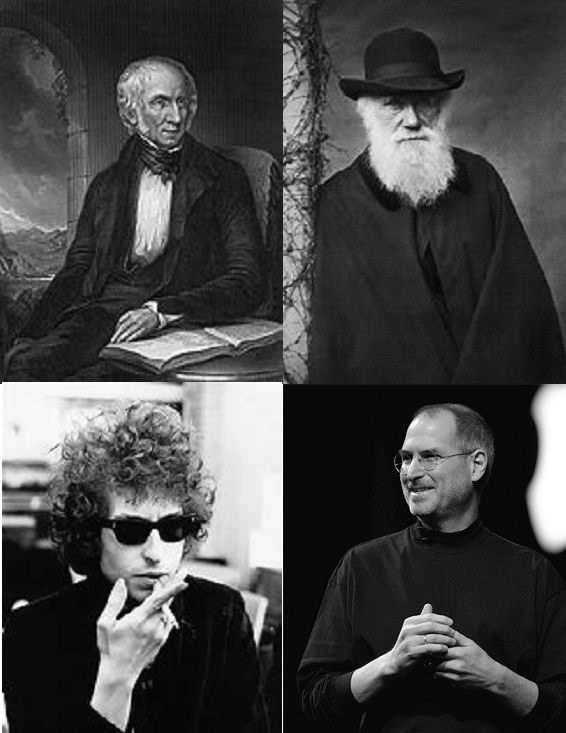
Frances Cornford has a singularly interesting back story, one that (so far) I only know the outlines of. On her father’s side she’s the granddaughter of Charles Darwin, one of the founders of modern science. On her mother’s side, she’s descended from William Wordsworth, a great reformer of verse in English at the turn of the 19th century. She seems to be whip smart, but her poetry may have a deceptive surface. Just to glance at it on the page or rattle it off the tongue, some of it looks and sounds like light verse, the kind of thing that might speak of little foibles and humorous misapprehensions. But then there comes a line that seems out of place, almost a mistake. When I first presented her earlier this month, the “sticks out” line in that poem was “O fat white woman who nobody loves.” Even if we may read that line differently than she intended, I think this smart writer intended for us to be surprised and arrested by it.
Frock coats to black turtlenecks. Frances Cornford: roughly like being a descendent of Dylan and Steve Jobs today.
Today’s Cornford piece, “Missing,” is even shorter. Two lines in (but ¼ of the way in this very compressed poem!) we might think we are about to get a piece of humorous verse musing about “just where did I put that.”
Wham! “Dead soldiers or unposted letters…”
If this was a Dada or Surrealist collage we might be forewarned by stylistic expectations, not just that a war casualty is about to drop into our short poem, but that it would be joined with something as mundane and as overlooked as an unsent letter. Like Cornford’s “Fat white woman” line it risks seeming like bad poetry or an example of egregious insensitivity.
But of course, this was a woman who lived through both World Wars. She named one of her sons after Rupert Brooke, the doomed Georgian poet whom she knew, and who would die in WWI. And that son then was killed fighting on the side of the republic in the Spanish Civil War.
Taken inside, as small, strange poems can be, Cornford’s “Missing” may make you see differently, think differently. Also, these poems have made me think again about the value of risking “bad poetry.”
To hear my performance of “Missing,” use the player below. I liked the simplicity of the music today, just strumming guitar and voice, as I worked on a more complicated piece that you might soon hear. Maybe you’ll like it too.
*In 1910 the British king Edward died and King George V was crowned. He lived until 1936, so his reign was a handy shorthand for a group of British poets whose careers emerged just before WWI.
**The group of American women poets, sometimes given the label “Songbird Poets” (Teasdale, Millay, Wylie, and to some degree Taggard and Bogan) who are favorites here have some of the same position and problems with “High Modernism”.
It should have been just a throw-away line in Modernist novelist Ernest Hemingway’s first novel. A character describes how he went bankrupt: “Two ways. Gradually and then suddenly.”
That line, or the concept of it: gradually, then all at once, has persisted because it encapsulates something that occurs more broadly than the accumulation of debt obligations. Economics, politics, artistic movements all work socially in ways that may be tied to some very deep concepts, deeper than mere humanity.
Earlier this winter I presented William Butler Yeats “The Stare’s Nest at my Window.” It’s Yeats musing on his country, which had so recently achieved colonial independence and yet had then fallen so soon into sectarian civil war. The “stare” is an archaic word for the common starling, and despite its presence in the title, this bird doesn’t really appear in the poem. Instead, Yeats’ poem is asking for honeybees, rather than starlings, to build in the nesting cracks in the deteriorating masonry of his home.
In talking about how I experienced the poem, I felt that Yeats may have been speaking to an understanding of starlings as a harmful, invasive species. European starlings are obnoxious, capable of displacing other birds, and they are artless, bereft of any sort of lovely birdsong or plumage. Their large flocks can damage crops, eating grain, fruit, young plants, and even the very seeds before the crops have become anything. Honeybees, as I read Yeats’ wish, are some better, more directly constructive creatures.
When a country is in turmoil, acting against its own as well as humanity’s best interests, doesn’t it seem as if such is evidence of base and selfish forces that are natural and therefore incapable of change? Evil, greed, and self-dealing seem ingrained, the result of some gradual deteriorating evolution toward greater and greater failures of heart and mind.
As it turns out, starlings, those deplorable birds, do have something marvelous that they can do. In flight, flying near to each other so as to seem to be grains in a sand painting or facets in a mosaic, by the hundreds and by the thousands, they can shift and change direction in such an amazing way—gradually, then suddenly.
Though this video has some cutesy elements, it’s one I could find that both shows the murmuration behavior and a theory of its mechanism.
These birds, certainly those individual birds in the flock, cannot know that this is beautiful, yet they do it anyway. Human observers may think they have seen a miracle, a sign of the divine, or at least some unprecedented event—but what they have really seen is just as ingrained in nature: a physics of change and of glorious new shapes.
In a comment on “The Stare’s Nest at My Window,” alternative voice here at the Parlando Project Dave Moore remembered that he too had done a starling piece, so we’re overdue to present it to you today. His song is called “Murmuration,” and it’s about this startling flight behavior of starlings. You can hear it performed by the LYL Band with the player below.
Continuing on with lyric poetry, that short form of compressed immediacy, here’s a poem that seems to be better known in Britain that it is here: Frances Cornford’s “To a Fat Lady Seen from the Train” first published in 1910.
I think it illustrates one of the things about good lyric poetry of the Imagist* type: it may be right or it may be wrong, but it’s always true. Almost immediately this poem was recognized as “wrong” by many (most?) readers. It could, and was, easily seen as unfeeling, or an expression of cruelty to the extent it has implied feeling. How the hell does the poet on the train know anything about that fat white lady in gloves? Early responses seemed to dislike the compression they read as glibness; more current readers see haughty fat-shaming.
Good lyric poetry of the Imagist type: it may be right or it may be wrong, but it’s always true.
I haven’t found anywhere where Cornford wrote about her intent with this poem. Given that she lived a long life and this poem became her best-known one, she must have said or written something, but lacking that I’m left to react to the text itself.
The objectionable is the poem’s third line. If the poem did not include it, I doubt any significant number of readers would dislike the poem. Let’s look again at that line: “O fat white woman whom nobody loves.”
If that was a social media post today, one can see the storm breaking rapidly. It sounds like it’s “kicking down” doesn’t it? Our graceless current President could easily tweet this line at someone who disapproved or challenged him, and regardless of one’s political stance, his demeaning meaning would be clear. But even in this short poem that stands alone with no testimony from its author, context may change how we read it.
What’s changed since 1910? “Fat” stands in a strange place in our culture currently. There are elements that regard it as somewhere between a sinful sign and a regrettable disease, but also strong elements that wish to make fat-shaming disreputable. Our general agreement, best as I can read it, is to allow “fat,” like curse words, as something we allow or forgive when we feel the subject it’s applied to has wronged us sufficiently, but not something we should throw around willy-nilly, particularly at strangers. But how damning and diminishing was “fat” in 1910?
Much less I think. First off, let’s look at the U.S. President in that year. A crude reading of the culture for sure, but William Howard Taft was, well, fat, and yet today few politicians are.** Female beauty standards too were curvier (though this was soon to change). Fat was, to the level of unexceptional cliché, associated then with wealth, and therefore wealth’s courtier, power. This once unquestioned association with wealth and power is partly responsible for how the fat person was treated comically, even later in the century. The lean, skinny person was the scrappy underdog, the fat person the one who ran things. Stan Laurel was put upon by the more officious Hardy. The Marxist critique of Margaret Dumont was to tear down the well-fed power structure of white women in gloves.
Moving on in Cornford’s problematic line: “white” is if anything more striking in its frank appearance in this short poem. Here I’m even more unsure of Cornford’s context and intent. “White” as a term for those not considered a person of color existed in 1910 certainly, and that’s how most of us will read Cornford’s line today. But a consciousness, without the context of other non-white people in the frame, of a white person calling out someone as “white” strikes me as so unusual in 1910*** that I wonder if we’re misreading her intent. Does she mean that she’s dressed in white? If she means, to us as we may experience the poem now, “a member of the favored and privileged racial caste,” we should take that into consideration regarding the effect of the poem more than most readers seem to. If she means “dressed in white,” which I think is more likely in the poem’s context, then she’s extending the “gloves” image as observing someone she imagines is not in touch with the earth. It’s probably taking too large a deterministic leap to think that she’s meaning to reference suffragettes with a singular woman in white. It’s a slightly lesser leap to consider dressed in white as a wedding gown undertone.****
And yes, let’s not miss the third word in this compound epithet: “woman.” Given that the author is a woman, and we presume the train-riding speaker of the poem looking out the window is a woman, we may have something like a peer to peer relationship between the observed subject and the observer.
In the few Frances Cornford poems I’ve read so far, there’s considerable female empathy exhibited. Why are we sure that the woman in the train is disgusted with or condemning the other woman? Does she feel superior or knowing in some way in the lyric moment (regardless if she’s right or wrong) that the white woman is missing something (love, an experience of nature)? Yes, I can see that. Is it a haughty superiority? I think that leans too much on the dismissive way we read “fat” and even “white.” As I read this poem over, I visualize looking out a train window, and the sense that comes to me is that one sees the woman outside through one’s own reflection in the glass we are looking through. I think, in the lyric moment, Cornford is imagining (and letting us know that it’s only that, imagining) a difference and a risk for herself, and for that other woman.
Dialectic: Frances Cornford at work. Frances Cornford without gloves.
There’s another mystery in the poem that I can’t decode completely: the gloves that refrain along with the absent loves. One reader jocularly suggested that the woman is hurrying on her way to a cricket match, and she’s wearing gloves because she’s a wicket keeper. Some, I think seriously, see gardening gloves. Others, formal-wear gloves. This is part of what I like about this poem: it’s plain-spoken, allusive, and elusive. That’s a hard combination to pull off. Along with its excellent musicality, that may be why it’s so well remembered in Britain—even by folks who are sure they dislike it.
Like Marlowe’s shepherd, this is a poem that calls out for an “answer record,” and humorist G. K. Chesterton’s retort “The Fat Lady Answers” is the most famous of several. I stand more with Cornford’s lyric than Chesterton’s busted triolet, but his point is worth remembering as we consider “other people’s stories.” And so I performed the two together today. At the time I recorded this performance I decided to read the female poet’s poem in a male voice and suggest a woman’s voice in the male Chesterton’s response. I was still buying into Chesterton’s objection more than I am now after living with the poem a bit longer.
Anyway, Cornford’s triolet is so damn catchy that I wanted to keep it to the hook today—mostly drums and bass for the music—but I added a little of my naïve electric piano working off an odd inverted-voicing CMaj13 chord. One of my shortest audio pieces gets this long post. Go figure.
*AFAIK, no one considers Cornford an Imagist, and this poem was written and published before other pioneering Imagist train poems like Pound’s “In a Station of the Metro” or Sandburg’s “Limited.” But in its straightforward immediate language, specific color imagery, compression, and avoidance of sentimental emotional language, it follows the intent of those later free-verse Imagist poems.
**King Edward the VII doesn’t look svelte either, nor Queen Victoria in her later years. Of course, “Who made you king of the Britons?” and all that, but this still speaks to how excess weight was viewed in 1910 as representative of wealth and power.
***I don’t know much about Cornford’s political and social beliefs. She had one son who was a dedicated Marxist of the Karl branch, but what she thought herself about racial questions, I don’t know.
****If it was explicitly a wedding gown, it’d be a different poem, but you can re-read or relisten to the poem and imagine that at your own option. Another possibility would be that the woman is white because she’s a ghost. Again, overdetermining the poem. I’d still like to know what Cornford’s intent was, but even if it was a bit of light verse that got away from her, one of the joys of lyric poetry is that undercurrents can be waiting for the next time you read, hear, speak, or perform it.
Here’s a follow-up note on another alternative reading of this poem. In the time since I wrote this post I sometimes wonder if the woman in white we ostensibly see through the train window is actually the poet, Cornford, looking at her own reflection in the glass which would then seem to be sweeping through the countryside. In photos I’ve seen, Cornford appears quite thin, and even given cultural differences in body image that I talk about above, I wonder (with no evidence) if Cornford may have suffered from anorexia.



 Frank Hudson