Today’s piece is our first proper piece by English poet Thomas Hardy. In America Hardy may be better known as a novelist, though he considered himself a poet first and last. When Hardy began writing poetry in the 19th Century, William Wordsworth was but a decade dead, and at the end of his career in 1928, T. S. Eliot’s “The Wasteland” was several years old. So, Hardy’s career starts at the tail-end of the English Romantic revolution, and proceeds through the Modernist Explosion of the early 20th Century.
In some particularities of locales and events, Hardy’s poetry can seem of the 19th Century; but his language, direct, colloquial, and unfusty, seems as modern as the 20th Century modernists. Indeed, modernists from Robert Frost to Phillip Larkin found much to admire in Hardy. Setting many of his poems in the rural areas of western England diffuses the placement of some Hardy poems on a timeline, as the more rapid pace of cosmopolitan change does not mark them as sharply.
“Strap yourself to a tree with roots”
Gravestones moved by Thomas Hardy when progress impinged on a country graveyard.
Today’s Thomas Hardy piece is “The Self-Unseeing,” published in 1901, right in the turning of those centuries that Hardy spans. This is another poem brought to my attention by the Interesting Literature blog, and I cannot improve on the excellent analysis of the poem there.
In “The Self-Unseeing” there’s a visit, in a mix of memory and reality, to a long-ago childhood house, a mental voyage many of us can do, assuming we can ride out the emotional waves. Given the fires, floods, earthquakes and winds of the past couple of months across our continent, some will be being taking this visit now wholly in memory.
Bury my heart in Stinsford.
So, that’s it for analysis of the poem this time, but we’ll offer some music to go along with it: strummed acoustic guitars and bass, and a vocal that’s a bit more to the “sing” side of our usual talk-singing. To hear it, use the player that should appear below. If you like the variety of what we’re doing here, combining various words with various music, please help us by sharing links to here, hitting the like button, or otherwise letting folks know. Thanks!
It’s been too long since we featured one of the looser live performances of the LYL Band here at the Parlando Project, and with the interval, it’s also been too long since alternate voice Dave Moore has been featured. Given that we’re running up to Halloween, and that Dave has a long-standing interest in fantasy and scifi, it’s time to redress that.
Today’s piece is Dave’s adaptation of a short story by Anglo-Irish writer Lord Dunsay from Dunsay’s fantasy collection “The Book of Wonder”. The story is called “The Return of the Exiles.”
Yes, it’s Avebury, not Stonehenge. Poetic license applied for.
Lord Dunsay is one of those writers who had a long successful career during the first half of the 20th Century, but who now gets mentioned more as an inspiration than read as a writer. His Wikipedia entry has one of the longest lists of writers who’ve acknowledged him as an influence that I’ve run across. Everyone from Tolkien to Gaiman has tipped their hat to Dunsay.
Dunsay served in both World Wars and the Boer War.
Besides writing, Dunsay appears to have served in three wars. One hopes that future soldier-writers will be able to avoid reaching that achievement.
Dave adapted the short story to make it more musical, but his telling is generally faithful to the original. One detail retained, that I personally liked, is that our narrator is on a bicycle journey as the story begins.
To hear “The Return of the Exiles” use the player that should appear below.
Here’s a list of poets and poems, along with the year they were written:
OK, you probably already read the title of the post, so you know what they are.
This list comes from an article I bookmarked this summer that intrigued me, and today I returned to it because I’m thinking a bit about “The Canon”—those poems and poets that are judged by some generalized panel of experts as being worthy.
The whole The Canon thing is full of controversy, with complaints that it doesn’t include enough of what some favor in terms of poetic expression, or that it’s too-much a dead white man’s club; but part of what makes that discussion worthwhile is that The Canon is how almost all of us got introduced to poetry as an adult practice. Somewhere in our school years, we will be asked to open a textbook, and there on the pages will be some “great poems” that we will be asked to grapple with. Some of us will be puzzled that we can’t figure out how to do the sums of what these poems mean; and some of us will want to emulate them, to steal a little of their vision of existence, and some will hope to someday gain for ourselves something like that esteem in the eyes of others, to be, in our words, on a page in an anthology.
Sure, we may have already encountered nursery rhymes, Dr. Seuss, and perhaps some song lyrics, but these poems are the adults, writing the adult things. Poetry sections of literature classes can be as fraught with adolescent frisson as sex ed.
The article I was intrigued by was written by Emily Temple and posted on Lithub. It’s a painstakingly counted-up list, collated from twenty anthologies of poetry. The selection of anthologies has some problematic focus: half of them were specifically focused on American poetry, and nearly half (eight) were anthologies of modern or contemporary poetry. Still, the work to make this list must have been considerable, and I don’t know any similar, but better, efforts to use instead. For this post, I’ve decided to take even more shortcuts, over and above relying on Temple’s work, so bear that in mind.
I’m going to focus on the “Top 20,” the poems that appear in nine or more of the twenty anthologies. While this doesn’t eliminate the anthology-weighting to modern Americans, I think it means that these 20 poems and their authors are safely in “The Canon” as constituted in our current century. Here are a few scattered, short, observations about these most of the most anthologized modern American poems.
I had read and/or remembered reading all but three of the poems. (“Musee des Beau Arts,” “Skunk Hour,” and “Love Calls us to the Things of This World”). I suspect anyone who’s been interested in American poetry for a few decades would come in around that.
I sometimes worry that I’ve concentrated here too much on works from the first quarter of the 20th Century, and particularly those connected to the “Imagist” revolution in the center of that time. From this list, I shouldn’t. Nearly half the list (nine) is from this period, and if one was to play the “Kevin Bacon game” with Ezra Pound concerning these, your number is always zero to one, or you’re Wallace Stevens. I use so much from this era because I have trouble even finding the time to seek the rights to present a piece still in copyright, but also because I happen to find that era fascinating—and it turns out as far as modern American poetry is concerned, it’s still the core of The Canon.
However, even though the Parlando Project is closing in on 140 pieces, we’ve only done two of these top twenty poems (“The River Merchant’s Wife,” and a small portion of “The Waste Land.”)
What era other than the Teens and Twenties of the 20th Century was over-represented? The Fifties, four selections, and you could consider Gwendolyn Brooks’ 1960 “We Real Cool” sneaking in as a fifth.
Dead White Man’s Club? Not as bad as it was when I was in school. Not Dead White Males: 7 out of 15 authors if I count William Carlos Williams’ second-generation Puerto Rican heritage and don’t count that Richard Wilbur, though white and male, and still alive. The Canon is always historical, always trailing the contemporary. It’s not 7 out of 20 because five authors had two works in the Top 20. If someone does this article in 2117, or even 2067, I wager the pale dead males will be less than 50%. This is an easy bet (I won’t be around to collect from after all) but also because if we take the short-term acclaim of literary awards for new work in the past few years, I informally believe we’re already at that level. I know some will object to even mentioning these distinctions for various reasons. That’s a big topic, another time. If one wants to make an argument for tokenism from either side of that debate, that only the white males got double selections in the Top 20 would be your data point.
UPDATE: not to belabor the White Males count, but as I pointed out when we presented “The River Merchant’s Wife” back in July, the authorship of that poem in a complex subject. It is a translation of classical Chinese poet Li Bai. Pound’s Chinese translations are acknowledged to be of the looser variety however. If we split that one 50/50 we’re halfsies on White Males.
Here’s one that was interesting to me as I think about another issue: how old were the authors when the wrote their “Top 20 poem?” Go ahead, guess….
You didn’t look ahead, did you?
I guessed low. I was of the impression that poetry was a young person’s game, and many of the poems I’ve used here were written by authors below the age of 30. Turns out the average was a fraction over 40 years old, with Elizabeth Bishop at 65 and Wallace Stevens for his second selection at 75 making appearances for the Medicare set. The youngsters? Eliot at 27, Pound at 28 and 30, Auden and Moore at 32, Dickinson and Plath at 33. One oddity? Despite the average of a bit over 40, no one wrote a Top 20 poem in their 50s. If you’re under 30, don’t despair, as I did, thinking “John Keats died at 25, and what have I accomplished.” If you’re a poet in your 50s, consider a career in the insurance industry and plan on being Wallace Stevens.
This is another of the posts here that I’m tagging “About” that are not occasioned by a new Parlando Project audio piece. For those who can’t wait for the next piece mixing various words (mostly poetry) with original music, here’s that “included in 10 out of 20 anthologies” hit “The River Merchant’s Wife: A Letter” done up Parlando Project style. Use the player below to hear it.
In 1899, as the 19th Century was leaving in Victorian London, a 13-year-old boy from a large poor family left school and went to work at whatever jobs that could be found. An unremarkable story.
After several years, and some job security as a civil service typist, he could enroll at a workingman’s night school. This story too, unremarkable.
Men and women with stories like this often go on to form families, start small businesses; or slip into slightly better jobs, finding what opportunities are left unguarded or unattended by those who started further up the economic ladder (or wall). Working diligently, they sometimes become the mothers and grandfathers of poets and scholars, preachers and social reformers. That’s not the way this story goes however.
This teenager moved quick, and found out he had a talent for language, not only his own native English, but German, Spanish, Russian, Dutch, and French too—they all came under his control. He accelerated himself beyond the speed of night school, and in a matter of a couple of years, our young man became a poet and a leading proponent in his time for avant-garde French poetry. And then he began meeting with some other poets in the cafes of London.
This man was F. S. Flint. It would be easy to pair him with one of those artists he was making talk and friendship with: T. E. Hulme. Neither had privileged backgrounds, and both are too little known, read, and studied today. In 1909, ten years after this boy had left school at 13, the meetings in these cafes included not only Flint and Hulme, but Ezra Pound, H. D., Florence Farr, William Butler Yeats, and Robert Frost. What they were plotting was a poetic revolution—one that would succeed, and become the dominant strain of English poetry for the rest of their century.
Although all of them had avowed influences, often ancient ones—English and Celtic bards and Latin, classical Chinese and Greek poets—they were resolved to “make it new” in Pound’s famous motto. They all wanted to change the language and the sound of English poetry, and since words and music are what make up poetry, they wanted to change everything about it.
In terms of language, the thoughts centered around removing decades, even centuries, of encrusted dead metaphors that no longer had any meaning. The imagery in the new poems would need to be fresh, different, vital and intrinsic to the poem, not mere decoration. Extensive, romantic effusions of feelings would be replaced with palpable images.
The “School of Images” was coalescing. By some accounts it was Flint who suggested tacking the suffix“-ist”, (in French “-iste”) to “image” to brand the movement.
In terms of poetry’s music, there was less agreement. Yeats and Farr were trying to invent a new kind of chanted poetry to music. Frost and Yeats would write some of the most accomplished metrical poetry ever written in English, but with a naturalness that made it disappear into unfussy verbal music. Pound remained interested in combining music as in the days of the medieval troubadours. Hulme talked of “chords” harmonically struck in the mind when an image was right. Flint, along with Hulme, thought French vers libre, “free verse” without rhyme and strict meter, was the mode to use. Flint called his verbal music “unrhymed cadences.”
And that’s where today’s piece comes in. In these three loosely-linked and lovely London-based poems, Flint demonstrates what he means, and this sort of breath-based line has echoed in much English poetry since.
The three poems or sections that make up Flint’s “Poems in Unrhymed Cadence” seem connected to me, though the middle (swan) section had been published previously in a much more verbose version a few years before. I’ve only been a London visitor—Flint grew up there—but I personally associated the scenes throughout with Hyde Park/Kensington Gardens, with the silver birch trees, swans, lilies, and other flowers mentioned. However, the third section specifically mentions aspen trees, which I don’t believe are in Hyde Park or Kensington Gardens.
Hyde Park and Kensington Gardens in London—swans didn’t pose for me, no aspen trees in sight.
Following the three Imagist rules (which were first written down by Flint), the images are direct and exactly presented, the words are spare and free of unnecessary elaboration, and the “To compose in the sequence of the musical phrase” rule is something of a restatement of Flint’s “cadence.” Like most imagist poems—and even though these poems unmistakably reflect a mood—there is less spelling out of emotions by their abstract names that would have been customary before. It’s only at the end of the second (swan) section that the first of these, “sorrow,” is spoken, and when the third, final section unleashes “afraid,” “anguish” and “pain,” the images have set this emotional summary in a real physical, sensory place first.
The only picture I can find of F. S. Flint
Musically, once again I don’t know what to call the music I wrote and performed for F. S. Flint’s set of poems. There are several orchestral parts and percussion, but the lead instrument that eventually emerges is a sitar. Since in the 21st Century chicken tikka masala can be said to be the British National dish, my limited skills on this instrument of virtuosos can be forgiven.
As I promised last month, there’s going to be a few more posts here without new audio pieces, discussing some side issues and ideas I’ve run into during the last year or so of the Parlando Project. Some of these are going to be lengthier, and they may not be as interesting to those who come here just hear surprising combinations of music and words. I’m using the tag “About” on this sort of post, so that you can easily filter the audio containing posts (Podcasts) from these.
Today’s post is about what I found as I looked at Tristan Tzara’s poem “Vegetable Swallow.”
Why was I looking at Tzara poetry? I have a long-standing interest in the Surrealists, a movement that followed Dada, and with whom Tzara sometimes made common cause. And my first translation of Tzara for use in an audio piece, his elegy to proto-Surrealist Apollinaire, was unexpectedly popular here, the third most listened-to piece of last summer. So, time to look into some more Tzara I thought.
I own books that I could have searched, but they are poorly stored and arranged, and so I relied on our modern vade mecum, The Internet, to see what else might be out there to compose music with. A familiar search engine found 122,000 results for Tzara poems, but of course all is relative. One of my favorite French Surrealist poets, Paul Éluard, still obscure to many English speakers, had 222,000 results, and Carl Sandburg turned up 448,000. Emily Dickinson? 23,000,000! So Tzara’s poetry is not as widely available as some. I did not look at all 122,000 results, but of the poems I found translated into English, a handful seemed to repeat, and looking through them, I eventually thought one titled “Vegetable Swallow” had the most potential for use along with music. Here is how it appeared on several web sites, in an unattributed English translation.
two smiles meet towards
the child-wheel of my zeal
the bloody baggage of creatures
made flesh in physical legends-lives
the nimble stags storms cloud over
rain falls under the scissors of
the dark hairdresser-furiously
swimming under the clashing arpeggios
in the machine’s sap grass
grows around with sharp eyes
here the share of our caresses
dead and departed with the waves
gives itself up to the judgment of time
parted by the meridian of hairs
non strikes in our hands
the spices of human pleasures
Why did I select “Vegetable Swallow?” It was a good, short length. It seemed to have some musical qualities. I liked how it concluded. Some of it was incomprehensible at first take—but it’s Dada isn’t it. This is, after all, a poet who taunted the art-world with the idea that randomly arranged words could be compared to the value of recognized literary art.
I found I had preferred my own translation of Tzara’s “The Death of Apollinaire,” and so I aimed to do my own translation of “Vegetable Swallow” too.
As I started work on “Vegetable Swallow,” I first had to find it in the original French. After some searching, I found an edition of Tzara’s “Poésies Complètes” to work from. Right from the top, at the title, I started to dissent from the English translation used elsewhere. Perhaps you read “Vegetable Swallow” as Dada: two unrelated words jammed together for the effect of absurdity, but one could also read it in English as a compression of the phrase “Eat your vegetables,” which can be a parent’s command, or a commonplace for feeling obligated to do the unpleasant but necessary thing. But in French, swallow as a verb is not the same word as swallow the bird. Tzara used: “Hirondelle,” and as Minnesota’s own Dada bards The Trashmen once proclaimed: “The Bird is the Word.” I would have chosen “Vegetable Martin” or “Vegetable Bird” as the title, because I clearly think I’m conveying Tzara’s presentation more accurately there—even though, in this case, I’m making the title more hermetic.
The next major puzzle I have is with the second line “l’enfant—une roue de ma ferveur.” In the online text the em dash has changed to a hypen, and we are pressed to visualize a compound noun “child-wheel,” rather than to break the thought after child/l’enfant. I made a more speculative translation of roue/wheel, when I saw that the same French word is used for the gymnastic “cartwheel”. Cartwheel is a very specific, vivid image. It’s also an inside joke relating to the story that Paul Éluard met his wife when she literally cartwheeled down the street. It does the job of making a hyphenated “child-wheel” comprehensible, even if child-wheel’s presence in the Internet version may be a typographical misunderstanding.
In summary, the first stanza is two lovers together, embracing (or at least realizing/admitting) their carnal physicality.
The second stanza to me describes a rain storm above our two lovers. I can’t tell if stags are the storm clouds, or creatures caught in the storm. I chose caught in the storm. Next up I probably make my own mistake, which I’m catching only now. I translated “coiffeur” as simply hair because one of my computer translators had it as hair and I didn’t double-check that, when it now looks like “barber” or “hairdresser,” as in the Internet version, is more likely correct. I love the image of the rain falling down like hair cut by the barber’s scissors. Maybe the image works better if the focus is on the dark hair as heavy rain instead of the immaterial hairdresser, but still, I’m likely wrong on what Tzara wrote.
I make the syntax of the third stanza more English, and I make the most substantial and speculative change in the last line there. I understand “mordues” to not mean dead, as the Internet version has it. It can mean bitten as a verb or a fan/fanatic as a noun from what I find. I chose to go with the fanatic choice. And “parties” can mean part, but it can also be used for a political or other faction. From my choice of “fanatic” I could have then gone with “faction” for the French “parties,” but instead I chose the image of the swirling waves as a convention of fans or fanatics. I liked that image in as a presentation of two ardent lovers sharing caresses within the stanza, but now I’m thinking maybe I should have gone with the ideas of bitten and apart, as it would foreshadow the final stanza to a degree.
In the final stanza, I change around some syntax a bit too, but, in the next to last line, I confront a typo, repeated over and over as the other translation is duplicated on the Internet: “non strikes in our hands.” This is surely Dada! Is this a crossword-puzzle clue for baseball fans with a naughty testicular subtext (but what does Tzara know of baseball?) Or is it a cry against our complicity in the suppression of organized labor’s rights? A clumsy bowler approaching the lane, about to roll another gutter-ball? Such rich poetry!
No. It’s a missing “o.”
Here again, accessing the original French helps, though I should have distrusted one of my machine translators more in other matters after it insisted on translating “midi”, the common French term for noon, as MIDI. Perhaps it knew that I would be using MIDI to play synthesizers from my guitar and little plastic keyboard?
Fixing the typo allows the poem to close strongly. The last stanza’s first line works in either the Internet translations more active voice (though I would have chosen the stronger “surrenders” to “gives up” if I went that way). My choice is more passive: “The hours’ judgement is offered.” I think the third stanza is something of a time-lagged aubade, were the lovers have reached a time (noon instead of the traditional dawn) when they must part. The Internet version of the next-to-last line, with the typo fixed: “noon strikes in our hands” is fine. My version, “gone noon in our hands” means to clarify what I feel is the image here, the reclining lovers atop each other, hands clasped together above their heads, like the hands of clock at noon, knowing they must part as the day reaches the border of PM (Post-Meridian); but typo fixed, the Internet version may be more accurate to what Tzara wrote. I’m afraid that by this point, I had been letting my poet half overtake my translator half, and I wanted the poem to end as well as it could by my lights, even if I was recasting what Tzara wrote to a sense of what I think he was getting at.
In the end, the Tristan Tzara poem “Vegetable Swallow” I found on the Internet in English is less of a Dada exercise in scourging language, and more of a sensuous love poem, albeit one with fresh images. And even if you are not an expert in the foreign language being translated, checking English translations against the original is revealing. Furthermore, just as in performing the work does, doing one’s own translations helps one see deeper into the choices the poet made.
So yesterday, proud of my work, I was disparaging the unknown translator of the “Internet Version” of “Vegetable Swallow.” Reviewing and double-checking my work after the deadlines of performance and recording were finished, his work comes off better upon further review. In the second and fourth stanzas, his work is more accurate than mine, and arguably better than mine (even if I’m doing the scoring). And with the hilarious “non strikes” typo, he’s blameless.
And from further research last night, I think I can identify the translator of the Internet version: it’s Lee Harwood. I was even able to find an audio link on the web where he reads “Vegetable Swallow.” Even just hearing the modesty in his voice at midnight, him reading “Vegetable Swallow” across the network as I stayed up too late tracking this down, I wished I could sit down with him and ask him more about his own work and that of Tristan Tzara. Alas, he died two years ago this summer.
Several Internet sites use Lee Harwood’s translations of Tzara, yet do not credit him.
For easy reference, here are links to the players of my translations and performances of Tristan Tzara’s “Vegetable Swallow” and “The Death of Apollinaire.”
As I started doing some translations of Tristan Tzara, the man who was most famous for being one of the “Presidents of Dada,” I was surprised in more than one way.
Like some writers I’ve presented here, Tzara was known to me only by reputation, as a name, and that reputation was not only as a founder of Dada, but of being the theorist of its most nihilist and avant-garde wing. Dada as Tzara spoke of it seemed to say: let’s destroy everything, and see what remains. Sounds like a pretty fearsome guy, and from my generation’s punk rebellion in music, his reputation reminded me of the those just past the first wave of punk that bought into a first principle of denigrating everything that came before. That could be a useful corrective, a way to clear the creative mind from everything you feel has come to a dead end, whether it was “Tales of Topographic Oceans” or Tennyson; the horrors of WWI or the denigrations of Reagan and Thatcher. Such a stance, pure as it is, has dangers of discarding the baby with the bain-eau.
Tzara also provoked with ideas like his “How to Make a Dada Poem:”
Take a newspaper
Take some scissors.
Choose from this paper an article the length you want to make your poem.
Cut out the article.
Next carefully cut out each of the words that make up this article and put them all in a bag.
Shake gently.
Next take out each cutting one after the other.
Copy conscientiously in the order in which they left the bag.
The poem will resemble you.
And there you are–an infinitely original author of charming sensibility, even though unappreciated by the vulgar herd.
One can read this and miss the satire in it (particularly that last line); or one can read this laughing, and miss the value in this practice, variations of which were carried out throughout the rest of the 20th Century by Surrealists and Beats and unclassifiable modernists like John Cage. I, myself, independently discovered an analogous method as a teenager, and composing pieces by randomly opening a dictionary and blindly pointing with a finger at word after word. And Tzara did publish pieces that seemed to be just such an assemblage of words and phrases, for example “Bilan.”
Never Mind the Boustrophedon, Here’s a Tzara Poem as published in Dada magazine
Not only is “Bilan” typographically incoherent, the phrases are such things as “the bloody revenge of the liberated two-step” or “satanic horoscope dilates under your vigor.”
I believe this sort of thing can work: as a corrective, as a breaker of writer’s-block, as a reminder of the random and irrational component in creation, and as an insight into the dead and clichéd language which infests all societies. I think it works best in small doses when needed, and longer pieces based on it, or continued reliance on it, can be analogous to over-reliance on laxatives.
So that was the Tzara I assumed I would meet as looked for pieces to translate and use here with music: a man with little to say other than to point out with broken language that language is broken.
And to some degree that was reinforced as I looked at the few English translations available on the web of his work. Occasional beautiful lines, perhaps of accidental beauty, mixed with incoherent lines. Here is a link to an English translation of a Tzara poem “Vegetable Swallow,” though its translator is never credited on the several sites which have it with identical wording. This is the same poem which I use in today’s piece, but with my own translation from the original French.
I’ll talk more about what I found as I translated Tristan Tzara in my next post here, but I’ll summarize by saying that I found problems in the translation I linked to, surprising problems that sometimes feel to me a bit like reading the “bad quarto” of Shakespeare. I could be wrong in my interpretation of Tzara’s “Vegetable Swallow (Hirondelle Végétale)”— I am neither a scholar of Dada nor anything even close to a fluent French speaker—but I don’t even like the translation of the title, though I have kept it, because it may be what an English speaker is likely to know the poem as. “Hirondelle” is French for the species of bird, the swallow. I might have my own inevitable and anachronistic “Monty Python and the Holy Grail” connection with the swallow, but in the title’s context along with the English word “vegetable,” one thinks of that scary and prescriptive phrase from childhood: “Eat your vegetables”—not how it’d be understood in French.
Steve Jobs would have told the young Bill Gates (on the right) to try a black sweater
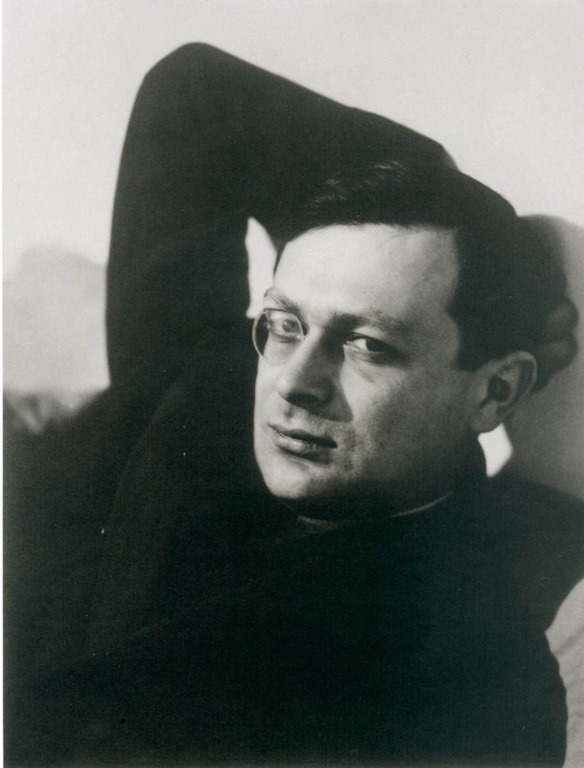
Tristan Tzara (on the left, photo by Man Ray) would have suggested a monocle.
In my translation, Tristan Tzara is providing something more like a Surrealist’s Lover’s Rock lyric—more Paul Éluard than Dan Bern hilariously parodying Bob Dylan. Musically, I’m not attempting reggae though. I’m not even sure what genre to call my composition on this one, but it is, like Tzara proclaims, “Swimming in disparate arpeggios.”
I was ready to post this new piece, Carl Sandburg’s “At A Window,” early yesterday when I had one of those days that come to challenge artists. Artists less fortunate than I can perhaps point to a single thing that holds them back, but with myself it’s often several smaller things.
I’m a habitual early morning reader of the news, a rhythm that may have started in my earliest teens when I delivered newspapers before school and continued through night-shifts in hospitals where I’d read the papers as they came out in the predawn hours. Nowadays, it’s not the papers I turn to for news, but Internet newsfeeds, and the pre-dawn hour was filled with the reports of another mass shooting profaning music, this time in Las Vegas. These events hurt me because I often spend as spend as much of my day as I can carve out making the music here in combination with the words that I combine with it. One of art’s purposes in my mind is to allow us to set aside momentarily the real consequences and strictures of life. Not necessarily to escape them—in fact, many times art allows us to examine them so that we can treat them as the reality of what they really are, because those strictures, even things we fear most, have their limitations, just as we do. And art can be the “R&D Department” of the soul and the repair of the world.
Thus, the hurt when those borders are crossed. Thus, the feelings of one’s work in an inadequate field.
Of course, my feelings on this matter are a small and abstract hurt, compared to the suffering of those more directly impacted. Small things closer to my heart feel larger than great things farther away. This is one of the limitations of our perception. Then my day continued with another unrelated hurt, closer yet to my heart, and I was reminded again of my limitations and imperfections.
Real hurt seems so large, art seems so small, and I feel like a poor worker in a field of playful trivia.
Which may be so, the limits of my perception may not be able to tell. However, I believe this is a common feeling for artists to have, and so if you create art, you may also have felt this. We try to do so much, and all we can see is so little. This is part of why the Parlando Project principle: “Other People’s Stories” has value. Speaking the words of others helps me by adding what their eyes and hearts have seen.
“He is an observer with sympathy but without fear”
This morning, it turns out that Carl Sandburg, in the very piece I was working on this previous weekend, “At a Window,” was speaking to this experience, though in my down-heartedness, I couldn’t hear him for a while. This short poem, appearing first in 1914 in Poetry magazine alongside his “Chicago, hog butcher for the world…” poem which will overshadow it, waited patiently to speak into my ear. What good could a more than a 100-year-old poem have for me?
Eight poems of Sandburg’s Chicago Poems debuted in this issue.
“At a Window” says that even in shame and failure you must hunger for even more of the same. In the context of the sampling of Sandburg’s Chicago poems, which spoke so frankly about the situation of poor and working-class Americans, I think that window in the title means so many things. Yes, it means there is an imperative to look outside oneself as an artist. The dusk and shadows out the window lets one see little, but one must still look.
Will there be any consolation? Sandburg apparently had such consolation in his spouse, who championed his work, who he speaks of in the “Leave me a little love…” section. Perhaps you have such a champion in your life, perhaps you don’t. We are called in “At a Window’s” conclusion to look out the window anyway. Perhaps the one who comes walking out of the dusk is yourself, to champion someone else?
To hear the performance of Sandburg’s “At a Window” use the player below, and thank you for listening.
100 years ago, a WWI German artillery shell ended the life of T. E. Hulme, the man who sparked off what we now know as modern English poetry. I was going to say “invented,” but that’s a dodgy word in art as much as in science. Hulme borrowed ideas from several places, and adapted poetic tactics the French and some Americans had already made use of. But we can still say he started things off because he collected the tinder and cordwood in the Poet’s Club in London in the first years of the 20th Century, and the spark was applied by suggesting that everything he thought poets were doing since, well, just about the Renaissance, was wrongheaded. Too flowery. Too ornamented. Too “romantic,” an error he believed made them think of mankind as exalted and godlike.
Hulme, interested in visual art as much as he was in literature, thought the new literary direction should be visual. Cold hard images, direct and vivid, not abstract, were to be the new order, but these images could even be homey and simple (as long as they retained that vividness), not the sort of thing that signaled high culture in the British poems of the past couple of centuries. He was very certain of this, and he either made a convincing case in person or provided the theoretical underpinnings through first or second-order influence to the soon to be mighty modernists: Pound, Eliot, Yeats, H.D., and Frost.
Bust of T. E. Hulme by Jacob Epstein, another member of the early 20th Century artistic “American Invasion” to England
Hulme illustrated his ideas with short poems. I’m not altogether sure how seriously he took these writings, but I find they have three attractive attributes. First, for all the bluster and pugnaciousness that he propounded his theories, the poems are very unassuming. In subject, they often seem to follow one of the principles I try to follow in the Parlando Project: “Other people’s stories.” Second, they are short, and I am attracted to the variety of expression that can succeed in short poetry. And lastly, they are the first. They have that charm, the same charm I might apprehend looking at a Chuck Statler music video, an Apple I or MITS Altair personal computer, an early horseless carriage, or the pictograms on a cave wall. The other beginners looked at this, and said “why not?” Ezra Pound related to Hulme’s ideas in formulating “Imagism.” T. S. Eliot either saw or was reinforced in his ideas for a new classicism in poetry in Hulme’s work.
What would be striking about today’s piece, Hulme’s “Autumn,” in 1908 when it was published?
It’s “free verse.” No rhyme, no regular metrical scheme. Besides some French poets, American Walt Whitman had done this, but this was still rare, and rarer still in England. The last part of Hulme’s “Autumn” is still musical however, essentially iambic, and sound echoes, if not rhyme, are present in “wistful stars with white faces.”
Hulme’s two substantial images in “Autumn” are extraordinarily unpretentious, particularly the first one: “the ruddy moon” at sunset leaning “over a hedge/Like a red-faced farmer.” Compare this to Shelley’s “To the Moon” where the moon is “of climbing heaven” and is addressed as “Thou chosen sister of the Spirit” or Wordsworth’s “With How Sad Steps, O Moon” which is “running among the clouds a Wood-nymph’s race”—and these are examples from good poems of the 19th Century, not the more forgettable lot.
Over at the Interesting Literature blog, where I discovered Hulme, it is pointed out that Hulme, who was from a rural district, also had a ruddy complexion. Perhaps Hulme is looking at himself when he sees the ruddy moon, or his hometown in the moon, but we don’t need to know this subtext to sense the nostalgic comfort in this scene. Except for “cold” near the beginning, which is a sensation as well as an emotion, the only other emotion that is “told” rather than “shown” in the poem is the adjective “wistful” applied to the stars.
Did Hulme toss this off, just to say “Look! You can write a poem like this.” I don’t know, but that’s beside the point. As a person myself who has emigrated from a small rural town, Hulme’s “Autumn” works as well or better than a grander poem in a more florid manner.
What would Hulme have done if he hadn’t insisted in serving his country in WWI, or if that shell had landed on some other poor soul? That, no one can tell.
Like Pound, Eliot, H. D., Frost, and Epstein, Miles Davis was another American making new art abroad.
For today’s performance, I was struck by rehearing a portion of Miles Davis’ soundtrack to “Ascenseur pour l’échafaud” earlier this week when a piece of it, “L’ Assassinat de Carala,” appeared unexpectedly in Ken Burns and Lynn Novick’s “Vietnam” documentary series.. Performed by Davis with a mostly French pickup band over a couple of days during a short stay in France, it’s something of a radically simple first of it’s own, as Davis essays a spare style with less harmonic movement, a style that he was soon to use with a company of more experienced and exceptional improvisers in his epochal “Kind of Blue” recording. Other than Davis’ own trumpet, the featured instrument on “Ascenseur pour l’échafaud” is Pierre Michelot’s bass. In my music for “Autumn” I made more use of the drums as well as the bass, as the only “trumpet” I could use was a synthesized approximation of the timbre of the real thing. There’s another first here: the first drum solo on a Parlando Project piece. To hear T. E. Hulme’s “Autumn” as I performed it, use the gadget below.
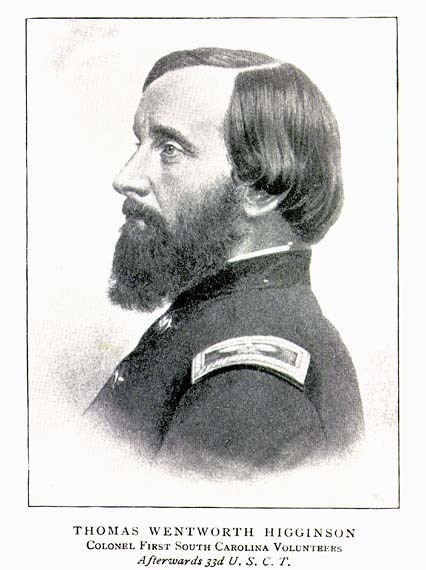
Thomas Wentworth Higginson may have exaggerated a bit, speaking then of “dread.” But it was 1891, and he had taken on editing the surprisingly vast literary legacy of Emily Dickinson for its first substantial publication. In this task, he was a lucky find, for though he had engaged in a lengthy correspondence with Dickinson when she was still alive—the real rarity was that he was a thoroughgoing radical, a Transcendentalist comfortable with heterodoxy, an uncompromising abolitionist who raised and lead a company of Afro-American soldiers in the Civil War; and rarer yet in his time, a stalwart feminist who knew and worked with pioneering American feminists Lucy Stone and Susan B. Anthony.
Abolition, Transcendentalism, Civil War, Women’s Suffrage and rights
Higginson wasn’t going to keep a little keep a poem about desire bottled up
So, fear of controversy was not in Higginson’s nature. Still “dread” was the word he used:
One poem only I dread a little to print—that wonderful ‘Wild Nights,’—lest the malignant read into it more than that virgin recluse ever dreamed of putting there. Has Miss Lavinia (Emily Dickinson’s surviving sister, and the one who found the large cache of poems at Emily’s death) any shrinking about it? You will understand & pardon my solicitude. Yet what a loss to omit it! Indeed it is not to be omitted.
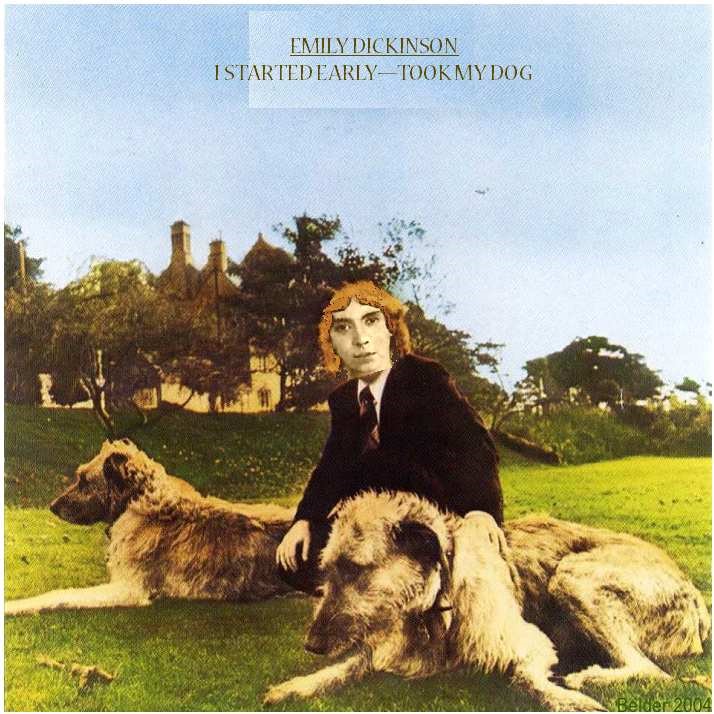
What dread could a little 12-line poem cause? Dickinson’s “Wild Nights Wild Nights” appears to be a poem about unembarrassed female desire. Even with suggested subtext supplied for for lines like “Rowing in Eden,” it probably seems less shocking today. Still, let’s give Higginson some credit. He not only didn’t want to censor it, he maintained it needed to be included for publication.
Even if we’re not shocked by an erotic element, let’s not forget: it is an Emily Dickinson poem. It’s terribly concise. It sings off the page, yet with such short lines, just three to five syllables long. It’s memorable. When I mentioned it to my wife as the next piece I was working on, she nearly knew it by heart.
But most strangely, though it starts like an ardent valentine, it finishes either in disconnected thoughts blurred by lust, or with something altogether less conventional. Setting humptastic subtext aside, why would one row in Eden? You’re in paradise! Where do you want to go? Do you need to stock your ship up with the fruit of knowledge against the scurvy of faith? And you’ve made it to port in the last stanza. Again, let’s leave the “made it past third base” metaphors behind for a moment. Why are you exclaiming the sea when you’re in port? I even wonder if Dickinson is slipping in a pun here: “Ah! the sea!” sounds like “Odyssey.” Is Emily’s wild-nighter an Odysseus looking to getting back on the boat and back to sea?
I don’t know exactly what Dickinson is getting at there. It’s her characteristic level of concision: pretty, but sharp pieces of glass, leaving lots of slant light to refract.
Poetic license. Yes, I know “Wild Night” is on Tupelo Honey
We’ve followed the Parlando Project goal of varying the music with Dickinson poems so far, even casting her as a classic blues singer. For “Wild Nights Wild Nights” I wrote a more rocking R&B thing this time. I relaxed a bit with the vocal this time too: tossing it off in one take while playing the acoustic rhythm guitar part. The opening lines of Dickinson’s poem reminded me of Van Morrison’s song, and so I slipped a few mutated lines near the end. Play the performance with the gadget below. You can dance if you want to…
Today was the Autumn Equinox, which some use to mark the beginning Fall. Where I live it was very hot and muggy, hardly autumn-like at all, and even the reasonable breeze could not budge the heat. I went bicycling with my son, promising him ice-cream, which he accepted as adequate exchange, and picked up cold sandwiches for our supper, but in-between I worked on the setting for this piece, yet another by Christina Rossetti.
I wasn’t intending to return to Rossetti so soon, and I’m not sure how I ran into this poem, but it meshes so well with some others I featured here this month about summer and attitudes to love. I just couldn’t deny it.
Christina Rossetti: sadness that none-the-less sings in a lovely way
I know little of Christina Rossetti’s life, if she suffered from depression, or if this reflects a more temporary mood; but in whatever case, she fashioned a finely crafted lyric to present the experience. I find this sort of thing often in English poetry, sadness that none-the-less sings in a lovely way. Here is America we grew up some Blues, and we tend more to bargain with despair, or call it names and begin to insult its absurdity.
The title is a bit of puzzle to me, though. “From Sunset to Star Rise” has something of a “It’ll get better” connotation. Was she trying to remind herself of some wisdom that could come from this, or that there is some mystery yet to work out?
Musically I wrote this on acoustic guitar and the full arrangement retains the acoustic guitar part with some disconsolate drums and slowly building synth parts. To hear it, use the player gadget below.







 Frank Hudson
