Like the Touch of Rain

I wanted to get another musical piece up this week as I was somewhat dissatisfied with my performance in my last one here for Armistice Day/Veterans Day. I looked a pieces I had near ready, and selected this one, by Anglo-Welsh poet Edward Thomas. Thomas is lesser-known in the United States, but is more recognized in Britain where he often gets grouped as a “War Poet.” The main reason for that: he volunteered and was killed in WWI, and some of his poetry speaks about his thoughts as he considered volunteering for overseas front-line service.

Sitting in America, which hasn’t regarded Thomas enough, I’d like to expand him a bit from behind that label. First off, like Wilfred Owen (another British poet filed under war poets, and another WWI casualty) Thomas was something of a beginning poet,* but like Owen his poetic voice is so strong it doesn’t need to apologize for being early days. As powerful as Owen’s poems about trench warfare are, I’m just as impressed by his home-front poem “Shadwell Stair.”   And Thomas, this other “war poet,” seems not to have finished any poetry about his short front-lines experience before his death in that service. As we celebrate Veterans Day it would be good to remember that each person who served is not just their service.
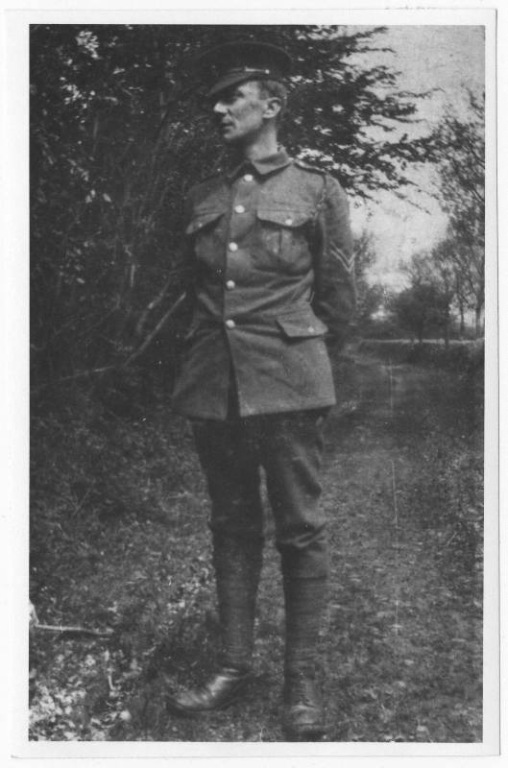
edward_thomas_in_uniform800

Edward Thomas in his uniform. He was married and past the age of most soldiers, but still volunteered.

.

So, here’s a poem that I think has nothing to do with the war directly – perhaps not indirectly either. “Like the Touch of Rain”  seems to me to be a love (or rather a loss of love) poem, though the nature of the relationship is not spelled out.** It uses as its central symbol rainfall, and I suspect it’s speaking of erotic love because of the sensuous opening where the rain, however wild, is caressing the poem’s speaker and he sings and laughs here. The poem ends by telling us he’s now closed in, out of the rain, not by his choice but by some her’s “Go Now.” It’s a turn-about from the typical “Who’ll Stop the Rain”  or “Shelter from the Storm”  depiction of rain vs. shelter. Here’s a link to the text of the poem that I’ve now turned into a short song.

“Like a Touch of Rain”  is not the most complex or virtuosic poem, but it also doesn’t detract from its depiction with any overreaching or stilted poetic diction. There’s a power in that. Reading Thomas’ contemporaries’ poetry in search of material for this Project I’ve read a great deal of published poetry that doesn’t escape those faults. My wife gave me a copy of Thomas’ collected poems a few years back – it’s not a thick volume, and I believe that most of the poems in it were first published in this collection posthumously through efforts of Thomas’ friends.***

After overreaching with my Padraic Colum poem setting earlier this week, and having to settle for an incomplete recording, it may behoove me to leave today’s piece as just voice and acoustic guitar accompaniment – and as rough-hewn as my voice is on this performance, I think it’s better too.

You can hear my performance of Edward Thomas’ “Like a Touch of Rain”  with the audio player below. What, has the door to any such player gadget been shut? Well, this highlighted link will open a new tab with its own audio player.

.

*Thomas took up poetry only a couple of years before his death, at the insistence of his American friend Robert Frost.

**I have not read a full biography of Thomas, but before the war he seems to have had a complicated set of affections as well as bouts of depression and drug use. Those two things might cause one to suspect a ne’er-do-well life, but through-out that he wrote voluminous freelance reviews and essays to pay the bills for a young family.

***Friends? Well, Frost for one. And since one of the good things in my post before this one was the discussion of poets best remembered for what became a song lyric, one of his close affections was with a young writer Eleanor Farjeon, who wrote what became the lyrics to the song “Morning Has Broken.”

An Irish Airman foresees his Death

The song below using the words of William Butler Yeats had a direct, contemporary inspiration: John “Paddy” Hemingway died this St. Patrick’s day. He was Dublin born, and in Dublin he died — and he was in the news because he was the last surviving RAF pilot from the Battle of Britain during WWII.

Reading the notice, I immediately thought of this Yeats poem, about a fatalistic Irish pilot during WWI who flew into battle having no love for the British Empire. John Hemingway’s Wikipedia summary mentions nothing about his weighing of the enormous risks he took in RAF battles, but a recounting of the number of times he was shot down and got back to flying again makes me think he’d accepted his death as a probable result of his service. Fate had sport with him, he lived to be 105.

So here’s this poem by Yeats, written during WWI about an Irish combat pilot. Yeats seems prone to removing the specifics in some of his poems written about contemporary events. One of the most popular posts ever here draws interest because it resolves the mystery of who and what the friend and work was in Yeats’ poem “To a Friend Whose Work has Come to Nothing.”   Did Yeats invent the fatalistic airman in today’s poem, or did he have someone in mind?

Not much research required in this case, it’s widely recognized as a poem written as an elegy to a particular doomed Irish Airman, Robert Gregory, the son of a friend and ally of Yeats, Lady Gregory.

I know nothing of how this poem was received by the mother who’d lost a child. Yeats portrays a peculiar heroism with the poem’s subject. Using only the evidence within the poem’s boundaries, it’d be a fair reading to say that the titular airman here was driven to mortal combat because there was no hope otherwise in his country’s situation. Another reading, more specific to the man Yeats had in mind, might be that the airman was drawn to air warfare for the pure sport and sensation of it, but that latter reading still incorporates, if not an outright death wish, a sense that the most intense love of the moment asks for an acceptance of imminent death. So, an odd poem, poised between self-destructive despair and dark romantic thrills.

Well, whatever — it is a poem by Yeats, so of course it’ll sound wonderful, and reading it on the page will cause any number of its silent readers to want to sing it. After I completed my version, I listened to nearly 10 other musical versions, yet I still hope that my version isn’t superfluous.

An Irish Airman

Here’s the chord sheet for today’s song version of Yeats’ poem. Feel free to improve on my attempt. As I play it the G and A  chords in the last line of each stanza are played at the 3rd  & 5rh fret positions.

.

I chose to make my song entirely jaunty, a reverse of my minor key remembrance in the E. E. Cummings Spring poem last time. That doesn’t mean I want the listener to take it as a recruiting poster or an endorsement. Poetry is portraiture you can feel in your ears or breath, but you’re still allowed to think. Whatever his internal motivations or conflicts, the singer of Yeats’ words seems proud of his choice. John Hemingway likely thought he was in for the same deal that Robert Gregory signed up for. Fate laughed. Reports say Gregory, the brilliant Irish WWI flying ace, may have died either from friendly fire or pilot error secondary to a case of the flu. Another man, a proudly stupid one, once said that he liked pilots who didn’t get shot down. Hemingway, as it happens, was shot down several times in WWII, and yet had decades to live other pleasures I’d find more delightful than combat. And that otherwise unrelated man, the one who truncates his thought, but not before he asks to be judged by his judgements — how is he weighed?

You can hear my performance of Yeats’ “An Irish Airman foresees his Death”   with the audio player below. No player to be seen? You can hear my performance stored somewhere in the clouds above by clicking this link, which will open a new tab with its own audio player.

.

In Just Spring

It’s the first day of Spring.

This E. E. Cummings poem is often read as delightful. And it is. It’s also a poem some encounter in childhood. At least in my youth, it was an anthology favorite that vied with Carl Sandburg’s “Fog”  as an introductory example of free verse. And no verse is ever more free than this: the letters smattered like mudprints all over the page, capital letters not yet grown, stuff smushed together. No colonnaded sonnet, no astringent exhale of meditative breath like a haiku. On your poetic menu, this is a mudpie for Spring.

Is it just this?

I set it to music. That’s what this Project does in Spring, and Fall, and Winter too. Every chord in the music I made today is a minor chord. Is this a sad poem, did I want to force it to be one? Not that simple. Just lowering the 3rd note in a scale a half-step to form a chord from it, is that really determinative? These are just sounds playing together.

But this is a considered song about Spring and the distance in half-steps from childhood, not just some neutral exhalation of it. The poem itself grew up, or blew up, over a few years. It was first submitted for a class assignment by a Harvard college student in 1916, and that version, while free verse, lined up this way.

In Just Spring 1916

I found this excerpt of the original version of the poem in a section on Cummings written by Michael Webster included in A Companion to Modernist Poetry published in 2014.

.

That college student would soon go overseas into a world war as an ambulance driver, and Cummings and his cohorts there took exception to simplistic war piety. I’d guess the logistics of suffering didn’t firm up the young man’s patriotism. In something I see echoed in this week’s American news, his talk was deemed an imprisonable thing to say, and Cummings was imprisoned in France. It’s one thing to write free verse, it’s another to convert the currency of one’s free thought into loss of freedom. I wonder if at this point the blood-soaked mud of WWI’s trenches were known to the young man. Anything but mud-luscious.

Cummings had enough luck or privilege to be released. In 1920 The Dial  publishes a new version of that college poem. In a few years more this magazine would publish an expatriate American’s poem that indicted Spring, starting “April is the cruelest month…” But this is Cummings’ poem, and this is how it looked on The Dial’s  pages.

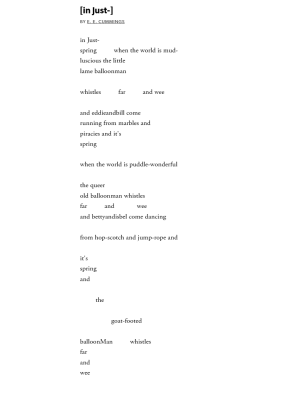
in Just-spring dial 1920

On first publication it’s largely the poem we now know, but it doesn’t have a title. And curiously, the second instance of balloonman is “balloonMan.” Did a proofreader just get exhausted editing Cumming’s manuscript?

.

In 1923 Cummings published a poetry collection, Tulips and Chimneys. He put the still untitled poem in a section “Chansons Innocentes” (Innocent Songs). By innocent did he mean from childhood’s sensibility, or a plea of not guilty? And this is how that version went.

In Just Spring Tulips and Chimneys 1923

Nope, the balloonman to balloonMan thing must have been Cumming’s intent.

.

We’re near the final version, but at some later date (I’d assume a selected or collected poems publication) it converted its first line (strictly constructed) into a title with some typographical marks to make it look like Cummings was establishing Bon Iver’s song titling methods a few decades before the bard of Eau Claire. In the end, the poem that a lot of folks informally recall as “In Just Spring”  is [in Just-].   I can’t help but read that title as a pun.

In Just Spring final 400

Here’s how the poem in it’s final form appears collected on the PoetryFoundation.org web site. “Just” is the only capitalization and man stays lowercase.

.

And now decades have past — and I, an old man, have gone to perform this poem for this year’s Spring, and I pick minor chords. Much has past us, dancing toward or running from: another world war, and current cruel wars happening somewhere further than the far distance whistle of the balloonman. Cummings’ childhood was close enough to me that I can actually recall playing marbles in the dry dirt finger-writ circle of a schoolhouse playground.*  I know how a hopscotch chalk field is laid out. Do children still jump rope with rapping rhymes, and if not, what has poetry and hip-hop lost? If there’s a balloonman, his creatures are mylar and determinedly decorated no doubt. All this 20th century stuff is now as archaic as the arcadian goatfoot-god Pan who whistles like escaping air. I, and once-girls with names like Betty and Isbel, know this. Now, as I experience the poem this year there’s more distance there than there was for a twenty-something poet who wrote it. I put a distance far and wee in the music — for Cummings was of an age that he knew he was to be an adult now, while still young enough in years to know within his body’s memory the lost experience of the playing children delighted at the balloons. Balloons that would either fly away or deflate — escape/ascent vs. air loss or a pop as sharp as a bullet.

It’s the first day of spring. My chords have a third a half-step deflated. Disordered self-important dolts are running things, and I think better to have an old halt body with a bouquet of floating hearts. If the world can still seem puddle-wonderful — to be aghast is not to wonder. So, I must recall how to wonder, far and wee.

You can hear my performance of E. E. Cummings “In [Just] spring”  with the graphical audio player below. Did someone let go of the string and a player is blown away? Don’t whistle, just use this highlighted link alternative that will open a new tab with its own audio player.

.

*And playing pirates without extra-faceted dice, is a lost quattro too — but I wonder if Cummings was thinking of Barrie’s Peter Pan  in choosing that manner of play. I’ve just finished watching an absorbing 2022 TV documentary series called Wonderland on BBC Select that often asks over its episodes how much childhood trauma, WWI, and social injustice informed English children’s literature a hundred years ago.

I Sit and Sew

Today is International Women’s Day, and I was fortunate to be able to complete this recording of a new musical piece setting a poem by Alice Dunbar-Nelson before the day ended.

“I Sit and Sew”  is likely Dunbar-Nelson’s best-known poem — it’s certainly the first one I knew of. I’d encountered it as a poem written amid WWI during the years this Project was noting that conflict’s centenary. “I Sit and Sew”  still comes up fairly often in regards to war and destruction, or because it mentions domestic, woman-associated work in the context of the greater world.

I noticed one other element in re-reading it this week: it seemed to me to relate to another line of woman-associated work: medical nursing. Having spent a couple of decades doing nursing work myself, the poem’s focusing-in on the trauma and injuries of warfare really made me think Dunbar-Nelson wasn’t just thinking generally, writing something that could be paraphrased as “War is terrible, and yet here I am peacefully making or mending something with needle and thread, as women have for millennia.” There’s nothing wrong with experiencing the poem that way, as a companion-piece perhaps to Hardy’s “In the Time of the Breaking of Nations”but I’m a person who often asks questions while reading.

While the poem can stand on its own, I wondered if Dunbar-Nelson herself wanted to serve as a nurse.*   Short answer: this issue has additional complications. Currently in the United States we’re suffering from numerous outlandish statements and acts snuffing out complexities of diversity, but historically women’s wartime work, including nursing, is tightly connected with increasing respect and civic equality for women.

Alice Dunbar-Nelson was an Afro-American woman. The U.S. armed forces were segregated during WWI, and the roles available to the non-White military were limited along with that, based proximally on rules about race-mixing no-doubt supported by a pervasive background of racial superiority. A few years back, while learning about another poem, I came upon the case of Col. Charles Young, a Black West Point educated officer with experience in two foreign deployments who couldn’t get himself utilized as America mobilized for WWI. The situation for Black Americans who wanted to work overseas as nurses was also exclusionary. I’ve found out Dunbar-Nelson was working as a national organizer, a member of something called the Women’s Committee of the Council of Defense, and her focus was on Afro-American support of the war effort. She published today’s poem in 1918, and after the war she wrote up a summary of Black women’s WWI efforts.

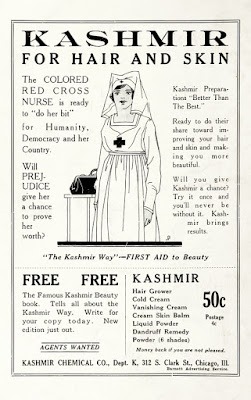
Kashmire for colored red cross nurse Crisis Vol 16 No 4 Aug 1918

We Wear the Mask Dept. I found this ad here in another post mentioning this poem. In her article linked above, Dunbar-Nelson mentions, in passing, (pun intended) that some lighter-complexion Afro-Americans snuck through the overseas nursing service ban.

.

No long post today, that’s a start for anyone who wants to dig deeper.

The song I made out of her poem came together more efficiently than many, partly because it began before I knew I was making a song. This week I remodeled a nearly 30-year-old Squier Telecaster that I had put a Bigsby vibrato bridge on a decade or so ago. This guitar and that bridge just never worked out. I couldn’t get the neck angle and string height right, the saddles rattled, and the strings slipped sideways when I bent strings. After some looking, I unearthed the guitar’s original non-vibrato bridge and put it back on.**  The guitar was transformed. Back when I put on the Bigsby I’d also installed a set of upgraded replacement pickups, and with the string-path mechanics sorted out, the guitar played and sounded great! While I was resetting the action/intonation etc., I quickly made a short musical piece on my recording computer that would let me play strummed chords, arpeggiated chords, and single-note lead lines over three separate sections — just so I could have fun while seeing if I’d eliminated all issues.

Funny how fast you can compose, if you’re not composing. I saved the drum pattern, the bass track, and the keyboard noodling after testing the guitar, thinking “Hey, I like that groove, might be useful.” This morning, I had about an hour when I could open a mic and record. I loaded the saved rhythm tracks, worked them into a longer song-form, recorded the guitar parts using the transformed guitar, and found that I could sing Dunbar-Nelson’s poem to this.

You can hear it with the audio player below. No player? It’s not hiding under a box, it’s just some ways of reading this blog suppress the player gadget.  This highlighted link will open a tab with its own audio player.

.

*”Nursing” is a very broad word covering a wide range of caring work and levels of technical knowledge. Dunbar-Nelson’s write-up seems to indicate the women’s war work she was promoting covered a range of things, not just licensed medical nursing as we know it this century.

**One difficulty was that the original — like the Vibramate-brand vibrato bridge I took off — was a non-standard bridge. When I finally found the original bridge, it was sitting underneath  a storage box in my studio space. Luckily, like most Telecaster parts, it’s not a fragile thing. By the way, I’m not knocking Vibramate’s hardware. I’ve used Vibramate products to add Bigsby vibrato bridges to other guitars with good results, and their “Spoiler” accessory for Bigsby bridges makes restringing or replacing a broken string a much calmer experience.

Let Me Call It Remembrance Day

A post today for a holiday with complications. In the UK, Canada, and the former Commonwealth, today is Remembrance Sunday and tomorrow is Remembrance Day. In my United States tomorrow is Veteran’s Day. Remembrance Sunday/Day is a bigger deal. Here in the U.S., it’s one of two holidays set aside to honor the armed forces,*  and the Spring Memorial Day gets more observance. America moves it around as a Monday workday holiday, so it now rarely occurs on November 11th, the day it was originally meant to commemorate, Armistice Day, the day that WWI ended. In the American observance, the day and the moment being observed are no longer there as they happen to be this year.

But then, all the events of WWI have now passed out of the living’s remembrance, and WWII is entering the time of that leaving — while in England the wound and loss are still felt by a generation that themselves only recall the generations that personally experienced it.**

Historically, poets suffer, fight, and die in wars. Presently in the U.S. this may be less true than was traditionally so, our soldiering ranks now coming from a different cohort than those with MFA and workshop attendance. That too is complicated, and I’ll choose to honor your time today by not going into all of that. Yet I’ll maintain that the experiences of service to country, of organized protection and organized death, of comradeship and loneliness — these words of history aren’t so far away if we only open ourselves to listen to them.

Here are five poems for this complicated holiday that this Project has presented over the years. In honor of the UK preservation of the original reason for the holiday, four of them will be British to one American.

Gone, Gone Again (Blenheim Oranges)

British poet Edward Thomas is too little considered in the United States, but in the run-up to WWI this overworked and underpaid freelance writer started to expend his writing efforts to the least commercial of literary forms, poetry of individual honesty — urged in that endeavor by his expatriate American friend, Robert Frost. Frost left England for America as the war began and he asked his friend to follow him and emigrate to the United States.

Thomas didn’t accept his offer. In Britain Thomas is remembered as a War Poet, as one of the casualties of The Great War, but his poetry doesn’t speak of his trenchside times in the conflict — instead it sings with lovely precision and concision of the British countryside as he is making his decision to take the road well-traveled to enlist to the front. “Gone, Gone Again”  is one of his masterful poetic verse-essays on this time of decision, as he observes an England depopulated of its workmen. Why did he go to the front? He explained it mostly as being unable to shake his patriotic connection to the very soil and experience of Britain that his poetry sings of, but I said today’s post would be about complications. Thomas was also a troubled soul, looking for meaning in his life not captured by certainty, and some have speculated that a soldier’s pay was a better economic offer for his family than his Grub Street freelancing. He packs every bit of that into this short poem.

.

Shadwell Stair

Wilfred Owen is another Brit who took up poetry in the context of serving in The Great War. He’s known for his scathing anti-war poems, which to Britain’s credit doesn’t keep him from being honored nationally as a War Poet. But here’s a lonely poem written on the banks of the river Thames, likely during the time he was back from the front being treated for what was then called “shell-shock.” Folks today can experience the poem in a context pointed out later, that the Shadwell Stair location was a gay cruising spot at that time. Historically, there’s a blindness in some eyes to see that not just that poets and artists serve, but that they aren’t all straight.

.

On the Troop Ship to Gallipoli

Rupert Brooke was a rising young poet before WWI started, and even at his young age, great things were predicted for him. Unlike Owen, his war poetry is conventionally heroic, conventionally patriotic. Unlike Thomas, he was under no economic pressure when he enlisted. Would that tone have continued, could he have written glorious battlefield odes, or would the war have turned him into a skeptical Modernist? In an irony that only the Fates could have woven, he was detailed to be part of the disastrous attempt to land at Gallipoli. While on the troop ship steaming there, he fell sick from what I’ve read was an infected insect bite, and died before reaching the deadly front.

I took a fragment Brooke composed on that fatal voyage, and audaciously decided to take a Modernist blue pencil to trim and rephrase it the way an Imagist might. That was a complicated act, one that I’m not sure I can justify, other than to say that I wanted Brooke’s moment on that troopship to stand out more vividly, riding roughshod over his verse to honor that.

.

The Cenotaph

I don’t believe there are any women on WWI War Poet plaques in Britain, but of course they were asked to and worked with the war effort, and were there to tend, mend, and mourn the casualties during and afterward. Here’s a complicated poem of mourning, written as the original Cenotaph*** was erected in London. Its author Charlotte Mew is another British poet little-known in America. From what I’ve read she was seen as eccentric by other artists of her time, and her poetry doesn’t fit easily into any movement or style. Every Remembrance observance in Britain to this day has a ceremony at the London Cenotaph where the current government pays solemn homage to the soldiers’ sacrifice. If I read Mew right, she’s the ghost-at-the-feast here, and has some particular wailing to do.

.

.

Grass

Lastly, for Remembrance Day, here’s the American — and non-more American than the child of immigrants Carl Sandburg. I would post his poem “Grass” every Memorial Day, every Veteran’s Day — and yes, even every Remembrance Day. Yet, this is a poem that sings about forgetting. Is forgetting wars, forgetting soldier’s service and sacrifice, a callous thing? Is forgetting the follies and cruelties of war dangerous ignorance? Is it better to forget wars than to suffer them forever in endless horror? Is forgetting just the way things are eventually, an erasing sigh that fades into new present days — as what humans do that humans can never fully comprehend?

Look, I said it was complicated.

.

*In the US, there’s fine print sometimes invoked to separate the two: Memorial Day for those who died in service, and Veteran’s Day to honor all that served. The UK Remembrance Day is more like American Memorial Day focused on wartime losses and sacrifice.

**Proportionate to population, the US casualties in WWI were much lower. And England’s cities suffered under bombs during WWII. I was going to write too about the World Wars and their effect on the British Empire and colonialism, and America sliding in as a replacement, but that subject is too big for any footnote.

***So great were the WWI deaths that logistics couldn’t see to repatriating all the bodies of British war dead back home, and unidentified dead and missing in action mysteries clouded the situation too. Regional cenotaph memorials, including a great one in the national capitol, would serve as a consolidated gravesite to lay flowers and visit in remembrance.

Shadwell Stair

Halloween is a chance for us to note our fears.

I first wrote “celebrate” in that sentence, but revised it to ”note,” with musical pun intended.* I don’t think we actually celebrate fear on Halloween, but rather we play with it: pretend we don’t have it, pretend we can sport with it — though perhaps some connoisseurs roll the sense of it around on their tongue to absorb fear’s full body and taste. But in any of those ways, however obliquely, we are acknowledging it.

How close are we to our fears the rest of the year? I suppose that varies. Can we name them? Do we bother? Do our friends, our intimates, know them? Do we even speak of them to ourselves?

Today’s piece is based on a hard to explain poem by one of the most loved British “War Poets” who wrote of their experience of WWI, Wilfred Owen. Certainly that war’s trench warfare, mixing squalid contemplation and carnage, would offer enough horror to write about, and Owen’s WWI poetry is loved while not flinching from that horror or buffering it in patriotic bunting.

But then there’s this poem. It is not set on the front lines. If it mentions the war at all, it must be implied from knowing his biography.

Shadwell Stair is on the banks of the Thames River in urban London. In Owen’s early 20th century it was apparently a noisy, smelly industrial area. This blog post has numerous pictures, some history of the Stair, and the delicious trivia that it’s next to “Labour in Vain Street.”

As treasured as Owen’s bleak poetry is, Shadwell Stair  isn’t one of his best-known “Greatest Hits.” Its effective condensed portrait of the locale isn’t the most-read poem of that time and place in metaphor, being eclipsed by “The Waste Land’s”  bankside sections written by an American, T. S. Eliot. Those portions of Eliot’s poem are alienated, partly by the recent Great War, and partly by his own sense of an educated visitor weighing England’s and Europe’s history and culture against the grimy realities of the London he had settled in. Eliot’s “The Waste Land”  doesn’t actually name the fears in the center of it, but it conveys them in vivid and varied silhouettes. Arguably, Owen’s poem is more coy — if only by being brief — but let me make a case for it. Here’s a link to the text of Owen’s poem.

The first stanza introduces lovely word-music that the poem carries on throughout. It claims to be in the voice of a ghost. We may (I did) anticipate a classic Halloween poem. If we know Owen’s biography, we might think the slaughter-house there is a reference to the war. It may be, but I think the second stanza gives us a different context.

It’s a fleshy context. I can almost feel the goosebumps on the skin, and the speaker’s eyes are lit up in what? Fear? Anticipation? Heightened vigilance? If this be a ghost, it’s an embodied one.

The third stanza is almost all scene-setting, lit by snapping arc lamps evoked between interrupting night noises — those streetlights had a sensual, buzzing, almost reptilian sound that younger readers now may not have had the experience to hear. Of our mysterious speaker, it only says of themselves here that they are watching. OK, watching for what?

Later readers have given an understanding to the mystery here: Owen’s sexuality had a homoerotic element. In this reading, the speaker (presumably Owen) is cruising for a hookup, and it’s said that the disreputable docks and titular Stair were known sites to London’s homosexual demimonde. As with the harsh arc-lights, this context illuminates the poem. I see vividness in this reading, and no reason not to give it credence. Let’s consider then the situation evoked: here is a man, likely on leave from the immense horror of a war that was grinding men up with ineffective tactics in the face of modern lethality. Many Halloween readers here with holiday ease to play with fears would likely have no gauge to measure that — but what has his flesh firming, his skin puckered with cold plucked-chicken skin, his pupils dilated out round as the gems of Rilke’s absorbing cat from last time? Answer: the anticipation of sensual, carnal, sexual contact — intensified by a fear of police trolling for arrests, complicated in the doubts of attraction or rejection with disgust that strangers meeting in the night would encounter.

If so, the enigma of this poem has a specific — if unspoken — core, and the last stanza is an aubade of something even more transitory than the average parting of lovers at dawn. We started being told this is a ghost poem, and the ghost here meets another ghost. The ghosts here are metaphor for spirits that could barely speak of the eros of their lives. A silencing louder than bombs.

shadwell stair MS1

Here’s Owen’s poem in work-in-progress form, He seems struggling most with the 3rd stanza yet at this point.

.

Today’s music had two challenges for me. The setting I devised might benefit from a “real singer,” someone who could carry a melody with confidence and a beautiful timbre. I’m not that. I decided I could do no better than I can do. And then too, while I was pleased at what I could come up with feeding parts into my orchestra instrument arranger, and particularly with the high trumpet part that comes in near the end, I was never satisfied that I could get the best trumpet Virtual Instrument I own to have the correct envelope I wanted. There I just surrendered. No one with a “no-revenue” independent musical enterprise could expect to be able to present the full richness of the actual instrument. Those who can, will know I fell short — but the rest will, I hope, accept my approximation. You can hear my musical setting of Wilfred Owen’s “Shadwell Stair” with the audio player gadget below. Not even a ghost of such a player visible?  This highlighted link is an alternate way which will open a new tab with its own audio player.

.

*”Note…fears?” See that final paragraph today.

The Dumb Soldier

I spent Thursday recovering from a brace of winter vaccinations. I was tired and achy enough that I even missed attending my treasured monthly Midstream Poetry reading, but besides whatever mojo the shots might give me from winter respiratory crud, it made me grateful upon waking up Friday with my usual level of old-guy energy. I took a crisp 34 degree F. bike ride for a veggie sandwich and tea at a local bakery, and then spent a good deal of the day finishing some live LYL Band recordings from last September. Only then did I recall that I should do something for Veteran’s Day — or Armistice Day as it used to be called here in the United States. Armistice Day is still the name in much of the rest of the world that experienced WWI, and perhaps because I’ve been thinking a bit more about British poets this week, I quickly settled on two poems by British authors.

The post just before this one, Housman’s “Soldier from the wars returning”  was the first poem I wanted to do, and it’s a straightforward poem of simple gratitude for a veteran’s service. The second one is a little stranger, and I made it stranger yet. Can we be sure Robert Louis Stevenson wished his poem “The Dumb Soldier”  to be read as a whimsical piece about a child’s toy? He published it in A Child’s Garden of Verses  after all.

There were no sensitivity readers for children’s books then,* but the nature of the poem’s story is not benign. It starts right out with the poem’s speaker burying a soldier, which from the text alone we don’t know yet is a toy. When we read “leaden eyes” we might get the hint that it’s a cast metal toy soldier — but if we were to hear this poem as I performed it, without context, sung by an adult, even that detail might not tell us clearly what is going on.

I leaned into that strangeness. I trimmed a couple of stanzas for better performance length and chose to truncate the final one, leaving off the reveal that this is a toy soldier that will return to the child’s shelf. This left this a more ambiguous buried soldier then unable to tell us anything about what they’ve seen.

The Dumb Soldier

Here’s the chord sheet for my version of Stevenson’s poem. To read his original text, here’s a link.

.

Although written decades before the first Armistice Day in 1918, this mode of the silent war dead is clearly apt for that holiday as celebrated outside the U.S.**

It was late Friday night before I was ready to perform these two poems as songs. I had music written, and for practicalities sake, I was able to quickly use my studio space to record the pair of songs with just acoustic guitar for accompaniment. Neither of these are perfected or sophisticated performances, they are more or less what you’d hear if I was to present them off the cuff. You can hear my version of “The Dumb Soldier”  with an audio player below, unless you don’t see any such player. Some ways of reading this blog won’t display that, so I give you this highlighted link that will open a new tab with an audio player in those cases.

.

*”Dumb” used as a term for someone who cannot speak is now a highly impolite term. Given the sacrifice and suffering of war, that term’s objectionableness might be a lesser concern.

**Since the U.S. had an existing holiday, Memorial Day, for remembering those who died in military service, the U. S. Armistice Day became Veteran’s Day to celebrate all who served, particularly the living. Housman’s poem, couched though it may be in the particulars of WWI, speaks to that element of the holiday. As a mid-century child, I can recall Armistice Day was still used occasionally in my youth for November 11th since veterans and others who had experienced that war were numerous.

Soldier from the wars returning

I’m going to present a pair of poems which are more related to Armistice Day, the former name for the holiday now called Veteran’s Day in the U. S. Here’s the first one.

Earlier this month I was confessing to Lesley Wheeler that I haven’t read much of English poet A. E. Housman, a poet who I believe retains more readership in the UK than here in the States. Well, no matter how little I know of him, his poetry has qualities that attracts musical composers like myself.

Soldier from the wars

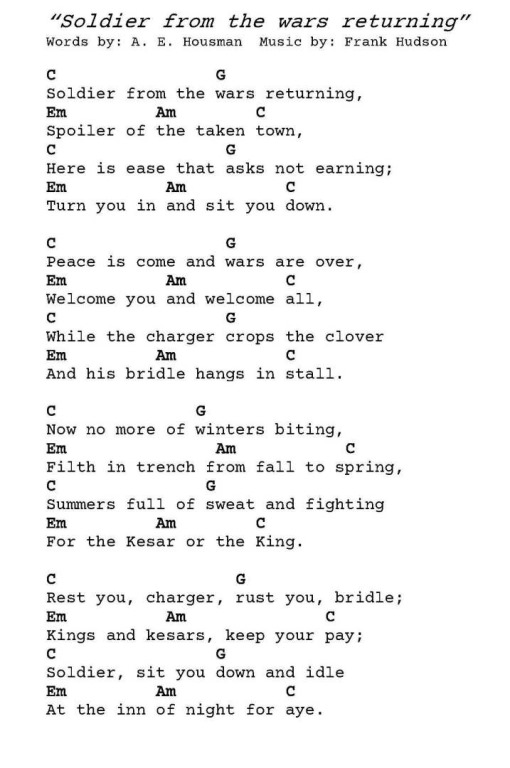
Here’s a chord sheet for today’s song. I recorded this with a capo on the 2nd fret, sounding in the key of D

.

This poem, which may not have had a title as I saw it with just the first line in quotes, is clearly a poem for Armistice Day and its veterans, first published a few years after the end of WWI. I don’t find it a complicated poem, but that doesn’t hurt it when one seeks to be comprehensible in an immediate performance such as I gave it. It’s hope, contemporary with Housman and his listeners when he wrote his words, that “wars are over,” now has sort of cruel quaintness, but it was an earnest statement then. Here’s a link to Housman’s words, and then below this is an audio player gadget to hear my performance of the song I made from them.

No audio player? Clicking on this highlighted link will open a new tab with its own audio player in that case.

.

Winter Stars

Yesterday was some kind of day to celebrate Wales, and I asked the teenager in the house what they did to celebrate since they have an interest in languages and had recently been studying Welsh language online.

“You mean for St. David’s Day?” They replied. I was surprised they knew — but then they’re often surprising. “What are you supposed to do?”

“I dunno. Maybe make a point to use W as a vowel?”

What did I do? I worked, using some increasingly rare time recently, on a new piece here that you may see later this month with words by Welsh poet Edward Thomas. But that’s not today. Today is my catching up with a piece that has been in the works for a couple of weeks at least, remaining unfinished as other concerns remand me to only hot takes and short contributions on Twitter.

Late February

Those I follow in the British Isles are sharing pictures of buds and first wildflowers. Not here.

.

Is Sara Teasdale’s “Winter Stars”  late then? In my upper Midwest, absolutely not. Monday it snowed, my bicycle which I’ve ridden all winter, is behind a shed door whose jam is frozen completely shut by an icy enchantment after melt/refreeze — and 15 degrees F. this morning certainly won’t let it go. Yet, there’s one other time displacement to account for in this poem, for this is another of Teasdale’s poems about WWI. Particularly in Great Britain, when “War Poets” are mentioned, male citizen-soldiers are typically meant, and few now recall that American poet Teasdale wrote poems about the war. One of those poems is likely her best-known poem (or at least poem title, since Ray Bradbury borrowed it) “There Will Come Soft Rains.”   So lovely and complete is that dystopian vision within itself that I suspect it never occurs to readers today that she was writing it in the context of WWI.

“Winter Stars”  has the same strengths of not seeming to be stuck in time or current events. Indeed, folks have written about the poem and thought the blood flowing and wars mentioned within its lines are metaphoric tropes. Alas, as I considered this poem during this past February, the anniversary of the still ongoing invasion of Ukraine provided a corresponding all-too-actual simile. Here’s a link to the full text of Teasdale’s poem.

Teasdale’s night stars are then, like the sure-to-come soft rains of her other poem, a meditation on what endures when suffering, violence, and human vanity can change everything else. I was particularly taken with the next to last quatrain in Teasdale’s poem, remembering as I read it her guarded and constrained by illness childhood looking out a bedroom window at the immortal stars and the mighty Orion, the hunter, who could change and master things.

In the poem, it turns out that Orion doesn’t change things, rather that desire to change things is the constant. Teasdale would leave her sick-room childhood in St. Louis, find some brief success in New York. That older Teasdale is the writer of this lyric. Armies can march, hunting changeable borders to be drawn in blood. Teasdale seems to somehow fatalistically know that Orion and winter never leave, they only blink, they’re always there, the hunter and the prey.

The player gadget to hear my performance of Sara Teasdale’s “Winter Stars”  is below for many of you. No player to be found? This highlighted link will open a new tab window with a player so you can hear it too.

.

The Absent Poetry of World War II

It’s been sometime since I’ve posted here. Having fewer blocks of uninterrupted time to compose and record the audio pieces for this Project, I’ve spent time instead with that proudly designed to be a time-waster Twitter in the past week or so. Twitter* has its own news stories this week — but that’s not my subject today.

I have a tiny number of followers there, and what I tend to talk about on Twitter is poetry, and then less-popular types of music. Really, not unlike what I do here on this blog, but more cut-up and off-the-cuff — and with more typos from typing on a small tablet screen and screen-keyboard. While working with poetry and music might cross-train you to fit things into constrained spaces, the Twitter short post-length limits challenge even this fan of compressed verse and sub-1000-word essays.

I came upon this Tweet this morning though that brought to mind something I’ve not revisited here on the blog for a while. One of the regular Twitter poetry-posters put up the devastating Wilfred Owen poem “Dulce et Decorum Est,”  and I once more thought of how powerfully the soldier-poets of World War I wrote about their war from the front lines — how to this day England recalls what they said combined with their presence as example casualties from that war, and in the sum, the tragedy all that entails. Long-time readers of this blog will know how thoroughly I’ve extracted poetry from WWI for presentation here.

War Poets in Poets Corner Westminster Abbey

Here’s a picture of a specific memorial to WWI poets in the Poet’s Corner of Britain’s Westminster Abbey

.

Perhaps it’s the Public Domain limitations of what can be freely reused in a Project like this, which puts my attention on pre-1927 work — but I was caused again to wonder, why don’t we have dozens of effective poems about WWII, many of which will be commonly anthologized and recalled by the general audience poetry retains? If called to find examples I might start (as would many others) with Auden’s “September 1, 1939” — but this isn’t a first-person “report from the front lines” poem like Owen, Sassoon, or T. E. Hulme presented back then. It’s not even as close to harms way as the incisive poems of Edward Thomas who wrote about his approach to volunteering for the British Army that led to his death in the conflict, or Apollinaire’s equivalent to Auden’s poem about the outbreak of WWI, “The Little Car.”  It’s not that poets or writers didn’t serve, and a great many novelists who served had a war book in them it seems.**  So, we can easily think of the novels about WWII written from frontline experience. But poems?

Was WWI poetic and WWII novelistic? I can’t make that case. Maybe you can. Is it down to the changes in the literary marketplace? Plausible, though within poetry’s more limited audience in the second half of the 20th century you think there’d be room for poetry as vivid as those of the WWI soldier-poets. Here’s a short list of a few of the notable American poets who did serve in WWII: James Dickey (Air Corps airborne navigator, though some reports say fighter pilot), Richard Wilbur (Army Signal Corps in Europe), Frank O’Hara (sailor on a destroyer in the Pacific), Richard Eberhart (gunnery trainer), Lawrence Ferlinghetti (Captain of a submarine chaser), Karl Shapiro (medical corps clerk in the Pacific theater), Kenneth Koch (infantryman in the Philippines), Randall Jarrell (“Celestial navigation tower operator,” which he claimed was the most poetic job in the Air Force).***

Of that list only Shapiro and Jarrell wrote what might be called “from the front” poems. Jarrell’s “Death of a Ball Turret Gunner”  may be the  example of an anthologized WWII poem, and Shapiro had his first book about his overseas, but not exactly in front line combat, V-Letter,  published as the war was still ongoing.

What happened? Why didn’t more of these poets write more about the details and moments of their service? My general observation is that instead they wrote consciously and unconsciously about how the war changed their outlook on the world. David Haven Blake wrote a short journal article on Wilbur’s World War II poetry, but instead makes the case more for this theory. He quotes Wilbur as saying “The war challenged me to organize a disordered sense of things, and so prepared me to write a poetry of maximum awareness and acknowledgement.” I’ve seen another quote from Wilbur circling the same thought “One does not use poetry for its major purposes, as a means to organize oneself and the world, until one’s world somehow gets out of hand.”

This non-scholar will now generalize wildly, but the WWI war poets used poetry, often structured metrical/rhyming poetry, to demonstrate the world out of joint, a genteel form container for barbarity and chaos. The WWII poets muted all that as unspeakable (or even over-spoken?) and sought to portray in poetry (that wasn’t always as formal) the values and observations of a peacetime more precious, however ambivalent and imperfect, from the militarized brutality of combat.

Let me dedicate this little essay to Robert Tallant Laudon. Laudon sought out the Lake Street Writers Group early this century as an 80-something veteran who had served in a logistical role in England during WWII. Though he became a music professor after the war, he seemed not completely sure of his skills as a poet, but he wanted to use poetry to portray something of his experiences during the war. By the time he was 86 he published a small chapbook “Among the Displaced — World War II”  with the resulting poems. I now view the younger me who heard him workshopping drafts of these poems as a much younger man than I thought I was then. Such is the progression of age! His poetry, like much good poetry, was written in an immediate present while depicting the 1940s, and I’ll always treasure that experience.

I mentioned at the start no new music, but here’s a piece, a “found poem” I created out of a recorded interview with another music professor, Weston Noble, who had served in WWII and which I set to my own music early in this Project. The voice you’ll hear in this must-listen-to piece is Noble’s. He commanded a tank in Europe during that war. In other parts of that interview, he recalled that when under fire, another member of his crew would ask him to sing. Inside that steel turtle shell the war outside existed mostly audibly, and the fate of those vibrating inside was unsure. The voice of Noble somehow calmed his crew. And this person now, here, who writes this? I’m still afraid to sing, worried that the unpleasant sounds that I too-often utter will embarrass me and displease any listeners. When I hear this man, now far in age from the war he fought in, decades from the interior of that tank, speak to the recorder of “The Garden of Trust”  claiming that it can be found in music, I invariably start to mist up.

Listen to this two-minute audio piece with the player below — or if you don’t see it, with this highlighted link provided as a backup.

.

*A new sole-proprietor owner has led many — who have through long activity and posting on this online service built up it’s usefulness for themselves and others — to worry about its continued existence.

**Kurt Vonnegut did two WWII novels . One, Slaughterhouse Five,  is one of the last first-person-experience-informed WWII novels, and another, Mother Night,  is a personal favorite, and includes this WWII poem that this Project performed.

***I was able to start this list from an article on the Poetry Foundation’s web site linked here.