The Parlando Spring 2019 Top Ten Part 2

Before we continue with our count-down of the most liked and listened to audio pieces this past spring, let me remind newcomers what the Parlando Project does. We take words (mostly other people’s, usually poetry) and perform them along with original music in various styles and sounds.

I really try to honor that intent for variety. My musical and singing limitations cannot be overcome just by intention—but the idea is to test limitations to see what will bend or break, not to treat them as barriers to be looked at from a safe distance off.

7. Water. One of our post series this spring I called “The Roots of Emily Dickinson.” I had the obligatory exposure to Dickinson during my education in the mid-20th century. My impression then was that she was treated as an approachable poet of the second rank. I think the shortness of her poems was part of that presumption of approachability, and that contributed to her subsidiary ranking too. And yes, the filter of gender stereotypes and prejudice had to be a factor. Common anthology poems like “Because I could not stop for death”  added a little gothic touch to our genteel high-school textbooks, and in my college life she got a place in American lit, though much less in more general literature or poetry courses.

But when you dive into Dickinson deeply you may find that the modest surface level of a Dickinson poem, which seems a homey back-lot pond, is rather a deep and mysterious well, and that you’ll run out of breath long before you touch the bottom of some of her little poems. If you’re curious like me, you can’t help but wonder: “What did Emily Dickinson think she was doing?”

So, this spring I looked at some of her models, confidants, and influences, and chief among them must be Transcendentalism, the hard to pin down American movement centered in Dickinson’s own region and time whose instigator and leading prophet was Ralph Waldo Emerson. I had fun in my original post on “Emerson’s Water”  by comparing Emerson’s fame and influence to Oprah Winfrey—but really, you’d have to add to Winfrey, Malcom Gladwell and the Dali Lama to get the range of Emerson’s influence.*  I was going to add some Robert Bly in there too, but though Emerson wrote poetry and influenced poets up to and including Robert Frost and Wallace Stevens, Emerson’s own poetry was not even wholly esteemed by other Transcendentalists.

Emerson’s poem “Water”  is still worth hearing, as many of you must have found here this spring. Back in The Sixties, when I first encountered the Transcendentalists’ story, I could see connections to the Hippie culture, and now in a generally more practical and materialist time I still see linkages. The Midwest had exceptionally widespread flooding issues this spring, and Emerson could have written “Water”  this year to address that. What’s Emerson got to say about water? The player is below.


Charles-Temple-Emily-Dickinson-silhouette

I could use this silhouette as metaphor for trying to understand Dickinson from what surrounded her. For the more mid-20th century among us: look at that chin and hear Charles Gounod’s music.


6. He Wishes for the Cloths of Heaven. William Butler Yeats is another familiar word-musician who supplies words to the Parlando Project. Perhaps I came closer to Yeats because I’ve ended up hanging around some Irish-American poets** once I moved to Minnesota, but if one is interested in musical sounding poetry in English, with things to consider beyond the inviting sound, eventually you’ll turn the corner and Yeats will be there.

The poem’s romantic closing lines are among several of Yeats’ that are well remembered by readers—memorability being one of the great tests of poetry. Hear those closing lines, for the first time or again, with the gadget below.


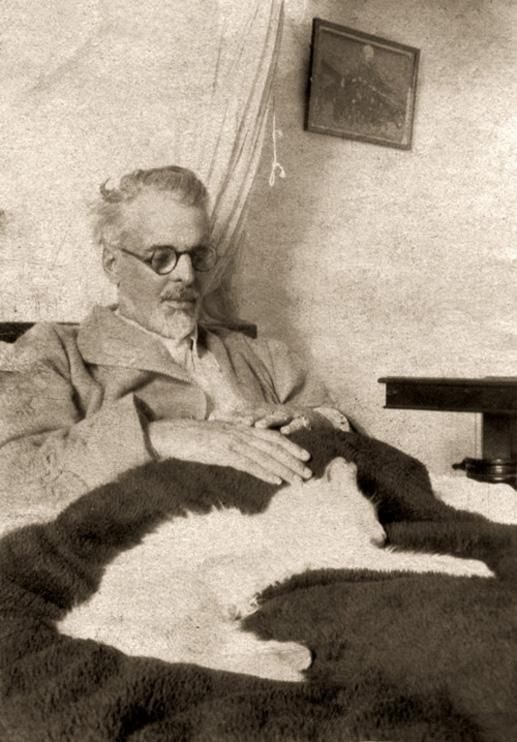
William Butler Yeats with cat

It was a classic battle of wills. The cat would not get up until Yeats agreed to get the cat food, and Yeats wouldn’t get the food until the cat got off his lap. Both were found and rescued in an emaciated state.***


5. May-Flower. From the roots present in Emerson, to the flower as expressed by Emily Dickinson herself, here’s the fifth most liked and listened to piece this spring.

Let’s return to the question of Dickinson’s intent. There some thought that this was written as merely a riddle-puzzle, that the reader was to guess the genus of the bloom from the clues in the poem. If that so, if that’s all, then it seems to me that Dickinson failed as a riddle-maker, as the clues don’t seem to determine the exact flower (and Dickinson, the avid botanist, would have had the knowledge to have done that). I decided to take her text and drill down to the mystical essentials she wrote of instead.

This is not the first time I’ve written of the psychedelic aspects of Dickinson. I can’t quite do the differential diagnosis on her eye problems (for which we know she needed medical attention) or decide on the theories that she may have had epilepsy or another disorder that could have caused auras and visual disturbances, but Dickinson often seems to be asking us to see differently, more intensely, as I believe she does here.

What kind of singular mind can toss this off as a riddle?

Hear my performance of “May-Flower”  with the player.


*All of these pop-culture comparisons understate the influence Emerson seems to have had in American academic life, also largely centered in New England at the time, but I don’t think they understate that Emerson’s readership in America’s 19th century extended deeply into the general literate class.

**Perhaps the most directly connected to Irish culture of them would be Ethna McKiernan. A footnote is not an adequate way to draw attention to the news that she has a new book, but she does.

***This is a joke, and only this footnote is serious. And don’t link to yesterday’s post for your homework as a cite that Carl Sandburg taught O’Hara, Baraka, and Wilbur about the building trades.

Are Song Lyrics Poetry? Part One

Today, somewhere, someone probably asked this question for the first time, and yet I’ve been aware of this question for my entire adult life. So, before I try to address the question, let me ask first, how long have we been asking this?

The ancients didn’t ask it. It seems clear that if one goes far enough back in most cultures it was taken for granted that poetry would be sung or accompanied by music. It seemed to make little difference if it was an epic story or a condensed lyric expression, music was assumed as appropriate bordering on required.

Was there a progression away from music being expected with poetry in those times? I wish I could say I was scholar enough to answer that question here. As literacy became widespread, as the collecting of libraries increased, I assume more people may have read Homer or Sappho* on the page than heard their works performed. And similarly, when Confucius and his school collected The Book of Songs  they may not have assumed that each student would learn to sing and accompany each of them. Still it would have been absurd then for someone to judge that these works could not be poetry because musical accompaniment and performance had been associated with them.

Plectra and Sappho

Let’s see, one of these ought to work….And Sappho holding her plectrum in right hand


If we stay with English language and move on, we know that the Elizabethans recognized some poetry as destined for the printing press’s page, some for performance on the stage, and some for musical settings as songs. Poetry could be associated with music, but it wasn’t the default.

Continuing to sweep forward quickly, a few Romantics like Robert Burns wrote songs and Blake was reported to sing some of his work as well. Some of the prime British Isles romantics wrote literary ballads or the like, works that referred to song forms but without associated music, meant to be seen on the page.

Likewise, there seem to be only a scattered few in the late-Romantic/Victorian era and onto the early English language Modernists who were musical composers and poets or who assumed musical performance for their chief works. Long-time readers here will know that I like to point to Yeats as an exceptional example to this. For a time he pushed for poetry as performance with music and may even have composed or aided in the composition of some of the accompanying tunes. Little of his crusade survives, though it’s possible that one of the tunes to which his poem “The Song of the Wandering Aengus”  aka “The Golden Apples of the Sun”  is sometimes sung might be his, or personally approved by him.

That Yeats was closely associated with drama and theater may have something to do with this. Newly composed poetic drama is an uncommon form in the modern era, but drama normally presumes performance. Although readings by poets are common in the 20th and 21st century, the nature of the performances vary considerably, and it became common for poets to give dry readings that by the writer/reader’s nature or intent drained dramatic and performance elements from the reading.

Let’s stop for a moment and consider two unlike American poets who emerged in the early 20th century: Vachel Lindsay and T. S. Eliot. Lindsay, who came and went well before the first Beat poet stepped in front of a jazz combo can easily be seen as the original slam performance poet.

He wrote his poetry expecting to perform it. Associated with that expectation, his writing is designed to impact the back row of the auditorium immediately, and if he ever wrote a poem with layers of meaning or intentional ambiguity, I’ve never come upon it.

Eliot on the other hand, read somberly in public, but as much (or more) as Lindsay he seemed to inform his poetry with music. As I return to my serialized performance of his masterwork “The Waste Land”  this month I’m reminded of music’s considerable presence in it. He samples music in his great poem just as a modern hip hop composer might, dropping in scurrilous barracks ballads, pop songs, Wagner opera, and birdsong. He didn’t perform it as floridly as he wrote it, and so even if “The Waste Land”  bore an original working title of “He Do the Police in Different Voices”  Eliot does not do the voices when reading it, nor does he sing the music he’s decidedly referencing. It can  be performed however, and while the poem’s detailed layers and references won’t come through in one sitting, a performance like Fiona Shaw’s illuminates the emotional and character range in it better than anyone’s silent first (or probably tenth) reading of it will.

My performance of “The Waste Land,”  now about half complete, attempts to bring the abstracted music back to life in the poem, even if I reserve the right to select genres and modes of expression that Eliot might not expect.

When I perform a poem like Vachel Lindsay’s “Abraham Lincoln Walks at Midnight”  I expect you’ll get as much, or perhaps even more, from hearing it once as you would reading it on a page.

One of the knocks on poetry with music, or performing poetry in general, has been that it doesn’t help subtle and complex thoughts in poetry come through the way that slow reading on a page where one can look up and down the page at will does. I’ll agree there’s a non-linearity in reading poetry on the page that is difficult to translate into performance. But does musical performance of words prevent “re-reading”?

Music rejoices in repetition. Words used with music often take on refrains and repeated sections. I will sometimes create such refrains even if the original page poem doesn’t include them. Gospel and other ecstatic performance styles have been known to drill down to word or syllable level in repetition, again, somewhat compensating for that weakness of performed poetry vs. its non-linear presence on the page.

Particularly with recordings (although repeated performances have the same virtue) you can re-experience the poetic text for comprehension of different levels or different vectors of observation.

When I’m attending a poetry reading, I’m often worried that I will not be able to keep up the level of attention on the poet’s words as they read them throughout an entire night. This is irrespective of the value or quality of the poetry. A good poet is quite likely to cause my mind to explode with exploration engendered by a line, and I’ll find on my return that I have missed the rest of the poem! And a really good poem can blank out the next several poems.

On the other hand, a simple text like Otis Redding’s song “Respect”  as performed by Aretha Franklin and band can bear (for me) hundreds of listens. I will notice new things each time, or given the decades over which I’ve heard it, I may re-notice things I’ve forgotten I’ve noticed before. These revisits will also reach favorite moments where I wait for pleasures to return. A knottier text like Bob Dylan’s “Just Like A Woman”  once seemed like a way to vicariously experience a certain kind of demimonde I was only peripherally experienced in. Listening to it over my life tested it against theories that it was about gender fluidity, or that it was a patriarchal endorsement of the male gaze and privilege, and now I usually hear it more as an expression of two addicts negotiating their other relationship besides the one to the chemicals and the situation that obtains them. It may be none of those things, or it may not always be one of those things. It may be something different the next time I listen to it.

Why shouldn’t Emily Dickinson’s “Hope is a thing with feathers”  or Wallace Stevens’ “To the Roaring Wind”  get the same chance? Of course we can re-read a page poem, or read it and double back to check some connection, but particularly with short poems, might not music encourage repeat play?

In this first part we’ve talked more about poetry and the perception that it has become increasingly separate from music. In the second part we’ll come from the other direction, and talk about song lyrics and that old, but not ageless, question about if they are poetry. I’ll leave you with my performance of Yeats’ “Wandering Aengus.” We don’t know exactly how Yeats would have wanted it performed, but his writing on poetry with music indicates he didn’t want the performer to sing it in an art-song manner. Perhaps I’m complying with his wishes, but then I can’t really pull off full-voiced art song.


*My favorite Sappho legend—as a guitar player that must have the right flat pick to approach the instrument—is that she invented the plectrum.

The Lake Isle of Innisfree

Last time we had a young man, an American walking in Paris in 1913 who came upon his poem leaving the Metro. Today, another young man, an Irishman in London in 1890, is walking too. He comes to a shop window, drawn by the sound there of water splashing. Looking in, he saw a fountain on display, its upward spray buoying up a ball.

The sound of water instantly brought memories of his childhood home on the coast of Ireland—and as he had been reading Thoreau’s account of his stay at Walden Pond, a small personal fantasy occurred to him of building and living in a self-sufficient cabin on a tiny island back home. Because that Irishman was William Butler Yeats, a poem came from that shop-street window, “The Lake Isle of Innisfree.”

william-butler-yeats-irish-poet-and-dramatist-in-his-study-at-woburn-buildings-london

If one can’t have a solitary wattled cabin, at least one can have books

 
That poem is now one of those beloved “Poetry’s Greatest Hits.” A few years back it topped a survey by an Irish newspaper as its readers’ favorite poem, and though I can’t find a picture of this, I’ve read that it’s been printed on a page of Ireland’s passports since 2013.

Lake Isle of Innisfree

Ireland’s favorite Irish poem was written in a foreign country


Of course, like most any Yeats poem it sounds lovely. Its language is straightforward, and there’s not much that needs explication. For a sound medium, it’s not always that a poem’s strongest images are sounds, but here the sounds of lapping water, bees’ hum-resonance, crickets, and a bird’s wings in flight carry the story.

Pound too, with his “In a Station of the Metro”  chose to use nature images in his Paris subway poem; but Yeats makes it plain that he’s stuck in the city, walking the grey pavement, not some country path. Thoreau had presented himself as the practical man in his book, making empirical living experiments. Yeats presents himself as the Romantic, helping imagine an Ireland—then viewed conventionally as a poverty-blighted colony—as an Eden, another locus amoenus. Another unusual choice Yeats makes is switching around the way we might describe night and day: night “a glimmer” and noon “purple glow.” Even though this was written before the dawn of urban lights dimming the night starfield, that’s the glimmering I sense, and if Irish coasts are foggy, noon could have a diffused glow. 1890 London might have fog and coal-fired air pollution too, maybe London fog didn’t glow, and maybe something beyond “light pollution” dimmed the stars.

This weekend’s St. Patrick’s day has become an occasion for the Irish diaspora to look toward its former homeland; and this poem, which speaks with Yeats’ humble yet beautiful specifics, invokes generally the homesickness of travelers, exiles, and immigrants. The specific in poetry often does that, the personal history that’s included standing for us all. This morning, as I filled my mouth with the word “peace” that Yeats wrote down twice in his poem, I could think of the island of New Zealand, and other travelers, exiles, and immigrants.

To hear my performance of Yeats’ “The Lake Isle of Innisfree”  use the player gadget below. If you don’t see the player (some blog readers won’t show it) then this highlighted hyperlink will also play it.


He Wishes for the Cloths of Heaven

Here’s a romantic poem by William Butler Yeats, in both senses of that word. “He Wishes for the Cloths of Heaven”  is Romantic in the literary and artistic sense in that it seeks to reconcile personal emotional experience with some sublime otherness through imagination, and it’s romantic in the sense that the poem takes a courting stance, that it’s an expression of love for another.

Yeats is one of those “bridge” poets who did substantial work in both the 19th and the 20th centuries. Always fiercely lyrical, he was able to recast his poetry so it continued to be read into the Modernist era. This poem, though written in the 19th century—and proving it by using an entirely antique word “Enwrought” to start off its second line—remains in circulation as some lovers still recall its ending.

It’s a short poem, only eight lines, so it can’t waste time.*  The first four lines are devoted to a nicely rendered image of the sky and a richly embroidered cloth, the sort of thing that would indicate high fashion when it was written. Of course, this is self-consciously an image on the poet’s part, he acknowledges that he’s made it as poets make images, as a new way to apprehend reality.

Oliver Tearle, over at the always Interesting Literature  blog, points out that prime English Modernist T. E. Hulme made his own version of this sky/cloth image only a few years after Yeats when he wrote his “The Embankment.”  Hulme saw himself as setting out to overthrow Romanticism, and I’d suppose it’s possible that he could even have been thinking of Yeats’ poem as he created his different one. Considering the two poems together makes for an interesting contrast.**

After those first four lines, Yeats goes on to reference something that was once a widely-known tale—just as untrue, but just as commonly known as Washington copping to chopping down the cherry tree. In the English mythical tale, Walter Raleigh, acting as a paradigm of Elizabethan courtly love and devotion was said to have taken off his expensive cloak and laid it over a muddy spot on the road so that Queen Elizabeth wouldn’t soil her royal footwear. And so it is that Yeats says he’d make this beautiful image and then allow his beloved to trod all over it.

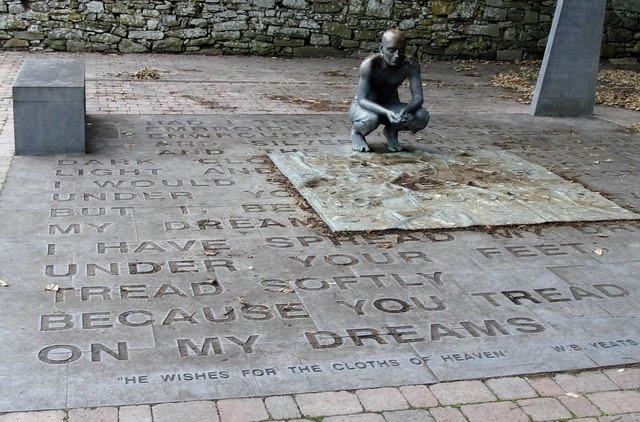
Yeats monument at Drumcliff

Yeats’ poem enwrought by sculptor Jackie McKenna in Drumcliff Ireland. Photo by Eric Jones.


There’s also something more here than just self-abasement or Yeats’ confidence in his brand of detergent: by saying he could put the plane of the heavens underneath his beloved, he’s also saying his poetry could take her to Heaven. But blink and you’d miss that implication.

Yes, the closing three lines are the poem’s best remembered, still quoted by those who have put themselves in the danger of love, or the danger of love refused. Romantic and romantic, and like most anything by Yeats, it just sounds so good! I performed it with acoustic guitar, electric bass, and a bevy of woozy keyboards, and you can hear it with the gadget I have spread below under your feet (or finger or mouse). Click softly.


*Here’s the text of the poem for those who like to read along. When the poem was originally published, Yeats used a persona as the poem’s speaker. Aedh was a kind of John-Keats-besotted nebbish character from what I read, and in doing so, Yeats is hedging his bets on the poem’s Romanticism, kind of a “I’m just asking for a friend” deal. When he included the poem in later collections, he dropped the persona.

**Here’s Tearle’s run-down of how Yeats’ does it in this poem, which also has links to his post about Hulme’s “The Embankment.” To hear my performance of Hulme’s “The Embankment,” you can click here. Beside producing one of the best daily literature blogs, I owe Dr. Tearle for introducing me to the work of T. E. Hulme, the pioneering Modernist poet and theorist who I’ve often featured here.

Love’s Greatest Hits

“If music be the food of love, then play on…” So said Shakespeare and Peter Green’s Fleetwood Mac. Here at the Parlando Project we explore music and words (mostly poetry) crushing on each other, and some of our most listened-to audio pieces feature aspects of love. So, for Valentine’s Day here’s a countdown of our most popular pieces that feature love.

As it happens this “Top 10” also does a good job of showing the variety of music and ways we integrate the words with the music. I often think I spend the majority of the posts here talking about the words we use, but love, like music, often prefers “to speak without having anything to say,” the thing that music does.

10. Vegetable Swallow words by Tristan Tzara. When I translated this Dada poem I wasn’t expecting it to form the recognizable poem of desire that appeared. Musically I set this to something that is unorthodox rock. The keyboard parts don’t really work the way rock keyboards usually work, but the second half features an electric guitar solo that while it’s not rock, meets it at least half-way.


9. Love is Enough words by William Morris. More plainspoken than Tzara about the value of love in a world that doesn’t seem to want to contain it. Here the LYL Band is in garage band mode, with the usual keening combo organ of that Sixties’ genre along with two guitars, bass and drums.


8. The Heart of the Woman words by William Butler Yeats. One of the limitations I need to deal with in this project is that I’m not a very good singer, so it was particularly audacious here for me to perform Yeats’ poem of tender devotion acapella. One of the things I love about traditional folk music field recordings is that they often capture singers who are not perfect in pitch or in other qualities that make one say “what a singer!” That quality brings a different reflection on humanity and the words being sung.


7. Sonnet 130 My Mistresses Eyes Are Nothing Like the Sun words by William Shakespeare. I loved the episode of Upstart Crow  where everyone and Shakespeare’s wife takes the bard to task for this too honest love poem that deconstructs every phony and limiting idea of beauty in his era’s poetry. Bonus Black History Month points to the possibility that the poem’s famous “Dark Lady” might have African ancestors. Musically, we leave rock’n’roll behind for 12-string acoustic guitar, bass, recorder and a string quartet.


6. Rosemary words by Edna St. Vincent Millay. One of my personal favorite musical performances from the more than 300 I’ve presented here in the last three years. I was trying to recreate the sound of the acoustic band The Pentangle, and I’m still shocked and pleased at how close I could get. Millay’s poem has a new broom sweeping out the old, failed love to make ready for a new one.


5. Sonnet 43 What Lips My Lips Have Kissed words by Edna St. Vincent Millay. Our first repeat appearance by a poet in this list, and there’s a tinge of romantic regret in this one, but also there’s some satisfaction in a life of romantic independence. A massively underrated poem! Another small string group arrangement here with some spare piano, but also electric bass and drums.


Allegory of Music by Laurent de La Hyre

Actual photo of my anima recording another Parlando Project piece. “Yeah, it needs more theorbo.”


4. Let Us Live and Love words by Thomas Campion. Another variation on the carpe diem poem that starts as Campion’s Elizabethan English translation of Roman poet Catullus, and then branches off to his own take. The music here is blues: acoustic guitar and slide guitar with harmonica. I don’t play bottleneck slide guitar much with the Parlando Project, but listeners for some reason seem to like the pieces where I do.


3. Tender Buttons words by Gertrude Stein. Another one where I outright tried to cop the style of another band, this time Captain Beefheart and His Magic Band. I remain surprised at the number of listens this one has accumulated, and even when I posted this I wondered how many are out there that appreciate both Gertrude Stein and Captain Beefheart. More than I expected you brave souls!

Even more than the Tristan Tzara poem, this one abstracts desire and love; but particularly in its closing section, that’s what I read was there expressed in Stein’s cubist language. It’s possible that, though the language is different, Stein is making something of the same point as Shakespeare’s Sonnet 130 does, that desire starts at skin deep and cares little how it’s attired or to what it’s compared to. Beefheart did much the same thing lyrically as Stein—but also musically, reassembling shards of blues music and visual emotions.


2. Sonnet 18 Shall I Compare Thee to a Summer’s Day words by William Shakespeare. More rock band instrumentation used in a different way than usual. The tolling piano sure ain’t doing no boogie-woogie, for this poem is yet another carpe diem argument, presented only slightly differently. As always in carpe diem, “we’re all going to die” is the unlikely come-on, and Shakespeare isn’t making the “mistake” of his Sonnet 130, opening this one by saying his beloved is better than, rather than lesser than, a common poetic trope; but as the poem continues he makes the ego-drenched claim that he’s the better love partner because he’ll put you in a poem that’ll make you immortal.

How’d that work out for the love object? Lots of conjecture as to who might be the “fair youth” or the “dark lady” in those sonnets (or if Shakespeare is, well, capable of just making the whole thing up) but in fact, we’re more concerned with Shakespeare than his romantic partners. We treasure the valentines, not the fleshy and independent lovers that they may have been addressed to, and we hold them while their erstwhile subjects are dust without names.

Doesn’t seem fair does it? Maybe for Valentine’s today the best thing is to skip the questions of appropriate metaphor and honor that partner, and to return to poetry and song tomorrow?

I can’t be serious, can I? This project needs more listeners and readers!


1. Love and Money words by Dave Moore. Can this be? An original song by Dave, who has contributed words, music, vocals, inspiration and keyboards to this project from the start is more popular than Shakespeare? How could this be?

Could it be the elemental and essential nature of the pairing in the title and the rest of the lyrics? I was considering some slavery stories as I first considered Dave’s lyrics, that added some weight for me, but Dave’s words are free-floating as far as time and place. So, I’m not going to knock the words, but maybe it’s the funky way his electric clavinet and the rest of the LYL Band jells on this one.


Happy Valentine’s Day to every reader and listener here!

China Mouth, a Changeling

I’m reading another critic/minor poet’s book about the early 20th century British literary scene, Edward Shanks’ First Essays on Literature.  He’s in general more backward looking than Herbert Monro’s 1920 Some Contemporary Poets  where I discovered Charlotte Mew (Shanks’ book has essays on Keats and Shelley) but I was interested what he had to say in his chapter “The Later Poetry of Mr. W. B. Yeats.”  Shanks seems ambivalent about Yeats, and this is one of the pleasures of reading contemporary assessments of still active artists. He notes with approval that Yeats’ language has with the 20th century become less formal and fusty, though Shanks feels that gain comes at a loss of a singing quality.*  Another conclusion he reaches is that Yeats’ is best when he’s describing the fantastical: “It is not Mr. Yeats’s business to describe the actual world, but to make beautiful pictures out of his dreams.” Though giving Yeats his due, Shanks doesn’t seem to think this is a good thing.

Interesting comment that, though I was already aware of Yeats’ appreciation of Irish myths and his dabbling in his era’s contemporary occultism. It caused me to stop and connect Yeats, and the two lesser known poets I’ve presented this month: Charlotte Mew and Yeats’ associate Walter Turner. Both have aspects of fantasy in their poetry too. And even our staid prelate of High Modernism, T. S. Eliot, while seeking his correlates within the whole timeline of culture, picks out elements of unreal gothic horror to weave into “The Waste Land.”  Elements so broad as to make me compare a section of “The Waste Land”  to Metal bands.

Did the horrors of WWI and the shifting ground of artistic Modernism impel some poets of the time to retreat (or advance) into fantasy? With the war poets, many of which had been “reporting” from the front-lines, no longer lining-out contemporary events while those events’ questions of outcome and action were pressing on all, was there now after the war a countervailing mode to step away from the pressing real?

If so, it’s no simple thing, and not just a matter of “give me some beautiful art to not let me think about hard questions.” Fantasy is just metaphor presented on another layer of art. Eliot, who unlike many of his contemporaries did not serve in WWI, would have trouble writing about the war as the veterans did after all. And the Surrealists—well their whole point was those “pictures out of…dreams” might reflect something essential.

Sir Joseph Noel Paton - The Reconciliation of Oberon and Titania

Fantasy. Escapism? Surrealism? Metaphor presented in another layer of art?


Mew’s “Changeling”  from my last post? Yes, it’s a fairy story, as is Yeats’ great “The Song of the Wandering Aengus,”  but either connects first on an emotional level deeper than any amazement at the fantastic. Talking fish or fairies knocking at windows are mundane compared to the loneliness of old age or the alienation of being an unlike youth.

Well, let’s end for now with an audio piece, an old one of my own. I wrote “China Mouth, A Changeling”  over 40 years ago, after listening to a conversation where someone else was bemoaning their alienation. During the conversation the main talker paused to reapply some very red lipstick, its deep red the China in the mouth of the title. Unlike Mew’s changeling—who will run off, who cannot be stopped—there seemed to me to be an element of stasis in that overheard conversation. They seemed resigned that they would have their art and their alienation in a frozen balance. That brought to mind a story in Robert W. Chambers’ “The Mask”  from his 1895 collection The King in Yellow  in which a liquid turns living things into statuary. That idea informed the last verse. Depending on one’s taste for mystery, it either saves or ruins the song. Use the player below to hear it and decide for yourself.


*I don’t think I agree, Yeats never stops being musical to me. Shanks himself has an interesting connection between poetry and music, as another chapter in his book “Folk-Song as Poetry”  deals with Cecil Sharp and other contemporary attempts to conserve British Isles folk music. Shanks’ first book was a collection of poetry called Songs, one of which lifts the floating verse that found its way into many folk songs, the one that starts “The cuckoo is a pretty bird, she sings as she flies.”

Memo from (W. J.) Turner ‘There Came a Lion into the Capitol’

One thing I loved doing to stretch my culture and entertainment dollar back in the 20th century was to go to a used record shop and look for unusual records. The more disorganized and undiscerning the shop, the better for my purposes then—since the lowest price was important, and whatever the time spent, it was enjoyable.

It felt so good to come home back then, less a dollar or two, but with a record by someone I’d barely heard of, or never  heard of. What would it sound like? What would they be trying to express? There’s a universe of art out there, commercial and not, music, words, every art. What hides itself, unlooked at, unheard, while our summarized cultural attention is elsewhere?

This project has allowed me to do the same thing with the poets of the early 20th century.

One way to find the overlooked is to read contemporary journalistic accounts of an era. They are unfiltered by later consensus, and focused on the day to day of their day, not overly informed by the judgements of history (which aren’t complete, much less unerring). And so, I’ve spent time this week reading Harold Monro’s* 1920 book Some Contemporary Poets.  Monro is himself a poet I thought might be an interesting minor writer to examine. Instead, his book led me to at least two other writers that I found immediately interesting. Today you get to hear something from the first of them.

Monro didn’t much like Walter J. Turner, who he refers to as W. J. Turner.** He leads off his book’s short notice on Turner by saying that Turner was “Rumoured in literary circles” as “a genius.” Monro then wastes little time getting on to disputing that, saying that Turner has only learned “the ‘tricks of the trade’ in the neo-Georgian school.” So facile but vapid? No, Monro, extends his critique to Turner’s technique too: “Simple monosyllabic epithets like cold, dim, dark, pale, wan, bright, grey, still, occur in all he has written to such excess that they cloy the reader’s memory like some unwanted tune.”

I happen to think that one of the common faults of poetry is its resort to too many and too uselessly fancy a set of adjectives, so I looked at a few Walter J.Turner poems. I didn’t have to go far to see one that called to this reader’s memory for some—who knows?—unwanted tune.

I haven’t found out much yet about Turner’s life, but those rumors of greatness back in 1920 largely came from William Butler Yeats—a blurb any lyric poet would be glad to get. Turner isn’t as fluid a poet/word-musician as Yeats is (is anyone?) but he seems to have been struck by the fanciful, exotic and even occult aspects that are one thread in Yeats. Today’s piece “’There Came a Lion into the Capitol’”  shows this.

Walter_James_Redfern_Turner_bust_by_Lady_Ottoline_Morrell

Besides poetry, Turner wrote music criticism.


Turner published that title in quote marks, but I can’t find the literal phrase he might be quoting exactly. Lions and rulers and rulers’ seats are a rich trope of metaphor in general, but he may be referring to Cassius speaking about Julius Caesar in dialog from Shakespeare’s play. If so, his poem is very impressionistic, mentioning nothing that links it to Caesar, to Shakespeare, or any particular time or place.

The poem is entirely fantastic, in the strict sense of the word. The title lion somehow materializes from the page of a book (Shakespeare’s plays? The Bible***  or some equivalent? A spell-book? Some other book of lore?) and an apocalypse occurs. By the last stanza, planet Earth is gone and cold space is left.

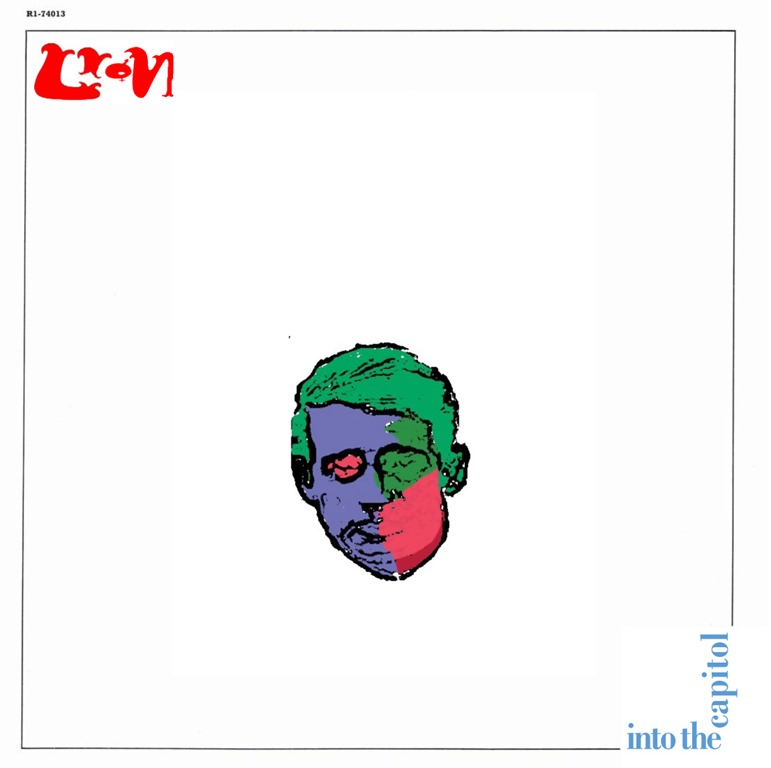
Musically, I may have unintentionally copped a bit of the sound of one of my favorite used record store finds, the masterpiece of one of the great overlooked Afro-American-led bands of “The Sixties,” Love’s “Forever Changes.”****  My playing and arrangements don’t reach that level, but the orchestration of “Forever Changes” is what comes to my mind when I think of acoustic guitar mixed with a horn section, so maybe one of those dark-horse used records from long ago did become a muse here.

loveforeverchangesLion Cover

Hey, what happened to the rest of the band? A classic LP cover and my W. J. Turner parody of it.


To hear my performance of Walter J. Turner’s “’There Came a Lion into the Capitol’”  use the player gadget below.


*H. Monro is not to be confused with H. H. Munro, the other writer whose penname was “Saki.” Monro and Munro were contemporaries. This might have been embarrassing at literary get-togethers!

**Not to be confused with J. M. W. Turner. He’s the painter.

***Lions appear in the Bible from the Old Testament to Revelation, but though the title phrase sounds like it could be in Revelation, I haven’t found an English translation that has it.

****The group Love was led by Arthur Lee, not to be confused with ace guitarist Albert Lee, who in turn is not to be confused with Albert Lea, the county seat of Freeborn County in south-east Minnesota. If you haven’t heard Love’s “Forever Changes,”  you should. “Forever Changes”  sold next to nothing—and the lyrics and some of the melody lines are unusual enough to explain that I suppose—but the LP’s arrangements are so rich and attractive that it’s difficult to imagine the real-world timeline that we actually lived through, the one where this wasn’t one of the biggest records of 1967. In our still ongoing time continuum, maybe Flying Lotus or Frank Ocean ought to do a tribute mixtape.

The Fisherman

Complaints about the size of the audience for poetry are far from new. So too, complaints about the quality of its audience. Throughout the course of the 20th Century, one increasingly common theory was to assume that a quality audience for poetry is likely incompatible with a quantity audience for the art.

We’ve just about used up two decades of our century, and that theory is still around. This quantity/quality audience-linkage belief is not always stated plainly, but it’s not hard to see its presence. Poets that rise to modest or surprising audience size will sometimes face some degree of backlash from critics. It may naturally be so that their poetry is less worthy by some criteria. This could be coincidental, honest criticism. It may be that it’s hard to find an audience for poetry criticism, as it is for poetry, so writing about better-known practitioners who have failed in some way helps grow the audience for the critic.

Another way to hold to this theory is to limit what poetry is allowed to do, to narrow its practice or even its definition. Spoken word or slam poetry? Not really poetry, or it encourages a poor selection of poetry’s virtues. Song lyrics? Self-evidently a different art, though given that the consensus canon of poetry is so different among itself, surely difference alone cannot be the criteria. Mix those two as rap or hip-hop and risk both  explanations of why it’s not poetry. Short, aphoristic poems? Too insubstantial. Long poetic forms once much in evidence, like the poetic epic or verse drama? No longer living forms of the art for the most part, if for no other reason than the type of poetic techniques the modern academic poet often uses can wear out an audience in a matter of minutes.

Myself, I don’t disagree or agree with those judgements in particular cases, and they could even be theoretically correct, I just viscerally dislike the idea that this thing poetry is so small and limited, that it’s a desert island disc for a few scattered islands, deeply loved by solitary coconut eaters with a very constricted shoreline.

When I break out of those narrow roles and rules for poetry, I will fail, and I do get discouraged. My limitations are bothering me two years into this project; and now 240 published audio pieces later, I may be running out of rules to break and the motivating pleasures of audacity.

William Butler Yeats with cat

Also dreaming of catching fish. Are cat pictures the secret to gathering an Internet audience for poetry?


Here’s a piece today using a poem by someone who somewhat agrees with me: William Butler Yeats. In one way it’s specific to him, and his time. I’ve recently honored two working-class sport fishermen in one of my favorite pieces so far this year, but the fisherman in Yeats’ title, the simple man working his craft on nature to help feed himself rather than for hobbyist enjoyment—well, he, even in a much poorer Ireland of 1916, is admitted as imaginary.

Otherwise, how about those folks listed in the middle section of today’s piece that are harshing Yeats’ mellow? How little imagination is needed to see them today?

I admire Yeats in this poem, embracing his failure, even though he brought immense poetic talents to his work, so much so that I should be embarrassed to admit to that admiration. In one way, the fisherman here is Yeats, casting with deft wrist or verse, but not in the course of the poem catching anything. There’s a saying with the fishermen in my family, “It’s called fishing, not catching.”

But the imagined fisherman is also that audience Yeats seeks. Maybe once, Yeats says at the end, maybe once,  he can please an audience correctly, with a single valid poem and valiant audience—even if he can only see that audience in his imagination. I surely hope (and Yeats’ life helps me here) that the singular fisherman is an image for a possible greater audience, and not a headcount. After all, to write for something as large as “his race” (by which he means Ireland), is too small a target to hit, while that tweedy imagined fly-fisher inside his jacket might possibly expand to more countries, more times, more genders. In Yeats’ case, as with all artists, he failed; but he failed reaching for a larger audience with a larger poetry, a poetry which he risked allying with other arts. Many of us will not be able to accomplish that failure, but I’m glad Yeats tried.

You can hear my try to alloy William Butler Yeats “The Fisherman”  with a rock band by using the gadget below.


March 2018 Parlando Top 10 Part 3

We return with the next three in the count-down of the most listened to and liked audio pieces of last Winter. Like last time, all poets who worked in the 19th Century, but in this group, all men.

Two out of the three today are from the British Isles. In may be no surprise, given its head start in English literature, that Britain is an outsized contributor both in words to be used and the Parlando Project’s reader/listenership.

I’ll be taking my second, short low-budget trip to London this month, and I’m frankly not sure what I will find this time, other than planning a side-trip to Margate to see the Turner art museum there and its small exhibition commemorating Eliot’s “The Wasteland” which was partially written in Margate. I’ll no doubt re-visit the Blake room at the V&A, and who knows, maybe I should try to find that alley beside the Savoy Hotel?

JMW Turner Waves Breaking on a Lee Shore at Margate

The London forecast calls for rain, hopefully not JMW Turner stormy though!

4. Ring out Wild Bells

When I posted this for New Year’s I noted Tennyson’s level of fame when alive, something that even the most popular Instagram poet cannot reach now. What I found out afterward was even more intriguing, that this section of his long poem “In Memoriam A.H. H.”  has become a tradition in Sweden to be read at the turn of the year, sort of how the Times Square ball-drop is ceremoniously repeated in New York, or how Guy Lombardo would once appear with his Royal Canadians near the top of the hour on TV to play a Scottish tune.

As evidence of Tennyson’s fame, I noted that my little Iowa hometown had a major street named for him when it was platted back in the 19th Century. Eventually the town and it surrounding farms were settled largely by Swedish immigrants. The Tennyson and bell-ringing tradition in Sweden started in 1927, long after the town was founded and settled, but wouldn’t it have been good in the town’s heyday if the farmers, shopkeepers, and schoolchildren had gathered on the sides of the street on New Years Eve to hear a poem?

Instagram poets get knocked for the shortness of their verse and it’s focus more on remediation than demonstrating literary skill. Tennyson built “In Memoriam”  into a book length series of poems, but his focus too was on remediation, in his case, of grief.


3. The Wild Swans at Coole

Yeats was Irish, and for decades I’ve met monthly with a group of poets the majority of whom were Irish-Americans. Yeats seems to have seamlessly transported himself between the 19th and 20th Centuries, changing so smoothly that he could not be observed changing. Somewhere around the turn of those centuries he decided that poetry should be chanted (not sung) to music, and yet we seem to know little about how exactly that sounded. Contemporary reports (and that’s what we have, there are no recordings I’m aware of) were decidedly mixed, even derisive, and Yeats eventually set that quest aside. The recordings of Yeats reading that we do have are from decades later, and in them there may still be traces of that concept audible in his, by then unaccompanied, reading style.

Yeats warns listeners that his chant may not necessarily enchant.

Reports also tell us that Yeats suffered from a difficulty carrying a tune, much as I do. His chanted, not sung, idea did not come from that he tells us, rather it came because conventional art song had too much ornament and melodic elaboration, deducting from the inherent music in the words.

In the course of the Parlando Project I take various stabs at what Yeats was trying to do, recreation in the literal sense, trying to create from the ancient and natural connection between music and poetry some combination that doesn’t privilege one over the other. Sometimes it’s spoken word, sometimes it’s “talk-singing,” and sometimes I think it necessary to sing.

I avoid apologizing for my musical shortcomings. It never mitigates anything anyway, and I’ve always found the humble-brag distasteful. I’ve hesitated at—and decided against—releasing performances most often because of failures of my singing voice. This performance came close to staying in the can. At times it works, not from my skills, but because there’s a certain match in the failings in the voice and the meaning of the poem.


2. My Childhood Home I See Again

One last 19th Century poet, an American. Long-time readers here will know that US President George Washington’s teenage love poem “Frances”  has been a surprisingly persistent “hit” with listeners here. It didn’t make the Top 10 this season, but we now have another Presidential/Poetical contender in Abraham Lincoln. If Washington was all youthful alt-rock persistence, Lincoln is more goth, with a downcast you-can’t-go-home-again tale of all he finds missing when he re-visits his hometown in his thirties.

Lincoln’s “My Childhood Home I See Again”  was very close to the popularity of the Number 1 this season. If didn’t count the substantial Spotify plays the Number 1 received, Lincoln would have topped this season’s list.

I posted this for what was once a common U.S. holiday, Lincoln’s Birthday. Also on this season’s Top 10 are the Tennyson New Year’s post and Rossetti’s Christmas song posted on Christmas Eve. Not sure if this is a trend, but listeners did like the holiday poems this winter.


Tomorrow, the most popular audio piece.

The Wood-Pile

Robert Frost is every bit the master of word music as Yeats and Millay. What makes Frost stand out is that he was every bit the thoroughgoing early 20th Century modernist as any of his free-verse contemporaries, while retaining an ease with accentual syllabic meter.

Here’s an example of Frost handling a subject just as a free-verse Imagist would. His aims, his presentation, hold to the Imagists’ principles. He deals with the thing directly (as we shall see, two things, but still…), and there are no tacked-on metaphors, no stock comparisons, no extraneous “poetic” language. Context is shown, but not explained. He loosens and varies his meter, so the poem sings and never seems to be a shackled march. At 40 lines, it’s a bit longer than Yeats’ poem considering “The Wild Swans at Coole,”  but Frost’s extra detail is even more specific and concrete than Yeats, though both begin their poem with the poet walking in a rural wetland. Yeats slough is a well-known place to him, conditioned with 19 previous visits. Frost is far enough into his swamp to not know exactly where he is, and so experiences what he sees with a first-time immediacy. Yeats’ slough then contains tradition, Frosts’ the more Modernist “Make it new!” place.

Though presented as one simple rural scene and story, “The Wood-Pile”  is more at two poems, though each part speaks to the other. As Frost’s tale starts, we are in the midst of one of his characteristic journeys, just as we are in other famous Frost poems. There’s a need for decision (“Turn back” or “go on farther”) and his choice, also made in other Frost poems, is to go on regardless of whatever doubts brought the question. If he’s lost in the dark by a wood on a snowy evening, keep going. If you come to a fork in the road, pick one and go on. If you’re walking in a swamp in winter and your foot is sometimes falling through the frozen crust, well, keep going “and we shall see.”

And so, here he sees his bird. No Keatsian nightingale, not Millay’s elusive flying swans with their awkward dangling legs and cries, nor Yeats’ majestic 59 swans, but a small bird. This bird becomes a mirror to the poet. Frost’s bird too must make choices in direction, and the poet, sensibly, thinks the bird’s guided by fear. “Keep something between little me and the big lummox trodding through the winter swamp,” he humansplains. And there’s a bit of humor at human’s expense as the poet muses that the bird, like humans with their self-importance, may think that the only reason for Frost to be out in the swamp is to go after the little bird.

Gackle with white tail feather

“He thought I was after him for a feather—the white one in his tail”


But, we don’t know why Frost is out in the frozen swamp explicitly. The only reason he’s given, or will give, is the Imagist poets’ reason: “and we shall see.”

The bird leads Frost to the second thing the poem wants to present: an abandoned fire-wood cache. Here Frost zooms in close. Every detail of the cut wood and the once neatly stacked and propped wood-pile is stated. Frost turns forensic, like some New England Sherlock Holmes: this pile has been abandoned for years. Mature vines have grown through it.

wood-pile

“The slow smokeless burning of decay”


Here is another context left unsaid. Why would someone abandon a purposeful wood-pile in a swamp? Frost leaves it for us to be detective and to solve the mystery. This isn’t some lot of fire-wood left temporarily to be gathered later in the day, care has been taken to stack and prop it.

The only thing I can think: someone once built a shack (now completely disappeared) on the swamp land. Frost muses, sardonically, that only someone so busy with “fresh tasks” could abandon such effort in cutting and stacking. Does he mean to say, “only a fool would be so industrious to cut and stack this wood and yet not notice he was building his shack on a swamp that would not support a homestead?”

Now, the small bird with his “little fears” and oh-so-human misapprehensions of reality—and now, the steadfast Frost of miles to keep going, even if you may be lost, are set in contrast to this choice. Your fears may lie to you—but so will your optimism.

I once heard an astringent biological statement that the length of our lives can be reduced to a slow-burning chemical reaction. Frost’s last line here is a sad and beautiful analog to that truth.

Turn back or go farther? Go on, and we shall hear my performance of Robert Frost’s “The Wood-Pile”  with my original music. Just use the player below.