Hart Crane’s “Hurricane”

One of the things I liked about the early English language Modernists when I began to examine their pioneering works was their clean unshowy language. While they sometimes slipped into colloquialisms (Sandburg, Langston Hughes) their time and place was close enough to my own that I never felt they were trying to talk over my head and state of learning, even if the things they were portraying were extraordinary or profound, and even if they might choose to use inflection and inference to portray a great deal “off screen” from the frame of their poem. Poetry tends to remind itself to do something like that every so often. I can still remember reading Wordsworth’s Preface to Lyrical Ballads, and agreeing quite readily with his charge to poets of his time to write using the language of ordinary people.

But then too, Poets are always falling back into “poetic diction,” that uncontemporary and artificial language that signals what is being written is a poem,  you know, real art  asking you to pay special attention. The reasons for this are several. First, of it’s fun to play dress up – fun to wear crowns, put on capes and formal ball gowns, or try on suits of shining armor. We already have slipped from the pitch and timbre of ordinary speech when we are moved to sing, and when words want to dance, we don’t ask them to settle down and walk straight. Those are innocent, even childlike, reasons, but of course there are others that can be in the mix for those choices. One could make the choice as a poet hoping for an eternal audience, believing that one must speak in the language of many ages and epochs to help stake out that claim. Or there can be elements of simple insecurity: these words, that antique cast of phrase, will show that I’m not ordinary and my works are not either.

Young poets are prone to the latter, sometimes thinking their verse must sound like some old poem anachronistically written to sound like a poem and nothing else, to demonstrate that they have risen to poetry. Old poets can sometimes speak extraordinarily plainly. Perhaps they’ve worn all the costumes, engaged in all the playtimes, and have no future to gain with pretense.

Today’s poem, as are all of the poems this month, is from the pages of Louis Untermeyer’s between-the-wars “Modern American Poetry”  anthology, and is by a poet that never got to be an old poet, Hart Crane, who died at age 32.* A man who spent time in the tropics, Crane writes here about one of that region’s storms, where winds whip waves and rain until the two are one, blowing down and inundating nature and man’s constructions. Here’s a link to the full text of “The Hurricane.”  Or, here’s the text of the poem and an interesting discussion of it and Hart Crane by Allen Ginsberg.
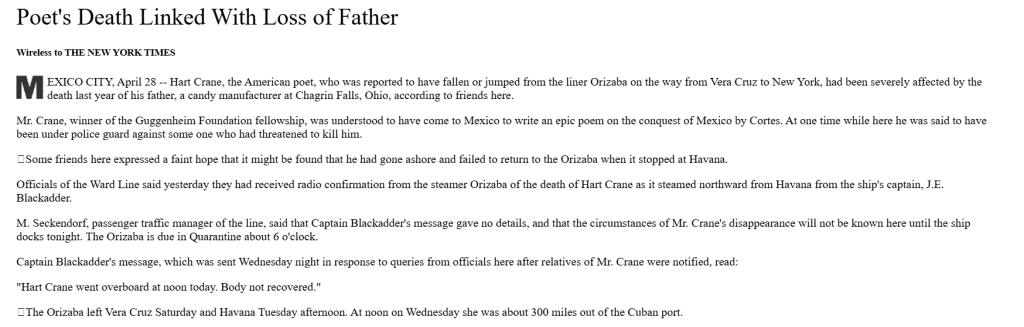
Hart Crane's Death reported in the NYT

Things modern will soon seem quaint. As terrible as the news conveyed in this circumspect newspaper report reads to me today, with it’s sea voyage delays, creaky “wireless,” and a “Captain Blackadder,” it seems of another age. The father mentioned had disowned Hart Crane, and that family wealth involved was based on a type of candy: the round hole-in-the-middle Lifesavers.

.

Had he witnessed one or more hurricanes in his young life in the early 20th century? I don’t know any details, but he doesn’t write his poem as if he’s seeing Model T Fords floating down streets as asphalt shingles are scaled off roofs and telephone and power wires play double-Dutch in flooded ditches. Nope. Crane’s poem is written in language made up of parts Anglo-Saxon epithets and alliteration, parts Marlowvian bombast. Why? I don’t know, but his poem is fun to read, even when my vocabulary’s pride is bruised by “levin-lathered” and “gambade.”*

I performed Hart’s “The Hurricane”   as spoken word backed by a rock quintet, two cross-current electric guitars, pelting piano chords with the drum sets levin-gambade, and an electric bass undertow. You can hear that performance with the audio player gadget below. No audio player? It hasn’t been erased by a storm, it’s just that some ways of reading this poem won’t show the player, and so I offer this highlighted link that will open a new tab with its own audio player.


.

*Reading about Crane’s life this week I’m both sad and exasperated, and this Monday is the 94th anniversary of his throwing himself off a boat sailing from Mexico. There’s plenty of reasons for his inability to find his place in the world: a dysfunctional family, society’s lack of acceptance of his sexuality, likely bipolar depression, the innate difficulty of establishing a writing career, alcoholism; but reading accounts from folks who tried to help him he seems quite a handful. I’m probably being uncharitable – the storms inside Hart Crane would take more than this poem to describe.

**Levin is a word for lightning, something I didn’t know. I assumed gambade might be a variation of gambol, which is pretty much correct, a leap – and like Parlando, I think I might have run into it as description of a musical articulation, as used here describing thunder.
The River Merchant’s Wife, Another Letter

What if you were to find out that a famous, much-loved poem was not a singleton, but that it was instead part of a pair?

The River Merchant’s Wife, A Letter”  is perhaps the most famous Chinese poem in English, and it’s been widely anthologized since Ezra Pound published it in his 1915 collection of translations Cathay.  It’s not hard to see why. It’s a lovely piece of free verse, and though it holds to the Modernist style of showing not telling its sentiments, most readers can easily divine the emotions of the young wife displayed in the poem, separated and longing for her partner.

Be patient with me, reader. I feel I must deal with a few peripheral issues with this poem, which I too admire, for as close as it is to many of its readers’ hearts, there are a few issues. While it’s reasonably frank in its Imagist way about a woman’s desire, one could look at it as an endorsement of patriarchal marriage, rather than a portrayal of two people at a particular moment of time.*  One could conclude that the woman’s agency in the poem is limited to the feelings her tale evokes in us.

If you, like I’m sure some readers here and elsewhere are, seeking art as a break from social issues, there is also a literary issue, one of the nature of translation. I would discuss even more things I happen to think about when I consider this famous poem, but to keep this post to a reasonable length, I’ll just speak to the translation controversy.

Pound wasn’t a Chinese scholar, didn’t speak the language, and didn’t have any knowledge in depth about the history or culture of that vast country. What he was instead was a poet who had what musicians call, and I’ll repeat with punning intent, “great chops.” Particularly at the time literary Modernism was getting underway in the early 20th century, he had a sense of how to pare things back, to express something vital minus a lot of useless extra baggage. Pound likely recognized a kindred spirit in Li Bai,**  the 8th century Chinese poet, and so thought it all right to speak for him in English.***  The poem he produced from Li Bai’s work is a loose translation, missing nuance that more informed scholars find in the original. There have been other attempts at better, or at least more accurate translations. None have produced as widely an effective poem.

But it was in looking at that this past week, while trying to better understand Li Bai’s work and intents, that I had a remarkable discovery. It was probably around midnight, when I should have been sleeping, reading a .PDF scan of a 1922 book of Li Bai translations by Shigeyoshi Obata.****  His translation of the poem Pound made famous is rendered as “Two Letters from Chang-Kan,” the first of which is Obata’s rendering of “The River Merchant’s Wife, a Letter.”   But, But But—what!   There’s another letter!  Did Li Bai intend this to be from another persona, another river merchant’s wife, or is it a second letter written by the same character? Either could make sense. The situation is the same, absent traveling merchant partner, young wife left at home. The speaker’s mood has similarities to the well-known poem too, but there are differences. In my reading of more Li Bai poetry this month I’ve come to believe that he works in subtle associations, subtle parallels, implied metaphors not necessarily made into explicit similes.

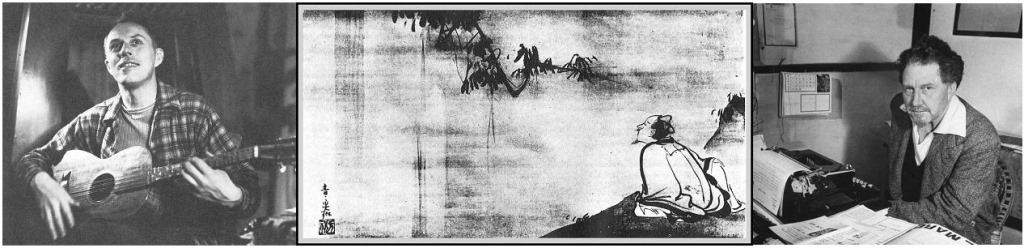
Partch-Li Bai-Pound

Harry Partch kicks out the jams, Li Bai considers the abyss, Ezra Pound looking like he’s ready to write yet another crank letter to the editor


In this poem, the speaker is a bit more angry with the situation and more wary. She’s not fallen out of love, no, but her expressions seem to mix frank longing for her missing partner, with suspicion that it might not be mutual. Was Li Bai contrasting two women, or expressing that the human heart can hold all those emotions at once?

I’m indebted to Obata for making this Li Bai poem known, and since I know of no other translations, I based my version I use today on his English language one—though I, like Pound but having only my own talents—took liberties. I wanted to tell a story that worked as a song, one that would pull the listener in and bring forward in both the text and performance the wider meaning of what is said by the river merchant’s wife in this purported letter. So, my version has a stronger if not strict meter, occasional rhymes, and I try to emphasize those parallels that serve as images that I think are part of Li Bai’s poetic sense-making. Parallelism, refrains, rhymes—these are all musical tactics that can work to bring some things to the foreground that were undercurrents in Obata’s version of Li Bai.

My performance of what I call “The River Merchant’s Wife, Another Letter”  is available with the player gadget below. As this is already a long and much-delayed post, I’m not including texts yet for this, but I hope the performance will work in its way.


*I’m sure some have written critiques on this basis, because there is matter there for this, including that the wife is a teenager (though the poem indicates the husband is roughly the same age.) I wonder if anyone has written that the husband’s absence is based on the needs of commerce, asking if this is a veiled attack on capitalism or a cultured acceptance of it?

**Li Bai is the now preferred way to write the poet’s name in western characters. Many works of Pound’s time use a different scheme to render the same poet’s name as Li Po. There are more variations too. Same guy. Confusing.

***Yes, one of the things I could talk about, instead of getting on to the pleasure of the resulting poetry, would be the cultural appropriation in that assumption. Big subject, worthy of a longer treatment.

****The Works of Li Po the Chinese poet done into English verse.  Obata was of Japanese heritage, but writes he had access to Chinese-speaking friends and other resources while studying at the University of Wisconsin. When he encounters Cathay  he realized Pound’s artistry, but also knew how loose Pound’s translations were, and how they missed certain cultural nuances. “I confess that it was Mr. Pound’s little book that exasperated me and at the same time awakened me to the realization of new possibilities so that I began seriously to do translations myself.” Despite reading both Arthur Waley and Pound’s Chinese translations as a young man, I had never heard of Obata, and there is little available in Internet searches to indicate he made any lasting impact—save for one thing: his translations have been used for settings of Li Bai poems by Constant Lambert and Harry Partch, which seems like remarkably rich company to the likes of me.

Theater of the Seasons

Monday night here in Minnesota it snowed. As I took my pre-teen son to school in the morning, he looked at the inch of fresh snow on the spring ground and said “Mother Nature is drunk. Shut her down!”

I rode my winter bike to breakfast that morning, and the trees overhanging the street were shedding overnight ice chunks that their budding branches were rejecting in the morning. As this shrugging hail fell on my ski helmet, it bounced off with a “ping!” like marbles or ping pong balls, and popped onto the icy street like broken ornaments.  A few hours later, in the late afternoon, I rode again to the grocery store in considerable sunlight. The streets were dry and I was in shorts and a T shirt.

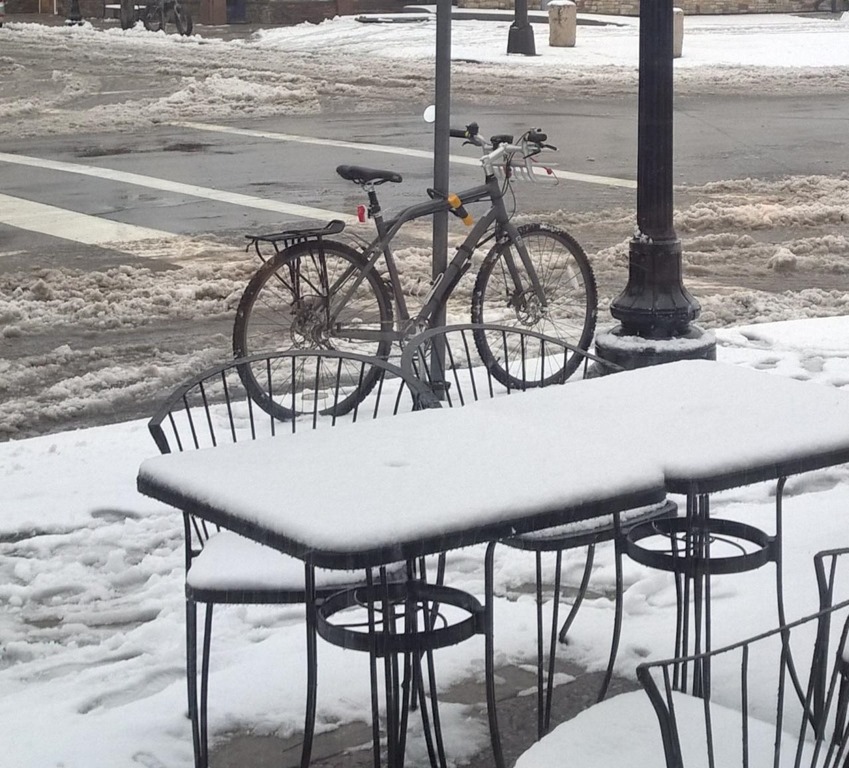
studded tires and slush on the patio tables

Plenty of patio seating available for Tuesday breakfast


Minnesotans have a well-worn phrase for our edition of the book of nature. It’s not a hand-bound collection of poems like our New Englander Emily Dickinson’s, but a play script. “The Theater of the Seasons” we call it. Famously, we try to hide emotions here, but we sure do enjoy a little drama with our weather forecasts, keeping an eye peeled for news of storms that can kill or injure you. Sitting in the upper Midwest we can receive weather sweeping up from the Gulf of Mexico or dropping down from the Northwest Territories. So, particularly in Spring and Fall, the Theater of the Seasons plays in repertory here in Minnesota.

Today’s audio piece is short, less than 2 minutes long, and it’s called“Theater of the Seasons,”  expanding on that phrase a bit. I think you’ll enjoy it. The player gadget appears at the end of the post, as usual.

As part of this blog’s participation in National Poetry Month, we’re trying to provide even more audio pieces like this that you can stream. If you know someone who might enjoy words combined with music like this, why not take this month to let them know about us and our Parlando Project, or share this or another favorite on your own blog or chosen social media site.