Here’s a piece with a short story written and read by Dave Moore.
Just as I have my bicycle ride poems, Dave has his morning dog walk poems and stories, and this one is one of my favorites. Dave tells me that he thinks he may have messed up the ending in this performance of “I Was Not Yet Awake ,” but I think it works just fine.
I’ll let the story unfold as you listen to it without a lot of commentary from me this time. “I Was Not Yet Awake” is a story about neighborhoods, neighbors, and trust, distrust and need.
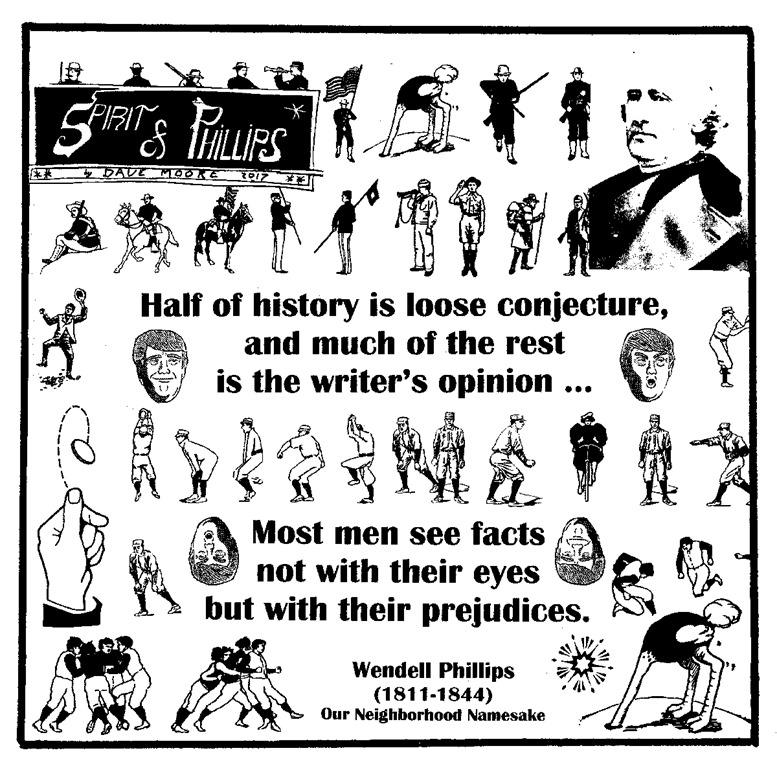
Dave Moore is also a cartoonist. His “Spirit of Phillips” reinvigorates the work of radical Abolitionist Wendell Phillips.
Dave is the alternative reader with the Parlando Project, and he also plays most of the keyboard parts you hear here on other pieces featuring the LYL Band. This story is much different from the last piece, where I tried to mash up Capt. Beefheart and Gertrude Stein, and it will also be different from the next episode. That variety in music and words is part of what we do. So go ahead and listen using the player you will find below.
Our audience growth in the past year has been largely as result of readers and listeners like you who have spread these audio pieces by sharing on social media or through their own blogs. Thanks to everyone who’s helped!
Returning now to our discussion of Modernism, that early 20th Century artistic movement that gave the artistic environment we are still grappling with. While it was a world-wide movement, reacting to world-wide changes in technology and society—for the first time, Americans were at its forefront.
But not all the Americans were residing in America.
Back in 2014, when there was a brief 50-year anniversary flurry of coverage of the Beatles “British Invasion” of the US, I played one of favorite games. So, if we were to think in 2014 of the way things have changed since 1964, what would a person in 1964 be looking back at from the same 50 year interval from their time?
Turns out they could have been looking at not a “British Invasion” of musical groups, the Beatles et al—but an “American Invasion” as Ezra Pound, T.S. Eliot, H.D., Gertrude Stein, Robert Frost, and Ernest Hemmingway all were residing in England or Europe around this time. Pound in particular, was busy making alliances and promoting his vision of Modernism, which he called “Imagist.”
Imagists, at least at the start, put a high value on concision. Pound was just as concise in Imagism’s manifesto, reducing it to three rules:
Direct treatment of the “thing”, whether subjective or objective.
To use absolutely no word that does not contribute to the presentation.
As regarding rhythm: to compose in sequence of the musical phrase, not in sequence of the metronome.
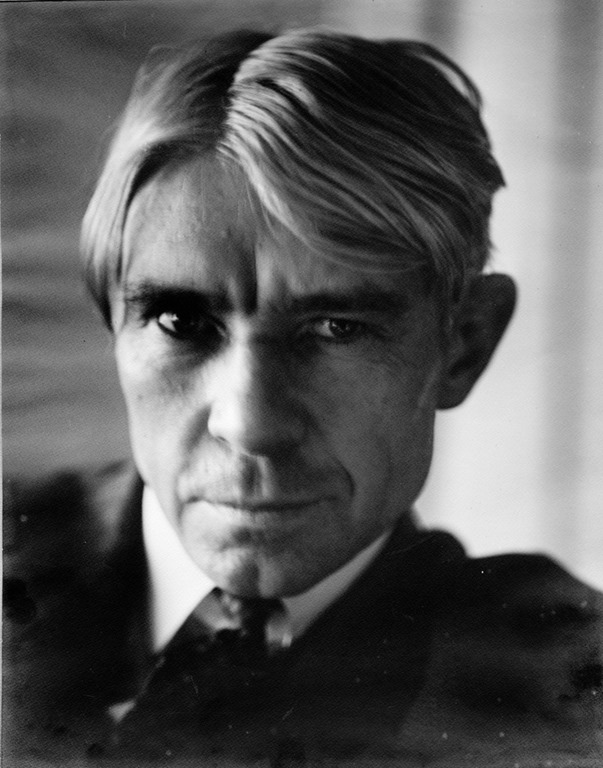
Images of Imagists: Sandburg on the left, Pound on the right. You can say that again.
Not all the Imagists were residing overseas however. Back in the specifically American city of Chicago, Carl Sandburg was to combine these Modernist/Imagist precepts with Socialist politics and activist journalism. He worked so hard at this that he essentially split himself into different people. There was Carl Sandburg the Imagist poet who hung out at the then new Poetry Magazine offices, where the poetry discovered by their European Editor, Pound, was funneled into America. But he was also a journalist working for the legendary Chicago daily press portrayed in “The Front Page”. At the same time, he was also associating with equally legendary American IWW radicals and anarchists, writing for their publications, sometimes under a pseudonym. Was he hiding his identity, or just saying that the agitator was a different personality?
Visualize that American comic-book secret-identify hero, say Superman. By day the “mild-mannered reporter for a great metropolitan newspaper…” by night fighting for “Truth, Justice, and the American Way…” as a crusading radical Socialist—but wait, there’s something more—he’s not just those two, he’s trying to create Modernist poetry as well. And pay the rent. Which is his true secret identity?
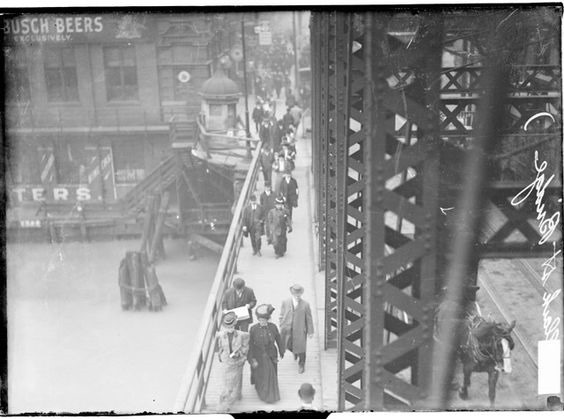
Chicago’s Clark Street Bridge, then and now: “No more dust and wagons.” Are the voices still unheard?
Today’s audio piece, Carl Sandburg’s “Clark Street Bridge” is an orthodox Imagist poem by this un-orthodox, tripartite man. The subject “thing” is definite as the downtown Chicago river bridge in its title. Its rhythm is as legato and singing as the absent voices singing at it’s end. It starts with its busy turn-of-the century black’n’white newsreel footage of crammed wagons and walkers, then takes us to the dog-watch night: only three scattered people interrupt the foggy mist and the brightest stars above the urban river. In this mist and shadows, reporter Sandburg takes off his double-breasted suit, but then, stay-at-home Imagist poet Sandburg takes off also his poets’ tights and doublet, and now, naked as a radical above the dark Chicago river he hears the “voices of dollars” in the city’s heartless commerce, the “drops of blood” from the men and women who animate it, and the gigantic chorus of the resulting “broken hearts,” as many as all the stars, as heavily present as the mist, and as unheard as either.
As I’ve often found with Sandburg, others have set his poetry to music, but no matter, I press on. My music for “Clark Street Bridge” started with an un-relenting long-measure typewriter-like drum part which I hoped would stand for hoof and foot beats. I tried to pair the guitar part and the reading of the words, and finally, I laid a legato bass part underneath it all to stand for those voices softer than the stars and mist. To hear it, use the player below.
The most popular TV show of my youth was a strange yet derivative series called “The Beverly Hillbillies.” The basic device of this comedy was as old as Shakespeare’s rude mechanicals, and as common as 19th and 20th Century perennials like hillbilly plays, Ma and Pa Kettle films and even minstrel shows.
Both of these statements are true:
A. The Beverly Hillbillies support your 2nd Amendment rights
B. They are portrayed as fools who constantly misunderstand the modern urban world
They all work the same way, and the joke never seems to grow old: rural folks are stupid, prone to exaggerating for comic effect all errors in human logic. They are above all inexperienced, leading to all kinds of misunderstandings; and they are peculiar in their language: misuse of words or odd pronunciations are rife. Abstractly, this is the ore of comedy gold, but culturally these traits are being applied to an “other,” a group that can safely be made fools of to demonstrate the audience’s superior understanding.
One trap of that kind of comedy: the dumber the writer thinks the audience is, the dumber the writer believes he must make the characters, until they lack all worth, delight and surprise. While one could worry about such authors violating political correctness, the worse danger to the authors’ career is for the audience to figure out that they are being played for rubes through a play about fools.
I was young when “The Beverly Hillbillies” was going strong, and living in a very small town in a rural state, but I found this show funny. I never occurred to me that my own inexperience might be blinding me to the idea that I could be part of this bumpkin class, at least in some people’s eyes. My little town was progressive, proud of its school, and besides I didn’t think like those silly folks, I knew full well that richer folks’ houses could have a swimming pool in the back yard and that they were called just that, not See-Meant Ponds.
But my youth and my small town were a course of inexperience. I was forever mispronouncing words and authors’ names because I had never heard them spoken—I had only seen them written on the page. I was, and yet wasn’t, those stock comic characters.
Is there any value in small towns? I believe there is. I’ll give you one example before I move on: in small towns there is no surplus of conscripts, everyone needs to do their part. Slacking doesn’t mean someone else does it, it means it doesn’t get done, and there’s no escaping that knowledge. I’m afraid that in my old age and life in a big city, I’ve become just such a slacker.
And there’s one other value to such a youth: going from a smaller, less varied place to a larger and more diverse one gives an eye a very sharp lens to look at things. I’m not sure movement the other way works as well. If one looks in the big end of the telescope, everything you point the small end at looks tiny and indistinct. It’s no accident that a very large group of writers follows that biographic path from town to city.
All this leads to today’s piece, “The Lake Street Testament,” which is an urban story through and through.
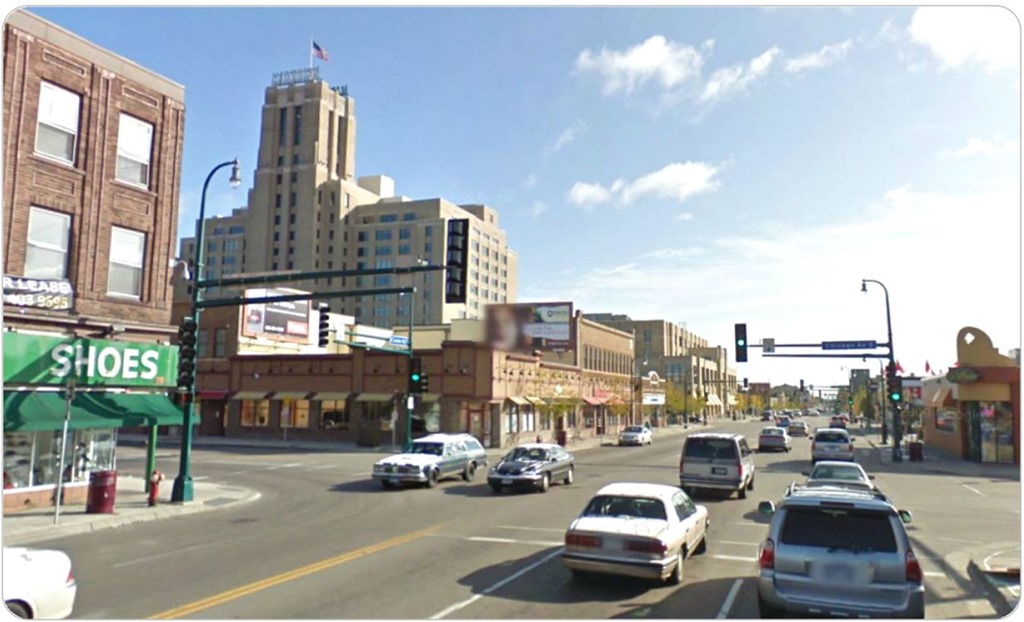
The path of a long build up like this to a short ending is another comic staple: the Shaggy Dog Story. Earlier here you’ve seen me write about the essentially comic dimensions of the human condition, particularly when talking about Leonard Cohen, Mose Allison, and Phil Dacey. This piece takes that thought into this religious season and puts it on Lake Street, which is a main commercial east/west street through the center of Minneapolis, as urban a road as exists anywhere.
Lake Street in Minneapolis Minnesota. No palm trees, no movie stars.
The audio player below will let you hear the story of “The Lake Street Testament.”



 Frank Hudson