Last Thoughts on Robert Bly

The poet and writer Robert Bly was unavoidable here in Minnesota, and to some degree that may be true elsewhere. Today would be the day this week I would have to record something new, but I’m going to write this instead on the week of his death.

I moved to Minnesota from New York in the mid-1970s, and Robert Bly was unavoidable even then, at least within poetry circles. Minnesota is used to single degrees, and it soon became clear to me that one didn’t need to reach a balmy high of 6 degrees of separation to connect a lot of the poets here to Bly.

Now as a younger man I was a big again’er, and so I was often moved to do by what I was in opposition to. Bly was this too, and he retained this spirit well into his middle age. I recall the first time I saw him read and then speak on more general cultural topics at a writers event. The reading was intriguing. I recall he spoke his poems in a Yeatsian* sing-song chant and I believe he may have strummed a mountain dulcimer haphazardly while intoning his poems. That sort of thing is not universally attractive, then or now, but I admired the attempt. The poetry held my attention while not bowling me over. I’m not entirely sure (memories of other Bly readings blur into my memory of my first) but he may have spent time in his reading speaking about the matters the following poem would be a distillation of. In effect a Bly reading sometimes seemed to be roughly in haibun form, prose talk containing associations and context, to be followed by a shorter lyric poem. In the mid-20th century this reading style was an again’er move, for the predominate public literary reading was flatter, trusting the words alone, or the persistence of memory from studying them on the page before or after, to bring forth the impact. The Beat poetry** with jazz thing still existed then, but this wasn’t quite that, and the Beats were still assayed plausibly as a faded popularizing fad with inferior poetry by many. Over the years my fondness/acceptance of Bly’s reading style continued, though I never wanted to sound like Bly reading.

Part of what might seem too much at a Bly reading, perhaps part of why he chose to explain the human connections not always overt in the poetry which followed, was that he really seemed to want us to treasure the words. That could seem vain or self-important — but of course he, or any of us poets, are only borrowing the words.

The video looks like it may be Bly reading around the same time I first heard him.

.

Later in the event series where I had heard him read, I heard him talk about culture. I recall the core of his talk that day was about how young people (he may have been restricting his subject to young men, even though this was years before Iron John)  had this narcissistic irresponsibility and lack of order. He called those suffering from this syndrome “Boy Gods” and he said these two words so close together that I wondered if this was a new word I hadn’t heard before: “buoygaadz.” Anyway, I wasn’t having this. Yes, nearly all writers, and more nearly all poets, have a sliver of un-endorsed self-regard for their thoughts and work.*** And we don’t generally know what to do with what skills we have, but at a young age drawing on our own lives isn’t just narcissistic, it’s also largely what we have any grasp on so far in our short years.

So, my again’er back was up. Maybe it wasn’t me he was talking about? Didn’t occur to me. I’d been working full time since I was 20 first in nursing homes taking care of folks Bly’s parents’ age, then in urban Emergency Rooms where people had no where else or no choice but to come. I didn’t need some writer with writing prizes giving me tough love, it was my day job to provide some pretty tough love to some needy people.

That’s often what happens when two again’ers meet. How much did I misunderstand? How much was Bly wrong? As an old man I’m not sure. That again’er part of me still arises, even in old age; but now I’m prone to doubt that there’s one way and one understanding — which was always part of my being against stuff that claims there was. Similarly, I was never attracted to Bly’s denomination of a men’s movement, though some others who seem a decent sort of person in my estimate were. I have no understanding of that part of Bly’s lifework, and so look elsewhere if that’s what you’re looking for. Also missing in my accounting today will be that there was, even more so in the older Bly, a sense of general good humor about our less than murderous follies.

Skip forward some decades and into a new century. Partly from examining closely the early Modernists (who wrote differently than most Modernism that followed) and partly from a renewed interest in how the classical Chinese poets expressed poetry, my poetry became more like Bly’s without any direct intent on my part to write like him (remember, my first impressions of Bly’s poetry were: nice enough, but not impressive or something I needed to copy.) If you’ve listened to some of the hundreds of examples of various performance styles I’ve used here combining poetry and music, I don’t think you’ll find me sounding much like Bly reading — but he is one of several whose courage in trying different ways to make verse work aloud inspired me.

And then, as readers here will know, I started to do more translations. I did this to expand what I presented here, and also because I think it’s a great way to get inside other ways poetry can express itself for my own writerly benefit. In the course of doing that, I would run across works that Bly had translated. My first thoughts? “He put stuff in there that wasn’t in the poem. And he makes them all sound like Bly poems.” Well, there’s my again’er again! I told myself that I want to honor the poet I’m translating — and sure, I can’t move the exact word-music over, but it should remain their poem, not mine. Oh, I still think I’m trying to do that, but I’m failing into doing what I see in Bly’s translations more and more. I’m not sure how I’ll eventually feel about this failure on my part. I’ll say only this (in example) if you think you’re reading Rumi by reading Bly, you’re not. You’re looking over the shoulder or between the ears of Robert Bly reading Rumi. That may be a fine location, just don’t hang the wrong sign on it. Ah, but as with the poetry we write, we’re only borrowing the words.

Have I been too dismissive or hard on the man who has just died, and who earned his honors and esteem and perhaps deserved even more? And who am I to cast this as if Bly and I are peers in any estimation! I worry that I might give some readers those impressions, but no, my intent is to say this in gratitude to Bly; and then to say this to you: if you, even partially, progress by opposition know that opposition may be like a pair of powerful magnets with poles repelling — they may snap around in your intending hands, together.

For an audio piece today, here’s an autumn poem by Rilke that Bly and I both translated. Here is a link to a page with Rilke’s own German beside Bly’s English version, and here’s mine.

Since this version from 2019, I’ve changed the 8th line to a less awkward one: “If you don’t have a house, you won’t build one now.”

.

You can hear me perform my translation combined with my own music either with the following player gadget (where shown) or with this highlighted hyperlink.

.

*I didn’t know back then, but William Butler Yeats had designs to do just such a thing early in the 20th century, perhaps more pitched than what Bly did, but by Yeats own instruction also not “art song” with elaborate melodic singing.

**While in New York I’d heard Ginsberg sing poetry; and though his pitch sense had issues, he was singing in full voice. Though I left New York before the hip-hop explosion, Gil Scott-Heron was a thing, and again, the cool, sly Beat infused (in both senses of the word) Scott-Heron thing wasn’t what Bly was doing. Bly then was always slowing the flow down, sometimes elongating the words almost like a stage hypnotist.  The Last Poets sounded more like drill sergeant chants compared to Bly. Ken Nordine’s “Word Jazz” had moments of that slow, hypno-suggestion groove, but it also had rhythmic variety. Later Bly chopped with a raised hand while reading, chopping also the words off at their feet with more variety in tempo.

***Often fighting with a stubborn bit of self-destruction or outright self-hate. Many artists think they know what they’re doing maybe 51% of the time, and then “I don’t have any idea about how to do it” fills the remainder 49%. The former pride lets us work, maybe even impress the results on others, the later portion calls us self-deluded. Some self-medicate trying to dampen down one portion or the other, but the drugs, drink, etc are not accurate enough.

Lament (after Sheng-yu’s Lament by Mei Yao-che’en)

It was difficult to return to work on new pieces for this project yesterday. November was blustery and very gray, the whole world seemed to shiver. It was weather to huddle up, as curled and still and hidden as one could be. None-the-less I rode my bike to breakfast, and when I rode past a small pond I could see three ducks on the soon to be frozen water. I wondered; did they miss the migration memo? Are three enough of a formation to make the long southward flight? Are they waiting for a greater flock to gather that I suspect won’t be coming around?

Having completed my Kurt Vonnegut series, I am reminded of a whimsical concept his made-up religion Bokononism introduced: the “karass,” a term for a group of disparate people strangely linked together without their knowledge that yet still seem to be working with a common purpose and unknowable goal.

If so, poet Robert Okaji and I may be in such a flock.

Ostensibly independently, Okaji and I both find creating American English translations/adaptations of classical Chinese poetry rewarding. We even often use the same source of literal glosses of the poems since neither of us understand the language those poets wrote in. Okaji’s practices have informed some of what I do with translation in that he allows himself to extrapolate English poetry from these old poems where his or the modern American reader’s understanding might otherwise be puzzled, unsure, or unmoved.*  This weekend I read one of his adaptations, “Sheng-yu’s Lament (after Mei Yao-ch’en)”  and was struck, as he apparently was, by the depiction of grief and loss.

Okaji’s version is quite good, but I still wanted to try my own adaptation. I approach translating classical Chinese poetry like I approach translating from French, German, or Spanish. My primary goal is to understand first what the poet wants us to see, to sense — the imagery. With poetry the “word-music” is highly important in the original language, but generally I do not try to transpose the sounds or even the sound-organization of the original language into English. I do like to retain something of what I call “the music of thought” in the original poem, the order and arrangement of the images in the poem’s journey.

I always start wanting to honor the original poet, the original poem, but despite that I often get carried away with a desire to change the way the poem ends to something that occurs to me from the experience of the other poet’s poem. This may be a failure, a fault on my part, and so when I do that here I try to cite what liberties I took. Okaji has a concise way to handle this issue: he calls his adaptations into American English “After…” which gives one license to do what the muse wills.

Lament

Robert Okaji’s fine translation is available here, and he also includes the English-language gloss we both used to create our versions of this poem. Besides his blog which includes selections from the full variety of his poetry, you can download a selection of his “after…” poems adapted from the Chinese here.

.

I started out thinking about how to render the first word: “heaven” in the gloss, a word carried over by Okaji. Best as I understand Chinese culture, the term “heaven” often carries a connotation closer to the concept of “fate,” and I actually used fate in the second draft, and then reverted to heaven in the final version. I decided I needed the listener to be firmly in the experience of mourning and grief, and to a Westerner, heaven does that. My next problem to solve were two lines both plain and puzzling: “Two eyes although not dry/(Disc) heart will want die” Interestingly, they rhyme in the English gloss, and early-on I decided to make that into a refrain. The narrator seems stuck, and refrains are a great device to show that situation. Okaji plays his “after card” here, with the very fine “my heart slowly turns to ash” that may not be in the original but adds vividness.

I wanted to bring forward Mei Yao-che’en’s image in the next set of lines — that there are things that seem elusive, that we think of as gone, but they still exist —and there are objective, work-a-day methods to go into the depths to retrieve them. I was unable to find out any additional context for the Sheng-yu whose lament the poem is said to be reflecting. Given my own age I read this poem as an older man, a widower who has now also lost his son to death, although given the historical dangers of childbirth it could be a tale of a woman who died of childbirth complications and then the infant too dies. The poignant specifics of the pearl sinking into the sea asks for allusive meaning, pearls coming from oysters on seabeds, and so a returning, perhaps a child-soul coming forth and then returning to where it came from. Or given my old-man framing, a widower throwing a dead wife’s jewelry into the sea. If the story of Sheng-yu was known to Mei’s readers this might be understood more specifically, but lacking knowledge I let this specific mystery remain.

Mei’s lines “Only person return source below/Through the ages know self (yes)” are hard to grasp. Okaji made his estimate, and I made mine. My aim was in part to underline that this section is a contrasting development of the supposedly lost things in the depths of the earth or the sea.

Okaji’s adaptation ends strongly, and it seems to me to be a more likely accurate translation of the poem’s final line. While I like my solution to the next-to-last line, I decided to go with a much odder final line. In my choice, inspired by what I felt in Mei’s original poem, and from being an older person with many grievings — the dead whose immortality is, in part, made up of my remembrance of them — is that I do not have to dig down deep or dive deep to see them, that they are with me. In the thin depths of a mirror I find them, and that my fate is to join their fate soon enough in my passage of years.

Musically I wrote an entire other tune for this, a bit more R&B like, which I abandoned early in my attempts to record this. Instead, I returned to my thought of some unusual colors associated with the Velvet Underground, and particularly John Cale,**  the Welsh viola playing member of that band. I created another spare and eccentric percussion part inspired by Velvet’s drummer Maureen Tucker’s inventions, and then laid down an electric bass line that anchors the melody. My guitar part came next, not R&B at all this time, the atmospheric arpeggios perhaps subconsciously connected to Chinese string instruments. The top instrumental lines are a cello and viola.

You can hear my performance of this lament with either this highlighted hyperlink or where available, this graphical player gadget you may see below.

.

*Others who have informed my practice: Ezra Pound’s rather free translations from glosses of classic Chinese poets, and Thomas Campion, who based his most famous poem on Latin poet Catullus while adding his own flavor.

**Two early John Cale solo LPs The Church of Anthrax and The Academy in Peril,  like his settings for Nico recordings in the early Seventies, aren’t to everybody’s tastes but hearing them opened my mind then to different ways to combine orchestral instruments with modern songwriting and electric instruments. If you want to explore them now, I’d suggest starting with 1972’s The Academy in Peril  which is the most accessible.

Summer 2021 Parlando Project Top Ten, numbers 4-2

Continuing our countdown of the most listened to and liked pieces here this past summer we move today to the numbers 4 through 2 on our list. I’ve mentioned that blog traffic and listens have dropped off a bit this summer, which from looking at past years stats follows a yearly trend. Things are picking up this month, which is encouraging — and even before autumn has begun, we’ve already rolled up our most page views and visitors for a year ever. Most of the blog visits come from those using search engines stumbling onto a particular page, and there are some perennially popular Parlando blog posts that draw visitors month after month and year after year. Maybe sometime this fall I’ll talk about those, but when it comes to listens to the audio pieces this summer, the list is all recent work, so let’s move on to them.

4. I, Too by Langston Hughes  I did a double post for American Independence Day, using texts from Walt Whitman (“I Hear America Singing”)  and this answer piece by Langston Hughes. Hughes’ piece easily outdrew the Whitman in listens, perhaps because it’s fresher to some listeners (Whitman’s piece has already had at least one widely-sung setting). Then too, the music I wrote for “I, Too”  was a catchy little cycle of chords that I played in full strums on acoustic guitar. To my ears, and apparently many of yours, it was simply effective.

Hughes wrote his poem as an individual Afro-American’s story, one paralleling his own biography, but it’s easy to see he intends it as a fully-earned addition to Whitman’s catalog of Unum’s in the E Pluribus. I decided to add onto Mr. Hughes’ lyric one short phrase at the ending, “If not us, who else,” in part to double-down the Independence Day point being made. Questions of cultural appropriation may prick us, their needling will establish these concerns have small if sharp and painful points, but the overall issue of who tells, who sings is long past decision. Story tellers will tell. Singers will sing. Poets can do both at the same time.

If you haven’t heard this one, or want to hear it again, there may be a player gadget below, and if not, this highlighted hyperlink can also play the piece.

.

3. Sappho’s Old Age by Sappho  Speaking of cultural appropriation, yesterday in this Top Ten countdown we had a piece written by pioneering Canadian poet Bliss Carman presenting himself as if a reincarnated Sappho. Is that ridiculous? I guess it can’t help but be, but I honestly enjoyed his poem and performing it. However, this piece in today’s part of the countdown was somewhat more popular this summer and was actually largely written by Sappho.

Now it’s my turn to respectfully appropriate her work and twist it my way. Ancient Greek being — oh what’s a saying for this? Oh yes: “It’s Greek to me.” — I worked from literal glosses of the text and tried to turn it into singable modern English idiom. Then I got to the poem’s conclusion, and enchanted by the parallels with a poem by 19th century French poet Arthur Rimbaud that I presented here this spring, I decided to replace Sappho’s metaphor with one drawn from Rimbaud and his life.

Bliss, I guess you and I are in the same boat, probably on one of the lakes between my state and yours.

To hear the performance in my old age of Sappho’s song of her old age a lot of ages ago, you can use the gadget below or this highlighted hyperlink which will open a new tab window and play it.

.

Bee Busy Hearts

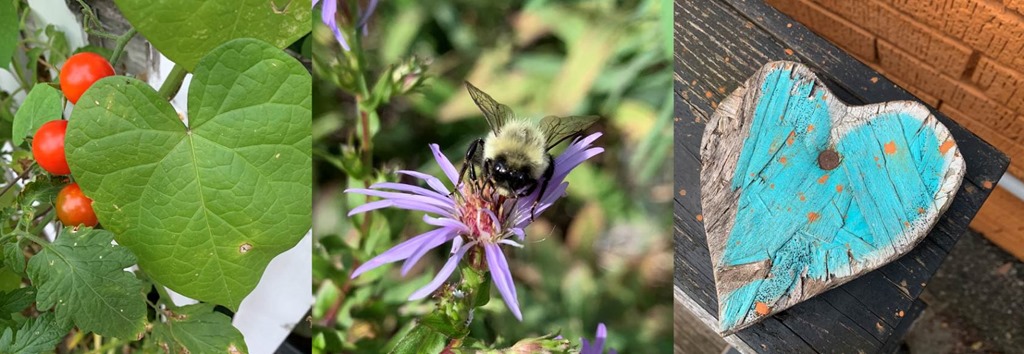
Bee busy! Hearts! Summer photos by Heidi Randen.

.

2. The Poem ‘The Wild Iris’ by Heidi Randen   Heidi wrote the text I used here at the end of a post at her blog this summer, though I added the music and additional repetitions and pauses of my device to the piece you’ll hear. In turn Heidi was resonating with something she had read in a poem by Louise Glück. So, in the end, I appropriated her work appropriating Glück’s. This process by which I appropriated the text as well as the musical repetition give it a rondeau effect if not that exact form.

Oddly, all this repetition was to present a thought about transitions, which Heidi and I are both going through this summer. Things cycle, things repeat, and then they don’t. Every day for months a parent picks up an infant and carries it somewhere. Then the toddler asks, and the parent lifts their toddling body to hip or shoulder and carries them bidden. One day they no longer ask, the parent no longer lifts, and never lifts again. And then sometimes, with time and age, the parent, will be carried by the child.

That and more. We can be so nearsighted with doorways, they sometime appear only when we are on the threshold.

You may see a player gadget below to play this highly popular piece from this summer, but some ways of reading the blog won’t show that. This highlighted hyperlink is another way to hear it.

Sappho LXXXII “Over the roofs the honey-coloured moon”

For not the first time here, I need to travel in a roundabout way in time and place to get to today’s piece. Last post, I discussed how little survives of the work of the ancient Greek poet Sappho: only a small handful of more-or-less complete poems, the rest fragments (some as small as a single word).

What caused us to then remember her at all, to collect and care about these fragments? I think it’s largely because the legends that grew up about her combined with the short verses that survive are intriguing. Yes, the ancient Greeks praised her formal poetic achievements highly, but what survives of her writing and biographic legends testify to a poet who lived and writes about love and desire. The compression of the lyric form mixes with the intensity of the erotic themes and the peak-a-boo of their historic fragmentation — the poems flirt with us.

And now for the time-jump. We move to the beginning of the 20th century, from an exotic 7th century BCE Aegean island dweller to a Canadian, a poet with the name of Bliss Carman.* In 1894, Carman and a college friend published a collection of poems extolling the romantic carefree life: Songs of Vagabondia.  Not quite as ecstatic as Whitman or Jack Kerouac, it none-the-less found a public and launched two sequels. Carmen followed this series up in 1907 with what became his most highly praised poetry collection, the audacious Sappho: One Hundred Lyrics.  How’s that? We’ve established there’s only a handful of somewhat complete poems.

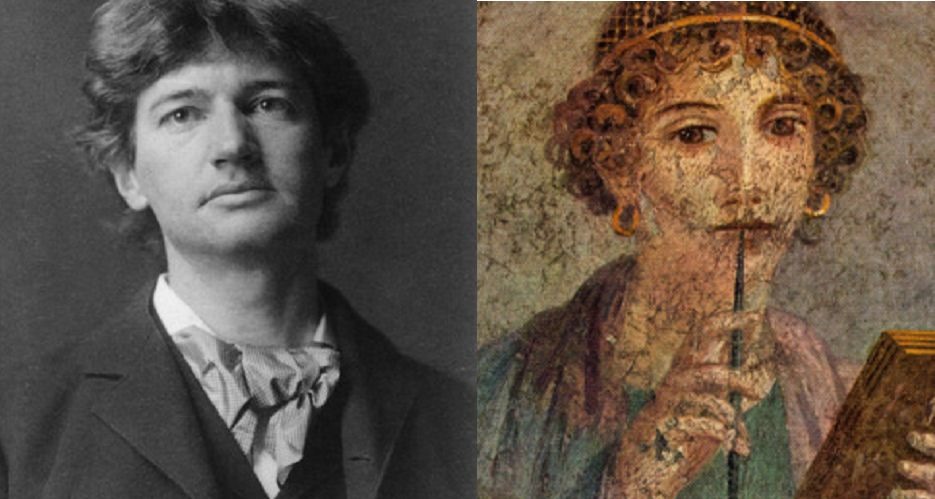
Bliss Carman and a depiction of Sappho

Bliss Carman audaciously invented his own extension of Sappho. Sappho is here depicted as being the first poet to chew on the cap of her pen while thinking.

.

Carman’s cousin, and fellow worker to establish a Canadian poetry, Charles G. D. Roberts, explained what Carmen did altogether briefly in an introduction to the book:

Mr. Carman’s method, apparently, has been to imagine each lost lyric as discovered, and then to translate it; for the indefinable flavour of the translation is maintained throughout, though accompanied by the fluidity and freedom of purely original work.”

One wishes for more explanation. Roberts’ account reads to me like one of those occultists who receive texts through spirit guides or translate ancient inscriptions by telepathic laying on of hands. However, in reading the entire book I get a sense of a different tactic with the same strategic goal that I’ve admitted in some of my translations and presentations with music: an attempt to make the old text in an old language uniquely accessible to some contemporary readers.

Yes, yes there are dangers in inauthenticity and willful anachronism. “Um, Actually” historical scholarship illuminates things too, but last time I said I understand and find value in those current readers of Sappho who wish to encounter her as if she was a modern gay woman. Carmen wanted his readers back then to get some sense of Sappho’s expression of unboundaried love that the fragments hint at if assembled just so.

His re-animated Sappho is more of a circa 1900 Pre-Raphaelite to Pre-Modernist** one. He eschews rhyme and doesn’t go all out for florid poetic diction. Most of the lines are his, not Sappho’s by any actual sense of translation, and perhaps they are best appreciated in the same way that dialog is in a historical novel. In research this week I understand there were some notes where Carman at least connected a portion of the poems with the corresponding cataloged Sappho fragments, but nothing like this was contained in the published book.

At it’s best, like today’s piece, you get a poem that wears its intent of patinaed timelessness lightly. Here’s a link to the poem’s text if you want to read along.  I particularly like the image of the coupled lovers watching from the bedroom window unknowable ships whose ventures are now safe in port.***

For music today, I’ve turned not to the ancient lyre and flutes of Sappho’s time, but perversely to try for that timeless illusion using synthesizers along with my fretless electric bass. The player gadget may appear below to hear my performance of Bliss Carman’s “LXXXII Over the roofs the honey-coloured moon”  poem. Some blog viewers will not show the player gadget, but then this highlighted hyperlink will play the audio piece if you click on it.

.

*I’ll admit it: the moment I read this name, I smiled. I couldn’t tell what gender. To modern ears “Bliss Carman” sounds like a florid pen name on a romance novel, or even a drag queen’s persona, but some reading and research staunched my snickering. In Real Life, he helped establish Canadian literary poetry and his career stretched from the establishment of the Canadian Confederation to the Modernism of the 1920s.

**Look to the youth of not a few Modernists and you’ll find William Morris and Pre-Raphaelite influences, and sometimes well-thumbed Algernon Swinburne poetry collections too. This Wikipedia article on Carman’s Sappho  says it was admired by Ezra Pound and Wallace Stevens. Though I have no cite, I could see H.D. and Amy Lowell drawing from Carmen’s version of Sappho too.

***Reminds me of Emily Dickinson’s “Wild Nights”  poem with lovers “Futile — the winds — To a Heart in port — Done with the Compass — Done with the Chart!”  Dickinson’s poem would have been somewhat freshly published when Carmen was working, and I wonder if he knew it?

Sappho’s Old Age (Rimbaud version)

The ancient Greek poet Sappho is one of the oldest poetic voices we have record of. Like the Greek epic poet Homer, her work likely predates written literature and was originally intended to be sung. How much more do we know about her?

Almost nothing for sure — or even by likelihood. As with Homer there are traditions and later stories about her, none of which are plainly based on first-hand accounts, all written centuries later. If one prefers to base their literary analysis on the text alone, that would be just about the only choice in Sappho’s case. Yet for many people not generally interested in ancient Greek poetry, Sappho is best known for being a lesbian writer — indeed the very term for that erotic affinity is derived from the Aegean Island where Sappho lived, Lesbos.

I’d need to be more knowledgeable than I am to discuss how Sappho’s lesbian identification came to be accepted as general knowledge, but some arguments are made using evidence from the text of her poetry. Which brings me to the next thing I was reminded of as I looked at using some of Sappho’s poetry over the past couple of weeks: there’s really very little of it. Very little of it.

Imagine you are a couple of centuries after some event which has erased a great deal of our formerly recorded literature. Suppose you were, in such a time, to try to assess the works of T. S. Eliot, Bob Dylan, or Emily Dickinson based only on other writers’ surviving references to them, references you can only hope will be buttressed with a short quote or two. Everything else would be lost. Sure, those commentaries in surviving texts would be tantalizing, testimony to the author’s greatness — but because they were written before some general loss of literature, they are painful too in their assumption that they needed then to be only pointers to something every cultured person would know.

In such a world of imaginary loss T. S. Eliot would be the “April is the cruelest month” and “bang not a whimper” guy without necessarily the rest of the poems that contained those lines in context surviving. And what could we make about a lost work about, what — cats? Dylan’s music*  might well be lost, but a few pithy phrases would survive because so many others liked to quote him to make a point about their times. Some accounts would say he was a great performer, yet others would make fun of his voice. Dickinson? Perhaps a legend would survive of a lifelong, lovelorn hermit, since that makes for a good story,**  but beside that we could have only a stanza or so of her short poems, her actual art retaining only the “greatest hits” lines that got quoted, “Hope is a thing with feathers,” “Because I could not stop for death,” and so on.

Sadly, this is what’s left of Sappho’s art.*** So perhaps it’s consolation during Pride month that we have presently imagined her as someone like those we know today: a breathing, living individual of desires and feelings.

Until this century there are only a couple of Sappho poems that were complete enough to consider as an entire work. Then in 2004 another mostly complete poem was added to the canon. The text was found incorporated into the structure of a paper-mache like mummy case that had languished in a European museum. The ancient makers of the mummy case had just recycled what was then garbage dump material, but this dump just happened to contain a manuscript from the 3rd century BCE of a poem by Sappho.

If you’d like to see the text in archaic Greek, a gloss in English, and several English translations other than mine, you can find it at this page. Alas, I can’t link to this section on the long web page that this poem’s entry is part of, but if you search for (Control F on your keyboard) Lobel-Page 58 you’ll jump to it.

Once more in my translation I was tempted and gave in to changing a concluding cultural reference made by the original author. Sappho used a mythological story of Tithonus, but having just this spring translated a poem (“Dawn”)  by 19th century French poet Arthur Rimbaud that imagined a strikingly similar story of a tryst between a young man and the personified dawn, the vividness of that similarity set against the biographical course of Rimbaud’s life was too powerful to resist.****  Up until that last part of the poem I tried to render my best estimate of what Sappho intended in modern English.

Sapphos Old Age

My translation, which substitutes Rimbaud for Tithonus

.

You can hear my musical performance of what I’ve titled “Sappho’s Old Age (Rimbaud version)”  with either the player gadget that some will see below, or with this highlighted hyperlink that will open a new tab to play it.

.

*Sappho was a composer and lyre player. Some accounts have her as the leader of a school that taught music, which led me to translate the opening of today’s poem as a musical admonition.

**That summary of Dickinson’s life isn’t all that different rounded-off from the one I received in my youth anyway, even though our modern scholarship has established a roughly normal life for Dickinson, whose noticeable agoraphobia came after her literary work decreased.

***There doesn’t seem to be a single cause for so little of Sappho’s work surviving intact. The random acts of time alone would account for much of that loss. The famed lost libraries of Alexandria no doubt carried some of her work.

****Rimbaud, who wrote his entire influential corpus of revolutionary poetry before he turned 20, spent the last years of his short life as a merchant-trader in an Ethiopian branch office dealing in coffee.

Rimbaud’s Dawn

The last time I created and performed a fresh translation of a Rimbaud poem here, I broke from my usual practice with translation and produced a rhyming poem. I don’t usually do that. There’s too much else to try to bring over from one language to another to add that extra degree of difficulty. But in the case of Rimbaud’s “Eternity”  I felt the incantatory power of the poem was too essential to discard.

Today’s new translation from Rimbaud’s French relieved me of that decision, as “Dawn”  is from his collection of prose poems Illuminations.  I’m still left with the usual problems of translation though. My primary goal when I translate is to make the poem vivid in the destination language, and that leads me to take care with two tasks: to transfer the sense of the poem’s images to the contemporary reader in the new language; and when a poem makes use of scenes or an overall plot, to do the same with portraying that. The translated poem’s sound word-music will almost certainly be diminished (per Frost’s “poetry is what’s lost in translation” declaration) but I try to respect the poem’s music of thought, that sense of harmonic relationships between things, the melodic undulation of its series of images. These primary tasks become fraught when the images and scenes are difficult, or by intent irrational or obscure; and in those cases determining the author’s intent and how understandable they would likely be to the intended reader they wrote them for adds another level of difficulty.

Lately I fear I may go too far in how I handle this, reducing to something determined that which the author wanted to remain mysterious or only an enticing sound or novel juxtaposition — yet still I risk it. Most other translations of today’s Rimbaud piece are less clear than the one I produced. My hope is that the sense of wonder in the poem is enhanced rather than reduced by portraying more exactly what I sensed Rimbaud was showing us. Here’s a link to the poem in French, and then here is the fresh translation I made and used for today’s performance:

dawn

Issues start with the poems opening sentence: “embrassé” has been translated as “embraced” (retaining some of the sound from French) and as “kissed.” From the whole of the poem, this non-native French speaker thinks there’s more of a context of grabbed or taken in here. Unlike others I then chose to make a compound English expression for Rimbaud’s single word: “caught and kissed.” My hope is that this sets up the story that Rimbaud seems to me to be telling, of the poem’s speaker and the dawn of the title being caught up in something between a passionate tryst and an abduction.*

Truckloads of dawn are being shipped while you sleep!

.

The second paragraph shows us an urban early morning as the sun is just rising. Grand public buildings, symbols of power and order, have no crowds or guards. The trees are still shadowing the streets. Warmth is only gradually emerging from the overnight chill.** The last phrase there remains somewhat mysterious to me, so I left it so for the reader. I believe the wings may be the pigeons or other early morning birds in front of the grand buildings, but “pierreries” (gemstones) is harder to grasp. I tried the thought that it might be iridescent feathers on the birds, but little else in this poem looks at such a close level and I suspect more at glints of early morning light breaking in, which helps inform how I handle the next section.

That next paragraph is mysterious too — and left somewhat at that in my translation. But I couldn’t resist making “blêmes éclats” into “gilded splinters.” It was just too good a connection from Rimbaud’s French to Afro-American creole French, known to me from the Voodoo folk-chant once appropriated effectively by Dr. John into a slow-burning musical ritual.

I think the next paragraph is dawn’s light coming in through tree branches, blonde on blonde.

In the next paragraph I once more choose a compound English expression rather than making a singular choice from the French. “Voiles” can be either a veil or a sail,*** an I think the sense of the poem wants it to be both. Dawn (feminine) is lifting veils, and the poem’s speaker (masculine) is setting sail on a voyage. Ecstatically Rimbaud is sailing down the streets in the poem’s mind and camera-eye out to the very borders of the city in a magical instant while dawn is still breaking and unveiling, to reach where in the penultimate paragraph dawn and Rimbaud fall onto a forest floor in what I read as a sexual embrace.****

Some readings of the poem have the final sentence as one of those “It was all a dream” trick endings. Yes, the poem intends to portray a visionary experience, but I think we’re still in the vision at the poem’s end, perhaps with the lovers only about to depart in a mid-day aubade — after all, the speaker has exercised the aubade trope of denouncing the time-announcing rooster. In their union, dawn and Rimbaud have stopped time, if only for an interval.

So, here’s the player gadget and alternative highlighted hyperlink for those who don’t get the player gadget in your reader to hear my performance of my new translation of Arthur Rimbaud’s “Dawn.”


.

*This poem is a vision, a fantasy. Yes, within the fantasy there’s no explicit consent, and we might read Rimbaud as male and the long-haired and veiled dawn as female (see the footnote on linguistic gender below) but that may be us putting our own casting on the fantasy roles here. But again, it’s a fantasy, and the loving and respectful rules of reality may contain it.

Alternatively, in kinky fantasy footnotes, my best-guess that the child (l’enfant) in that concluding embrace is a persona of the young Rimbaud, and that opens up age of consent issues regarding an encounter between the ancient cosmic event of solar dawn and a teenager. Beyond glib jokes, given Rimbaud’s biography, I wonder if that has been more seriously addressed by modern scholars?

**Personal aside: in my early-morning bike rides this May, I’m growing increasingly tired of the WWII-Fahrenheit temperatures of between 39-45 degrees so far. I want to ride with bare legs and arms and make vitamin D with human skin!

***The former noun is feminine in French and the later is masculine. My teenager strongly dislikes gendered languages with a personal dislike, and I’ve never cared for this common language feature for efficiency’s sake. Still, I searched the section to see if I could determine the gender intended and decided it wasn’t certain.

****Discrete Rimbaud leaves out (did I intend that pun?): forest floor matter in nether crevices, bugs more interested in their own desires, and pointy things extrinsic to the coupling. This is why Rimbaud is a poet!

Revisiting Stones Under the Low Limbed Tree, and what’s fair in song-making and translation

Many of the visits to this blog are not you, the regular readers who are reading this fresh post, but views of some older posts via a search engine. A gaggle from Google have come recently to a post from a year ago which doesn’t feature one of “Poetry’s Greatest Hits,” though it does use, in a way, the words of one of America’s most loved poets, Robert Frost.

Here’s a link to that post.  I looked at this post, and I’m not sure what brought it to increased attention, though after re-reading it today, I complemented my past self — who I alternately think is wiser or more foolish than the current occupant of my consciousness. I thought I did a good job of describing how we as writers may improve our work through revision, even though the example I used in the post was my own revision, for my own parochial reasons, of the words of a recognized great poet.

I do that sort of thing to the Greats from time to time — as recently as the last post here with a simple addition of a line as a refrain from a poem by Robert Browning, or more extensively with my extension and relocating a poem by Du Fu that many liked last winter, or further back with a piece of Rupert Brooke’s that became one of the most listened to pieces in the history of this project. I usually feel ambivalent when I do this. At the least, I try to warn you when I intentionally go beyond the original text. In each case above, the author’s dead, there can be no personal hurt or slight for them to feel, but with this project I do take on some duty to the text the author wrote. Have I cheated at my task? Am I dishonoring their work?

Cottonwood Catkins Spinal Halo 1080

How is this photo connected to today’s post? I don’t exactly know. So what should some translator do when asked to present it in their language?

.

I’m wrestling with these matters currently with another translation in process,*  a prose-poem by Arthur Rimbaud, particularly with a common issue I come upon in translation: how much did the author intend to be mysterious, and how much did they (or their ideal, likely contemporary reader/listener) understand to be clear in their original language? With translation, one can’t avoid substituting your own words, and likely things like word-order, idiom, and so forth — that’s inescapable, inherent in the task.

In the case of this poem by Frost, my recasting wasn’t so much for immediacy of meaning, or to make an image clearer to our time and place; but to make the poem more sing-able, to fit and obtain impact in a conventional song performance. Yet, the song that I made of it was not very popular with listeners here. When I looked today, it appears that nobody that has visited the post this month has listened to the performance.

Again, complementing my past self, the one I feel I can more often judge objectively; I think I did a pretty good job of the song I derived from inside Frost’s poem “Ghost House” and retitled “Stones Under a Low-Limbed Tree.”  My vocal (often a weak point) was passable — though I idly wish for “cover versions” by a legitimate vocalist for pieces I write and present here — and the rest of the audio piece works well.

So, here’s that audio piece, being presented again for your listening judgement and plausible pleasure. The player gadget should be below, and this highlighted hyperlink will also play it in a new tab if the player doesn’t appear on your device or reader.

.

*Following the practice of Robert Okaji, I’ve taken to casting some of my alterations or freer translations as “After a poem by…” — another way to deal with this, though it doesn’t remove all the questions I ask myself.

The Most Popular Parlando Piece this Past Fall Was…

Well, this is sort of embarrassing. The Parlando Project is about wandering about in the universe of other people’s words that I might combine with music. I wanted to cast for a wide choice of words because that was part of the core energy of one of the project’s ideas: “Other People’s Stories” and how could my music and the performances illuminate a range of experiences.

You see, I think that the performer—like you, the reader or the listener—should become the co-creator with the author’s text for the fullest experience. I find it rewarding when, in taking my part, I am collaborating with William Butler Yeats, Fenton Johnson, Edna St. Vincent Millay, Du Fu, Emily Dickinson, or Tristan Tzara. Long-time readers here may have noticed that in the past year I’ve increasingly turned to translation from non-English authors, which enforces that need to become the respectful collaborator with the author’s text, but in effect even those authors who wrote in my native language require translation into a performance with music.

Whitman with Butterfly

I had the damndest dream! I was this 4th century BCE Chinese guy eating breakfast in Minneapolis. And then I awoke, and I was just Walt Whitman, a cosmos.

.

So despite those principles, the most popular piece in terms of likes and listens this past fall was “Two Butterflies,”  an exception where I wrote the words as well as the music. In my original post on “Two Butterflies”  I didn’t take much time to write about my intent with the poem. Let me do that today.

.

The original experience that brought this poem to my mind was sitting at an outdoor city patio early one morning eating breakfast when I was startled by the pair of butterflies flying past me within inches without stopping on their way to the potted plant near the café’s door. For the next several minutes I was enraptured by them, compelled to watch them experience the same transient morning I was in. I noticed them intent on their connection to the flowers that co-existed with a watchfulness so that they would each take off in a spiral flight when someone else would enter the café for takeout.

Much of the poem then was pure observation, its ideas derived largely from what I selected to report. The effect I was seeking to bring out in the reader in that part of the poem was an intense investment and identification with these creatures and the poem’s speaker. At times the speaker is away and watching, at times he seems as close as one of the butterflies is to the other, or even seeing through their eyes the humans about them.

Then two stanzas from the end, the poem has its turn, its volta. I’m not sure if the way I went was the right way to go. I destroy the imagist mood of the opening three-quarters or so of the poem, but I often quite like it as a reader when a poem destroys its mood or continuity in service of another frame or facet of what it’s portraying.* My readers often note this as a fault, a mistake on my part, but if so, it’s a mistake following my intent here. The poem could  end before the last two stanzas, and it’d be more likeable. The casual reader would find that foreshortened poem largely understandable, a pleasant word picture.

The sin I risk in the last two stanzas is pretention—and that’s not a tantalizing sin to me. I fear committing it as much as I fear being caught committing it. To say what I sincerely thought in that morning’s moment is not an air-tight alibi. I pack a lot of metaphysics into those last two stanzas, and most readers don’t want to be waylaid by such. Most of us are too busy competing with or caring for each other to find that useful. For a few moments—and pretentiously, for only a few moments—one morning I was unoccupied enough to think on these things. You, dear reader, are not obligated to do the same. If you’d like to hear my performance of “Two Butterflies”  the player gadget will usually appear below. If you don’t see a player, this highlighted hyperlink will also play it.

.

*The desire for this kind of sideways explosion in a poem’s intent or at least a slicing undercutting of its statement was something that I found in my attempt this month to come to terms with the Zhuangzi,  and its own Butterfly Dream. Casual readers and even philosophers seem so taken by the implied question in Zhuang Zhou’s Butterfly Dream of how can we be sure if something is dream or reality, and then entirely miss the extra explosion Zhuang Zhou put at the end of his parable: that we find these two states completely distinct, and yet we move between them. Therefore, can we not move between completely different states in our outlook in other matters?

I’ve got Burton Watson’s translation of The Complete Works of Chuang Tzu  containing all the inner books of the Zhuangzi,  and it’s somewhat slow going to fully grasp despite Watson’s helpful framing and notes, but as promised Zhuang Zhou hops around quickly, hoping perhaps to destroy conventional reading.

End of the Sky–A Doomscrolling Sonnet after Du Fu

In the 8th century, in China, there was a poem written by a man whose name we now write in our alphabet as Du Fu.*  It’s a short poem, 8 lines, and in it Du Fu addresses a friend, another Chinese poet of his time, Li Bai. Du Fu was able to compress a lot into those few lines about their shared task of writing. I’ve seen the poem’s title translated as “Thinking of Li Po at Sky’s End.”

Here’s a literal gloss of the original Chinese ideogramic text translated into English:

Cold wind rise sky end
Gentleman thought resemble what
Goose what time come
River lake autumn water much
Literature hate fate eminent
Demons happy people failure
Respond together wronged person language
Throw poems give Miluo

I’ve been carrying this gloss around in the background since August, thinking about how to render it when I chose to translate a poem by Li Bai instead. Then this November I was taking time out from the Parlando Project for a task I complete each month: to write up my reactions to a small group of poems from a circle of poets I’ve known for over 40 years. I try do do my best at this. The members of this group are generally accomplished, two of them markedly more so than I. In-between responding to their work, I continued to consider the Du Fu poem.

This project that you meet me at here has allowed me to explore intensively how I respond to poetry, poetry that is often of widely different styles. This only makes me more worried as I respond to this circle’s new work. I’ve seen varied ways poems can work, but I’ve seen the varied ways they can fail with an audience too. I try to respond authentically to the circle’s work, with an open heart, just as I do with the poems I present here, but in the end, what do I know for sure about what works or makes something work better or less well? What then to tell other poets, perhaps ones better than you?

After all, the same thing that seems to succeed in one poem seems to fail in another. I often think of how many musicians and writers have said that if they had the maps and mechanisms to make their art work each and every time, they would go to that place and never leave.

Similarly, if we knew as readers and listeners how to always pay the proper attention, would more poems, songs, or tunes succeed or fail?

This year I’ve begun writing a series of sonnets about my inability to come to grips with a number of simultaneous crises: a viral pandemic, a wider and painful realization of our racial caste system and its costs, the climate change frog-potboiling, and a government in proud, foolish, and willful disarray regarding these things and the judgement of voters. Round and round I go trying to find out what I don’t know. Trying to figure out what’s best to do. No next thing I read or watch will answer that, and some of what I come upon will dismay or anger me. That syndrome has been given a name: “doomscrolling,” and perhaps you have found yourself falling into it too. In honor of the obsessive nature of us little people trying to make sense of these senseless things and manage some mitigating protection for ourselves, friends, and family, I’m calling my series The Doomscrolling Sonnets.  We try to puzzle these things out, just as we continue to try to make poetry or other art work.

I think that may be what Du Fu wants to tell fellow poet Li Bai he understands in his poem.**

In my roundabout way, I came to a decision about how to present Du Fu’s poem. I decided to use it as a rough framework, an inspiration, as the kind of translation as starting point that is most accurately described as “After Du Fu” rather than an attempt at a faithful translation.***  This poem isn’t going to be written to Li Bai, it’s going to be to my friends, and to you if you too read, write, speak, or listen to poetry in this troubled time when our rudder is stuck hard to one side and we circle endlessly.

End of the Sky

.

I love dividing the 14 lines of a sonnet in various ways. Instead of an octet and sestet, this one is two 7-line stanzas with the turn/volta in the middle, and a closing couplet. Rather than end-rhyme, I decided to use a variety of internal rhymes, repeated words, and near-rhymes. The effect I’m aiming for here is a constant but irregular little chime occurring rather than a fixed rhyme that has the reader settling into an expectation.

I open the poem trying to render Du Fu’s autumn setting with some extra elaboration, though I translated it to my colder Minnesota clime. I think of the geese here as our occasional encounter with our muses and sometimes the song we hear from them isn’t as sublime as we’d like. And late autumn reminds us of what we must, and have, finished, what we’ve written down: the dried, settled ink and frozen surfaces of pages.

Chinesepoems.com, the source of the gloss above, gives us a helpful hint at what Du Fu is getting at with his closing line. Qu Yuan is a poet who, in a time of despair, threw himself into the Miluo river and drowned. In tribute, poets would come later and throw poems into the Miluo at the site of Qu Yuan’s death. Here again, I had my own localization to apply. I used to walk every day over a bridge crossing the Mississippi River, that mighty stream that runs through the middle of the Twin Cities and the rest of our country. A couple of years before I came to the Twin Cities, John Berryman, a poet and professor had copied Qu Yuan (or Hart Crane) and jumped from that bridge, a direct downward path taken presumably in giving up his own doomscrolling life and literary problems. I knew nothing of Qu Yuan or Du Fu back then when that was my daily walk, but I too once dropped a poem over the side of the bridge. Maybe Du Fu spoke to me before I knew his name? Muses will do that.

This poem’s two best lines I think are my attempt to directly translate Du Fu:

True literature doesn’t care if it is popular, and
It is only demons that care about a poet’s failures!”

You can stick that one by your keyboard or in your notebook. I think it’s better to listen to muses than demons, even if the muses lead us on, because muses tell us to write poems which we may throw in the water rather than throwing ourselves. I say that, even though I have reminded you here over the years: “All artists fail.” And so, we, poets, will fail. We fail mostly.

Mostly.  That’s important.

You should see a player gadget below to hear my performance of “End of the Sky.”  If you don’t, you can use this highlighted hyperlink to hear it.

.

* Du Fu is also spelled out as Tu Fu, and Li Bai as Li Po. The poet Ch’un Yuan referred to at the end of Du Fu’s poem can also be spelled Qu Yuan. It all has to do with the problem of taking Chinese language and portraying the names with the Western alphabet.

** Du Fu’s poem was written in a troubled time. The government of China was in turmoil, the country divided in civil conflict. Both Du Fu and Li Bai were imprisoned during this conflict, and Li Bai eventually had a death sentence handed down against him. Li Bai’s death sentence was commuted, but he was sent into exile. The two friends were separated for the rest of their lives.

*** I read poet and blogger Robert Okaji’s version of Du Fu’s “Thinking of Li Po at Sky’s End”  last month. Okaji, faced as I am with the challenges of translating Tang Dynasty poetry into an unlike language in a place centuries later, calls his versions “After…” rather than presenting them as translations. This year after reading some of his “After…” poems I’ve decided to do the same sometimes. Here’s a link to Okaji’s fine rendition.  For other examples of how “After a poem by…” translations may work see Campion’s “Let Us Live and Love”  after the Latin poet Catullus and Ezra Pound’s free translation of Li Bai’s “The River Merchant’s Wife: A Letter.”

In German November, or What? Nietzsche was a poet?

As a person educated in the mid-20th century this is what I knew about Fredrich Nietzsche: he was a philosopher who was all the rage in the late 19th and first half of the 20th century and he had this thing about achieving a more perfected human condition. Oh, I knew one more thing about him, something that discouraged all other curiosity: the Nazis liked him, saw him as an intellectual forerunner of their decidedly non-intellectual movement.

I know only a little more than that now. In the past few years it’s become accepted knowledge that the Nazi connection was to a large degree accidental. Nietzsche’s sister was his literary executor,* and she was a Nazi fan-girl who did a great deal to forge that linkage; and since the Nazis were nationalists, the available idea that there was a notable German cultural figure whose contradictory writings could dab some intellectual cologne onto their bully-boy stink was useful.

I vaguely knew that one of my childhood heroes George Bernard Shaw had admired him, but I had no idea how many leftist and anarchist figures rated Nietzsche. Remember Gustav Landauer, the German Anarchist theorist and grandfather of the famous director and improv comic pioneer Mike Nichols, brutally killed in the post WWI revolutionary activity in Germany? He was said to be influenced by Nietzsche too.

But this fall, while reading a blog I follow,** I learned another thing: that Nietzsche was also a poet. Which shouldn’t be news to me I guess, but it had never occurred to me, even though as a philosopher Nietzsche seemed to be something of a human quote machine who could turn out memorable phrases. And today’s text, “In German November,”  was the example that introduced me to that fact.

November Sadness by  Heidi Randen

Ah sunflower! Weary of cold and $%*@! snow.

.

I know only a little about German literary Romanticism, but what I know makes Nietzsche’s poem part of that tradition: worship of nature, doomed love—Damn! There’s even a prominent talking flower for Odin’s-sake! This can seem very twee in summary, but Nietzsche redeems it with his gift for language and characterization. Unlike other translations I’ve done here, this one’s poetic images and plot moved rather easily into English.

This is autumn: it — it just breaks your heart.”

After the poem establishes its “This is Autumn…” refrain by opening with it, the first full stanza has a graceful post-equinox image of a now lower sun against a mountain that would please Wang Wei. The poem’s second scene, set in a orchard with post-frost fruit starting to rot mixes sex and death tropes effectively. And then there’s that talking flower.

It takes some nerve to carry that scene off both as a writer and as a performer. I felt I had to push myself as a singer to portray the sunflower, and part of the reason I’ve started to put chord sheets up for some of my compositions here is to encourage better singers to improve on my attempts.

German November My Translation for song

Simple chords, but this one has opportunities for a singer.

.

Because Nietzsche’s German moves fairly easily to English my translation doesn’t differ that much from the one in this link, which also provides you with the original German. One choice/change I made: I wanted to emphasize the existential angst of the sunflower and to strengthen an image—and so the original German: “in ihrem Auge glänzet dann/Erinnerung auf” gains a repeated word “memorial” reflected in the dying flower/eye. I also thought the implied pause in Nietzsche’s refrain: “This is autumn: it—just breaks your heart.” could be emphasized further by repeating the “it” for a stutter effect.

As I mentioned above, I went for it in this performance, and given my limits as a singer it may not be to everyone’s taste, but it was the best I could do given the more limited recording opportunities I have these days. The player gadget to hear it is below. Thanks for reading and listening in whatever November wherever you are.

.

*Nietzsche died in 1900, late enough to give his ideas access to the early 20th century’s cultural ferment, but with the benefit that the proponent of those ideas wasn’t around to contradict the uses interpreters put them to.

**Byron’s Muse. I like to think I’ve outgrown youthful goth romanticism, which fits badly with my aged frame and less virginal connections to death, but Byron’s Muse sometimes reminds me that artistically there is still some attraction there.