The Pumpkin

Last time I was musically blasting your ears with twin electric guitars, bass, drums, and keyboards as I commemorated the snark of the early Internet’s “flame wars.” Today’s piece combines – just in time for American Thanksgiving – a quiet nylon string “classical” guitar, and a 19th century poetic ode to pumpkin pie.

The words I sang were written by John Greenleaf Whittier, one of a circle of New England worthies who were grouped as the Fireside Poets. Back in my parents or grandparent’s time the Fireside Poets were as celebrated as pumpkin pie. As a group they took on the job of creating an American poetry written by Americans with American subjects.* Alas, that’s a job that once done, doesn’t inherently demand continued interest, particularly in a country like America that has become a cultural superpower. American poems written by Americans about American subjects are a commonplace thing now.

But to do this was a piece of work in the first part of the 19th century – and in furtherance of this Whittier chose an indigenous American plant for his poem. The pumpkin represents American autumn is so many ways, starteing with jack-o-lanterns in October, as a decorative harvest tote, and for its curtain call, the fruit for pumpkin pie at Thanksgiving. Whittier wrote his ode mentioning all these things, and here’s a link to his entire poem. I read Whittier’s tone as “mock heroic” in his poem, but I chose to make a small song using only his ending, the pumpkin pie part, since I was racing to complete it before American Thanksgiving. Friends of our officially young-adult kid are gathering downstairs tonight to do whatever they will, as I hole up under the slanting roof typing this.
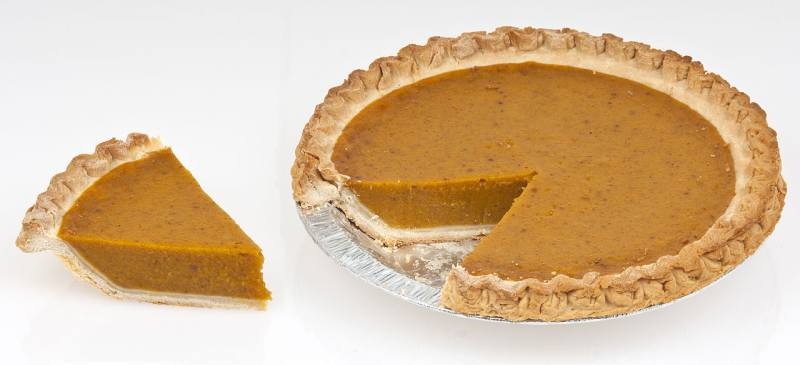
pumpkin pie

“Fairer hands never wrought at a pastry more fine.” Pumpkin pie picture by Evan-Amos

.

Is it just me, or is there a touch of what my wife calls “comfy gothic” in this passage at the end of Whittier’s poem? The poem starts out addressing the pumpkin plant itself, but as it continues we see it speak to the humans associated with it from childhood to grey-hair-dom. When I have Thanksgiving tomorrow with my little family I’ll have thoughts of everyone distant or dead that made or attended Thanksgiving meals over my life. In the poems final stanza Whittier speaks of, praises, the hands that make the wonderful pumpkin pie, and then as the poem ends, he sings them away with a wish that their final sunset is as orange and lovely as a pumpkin.

There’s an audio player gadget, or should be, below that will let you hear me sing that last stanza of Whittier’s poem. I focused on the simplest and most modest of musical settings for this one, purposeful contrast to the previous musical piece here. If you don’t see the audio player that’s likely because some ways of reading blogs suppress it, so I provide this highlighted link that will open a new tab with its own audio player. Consider that the apple or blueberry pie option to hear this song about pumpkin pie.

.

*Earlier this year when I asked AI to create some protest songs, it defaulted to a musical style stuck somewhere between Bro-Country and Indie Americana. When I needed to make up names for the faux acts I chose Fireside Poets’ names like  “Greenleaf Whittier” for them – because though writing for the page, those Fireside poets were the poetic roots of Americana.
Millay’s Thanksgiving

There’s a long tradition in poetry of civic poetry — poems not meant for an audience interested solely in the interior intimate experience of the poet, but speaking to larger, more public themes. I suspect modern poetry doesn’t do this mode directly much, even though some individualist poetry infers that purpose. American poetic Modernism began with an emphasis on the concrete, the thing specific: red wheelbarrow, ripples in a pool, a certain Chicago cat-fog, an exit on the Metro on a rainy day. Yet, a focused subject can still be an example that stands for more.

If the subject is small though, perhaps we poets expect our audience most often to be small too, compared to a variety of other, popular arts. But this was not always so. Longfellow and Whitman expected the nation to listen to their poems of democratic virtues. If the literary set eschew the mode, song-lyricists and non-literary poets will still assay it.

Just under four years ago, a poet Amanda Gorman who has written civic poetry, delivered a poem at the last U.S. Presidential inauguration, speaking of the nation’s fears, hopes, promises. The mode of the next Inauguration has changed. I’m not expecting poetry. Some will think, more-the-better — who wants a poet spouting off what I should think.

Why not, are they not citizens? What are the occupations that are allowed to speak?

Nearly 75 years ago. American poet Edna St. Vincent Millay wrote a long poem for the American holiday of Thanksgiving. She expected a good-sized audience: it was published in the Saturday Evening Post, a weekly general interest magazine, the one that often featured Norman Rockwell paintings on the cover, that claimed Ben Franklin as its founder.

Millay NFTG

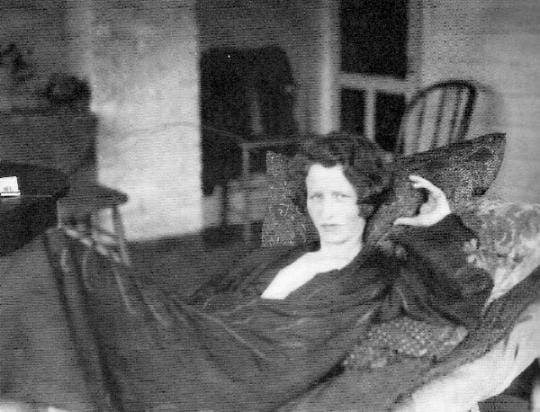
The most often used pictures of Millay show the young romantic adventurer. I’m also fond of this one that seems less all that. The poem which I perform excerpts from today was the last one she published before she died at age 58.

.

I’m sure there were specific things on Millay’s mind, geo-political, American issues. She writes five years after a war ended with two A-bombs. How long would be the peace? In 1950 there was another war going on overseas in Korea, there was a “Red Scare,” and to a large degree some deficiencies in American equality of opportunity were so far off to the side that too few even thought of them as political issues to address then. Millay didn’t cite any of that directly.

Instead, she wrote about how she thinks we, the citizenry, were feeling, assuming a general agreement that might be hard to gather today. Thanksgiving is a dual holiday occasion: it’s our harvest festival, a time to give thanks to what our work brought us, and it’s also a holiday to give thanks for what we’ve come through: it originated in a time of Civil War, and it commemorates the hardy survival of some early 17th century boat-people who landed without papers and survived on American shores. Millay’s Thanksgiving thoughts were more toward the latter than the former.

What will ring true in some American hearts this year will be her words of hopes dashed or at least deferred. Can one give thanks for having hopes that were unfulfilled? Can we at least forgive ourselves for hope? Her poem exists in that question. In the excerpts I performed today for this musically accompanied piece you can hear below, I focused on that sense, felt in my bones. “Cunning and guile persist; ferocity empowers” Millay writes. The lines that stand out for me as a Thanksgiving prayer this year are “Let us give thanks for the courage that was always ours; and pray for the wisdom which we never had.”

As civic prayer goes, that’s humble, but it has some bite in it.

You can hear my performance of portions from Millay’s “Thanksgiving…1950”  with the audio player below. The full poem’s text is at this link. No audio player gadget to be seen?  This highlighted link will open a new tab with its own audio player.

.

.

Thanksgivings

I’d hoped to have some more new musical pieces ready this month, but as I’ve reached the eve of the American Thanksgiving holiday I thought I’d mention a previous Parlando Project piece that has gotten attention this month as people on the Internet look for poetry about that holiday.

The post, the one people seek, presents this little marvel from Emily Dickinson:

One day is there of the series
Termed “Thanksgiving Day”
Celebrated part at table
Part in memory —
Neither Ancestor nor Urchin
I review the Play —
Seems it to my Hooded thinking
Reflex Holiday
Had There been no sharp subtraction
From the early Sum —
Not an acre or a Caption
Where was once a Room
Not a mention whose small Pebble
Wrinkled any Sea,
Unto such, were such Assembly,
‘Twere “Thanksgiving day” —

Though silent on the page, I can hear Dickinson’s voice start out examining this holiday at arm’s length. It has claims to be a historical commemoration (the landing of English colonialists in her home state of Massachusetts in 1620) but its observance, then as well as now, is basically a big meal, often with extended family in attendance. Many folks reading this today recognize or remember being in that in-between state of age at a Thanksgiving gathering, no longer a child, but not one of the family elders — neither urchin nor ancestor. Similarly, the Thanksgiving holiday in Dickinson’s time was of unclear seniority: it claimed to represent those 17th century English settlers and their harvest feast, yet the promotion of a U.S. holiday that became the one we celebrate now was a new movement of the mid-19th century.

Dickinson at first reviews it as if a pageant, and then as she starts to become a little harder to follow, with “Hooded thinking.” My guess is she’s meditating on it as if a monk or a nun wearing a habit. Her resulting take: “Reflex Holiday.” Fair — most holidays, most of the time, have elements of reflex: they are set celebrations, dates on a calendar. Sincere thanks-giving requires no excuse or appointment. If Dickinson had ended there, we’d have a poem in a predominate style of our age: a sharing of an observation from one sensibility to any and all, not unlike an Internet post.

Thanksgivings with ghosts
“Celebrated part at table/Part in memory —”

.

Dickinson however also has an abstract mode where our less agile minds may not follow as rapidly as her poem jumps away in the next lines. Have we subtracted from the piety of the Pilgrim settlers? And then the most obscure set of lines in the poem: “Not an acre or a Caption/Where was once a Room.” Huh?

I may not understand those lines. I certainly didn’t when I performed the poem a few years back, but this occurs to me: talk of acres as if in a deed, and the use of the curious word “Caption,” reminds me that she was a smart woman in a family where the men were lawyers. Caption is a legal term, it means, I find out, “that part of a legal instrument such as indictment, commission etc., which shows where, when and by what authority that legal instrument is taken, found, or executed.” Understanding that usage I think it highly likely she’s saying that the holiday celebration may not be on firm legal standing. Is she just commenting on the holiday not yet being a national holiday as it eventually became in the U.S.? Or does she have — or do we, her readers today, have — a reading outside the borders and celebration of the poem drawn by a culture of colonizers whose small settlement was under the forbearance of those already there?*

Dickinson closes by saying the original Thanksgiving assembly was like the proverbial pebble that spreads ever widening ripples in the water. Yes, big circles long past the pebbles. History is an unending cycle of theft and accumulation, deliverance and conquest. Kindness and fellowship are short in comparison. Oh, so short. And so sweet. Thanks for the sweetness is what I’ll celebrate.

Here’s an audio player below to the musical piece I performed using Dickinson’s words. Don’t see it? This highlighted link is a backup.

.

*A native American summary statement on this Thanksgiving matter comes to mind, considering the indigenous population brought food to that first harvest feast: “We did the giving. We got no thanks.” Could these matters have been on Dickinson’s mind? I don’t have the scholarship to support that. Should that injustice be our only thought as we celebrate our families and give thanks? No, I’m not saying that, but even as a “reflex,” a required simple thought and remembrance, that thought seems due on this day.

Wabasha and 5th, 1949

Tomorrow is Thanksgiving in the United States, a harvest festival with elements of a more general event for gratitude. Those who wish to emphasize the gratitude aspect will often decry that Thanksgiving has become too connected with the Christmas shopping season. Their criticism would be: how inappropriate that a day to count our blessings is the day to launch a month of acquisitions and striving for more to give or get.

Earlier in this frankly troubling week for my family, with losses, stresses, and dissatisfactions, I happened upon a photograph from Twitter user Gary Hornseth, who specializes in archived photos and scans from my region. As I glanced at it, I first noticed that it was a very nice urban nightscape shot. The photographer, either freelance or working on a newspaper’s staff, was able to get a long exposure and the right amount of what painters call chiaroscuro to make the high-vantage-point monochrome shot eye-catching. The archivist’s note didn’t tell us who the photographer was, but they say its source was the November 23rd 1949 edition of the St. Paul Pioneer Press newspaper.

Wabasha and 5th 1949

I don’t know who the photographer of this midcentury downtown St. Paul shot was. Fine work.

.

But then the next thing intrigued me. Hold it, I know that section of St. Paul Minnesota. I worked for 20 years just a couple of blocks away from that corner later in the 20th century. There — that must be the church spire next door to where my coworkers and I worked for a radio network. Back then, from the 4th floor or the roof of my workplace, nearly the same viewpoint on the night was on offer. The streetcar that runs down Wabasha in the old photo? That would be ancestral to the light rail that eventually ran down the street by my work. I looked closer to see what else I could find in the photo. Oh look, there are Christmas decorations spanning the street. Many cities and towns used to string them between light poles for the season, and there they were, like a Minnesota Bedford Falls, arrayed across Wabasha. I checked a calendar. Just as today’s 23rd of November, the day this photo appeared was the eve of Thanksgiving.

And finally, I saw the one thing that drew me furthest into that picture. At the left margin of the photo, silhouetted in a lit window on the 4th floor of an office building, is the single human figure in the shot. Not enough detail to say who they are, just their unmistakable human form. A cleaning person, night watchman, midnight-oil-burning worker, or business owner? Could it even be a writer such as myself? Because they are not so blurred in the photo’s long exposure, we know they were standing still, looking out for a good moment. To look out at the night on a settlement of people, especially from a high vantage point, is to have a thought, or the experience of something that may be more encompassing than an ordinary thought. Here then, as I would have seen decades later, are people and their creations, their government, their religions, their workplaces, their schools, their hospitals, their arts, their businesses. All of them have someplace to be or someplace to be lost from, something to celebrate or something that does not fit them. The gap in time from 1949 to now, is something like a lifetime of moving through those states, even on one corner in St. Paul Minnesota. To someone my age, that doesn’t seem that long.

In conclusion, that’s the real and balanced Thanksgiving, the one of all of us satisfied or unsatisfied, grieving or gathering, living in justice or injustice, may observe.

I wrote today’s piece you can listen to below after viewing that photo. It started somewhat prose-poem-like, which I revised more toward prose. It’s a couple minutes longer than most of our Parlando Project pieces and I didn’t have much time to put together a performance of it, so I decided to go word-jazz, working as spontaneously as a one-man band could do so. I quickly ran through the piano part, worked with percussion samples to get a drum track that worked (easily the longest task), and then played the fretless bass part. The spoken word story recording was one pass, not perfect, but close enough considering the time I could devote to this. You can hear it with the player gadget below, and where that gadget isn’t displayed, with this backup highlighted link.

.

After Apple Picking

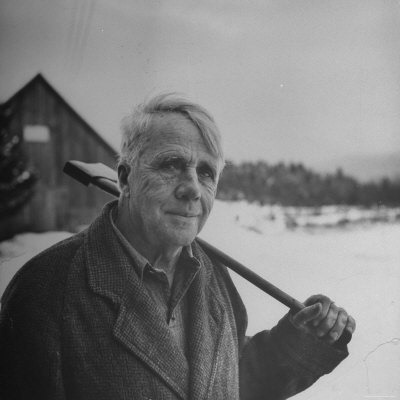
Around America people are getting ready to celebrate Thanksgiving Day, a sort of remembered harvest festival, now a family get-together mostly celebrated by eating as most Americans are separated from farm work by some distance and decades. However, back in 1914, American poet Robert Frost was close enough to that work to write a masterful and closely observed poem about harvest time that I’m going to present for today: “After Apple Picking.”  While I hope you’ll listen to my audio performance with my original music below, here’s a link to the poem in case you’d like to follow along with the text.

This poem is full of sensuous detail. Encountering it — even if you don’t do farm work — you should feel the completion and weariness of the poem’s speaker who is falling asleep at the end of his harvest season. The poem’s farmer has been working in an orchard, and that place is full of the scent of apples. In a fall orchard such as this, much of this scent may be from fallen apples which, even as they start to rot, give off a sweet musk. And it’s frost time, not just the poet’s name on the poem, but the livestock water-trough has a frozen sheet on top, so the picker has been racing against a loss of the crop. In a piece of rural surrealism, the farmer has, that morning, picked up a plate of this surface ice —which would be thin, wavy, and fragile — and looks through it as if they are magic spectacles at the morning frost on the grass. This lasts but a moment, the magic glass will disintegrate in his hands, but that’s of no matter, there’s work to complete.

While falling asleep his body is still weary, his feet are sore from standing on the round ladder rungs, but as dreams approach his mind once more magnifies and intensifies reality like the view through the wavy ice sheet, and he’s haunted by apples, by his job of picking and inspecting, his rush against the end of season frost.

As the poem moves to its conclusion the farmer seems to imply that his work to gather the crop before it’s lost is like unto the work of salvation. We might remember and notice that the poem started with a ladder pointing “toward heaven.” And those apples that touch the earth are held by it and not offered heavenly worth.

Frost ends his poem whimsically, not with an angel or a prayer, but with a small rodent, the woodchuck, which hibernates (“his long sleep”) in the winter. As the farmer falls off to sleep, he wonders how long a rest he has earned.

How big a slice of apple pie do you want? Stand back, I’ll cut you a piece.

.

When Frost wrote this poem about a third of Americans were farmers and farm workers. Now, most of us have other labors. Our harvests may not be food, we may not be tied to the cycle of seasons as exactly. My wife will be getting time off from working in a medical clinic, where she works to gather as many as she can, and Thursday she’ll be making a meal for us and her mother with dementia. I’m working past midnight to bring you a presentation of this poem. Our labors are many, they may make us weary, but perhaps, yet, we can be thankful for them.

My audio performance of Robert Frost’s harvest poem “After Apple Picking”  can be heard with the player gadget below, or with this highlighted hyperlink. My music today is percussion, piano, cello, two violins, horn, and harp.

.

A Verb or a Title

Today was a not-too-old, but widely observed American holiday. Yesterday was Thanksgiving, a holiday initiated by some indigenous Americans and some illegal immigrants who celebrated a military alliance and an autumn harvest together in the 17th century. As one native wit put it: we did the giving, we got no thanks. Invasion and conquest, colonial crimes—there’s no American exceptionalism in that.

Still and all, Thanksgiving’s purpose is generally to recognize a day to be grateful for what one has, the sufficiency of family, friends, life, community.

The day that follows, now given the unlikely name of “Black Friday,” reflects another facet of American culture: it purports to be a day designated to try to purchase all those things one doesn’t have,  or those things one thinks friends and family don’t have yet and should get for Christmas. What an odd juxtaposition!

What did I buy for Black Friday? I watched a streamed Patti Smith concert. A minor expense with no crowds and no rush to get the last one before it’s out of stock—though with artists of my age, in our time, there’s always the chance that what performers once offered will soon go out of stock faster than big-screen TVs or whatever Apple Corp object is offered in our naked garden. Patti Smith has spent much of her life cultivating a vocation as an American artist, earnestly so. That earnestness is a strong spice in her presentation, not to all tastes, but I found it helpful as a young person. She once chanted “I am an American Artist, and I have no guilt!” I suspect that wasn’t a report of something achieved, but a maxim to goad herself toward a goal. She got further to her goals than I did, but for either of us—and for you—a question is brought forward: is artist a verb or a honorary title?

Shopping needs answered with my virtual ticket, I enjoyed the concert during which she reminded the audience that tomorrow is William Blake’s birthday. Ah Blake, another inspirational artist. When I was still a teenager the idea that someone could remove the scrim in front of reality and converse with what they found there was a romantic temptation, but also there was this other thing: Blake marshalled enough skills technical as well as artistic and creative to make his art books with only as much resources as he could obtain, often by being his own technical arm.

A visionary depiction of Black Friday shopping? “The Spiritual Form of Nelson Guiding Leviathan” by William Blake. Note that Admiral Nelson is wearing his mask way too low for these Covid-19 times.

.

This project is about to present its 500th audio piece. It’s been a stout 4 years and a few odd months work. I often think of how much better it would be if I had additional musicians and singers who can do more than I can muster. I listen to work of other recordists whose audio quality surpasses mine, but for William Blake’s birthday this highlighted section is a link to a post from way back at the beginning of this project that talks not of Blake’s birth, but of the day he died. It discloses an unusual connection and possible inspiration to another set of poets who came by that place much later.

Longfellow’s Harvest Moon

What value is mystery and strangeness to gratitude, to a sense of thanks? Let me try an experiment with you here.

American Thanksgiving still retains a degree of its nature as a harvest festival, and so when looking for a text to use today I came upon this one by highly unfashionable poet Henry Wadsworth Longfellow. Looking at the poem on the page one can see why modern poetic esteem may have passed Mr. Longfellow by. It’s a sonnet, intricately rhymed (ABBAABBA CDECDE), an antique skill that we no longer appreciate as much. Its imagery is both pat and removed from most of our daily lives, a rural landscape at night before the coming of electric lights, where moonlight can illuminate reflective objects and cast discernable if low-contrast shadows. Harvest signs include loaded wagons (“wains” is the charming old word for wagons chosen perhaps for rhyming needs), bundled sheaves of grain after reaping by hand, the changing of the bird population, falling leaves. In summary, we have imagery that is largely meaningless or lacking impact to us today in our modern America. It looks like stuff that is, and justly is, filed away in dusty poetry collections.

Harvest Moon

An illustration for “The Harvest Moon” from an 1880 edition of Longfellow poems

.

But what if we were to experiment a bit with Longfellow, and make him stranger and more mysterious? After all, this past rural world is now alien to most of us as some far-off land. And Longfellow, who we mistake as a rote poet here, has a subtle point to make, one that cultured British people might excavate and polish if this were a poem by Shelley or Keats, but which Americans may be too willing to overlook due to the old modes of Longfellow’s poetry.

In today’s performance of Longfellow’s “The Harvest Moon”  I attempt that act of mysteriousation. It started with breaking up the lines and underemphasizing the end-rhyme. This lets it act as an occult undercurrent, rather than a regular chime we know is coming. I sing the words as if this is new and not fully understood to the singer or listener. And as I often do here, I make the music I wrote and performed carry a lot of the load. The main harmony is carried by a 12-string acoustic guitar, which is playing primarily suspended chords, chords that remove the 3rd of the scale that makes a chord major or minor, and replaces that significant note instead with a not fully discordant but unexpected 2nd or 4th. The bass plays a busy but similarly unsettled melody line under this. And as a final signal that we are to regard this old American landscape with a time-tourists’ eye, and not as an old poem full of discarded conventions, I play a higher melody line and drone on a sitar,*  an instrument from another continent.

All that distancing effect is to force the listener to hear this poem as if it may have some meaning other than a decorative picture of a quaint and therefore meaningless scene. Longfellow outright begs us to do this in the text when he writes “All things are symbols.” This poem is late Longfellow, he’s nearly 70 when he wrote this, his America has passed through a horrible civil war, his life has passed through multiple family sorrows, and he is now an old man. The songbirds gone here are but counters perhaps, but his life of poetry is nearing its close. He’s spent his life helping establish that there can and should be an American poetry, that there can be American poets. We are them. Our grandparents and great-grandparents are the children asleep in those strange and now far-off curtained rooms. We are the piping quails, grounded birds gorging on the grain-seeds fallen to the under-shadows of the harvested sheaves.

Let us be grateful, let us be thankful, for those before us. Wrong and right they labored for us. Enslaved and wrongful masters they planted and harvested on lands that cannot forget the exiled feet of those before us. How strange, that it was exiles and the tempest-tossed that appropriated this place. Exiles creating exiles. There is a mystery in that.

The player gadget for my performance of “The Harvest Moon”  should be below. If you don’t see the player gadget, you can try to use this highlighted hyperlink to hear it instead.

.

*If you visualize me sitting cross-legged on a damask pillow with incense wafting in paisley curlicues while plucking on that elaborate musical device, it may be good for the effect of the piece—but in the spirit of full disclosure I’m playing a MIDI guitar here which allows my plucking to be translated into the notes and sounds of that difficult to maintain and master South Asian instrument.

Fire Dreams, or Carl Sandburg’s Come On, Pilgrim

Emily Dickinson isn’t the only one of this project’s favorite American poets to write a Thanksgiving poem. Carl Sandburg did so too.

Long time readers here will know how much I like Sandburg and how often I like to speak toward the canon-keepers to point out that early Sandburg was a devoted Modernist with a strong American democratic take on Imagism, one that kept to Imagism’s unfussy and concise mode of expression without dressing itself up with any unnecessary scholastic references. Of course, I’m no opinion-shaper, and even if William Carlos Williams has undergone a reassessment as a domestic Modernist of the same era, Sandburg doesn’t seem to have benefited from the same second look.

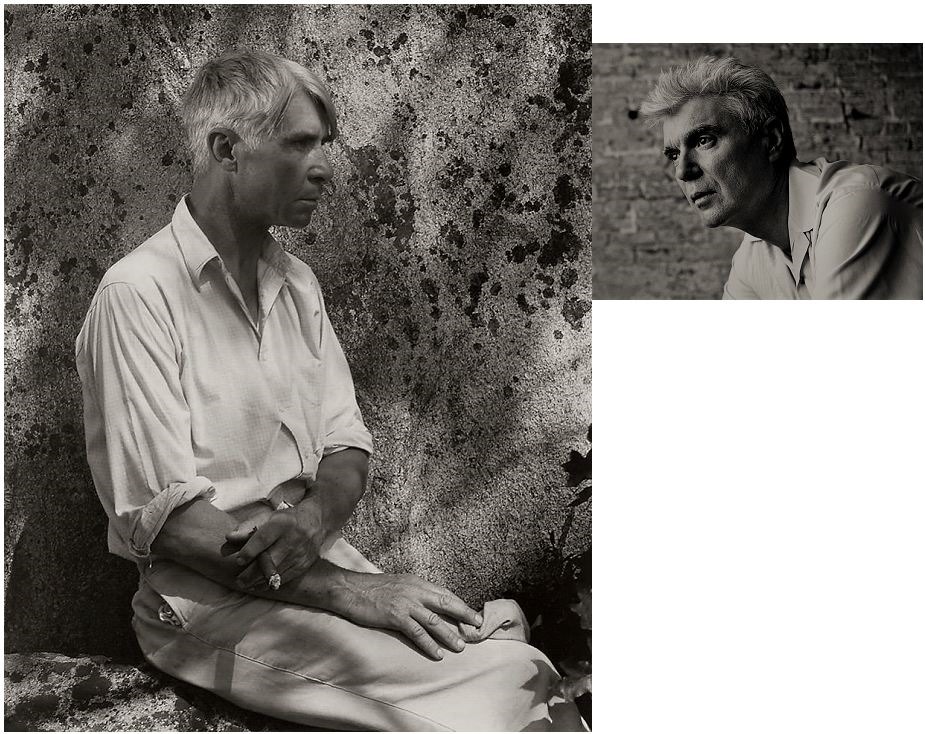
Sandburg and David Byrne seperated at birth

My title may reference the Pixies and Larry Norman, but I think this Edward Steichen image of Sandburg looks a little like David Byrne.


I think this is a great pity. A poem like Sandburg’s “Clark Street Bridge”  is as perfect an Imagist poem as any written in London or Paris, and Sandburg’s subject matter and life-experience is broader than most of his fellow Modernists, because he traveled across America with his Imagist eye and working-class soul.

That said, I have to say that today’s Sandburg text is a partial example of why this might be so. This is the kind of Sandburg poem that people think  he wrote. It’s somewhat sentimental, unquestioningly patriotic, and there are almost no strong, immediate Imagist images in it. Although it’s not that long-winded, it seems to me longer than it is—and if it had broken into a Whitmanesque catalog of a hundred things at least it would have the courage of its convictions.

So, it’s a Thanksgiving poem, but it’s not great Sandburg. Why bother?

Its central Pilgrim history myth may not be entirely accurate, but it is a good story—one that children were told in his time and mine, and perhaps even sometimes now: tempest-tossed dissenting religious immigrants undergoing tremendous trials. For good or bad, Sandburg leaves out the native Americans who helped them survive,* and who were rewarded with a few decades of peace before the wars of conquest ignited in the Pilgrims’ region.

Historians like to point out that the Pilgrim Thanksgiving didn’t include most of the foods that we’ve come to expect for the modern American holiday harvest meal. Sandburg reduces it to “soup and a little less than a hobo handout today,” which is also inaccurate but makes the connection he’s trying to make. America always has pilgrims like these somewhat mythologized Pilgrims. Sandburg, the child of working-class immigrants knew this completely, the ones who worship the God of broken hearts and empty hands.

And though he doesn’t show it here, Sandburg also fully knows the imperfection of America, and yet still wishes to say yes to gratitude, to thanks “if so be” for himself and his child.**  He wishes to say yes before perfection—and continue yes “Till the finish is come and gone.”

So, while this is not the poem to restore Sandburg’s rightful place in Modernism, I think it’s still worth hearing on this holiday. The full text of the poem is here, and the player to hear the LYL Band perform it live*** is below.


*In hearing the story of the Pilgrim Thanksgiving as a child I never absorbed the full story of Squanto (Tisquantum,) which deserves to be better explored. There is a long and detailed Wikipedia entry on the context of this American.

**And before we leave that, let me point out that Sandburg is the rare Modernist who deals with children wholeheartedly.

***LYL principals Dave Moore and myself are both dealing with the inability for our hands to follow what musical precepts we hold, and this has reduced the appearance here of the more spontaneous LYL Band recordings. I’ve been missing that element and we’re trying to do what we can.

One day there is of the series: Emily Dickinson’s Thanksgiving, sort of

Did you know that Emily Dickinson wrote a Thanksgiving poem? It’s not one of her “Greatest Hits” or anything, but it does represent a couple of Dickinsonian traits: skeptical humor and puzzling philosophical concision. You can read the text of it here as I discuss my encounter with it.

Dickinson didn’t use titles, and the first line, our entry into the poem, starts off with a strange tentativeness. What’s the series? All the days of our lives, of history? Or a series of holidays? I suspect the last, in that the next line throws up the American holiday inside quotes. It’s hard not to read “Thanksgiving Day” in Dickinson’s text without intonating the words with “air quotes,” that at least slightly dismissive way of saying “Well, you can call it that  if you want.”

I’m not a Dickinson scholar but I get the impression that Dickinson uses quotes literally—that is, when she’s quoting someone*—but there is a sense here of our modern manner in the poems first half. And as the poem continues, its opening comments could be written this week by someone musing on the holiday. Yup, Thanksgiving is a strange mix: part a big meal, a gluttonous celebration; and part memories of worshiping dissenter pilgrims and family. And Dickinson, in her thirties as she wrote her poem, notes she’s not sitting at the kids table nor is she some honored elder closer to the pilgrims than the present. So, outsider in a middle place, she says she’ll post a review, from her “Hooded thinking.”

Maybe you’re visualizing The Handmaids Tale  when you read “Hooded.” I think Dickinson is taking a bit of a religious acolyte’s stance in her review, even if playfully. Her two-word review: “Reflex Holiday.” You’re just going through the motions she seems to be saying.

Emily Dickinson family portrait

One won’t get a turkey drumstick: Emily Dickinson on the left with her siblings.


The poem could end there, but Dickinson takes off in the second half in gnomic concision. This is often beautiful as word music, but it’s hard to follow her mind.

What’s the sharp subtraction for the early sum? A falling away from religious immediacy? Mankind’s fall from grace? Forgetting the history or piety of the holiday? The next two lines are even more weird. What the heck does “Not an acre or a Caption/Where was once a Room” mean? This is Dickinson the hermetic riddler. I’ve rolled that couplet around in my head for a week and it always slips from my grasp.

The tossed pebble wrinkling the sea lines have a Blakean tone. Here the mystic Dickinson is plain as any mystic can be in words: our lives, our actions, are small against creation—just visible, just for so long. Her final couplet seems to say that our thanks, our Reflex Holiday, is insufficient to the gift. This realization combined with the reflex action is, in a way, a more sublime and awe-some thanks.

What an odd poem! It starts out witty and lightly skeptical and (as best as I can figure it) closes on a humble mysticism.

Musically, I tried to hew to the mystery, if a strange resonant piano and wavery synth can portray that. The player is below. Thanks for reading and listening!


*If she is quoting a person, it may well be Sarah Hale, a New England journalist who campaigned for the importance of a Thanksgiving holiday during Dickinson’s day.

Thanks Owing

A holiday for it, so this is due.

yard turkeys

Have you changed out your summer flamingos for autumn yard turkeys yet?

“The Parlando Project,” my 2015 dream to present over a hundred audio pieces combining various words (mostly poetry) with various music, has now reached 155 officially published pieces. For those who’ve taken some of your attention and spent it listening to me present my take on the words of others, primary thanks is due to you. Despite the amount and variety of material I present here, I respect that your attention is precious. Thank you!

Thanks even to the unintended. The strange movements of technology and trade have allowed highly flexible musical instruments to become available at low prices. Most of what I use to make this did not exist one hundred years ago, and in the past few decades, the cost of these instruments, software and recording technology has declined into broad affordability.

Similarly, the Internet, so easy to dismiss for its mundane temptations, has made the availability of artistic materials “ubiquitous everywhere” that tautologies are sold.

Both of these things, the music technology and the Internet, are so enabling of creative work that it seems almost sinful to me to not apply my human imagination to them. But, as with many things, avoiding one sin leads to the commission of others. So, thanks also to my family for the forbearance that has allowed this project to get the amount of time and attention it asks for.

Thanks to Dave Moore, who lets me take a break from presenting my voice uninterrupted , and whose words are presented in some of the most listened-to pieces presented here.

Thanks to the Modernists of  100 to 150 years ago, who showed us fresh ways to use language, and shared their complicated hearts, heart’s beats, and apprehending eyes. Thanks also to their foresight to publish their work before 1924, so that we’re free to demonstrate to the still living what they did. Alas, the leading sadness in this project for me has been the large number of works by no longer living writers whose work you and I cannot speak publicly, because our copyright laws forbid it.

No new audio piece today, instead, here’s one of the first officially released pieces of the Parlando Project, words adapted from Dave Moore. I view it as being about the people left even farther behind than the signed artists of famous paintings. It’s called “Netherlands.”

I’ll let it be a reminder that there is a whole lot of material available here now, so using the Search… box or just click-wandering through the Archives months on the right will allow you to listen to more of the variety that Dave and I do.

Subscribing to the blog either through the “Follow” button near the top, or on the WordPress Reader, will let you know about new posts as they occur, or if you just want an easy way to get the new audio pieces for listening to them off-line, you can do that by subscribing to the “Parlando – Where Music and Words Meet”  podcast on  iTunes, Google Play Music, Player.FM, Stitcher, or wherever you get podcasts. The “Parlando – Where Music and Words Meet”   podcast is free of course. [note: I’d previously mentioned using the little orange RSS buttons to subscribe to the blog, and for those who have an RSS-aware app they will  still work, but the Follow button I’ve just added today makes this easier for most.]

Here’s the player to listen to “Netherlands”