Back more than 200 years ago, poet, painter, engraver and mystic William Blake was reported to be conversing with angels in English trees. Last episode we had William Carlos Williams celebrating celebrity scientist Einstein in a blooming New Jersey night early in the 20th Century. Today we have Dave Moore in his backyard garden in Minnesota in our present century.
William Blake illustration of Dave’s Minneapolis garden night, sort of.
Is this poetry, song, or story-telling? It might be a little bit of all of them, but then labels are just sticky paper. Let me refrain this time from talking so much about the piece, but I encourage you to just listen to the LYL Band and Dave Moore tell the story. Use the player gadget below to hear it, or this highlighted hyperlink.
Metaphor, that stuff that helps make the music of thought in poetry, is the linking or liking of things. This is like that. This stands for that. The sensation of this is like the sensation of that. This reminds us of something else. The way I say this recalls the way one says that. Metaphor recombines the stuff of our world even though it’s a combination that only exists in the imagination.
Metaphor can make something clearer to an audience. It’s so useful in that way that one can barely explain anything challenging to an audience, even in the most prosaic day-to-day business world, without falling into metaphor. In poetry however, the bounds of increased clarity can be stretched, broken, and abandoned. Depending on one’s mood as a reader, this can be frustrating or a pleasing play of the mind. With the Parlando Project we perform the poems with music. One hope from this is that you can relax and let the beauty or strangeness of the words carry you over gaps in meaning. Sometimes you can enjoy a poem before you understand it.
William Carlos Williams who wrote the words in today’s piece, gives us Spring weather with Spring flowers and fruit blossoms, gardens and orchards, and all under a title that combines a famous saint with his era’s most famous scientist. He gives us almost no help in combining that title with the poem, other than yoking them together. The linkage of metaphor is much strained here, even when he further explains his title by adding a sub-title: “On the first visit of Professor Einstein to the United States in the spring of 1921.”
How are we to make the connection that will construct the metaphor?
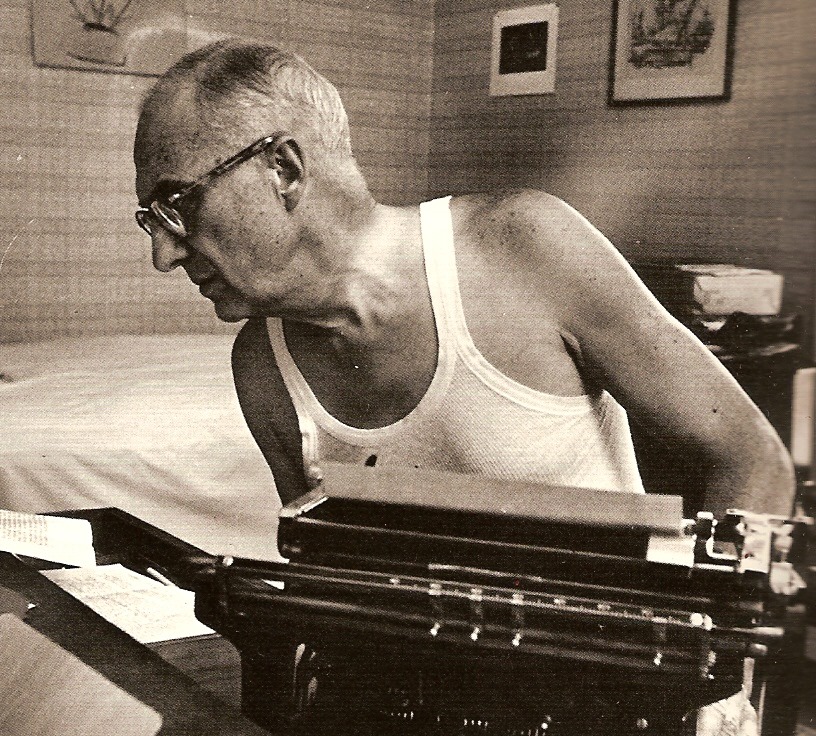
Just another hipster with his typewriter. William Carlos Williams throws off his covers.
My best understanding so far is that the connection is wonder and change. Recall our last post, where in his “Queen Mab” Percy Bysshe Shelley, the Romantic early-19th Century poet, gave us a vision of the wonder of an immense cosmos, which Shelley’s own notes tell us he could also sense through the poetic/mathematical meter of the speed of light. The theoretical scientist and the visionary poet each seek to grasp some new metaphor of the world. Einstein was changing physics in the time that Williams and his fellow Modernists were seeking to change the apparatus of art. Williams elaborates on this theme mostly by vivid descriptions of the change of Spring. In the only mention of Einstein in the body of the poem, Einstein is “tall as a violet.” He is the Spring’s new growth.
There are a couple of obscure literary references in one section, the sort of thing T. S. Eliot or his imitators would have used. Who is “Samos, dead and buried?” I’m not sure, but my guess is that it’s Pythagoras of Samos, the famous classical Greek philosopher for whom science and the arts were one. And Lesbia? Catullus’ Roman poetic beloved, who we’ve met here in Elizabethan guise. It may be enough that they have ancient sounding names, and of such ancient classical modes, Williams, who is in some ways the Anti-T. S. Eliot, says “Sing of it no longer.” He moves right back into a present day of Spring. Pythagoras is dead, Catullus’ Lesbia is dead, and so is a black cat buried in a newly planted garden. Awhile later in the poem we may get one more connection to that cat part of this buried trio. A chicken-raising man who puts out poisoned fish-heads to keep the cats from his chickens. That man becomes like the Modernists, needing to kill the ancients to protect the new flock he’s raising.
The poem closes with a sensuous image of Spring change, a night that grows warm as an orchard owner opens his windows and throws off the covers that were needed in the cold. In an earlier version of the poem, Williams had woven Einstein by name in and out of those Spring images explicitly, including this last one where Einstein was named as that man with the blossoming orchard, another grower of renewed things. In this later version, all these stated links to Einstein are removed (save for that one Einstein as a violet).
Not a violet, but the “Professor Einstein Narcissus.” Has “great curb appeal” and “deer won’t eat” says this garden center.
Was that a right choice? The resulting poem is shorter and more mysterious, but it also doesn’t make it easy to see what Williams is getting at. He’s using metaphor, but he’s removed all the connections. I decided to perform the later version. I think it performs slightly better, and perhaps the music makes the obscurities less taunting.
A simple musical arrangement this time, just acoustic guitar and subdued electric bass. To hear my performance of William Carlos Williams’ “St. Francis Einstein of the Daffodils,” use the player below.
Today I step aside from our usual practice here, and present words I wrote. With opportunity, next week I should be able to return to “Other People’s Stories.”
“Plum Tree Blossoms on 40th Street” was written recently, and includes elements of observations I made during a bike ride to school with my son in early May. In the course of writing the poem and revising it, I modified the events of that day. This is not unusual. The events of one’s own life have a fractal branching of meaningfulness that frustrate encapsulation. It may be useful to use those endless edges as perforations to tear away from all things remembered the shape of a poem.
I tested the revision before this one with a group of poet friends, and alas, it didn’t seem to work well for them. They were slightly puzzled why the speaker in the poem didn’t ask the child to stop and smell the blossoms, but altogether bewildered by the question (or the way I presented it) when the speaker asks near the end of the poem about memory being able to remember the smell of something overlooked in one’s past. That was useful information. They also made a very specific suggestion. Originally the blossoms had been tree blossoms, and though they were extravagantly fragrant on the morning that inspired the poem, I did not know in fact what kind of tree was bearing them. No matter, they suggested, it works better if you make them a specific tree.
OK, it was some kind of fruit tree blossoming, let’s make it a plum.
I read something once particularly wise regarding such honest critiques about one’s writing. It may have been from Kurt Vonnegut, or it may have been someone else, but the gist of it was that if good, honest, readers find a problem in a piece they are almost always right, even if they are often wrong about how to fix it. The suggestion to name the type of tree was simply right I thought, but how to deal with what they saw as the troublesome puzzle about memory?
What I was trying to suggest in my poem’s story was that we can indeed remember things retroactively. Things that were not noted at the time consciously, that were not filled out as if a contemporaneous diary as experienced, can still be recalled when we later find them important or precious. We do this partially from our subconscious, perhaps even from what the Transcendentalists would call the over-soul, but mostly this is augmented because our minds are great pattern makers, able to fill in gaps with all the other things we recall.
The readers who noted this as a problem were smart, perceptive people. They likely knew of this, but I still had perplexed them.
I could not remove this, for me it was the point of the poem. Sometimes, what folks most object to in a poem (or other art) is, paradoxically, why it needs to exist.
I made some slight changes in a couple of lines around that concluding question, hoping in this version to make this natural phenomenon of memory clearer, without hindering the “music of thought” as well as “music of words” that I think poetry should have. Maybe it works better now.
To hear my performance of “Plum Tree Blossoms on 40th Street” use the player below.
As I’ve done most quarters, I like to look at the most played and liked pieces during the past season and report back here. Usually a few of the results surprise me, they aren’t always my favorite pieces or even the ones that I think came off best.
I do this in classic countdown fashion, so we start off with number ten and move in the next few days up to the number one. The audio pieces for the Parlando Project can be consumed a number of ways. Some listen to them here using the audio gadget on the blog, but others listen by subscribing to us through any of the leading podcast services. The audio pieces are the same, but the blog allows me to write about the pieces in a much richer manner than I can with any of the leading podcast services. However, if you, or someone you know might be interested in just the music and words, this is a handy way to get them on your phone or other handheld. So, if you just want the tuneage, search for Parlando – Where Music and Words Meet on iTunes, Spotify, Google Play Music, or any of the other podcast services. You should find our audio pieces in their podcast sections.
On to the countdown…
Coming in at number Ten is one of the two pieces from May that gathered enough likes and listens to make it, despite having a shorter time frame to do it in, “Letters to Dead Imagists and A Pact.” I often like to look at who influences the writers we feature here, and this piece lets me do that with short poems from two poets: Carl Sandburg and Ezra Pound. Sandburg tips his hat first to Emily Dickinson and Stephen Crane, while Pound, rather grudgingly, acknowledges Walt Whitman. Despite being contemporaries with similar lifespans, despite both having connections to the American Midwest, despite Sandburg’s use of the early 20th Century Modernist/Imagist poetic practices as promoted by Pound; these are two very different men outside of their work with pen and typewriter. Interestingly, it’s Sandburg’s work that has an obvious Whitman influence though it’s Pound that points to him. Though Pound thought Whitman too careless in his craft, he’s the one that chose to give Whitman his due here.
Speaking of Imagists, at number Nine, we have the poet Hilda Doolittle and her “The Pool.” Pound acted as a high-handed branding consultant would with her, reading her poetry and then scrawling at the bottom of her manuscript her new brand: “H. D. Imagiste.” Doolittle writing henceforth as H. D. went on to a long career, and I’ve read that Hilda herself didn’t care much for the connotations of her family name anyway. Maybe that marketing advice helped, but early H. D. work like “The Pool” is striking short poetry mixing concreteness and mystery, so maybe it was an inspired choice to use the short and less defined H. D. for a pen name.
Musically, I really like what I came up for this one too.
“Now is a time for carving…” Pound once decried “the exceedingly great stench” of Whitman’s poetry
At number Eight, let’s welcome to our stage the man who Pound said in our number-ten-holding poem “broke the new wood” in free verse poetry: Walt Whitman. What an odd image for Pound to use! In looking at why he might have chosen that image I found out that Pound’s family established itself in Wisconsin by building a thriving sawmill there, so it may be that Pound is liking Whitman to a pioneering lumberman, bold in seizing the ground and resources he found there, while Pound seems to say he pictures himself more as a William Morris style furniture craftsman or perhaps even as a skilled woodcarver.
Straining at connections, because I love this photo so much: folksinger Carolyn Hester once recorded Whitman’s “O’ Captain,” but the 3 session men behind her appeared on many great folk records of the 60s: guitarist, Bruce Langhorne; bass player Bill Lee, father of filmmaker Spike Lee, and in the middle. the harmonica player with the shayna punim cheeks is known to trivia buffs as the father of Jakob Dylan, the leader of the 90’s band The Wallflowers.
Whitman’s “When Lilacs Last in the Dooryard Bloom’d” is one of a pair of elegies Whitman wrote responding to the assassination of President Abraham Lincoln, and the one I prefer to the other: “O Captain! My Captain!” regardless of the feelings some have for that other Whitman poem’s use in the movie Dead Poets Society. Furthermore, Whitman’s lilacs here are one of the reasons that T. S. Eliot’s landmark of High Modernism “The Wasteland” begins in spring with that very flower blooming “out of the dead land.”
We’ll have numbers Seven, Six and Five coming back here soon. So don’t touch that dial—wait, this is the Internet, you can touch the dial any time you want—but do check back, as we continue our countdown of the most listened to and liked audio pieces combining various words with original music here over the past season.
Here’s a story about a poem appropriate for this Memorial Day, though the story includes three Easter holidays.
First Easter: on Easter 1913 in March, a freelance writer, normally so pressed for a paycheck that he worked 15-hour days writing piece after piece, started off on a bike tour across Britain from his home near London to the south-western coast of England. Of course, there was a paycheck involved, a travel book was planned and resulted, which was called In Pursuit of Spring.
Can’t tell the model, but from the front it’s clear that Thomas was riding a classic English “roadster” on his tour.
This trip started in overwork and near the ending of a glum winter, and finished in May with true spring; and this bicycle journey allowed the harried writer to expend a bit more focus on his writing. In the book, his trip ends in Somerset England, but a packet of photos he took during the trip indicates that he must have somehow crossed the Bristol Channel to Wales, the homeland of his ancestors. A tell-tale photo with his handwriting on the back was discovered recently, saying it was taken near Tinkiswood, the site of a Welsh Neolithic stone burial chamber. A year later the site was excavated, and 920 human bones were located. Welsh legend has it that staying the night in the chamber will cause any surviving visitor to go raving mad or become a poet. That wasn’t included in the book.
The overworked freelancer who took this journey was Edward Thomas. Shortly after the journey completed, he met a then little-known American poet who’s work Thomas had reviewed perceptively. The poet was Robert Frost. Frost read In Pursuit of Spring and suggested that Thomas should write poetry.
“How so?” asked Thomas.
Frost told him that Thomas had already shown close readings of the book of nature and the rhythm of verse in passages in In Pursuit of Spring.
So, at this time Thomas began writing poetry, extraordinary poetry that is little known in the United States, but which is much loved by poets and readers in the U.K. Some of it so concise and so infused with deep attention to the natural world’s calligraphy that it rivals classical Chinese and Japanese forms.
And World War I breaks out.
I’ve already written about Thomas’ dilemma in deciding if he should enlist in the war, and Frost’s part in Thomas’ ambivalence, so here I’ll just say that Thomas did enlist. The records say it was in a company called “The Artists’ Rifles.”
Can Americans of our time imagine such a military organization? Of course, artists of all kinds have served in America’s military services, but I can’t envision that sort of name being used here in place of something like “The Screaming Eagles.”
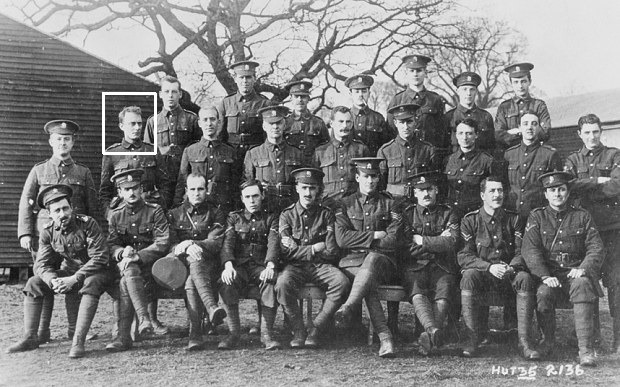
Thomas’ company in training camp
The second Easter: the somber name today’s poem was published under was not his. Thomas in his manuscript simply wrote down the Eastertide date in 1915 when he apparently wrote the first draft of this, two years after he’d started the trip that had indirectly formed him into a poet. That summer he was even stationed for a while on military training in one of the towns he’d passed through on the bicycle journey.
But never mind the name, what a poem. It’s four lines, a single quatrain. Nearly every word is telling, even ones you slide over in the first line. Decades later Pete Seeger wrote a song, “Where Have All the Flowers Gone,” condensing an episode from a WWI novel expressing a similar idea to Thomas’ poem. Seeger’s song is not long as songs go, but it’s a good length for a room to sing along with. Thomas’ poem has only started when it comes to its fourth line. The previous line breaks abruptly, enjambed, with “should,” and its final line reveals itself as it unwinds in heartbreaking fashion.
And Thomas? A third Easter: another spring, 1917. His diary entry in France wonders if the enemy is unseen in the fields ahead of him, which he still must view with the precision of a nature poet. He pauses to light his pipe. A bullet pierces straight through his beating heart that, will, do, never, again.
To hear my performance of the poem eventually published as “In Memoriam (Easter 1915)” use the player below.
I recognize that Memorial Day is an American Holiday, directly derived from the post American Civil War Decoration Day. I know this blog has a large segment of U.K. readers, so to explain: in the U..S. we have two holidays celebrating the armed forces, Memorial Day, which retains some of it focus on honoring the dead who served, and Veterans Day, which is the U. S. holiday that coincides with Remembrance Day. For readers on either side of the Atlantic who’d like to hear the LYL Band present a performance of an American poet for Memorial Day, here’s Carl Sandburg’s “Grass.”
We had a real Minnesota whip-saw this week, the aftermath of a 15-inch snowstorm as the week began and a day in the 50s as it ends.
Much digging out of cars, and wheels doing the whistle-spin on the ice beneath for three days. It’s been a long winter, but “Sometimes It Snows in April” as Prince once sang.
Today, when it reached the lower 50s, people were out in shorts and T-shirts, with snow still covering yards, with the low rubble of white ruined walls still on the streets where cars had once been imprisoned. This is how Minnesotan’s celebrate unbelievable spring.
Now this Saturday brings the anniversary of Prince’s death, which was as unbelievable as Spring. I was looking for another poem to combine with music, and I reminded myself I hadn’t done an Emily Dickinson poem yet this April, and there can be no full celebration of U. S. National Poetry Month without Dickinson. As I looked, I came upon this poem, and it seemed right.
“Dear March” has one of Dickinson’s bold apostrophes, but instead of death or some other imponderable, it’s Spring that gets to be portrayed as the caller, one who gets welcomed at the door with old-school manners. There’s delightful wit in this: the March winds portrayed as being out of breath, it must have walked the long way to get here! “I got your letter, and the birds.” But being Dickinson, she will add her slant. Just past halfway she bemoans the colorless landscape of winter that she’s been left with, as if it would be her job to color it in: “There was no purple suitable/you took it all with you.”
“There was no purple suitable, you took it all with you.”
I think again of Prince, and I think this is the poem to do.
The poem continues, and we can now understand that the wit has an undercurrent. Someone else is knocking. It’s April, more visitors—or are they both suitors? “I will not be pursued!” Dickinson is now ambivalent to more Spring, to more young man’s fancies. She’s not answering the door “He stayed away a year”—well so did March. The poem ends in ambivalence. She should doubt the constancy of these Spring suitors even with the flirting, the flattery and the gifts they bring, but then there’s joy in blaming them for their absence now that they have returned.
Prince: performer, songwriter, impresario, but I’ll think of him as the patron saint of studio rats
,
I don’t want to stretch things too far here, but there are a couple of similarities in Dickinson and Prince. Both known for wearing one color (white and purple). Both enigmatic to the public (“The Myth” and “The Glyph”) and increasingly reclusive. And both were capable of being prolific and artistically self-sufficient, though this is not as rare for poets as it is for musicians and songwriters who could (as Prince did) write and record all the parts. In the end, they are both American originals, not copies of anyone before or since.
To hear my performance of Emily Dickinson’s “Dear March” use the player below. And let folks know about what we’re doing here, combining various words (mostly poetry) with original music in different ways. It’s #NPM2018, and you can dance to it.
Yesterday’s Edward Thomas poem “Thaw” had an irony, he had rooks, a bird used symbolically to represent death, as messengers of Spring’s arrival. Walt Whitman ironically used early spring flowers to start his Lincoln elegy, and T. S. Eliot in “The Waste Land,” a long poem that we’ve been performing this April for National Poetry Month, followed flowered suit. Here’s a poem by Edna St. Vincent Millay that tackles some of the same tensions that Eliot put in in his longer poem, but in just a few lines.
“Spring” is Millay at her most Modernist. It’s free-verse, not the metrical verse, often in traditional forms, that she used elsewhere. Is she copying Eliot’s landmark poem, as many would try to later? No, “Spring” was published in 1921, a year before “The Waste Land.”
One of the good things about doing this project is moving from looking for poems to use, selecting them, and then one-by-one grappling with how to perform and accompany them with music. This poem is so full of complex, multivalent perceptions that I think I could perform it many different ways. Because of the production schedule I’ve set for myself here, I almost never spend more than a week on the production of any one piece. That means I must decide things about the composition and presentation fast. In the absence of limits, this piece could have gone on in search of a more perfect version. I’m comfortable with many of the choices I made here, but one bothers me still.
I decided early on I would sing this one. That decision came from the text itself, it wants to express a variety of things intensely. Good actors (something I’m not, or not yet) can put great shading on a speaking voice, but the singing voice has more tools to bring to the expression of a text. I am under no illusion that my singing voice is strong or skilled, and I think a better singer could improve this. What you hear here is simply my honest attempt to do the best I could with a text that I grew to admire considerably as I worked with it.
Musically I once more found myself using several tracks of Mellotron, the primitive 1960s tape-sample “virtual instrument” before it’s time. The topline melody is carried by violins and the famous Mellotron flute samples that are an audio madeleine for anyone who listened to certain English bands in the age of groovy. Each note played on a Mellotron keyboard sets running a short length of tape playing that pitch recorded from the “real” instrument.
Some random dude shows off the cheesy rhythm machine no one used before playing something you may recognize.
I can’t afford the cost and complexity of an actual Mellotron, but I use a good approximation issued by MOTU a few years back. One thing I perversely appreciate about it is that, just like the real thing, any note just stops after 8 seconds, when the strip of tape in an actual Mellotron would come to its end. Avoiding this can force you into some odd playing techniques when used in a slower tempo piece. If you listen very closely in “Spring”, I just let that abrupt tape end-stop happen for effect several times. For a sustaining note to end like that gives it a catch-in-the breath gasp effect.
For electro-mechanical nerds: the low down on how the real Mellotron worked, mostly.
One image in Millay’s poem puzzled me over the week I worked on it. “Life in itself is nothing…a flight of uncarpeted stairs.” I can find no one who has made any sense of it. The best I can figure out, knowing houses from Millay’s time first hand, is that while any stairs between floors of a properly furnished home would have likely had carpet runners, utilitarian stairs, such as ones to the basement would not be carpeted. I took that understanding, and had the melody fall down as the word “stairs” is sung.
Anyway, after all this talk about the utilitarian work of making these pieces, please take time to listen to Edna St. Vincent Millay’s “Spring,” using the player below.
I like to mix up our musical encounters with poetry here, using both well-known and lesser-known poems. Here’s one you probably haven’t heard before, written by a poet who is less-known in the U.S. than in his native Britain, Edward Thomas.
In 1913, Thomas was 36 years old and was scratching out a living for his family as a freelance writer on whatever topics could generate a check, but his real passion seemed to be as an enthusiastic naturalist. He liked nothing better than to walk about the countryside reading the book of nature, jotting down notes about what he’d seen. Then he met a similar no longer young writer, a 40-year-old American who wanted a career as a poet.
The American had not found his own country in agreement with his vocational desire, and so he had flipped a coin to strike out somewhere else: Canada or England? He knew no one in either place, it was just a hunch that someplace different might change his lot. The coin came up England. He took a cottage in the Cotswolds, near to where Thomas was living. The 40-year-old American poet? Robert Frost.
Over the next couple of years, the two men developed what would be the most significant friendship in their lives. Now Thomas had a companion besides his notebook on those nature walks. Although Frost had published only a handful of poems in periodicals at this point, Thomas saw his talent, a man who could write metrical verse so supple that it didn’t seem like poetic diction. In turn, Frost saw another poet in this self-described “hack writer” with his avocational notebook.
Nearing 40 years old and yet thinking about poetry. Edward Thomas and Robert Frost.
Frost published his first two books of poetry in England, “A Boy’s Will” and “North of Boston,” and Thomas reviewed them enthusiastically, helping launch Frost’s literary career. And with Frost’s encouragement, Thomas’ notebook jottings became poems.
In 1915 Frost moved back to the U. S. where publishers would now publish American editions of his poetry. Edward Thomas, and his family, were to follow. The two poets were to live near each other in America and continue their fruitful friendship.
These two men, these two friends, who each could write tremendously concise poems in which a natural drama could play out in but a few lines, had one constitutional difference. Frost was reconciled to chance and fate. He would jump oceans with a coin flip. If lost on a road by a snowy woods on the darkest night of the year—well keep on driving that buggy onward in the dark. Thomas, on the other hand, believed that introspection and judgement, an ever-closer reading of the book of nature could discern the right choice. If two roads diverge (as they would when he and Frost walked the Cotswolds) your honor derives from making the correct choice from the inconsistent evidence.
Back in the USA, Frost wrote his famous, misunderstood, poem about those two paths and sent it to his friend, still tarrying in England, and Thomas became the first person to misunderstand “The Road Not Taken.” No matter how much we honor the author’s intent, the poem exists after it’s creator. Thomas’ outlook saw the undercurrent in the poem, that choice could be important. Thomas thought: if Frost was making gentle fun of that, no matter, that was the point.
Here’s a small, four-line poem that Thomas wrote about spring, “Thaw.” As often with Thomas’ poems “Thaw” is set on a nature’s large stage, but it’s a very short drama. Winter’s snow, as it is here in Minnesota today, is half-melted. Crows are cawing in tree tops, as the crows I saw today on my morning bike ride to breakfast were too, speaking the inscrutable language of crows. I saw one swoop down and frighten a foraging squirrel on a lawn, the black bird somewhat larger than the squirrel—and then, larger yet to it when the rook spread its wings and hammered out its hard-consonant caw.
The squirrel hopped like something had exploded underneath it and disappeared. These natural decisions could be read if one picks up the book of nature.
In Thomas’ “Thaw,” the poet has come to understand that the crows know spring is coming, they are nesting already, and their treetop kingdom, unlike the ground beneath the poet’s feet, is snow free. They have read the book of nature more perceptively.
In Frost’s “The Road not Taken” the comic narrator will sigh “ages and ages hence” about not having read nature right, of having lost the experience the road not taken would have given him. Edward Thomas decided not to move to New England to live next to Frost. Edward Thomas decided, though he was nearing 40 years old, and with a family to leave behind, that honor and his sense of correct decision required that he enlist in World War I, then half-way over. Within a few weeks of arriving at the front, a German artillery shell, following the arc of nature’s laws for men’s unnatural needs, killed him outright.
Thomas had continued writing his nature poems through his boot-camp training, and presumably at the front. He was still seeking to find what it knows that he doesn’t.
You can hear my performance of “Thaw” using the player below. In the middle section I tried to give the impression with electric guitar of the sounds of a flock of crows.
If you like what we do here, particularly as we celebrate National Poetry Month (#npm2018), you may want to let others know about The Parlando Project on social media or elsewhere.
Cleverness in poetry or writing can be a mixed blessing. While poetry without cleverness can be bland and unexciting, poetry with too much of it can seem a show-offy exercise exhibiting the most exorbitant self in self-expression.
Unlike my pleasant puzzlement with H. D.’s “The Pool” last time, I can speak with authority about the author’s intent on today’s piece “Ruined Refrigerator,” because I wrote this set of words. A short aside for those that are new here: this isn’t the way the Parlando Project generally works, we’re normally about “Other people’s stories,” our audio encounters with other author’s words.
But since I wrote this I can say a bit about how this worked with “Ruined Refrigerator.” This started out as a sonnet I wrote in 1978. I’ve always been attracted to the 14-liner. It’s just about the perfect size to develop a point with a turn or even two, while still asking for concision. The 14 lines can be divided in many eccentric ways into stanzas, sections, and rhyme schemes. And since Shakespeare used it for his best poetry, you have a mighty model to measure up against.
The problem with the sonnet and Shakespeare as a model is that it can fall into clever complexity. Shakespeare was intoxicated with flowery language, language that loves using extra words and similes to express itself. Given the youthful vigor of the mostly modern English of Shakespeare’s day, and Shakespeare’s genius, this is not as tiresome in his best poems as it would too often be in those that were written after him.
Artists already have too much to worry about, but perhaps we should be more careful when we invent something, as any imitators will exploit all the faults in the invention—and so, eventually Shakespeare’s poetics can descend into “poetic language” that violates the call to concision that lyric poetry should heed, and to merely clever works that exercise the skills but not the aims and ends of great poetry.
I can tell you that as an author, writing clever poetry is great fun. Finding what you believe is a new way to say something is wonderful. Engaging in the music of thought where a theme emerges in a surprising and even mysterious way is as great a joy in words as it is when composing music. Fitting the stuff of a poem into the puzzle of meter and rhyme and stanza forms takes effort, but like any number of enjoyable crafts, it’s satisfying. The dance of metaphor as it leaps back and forth from the compared thing to the thing can feel in creation almost God-like.
These things have degrees of difficulty and achievement, yes, but the greater difficulty is engaging an audience for them. What is enjoyable and satisfying to the author is not necessarily the same to the reader or listener. Too little cleverness and the result is bland, too much and the reader will decide: too much effort for too little reward. Or they may read on and decide that it’s much ado about nothing. What the author thinks is clever, based on their effort and self-evaluation, seems mundane to the more sophisticated reader or obtusely obscure to the naïve one. Audiences don’t love or hate cleverness, they just want it to be worth their while.
Subliminal inspiration? Lower section the “We’re Only In It for the Money” album cover
created by Calvin Schenkel, Frank Zappa and Jerry Schatzberg 1967.
“Ruined Refrigerator” may suffer from these issues, from failed attempts at cleverness. I wrote a complete draft around 40 years ago*, and I must have liked the “deep ecology” idea enough that I revised it 15 years ago. So far (small) audiences haven’t cared for it much. Maybe that’s my failing, or maybe it’s the audiences’—though I believe the audiences were good ones. Maybe on the first day of spring in a time when global warming is on more minds this will make more of a connection?
As an artist, you can negotiate a treaty with that failure, knowing that all artists fail—sometimes, depending on the audience. Artists can succeed with some audiences by making the choices that will certainly cause them to fail with others. One can always choose to fail better or differently. The important thing is to try, in the way you think best to try.
Here’s my performance and try of “Ruined Refrigerator.”
*A note on the 2004 draft I have of this says the first draft (lost) was from 1978. But I also recall stealing the germ of the idea from a Gary Larson “The Far Side” one-panel cartoon, though I have not been able to find that cartoon, and “The Far Side” was first published in 1980.
Did I just say it’s been awhile since I featured a piece with words by Carl Sandburg? I started this Sandburg piece early this month thinking it would appropriate for the onset of spring and National Poetry Month. It fairly short order, I came up with the general chord progression I wanted to use, one which is somewhat ambiguous as to key-center (D, A, F# minor, E, with the cadence generally descending from D, but resolving either the A, the E, or the F# minor, and with a single B minor thrown in).
I liked this musically when I laid down the initial acoustic guitar track of the chords; but I intended to add additional parts to fill out the arrangement, and when I started that, I found I had given myself more of a challenge than I had anticipated. A better orchestrator than myself would have had less trouble I suspect, but I finally came up with something I felt I could accept yesterday.
Carl Sandburg rocks out, no fancy arrangement needed.
If you search for other Carl Sandburg pieces that have been part of the Parlando project, you can see how fond I am of Sandburg as a writer of short poems. For someone who writes generally in free verse, Sandburg’s work has been set to music more often that one might expect. As I worked on “Spring Grass” I assumed someone else had taken a crack at it, but I put off looking at that to concentrate on my own musical problems. This morning I did some searching and found that there are at least twoother settings besides mine, one done by the young Phillip Glass, a composer I very much admire.
This guy probably had less trouble with his orchestration.
I find one word Sandburg used here intriguing: “spiffed,” which is obscure enough in his poem that I’m not sure what it means. At first I thought it was a nice onomatopoeic sound for the wind horse in the poem snorting gently near the poet’s face—and perhaps it is—but if I read Sandburg’s sentence right, it’s the spring grass smell riding on the wind that “spiffed” the author. Does he mean “spiffed up,” the only idiom I know that uses that word? I’ve never heard “spiffed” without the “up” myself.
Well, the word-mystery doesn’t stop the poem, there’s enough mystery in Spring itself. Enjoy the rest of #npm17 and keep telling folks about the Parlando Project and our combining of various music and various words in various ways. To hear my version of “Spring Grass” use the player that appears at the end.






 Frank Hudson