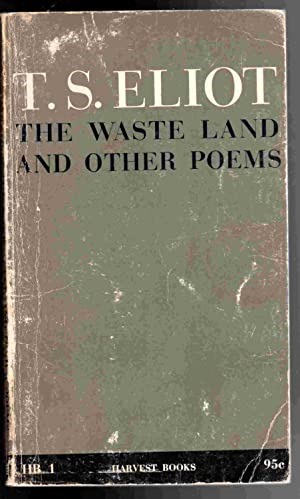
It’s April, time to celebrate U. S. National Poetry Month! We’ve had a tradition here over the past five Aprils of performing “The Waste Land” in serial-installment fashion, and now this year we’ve come to the landmark Modernist poem’s final section: “What the Thunder Said.”
Since the Parlando Project officially launched in August 2016 it’s been a tremendous effort to lead this exploration of a variety of poetry and ways it can be performed with original music. Last year we crossed the 500th piece threshold — an incredible achievement in creative productivity that I’m often proud of. One could spend hours here just exploring the poets we’ve featured and the ways we’ve performed their work. Though I expect most listeners will enjoy only a portion of what the Parlando Project does, I’d say this month is a good opportunity to wander randomly through our archives or use the search function to see what we’ve explored.
Putting a little worn patina on The New, The Modern…
.
I am a little sad and a fair bit intimidated in reaching this section of “The Waste Land,” the ending. It has become harder for some uninteresting reasons to keep up this project’s pace, but as I come to this April, I know I’m going to miss my annual return to the sprawling collage that is Eliot’s great poem. Though I’m hugely grateful for the ability to come this far, sadness is all around me, friends and relatives in suffering situations that I’m unable to address or help, and a sad tribunal is taking place a few blocks from where I sit and write.
I’ve always found this section of the poem a confrontation with sadness, and as it largely removes the masks and personas that have peopled the rest of the poem, I think it’s the most difficult to perform, both for audience-effectiveness and because the performer should/must confront that element inside themselves.
I’ve always found this section of the poem a confrontation with sadness, and as it largely removes the masks and personas that have peopled the rest of the poem, I think it’s the most difficult to perform…
As dysfunctional and damaged as they may have been, today’s section of “The Waste Land” transitions us from the unreal city, its duplicitous characters, and the sweaty faces and the hubbub of “He do the police in different voices” sections, and begins to move us to the titular waste land that will be the stage on which that final confrontation with sadness will occur. Musically, I open this with an urgency as the battle is about to begin. And so, to hear my performance of the first part of “What the Thunder Said” from “The Waste Land” you may be able to use a player gadget below. If you don’t see the gadget, this highlighted hyperlink will alternatively play it.
Thank you for reading and listening. Over the rest of April, I plan on pressing on to the end of the poem, and to present as much other work here regarding the sister arts of poetry and music as I can. Click follow or come back, check out the other things here, and spread the word about this Project. Those of you who’ve done that are what keep this going.
Here’s a piece celebrating our Spring springing forward that’s also appropriate for America’s celebration of Irish heritage on St. Patrick’s Day. It consists of three short poems by the Irish poet Joseph Campbell.* I put them together as I think they somehow increase their individual power presented that way. I call the combination “Sail-Moon-Sheep.”
Campbell was also an artist. Here are his own illustrations for the three poems I used today: “Sail Answers Sail,” “The Moon,” and “Sheep.”
.
Campbell is one of the more fascinating discoveries I’ve made while doing this project. As far as I can tell he’s largely unknown in the United States, even though he spent some time here between the World Wars. And while it’s harder for me to assay his position in Irish arts and culture, he doesn’t seem to be highly esteemed and remembered there either.
What draws me to present him then? First, he seems to be an early Modernist poet, who writes in a mode those pioneers used — one that I think bares reconsidering today: short poems that present charged emotional states by physical description while eschewing both tired conventional metaphors or overly elaborate original imagery. A hundred years ago there was a name for this kind of writing. It was called Imagism. It rose as a force in opposition to established literary styles, flourished briefly attracting both writers we still celebrate and even some not-inconsiderable popular interest, and then was largely discarded for further evolutions of Modernism.
Campbell didn’t always write in this style, but he did so often enough for me to have work to present here. I’m not sure exactly where or when he picked up this mode of poetic expression. Today’s pieces are from a 1917 poetry collection of his called Earth of Cualann, a year when Imagism would have been in more common currency as a poetic style, but he seems to have used it occasionally before 1910 when he might well have been independently inventing it — or he could have had some as yet undiscovered connection to the small pre-WWI Anglo-American group in London that would give the Imagist style a name.
Chinese ideograms for sail (or rather, boat), moon, and sheep (though more at goat I gather). Some of Campbell’s poems seem to me to work very much like classical Chinese poetry too.
.
Secondly, he is like Yeats, intimately involved in the Irish cultural renaissance** that was an engine driving to Irish political independence. Indeed, in that second event he seems even more involved, perhaps to the detriment of his poetic career.*** My 20th century brought forward many anti-colonialist artists, but America has it’s own colonialism (both internal and external) and English language eloquence on these matters may be useful to us. Often when reading Campbell I think that aside from some simple translations of particulars I could be reading a poem by someone of American-Indigenous heritage and culture. Campbell’s connection to nature and his native landscape is deep and inescapable.
If one reads a book of Campbell’s poems, this repeated connection to the landscape and its history is so deep that it’s impossible to not think of it as an Imagist expression of a spiritual or religious feeling**** in the poems, even where that is not overtly mentioned. I know next-to-nothing of Campbell’s religious beliefs. Catholic Christianity is sometimes invoked, and at other times a Neo-Pagan-like stance seems to be displayed.
Well, it’s so like this project to say a whole lot about three very short poems from Campbell’s Earth of Cualann that I present in the expectation that they hang together as a portrait of Spring, and then a Spring in a nation in need of renewal. It’s an Irish man’s depiction, and let us celebrate that too, but perhaps I’ve opened you to some further ways to consider that.
*As I must always say when mentioning his name — no, not that Joseph Campbell — this is another man who also used a Gaelic name Seosamh MacCathmhaoil.
**It would not surprise me if the instigators of the Afro-American Harlem Renaissance featured here last month were not aware of the power of Irish elevation of Irish art, history, artists, and culture as a pre-requisite to self-determination as well as a significant argument for their value as citizens. And in other anti-colonialist cross-pollination: consider the mutual admiration of Rabindranath Tagore and William Butler Yeats, or Gandhi’s example to Martin Luther King.
***Imprisonment and exile, for two examples, were involved. Knowing a little now of some of the impassioned factions even among and between the Irish Nationalists, I fear finding out more of Campbell’s actual political beliefs, alliances, and possible revolutionary actions. It’s also plausible that it may have reduced his stature in Irish literature, as political opponents divided by violence often are unconcerned with merely literary merits.
****Remember, Imagism expects there to be few, if any, overt use of words naming emotions or reactions to what it is depicting. It expects — and when it works, it may even compel — the reader or listener to supply their own internal emotional reaction and impact from the poem’s description of a charged moment.
Here’s a song about springtime and wonderous music. The author of the words is William Shakespeare, and it was written to be sung* as part of a play, an art that invites instant appreciation of itself simultaneously by a crowd and a group of people who present it. To merely read a play is like looking over the score of an orchestral work. If you are musically literate you may appreciate the ingenuity of the notes and musical parts, but it’s only a map or tool guiding musicians to the creation of the actual, momentary, and simultaneous thing.**
Stuck in the melting ice/snow, a tiny stick hosts some March fungi trumpeting spring! photo by Heidi Randen
.
So, as we await the onset of spring and its ancient and age-tested paradox of everything fresh and new, let us return to another warm day that was once fresh and new. It’s 1613, and we’re in London where there’s a new Shakespeare play opening at the Globe Theater, that wooden O that has made his career, the entertainment center that the Bard himself is part owner and begetter of.
Yes, Shakespeare at this time was an established force in English entertainment — but this play has a tough balancing act to perform. The new piece is entitled Henry VIII, or All is True” and unlike Shakespeare’s older history plays, this one deals with events within the childhood memory of the oldest inhabitants of London. The time Henry VIII, or All is True is set in is no more past than the first season of The Crown on TV is today. The theater and his company, The Kings Men, exist partly on the support and permission of the royal family.
The Globe is an entertainment business. Of course, Shakespeare uses his prodigious artistic talents as a draw for this enterprise, and much has been made about how Shakespeare used words uttered by actors alone to do what modern movies and TV shows spend a small nation’s budget worth of money to make with computers and craftspeople now—but the Globe company is not beneath practical special effects to boost the spectacle.
Near the end of Act 1 of the play, there’s a scene where Henry VIII enters with a celebratory cannonade to announce his arrival. If we were there, in that simultaneous artistic moment in 1613, beneath the bang and above us, some sparks from the cannonade equipment (located off-stage near the thatched roof attic of the theater) set the roof afire. For a short time, the play continues until the fire lapped around that wooden O*** and interrupted that moment before the play would come to its third act where today’s song would have been performed.
So, let us leave the simultaneousness of 1613, and ask about what context today’s piece would have been presented in if they had gotten to the third act. At the end of Act 2, Queen Catherine of Aragon has just begged Henry VIII and the play’s chief villain Cardinal Wolsey to not divorce and cast her out. As the thirdAct would have begun (if that theater fire hadn’t broken out) she asks a servant — who in what seems to be musical theater logic, is also a skilled lutenist who has her instrument at hand — “Take thy lute, wench. My soul grows sad with troubles. Sing, and disperse ’em if thou canst.”
In the course of the play, the song doesn’t work. At the end of the song, Wolsey appears to further seal Catherine’s fate.
Simplified map, not the thing itself: the Esus4 riff is repeated twice, and I think I played a CMajor7 over the final “die”
.
Taken out of this context today’s lyric may seem like a simple song in praise of music — one that references the mythological character of Orpheus, who the Greeks held as the first and finest lyre player, and one whose music was so powerful that it was said to cause trees to travel to be nearer to his music.**** The poem includes more examples of this most well-known power of the marvelous musician Orpheus, but even as the first section ends there’s a subtle undercurrent introduced. Orpheus’ song can control nature the poem says, double-stating a claim that he has “sprung…spring” — but there’s some fine print, or rather a promise is made that we know nothing can fully deliver: it’s a “lasting spring.”
We who sit today in the North on the verge of spring know spring will come. We also know it will go. There’s no such thing as a lasting spring, or a never-ending song. Shakespeare’s new play can start, we can all watch as it occurs before us, but in an instant we might be hot-pantsing it out of the moment and dowsing it with ale. We can be a faithful lover and be denied.
I may be misreading, but the end of the poem seems to add further ambiguity. The servant singing Shakespeare’s song to the soon to be deposed queen says music can kill care and grief, but the sentence continues into the next and final line of the poem: “Fall asleep, or hearing, die.” Is care and grief killed, or is it just beguiled and sleeping for the length of the song? Is the listener to the song — the other hearer besides care and grief — distracted only for a time, for a moment of spring, as one asleep? And then the song ends on that most falling of notes, the word “die.”
Shakespeare’s play can have cannons. And then it can have little 12-line songs.
Today’s song performance has bass and acoustic guitar, organic instruments that have known trees, and then one of my favorite fakeries: the Mellotron. Long time readers here will know my fondness for the Mellotron, a primitive yet overly complicated approximation of orchestral instruments that was used around 50 years or so ago to suggest a bigger recording budget for certain vinyl records. It’s a failed approximation of the things it suggests, but there’s a tragic richness to that failure for some. To hear my performance of “Orpheus with his lute made trees” you can use either this highlighted hyperlink to play it, or if your blog reader favors us with the appearance of the player gadget below, you can fire it off with that.
.
*Alas, the music to which the songs in the plays were sung during Shakespeare’s time is lost, though today’s lyric has been set to music by a number of composers.
**As we approach a year into our current pandemic, doesn’t this art, the art of live performance in one crowded place, seem even more strange and marvelous?
***Art and time passed aside; you may wonder: three thousand people in a packed wooden theater with at most two exits. How many died? Apparently, no one. Eyewitness accounts include this detail of one notable casualty, “One man had his breeches set on fire, that would perhaps have broyled him, if he had not by the benefit of a provident wit, put it out with a bottle of ale.”
****I wonder if Willy Shakes wasn’t engaging in some wordplay with the songs opening line. As a player of the guitar, an instrument that is something of a successor to the lyre and lute, we know the reverse of his opening: our “lutes” are largely made of trees. And rather than having musical power to enchant trees we sometimes think as that wood shifts and changes the playing action of our instruments, or it boggles tuning stability, that our wooden guitars have not quite gotten over being wild trees, ones not totally enthralled to our powers.
Here’s one of Robert Frost’s well-loved poems that has managed to penetrate into popular consciousness in a way that few modern poems have. “Nothing Gold Can Stay” is therefore found anew inside of S. E. Hinton’s novel The Outsiders and the resulting movie and Stevie Wonder song, or via the 21st century song by First Aid Kit.
Often when I present Robert Frost poems here, I ask your indulgence to point out that what is often drawn from them doesn’t represent what Frost seems to be trying to impart. “The Road Not Taken” isn’t about the critical importance of taking the “road less traveled,” but about the irrelevance of choice and dangers of “analysis paralysis.” “Stopping by Woods on a Snowy Evening” isn’t about tarrying by a beautiful winter scene instead of getting on with life’s duty, but about someone lost in rural darkness. Even this month’s “Acquainted with the Night” —while, yes, frankly dealing with despair—is about living with depression rather than dying from it.
But “Nothing Gold Can Stay” does seem to be saying what most everyone draws from it—and so, unlike these other Frost poems, it’s loved for exactly what it is saying: that certain kinds of beauty and states of grace are transitory; and then by implicated extension, that to hold them inside a memory or a memorable poem is our consolation. So, what’s left for me to say then?
Well, maybe there’s this element: that a catch phrase drawn from it, “Stay Gold,” is not in Frost’s poem, and his poem indicates that will not happen even if wished; but I’m willing—as was Carl Sandburg in our last post “Monotone” —to cut humanity a little slack here. Sandburg in his middle stanza of “Monotone” tells the same story as Frost’s more famous poem, though more of us remember Frost’s expression of the idea, which may be testament of the power of Frost’s rhyme in memorability. Sandburg’s point however, the one I subscribe to, is that there’s something to be admired that is left after the loss of moments of perfection or passion in both memory and the continuing changed moments.
One other thing I’ll admit I hadn’t noticed until preparing this piece this month: “Nothing Gold Can Stay” is a spring poem about tree blossoms as much as it’s an autumn poem about falling leaves: “Early leaf’s a flower.” The tree blossoms on my bike rides this spring are, it seems to me, more numerous, fragrant, and beautiful. Is this a side-effect of the closed in spring of our current epidemic? I think too, not only of Sandburg’s “Monotone,” but of Meng Haoran’s “Spring Morning,” and my own “Plum Tree Blossoms on 40th Street.”
Early one morning this month, I rode my bike down 40th street to the now closed schoolhouse, the route I rode a few years back with my child in “Plum Tree Blossoms on 40th Street.” I remembered one fine tree full of blossoms there a block before a bicycle bridge that crosses the then busy freeway, and the flowers’ smell that day that told me the tree was louder to my nose than the traffic under the bridge. This morning, this month, I was surprised to see not one, but a whole row of trees, all in bloom.
Blossoms revisited. The other side of the street from the rusty camper was a tattered car with blankets blocking all it’s window glass, evidence that some of the cardboard sign beggars at the nearby freeway entrance may have slept there the previous night.
A few words on the music before I ask you to listen to my performance of Frost’s “Nothing Gold Can Stay.” The music I created for this is based on my appreciation of South Asian music, a style that I refer to sometimes here. This is a complex musical tradition of which I have little knowledge of other than as a listener, yet like some others I’ve been drawn to its tactics from the first time I heard it.* Oddly, the top line musical instrument I used for this is a uniquely American one: the mountain dulcimer, a small, fretted, plucked string instrument.** And the percussion instruments here do not include the tabla drum sets used in South Asian music because I don’t have access to them, but are instead approximated with a mix of “Latin Percussion” drums and rhythm instruments, like congas, bongos, and small rattles, bells, and such. I do have good tampura and harmonium virtual instruments that I can play with my MIDI guitar and little plastic keyboard, so I did use those traditional South Asian sounds.
I like how this turned out. Why this music for Frost’s “Nothing Gold Can Stay?” There’s no harmonic progression to it. I don’t notate this sort of composition with chord symbols the way I might a rock music piece. If I did it would be sort of Dsus4, D, D5, Dsus2—so really it’s just about the drone center of D and how one steps out and back to the D note in a rhythmic/melodic dance. Nothing gold can stay, but the D drone reminds us musically that change is return, that return is change.
Here’s the player gadget to hear the performance.
*Like many Americans it was Ravi Shankar LPs on the World Pacific label, reinforced by his appearance in rock concert films like Monterey Pop and Woodstock, and other audacious appreciators who (like me) started to drop in things they drew from these performances into their own work.
In the early 70s in New York I worked in an E. R. with an Indian surgeon who would sing melodies acapella while suturing away. Those melodies would keep us going during long nights.
In the Twin Cities area we are lucky to have some South Asian tradition performers, and westerners like Dean Magraw, Marcus Wise, Steve Tibbetts, and Greg Herriges who incorporate this tradition into their playing.
**The mountain dulcimer has a mysterious past. It’s like and then not like a lot of other instruments from around the world. It seems to have been played by rural Appalachian mountain country settlers, often from Celtic backgrounds where harp instruments and drone wind instruments were common, but it’s not a harp. What it is though is an instrument that was relatively easy to make at home without complex tools or fixtures. In quiet times in those night-time hospital E.R.s I would sometimes quickly construct a rough fretless one out of a cast-plaster box and rubber bands.
This project doesn’t operate by some master plan, but it does operate keeping in mind a number of principles. I want to explore various ways to combine words with music. There’s a long tradition of setting poetry to music as Art Song or Lieder. While elaborate melodic contours can sometimes detract from the expression of the text, I have no objection to that tradition, just a feeling that there are other approaches.* I want to vary the music used, as much as my resources and skills allow. I would like the texts to vary in expression as well, so much so that even though this project started with the help of a fellow poet and musician, Dave Moore, it doesn’t use our own poetry or writing for text to connect with music much here. I like to honor “Poetry’s Greatest Hits” but I also like to go crate digging for overlooked writers and poems. And unlike most of the modern web, this blog and this project isn’t out to sell you anything. I’m well past my sell-by date as an indie music act.
I’ve been at this for around five years and presenting things here at this blog for nearly four. Today’s piece makes the 450th combination of various words with various music. My current expectation is to continue this project to the 500th piece. The audience continues to grow, which is gratifying and motivating, but this project takes a tremendous amount of effort. How can one weigh these things? My own subjective feeling right now is that the continued amount of effort involved would make more sense with a larger audience than I’ve been able to attract, even now as this thing nears its fourth-year anniversary.
the 450th audio piece since we launched in August 2016
There are ways that might increase that audience that are somewhat known. Most of them have costs in money, time, focus, and complexity that are daunting to me.** The introverted, heads-down composer, researcher, writer, and musician for whom those efforts would be undertaken is likely incapable of sustaining that and continuing to do as much creative work as this project has become accustomed to. Other than the rewards of perseverance, much of the growth that motivated me in the past few years has been due to the efforts of readers and listeners to spread the word. If you’ve done this, even a little bit by telling a friend or linking a piece, particularly on those social networks that I don’t have time to participate in, thank you!
I should reach 500 pieces sometime later this year. I continue to think on these things and what to do about this project as I continue to work on new pieces.
Today’s piece violates that principle of featuring other writers. I may bend that way a bit more in the coming weeks than in the past, as I have a few pieces I wrote that I want to present. But it does speak to my thoughts today about this project at piece #450. “Birds Busking” is about that music offered every morning by those exiled dinosaurs. Oh, they have hopes too, if not actual open musical instrument cases with a few bills salted inside. Maybe some territorial claim, mating opportunities, or commiserating calls to like birds-of-a-feather. But one can think, as poets do as they continue, that they might sing anyway.
I may have invented a word (“eached”) in the 12th line.
How many poets have listened to that birdsong? I cannot count and neither can you. The countlessness of that is magnificent! The wonder of all those poets and all that music is what this project is about. And so I write and post this new piece here this morning, tenaciously.
The player to hear “Birds Busking” is below.
*In fact I enjoy Art Song, and just because the style has its characteristics doesn’t mean it doesn’t have its worth. But I can’t sing elaborate melodies successfully (my tune bucket’s got a hole in it). Similarly, I think hip hop can do remarkable things, but the fast rap flow is something my voice can’t quite hack.
**I’m not even good at following up and acknowledging your comments on these pieces. It’s not something you said! I’m just writing another piece of music, or recording it, or researching or looking for a new poet or poem.
There I was, thinking it’s been over a month since I’ve presented an Emily Dickinson poem here. I didn’t start this project thinking that Dickinson would be so prevalent as a source for texts, but that’s what happened, and during the past four years my appreciation and wonder at Dickinson has increased greatly.
One thing I came to sense in her poetry that I had not noticed before was an air of the mystical combined with an almost psychedelic playfulness. This can be dark or light depending on the poem, but since many of the things I’ve been working on lately have been in a darker, more gothic vein, I thought I’d look more to the lighthearted side. I started a search for Dickinson and spring, and while I’m not sure exactly what keywords I used, this poem turned up very near the top, and it immediately captured me. I had thought I’d be searching for a while but found my next piece in less than 10 minutes.
It opens with two remarkable and attractive lines that don’t present a distinct image. I’m not sure which meaning of the word “Fair” we’re to understand in the first line. Fair as in a celebratory meeting or market (like a county or town fair) or fair as in beautiful, but rainbows and fair in the first line and we could almost be in My Little Pony land if Dickinson doesn’t launch us further out quickly into a “A vision of the world Cashmere.” I first thought of the luxurious wool,* but she also could be using this word as an alternate name for the Asian region called Kashmir. Peacocks complete the luxurious imagery of the first stanza. In later context we’ll see that this is an image of wildflowers, but at this point we’re still in mystery and allure.
Next stanza is lovely in sound and more specific in what it pictures. Butterflies are butterflies, ponds have insect sounds again, and in an image that might make one laugh out loud, bees are “barons” out of their castles and on the ambling march.
Third stanza, robins have replaced the enrapturing snow that Dickinson so ably described in a poem many liked here last winter. She next gives us an orchis flower prettying up for an old lover, the exotic Spanish nobleman “Don the Sun” who is revisiting her in her swamp.** The sensual and the silly playfulness keep mixing it up.
In context we now suspect that the poem is describing wildflowers in its more impressionistic and feathered images. And the final stanza marshals the spring blooms into an army. And then, like it started, the poem departs with two lines that end in mystery. What’s up with the flower children of “turbaned seas” and the “Circassian Land?”
Well first, flowers again.*** The spring flowering tulip’s name is derived from the same word as the Turkish word turban because the bud’s shape is of a like shape to the head covering. The Circassians and their native region in the Caucasus mountains were in the news at the time this poem was written. Imperial Russia had invaded the area, and the Circassians were fighting back.**** Some of the coverage dealt with atrocities including the enslavement of Circassian captives and captured Circassian women being held in Turkish harems. As we’ve discussed before, this last trope was an exotic/erotic fixation for some westerners. Circassians were geographically “Caucasians”—and in the archaic understanding of ethnicity of this time, Caucasians were held to be the prototypical white race. Therefore, beyond the usual fascination with underdog fighters against Imperial forces and humanitarian concerns with displaced refugees, there was this additional element of “White Slavery” and a frisson of the forbidden.
So this is a very particular and odd way to end the poem—but even if you know nothing of the current events of the mid 19th century, it does still convey that exotic flavor. A reader reading this without context may still find it an enjoyable spring celebration poem. It certainly captured my interest at first reading. But wait, there’s one more bit of context!
It may well have been intended to capture it’s reader, as it did me, in that it’s one of the poems Dickinson sent in a letter to her friend, sister in law, neighbor, and possible lover Susan Gilbert Dickinson in 1859. If you look at the end of that handwritten manuscript, it ends with this note:
Dear Sue, I haven’t “paid you an attention” for some time. Girl.
As with all things Emily and Sue, there’s a gathering amount of modern speculation and scholarship to these matters. Just a little friend to friend note or a bread-and-butter obligation repaid to a sister in law? Or is this poem meant to be an encoded mash note to a romantic crush?
If it’s consciously or unconsciously erotic, one may be able to see that reading without strain. Cashmere as fabric for a vest or blouse. The pervasive flowers now as the beautiful reproductive organs of plants. And butterflies. The bees, are they singing Slim Harpo’s“I’m a King Bee” from a hundred years after Dickinson’s poem? That Orchis waiting for a lover? Oh, for certain. Sensuous feathers. The whole captive in a harem as role-playing. It’s not just the spring wetlands that are getting steamy in here!
In the end, the poem may stand either for spring’s desire and delight or the poet’s. And as I said last time, it captures you with it sound of thought either way. The player gadget for my performance is below.
* Dickinson might have had it in mind, as this textile from Asiatic goats had been introduced to western countries, and Massachusetts in her time had mills that wove it into fabric.
** The informal British English meaning for “bog” was not likely on Emily’s mind. However, one of Dickinson’s poetic heroes Elizabeth Barrett Browning had helped propagate the Latin lover trope with her publication of her love poems Sonnets from the Portuguese in 1850.
***Emily Dickinson was an avid gardener, and as a young woman compiled an elaborate herbarium classifying a great many flowers in her region. Whenever Dickinson mentions a flower you can be sure she knows more about it than the average person.
****These overseas battles were covered in the Springfield Republican, a Massachusetts newspaper that was read in the Dickinson household and which was one of the few places that published an Emily Dickinson poem while she was alive. Alas for the Circassians, the final outcome of this invasion was diaspora and what in a quaint 20th century euphemism was called “ethnic cleansing.” And to think that I sought out this poem because I wanted contrast to other, darker stuff I was working on.
Robert Herrick wrote in the awkward 17th and 18th century era in English poetry where if you aren’t Milton you get tabbed in the minor poet folder. That didn’t stop Herrick, as he wrote a couple thousand of poems without ever achieving widespread cultural impact. There’s likely some overriding reasons why the gap between the inventiveness of Shakespeare, other Elizabethan poets and John Donne; and then Blake, Wordsworth and the Romantic movement was a fallow period for innovation in English language verse.
What poetry of Herrick’s I recall from my youth had a chaste lustfulness about it—a difficult combination to make work. I haven’t thought much since then about refreshing my experience of his work until I came upon this May Day poem looking for material this spring: “Corinna’s going a Maying.” It’s yet another carpe diem poem, a genre that can’t escape the imprint of the patriarchy on it.* But Herrick doesn’t really launch into the hard-core let’s get it on before we die argument until after a fair number of stanzas that are so much “Spring! Time to get outside and enjoy that frostbite is no longer the charm that nature has on offer.”
And yet this May, a springtime carpe diem poem has a different cast. We didn’t really folk-dance around maypoles much in our century, but this May we know we can not do what we didn’t do. Even the poem’s warning that our days may run out before we know our liberty, dark as that thought may be, is more present.
And yet this May, a springtime carpe diem poem has a different cast. We didn’t really folk-dance around maypoles much in our century, but this May we know we can not do what we didn’t do.
So mopey guy that I can be** I zeroed in on the final stanza, which seemed to have by far the sharpest lines, and if performed alone wouldn’t tax my listener’s patience. Herrick’s “Corinna” is written in rhyming couplets, which was in fashion in his age (as it is for Hip Hop now). Since carpe diem tropes go back to Roman poets, Herrick adopted to his English poetry some verbal riffs from Latin.
Which is when I flashed on the idea for how to present “Corinna’s going a Maying.” It’s easy to adapt rhyming couplets to the Blues Stanza (two repeated lines completed by a third rhyming one that often surprises in its completion). And then the name of the woman addressed by Herrick is the same addressed by an American folk song “Corinne, Corinna” or “Corinna, Corinna” that’s been recorded by dozens of blues, folk, country, and rock artists. I knew it mostly from Joe Turner’s blues version from the 50s and Bob Dylan’s mildly electric cover from his Freewheelin’ Bob Dylan LP.
So, the die was cast. I would try to perform Herrick’s closing section as a set of blues stanza adaptions. The feel I fell into was my approximation of the Vee-Jay*** records of my youth that featured Jimmy Reed or John Lee Hooker. Unlike ex-big band blues shouter Joe Tuner, Hooker made his early mesmerizing recordings with just voice and electric guitar, but by the time he was recording for Vee Jay they often added drums and sometimes a second guitar to make the records more palatable to the R&B audiences of the late 50s and the early 60s. Which leads to a remarkable thing about Hooker’s Vee-Jay recordings: the singer/guitarist at the center of those recording dates wasn’t the most regular in his song structures. Rather he was steeped in the drifting Delta style where the little breaks and asides were thrown in at various times depending on the feeling he was building in any one take.**** This meant the drummer had their work cut out for themselves in those days before everyone would be asked to sync to a click track and verses are expected to snap to a fixed grid. That “backwards” style where the drummer follows the guitarist has a certain charm to it, and you can see its rock’n’roll descendants in the Rolling Stones and The White Stripes.
All that is to say that it took some precise work to do the loosey-goosey May Day take of what I call “Corinna, Corinna Let’s Go a Maying” even if I don’t sound much like Reed or Hooker. I doubt Herrick would mind too much, after all he was adapting Catullus and Ben Johnson for his times, just as John Lee Hooker was adopting his style to the space and tail-fin age. The player to hear my performance of the final section of Herrick’s poem is below. The full text of the Herrick poem is here. Just jump to the final stanza if you want to read along to my performance.
*Are there any poems written to men from a woman’s perspective that make the argument that they need to get busy with the woman poet because, well, you’re aging and death awaits all? There are male to male poems that fit this genre (some of Shakespeare’s sonnets are examples), but I can’t think of an example by a woman off hand.
**Sometimes I wonder if I hold with songwriter Townes Van Zandt who famously stated, “There’s only two kinds of music: the blues and zippety do-dah.”
***Chicago-based Vee-Jay preceded even Motown as a black-owned record company, and besides recording R&B, jazz and gospel they were the American label that cut a deal in early 1963 to release records by The Beatles. You’d think that would be the beginning of a great success story. That’s not how the record business works.
****Lightnin’ Hopkins was another. Jas Obrecht in his book Rollin’ and Tumblin’ quotes ZZ Top’s Billy Gibbons with this tale of a recording session: “We were playing a traditional blues and we all went to the second change, but Lightnin’ was still in the first change. He stopped and looked at us. Our bass player said, ‘Well, Lightnin’, that’s where the second change is supposed to be, isn’t it?’ Lightnin’ looked back and said, ‘Lightnin’ change when Lightnin’ want to change.’”
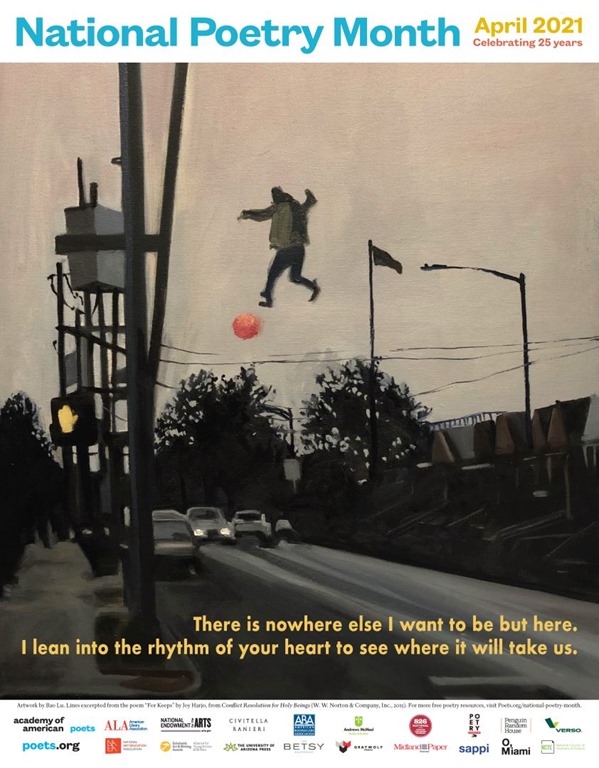
Let’s launch the Parlando Project’s celebration of National Poetry Month with one more poem about march, about spring, and about joy. And oh, could I use some joy in this uncertain pandemic plagued spring! You too?
I’ve chosen to use this poem, “Written In March,” by British poet William Wordsworth today. National Poetry Month is a U.S. thing—but that’s OK, because I’m going to make him an American for the day by combining his original English rural scene with some American music: the blues.
Lots of folks will think of ways to celebrate poetry this April. The Parlando Project has been doing our odd part for several years now.
This is not so wild a thought as you might think. While Wordsworth is not the kind of early 20th century Modernist that I often feature here, a century before them he helped make a statement for plainer speaking and broader subject matter in his landmark Preface to the Lyrical Ballads in 1801. He famously stated there that poetry is simply “Emotion recollected in tranquility.” Among the things that he and his fellow English Romantic movement poets looked to for influences were folk music and ballads.
American blues was created by the uncrowned Afro-American Modernists of the early 20th century. Since there was very little authentically American “serious music” in 1900, and what there was they weren’t exactly welcomed in it, they created a Modernist form of their own device. We could call it a folk music, but then Louis Armstrong was fairly sure “All music is folk music. I ain’t never heard a horse sing a song.” Musically it used all kinds of things, some of it was from African nations their forebears had been abducted from, some of it was from native American soil, some of it was from other immigrants, some too may have been from indigenous Americans, and some of it had to have been the creation of their own minds, needs, and creativity. Musically it has many descendants, and its core is the greater part of what makes something musical distinctly recognized as American around the world.
That this form could be called “The Blues” was a problematic branding, because the term then and now can be confused with a long-existing synonym for sadness or depression. While there are sad and pitiful blues songs, the typical stance of a blues to trouble is to say that it’s wise to the situation, that even if the singer is beaten down by something, that they’re still here. And many Blues songs are also perfectly happy to be joyous, and that’s the mode I went for today.
So, I maintain that this is a reasonably natural combination. Wordsworth wants to tell us a rural tale of winter’s end arriving, of fields and livestock thriving, of an outdoors that welcomes us again with open arms. In this year’s troubled spring we may not have a full measure of spring’s blessings, but we are still given a portion. Let’s devour the portion we’re given all the more joyously even if the serving may be smaller this year.
I played acoustic slide guitar for this one, using a favorite guitar variety used by early American blues musicians: the resonator guitar invented by Slovakian immigrant John Dopyera. It’s essentially a big pie-plate-sized metal speaker cone driven by the strings of an otherwise more-or-less conventional guitar that houses it. The guitar is retuned to a non-standard tuning that many blues players called “Spanish” and some think may have been learned from Mexican laborers that crossed paths with the Afro-Americans in the southern U.S. I wear a ceramic tube on a finger of my fretting hand to stop the notes, and this sliding tube on top of the strings gives legato note transitions and microtones. Many players can use this slide guitar technique fluidly, giving the guitar a smooth legato note envelope as the only artifact of using the slide, but I also enjoy letting other possible artifacts stand out more, putting a mic near to the fretboard so I can hear the heavy slide strike against the strings or even slap the fretboard wood at times.
Join us over April’s National Poetry Month to see what else we can come up with to surprise you with. If you want to sample the range of different things we do immediately, our archives here have over 400 other examples of words (mostly poetry) combined with original music.
Given the times we live in and the current virus-crisis, can I be excused for being a little bit late with an audio piece for World Poetry Day?
It occurs to me that if World Poetry Day was some kind of Olympian-Olympics or the World Cup in Verse, and the United States had to look over its relatively short history on the literary scene and pick it’s most powerful and representative champion, Dickinson could be our choice, even though she spent her writing career not really having one.
Indeed, when I was introduced to Emily Dickinson as a teenager back in the middle of the last century, that was the inevitable, subtitled fact about her: a recluse, a nun of poetry in effect—self-isolated in her room, scribbling odd little poems which are now seen to have at least some middling value because, well, they’re so unusual and such.*
For a century and a bit more, past-through that time when I first read her, and over our new century line by a couple of decades, readers, critics, and listeners still discover that there’s as much there in her little poems as we seek to look, and look again, for.
Take today’s spring poem of hers “A light exists in spring.” It’s as simple and complicated as a William Blake song of experience. It’s as metaphysical as a poem by Donne. Yet it doesn’t push me, or (I think) many other readers away. It draws me in to this mystery of what it is describing. Dickinson confides in us: we are likely to feel/see this too.
I compared her to Blake with consideration, because poems like this strike me as describing some kind of mystical or limerent moment. Dickinson has a strange effect often, she can be a cold romantic, a skeptical seer, as I read her.
Something in spring almost speaks to her, and that “almost” in her poem seems powerful—a present absence. I question my musical setting once again today. I’m not sure if I have mistaken a playfulness in this poem as a meditation upon a mystery.
Perhaps it’s my time, and much of the other world’s, this World Poetry Day that leads me there. Many of us are taking Emily’s vows this March, this spring: sheltering in place, practicing social distancing, pondering perhaps a mysterious illness’ distance short or near—and whatever our usual disposition, we may be now far from even lonely crowds in our homes and rooms. This spring is visible as a distance as far as we can see.
Shelter in place: Emily’s room was on the 2nd floor behind the trees in the front-left of this picture.
The player to hear my performance of Emily Dickinson’s “A light exists in spring” is below. Thanks for listening, reading, and sharing the existence of this project.
*Scholarship has shown this blurb-level summary of Dickinson’s life was misleading. For a woman of her time and location, she was above the average line in experience (Some college! Visited other cities. Privileged and connected family in a college town located in the region of America’s greatest intellectual ferment at the time). But by her middle age the burden of a woman’s domestic role and a much speculated-on illness tied her down to the homestead, and only then, in her later years, did she become the recluse of legend.
Most days I take a bike ride to and from a cafe I have breakfast at. It’s my conviction that exercise is a good thing for people of all ages, but it’s more at required for folks my age. The kind of sitting that goes into composing music or the reading and writing that contributes the texts this project uses is pleasant and absorbing, so I think that if I don’t start my day with something that gets me moving outdoors all I would see is screens and pages. No matter if they are blank or full pages, the book of nature cannot be found there.
When it comes to the book of nature I’m not well read. When I read poets like Emily Dickinson or Edward Thomas I can easily tell that. Therefore, my only advantage is that I get to read the book of nature as if for the first time.
Chemical nature observed. My homage to the Yip Abides blog. I love how the rust has created a sunburst finish lacework that matches the original paint color of this truck I passed this month.
This spring I began to notice birdsong more and more. In early morning rides the birds were active and making a note of that with their calls and singing. Summer writes diminuendo, and by now my northern state is quite silent. Nor do I get to see any birds much, though the streets here are full of the year’s batch of weaned squirrels, now nearly adult-sized, who are dashing about as if they have a plan for winter. And with the squirrels I hear less of the cackles from those that take time to chase another squirrel for sport. I sometimes imagine those pursuing pairs were littermates, another they were once eyeless beside.
No one’s singing because there’s autumn work to be done—but what work? Will it bring reward? What to store, what to leave behind.
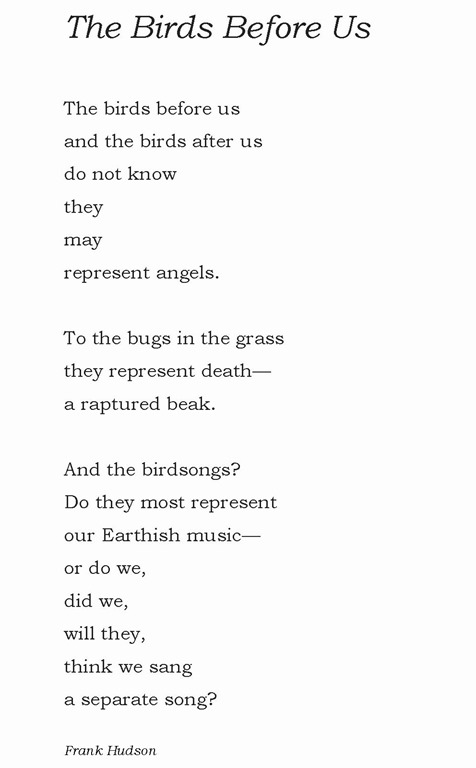
Today’s text is a poem I wrote about birdsong, and the larger book of nature in which we are only an entry, somewhere between horseflies and iguanas as alphabetized with our symbols. It’s occurred to me that I have taken time in this later year of my life to listen to the birdsongs, their piercing intervals; and that after I no longer roll down these streets looking for tea and scrambled bird eggs, that there will be birds in spring moving from note to note, and birds in fall, quiet and studious.
Here’s the poem if you’d like to read along as you listen to the performance.
The piece is called “The Birds Before Us,” and you can hear my performance of it with the gadget below. We’ll return soon with the usual Parlando Project thing: encounters with other people’s words.


 Frank Hudson