Let’s give the lyrical reins over to Robert Frost one more time for another electric guitar driven piece. “The Aim Was Song” is a poem from Frost’s 1923 Mountain Interval collection, and not only is it a reasonably straightforward poetic credo from Frost, it speaks a little to Parlando’s goals too.
I put forward a definition of poetry as I was starting the Parlando Project as “Words that want to break into song.” I don’t recall where I read that definition, but when I searched this afternoon, all I can find is myself, so the source of that phrase may remain a mystery.
Unlike Sandburg and Yeats, Frost himself had no desire to sing or perform to music that I’m aware of, but his desire to use metrical/rhyming verse goads me to use him often here. And Frost had his own theory about how meter and language worked in poetry. He called it “The sound of sense,” and he once described it in a letter as akin to what comes through if you listen to talk in another room from the other side of a door. I don’t think he’s writing there about meter as commonly scanned in metrical poetry, I think instead he’s talking about human vitality that arrives through the panels of a door, the rise and fall, the breath and repetition. Frost’s theory was that you then laid that over the structure of metrical/syllabic prosody, so that each side pushes and pulls on each other. Too much evenness and it’s a motorik machine. Too little and you have only thoughts scattered on the page where only a silent and uncycling eye can gather them. You find that balance with one’s ear and heart.
Perhaps what Frost is aiming for here is the thing musicians call phrasing, but one thing that’s sure is that Frost believes poetry, even poetry of complex meaning or subtle rhetoric, is received through the ear and not the eye. So, even if Frost was not thinking directly of his poetry in association with music as we present things here, he is thinking of poetry as suffused with orality.
In “The Aim Was Song” Frost develops one image throughout: how the human being captures breath, moving air in waves, the essence of that natural force of the fierce spring wind, and shapes it into a smaller but more intimate thing. That is the work of musicians and poets. I could almost hear Lord Buckley read this one, as Frost repeats some words in his short poem that seem to pun on musical terms, to “blow,” “how it ought to go,” and “measures.” I didn’t go that route (if I could) but consider that an undercurrent in this.
To hear my performance of Frost’s “The Aim Was Song,” use the player below if you see it. Don’t see a player? This highlighted hyperlink will also play it. U. S. National Poetry Month is coming up in a few days, and I’m hoping to have a good number of encounters between music and words here in April. Please check back or subscribe, and spread the word.
A bit earlier this month we presented a landmark very short Imagist poem, Ezra Pound’s “In a Station of the Metro.” 14 words, and a prime example of the Modernist’s reaction to the rhetorical flourishes of a worn-out 19th century. Today I’m going to release a Robert Frost response, a 47-word rejoinder, a spring poem with some winter snow left in it.
Frost was born 145 years ago this week. His relationship with Pound is complex. On one hand Pound could view himself as responsible for launching Frost’s career, writing the first substantial review of Frost and seeing to it that his poems were published in Poetry magazine. Without Pound’s endorsement, Frost had submitted poems there which had been rejected.
Frost tells the story of their initial meeting, with Frost’s first book A Boy’s Will so newly published in England that he himself hadn’t gotten a hold of a copy. F. S. Flint (a too-often-forgotten pioneer of British Modernism) had met Frost at a bookstore reading, shortly after Frost had moved to England. Flint noticed Frost’s American shoes and insisted that he must meet his countryman Ezra Pound, now also residing in London. Frost later went to Pound’s apartment, and this is how Frost recounted their meeting:
[Pound] said, ‘Flint tells me you have a book.’ And I said, ‘Well, I ought to have.’ He said, ‘You haven’t seen it?’ And I said, ‘No.’ He said, ‘What do you say we go and get a copy?’ He was eager about being the first one to talk. That’s one of the best things you can say about Pound: he wanted to be the first to jump. Didn’t call people up on the telephone to see how they were going to jump. He was all silent with eagerness. We walked over to my publisher; he got the book. Didn’t show it to me—put it in his pocket. We went back to his room. He said, ‘You don’t mind our liking this?’ in his British accent, slightly. And I said, ‘Oh, go ahead and like it.”
Even in prose, there’s some Frost-ian ambiguity it his account. He notes in passing that the American Pound was putting on a British accent. And his sly quote of Pound “You don’t mind our liking it” before Pound has read it—a subtle dig at poetic politics that—and who’s the “our” here. Pound (and Flint too) were promoting a poetic movement, Imagism—poetry that used direct, concise treatment of “a thing” without any extra words whatsoever.
Frost never liked a movement that included more than him.
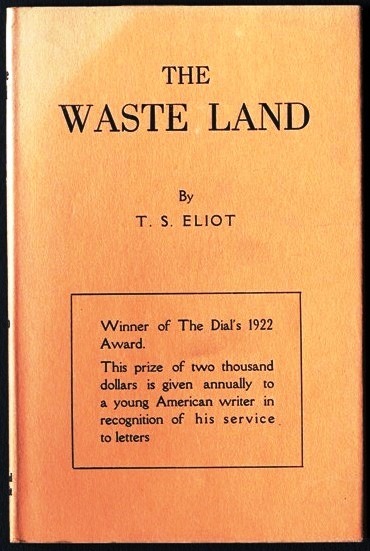
And to some degree this soon led to a break between the two poets. Pound thought that Frost fell short on the “use no extra word” dictum of Imagism. He apparently offered to help Frost learn to excise those surplus words—and though similar offers from Pound were taken up by literary giants like T. S. Eliot and Ernest Hemmingway, Frost refused it.
There was a second catch. In Pound’s review that launched Frost, Pound wanted to make a point of Frost’s rejection by American editors, and he was loudly saying this in an American magazine (one of those that had, in fact, rejected Frost). Many musicians and music fans will quickly recognize Pound’s move here. This is the punk/indie/”street cred” claim. This artist has too much honesty and individualism and lacks the subservient guile to please the suits and the mainstream! The problem here was that Frost was a middle-age man with a family—he wanted to cross-over to those editors. Frost thought Pound was pulling this move to show what a discerning critic he was more than to promote Frost as an outsider artist.
But note too in Frost’s account of his first fateful meeting with Pound, the subtle admission he makes about himself. “Oh, go ahead and like it.” He wanted, needed the help—by any means necessary.
Oddly, if you were to read Pound’s short review today, you might be surprised that it worked to launch Frost at all. There are condescending elements, Frost is almost treated as some idiot-savant country bumpkin. And worse for Pound, he goes on record as the first man to misread Frost as simple and earnest (the same mistake that I made as a teenager, but then I’m not Ezra Pound).
A patch of old snow, blossoms on wet dark bough not included
Here’s the text of Frost’s poem I use today and here’s Pound’s 14-word Imagist flagship. Look at Frost’s first stanza. Sure, Frost’s is rhymed and metrical, though Pound uses a near rhyme that many miss. If Frost ended there, his poem is purely Imagist. “Old” in front of snow isn’t a wasted word. We need to know it’s spring now, and that the snow is past its sell-by date. And it’s an interesting choice to say “blow-away paper” instead of blown-away—more immediate, and it indicates that its transient nature is inherent, not something acted upon from without.
Frost’s second stanza? Pound’s editor’s pencil might have suggested he’s restating the image from the first stanza, but Frost might have countered by noting that he’s making clear this isn’t just any crumpled scrap paper the snow is being made equivalent to, but a newspaper or other publication, with “small print.”
Here’s the Imagist difference. In conventional poetry, the images, the similes and metaphors, are only decorative—look, clever I can compare this to this. In Imagist poetry this comparison shouldn’t be just decorative—it’s the meaning of the poem. This last edition of winter is “yesterday’s papers.” And bilaterally, wrong-headed reviews in Poetry? They will pass like the lonely grimy snow-bergs.
The last line, “If I ever read it,” is Frost’s touch. Pure Imagism doesn’t like to draw conclusions, even enigmatic ones. Does it mean one thing? I think it predominantly says, it’s the past, I’ve endured, it’ll soon be gone completely. The poem first appeared in Frost’s third book, the first to be published in America not in England. Frost was on his way. But there’s an undercurrent—with Frost there always is. Is that small print an edition of The Book of Nature? After all, we also know this: winter will return, and should we not read what it has written to us?
Frost will do that too in many of his greatest poems.
This morning I ask myself, what a strange way to spend a weekend full of news and melting snow, reading the small print about two poetic innovators at cross-purposes to each other.
Musically, I wanted to let loose a bit for this one. I’ve been playing acoustic guitar for many recent pieces, so I wanted an unleashed electric guitar. The wild spring bird-whistles near the end are feedback between the guitar’s pickups and the amplifier.
Let’s just name the winner right off, and kill the suspense: Wallace Stevens’ “To the Roaring Wind.”
There was a time in my teens and twenties when Wallace Stevens grabbed ahold of me. I think back at that young man and try to wonder why. Well there was the accident of a very affordable collection of his best work that I mentioned when I first posted “To the Roaring Wind” back in early January. I think that I also liked the way his poems looked. Free verse looked right on the page to me as well to my ear—I was not writing metrical, rhymed poetry when I started—but the poems also looked ordered, focused, a tightly built thing. E. E. Cummings or Marianne Moore with their ragged lines and strange fragmentation looked like that they were confused about how to put things into words, where Stevens looked sure. Other favorites that came to me later in life, like Frost and Dickinson, seemed to my younger self all too pat and superficial then, and there was Stevens, his poems with majestic numerabled sections that seemed to be laying out a lawyerish or legislative structure filled in with an exact poet’s eye.
Poet Wallace Stevens. Gromit not pictured.
That I didn’t understand all that he was getting at in his poems wasn’t a problem. No, that was a benefit. For my paperback edition $1.45 I got work that one could re-read without knowing already how it would come out! I recall writing poems that I didn’t know how they would come out either, something I will still do. There was one longer one from that era, the first one of mine ever to be published. It had Stevens’ influence all over it, copying his Blackbirds-numbered sections.
Frost, who I thought was entirely too conventional then, claimed that he never liked Stevens’ work “Because it purports to make me think.” Isn’t that line so Frost-ian? First you might high-five Frost and shout “burn!” And then, if you pause and think about it, in decrying Stevens Frost makes a good argument for why you might want to read him—indeed, why I wanted to read him.
Oddly, this poet who was attractive to this teenager, published his first collection Harmonium when he was 44 years old. Lewis Untermeyer, one of the canon-gatekeepers of Stevens’ time, reviewed it then:
“…lacking the spell of any emotion, Harmonium loses both itself and its audience. It has much for the eye, something for the ear, but nothing for that central hunger which is at the heart of all the senses.”
Untermeyer and Frost may have been right to some degree. I fell away from Stevens as I aged, not from any conscious choice, but because I had other poetic worlds to explore, ones that often had emotional and visionary aspects that weren’t overt in Stevens work.
Here is where the Parlando Project, which performs the poems with music, comes in. There is no inherent emotional content in any series of notes stronger than what the musician manifests when they perform it.
As I noted that Harmonium, as a work published in 1923. was now in the public domain as of the first of January 2019, I looked for a piece from it that wasn’t one of its “greatest hits,” a deep cut to represent the collection itself rather than an often anthologized and well-known poem. My attention fell on the last piece in the book, this one. As I did this, a connection emerged with a local poet and poetry-reading organizer, David Shove who I learned had died at the turn of the year. “To the Roaring Wind” is a call to two things: to the muse, that time-honored concept that what supplies us as artists isn’t from our individual merits, but from things outside us that we must serve, and then, to speaking poetry aloud.
Should I stop for a moment in our count-down of the most liked and listened to pieces this past winter to describe briefly what the Parlando Project is? After all, there are always new people coming upon this stuff.
What we do is take various people’s words, mostly poetry, and we combine them in various ways with original music. The music too is not one style. Sometimes we sing the words, but not always, or even usually. Sometimes we read them or chant them or talk-sing them. Singing gives a particular effect to the words, and though I admire many examples of art-song, including some examples that use the same texts that I’ve used, I think there are other facets of the poetry that can be shown with other performance styles.
I wish we had more modern or semi-modern poetry here, but very soon in this project I determined that the effort to obtain the rights to creatively engage with work still in copyright protection would reduce the amount of encounters we could produce.
Limits and restrictions often engender creativity though. I’ve found that being largely restricted to the pre-1923 public domain world still allows me centuries of material to pour over, and there seem to be a great many under-appreciated and forgotten writers to discover. A lot of what I end up using is work from the first part of the 20th century, the Modernists that established the world of literature we are still continuing and reacting to. It’s been fascinating to experience this early formative time of Modernism by adapting and performing their words.
Now let’s return to our countdown with numbers 4, 3, and 2 in popularity this winter. Yes, they’re all early-20th century Modernists. And one poet takes two slots in the countdown today.
4. A Winter’s Tale. D. H. Lawrence is another novelist who was also a poet. In my youth he was probably better known for his novels, and their spicy rep in the mid-century world no doubt helped his youthful readership. I recall reading some Lawrence poems in the sixties and I remember liking them then, but I have to say that my interest in them didn’t continue. Now in this project, in this century, I’ve run into him again. The Imagists who kicked off British literary Modernism considered him one of them.
I liked this poem of his, even though I still can’t say for sure what’s going on in it, but we often can forgive that in the context of music and words. My musical setting for an early 20th century poem kind of took some small inspiration from the late 20th century music of Mark Hollis (of Talk Talk) who died last month.
D. H. Lawrence asks “Is that a Mexican poncho, or is that a Sears poncho?”
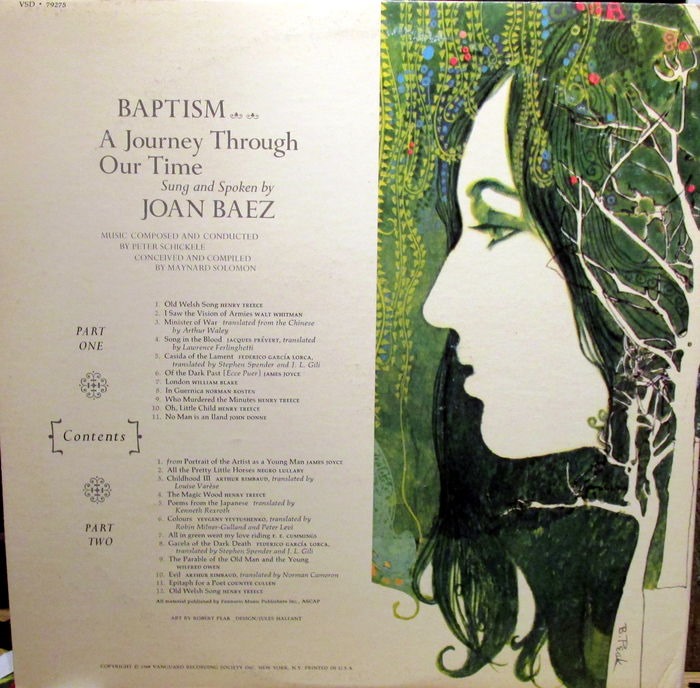
3. Gacela of the Dark Death. Here’s another work that I translated into English myself for presentation here, a poem of passion and wit from Spanish poet Federico Garcia Lorca. I actually first heard this poem as part of a project that attempted to do something like what the Parlando Project does: Joan Baez and Peter Schickele’s 1968 LP Baptism. Baez read Stephen Spender’s translation of Lorca’s poem earnestly there, and the poem’s title would lead one to read it as sorrowful. As I translated Lorca’s Spanish I sensed a more playful and mocking attitude in some of the images, and my performance tries to bring that out from my translation. As part of conveying the emotional range of the piece, I sang the opening and closing sections while speaking the middle of the poem—an example of how singing and speaking words changes the experience of them.
Baez and Schickele do Parlando 51 years ago
2. Self-Pity. D. H. Lawrence again, but a different kind of poem from “A Winter’s Tale.” Shorter, and superficially an Imagist poem, it so clearly makes its “no whining” point that it was once used in a film by a drill sergeant. Poetry that makes straightforward self-improvement/empowerment points was not that common in early Modernism, and it’s not the usual way to literary cred these days either. I’m not sure why that would have to be. There’s an audience that likes it, and the 19th Century revered some poets who plied lessons like this poem does, although usually with many more words and stanzas. My best guess is that artists, particularly now in an era when literary poetry is something of an outsider art, like novelty and rebelliousness too much to settle for earnest self-improvement.
Well, this poem isn’t one of my favorites, but you know something: I need its message some days as much as anyone. I may have worked extra hard on the music I wrote and performed for it to compensate for that.
So what will be the most popular piece from last winter? I’ll be back soon to reveal that.
It’s time to look at the most liked and listened to pieces here during our just ended winter. Overall, listenership was down in December and January, and I was a little discouraged by the drop off from the growth I was seeing throughout the rest of 2018. But then February was one of our most listened to months and March has started off strong too while readership of the blog posts here continues on a general upward trend.
As I’ve done for the past couple of years I’m going to count up our Top Ten audio pieces from 10 to 1 the rest of this week. I always enjoy tabulating these totals, as just like the Parlando Project in general it’s usually a mix of the “big names” as well as the lesser-known writers who I come upon looking for material we can use.
10. There Came a Lion into the Capitol. And we don’t have to wait long for a lesser-known. Walter J. Turner was a friend of Yeats who I hadn’t heard of until I read a book from 1920 seeking to summarize the British poetry scene, and saw Turner’s name. This one seems full of occult symbolism, something that links Turner to some of Yeats work as well. Since the lyrics mention the lion coming to the “blare of a great horn” I tried my best to play a trumpet line using a synthesizer “virtual instrument.”
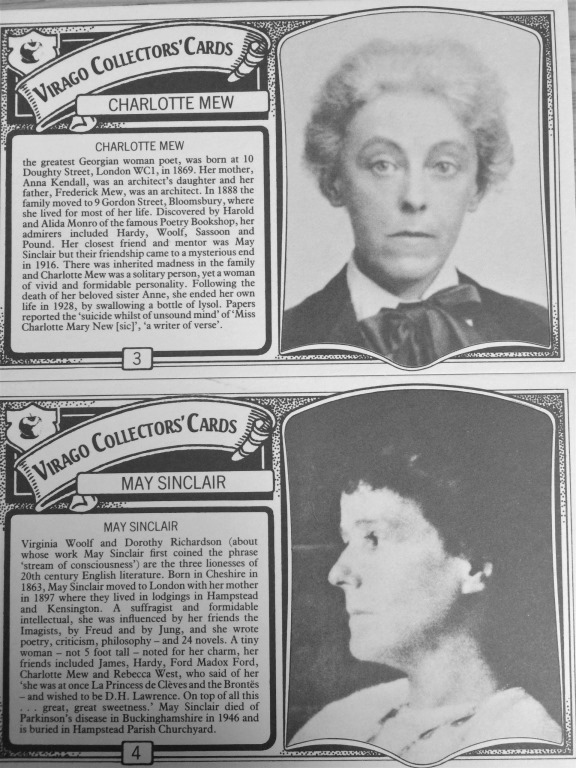
A Lioness Comes to the Capitol, or ‘Shipping the Poets. At least by the accounts I’ve read, Mew and Sinclair’s relationship was more troubling than these trading cards have room to recount. The “sudden end” involves May unexpectedly chasing Sinclair around a bed
9. The Trees are Down. The same 1920 book that mentioned Turner had considerable praise for Charlotte Mew, who’s become a personal “talent deserving of greater recognition” cause for me this year. You can see some similarities to Emily Dickinson, Thomas Hardy or Christina Rossetti in Mew, but she’s got her own sensibility that immediately stood out as I started to read her work. She seems to have been an eccentric person in her life, but one of the joys of art is that different often attracts. This one’s a surprisingly modern meditation on a group of urban trees and spring. I liked what I was able to do with the bass and guitar parts following each other as Dave’s piano playing filled up the middle of this LYL Band performance.
8. Archaic Torso of Apollo. Even though he wrote in German, Rainer Maria Rilke is, on the other hand, well-known even to English speakers. There’s a spiritual/philosophical element to his writing that seems to attract many seekers, whatever language they read him in. Several translators have tackled transmogrifying this poem from German to English, but I try to do my own translations here.
In the process of doing this project I find I have to dig into the words I use and try to figure out what they’re asking for in terms of music and presentation, but doubly so when I attempt translations to English. I’m not sure how good I am at the translation task, but it’s a very intimate experience, trying to see, sense and think like another poet. I highly recommend doing your own translations to poets seeking to stretch their literary muscles.
Musically I spent even more time than usual on getting the drum part right, as the opening of my performance is all spoken word over percussion.
I’ll be back next with numbers 7-5 in our Top Ten Winter Countdown.
As we were going to school this morning, my son and I were listening to reports from the South by Southwest event in Austin this week. The guy on the radio was explaining that while SXSW has broadened over the years, it’s still the place to go for Alternative Music.
“I wonder where you go if you’re looking for an alternative to Alternative Music?” I asked out-loud. Not the most original thought, but I’ve never liked labels even though we all use them.
My son—who’s reminded me for several years now that he is not a Millennial—replied “Well, I only listen to lowercase!”
Proud of that boy.
Well of course, Alternative Music or Indie music, or whatever you call it isn’t really a Millennial thing. It’s more of an outgrowth of Generation X* in the last century. And that in itself was just the next name stuck on whatever Dave and I were doing 40 years ago when someone thought Punk was the label. And then, scratch-off the sticky paper from a Punk from those days and most likely you’d find someone who was once a young Hippie. And Hippies were just kids that Beats thought hadn’t wised up yet.
I don’t know all that much of what Ezra Pound thought of the Beats, but I recall in the 1950s Allen Ginsberg wrote Pound in St. Elizabeth’s hospital where he was serving his commitment as crazy, the alternative to his prison cage for WWII treason.** Ginsberg later met him in 1967 and Pound sorta-kinda apologized for the—you know, anti-Semitism and stuff.
But back in 1913, before either world war, Pound was trying to figure out modern poetry in English. If it would be, what it should be. He had some materials to reuse: medieval vernacular poetry, classical Chinese and Japanese poetry, some of the modern French poets, and he wasn’t the only smith at the poetry-forge either, Brits T. E. Hulme and F. S. Flint were working at this too.
Late 19th Century English poetry tended to be enwrought in the cloths of heaven, lofty abstract metaphors and repetitions of what were considered the usual Romantic poetic sentiments. Those poems sounded poetic, sure, but were they? But if so much of that was thrown out, what would be left, what could replace that?
In such a mood, in such preparation, Ezra Pound stepped out of a subway station in Paris. Something in the urban crowd he saw there struck him and he wrote a modest 30-line poem that is unknown to you and me. Pound did not like his 30-line poem. It may have sounded poetic, it may have looked poetic, but it seemed false. He wrung out the false and the result was two lines, the famous Imagist poem “In a Station of the Metro” that begins “The apparition of these faces…”
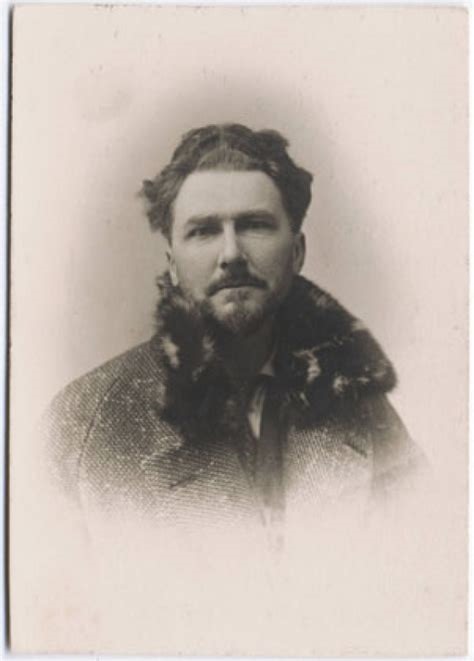
Ah dude, nice marmot! The young Ezra Pound
I’ve used an excerpt of an account that Pound published three years later about his experience and aims in creating “In a Station of the Metro” to begin today’s audio piece. I sometimes think of Pound as gruff, inward looking, full of unusual words and quotes from various languages I do not speak, a portrayal of a learned hermit that both of us want to leave alone. But if I’m to take him at his word as he tells this story, he is the transit-riding 20-something Pound, struck by ordinary daily beauty and not wanting to betray it with ordinary poetry.
What do the 14 words of “In a Station of the Metro” tell us? It’s spring—for tree blossoms, like Meng Haoran’s famous short Chinese poem, are the central image. Perhaps there’s been a rain-shower while Pound was in the subway. He climbs up the stairs and unexpectedly the faces in the street are not cast down out of the no-longer rain. Perhaps the sun is peeking through. They are beautiful without saying, as blossom flowers are. As blossom flowers are, some would have been knocked down by rain, some nourished, and none will be even spring-forever.
To hear my performance of Pound’s account of how he came to write it, followed by the poem itself, use the player below.
*Has anyone fully blamed Billy Idol for that name? Idol claims he took his first band’s name from a 1950s book, but conceptually I’ve always wondered if Richard Hell and his song “Blank Generation” was the fountainhead.
**Pound had remained in Italy where he had settled before WWII. Enamored of various esoteric theories he thought congruent with Italian Fascism, he recorded radio broadcasts which were characterized as propaganda for the enemy during the war. Captured after the fall of Mussolini, he was at first imprisoned as a traitor in an outdoor cage.
I don’t have much to say yet about Genevieve Taggard, who wrote the words I perform today. Unlike (for example) Jean Toomer she’s not one of those writers who are only names to me, because until this month I’d never heard of her. I came upon Taggard reading John Dizikes’ Love Songs, a lively group biography of nine women in the poetic milieu of New York City during the first part of the 20th Century. I’m only halfway through the book, and he’s starting to tell about Taggard.
Genevieve Taggard
I’m told that, like Millay and Teasdale, Taggard began writing with a nuanced eye about love, that subject that combines not just desire and it’s thwarting, but also easily branches into the nature of relationships between people. I have so far read only two or three of Taggard’s poems from this era, but overviews of her career mention that after the Great Depression and the rise of Fascism, she was one of the writers who moved to direct political engagement on the leftist side, which in the ‘30s in the U.S. most often meant alignment with the Communists.
Taggard died fairly young in 1948, and her career never reached any heights to fall from. As it was, the second half of that century that I share with her was not very kind to many of those who made that move. For some their Red past was overlooked if they themselves acted as if they had overlooked it too. Some recanted their former beliefs, and of course there are reasons one might do that.*
Why would this harm an American artist like Taggard who didn’t live until the rise of an anti-Stalinist and non-Soviet Union aligned New Left? This was the era of the New Criticism, which took the stance that politics was an inferior non-Parnassian and transitory arena compared to art, and besides many of the New Critics “private” political views were conservative. Poor Taggard. Writing about love was considered a minor poet’s subject, the sort of thing non-serious women were prone to do, but leaving that and engaging in party-line political action wouldn’t gain anything from New Criticism either.
None of Taggard’s work is in print and I may never get around to finding, much less reading, her politically engaged work, so I can’t really speak to its quality.**
I figure I’ve just lost half my readers now, and I’m unsure why I brought this up, other than when I read “Everyday Alchemy” at the end of a chapter in Dizikes’ book, I was transfixed. Is this a political poem or a love poem? This is a poem that is both heartfelt and sharp in its analysis. Like much great art it’s balanced on razor’s edge, one half clear-eyed on the unfairness of the emotional burdens placed on women by men, and one-half equally sure that society gives poor and working-class men no other peace. In eleven lines Taggard speaks volumes on this. It’s nearly 100 years old, yet has it outdated? As poetry it works well too, ringing word-sounds via consonance and assonance, fragmented phrasing in a relentless dance. This is what it sounds like when doves cry.
If you’d like to read along while you listen, here’s the text of Taggard’s poem.
When I say a love poem can be as complicated, as analytical as any, “Everyday Alchemy” would be a great example. I’m told the 1930’s Taggard considered most of her early poetry about love as a mistaken focus after she moved on to her later political stuff. However, observers note that this poem, published in her first love-poem book For Eager Lovers, was reprinted again in her reputedly socialist realist volume Calling Western Union in 1936. This poem works both ways.
Here’s my performance of this remarkable poem, available with the player gadget below.
*This is a complex story, and I’m skipping over so much history and passion here, but it’s one of those things that is impossible to summarize adequately in a couple of sentences.
**I am seeking to get a hold of her 1930 biography The Life and Mind of Emily Dickinson via my local library system however.
I’m sure many readers here are enjoying spring or its imminent promise. In Minnesota, not so much. It was 4⁰ F. when I awoke this morning, and everyone is already flinching for another snow-storm due this weekend. So let’s have one more winter piece, this time by Wallace Stevens from his landmark collection Harmonium, “The Snow Man.”
Not the first sign of spring.
Over at the Interesting Literature blog, Oliver Tearle reminded me that Stevens was influenced by John Keats as a younger man, and in his reading of “The Snow Man” he has Stevens’ poem as a statement of his break from that youthful connection. Keats, and the romantics of his sort, were great fans of the pathetic fallacy and have no shame in ascribing to any landscape or natural object feelings and personality that the poet can address.
Even if we think that talking Keatsian nightingales bearing messages is an absurdly old-fashioned trope, we’ve never left the idea that weather or a landscape is supposed to mean something. Book, movie, poem, song video—if we’re given a bleak winter picture we’re usually led to understand that death, suffering, despair, scarcity, loss, or the like is what’s being conveyed.
In “The Snow Man” Stevens describes a winter scene. Snow-trimmed trees in an icy wind which is carrying refracting snow crystals. Stevens’ conclusion from this is ironically—well there’s no other way to put it—cold. We’re not supposed to draw any meaning from it, other than meaning-free is-ness.
It just so happens, that Keats wrote his own short lyric poem about winter “In the Drear Nighted December.” And yes, there’s immediately an emotion attributed to a bare-branched tree wind-whipped by sleet and then to a frozen brook in Keats’ poem.
What’s that emotion? Happy.
Woah—why happy? Because Keats has these landscape features also in a state of simple is-ness. They reckon no loss from summer, know no delay ‘till spring.
Keats Buddhist koan is “to feel and not to feel it.” Stevens, “Nothing that is not there and the nothing that is.” These two poems approach in seeming opposition, but merge in agreement.
A Modernist sculpture of American poet Wallace Stevens
One other thing in “The Snow Man” to note: where’s the titular snow man? Perhaps including one in Stevens’ scene would add a connotation of jolly play, or the impermanence of artistic making—but if that’s so, why call the poem “The Snow Man?” Could it be a mind trick, the equivalent of instructing “Imagine a winter scene, but I don’t want you to see a snow man in your imagination. Make very sure you don’t even think a little bit about a jaunty snow man or an elaborately constructed one now melting…?” Tearle’s solution is that the snow man is the speaker of the poem, the “nothing that is” there, the cold observer that we don’t see because we’re looking from his cindered eyes.
Here’s a romantic poem by William Butler Yeats, in both senses of that word. “He Wishes for the Cloths of Heaven” is Romantic in the literary and artistic sense in that it seeks to reconcile personal emotional experience with some sublime otherness through imagination, and it’s romantic in the sense that the poem takes a courting stance, that it’s an expression of love for another.
Yeats is one of those “bridge” poets who did substantial work in both the 19th and the 20th centuries. Always fiercely lyrical, he was able to recast his poetry so it continued to be read into the Modernist era. This poem, though written in the 19th century—and proving it by using an entirely antique word “Enwrought” to start off its second line—remains in circulation as some lovers still recall its ending.
It’s a short poem, only eight lines, so it can’t waste time.* The first four lines are devoted to a nicely rendered image of the sky and a richly embroidered cloth, the sort of thing that would indicate high fashion when it was written. Of course, this is self-consciously an image on the poet’s part, he acknowledges that he’s made it as poets make images, as a new way to apprehend reality.
Oliver Tearle, over at the always Interesting Literature blog, points out that prime English Modernist T. E. Hulme made his own version of this sky/cloth image only a few years after Yeats when he wrote his “The Embankment.” Hulme saw himself as setting out to overthrow Romanticism, and I’d suppose it’s possible that he could even have been thinking of Yeats’ poem as he created his different one. Considering the two poems together makes for an interesting contrast.**
After those first four lines, Yeats goes on to reference something that was once a widely-known tale—just as untrue, but just as commonly known as Washington copping to chopping down the cherry tree. In the English mythical tale, Walter Raleigh, acting as a paradigm of Elizabethan courtly love and devotion was said to have taken off his expensive cloak and laid it over a muddy spot on the road so that Queen Elizabeth wouldn’t soil her royal footwear. And so it is that Yeats says he’d make this beautiful image and then allow his beloved to trod all over it.
Yeats’ poem enwrought by sculptor Jackie McKenna in Drumcliff Ireland. Photo by Eric Jones.
There’s also something more here than just self-abasement or Yeats’ confidence in his brand of detergent: by saying he could put the plane of the heavens underneath his beloved, he’s also saying his poetry could take her to Heaven. But blink and you’d miss that implication.
Yes, the closing three lines are the poem’s best remembered, still quoted by those who have put themselves in the danger of love, or the danger of love refused. Romantic and romantic, and like most anything by Yeats, it just sounds so good! I performed it with acoustic guitar, electric bass, and a bevy of woozy keyboards, and you can hear it with the gadget I have spread below under your feet (or finger or mouse). Click softly.
*Here’s the text of the poem for those who like to read along. When the poem was originally published, Yeats used a persona as the poem’s speaker. Aedh was a kind of John-Keats-besotted nebbish character from what I read, and in doing so, Yeats is hedging his bets on the poem’s Romanticism, kind of a “I’m just asking for a friend” deal. When he included the poem in later collections, he dropped the persona.
“Papa John” Kolstad worked to arrange at least one more Midstream poetry reading event tonight, as a remembrance and continuance of the series run for the past six years by David Shove who died at the turn of this year.
I know this blog has a good number of Twin Cities Minnesota readers, but even locally the Midstream series was a less-known-than-it-should-be thing. Best as I can tell, three things made it special: David Shove himself, who had a beautiful offhand way* of presenting a wide-ranging group of poets and writers; the space itself, a large second floor room full of clutter that says unpretentious and informal;** and the upper-Midwest kind of poets, who have a tendency to community feeling, a sense that they, their poetry, and their readers/listeners are all in this together.
Community Feeling. Some of the folks gathered to remember David Shove tonight in Minneapolis
Therefore, even though the event occurred with the palpable absence of David Shove, it still felt part of the series—and not just because absence is a kind of presence. As it sometimes does, the reading opened with some music—tonight, Kolstad on guitar and Richard Terrill on saxes performing some jazz as folks wandered into the room from the trench warfare of our most recent eight-inch snowfall. Then sixteen people with various connections to David and the Midstream series spoke of him, often concluding with a short poem.
I was one of those, perhaps the one who knew David less than any of the others. I only knew him from the reading series, but that was still a something. Yes it was. I did an off-the-cuff reading of the Wallace Stevens’ poem “To the Roaring Wind” that I had posted in a musical performance here last month when I first heard of Shore’s death.
Here’s a player gadget to allow you to easily hear that performance of “To the Roaring Wind” from January.
*Shove as a presenter had a slow, dry way of speaking that the first time you saw him you might not think much of it. Then the next time you’d notice the method of it, and the third time, the art of it.
**The decor of the room I think is the unstoppable flotsam of past enterprises run out of the room and Kolstad’s own intended collage sense. Part Marcel Duchamp and part Daniel Kramer’s “Bringing It All Back Home” record cover.