An Arbor Day during National Poetry Month

Today is Arbor Day, a curious holiday, born in the American Midwest, meant to celebrate and cultivate trees. It’s more established than the uncounted more recent designated days, special weeks and “National Months” like Poetry Month, but its observance is spotty.

Birdsey Northrop

Wikipedia says this is someone named “Birdsey Northrup” who helped popularize Arbor Day. Since this isn’t April Fools Day should we believe that?


I can’t say I remember and keep it myself, though I’ve always had an attraction to trees. I remember an old tree with exposed root tops outside my earliest remembered childhood schooldays, its roots large and far enough apart that we small school children would sit between them as if it was ground-level-low bench with bark covered armrests. And I remember forgetting where the tree was, like the location of Eden is forgotten, and being unable to locate it even only a decade or so later. That tree is no doubt gone, as many of those school children are gone by place of current location or end of life.

The backyard of the house I grew up in had four large walnut trees, majestic if a bit messy when the nuts fell, littering the ground like a green elfin golf-driving range. I remember that a major branch of one of them had a full long-handled scythe, like the grim reaper’s side-arm, crooked in a joint above anyone’s head or reach, it’s blade now being held in the teeth of the bark which had healed its wound. This I noted as a child, long before I thought to write, or write poetry, and it exists in my memory like a poem that doesn’t need to be written because it just was.

When I was looking for the house I live in now I wanted a yard with trees, which it has. The largest is outside the window as I write this, being old as a tree is and budding like the geriatric Sarah. I note that when Sarah’s husband Abraham met the three angels who told him that he, 100 years old, was to have son with his wife of near the same age, that he met these angels and heard this news under a great oak tree. Abraham, being a patriarch, and therefore by definition part of The Patriarchy,  had his wife get busy making a quick meal for the angels, who as divine beings might not need earthly bread and could have said to Sarah, “Oh, don’t bother, we’ve already eaten.”

Anyway, in what is surely the strangest conversation with angels in a book of strange things, Sarah, hard at work on whatever quick-bread recipe that an antediluvian Epicurious might provide is said—right there in the first book of the books of Moses, the Holy Bible, in Genesis 18, in father Abraham’s tent—to have laughed.

Now the angels—who knows here what angels know—might have figured that Sarah’s laugh was the wisest thing they’d ever heard from a mortal, but it doesn’t say that in Genesis. Yes, it’s revered by many as a holy book, so the author may have figured he’d do something subtle here—or maybe it’s a blunder by a non-inspired editor somewhere down the line. Genesis just has Abraham being told they heard that laugh. Do angels joke? Did one of them wink to the others? Do angels wink? And then, to wind up the old geezer Abraham, who knows they’re angels, and is doing all he can to show how well he treats divine messengers who might only appear to be strangers who’ve wandered up to his tent, the angel looks Abraham in the eye and tells him “We heard Sarah’s laugh you know.”  The term pregnant pause was invented then I think.

giovanni_andrea_de_ferrari_-_abraham_and_the_three_angels

“I dunno, should we threaten to give him a bad Yelp review or something?” Sarah and Abraham with the 3 angels. Oak tree not pictured.


I don’t know what kind of pants folks wore in those days, if they even wore pants at all. If they did, let’s hope Abraham was wearing an old, brown pair. A divine being has just implied that your wife has been impolite, maybe even blasphemous. Genesis has other stories about what happens when you don’t treat angels right.

And 90-something Sarah, who’s just been told she’s about to become pregnant at that age, Sarah who laughed, quickly looses her wisdom—as we mortals who may find wisdom in a moment only to loose it in the next do—and she tells the angels she didn’t laugh. And the angels just said back, like trees do when we laugh beneath them, “Yes, you did laugh.”


No new audio piece today, but I hope to work on the next part of our National Poetry Month serialization of T. S. Eliot’s “The Waste Land”  this weekend. Here’s a fairly recent piece that’s in our archives along with over 300 other ones, one that seems right for Arbor Day: Charlotte Mew’s “The Trees are Down.”  You can read more about Mew and the poem here, or the full text here. But to hear the LYL Band perform it, use the player below.


Angeline Palmer

Here’s a story. You can decide for yourself if it’s a sad or happy one.

It was a spring day in 1840 in a town in rural Massachusetts named Belchertown. For children you might expect that would be a fine day for play, but that’s not what this story is about, though it is about a child, one with a beautiful name: Angeline Palmer.

Angeline was a poor orphan and ten years old. Playtime was not on her mind. About a year back, the town poorhouse in which she’d lived since she was two years old had bonded her out as a servant to a prominent family in Belchertown. The town’s council ran the poorhouse, and Angeline was their ward legally, but such arrangements reduced the cost of running the almshouse.

I can’t be sure what work a nine or ten-year-old servant performed in those days in that place, but of course there were no appliances, and in rural towns there were not even stores stocked with things we might buy to save a household from having to make them. Households then were very labor intensive, so there must have been work for Angeline.

A servant like Angeline might dream of a better life on a spring day. Some would learn trades in household service that would allow them to start their own businesses. Or they might marry and start households of their own, where even if their lot would be the same sort of household work, they’d be servants of their own.

But Angeline wasn’t dreaming of a better life that day. Instead the future looked ominous. The man who owned the house was now staying in Georgia, looking for new business ventures. He had sent his wife all the way to Massachusetts to check on things at his house in Belchertown, and while she was there, a letter arrived. The letter had instructions for raising some money for his new business: ship Angeline Palmer down to Georgia. The letter figured she’d be worth $600 cash sold as a slave there. That’s about $17,000 today.

You see, Angeline Palmer was Afro-American. She was an orphan, poor, a servant—all things that limited her life, but she was free.

Servants in the house heard this letter being discussed, and quickly sent news of it back to the town where Angeline had been born. She had a half-brother there, Lewis Frazier, barely more than a teenager himself, he arranged a delegation to the town’s council, the men who were by law Angeline’s effective parents. The council wouldn’t take action.

Angeline was allowed to return to Amherst to say goodbye before the trip to Georgia and slavery. Her Grandmother was a servant at the home of the town’s postmaster. She asked him what could be done. Alas, the postmaster was the brother-in-law of the wife who’d been sent the letter. Instead of stopping this, he warned the Belchertown people that someone might be trying to stop the shipment of Angeline.

The postmaster worried someone might try to interrupt Angeline’s trip back to Belchertown by the scheduled stagecoach. Figuring they’d try something on the open road, he hired a liveryman to take her back by special wagon over a different route.

The postmaster was right. Angeline’s half-brother and a friend did flag down that stage, and of course Angeline was not on it. Slowly the pair walked back to town, sure that they’d failed.

But the liveryman had a servant too, and he knew the slower roundabout route the liveryman was taking back to Belchertown with Angeline. The town’s butcher loaned the liveryman’s servant a wagon and the now trio of rescuers sped off to Belchertown.

Despite the liveryman’s slow route, Angeline was already there, back in the house where she’d been a servant and from where she’d soon be shipped off to slavery. There was no time to waste, no one left to appeal to. Leaving the other two in the wagon, Lewis Frazier rushed into the house and found Angeline. Those in the house quickly reacted, and locked Angeline and her would-be rescuer in a room.

The other two men who’d raced from Amherst then left the safety of the buggy, ran up the stairs, pushed aside those trying to stop them, opened the door and took Angeline and her half-brother back down the stairs to their borrowed buggy. A crowd was beginning to form. Angeline and the three men didn’t wait to see what they might do, whipping back out of town as fast as their team could pull.

Angeline was secreted out of Amherst to an underground railroad safe house. Lewis Frazier and his two accomplices were arrested and charged. Though they’d stopped the fraudulent theft of a human being who would have been turned into property, who would have been owned along with her offspring, and bought and sold like livestock, the trio was charged with assault and kidnapping. The evil scheme of the man in Georgia was beyond the local court’s jurisdiction, and besides the three men had prevented that crime.

I don’t know how Belchertown looked upon this matter, but some in Amherst seemed to support the rescuers. Amherst’s most prestigious lawyer defended the trio of Afro-American men at the trial. That lawyer’s name was Edward Dickinson. Dickinson had a red-headed daughter, only a year older than Angeline Palmer, and her name was Emily Dickinson, who later would become known as a poet. Despite Dickinson’s efforts, the trio were convicted. They were given a sentence of 3 months, but it would be stayed if they would reveal where Angeline was hiding.

The dutiful trio didn’t take that deal, but the jailer seemed to be another who sympathized with them. While they slept in the jail at night during their sentence, he granted them liberty each day, and it’s said that townsfolk brought them gifts of extra food. The three men gave up some of their liberty for a short time but prevented a life of slavery.

So, what happened to Angeline Palmer? After a decade had passed, she returned to Amherst and married a relative of one of the men who had rescued her. She died, likely in childbirth, a few years after that. That may sound sad, but that was also the ordinary risk of a free woman living a married life in that time. They’d tried to steal her away and make her a slave, but a network of servants and three African-American men who cared for her risked all to prevent it. So, is that a sad story or a happy one?

For today’s audio piece, here’s my reading of Robert Hayden’s poem “Frederick Douglass”  about a man who stole his own freedom. Thanks again to the publisher for permission to perform this. “Frederick Douglass”  is Copyright © 1966 by Robert Hayden. From COLLECTED POEMS OF ROBERT HAYDEN by Robert Hayden edited by Frederick Glaysher. Used by permission of Liveright Publishing Company.

My chief source for the story of Angeline Palmer is this blog post by Cliff McCarthy of Belchertown. The web site that includes that post has  other stories about Afro-Americans in Emily Dickinson’s time and region.

The player gadget for my reading of “Frederick Douglass”  is below. The text of Hayden’s sonnet for those who wish to read along, is here.


Are Song Lyrics Poetry? Part Three

In the first two parts I’ve tried as briefly as I can to outline two things surrounding this issue. In part one, I surveyed how poetry moved from an ancient form performed with music to a modern form most typically associated with printed text on a page. In part two I looked at the surprising result of a political decision made in the 1930s that led to a rich cultural mix being encouraged to compose music for non-commercial purposes linked to folk music. 25 years after this decision, a singular singer-songwriter linked that idea with many of the discoveries of Modernist poetry and revolutionized what song lyrics could do.

These two things, the move of poetry away from music and performance in general and the move of song lyrics to utilize all the elements pioneered by the Modernist poets naturally bring this question of “Are these lyrics poetry?” to the fore.

I’m going to try (again as briefly as I can) to deal with the issues brought up by this question. Before I do, I’ll spoil the suspense: I believe song lyrics are poetry, even though I agree to some level with the objections to that idea. On one level, a matter of definition, it ought to be simple to agree: the argument isn’t really that song lyrics aren’t poetry (or that various kinds of performed poetry aren’t poetry) it’s an argument that those things aren’t (or aren’t very often) any good as poetry. As I argued here a couple of years back, “not so great poetry” isn’t worthless, and I doubt the arguments that not so great poetry harms those poems we feel are greater or more accomplished.

What are those objections?

Without music or when printed silently on the page many song lyrics, even effective ones, seem much less effective. It may be 20th century comedian Steve Allen who originated the gag where a pop music lyric is intoned as if it’s a deathless ode.  Laughs ensue. Allen liked to remind us that he was a songwriter and the author of serious books, but here, for the bit’s sake he’s showing us his skills as a performer. The unintended air of seriousness is incongruous to the material, he leans hard on the choral repetitions—which are used in poetry, but are used much more often in sung lyrics—and any infelicities in songwriter Gene Vincent’s words that we might ignore in the flow of Vincent’s performance get a raised eyebrow in Allen’s. A performer could do the same to “The Waste Land”  or Emily Dickinson and make it ludicrous. And Bullwinkle J. Moose could present the once worthy Longfellow for laughs too.


“Drink in the simple beauty and the profundity of the sentiment…Skitch…”


Context is important in art. “The Waste Land”  gained part of its launch velocity because of the trauma of WWI and because the Modernist movement was primed for a weighty masterpiece. But context is even more important in performed work, “Be Bop a-Lula”  is designed to be heard sung with music.

Allen was taking a jazz-snob swipe at rock’n’roll. Here he is providing appropriate context for Jack Kerouac. “In Iowa I know by now the children must be crying in the land where they let the children cry.”


That if considered as poetry, using the same criteria a critic would apply to poems, many song lyrics fail to meet those criteria. Well, a great many poems that have never heard a note sounded beside them probably fail those criteria too. There are arguments that complex song lyrics fail because  they are performed which I deal with below, but I ask: how sure are you your criteria are universal? When folks argue that Kendrick Lamar or Bob Dylan are bad poetry they are almost never arguing “Well, they just don’t work for me.” Instead they maintain that those who feel they do work have been duped or lack the intelligence and skills to appreciate something they posit as more worthy. How many Modernist, now cannon-resident poems, met the criteria of 19th century poetry? Did the Modernists forget how to be modernists? What part of “Make it new” did we forget?

The more I look at poetry, the more I’m surprised that a great many ways of “making poetry” seem to work. I’m pleased by that discovery, while I suspect the criteria people coming across the same discovery would be somewhere between puzzled and disappointed.

When folks answer this question by pointing out ways that song lyrics (generalized in some way) are different from poetry (generalized as well), I often wonder just how narrow their generalized view of poetry is. Poetry expresses itself in so many different ways even without leaving the page. The differences between how Du Fu’s “Spring View”  and Eliot’s “The Waste Land”  allow us to feel somewhat similar responses to similar situations are immense, larger than the differences between “The Waste Land”  and Dylan’s “Desolation Row.”

Complex poetry cannot be appreciated in performance, much less with the distraction of music. I’ve dealt with this briefly elsewhere in this series, but we also need to ask: is complex, analytic, response always called for? In every other art-form I can think of, we allow for various levels of involvement with the art. Because complex poetry can reward deep examination, must it always be approached in all times and places by all people in that way? Audiences differ in their need to understand immediately. “Be Bop a-Lula”  is designed to be absorbed with immediacy as expression and as a series of pleasing sounds. Donald Glover’s “This Is America”  isn’t, and indeed it’s designed to make you question your pleasure in a text that works like “Be Bob a-Lula.”  What the Bob Dylan revolution proved (regardless of how you rate Dylan) is that audiences will accept complex and unconventional expression in song lyrics. Not every hit song has complex lyrics, but complex lyrics can be a hit song.

If lyrics were good in the way complex poetry is good, that’s immaterial or it may even detract from the music which is the main thing an audience wants from a song. Yes, audiences come to songs for various reasons. Have you never loved a song for evolving reasons? With page-poetry I have certainly been attracted to a poem because of the way it sounded, and that pleasure indicated I might want to stick with it a bit (or re-experience that sound-pleasure) to see what else it might be expressing.

Sure, the ancients performed poetry with music, but that was a primitive solution. Literacy and mass-distributed printed matter is a better medium for poetry. I’m not sure about this. I agree that printed poetry allows for a different experience of the text. Alternate reader here Dave Moore has reminded me that it’s helpful if I provide access to the text of what is performed here. Good point! But the Parlando Project is in part a big experiment to see what works if various kinds of poetry are performed along with various music in various ways. I expect to fail, and I expect to succeed.

Speaking of success and failure, if you’re still here, I appreciate the time and attention you have given to read this. I’m both apologetic for its length and its brevity. Here’s a short audio piece, my translation (with a slight 21st century American adaptation I couldn’t resist) of that four-stanza poem that Du Fu wrote about the trauma of a broken country in springtime, the “Spring View”  I mentioned above. Here’s a more literal translation of the text. The player for my performance is below.


Hitch Your Wagon to a Star

As we continue to celebrate National Poetry Month here, I ask your indulgence—today’s piece isn’t based on a poem. Earlier this week I did use a Ralph Waldo Emerson poem, mentioning then that his poetry often fails. Well, there are compensations—as an essayist, Emerson often expresses himself poetically.

Today’s piece is part of an Emerson essay published in The Atlantic in April 1862 called “American Civilization.”  In it Emerson ranges quite a bit, including some racial and regional stereotyping that may shock some modern readers with its ignorance and prejudice. But rather than concentrate on what Emerson got wrong—after all, I don’t need to go to 150-year-old writing to find that sort of thing, our own age will supply all we’ll ever need—I want to present to you some things that Emerson might have gotten right.

I’ve selected a handful of sections from Emerson’s essay for today, the parts of the essay that strike me as if they were a poem. I call my extracted text “Emerson’s Wagon,”  in that one of the phrases it popularized became a pervasive folk-motto: “Hitch your wagon to a star.”

What do you think that means when you hear it today? Most likely you think it means have high ambitions, aim for success not mediocrity, that if you only make it half-way you’ll still get farther than if you’d set your sites lower.*

If so, you may be surprised to hear how Emerson meant that phrase. Indeed, the whole argument Emerson makes in today’s piece is a subtle and surprisingly contemporary one.

Ralph Waldo Emerson at desk

Emerson wondering if his essay will go viral—wait—can something go viral on the telegraph?


“Emerson’s Wagon”  starts by telling a technology story. While he’s speaking about the telegraph, a recent marvel of his time, the metaphor here could just as easily be applied to the Internet on which you are reading this.**  In this metaphor we meet the essay’s first wagon, and it’s, well, stuck and broken down. He points out technology has found a way to get around that.

OK, nice story. Interesting contemporary parallel.

Then mid-19th century Emerson starts considering renewable energy. A couple years back I was talking to someone about that very subject and he mentioned Massachusetts had fewer resources than some other parts of the U.S. for that, which I found ironic, because Emerson’s 19th century Massachusetts was leading the country in exploiting water and tidal energy for industrial power.

Here is Emerson’s second wagon, the first one he hitches to a star. He’s not talking about personal advancement particularly, he’s talking about harnessing nature’s renewable power, and working with it to improve our civilization.

Now his technological story is getting more interesting. How many times have you heard of nature and technology portrayed as opposites? Enough that you may think that technology inevitably destroys nature, or that technology is replacing nature, and so on?

Emerson’s asking you to think of technology (and also nature, as we’ll soon see) differently. Technology comes from close observation of and analysis of the powers of nature. And in concert, the book of nature can tell us something about how to use and deploy technology, and how we should share the bounty of that.

Finally, Emerson goes somewhere you probably won’t expect. His third wagon*** says that moral principles are natural principles (and vice versa). We moderns may have some doubts about this, but it was part of the Transcendentalist ideals that Emerson and his fellows believed. From that equivalence, he says that for American civilization to succeed, for us to fix those broken and stuck in the mud situations like that first wagon, we must align ourselves (if we wish to make change) with the moral principles of a nature that spreads over all and gives benevolently. To do so makes us more powerful agents of change that cannot be defeated in the long run.

An interesting thought for a time of lies and behavior that isn’t pulled forward by the tides of heroic stars, that instead aims at the lower level of personal enrichment defended with the muddy shield of not-quite-legally-indictable.

To hear me perform Emerson’s story of three wagons, use the player below, and electricity will transfer it to you in its invisible pockets. To read all of Emerson’s essay, you can find it here.


*It was a phrase my mother would use, and in this sense too. She raised her large and different family whose members did different things, so maybe it has some value used in this way as well.

**The “invisible pockets” he has the telegraph carrying data in so easily become the “packets” that have flown through TCP/IP routers to bring this post or the accompanying audio file to you. Did you know that some of the savviest conceptual thinking about how the Internet works can be expressed via carrier pigeons?

***As he once more returns to the line “hitch your wagon to a star” Emerson eventually reels off a list of constellations named after heroes. You might be thrown by the first one on his list “Charles’ Wain.” I’d never heard of it. Turns out it’s another name for the Big Dipper. Wain is a Middle English word for, yes, wagon and together Charles’ Wain sort of morphs into the name of legendary king Charlemagne.

Limited

Isn’t it odd that early 20th century Modernists used the locomotive as one of their talismans? After all the railroad train wasn’t particularly new at the time, though like buildings and the airplane it eventually became a fine armature upon which to sculpt the curved Streamline Moderne style—but that was later in the century, and before it arrived the train was already the nightingale of the make-it-new crowd.

Modernist Trains

“…Shining, just like gold. Don’tcha hear me cryin? Ah Wooo-Hooo,,,”


It probably comes down to speed and power. Much of America in the pre-1920 years was still held between walking and horse-saunter speed, trains were exceeding the magic mile-a-minute rate, a supersonic difference to then. The sight of a long train rolling through the countryside must have been a majestic contrast of speed, noise, and human-constructed momentum.

Even back in the 19th century, the father and the mother of modern American poetry each wrote a train poem. Walt Whitman with his somber “Locomotive in Winter”, and Emily Dickinson* at her most playful with “I like to see it lap the Miles.” The strength of the train ideal is such, that without motion or even presence its gravity is silently impressed onto two classics of early 20th century poetry: “In a Station of the Metro” and “Adlestrop.”

Even poets later in the century could have a train poem in them somewhere.

Pioneer Zephyr and Chicago 1933-34 World's Fair

Limited. Shortly before he died, my father told my son and I that he recalled one thing from his childhood visit to the Chicago Worlds Fair in 1933-34, the Zephyr streamlined train. That year we visited it, exhibited in the Chicago Museum of Science and Industry and sent him a picture of us by the train.


But today I want to celebrate Carl Sandburg during America’s National Poetry Month, and to advocate once again for this forgotten Modernist, the son of an immigrant, born in the Middle West of our continent. The poem I use today isn’t particularly difficult or full of samples and beats from everywhere like “The Waste Land,”  or subtle in its questions like much of Emily Dickinson. Sandburg gets into it, drops its Imagist payload in a sentence, and then makes its point. As Harriet Monroe said in reviewing Sandburg’s Chicago Poems,  in which “Limited”  appears: “His book, whether you like it or not, whether you call it poetry or not, is fundamental in the…majestic sense.”

And a poem like “Limited” is  fundamental. What it says isn’t novel, but what it says is low enough down beneath our florid lives to be overlooked. We often ask great poetry to tell us something we don’t know, to surprise us, but there may be a place for it also to tell us something to which we can say, dismissively, “Well, yes, I know that!” and for the poem to remain, silent at its ending, saying “If you know that, why haven’t you acted like it’s something you know?”

20th Century musicians loved the train too and its rhythms, that rattling phrasing and doppler marcato. For this performance of “Limited”  I tried to touch on that and let some guitar tracks run out. You can hear it with the player gadget below. Not a long text today, but for those who like to see as well as hear the words, click here.


*One of the interesting side-lights I picked up in Genevieve Taggard’s Emily Dickinson biography, one of the first full-length treatments of her life and work, and written early enough that she could talk to people who overlapped Dickinson’s life in Amherst, was that her domineering father, who looks so stern and austere in his photograph was well known in the community for always wanting the fastest team of horses in for his buggy. I see Vin Diesel et al in a prequel Fast and Amherst, but Drift it Slant.  Hollywood, call me, I can put the blog aside….

Emerson’s Water

Here’s another post in one of our National Poetry Month series: The Roots of Emily Dickinson. We’ve already touched on Emily Bronte, who’s fierceness inspired the American Emily; and Helen Hunt Jackson, a childhood classmate who encouraged Dickinson to publish her work.*  Today we look at a poem from the foremost public intellectual of her region and era, Ralph Waldo Emerson. We’ll see how it connects to Dickinson, and you may be surprised at how current Emerson’s thoughts about water are.

It’s difficult to think of a modern analog to Emerson. It’s not an exact fit, but Oprah Winfrey could be put forward—but that understates the level of Emerson’s pioneering in the mid-19th century when America was still seen as a backwater. Like Winfrey, Emerson’s approval or endorsement could do much to help a new writer come to the fore. Emerson’s opinions, not just on the arts, but on public culture in general, about how best to live and shape one’s own life, were widely distributed and read by a broad readership. But even if similar in fame and broad impact, Winfrey has never pretended to be a philosopher herself, while Emerson was viewed as a central figure in a movement called Transcendentalism. What is Transcendentalism is a book-length subject, but there are, within its core, beliefs in the powers of individual insight over religious authority and the desirability of a close reading of the book of nature.

Winfrey-Emerson

If it was the middle of the 19th century, the guy on the right might be your Oprah.


When I would read Transcendentalist writings more than a hundred years after they were written, in my 1960s, I would be struck with how often (if one gave some allowances for language changes) they sounded like a hippie critique of 20th century culture,** and in the half-century and more since, if I dip back into them, I find some of their focus surprisingly contemporary.

Was Emily Dickinson a Transcendentalist? I can’t say for sure, but it’s near certain that Transcendentalist ideas, particularly as expressed by Emerson, were familiar to her. His thoughts were in the newspapers and magazines she read in her lifetime. We know she had been given a book of his poems by a friend, and we know she read them, and even copied at least one of them in her own handwriting. It’s possible that she attended one of Emerson’s popular public lectures.

Emerson Poem Sacrifice copied by Dickinson2

Part of Emerson’s poem “Sacrifice” copied in Emily Dickinson’s own hand.


Emerson’s poetry rarely works well, and Dickinson is a great poet, yet in poems like today’s Emerson selection “Water”  I can see similarities between them. Emerson punctuated his poem as one purported sentence, but its syntax is impossible to follow, and so “Water”  is as fragmented as one of Dickinson’s heavily dashed poems. Incredible leaps occur from line to line with no attempt to bridge them with explanatory connections in either poet’s work. Emerson begins his poem with a striking phrase, similar to many of Dickinson’s great first lines: “The water understands/Civilization well;” but we soon meet a strange homey image of sticking a toe (or foot) in it, and Dickinson too loved to mix the universal and the mundane. Emerson’s poem develops with water personified as not having or having certain feelings, and then with little preparation we’re warned it can be the destroyer.

I think Emerson is making a very modern point here, one that he expressed also in his essay “Civilization.”   When water is respected and harnessed appropriately for its utility *** we are in harmony with nature’s nature. But, if we ill-use nature, we literally go against the tide, and water will be our destroyer.

If Dickinson was influenced by Emerson’s ideas and outlook, and if she picked up his individualist style that dares to be somewhat obscure to stay true to the individual’s perceptions, why is she so often a great poet while Emerson isn’t?

I think Dickinson makes better word choices both for sound and impact. Having “decketh,” “adoreth,” and “doubleth” as three wet dish-rags in a four-word stretch is enough to make Emerson’s poem soggy. And Dickinson has a talent for intriguing mystery that pulls us along even to places we don’t fully understand. She does that partly with her hymn/ballad rhythms which Emerson doesn’t use. Dickinson is usually more immediate too. A few posts back I stated that a poem is not about ideas, but the experience of ideas. In an Emily Dickinson poem, I’m more often able to feel I’m experiencing those ideas as the are perceived, where I feel Emerson is summarizing his thoughts after the fact.

Unafraid, I waded through the -eth words and performed Emerson’s “Water”  with my own music, and you can hear it with the player below. And here’s the text of Emerson’s poem if you’d like to follow along on the page.


*With the exception of one poem, which was published anonymously while Dickinson was alive, Jackson failed at that. Still, I think it possible that having some knowledge of her friend selecting poems for publication could have been motivation for Dickinson to create her hand-written booklets of poems which were found after her death.

**This is for good and ill. Idealistic critiques of society are important, but adventurers often take wrong turns. And idealists have a hard time figuring out viable new structures.

***Emerson’s Massachusetts led the nation in using water power for small to large industry in the 19th century. So, when the city of Minneapolis was founded largely due to it’s exploitable water power, a good portion of the city fathers had New England backgrounds. Many Minneapolis streets still bear the name of 19th century New England luminaries, including Emerson. Alas there’s no Dickinson Avenue, as Dickinson’s poems were not published until close to the end of the century.

Tiresias

Each April, as part of National Poetry Month I’ve been recording a performance of T. S. Eliot’s “The Waste Land”  and presenting it here in serial fashion. This year we’re performing the third section of the poem, “The Fire Sermon.”

When we last left “The Fire Sermon”  we were by the not-so-sweet Thames river where (as elsewhere in the poem) voices and diction were constantly changing. We don’t know who, or how many “whos,” were speaking in that segment, but the narrator in today’s section identifies himself as Tiresias. As we’ll soon see, Tiresias is as shape-shifting in body as the poem has been in voices.

Tiresias’ has many characteristics in the various mythological tales told of him. He’s able to predict the future, and he does this by studying birds (augury) and in particular by studying birdsong.*  He’s blind but is able to perceive things anyway through second sight and acute hearing. He’s said to have been given the gift (or curse) of an extra-long life. He also has the ability to talk to the dead, and in some stories talk to the living after his death. But perhaps the most remarkable part of the Tiresias story is that he was transformed from a man to a woman, and back again.

Tiresias_striking_the_snakes

Tiresias as he is transformed into a woman by Hera because he killed a female snake.


We open not with Tiresias introducing himself, but with his encounter with a merchant, who seeks some kind of meetup with the narrator. There are some who tell us the meetup locations suggested indicate that the narrator is being propositioned for a homosexual tryst. If so, this would be consistent with the closing song in the “Sweet Thames”  section, referring to heterosexual prostitutes and that section’s opening in some kind of any-affiliation “after the party” ennui by the river. And so the theme is set: “The Fire Sermon”  is going to talk about sex and what passes for love.

Now Tiresias introduces himself, and his sexual fluidity, as he begins to tell what seems at first a straightforward story: a typist has come home to her small  apartment. Hers is a low-paid job in the early 20th century business/bureaucracy, one often filled by the new “working woman.” She’s taking care of after-work household necessities, including collecting her drying laundry scattered across the room’s couch (which also serves as her bed), and fixing a meal.

Tiresias tells us he already knows what’s going to happen, and since mythologically he’s told the fortunes of kings and heroes, he’s sort-of over-qualified to tell this story.

And sure enough, Tiresias tells us a young man (carbuncular, i.e. covered with zits) arrives. He’s another wage slave, a clerk, who affects a silk hat that he thinks makes him look like a wealthier man. The typist and the clerk have a meal the typist has cooked and then he, hurriedly, unromantically, and with no real consent, jumps her bones.

And here Tiresias tells us he’s not just seen this all before (in both senses of the phrase, as someone who can predict the future, but also as a demi-immortal for whom this story only changes costumes and scenery as it repeats) but that he’s experienced it as both genders.

And then it gets weirder. That back-story of Tiresias’ own history with sexual exploitation is told in a long compound sentence in parenthesis. Today’s section then ends with an unstated someone who “bestows one final patronizing kiss, and gropes his way, finding the stairs unlit” out of the apartment. Is that the young man carbuncular, or Tiresias, or are they one in the same? And for that matter what of the woman, the typist?

As they used to say in serials, tune in tomorrow, as our story continues. To listen to my performance of this segment of “The Waste Land”  use the player below.


*And birdsong acts as a bridge between our first segment of “The Fire Sermon”  and this one.

**There are a great many interpretations of “The Waste Land”  and its sections. Mine is far from the most learned. I could use footnotes to try to explain every reference and connection in the poem—at least until my learning and research ran out—but I’m choosing to resist cataloging all the connections and references, so that we can appreciate the poem as an impressionistic, imagistic, musical suite of scenes, voices, and songs. If you’d like to read along, here the whole poem.

Sweet Thames

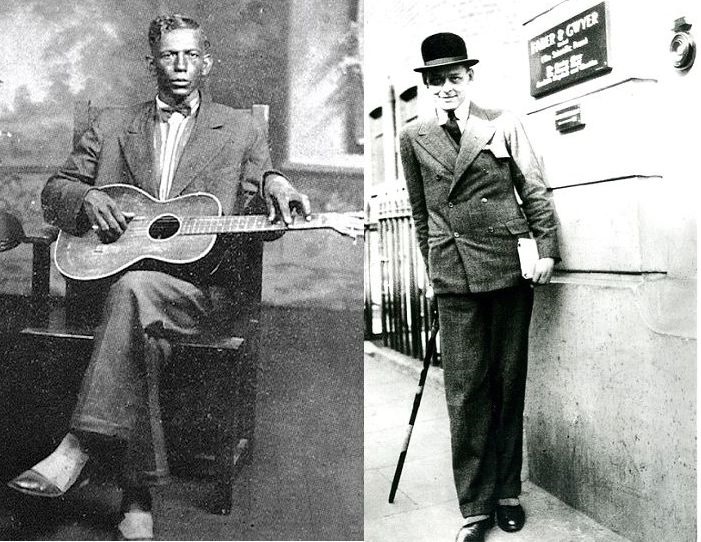
Was I being audacious when I compared Eliot’s “The Waste Land”  to a modern hip hop/rap production sampling various parts and levels of the world’s culture? I don’t think so (though maybe I should be worried). I’m not going to get into a rap battle between T. S. Eliot vs. Missy Elliot, or a discussion about “Kendrick Lamar, is he a ‘real poet?” like my generation used to discuss Bob Dylan. My aging generational knowledge isn’t deep enough to discuss Lamar or Elliot as intelligently as I should. I’m more comfortable discussing folks who were born long before I was, but someone like Charley Patton is too O. G. to bring up here often. After all, T. S. Eliot and Charley Patton are my grandfather’s generation, born in the 19th century. People like me can be pretty good in figuring out what lessons our grandparent’s completed lives impart, not so good at what lessons our children should learn from us, and terrible at what lessons our children could teach us.

Charley Patton and T. S. Eliot

Charlie Patton and T. S. Eliot: two young swells put their best foot forward beside different rivers in the 1920s.


Eliot may have thought he was copying cubist paintings or cinema montage or some French poetry, but he chose this sampling tactic or he would have done something else. Who was Charlie Patton copying? I don’t know exactly. Maybe he made it up. Maybe some griot or indigenous shaman whispered it in his ear.

T. S. Eliot was his own kind of odd guy, odd to his contemporaries, even if he eventually became enormously influential in the Modernist literary movement that had taken over poetry education by the time I was a student. When I first introduced “The Waste Land”  here I said there’s two things you need to know to approach it, and they aren’t esoteric at all: first that it’s musical and intended to be, and second that it’s written by a person suffering from depression, a common human malady that colors and filters perception profoundly. Now, following my grappling with it in the past few years, I’ll add two more things, neither of which require reading about Grail legends or From Ritual to Romance  either: it’s written by a man writing for a culture coming out of a tremendous wartime trauma and it’s written by a man struggling to come to terms with human sexuality, it’s sins, pleasures, and disappointments.

On the war issues, Eliot is guiltily living, not dead, in a world where many others weren’t so lucky. Estimates vary, but somewhere between 15 and 19 million people were killed in WWI, the majority from the European theater that had become Eliot’s home. Given this level of death, it’s not surprising that Eliot personally knew people killed in the war. Most of his British literary contemporaries served in the war, he didn’t. Indeed, while WWI raged, he tried to disengage from the war, to continue to focus only on scholarly issues and his literary writing.*

Eliot’s an American from St. Louis in a foreign country and he’s gotta figure out how to trans-Atlantic code-switch. He goes in full-force, becoming so completely English that he eventually was able to style himself as an authority on what was appropriately British. After the conclusion of the war, as a literary critic he can write about “objective corelative” and all that, but he can no longer ignore the trauma his adopted country and the rest of Europe has suffered.

Last year’s segment “A Game of Chess”  rolled-up into one audio file in our last post, portrays marriage darkly and introduces rape and sexual coercion as one of the underlying themes in “The Waste Land.”  Here we know little about Eliot’s own experience, other than his marriage to an English woman was dysfunctional. As we move further into our section for this year, “The Fire Sermon,”  sexuality is further brought forward in an unflattering light.

As the section begins in the segment I call “Sweet Thames”  we’re back in a ruined landscape, the titular “Waste Land.”  The scene seems post a debauched party season, missing even the messy vitality of that. Eliot, a man who grew up near the banks of the southern Mississippi is now on the banks of London’s Thames river.

And then he, or some incarnation of the poem’s speaker, the many voices in Eliot’s head, is fishing. Following the literary and critical references, this is the Fisher King, and we could look to a trail of ancient myths, but I chose to keep it immediate and funky in performance. This is a dirty, river-rat frequented urban river. He wants us to know that he’s fishing next to a gashouse, which I take to be one of those now obsolete processing furnaces that turned coal into coal gas, a smelly and polluting process usually relegated to the worst part of town. The anachronistic pendant in me found this amusing, as a decade after ex-St. Louis boy Eliot wrote “The Waste Land”  his home-town Cardinals baseball team used to intimidate their opponents by wearing stinky unwashed uniforms and were given the nickname “The Gashouse Gang”  for their smell and general lack of decorum. There’s no known connection for this coincidence, but it’s good that they didn’t wait until later in “The Fire Sermon”  and to then become the World Series winners dubbed “The Young Men Carbuncular.”

As the section nears an end point another song-sample break is dropped,** the Mrs. Porter section. Eliot noted that it was an Australian army folk song, and further research indicates that the Mrs. Porter may have been a Cairo brothel keeper known to the ANZAC troops heading for the disastrous Gallipoli campaign, where a dear friend of Eliot, Jean Verdenal was killed in battle. Depending on how salty the soldier-singer may have felt, the body parts being reported as washed varied.

I like to think that Charley Patton, further down the Mississippi river, might have known that tune, but since neither he nor T. S. Eliot are here to sing this, you can hear my performance using the gadget below. If you’d like to look at the text of “The Waste Land”  while you listen, the full text is here.


*Like Ezra Pound his overseas American citizenship status complicated things, and like Pound there are some stories that he made an effort to serve. Eliot did teach night-school literature classes to working-class English women during the war however, and it’s easy to speculate that he may have picked up things later incorporated into “The Waste Land”  from that experience.

**And for all you carpe diem fans, did you note the sample from Marvell’s To His Coy Mistress”  here, when just before Mrs. Porter soda-washing-song he says “But at my back from time to time I hear…” and instead of a winged chariot, it’s motorcar horns. If given the choice of grave or sex, I think Eliot would have held out for a third choice.

A Game of Chess, presenting T. S. Eliot’s “The Waste Land” for National Poetry Month

Each April, as part of our celebration of National Poetry Month, the Parlando Project has been presenting in serial form T. S. Eliot’s High Modernist masterpiece “The Waste Land.”  This year, we’re up to the third section of the poem “The Fire Sermon,”  but before we present new material, I want to give our newer listeners/readers a chance to catch up.

It’s possible to read the entire “Waste Land”  aloud as a dramatic monolog in less than 40 minutes total time. Fiona Shaw has done this, and her performances of it cannot be praised or recommended enough. But for me personally (and this goes back to my first readings of the poem) I’ve always been struck by “The Waste Land’s”  intense musicality. The collage process of various voices is musical, and “The Waste Land’s”  constant changes in tone and insertion of quotes from other poetry eerily predict hip hop mix tapes in a 78 rpm world. Themes emerge and fall back and are then repeated later on, just as they do in long-form musical composition. Eliot even quotes song lyrics multiple times in the poem.

The Waste Land cover

He got $2,000 for service to letters, but our aim is to demonstrate the music in it


So, I’ve long dreamed of performing “The Waste Land”  with music—and now, as part of this project I’m realizing that dream on the installment plan. While I think the music can help bring some solace and additional shadings to Eliot’s unstinting look at human failure and limitations, the resulting performance is lengthy. It’s not the kind of thing I can take on creating and performing lightly—and to listen to it, even casually, is not light entertainment either. The Parlando Project normally focuses on shorter poetry, the lyric impulse. Almost all of our pieces are under 5 minutes, and we have hundreds of them available here. So, don’t feel obligated to listen to these longer “Waste Land”  pieces. They are not for everybody, and I believe they are consistent with Eliot’s design to write only for those willing to look at dark impulses and feelings, to weigh and consider them within your mind and heart.

Here’s “I. The Burial of the Dead,”  the first section that famously opens with “April is the cruellest month, breeding/Lilacs out of the dead land…” which is likely a reason that April is U. S. National Poetry month (and may already be referring to another poem, Walt Whitman’s Lincoln elegy, When Lilacs Last in the Dooryard Bloom’d.”)


And here’s last year’s contributions, the section “II. A Game of Chess”  rolled up into one piece for the first time here. I start out this one by making an ex-post-facto connection of Eliot’s lavish and dissipated opening of “A Game of Chess”  with the late-night, dragged out, “Ain’t it just like the night” style of Blonde on Blonde era Bob Dylan, and it ends with an appearance of a guest reader Heidi Randen for the monolog about Lil and Albert and their just-discharged-from-the war marriage.


This month we’ll continue our serial presentation of “The Waste Land”  with one of its longest sections, “III. The Fire Sermon.”  If you’d like to read along with the text of the poem while listening, the full poem is here. With these musical presentations I maintain that you can listen to them and not feel that you need to understand what the poem means in the essay-question sense, and instead only require the poem’s words to strike you with scattered connotations and impacts. There are a great many resources for those who would like to delve into deeper meanings of “The Waste Land,”  all the things that Eliot intended to put there—and also the things he only inherently and accidentally included. For those that enjoy that, there’s much there at that level, but I remind you of the concept I laid down a couple of posts back regarding Emily Dickinson’s much shorter poem: a poem isn’t so much about ideas, it’s about the experience of ideas.

10 Definitions of Poetry from Carl Sandburg

Let’s continue our celebration of U. S. National Poetry Month!

If Emily Dickinson and Walt Whitman are the parents of modern American poetry, then one poet is most nearly the descendant with an equal inheritance from both: Carl Sandburg.

Sandburg’s poetry has two modes: the tightly compressed Imagist poem and the expansive, iterative, catalogic Whitman-like ode. I find him effective in both styles—and sometimes he mixes both, as in today’s selection. Each line in his “10 Definitions of Poetry”  is its own compressed poem, but taken together in a list they express different aspects of poetry.

Carl Sandburg in black cowl-neck

The forgotten American Modernist. Sandburg! thou shouldst be living at this hour!

.

I’m something of an advocate for Sandburg here, as I feel he’s fallen out of favor during my lifetime and now is more than due to be re-evaluated. The major knocks against him in the later part of the 20th century were that he wasn’t complex and subtle enough, that his poetry didn’t dig deep enough in to the hard-to-grasp philosophic questions at the core of meaning and human existence, and to a secondary degree that his poetry wasn’t, well, poetic, that it was neither lyrically beautiful nor painstakingly constructed.

I won’t lay out a complicated case for Sandburg on those two issues here today, but on the first issue I’ll say that Sandburg’s Socialist and working-class outlook leads him to address universal issues of the human condition, from top to bottom of our current social organization; while other poets, ones with an avowed aesthetic focus or a calling for self-contained spiritual insight look at only part of the situation. Even those that don’t share Sandburg’s politics can benefit from his insights. On the charge of Sandburg not being a poetic craftsman, I’ll say that while I don’t know much yet about his working methods, I can look closely at some of Sandburg’s shorter works and find well-chosen small things—and whether they were intuitively there in his vision or created by exhaustive study and revision, I find that less important than their existence.

I’m also sorry to say that Sandburg’s poetry can sometimes be—as reflected in some of his definitions in this list—fun, funny, entertaining. You’ll just have to overlook that.

And if he’s charged with those things, weren’t Whitman and Dickinson also charged with these faults throughout the 20th century? Our current century looks at Whitman and Dickinson and sees their still startling differences—but has begun to realize that where the past saw in those differences infelicities of expression or simple directness, that they are instead part of their genius, part of why our need for those poets has not been replaced. And if we need Whitman and Dickinson, then perhaps we also need their hybrid descendant Sandburg too—he of his synthesis of hyacinths and biscuits.

I took my musical inspiration today from Sandburg’s first definition: “Poetry is a projection across silence of cadences arranged to break that silence with definite intentions of echoes, syllables, wave lengths.” My guitar part runs through some modulation effects and an echo/delay; and underneath, working with my electric bass-line, a wobbly Mellotron* waves along. Hear this with the player gadget below, (of if you don’t see the player, you can use this highlighted link)  Check back soon for more combinations of various words with original music—and, oh yes, please let others know what we’re doing here at the Parlando Project.

.

*No, I don’t have an actual funky tape strip Mellotron. Thankfully the tapes have been converted into digital samples and can be played with an inexpensive MIDI keyboard or controller.