Unlike its Songs of Innocence partner, William Blake’s other “Holy Thursday” poem has no plausible ambiguity in its view of childhood poverty. One reader wrote to remind me that the Songs of Innocence “Holy Thursday” poem shows a peaceful, happy scene that I misread. They could be right! Allen Ginsberg famously thought Blake appeared to him and instructed the later poet by reading “Ah, Sunflower” to him, but what instructs me to see undercurrents in the first Holy Thursday poem is reading more about what we believe we know about Blake’s beliefs. Reader Alan also reminds us the two poems’ connections should be examined — and that’s what I’ll do today, along with sharing a performance of Blake’s second song about Ascension Day.
As Blake illuminated and printed these two poems. One of the things I always admired about him: he was a self-contained, DIY, artist who learned what he needed to do to manifest his art.
.
Let’s jump to the second poem, the one from Songs of Experience.* Childhood poverty is an undercurrent in the first — would Blake even expect his readers to know that the children in the first poem are charity cases (many modern readers do not) — but poverty is foreground in the second. Blake takes on the mode of a Biblical prophet in this second poem and charges against the civic and/or religious state pour down from the start of it. Holy Thursday happens in springtime, but it’s “eternal winter” here. Its final stanza is preaching that this is not the natural order, and that in a polity of mankind’s natural state, the Earth’s fecundity would provide food for all.
I’m not sure we invariably think of Blake, for whom a spiritual element is clearly present, as a writer of civic poetry, as a political creature — yet modern scholars have subsequently delved into that element of the poet. Ginsberg, a civic poet of my youth, recognized a fellow civic poet in the prophetic Blake, and to deal with that is not to deny the spiritual element. I myself am no more a fine scholar than I’m a fine musician. In both professions, I’m simply and old man who does what he can in those fields haphazardly because he cannot wait longer at this point in my life to perfect those arts.
How do I currently think the two “Holy Thursday” poems connect? I don’t want to put words into Alan’s mouth, he’s likely sharper than I can draw him, but he or others may believe that first poem is happy, innocent children in safe, supportive clerical care, uttering praise to their religious saviors/supervisors and that institution’s godhead and nation. And the second poem? Perhaps either a progression or another facet degraded from that? I’d say there’s no reason not to think that the two poems are happening at the same time in the same Britain — so, the two situations simultaneously comment on each other. The wards in the first poem may live better than the utter misery of the poor in the second, but they are part of the same civic system, the same “land of poverty.” The thunder within the ward’s song that ascends briefly to heaven in the first, is the fecund rain that feeds all in the yet to be manifested world of the second. I’d summarize that Blake thinks that poverty and its partial charitable mitigations aren’t in opposition, but rather that poverty is a civic construction like the imperfect charity schools were. What Blake sees as opposition (in both poems) would be some Rosseauian natural state as the proper order of society. Yes! I realize that’s idealistic, that’s there’s no actual political party or plan ready to implement such an Eden. You can call it a fantasy. You’ll have good arguments to do so.
In my country, in my time, we’re at one of those political moments where forces in power wish to remind us that the poor are a disreputable burden, feeding off the productive citizens, wasting our resources of freedom and pleasure. You can call that a fantasy too. You’ll have good arguments to do so. But unlike the former view, this one’s on offer, even in the process of being implemented.
I’ve “progressed” from acoustic guitar to electric guitar in today’s “Holy Thursday,” along with piano and percussion. You can hear it with the audio player below, or if that player is obscured in a field of thorns, you can get a rain check with this alternative highlighted link that will open a new tab with its own audio player.
.
*Text linked here in case the picture of Blake’s original illuminated plate is too hard to make out.
My parents had a small library, which was on a set of bookshelves in their bedroom in the house I grew up in in a little Iowa town. I’m not sure which books came from which parent, or even if some of them were passed down from their seniors, for I recall a couple of books on 19th century figures: William McKinley and Frances Willard. I think my mother’s people were Republicans, and both sides were teetotalers as far as I know. Some of the books were college textbooks. There were books relating to the Protestant ministry, which my father aimed to practice as his father had, and others connected to journalism and high school teaching, which was my mother’s line of work before marriage. I loved looking through them while laying on the chenille bedspread of their double bed.
I bring this up today because I believe I first encountered William Blake in one of those books of theirs. It wasn’t a poem of his, but rather a small note in the back of the volume dealing with other minor figures. The note reported that Blake wrote some quite fine short lyrics before descending into longer mystical tracts that might be seen as evidence of madness.
Having already gone through a short but intense Edgar Allen Poe phase when my teenage-self read that, my interest was piqued. A year or so later I learned that The Doors, a rock band headed by someone who was said to be a poet, had used a line from a Blake poem in one of their songs. Now I really was intrigued.
And yet it was maybe another year before I found and bought a small paperback containing selections from Blake’s writing. My initial reaction? The longer prophetic books puzzled me, many (but not all) of the shorter poems could come across as twee little nursery rhymes, but some of his poems that fell between those two became favorites, particularly his satiric and scathing “Proverbs of Hell.” No teenager ever since deciphering metal-band lyrics or any rapper’s flow was more happy than I was to read that rebellious page poem.
Those short lyrics? I liked more of the poems Blake printed in Songs of Experience than those in his companion volume Songs of Innocence. Simplicity can be harder to value, and Songs of Innocence is a case in point. Today’s piece is one of a pair of poems in Blake’s non-identical twin volumes using the title “Holy Thursday.” Here’s a link to the text of this one.
First off, what’s Holy Thursday, at least as it relates to Blake’s poem? I didn’t know as a kid, and I didn’t know as an adult either until this year, so late in my life. I thought it was the Thursday before Good Friday, the date commemorating the Last Supper of Jesus and his disciples before his arrest, trial, and execution. And as far as some Christian denominations go, that would be correct — but not so fast! Holy Thursday is also another date,* one at the very end of the Lenten calendar: the date commemorating the resurrected Jesus ascending into heaven after being seen on earth for 40 days by the disciples. That one falls on May 29th this year — or on the following Sunday, just to make things even more confusing.
We know that Blake is referring to the later Holy Thursday because the poem of his that I perform today is reportage on an annual British Holy Thursday (Ascension Day Edition) event: a marching of a batch of orphans from charity institutions up to London’s St. Paul’s Cathedral for a special mass where they sang hymns they’d been taught.
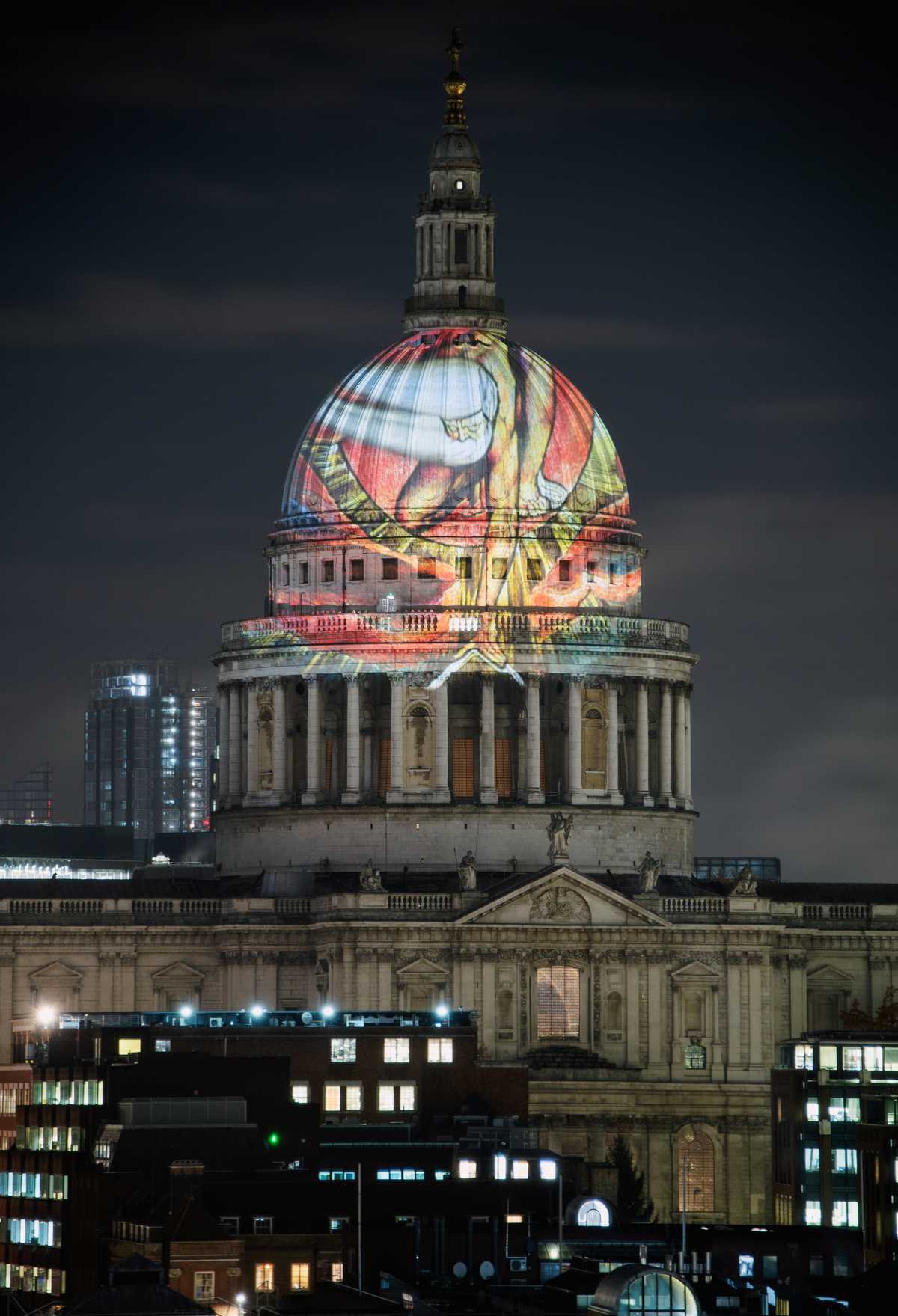
A few years ago the Tate Museum had a big Blake celebration and had one of Blakes most famous paintings projected onto the dome of St. Paul’s Cathedral. I wonder what Anglican dissenter Blake would have thought of that? (photo by Alex Wojcik for the Tate)
.
Blake’s tone is ambiguous in his account. One could read this poem and assume this is an act of charity being celebrated — but in the context of Blake’s beliefs one could see otherwise, as he was an ardent dissenter from the state-sanctioned Church of England. Elsewhere in Songs of Innocence, the children are free (at least at times) in some Edenic state — but these Holy Thursday children are regimented into ranks by schoolmasters (beadles) caring disciplinary canes. The song they sing is given to them by those that control their lives. What happens when they sing the song they are directed to sing? Heaven, the seat of the godhead that Jesus has risen to merge with, harmonizes in thunder that descends on the “wise guardians of the poor**” seated below the heaven and the children in this rich and mighty cathedral. In summary, I think Blake is pointing out the self-satisfied “virtue signaling” in this pomp and ceremony.
Perhaps I should have tried to create a choir or used a pipe organ for this one, but simple music today, which you can hear with the audio player gadget below. Has your audio player ascended into the Internet to sit as the right side of Jeff Bezos or Elon Musk? No, it’s just that some ways of reading this blog suppress showing it. This highlighted link will launch a new tab trailing heavenly glory — or at least its own audio player to carry forth my acoustic guitar and voice of subjective quality.
.
*The Last Supper Thursday is also called Maundy Thursday — the other, Ascension Thursday or Day. Separate names would of course make things clearer. I grew up a Methodist, and they bungled the fix: they use all three (or is it four?) names.
**I sing this phrase as a question, which I divine is Blake’s intent.
I’ve worried a bit lately that I’ve been doing too many Parlando pieces presenting sad poems. It’s likely that mood is part of my nature despite living a life I’m grateful for — perhaps even more so because I live a life I’m grateful for, and I’m therefore aware of its temporary nature that I cannot keep. Because of this, I’ve kept a quote, a suggestion, from Kurt Vonnegut close to me:
I urge you to please notice when you are happy, and exclaim or murmur or think at some point, ‘If this isn’t nice, I don’t know what is.’”
Vonnegut wrote this in one of his last books, one that might again speak to my mood in this state of my nation and its ideals, A Man Without a Country.
At my age, it’s no longer morbid to think about death. This past weekend my wife and I went on a goth date, and visited one of the fancier local cemeteries. We mostly went for the 1910 main chapel building full of early 20th century William Morris/Pre-Raphaelite derivations which echo back to the start of the era I mine for a lot of the poetry here.* The cemetery was taking part in a special open-house event held around the Twin Cities offering more access for the public to “behind the scenes” parts of the facilities.
We walked by famous early citizen’s gravesites, some elaborate with statues and such, and then too the many small vaults with names and dates on their file-cabinet sized faces. One room’s space was maximized with rows floor to ceiling across the room — so much like a library, even up to having a rolling metal staircase that would facilitate viewing the topmost. Instead of spines one views in those tall rows names, and partner’s names, and those bookend years. Every one of them, like every book I suppose, expects that there’s someone left to see and remember them, and I paused to consider that that wasn’t always so.
In another part of our tour, another portion of my nature was stoked. Walking by the cemetery’s crematorium, I noticed this homely implement hanging on the wall. As the old prayer book has it: ashes to ashes, dust to dust — and that passage now had a corollary: and dust to pan.
Part of the main chapel: tiled mosaics, stained class, intricate motifs, capitol mottos. Crematorium: clean, professional, and an inexpensive hanging broom and plain white plastic dustpan, the same model as hangs in our home pantry.
.
Oh, it was a beautiful Spring day, full of decoration, full of evidence of grief, inscriptions of loss — and to the puritan, evidence of vanity. Life is so big, or so small, we must laugh at it.
Which brings us to today’s poem I’ve performed with music: Edna St. Vincent Millay’s “Dirge Without Music.” I had finished this piece earlier this Spring, but at first held it back because I feared it was too much like some other musical pieces I was working on — and then after those coincident issues expired, I started to worry that it was too much-more sadness. Revisiting it this week, I now think no, it’s not just bleak — it’s a bald-faced statement of honest feelings about death and loss. Here’s a link to the full text of the poem.
In writing music and preforming this poem, am I disrespecting the author who titled her poem “…Without Music?” I think Millay’s intent here was to speak against sentimentally decorating loss. Loss has patterns, resolutions, codas, and rests — and music too, even if it has repeat marks, has an ending measure — but music’s part of the equivalence is so often beautiful. In such ways fine poetic word-music, as well as that with express melodies, may speak over loss, interrupt it. Perhaps my rough-hewn voice with its limits and plainness, its lack of precise or elaborate lyricism, is apt for Millay’s mood here?
You can hear that musical performance of Millay’s poem with the audio player below. What if you see no player? That’s likely because some ways of reading this blog suppress showing it, but this alternative highlighted link will open a new tab with its own audio player.
.
*A few years back here I did a series on “before they were Modernists” with early poems by some Modernist figures. More than a few had roots in those retro-hipster movements of the late 19th century, and many a free-versifier had carried around a Swinburne volume in their youth.
I’m not one to closely follow religious matters, though many poets over the ages have — the history and the weight of all that combined belief and its inconsistent practice is considerable. I did have an interval as a youthful churchman of the Protestant kind, attracted by the community bonds and social activism of the Martin Luther King era,* but it was recent reading of those fresh drafts of history that we call the news that brought the selection of a new Catholic Pope to my attention. For a moment my country was caught up in ancient offices as a break from the depravity of our domestic head of state.
So, first the death of the serving Pope, then the mourning, then the secret conclave in its smoke-emitting room, then the new Pope and the follow-up consideration of his background and concerns — extended this time by his North American origins. My BlueSky feed of wits supplied me with humorous predictions based on Bob/now Leo’s Chicago origins, but the pedant in me snorted most heartily when I read this news service summary of Leo’s biography explaining that he was a member of the Augustinian Order, monks with a call to service and piety. The wire-service, no doubt constrained by the spread-so-thin-the-bread-tears nature of modern journalism, informed its readers that the Augustinians were founded in the 13th century by Saint Augustine.
I have no idea what the titrated level of history buffery is within my treasured readership, but they were off by near a millennium — St. Augustine being a 4th century North African early church father! The medieval founders of this order of monks were looking back to late Western Roman empire times for a guiding light.
The Parlando results of my guffaws? I thought of a song that abides with me that I found on one of the first three record albums I bought as 1967 turned into 1968: “I Dreamed I Saw St. Augustine” from Bob Dylan’s slightly undervalued LP John Wesley Harding.** Dylan was on the face of it no more accurate than our news-service scribe. His apparition of St. Augustine is a troubled man, as many spiritual people are, and he briefly charges us with his preaching in the song, but Dylan’s Augustine is also specifically a martyr who was put to death, presumably by the authorities. Unlike many saints, Augustine of Hippo was not a martyr. While Augustine’s town was under siege by Vandals (the original ones, doing business as that tribal name not as members of DOGE)*** he died an old man from natural causes.
Dylan’s song is brief, brevity being an unusual virtue Dylan exercised in all but one song on John Wesley Harding. And yet he was bringing history into the three verses, no choruses, no bridge song structure of his song. Within his seeming historical inaccuracy was his choice of a borrowed tune. “I Dreamed I Saw St. Augustine” uses the melody and the structure of a 1930s song setting by Earl Robinson of a 1920s poem by Alfred Hayes**** about a man put out to death in 1915: “I Dreamed I Saw Joe Hill Last Night.” I believe Dylan clearly meant to link the two men, in the way that dreams can combine things we never see in waking hours.
This song, and Dylan’s performance of it, has always touched me — and so having the coincidence of Augustinians being in the news, and the hopes that the new Pope may preach to our current overly-gifted Kings and Queens, I went to record myself singing this song of a remarkable comparing. Since it’s a copyrighted work, I present that performance today as a YouTube video. The few-hundred views one of my videos might gather would not make even a widows mite, but it’s my understanding that any revenue gathered from those annoying YouTube ads can be claimed by the rights holders. For my video I mingle artists representations of Augustine and Hill. If you can’t tell, the photos are Joe Hill and a news photo of a memorial march for him in 1915. Our 4th century Augustine was camera-shy, and has to be represented by artists’ paintings.
.
*My youth included a couple years working at a hospital still being actively managed by an order of nuns in those days.
**In search of more footnotable connections: was it coincidence that the then considered inscrutable cover of the LP has two Bengali Baals, singers in the tradition of the first songwriter to win the Nobel Prize, Rabindranath Tagore. Surely the Bob Dylan of 1967 didn’t know he’d eventually be the second. Another connection: Joe Hill was a songwriter who sang for union organizing meetings and “He who sings, prays twice” is a saying attributed to Saint Augustine.
***Augustine’s writings include thoughts on The City of God that may survive the fall of empires. Shortly after Augustine’s death, the Vandals sacked his city. Stories have it that these Vandals were impressed by Augustine’s learning, and spared the library he had established there. The current ones aren’t up to that level of civilization.
****Hayes had a long writing career. Wikipedia tells me he was an uncredited screenwriter for the famous Italian film The Bicycle Thief. It also claims he wrote a script for The Twilight Zone, but IMDB doesn’t confirm that.
I went to one of the marker events of my year, the May Day Parade in South Minneapolis last Sunday. It’s a wonderful thing to return to, kids and neighbors dressing up and marching from Lake Street to an urban park, some putting on elaborate homemade puppet exoskeletons, others holding signs of local resistance, beating drums, playing instruments, and riding on contraptions ranging from customized bicycles to the mighty fire belching Southside Battletrain hauled upstreet by local Anarchists, a tribe of pierced and tattooed Sisyphus.
But more precious than all this exuberance was that I got to meet up with my old friend, poet, cartoonist, and musician Dave Moore and his partner. We did as we have for many years: we sat on the low concrete curb near the start of the street parade. The little curb, inches high, is a perfect seat for the lower children, the ones that would leap up near us on either side of the march as any promise of tossed candy delighted them. Dave and I are not children, far from it. Oh, very far. Our old bodies creak up and down when we stand to clap, call out, and cheer “Happy May Day!” as the parade passes by. The tumult covers the sound of our joints, our happy shouts outstay our grunts and groans.
And then there is the silent thing Dave does as our neighborhood starts to disperse back to their homes or other activities after the parade passes. Dave carries a bag of milkweed seeds to the parade each year. The bridge whose street side we’ve been sitting on spans the Greenway, a reclaimed railroad right of way that’s now a walking and biking trail. In its older, more overgrown times milkweed lined the tracks, and the hulking trains then whipped up their fluff from the dried pods — little vegetive boxcars unloading the slightest, near weightless freight of their commerce. And so after the parade, Dave takes handfuls of those seeds he’s brought, and tosses them to the present air. They rise like tiny albino angels, swirling into May skies with a job in their seeds: milkweed is the manna of the immigrant monarch butterflies who migrate from Mexico, whose children depend on it when they are infants bundled as caterpillars.
That, kind readers, is a holy moment. The noise, the quiet, the Spring, the joy of workers celebrating their day.
But there’s another chapter in this story. Someone Dave knows sees him and stops to chat. He’s happy enough with the parade of course, but his conversation is troubled. He’s a schoolteacher. Looking nearly as old as Dave and I, he’s still working as such, and he despairs. The children have no attention span, no lessons can adhere, he reports. No one realizes how tough it is now, he says, and I guess I’m an example of that, but I hope he’s partly wrong. I’m one of those dried seed pods now, I don’t know where the escaped fluff I release here lands, and that lofted randomness releases me.
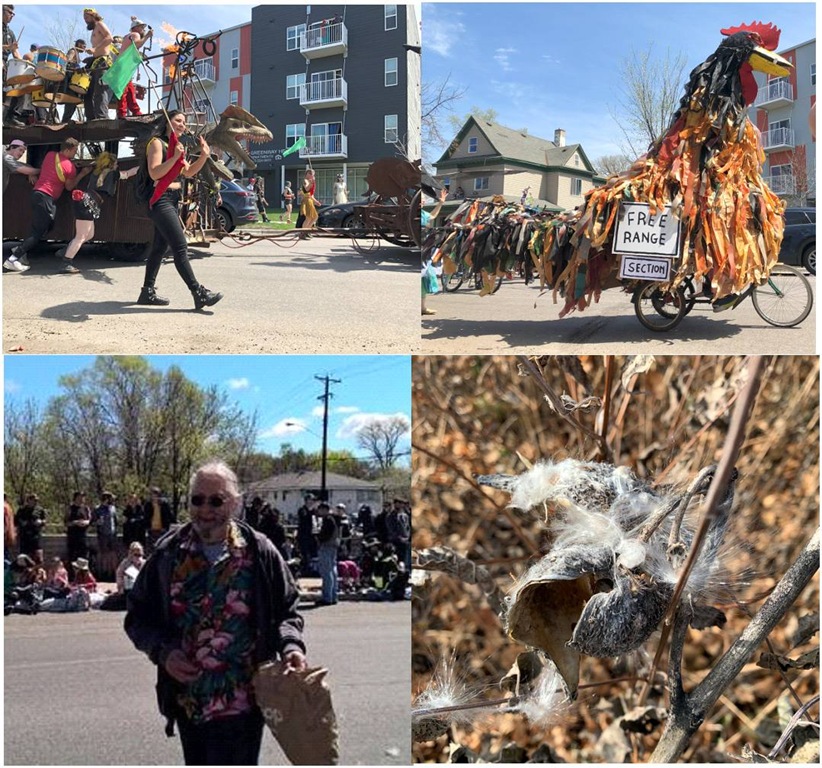
I made a choice to not take pictures this year at the May Day Parade — but here are some older pictures: part of the Southside Battletrain, a bike-powered puppet-float, Dave with his bag of milkweed, and a milkweed pod
.
I thought of this teacher and his tale alongside this poem I perform today written by the young Langston Hughes. Hughes was in his 20s when he published it, so it seems to be another of those poems about old age written surprisingly in youth. Did Hughes have a particular teacher in mind, or was he (even unknowingly) writing about an element of himself as he created this epitaph? In “Teacher” Hughes is engaging the poetic trope of the grave as a place of unending reconsideration, but as a person in their 20s he was a chrysalis where the pulpy worm may turn to wings — not a pulpy corpse under a dissolving summary. Hughes has his teacher in the poem speak as if the unvarnished holding on to virtue pinches the soul – and yet virtues are something that young people are always being told they need to develop. I don’t think such lessons are entirely wrong, but they are not the entire either. I think the star-dust that cannot penetrate the poem’s speaker is the diffuse, the random, the broad-spreading possibility. It’s a signifier of entirely unsure hope, a precious kind. Here’s a link to the text of Hughes’ poem.
You can hear my performance of Langston Hughes’ “Teacher” with the audio player below. Because I wanted a slow, long-hanging-in-the-air, timbre for the guitar here I chose to play electric guitar on this performance— appropriately my Guild Starfire guitar for this representation of star dust or milkweed fluff. No audio player to be seen? Some ways of reading this blog won’t show it, this highlighted link will germinate a new tab with its own audio player so you can hear it.
Another poem for April Poetry Month. Another Emily Dickinson poem. Once more, wildflowers. Once more they’re that early spring flower, daffodils. Once more the poet is looking back because something’s missing.
Chord sheet because someone else might sing this better than I can
.
Last time the voice in Dickinson’s poem was also alienated from Spring, but there was a taunting wit to that one. The mode in today’s Dickinson is more abstract, and the second, final, stanza is so gnomic here I can’t say I know fully what it’s conveying. Even the first stanza is tied in knots, tangled with those Dickinsonian dashes. Is “an April Day” the “Absent Place” — or is the April day, with present dancing-in-the-breeze daffodils, in contrast to the Absent Place? The stanza’s final line asking us to consider the viewpoint of “the Souls that snow” could be saying then the snow is more full of motion and drifting shapes than mere blossoms — or that April brings forth feelings that makes the Absent Place snow-Souls uncomfortable?
In intent or effect, it may be a shifting Tao — an all of the above in motion with each other?
But the final stanza? I assume “Drift” within is of the snow-Souls’, a self-impediment worse than snowed-in roads or walks, but the concluding two lines are harder to follow. Perhaps she’s saying that snow-Souls are the ”Him” in the last line, and their change and emotion is as strong as (“duplicate”) as the wind-moved daffodils? But “duplicate” is a strange word choice. Even within slant-rhyme it’s quite strained to rhyme with “without.” I even toyed with pronouncing the duplicate as the noun, not the verb, which would be a nice sound-pair with “but.” However, that’s syntactically sour and doesn’t follow the first stanzas ABAB rhyme scheme.
For awhile I engaged in a little fantasy extension of this brief poem while asking why daffodils, rather than another Spring flower. Poet Dickinson famously knew her plants — not just as an avid gardener — but as a woman with more education than most in her time and place (which included science, considered a presentable ladylike field). She was the maker of an impressive book of pressed flowers labeled with their scientific names. Did she know her Greek myths as well as the scientific name for the daffodil, Narcissus? The essential piece of the Greek myths of Narcissus is that the youth of that name dies because he becomes entranced by his reflection, his duplicate. Is the last line’s “Him” Narcissus or something like him?
Or is she taking another route into the roots of the word narcissus, related to narcosis, a drugged numbing? Does the final stanza mean to say that springtime joy can be as numbing as wintertime sadness?
It may be wise to consider my thoughts about the final stanza over-thinking. They’re surely speculative, but it still seems likely that the poem means to link the emotions extracted from Winter and Spring landscapes.
As April National Poetry Month winds down, I’ve fallen into a theme without designing it. Many of us are feeling crabby, dismayed, disgusted, frightened, but Spring doesn’t know that. The cold of Northern April is now behind us, and May lays out ahead with greening and warmth. Is it taunting us by being pleasant and hopeful?
For the music in the performance you can hear below, I fell into it too, as certain and mindless as Spring. The recording started with the chordal guitar part, which I played on my jangling Squier Jazzmaster instead of an acoustic guitar because I was telling myself I’ve been stuck on acoustic playing too much lately, and I hate to be predictable. In timbre and volume it was hardy enough to easily accept the drums and electric bass that I matched with it. The final part was the lead guitar line played largely on the B string of the guitar up and down the neck, in that “I’ve just heard a Ravi Shankar LP” way that was popular in The Sixties — the 1960s, not Emily’s 1860s. You can hear it with the audio player gadget below. No such gadget to be seen? The authorities haven’t shut down the psychedelic ballroom, it’s just that some ways of reading this blog suppress showing the audio player. This highlighted link is an alternative which will open its own tab with its own audio player inside.
The attention I’ve been calling forth this National Poetry Month has been divided up between “civic poetry” about the state of nations, and poet’s examination of Springtime. Today’s piece continues with the wildflowers and wildlife side of April, but because it’s by Emily Dickinson, it’s a complex statement.
Dickinson here uses the ballad meter as she often did, a form also used for many Protestant hymns. This form as common as the robin. Simple music, startling images, another disconnect.
.
This poem, approximately dated at 1862, can still startle the modern reader. Over a century and a half of poems have been written since then, yet the language, images, and play of thought within it still seem fresh and surprising. And there’s no wait for the surprise in this one, beginning with the idea that I used for a title for the resulting song I made of it. Dread of Robins? This common North American bird is anything but frightening. It’s not large, or fierce, no raptor or raven. In the context of the poem, the outstanding thing about the American Robin is that it’s a migratory bird whose arrival is a sign of Spring. Yet it causes pain somehow.
The next stanza seems to amplify sound. The song of the robin is not that loud, but the sound of wild birds in Spring taken together does have a choral aspect. In their territoriality and mate-seeking, there is a shout to their throats. Dickinson hears some music in it, but it’s not altogether pleasant. The Piano in the Woods image delights in sideways incongruity. The piano is Dickinson’s instrument, the one she played, but as an acoustic guitarist one thing I know about the piano is that it can be overpoweringly loud. And placing the piano with its wooden case in a woodland implies a metamorphosis. Perhaps ED hears a piano whose notes are bird calls? “Mangle” here is another characteristic unusual word choice by Dickinson. In her day she’d know the machine named with the verb: the wringer for squeezing water out of laundry. Spring is putting the speaker in the poem through the wringer.
Many of this April’s pieces have featured wildflowers, and specifically daffodils, but the colorful brightness of the flower here does not delight even after the dreary monochrome of a Massachusetts Winter.
Bees are everywhere in Dickinson’s poems, more than angels in Blake or Rilke. She often speaks fondly of their seeking sweetness, their industry, their pollinating agency in horticulture. Dickinson had by interest and education knowledge of these details, yet here the Spring bee too is unwelcome and she feels alienated from them.
In the penultimate stanza the creatures and flowers of Spring are present. She grandiloquently calls herself, “The Queen of Calvary,” suffering as if the crucified Jesus of Lenten Spring.
In the final stanza there’s a parade of sorts, with drums and salutes. “Plumes” here strikes me as an odd choice. It may be a bereaved funeral procession. Black ostrich plumes were apparently used for funeral decorations in the 19th century, so oddly we start with a modest small bird and end with the plumage of one of the largest. The poem’s speaker dreads the robin, yet seems accepting of the plucked raiment of the giant.
Is this a poem of disappointment and depression? Yes, that is there — but it’s majestic too. The poem is a catalog of Spring’s changes, all of which the poem’s speaker is unable to find pleasure in: dreaded little robins, pianos in forests, piercing yellow wildflowers, the energy of bees. There’s wit here, and like a Blues singer, there is a power of being able to sing knowing the score of a bad outcome!
I think this is a poem of a divided mind. I can relate. Spring remains wonderful, much as this Spring I’m experiencing this year, but my civic world has presented us with discordant changes, public cruelty, careless acts, all cloaked in self-serving bluster. Dickinson’s poem is dated to 1862 — the American Civil War, which for now still has a singular name, had started.*
I originally tracked my musical setting here with just my voice and acoustic guitar. I thought that spareness might contrast with the last two musical pieces here with full-on Rock ensembles. I had second thoughts though: this may be a poem about internal sensations, but it’s also about change in a fuller natural and national world. Eventually this arrangement, one that evolves throughout with high wind instruments and emerging synth seemed better suited. You can hear it with the audio player gadget below. No dreadful robin, I mean player, to be seen? You may be reading this blog in a way that suppresses the player, so here’s a highlighted link that will open a new tab with its own audio player.
.
*One reader of a Dickinson blog has a detailed theory of the personal particulars that might have faced ED when the poem was written. Deadly Civil War or mentors splitting for the coast would be matters of mismatched scale. Is the Spring of closely watched bees, and little birds and yellow wildflowers smaller or bigger than those things?
Attention is an investment. Today’s piece combines two poets that had my attention this Spring. Regarding one poet, this expenditure was long-standing, for the other, the attention is more short-lived, conditional. My attention requests yours, so let me get on with this as I try to be brief while providing context.
Fifty years ago I had just bought a cheap nylon-string guitar from the unsold Christmas stock at a local J. C. Penny’s store. I was learning to play it because I, a poet, wanted to write songs. I can’t say much for how substantially I’ve mastered guitar playing, but I have learned how to make songs.
I had models in early 1975 for what I was trying to do. My internal list of influences was shorter than it would be now, but it wasn’t just one or two. Certainly one was a young woman roughly my age who I’d read was performing her poetry with an electric guitar player and who had written a few literary pieces I’d seen published.* In the Fall of 1975 she released her first record album. I bought that LP the week it was released, likely at the sprawling Lloyds store on the edge of town.
The Seventies were a heyday for recording. The record business had recently become bigger economically and Rock music was huge culturally. Oddly, at the same time of this growth there was a falling off of the visionary and exploratory stuff that had attracted me as a teenager. Key artists of the previous decade had died or been diminished. Commercial filters along with endemic chemical narcissism and dependency reduced the force of many of those still recording. That debut record I eagerly bought — Horses, by the Patti Smith Group — was nothing like those compromises, and it retains considerable uniqueness to this day. It’s a poetry record as much as it’s a Rock music record. Large portions are chanted rather than sung. Smith’s words, however delivered, demanded a listen from the heart and the pelvis before taking the long-way around to the brain. What Smith was doing wasn’t unprecedented for a woman (or a man for that matter), but it was rare then, and still is. But I don’t want to diminish the music on the record either, the band, the Patti Smith Group, were also doing things underrepresented in 1975, despite their irregular formation. Writer Lenny Kaye had been the electric guitarist backing Smith at those NYC poetry readings earlier in the decade, and now he had another guitarist, Czech refugee Ivan Kral, to expand the sound, along with a rhapsodic keyboardist Richard “DNV” Sohl, and a drummer, Jay Dee Daugherty, who had joined the group just before going into the studio. They were fellow explorers to Smith, willing to go places they didn’t have charts or established trading routes for.
Horses gathered some attention. It was the spearhead of a musical revitalization movement that soon got a reductionist name: “Punk Rock.” Released on a major record label in this era meant that it had to be reviewed. While Horses is now recognized as a landmark, a signpost to new paths, the reviews then were mixed, though usually respecting its ambition. It was not a commercial blockbuster, sales were modest, but that was OK then as first albums were allowed mere “worthy of attention” response. My own reaction wasn’t as a critic or chart watcher — I needed inspiration, and I overwhelmingly welcomed it.
To get to today’s Parlando piece we need to move on to the PSG’s meeting up with the problematic-second-album syndrome. That album, Radio Ethiopia, sold even less than the first, and the Rock critics were even more mixed in opinions. It was a shot-by-both-sides response. These contradictory judgments were issued: it was even less commercial than Horses, it was trying to be a mainstream Rock record and so wasn’t Punk; it indulged too much in Smith’s self-mythologizing (evidence: she, a woman without credentials, played naïve guitar on the LP’s longest jam), it was too much a band-record featuring the Group instead of Smith.
I liked Radio Ethiopia. More inspiration as far as I was (and still am) concerned. A song from that doomed follow up has remained in Smith’s repertoire for the rest of her career: the breakup song “Pissing in a River.” In this linked 20 minute 21st century account of Radio Ethiopia and that song, Smith herself movingly describes her state of mind while making that expression. She was so full of doubts that the wholly committed vocals that mesh with Ivan Kral’s compelling four-chord cycle in “Pissing in a River” are credited by Smith to her brother, who came to the studio just to stand next to her, silently, at the mic. Last time here I spoke of how our relationships with others broaden what we see and report as artists. I teared up listening to Smith’s account this week, another testimony.
The version I used for performance is roughly half the length of the original poem.
.
This Spring, as I made tentative plans for National Poetry Month pieces here, I made a note next to a poem “Lilacs” by pioneering early 20th century Modernist poet Amy Lowell: “Long. Maybe do it Patti Smith style?”
I have not played much attention to Lowell, though one musical performance of a poem of hers is a personal favorite of mine. In the landmark era when English-language Modernist poetry emerged, she was a controversial figure — those mixed reviews again. It’s undeniable that she helped popularize the new free-verse style as a poet, anthologist, critic, and promoter — but otherwise these were arrayed against her: she was a woman, not gender-conforming, overweight, and suspected of being a wealthy bougie poetic interloper on the bohemian Modernists. I’ll add my own personal count against Lowell: a lot of her poetry doesn’t consistently reward my interest. My current theory is that she’s something like Wordsworth, a poet whose best work may be diminished by a mass of undistinguished work, and great lines sit next to meh ones. But also like Wordsworth, her value in theorizing and promoting a new prosody must be acknowledged.**
“Lilacs,” the poem that gathered some of my attention, is an example of the good and bad as I see things with Lowell. There’s immediacy in the poem that attracts me for performance (Lowell was an enthusiastic public reader). “Lilac’s” theme, remembering her New England ancestry,*** would befit her cousinoid Robert Lowell later in the 20th century, and I loved lines that sounded like Allen Ginsberg (“Clerks….reading ‘Song of Solomon’ at night, so many verses before bed-time, because it was in the Bible”) and Frank O’Hara (“Parks where everyone walks and nobody is home.”) ****
So, I did one of my “use what fits me best” editing jobs on Lowell’s original text, excerpting what I thought of as the most vital images in the poem, reshaping some of the lines, and following through on my first-thought of performing it in the manner of the Patti Smith Group.
That incantatory “Pissing in a River” chord cycle was a good match. I needed to rotate myself into each player’s role to create the ensemble, getting the rhythmic core down with a drum program, adding a bass line, and then performing each channel of the song’s double-tracked rhythm guitar bedrock. I used a sophisticated arpeggiator to create a right-hand piano part, but on evaluation I was so proud that I could get the just-little-different precision of the doubled guitar parts that I removed the piano.*****
Now it was time for the vocal recording pass. I made an unusual choice to try to improve what I fear is the least successful part of my recordings: as my expedient to Patti Smith’s brother undergirding her resolve, and only as preparation for the take using Amy Lowell’s words, I recorded an entire “scratch take” performance of “Pissing in a River,”
My four-chord riff cycle isn’t played exactly as the PSG recorded it, but the last part of my recording was an even larger departure from my inspiration. As a musician I’m a full-idiot/half-way savant. The part I’m most comfortable in is lead guitar playing, so my version isn’t a copy of theirs, I looked to another mode, their adventuresome NYC scene-mate guitarists: Tom Verlaine, Richard Lloyd, Ivan Julian, and Robert Quine. The performance in my recording of “Lilacs (version)” includes what some (many?) would consider overplaying. As I (too?) often do, I continue to play during the vocal passages. I know this is incorrect — but more than correctness, I worry that it might detract from the song. Asking myself why I do this, my answer is that because my voice can’t provide the melodic elaboration I’d offer if I was a more skilled singer; and as a poet, I think the words can be (are?) powerful enough to compete with wailing electric guitar.
I leave that last thought with this restatement: as a writer, it’s OK to whisper — understatement has its power — but even if you read unaccompanied, or write for the silent but companiable page, consider if your chosen words are committed so they could go toe-to-toe with a cranked guitar. Sometimes you might want that.
You can hear my performance melding impressions of the 1970s Patti Smith Group with parts of the 1920s Amy Lowell poem “Lilacs” using the audio player below. No player? It hasn’t been dropped by the record company man — it’s un-displayed by some ways of reading this blog. This highlighted link is an alternative way to rock it, as it will open a new tab with its own audio player.
**As I mentioned recently, the issue of being too prolix and prolific with putting out work is something I worry about with the Project and myself.
***Like fellow New Englanders Cummings and Millay (and the British Housman) already performed this National Poetry Month here, Amy Lowell is presenting Spring as a memory of the quill-written past wafting through graveyards unkempt by their Modern age.
****As with a lot of early 20th century female Modernists, Amy Lowell dropped off the canonical map in mid-century as High Modernism and the New Critics came to the fore. Lowell’s popularizing efforts gained little credit as poetry sought a refuge in elite understandings and “serious subject” male-centric viewpoints. Our current century is re-evaluating that.
*****As a naïve keyboard player, arpeggiators are a crutch I often lean on. Give them a chord and their rule-based fingers will present a more sophisticated output. I border on shame when using them, though similar tactics are all over modern music. I’ve tried to bargain with my guilt by referring to my favorite arpeggiator as “DNV” — the nickname Lenny Kaye gave to Richard Sohl who was a vital elaborator of the earliest PSG records. “DNV” stood for “Death in Venice” because Kaye thought Sohl looked like an actor from the movie version of Thomas Mann’s story.
Here’s a poem by British poet A. E. Housman that’s not an Easter poem — and then again, might be. On its heathered surface it’s a poem about wildflowers. My wife, who likes to hike in natural areas, could probably make good sense of it on first reading — but if you don’t know your wildflowers and aren’t attune to some Britishisms, you might be left with just a pretty set of words.
Right off in the poem we’re rambling on “brakes.” As a bicyclist, “hilly brakes” might make me think of brakes squealing on my old much-missed mountain bike. While I’d like to think of Housman in a tweed jacket enjoying such a ride, the “brakes” here are a Britishism for a thicket or area of shrubs and other undergrowth. Other words that would have “special” British or archaic English meanings? Young girls are asked to “sally” — which is not the given name of one of the girls, but a word meaning to go forth. In the first stanza besides the “brakes” Housman calls the place of the flowers “hollow ground,” a word-choice that’s a little harder to parse. Hollows are an old word for a small valley, which is likely what Housman means (he calls out valleys in the last stanza). One reading I came upon thought the “hollow” a variant of “hallow,” as in “hallowed ground,” and derives from that the idea that Housman’s wildflowers have sprouted in a graveyard. I can’t find a cite for that variation, but hollow is a somewhat odd choice here, and without regard for hollow meaning hallow, graves do produce hollows in the ground.
Our first wildflower, primroses, are found in that opening stanza. Next stanza, next wildflower, the windflower, which I first thought was a Gerard-Manley-Hopkins-like compound word, but windflower is the common name for another wildflower. The stanza goes on to introduce the flower featured in the poem’s title: The Lenten Lily which the poem tells us “dies on Easter day.”
Third stanza, the primrose and windflower are still present to decorate May Day, but the daffodil we’re told is not. And the poem ends with a final stanza telling us again that the daffodil dies on Easter day.*
Here’s more wildflower ignorance on my part: the Lent or Lenten lily is the daffodil — just another name for the same flower. I’d never heard that Lent lily name, but for a long time I really didn’t know the daffodil either. The daffodil is a common wildflower, but unlike my wife, I don’t know it to call it out by its name and properties on sight. I knew the daffodil not from the book of nature, but from the famous poem by William Wordsworth** “I Wandered Lonely as a Cloud.”
A few years ago while visiting England in the early Spring I came upon an entire lawn at Kew Gardens filled with yellow flowers. “Daffodils” my wife told me. This was a London park, not the hilly brakes of Britain’s Lake District, but I suddenly found myself, from her knowledge imparted to me, inside Wordsworth’s poem and the physical, now knowing, presence of this flower. The dark green grass and the sunny yellows in array before me were ever brighter because back at my home in one of the most northern states, things were still snow covered in early April.
My view soon after entering Kew Gardens.
.
Housman is telling us something else about the daffodil: not only is it one of the earliest blooming Spring wildflowers, giving rise to the Lenten lily alternative name for it, but it’s also one of the quickest flowers to die and disappear. That name, that property, gets us to the question of “Is this an Easter poem?” Housman is not at all a Christian devotional poet — he was a devoted academic classics scholar and agnostic.
Well, maybe that’s his point. Easter is the particularly Christian holiday of resurrection and eternal life. Housman, not a Christian believer, has written a poem that refrains on something natural — this flower — that’s not spiritual like a soul or godhead, but a piece of lovely, wind-caressed carbon that dies by Easter Day. In that natural order, this brief wildflower certainly dies. A Christian apologist could easily counter: that’s the promise of The Resurrection, that it is something else. One can read the poem and see either side. Of course, there is a thumb on the balance: Housman has written a poem, and I’ve gone along with him and made a song of it. Poems are not so much about what they say — because they have sound and a carefully selected order, they are more about what it feels to say or see or sense something.
You can hear what I made of what Housman’s poem portrays with the audio player you should see below. What, has any player disappeared like the daffodil? It’s not that — some ways of reading this blog don’t believe in showing the player. So, you can roll away the stone and use this highlighted link to hear it instead.
**As it turns out, William Wordsworth based his daffodil poem partly on journaling done by his sister Dorothy Wordsworth who had accompanied him on his Lake District walks. That’s a wonderful thing about our relationships with others: what we see and sense can be informed by them.
I will not write much about the Yeats poem I present today. Unlike some others I’ve performed here, it’s quite well-known. Phrases in the poem like “things fall apart; the centre cannot hold,” “the ceremony of innocence,” “the best lack all conviction, while the worst are full of passionate intensity,” and “what rough beast…slouches towards Bethlehem to be born” have been quoted, reused, and brought out as touchstones and summaries alongside distressing events. Still, if you’d like to see the entire poem “The Second Coming” as it appears on the page, here’s a link.
Where folks do explainers for this 1919 poem, it’s usually pointed out that the Irish poet William Butler Yeats studied mysticism and magic, and alongside this short poem, he wrote other texts explaining his esoteric theories of the rise and fall of epochs. This was more than colorful stuff for poetry for him, he believed it, and believed that the 20th Century was some kind of end-times. Now that we’re a quarter of the way into the 21st Century, we seem to be running a little late — but Yeats was writing of millennia, so being off a hundred years or so might be a rounding error. And as he starts off writing of the cycles, the widening gyres of history, his sonorous phrases of dread keep coming back to us.
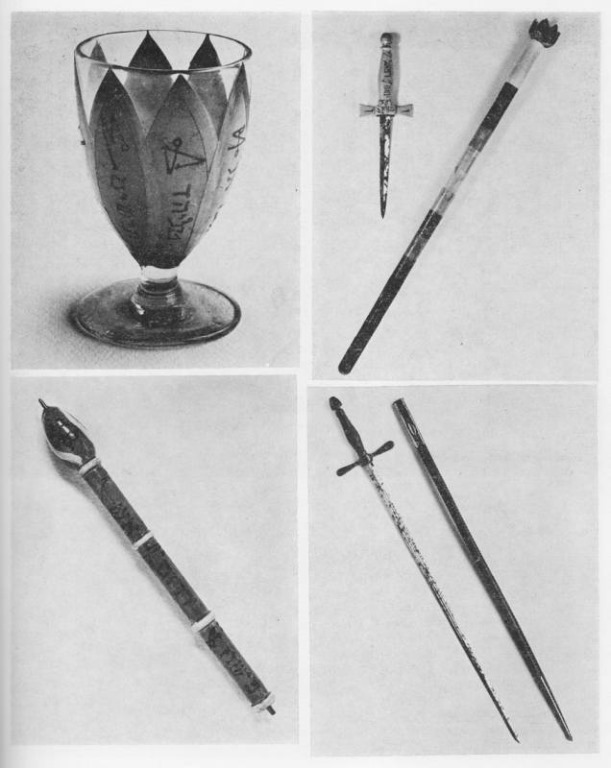
Yeats as wizard. Here are some of Yeats magical weapons. Photos from “Yeats, The Tarot and the Golden Dawn by Kathleen Raine” which I found at this web page.
.
Even ignoring all the mystical back-story, this is a poem about the breaking of nations. Therefore,“The Second Coming” fits with the theme of civic poetry, and I put this poem down on a short list of poems to consider combining with music for this April’s National Poetry Month, but we’re nearly half-way into the month before I could complete a version that I felt was presentable.* Given its grand scope it called for some big music, and my orchestral scoring skills have atrophied from where they had developed earlier in this project. Another way to make a large noise is to perform it with a full rock band, and I have been trying to recover my skills in that kind of ensemble playing this Spring. But there was another obstacle: I found that, unlike other Yeats’ poems, this one isn’t easy to fall into singing. The blank verse here tends stentorian, and I’m not a big-voiced powerful singer. For one stubborn section of the poem, I felt I needed to break into chant rather than try to keep the lyrical lift of singing. This sort of thing is a consequence of a composer needing to rely on a limited singer to realize the work.
The raw tracks I recorded for today’s song were somewhat messy due to the number of instruments: three guitars, organ, piano, bass, and drums, It was quite the operation to mix them even to my “good enough” level. You can hear that musical performance of W. B. Yeats’ “The Second Coming” with the audio player you should see below. What, has that rough beast not slouched onto your screen? It’s not the end of the world — some ways of reading this blog suppress showing the player gadget. Here’s an alternative, a highlighted link that will open a new tab with its own audio player.
.
*As I write this sentence, I take stock and consider that since this Project began 9 years ago, I’ve been composing and recording the more than 800 pieces presented here at a rapid pace. To create a single album’s worth of music in a month is considered a challenge — since 2006 there has been an “RPM challenge” to write and record an album of songs during the month of February. I’ve been doing something like that, nearly every month, for nearly 9 years!
Has that been good for the quality of the work? I don’t think the answer is a straightforward “Of course not.” While there are times when I wonder about some months-long work focused on a single composition, at my age I figure anything I want to explore or express needs to be a matter of getting down to it and getting it done as well as my current skills allow.