In Another Language

I mentioned last time that I’m cleaning out things I can no longer reasonably expect to use, and found a box which included poems by my late wife. Perhaps such things are past the use test, but I asked what use can I make of them?

After paging through the papers, I transcribed the handful of poems I found, typing them into documents on my computer, a now ordinary device which would have been a SciFi marvel to her back when she wrote these poems in the 1970s. Could I perform some of them, here, as part of the Parlando Project? Could that seem like special pleading, an enforced overlay of widower husband wants you to shed a tear for his dead wife? Let me try to move you past that. Decades after a death, and when one is old enough to reasonably consider one’s own death to be a nearish interval, shorter than the one from that loss, loss begins to take on a universal and obligatory aura. These aren’t sentimental poems – my late wife, Renée Robbins, was funny and was wearing the full costume of life when she wrote them. Those costumes of life go back into storage, kept for use in later productions. Perhaps her poem “In Another Language”  can be worn by someone still treading the boards?

Yes, these poems are little pieces of someone I loved deeply, written early in her too-short life, and bringing them on to you extends a tiny bit of what she was. Yes, it was particularly nice to feel I was working with and playing this part of her when I performed this poem this month – but yes too, it’s October: everyone’s wearing costumes and pretending they can see ghosts.

I can hear her responding to this situation. How? I’ll explain it with a quote from Woody Allen* that has been reverberating through my mind:

I don’t want to achieve immortality through my work; I want to achieve immortality through not dying. I don’t want to live on in the hearts of my countrymen; I want to live on in my apartment.”

So here you have it, a poem likely written while she was still in college, studying writing under Howard Mohr and Phillip Dacey. I’m fond of the obscure strangeness in the framing image. I can’t be sure what she, the author, was seeing. My best guess is a whole crab or lobster on ice in a seafood display, a mundane piece of unintended Surrealism – and being in a world of frozen water is also an accustomed strangeness to Minnesotans. I like the poem’s leaps, like the dream of the crab escaping to her bathtub, and the totally unexpected leap into the genderless cross-shifting-borders of “Finno-Ugaric.”**

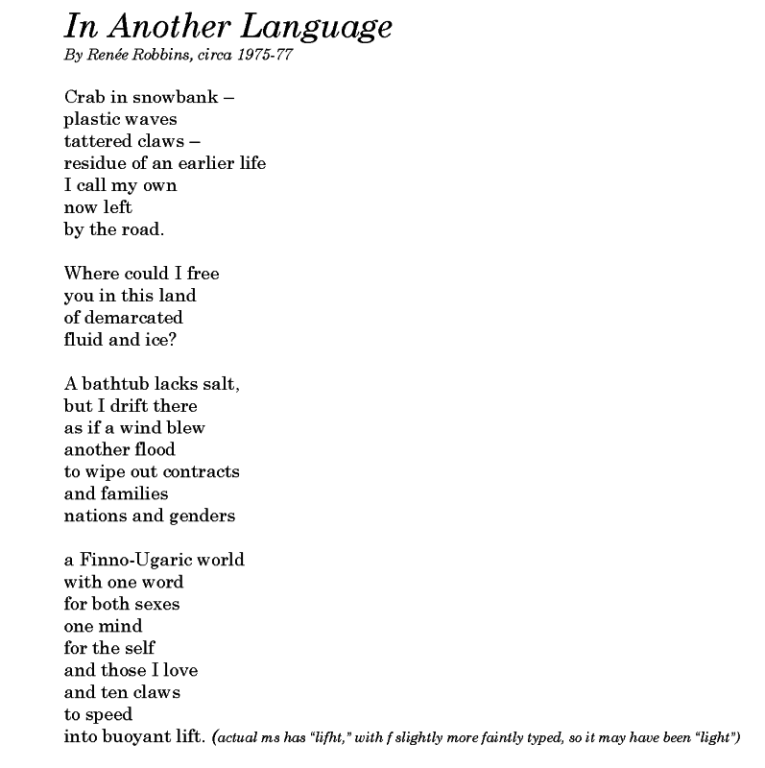
In Another Language

Besides the crab image, I see Noah’s flood in the third stanza. I chose “lift” from the alternatives for that last line because it’s more sensual.

.

I performed Renée’s poem in a style that still hadn’t gone-out-of in the Seventies, as spoken word with an approaching-Jazzy musical backing: drums, bass, and two electric guitars. I believe the music, taken by itself, might shows the subliminal influence of a current band, Khruangbin. It’s subliminal because I don’t use as much reverb.

So, there you go. Looped through with the footnotes, we’ve got Khruangbin, Krasznahorkai, Woody Allen, my late wife Renée Robbins, Phil Dacey, The 1970s, and a fifty-year-old poem by a twenty-something. There’s a lot of intervals and strange harmonies there, but I’ll end with another quote from an artist (actually, from his less famous brother). I read this one in a recent interview answer given by Ken Burns when asked how he makes those famous “Ken Burns Effect” intelligence flights over photos as he edits his work:

It’s all music—my brother, Ric, said that all art forms, when they die and go to heaven, want to be music.”

So, there you go Renée, not immortal from non-dying – but you get music.

As you can see today, we stay narrowly focused on the topic here at the Parlando Project, and we will return with poems by more famous literary poets soon – but to hear Renée’s poem “In Another Language”  as I performed it with music, use the player gadget below. No graphical audio playing gadget? I offer this heavenly highlighted link that will open a new tab with its own music player.

.

*I know a fair number of possible readers of this have strong opinions when they hear his name. I’ve got at least half of those myself. There’s a second, artistic, set of subjects regarding his work that would overwhelm the focus of this piece. To stay on topic, let me just say that my late wife was a comedy fan who could recite from memory the entire 30-minute Firesign Theater Nick Danger radio drama parody, and that Woody Allen movies were a constant date night thread in our relationship. Renée had opinions too, consistently caring ones, but she would have laughed at that quote, and I’m laughing now too, but with a deeper resonance to that laugh.

**My memory of seeing Woody Allen movies with my late wife was intensified by the recent death of Diane Keaton, but there was even more coincidence as I worked on this: the Nobel Prize for Literature went to László Krasznahorkai, who writes in a Finno-Ugaric language. And yes, that language group is non-gendered, even the pronouns – at least from what I find when I checked on Renée’s reference in her poem. And if I may risk one more Woody Allen reference, in my life back then I was (roughly speaking) playing more the Annie Hall role.

Absent Place — an April Day

Another poem for April Poetry Month. Another Emily Dickinson poem. Once more, wildflowers. Once more they’re that early spring flower, daffodils. Once more the poet is looking back because something’s missing.

Absent Place-April Day

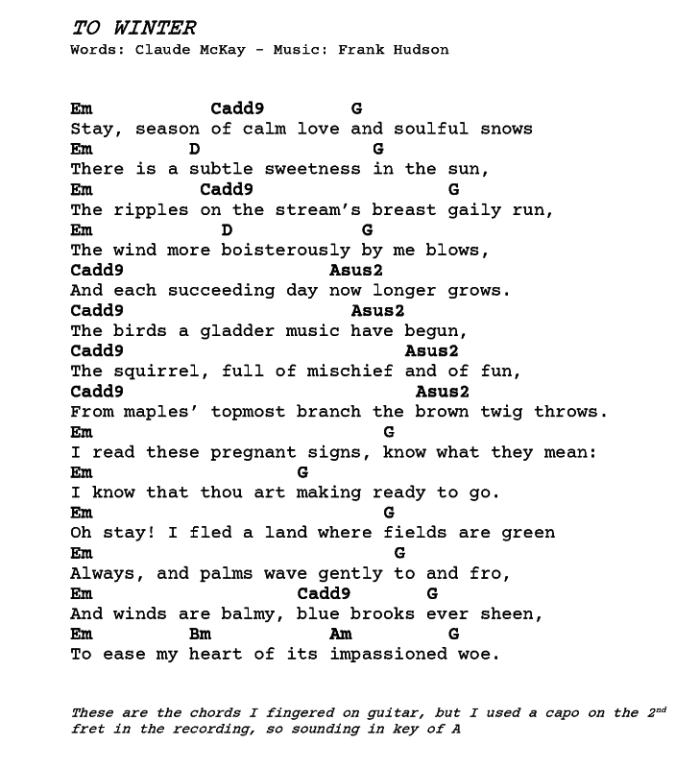
Chord sheet because someone else might sing this better than I can

.

Last time the voice in Dickinson’s poem was also alienated from Spring, but there was a taunting wit to that one. The mode in today’s Dickinson is more abstract, and the second, final, stanza is so gnomic here I can’t say I know fully what it’s conveying. Even the first stanza is tied in knots, tangled with those Dickinsonian dashes. Is “an April Day” the “Absent Place” — or is the April day, with present dancing-in-the-breeze daffodils, in contrast to the Absent Place? The stanza’s final line asking us to consider the viewpoint of “the Souls that snow” could be saying then the snow is more full of motion and drifting shapes than mere blossoms — or that April brings forth feelings that makes the Absent Place snow-Souls uncomfortable?

In intent or effect, it may be a shifting Tao — an all of the above in motion with each other?

But the final stanza? I assume “Drift” within is of the snow-Souls’, a self-impediment worse than snowed-in roads or walks, but the concluding two lines are harder to follow. Perhaps she’s saying that snow-Souls are the ”Him” in the last line, and their change and emotion is as strong as (“duplicate”) as the wind-moved daffodils? But “duplicate” is a strange word choice. Even within slant-rhyme it’s quite strained to rhyme with “without.” I even toyed with pronouncing the duplicate as the noun, not the verb, which would be a nice sound-pair with “but.”  However, that’s syntactically sour and doesn’t follow the first stanzas ABAB rhyme scheme.

For awhile I engaged in a little fantasy extension of this brief poem while asking why daffodils, rather than another Spring flower. Poet Dickinson famously knew her plants — not just as an avid gardener — but as a woman with more education than most in her time and place (which included science, considered a presentable ladylike field). She was the maker of an impressive book of pressed flowers labeled with their scientific names. Did she know her Greek myths as well as the scientific name for the daffodil, Narcissus? The essential piece of the Greek myths of Narcissus is that the youth of that name dies because he becomes entranced by his reflection, his duplicate. Is the last line’s “Him” Narcissus or something like him?

Or is she taking another route into the roots of the word narcissus, related to narcosis, a drugged numbing? Does the final stanza mean to say that springtime joy can be as numbing as wintertime sadness?

It may be wise to consider my thoughts about the final stanza over-thinking. They’re surely speculative, but it still seems likely that the poem means to link the emotions extracted from Winter and Spring landscapes.

As April National Poetry Month winds down, I’ve fallen into a theme without designing it. Many of us are feeling crabby, dismayed, disgusted, frightened, but Spring doesn’t know that. The cold of Northern April is now behind us, and May lays out ahead with greening and warmth. Is it taunting us by being pleasant and hopeful?

For the music in the performance you can hear below, I fell into it too, as certain and mindless as Spring. The recording started with the chordal guitar part, which I played on my jangling Squier Jazzmaster instead of an acoustic guitar because I was telling myself I’ve been stuck on acoustic playing too much lately, and I hate to be predictable. In timbre and volume it was hardy enough to easily accept the drums and electric bass that I matched with it. The final part was the lead guitar line played largely on the B string of the guitar up and down the neck, in that “I’ve just heard a Ravi Shankar LP” way that was popular in The Sixties — the 1960s, not Emily’s 1860s. You can hear it with the audio player gadget below. No such gadget to be seen? The authorities haven’t shut down the psychedelic ballroom, it’s just that some ways of reading this blog suppress showing the audio player.  This highlighted link is an alternative which will open its own tab with its own audio player inside.

.

Northern April

I wrote down this poem earlier in the year as a good fit for an April National Poetry Month piece. It’s author, Edna St. Vincent Millay, was from Maine, and I write from another northernmost American state, Minnesota. If a southern-born St. Louis boy like T. S. Eliot who went to live his life in temperate England wants to ironically write about April being the cruelest month, dryly riffing on the Middle English of a Chaucer’s pretty “Aprille with his shoures soote” — well, what with all the flowers and pleasant nourishing rain, that kind of puts a climatic brand on the month poetry-wise.

I rise with Millay to contradict: we have birdsong here, but it’s a more desperate, assertive song, not some celebratory strope — because it rained, sleeted, and concludingly snowed a sloppy wet mix all night and afternoon as I worked on completing today’s musical piece, and this morning everything — tree branches, overhead wires, yard fenceposts, garbage cans — had, to the very limits of toppling, piles of sticky snow as high as any booklover’s stack of unread books.

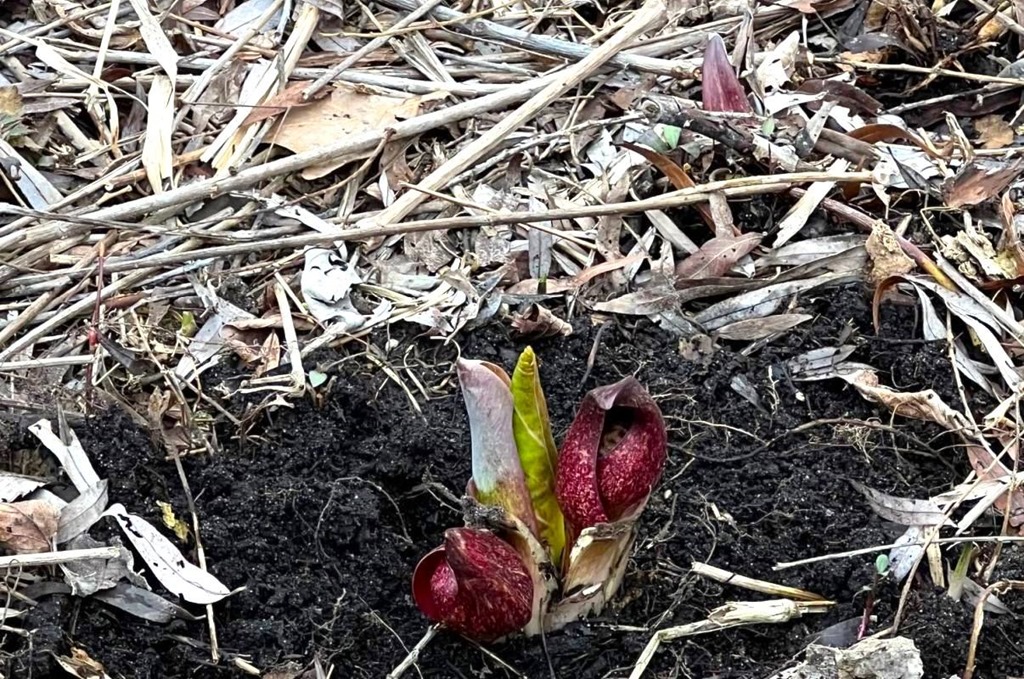
My nature loving wife took a European-born friend on a hike last week and showed the friend skunk-cabbage, a strange red, raw-meat looking early Spring plant that is exothermic — it creates its own heat like some huddled mammal so that it can bake through the snow cover. Nearer to home, indeed right next to the foundation, a small surviving clutch of tulips has sent up green leaves, but no buds yet. Their leaves course with some green antifreeze, as nighttime temps remain consistently below freezing.

Skunk Cabbage - Photo by Heidi Randen 800

“O April, full of blood, full of breath, have pity on us!”

.

My wife and I have varied memories of who planted the tulip bulbs. I remember it was my late father, long ago — while she thinks it was her mother more than a decade ago. There are only a few left. Brazen squirrels dig them up, or perhaps they are only perennial in the same sense that we are, bound to rise in many springs, but not forever.*

So, if the theme of this April’s Poetry Month is The Shared World, I certainly felt I was sharing the world within Millay’s poem “Northern April.”   The wind, the resonance of a creek with remaining ice, the just warm enough to be rain/rain. At least for me, in my northern clime, there’s a rich sensuousness in the poem, and enough word-music inherent in it to command me to sing it.

I’ve noticed that I haven’t used my 12-string guitars much this winter. They are a little more stout to play, and I think they show less forgiveness for my less-than-pristine technique, but I tried to plant today’s piece in the furrows dug between my limitations.

My music today makes use of a couple of instruments playing at the edge of their ranges. The bass guitar part is entirely played in the upper octave of the instrument, giving it an unusual sound I found I liked; and for a bit of melodic embellishment, I played an oboe line, again at the upper reaches of the instrument. Why an oboe? I thought of a 20th century band called Oregon who would mix 12-string guitar with reed/woodwind instruments, and I wanted to revisit that set of timbres from the composer/player side instead of from my listener’s memory.

You can hear my performance of Edna St. Vincent Millay’s “Northern April”  with the audio player gadget many will see below. Has no such gadget sprouted? I offer this alternative, a highlighted link that will open a new tab with its own audio player.

.

*I took leave from poetry and music to very briefly look at that issue from gardening knowledge. It appears that the bulbs shoot off other child bulbs, a process hidden in the dark underground in the later, non-flowering, part of the year. If so, appropriate for the idea that we think these spring flowers are from our parents.

Stars: Robert Frost and The Book Of Nature

Robert Frost. Long-time readers/listeners here will know I love to sing Frost’s early poems as part of this Project. We’ll get back to Frost, but another thing long-timers here know: for me, roundabout is the best mental journey — and there will be a piece of music at the end as we rest from our walk.

Ok, let’s stroll.

It’s a famous midcentury half-hour black & white TV episode. So famous that you don’t have to have seen it to know the recognition scene near the end of its story that has become a modern myth that SF and Fantasy fans like to point out their stories aspire to. Given that, I’m going to assume no one will need a spoiler alert for this 1962 Twilight Zone episode called “To Serve Man.”

The format’s so brief, the story must be told rapidly. We’re told that a race of other-planetary beings have landed on Earth. With retrospectable irony, their leader is described as “Christopher Columbus from another galaxy.” They go about setting things here in benign order with advanced technology. They leave behind a book in their language that seems to be a guide to the extraterrestrials’ efforts. Partway in, Earth’s code-breakers have deciphered the book’s title: To Serve Man.  And they seem to be doing just that: ending hunger, gently enforcing world peace, taking selected humans on spaceship rides to their home planet.

Many of you are now speaking — telepathically or aloud — to a device’s screen what is urgently delivered to the story’s human hero once the humans can decrypt more of the book than just the title: “It’s a cookbook!”

I’ve written here often about something I call The Book of Nature. Though not an exclusive American idea, I connect it with the 19th century American “New Thought” movement called Transcendentalism. The Transcendentalists believed that a true scripture of the universe’s higher power was transcribed in nature. By contemplating nature big to small one could discern the highest truths. Our contemporaries who are “spiritual but not (sectarian) religious” may hold to this as a core belief, but it’s likely that every denomination of religious belief can incorporate this too — after all, if The Creator made this, their authorship means there is plausibly something there to be read.

Now we can get back to Robert Frost. Frost no doubt knew Transcendentalist thought, but unlike his fellow great American poet, Emily Dickinson, Frost didn’t hold with its doctrines.*  Yes, Frost wrote seemingly “En plein air” about nature often. His early poems, some of the ones I like best, are suffused with the landscape and particulars of New England nature. Did he see a supreme being’s handwriting there?

If so, Frost would be critical of The SB’s penmanship.

stars

Chord sheet so that you can sing this one yourself.

.

If we look at this example, “Stars”  from Frost’s first book of poems, A Boy’s Will,  what do we “read” from nature’s book? The stars come out at night. What is their nature?** “Countless(ly),” we can’t even get the basic stats correct. Oh wait, Frost can see a primary Roman goddess in there: Minerva, the goddess of wisdom and strategy. No, he reconsiders: it’s a statue of Minerva he sees in the stars, a human-made simulacrum — and her marble eyes are the form of sight organs without any such function. So should we look lower down at our earthly landscape?***  Snow covers it profoundly, drifting “as tall as trees” and so obscuring even the ground-level facts. Wind is blowing — the choreographer of this landscape — yet, this dance doesn’t tell a story, it obscures it, though here at last Frost reads a message. That wind, that obscuring snow, is “our fate.” In the most mysterious part of the poem, the second stanza, we cannot see where we’ve walked or where to guide our steps. The gothic part of my nature reads Frost’s “place of rest invisible at dawn” as death. I read the image in this stanza that in such deep and overblown snow, one cannot even see the walk fate will not reveal to a farmhouse graveyard.

Nature acts “with neither love nor hate.” Robert Frost has decrypted The Book of Nature — and all the pages are blank.

Here’s that song at the end of our mental walk where I set Frost’s poem to music with acoustic guitar. You can hear it with the audio player gadget below, or with this backup highlighted link if that gadget is not shown.

.

*Frost’s friend and fellow poet Edward Thomas was an exquisite nature poet of his British Isles countryside. In regards The Book of Nature, he’s between Frost and Dickinson for he has a horticulturalist’s specific eye like Dickinson — and his consistent naming of natural details and seeing them as readable symbols indicates he finds them plausibly capable of guidance.

** Astrologers, Biblical Magi, and classical constellation dots-connectors of course are reading that sky in clear text.

***In a changeup meant to fool this writer and singer, my specific winter this year has been oddly empty of any expected Northland winter symbolism. We’ve had next to no snow, only a week or so of bitter sub-zero cold, and I look out today on a sunny brown yard over which squirrels are carelessly playing tag and tree as we rise to our predicted afternoon high of (in Minnesota! In January!) of 55 degrees F.

I’ve been riding my summer bicycle with its summer tires most every day this “winter,” where that bike normally stays hung up high in the back of my shed. Spring in Minnesota is famously snowy, my winter bike with studded knobby tires cannot be put out of the way. Perhaps as long as I leave it by the door we may continue to have a mild winter.

A Winter’s Tale: A cold mystery for Halloween

Having done over 700 audio pieces in the more than 7 years of the Parlando Project, I take pride in the variety of the original musical settings I’ve supplied for them. Oh, there are more than a few of the performances over the years that embarrass me: stuff were my problematic vocals don’t deserve parole, or arrangements where I can’t now tell how I ever thought they worked, or those where it would have been better if I’d had access to better musicians than my overdubbing, but many of them still sound good to me.

None sounds better than this one as we near the end of my Halloween Series presenting some of the listener favorites from those 700-plus pieces. “A Winter’s Tale”  sets a should-be-better known poem by D. H. Lawrence. For some of you that poem’s climate is going to seem premature — and you may even wonder why it fits a Halloween theme. I assure you in Minnesota, in the northern parts of North America, this poem is not out of season. We’ve had no snow yet, but my morning bike ride was –5 Celsius. And tomorrow? Those thin polyester costumes sold at stores for trick or treating are not right for many a Minnesota Halloween. And any creativity in making one’s own costume is suppressed by the eventual need for an overcoat which will cover it. And what of Lawrence’s poem — here’s a link to the text of the poem — what’s Halloween about it?

Winters Tale 1080

A long way between houses just for some candy.

.

Well, it’s quite mysterious. This is the third time I’ve presented it, and I’m still not sure what the specifics of the described wintery mystery are. At times it seems like a breakup or strained love poem. Other times it seems like a hunting poem, metaphorical or not. It may have some connection I’ve not fathomed to Shakespeare’s play concerned with virulent mistrust. If it’s a hunt, I can’t even say who the speaker/singer and the hunted are. One or the other may even be Winter itself. That mystery and the air of danger are enough to make it a Halloween poem, and after my musical work, a Halloween song.

You can hear it with the audio player gadget you should see below. No player to be seen? This highlighted link is a backup that will open a new window with its own audio player.

.

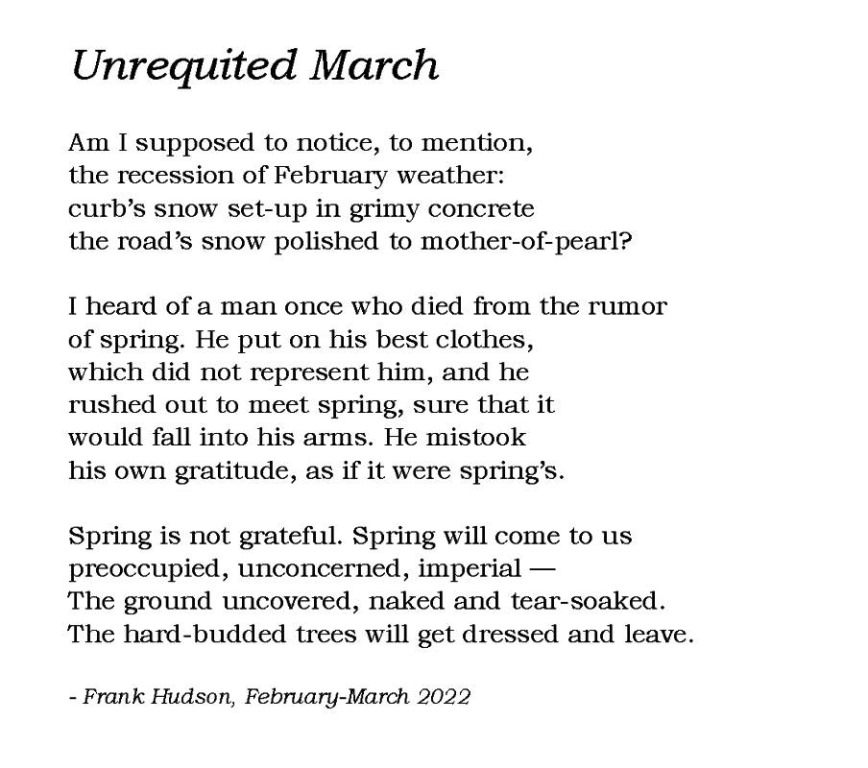
Unrequited March

Here’s a sonnet of my own about the oncoming spring. I live in Minnesota, and here that season’s arrival is something of a lottery ticket. Oh, it’s likely that by sometime in February a Minnesotan is tired of winter, and we know that somewhere around May Day we’ll not have snow or cold to deal with for a few months, but when today’s high got to 40 F, we know no more than that. When I moved here, I was told that on days like today we might see folks wearing T-shirts outside — and yes that’s so. We are so in a hurry for spring that what would be a 5-degree Celsius winter day in more temperate regions seems time to ditch the jacket. Yet we are still likely to have more cold, and even more likely to get substantial snowfall, particularly in March.

So it is, from late February to late April is a two-month season of “what d’ya got” in our state. That’s what my poem performed today deals with.

Things are still snow-covered around here, but it’s not fluffy, Christmas-card snow— more at rugged crusts. I still ride a bicycle nearly every day year-round, and so winter means that I pay special attention to the surface conditions of the side-streets that I most often ride. You know the old factoid that Inuit peoples have a multitude of words for snow in their vocabulary? A day or two after a snow what’s often found is compressed and polished snow with some patches of white glaze where tires’ friction has buffed a gloss.*  A few days later there will be areas where that surface further abrades and patches of dull-brown porridge-like snow aggregates are scattered on the roadway. I call the later “brown-sugar,” and the earlier hard white surface looks to me like the smooth inside of a shell.

Spring-time bike rides in Minnesota aren’t necessarily what you think.

.

Low-pressure studded bike tires work pretty well on the hard shiny stuff, and large knobby treads are the thing for the loose brown sugar. My deep-winter bike’s tires are a pair of Venn diagram hoops circling both.

That’s a poet’s bike ride for you: metaphors per hour.

Unrequited March

The meter’s a bit loose, yet not loose enough to cry “Kings X — Free Verse!” either.

.

Does any of this help “translate” my poem for those without my climate? That’s my hope anyway. Though the title of my poem is “Unrequited March,”  my wish for you, curious or stalwart reader/listener, is that spring will love you back this year. The player gadget to hear about the uncertainty of that is below for many readers, and for those whose way of reading this blog won’t show that graphical player, this highlighted hyperlink will open a new tab to play the performance just as well.

.

*The large, knobby, low-pressure tires are also capable of riding on fresh snow before cars get to it. Un-rutted light and granular cold-weather snow is kind of fun to ride in. The wetter and clumpy snow that will likely come in any heavy storms for the rest of the season is much less joyful. That stuff is like riding in deep mud. The tires’ knobs will get traction — it’s not the tires, it’s an old out-of-shape guy like myself who’ll get tired quick riding through that.

Velvet Shoes

I’ve got a gorgeous song for you today, despite a difficult week for new work. I’ll try to get to it shortly, with only a little throat-clearing first.

It was 18 degrees F below zero* this morning. Oh, there was probably some wind chill too, but let’s not put too fine a point on temps like that — Minnesota January winter certainly doesn’t.

Our winter, to speak broadly, isn’t just cold. There’s also ice, snow, and winter cancellations and rescheduling. If that sounds grim, well, somedays it is — but then there’s a little something else about this sort of winter when you run across others out in it. Early this morning I saw another bicyclist with full face mask and goggles sawing their bike over the packed snow pavement. Before that, a woman walking her dog, each of them concentrating on getting such business done. In other duties, some school kids were walking to school. Every one of those fellow citizens are dealing with this shared winter too, and despite not being able to see much of their faces, you can likely feel something of a common cause.

But winter can also be experienced without even such scattered crowds. I used to commute around midnight on a bicycle, and the urban streets on rough winter nights would be the same as some new nowhere, like unto a SciFi paperback cover of the astronaut gazing through alien ruins. My wife sometimes runs just before dawn to a park that has no others but her and the existential animals.

Today’s piece is a winter poem by American poet Elinor Wylie, who wrote absolutely lovely short lyrical poems around 100 years ago. Hers is a slightly different winter. First, she’s walking with someone else. She doesn’t mention the temperature, but I doubt it quite as bitter-brittle as my morning. Hers is explicitly windless, but there is snow, the kind of loose powder that tends to fall when it’s colder than the soggy wet flakes.

Here’s a link to the text of Wylie’s Velvet Shoes,  in case you’d like to follow along.

Wylie’s reputation dropped fairly rapidly after her premature death in 1928. One knock against her pretty poems was that they were that and nothing else but attractive pictures drawn in word music. Well of course music itself doesn’t task itself with more than to be attractive, and visual art doesn’t need to support a philosophical argument or insight explicitly.

Elinor Wylie at the door

Sure it’s a pretty line: “I shall go shod in silk,” but damn it, open the door, it’s seriously winter out here!

.

I rather like this poem’s picture, because it’s something of a white-space void with just scant details coming out of the snow, like a Whistler painting. But it’s not even visual clues for the most part — the details are textures, feel images: veils, silk, wool and fleece, feathers and down, and then the velvet of the title. There is testimony that there is no noise, much less talk. Indeed, her partner in the walk is near-totally obscured, and this choice —conscious or unconscious — seems striking to me. Is she alienated from them, or so close that there’s no novelty in mentioning? The sensuality of the imagery may give undercurrents of erotic love, but the obscuring of the partner makes that reading stranger.

I seem to be specializing recently in taking leaps at alternate readings that even I don’t think likely, though not impossible either, like my wild-ass guess that Truth’s body moldering in the grave next to Emily Dickinson’s Died for Beauty could plausibly be John Brown. Don’t bet your grade on that one, students! But I thought of the woman walking her dog this cold and snow-covered morning. No reason to talk there, nor was the dog taking time out for a barking address. Wasn’t that dog wearing a wool sweater? Less romantic a poem, but not impossible.

Though it’s freshly done, I’m fond of the music I came up with for Wylie’s poem. Maybe you’ll like the little song they make together when I performed it this morning. The player gadget is below for some of you, and if you don’t have that, you have this highlighted hyperlink that will also play it.

.

*That’s minus 28 C. Minus.

Winter ‘20-‘21 Parlando Project Top Ten, numbers 4-2

Today’s report on the most listened to and liked pieces featured here over the past quarter will show three experiences of the mystery of winter. So, let’s return to our countdown:

4 Twilight Fallen White and Cold  by Joseph Campbell.  I seem to have become something of a promotor of this little-known in the United States Irish-born poet who I still know little about. He published a series of poetry collections before the end of WWI, and then his poetic output dropped off, for reasons I’m not yet clear on, though the politics of his country’s decolonization struggle may have contributed. This piece using his words that a lot of you liked and listened to may be the most mysterious of today’s trio.

Best as I can figure it, this winter nature landscape poem may be an expression of his nation’s detracted state and situation, particularly in the invocation of ancient earthworks (raths) and burial mounds — but I cannot plumb the entirety of the refraining line of “wounds of Eliom/weep on me” that I feature in my setting of Campbell’s poem. Eliom is a plural word for gods, sometimes used for polytheistic gods, sometimes used for the singular monotheistic diety, and as it may be here, used for angels. If that’s so, then the starry constellations, the winged vampires, the curlew birds, the floating mists, the carrying sound of the ocean are all the Eliom, the angels in this changed winter nighttime vision.

To hear my setting of Campbell’s poem, you can use this highlighted hyperlink which may open a new window with a player, or in many cases, you’ll see a player gadget below to directly play it.

.

What the Story Tells Itself by Kenneth Patchen

It’s been too long since I’ve said this: thank you for coming to read or listen here.  It’s become harder for me to respond to comments or properly promote this project, but I appreciate so much those who come here, listen, and let others know what the Parlando Project does.

..


3 The Snow is Deep on the Ground  by Kenneth Patchen.  Lawrence Ferlinghetti, whose words we met earlier in this countdown, would sometimes remind folks that he wasn’t really part of the Beat Generation, even if he was associated with others who might have been so thought. Patchen is a similar case, or perhaps more so, in that his poetry career started in the 1930s,

As with many of the best Patchen poems, even the political ones, this is a love poem, delicately poised between the enchantment of love and the world that allows the shattering of it. If one can fully absorb the illumination of this poem, as with some of the best of Patchen, you would cry tears of joy and sadness at the same time.

You can hear my performance of Patchen’s “The Snow is Deep on the Ground”  with this highlighted hyperlink, or if you see it, with a player gadget below.

.

2 The Sky is low  by Emily Dickinson.  Some years back in this project I once compared Emily Dickinson to one of those unexploded, yet potential, bombs that are still unearthed in Britain or Europe from the World Wars. Originally she was found as the creator of curious little poems from an eccentric woman, then as a prescient 20th century Imagist, and now in our deconstructed age we can stare at one of her tiny poems, and like one trying to follow the decent of a single flake of snow in a flurry, fall as far as one can follow.

You can read, or listen to my performance, of “The Sky is low”  and find a whimsical nursery rhyme, and find enough enjoyment in that — but let it stick in your memory or repeated ear and a little dialog about predestination, first causes and fate is discernible. To listen, use this hyperlink, or you may see a player gadget to directly play it below.

.

One more post in the Top Ten countdown to go, and then we can move on from the mysteries of winter to the mysteries of spring.

The Sky Is Low

This little poem by Emily Dickinson seems at first so slight, little more than a tiny winter nature lyric using the risky literary trope of the pathetic fallacy* deftly enough that it doesn’t cloy. The language is almost entirely simple and plain-spoken, but in such a short poem the words that aren’t entirely clear may reward further attention.

The Sky is low manuscript

Dickinson’s handwritten manuscript for today’s poem from the collection of Amherst College.

.

The Imagists that came decades after Dickinson’s work weren’t much for the pathetic fallacy, but if one ignores that element— something possible to do because it’s so swift and unpretentious about it — this poem does work like an Imagist poem or like one of the models Imagism sought to emulate, the classical Chinese short poem.

Let’s start right at the first line, and the first word that requires some figuring out. “The sky is low, the clouds are mean” sets our stage. A “low sky” and “clouds” would indicate that this poem’s day-moment is overcast, but what does “mean” mean? It would be easy to think it’s saying, pathetic-fallacy-wise, that the clouds seem angry and spiteful. I think many modern readers will hear this sense primarily, and I cannot eliminate that Dickinson intended that at least as an undercurrent, as it seems a pair with the complaining wind we meet in the second stanza. Yet, in the context of the sentence that makes up the first stanza, my best thought is that she is presenting the clouds as a secondary definition of “mean” (now somewhat obsolete) as shabby or stingy. The image she’s setting up is that it’s overcast, but it’s not a snowstorm, there’s only a modicum of that mentioned: a specifically singular “flake of snow,” so that may be all these clouds are producing.

Our snowflake does have feelings. From its actions, aflutter in the wind and singular enough for the eye to want to follow it as an individual, it seems indecisive about what route to take over the landscape. It might fly high (“across a barn”) or low “through a rut.” It’s frozen (sorry, can’t help myself) in a moment in the poem and we never find out. In its concise way, Dickinson’s snowflake is like Robert Frost’s chiding portrait of his friend Edward Thomas: two possible roads, and the snowflake thinks it’s important to choose one.

The pathetic fallacy gets stronger as the second stanza begins. A cool or cold gusty wind is presented as if it’s complaining for hours on end. For an old/weak bicyclist like myself who tires of headwinds that seem to always be in my face no matter that one has changed direction, this is an ascribing of malice and forethought that I can appreciate. If you look at Dickinson’s own manuscript, you can see that she considered using a legalistic term**  “some parties,” but “some one” seems the broader and better choice. Here, in a different aspect from the snowflake who thinks it has at least a binary choice, it appears the wind is saying it’s been diverted or prevented from something.

In this small poem’s presentation, these two things are joined. The snowflake thinks it can decide, but we know the wind will send it where it directs, but the wind thinks it has been in someway enjoined. Pathetic fallacy aside, it cannot choose, meteorological forces and barometric lines will send it where they will.

In the last two lines, Dickinson doesn’t tell us how it comes out — she refuses to leave her poem’s lyric moment. Her final line brings one more uncommon word choice. It has it that “Nature, like us, is sometimes caught/Without her diadem.” A diadem is a ruler’s crown, worn to signify that the wearer, well, rules, decides. Once more, the pathetic fallacy is invoked: nature is the decider, but for the poem’s moment they have momentarily forgotten to put on the device that lets them take on that power — but in a tiny aside (“like us”) Emily Dickinson says we actual humans, who can actually think, feel, decide are sometimes also in this situation, we may blithely follow what seems like a free will choice or complain that we are forced into our directions. Which is it, really? Did you forget your diadem?

Read this poem, or many an early Imagist poem or classical Chinese poem, and it may seem a miniature painting of a mundane scene. We may be charmed briefly, or we may think, “Oh, that’s too slight to be a thoughtful poem.” Did Dickinson consciously or unconsciously intend what I see here? The number of times she was able to pull off effects like this poem can produce, and the subsidiary writings demonstrating how she thought***  indicate that even if she didn’t consciously work out the complexities underneath her simplicities in some grand and lengthy inner symposium, she put herself in the place where she could receive and express these charged moments.

As usual, I’m going to perform “The Sky Is Low”  with some original music. The player gadget should be below, but some blog reading software won’t show it. If so, this highlighted hyperlink will also play my musical performance.

.

*The pathetic fallacy is the tactic of ascribing human emotions and thought to inanimate objects or forces. Despite the literal words of this poem, it’s not debatable that snow does that, and the wind doesn’t really have some angry dispute.

**I’m not sure how many scholars have considered that Dickinson grew up in a family of lawyers, and even though as a woman that field was not open to her, it’s likely that some of that was picked up by her avid mind.

***Long footnote ahead! What can we gather from how Dickinson used this poem that might indicate how she considered it? This poem was “published” in a personal letter to the wife of a couple that were long-time friends of Emily. The husband in the couple was Josiah Holland, a medical doctor and lay preacher. By the time this poem was written in 1866, Josiah had become a well-known journalist, lecturer, poet, and author. He was a principal in the Springfield Republican  newspaper which famously published seven of Dickinson’s poems during her lifetime. He had just published one of the first full-length biographies of Abe Lincoln, and would a few years later found and become the first editor of Scribner’s Monthly.  His wife, to whom the letter with the poem was addressed, Elizabeth Holland, has no known literary work — but read the letter by following this link.  Here one may get the sense of how another important literary personage who Emily Dickinson interacted with, the formidable Thomas Higginson, remarked about how Dickinson wore him out. The amount of philosophical legerdemain, reference, and zen parable in this short letter is striking to me. Did Dickinson expect Elizabeth Holland to understand that letter?

Emily Dickinson’s correspondence and friendship with the Holland couple seems to have been one of the most stable and ongoing in her life, equal to those who were Dickinson’s blood relatives. Whatever bonds were between them, this letter shows the expectation of considerable intellectual understanding, and for “The Sky is Low”  to be enclosed indicates that Dickinson had goals beyond the simplistic for it.

The Snow Is Deep on the Ground

Today’s piece is a winter poem for troubled lovers, but in the wandering tradition of this project, we’re going to go somewhere else on our way there.

Next week there is to be an inauguration of a new American President. It’ll be the 13th new President in my lifetime. Though I remember witnessing all these inaugurations in part through news reports, photographs and recorded footage; to the best of my recall, I have only watched two as they happened. Which ones? Most recently, I watched Barack Obama’s first inauguration in 2009 while working in a place with a newsroom; and then, before that, as a schoolchild I watched John Kennedy’s inauguration.

I believe this is so because in our democracy we have a tradition of our Presidential terms ending and beginning uneventfully and with a comforting regularity. It’s not that we citizens ignore that there’s a new President, but the event itself happening is largely unremarkable.

Kennedy’s inauguration in 1961 was contemporaneously recognized as a post-WWII milepost, the Presidency passing to a young former enlisted man in that war, moving us beyond a country ruled before by 19th century men. As I said, I was a schoolchild. My class watched it on a single gray TV set placed up high in front of our schoolroom instead of our usual lessons. I don’t think I was alone in the audience for that event in thinking it was important to pay attention to what was said, watching for news of a new era we knew was new.

Obama’s election and inauguration said something about America recognizing it had changed its evaluation of people of color.*  It’s become a mark of sophistication and analysis to say that was an illusion, disproven by everything wronged people and close examination brought forward then, and since then. I thought, and think, we’re in the midst of things. If more know that now, the marker post of Obama can still tell us where we’ve come from and where we can go.

Is it a coincidence that both of those Presidential Inaugurations had a poet read a poem as part of the ceremony? That’s not a common choice: Kennedy was the first President to ever do so, and only one other President, Clinton, did so besides Obama.

Now, as it happens, I hope to watch the Inauguration next Wednesday, because this one seems more precious to me, more extraordinary, something not to be taken for granted. I will not watch it expecting or requiring great words — no need anyway, because the event alone now has a greatness thrust upon it. Yet coincidence or not, there will be a poet, a particularly young one, reading next week: Amanda Gorman, all of 22 years old.

There are several videos of Gorman reading on the web, but I wanted to bring forward what she says here about her poem for Independence Day, which starts with Phillis Wheatley and mentions that she’s speaking in the Washington-Longfellow house that day. It occurs to me that Gorman seems to be essaying a kind of civic American poetry that Longfellow might recognize.

.

So, now I’m ready to return to today’s piece, one using the words of American poet Kenneth Patchen’s poem “The Snow Is Deep on the Ground.”   If you’d like to follow along with the text, here’s a link to the poem. “The Snow is Deep on the Ground”  seems to fit my times, and perhaps it fits yours too, and so we may think of it as my unofficial poem for this January’s Presidential Inauguration.

What did Patchen intend with the repeated image here of deep snow? As a northerner I know one thing it portends, a restriction of movement, and it’s often too a trope of accumulated time. I read something now in the image that Patchen may not have intended, restricted as I am in movement by our current epidemic and having just endured a cloddish act of insurrection deep in whiteness. It seems, or we hope it is, that that “war has failed.”

Patchen says the snow is beautiful though — but specifically it’s beautiful in a fallen state,  something meteorologically and theologically true in Patchen’s poem.

The poem’s third stanza has muffled terrors. What a strange and yet strong line “Only a few go mad” is! And the whiteness “like the withered hand of an old king” undercuts any sense of simple winter landscape beauty. To say twice “God shall not forget us” implies this is in question, doesn’t it?

The poem has it what we know more than we know by faith: our love, our lovers. How beautiful it is to be loved, to love. And to know that after talking of politics in a world where lies and flags are used as shields and lances to beat each other with!

My performance of “The Snow Is Deep on the Ground”  can be heard with the player below, or if you don’t see that, with this highlighted hyperlink. The musical core today is my naïve piano playing, over some drums and small percussion instruments. To add some character to the string bass part I doubled it with a synth-bass. Thanks for reading and listening, particularly as my ability to produce new pieces is reduced right now.

.

*There was something else about that Presidency. I’ve lived a long life, and yet in all those years Barack Obama is the only President I’ve ever had who was younger than me.