Here’s another short poem by Sara Teasdale that I’ve done the Parlando Project thing to by making it into a song. As a young woman, Teasdale won the Pulitzer Prize for poetry in 1918, but as the century continued her poetry lost some of its literary/academic esteem for not being written in the manner of High Modernism’s Hermetic allusions.*
Teasdale grew up in the same turn-of-the-century St. Louis Missouri as High Modernism’s Chief Mage T. S. Eliot, though I’ve never been able to establish that they ever met as young people. One plausible reason why not: both were educated in gender-segregated schools for the most part. And Teasdale’s early life was like late-life Emily Dickinson in its isolation, largely confined to a room in her family’s home due to some vaguely defined illness. As a young woman she was able to break away from that confinement, moving to New York City and engaging with other literary figures there during her heyday as a poet. Like her contemporary Edna St. Vincent Millay, she married a non-literary man after romances with other poets, but Teasdale’s marriage was less successful.
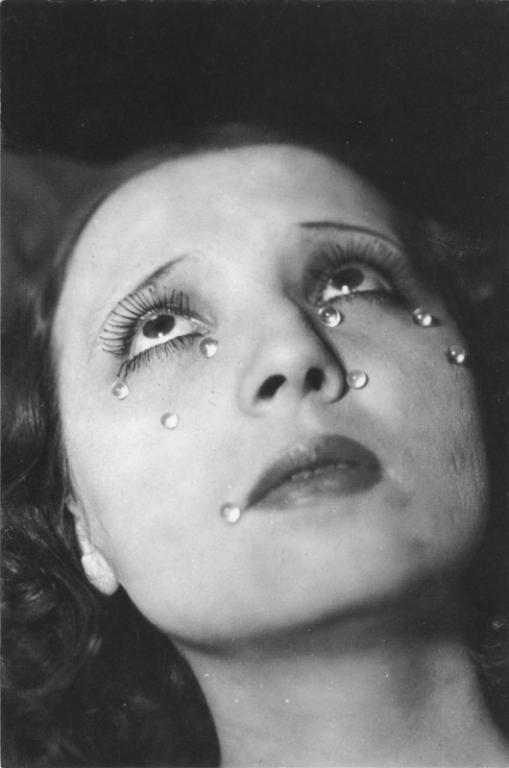
Teasdale’s Pulitzer-honored collection was titled Love Songs, and that does describe her most common subject. Today’s poem, at least on face value, is one step removed from a personal experience love poem, posing itself as a poet-supplied maxim applicable to a disappointed-in-love younger woman.** I’d dispute that the poem’s advice is only useful for women — but then the specific in poetry often stands for the general. Here’s a link to the text of this short poem.
“This truth, this hard and precious stone, lay it on your hot cheek.” Photograph by Man Ray
.
Like many of the poets I feature here, Teasdale’s Wikipedia page is brief and fragmentary — but one thing it does document: her work has been set to music often, and by a wide range of composers. Early in this project I mentioned that singer-songwriter Tom Rapp’s setting of a Teasdale poem was an early inspiration for me. One could make the case that it was us composers, more than literary academics, who maintained Teasdale’s art until it could be re-engaged with.
Part of me wishes I could’ve produced a more polished performance of Teasdale’s “Advice to a Girl,” but my current life often reduces the time I can spend on the musical pieces. I like the harmonic cadence in this song’s music, but I expressed that with just an expeditious strummed guitar part along with some acoustic bass accompaniment. Still, the idea’s there now, and an unexpressed idea easily fades and disappears. You can hear my performance with the audio player below. If you don’t see any audio player, there’s also this highlighted link which will open a new tab with its own audio player.
.
*That I’d write “Hermetic” there indicates that my moods and mind are not opposed to that kind of poetry — but then I’m also not opposed to poetry that speaks of our ordinary and present human relationships, which in their complexities and footnotes exceed any grimoire’s or textbook’s breadth. Just as with music, I’m a poetry eclectic.
**This poem could easily be read as someone talking to and soothing the memory of their own younger self. Our youth may lord over us with its misapprehensions we cannot correct, and that time-separated self often benefits from our wiser selves speaking to them from later up the years.
Here’s another one of these posts that is going to jump around a bit, though I’ll keep it brief, and there’s a heartbreak poem set to music that I’ll end with.
I don’t post every time some figure influential to me dies. It should be apparent to long-time readers of this that that group of influences is wide, and therefore large. Still sometimes the spirit moves me. This week a midlist musical figure, John Mayall, died. He was 90 — so not a surprise to any actuaries in my audience — but his extraordinarily long musical career (he was still regularly touring up until the last few years) might have masked the imminence of that death.
I can’t quite figure how many of you will recognize his name, and of those that do, how many will see why I’d count him as an influence. I often worry, what with the variety of the musical settings I publish here for strangers to listen to, that someone listening to one, two, or three of the Parlando musical pieces will think that I’m fixed in some musical genre. “Oh, he does folk-song-like stuff with solo acoustic guitar.” “Some kind of rough garage rock thing, isn’t it?” “Do you know you sound like Bob Dylan?” “What’s with all those orchestral instruments — and was that a sitar?” “You know, that beatnik to poetry slam kind of spoken word over spare Jazz backing stuff.”
To my mind, my aim is to vary the music, just as it’s my intent to present different sources for the words. But what’s that got to do with John Mayall who was not generally filed in any of those genre bins. If you look for Mayall’s work, he’ll be filed under “Blues.”
Blues, that great Afro-American musical approach, is (while often imperceptibly) as close as a center as I can find in my music. The other day one of the household teenager’s friends arrived when I was in another part of the house practicing guitar over an entirely not-Blues chord progression I had ginned up. I stopped, wanting not to intrude sonically on their get-together. When I met up with the young visitor (who plays guitar themselves) I apologized for the racket, and they replied, “Blues is always cool.”
Odd, I thought. I certainly didn’t think of the idea I was working with was Blues, but then the things I was playing over it used embellishments that I learned from musicians who played within a recognizably Blues song and harmonic structure.
“[Blues] is about – and it’s always been about – that raw honesty with which the blues express our experiences in life, something which all comes together in this music, in the words as well. Something that is connected to us, common to our experiences. To be honest, though, I don’t think anyone really knows exactly what it is. I just can’t stop playing it.”
Read the whole interview in that link above if you want an overview of the man’s career and its variations on what you might think defines the Blues— but I admire Mayall regardless of genre borders, because his career exemplified something I call the Indie Spirit. He was a “get in the van” sustainable-costs touring musician when D. Boon was a fresh kindergarten graduate. Like Grant Hart, he did the graphic design for his band’s records from the very start. He played for small audiences in small venues through most of his career, and ballroom and converted movie theater venues were about as big a draw as he could muster at the height of his popularity. If that bothered him (it didn’t seem to) it didn’t stop him. He played his music without a thought to maximizing its commercial potential, a genial stubbornness that I admire. Furthermore, every band he put together over around 60 years of music-making had musicians that were better than he was, and he based his bandleading on letting them shine. Every obit tries to list those once bandmembers, but the list extends over the horizon because that group of boosted musicians, like the bandleader, included many individual talents that never became big stars while making fine music.*
A song not by John Mayall: “You look to me like misty roses…” The roses from a morning walk my wife took. The picture of Mayall is on a pillar overlooking where Dave Moore plays in my studio space.
.
That went on longer than I expected, but here’s a piece I just finished, with words from the American poet Sara Teasdale. Teasdale is another writer from the first third of the 20th century whose poetry I can’t resist setting with music. Much of Teasdale’s poetry is short and compressed like today’s selection “Dooryard Roses.” And much of it expresses heartbreak, as this poem does. But like the Blues, it tries to be honest and straightforward about it, and to sing it so we can say back to the singer “Yeah, I’ve been there too. Is that what you figured about it? Well, we’re both still here, so sing it some more!”
The music I composed for this piece, is it Blues? Maybe I don’t know, but I don’t think it is. I just can’t stop playing it. You can hear it with the audio player gadget below. No gadget? This highlighted link is your alternative then.
.
*A personal factor in my connection to John Mayall’s music: alternative voice and frequent keyboard player in this Project, Dave Moore, is the person who introduced me to Mayall’s records. In those 20th century days when one might fruitfully evaluate a person by their record collection contents, Dave didn’t need any help there — I’d already heard his poetry — but he’s why I came to hear and follow Mayall’s music.
Here’s another piece that has been in process for nearly a month. It’s also another that I’ve held back because I feared it would be either disturbing or unattractive. It should be apparent by now that this Project doesn’t exactly pander to an audience — what with its inconsistency and stubborn variety — but I do sincerely appreciate those who take some of their time to read or listen to it. So let me explain.
Sara Teasdale’s “Since There Is No Escape” is a piece of gothic romanticism. Since my tastes are wide-ranging, it’s not the first time I’ve touched on that strain of expression — “The Dark Cavalier” from earlier this month would be another example. These are pieces with a kind of dark beauty to them, and therein is the danger. For, at least to some, there’s a simplifying morbid pull to that kind of thing.
Do gothic pieces impel that kind of response? They have a defense. I wrote that “The Dark Cavalier” implies skeptical elements while expressing the dank promises of death. “Since There Is No Escape” might be said to go further, presenting itself as a memento mori exercise, a way of praising life by starkly expressing the inevitability of death. As an old person I’ll frankly acknowledge that the ending of any expectation of unlimited numbers of years ahead of me motivates me in getting on with what I do. At my age, my cohort of fellow art-workers near and far from me are dying off. Yes, that’s inevitable, but I’m not going to put on a big black-crepe production about it either. Let it get me off my butt and onto my work — but beyond that, those concerns could just get in the way and constrict my vision.
Teasdale means to say nearly the same thing, but with poetry it isn’t so much about what is said (unlike a book or essay) but more about what it feels like to say it. The emotional moment in this poem is stuck a bit — and it’s a short poem which contains only a moment — in the contemplation of death and the romanticism of life and song against it. If “The Dark Cavalier” sees death as a lover who promises to be faithful, a quality many lovers promise with crossed finger bones, the “Since There Is No Escape’s” singer sees death as a chief magnifier of the author’s art.
Maybe that’s so. Maybe there’s no escape from that: that we value the transience of life, love, and art because it’s transient. Memento mori is a motivator, as I acknowledge, but it can get in the way of living, which has a right to the flavor of the inconsequential and the illusionary non-obsolescence of the present.
An oft used picture of Sara Teasdale. I’m struck by the enigmatic expression.
.
All this sounds like I’m dragging on Teasdale, whose word-music pulls me in, and whose poetry is worthy of greater attention. It’s not that simple. The poète maudit stance can be overvalued as the only true outlook — it’s not the only way to frame life and living — but poetry and song that expresses those emotions allows us to examine those feelings in ourselves, in others. That then is my explanation: those who believe life is richer and stranger can find value in examining and acknowledging that gothic outlook.
A few words on the music for today’s audio piece. I’d like to give a romantic explanation for the elaborate ensemble you’ll hear when you listen to it: three (count’em) three pianos, two Mellotron parts, organ, upright bass, drums, and a large mixed chorus of voices. I could write about the music trying to express the richness of life that Teasdale says she’ll miss, or that those are the choral voices of sweet and solemn death angels singing above us temporary earth dwellers.
Don’t let anyone else know, but that fair field full of folk set of sounds is due to my setting up a new more powerful audio production computer because I’ve finally started to run into issues with larger numbers of more demanding virtual instruments in some of my arrangements. This music was motivated by me layering in a bunch of those VIs to see that I’d successfully reauthorized them, and to test that the upgraded computer was able to run them at low latency settings without glitching. Perhaps this is a parable: that you can find substance while you are only concerned with the mundane, since it was freeing to play the various lines on these instruments on my plastic piano keyboard unconcerned with their lasting success.
To hear my performance of Sara Teasdale’s “Since There Is No Escape” you can use a graphical player you should see below. No player? There’s still a way, this highlighted link will open a new tab with its own audio player. Those wanting to follow along with the text of the poem can find it at this link.
Yesterday was some kind of day to celebrate Wales, and I asked the teenager in the house what they did to celebrate since they have an interest in languages and had recently been studying Welsh language online.
“You mean for St. David’s Day?” They replied. I was surprised they knew — but then they’re often surprising. “What are you supposed to do?”
“I dunno. Maybe make a point to use W as a vowel?”
What did I do? I worked, using some increasingly rare time recently, on a new piece here that you may see later this month with words by Welsh poet Edward Thomas. But that’s not today. Today is my catching up with a piece that has been in the works for a couple of weeks at least, remaining unfinished as other concerns remand me to only hot takes and short contributions on Twitter.
Those I follow in the British Isles are sharing pictures of buds and first wildflowers. Not here.
.
Is Sara Teasdale’s “Winter Stars” late then? In my upper Midwest, absolutely not. Monday it snowed, my bicycle which I’ve ridden all winter, is behind a shed door whose jam is frozen completely shut by an icy enchantment after melt/refreeze — and 15 degrees F. this morning certainly won’t let it go. Yet, there’s one other time displacement to account for in this poem, for this is another of Teasdale’s poems about WWI. Particularly in Great Britain, when “War Poets” are mentioned, male citizen-soldiers are typically meant, and few now recall that American poet Teasdale wrote poems about the war. One of those poems is likely her best-known poem (or at least poem title, since Ray Bradbury borrowed it) “There Will Come Soft Rains.” So lovely and complete is that dystopian vision within itself that I suspect it never occurs to readers today that she was writing it in the context of WWI.
“Winter Stars” has the same strengths of not seeming to be stuck in time or current events. Indeed, folks have written about the poem and thought the blood flowing and wars mentioned within its lines are metaphoric tropes. Alas, as I considered this poem during this past February, the anniversary of the still ongoing invasion of Ukraine provided a corresponding all-too-actual simile. Here’s a link to the full text of Teasdale’s poem.
Teasdale’s night stars are then, like the sure-to-come soft rains of her other poem, a meditation on what endures when suffering, violence, and human vanity can change everything else. I was particularly taken with the next to last quatrain in Teasdale’s poem, remembering as I read it her guarded and constrained by illness childhood looking out a bedroom window at the immortal stars and the mighty Orion, the hunter, who could change and master things.
In the poem, it turns out that Orion doesn’t change things, rather that desire to change things is the constant. Teasdale would leave her sick-room childhood in St. Louis, find some brief success in New York. That older Teasdale is the writer of this lyric. Armies can march, hunting changeable borders to be drawn in blood. Teasdale seems to somehow fatalistically know that Orion and winter never leave, they only blink, they’re always there, the hunter and the prey.
The player gadget to hear my performance of Sara Teasdale’s “Winter Stars” is below for many of you. No player to be found? This highlighted link will open a new tab window with a player so you can hear it too.
I risked taking the charm and playfulness out of Emily Dickinson’s ghost poem last time by trying to puzzle out exactly what she saw. I won’t risk that today. This next poem in our Halloween series was written by a poet, Sara Teasdale, who wrote some complex adult love poems — but with this one she portrayed a child’s wonder. Well, a child with a little taste for tea parties with witches, but still.
Sara Teasdale. Want to come to my tea party?
.
Teasdale was roughly a contemporary in her childhood in St. Louis with T. S. Eliot, but Eliot decamped for Harvard and then Europe — so as far as I’ve been able to find out, the two poets never met. I think Teasdale’s poem requires no further explanation, so I’ll just urge you to listen to it below. And here’s a link to the text of the poem if you’d like to read that.
Another simple musical accompaniment here, this time just some acoustic guitar. You can hear Sara Teasdale’s “Dusk in Autumn” with a graphic audio player that many will see below. However, there are ways to read this blog that won’t show the player, and I also provide this highlighted link to click, which will allow those who don’t see the player to access the musical performance.
Each quarter I like to look at the pieces here that have received the most listens and likes. It’s time to look back at this year’s spring, and so I’ll be doing that this week. However, I once more need to report that it’s become increasingly hard for me to desire to create new pieces for this project. I say that partly as an apology to those who do enjoy the weird mix of the known and unknown writers whose work I present here, and partly as a statement of the cold facts of our time and how it impacts this artist. Perhaps I’ll write a post about this at greater length soon, but I don’t want to stand in the way of those of you who enjoy what the Parlando Project does. I appreciate you too much.
And too, part of these Top Tens is not just to point out what you liked, but also to help new readers and listeners understand this project beyond the one piece they find here from a web search or something you found linked-to on your social media feed or another blog. We have 460 audio pieces posted here in a range of musical styles and authors.
So on to our countdown, starting today with the 10th through 8th most liked and listened to piece. The bold title is also a link to the original post where the piece was first presented if you missed that earlier.
10. The Old Nurse by Frances Cornford. One of the constraints of this project is that so much of it requires my own voice, which has its limits of which I’m aware. From the beginning Dave Moore has been a great boon as an alternate contributor here, but age and Covid-19 is making that difficult. This spring my wife Heidi Randen has been good enough to take time to contribute her voice a couple of times, and this piece received enough response to just make it onto the Spring Top 10.
“The Old Nurse” is by little-known British poet Frances Cornford. I’ll write more about her soon, but this ghost story requires no introduction or framing to be effective I think.
9. Morning by Sara Teasdale. This project loves the subject of poets whose work needs to be better known (or known in a different way.) Teasdale’s a good example of this. She’s a contemporary of T. S. Eliot (and grew up in the same town and neighborhood, though there’s no record they ever met that I’ve found) and for a time, just as Modernism was arising as a poetic movement in English around the years of WWI, she was recognized as a substantial writer.
And then she fell off the barrel of the canon while others got launched into the circus catch-net of remembered poetic artists. Was this because she was a woman, or that she wrote rhymed metrical verse? The former reason is important, the later not completely unimportant, but I’ve come to think a large part of this is that she wrote short, lyric poems. “Lyric” in this sense does not mean she wrote words to be set to music (though her poetry is extraordinarily amendable to that.) Lyric means that her poems tend to be short and present “an intellectual and emotional complex in an instant of time.” That phrase, one of the definitions of pioneering Modernism in English, soon became honored more in the breach than the observance. Big subjects, tackled by big poems, often anchored once more in allusions to substantial cultural markers beyond our eternal instant became the ideal in the 20th century. Teasdale didn’t do that, it wasn’t in her range.
Our complex instants in time became a forgotten subject.
So, this project asks you to pay attention to the complexity of Teasdale’s spring moment.
Carl Sandburg and coven with a satanic familiar at his shoulder strike a chord for lyric poetry. Let’s sing along: “See the U.S.A. with your Chèvre, hey….” And guitarists: an interesting voicing for C minor 6 with a 9th in the bass if you sound the open D string.
8. Monotone by Carl Sandburg. Sandburg isn’t exactly a case like Teasdale, though like her, he also is less honored now than during his lifetime. He was able to write long poems on big subjects, eventually becoming known for a multivolume biography of Abraham Lincoln that retained portions of his long-form poetic style. Where he became less rated as an important poet, it was due to his apartness from a later high-culture and academic-oriented school of poetry that viewed his work as insufficiently formed and shaped, as too unsophisticatedly straightforward in expression. The prose-poem looseness of his free verse became just as out of style as Teasdale’s verse.
All of which obscured the Imagist Sandburg, just as dedicated to the “intellectual and emotional complex in an instant of time” as Teasdale. Like Teasdale, I feel that these now less-remembered shorter poems of Sandburg deserve more attention and consideration of their complexity.
I don’t plan ahead with this project much, which has it’s benefits and costs. Often one piece sort of kicks off the idea for the next one and so on. That was the case with doing my roll up of last year’s section of “The Waste Land” for National Poetry Month, and then following it up with a very short poem by Sara Teasdale, T. S. Eliot’s contemporary in growing up in St. Louis Missouri.
But I had looked at doing another Sara Teasdale poem other than her “Morning.” I even went so far as to write a sketch of the music I would use. I liked what I had there, but “Morning’s” striking compression made it more of a contrast to Eliot.
This project has a lot of inefficiencies like that, poet’s collections I read or skim and then find nothing that inspires me to go further. Ideas for musical combinations that don’t quite bear fruit. Poems that jump out at me as compelling, only to find that they aren’t in the public domain and therefore free to use. Ideas that seem sound but get pushed aside by other ideas that step in front of them.
Given the extraordinary work that I put into this project: selecting my own texts, researching what to say about them, and then composing, playing and recording multiple musical parts, these inefficiencies could trouble me. I certainly don’t want to increase them, but I’m somewhat comfortable in them. Like a meditative walking maze, there’s something in the time and indirectness that lets other thoughts in.
The Official Moon of Shelter in Place. None of you stand so tall. Pink Moon is going to get you all.
I’m continuing this project in a time of a global pandemic, which doesn’t aid efficiency either. Luckily so far, I haven’t had to deal with any family members or friends suffering from the Covid-19 virus. In their place, there’s the toll of artists who have succumbed to it. It’s been a tough week for that. Bill Withers, who in his too brief time singing through the music industry, produced songs and performances of them that could carry this troubled workman through his clocked-in days. Adam Schlesinger, a songwriter after my own heart who liked to jump and mix genres. Hal Willner, that most underappreciated functionary in the arts, the impresario, who melded other artists into projects many and wide, projects often aimed (as this one does) to celebrate other artists. And then John Prine, the singing mailman from the outskirts of Chicago, who came from nowhere quickly into the Seventies age of the singer-songwriter, and then stayed like a little public park that you knew was always there, visited by yourself, some others, some pigeons, but nothing elaborate and scenic enough to celebrate.
“Become an artist. They are the only profession that celebrates what it is to live a life.” – Viola Davis
When something, someone, goes away it’s a good time to notice what a sum total of things are. Some people are heroes for one thing they once did. Some have career highlights, a dozen or half-dozen models of importance. Others do things for decades, just doing what they do. Prine’s like that. Here’s a guy that in the decade that got called “The Me Decade” wrote songs that had other people in them. He kept writing, forging his trademark take on the human condition into song after song. No big thing. That’s what he does. Or did, because now he’s dead and you notice something: there aren’t a lot who did that, and we have songwriters and songwriters still who will do something other than that.
Anyway, these thoughts in a pandemic brought me back to this other Teasdale poem, the one I didn’t use, “I Have Loved Hours at Sea.”
It’s a premature, self-elegy. That’s a hard form to pull off, but I think Teasdale does. It’s bitter-sweet, but that’s what we should expect from Teasdale, poem after poem. It can be read as a poem with a moral, a lesson, that we should live our lives fully so that our container of time is fulfilled—but also as Teasdale often does, there’s a gothic undertone to it all: many the blessing she recounts is qualified or undercut and stated by this young poet in a past tense. Here’s the full text of her poem.
So, as you can see with the player gadget below, I decided to go through with performing this second Teasdale poem in a row. I even decided to write and perform a short piece for strings as an introductory lament. In the delay of inefficiencies and skimpy planning, “I Have Loved Hours at Sea” now seems to have a reason to be performed, and perhaps for you to listen to.
It’s easy to figure T. S. Eliot as an English poet—after all, while his “Waste Land” spans history and cultures, its landscape is distinctly English and European—but he grew up in St. Louis Missouri, a middle-of-America river town.
I promised you a different poem by a St. Louis poet last time, and so now we return to the compressed lyricism of Sara Teasdale. Just four years older, and with a family that would have crossed paths with Eliot’s in similar social circles, there’s no indication that I’ve seen that these two ever met in childhood.
And oh how different in some ways this poem of Teasdale’s is. “The Waste Land” is hundreds of lines long. Even it’s third section, which I presented in whole form a couple of days ago, takes over 20 minutes to do it justice. Teasdale concentrated on the concentrated, and her poem “Morning” first published in 1915, is just 8 lines long, and I assay it in less than 2 minutes.
“The Waste Land” is a cathedral of High Modernism, and a poem like “Morning” is what? A little song? A diverting lyric? A small bit of uncomplicated thought or feeling? A mouse in the wainscoting of the sanctuary? A facet light dropped from a stained glass window? In the end we are left with the question of how big is big and how small is small.
One of these cats is not from St. Louis.
But here’s one thing the two poets shared. Both of them suffered from some form of depression. Eliot’s poems are generally seen as a search for meaning. Teasdale’s poems are seen as about a search for love. The former seems grander, the later more feminine. But how different are the essences of these two consolations really?
I am an old man. I haven’t answered these questions. You, reader, may well be younger, perhaps you’ll get further in this?
Morning
I went out on an April morning
All alone, for my heart was high.
I was a child of the shining meadow,
I was a sister of the sky.
There in the windy flood of morning
Longing lifted its weight from me,
Lost as a sob in the midst of cheering,
Swept as a sea-bird out to sea.
Before I leave you with my performance of Teasdale’s “Morning,” let me just talk a bit about how I experienced it. Like “The Waste Land” it starts in the spring of April, our U. S. National Poetry Month. The second line may trip off the tongue in song, but it’s a strange one: “All alone, for my heart was high.” One could write an essay on that line I think. My first reading was that the poem’s singer is experiencing heightened feelings which bring forth her sense of aloneness. But it also seems to be an image of feeling a oneness with nature, as outlined in the following lines of the stanza, away from humanness. Uncannily, the conclusion of the stanza seems like the John Lennon anguished lines in his song “Yer Blues:” “My mother was of the sky/My father was of the earth/But I am of the universe/And you know what it’s worth.”
The second stanza tells us in its second line that longing, this aloneness, has been lifted by the flooding experience of this natural morning. The resolution of the final two lines is deeply ambiguous as I read them. The line “Lost as a sob in the midst of cheering”—anyone who has suffered depression, or even a moment of intense sadness, recognizes this image, and I don’t think we can read this as a simple consolation of nature’s largeness. I feel the final line, lovely and sound-rich though it is, is also ambiguous. The sea may be home to a sea bird, but is it home for the poem’s singer?
So only 8 lines, laid sideways, infinity.
You can hear my performance of Teasdale’s “Morning” with the player gadget that should be below. If you’re reading this post on an iPhone or iPad with the WordPress reader you’ll be wondering what I’m talking about, but if you use the box-with-arrow share/action gadget in the iOS WordPress Reader app you’ll see a choice to Open in Safari, and the player gadget and your ability to hear the audio performances will be visible in the full browser.
Thanks for reading and listening. This project doesn’t ask for funds, but if you’d like to help it consider helping spread the word about it, particularly on social media during this National Poetry Month.
The cosmos says we need to get a leap year, and extra day, and yet we put it in February. It was a dozen degrees Fahrenheit this morning, and my bike ride back from breakfast was into an insistent north wind that explains to me that we’re in Minnesota and we’ll probably have a snowstorm or two yet before we can see spring—a spring that sometimes seems too short to form memories.
So, before we leave this month and season, I thought it a good time for a short poem referencing a short month from American poet Sara Teasdale. Teasdale is like Edna St. Vincent Millay, a poet that 100 years ago was thought a leading voice in this country’s verse, after which we spent the rest of the century more or less forgetting or down-grading their place.
When such re-evaluations happen, it’s common to assign them to the refined judgement of posterity, the further assay that separates momentarily sparkly stuff from the for-all-time classics. How does that happen?
One could assign this downward path to Teasdale (like Millay) writing metrical and rhyming verse in their prize-winning years early in the 20th century. The evil Modernist free-verse hordes in this view laid waste to all who dare to rhyme or march to a one-shoe-off beat.
There’s a factor there, sure, but this story doesn’t account for two giants whose statues were not toppled: Frost and Yeats. Nor the monuments on many campuses to canon sitters like Auden and Wilbur et al who were not primarily free-verse poets.
No, I think there are more important factors in this determination, one that is currently under revision in our new century. First, both were essentially lyric poets. “Lyric” in this sense doesn’t mean that they wrote song lyrics. Though of course this project finds them sing-able and otherwise suited to presentation with music, “Lyric” in the literary sense means that their poems tend to be set in the impressions and immediacy of a moment, and their final and considered judgement of that moment is not necessarily explicit. Lyric poems don’t usually have great themes developed with long arguments in verse. Nor do they have narratives the way a novel or story does, were we turn the page to find out what happens next. What happens in a lyric poem—happens! Right then. Right now.
The pioneering Modernists in the years before the end of WWI, those that were or wrote like Imagists, were fine with that. Indeed, this was the point of Imagism. Teasdale wasn’t called an Imagist, but she could write like one, albeit with rhyme and meter. The Imagists didn’t call for the end of rhyme and meter, they called for an end of poems that existed to fill out those forms without the vividness of the lyric.
But post Eliot and the Pound of the Cantos, post the sheltering of poetry inside the academic monasteries which could too easily fall into a rout of poems to be taught rather than poems to be experienced, these poems could seem slight. The Imagists were a fine exercise to break from the past, but they were not, in this outlook, the way to write great poetry.
And here’s the other reason. Gender. The academics were overwhelmingly men and were steeped in the things men were thinking about. And the world of the middle of the 20th century had a lot of concerns that made the concerns of Teasdale and other women poets of the early part of the 20th century seem like the line in Casablanca uttered by Humphrey Bogart “The problems of three little people don’t amount to a hill of beans in this crazy world.”
For the first part of our double feature: 90 seconds of cinema that was an emotional touchstone to many. Also, mansplaining.
It took the culture until nearly the end of the 20th century to see that part of the world’s craziness was because men were still explaining how it worked to women.*
All that may be too much of a burden to bear for this short poem by Teasdale. But if “February Twilight” was signed Frost or Yeats, I suspect more attention might be paid to her poem. It doesn’t read much like Yeats, but it could pass for the shorter, lyric Frost.
The lyric impulse in poetry survived the mid-20th century when colored with Dada and Surrealism. “See, it’s not me! I’m a serious poet, but I just chanced into this charged moment.”
What does Teasdale experience in the charged moment of her lyric? That it seems like she’s the only one that views this star, a manifest untruth we could explain to her, but which I think she knows as the final line presents. She doesn’t explain this to us, but we can stand in the cold, snowy February and experience it with her.
I’m choosing tambura and acoustic guitar again for my performance today, this time with an organ keyboard part. Click on that player gadget below to hear it. “If you don’t, you’ll regret it. Maybe not today, and maybe not tomorrow, but soon, and for the rest of your life.”
*Which I’m doing here. Ha Ha! Here’s where one of the principles of the Parlando Project comes in: “Other People’s Stories.” I’m not claiming the exclusive right to mansplain mansplaining, but men speaking up about it has its place and value.
Oh, and explaining has value too. And I happen to like Casablanca as a movie. And defeating fascism might have a value greater than the optimum choice for a snuggle-bunny. And I had huevos rancheros for breakfast. A hill of beans would be meaningful and sustaining to me!
I almost feel like I need to place a warning label on today’s piece: Rated RE Strong Romantic Emotional Content. Thanatopsic material. May not be suitable for those who have not sufficiently worked through issues with self-harm or the experience of self-dissolution.
Modernism had a strong tendency toward a critique and reaction to romanticism and its characteristic expression of emotional content. A man viewed as the founder of its English-language poetic wing, T. E. Hulme, wished to set it on a course of completely overturning Romanticism. But those bylaws didn’t always filter down to every chapter and member of the Modernist International. Readers here know I love some of the early Imagist works which are parsimonious with overt emotional words, even while seeking to charge their images with a fresh immediacy. These poems aren’t necessarily devoid of emotion if the reader has it to supply themselves—but then some Modernists, such as E. E. Cummings, were perfectly fine with frank emotional outpourings.
Sara Teasdale, in addition to being largely forgotten for the better part of the last 100 years, was never officially a Modernist, so there’s no movement membership to endanger and no expectations for her to fulfill anymore. She wrote intensely lyrical and musical verse in plainspoken and non-archaic language. That’s a surface shiny enough, devoid of hermetic imagery, and with sweet word-music that makes it too easy to miss what she’s saying.
Sara Teasdale is sick’n’tired of you mentioning how pretty her poems are
I knew this already, having presented Teasdale regularly here. Still, I had to go through a journey to inhabit and grasp this poem for this project. I collected it earlier this summer, seeking to stockpile a few seasonal poems ahead of time to have some on-the-shelf ideas for possible use.
Here’s the full text of the poem. If you skim through it, it looks like a fairly common poem subject: summer night. It might seem to hit the expected points too: hey, summer, it’s nice at night (maybe even better than the heat of afternoon). Plants, trees green and full, explicit birds. A Moon one can linger with long enough that you feel that if you stay the night you could watch it change its phase.
Teasdale can write a poem that seems like that. That’s a problem. It’s too easy to miss what she’s communicating if you leave it at “That’s pretty.” You could use her writing as a case-study in why some of the Modernist tactics that frustrate (or delay) understanding might not be counterproductive. Teasdale gets misunderstood quickly as one passes over the words, while someone like Mina Loy, Tristan Tzara, or Gertrude Stein causes those who won’t care to read carefully and empathetically to not stop in at all.
As I began to read, really read, “August Moonrise,” to figure out how I might perform the words, the last section seemed dark—and not in the pretty moonlight way. Here are some of the words that hit the notes in her word-music after the poem’s midpoint: bitterness, sorrow, death, wavering, blind, fearful, fire, cold, vanish.
Seeing that, I reexamined the opening half for portents. The swallows are rushing, willfully, together and departing from each other. And is their willful act truly willful? Maybe not, it’s like the movement of dark tree leaves. If that was a spare Imagist poem, or a work of classical Chinese poetry, we’d be confronted with that image, asked on no uncertain terms to deal with it. Here you may think it’s so much minor scene-painting.
The scene-painting gets even more painterly next. Sunset, moonrise. The final palette: “a deeper blue than a flower could hold.” Is that merely a beautiful picture or a statement of more blue than can be sustained?
Teasdale’s singer in the poem is drawn in (note, she goes “down,” descends to it, even though the preceding birds, trees, sunset, moonrise are all things normally above the horizon) because it’s her, or because it will become her. The poem reaches—if only briefly—a quasi-orgasmic happiness. One line here: “I forgot the ways of men” is so rich in ambiguity. I could read it three or four ways easily.
This happiness, this intoxicated leaving of all but the senses (however brief) is portrayed as a consolation. Consolation for what?
And then we enter that section that is so full of darkness, loss, imperfection. Is this section spiritually sublime or just harrowing? I think you can play it either way, though I suspect it works best if the other choice is kept as an undertone. Compare this to Laurie Anderson’s childhood account of Buddhist Midwest night skies and the non-necessity of self, the archaic trials of the Lyke Wake Dirge, or to a searing inventory of imperfection, almost a suicide note.*
Teasdale’s concluding couplet is so searing I think it must be performed understated. The crucial word in it, “theft,” says she doesn’t feel in control of this loss of control. Isn’t that frightening? Spending several hours with this text this week, fitting it to music, performing it, thinking about it was a journey, from “Oh, a summer night poem” to a consideration of the sameness and the difference of exceeding the self and end of the self.
So, am I out on a limb here, thinking this a major poem by a too overlooked poet? Has the seeming conventionality of its setting (subverted as it may be), the gender of its author, the musicality of its expression, the unabashed romanticism of its sensibility obscured our view? If this was Rilke translated from the German would we read it differently? If this was Yeats with swans instead of swallows would it matter? If a Cubist ran it through a copier a few times and then cut up all the lines and reassembled it, would we stop long enough to think about it? The issue of Teasdale’s membership or non-membership in Modernism might have seemed germane in the mid-20th century, but to a significant degree it’s immaterial now.
Well, I’ve done it again. Talked about the words so long that there’s no time to dance about the architecture of the music. Thinking about what I said above, I could have cut up and obscured Teasdale’s words rather than a straight recitation I recorded, but the choice I made has its strengths too. I did try to undersell the sensuousness of the lyric in hope it would cause the listener to consider it differently, but the opposite choice works too, for I’ve discovered this gorgeous and emotionally effecting choir setting of “August Moonrise” by Blake Henson that had me in tears this morning. See my comments last post about how my limitations as a singer and no access to alternative skilled singers focuses my composition into other modes.
I intentionally avoid apologizing for my work. I think that’s a good practice. If you think you should do better, do better or do different, instead of talking about it. My approach to “August Moonlight” with a skip-footed motorik beat and an ominous and fateful tone in the reading and music certainly contrasts with Henson. I could even imagine that hearing Henson’s work after considering Teasdale’s darker undercurrents intensifies it, as it did for me today. You can hear my version with the player below. Don’t see a player gadget? Then use this highlighted hyperlink to play it.
*There was a point in the production of this piece that I seriously considered abandoning my presentation of “August Moonlight” because of this. Once I could see that element was present in the work (as it is in Teasdale’s life), I felt it shouldn’t be denied if I was to perform it. Many artists deal with feelings of self-harm and because “All artists fail” in the sense of imperfection and producing things farther, rather than “Something nearer your desire.” I hesitate to present work that might feed into that, particularly with a beautiful and romantic sheen to it all. In the end I decided that Teasdale is illuminating that, and if I presented it so that you can consider its danger, it could have value. Henson’s setting makes a choice to emphasize the perception of beauty, the singular hour of atonement, which also would have answered this concern.


 Frank Hudson