In Just Spring

It’s the first day of Spring.

This E. E. Cummings poem is often read as delightful. And it is. It’s also a poem some encounter in childhood. At least in my youth, it was an anthology favorite that vied with Carl Sandburg’s “Fog”  as an introductory example of free verse. And no verse is ever more free than this: the letters smattered like mudprints all over the page, capital letters not yet grown, stuff smushed together. No colonnaded sonnet, no astringent exhale of meditative breath like a haiku. On your poetic menu, this is a mudpie for Spring.

Is it just this?

I set it to music. That’s what this Project does in Spring, and Fall, and Winter too. Every chord in the music I made today is a minor chord. Is this a sad poem, did I want to force it to be one? Not that simple. Just lowering the 3rd note in a scale a half-step to form a chord from it, is that really determinative? These are just sounds playing together.

But this is a considered song about Spring and the distance in half-steps from childhood, not just some neutral exhalation of it. The poem itself grew up, or blew up, over a few years. It was first submitted for a class assignment by a Harvard college student in 1916, and that version, while free verse, lined up this way.

In Just Spring 1916

I found this excerpt of the original version of the poem in a section on Cummings written by Michael Webster included in A Companion to Modernist Poetry published in 2014.

.

That college student would soon go overseas into a world war as an ambulance driver, and Cummings and his cohorts there took exception to simplistic war piety. I’d guess the logistics of suffering didn’t firm up the young man’s patriotism. In something I see echoed in this week’s American news, his talk was deemed an imprisonable thing to say, and Cummings was imprisoned in France. It’s one thing to write free verse, it’s another to convert the currency of one’s free thought into loss of freedom. I wonder if at this point the blood-soaked mud of WWI’s trenches were known to the young man. Anything but mud-luscious.

Cummings had enough luck or privilege to be released. In 1920 The Dial  publishes a new version of that college poem. In a few years more this magazine would publish an expatriate American’s poem that indicted Spring, starting “April is the cruelest month…” But this is Cummings’ poem, and this is how it looked on The Dial’s  pages.

in Just-spring dial 1920

On first publication it’s largely the poem we now know, but it doesn’t have a title. And curiously, the second instance of balloonman is “balloonMan.” Did a proofreader just get exhausted editing Cumming’s manuscript?

.

In 1923 Cummings published a poetry collection, Tulips and Chimneys. He put the still untitled poem in a section “Chansons Innocentes” (Innocent Songs). By innocent did he mean from childhood’s sensibility, or a plea of not guilty? And this is how that version went.

In Just Spring Tulips and Chimneys 1923

Nope, the balloonman to balloonMan thing must have been Cumming’s intent.

.

We’re near the final version, but at some later date (I’d assume a selected or collected poems publication) it converted its first line (strictly constructed) into a title with some typographical marks to make it look like Cummings was establishing Bon Iver’s song titling methods a few decades before the bard of Eau Claire. In the end, the poem that a lot of folks informally recall as “In Just Spring”  is [in Just-].   I can’t help but read that title as a pun.
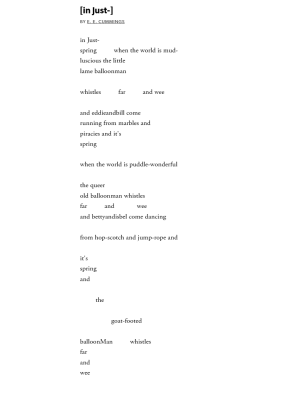
In Just Spring final 400

Here’s how the poem in it’s final form appears collected on the PoetryFoundation.org web site. “Just” is the only capitalization and man stays lowercase.

.

And now decades have past — and I, an old man, have gone to perform this poem for this year’s Spring, and I pick minor chords. Much has past us, dancing toward or running from: another world war, and current cruel wars happening somewhere further than the far distance whistle of the balloonman. Cummings’ childhood was close enough to me that I can actually recall playing marbles in the dry dirt finger-writ circle of a schoolhouse playground.*  I know how a hopscotch chalk field is laid out. Do children still jump rope with rapping rhymes, and if not, what has poetry and hip-hop lost? If there’s a balloonman, his creatures are mylar and determinedly decorated no doubt. All this 20th century stuff is now as archaic as the arcadian goatfoot-god Pan who whistles like escaping air. I, and once-girls with names like Betty and Isbel, know this. Now, as I experience the poem this year there’s more distance there than there was for a twenty-something poet who wrote it. I put a distance far and wee in the music — for Cummings was of an age that he knew he was to be an adult now, while still young enough in years to know within his body’s memory the lost experience of the playing children delighted at the balloons. Balloons that would either fly away or deflate — escape/ascent vs. air loss or a pop as sharp as a bullet.

It’s the first day of spring. My chords have a third a half-step deflated. Disordered self-important dolts are running things, and I think better to have an old halt body with a bouquet of floating hearts. If the world can still seem puddle-wonderful — to be aghast is not to wonder. So, I must recall how to wonder, far and wee.

You can hear my performance of E. E. Cummings “In [Just] spring”  with the graphical audio player below. Did someone let go of the string and a player is blown away? Don’t whistle, just use this highlighted link alternative that will open a new tab with its own audio player.

.

*And playing pirates without extra-faceted dice, is a lost quattro too — but I wonder if Cummings was thinking of Barrie’s Peter Pan  in choosing that manner of play. I’ve just finished watching an absorbing 2022 TV documentary series called Wonderland on BBC Select that often asks over its episodes how much childhood trauma, WWI, and social injustice informed English children’s literature a hundred years ago.

Barn, Burning

Here is a piece based on a poem by a second Irish-American poet, Ethna McKiernan, who before her death in 2021 would host a reading every St. Patrick’s Day. I can’t say I knew her very well as a person, though as mentioned last time she was a long-time participant in the Lake Street Writer’s Group with myself, Parlando contributor Dave Moore, and the poet featured last time, Kevin FitzPatrick. I’ll next be going off on a short tangent, as is my nature, but it any of this writing displeases or tires you, just skip to the bottom. I quite like the piece that is the occasion for writing this today, and you are excused to go there and just listen to it.

I don’t think Ethna liked me much as a person, and I can imagine any number of reasons why that might be so. Let me leave most of those guesses behind for today’s purposes. In my old age I’ve come to the realization that I am often a careless and inappropriate person. I suspect that’s for neurological reasons, but who can say, it may be a defect in my soul as would have been said in the old ways.

One peculiarity that I had in writing groups is that I was prone to writing long responses to drafts shared by other members. I’d often get quite detailed with noticing what works, and at least as much so with what I thought didn’t or had alternatives to be considered. The audience of this Project know that I have a broad appreciation for styles and approaches. I don’t hold to a narrow poetic style and down-rank anything that doesn’t follow it, but just as I do with editing audio or trying out compositional ideas in music, I tend to look closely, and over the years of doing this, I’d notice how zoomed in and nit-picky some of my responses were — and I wasn’t at all sure my suggestions for alternative approaches were actually improvements. It’s been a few years since I’ve done that, but I still cringe at some of the things I wrote, particularly in response to Ethna’s poems. After all, here was a poet with several published collections, a grant-winner with a distinct cultural connection to a great poetic culture, and who had taken advanced academic creative writing study. Me? I’m a high-school graduate from nowhere, who has no distinct poetic style to trumpet, who last was published in the 20th century. And need I add one more kicker — I would be in Etna’s case a man writing to a woman poet. Women poets reading this know how that often goes.

So in summary: matters of technique and poetic tactics vs. being emotionally myopic. A lot of the first only emphasizes the second.

My reactions to Ethna’s poems continue to trouble me because, at her best I considered her to be an excellent writer, but one that left me tantalized by another poet within her — a far stranger one, one that only materialized from time to time, and seemed to be constrained by her internal editor and self-anthologist.* Yes, it’s a writer’s prerogative to choose what to present or emphasize, but I wonder if other writer’s group respondents, creative-writing seminars, or outside editorial preferences/fashions kept that element down in McKiernan’s writing. Those things have standing, and it may be me who’s out of step, whose taste is questionable or unlikely. But that’s how I felt when reading the poem “Barn Burning” used to make today’s musical piece. I was compelled to do something that may be regrettable. I strongly thought that a developed image just past the midpoint of the poem was not quite as vivid as possible, and that the poem’s ending was short of how sharply spoken it could be.**

Light Rolling Slowly Backwards front cover

Want the author’s final selected poems collection without my blather? Ethna McKiernan’s “Light Rolling Slowly Backwards”  is available here.

.

Ethna is some years dead now. Poets have trouble finding audiences when alive, and once they cross the Lethe, our forgetting often matches the dead’s. Improper, inappropriate, imperious, presumptuous — convict me of the lot. I’m taking the risk that I’m damaging the poem, though that’s not my intent. It’s done out of love for the poem and in hopes of bringing forth this element of the poet who might be condemning me from the other side.

If the worst is the case, take the performance below as damaged, counterfeit goods. If the best of the case is so, enjoy this poem’s mystical experience with my best efforts at adding music to it. I’m not Irish, I just hung out with some Irish-American poets, and it seems consistent to make this offense out of admiration.

You can hear the resulting “Barn, Burning”  with the audio player below. What, has the player been incinerated and not even ash remains? Well then, your listening can be reborn with this highlighted link that will open a new tab with its own audio player.

.

*I remain puzzled why her poem “Letting Go the Wolves”  was not included in her own final new and selected collection Light Rolling Slowly Backwards.  While it’s a fine collection, well worth reading, to my tastes that’s a pluperfect anthology piece, one I’d say any poet could be proud of having be the one poem others know of their work. Of the poems included there, poems as strange as “Stones”  and “Barn Burning”  display moods not widely indulged in, even though her other poems have their virtues too.

**Should be? Let me say again, I don’t know. I’m just one reader, but one who chose to perform it, and who wants to maximize its impact. Here are the last six lines of “Barn Burning”  as McKiernan had them in her final collection: “The outline of the lit barn/and its lean bones;/the world changed suddenly/as baptism, my life changed/forever with the knowledge/of fire.” Here is what I performed: “The outline of the barn,/the eager edges of its light/surrounding reluctant bones./The world, now sudden as baptism./My life forever with fire knowledge.” And as evidence of how zoomed in my suggestions sometimes were: I think the poem’s title is stronger with a comma in the middle.

The House of Ghosts

It’s been a busy week at the Parlando Project studio as I record more Halloween-themed songs freshly made by combining other people’s words (usually literary poetry in the public domain) with original music in differing styles. Let us go to the lab and see what’s on the slab.

Last dark-and-stormy-night-time we had a poem that started with someone at a household’s door asking to be let in. Waif or wraith? Therein lies that tale. Today we again have a piece that starts at a doorway — but the tale-teller here lets themselves in. What do they find there? Well, that’s the song.

The words I used today originated with a poem by early 20th century American writer Margaret Widdemer. While Widdemer is little remembered now, she was a successful presence in the literature of her day. And while the Parlando Project does the everlasting Greatest Hits of Poetry sometimes, I also like digging through old poetry collections and anthologies looking for overlooked poems and poets. Such “many a quaint and curious volume of forgotten lore” reading let me find Widdemer, and one thing that drew me to her was that she seemed to have absorbed some stuff from the folk-music collectors of her time — for example, this eerie poem of hers that builds on the “Lyke Wake Dirge”  presented here six years ago.

One thing that folk-music tradition teaches us: the singer is free to change and adapt the song that was handed down to them. Entirely new words or new music may be applied. Verse order, much less exact wording is not sacrosanct. Instead, a good fit for the singer and the audience (these being the folk in folk-music) is the guiding force. Most composers who work in the Art-Song form are compelled to keep the text unaltered, and while I’m not of that tradition, I most often present the poet’s words as they published them for the silent page. But, for today’s piece I substantially altered Widdemer’s poem to make what I hope is a more effective song.

House of Ghosts

Widdemer’s poem is linked here if you’d like to see the “before” to my substantial revision.

.

I started with a simple change: I created a refrain based on the initial verse of Widdemer’s original text when I found it ineffective for audience grabbing. In other revisions and additions, I sought to sharpen the “build” of the story’s details, and I excised antique words and diction that added no charm.

Musically I recorded a late-night laid-back Rock combo of two electric guitars, electric piano, bass, and drums for my resulting song. Here’s the chord sheet in case you’d like to play your own rendition. That’s also the in the folk-music tradition: the song shouldn’t belong to only one voice.

To hear the way I played and sang it you can use the audio player below. What? Has no audio player gadget materialized on your screen?  This highlighted link will open a new tab with its own audio player then.

I plan to be back soon with an entirely different, more orchestral ensemble for the next piece in our 2024 Halloween series. Should I act like a YouTubber or Substack author and urge you to subscribe for this upcoming content?*

No, I’ll leave you as a free agent on that decision. This Project goes beyond non-profit — it is by design no-profit. I just love diverse music and poetry and get a kick out of exploring what’s possible. I have nothing to sell and would avoid anything that is paid by the click, because I have no makeup to be a small-businessman.** But my self-regard (or desire to promote a range of poetry) likes seeing viewers and listeners. Sharing this stuff on social media, or just telling a friend, will help keep this going.

.

*The Parlando Project started as a short-form podcast, one sans the usual blather, paid-for-promotions, and between-host jocularity — presenting instead our typically 2-5 minute musical pieces unadorned. It turns out that podcast audiences prefer one-to-two hours of gab — but if you want a break between the talkers in your podcast app, you can still subscribe to the Parlando Project on Apple Podcasts or most other popular ways to get podcasts.

I don’t believe I misunderstand those who appreciate the typical podcast format. I sometimes listen to podcasts while cleaning or fixing something with my hands. Alas, as a person who spends much of their time reading, composing, playing, recording, and mixing music, my own ears are usually occupied, and so I lack time to partake.

**I admire small-business people in general — and yes, I appreciate how hard it is for musicians, composers, and writers to make even a meagre living these days. While I work at this Project like someone with a small-business enterprise, I’m just not suited to bookkeeping, form-filling, and tax-law lane-keeping.

Warm Summer Sun, the 700th Parlando Project piece

This is a modest little piece — a small number of words, a simple musical setting — so it may seem odd to choose it as the 700th audio piece from this Parlando Project. Well, this whole project is odd, isn’t it? You, for reading this and listening to the audio pieces are unusual. I’d say I’m odd too for taking the uncounted hours this Project has taken: looking for available words that strike me as worthwhile for performance, composing the music, performing most of the instruments, recording them, and figuring out what to briefly say about my experience of these words.

I plan to say more about reaching this milestone in a follow-up post, but I will put that off so that we can get to American author Mark Twain’s words without overwhelming them with my particulars.

I came upon this as if it was a poem written by the famous novelist, something I took immediate note of. Poets who publish novels at least once or twice aren’t extraordinarily rare. Established novelists who take to writing poetry may be slightly more unusual, but there are examples. The two arts are unlike enough that the list of those whose expression in both fields remain worth considering exists, but that list isn’t likely to take more than one page. But Twain’s poem was specifically unexpected. If you have followed this Project completely for a while you will have encountered most of what might be considered poetry by the great novelist Twain. One was a little monolog that performs easily.*  That piece is a still-acute skewering of poète maudit literary stances. Twain’s other poem used here was a satire produced by a character in a novel who wrote rafts of terrible elegies, a poetic form that Twain’s era loved more than any other: Tennyson’s book-length, multi-part, In Memoriam  elegy was a Victorian best-seller. Twain’s USP while he worked in the book trade was instead books full of life and absurdity written in garrulous American vernacular. Yet, here’s a poem by Twain that is:

Heartrendingly sincere
An elegy
Short enough to be engraved on a headstone

Where did this come from? It has both a biographical and literary inheritance. The biographic one: the headstone it was engraved on was for Twain’s beloved eldest daughter, a talented young woman who died at age 24. If you’ve got a few minutes, click this link and read her Wikipedia entry, so that you can mourn along with Twain. The literary antecedent, who Twain credited on the headstone as the author, was a contemporary poem written by an Australian expat-to-Scotland named Robert Richardson. Richardson is next to unknown and I’ve only glanced at the collection in which his poem titled“Annette”  appears. He was a newspaper and periodical poet who wrote (as did Twain) for popular audiences — but unlike the Twain we best remember today, he is (at first glance) conventional in his literary diction and full of the usual Victorian sentiments. Richardson’s “Annette”  takes up three pages and many stanzas, and Twain’s adaptation uses only the final stanza. Twain’s poem is 27 words long. Only 20 of those words come from Richardson’s stanza.

Here’s Richardson’s stanza followed by Twain’s poem as it appears on the headstone:

Warm summer sun, shine friendly here;
Warm western wind, blow kindly here;
Green sod above, rest light, rest light,
Good-night, Annette!
Sweetheart, good-night!

Warm Summer Sun Twain headstone

Here’s a link to a page where I found this picture of Olivia Susan Clemens’ headstone in Elmira New York. The link also includes the full text of Richardson’s Annette.

.

What are the alterations, which I’ll presume to be Twain’s, and which I assume are changes, not Twain using a different version than I found in an 1893 Richardson poetry collection?

“Friendly” is dropped from the description of the sun. “Kindly” is moved to the sun in Twain. “Softly,” a more objective adverb is used for the wind by Twain. Imagists (who’ll arrive only a decade after Twain’s poem) would have preferred kindly to be dropped entirely for an objective word, but on balance Twain is just slightly more modern. “Southern wind” not western may be localizing weather patterns between Richardson and Twain’s locales, but making this change shows a careful choice is being made.

Both Richardson and Twain make the choice to move from the above world of the living to the below ground world of the buried in their stanzas. Richardson has the sod “resting,” personifying in Victorian fustian. Twain has the weightier and more objective “lie.” Small difference, but I hold with Twain’s choice.

“Dear heart” for “Annette” removes the inapplicable specific from Richardson. In the final phrase Twain again adds power in my judgement by refraining “good night” rather than using the specific Victorian term “sweetheart.” Although Twain intended his poem as an inscription, the refrain adds to the effect when sung in performance.

Tiny poem, tiny changes, but of course the greatest difference, one made by a novelist (of all trades) was to presume that these spare 27 words from the end of Richardson’s longish poem make an apt summary of the situation: a beloved, talented daughter struck down by illness in her youth. This may have been a practical choice: carving it on a headstone (though larger headstones with longer inscriptions are found in Victorian graveyards). Intent and practicalities aside, I was moved.

You can hear my performance of Twain’s epitaph/elegy with the following audio player. No player? This is a backup link that will open a new tab with it’s own audio player. As I said, simple music today. Just me playing a nylon string “classical” guitar, the kind of instrument that I first played when I started out.

.

* Besides being credited by Hemingway as the progenitor of “All modern American literature,” Twain pioneered what today we’d call standup comedy.

On the Troop Ship to Gallipoli for National Poetry Month

Though an often-puzzling poem, Eliot’s “The Waste Land”  is tightly written. I’m not talking about some raw stat like its number of lines, but that the language itself works in its sentences and small phrases directly and without much waste. That’s not a Modernist-only tactic, but early Modernism did make it a goal.

And a large amount of that vividness came not just from the sharpness of the experiences of grief, depression, and failure that Eliot had experienced, but from revision and re-writing, a process famously aided by Ezra Pound suggestions — most often excisions.

Back in this blog’s first year or so I decided to try an exercise based on those Modernist principles. I took this poem, or rather a fragment, written by British poet Rupert Brooke* while he was steaming on his way to the same disastrous Gallipoli landing in World War I that killed Eliot’s friend Verdenal.

My goal wasn’t just to do what Brooke himself might have done if he’d had time to polish up further drafts of his fragment, but to do what Ezra Pound would have done with his blue pencil. Even though I started with a 19-line fragment, I removed over a hundred words, including many that seemed uselessly archaic and flavorlessly formal. This wasn’t just a Readers Digest-style abridgment, I worked to remove the crud and bring forth the images as an Imagist would have.

Here’s the lyric video.

.

I maybe favoring myself, but I thought the result increased the power of the remainders considerably,** and once I composed and performed the eventual musical setting, I titled my adaptation“On the Troop Ship to Gallipoli.”   It remains one of my favorite pieces that I’ve presented here for the past six years, and it easily became one of my candidates for this National Poetry Month series where I’m re-releasing some of the earlier pieces from this project along with new lyric videos. You can hear it three ways. The graphical player is below for some, but if you don’t see that, this highlighted link will also play it.  And you’ve seen the thumbnail picture above that will play the lyric video.

.

*Brooke was — let’s not put too fine a point on it — a very good-looking young man, with full access to the class-bound academic and social circles of early 20th century Britain. Yeats called him “the handsomest young man in England.” He was considered promising as a poet, or certainly something, even before the war. Frances Cornford, a concise poet who counted Charles Darwin and William Wordsworth as her ancestors, wrote of Brooke “A young Apollo, golden-haired/Stands dreaming on the verge of strife/Magnificently unprepared/For the long littleness of life.”

So, when Byronically larger-than-life Brooke saw WWI’s outbreak, he saw a way to join in something big and heroic. He wrote an instantly famous sonnet about the honor of dying for one’s country in battle. That poem was read by the Dean of St. Paul’s Cathedral on Easter Sunday — and then less than a month later Brooke was dead. Back in 1915, an editor/fate blue-penciled this: Brooke never reached the doomed landing at Gallipoli. He was bitten by an insect which led to a generalized infection, which killed him three days before the battle.

**Perhaps I shouldn’t have left this for a footnote: you might want to try a similar exercise on some other person’s poem or two yourself, and then try what you learn on your own work. Yes, one can add lines and words in a revision, but what this exercise usually does is show how much you can add in power by excision.

Fall 2021 Parlando Project Top Ten, numbers 4-3

Today we continue to move up the countdown to the most popular and liked piece from this autumn. I mentioned earlier in the countdown and elsewhere that during this year two poets that Dave Moore and I had grouped ourselves with over the years fell seriously ill, and this autumn they both died. Dave himself has been through a health swerve since 2020, but given that he’s alive and could tell his own story, I’ll leave that to him. I’ll just summarize that these three people were a large part of my direct and living connection to poetry, and my circumferential part of the ripples from two of them dying has been to sharply feel that human poetic-creation connection become past-tense.

Two of the pieces left in this countdown are remainder connections to those two poets.

4. Timepiece by Kevin FitzPatrick.  This is one of my favorite pieces that I heard Kevin read even before it reached its final draft for publication. I believe Dave liked it too, and shortly after we heard it, the LYL Band performed it and that’s the recording you can hear below.

Kevin, like our other departed poet, Ethna McKiernan, was a consistent reviser of his work. Poets in groups like ours sometimes present work soon after it reaches a completed draft, but Kevin’s early drafts nearly always seemed close to “ready to publish.” Despite his reliance until far into this century on a typewriter and carbon paper, his drafts’ punctuation and spelling was always correct and the suggested and taken revision ideas often revolved around clarifying narrative elements that would be in the forefront of his poems.*  Kevin also paid attention to meter, and when we’d see later revisions that would be another area he’d have changed.**  As a group we could sometimes be brutal with each other’s work, but it was rare that Kevin would present a stick-out sore-thumb.

“Time Piece”  (the title may have been a single word in the draft I performed it from) had one issue that I recall: there was discussion of the “incorrigibles” that the poem concluded hadn’t stolen the dead father’s wristwatch. At least one of us didn’t like it, perhaps thinking it an archaic, obscure or somehow too formal a word. Kevin nodded and said little as was his usual response to suggested revisions. I think I may have argued for incorrigibles, and since it was there in the draft we performed from long before the poem’s publication in Kevin’s 2017 collection Still Living In Town,  that was still the word in my performance.

Well, damn it, Kevin’s dead, and it’s his poem, and he was good at writing poetry, but “incorrigibles” is the right word, and his revision for publication: “those slick boys” doesn’t have enough flavor. That Dick Tracy word-aroma is just what’s called for! “Greatest Generation” father, and a wristwatch after all! He also made one other revision on the published version: from “That he wasn’t scheduled for a boxing match at six” to “That he wasn’t scheduled to box at six.” I suspect Kevin’s ear thought the later better meter-wise. However as boxing has become a more obscure sport the shorter “box” may miss some readers.***   “Did he work in an Amazon warehouse?” some moderns may think.

“Timepiece”  or “Time Piece”  is a poem well worth reading or listening to. The LYL performance of the earlier draft is what the graphical player below will play, and if you don’t see the player, slug this highlighted hyperlink.

.

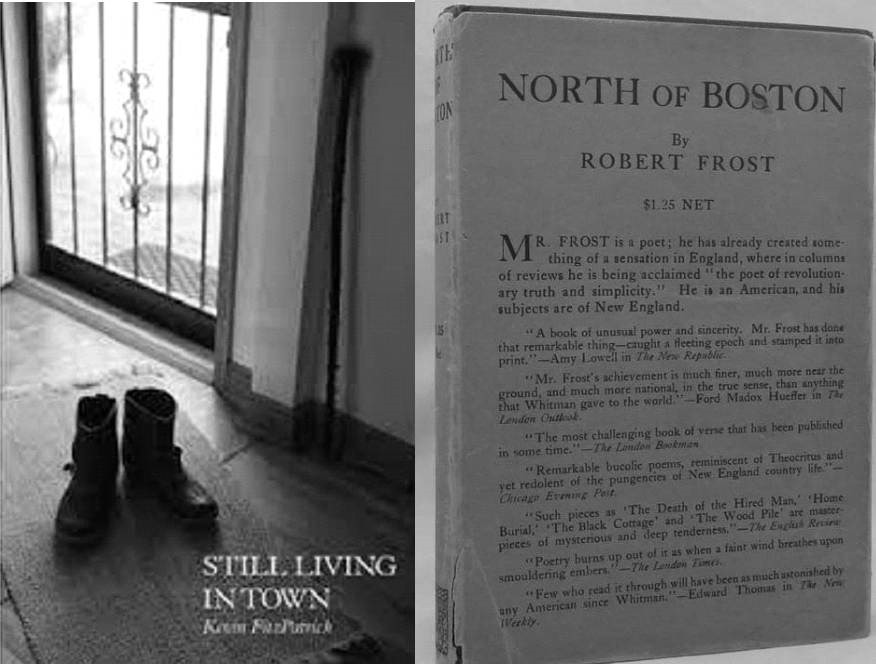
Still Living In Town and North of Boston

FitzPatrick’s publisher, Midwest Villages & Voices, doesn’t distribute online, but this link contains an ISBN and other info that may help you obtain a copy from your local book store or library. Then this other guy, Frost, has books available  too.

.

3. After Apple Picking by Robert Frost.  Unlike our other Frost poem in this autumn’s Top Ten, the metaphysical “Bond and Free,”  you can feel this one. Particularly as Kevin began to spend his weekends working at his life-partner’s rural farm, I could see kinship between FitzPatrick and Frost. Both were drier than a Minnesota winter’s static humidity, both liked to observe human outlooks critically, and both of them could give you some of the tang of work tied to nature. I’m not sure if lifetime farmers are likely to write a poem like this, but someone coming to that work from something else, as Frost and FitzPatrick did, has the outsiders’ advantage of fresh observation.

When I presented this poem last month I thought about dedicating it straight out to Paul Deaton, who’s blog I’ve read for the past few years, in part to catch up on his accounts of small-format food farming, sometimes mentioning apple trees and orchards. But I wasn’t certain how well it fits anything Paul experiences. The apple trees of my youth were tall enough that ladders would be required, but the orchards I saw biking around Bayfield this fall have quite short trees, the kind where an adult would stand flat-footed to pick the fruit.

But maybe I should have gone ahead. Even though this poem has specifics, even to what aches after work, it’s about finishing a task. When another blogger I read: professor, editor, and author Lesley Wheeler wrote of getting to the final stage of a book-length manuscript, I thought of how I felt after finishing a manuscript decades ago. That same “Well, I probably missed a few, but I’m done  with apple picking now.”

Player gadget below for some, this highlighted hyperlink for the rest of you to hear my performance of Robert Frost’s “After Apple Picking.”

.

This post has gone long, though with things I wanted to say. Our next post will break from our usual Top Ten countdown, as it will deal with both the most popular piece, and the runner up, and I’ll talk more about poet Ethna McKiernan.

.

*More than once I’d say to Kevin “If I had had the idea to write something from this same material that you used, I’d have written a short story.”  I remember once Ethna took me sharply to task for saying that, admonishing me that Kevin was writing a narrative poem. She misunderstood me, for I knew and admired that. Mixing into a short poem, with its almost unavoidable lyric immediacy and compression, with narrative elements sometimes even including a Joycean epiphany, is not easy. Once or twice, so taken with the story in one of Kevin’s poems I attempted to craft a short story from the same material, to demonstrate my point — and yet I could never complete one of those attempts. Kevin’s poetry may look unshowy, but it’s not easy to duplicate.

**Several years ago, Kevin and Minneapolis folk/blues revival pioneer Dave Ray of Koerner Ray and Glover engaged in a little side-bar about meter in Blues lyrics, with Kevin scanning their iambics. Kevin played a little blues harp, and Ray and Kevin’s dad were both in the insurance business.

***Kevin also boxed, and not in a warehouse way. He once wrote a poem which had as significant line “The boxer slugs!” Dave Moore’s punishing wit, after dealing with a lengthy group discussion about if that line would be misunderstood, was spurred to write an entire song about a garden beset by invasive…wait for it…”boxer slugs.”

Revisiting Stones Under the Low Limbed Tree, and what’s fair in song-making and translation

Many of the visits to this blog are not you, the regular readers who are reading this fresh post, but views of some older posts via a search engine. A gaggle from Google have come recently to a post from a year ago which doesn’t feature one of “Poetry’s Greatest Hits,” though it does use, in a way, the words of one of America’s most loved poets, Robert Frost.

Here’s a link to that post.  I looked at this post, and I’m not sure what brought it to increased attention, though after re-reading it today, I complemented my past self — who I alternately think is wiser or more foolish than the current occupant of my consciousness. I thought I did a good job of describing how we as writers may improve our work through revision, even though the example I used in the post was my own revision, for my own parochial reasons, of the words of a recognized great poet.

I do that sort of thing to the Greats from time to time — as recently as the last post here with a simple addition of a line as a refrain from a poem by Robert Browning, or more extensively with my extension and relocating a poem by Du Fu that many liked last winter, or further back with a piece of Rupert Brooke’s that became one of the most listened to pieces in the history of this project. I usually feel ambivalent when I do this. At the least, I try to warn you when I intentionally go beyond the original text. In each case above, the author’s dead, there can be no personal hurt or slight for them to feel, but with this project I do take on some duty to the text the author wrote. Have I cheated at my task? Am I dishonoring their work?

Cottonwood Catkins Spinal Halo 1080

How is this photo connected to today’s post? I don’t exactly know. So what should some translator do when asked to present it in their language?

.

I’m wrestling with these matters currently with another translation in process,*  a prose-poem by Arthur Rimbaud, particularly with a common issue I come upon in translation: how much did the author intend to be mysterious, and how much did they (or their ideal, likely contemporary reader/listener) understand to be clear in their original language? With translation, one can’t avoid substituting your own words, and likely things like word-order, idiom, and so forth — that’s inescapable, inherent in the task.

In the case of this poem by Frost, my recasting wasn’t so much for immediacy of meaning, or to make an image clearer to our time and place; but to make the poem more sing-able, to fit and obtain impact in a conventional song performance. Yet, the song that I made of it was not very popular with listeners here. When I looked today, it appears that nobody that has visited the post this month has listened to the performance.

Again, complementing my past self, the one I feel I can more often judge objectively; I think I did a pretty good job of the song I derived from inside Frost’s poem “Ghost House” and retitled “Stones Under a Low-Limbed Tree.”  My vocal (often a weak point) was passable — though I idly wish for “cover versions” by a legitimate vocalist for pieces I write and present here — and the rest of the audio piece works well.

So, here’s that audio piece, being presented again for your listening judgement and plausible pleasure. The player gadget should be below, and this highlighted hyperlink will also play it in a new tab if the player doesn’t appear on your device or reader.

.

*Following the practice of Robert Okaji, I’ve taken to casting some of my alterations or freer translations as “After a poem by…” — another way to deal with this, though it doesn’t remove all the questions I ask myself.

Stones Under the Low-Limbed Tree

Today’s piece has an eerie history. It started as a poem by Robert Frost, but I think four years ago I turned it into a song. I had more or less forgotten about it, but this past week I found it in some past work that I had separated out to work on for this project.

Looking at it, I put it near the top of the pile. I thought it representative of the best of early Frost, when he was a supple lyric poet. “This’ll be great. So clean in language. So concise in his laying out of the story.”

The process of producing the performance and recording that you can hear below went well enough. So today I was getting ready to write about my experience of Frost’s poem after going through this project’s process. As usual, I wanted to find a location for the original text for those that want to read along. I found a good link to Frost’s poem. It’s here.

Surprise! Turns out I had modified Frost’s poem much more than realized. I had recalled only that I had repurposed a pair of Frost’s lines to create a chorus/refrain—but when looking at the original poem I hardly recognized the text I had been working on during the recording of the performance this month. It turns out, “Ghost House”  (as he titled this piece) was an early poem of Frost’s, written in 1901 and included in A Boy’s Will,  his first collection of poems published in England in 1913. Unlike most of the poems in that collection, “Ghost House”  had been published, back in 1906 in a magazine. The reason A Boy’s Will  was published in England was the Frost had made little headway as a poet in the United States. At that point he was nearing 40 years old, so it’s possible that if Frost hadn’t traveled to and succeeded in England, this greatly loved American poet would be nearly unknown.

I stress the actuality that I had no recollection of recasting the poem extensively when I say that I prefer “my version” to Frost’s original. The lack of any memory of the work I did means that this judgement is rather impersonal. Frost’s “Ghost House”  isn’t bad, but it’s not as distinguished as other poems in his early work. It seems more 19th century for one thing. It also overdoes it, seeming to confuse more elaboration and details for more impact and substance.

Stones Under the Low-Limbed Tree

Here’s Frost’s poem as revised for singing.


When I briefly try to reconstruct what I did to make the text for today’s piece, I see I used his lines for the most part, but I trimmed out much. My lyric is essentially 17 lines. Frost’s is 30. I dropped entire images, some inconcrete and a bit trite (“I dwell with a strangely aching heart”—you’ve shown us that mood Robert, telling us that is less vivid), and some redundant (we’ve got raspberries and grapevines, we don’t need the apple tree* too). Then too, I chopped the entire whippoorwill stanza, which some argue contains the key image in the poem.**

I also may have just been trying to make it more sing-able.

These two things are lessons. First, poetry often gains power by saying something in its most striking, sensual, and strong way—or even when it’s being less direct, by combining a few things (perhaps only two things) in an unexpected but powerful way. Everything beyond that may detract. The second-best or third-best image subtracts by its addition. Frame your best images, don’t embarrassingly hide them in clutter. And secondly, at least with lyric poetry, when it sings it means.  Poetry works through the music of thought. Even something that clarifies the meaning or explains further a point may sometimes be dispensed with in order to make a poem a musical statement that will lodge in the reader/listener’s ear, and via that canal to their brain. In this case I don’t think I sacrificed clarity, but also I don’t think I could sing Frost’s version—and at least in my case, I didn’t remember his.

Did what I do mean I think I’m a better poet than Robert Frost? Nope. I also may not be a better poet than you. But on any one day, on a particular task, with a particular aim, I might be. Frost was a famously grumpy personality, but perhaps his ghost has mellowed with immortality. If so, I hope he might think I served the inspiration of his early poem by trimming it back. Or maybe I didn’t make these changes, since I don’t remember? Perhaps Frost’s ghost came by and made the revision?

To separate this version from the canonical Frost version I call it “Stones Under the Low-Limbed Tree.”   The player gadget for my performance is below. Oh, and do follow at least one of the links in the first footnote below. You’ll visit other ghost farmsteads in search of fruit still yielding outside fallen cellar walls.


*This morning I read this fascinating story that went out on the AP wire. It covers something called the “Lost Apple Project” which is haunting abandoned farmsteads looking for old varieties of apples that sustained—or tried to sustain—homesteaders. Oh man did this resonate when working on this piece!

**I didn’t know, but some readings of “Ghost House”  say the whippoorwill is known as a bird foretelling death or other disasters. News to me. Even if I knew that, foretelling seems to blunt the impact of the poem as I cast it. In my mind the point is that the death/disaster has already occurred. Yes I know, some readings say that the poem’s speaker is either dead or gothically welcoming death for himself. I don’t disagree with that, but it doesn’t change my view. Even if the speaker is still alive but wants death, an omen bird’s warning is gilding the raven.

Ollendorf’s Wife ‘Bout Changes and Things

Despite Orrick Johns’ lack of poetic fame, our curious audience seems to be responding to “Ollendorf’s Wife.”  Are you forgiving my unilateral revision of Johns’ 1917 words?

OK, here’s another rule breaker. The same day that I recorded the acoustic version of“Ollendorf’s Wife”  I also recorded this folk-rock performance with bass, drums, organ, and electric guitars. Is it better or worse than the acoustic version? I can’t say.

By subtitling this post/version “’Bout Changes & Things” I’m making an obscure reference to a quixotic mid-60s LP by Eric Anderson. Anderson was one of a handful of Greenwich Village folkies well positioned in the ‘60s to step into the new post-Bob Dylan breakthrough were the singers were expected to write their own songs with poetic sounding lyrics. ’Bout Changes & Things  had some of Anderson’s best early songs, songs that were already getting covered by some of the same acts that might also use a Dylan song.

However, about the time it came out another sea-change was occurring. Everyone’s folksinger records were starting to use electric instruments and drum-sets. Earnest acoustic guitar LPs with maybe Spike Lee’s dad on standup bass or Bruce Langhorne on “second guitar” were no longer what was expected. Dylan goes electric! The Byrds were having hits with folk songs and glorious electric 12-string guitars, John Sebastian and Zal Yanovsky had formed the Lovin’ Spoonful.

The trend was so strong that the production equivalent of revisionist history was resorted to. Tom Wilson overdubbed some session men on top of an already released but unnoticed Simon and Garfunkel song “The Sounds of Silence.”*  Alan Douglas took old tapes of Richie Havens and added new instruments to make “Electric Havens.”**  The former created a hit record and launched a career. The later couldn’t stop the undeniable soul force that was Havens.

Producers and Piano Players

Producers and piano players: Alan Douglass with Duke Ellington and Charles Mingus
Tom Wilson producing “Like a Rolling Stone” with Bob Dylan


Eric Anderson just went back into the studio and re-recorded his whole album with a band, and it was released as ’Bout Changes ‘n’ Things Take 2.  It did nothing for his career, and maybe even hurt it. It probably seemed not authentic, scene chasing, or some other sin.

Bout Changes and Things x2

Revisions: One set of songs, two albums.


So, there you go, one guy in Greenwich Village years ago who seemed at one point the equal of a lot of other up-and-comers but turned out to be a damp squib that didn’t ignite. And another guy. Same story.

To hear my folk-rock performance of “Ollendorf’s Wife,”  use the player below.


*Tom Wilson is another one of those “Why don’t more people know about him” characters. Besides midwifing Simon and Garfunkel’s first hit, even a brief look at who he worked with listed in his Wikipedia article should amaze anyone with any interest in mid-century American music. This labor of love web site can tell you more.

**Alan Douglas has an impressively varied producer’s resume similar to Wilson’s, but his ghost could probably stand to be less well-known. His overdubs of Havens work are largely forgotten, but he spent a couple of decades redoing tracks in the Jimi Hendrix archives (including replacing parts on the tapes with newly recorded session men) in an effort that was increasingly seen as fraudulent and cheesy. It’s not that I can’t see their critics’ point regarding Douglas’ Hendrix releases, and the resulting recordings are a mixed bag, but I indulge in the same sins of reusing and re-doing other artists work.

Ollendorf’s Wife

I’m going to do something this time that I’ve done before but is rarely done.

I’m going to revise someone else’s poem without their permission—which I would feel bound to obtain, but the author Orrick Johns is long dead. The last time I did this, it was Rupert Brooke’s work I used, and my excuse was that his fragment that I presented here as On the Troop Ship to Gallipoli”  was likely an early draft left unpolished due to Brooke’s death.

Orrick Johns published “Ollendorf’s Wife”  in his first book-length 1917 collection Asphalt and Other Poems.  There’s little online to help me make sense of Johns’ life, but it’s probable that Asphalt and Other Poems  collected early work Johns had written in his twenties. While most of the poems are short lyrics, Johns works there in several styles. The poems are rhymed, not the free verse of “Blue Undershirts”  that made such an impression on William Carlos Williams. The opening section, “Asphalt” is an odd set of doggerel poems in dialect. I have trouble reading dialect poems, and from my vantage point as a mid-20th century man I can’t make out what ethnicity Johns is representing in these poems. There’s a lot of dropped consonants and dere’s, dem’s and de’s. I assume these poems are intended to be proletarian poetry and demonstrate John’s solidarity.

Another section “The City”  has other poems dealing with social issues of the day, but without the distraction of dialect. It includes one of the book’s longer poems, “Second Avenue,”  infamous in its moment of possible fame for being the poem that beat out Edna St. Vincent Millay’s “Renascence”  in The Lyric Year’s  poetry contest.

Almost nothing in Asphalt and Other Poems  grabbed me. Nothing passed the Emily Dickinson test, there was no spectral cold and the top of my head remained attached throughout. While it was trying to depict its modern world, the music was awkward for me, with some forced poetic diction and conventional sentiments that made it more similar to Margaret Widdemer than Millay or Sara Teasdale, contemporaries that were writing prize-winning short rhymed lyrics at the same time as Johns. Like Widdemer, and unlike Millay or Teasdale, the poetry in this book of Orrick John’s is understandably forgotten.

There was one poem in a section titled “Country Rhymes”  that did seem to have a germ of something though.

Ollendorfs Wife 1 Page final

Johns’ poem as it appeared in “Asphalt and Other Poems”


Like T. S. Eliot, Johns grew up in St. Louis, but unlike Eliot he stayed in the Midwest for college. The “Country Rhymes”  section reflects that longer experience, and nowhere better than in “Ollendorf’s Wife.”  First off, the poem is generally free verse, with uneven line lengths and sparse rhymes. And it has some vivid images. Ollendorf’s wife significantly has no name of her own in the poem. She works her farm plot assiduously, with no love showing in her face, but also as if it’s her last child. How many children, like her name, go significantly unmentioned? The fields she works, and the farm wife are “drawn together” by a “knowledge…greater” than “each other’s best.”

At its core, this poem works by the things it leaves out, fulfilling Hemmingway’s Modernist theory that you can remove the most important things in a story correctly, and by doing so depict them all the more intensely.

So out of care for “Ollendorf’s Wife,”  I revised it, intensifying that paring away of the unneeded, leaving only the cutout cameo around the farm-wife’s charged day in a life. I added nothing really, but took away words that restated something otherwise established, and rewrote lines aiming to make connections stronger. I made one additional repeat of the “day after day” phrase, because there the repetition is  the image. Though I intended to perform my revision, I generally wasn’t thinking of making the poem more “sing-able” as I changed things, but I suspect that factor worked its way in as well.

Ollendorfs Wife revised

Here’s my revised version of Orrick John’s poem


As I said at the beginning, this is not something that is commonly done. There are poems that use the subscript of “after a poem by…” but those poems that are revised and re-voiced are usually much older or in a different language than the new version. Obviously, such an act could fail as well as succeed. You are the judge in this case. The gadget to hear my performance of my revised version of Orrick John’s “Ollendorf’s Wife” is below.