Old Soldier

Today’s piece was created from a poem written by the Irish poet Padraic Colum. Colum was born in the 19th century, then traveled through the world of 20th Century Modernism, and lived on long enough to overlap my lifetime. Looking at the outlines of his life I am pleased to report that Colum connects a favorite of this Project, the undercelebrated Irish poet Joseph Campbell* and the American mythological theorist of the “Heroes’ Journey” also named Joseph Campbell. With the American Campbell, Colum connected because he was a folklorist as well as a poet, and he wrote several young adult and children’s collections of folk tales and retold myths which I’ve not yet read. With the former Campbell, besides being Irish literary revival contemporaries, he collected folk-songs.** Like that Irish Campbell, Colum’s best-known work today is arguably a folk song.

Long-time readers here may recall that the poet Campbell is likely responsible for the song “Reynardine”   being sung in a version featuring a supernatural, shape-shifting lover. At around the same time, and for the same publisher of Irish folk songs, Colum collected/wrote the lyrics to the song “She Moved Through the Fair.”   Why the slash notation on the authorship? There’s some controversy if Colum closely adapted a traditional set of lyrics, or largely wrote original lyrics to an existing tune. Colum claimed he wrote the lyrics, making use of only a few floating lines that are folk song ready-mades. The challenge to Colum’s authorship strikes me as highly suspect: it’s based on another collector writing in 1970 that he came across an old man who told him he’d learned it as a traditional song before Colum’s version was published in 1909.
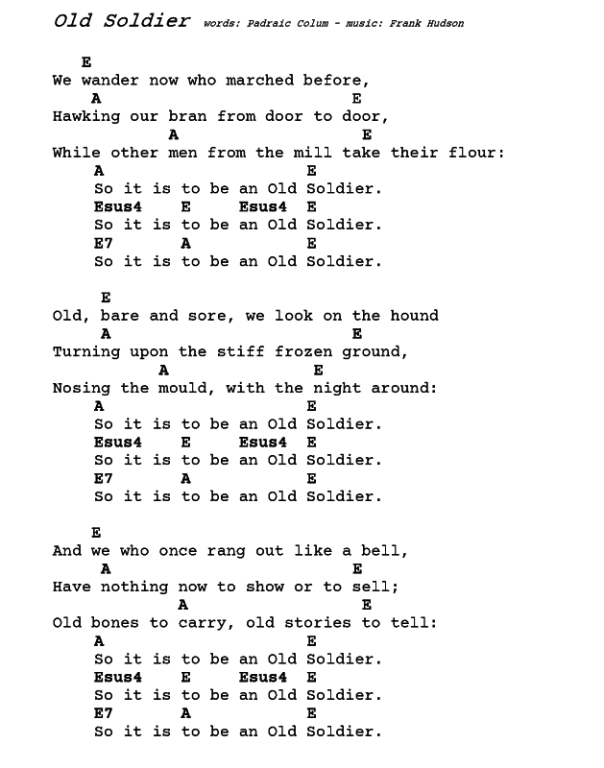
Old Soldier

I suspect there’s someone out there who can do a better job singing this song I created from Colum’s poem.

.

“She Moved Through the Fair”  was included as a poem in Colum’s first poetry collection “The Wild Earth”***  which also includes today’s poem. I note that “Old Soldier”  has some similarities with the lyrical methods of SMTtF:  both use spare details and leave out a great deal. Some of what is implied in the two lyrics may have become more obscure to modern listeners. SMTtF  very early on speaks of the singer’s “lack of kind” which uses a now archaic meaning of “kind,” meaning family. “Old Soldier”  opens with the titular old soldier going door to door. Since “hawking” (a hawker is a street-seller) is used as a verb in the second line I thought at first he was peddling, but from what I can find, no one sold flour that way. I think he’s begging for bran, which was then the discarded part of the milling of flour. That waste part after the wheat was milled or boulted, was thrown out or used as animal feed, though apparently the poor sometimes made use of it for human consumption.**** In the second stanza we meet the old soldier’s only companion, a dog, and the bran the soldier has garnered may have gathered mold.

I don’t know if “Old Soldier”  has been set to music before this, but it seems every bit as singable as “She Moved Through the Fair,”  and as soon as I read it, I wanted to sing it. I decided to use an arrangement soaked in South Asian musical influences, perhaps due to the wonderous extended version of the SMTtF tune played by Davy Graham. That link above includes one of Graham’s recordings of it, as well as Anne Briggs wonderous acapella version. Oh, hell, here’s that link again, click it indeed if you haven’t heard the song Colum made. Last week I recorded the basic tracks singing and playing a tune I created for Colum’s poem using my guitar in an alternate tuning driving a sitar virtual instrument though a MIDI pickup. To this first pass, I added harmonium, tanpura, tabla drums, acoustic guitar, and a final vocal.

Every one of those overdubbed passes felt good as I played them (save for my vocals, I’m never happy with my vocals) but the result was a whole bunch of tracks that would require careful mixing so that the instruments blended well. I set about doing that, working until midnight when I figured I might have a piece to present and saved a complete mix down. Awaking the next morning, I listened again, and the result wasn’t just flawed, it was a mess. A useful question for one mixing a piece of music with various instruments in an ensemble like this is “What track is the focus of the piece?” My putative mix had no good answer for that. The voicings of the chords on the sitar and the guitar didn’t mesh well. The harmonium and the tanpura were fighting over the same part of the sonic spectrum despite my efforts to give them their own sonic space. The tablas didn’t mesh with the acoustic guitar’s rhythm.

The wise solution would be to just re-track the piece. Maybe I should have more particularly considered that Davy Graham had made his impressive version of a Colum poem/song with only a solo acoustic guitar. But I would not have another opportunity to record with a sensitive open mic until this week, too late for Veteran’s Day. So last night I went to work stripping back the crud of my failed mix, leaving mostly the acoustic guitar and the vocal, with the tanpura and then the harmonium coming in for later parts of the song in turn. It’s not an ideal recording, but it’s my hope it lets one consider “Old Soldier”  as song today.

The more palatable version can be heard with the audio player below. The song itself is simple, and the remixed arrangement that builds a bit as the song continues serves it better. You don’t see any audio player gadget? No, I didn’t remove that, it’s a side-effect of some ways of viewing this blog. I have a plan B for that too: this highlighted link that will open a new tab with its own audio player.

.

*Joseph Campbell, who also wrote under the name Seosamh MacCathmhaoil, was acquainted with the original London Imagist circle, and wrote what I think is some excellent short verse in the form. His life and literary career were brought low by siding with the losing side in the Irish Civil War.

**Given that I’ve been doing this project for a decade, the folklorest/singer/collector and poet is a combination near to my heart. Besides Colum and Campbell, two American poets from the same era, Carl Sandburg and Edwin Ford Piper did both things, and I’ve tried to briefly make the case that Sandburg should be more often cited as instrumental in connecting folk song with progressive politics and literary poetry in the United States, which eventually leads to the case of a Nobel laureate in Bob Dylan. Around the same time as all these others, elements of the “Harlem Renaissance” in Afro-American literature were open to melding folk song with high literature too (Fenton Johnson, Langston Hughes, Jean Toomer, Waring Cuney, Zora Neale Hurston).

I’m going to jump far afield before leaving this footnote: I’m writing this on the 50th anniversary of the release of the Patti Smith Group’s glorious debut LP Horses. The Patti Smith Group started because Smith, a poet personally immersed in colloquial music, a paramour of Fugs-adjacent musician/actor/playwright Sam Shepard, joined up with a guitarist/rock critic/crucial anthologist of garage bands Lenny Kaye, wanting to make unexpected poetry combined with electric guitar.

***Just when Colum’s The Wild Earth was published is unclear to me. My copy has a 1927 American printing of a 1922 edition. Wikipedia says “She Moved Through the Fair”  was in a 1916 edition of the book, and then in their entry for Padraic Colum gives a 1907 date for the book.

****What, that’s the healthy part! Whole wheat! At the time the milled pure white flower was prized from making lighter baked goods and for a longer shelf life. The city I live in was growing rapidly at the time of this poem by finely milling the “Best” and the “Gold Medal” flour that had absolutely no bran or wheat germ at all.

Blake’s Other Holy Thursday, from Songs of Experience

Unlike its Songs of Innocence partner, William Blake’s other “Holy Thursday”  poem has no plausible ambiguity in its view of childhood poverty. One reader wrote to remind me that the Songs of Innocence “Holy Thursday”  poem shows a peaceful, happy scene that I misread. They could be right! Allen Ginsberg famously thought Blake appeared to him and instructed the later poet by reading “Ah, Sunflower”  to him, but what instructs me to see undercurrents in the first Holy Thursday poem is reading more about what we believe we know about Blake’s beliefs. Reader Alan also reminds us the two poems’ connections should be examined — and that’s what I’ll do today, along with sharing a performance of Blake’s second song about Ascension Day.

Both Holy Thursday plates

As Blake illuminated and printed these two poems. One of the things I always admired about him: he was a self-contained, DIY, artist who learned what he needed to do to manifest his art.

.

Let’s jump to the second poem, the one from Songs of Experience.*   Childhood poverty is an undercurrent in the first — would Blake even expect his readers to know that the children in the first poem are charity cases (many modern readers do not) — but poverty is foreground in the second. Blake takes on the mode of a Biblical prophet in this second poem and charges against the civic and/or religious state pour down from the start of it. Holy Thursday happens in springtime, but it’s “eternal winter” here. Its final stanza is preaching that this is not the natural order, and that in a polity of mankind’s natural state, the Earth’s fecundity would provide food for all.

I’m not sure we invariably think of Blake, for whom a spiritual element is clearly present, as a writer of civic poetry, as a political creature — yet modern scholars have subsequently delved into that element of the poet. Ginsberg, a civic poet of my youth, recognized a fellow civic poet in the prophetic Blake, and to deal with that is not to deny the spiritual element. I myself am no more a fine scholar than I’m a fine musician. In both professions, I’m simply and old man who does what he can in those fields haphazardly because he cannot wait longer at this point in my life to perfect those arts.

How do I currently think the two “Holy Thursday”  poems connect? I don’t want to put words into Alan’s mouth, he’s likely sharper than I can draw him, but he or others may believe that first poem is happy, innocent children in safe, supportive clerical care, uttering praise to their religious saviors/supervisors and that institution’s godhead and nation. And the second poem? Perhaps either a progression or another facet degraded from that? I’d say there’s no reason not to think that the two poems are happening at the same time in the same Britain — so, the two situations simultaneously comment on each other. The wards in the first poem may live better than the utter misery of the poor in the second, but they are part of the same civic system, the same “land of poverty.”  The thunder within the ward’s song that ascends briefly to heaven in the first, is the fecund rain that feeds all in the yet to be manifested world of the second. I’d summarize that Blake thinks that poverty and its partial charitable mitigations aren’t in opposition, but rather that poverty is a civic construction like the imperfect charity schools were. What Blake sees as opposition (in both poems) would be some Rosseauian natural state as the proper order of society. Yes! I realize that’s idealistic, that’s there’s no actual political party or plan ready to implement such an Eden. You can call it a fantasy. You’ll have good arguments to do so.

In my country, in my time, we’re at one of those political moments where forces in power wish to remind us that the poor are a disreputable burden, feeding off the productive citizens, wasting our resources of freedom and pleasure. You can call that a fantasy too. You’ll have good arguments to do so. But unlike the former view, this one’s on offer, even in the process of being implemented.

I’ve “progressed” from acoustic guitar to electric guitar in today’s “Holy Thursday,”  along with piano and percussion. You can hear it with the audio player below, or if that player is obscured in a field of thorns, you can get a rain check with this alternative highlighted link that will open a new tab with its own audio player.

.

*Text linked here in case the picture of Blake’s original illuminated plate is too hard to make out.

Sonnet Suggested by Willy Vlautin

I’m usually not very articulate about my own work, and part of the benefit of this Project’s aim to largely present other people’s poetry is that I can better express my experiences with others’ work than my own. This may be why I am envious of those who can speak effectively about their own art.

More than a dozen years ago I was reading an interview with a novelist Willy Vlautin who also wrote songs and performed with an Americana/Indie rock band called Richmond Fontaine. In explaining his art this is what Vlautin had to say:

It’s sort of a gamble, one’s life. Where will you fall, what are your weaknesses, will they kill you? If you’re hurting, will people help you or take advantage of you? Will the people you love, love you when you need them to? The mistakes you make, they could ruin you, set you off on a bad run. Hell, I think about all that all the time. Nothing makes me sadder than someone hurting and then being done wrong or worse by someone who’s aware of that.”

As you might imagine, Vlautin was not writing cheerful stuff,* but the observation about the human condition, its fears, and the dangers of how others can react to failings in ways deserved and undeserved seemed honest. Humankind differs somewhat on what constitutes crimes and failings, and the hierarchy (lowerarchy?) of such acts and outcomes, but we seem constitutionally subject to the reaction that the bad or unlucky person deserves their fate — or here’s the odd intensifier — deserves more and more bad outcomes, stacked on in order to prove or instruct them in how bad their choice or fate was.**

It seems to me that Vlautin takes this internally as well, or at least wants us to consider that. That’s something I resonate with myself. The fear, much less the result, of failing someone I care about is nearly disabling for me. I fear this enough that I will not do things for others, little things, things others find routine, because I fear doing them badly.

Reading Vlautin’s interview answer soon caused me to write this sonnet all those years ago, combining Vlautin’s thoughts with my own on these matters, the result merging sins of omission with sins of commission, confronting the fears of both as honestly as I could.

Just as with the last piece here, I found that sonnet among the thousands of song-sheets I went through late this summer from my studio space. Unlike the last one, I think Dave and I attempted to perform this poem as a song years back to little success. After finding the song-sheet, I did a revision of the words and changed the music a little bit. This afternoon I had just over an hour in my studio space to record it. I focused on simple accompaniment, just acoustic guitar to maximize my chances of getting a completed performance, and that worked well enough that you can hear it below. Because the piece’s outlook is stark, the spare music may help reflect that.

Willy Vlautin

There are direct quotes from Vlautin in my sonnet, also some subtle changes to his phrases, and then too my own interpolations.

.

A player gadget is below for many of you, but some ways of viewing this blog will suppress that, so I also offer this highlighted link which will open a new tab to play it.

.

*In another interview he says he had pictures of John Steinbeck and the Jam on his childhood bedroom wall. His brother bought him his first guitar and told Willy to “Write about what hurts and haunts you. That’s pretty much what I’ve done ever since. Along the way, I somehow forgot to write about the girls and the parties.”

**Perhaps a small part of the choice to pull this piece out of the pile today has to do with the bizarre news that a couple of governors have decided that some folks suffering from poverty, fear, and abuse should be secretly trundled off in busses to other states in the course of increasing their suffering or insecurity — and with the further aim of using their arrival to instruct other governors or mayors to do what, I’m not sure. Articles indicate that one beef the two governors have with the other jurisdictions is that they aren’t making others already there from similar situations in these other states more fearful and uncomfortable. Am I to infer the theory here is that making folks more uncomfortable, less secure, and more confused will improve their luck and the wisdom of their choices? Or that the other governors or mayors will by this action understand that the two “put’em in busses and dump them outstate” governors are demonstrating their better administrative acumen?

Sonnet To Beauty — Two Women Who Wrote Poetry While Working with the Economically Desperate

I’m posting a bit late in the day, but it’s International Women’s Day, and so today’s audio piece uses as a text a poem by a very international woman, Lola Ridge. Ridge’s poetry is perhaps best known for a fierce commitment to social justice and the situation of the poor in early 20th century America; but she was born in Ireland, left with her parents for New Zealand as a child, emigrated from there to Australia to attend college, and then to America, eventually New York City, where she mixed with most of the political and artistic radicals of the early Modernist era, including on the arts side: Marianne Moore, Edna St. Vincent Millay, Hart Crane, and William Carlos Williams and the rest of the circle around the NYC Modernist magazine The Others.  Over at the Midwestern anchor of Modernist American poetry, it’s editor/founder Harriet Monroe was said to have called Ridge a genius, and she won awards and some favorable reviews in the years between the two World Wars.

Late in the 1930’s she apparently fell from the scene politically and artistically, and when she died in 1941 she was as poor as the people she wrote about, and then seemingly the subject of a rapid and rather complete forgetting for the rest of the 20th century.

Luckily our 21st century has become interested in reassessing the women who were on the scene a century ago along with the male Modernists, and there’s now a revival in considering her work.

Unlike some of Ridge’s poetry, today’s piece is not formally Modernist. It’s not only a sonnet, it attempts to present a passionate if conventional poetic argument regarding the abstract ideal of artistic beauty. Taken by itself it’s more Percy Bysshe Shelley than William Carlos Williams, but if we look just a little beyond its surface we can be reminded that Shelley was a thoroughgoing political and social radical as well as a Romantic era poet. Here’s a link to the text of Ridge’s “Sonnet to Beauty,”   from a blog that does a great job of presenting sonnets and similar shorter poems, FourteenLines.blog.

Ridge’s poem starts by worshiping beauty almost as an awed acolyte unable to face the godhead. But in the midst of the poem, something strange starts to manifest itself: a buzzard (an ugly, carrion-eating bird) appears gussied up by “The wizardry of light” to appear “All but lovely as the swan.” I read this as Ridge saying that artists and society can fail, can deceive, can fake beauty.

A musical metaphor follows this that says despite the diversity of artistic endeavor — including false beauties or injustice like unto our buzzard — that beyond the dissonance and the harmonic stress of this dialectic, that the chords can resolve. The poem ends avowing that true beauty can still chime through ugliness, falsehood, and strife.

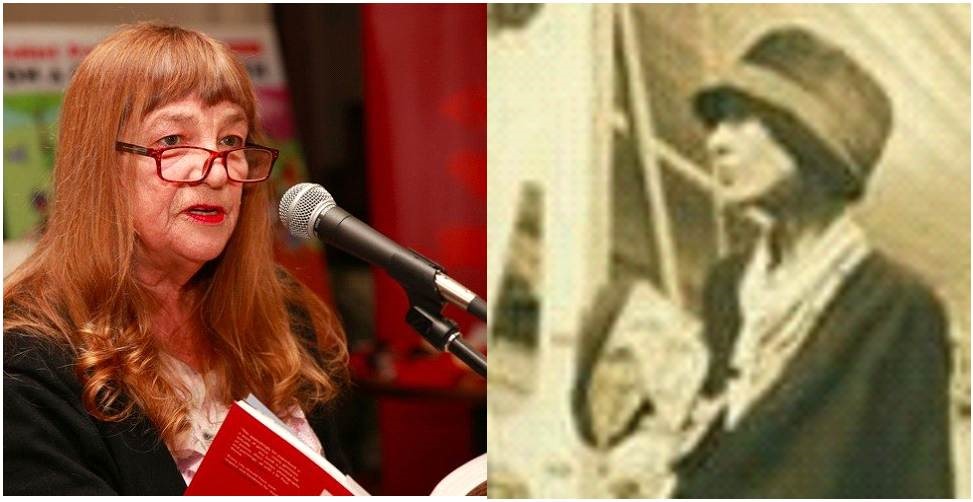
Beyond sonnets, I will now make a turn in this post before giving you a chance to hear my performance of Ridge’s poem. Let me quickly summarize the event I attended this past Sunday remembering Irish-American poet Ethna McKiernan. There may be more than coincidence that Lola Ridge started this off.

Ethna McKeirnan - Lola Ridge

Ethna McKiernan reading, with lipstick, and Lola Ridge, I’m not sure.

.

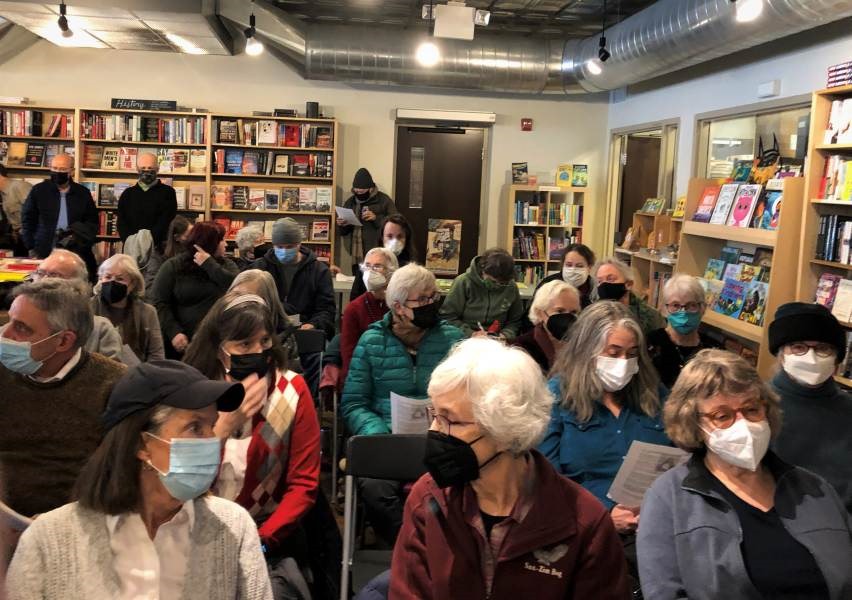
Minnesota weather and continued Covid-19 concerns might have conspired to reduce attendance, as the side streets were still full of sloppy snow from Saturday’s snowfall.*  I arrived early and helped the bookstore staff setup chairs. They seemed to be expecting maybe a couple of dozen, which may be par for a Twin Cities local-writer poetry reading, but both the event organizer and myself the bystander suspected we’d need to maximize the amount of chairs the space could hold. I think we were able to get nearly 40 folding chairs into the designated space, but as the crowd started to assemble, extra chairs needed to be rounded up and put in the various aisles between the bookstore shelves to handle those that kept coming in, and we had a few standees who fit in where they could.

More than typical bookstore poetry readings, I suspect most of the crowd knew Ethna for a long time. And that may have given a boost to the eight poets who read poems of Ethna’s, a smattering of their own, and gave short thoughts about her as a writer and a person. So less a usual public reading where some poets might be nervously trying to consider how they would come off presenting their work to an audience which might not know it, and more like an experienced and informal poetry group of long-time colleagues.

Several of the readers were members of other periodically-meeting writer’s groups that included Ethna, like unto the Lake Street Writer’s group that Dave Moore, Kevin FitzPatrick, Ethna, and I were decades-long members of. I’m sure that if Kevin had lived, he would have been a valued part of this event, as Ethna often credited Kevin as an influence on her writing — but he died a few weeks ahead of Ethna. I tried to make myself useful by playing stagehand and raising and lowering the mic stand for the variety of readers.

Many of the readers spoke of Ethna’s work with homeless outreach, and read some of her poems that dealt with that work, something that echoes today’s poet Ridge. Though the audience was entirely masked, a few noted that Ethna was a stickler for always putting on lipstick when out in public. For all anyone knew, what with our Covid era masks, we all were wearing lipstick! Who could see — but I believe all of us were remembering Ethna.

Backpart of the crowd at the Remembering Ethna Event March 2022

Covid-era ambiguity: “Lipstick? We were supposed to wear lipstick?” A portion of the crowd at the “Remembering Ethna” event last Sunday.

.

So, as I speak of a woman who promoted culture, wrote beautiful poetry, and was committed to helping the economically desperate, I will now leave you with a piece using the words of another woman who a century before us did the same. You can hear Lola Ridge’s “Sonnet to Beauty”  with a graphical player below if you see that, or if you don’t, with this highlighted link.

.

*My friend and participant here in the Parlando Project Dave Moore was unable to attend due to concerns with the street conditions. I’ve attended two other book-launch poetry readings given by Ethna herself, and this Sunday’s was the smallest crowd of the three. Consider though that most of those who knew Ethna are “senior citizens,” and some are frail as well.

Oh, Maria

Here’s my performance of another poem from Irish-American poet Ethna McKiernan’s final collection Light Rolling Slowly Backwards.  In McKiernan’s later years of life she did social work with people who were homeless, and she dedicated Light Rolling Slowly Backwards  to “the hundreds of homeless clients I’ve worked with through the years — to their resilience, courage and care for each other.” Given that Ethna was somewhat frail even before her final illness, I marveled at her strength in taking that work on.

I recommend this collection, a fine summation of McKiernan’s poetry and its range. Here’s that link again to the Irish publisher of this book.

Why this one to start reading McKiernan? She herself created this “New & Selected Poems” book before she died late last year.

.

When I first encountered “Oh, Maria”  in draft form as a member of the Lake Street Writers’ Group I couldn’t help but flashback to my time working in Emergency Departments as a young man. As one side-point Ethna’s poem tries to convey the feeling of being next to someone experiencing a sudden, and unexpected death. I’d summarize those memories of mine as being full of intense experience, intent action, and if stabilization isn’t achieved, a solemn ceasing. Ethna’s account adds poignancy because it’s missing that middle part. I ached with her both as she feels guilt for not immediately recognizing the mortal nature of Maria’s incident — and then comes the line as she considers if she should have performed CPR: “If I remembered, God help me, how.”

I probably did my usual awkwardness in responding to that first hearing, perhaps mentioning how it reminded me of my experiences — something which was likely no help in her revision process. I think I did express that her missing the initial diagnosis of what was happening was not only forgivable, but par for the course. Could that have been worthwhile?

Indeed, my experience was that most people, even people who are otherwise medically trained, are likely to get this wrong in some way. Although my experience is now decades ago, I’ve seen CPR being performed on breathing people with a pulse — which is not a good thing. And effective CPR requires a degree of skill and frankly cold intent that is hard to practice outside of repeated actual events. Given that I last worked in an Emergency Department more than 30 years ago, and last went through the practice-with-dummies certification around a dozen years ago, I myself would likely not be the best person to be next to you if you were to experience a cardiac arrest.

If you ever take, or have taken CPR training, pay attention to that first step of assessment.   It’s important.*

So, besides the imperfectly empathic personal reaction I had, this poem’s core matter is Ethna’s continued sharing of the experience of those without homes, which exceeds even my old ER experience with our un or underhoused “regulars.” Notice the subtle point Ethna weaves into this poem: she expects that Maria is severely intoxicated when she collapses, and then she concludes her memories of this person dealing with complex problems imperfectly in the telling line “I laughed at your antics weekly.” What were the antics? Maria might have had a sense of humor, that could be part of it. It’s also possible, even probable, that Maria’s human attempts to deal with the difficult state of homelessness and its context were at times comically imperfect or ineffective.**   Ethna knows this from her intimacy with Maria, just as you know it with those you have in your lives. Intimacy isn’t just the experience of joyous connection, it’s the experience of our misapprehensions too.

Same with poetry. We write it imperfectly, read it imperfectly. That is part of our human experience of it.

To hear my performance of Ethna McKiernan’s “Oh, Maria”  you can use a player gadget if you see it below, or this highlighted hyperlink which will work if you don’t see the player.

.

*Several decades ago a book called The House of God  by Samuel Shem was written that was like unto a modern Machiavelli’s The Prince,  only about practical hospital medical training instead of statecraft. In Shem’s book there is a list of “laws,” one of which is “At a cardiac arrest, the first procedure is to take your own pulse.”

**Dealing with homelessness either as one who has reached that state or, as McKiernan did, as someone trying to mitigate it, is much more difficult than dealing with cardiac arrest. In my couple of decades in Emergency Rooms, I’ll admit that in the course of a shift or two dealing with intractable problems and complexly impossible situations, the “break” of dealing with a crash-cart severe trauma case or a cardiac arrest with their steps of immediate choose/act instants was, strange as it might seem, a relief.

Christmas in the Workhouse

One thing about the Christmas and winter holiday celebrations is that they can occasion the sharing of strands of different traditions. For the teenager in the house, hardly old enough to have traditions, it’s been watching Hogfather,*  and at least for this year, as many of the Matrix movies** as can be found to stream. For the wife, it’s been revisiting a memorable-to-her Seventies’ Christmas TV movie The Gathering.***

The Gathering stars Ed Asner, not yet transformed from the comic Lou Grant of the Mary Tyler Moore Show  to the more dramatic Lou Grant of the spinoff series.  One of the pleasures of this cheaply and quickly made TV movie are the scenes where Asner gets to show off some of his range the viewing public probably didn’t know he had, aided by the rest of a cast headed by Maureen Stapleton.

The script’s story by James Poe could be viewed as a blander suburban-set predecessor to The Royal Tenenbaums,  with Asner as the thoughtless and self-centered older father trying to reunite his varied family and his connection to them.

One lovely scene stood out for me, one odd enough that it could have made it into a Wes Anderson version. Male family members surround the partially redeemed patriarch Asner amid Christmas decorations in the old family home to enact what is presented as a family Christmas ritual. Adapting a broad Cockneyish accent, Asner recites a poem he ascribes to Rudyard Kipling while another family member, who well knows the piece, “bleeps” offending words with a little Zuzu Bailey Christmas ornament bell.

Readers here will know this’ll ring the Parlando bell too. I had to know more about this poem! First off, there’s no evidence that it’s by Kipling, though its audience would likely have been familiar with Kipling’s poetic style. Rather it’s an Edwardian parody of unknown authorship of an earlier Victorian sentimental poem by George R. Sims.  Sims’ poem is a critique of the limits and constraints of the workhouse solution**** of poverty and vulnerable citizens without support, couched in a Dickensian weeper of a personal story by a poor man who the system has failed. The original aims to engender angry tears.

The parody on the other hand is a much more compact work, though too a critique of the same workhouse system and limits of charity. This work by an unknown author is meant to make one’s anger laugh at such human coarseness. It can be enjoyed, immaturely, as simple travesty, a variation of the “Jingle Bells, Batman smells…” substitution of sentimental holiday cheer with the lyrical equivalent of fart noises or singing dogs. But Batman is a fairytale character who wears his underwear on the outside of his tights, and riding a sleigh to grandma’s house is unexperienced nostalgia; while residents of a workhouse, or the unhoused modern equivalents, are actual fellow human beings who we emphasize with and aid imperfectly.

If you’re of the mood to shout “balls” at unexamined Christmas cheer or the faults of Capitalism, or if you’ve ever been condescended to by a “better,” then you’re the audience for this piece. Perhaps you’re not of that mood? Well then, here are two Christian Christmas hymns the Parlando Project has done: Christina Rossetti’s sad-sounding yet beautiful and joyous “In the Bleak Midwinter”  and my adaptation of Henry Wadsworth’s Longfellow’s “The Three Kings”  which is full of precise majesty even with undernotes of parental anxiety.

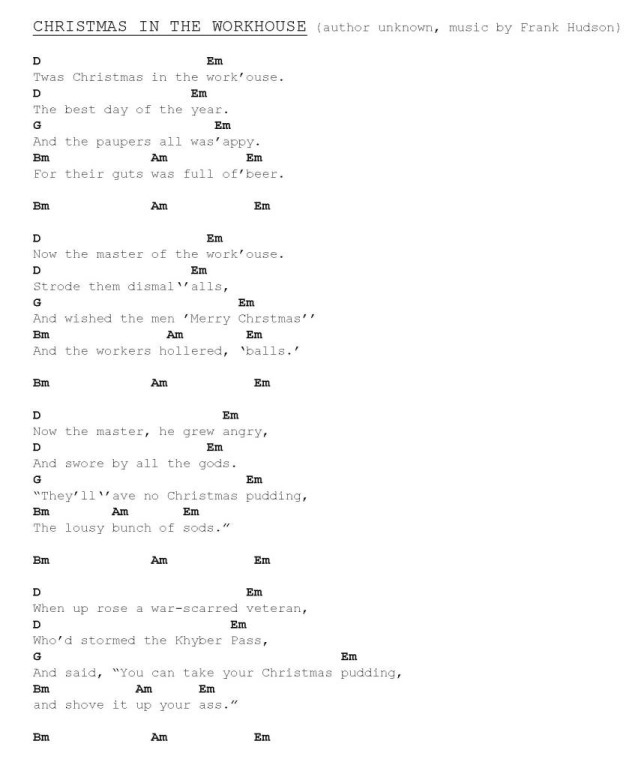
Christmas in the Workhouse chords

Here’s a chord sheet in case you want to form your own workhouse chorus to sing this one

.

In the 1977 movie, the missing but rhyming rude words of this ditty were assumed to be understood even if missing. In modern TV standards they’d all be allowed. Rude British slang probably even adds unintended charm to American audiences. “Beer” of course isn’t a curse other than to abstainers, though too much may be a burden to be coarsely unburdened of. “Balls” or bollocks are testicles, and patriarchally still somehow measurably more polite than the “c word” (also used more freely in British than American slang.) “Sods” is more obscure, but is short for Sodomite, which gets its suppositorian retort from the don’t ask, but will tell, crusty veteran.

Assault your tender ears with my performance of “Christmas in the Workhouse”  using the player below. No player to be seen? This highlighted hyperlink will serve.  I was aiming for a bit of the early Billy Bragg sound for this one, but I ended up somewhere else nearby. Wife and teenager were dragged away from their Matrix series home-viewing festival to play members of the workhouse chorus, so the least you can do is listen. Happy Holidays to all you intoxicated, genital flaunting, gender-queer, ass-owners who despite it all manage to listen to a variety of musical presentations combined with a variety of words — only some of which are solemn — here.

.

*A wonderful British TV movie presentation of an episode from Terry Pratchett’s Discworld. Unreservedly recommended.

**I saw the first one and liked it well enough to not have a great desire to see the continuations.

***Footnotes, it’s like even more gifts to unwrap after that package of socks — and wait…it’s… another…pair of…socks.  Watching The Gathering  made me grateful for the much higher standards expected of modern “event television” productions. The Gathering  won an outstanding dramatic event Emmy for 1977, so it was considered good of kind for that era.

****Workhouses were a British invention to solve the problem of the chronically unemployed, unhoused, indebted, and sometimes frail or mentally abnormal citizens. The idea was that if you couldn’t scrape together enough to survive otherwise your option was to be sent via government edict to a facility where you’d be given enough to arguably survive under a discipline and order that might include being treated as inmate labor.

This sounds exactly Dickensian and out of the mouth of Scrooge before conversion, but this solution was also widely adopted in America. Even in my childhood I can remember driving with my dad past a local Iowa “county farm,” which was founded on the same principle. In practice these institutions varied from hell-on-earth abusive places through ascending circles of shame and shaming up to sites that, at least when under the best administrations, may have been not altogether worse to what came before and after. The degradation was often “designed-in,” as the workhouse was supposed to make even the worst of wage-labor situations look better than the alternative.

In some ways then, today’s piece continues my honoring of the life of Ethna McKiernan, who worked with the unhoused professionally up until the onset of her final illness.

Everyday Alchemy

I don’t have much to say yet about Genevieve Taggard, who wrote the words I perform today. Unlike (for example) Jean Toomer she’s not one of those writers who are only names to me, because until this month I’d never heard of her. I came upon Taggard reading John Dizikes’ Love Songs,  a lively group biography of nine women in the poetic milieu of New York City during the first part of the 20th Century. I’m only halfway through the book, and he’s starting to tell about Taggard.

Genevieve Taggard

Genevieve Taggard


I’m told that, like Millay and Teasdale, Taggard began writing with a nuanced eye about love, that subject that combines not just desire and it’s thwarting, but also easily branches into the nature of relationships between people. I have so far read only two or three of Taggard’s poems from this era, but overviews of her career mention that after the Great Depression and the rise of Fascism, she was one of the writers who moved to direct political engagement on the leftist side, which in the ‘30s in the U.S. most often meant alignment with the Communists.

Taggard died fairly young in 1948, and her career never reached any heights to fall from. As it was, the second half of that century that I share with her was not very kind to many of those who made that move. For some their Red past was overlooked if they themselves acted as if they had overlooked it too. Some recanted their former beliefs, and of course there are reasons one might do that.*

Why would this harm an American artist like Taggard who didn’t live until the rise of an anti-Stalinist and non-Soviet Union aligned New Left? This was the era of the New Criticism, which took the stance that politics was an inferior non-Parnassian and transitory arena compared to art, and besides many of the New Critics “private” political views were conservative. Poor Taggard. Writing about love was considered a minor poet’s subject, the sort of thing non-serious women were prone to do, but leaving that and engaging in party-line political action wouldn’t gain anything from New Criticism either.

None of Taggard’s work is in print and I may never get around to finding, much less reading, her politically engaged work, so I can’t really speak to its quality.**

I figure I’ve just lost half my readers now, and I’m unsure why I brought this up, other than when I read “Everyday Alchemy”  at the end of a chapter in Dizikes’ book, I was transfixed. Is this a political poem or a love poem? This is a poem that is both heartfelt and sharp in its analysis. Like much great art it’s balanced on razor’s edge, one half clear-eyed on the unfairness of the emotional burdens placed on women by men, and one-half equally sure that society gives poor and working-class men no other peace. In eleven lines Taggard speaks volumes on this. It’s nearly 100 years old, yet has it outdated? As poetry it works well too, ringing word-sounds via consonance and assonance, fragmented phrasing in a relentless dance. This is what it sounds like when doves cry.

Everyday Alchemy

If you’d like to read along while you listen, here’s the text of Taggard’s poem.


When I say a love poem can be as complicated, as analytical as any, “Everyday Alchemy”  would be a great example. I’m told the 1930’s Taggard considered most of her early poetry about love as a mistaken focus after she moved on to her later political stuff. However, observers note that this poem, published in her first love-poem book For Eager Lovers, was reprinted again in her reputedly socialist realist volume Calling Western Union  in 1936. This poem works both ways.

Here’s my performance of this remarkable poem, available with the player gadget below.


*This is a complex story, and I’m skipping over so much history and passion here, but it’s one of those things that is impossible to summarize adequately in a couple of sentences.

**I am seeking to get a hold of her 1930 biography The Life and Mind of Emily Dickinson  via my local library system however.

Tired

I’m going to close out our investigation into the little-known early 20th Century Chicago Modernist poet Fenton Johnson with one of his most emotionally moving poems. James Weldon Johnson first included “Tired”  in his “Book of American Negro Poetry”  in 1922, and it has been anthologized several times since. “Tired”  remains the poem of Fenton Johnson’s that one finds most often shared on the Internet today.

You can see why. Only a few beats in, that powerful line is spoken: “I am tired of building up somebody else’s civilization.” It may take no more than that line alone to have some tag Fenton Johnson as the first radical Afro-American poet.

I cannot categorically disagree there. I know little about Johnson’s political views, and though the two short-lived magazines he founded before 1920 are said to have included political philosophy, I know nothing of the particular stances he took or supported. At least at the time (the first two decades of the 20th Century) “Tired”  along with a few other of Johnson’s poems caused some Black cultural critics to remark that Johnson was too pessimistic, too given over to despair. You might find that strange, but in that moment, there was a feeling that educational and cultural uplift could soon raise the Afro-Americans along with the time’s large and wide immigrant demographics into a new, more accepting America. We know now that didn’t happen, that indeed 20th Century racism and poverty had some mighty blows to land on America and American Blacks with KKK branded racism, Great Depression poverty, and world-wide Fascism—but at the time, that uplift was what many Afro-American elites were pulling for.

However, just by going on what Fenton Johnson poetry I have available to me, I’m not entirely sure Johnson was, at this time, a political radical or a thorough pessimist.

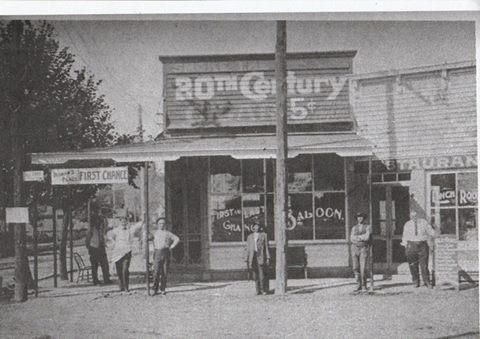
Last Chance Saloon

Somebody give me my gin.” Mike is out back serving warm gin to ladies.

After all, the speaker in “Tired”  is not Johnson himself, no more than the banjo player in our last post’s poem is Johnson, the middle-class raised, college educated man. Even the Last Chance Saloon, where the banjo player played for tips, returns in “Tired”.  Johnson didn’t live in a shanty, he wasn’t married to a laundress.

True, this is a character that Johnson wants us to hear, an important voice that maybe even the Black “Talented Tenth” wasn’t listening to then, much less White America. And though it’s free verse, this is a poem, not an incisive political analysis or program. It’s a dramatic speech with rhythm, repetition, and a rise in despair from gin-houses to the stars.

It’s not hard for me to see in “Tired”  the ancestor of August Wilson’s great play cycle, or the range of characters and voices in Walter Mosely’s detective fiction.

Musically I stepped at least as many decades into the future here, concluding this audio piece with a short burst of the kind of free jazz that allied itself with the Black Arts movement in the later part of the 20th Century. I’ll allow that this music is an acquired taste, but at its core is an ethic of allowing individual voices and modes of expression even in a group context. Free Jazz is not always as raucous as what I played for this, but it does not forbid it either. That’s consistent with what I try to do (within my limits as a musician) with the Parlando Project. When I say we combine words with various music, I mean it.

That does mean that you may not like all the writers’ words I present, or all the kinds of music I write and play to combine with those words, but it means that I’m also not going to stick with one thing and repeat it until we are both tired of it.

I’ve ordered these last four posts here on Fenton Johnson purposely, so to present the man more in full, and because, to be honest, I didn’t feel I could earn any license to speak these words without doing something more than just putting them in my mouth. To listen to Johnson’s “Tired”  as I performed it, you can use the player below where it appears, or this highlighted hyperlink.