In my roundup of World War One War Poets earlier this week for the upcoming centenary of Armistice Day, I only mentioned Edward Thomas in passing. He shares the military service and the battle-related death of the others, but his writing about the war is different. Though he was working on notes that could lead to poems during his short front-line service, I’m unaware of any Thomas poems that tell of his experiences of battle. Many of his poems instead deal, intentionally, or inherently in their time’s context, with the change in norms that the war brought.
A poem like his much loved “Adlestrop,” if read in the context of the war’s coming outbreak, speaks even more intensely of the peace and unnoticed wonder that pauses in the muddle of an unscheduled train delay.
“Adlestrop” doesn’t mention the war though, and it’s based on one of Thomas’ journal entries from before the war. On the other hand, a poem like his “Gone, Gone Again” speaks intentionally and masterfully about the changes in his beloved countryside “before the war began turning young men to dung.” His highly condensed “In Memoriam, Easter 1915” is another that intends to mark the war’s changes.
Edward Thomas, a British nature poet that events bent into a War Poet
If you look at a continuum* from his “In Memoriam” through today’s “The Owl” to “Gone, Gone Again” you can see a journey from a short and moving, though impersonal, elegy/pastoral through “The Owl’s” introduction of a linkage of his own corporal experience to those on the front, and concluding with the even more personal and aching conflation of his own state with his country’s situation in “Gone Gone Again.” For this reason, I’m going to put the audio player gadgets for all three in the post today, so that you can follow Edward Thomas’ journey as he decided as a middle-aged family man to enlist—volunteering for the front-lines, and his eventual death.
Here’s “In Memoriam (Easter 1915)” as Thomas begins to weigh the costs of war.
And this is today’s new addition, “The Owl.” It’s not important to the poem, but the pendant in me wanted to know what species of owl Thomas heard. England helpfully has fewer species of owl than North America, so it must have been a male tawny owl, as the other candidate, the barn owl, has a screechy call that couldn’t have been cast as melancholy.
And finally, here’s “Gone, Gone Again.”
*I don’t actually know what order that Thomas wrote them, or even if “The Owl” was written before the war, as some particulars of the journey he describes echo the book he wrote about a bicycle tour he took from the suburbs of London to the border of Wales in 1913. But for performance reasons, seeing the three poems as a narrative seemed defensible to me, or at least no more anachronistic as having the artificial tang of Mellotron strings and flutes to stand in again for England in the music.
As we enter the week in which we note the ending of World War One a century ago, I want to call attention to some the ways we’ve shown poets wresting with that war in their own time. It’s a longer post, but each one of these pieces presents something different for Armistice Day.
I didn’t start out to feature the WWI generation here. I first intended to include more modern poets’ words, but to do so I would have needed to try to negotiate the issue of finding the copyright holders and getting them to respond to requests for permission when I thought I’d located them. That turned out to be frustrating.
This left me with the pre-1923 generation, the original Modernists, as the most recent voices I could consistently present. Like many limitations this brought an unexpected return. This generation’s members were the pioneers in the new poetic voice that I had to deal with as a young man and young writer, and to some degree we’re still dealing with them now. Even the basic and incontrovertible truth that the majority of published poetry has been free verse in my lifetime is not some inevitable thing, someone had to suggest and prove its efficacy. And the kind of imagery we take for granted as allowed or desirable in literary poetry? That too is their doing.
WWI did not start Modernism. Americans and the French were experimenting with many of its tactics as early as the mid-19th century, and British Modernism was already emerging before 1914. But the events of WWI bent the development of Modernism by their tremendous gravitational pull. Sometimes directly, by poets and artistic allies who were killed, but also by propounding the idea that the established artistic order was incapable of describing the world of the first world war or it’s aftermath. Pre-WWI Modernists writing in English could be straightforward and modest in their poetry. They often valued shorter forms that assumed the elaboration would occur in the minds of readers rather than in endless lines on the page. Post-WWI, the longer poem and much more elaborate and opaque imagery came to the forefront, and the form of the irrational became a large part of the reflected world, even for writers outside the movements like Dada and Surrealism that were formed around that.
It’s been an adventure here reliving those changes. Some of the Parlando Project’s most popular pieces have come from that WWI moment, and here are the six most popular WWI poems we’ve presented here.
6. Christ and the Soldier. Siegfried Sassoon seems to have been somewhat superseded by his friend Wilfred Owen as the representative British War Poet of the anti-war stripe. Owen may have “benefited” by dying in the war, rather than having the long career that Sassoon had. Sassoon was a highly decorated veteran of the trenches when he started to publicly oppose the war, and this lead to the danger that he could have been charged with treason, and a weird compromise was worked out where he was treated instead as a man suffering from mental illness caused by the war instead of being put up on trial, the kind of outcome that Joseph Heller would have relished writing of decades later. “Christ and the Soldier” is not politically anti-war, but it’s stark, darkly-humorous, and yet serious account struck me from the first time I read it. As WWI poems go, it deserves to be much better known.
You probably haven’t heard this one, so use the player below.
5. These Fought. Ezra Pound did not fight in WWI. Pound was an American living in England, which would have complicated his enlistment before and after America’s entry into the war, but in either case a determined man could have overcome those obstacles. Pound’s friend, and co-founder of English Modernist verse in the years leading up to the war, the lesser-known Englishman T. E. Hulme, enlisted, as did others in his wide circle of acquaintances. So, when this post-war poem was published, excoriating the waste and propaganda of the war years, it was in the context of a longer poem that it’s only a section of, “Hugh Selwyn Mauberley.” In the entire poem, Pound, who’s personality seems to have been a strange mixture of generosity and egotism, stubbornness and self-admonishment, also charges himself with failing to decisively deal with the titanic issues of the war. I’d muse that this sounds like survivor’s guilt is mixed in with the contempt for the war stated after the fact. In Pound’s case, his self-correction found him supporting his next foreign home, Fascist Italy, against his native country’s side during the next World War. Ironically, this lead, like Sassoon, to the compromise of “Well, maybe he’s a traitor, but let’s treat him as crazy.”
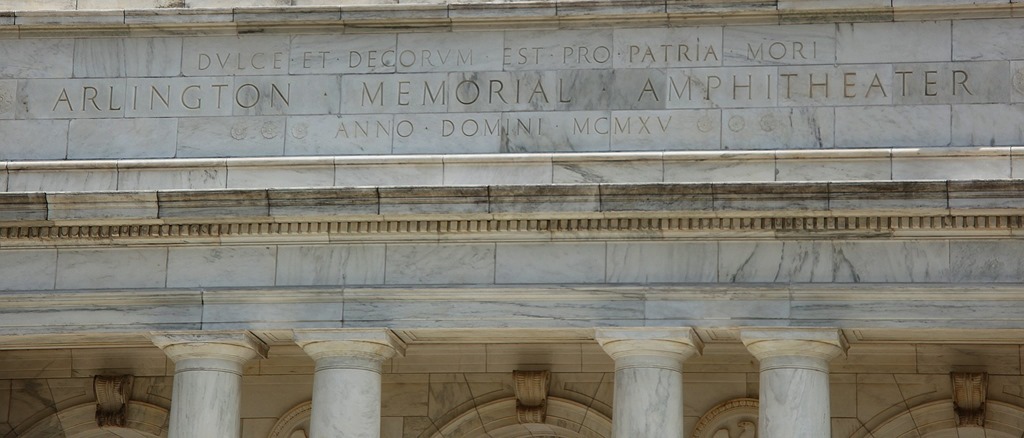
Still, as a piece of invective, and as a condensed statement of art’s challenges in dealing with monstrous events, I have to hand it to Ezra for his set of words. Pound helped “popularize” the use of phrases from many languages in High-Modernist English language poems, much to the benefit of footnote writers, and in “These Fought” he drops a variation on the same Latin phrase used by Wilfred Owen in Owen’s best-known anti-war poem: “Pro patria, non dulce non et decor” in Pound, “Dulce et decorum est” in Owen. In either case, the Latin phrase, from Roman poet Horace, is about it being sweet and proper to die for one’s country, and neither the veteran Owen or the non-veteran Pound meant to endorse that phrase when they used it. In our 21st century world, large portions of proper Americans would agree with Horace’s original thought, and take umbrage with Pound, or possibly even Owen denying its validity—yes, I could see that being charged against even Owen who gave his life, however sweet or properly.
The gadget to hear Pound’s rant about the waste of it all is below.
This large American military cemetery engraved Horace’s maxim in 1915. And whether for solidarity, guilt, or respect for duty, many will endorse it still. Some will stand by it with their lives not just a chisel.
4. Trenches St. Eloi. Another poem by a front-line veteran of WWI, one who didn’t survive the war, and a man who was important enough to the founding of English language Modernist poetry that his war death might have alterned post-war Modernism to some degree. T. E. Hulme helped form Pound’s own views on how poetry should “make it new,” and was admired as well by T. S. Eliot, but his own poetry is now little-known because of its sparseness in number and length. Though he was known as a pugnacious talker in person, and was a writer of audacious criticism, his surviving poems have a shocking modesty about them, something I find quite admirable. Though he wrote dispatches to English home-front periodicals during his service (from those I’ve read, they support the English cause) this is his only poem about his experience of the war itself, and it was composed, or rather transcribed, while he was back in England being treated for battle wounds before going back to the front and his death.
To hear Hulme’s ode to soldierly persistence, use the player below.
3. The Death of Apollinaire. Speaking of influential casualties of the war, Guillaume Apollinaire, must be right up there. The man coined the names “cubism” and “surrealism” after all, and his verse influenced not only countless French poets, but Americans like E. E. Cummings. The exact cause of Apollinaire’s death is open to attribution. He was still weakened by war wounds when he was struck down by the infamous 1918 influenza epidemic just two days before the end of WWI. The poem used here is a surprisingly sincere elegy written by a frank shirker of military service, Tristan Tzara, who as a teenager fled the tinderbox of the Balkans where the world war started for neutral Switzerland, where he participated in the invention of Dada at the famous Cabaret Voltaire. Dada had no respect for the pieties of the warring parties, but Tzara’s respect for Apollinaire comes through in my original translation of his poem.
Thinking of Hulme and Apollinaire as front-line soldiers in WWI makes me pause and wonder at the differences in my own time. Can you imagine John Lennon and Bob Dylan serving as grunts in Vietnam? Or Damon Albarn and Jay Z being deployed to Iraq? Of course, there are differences in poet/critics and pop-stars however artistic the songwriters are, but still it’s a different world, and Modernist artists both reflected and helped to form it.
To hear my performance of my own new translation of Tzara’s poem about Apollinaire’s death in the autumn of victory, use the player gadget below.
2. Grass. Carl Sandburg didn’t serve in WWI. He was a Spanish American War vet however. His personal position on WWI is somewhat hard to figure. He was writing for the stalwartly anti-war IWW under a pseudonym and explicitly supporting there the radical IWW line that the war was the Capitalist class enjoying their profits in a cage match between the working people/cannon fodder of both sides. Yet also during the war he wrote pro-war pieces under his own name, taking the same stance as some other parts of the US left: that the Central powers were evil empires lead by ruthless kings that needed to be defeated by the democracies Britain, France and the U. S. In 1918, Sandburg published “Grass” and attempted to synthesize both sides of Sandburg.
“Grass” is sometimes considered a straightforward patriotic poem, a reverent poem about the ultimate sacrifice of veterans, and if read in such a context no one is likely to object. But listen closely. Even though he echoes Whitman’s leaves of grass metaphor, even if you may find it next to John McCrae’s “In Flanders Fields” in some presentation of poems about honored war dead where we might be implored to “Take up our quarrel with the foe!” One might even too-quickly think it’s akin to what Sandburg’s hero Lincoln would say in his Gettysburg Address, that we “cannot forget what they did here.” But, Sandburg’s poem’s point is literally the opposite of Lincoln’s: that we will forget what they did here.
How completely true is that forgetfulness as we approach the centenary of the end of WWI? A discussion point.
You could read “Grass” as an antiwar poem, saying that “It doesn’t matter how important and glorious they tell you the cause you are fighting for is, because the same or equivalent crowd will run things afterward and what you thought you were fighting for will be forgotten.” Speaking of WWI, 50 years after it started, Sandburg admirer Bob Dylan could sing “The reasons for fighting, I never did get.”
I just got done earlier this fall performing Sandburg’s “I Am the People, the Mob,” In that poem, Sandburg makes a subtle point. That thing the leftish political vanguard often bemoans about “the people,” that they forget the injustices committed against their best interests, is in fact how they’ve managed to survive and endure. If they remembered their defeats, their sacrifices, they might not go on, they could be immobilized in grief and despair. Is Sandburg saying the same thing in “Grass?” Is he saying “I was never sure if this was the rich man’s war fought with working man’s blood, or a war to save democracy. It’s over now and the rich and powerful will forget us as unimportant. Or perhaps it was a struggle so our imperfect democratic governments can continue in a long battle to perfect themselves, but that in the end is what we need to concentrate on.”
To hear the LYL Band perform Sandburg’s elegy to soldiers graves, use the player below.
1. On the Troop Ship to Gallipoli. These most-popular-here WWI pieces I feature today: it’s a rather downbeat outlook, even Hulme’s piece is not the sort of thing to inspire sacrifice for one’s country. Pound’s rant openly doubts the beliefs of some that did, and is unequivocal on the base motives of those who lead his host country in the war. WWI war poets did write poems that supported the war effort. A personal favorite of mine, Edward Thomas, volunteered and died at the front with a deep belief in the nobility of service that overwhelmed his suspicion of the war’s rationale. Pete Seeger’s uncle, Alan Seeger, wrote his fatalistic but heroic “I Have a Rendezvous with Death.” Another well-known poem in this mode is British poet Rupert Brooke’s “The Soldier.” If one believes that any active deity must have a dark comic streak, Brooke dying of an infected mosquito bite while steaming to the front lines of one of the most horrific battles of the war could be part of your testimony.
Pound once had to explain that when he was critical of Brooke’s poems he was speaking of their old-fashioned prosody, not his character. When I saw this fragment found in Brooke’s journal after his death I saw an opportunity. What if Brooke’s observation of his fellow soldiers on their way to battle could be shaped to express itself in the mode that Modernists like Pound, Hulme, or Sandburg would have used? You can see the edits I made here, and listen to my performance of my setting of it with the player below.
We’re entering a month in which Veterans Day will be celebrated with additional ceremony, because the 11th will be the 100th anniversary of the ending of the first world war. Earlier in the blog I remarked that World War 1 was the last war which was substantially narrated to us by poets.
That’s so for a complex set of reasons. Modernism, arising before the outbreak of the war, sought to revive a fresh poetry shorn of worn-out imagery and obligatory practices. The war brought both the old poetry and the new Modernist ideas into a great deadly laboratory to test their efficacy. The comfort of the old poetic music survived this test, but it was gravely wounded. The new practices were not exactly proved either, such was the horror and absurdity of the war. Indeed, the post war Modernism that came out the other end of the war’s meat grinder was oddly often much more obscure and seeking after esoteric tactics.
To a large degree, the post-WWI era marks an off-ramp for poetry. 20th century poetry emphasized the language of aesthetics and philosophy that might employ music to sweeten its sound, rather than the music of words that might employ philosophy as one of its harmonies. Eventually, by our current century, it turned again, and it is now largely about memoir and the establishment and explanation of personal identity.
World War 1 broke poetry, and in it’s wake, the Modernists ascendant decided the shards better reflected reality than some dusty Grecian Urn.
Any of these schemes can work (and not work) artistically, but there is a sort of hierarchy of needs and audience here. The old poetry was more universal, the post WWI High-Modernism the most exclusionary, and our current poetry can result in a multitude of voices crying “I’m here!” to the exclusion of “I see you!”
If one sets aside modern literary poetry, the old poetry still survives. One place you might find it is in the library that some carry about in their heads: memorized poetry. How rare is that today? I cannot say, but I can recall late in the last century, observing Garrison Keillor offering some prize (an autographed book? a T-shirt? I can’t recall the exact prize) to anyone in an admiring crowd who could recite a poem of more than 8 lines. I recall no one taking him up on that offer. Poetry started with those libraries in our heads, and we have the Iliad, the Odyssey and other ancient poetic epics because of prodigious memorization before writing. It isn’t just the noise from our glowing palm screens, or giant TVs that numbed this out of us, it started with the silent racket of all those printed books that call us to read them. Memorization seems a mooted point.
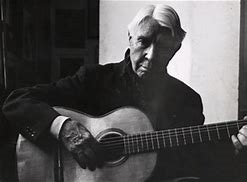
Can you pick out the veteran in this picture?
But returning to that portable library in our heads, and returning da capo to where we started. Somewhere near the middle of the 20th Century, a U.S. Navy pilot was captured and imprisoned by the forces of the country they were bombing. Their captors were none-too-restrained in their treatment of their prisoners, torture and physical abuse was part of that; but in-between that and the constant lack of control that all prisoners face, the prison was made up of small solitary cells with deliberate and extraordinary limits on communication between the prisoners. The design was to break their will, not just their bodies.
The captured pilot was John McCain, who survived this and later went on to a long political career, but one thing that he said helped him persevere in his prison was another captured pilot teaching him a poem by Robert W. Service, essentially loaning out a book from the library of one prisoner’s head to the other. And the method of doing this was painstaking: a pseudo-Morse-code of taps on the wall of the cell that the prisoners devised.
Robert W. Service poems would fit well into taps, as his marching poetic feet can make one tap involuntarily—and the rhymes and narratives give a good structure to assist memorization too. Of course, this was a war prison, it wasn’t a graduate class in Modernist poetry, and if any of the prisoners might have known T. S. Eliot’s “The Wasteland” they might have skipped it if they couldn’t add the famous published edition’s footnotes in tap codes.
Other than Service’s poetic aids to memorization that let his poetry be present in these solitary cells without possessions, another reason that it should be a poem of his that helped these prisoners endure is that some of Service’s best-known poems are about fatalistic endurance leavened by dark humor. Service’s poetry wasn’t just available without paper, it shared an outlook that helped sustain the prisoners.
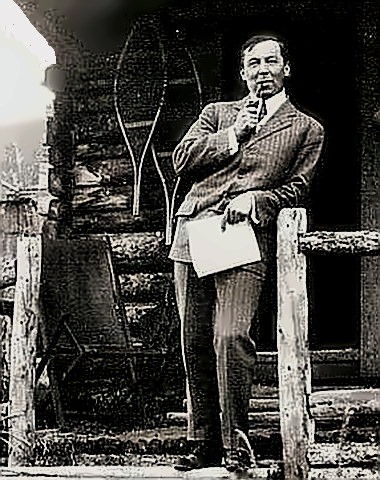
Canadian poet Robert W. Service, not essaying a look that Leonard Cohen would own up to.
So that’s one veteran’s story from a war, decades after WWI. Here’s another.
While McCain was imprisoned, another Navy veteran went into a studio in New York City and recorded an LP of Robert W. Service poems set to music.* While Service’s pre-war “Canadian Kipling” poetic style hadn’t changed, the outlook of the poems used in this record included Service’s rage at the horror and lies of WWI. Robert W. Service didn’t become a Modernist poet, but he showed in these poems the same WWI impact that broke other pre-war poetic outlooks.
The veteran in this case was “Country Joe” McDonald, and even if these Service poems talked distinctly of WWI and the British, French and Canadian experience of it, McDonald no doubt intended it to reflect on the then ongoing war in Vietnam. Of course, there were poems written after the WWI era about war, and McDonald had already tossed off one of the most famous Vietnam war songs himself: “I Feel Like I’m Fixin’ To Die Rag.**” And yet, here he was, drawn to these poems about World War I to express something decades later.
For our audio piece today, here’s a Robert W. Service poem, “The Lone Trail,” more from the endurance side of the poet, performed by Dave Moore with the LYL Band. Here’s the player to listen to it:
*The record War, War, War largely draws on Service’s Rhymes of a Red-Cross Man which was published in 1916. McDonald’s record is a true solo record, just acoustic 12-string guitar, vocals, a bit of harmonica, and some foot-stomping; a straightforward, earnest, and harrowing collection. Parlando Project voice Dave Moore owned that LP, part of the reason he performed today’s Robert W. Service piece.
**McDonald later tells the story of hearing that not only did the North Vietnamese appropriate his song for propaganda broadcasts meant for the U.S. troops, but they even piped it into that POW camp in Hanoi. In the story McDonald heard, the soldiers, and even the prisoners, would laugh. His analysis: the French-educated Vietnamese “Never understood…an American sense of humor.”
Last week was a tough week to bear, from the guns of Louisville through Pittsburgh and the man with the bomb plan and his sheets of flag stamps. Evil should not surprise me, it should not baffle me—and yet it does baffle me. Should I also feel sad along with bafflement? A good question for lengthy political analysis, but that won’t change how I feel beholding this.
I’m not naïve. I’ve lived a long life, and I’ve met a fair cross-section of Americans in it. Ignorance, racism, clan and gender prejudice—humans are prone to this. If I had a great deal of experience outside of the U.S., I would expect to find these things elsewhere too. But now and here, we have a benighted charlatan—in over his head—who trashes around in these things, knowing in some simple, instinctual, skunk’s way that this cloud of stink will confuse us from considering him.
In a few days our imperfect democratic republic will have an election. I do not suppose to know what will happen. I’m a poet and musician, go elsewhere for predictions. Poetry and art allow us to see more vividly across our temporary borders of place and time, but that sort of perspective doesn’t necessarily make us better prognosticators. In poetry and music, like in history, everything is possible, and over the long time, a great deal of the possible will become.
So here I sat, in this mere and disturbing week, having trouble considering the attempted and achieved beauty of my arts—because, in this stink and sadness, what can be meaningfully beautiful?
Carl Sandburg essays a look that Leonard Cohen would cop to sometime later
As I did earlier this fall feeling like this, I turned again to reading Carl Sandburg for my soul’s sake, for the early 20th Century Sandburg had seen every evil I have seen, and yet retained an embrace of humanity. Often here I focus in on the neglected Modernist Sandburg, the forgotten Imagist Sandburg of short poems that sing our overlooked, ordinary, humanity. Sometimes I fear the more expansive, Whitmanesque voice that Sandburg also used has drowned out the individuality of his shorter, less shouty poems.
But I needed him to shout some of his heart into me this week, so here’s Sandburg’s “I Am the People, the Mob.” The player is below to hear it.
I’ve spent a lot of words this month talking about the history of poet and songwriter Dave Moore, who’s been the alternate voice here since we kicked things off more than two years ago. Today I’m going to end the history and get back to the present, shut up a bit, and let Dave’s words and performance tell its own story. Here’s a recent Dave Moore piece performed with the LYL Band this fall.
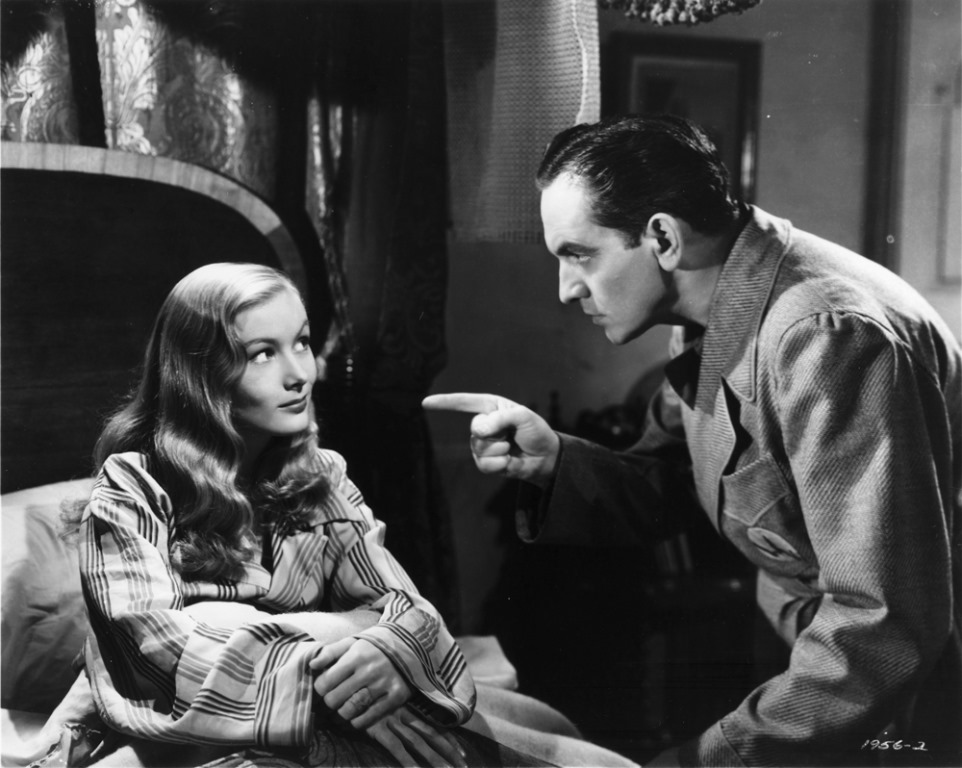
Little to do with Dave’s song, but I can’t resist including a still from René Clair’s “I Married a Witch”
Is this a Halloween song? A political commentary? An investigation of something that precedes and supersedes civilized politics? An excuse for me to fire up my Mellotron virtual instrument again? I could talk. You could listen. Today let’s choose the later. The player gadget is below.
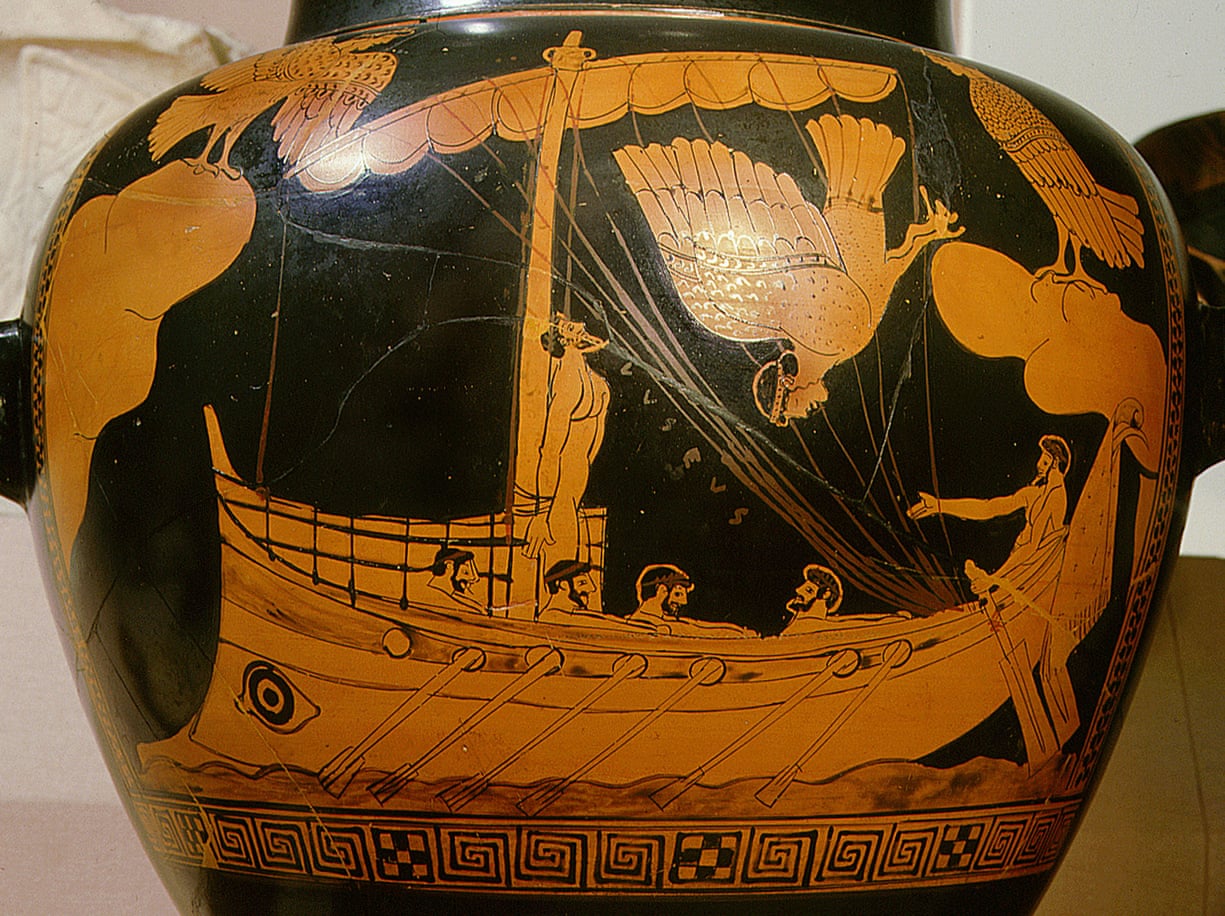
Here’s a piece to celebrate the announced discovery of the oldest intact shipwreck, a 2,400-year-old Greek ship discovered in the Black Sea with its mast, rudder, and even a rower’s bench still in place. This can’t be fully romanced into being Ulysses’ ship—it’s centuries newer—but it does give us an object, beyond the stories, to remind us of ancient sea voyages.
“Tales of brave Ulysses, how his naked ears were tortured by the sirens sweetly singing.” This vase depicts a ship like the one in the shipwreck.
Tennyson’s Ulysses is one of his best-known shorter works, and one I was a bit surprised to find still survives on the seabed of modern teaching syllabuses. I expect that many will read “Ulysses” as a complement to Tennyson’s American contemporary Longfellow’s “Morituri Salutamus”which we’ve featured here, as a pledge from one who is old and past their expected prime to continue to strive. After all, the most quoted section, the one I used, starts right off declaring “You and I are old.”
Well for someone my age or Dave’s—that is to say, old—this understanding might seem natural.* Indeed, as we recorded this last week, we too were not “that strength which in the old days.” But if one looks at Tennyson’s “Ulysses,” both biographically and mythologically, there are some surprises to be found.
Would you be surprised to learn, as I was, that this was not some later work by a long-lived poet (as Longfellow’s “Morituri Salutamus” was), but instead the work of a 25-year-old? Odd that in our modern times, where we often expect authenticity in our poets, were the poem is expected to be biographically true to the author’s own experience. But of course, it isn’t rare for younger people to feel old and to feel an age is past. Tennyson chose to make his poem’s speaker aged because it did represent something he felt after the death of his close friend Arthur Hallam (the same friend that his book-length epic elegy “In Memoriam A. H. H.” was dedicated to).
If one looks at the poem and sets aside preconceptions, you may find, even in its oft-quoted concluding exhortations I used, an undercurrent from this inspiration. Not only is this Ulysses a hero well-past the age of his greatest physical vigor, he’s demonstrating in his concluding speech two other characteristics. He’s looking backward to look forward. He recalls his Homeric feats, acts that in that story literally had heroes that “Strove with Gods.” He reminds his crew, in effect, “Look, we are the generation that knew Achilles personally, not the modern folk who only read about him.” Which brings us to the subject of his crew, the men he’s addressing in this exhortation. Homer’s Odyssey is clear on what happens to them, after deadly battle followed by deadly mistakes: they were all killed, long before this poem begins. Like Tennyson after the death of his friend, those who know, those who shared and could testify to Ulysses soul, are gone. So, when he asks to set sail in that boat, there will be no rowing soldiers on those benches sitting well in order, except in his soul.
So, he’s crazy? Deluded? After all, he’s plainly talking to those that aren’t there. Well this is a poem, a work of art. Ulysses might never have existed, or might not have existed in the way we know him if not for Homer, who also might not have existed. And Tennyson and his friend Hallam? We can pretty well know they existed, even if anyone who could say of the eventually long-lived Tennyson “who we knew” is now dead, and so closely equal to the imagined. This is a poem about the hereness of the not-here.
I was telling my son the other day, “Death is the leading cure for immortality,” but sometimes the cure doesn’t take. I can’t say that the LYL Band’s performance of this part of “Ulysses” is immortal, but we do strive to seek to find and not to yield. Hear it here:
Another short break in the Dave Moore series to present an unabashedly ecstatic poem by E. E. Cummings.
The kind of Modernist poetry we often use here rarely presents itself like this, as the early 20th Century pioneers tended to be a downbeat and skeptical lot, even before the great tribulation of the First World War. Cummings isn’t the only exception, but a poem like this is so extraordinary in its exuberance that it will always stand out.
Lipping flowers…the ecstatic poet’s self-portrait in pencil
As a page poem, “Crepuscule” is laid out on the page in staggered lines sans punctuation, something Cummings may have picked up from Apollinaire, but the syntax isn’t as jumbled as some E. E. Cummings poems. It actually reads fairly easily once I lined-out the dismembered sentences. The images are surreal, though written before official Surrealism, and paradoxical sensations and states come one after another. Can one gather what is happening in the poem beyond the welcoming of sensation and exploration?
Cummings’ “Crepuscule” as a page-poem.
The title is “Crepuscule,” an antique word for twilight, and so the poem is set in that proverbial border time. The poem goes on to either explore sleeplessly and fearlessly in the unknown darkness, or launch itself into the imagination of dreams, which surreally complete and supersede the “mystery of my flesh”—at night exploration, or dreams, at once, indistinguishable.
I didn’t see this until after I finished performing it, but I suspect the poem may have bookended images near the start and at the end, the twilight beginning with the swallowing of the sun, the ending with the moon setting the teeth (on edge) with the metallic bite-taste of the moon.
As sometimes happens when I compose the music for these pieces I find out or remember that others have done this before me. As soon as I saw the title I thought immediately of Thelonious Monk’s instrumental composition “Crepuscule with Nellie” and the idea was planted to use piano in my music for this. I did end up with some piano, but I reverted to guitar, my home instrument, to express the unrelenting long line of this poem that leaps into the bothness moment of twilight.
Embarrassingly, I had forgotten that Björk had performed all but the last part of Cummings’ poem as “Sun in my Mouth” on her album Vespertine. Björk brings big time sensuality to Cummings’ words, bringing out the eroticism that was always there, not just by her commitment to the performance, but by ending on and repeating the “Will I complete the mystery of my flesh” line, bringing fleshiness to the mystery. But this is a poem of the borderline, and the flesh is also hymned to complete a change to something else.
My fearless borderline tonight is presenting this music which would have difficulty reaching the level of originality of Monk or Björk. To hear my performance of E. E. Cummings’ “Crepuscule,” leap into the ripe air by clicking on the player below or click this highlighted hyperlink to open a new tab window that’ll play it.
I’m going to take a break from my Dave Moore series today, if only because I rather like this piece I’ve been working on and want to present it to you.
“Fog” is likely the most well-known poem by Carl Sandburg without Chicago in its title, and it appears in many school textbooks where it serves as an introduction to metaphor. The Carl Sandburg who wrote it didn’t intend it to be a lesson. I think he wanted to write a Modernist, Imagist poem, the way a small group of others were writing them in the era roughly 100 years ago.
One thing I’ve learned searching out pieces for this project was that Modernism in its High Modernism guise has overtaken the work done by those preceding Imagist pioneers. As those who’ve visited here during cruel April Poetry Month will know, I enjoy somewhat those knotty, learned, collaged and college-ruled works that T. S. Eliot’s The Wasteland laid out. And World War I, we should not forget, was a terrible disaster with near untellable loss of life and loss of hope for its generation. WWI probably had to change things. The Carl Sandburg who wrote his early Imagist poems went about his pre-WWI world with an open heart and open eyes. In his poetry and in his political writing there’s a panorama of evil and survival, loneliness and stubborn love.
So, to reduce “Fog” to a lesson on metaphor is to amputate that context, and to forget the Imagist quest to renovate entirely metaphor as it had been received by Sandburg’s generation. Imagist poems often wanted to break through the fourth wall of metaphor, to make it more than an a decorative, this stands for that, analogy. “Fog” is fog, and the cat is a cat. Yes, they have meaning beyond that, all reality does.
You could start by asking yourself, if this is a real cat then, what kind of cat is it?
A house pet, one used to demanding the pricey wet food and best place on the dry, warm bed? No, it’s on the docks. It could be a ship’s cat, a fellow laborer, or a feral cat making do with what it can find there. It can’t call attention to itself for its prey and its own risk, and so it’s silent—and like its life and labor, obscured by the fog, by the cat’s own actions and the actions of the world. Sandburg sees his worth to see that.
Carl Sandburg at the machine of his labor.
That’s an Imagist poem, a direct presentation of reality, with no false rhymes of conventional or show-off imagery. There’s love and respect in it too, for the working common of us, singing the insubstantial and all-covering fog of our lives and labor, that save for the notice of the poet or artist, is silent and then moves on.
That, dear readers and listeners, is why you should pay attention to Carl Sandburg, who’s nearly fallen out of the cannon of important Modernists and consideration as an important poet, who is, I tell you, as you are, more than an example of metaphor.
Remember back to the formation of the LYL Band were we self-labeled ourselves as “Punk Folk?” Given that folk music by definition doesn’t ask for certifications or approval to be performed, that was something of a tautology. It occurs to me that what I’m doing here with pieces like this, using a string quartet I play part by part along with two pianos (one electric) and a drum set could be Punk Orchestral. My string parts are extraordinarily simple, like unto a lot of downstroke strums of power chords in some Punk.
Decades back, the Pixies helped popularize the Punk soft/loud arrangement, but of course orchestral music did it OG before them, and I exploit that in this one. Some other incidental ideas that helped steer me in this piece came from reading some recent posts at the Brettworks blog, where a more trained and accomplished composer talks about some of his processes and inspirations. Specifically Brett was talking about creating a piano part that had enough space where the various notes could have enough time to express their decay trails. Musically, this piece started by exploring that idea, but then the string quartet decided to kick out their jam.
I peform Sandburg’s words like a stalking cat hunts, sliding forward and stopping, then slipping forward again before pouncing. To hear this, use the player gadget below.
Did I skip over Dave Moore the poet and writer to get to Dave Moore the words and music guy? Perhaps. Let’s step back away from the 1980s and recap a bit in word-print silence, without any musical noises at the beginning.
I met Dave almost exactly 50 years ago in 1968. And my first encounter found him reading his poetry in a church. He was also publishing what would have been called an “underground newspaper” in those days, an occasional Ditto-machine-printed* dozen pages or so of social, political and cultural comment, which I eventually contributed to. 1968 was a fabled year, like unto 1989 or perhaps some year coming soon in our current folly, full of momentous and contentious events. Odd as it may seem, it felt important to engage with them on paper, even for a small audience.
Dave left for Wisconsin to continue college, I ended up in New York to not. We didn’t see each other for over five years.
When I decided to cover Bob Dylan in reverse, and left New York for Minnesota in 1976, I ended up staying with Dave for a while and helping him work on rehabbing a run-down house he was living in. Dave had hooked up with a group of writers, the Lake Street Writers Group, all of whom lived a few blocks from that central east-west commercial/industrial strip in Minneapolis. As a group it was an unusual mix, including bartenders and low-paid workers, most with some college under their belts, but now in their mid-20s trying to figure out what to do with life that didn’t formally give college credits. These experiences gave the group something of a blue-collar, we’ll earn our cultural worth, not be awarded it, air that I liked. I too joined in the group.
The Revolution Will Not Be Duplicated…for less than 1/4 cent a copy! Just think, I could run off a few pages of this blog and have them in mailboxes by the morning!
Besides the usual get-together/critique/talk thing that writers’ groups have done forever, the Lake Street Writers Group ran a little magazine, The Lake Street Review. The first two bootstrap issues were printed on Dave’s Ditto machine, the magazine’s post office box was Dave’s too, and Dave was co-editor in the beginning along with the founding spirit of the enterprise, poet Kevin FitzPatrick.**
I asked Dave what poetry he remembered writing or publishing from this era today, and he reminded me that in the mid ‘70s he was concentrating more on stories. “Oh,” he recalled, “There was a song ‘Ballad of Mr. Lake Street vs. Mr. Id’ in the Lake Street Review.” That piece of Dada was attributed to John Lee Svenska in print, but it would have predated his work with Fine Art or the LYL Band by several years.
What would you get if you combined blue-collar with Dada? One answer would be some of the first songs Dave wrote for the LYL Band. Yesterday’s “Evil Man” would be one example, the man in the title morphing from childhood bully to sociopathic businessman to stickup man. You could see this as a new expression of the notable Woody Guthrie line about “Some will rob you with a six-gun, and some with a fountain pen,” but by having the evil man fade in and out of these equivalented roles from verse to verse, the Dada this-beside-this comparison is made. In today’s piece, Dave’s early ‘80s song “The Night Inspector,” the Ubu Roi rides a fork-lift in a factory. To give you some relief from the audio quality of the archival recordings from the early ‘80s, this performance is a later one where I sing Dave’s song with acoustic guitar. Go go Night Inspector (player) Gadget…
*I’m reminded that Fugs’ founder Ed Sanders was able to raise his ruckus in the ‘60s Greenwich Village scene at first by being the owner of a similar machine on which he printed his own little magazine and flyers. Ditto machines were better than Mimeograph machines. Mimeo machines printed in purple and their printed pages stank of that can’t-be-healthy-for-you volatile ink that is probably responsible for some of you getting lower mid-century grades than your parents expected on school tests. Ditto machines produced pages that looked more like “real” printed work with dark black text.
**Kevin FitzPatrick has continued to write poetry dealing with this milieu for his entire career, including a great number of poems, too rare in our culture, that deal with the complexity of day to day work as an employee. Here’s a link that will let you read part of his introduction to some selected poems of his, where Kevin talks about the life experience from this Lake Street Review era that helped inform his poems.
This month, I’m going to start a series here featuring the words and music of Dave Moore. This is different—and not—because long-time listeners will have heard Dave’s voice and words here from the beginning, but this time I’m going to expose a little more of Dave’s range of work. If you’ve come here expecting our usual eclectic mix of poetry from various eras with music, don’t worry, we’re not abandoning that (and there’s lots here, just look at the archives on the right), I’m just taking some time to present something different, and “something different” has been my aim since the start.
I’m going to try to put Dave’s stuff in context, at least the way I’ve seen it. I’ve known Dave for 50 years. He was writing poetry before I met him, and he’ll write things for the page to this day, but he became a songwriter and he has had a long-running one-panel comic for decades too. I’ll start by talking about the songs.
A little over 40 years ago Dave’s words were used for the lyrics of a third of the songs on one of the pioneering Twin Cities punk/new-wave/indie records: 1978’s Fine Art’s Fine Art. Dave didn’t perform with the band, and as far as I know, he didn’t have any direct input on the music the band created for the songs. Fine Art existed from just before their only LP was recorded until around 1983.
That you haven’t heard of Fine Art is likely derived from several reasons. The biggest one is that they, unlike some later Twin Cities’ Indie bands, never made it nationally, but I remain puzzled as to how they have disappeared from the memories, books, and posts of those who have sought to cover the local Minnesota-based heroes that made and made up the late 1970s scene that produced The Replacements, Husker Du, and Soul Asylum, and even to some degree Prince, a scene that was then the platform under an even later generation of Twin Cities connected indies like Babes in Toyland, The Hold Steady, or the Jayhawks. Like other cities who experienced the eruption of indie bands in the late 70s and early 80s, the Twin Cities has its own selection of “They were so good and original, how come they never made it as national acts?” bands. The Suicide Commandos, The Suburbs*, and The Wallets were unforgettable to most who saw them locally, but their national/international profiles never really existed, and are now, like our weather will be soon, below zero. Fine Art, who have a good case to being seminal to the scene, who staked their own distinctive sound within it, are forgotten even locally, and that pains and puzzles me.
So, if you make it through this post, you’ll know more about the band Fine Art than anything you’ll be able to find in a book or on the web. In talking about why they didn’t make it into history, I’m going to try to sneak in why you should care about what they did.
OK, what were the problems and obstacles that explain why you haven’t heard of Fine Art, even though they helped break the ground for a significant Indie rock scene?
Their name, Fine Art, can be understood unironically. Their leader**, Colin Mansfield was a highly experimental guitarist, and his compositional ideas were not punk pure nor entirely pop accessible. A sizeable portion of the Twin Cities scene followed the early 80’s movement to make hardcore music which was intense not only in its volume and velocity, but in the kind of loose authenticity that later was called grunge.*** “Art rock” was another of the labels hung on “Progressive Rock,” and that was the enemy to this segment. Fine Art, particularly in it’s early days, could be just as much (or even more) a focused frenzy as, for example, Husker Du,**** but that band had a non-sequitur, non-significant name, and Fine Art’s name on a concert handbill may have suggested the wrong thing to some of the market.
They were song-oriented. Despite the continuing connoisseur appreciation for Grant Hart, Paul Westerberg, and Bob Mould as songwriters, the early TC live indie music scene then was not conducive to them. PAs, live board ops, and venues tended to make all the bands vocals unintelligible. On record, the songs come through, but Fine Art issued too few recordings: essentially one self-titled LP of an early version of the band before they were fully formed, and one EP, Scan, that better represents the middle of the band’s life. I’m unaware of any other Minnesota band with the breadth and quality of material from this early ‘80s era which left so little recorded legacy—but then that proves my point I guess, how would I know if such other bands existed?
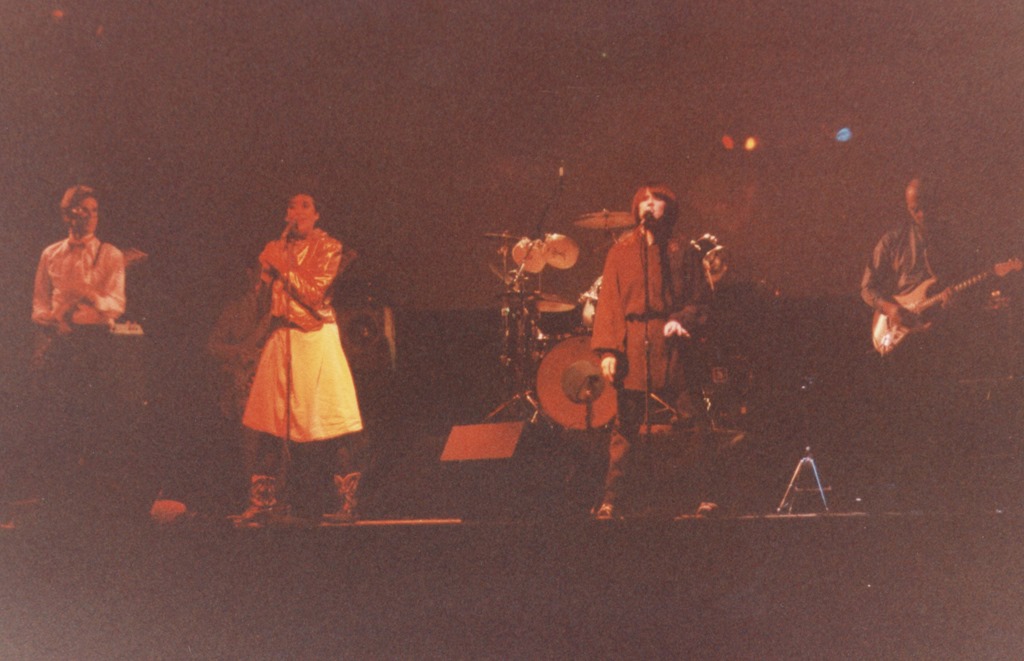
The Fine Art lineup in 1980 fronted by Terri Paul and Kay Maxwell, Colin Mansfield on the far right. Also visible is Liz, their bass player that year which gave the band a 50/50 male/female split.
Live shows. The power of Fine Art in a live show could be substantial, perhaps most intensely on a small stage in a small room, but despite having exceptional singers/front-women over the band’s lifetime, they didn’t always come over on the First Avenue mainstage, the largest venue to present indie acts by the early ‘80s. Their contemporary local heroes The Suburbs (who like Fine Art never limited themselves to hardcore punk-rock moves) would in this era have one of the most dynamic high-energy live shows I’ve ever seen. Last night I watched Sammy Hagar on TV relating what he thought the wisest words legendary concert promoter Bill Graham had imparted to him: “It isn’t the audience’s job to win you over, you have to win them over.” Sammy Hagar, then as now, wouldn’t be a cool re-teller of an always controversial promotor’s bromide, but Fine Art in all it’s incarnations, had a cool stage demeanor, putting out the best music they could devise without a smarmy sales pitch, but also never explicitly pulling the audience into their vision. This stance works more often after you’ve become famous, or (paradoxically) after you’ve become famous for not catering to audiences in an overt way, but it’s the more difficult shot to make, and Fine Art didn’t make its shot.
I was going to write even more dancing-architecture about Fine Art on stage when I discovered that there is available a good quality film of them just past the midlife of the band, performing at the famous 7th Street Entry small room in Minneapolis. This was a good lineup for the band musically, and the performance is about as open and inviting as any I recall seeing. The short film misses some of my favorite numbers, any 45 minute film would, and in particular it includes none of the songs that best showed singer Kay Maxwell’s more exploratory vocal work. But, apropos of my point above, this is about as open and warm as they got, even in a small club. Guitarist Colin Mansfield even smiles. On stage. While the camera is on him.*****
Fine Art in 1981 perform a set in First Ave’s small 7th Street Entry room. As per usual, I think Dave Moore may have written about a third of the lyrics in the songs here.
They didn’t tour. I can’t say for sure why they didn’t. Any bootstrap band has to commit to a “get in the van” leap even for an Indie tour. This means no income other than chancy part-of-the-door proceeds and increased costs even if only for gas and repairs. Hometown relationships will be sacrificed. And the logistics for a six-person band with two women are a much greater challenge than for say a three person trio male-bonding road trip. Realistically, if they had toured, would out-of-state audiences have reacted differently than Twin Cities ones? In some markets I think it’s possible, but far from assured.
Front women. Throughout almost the entire run of the band’s life it used dual female lead singers. This was unusual in this era, locally and nationally, but more so in Minnesota indie circles before the mid-‘80s. Gender mix at indie shows in this era from my memory showed a higher male attendance, and the tastemakers were almost entirely male. Early versions of the band paired Kay Maxwell with Terri Paul until Terri Paul left to marry Suburbs’ principal Chan Poling. Maxwell then was joined at the front of the stage by violinist/vocalist Jennifer Holt, who in turn left to form Tete Noires, another needs-to-be-remembered-more Twin Cities band that prefigured the Riot Grrl idea of the later ‘80s. In theory, you could expect CIS sex-appeal to be a marketplace-trumps-art plus, but remember Fine Art wasn’t a band that wanted to explicitly ingratiate itself with audiences, and the band’s songs almost never featured conventional or playful boy-girl romance or sexual come-ons. In fact, most Fine Art songs throughout the life of the band took a distinctly cool look at relationships and their frictions with individual autonomy, something that pop and rock music didn’t allow female singers to do much in the 70s.****** In this skeptical and examining regard, they were doing in the small Minnesota scene what some post-punk bands in England and the US coasts were doing, but it’s likely that Fine Art was developing this attitude independently. My guess is, that to the extent the young men of the Brent Kavanaugh generation heard the lyrics at a gig, or absorbed the stance portrayed by the singers on stage in a non-literary way, Fine Art wasn’t going to be their new favorite band. Would it be better if they listened? I certainly think so.
Fine Art circa 1982 on the First Avenue mainstage: Ken Carlson, Jennifer Holt, Kay Maxwell, and Colin Mansfield
Today as I think through these things I wonder what would have happened if I was rich and possessed a time machine, could I use cubic money and hindsight to change things? Could I have tried to break them as a recording act without local scene cred? No assurance in that. Try to move them to New York and ace out Blondie, but end up as The Shirts instead? Move to Athens Georgia and try to be the B52s, but end up as Pylon? I suspect the best fantasy bet would have been to move them to England, an even more imaginary gambit, but it was a scene more capable of breaking unusual bands because the extensive network of critics and music press there competed relentlessly to find unusual bands to champion.
OK, we’ve left Dave Moore for awhile here, so let’s circle back. Fine Art had women frontmen who handled the vocals. That means that Dave’s lyrics first were sung by women. A song like “Nailed,” performed by Fine Art on their LP and regularly in concert afterward, is ostensibly a vampire blues that might have been the text from an issue of Tales From the Crypt, takes on a different cast sung when sung by two women in harmony. Lines like “I gave you my body, and you took it too. Always thought you’d give it back—shows how much I knew” change in that context.
Here’s Dave Moore’s lyric “Nailed” performed not by Fine Art, but by the LYL Band. Colin Mansfield wrote the music here, and we only approximated it. I’m doing the lead vocal, though Dave peeks through on backing vocals. If you watched the Fine Art/7th Street Entry video you may be able to put together a mental construct of what the “real thing” sounded like on a good night. Let me assure you, it was even better than what you are imagining.
——————————————
Because what’s more punk-rock than footnotes
——————————————
*The Suburbs are perhaps the most similar Twin Cities band to Fine Art in style. Their principal Chan Poling brought a broad outside musical background into his band as did Fine Art’s Colin Mansfield. And at their best, each band’s rhythm section was solid, and their approach to songwriting eclectic and unafraid of oddness. The Suburbs had the more dynamic live show though, even on a large stage, and the conventional all-male lineup presented a show that could be enjoyed without further thought by the plastic beverage cup waving male club goer. My impression was that the Suburbs were soon a very consistent live draw for any venue hosting them, and Fine Art never was that. Of course, all that talent and appeal didn’t mean that even The Suburbs made it past local hero standing.
A survivor band version of The Suburbs still exists, and Poling (who performs with them) has gone on to a successful career in music that continues to today.
**I don’t know exactly how the band was organized, but Colin Mansfield, along with his then wife Kay Maxwell and outstanding rhythm guitarist, the late Ken Carlson were the three members who participated in every version of the band, and though music and lyrics were contributed not only by Dave Moore but as well by the rest of the band, I always got the impression that Colin was the organizer and collator of that process. I’ve lost the thread with Colin over the years, but he transitioned to in the box electronic music later on, and unlike the Fine Art material, that later work is available.
***As a marker for this aesthetic, I’ll note that Soul Asylum first performed under the band name Loud Fast Rules. The Replacements, whose IP holders should see about the availability from Blackglama of the phrase “What becomes a legend most,” were able to gain attention as the ultimate in anti-showbiz casualness, where a sloppy show meant that they really meant it.
****Colin Mansfield from Fine Art produced Husker Du’s first demos and their initial single, which sounds less like later Husker Du and more like Fine Art. After Husker Du broke up, Colin and Du bassist Greg Norton formed a short-lived trio Grey Area.
*****In my experience Colin Mansfield was a pleasant, understated and helpful man, as well as quite a musician. I once suggested, from my position on being less than any of those things, that it might help if he looked more animated and moved by the music on stage, and he asked back if there wouldn’t be some visual value in all that sound coming out a still and undemonstrative musician. We both were probably right, but he was right from a position of greater talent and achievement.
******Here for example are some of the other songs from that LP issued at the band’s beginnings in 1978, and remember all vocally performed by women: “Don’t Tell Me That,” “Too Much Pride,” “I’ve Got to Protect Myself,” Rapist,” and “Speak My Language.” Ken Carlson wrote the first three, Andy Schirmer wrote the third, and only the last was written by one of the vocalists, Terri Paul. It’s an odd dynamic isn’t it? Songs of self-assertion, anger, skepticism toward love relationships as a system, sometimes inward turning pain, written largely by men to be sung from the viewpoint and voice of two women. I don’t know if this was planned, my suspicion is that was something of an accidental combination which the band allowed to happen and then grew to embrace. I never asked. I don’t even know if any of the band men thought of themselves as feminist, and it wouldn’t shock me if any of the women in the band would have stories where the men failed to show feminist understanding. Human beings, they’re like that.




 Frank Hudson