John Gould Fletcher’s weird “America”

It appears that no one reads or is concerned with American Modernist poet John Gould Fletcher these days. I came upon him in a passing mention that he was associated with Imagism, a pioneering English-language Modernist style that I find worthy of sustaining. Turns out this was only the half of it: in Fletcher’s “associated with” resume, later in the first part of the 20th century Fletcher was associated with a southern American ruralism movement known as The Agrarians which then morphed into The Fugitives who furthermore helped birth — not sheep or lambs — but the monastic New Criticism that reigned supreme when I was in school as a young man. I’ve learned only a little about Fletcher, so don’t make me out to be an expert on him, but this linked short bio is much better than his sparse Wikipedia entry for flavor and detail, and it makes it sound like sometimes Fletcher’s “associated with” was a brief prelude to a falling out.*

John Gould Fletcher by Edward McKnight Kauffer 1024
“Tell you ma, tell your pa, gonna send you back to Arkansas!” Fletcher traveled and lived overseas early in the Modernist era, but spent the last part of his life back in his home state of Arkansas. Here in 1924 he could pass for “Remain in Light” era Brian Eno don’t you think.

.

Thanks to the wonderful collection of scanned books at the Internet Archive I’ve spent this month looking through two of the nine books that Fletcher published in the era surrounding WWI. My impressions are early and will be subject to change, but he seems to be writing in a different mode than other early American Modernists that I admire and have presented here.

Like early Pound you can see elements of Victorian era poetry remaining in his verse. He’s generally less interested in short poems of specifically observed moments than many Imagists. His free-verse often has a definite beat and attention to sound — using, a century ago, word-music techniques that a skilled modern slam poet might select today. Reading poems like today’s selection, I could imagine a live in-you-face-off between Vachel Lindsay and Fletcher in their primes in front of a raucous audience.

He’s a more genteel poet than Lindsay, and among the 19th century influences I see in what I’ve read so far are Whitman, Rimbaud, and William Blake, and today’s selection will help illustrate that I think.

Fletcher’s “America, 1916”  comes in near the end of his 1921 Breaker and Granite  poetry collection. This “America”  is a six-page prose poem that, like the poems that precede it in the collection, attempts to sum up the state of America in 1916, but ends, in the final section that I performed, rhetorically like one of Blake’s prophetic books sung to the word-music of Rimbaud’s The Drunken Boat.**   There are no good online sources for the full text of this poem, but I’ll link here to a Google Books result that may allow you to read the whole thing.

Is there a prosaic political point to this poem? In the context of the rest of the poem it could be reduced to a call for America to enter World War I — which though the war had been raging for two years in 1916, was something that wouldn’t happen until a year after the poem’s date. But like Blake’s America, a Prophecy  (which after all includes specific contemporary references of the American Revolution) Fletcher’s poem is doing so by making a more esoteric call for an elusive greater spiritual body of America to be born.

Is America still in an extended, excruciating, labor toward that birth? I’m no prophet, I won’t tell you, but I’ll do my best to give voice to Fletcher’s 100-year-old-words. The final sentence of the poem is one place where I made a slight change in Fletcher’s text. Weirdly, in a way I can’t quite pick out the intended significance, Fletcher ends his piece with “thou shalt arise, perhaps in vain shalt seek, to rule the earth!” As a prophecy of the subsequent “American Century” this could be counted as a palpable hit. Here in 2022, I sought to echo the internal subtlety of Bob Dylan’s opening line to his “License to Kill:”***  “Man thinks ‘cause he rules the earth he can do with it as he pleases — and if things don’t change soon, he will.” With Fletcher’s last line I did it mostly by repeating the “in vain” twice more to add weight to the dangers of vanity.

I performed only the closing section of Fletcher’s “America, 1916”  today because composition and recording time are hard to come by right now. Lots of drums and I was able to play my own horn section this time thanks to getting short-term access to a better set of virtual instruments than I previously had at my disposal. You can hear my performance below either with a graphical player many will see, or with this backup highlighted link provided for those who won’t see a player.

.

*The bio mentions bipolar disorder, which might help to explain the bursts of output and the periods of disengagement.

**Stop the presses, ah, blog post — whatever. I’ve just discovered that the prose-poem style used in this and some other pieces in Fletcher’s collection are “Polyphonic Prose,” a term most associated with Amy Lowell, who Fletcher was specifically aligned with at the time. This short notice of Lowell’s use of the form in Poetry Magazine,  November 1918 shows Fletcher highly praising that poetic form two years after the date of “America, 1916,”  but before the publication of the collection in which I found Fletcher’s poem. Lowell (and to a lesser degree, Fletcher) credit a contemporary French poet Paul Fort as the inspiration of this form. At least in the Wikipedia article on Fort, Rimbaud is not mentioned as a direct influence on Fort, even though I heard Rimbaud word-music in Fletcher’s expression of the form.

***While there are few live-take liberties with the lyrics, this version of that song by Richie Havens is definitive to me.
The most popular Parlando Project piece for spring 2022

One unusual thing I did this spring to celebrate National Poetry Month was to re-release 31 pieces from the early years of this project. This was a way, despite reduced time and opportunities to create new pieces, to still celebrate and demonstrate the various poems and music combinations of the Parlando Project.

That April batch does show something of the range of words I’ve used. Famous poets? Shakespeare, Dickinson, Yeats, H.D., William Carlos Williams, Marianne Moore, Frost, Pound, Millay, Cummings, Eliot, Sandburg. Foreign poets less known in America than in their native countries? Edward Thomas, Tristan Tzara, Du Fu. Afro-Americans less-known to their fellow Americans: Fenton Johnson, Raymond Dandridge, Jean Toomer, Anne Spencer.

As part of this April celebration, I spent more time that I thought I would creating “lyric videos.” I figured I would just put in a couple of pictures in a video file and place the words to the poems on the screen in time with their appearance in the music, but they got a little more elaborate.

How popular were they? It doesn’t look like YouTube counts as views any plays of those videos from the inside-the-blog-posts thumbnail images, but it does count those who found them on YouTube itself. Given that sub-set it does count, the most popular of the April Poetry Month videos was our Parlando version of Yeats’ “He Wishes for the Cloths of Heaven.”   No surprise there: William Butler Yeats’ poetry is welcome to so many ears around the English-speaking world. If I was to look at most viewed posts (a metric I don’t use in these Top Ten lists) four out of the top ten most viewed posts so far this year are concerning Yeats’ poems. Yeats is a Poetry’s Greatest Hits poet.

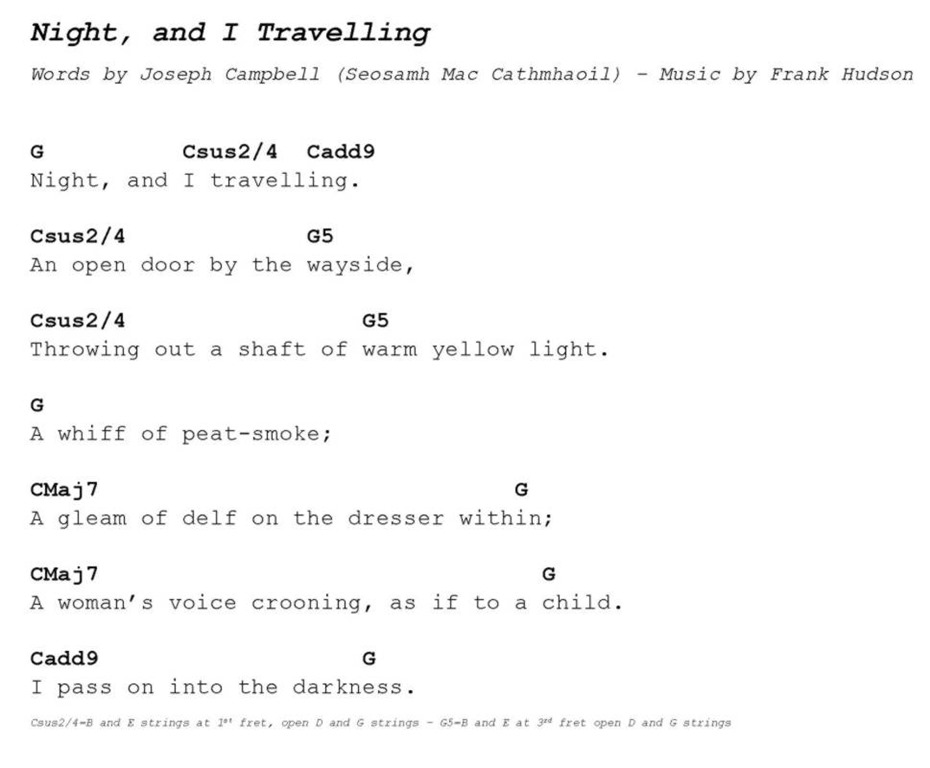
The most listened to and liked piece this past spring was an Irish poem, but it wasn’t by Yeats. It was one of the April Poetry Month re-releases though, “Night, and I Traveling”  by too-little-known Belfast-born poet Joseph Campbell (who also published under the name Seosamh MacCathmhaoil).

I’m partway through a biography of Campbell that was an Anniversary gift from my wife. From it I’m getting more of a sense of the young man who wrote this poem — a poem which is remarkable not just for its tightly compressed and effecting scene, but for being published in 1909 so that it might be counted not just as the work of the first Irish poet to use free verse, but also as one of the earliest published examples of Imagism. It wasn’t until 1913 that F. S. Flint and Ezra Pound published their A few Don’ts by an Imagiste”  and laid out the three famous Imagist suggestions/rules, but before that in London Flint, Pound, and T. E. Hulme had been working out how to radically strip back poetry to a fresh, precise, and direct essence in the months before Campbell published “Night, and I Traveling.”

Night and I Traveling

The chord voicings I used for the 12-string guitar part here are bit unusual.

.

I now know that Campbell was in London and meeting with those incipit Imagists in that first decade of the 20th century. Alas I don’t know how junior a partner he was in their meetings, but “Night, And I Traveling”  is to my judgement as fine an early Imagist poem as the more famous and anthologized ones, arguably a more worthy example because of its empathetic attention to the isolated rural woman in a still-colonialized Irish hut in place of Pound’s  damp impressionistic leaf-faced Paris Metro riders published four years later.*   The biography, Joseph Cambell Poet & Nationalist   by Norah Saunders and A. A. Kelly, reminds us that Campbell liked country walks at night. Campbell wrote: “Night walking — all my best thoughts, I find, come to me that way. Poetry, like devilry, loves darkness.” Devilry? Campbell did write some of the supernatural, and would mix Christian and pagan mythologies —but in this one, this night, he stays in our earthly plane. Am I reading too much into the poem to note the poem’s only simile has the lone woman crooning “as if to child” when there is no child depicted? Is that child dead? Or perhaps emigrated to America?


Not as popular as Yeats on YouTube, but here’s the “lyric video” I did for this piece

.

You can hear my performance three ways. The “lyric video” is above, an audio player gadget should be below, and this highlighted link is a backup for those ways of viewing this blog that won’t show the player. Thanks again for reading about these encounters and listening to our combinations of music and words.

.

*Make of this connection what you will: Pound and Campbell would both eventually be imprisoned by their own countrymen for acts during wartime.

May Music Find a Way. Spring 2022 Parlando Top Ten numbers 7-5

Tonight is Jazz Night here at the Parlando Project Top 10 countdown. I’m going to ask the folks who come here for the talk about words to murmur down quietly today as I speak about the music.

Funny how these quarterly counts sometimes become nice little “sets.” Both today and tomorrow’s segments as we countdown to the most popular piece this past spring are as good as any planned ones I could have devised. So, let’s get the musicians on stage!

7. Sonny Rollins, the Bridge, 1959 by Frank Hudson.  Remember that the bold-face headings at the start of each entry in this countdown are links to the original post presenting them, where you can read what I had to say about it then. I had a lot to say about this one back in January, and so even though this is a piece where I wrote both the words and music, today I’m going to talk about how this (and many of our Parlando Project musical pieces) was realized.

With significant accuracy I hesitate to call myself a musician. My home instrument is the guitar, but even there my knowledge is not something to brag about, my skillset a bit unusual, but limited, and my consistency not up to a professional (or even many dedicated amateurs’) level. But I have a secret weapon: I can choose to compose or improvise (spontaneous composition) the things I present here. My Jazz guitar chops are not strong, but the chordal part was something I was able to execute. Listening back today to the second guitar part I improvised for this I think it was a good day with the wind at my back for me.

In another world I’d more often use other musicians who could add their skills to this enterprise, but logistically and financially the one-man-band approach is what makes it possible for me to express the variety of different musical ideas that I present.

To hear this or the other musical pieces here, use the player that may appear below, or this highlighted link.

.

6. Lenox Ave Midnight, an Extension by Langston Hughes.  Another little miracle pulled from my limited, if a bit unusual, skill set? On a good day I can do a passible impression of a guitarist, but my keyboard playing is always naïve. The advantage I can find? Modern MIDI lets me use my mind where my fingers don’t know what to do. In a piece like this I figure out some kind of harmonic flavor by trial and error and my sketchy knowledge of music theory. I played that part and then improvised a right-hand part, editing on a MIDI “piano roll” to correct bad dynamics or altering notes I didn’t like. To an actual pianist this could be called “cheating.” To a composer, it’s called “composing.” You see, I use the term composer protectively, because I really do feel ashamed sometimes that I couldn’t play in real time with two hands the keyboard parts that to casual listeners make a sound like I could. And I think: to a real pianist realizing this simple composition would be a trifle. To me: achievement!

Near the end of this piece, to open up its musical world before I speak the two lines I added to Langston Hughes poem (the reason I call this piece “an extension”) I did something I rarely do here, which I personally try to avoid, because it really does feel like cheating to me. I used a couple of small loops of recorded melodic material from Apple Logic’s free-to-use loop library. My composer’s need here was that my simple and not very convincing saxophone part, that I did play on MIDI guitar, needed something to camouflage those issues.

Why does this bother me to do? After all sampled loops have been part of popular music since the hip-hop DJ’s started dropping riffs from vinyl records. Because I use “composer” as my excuse, my get-out-of-pretender-jail free card, I believe I (or at least some human present in the room with me in the creation process) should have played or scored the notes. I think the two short horn section loops used here sound fine, helped make this piece successful for listeners — but that’s why I feel guilty for using that tactic. Whoever played them, devised those short motifs, didn’t know what I was doing, wasn’t working in concert with my aims.

Now look, I don’t generally mind when other artists do this. Returning to words briefly now: I spent many an April here performing the words of Eliot’s “The Waste Land”  which includes — even more than I imagined — squadrons of quotations and paraphrases from pre-existing works. Selection, curation, recombination, and recontextualization are easily defined as creative acts. Maybe my qualms and self-imposed rules in this have a most self-interested reason: I worry that the casual listener here will think I’m just reading poems over pre-recorded music, when I’m proud that I had to write and play and record the majority of the music on this Project, one track at a time.

Player below, or link.

.

Sonny Rollins, inspiring to me, yet my distance from that discipline shames me

.

5. Autumn Movement by Carl Sandburg.  I stopped writing this post here yesterday, because what I had written so far seemed embarrassingly solipsistic, pretentious, and uninteresting to my audience, and yet also because some of the things I’m feeling as I write about my musical work are hard to condense into a reasonable length post — to be better, it would be even more. And so here we are at this, my presentation of a short nature poem by one of my heroes Carl Sandburg, illuminated by lovely music I made for it. How am I to feel about it tonight? Amazed that I, a non-musician, was able to make it? Or something that feels almost like shame or embarrassment that I present it publicly, when there are days I can’t play anything of any value? Knowing enough to know that what I know as a composer (little) and what I can bring to the composer as a player (limited). Knowing that at my age (old) there isn’t much lifetime to remedy those things.

This, though I cannot say I have sufficient understanding or skills, is where Jazz comforts me as no other art does. Jazz is always confronting the empty sky. Always a critique of silence — and able to the fears inside silence, now, not later, and with surprise and failure. There can be no surprise without failure. I’m a small man, it’s a big sky and a big silence. There are better musicians, better composers, but it’s a big sky and a big silence. This the musician’s and composer’s prayer: may music find a way.

Player below, or link.

.

Generations, and Poetry’s Possible Worlds

I won’t take much time today in presenting another short 90-second musical piece I composed. I also wrote the text for today’s composition, which isn’t the normal thing here. One of our principles is “Other People’s Stories” — we try to emphasize the value of a variety of poetic expression and what it’s like to encounter that. It’s not like I discourage the writing of more poetry, I only wish to increase the engaged reader side of the equation and to pay tribute to traditions that I draw from when writing or composing.

I’ve been reading this month a new book by poet and teacher Lesley Wheeler: Poetry’s Possible Worlds.   It’s a fine and enjoyable example of that sort of thing hosted inside another mind and lifetime. Wheeler takes 12 not-particularly-well-known contemporary poems and applies care, consideration, and her life’s own insight to them. This would be a different book if these poems were Contemporary English Language Poetry Greatest Hits. Such another book could have value — but it would be more about known worlds with existing maps and pins already placed. This book does something else more uniquely valuable.

Because we perform the poems we present in the Parlando Project, we must breathe inside them. Poetry’s chest inflates when you do that. Wheeler’s book makes each of these poems a sibling, cousin, co-worker, friend, parent, or child — those who we encounter life beside and together with.

One last thing I want to stress about this book: it’s entirely approachable. While Wheeler has written elsewhere as a scholar, and I have one of her books in that line that I’m anticipating reading this summer, this is a book about life and poetry looking at each other that doesn’t require any prerequisite classes. Middle-aged people and above may particularly appreciate “Poetry’s Possible Worlds”  due to the life events encountered, but not every young person is uncurious about life-planets they haven’t voyaged to yet. Here’s a link to details in case you want to join me in reading this book.

So, here’s today’s piece, and since it’s called “Generations”  you may expect it has something to say about different ages speaking to one another. Read/listen carefully, there’s a little barb in the middle of it.

Generations

Is there a Möbius strip inside this one, or just a recognition of how we recall life-lessons when we get older?

.

Musically, this performance has a benefit from the new orchestral instruments I have available for the rest of the year in the richer French Horn that plays a prominent role. Player gadget below for many, and this backup highlighted link for the rest of you.

.

Did you come here looking to celebrate Bloomsday? The Parlando Project has got 2 1/2 minutes of your young, concise poetic James Joyce right here.

.

my adaptation of Li Bai’s “Staying the Night at a Mountain Temple.”

Let me write today about two possibly useful incidents in this project’s working process. Let’s start with the process of translation or adaptation of 8th century master Chinese poet Li Bai’s words. Long-time readers here will know I rely on English language glosses. Here’s the one I used to start work on today’s piece:

High tower high hundred feet
Hand can pluck stars
Not dare high voice speak
Fear startle heaven on person

.

Unlike some other glosses I start with, this presents a fairly clear setting: there’s a high tower, from the title, part of a temple. It’s so high and the 8th century sky is so clear at night that one can imagine grasping the stars. The final two lines say there’s a compelling notion to not speak loudly, that heaven might be startled by a loud voice. The first two lines, clear, objective, the last two lines, in that they seem to be reflecting something subjective, open to interpretation.

Here’s an even-tempered and minimal translation into modern English:

This tower is a hundred feet high.
From its top one’s hand can pluck down stars.
I shouldn’t talk in a loud voice,
for I might startle the people in heaven.

.

I could leave it at that. One might consider the above an accurate translation of a modest thought. One might ask why the concluding fear/shouldn’t statement, and answer that matter by saying the poet is in awe in this high nighttime temple. I later saw at least one published translation that goes this way.

That could be  what poet Li Bai was saying, or would say if he was speaking to us in modern English today, but I made another approach. My understanding, limited though it is, is that Li Bai was often not a respecter of conventional piety, and legends include stories of his early life as some kind of free-lance swordsman*  and his lifelong habits of drinking and intoxication. Chinese scholars think Li Bai helped bring an individualized mode of expression to classical Chinese poetry and that’s part of what he’s revered for.

Audaciously thinking then that I know those things, I took almost the same English words, and even though classical Chinese writing has no equivalent of the question mark, made the phrases questions — impudent questions at that, aimed as replies to whoever might be hosting a boisterous poet. This is the result of that approach:

Mountain Temple

Later below I mention my persistence in composing music, despite my limitations. Why not? Am I afraid I’m going to bother the people in heaven?

.

I like that. I think it’s a better poem in English, though I could be wrong about Li Bai’s attitude. Do not trust me as a Chinese scholar! Furthermore, do not trust fully any  translation. Even better scholars than I are making best guesses and practical choices while enclosed in their own mindsets while translating.

For a second chorus, here’s a short tale of how my music for this came to be. I’ve been dissatisfied with my musical efforts as of late. I call myself “a composer” because I don’t think I’m a competent musician most of the time.***  Yet a lot of the things I’ve been presenting lately are mostly to entirely live takes. Of course, instantaneous improvising is composition of a rapid kind. I enjoy that as a listener and player — yet I also didn’t think I was presenting enough music recently that was reflectively devised to my plans, making choices and re-choices before presentation. Even though I felt that, I couldn’t get started with that mode. And this was so, even as this spring I’d sprung for a yearly subscription to a larger set of orchestral virtual instruments. Weeks had passed by, and I hadn’t made use of them.

Would I this week? I kept telling myself: no, you have too many distractions, your energy level is too low, your musical concepts are probably too simple-minded anyway.****  But I willed myself to sit down with them and my MIDI keyboard and guitar and….

Several of the new sample libraries, present on an external hard drive, wouldn’t load. Couldn’t be found. I’d told the software where they resided, but somehow it hadn’t understood. I thrashed about trying to figure this out for nearly an hour (I’m not quick witted) and then finally told them again where the sample libraries, all those gigabytes of notes and articulations of notes, were sitting.

And that worked! By this point I was a bit mad at myself or the software or fate. But mad is energy. Over the next day or so I worked on today’s music as I made myself familiar with some of the new software’s system. Some of that aggression found it’s way into the orchestral swells, and I think it fits well with my portrayal of Li Bai’s belligerence when told to be quiet.

You can hear that example of my composed music, and my adaptation of Li Bai’s words in the recorded performance below using a graphic music player that many will see. Don’t see the player? This highlighted link is an alternative way to play it.

.

*Obligatory explanation: how Chinese character names are presented in western alphabets is a fraught process. Li Bai has often had his Chinese name presented in the West as Li Po. Same guy, just a different system/approximation.

**Given that early history, I’m tempted to adapt a Charles Mingus phrase about the influential bop saxophonist: “If Charlie Parker was a gunslinger, there’d be a whole lot of dead copycats.” The story is that Li Bai was handy with a deadly weapon. If Li came to us out of a time-machine, Western authors of inessential haikus — or chancey translators like me — might want to up their armor class before meeting up with him.

***This is not humble-brag, but a clear-minded evaluation. I’ve never developed a goodly number of useful musician skills, and even those things I can do some days to my reasonable satisfaction escape me on other days. A musician has a baseline and a variety of dependable skills I don’t have.

****I sometimes call what I do with orchestral instruments “Punk Orchestral” in that it asks simple motifs and naïve playing abilities to carry the weight over greater elaboration and musical knowledge. Via that approach, what comes out sometimes sounds to others like that Mid-Century musical movement that was dubbed Minimalism. I was aware of that movement in the 70s and 80s, attending Phillip Glass, Steve Reich, and others’ performances and listening to eventual recordings. But I don’t have a theoretical basis for what I do, I just make music with what I can figure out to do, trusting that simple concepts sometimes produce equal effects to more elaborate ones.

The Dick & the Dame, or Dave Moore goes Pulp Noir

This project spends a lot of time in the first quarter of the 20th century where the public domain diamonds are scattered free for recutting and reuse — but If I was able to expand this, I’d probably skip the Thirties and delve into the 1940-1965 mid-century quarter, the era I personally remember through youthful-eyed memory. What were those adults up to then, what were they thinking?

We can never answer that fully. Even through that time’s poetry and other art we can only get shadows and dappled sunlight. The high-level summary is “The Greatest Generation” with its dedication to institutions and its obverse face of turned-away conformity. One way the dark leaked out from this gloss color print with scattered blood stains was through paid-by-the-word hard-boiled detective fiction and the run-fast through the projector snap-traps of film-noir. This stuff was white-male written, and mostly for male audiences too. Misogynistic? Well, yes — and in its defense it’d plead misanthropic. That first quarter of the 20th century had its Lost Generation, but this quadrant had exiles. The former wandered off in search of something and doesn’t know where home is anymore. The latter was sent away from home and was pretty sure it couldn’t go back.

The misogyny can bother me when I read or view it, but the magnetic soundtrack of caustic oppositional views attracts me too. And then the outmoded slang involved can seem almost Shakespearian now, the anarchic becaming archaic.

Pulp Detectives 600

“The underwires on this dress are killing me, so don’t think for a moment I won’t use this piece.” Dames on the covers, dicks on the bylines.

.

When Dave Moore and I got back together to set down some live “in-the-moment” tracks this spring, Dave brought two outstanding longer pieces he’d written since we last worked together. The first, already presented here was “The Wall Around Heaven,”  a satire which is set in our present day. If you haven’t heard it, you should. Here’s a link to it.  I can’t praise it enough. The second I present today is a re-weaving of pulp detective and film noir tropes, told though. as Dave turns the pages, with his own poetic verve. Language of course was the chief freedom of the grayscale Abelards & Heloises in those stories, and Dave makes the most of that argot. In a note on the copy of the text we performed this spring, Dave wrote that “The Dick & the Dame”  was “inspired by Robert Coover’s Noir.”   Dave marked a handful of lines as “taken or shaped by Coover.”

The music here is Dave’s too, though some of the decoration is mine. There’d be a temptation to dress this set in mid-century Jazz sounds, which I didn’t do here. Afterall, Elvis Costello’s “Watching the Detectives”  went with the end of the mid-century era with its reggae and Secret Agent Man guitar twang. I went with funky electric guitar neck wringing and whammy bar abuse which would scorch the manners of the Jazz cigarette world. The result is longer than our usual pieces, and neither Dave nor I are well-known poets who’ve written well-known poems, so this breaks from our “Poetry’s Greatest Hits” format. I figure: by this point summer is breaking out and there are fewer listeners and readers of this project until fall anyway. Might as well turn it up and go loose today.

Warning: in this crescendo of innuendo, bad words and flawed people show up.  You can hear that and it with the player gadget below, or where that doesn’t show, with this highlighted hyperlink.

.

.

Burying the Poet’s Typewriter

Elegies are a funny business. Your job is to say something about the missing person — the missing and the person — in some combination. I’m personally committed to the short lyric poem, which asks furthermore that one finds short, immediate, and melodious things to stand for a life and loss. Proportions like that risk absurdity. I decided with this piece to run into that risk.

Absurd proportions in elegies can work. I think of Frank O’Hara’s pair of marvelously effective elegies A Step Away from Them”  and The Day Lady Died,”  which spend nearly their entire compressed length talking about the persona and the living activities of the mourner.

Do we expect Bunny Lang or Billie Holiday to rise up and slap O’Hara’s face or utter a sharp remark? “Who cares about your malted or gift shopping, your cracks about Puerto Ricans or African poets. I just died!”

Buy and large, we don’t object. Mundane specifics and little noticings go on after loss for the living. One wonders if the dead (if they have consciousness) miss them as much as the most luminous moments of their lives. And in the end, don’t those little tarrying things mock death most thoroughly?

The performance you can hear below is from last March, live in my studio space with the Dave Moore that’s also in the poem. I continue to tinker with the poem, a few lines or phrases may not be done yet. Go ahead and listen now at the bottom of the post if you’d like to experience the poem and the performance without further discussion from me. The rest of this post is unnecessary to that.

Burying the Poet's Typewriter Cover smaller

Other performances from this session were featured back in March 2022, and are available via our archives

.

The optional part begins here…

This poem is an American Sonnet, which means we hold the truths self-evident that we can change elements of the sonnet form. I wanted to set the opening, as many of Kevin’s poems did, firmly in working-class lives with old cars that work if you know what to do.

Burying the Poet's Typewriter

There are small differences in the above version that post-dates the live performance you can hear below.

.

Stanza two introduces elements of the typewriter in the title obscurely. Even though the title will prepare the most alert readers to what the object is, my expectation is that most readers are not oriented to the world of the poem yet. The typewriter serves as a generalized symbol here, though with a specific in-joke. In Real Life Kevin used a typewriter to present his poems well into this century. We’d gather to discuss work and exchange drafts each month and Kevin would hand us not some variety of computer printed high-resolution pages, but copies made with carbon-paper on his typewriter. I’d sometimes joke: “Kevin, mine’s from down in the stack. Could I have a darker one closer to the top?” All that’s missing from the poem today — except to Kevin’s family and friends who might hear or read it. Kevin’s place was always quite neat, nothing left out and un-put-away, so I don’t think I ever saw his typewriter, but I think it was a later generation electric typewriter. Yet, the one I present in the poem is more OG, one with an open keyboard with exposed metacarpal levers beneath the lettered key tips. Back when I took a typing class we called them “manual typewriters” (as opposed to the electric models that we had just one seat-row of in the classroom) and they metaphorically are our skeletal writing hands within the poem’s second stanza.

Kevin wrote an elegy, included in his final collection “Still Living in Town  for Katie, the incongruous farm-dog poodle that appeared in several poems in that collection. In it, Kevin struggles to bury the dog in frozen farm ground. Kevin’s poem is an Old Yeller-sized tear-jerker in reader effect, but he undercuts it with humor and anger that intensifies that effect. Here too the proportions are absurd, and that poem of Kevin’s has mechanics that are strange if one stops to look at them. I start the third stanza tipping my hat to that poem of his. I do worry that that connection is lost on the casual reader of this single poem of mine, but it may be enough in the self-contained world of the poem that it indicates that if we are burying Kevin’s typewriter we would choose a meaningful place. I’m trying to adjust the balance here between the missing person and the persons doing the missing.

My feeling/judgement/plan is that last line in that stanza works by strange underlayment of associations with several typewriter brands. Even now in the 21st century I fear this may already be footnote material as typewriters recede into history. These brand-names reeled off say this is a “royal” burial, “underwood,” of the mythical messenger Hermes, and finally the Mount of Olives significant to the Abrahamic religions.

Maybe this is a poem for folks my age — or the very diminished audience of those even older. Perhaps they are the only ones who have the shared experience to “Do not ask for whom the return bell tolls…”

Now why did I go through these other few paragraphs here? The planning and intent and selection I talk about is immaterial to the poem as an object. The reader or listener either gets what I put there and left out, or they don’t. I did this partly out of my nearsighted pride in my craft. More than one reader of this has commented “It seems like a dream.” Well, yes, there was imagination involved. Work at writing or any art long enough and your imagination may become trained, and your appreciation of imagination’s useful moments sharpened. But in the end the poem succeeds as an object based on craft. I’m unsure of my level of craft, but I continue to try to use it.

You can hear the LYL Band’s performance of “Burying the Writer’s Typewriter”  with a player below. Don’t see a player?  This highlighted hyperlink will also play it.

.

*Just so that there be no mistake, I admire Frank O’Hara and these two poems. And if you’ve got a moment, follow the hyperlink for “A Step Away from Them”  as it leads to a nice short appreciation of that poem by Rod Padgett.

To Whom It May Concern (Carry Them Away)

I’ve mentioned previously that our poetic colleague Kevin FitzPatrick, who died last autumn, often wrote poems about work. Here’s one of them from his book Rush Hour.  Kevin titled his poem “To Whom It May Concern,”  and in performance I took a line from the poem and recast it as a refrain, which you’ll see as the subtitle today.

Dave Moore and I attended the memorial service held for Kevin at the end of last month. It was organized by Kevin’s large and talented family, many of whom I only knew as their player-shadows in Kevin’s poems, and many of his family read favorite poems of their relative at the memorial. It seems that Kevin, who was decidedly analog and offline well into this century, would often send them copies of his work in letters mailed across town. Some of them read their pieces after unfolding them from inside their original envelopes.

I’ve been online since online meant wire phone lines. I ran a BBS, I used Gopher, FTP, Usenet, but I found this charming as I listened to their stories in 2022. Typed poems sent in paper envelopes, still bearing cancelled stamps. Poems read by “civilians” recognizably about parts of their own lives. A man whose poetry was generous with “other people’s stories.”

I know many of you are in various parts of the US, or in other countries around the globe. Kevin didn’t “tour” his poetry, and though he often read publicly in the Twin Cities area, his poetry collections were not available other than by being specially ordered through a local bookstore.* You can still do that, but I’m happy to also mention that his family have recently made the books available online via their own website: kevinfitzpatrickpoetry.com. This makes it easy for you to get a copy of Still Living In Town  or one of the earlier collections.

A good picture of Kevin from that web site where one can order his books.

.

Now, back to that memorial. Dave gave a fine summary of Kevin’s work on the Lake Street Review magazine at the event. I had asked the organizers to read one of Kevin’s poems. They asked me which one, and I said “Timepiece.”

“That one’s already taken…” which didn’t surprise me. It’s a touching poem, and in writing about his father’s death, Kevin wrote well about the shared underground of grief connecting all losses. No problem.** I suggested instead the short poem you’re going to get to hear a performance of today “To Whom It May Concern.”

I warned her: I sing that poem. “Warning, why?” you may ask. I was largely warning and committing myself at the same time. To say the least, I’m an inconsistent vocalist, and if one was to listen to a great many of the pieces here you’ll see how often I eschew actual singing — and some examples where perhaps I should have more consistently done that. Still, “To Whom It May Concern”  is a story that askes to be sung. And in the folk music tradition that means you’re obligated to sing it regardless of your American Idol candidacy. For logical and cultural reasons*** I decided to increase my own fear factor: I would sing it unaccompanied.

I practiced singing it while riding my bicycle for a few days before the event. Then, just to see if I could at least keep to a level of performance that wouldn’t take away from the event’s focus on Kevin, I recorded two takes**** of me singing it unaccompanied in my studio space.

The day of the event, I got on stage, I softly tried to find a note by singing the phrase with the highest note under my breath and launched into Kevin’s poem. How’d I do? Folks were kind. I myself had no sense whatsoever. That’s one of my problems with live singing: I can’t really “hear myself” well while singing even with monitors or headphones. Even more oddly I had no memory at all of singing the majority of the 2nd stanza. I’d guess I did, but by that point I was thinking of the poem’s speaker and the bard that wrote down their story, and that was all I could remember.

Today’s version of “To Whom It May Concern (Carry Them Away)”  starts out with that first proof-of-concept take in my studio space and then segues into a recorded live performance with Dave and some guitar accompaniment. There’s a player below to hear that, and if you don’t see the player, this highlighted link is another way to playback this audio piece.

.

*The web site’s listing of Kevin’s books include the titles and ISBN numbers of the collections that may help at a bookstore or when requesting at a library.

**Dave and I had performed “Timepiece”  long ago, shortly after it was written, so you can easily hear our take on that poem via this link.

***Irish and British Isles singing in general has a strong tradition of unaccompanied singing of songs. The modern scheme of accompanying singing of folk songs with guitar accompaniment was actually resisted as untraditional, at least at first. Logistically it just seemed like carrying a guitar around would get in the way of the event’s focus.

****I’d actually planned to record only one take, which I thought better as the public performance would be just that: getting up and singing. Recordists get the luxury of working into the performance with several takes, and live performers don’t. The second take was no better than the first. Oddly enough, that was comforting.

Enjoying Flowers Walking Alone

I mentioned earlier this spring, that master classical Chinese poet Du Fu wrote in a troubled era that also troubled his life. Both he and his contemporary poet Li Po were exiled or forced to flee at times, and while I know no details of this poem, I get an exile sense from it somehow.

Have I mistaken this poem? It’s possible. To say I’m no expert on Chinese history, culture, and literature, is to greatly understate the concern one should have. On one level it seems to be a nature poem, set in spring with tree blossoms and flowers. The poem’s speaker walks out among them one morning and notes how extravagant their splendor is.

American nature poetry, such as Emily Dickinson’s, is often suffused with Transcendentalism and a sense that the book of nature presents truths to a close observer. It’s in that sense that I read this poem. The speaker (I’ll just call him Du Fu for the rest of this) is letting the wind (nature, fate) carry him on a path. He notes that the peach trees are blossoming, though no one owns them. No boss, no lord, no slave master, has sent the requirements for this work. Du Fu observing them wonders if he should prefer one shade of blossoms to another, and decides choice is beside the point.

Nor is there any need for an accounting and report of the number of petals that cover his path. They are not losses to be put on a balance sheet, for the trees simply have “more blossoms than they can hold.”

The concluding two lines have my greatest leap of faith or invention from the literal English gloss that I worked with. If, as I sense, this may be the poem of someone fleeing trouble or in exile, this beautiful morning presents a bittersweet scene. Should he simply stay and revel like the butterflies? I sense the final line’s “free and unrestrained” oriole bird is a contrast to that. That bird has choice. It, like Du Fu, can leave. That freedom, to flee beauty, is not a simple thing.

Here’s the text for today’s performance that I adapted from Du Fu’s Chinese poem using a literal gloss in English. All I had were two portions (#5 and #6) of what is apparently a longer poem or series:

Enjoying Flowers Walking Alone

.

Here’s what that gloss had:

Huang abbot pagoda before river water east
Spring bright lazy sleepy rely on light wind
Peach blossom one clump open without owner
Lovely deep red love light red

Huangsi girl house flowers fill path
Thousand blossom ten thousand blossom press branch low
Reluctant to leave play butterfly constantly dance
Free and unrestrained lovely oriole cry

The music today features an acoustic guitar that doesn’t harmonically move much with a root note of D. While an actual D minor chord is sounded at times, much of the music stays on suspended chords without a major or minor defining 3rd. At one point I’m fretting an F and F# at the same time which somehow works to my ear in this song’s mood. You can hear the performance with a player that appears below for many of you. Don’t see a player?  This highlighted link is an alternative way to hear it.


Dickinson’s “Bloom”

If I didn’t read the news, it would still be spring.

I’ve mentioned it’s been hard to produce new pieces here recently. While there’s a variety of reasons for this, here’s one: I’d planned a little series on May flowers. I was inspired by my wife’s love for our native northland wildflowers and some gorgeous photographs of cactus blossoms by Kenne Turner that I recently viewed on his blog. I had this witty little poem by Emily Dickinson with a not so obscure moral underneath about being an artist — Emerson with a dose of playfulness. I’d completed composing the tune for it. And I planned to pair that Dickinson with a couple of poems by the master of Chinese classical poetry Du Fu.

But I was only halfway there in how captured I was by transient beauty. Earlier this spring on my morning bike ride I started to mull over this line that hasn’t found its poem yet: “This spring is filled with bird-songs and the death of young black men.” So, the horrible and the hortatory were already mixing in my thoughts, while I have nothing but good will and empathy to claim there.

Everyday I try to will myself to make useful or pleasurable work toward this project, and this, among other things, makes me pause. Am I missing the point? Do I even know what the point is, or the series of points that lead to it? I feel bad for the limits of what I can offer, and then I feel bad for not offering that little. Still, I’m stubborn with this. I keep butting against it, trying to push it over or trick my way around it.

And Tuesday I did. Starting early, I recorded an acceptable performance of the Dickinson poem with my music, worked on music for the Du Fu flower poems, and practiced my understanding of how to perform a poem of Kevin FitzPatrick’s that I will present at a memorial event this weekend. A good day it seemed, even if I missed the day’s near-perfect spring weather outside — never mind, the internal weather of being able to create, to illuminate for myself and perhaps for others the work of Dickinson, Du Fu, and Kevin was pleasant and enough.

Never mind, as I got ready to go to bed after this fruitful day, and I caught the news of another rain of bullets. Grade-school kids!

Should I have something appropriate to say, something useful about that? The horrible and the hortatory. Something that isn’t so entirely obvious to some and beside the point to others? Long time readers here will know one motto I have here: “All artists fail.” I’m certainly failing here for some today.

So, you’re going to hear me perform this little poem about flowers, about the work that goes into making mere transient beauty. Here’s a link to the text I used today if you’d like to read along. Dickinson judges right off that she’s sure this isn’t some “minor circumstance.” And Dickinson would know. She knew her flowers, wild and cultivated, intimately.* She was a serious gardener of food and flowers, and despite her growing reputation for being some secular nun always in cloister, she purposely chose that outdoor work with plants over other household chores. She knew their use for food, she knew their use for transient beauty. Flour and flowers.

Her little poem goes on, and the little bud fights several ways for survival. I love the litigious line she uses in passing that she may have borrowed from her male family’s life as lawyers “Obtain its right of dew.”

Prowling Bee by Heidi Randen

A prowling bee “Assisting in the Bright Affair so intricately done…”

.

My dear wife left me on the rise to her job with a hug this morning, wishing me success in being creative today. Was she being a “prowling bee?” If so, as another bard had it, “Sail on my little honey bee, sail on.”

To fail in art, as with Dickinson’s final judgement on our flower that blooms past bud, is a “Profound Responsibility.” If you’re working on art this spring, I’m not asking you to fail, or to be happy with failure — at least I never am. This spring is full of bird song and dead people, the lightness of flower petals laid on us are a suffocating “heavy brocade” as Du Fu had it in a poem of his, one I was able to complete a performance of. All I know and can tell you is how that feels.

To hear my musical performance of Dickinson’s  “Bloom” (Bloom — is Result — to meet a Flower)  you can use the audio player you may see just below, or if you don’t see the player, through this alternative highlighted link.

.

*As I mulled over this poem’s presentation, I was reminded of how seriously Dickinson took her connection with gardens and flowers by Twila Newey musing on Twitter that Dickinson’s mature aversion to publishing could have been the result of her individual conviction that transient and intimate beauty, as in her garden, was sufficient, or even superior to a wider advertisement fixed in type.