Don’t Have To (Now You’re Done)

Here’s a well-worn trope you’ll see somewhere as the year 2022 ends. Someone will write or say:

“2022 — would it ever end? Glad to see that sorry year done.”

Troubling and bad things happened this past year. I know. I’m a grateful and privileged person, but still this year has had stressful and even frightening things in my family. And if we are to look fully at our nations and the world? Distress might seem a slighting word there.

Here’s another trope, one portrayed in many a cartoon around the New Years, one old enough to be old when I was a child: an aged man with a 2022 sash around his stooped body, and a young smiling toddler just able to stand and show the New Year 2023 banner arrayed across its torso. When I was a child, even a younger adult, I always looked fondly at that baby with the New Year’s sash. What wonders, what new things will the upcoming year bring? What burdens will be set down with the expiration of the old year? Even if I didn’t know how the balance of the forthcoming year would settle with the debts of the passing one, I was looking forward, closer in age to that toddler than to that geriatric December 31st.

Now that I’m an old man, that expiring year is closer to me than that tiny child — and it’s not just years that expire or stoop with age. Since last winter, long time alternative Parlando Project voice and LYL Band-mate Dave Moore and I did our part to say goodbye to some colleagues in poetry, and we both have had some family deaths. No wonder that there’s been a good number of elegies presented by this Project lately.

I’ve had the rough tracks of today’s elegy since last spring, the best of which was a vocal track that Dave laid down as part of a session we did in memory of poet Kevin FitzPatrick. It was only this December as the year was coming to a close that I found an idea of what to do with Dave’s song. His words in “Don’t Have To”  are all about the routine troubles, tasks, and stresses of life mixed with the aspirations we poets dream to grasp. Kevin, who wrote about work and labor, and who labored and worked at his writing, had all of that.

Don't Have Too

This was Dave Moore’s own corrected manuscript I worked from to complete today’s piece.

.

It struck me that this is a great life-lot of things, a glorious jumble — Kevin’s poetry that I was privileged to experience, the care and responsibility that his family, friends, colleagues, and clients were sheltered by. If the First Noble Truth of the Buddha is that life is dukkha sacca,*  then noticing a cessation of dukkha  is apprehending the punching out of the timeclock of a lifetime too. Might it be worthwhile for us on New Year’s Eve to notice, or even thank, the aged 2022 of our families, friends, colleagues, and ourselves for their labors however strained and imperfect they were? When we, like the year 2022, are gone, others will take up that imperfect and sometimes thwarted work.

That thought arose as I took Dave’s vocals from last spring and using the modern tools of audio editing, I sped up their tempo to increase urgency. For music I started with a rollicking piano part which I triggered on my little plastic keyboard but made sound impossibly knuckle-busting by invoking an arpeggiator that kept the sixteenth notes flying. After establishing that tempo, I had to give my fingers a workout on the bass to lay down a bass track, and frankly I was running to catch up the whole length of the song. I added a little vibraphone and guitar to add some visiting outside timbres to the dominant piano and that completed the unusual elegy “Don’t Have To (Now You’re Done)”  you can hear with the player below. Don’t see any player? This highlighted link is an alternative way to hear it.

.

*A complicated term to translate, though the simple translation of “life is suffering” is common. Properly, it includes the sense of stress, unease, and dissatisfaction as well.

The House of Hospitalities

It’s Christmas morning, and besides spending time with my little family, I spent Christmas Eve wrapping a little present to myself and to you, reader and listener. It’s a poem by British poet Thomas Hardy, who has supplied several texts for pieces by this Project. “The House of Hospitalities”  is wistful, even melancholy, but I think its heart is in memories — which after all, each Christmas gives and becomes. That’s what we seek out, make, and gift wrap: memories of each other, of each other’s gifts and presents.

Hardy writes using some older words and phrases, a few seeking the rhyme here, and the nostalgic sentiment in his poem might remind us that he lived, and lived past, the Victorian age in Great Britain when some of the Christmas traditions that are still part of observances of this day emerged. There’s hearth, food, company, and music in this Christmas memory, but like a good 20th Century Modernist Hardy tells this story in things, not labels. Note the absence of words naming emotions in this old man’s poem. Oh, “tired” appears in Hardy’s second stanza — but I can testify as a fellow old man that tired is not a verb or adjective, it becomes a very noun in later life. His word-music is graceful, but careful readers of Hardy’s text* that I sing here will notice that I modified it a bit to fit the song music I made and sang this with.

New Year's Gifts

Music as a gift: later today I’ll be going out to hear the Midwestern Jazz combo The Bad Plus, a present from my wife.

.

While other members of my little household baked cookies, I worked on composing that music for “The House of Hospitalities.”   It’s a simple tune, but Hardy’s words and my sensibilities didn’t ask for more than that. I played it on an electric guitar as I sang — electric oddly, so that I could keep the sound lower and separate from the household’s other holiday tasks, for Hardy’s poem is solitary save for memories. Then late on Christmas Eve I worked on adding the bowed strings Hardy mentions in the viol that is now home to wood-worms, some treated electric piano, and the tiny lead instrument of the piece you can hear: glockenspiel. I finished after midnight’s noon, Christmas having entered in the dark.

This morning I give it to you to unwrap. You can play it with the graphical player below that most will see. Don’t see that? No problem, here’s an alternative highlighted link that will play my performance.

.

*I need to thank the Fourteen Lines blog who introduced me to this poem of Hardy’s this month. Lots of variety in the poems they share there. Here’s a link to their presentation of it with Hardy’s original text.

Now Winter Nights Enlarge

Still not able to find time or the skills and concentration to produce as many new pieces, but I thought it was time to finally realize a Parlando version of Thomas Campion’s Winter Solstice poem “Now Winter Nights Enlarge.”   I’d first thought about doing it back in 2017 when this Project was a little more than a year old, but for some reason I never wrote music for it, so it was time to set that one right.

Using an unplugged electric guitar so as not to disturb my household, I composed a good tune with an attractive set of chords that were more at a chord-melody approach, with moving notes inside the chord forms than is my usual style. Unplugged, with me mumbling the words to myself, it sounded quite promising.

Earlier this week I had a couple of hours in which to try to record it. I grabbed an electric guitar to play the music I’d conceived, plugged it in, and…

I couldn’t play the more complex chord voicings and keep any sort of appealing groove and vocal performance. I’ve never been a good, or even part-way good, comping or rhythm guitarist, so this shouldn’t have surprised me — but it disappointed me. I tried just laying down the chords with the idea that concentrating on that and leaving the vocal to a secondary, overdubbed, take might fix things. No, it didn’t. A little better, but still not nearly good enough. I thought of all the not-extraordinary guitarists in the world who could have done a passable job of playing what I’d written with some verve, but none of them were in the room with me.

So, I appealed to the composer — who being me, myself, listened with concern and quickly rewrote the tune with a simpler chord progression while the microphone waited. I put the electric guitar back on its rack and figured that Campion (who wrote music for his poems) had probably composed his music on the lute. I grabbed a small bodied acoustic guitar strung with some European silk and steel wrapped strings.*  In short order I figured out a cross-picked part for the new music, but my time was getting short. I quickly ripped off three or four takes of the new tune with the acoustic guitar, and I thought the last one just might be worth sharing.

lute-player-accompanying-an-old-man-holding-a-musical-score-jacques-des-rousseaux

Too many chords old man. What do you think this is, Jazz?

.

Overnight last night I stayed up recording the piano and cello parts you can hear below. As is common for me, I played the piano left-hand and right-hand parts in separate passes on my little plastic keyboard. I wanted to play a viola part for the bowed-string track, but I don’t have a good solo viola virtual instrument, and so I used a cello VI I did have. This morning I mixed the results, and there it is.

Campion’s words do well to try to convince one of the cheer of long nights and cold temps, and this December we’re to have our fill of both of them this week along with wind and blizzard snows predicted. Is that the message play the Minnesota Theater of the Seasons is putting on? That our lives and loves may be but toys, but playing with the unwrapped toys in dark December** is never an elderly joy, but something always new and discoverable.

Want to read Campion’s words silently in the enlarged night? Here’s a link to them. The player gadget to play my compromise Solstice song is below for many of you. Nothing that looks like a graphical player below your tree?  This highlighted link will open its own player so you can hear it.

.

*The strings are the Plectrum set from Thomastik-Infeld. They are extraordinarily low tension and smooth, but must be played with a very light touch. Rather than the bright zingy tone that the common steel-string acoustic guitar produces, the resulting timbre is somewhat like gut or nylon strings.

**If your top falls and doesn’t always give you גאַנץ, may it at least fall on האַלב.

I felt my life with both my hands

The occasion for today’s post and audio piece is Emily Dickinson’s birthday, but I chose this poem of hers to set to music for other reasons. It’s been quite the year since spring for my little family, and this past month has had some additional things to deal with. I keep meaning to find a way to write about those things, but despite the large presence of I-own-my-part-of-the-story writing on the Internet and elsewhere, I can’t feel comfortable writing for the public about personal journeys of others I love and are close to me.

I’ve read through various collections of Emily Dickinson’s poetry over the years, and I even attended online a reading this past September of all 1,789 of her poems from one ascribed complete edition. Here’s one thing I notice about reading or listening to Dickinson: while I’m always ready to wave my hands in the air for her greatest hits, each time you dive into that alternate hymnal of hers some poem will seem new to you, will grab you with a fresh surprising turn of phrase or thought.

And so, it was a few weeks ago when someone shared today’s poem on the Internet. I wished I’d taken notes, as I have that person to thank. Even before I finished reading “I felt my life with both my hands”   I said to myself “Is Dickinson talking about what I think she’s talking about — and if she isn’t, has she written a poem that accidentally speaks to certain things we think of as modern concerns?” I think the question comes around to if this is a spiritual poem about immortal souls, or if it’s a body image poem — and then, if we must necessarily divide those things, if Dickinson wanted us to. On the outward level this poem speaks of our inner spirit, of consciousness of selfhood, but the metaphors are often physical things one can touch and see, and since Dickinson has shown in other poems that she is comfortable writing in incorporeal abstracts, I can easily believe this imagery is a choice here.*  In short, before I finished that singular reading of this poem this fall, I thought “Dickinson is writing a poem about body dysmorphia, or plausibly gender dysphoria.”

Both of those things weren’t named until after Dickinson’s death, and discussion and understandings about gender dysphoria are still somewhat new in our century, so it’s a leap to say that our mid-19th century poet means to write about those things. So let me go through the poem and try to extract a gloss of what Dickinson wrote.

Both my Hands

I added an “inline epigraph” to the text of Dickinson’s poem. It appears in quotes above.

.

The first stanza refers to an antiquated test for life, holding a mirror up to a subject’s nose and mouth to see if it mists over from respiration — but she’s also portraying by association looking in a mirror. Of course in our day the glass we hold up to our faces is likely the screen of a smartphone with a selfie camera, but the image retains.

I don’t think one needs to insert much into the second stanza to see body dysmorphia. Sure, she could  be reaching for a rhyme for “round” when she uses “pound.” I’m not knowledgeable enough to know what weight ideals were for Dickinson’s time and place, but what’s clear here imagistically is that the poem’s speaker is examining their body and feeling like they are not that body. Is it because they, their self, are philosophically a soul — or because that body doesn’t agree with their soul?

Third stanza. More body examination. “Jarred my hair” is a particular image. Is this some kind of pomade or other cosmetic? I think Dickinson has chosen jarred to pun on “jarring” here. The dimples image would again speak perhaps of weight concerns/dysmorphia.

The last four lines, Dickinson’s final stanza, indicates again the spirit or soul as essential self. Having left off with knowledge that the self/spirit and the body are not the same, the new place, the new home, the poem’s speaker finds themselves in is Heaven.

Nowadays speculations learned and affinititory about Dickinson’s sexuality have become common, yet I don’t see any first page search hits on her and gender dysphoria. The case for that here in this poem may well be accidental, if none-the-less striking, as the narratives of folks experiencing gender dysphoria might well fit into these poetic lines: the separation of the spirit and the body, the disconnection of the body from the authentic self, the feelings of relief when expressing outwardly their inner conviction. The third stanza’s jarring of hair and pushing in dimples takes another vivid incarnation if viewed in that frame.

Now those with the patience to read this far may still be interested in what I did with this experience of the poem — though if you’re a patient reader who is muttering “Balderdash” as you read the above, you are excused to go do something worthwhile. My impression from my encounter led me to alter Dickinson’s text with a sort of in-line epigraph from the song “Candy Says,”  written by Lou Reed for the opening track on the LP eponymously called The Velvet Underground.* *  The unpredictability and distress of the past couple of weeks has, I fear, given forth a less than ideal performance — but perhaps it’s imperfection has a certain authenticity to the times it was composed and recorded in. You can hear it with the player gadget below (where seen) or with this backup highlighted link.

May you find your joy and help others find theirs too. Production of new pieces and new blog posts here may be erratic, or they may be therapeutic, in unpredictable proportions, but there are the over 650 pieces in our archives here.

.

*Another choice is her use of “both my hands” in the first line. It’s not like the body would slip out of one’s grasp if you didn’t grab it with two hands. I think this is a choice to highlight duality.

**This song from 1969 opens with a clear dysphoria statement: “Candy says, I’ve come to hate my body, and all that it requires in this world.” I’m sure there are clever thinkers among spiritual people who can consolidate the idea of an inner soul which is not the physical body with a disbelief in gender dysphoria.

I’m Sorry for the Dead Today

Last episode here we had Jean Toomer’s poem of alienation from labor. In Toomer’s “Beehive”  the poem’s voice is portrayed as just another drone bee, only able to fantasize of escaping work or receiving any benefit from it. Today’s piece is by Emily Dickinson, and while there can often be a touch of irony in Dickinson, I think we can take the voice in her poem “I’m Sorry for the Dead Today”  as earnestly engaged in their farm work.

One doesn’t have to go too far into differences in biography to account for the contrast between the two poems. As I mentioned last time, Toomer was the child of an enslaved person, and the book in which his poem appeared was his literary account of an early 20th century southern American feudal society associated with a racial caste system. Dickinson was an upper middle-class daughter of a successful lawyer and politician — and well, let’s just say it — even if the rights and social assessments of women in mid-19th century America were constrained, she’s got that White Privilege and a different economic vantage point.

Dickinson’s poem, the one we perform today, looks to a specific farm labor event: the harvesting and storage of hay, likely for the animals including the horses used for transportation by her family. One thing I learned when I visited the Dickinson Homestead a few years ago was that the area right across the highway that still runs in front of her family’s house, was a field used to raise grain; and that at least in her youth, Dickinson had as one of her chores, taking food and water to the workers in that field. I don’t know the details of the ownership of that field. Was it shared between more than one family? A village green sort of resource for the town? The harvest depicted here seems to involve more than one family. That doesn’t make certain that it’s a shared field. For haying time, particularly when one has a smaller family lacking muscle power headcount, there may be an exchange of services between farmers, either for hire or in a cooperative barter agreement.

It’s a temptation, one that some American thinkers of Dickinson’s time easily fell into, to romanticize that kind of work, so different from the arrangement of slave labor plantations or share-cropping vassals. Indeed, some of the Northern and border state opposition to American chattel slavery was based less on belief in the full humanity of the enslaved and the crime of denying that, than on the idea that “free soil” labor was ennobling in and of itself and a benefit to a republican citizenship.

So, when Emily Dickinson, northern state’s daughter of a Whig representative, speaks of how engaged and happy the hearty labor of the hay harvesters is, she may be participating in a political sentiment of her time. Now how much the ironic Emily wants to undercut this I can’t tell for sure. The poem’s general argument is that this bustle of life and colleagueship for those with human rights, who are not scrounging for subsistence, is such that the sleep of death is not welcome. Is she making a subtle point in some undercurrent, that death will find this work only vanity? Is there a winking case for the repose of the grave verses labor’s toil? Intended or not, you might find a bit of that there, but it doesn’t seem so to me.

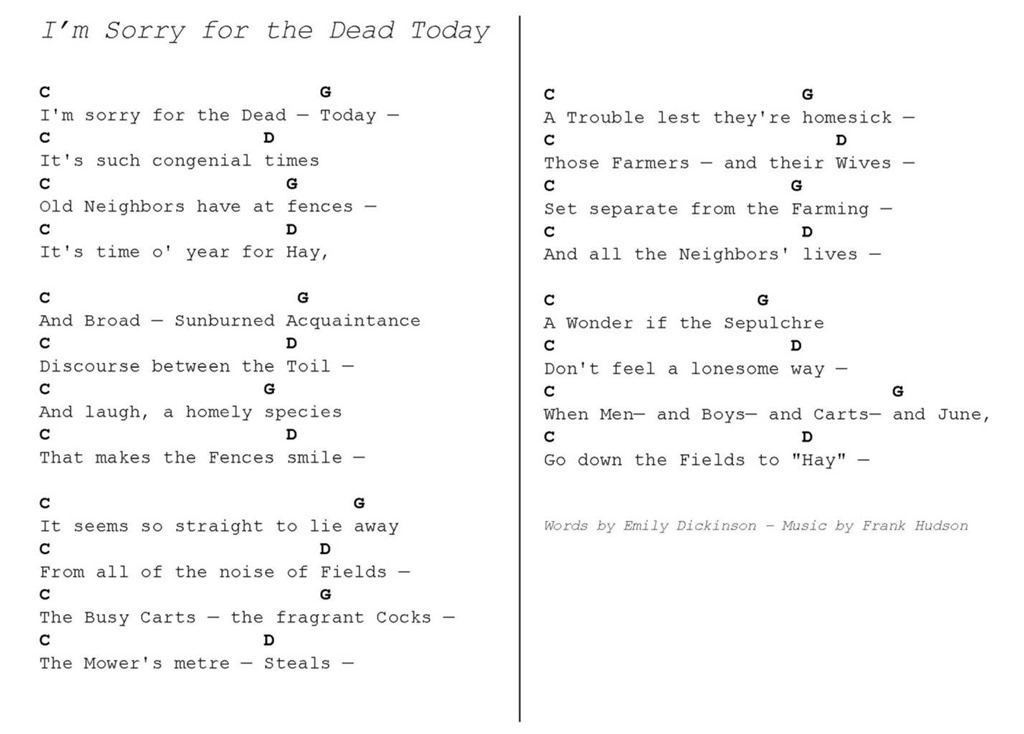
I'm Sorry for the Dead Today

Dead simple chords today. When I present these songs-sheets I’m hoping for better singers and players than I to take up these pieces.

.

Did you find this discussion of what surrounds this poem tiresome or detracting from the pleasure of Dickinson’s verse as a piece of art? If so, you may not even get to this paragraph. I read a remark by writer Caitlin Moran this week that a woman spends less than 1% of her lifetime making love — yet sex and desire, and woman’s role in that, seems to take up a much greater portion of what is written about them. Poetry too has that disproportionateness — and I’m not here to knock love poems, particularly honest ones — but I feel the world of work is too unrepresented in poetry. Maybe I’ll find a poem of acute love, or a transfixed descent into the book of nature next time? We’ll see.

You can hear my musical performance of Emily Dickinson’s “I’m Sorry for the Dead Today”  with a player gadget, if you see that. No gadget? I supply this backup highlighted link.  Thanks for reading, listening, and putting up with my varieties here!

.

Beehive

Here’s a short post presenting a short poem,performed now here as a short song. The poem is “Beehive”  from Jean Toomer.  If you meet the poem, as I did, first as a series of words on a screen, you might be drawn into it as a pretty lyric poem which leans into a poetic tactic: repetition. Three words get refrained heavily: silver, moon, and bees.

Of those, moon is the least surprising, for if one was to take all the poems ever written the moon would likely take a top spot in the category of celestial objects. Sure, the sun would give it a contest, stars indeterminate would be in the running too, but the added changeableness of the moon, and in English the longing of its doubled vowel sound, gives that word a poetic familiarity. Silver then comes along for the ride with moon, though it’s not the only color that is used to describe the moon in other poems. The final highly repeated word, bees, is more clearly a choice, not a convention.

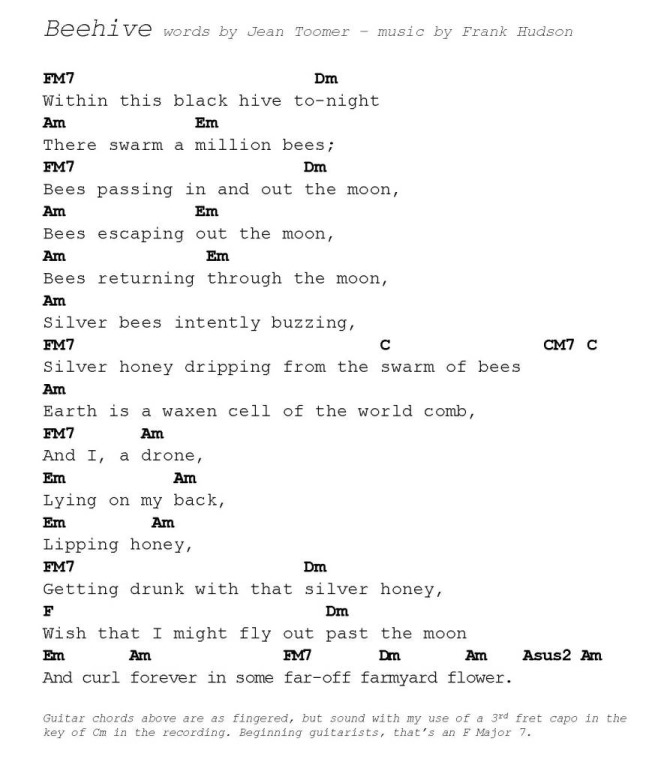
Beehive

Here’s Toomer’s poem as a chord-sheet for my musical performance.

.

I had fun during this year’s marathon Emily Dickinson reading typing a chat notice every time a bee appeared in a Dickinson poem, and my opportunities there were plenty — but Dickinson’s leitmotif choice can be easily explained: she had a great interest in plants and gardening, and so the busy pollinator could be like Blake or Rilke’s angels to her, an important object in her understanding of how things are signaled and accomplished. That’s how I understand Dickinson’s bee,*  but Toomer’s choice to use bees six times (not counting associated words hive, comb, buzzing, drone, and swarm) in this 80-word poem is my task today.

If one wants to think about this poem in addition to enjoying its word-music and flow of images with their surface lushness, the bee here seems a clear image for labor. Toomer published this in his book Cane, which gives his impressions of southern American agricultural labor. Toomer himself was the child of an enslaved man. The laborers in his book from the Last Decade to be Called the Twenties, are part of a feudal arrangement that barely rises to the level of Capitalism, and that scheme is enmeshed with a blunt racial caste system. Because the book is set in the past it may be easier to see the sharp edges and crushing weight of such things for some of us — however much the haze of the present day occludes our present vision. The moon is silver, the color of coinage, this work is part of an economic system, the beehive. The speaker is a drone, a worker. The bees are portrayed as agricultural workers not poets (the pollination is of a “farmyard flower” not artistic flower-show candidates.) They appear alienated to the degree they’re thinking at all, yet our poem’s bee is unable to separate themselves from the hive, the swarm.

Does that reading damage the poem for you? I can imagine it might for some. “It was a pretty poem” might be a response to the above. And of course I could be wrong — poets themselves have told me I misread their poems. I’m not an expert on Toomer, I’m merely here exploring with you.

You can hear my musical performance of Jean Toomer’s “Beehive”  with the player many will see below. Those who don’t see the player can use this backup highlighted link.

.

*Dickinson’s bee is most often singular from my casual memory. Toomer’s here in this poem is always plural, though the quiet quitter dreaming of lying on their back drunk with “lipping honey” seems a single drone’s desire.

Wabasha and 5th, 1949

Tomorrow is Thanksgiving in the United States, a harvest festival with elements of a more general event for gratitude. Those who wish to emphasize the gratitude aspect will often decry that Thanksgiving has become too connected with the Christmas shopping season. Their criticism would be: how inappropriate that a day to count our blessings is the day to launch a month of acquisitions and striving for more to give or get.

Earlier in this frankly troubling week for my family, with losses, stresses, and dissatisfactions, I happened upon a photograph from Twitter user Gary Hornseth, who specializes in archived photos and scans from my region. As I glanced at it, I first noticed that it was a very nice urban nightscape shot. The photographer, either freelance or working on a newspaper’s staff, was able to get a long exposure and the right amount of what painters call chiaroscuro to make the high-vantage-point monochrome shot eye-catching. The archivist’s note didn’t tell us who the photographer was, but they say its source was the November 23rd 1949 edition of the St. Paul Pioneer Press newspaper.

Wabasha and 5th 1949

I don’t know who the photographer of this midcentury downtown St. Paul shot was. Fine work.

.

But then the next thing intrigued me. Hold it, I know that section of St. Paul Minnesota. I worked for 20 years just a couple of blocks away from that corner later in the 20th century. There — that must be the church spire next door to where my coworkers and I worked for a radio network. Back then, from the 4th floor or the roof of my workplace, nearly the same viewpoint on the night was on offer. The streetcar that runs down Wabasha in the old photo? That would be ancestral to the light rail that eventually ran down the street by my work. I looked closer to see what else I could find in the photo. Oh look, there are Christmas decorations spanning the street. Many cities and towns used to string them between light poles for the season, and there they were, like a Minnesota Bedford Falls, arrayed across Wabasha. I checked a calendar. Just as today’s 23rd of November, the day this photo appeared was the eve of Thanksgiving.

And finally, I saw the one thing that drew me furthest into that picture. At the left margin of the photo, silhouetted in a lit window on the 4th floor of an office building, is the single human figure in the shot. Not enough detail to say who they are, just their unmistakable human form. A cleaning person, night watchman, midnight-oil-burning worker, or business owner? Could it even be a writer such as myself? Because they are not so blurred in the photo’s long exposure, we know they were standing still, looking out for a good moment. To look out at the night on a settlement of people, especially from a high vantage point, is to have a thought, or the experience of something that may be more encompassing than an ordinary thought. Here then, as I would have seen decades later, are people and their creations, their government, their religions, their workplaces, their schools, their hospitals, their arts, their businesses. All of them have someplace to be or someplace to be lost from, something to celebrate or something that does not fit them. The gap in time from 1949 to now, is something like a lifetime of moving through those states, even on one corner in St. Paul Minnesota. To someone my age, that doesn’t seem that long.

In conclusion, that’s the real and balanced Thanksgiving, the one of all of us satisfied or unsatisfied, grieving or gathering, living in justice or injustice, may observe.

I wrote today’s piece you can listen to below after viewing that photo. It started somewhat prose-poem-like, which I revised more toward prose. It’s a couple minutes longer than most of our Parlando Project pieces and I didn’t have much time to put together a performance of it, so I decided to go word-jazz, working as spontaneously as a one-man band could do so. I quickly ran through the piano part, worked with percussion samples to get a drum track that worked (easily the longest task), and then played the fretless bass part. The spoken word story recording was one pass, not perfect, but close enough considering the time I could devote to this. You can hear it with the player gadget below, and where that gadget isn’t displayed, with this backup highlighted link.

.

Ghosts

There’s a story that a poet once read a poem to a small group. There were a few murmurs in that small audience, that kind of appreciation — the kind that a not-uncommon everyday poet might expect at a public reading. It’s a sound that says “That certainly sounded like something. Might be good, but can I trust myself? That was poetry, and poets can be clearly beautiful without being, well, clear.”

Yes, there are poems that can cause amen shouts. Yes, there are poems where audiences will applaud. Some of those poems are useful, and isn’t that a kind of beauty? Yes it is — but I said this was one of those poems one more commonly hears when a poet reads.

This time, one listener in the small audience spoke up. “What does that poem mean?” they asked.

The poet looked at the honest questioner for a moment. Looked down at the podium. Paused a moment more. And then they simply read the poem again.

Note, the poet didn’t chastise the listener. It’s good when readers and listeners want to know what they can take in from a set of words and sounds. The issue here is that many poems are written by sincere poets who wrote and crafted a poem without being able to express what they labored to put in the poem nearly as well otherwise. The object of such a poem isn’t a summary, an allegory, or single thread of argument or narrative, rather it may be something designed not to be vague, but to exactly reflect differently as one stands around it.

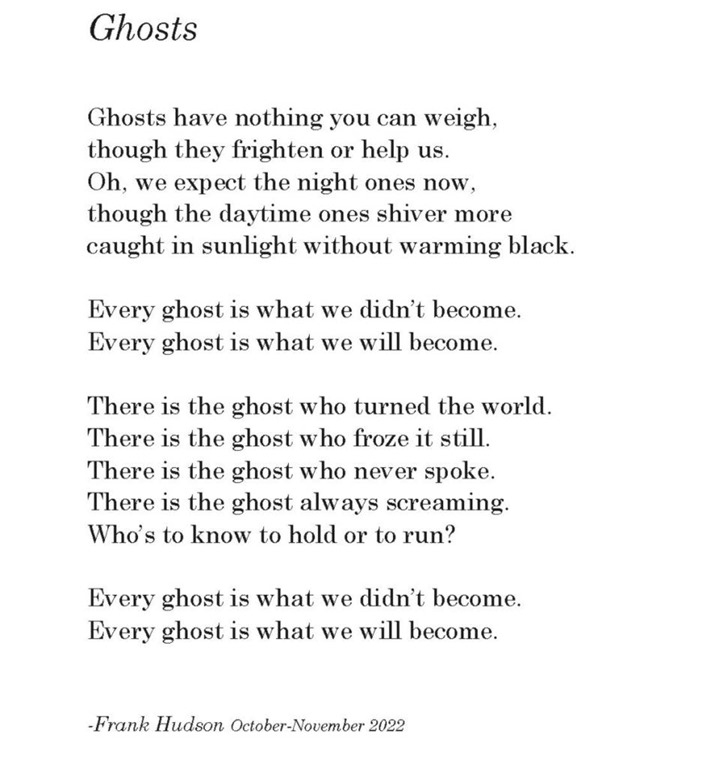
Ghosts

Are we to comfort and remember the ghosts or be frightened of them? Yes.

.

I wrote the text for today’s performance. I accumulated a few lines in my head during a day — and then when I should have been going to sleep, they asked to be written down. Three revisions later and it’s at the version I performed today. I think this is a fairly plainspoken poem, but I know from experience when I’ve presented my work to other people they often find poems in this style baffling and ineffective, this even though they too are poets. I could write here about what they’ve suggested, and what I’ve resisted in those suggestions, but let’s defer that for now. I could also write about what engendered this poem, what the lines seemed to mean when I looked at them from a variety of directions, but tonight I feel the poem at this level of revision says what it should say as well as I can say it in its resonances and refractions. You can hear me perform “Ghosts”  with the player gadget below. Don’t see any such player?  Use this highlighted link and it will open a new tab with an alternative player so that you can hear it.


.

My November Guest

Back in 1916 American Poet Robert Frost published this short poem about what we’d today call Seasonal Affective Disorder (SAD). SAD is that syndrome where the increased darkness and other autumn changes set off depression in some individuals. Like many early Frost poems, it’s a beautiful, graceful poem with effective yet unaffected rhyme and meter — but when I saw it early today in a Twitter post by Cian McCarthy I was struck at the unusual way Frost treated this account of seasonal depression.

“My November Guest”  is set in the time of year we’re experiencing in my part of Minnesota this week. We’ve had two days of dark rain, even thunderstorms, the rain falling unbroken through the bald branches of the trees. It was around 60 degrees F. when I awoke this morning. I rode my bicycle to breakfast at a café wearing shorts as I might in spring, but when I rode past a small pond on my route I noted per the Keats of memory that “The sedge has withered from the lake/And no birds sing.” I returned home and spent an hour or so reading on our porch, but the forecast says it’ll be 26 F by midnight. Snow and ice will be falling north of us over the evening. “Robert Frost” is certainly the correct name for a poet to describe this.

Within the poem’s 20 lines Frost recounts a conversation between the poem’s narrator (we’ll say it’s Frost for simplicities sake as I paraphrase the poem) and his “Sorrow” (the poem’s name for depression.) Most of the conversation are points sorrow (simultaneously personified as external nature) is making to Frost. Sorrow/nature is stating that these dark days could be seen as beautiful. Frost says he is listening to this, feels what his sorrow is telling him has worth. The poem continues: the absent bird song, no colorful leaves on the trees, the cold mist — is it the dullness of grey or the burnish of silver? “You can’t see this as beautiful” nature concludes.

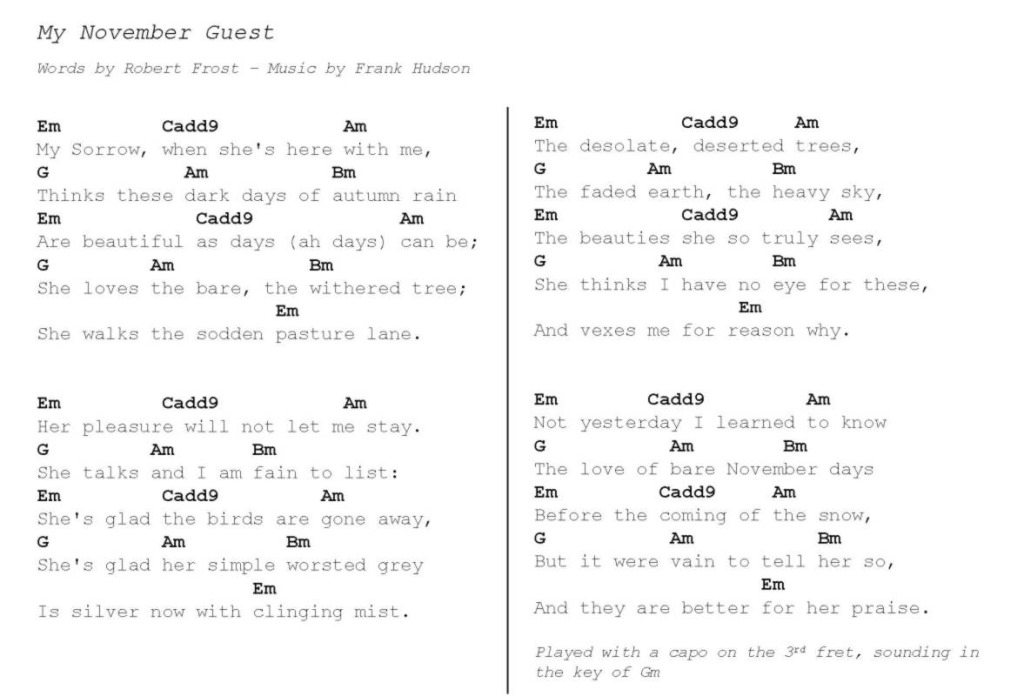
My November Guest

Here is the song I produced from Frost’s poem in songsheet format. I present these in hope that better singers than I might perform them.

.

Frost’s last stanza is his part of the conversation. “Yes, I know how to read the book of nature — or at least the calendar. I wasn’t born yesterday.” His day, the poem’s day, like my day today, may have been dark and damp, but it wasn’t yet the winter that is coming over the walls of the calendar’s date-boxes soon. I know I’ll miss sitting on the porch, biking without mitts, streets only wet not packed with snow or ice. The early and long November darkness may overwhelm us, set off mad clocks inside us, but that’s only dark, only hidden. Or so we tell ourselves and light our LUX lamps. Frost says it’d be vanity to tell his sorrow and this nature this, his mere knowledge, for nature knows the is  of this that surpasses knowledge.

Today’s music is a simple arrangement: me singing with acoustic guitar, as I quickly spent the middle of the day setting Frost’s poem to music and then recording it efficiently in my studio space before I need to hide my microphones from HVAC noises there. You can hear it with a player gadget where you can see that, or with this backup highlighted link for those who can’t.

.

The Absent Poetry of World War II

It’s been sometime since I’ve posted here. Having fewer blocks of uninterrupted time to compose and record the audio pieces for this Project, I’ve spent time instead with that proudly designed to be a time-waster Twitter in the past week or so. Twitter* has its own news stories this week — but that’s not my subject today.

I have a tiny number of followers there, and what I tend to talk about on Twitter is poetry, and then less-popular types of music. Really, not unlike what I do here on this blog, but more cut-up and off-the-cuff — and with more typos from typing on a small tablet screen and screen-keyboard. While working with poetry and music might cross-train you to fit things into constrained spaces, the Twitter short post-length limits challenge even this fan of compressed verse and sub-1000-word essays.

I came upon this Tweet this morning though that brought to mind something I’ve not revisited here on the blog for a while. One of the regular Twitter poetry-posters put up the devastating Wilfred Owen poem “Dulce et Decorum Est,”  and I once more thought of how powerfully the soldier-poets of World War I wrote about their war from the front lines — how to this day England recalls what they said combined with their presence as example casualties from that war, and in the sum, the tragedy all that entails. Long-time readers of this blog will know how thoroughly I’ve extracted poetry from WWI for presentation here.

War Poets in Poets Corner Westminster Abbey

Here’s a picture of a specific memorial to WWI poets in the Poet’s Corner of Britain’s Westminster Abbey

.

Perhaps it’s the Public Domain limitations of what can be freely reused in a Project like this, which puts my attention on pre-1927 work — but I was caused again to wonder, why don’t we have dozens of effective poems about WWII, many of which will be commonly anthologized and recalled by the general audience poetry retains? If called to find examples I might start (as would many others) with Auden’s “September 1, 1939” — but this isn’t a first-person “report from the front lines” poem like Owen, Sassoon, or T. E. Hulme presented back then. It’s not even as close to harms way as the incisive poems of Edward Thomas who wrote about his approach to volunteering for the British Army that led to his death in the conflict, or Apollinaire’s equivalent to Auden’s poem about the outbreak of WWI, “The Little Car.”  It’s not that poets or writers didn’t serve, and a great many novelists who served had a war book in them it seems.**  So, we can easily think of the novels about WWII written from frontline experience. But poems?

Was WWI poetic and WWII novelistic? I can’t make that case. Maybe you can. Is it down to the changes in the literary marketplace? Plausible, though within poetry’s more limited audience in the second half of the 20th century you think there’d be room for poetry as vivid as those of the WWI soldier-poets. Here’s a short list of a few of the notable American poets who did serve in WWII: James Dickey (Air Corps airborne navigator, though some reports say fighter pilot), Richard Wilbur (Army Signal Corps in Europe), Frank O’Hara (sailor on a destroyer in the Pacific), Richard Eberhart (gunnery trainer), Lawrence Ferlinghetti (Captain of a submarine chaser), Karl Shapiro (medical corps clerk in the Pacific theater), Kenneth Koch (infantryman in the Philippines), Randall Jarrell (“Celestial navigation tower operator,” which he claimed was the most poetic job in the Air Force).***

Of that list only Shapiro and Jarrell wrote what might be called “from the front” poems. Jarrell’s “Death of a Ball Turret Gunner”  may be the  example of an anthologized WWII poem, and Shapiro had his first book about his overseas, but not exactly in front line combat, V-Letter,  published as the war was still ongoing.

What happened? Why didn’t more of these poets write more about the details and moments of their service? My general observation is that instead they wrote consciously and unconsciously about how the war changed their outlook on the world. David Haven Blake wrote a short journal article on Wilbur’s World War II poetry, but instead makes the case more for this theory. He quotes Wilbur as saying “The war challenged me to organize a disordered sense of things, and so prepared me to write a poetry of maximum awareness and acknowledgement.” I’ve seen another quote from Wilbur circling the same thought “One does not use poetry for its major purposes, as a means to organize oneself and the world, until one’s world somehow gets out of hand.”

This non-scholar will now generalize wildly, but the WWI war poets used poetry, often structured metrical/rhyming poetry, to demonstrate the world out of joint, a genteel form container for barbarity and chaos. The WWII poets muted all that as unspeakable (or even over-spoken?) and sought to portray in poetry (that wasn’t always as formal) the values and observations of a peacetime more precious, however ambivalent and imperfect, from the militarized brutality of combat.

Let me dedicate this little essay to Robert Tallant Laudon. Laudon sought out the Lake Street Writers Group early this century as an 80-something veteran who had served in a logistical role in England during WWII. Though he became a music professor after the war, he seemed not completely sure of his skills as a poet, but he wanted to use poetry to portray something of his experiences during the war. By the time he was 86 he published a small chapbook “Among the Displaced — World War II”  with the resulting poems. I now view the younger me who heard him workshopping drafts of these poems as a much younger man than I thought I was then. Such is the progression of age! His poetry, like much good poetry, was written in an immediate present while depicting the 1940s, and I’ll always treasure that experience.

I mentioned at the start no new music, but here’s a piece, a “found poem” I created out of a recorded interview with another music professor, Weston Noble, who had served in WWII and which I set to my own music early in this Project. The voice you’ll hear in this must-listen-to piece is Noble’s. He commanded a tank in Europe during that war. In other parts of that interview, he recalled that when under fire, another member of his crew would ask him to sing. Inside that steel turtle shell the war outside existed mostly audibly, and the fate of those vibrating inside was unsure. The voice of Noble somehow calmed his crew. And this person now, here, who writes this? I’m still afraid to sing, worried that the unpleasant sounds that I too-often utter will embarrass me and displease any listeners. When I hear this man, now far in age from the war he fought in, decades from the interior of that tank, speak to the recorder of “The Garden of Trust”  claiming that it can be found in music, I invariably start to mist up.

Listen to this two-minute audio piece with the player below — or if you don’t see it, with this highlighted link provided as a backup.

.

*A new sole-proprietor owner has led many — who have through long activity and posting on this online service built up it’s usefulness for themselves and others — to worry about its continued existence.

**Kurt Vonnegut did two WWII novels . One, Slaughterhouse Five,  is one of the last first-person-experience-informed WWII novels, and another, Mother Night,  is a personal favorite, and includes this WWII poem that this Project performed.

***I was able to start this list from an article on the Poetry Foundation’s web site linked here.